Blogger Andrew Ray of Some Landscapes recently re-read The Wind in the Willows to his son, stumbling on “an intriguing passage that I’d forgotten all about, concerning Badger’s large underground home.” It is a scene where “the idea of the city has been literally buried,” where, “civilisations decline but nature endures,” an underground world of ruined architecture and vaulted halls disguised as forests.
Tag: Subterranean
Then we descend

 [Image: Descending into Mammoth Cave, from Beneath the surface; or, the wonders of the underground world by W.H. Davenport Adams].
By way of JF Ptak Science Books, I found myself reading through an old book called Beneath the surface; or, the wonders of the underground world by W.H. Davenport Adams this weekend, a travelogue from 1876 exploring subterranean landscapes around the world, including what is now Mammoth Cave National Park.
“Then we descend,” Adams writes upon his arrival at the cave, “by a small pathway excavated among the rocks, until we discover, in the sides of the mountain, and at the bottom of a funnel-shaped cavity, overgrown with verdure, an opening so low and narrow that two people can with difficulty enter at once.”
Slipping through, they pass into “a labyrinth of caves” consisting of seemingly endless sloping rooms, shafts, and corridors.
As my own phrasing there indicates, these spaces are described by way of architectural analogy: as naves and vestibules, chambers and rotundas. In fact, their perceived architectural characteristics are highlighted even on the acoustic level. One cave, for example, is a place “where the voice resounds and, lingering, reverberates, like the strain of an organ through dim cathedral aisles.”
 [Image: A room in Mammoth Cave known as “The Maelstrom,” from Beneath the surface; or, the wonders of the underground world by W.H. Davenport Adams].
Continuing on their downward trek, Adams & Co. soon wander into “a chamber nearly 320 feet in circuit, whose roof rises like the stand of an immense nave. Its form, its grandeur, its magnitude (it could accommodate five thousand persons), and the strange architectural-like stalactites which embellish it, have procured it the name of the Gothic Church.”
Indeed, standing amidst this ersatz cathedral, and “thanks to the power of imagination, and the varying influence of the light, we here distinguish all the details of a medieval nave, pillars, and columns, and corbels and ogives.”
Among many things, what interests me here is how the interior of the earth is seen as if through the haze of a projection, with architectural forms emerging where, in fact, only inhuman geological processes at work—but also, in the opposite direction, the implied observation here that, in an age of masonry construction, architecture and geology were, in effect, natural cousins, lending themselves to mutual comparison far more easily than in today’s time of glass and steel construction.
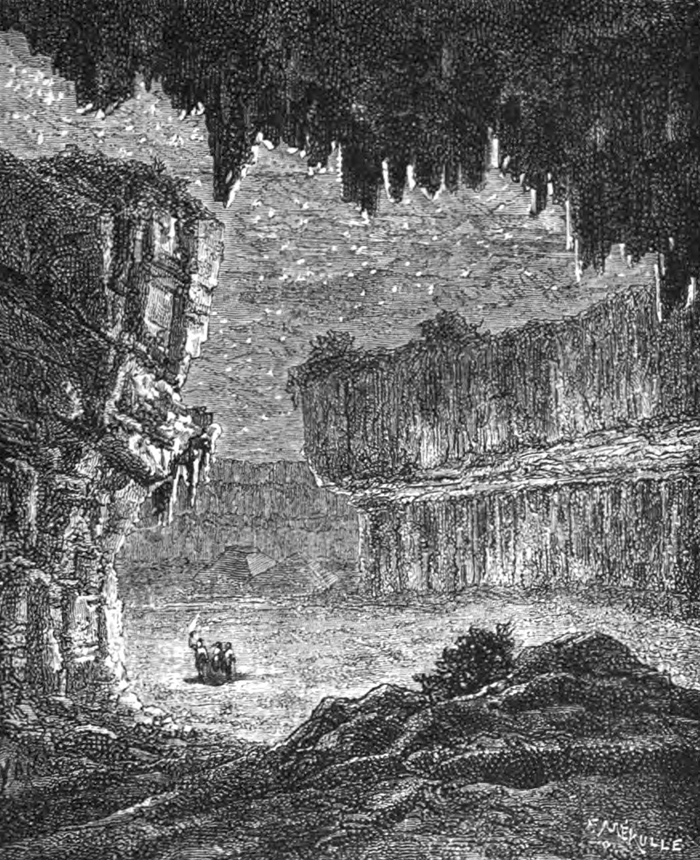 [Image: A vast underground room filled with “a silent, terrible solitude,” from Beneath the surface; or, the wonders of the underground world by W.H. Davenport Adams].
To put this another way, many streets in Manhattan are often quite appropriately described as “canyons,” not only due to their perceived depth—that is, given the towering buildings on either side, as if pedestrians merely wander at the bottom of artificial slot canyons—but also due to the geological materials those buildings were made from.
However, following widespread transformations in global building construction, our buildings today are now more likely to be reflective—even dangerously so—or partially transparent, whether this is due to the use of glass curtain walls or shadow-annihilating polished titanium, with the effect that our urban environment is no longer particularly well-served by geological analogy.
In any case, the book’s flirtation with an architectural vocabulary is gradually abandoned as Adams and his colleagues venture deeper into the planet. They eventually find themselves standing somewhat uncomfortably surrounded by a “phantasmagoria” of black gypsum walls, all “covered with sparkling crystallizations,” in a vast room whose belittling proportions inspire feelings not of grandeur and religiosity but a kind of exhausted desolation.
Here, Adams writes, “you think yourself on one of those dead and naked planets, where mineral nature reigns in the bosom of a silent, terrible solitude; on some earth never warmed by the sun, and which is animated by no kind of life.”
 [Image: An unfortunately rather low-res image from Beneath the surface; or, the wonders of the underground world by W.H. Davenport Adams].
The rest of the book—including the image seen immediately above this sentence—ventures elsewhere, into silver mines and glacial caves, even briefly passing by way of underground “artificial ice caves” for the premodern production and storage of ice.
I’m just a sucker for subterranea. Check it out if any of this sounds up your alley, and click through the archives of JF Ptak Science Books while you’re at it.
Subterranean Saxophony

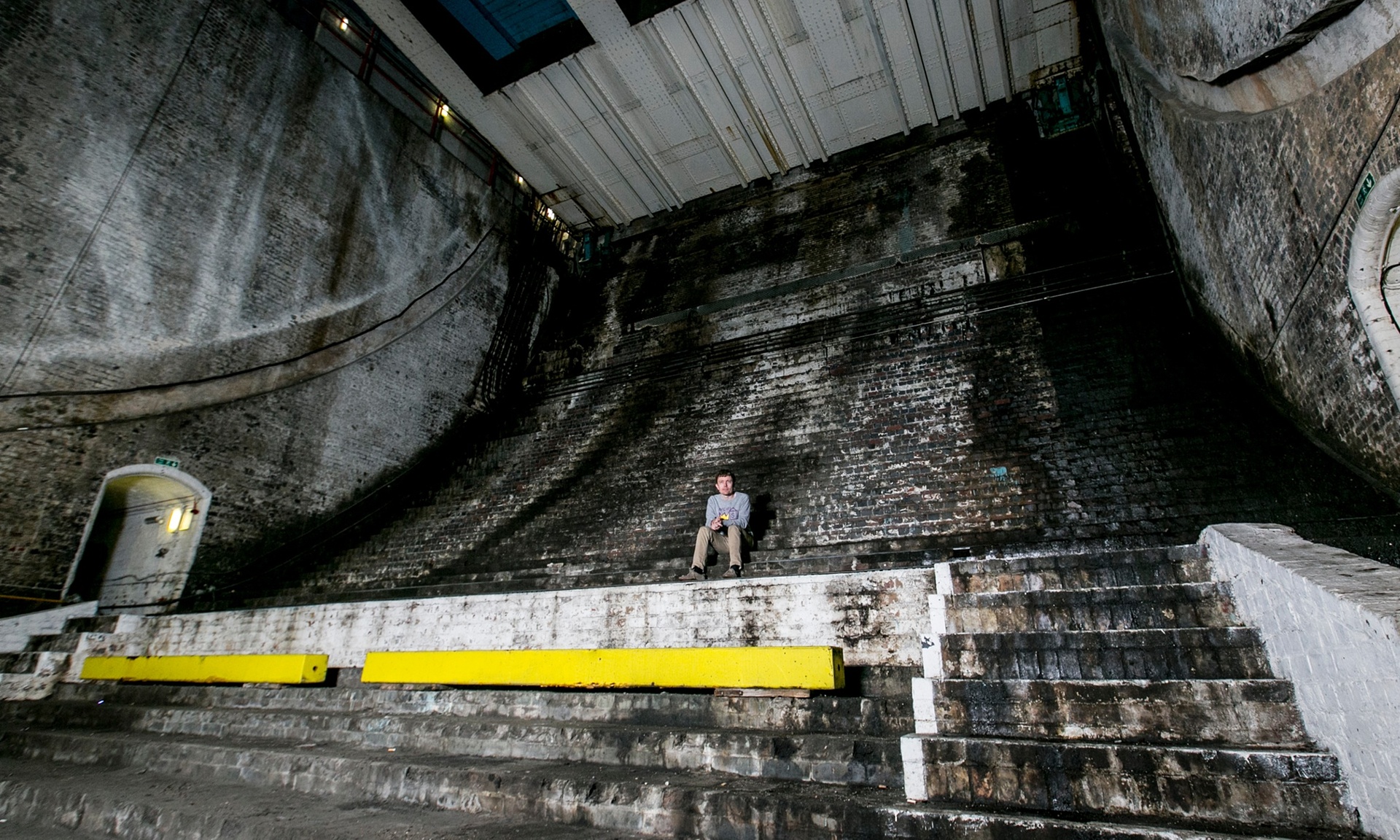 [Image: Photo by Steve Stills, courtesy of the Guardian].
Over in London later today, the Guardian explains, composer Iain Chambers will premiere a new piece of music written for an unusual urban venue: “the caverns that contain the counterweights of [London’s Tower Bridge] when it’s raised.”
The space itself has “the acoustics of a small cathedral,” Sinclair told the newspaper, citing John Cage as an influence and urging readers “to listen to environmental sounds and treat them as music,” whether it’s the rumble of a bridge being raised or the sounds of boats on the river.
In fact, Chambers will be performing one of Cage’s pieces during the show tonight—but, alas, I suspect it is not this one:
It is rumored that the final, dying words of composer John Cage were: “Make sure they play my London piece… You have to hear my London piece…” He was referring, many now believe, to a piece written for the subterranean saxophony of London’s sewers.
Read much more at the Guardian—or, even better, stop by tonight for a live performance.
(Spotted via @nicolatwilley).
Abandoned Mines, Slow Printing, and the Living Metal Residue of a Post-Human World

“High in the Pyrenees Mountains,” we read, “deep in abandoned mines, scientists discovered peculiar black shells that seem to crop up of their own accord on metal surfaces.”
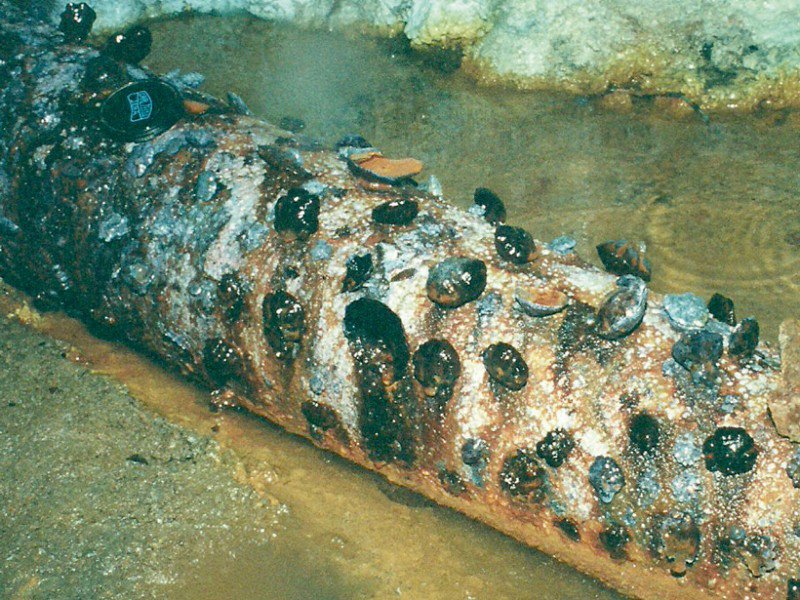 [Image: Metal shells growing in the darkness of abandoned mines; photo by Joan Santamaría, via Eos].
No, this is not a deleted scene from Jeff VanderMeer’s Southern Reach trilogy; it’s from research published in the Journal of Geophysical Research: Biogeosciences, recently reported by Eos.
It turns out that, under certain conditions, subterranean microbes can leave behind metallic deposits “as part of their natural metabolism.” Abandoned mines are apparently something of an ideal environment for this to occur within, resulting in “a rapid biomineralization process that sprouts iron-rich shells from the surface of steel structures.”
These then build up into reef-like deposits through a process analogous to 3D-printing: “Electron microscopy revealed small-scale, fiber-like crystals arranged into lines growing outward from the steel surface. The shells appear to be formed layer by layer, with crystal size and composition varying across layers.”
There are many, many interesting things to highlight here, which include but are not limited to:
Slow Printing
We could literalize the analogy used above by exploring how a controlled or guided version of this exact same process could be used as a new form of biological 3D-printing.
To put this another way, there is already a slow food movement—why not a slow printing one, as well?
Similar to the project John Becker and I explored a while back, using genetically-modified bees as living printheads, damp, metal-rich environments—microbial ovens, so to speak—could be constructed as facsimile mines inside of which particular strains of microbes and fungi would then be cultivated.
Geometric molds would be introduced as “seed-forms” to be depositionally copied by the microbes. Rather than creating the abstract, clamshell-like lumps seen in the below photograph, the microbes would be steered into particular shapes and patterns, resulting in discrete, recognizable objects.
Boom: a living 3D-printer, or a room of specially cultivated humidity and darkness out of which strange replicant tools and objects could be extracted every few years. At the very least, it would make a compelling art project—an object-reef sprouting with microbial facsimiles.
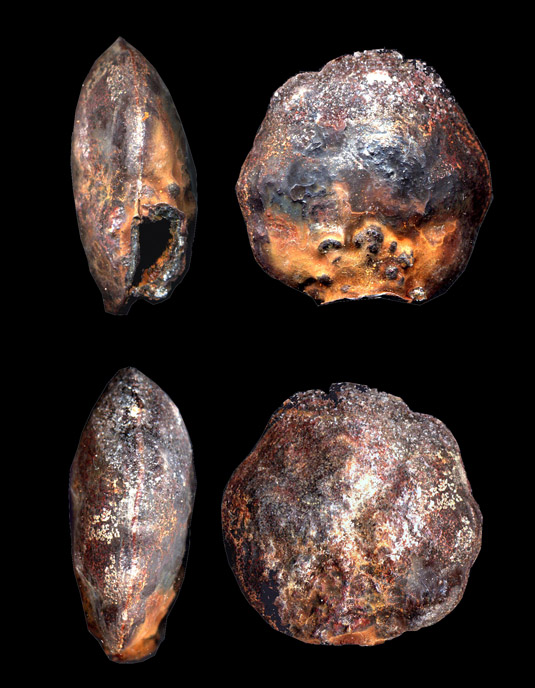 [Image: Metal shells growing in the darkness of abandoned mines; photo by Nieves López-Martínez, via Eos].
Dankness Instrumentalized
Historian David Gissen has written interestingly about the idea of “dankness” in architecture.
In an article for Domus back in 2010, Gissen explained that “dankness”—or “underground humidity,” in his words, a thick atmosphere of mold, rot, and stagnation usually found inside closed, subterranean spaces—was even once posited by architectural historian Marc-Antoine Laugier as a primal catalyst for first inspiring human beings to build cleaner, better ventilated structures—that is, architecture itself, in a kind of long-term retreat from the troglodyte lifestyle of settling in caves.
Dankness, to wildly over-simply this argument, so horrified our cave-dwelling ancestors that they invented what we now call architecture—and a long chain of hygienic improvements in managing the indoor atmospheric quality of these artificial environments eventually led us to modernism.
But dankness has its uses. “While modernists generally held dankness in suspect,” Gissen writes, “a few held a certain type of affection for this atmosphere, if only because it was an object of intense scrutiny. The earliest modernist rapprochements with dankness saw it as the cradle of a mythical atmosphere, an atmosphere that preceded modernity.” The “atmospheric depths of the cellar,” Gissen then suggests, might ironically be a sign of architectural developments yet to come:
Today, in the name of environmentalism, architects are digging into the earth in an effort to release its particular climatic qualities. Passive ventilation schemes often involve underground constructions such as “labyrinths” or “thermosiphons” that release the earth’s cool and wet air. The earth that architects reach into is one that has been so technified and rationalized, so measured and considered, that it barely contains mythical or uncanny aspects. However, this return to the earth’s substrate enables other possibilities.
In any case, I am not only quoting this essay because it is interesting and deserves wider discussion; I am also quoting all this in order to suggest that dankness could also be instrumentalized, or tapped as a kind of readymade industrial process, an already available microbial atmosphere wherein metal-depositing metabolic processes pulsing away in the dankest understructures of the world could be transformed into 3D-printing facilities.
The slow printheads for long-term object replication, mentioned above, would be fueled by and dependent upon Gissen’s spaces of subterranean humidity.
Heavy Metal Compost
If it is too difficult, too unrealistic, or simply too uselessly speculative to consider the possibility of 3D-printing with microbes, you could simply eliminate the notion that this is meant to produce recognizable object-forms, and use the same process instead as a new kind of compost heap.
Similar to throwing your old banana peels, coffee grounds, apple cores, and avocado skins into a backyard compost pile, you could throw metallic waste into a Gissen Hole™ and wait for genetically-modified microbes such as these to slowly but relentlessly break it all down, leaving behind weird, clamshell-like structures of purified metal in their wake.
Cropping teams would then climb down into this subterranean recycling center—or open an airlock and step inside some sort of controlled-atmosphere facility tucked away on the industrial outskirts of town—to harvest these easily commodified lumps of metal. It’d be like foraging for mushrooms or picking strawberries.
 [Image: An “ancient coral reef,” illustrated by Heinrich Harder].
The Coming Super-Reef
Finally, this also seems to suggest at least one fate awaiting the world of human construction long after humans themselves have disappeared.
Basements in the ruined cores of today’s cities will bloom in the darkness with ever-expanding metallic reefs, as the steel frames of skyscrapers and the collapsed machinery of the modern world become source material—industrial soil—for future metal-eating microbes.
Quietly, endlessly, wonderfully, the planet-spanning dankness of unmaintained subterranean infrastructure—in the depths of Shanghai, London, New York, Moscow—humidly accumulates these strange metallic shells. Reefs larger than anything alive today form, crystallized from the remains of our cities.
A hundred million years go by, and our towers are reduced to bizarre agglomerations of metal—then another hundred million years and they’ve stopped growing, now hidden beneath hundreds of meters of soil or flooded by unpredictable shifts of sea level.
Clouds of super-fish unrecognizable to today’s science swim through the grotesque arches and coils of what used to be banks and highways, apartment blocks and automobiles, monstrous and oyster-like shells whose indirect human origins no future paleontologist could realistically deduce.
Abandoned Basements as Stormwater Basins

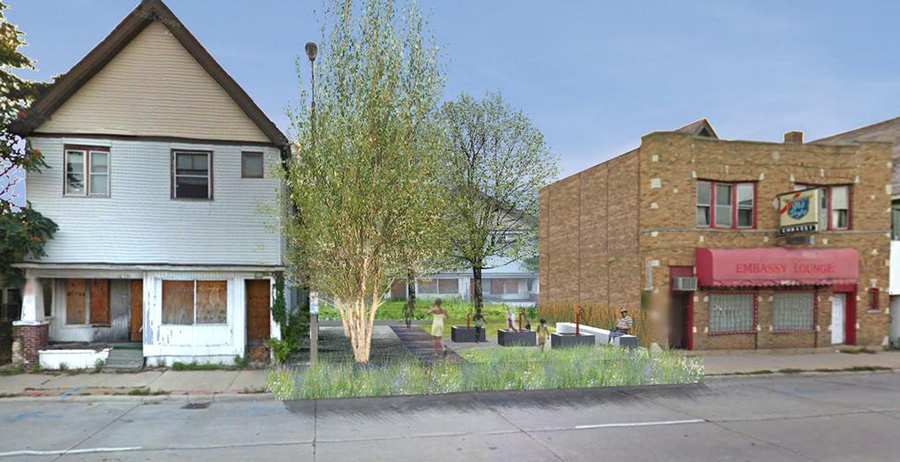 [Image: Rendering of a possible “BaseTern” landscape by students Brett Harris, Andrew D’Arcy, and Heidi Petersen, via Landscape Architecture Magazine].
Not all the news coming out of Milwaukee involves misguided highway megaprojects or tax-funded crony capitalism—though there is that.
For example, Wisconsin governor Scott Walker—confusing an earlier generation’s urban mistakes with how a city is meant to function—has been plowing billions of dollars’ worth of taxpayer money into “freeway megaprojects” for which “the pricetag got so big that leaders from his own party rejected his plan as fiscally irresponsible, leaving the state budget in limbo,” Politico reports:
As the state has shifted resources into freeway megaprojects, 71 percent of [Wisconsin’s] roads are in mediocre or poor condition, according to federal data. Fourteen percent of its bridges are structurally deficient or functionally obsolete, which is actually better than the national average. Walker and his fellow Republicans have killed plans for light rail, commuter rail, high-speed rail, and dedicated bus lanes on major highways, so there is almost no public transportation connecting Milwaukee to its suburbs, intensifying divisions in one of the nation’s most racially, economically and politically segregated metropolitan areas. Yet Walker, who is running for president as a staunch fiscal conservative, has pushed a $250 million-per-mile plan to widen Interstate 94 between the Marquette and the Zoo despite fierce local opposition.
If that sounds both avoidable and unfortunate, consider the fact that “Walker also killed a ‘Complete Streets’ program that pushed road builders to accommodate bicyclists and pedestrians.”
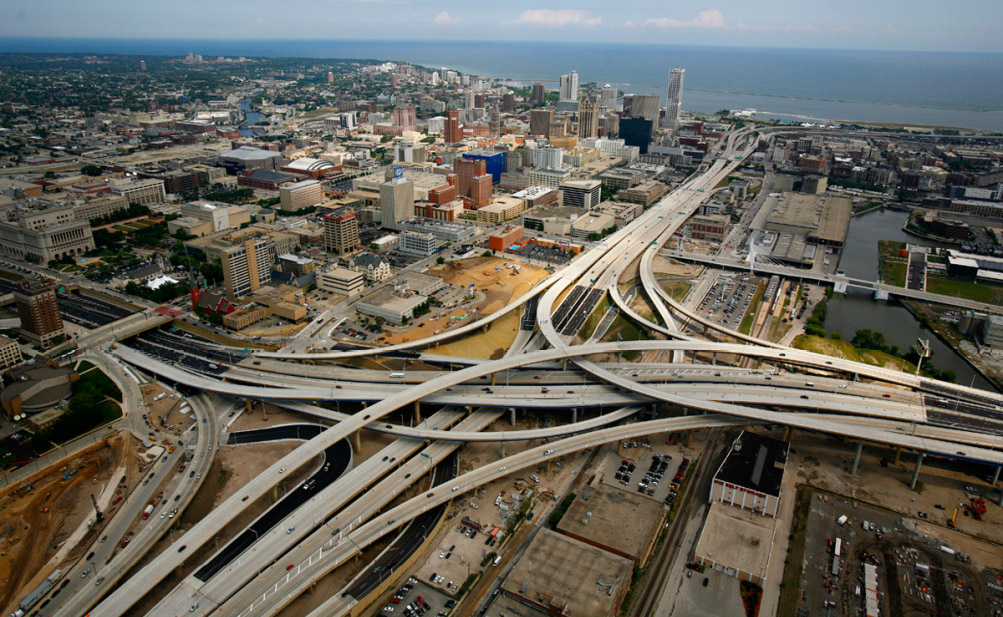
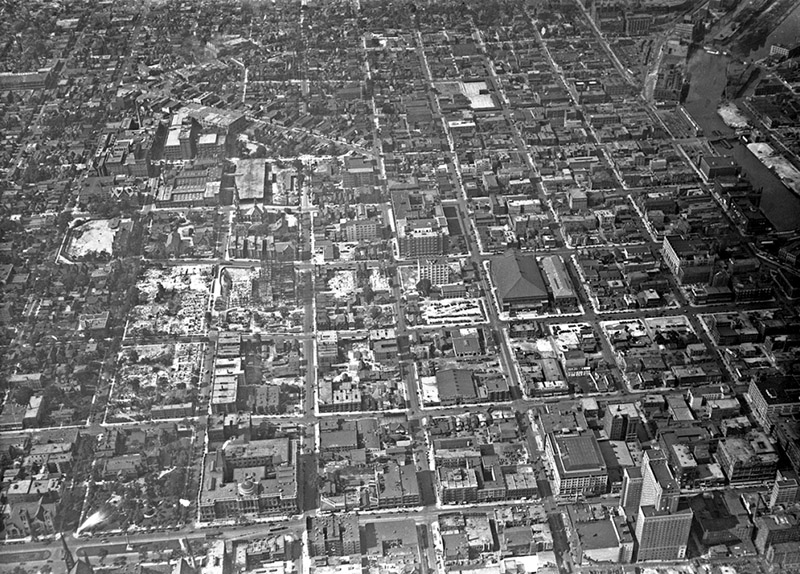 [Images: (top) Milwaukee’s Marquette interchange, nearly the same size as the city it cuts through; (bottom) Milwaukee before the interchange. Images via Politico].
At the same time, Walker has also “championed a high-profile proposal to spend a quarter of a billion dollars of taxpayer money to help finance a new Milwaukee Bucks arena—all while pushing to slash roughly the same amount from state funding for higher education,” the International Business Times reports.
But, hey, why does Wisconsin need universities when everyone can just go to an NBA game? Not that benefitting the public is even Walker’s goal: “One of those who stands to benefit from the controversial initiative is a longtime Walker donor and Republican financier who has just been appointed by the governor to head his presidential fundraising operation.”
In any case, an interesting landscape test-project is currently underway in Milwaukee, called the “BaseTern” program.
As the city explains it, a “BaseTern” is “an underground stormwater management or rainwater harvesting structure created from the former basement of an abandoned home that has been slated for demolition.” Why is the city doing this?
By using abandoned basements, the City saves the cost of demolition on these structures (filing the basement and grading the surface) and on excavation for the new structure. In addition, BaseTerns provide significant stormwater storage capacity on a single site, the equivalent of up to 600 rain barrels.
The result, the city is keen to add, is “not an open pit. Rather a BaseTern is a covered structure, which is covered with topsoil and grass, and will appear the same as conventional vacant lot.”
In their July 2015 issue, Landscape Architecture Magazine explained that this is, in fact, “the world’s first such system.” Conceived—and actually trademarked—by a city official named Erick Shambarger, the idea was inspired by a GIS-fueled discovery that the worst flooding in the city always “occurred in neighborhoods with high rates of foreclosures. The city controls roughly 900 foreclosed properties, many of which it plans to demolish. Shambarger figured the city could preserve the basement structure and put it to use.”
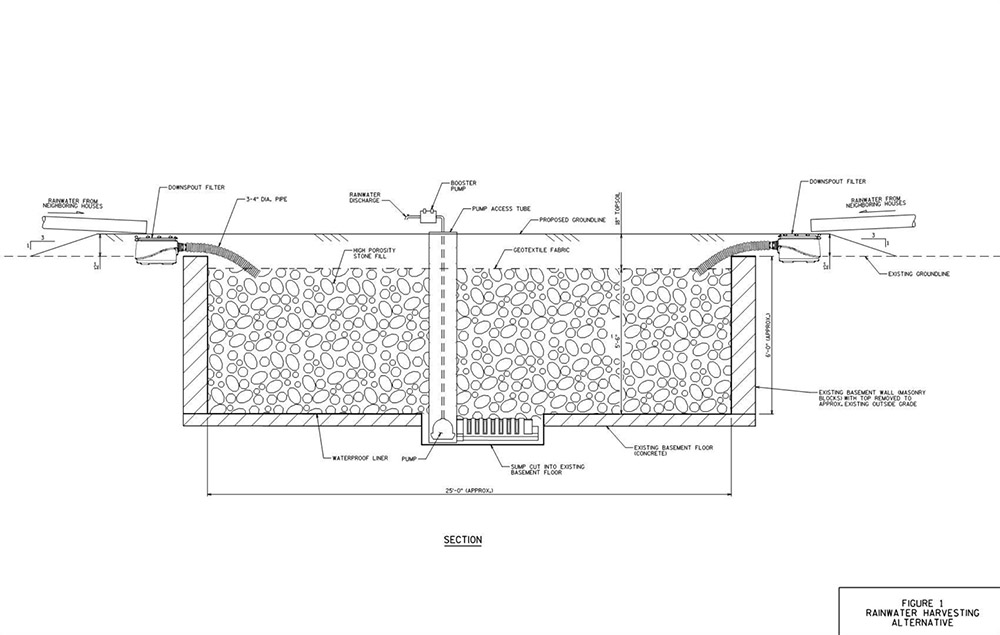
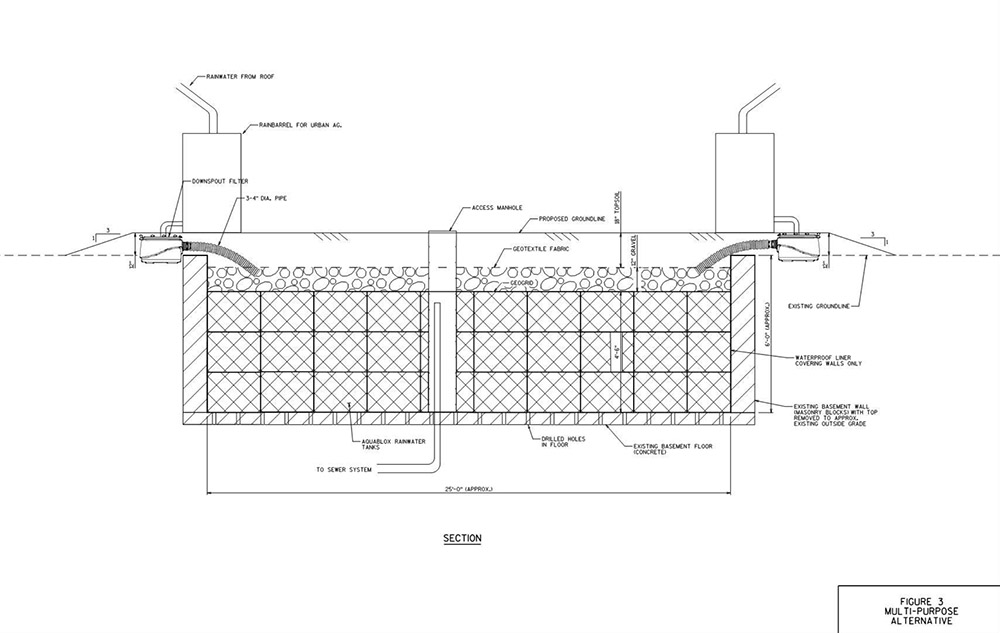 [Images: Two BaseTern design diagrams, taken from Milwaukee’s “Vacant Basements for Stormwater Management Feasibility Study“].
While there is something metaphorically unsettling in the idea that parts of a blighted, financially underwater neighborhood might soon literally be underwater—transformed into a kind of urban sponge for the rest of Milwaukee—the notion that the city can discover in its own economic misfortune a possible new engineering approach for dealing with seasonal flooding and super-storms is an inspiring thing to see.
The BaseTern program also potentially suggests a stopgap measure for coastal cities set to face rising sea levels well within the lifetimes of the coming generation.
In the all but inevitable managed retreat from the coast that seems set to kick off both en masse and in earnest by midcentury—something that is already happening in New York City, post-Sandy—perhaps the subterranean ruins of old neighborhoods left behind can be temporarily repurposed as minor additions to a broader coastal program intent on reducing flooding for residents further inland.
Before, of course, those underground voids—former guest bedrooms, dens, man caves, she sheds, and basements—are inundated for good.
Read more about BaseTerns over at Landscape Architecture Magazine.
Subterranean Lightning Brigade

 [Image: “Riggers install a lightning rod” atop the Empire State Building “in preparation for an investigation into lightning by scientists of the General Electric Company” (1947), via the Library of Congress].
This is hardly news, but I wanted to post about the use of artificial lightning as a navigational aid for subterranean military operations.
This was reported at the time as a project whose goal was “to let troops navigate about inside huge underground enemy tunnel complexes by measuring energy pulses given off by lightning bolts,” where those lightning bolts could potentially be generated on-demand by aboveground tactical strike teams.
Such a system would replace the use of GPS—whose signals cannot penetrate into deep subterranean spaces—and it would operate by way of sferics, or radio atmospheric signals generated by electrical activity in the sky.
The proposed underground navigational system—known as “Sferics-Based Underground Geolocation” or S-BUG—would be capable of picking up these signals even from “hundreds of miles away. Receiving signals from lighting strikes in multiple directions, along with minimal information from a surface base station also at a distance, could allow operators to accurately pinpoint their position.” They could thus maneuver underground, even in hundreds—thousands—of feet below the earth’s surface in enemy caves or bunkers.
Hundreds of miles is a very wide range, of course—but what if there is no natural lightning in the area?
Enter artificial military storm generators, or the charge of the lightning brigade.
Back in 2009, DARPA also put out of a request for proposals as part of something called Project Nimbus. NIMBUS is “a fundamental science program focused on obtaining a comprehensive understanding of the lightning process.” However, it included a specific interest in developing machines for “triggering lightning”:
Experimental Set-up for Triggering Lightning: Bidders should fully describe how they would attempt to trigger lightning and list all potential pieces of equipment necessary to trigger lightning, as well as the equipment necessary to measure and characterize the processes governing lightning initiation, propagation, and attachment.
While it’s easy enough to wax conspiratorial here about future lightning weapons or militarized storm cells—after all, DARPA themselves write that they want to understand “how [lightning] ties into the global charging circuit,” as if “the global charging circuit” is something that could be instrumentalized or controlled—I actually find it more interesting to speculate that generating lightning would be not for offensive purposes at all, but for guiding underground navigation.
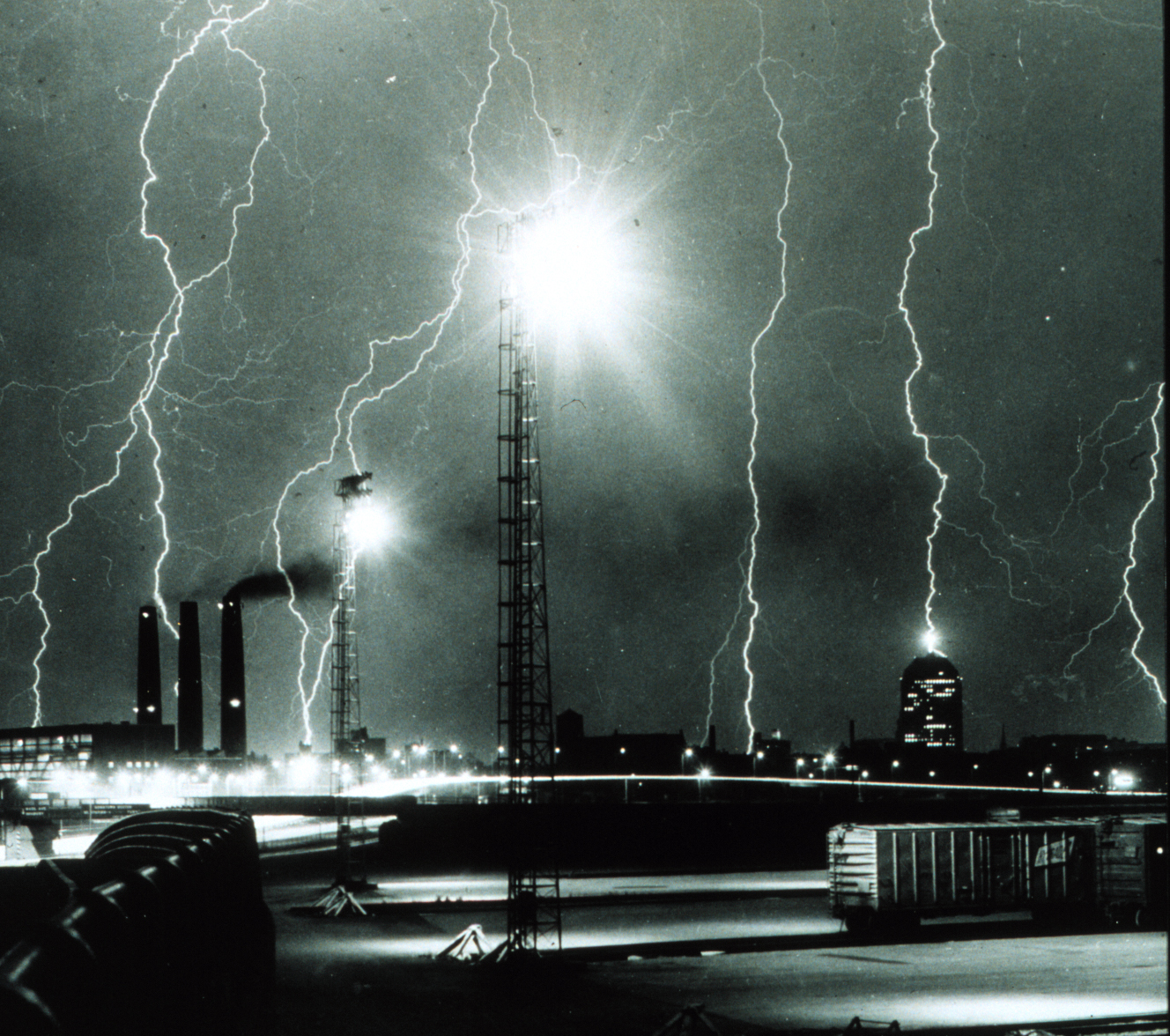
 [Image: Lightning storm over Boston; via Wikimedia/NOAA].
Something akin to a strobe light begins pulsing atop a small camp of unmarked military vehicles parked far outside a desert city known for its insurgent activities. These flashes gradual lengthen, both temporally and physically, lasting longer and stretching upward into the sky; the clouds above are beginning to thicken, grumbling with quiet rolls of thunder.
Then the lightning strikes begin—but they’re unlike any natural lightning you’ve ever seen. They’re more like pops of static electricity—a pulsing halo or toroidal crown of light centered on the caravan of trucks below—and they seem carefully timed.
To defensive spotters watching them through binoculars in the city, it’s obvious what this means: there must be a team of soldiers underground somewhere, using artificial sferics to navigate. They must be pushing forward relentlessly through the sewers and smuggling tunnels, crawling around the roots of buildings and maneuvering through the mazework of infrastructure that constitutes the city’s underside, locating themselves by way of these rhythmic flashes of false lightning.
Of course, this equipment would eventually be de-militarized and handed down to the civilian sector, in which case you can imagine four friends leaving REI on a Friday afternoon after work with an artificial lightning generator split between them; no larger than a camp stove, it would eventually be set up with their other weekend caving equipment, used to help navigate through deep, stream-slick caves an hour and a half outside town, beneath tall mountains where GPS can’t always be trusted.
Or, perhaps fifty years from now, salvage teams are sent deep into the flooded cities of the eastern seaboard to look for and retrieve valuable industrial equipment. They install an artificial lightning unit on the salt-bleached roof of a crumbling Brooklyn warehouse before heading off in a small armada of marsh boats, looking for entrances to old maintenance facilities whose basement storage rooms might have survived rapid sea-level rise.
Disappearing down into these lost rooms—like explorers of Egyptian tombs—they are guided by bolts of artificial lightning that spark upward above the ruins, reflected by tides.
 [Image: Lightning via NOAA].
Or—why not?—perhaps we’ll send a DARPA-funded lightning unit to one of the moons of Jupiter and let it flash and strobe there for as long as it needs. Called Project Miller-Urey, its aim is to catalyze life from the prebiotic, primordial soup of chemistry swirling around there in the Cthulhoid shadow of eternal ice mountains.
Millions and millions of years hence, proto-intelligent lifeforms emerge, never once guessing that they are, in fact, indirect descendants of artificial lightning technology. Their spark is not divine but military, the electrical equipment that sparked their ancestral line long since fallen into oblivion.
In any case, keep your eyes—and cameras—posted for artificial lightning strikes coming to a future military theater near you…
The Conqueror Worm

 [Image: Photo by & courtesy of Trackrunners, used with permission].
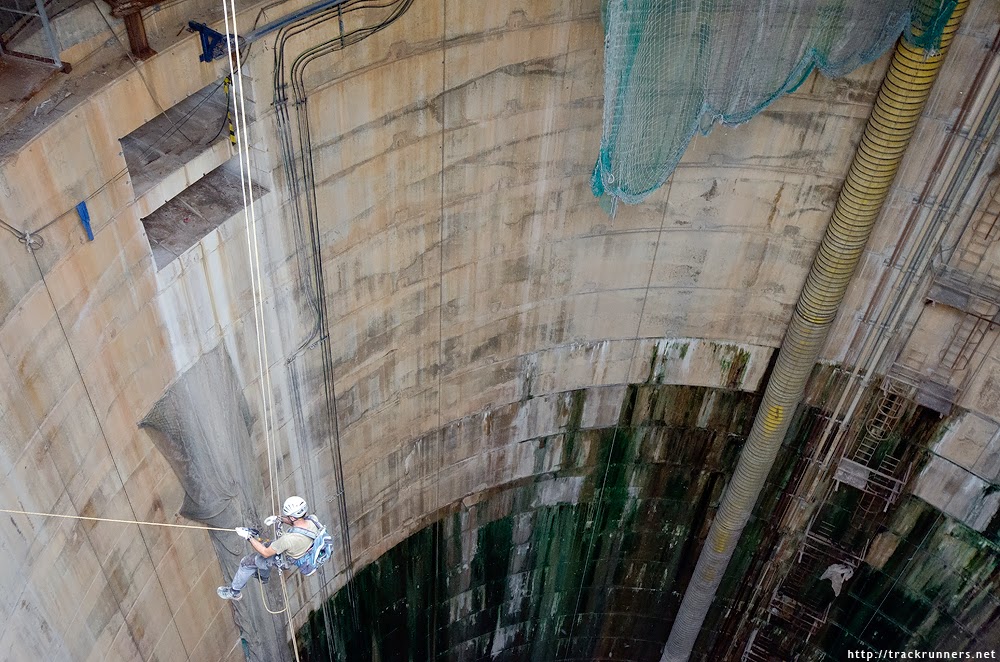
A group of friends, their faces rigorously hidden from public view, find a huge borehole leading down into some tunnels beneath the city.
Not content to just lie there, straining to see more than 260 feet into the deep and merely wondering what might be down there, they do what any enterprising team of explorers would do.
They don mountaineering gear and descend into the pit.
 [Images: Photos by & courtesy of Trackrunners, used with permission].
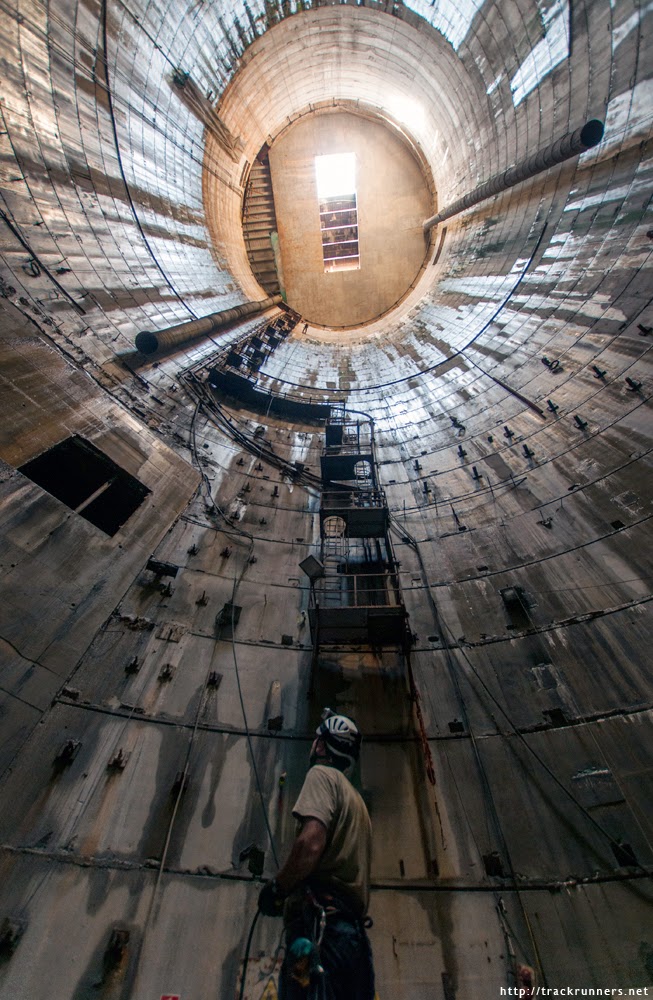
It’s like scaling Mt. Everest in reverse—“descending black ropes,” in their words—swinging ever closer to the entrance to the tunnels, their headlamps and cameras at the ready.
Plus, some weird new myths have been circulating around town: that there’s a monolithic machine down there, something massive and temporarily abandoned beneath the city. It is “the toughest of all the machines. A dormant juggernaut that lies underground.”
They want to find it, to see if the rumors are true—and, who knows, to discover if the machine might still be operational. Imagine what you could do with a discarded tunneling machine seemingly forgotten in the deepest basement of the metropolis. Imagine if you could bring it back to life.
 [Image: Photo by & courtesy of Trackrunners, used with permission].
Thus begins the next phase of their subterranean quest to find the so-called “Worm Maiden,” this conquering machine-animal lying dormant in its lair somewhere under the streets.
“Hitting our helmets and our backpacks on almost everything we found on the way,” they inched forward on foot.
 [Image: Photo by & courtesy of Trackrunners, used with permission].
They soon drop their ropes and progress through a series of excavated tunnels and industrial caves, as if puzzling some new route into a pharaoh’s tomb—an Egyptology of urban infrastructure with its own secret chambers and traps.
And, incredibly, they actually do it: they actually find the machine, realizing that the rumors were both true and strangely inaccurate.
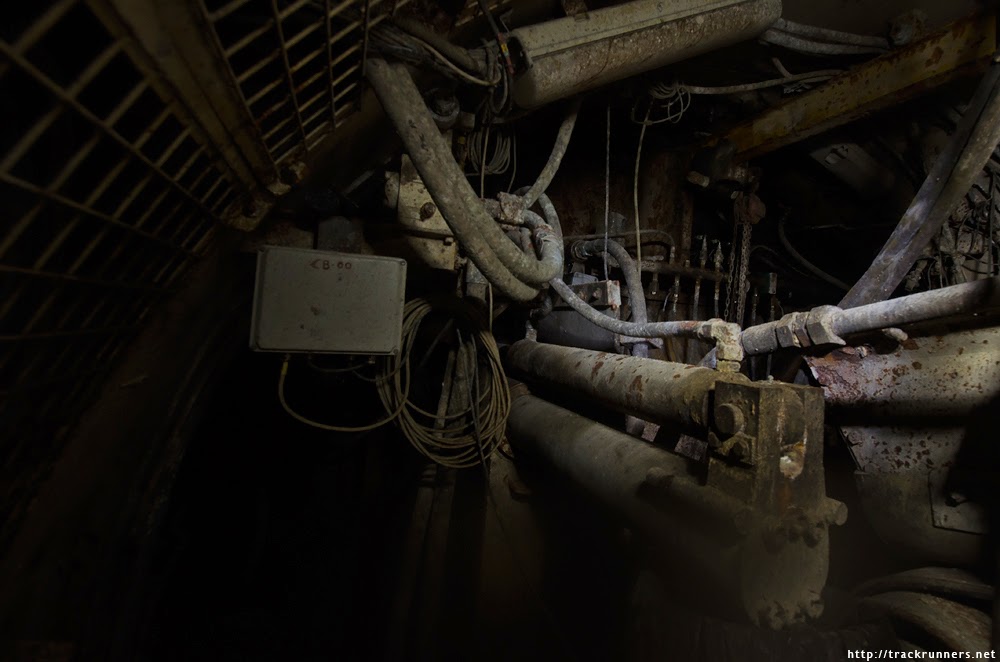
That is, the machine is even larger and more extraordinary than they’d been led to believe. It is a sprawling and tentacular presence that blocks the tunnel with the dark bulk of its old valves and pipework, like some ancient engine that wanted to hide itself in a cocoon of its own making.
 [Image: Photo by & courtesy of Trackrunners, used with permission].
“Walking through the sleeping beauty, through her corridors amongst rust and spiderwebs,” we read, “she looked much bigger than we could have imagined. She didn’t seem to have an end. Eventually we reached a point where we couldn’t go any further, it was full of pipes and unknown mechanisms but the end was intuited.”
The machine was so complex, in other words, that they couldn’t find the other end of it, having to negotiate their way through all its internal doors and control panels.
 [Image: Photo by & courtesy of Trackrunners, used with permission].
It could be the ultimate joyride—Grand Theft TBM—driving a stolen machine literally through the foundations of the city, carving your own maze through bedrock.
But a way forward was eventually found, and the Kubrickian monolith of this now-stationary drill head was revealed up ahead like some Mayan sculpture in the darkness. Abandoned for now and just lying there: a machine-ruin rusting away in the underground world it had made for itself. The conqueror worm.
 [Image: Photo by & courtesy of Trackrunners, used with permission].
“It was much better than I had imagined,” we read. The text is like an archaeological report made possible by climbing gear and GoPros. “A twelve meter diameter of pure love just in front of us, was bestial. I couldn’t stop staring at HER. I could see the strain on her, the hard work she had done. The dirt in every part of the face. Pure beauty. All the space around her was filled by a foot of dirty water. A mixture of sand, dirt, water and oil. This mantle of fluids that covered everything was perfect, the vapors fogged my camera lens but the effect was delightfully dramatic. Go and use a filter to look like this. I can see the new Instagram filter now… TBM vapors effect!”
But that’s literally only half the journey. They’ve mountaineered into the planet, like reverse-Alpinists of the inferno—and they go so far as to discover an artificial lake beneath the city, a brackish reservoir that “shone under the light of our torches”—but now they have to get back out, which is not nearly as easy as it had seemed.
There are dozens of other photographs over at Trackrunners, and a much longer version of how everything happened that day; go check it out (and don’t miss their other stories, such as the disused stations beneath Barcelona).
(Thanks to Charles Bronson for the tip.)
Military Cave Logistics

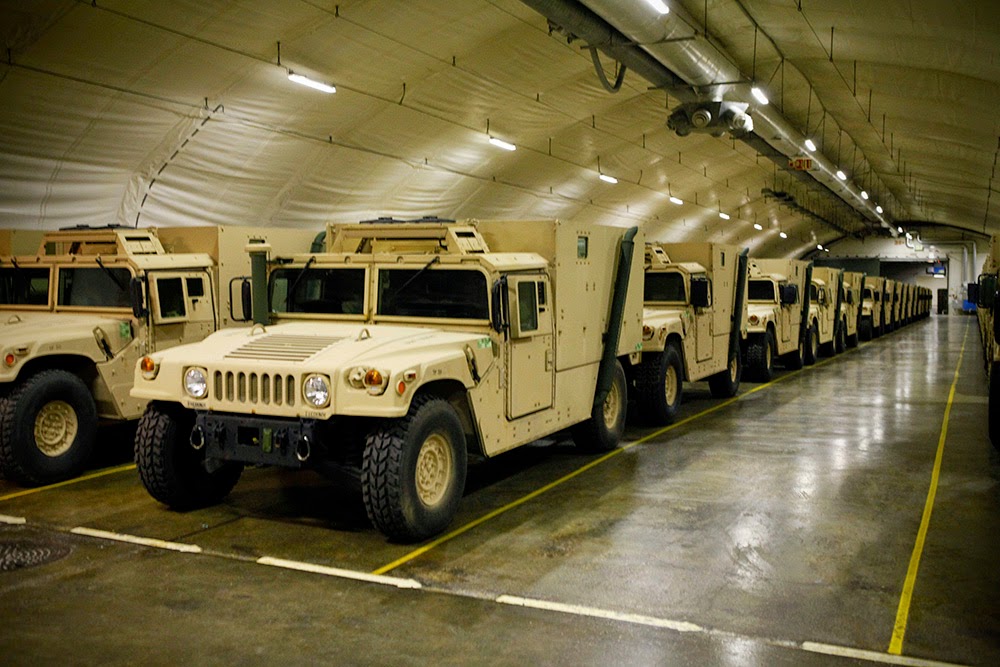 [Image: “Humvees are stored inside the Frigaard Cave in central Norway. The cave is one of six caves that are part of the Marine Corps Prepositioning Program-Norway, which supports the equipping of Marine Expeditionary Brigade consisting of 15,000 Marines and with supplies for up to 30 days.” U.S. Marine Corps photo by Lance Cpl. Marcin Platek].
Norwegian caves are being stuffed full of U.S. military equipment, including armored Humvees, tanks, and cargo containers full of weaponry, all part of a vast and semi-subterranean supply chain maintained to help wage future wars around the world.
The Marines have “stashed weapons and equipment in the Norwegian countryside since the 1980s,” War is Boring explains, in sites that include artificially enlarged and fortified caves. It’s all about logistics: “With this setup, Marines can fly in and be ready for a fight in no time.”
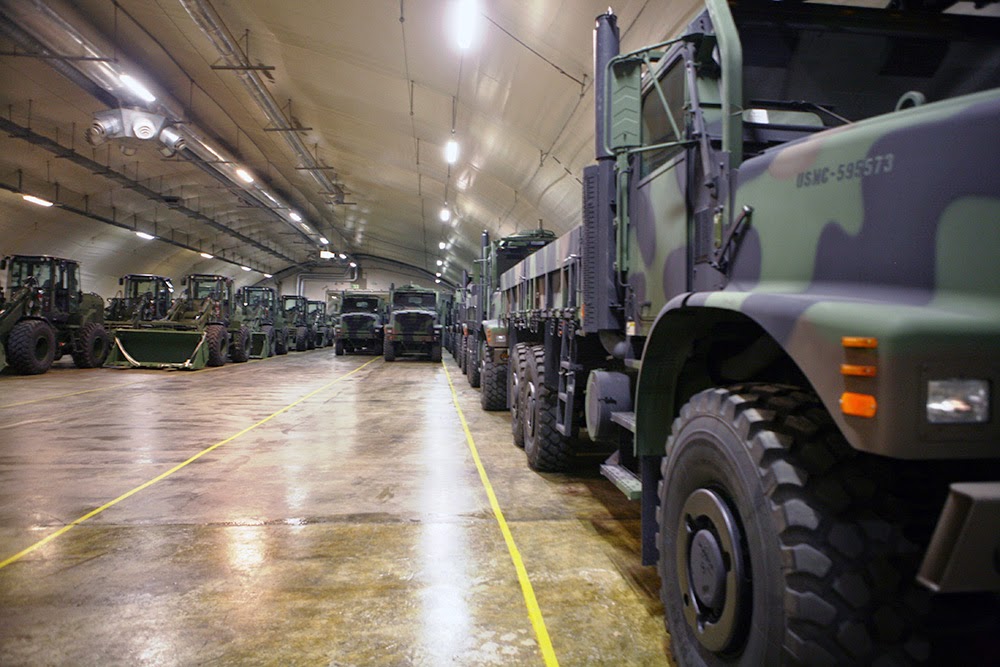 [Image: “Rows of front loaders and 7-ton trucks sit, gassed up and ready to roll in one of the many corridors in the Frigard supply cave located on the Vaernes Garrison near Trondheim, Norway. This is one of seven [see previous caption!] caves that make up the Marine Corps Prepositioning Program-Norway facility. All the caves total more than 900,000 sq. ft. of storage space, full of enough gear to outfit 13,000 Marines for up to 30 days.” U.S. Marine Corps photo by Sgt. Matt Lyman].
These facilities are commonly described as “supply caves,” and they hold warfighting gear in a state of indefinite readiness, “reserved for any time of crisis or war.”
Marines can simply fly in, unlock their respective caves, and grab the keys to one of hundreds, if not thousands, of combat-ready vehicles, all “gassed up and ready to roll in one of the many corridors” of this subterranean empire on the edges of American influence.
Among many other points of interest, the Marines identify six such supply caves in the caption of one image and seven caves in the caption of another, as if—assuming this is not just a minor clerical error—the Marines themselves don’t even know how many caves they have.
Instead, there’s just Norway, some faraway land of underground voids we’ve stuffed full of combat gear, like emperors stocking our own tombs in advance of some future demise—the actual number of caves be damned, for who will be left counting at the end of the world?
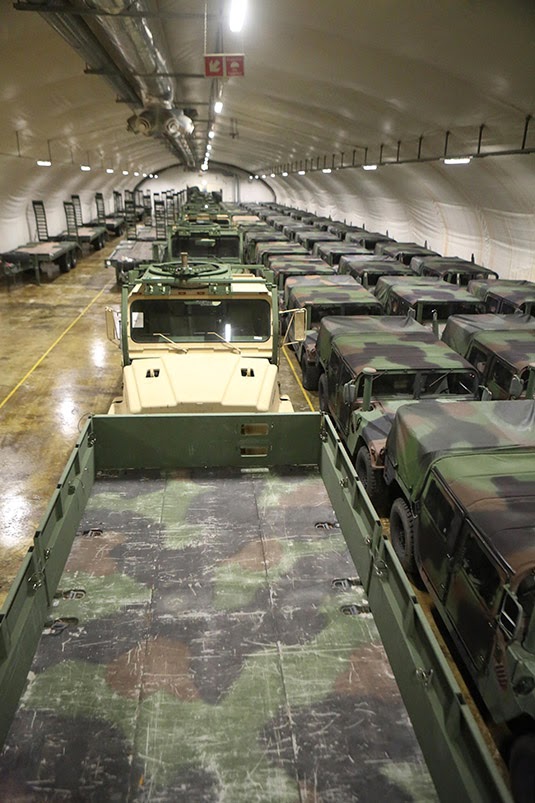 [Image: “Medium Tactical Vehicle Replacements, High Mobility Multipurpose Wheeled Vehicles and trailers, which belong to Marine Corps Prepositioning Program-Norway are staged in a storage cave at Tromsdal, Norway, Feb. 24, 2014. Marine Corps began storing equipment in several cave sites throughout Norway in the 1980s to counter the Soviets, but the gear is now reserved for any time of crisis or war.” U.S. Marine Corps photo by Lance Cpl. Sullivan Laramie].
On one level, I’m reminded of Marcus Trimble’s old joke that France has been constructing a back-up version of itself in China. It is a frenzied act of “pre-emptive preservation,” led by the cultural ministers of that sclerotic nation of well-tended chateaux who realized that la belle France could only survive if they built immediately ready copies of themselves elsewhere.
Only, in France’s case, it wasn’t willful self-burial in Norwegian caves, but in the real estate free-for-all of urban China. After all, Trimble suggested, that country’s “construction industry seems perfect for the task of backing up bricks rather than bits—cheap and powered by the brute force of sheer population. Copies of places may be made in a fraction of the time that it took to create them. If, in the event of a catastrophic episode, the part of France in question could be restored and life would go on as it was before.”
 [Image: “China: ample space for a spare copy of France”; image by Marcus Trimble].
Militarize this, secret it away in a cave in Scandinavia, and you have something roughly approximately what’s called the Marine Corps Prepositioning Program.
However, I was also reminded of a recent paper by Pierre Belanger and Alexander Scott Arroyo at Harvard’s GSD. There, Belanger and Arroyo describe the U.S. military as a kind of planetary logistics challenge. (A PDF of their paper is available here courtesy of the U.S. Department of Defense).
Specifically, it is the problem of building and often violently maintaining “logistics islands,” as Belanger and Arroyo describe them, that now characterizes much of the U.S. military’s global behavior, an endless quest for finding and protecting “a secure staging ground adjacent to the theater of operations,” in an era when adjacency is increasingly hard to define. As they explain:
While logistical acquisitions are managed by the Defense Logistics Agency (DLA), logistical operations in the field are predominantly coordinated by USTRANSCOM. On average, the command oversees almost 2,000 air missions and 10,000 ground shipments per week, with 25 container ships providing active logistical support. From October 2009 through September 2010 alone, USTRANSCOM flew 37,304 airlift missions carrying over 2 million passengers and 852,141 tons of cargo; aerially refueled 13,504 aircraft with 338,856,200 pounds of fuel on 11,859 distinct sorties; and moved nearly 25 million tons of cargo in coordinated sea-land operations. DLA and USTRANSCOM and their civilian partners are responsible for the largest, most widespread, and most diverse sustained logistics operation in history.
The largest, most widespread, and most diverse sustained logistics operation in history.
The obvious and intended resonance here is that military operations perhaps now most closely resemble complicated UPS deliveries than anything like actual ground combat. However, we can also infer from this that establishing new and ever more convenient logistics islands is vital to U.S. national security.
A literal archipelago of shipping hubs is thus key to the country’s global military activities, and this not only requires sites like Diego Garcia, which Belanger and Arroyo specifically write about, or even the “mobile offshore bases” they also describe, where the pop-up urbanism of Archigram has been inadvertently realized by the U.S. military, but artificially fortified caves near the Arctic Circle where truly daunting amounts of military materiel are now kept on hand, as if held frozen in some imperial freezer, awaiting the day when global tensions truly heat up.
Read a bit more at War is Boring.
(This is more or less irrelevant, but you might also like Kiln, earlier on BLDGBLOG).
NATO’s Underground Roman Super-Quarry

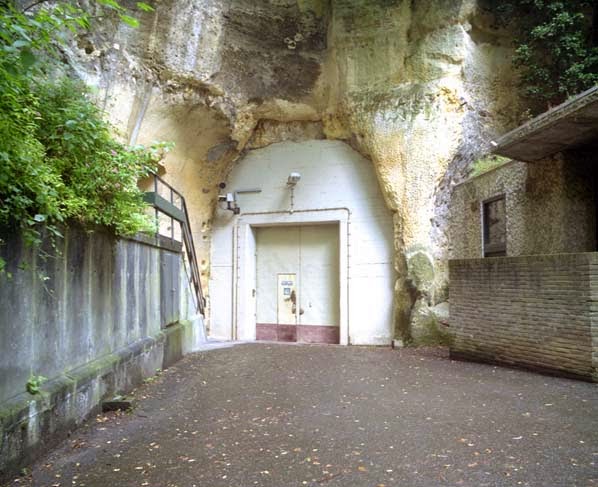 [Image: An entrance to the quarry in Kanne; photo by Nick Catford via Subterranean Britannica].
There is an underground Roman-era quarry in The Netherlands that, when you exit, you will find that you have crossed an invisible international border somewhere down there in the darkness, and that you are now stepping out into Belgium; or perhaps it’s the other way around, that there is an underground Roman-era quarry in Belgium that, when you exit, you will find that you have crossed an invisible international border somewhere down there in the darkness, and that you are now stepping out into The Netherlands.
However, this is not just a disused quarry—not just an archaeological site on the fringes of the Roman empire that was once mined for blocks of limestone. Its afterlife is by far the most interesting part of the story.
For nearly a century, beginning in the 1800s, these underground hollows were used by Jesuit monks as a secluded place for prayer, study, and meditation, and even for the carving of elaborate and impressive forms into the soft rock walls; then the Nazis took over, transforming this weird underworld into a subterranean factory for World War II airplane parts; then, finally, pushing the stakes yet higher, the whole complex of former Roman limestone mines, straddling an international border underground between two modern European nations, was turned into a doomsday bunker for NATO, a dark and mold-prone labyrinth within which military commanders constructed a Joint Operations Center for responding to the end of the world (whenever the time finally came).
 [Images: Monks underground; via De Limburgse Mergelgrotten].
“There was even a 3-hole golf course complete with artificial turf,” Subterranean Britannica reports in a recent issue of their excellent magazine, Subterranea.
“The complex was on average 50 meters below ground covering an area of approximately 6750 acres with eight miles of corridors, 400 branches and 399 individual offices,” SubBrit explains. There were escape tunnels, as well, “one going out to the banks of the Albert Canal in Belgium, and one which came out in a farmer’s potato store in the village of Kanne.” It had its own water supply and even a dedicated wine cellar for NATO officers, who might need a glass of Europe’s finest chardonnay to help feel calm enough to launch those missiles.
Just look at this thing’s mind-boggling floor plan.
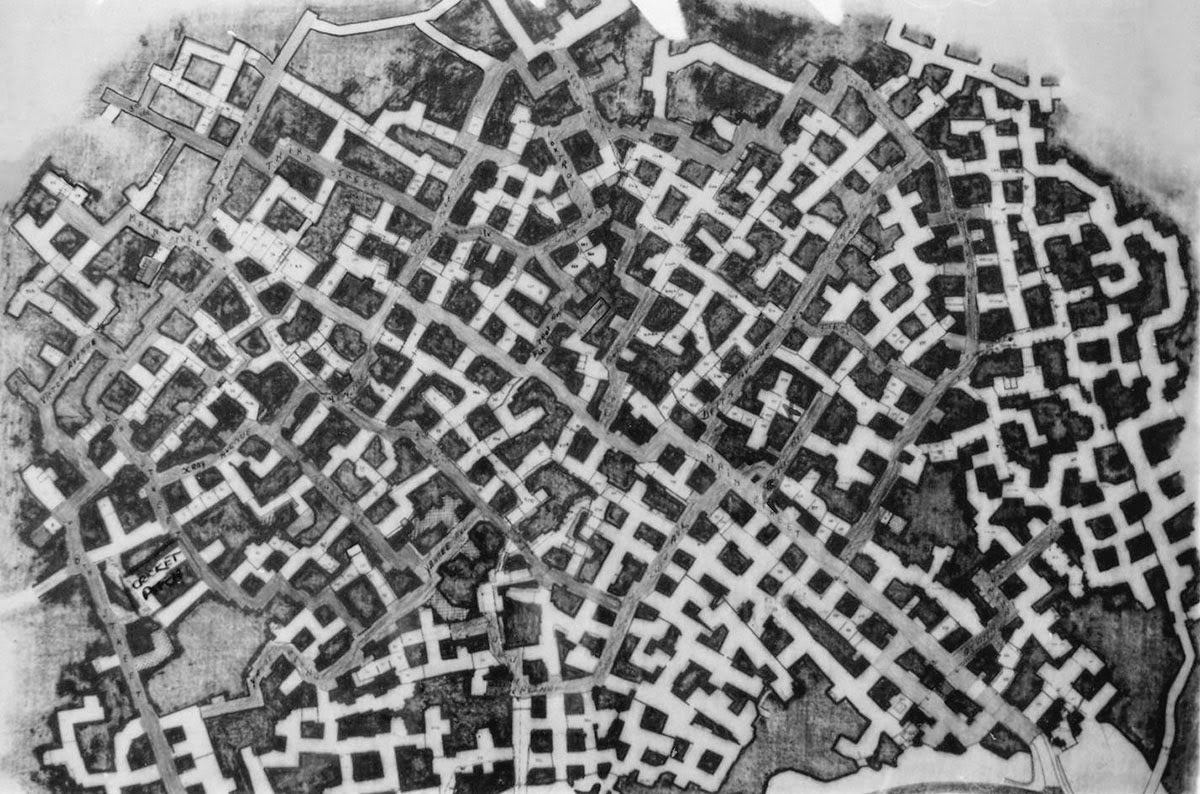 The “streets” were named, but not always easy to follow; however, this didn’t stop officers stationed there from occasionally going out to explore the older tunnels at night. A former employee named Bob Hankinson describes how he used to navigate:
Most corners were roughly 90 degrees, but only roughly. Going through the caves was an exercise in left and right turns every 50 feet or so. Navigation was helped by street names. Unlike in the USA, where streets are numbered on a sort of grid pattern, these were zigzag streets. My office on Main Street and J Street, so if I got lost I would just keep walking until I came to either Main or J, and join it. If I went the wrong way, eventually the street would peter out either at the perimeter or a T-junction, and you would just turn round and go back the other way.
As another former employee—a man named Alan Francis—explains, “If I did have spare time, I would wander through the dark tunnels where there were very few lights on at night, thinking how strange it was to be working in a Roman stone quarry.”
Writing in Subterranea, SubBrit explains that “nothing ever came out.” This was “a strict rule: apart from people, anything that went in never came out. All waste material ranging from redundant furniture to foot waste was dumped in one of the sixteen underground landfill sites” designated within this sprawling whorl of rooms and passages. Shredded documents were even mixed with water and applied directly to the walls as a kind of fibrous paste, used for insulation.
Such was the secrecy surrounding this place that it was officially classified as “a ‘forbidden place’ under the Protection of State Secrets Act which forbade people to even talk about it.”
One reason why the underground galleries are so vast, meanwhile, is apparently because of the character of the limestone they were carved through; in fact, “the limestone was so soft that the workers used a chainsaw to cut it.”
The notion that I could just cut myself a whole new room with a chainsaw—just revving this thing up and carving an entire new hallway or corridor, pushing relentlessly forward into what looks like solid earth, possibly even sawing my way into the roots of another country—is so awesome an architectural condition that I would move there tomorrow if I could.
Just imagine building this titanic doorway into the earth with a small group of friends, a case of beer, and a few chainsaws. It’s like Cappadocia by way of the Cold War. By way of Husqvarna.
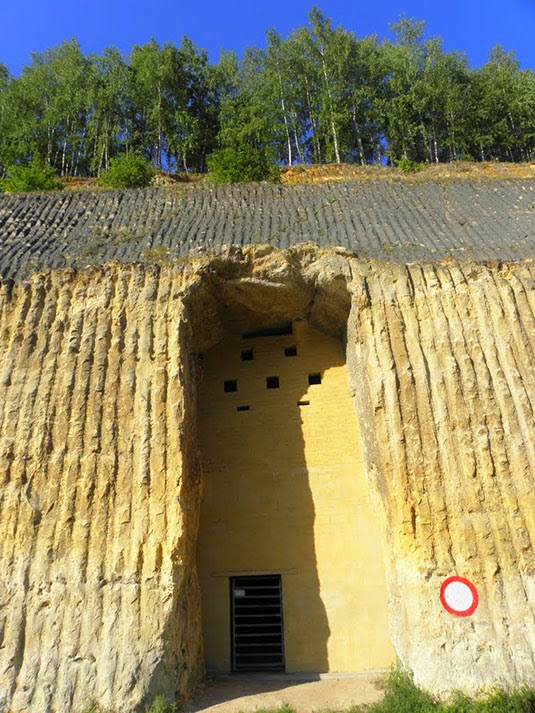 [Image: An entrance into the NATO complex; via this thread].
Sadly, the whole place is contaminated with asbestos and has been badly saturated with diesel fuel. At least one environmental analysis of the underground maze found that “diesel fuel from the [copious emergency fuel] tanks had leaked into the porous limestone over a long period and had penetrated to a depth of about forty feet into the rock.”
You can imagine the weird bonfires that could have resulted should someone have been stupid enough to light a match, but “this area had to be removed and disposed of,” we read—presumably by chainsaw.
Nonetheless, today you can actually take a tour of this place—this now-derelict doomsday logistics hub that straddles international borders underground—courtesy of the Limburg Landscape Foundation.
If you can take the tour, let me know how it goes; I’d love to visit this place in person someday and would be thrilled to see any photographs.
(If you like the sound of underground NATO quarries and want to see more, don’t miss these vaguely related photo sets: NATO Quarry, N.A.T.O. Quarry, N.A.T.O. Quarry, France, Urban Explorers Discover Corroding Military Vehicles in Abandoned Subterranean Bunker, and Nato Quarry, Paris Suburbs May 2011).
The Snow Mine

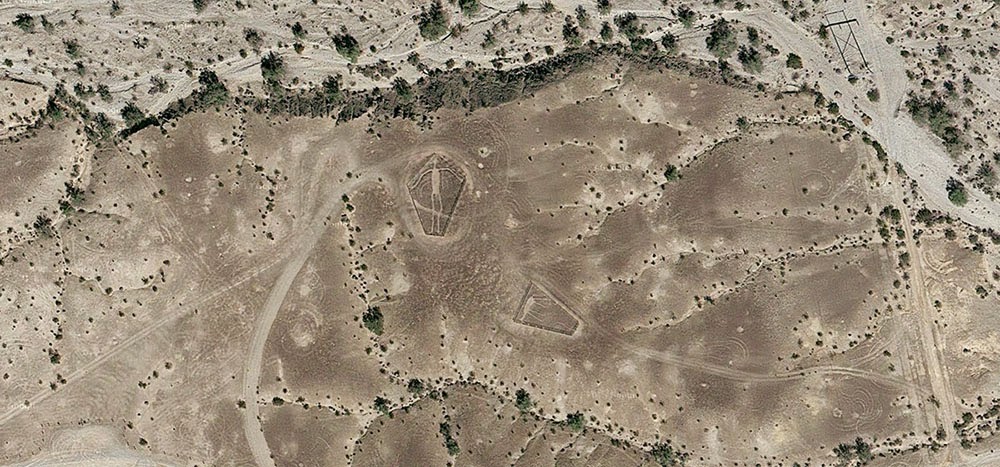 [Image: The “Blythe Intaglios,” via Google Maps].
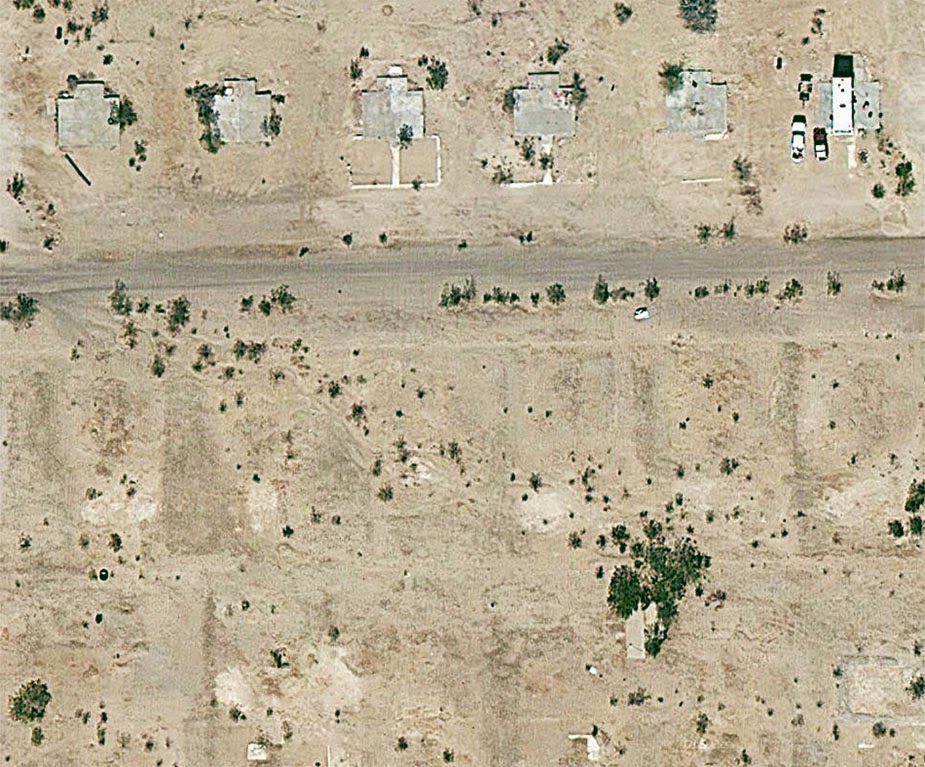
After reading an article about the “Blythe geoglyphs”—huge, 1,000-year old images carved into the California desert north of Blythe, near the border with Arizona—I got to looking around on Google Maps more or less at random and found what looked like a ghost town in the middle of nowhere, close to an old mine.
Turns out, it was the abandoned industrial settlement of Midland, California—and it’s been empty for nearly half a century, deliberately burned to the ground in 1966 when the nearby mine was closed.
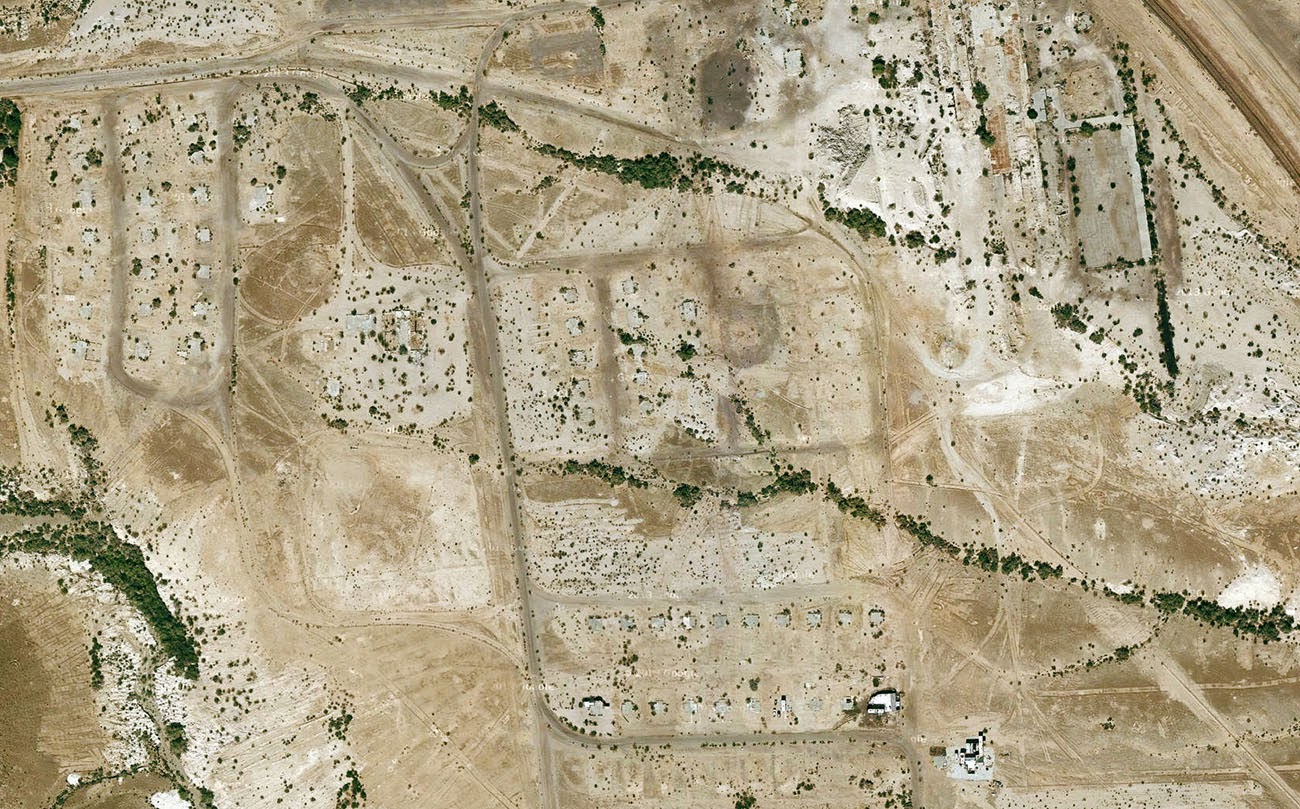 [Image: Midland, California, via Google Maps].
What’s so interesting about this place—aside from the exposed concrete foundation pads now reused as platforms for RVs, or the empty streets forming an altogether different kind of geoglyph, or even the obvious ease with which one can get there, simply following the aptly named Midland Road northeast from Blythe—is the fact that the town was built for workers at the gypsum mine, and that the gypsum extracted from the ground in Midland was then used as artificial snow in many Hollywood productions.
 [Image: Midland, California, via Google Maps].
As the L.A. Times reported back in 1970—warning its readers, “Don’t Go To Midland—It’s Gone”—the town served as the mineral origin for Hollywood’s simulated weather effects.
“Midland was started in 1925 as a tent city,” the paper explained, “with miners in the middle of the Mojave Desert digging gypsum out of the Little Marias to meet the demands of movie studios. All the winter scenes during the golden age of Hollywood were filmed with ‘snowflakes’ from Midland.”
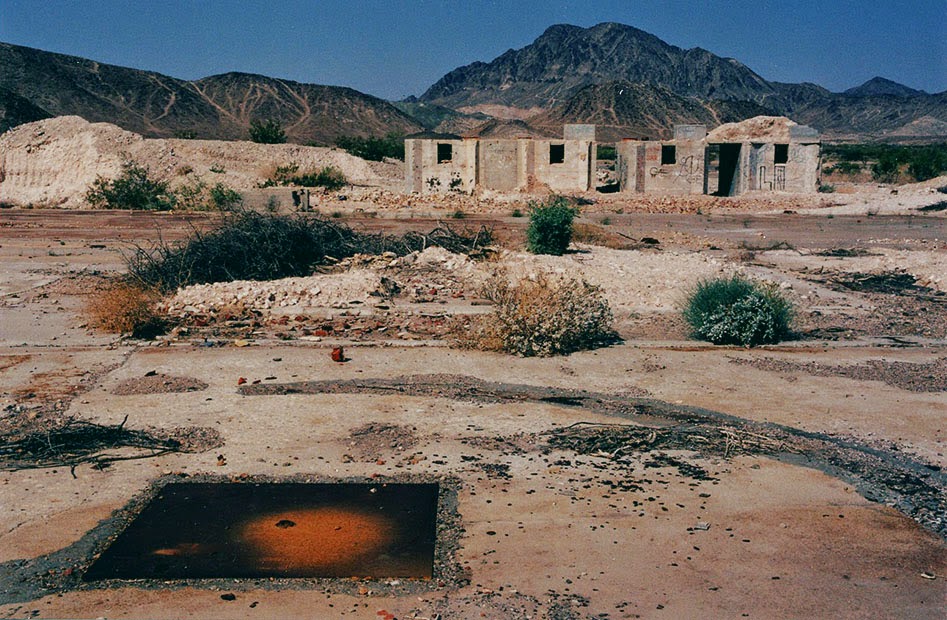 [Image: The abandoned streets of Midland, former origin of Hollywood’s artificial snow; photo via CLUI].
Like some strange, artificial winter being mined from the earth and scattered all over the dreams of cinemagoers around the world, Midland’s mineral snow had all the right qualities without any of the perishability or cold.
See, for example, this patent for artificial snow, filed in 1927 and approved in 1930, in which it is explained how gypsum can be dissolved by a specific acid mix to produce light, fluffy flakes perfect for the purposes of winter simulation. Easy to produce, with no risk of melting.
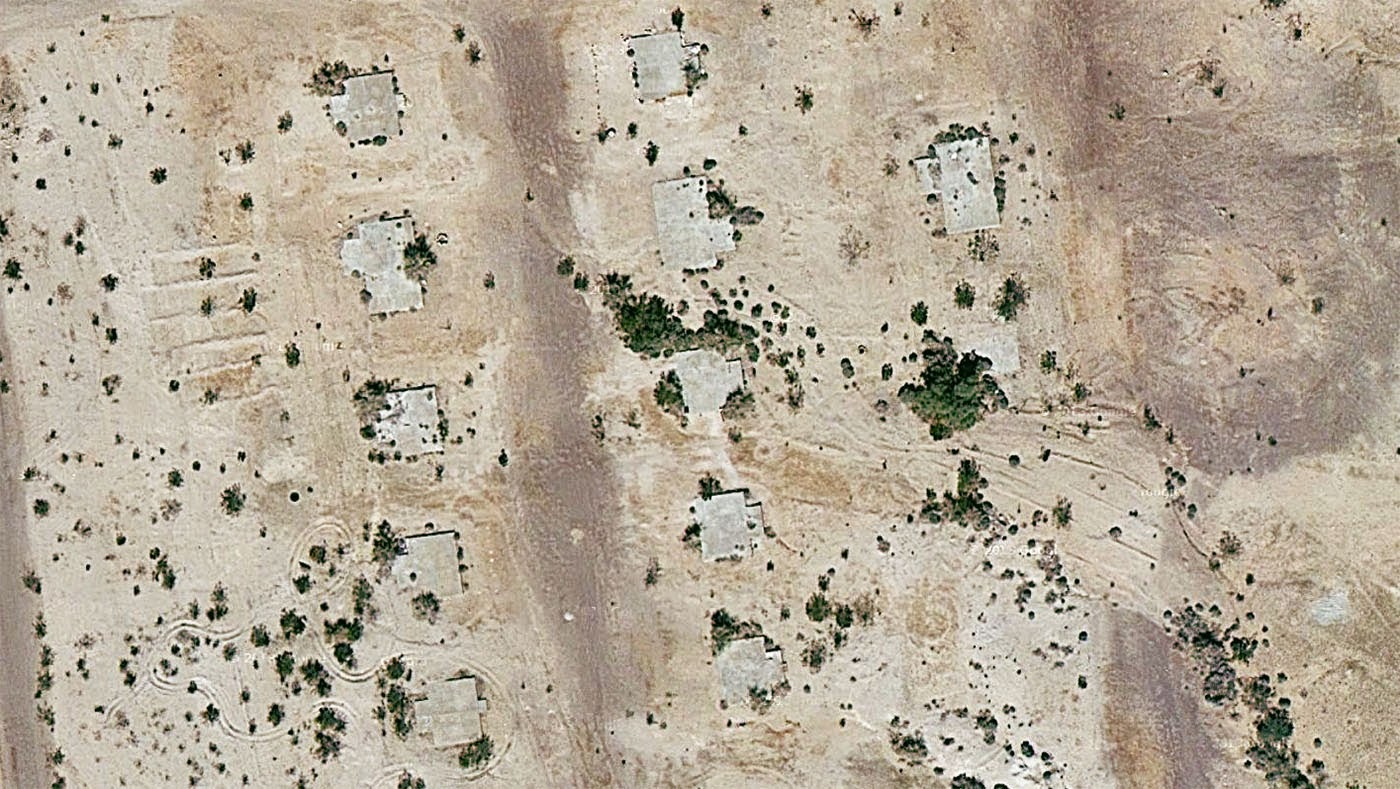 [Image: Midland, California, via Google Maps].
I’ve long been fascinated by the artificial snow industry—the notion of an industrially controlled climate-on-demand, spraying out snowflakes as if from a 3D printer, is just amazing to me—as well as with the unearthly world of mines, caves, and all things underground, but I had not really ever imagined that these interests might somehow come together someday, wherein fake glaciers and peaceful drifts of pure white snow were actually something scraped out of the planet by the extraction industry.
As if suggesting the plot of a deranged, Dr. Seussian children’s book, the idea that winter is something we pull from a mine in the middle of the California desert and then scatter over the warm Mediterranean cities of the coast is perhaps all the evidence you need that life is always already more dreamlike than you had previously believed possible.
(Very vaguely related: See also BLDGBLOG’s earlier coverage of California City).
City of Buried Machines

 [Image: Courtesy of London Basement].
A story of buried digging machines made something of an unexpected splash over at New Statesman this week, quickly becoming their weekend’s most-read article.
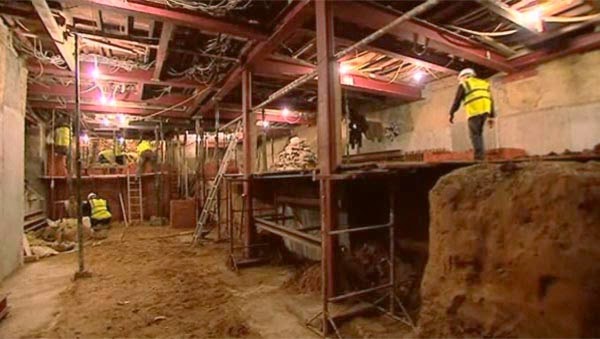
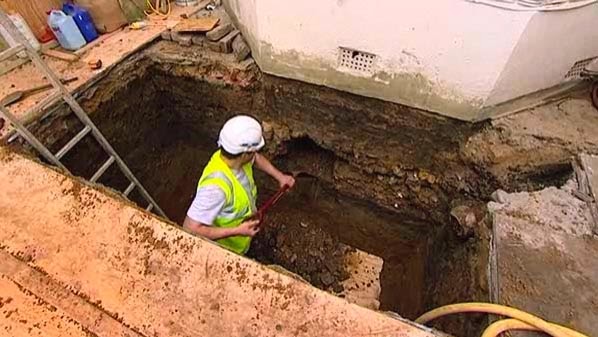
It turns out that all those elaborate basements and artificial show caves built for Londons’ nouveau riche have led to an interesting spatial dilemma: contractors are unable to retrieve the excavation equipment they used to produce all those huge underground extensions in the first place, and they have thus developed a technique for simply abandoning their machines underground and burying them in place.
London is thus becoming a machine cemetery, with upwards of £5 million worth of excavators now lying in state beneath the houses of the 1%. Like tools invented by M.C. Escher, these sacrificial JCBs have excavated the very holes they are then ritually entombed within, turning the city into a Celtic barrow for an age of heroic machinery.
What will future archaeologists make of these interred devices, densely packed in earth and left behind in unmarked graves?
 [Image: Courtesy of London Basement].
As we explored here on BLDGBLOG six years ago, deep below the mansions and row houses of the city’s wealthiest residents, colossal cave adventures are taking shape: massive swimming pools, TV rooms, personal gymnasia, full-scale cinemas, and whole subterranean flats are being constructed in order to side-step strict historic preservation laws on the earth’s surface.
Pioneered by firms such as the appropriately named London Basement, these massively expanded homes now feature “playrooms and cinemas, bowling alleys and spas, wine cellars and gun rooms—and even a two-storey climbing wall,” the Guardian reported in 2012. “It is leading to a kind of iceberg architecture, a humble mansion on the surface just the visible peak of a gargantuan underworld, with subterranean possibilities only limited by the client’s imagination.”
As the architect of one such mega-basement explained, “We analyzed the planning laws and realized that they cover everything about the surface of the ground, but nothing beneath it. There was nothing whatsoever that could stop us from drilling all the way down to the south pole.”
 [Image: Courtesy of London Basement].
Those grand old piles you see lining the streets of Belgravia thus might hide vertically sprawling domestic labyrinths and basement mazes down in the soil and clay beneath their ever-growing foundations, as home ownership fractally expands downward into the planet by way of waterproof geotextiles and carefully buttressed retaining walls.
However, these vast catacombs are by no means uncontroversial and might yet see their era come to an end due to local frustration with the disruption caused by construction crews and because of ever-growing municipal fees and penalties.
Until then, though, this abyssal impulse is surely approaching the inevitable point where we will see a private home legally redefined as a mine, a site of excavation closer in spirit to the extraction industry than private housing.
(Thanks to Martin John Callanan, Peter Flint, Paul Black, and Nicola Twilley! Meanwhile, if you like this, you might also like Subterranean Machine Resurrections)