The Drowned World

[Image: From Terra Forming: Engineering the Sublime by Adam Lowe and Jerry Brotton].

Artists Adam Lowe and Jerry Brotton’s project Terra Forming: Engineering the Sublime simultaneously explores the history of different geographic projections—including how these have been used to misrepresent and distort the earth’s surface—and at the future of that earth in an era of rising sea levels.

[Image: From Terra Forming: Engineering the Sublime by Adam Lowe and Jerry Brotton].

As Factum Arte explain, their chosen geographic projections offer “a way of engaging with the Earth from different points of view, and reflect historical ways of mapping the world from the Greeks to Google Earth.”

[Image: From Terra Forming: Engineering the Sublime by Adam Lowe and Jerry Brotton].

The projections are milled into beautiful 3D topographic models, with the vertical axis exaggerated to allow for changes in altitude to become visible.

The Andes, for example, become an abrupt spine of skyscraping pinnacles on the edge of an otherwise dead-flat continent, and deep-sea plains become spiky fields of underwater needles and pins.

[Images: From Terra Forming: Engineering the Sublime by Adam Lowe and Jerry Brotton].

As the artists write, “distortion was used because without it the globe’s surface would appear almost totally flat”—which interestingly suggests that representational distortion, with a great deal of irony, is actually central to giving our planet geographic legibility.

To map it or to know it, the implication seems to be, you must first alter it.

[Image: From Terra Forming: Engineering the Sublime by Adam Lowe and Jerry Brotton].

This is only half the project, however.

The artists refer to Terra Forming as “a cartographic response to the advent of the Anthropocene“—which is why the resulting topographic models are then flooded.

[Images: From Terra Forming: Engineering the Sublime by Adam Lowe and Jerry Brotton].

“The installation will mimic the passage of time as well as space,” Factum Arte write, “by flooding the world with water over several days, until we reach current sea levels; the world will then be flooded completely, leaving us with a drowned world, a prescient image for those parts of the world facing rising sea levels, as well as those such as parts of the Arabian Peninsula which is trying to reclaim land from the sea.”

You can watch a short video of the project’s gradual submergence on Vimeo—or embedded below.


And you can read much more about the project over at Factum Arte.

Liquid Quarries and Reefs On Demand

[Image: Micromotors at work, via UCSD/ScienceDaily].

Tiny machines that can extract carbon dioxide from water might someday help deacidify the oceans, according to a press release put out last week by UCSD.

Described as “micromotors,” the devices “are essentially six-micrometer-long tubes that help rapidly convert carbon dioxide into calcium carbonate, a solid mineral found in eggshells, the shells of various marine organisms, calcium supplements and cement.”

While these are still just prototypes, and are far from ready actually to use anywhere in the wild, they appear to have proven remarkably effective in the lab:

In their experiments, nanoengineers demonstrated that the micromotors rapidly decarbonated water solutions that were saturated with carbon dioxide. Within five minutes, the micromotors removed 90 percent of the carbon dioxide from a solution of deionized water. The micromotors were just as effective in a sea water solution and removed 88 percent of the carbon dioxide in the same timeframe.

The implications of this for marine life are obviously pretty huge—after all, overly acidic waters mean that shells are difficult, if not impossible, to form, so these devices could have an enormously positive effect on sea life—but these devices could also be hugely useful in the creation of marine limestone.

As UCSD scientists explain, the micromotors would “rapidly zoom around in water, remove carbon dioxide and convert it into a usable solid form.” A cloud of these machines could thus essentially precipitate the basic ingredients of future rocks from open water.

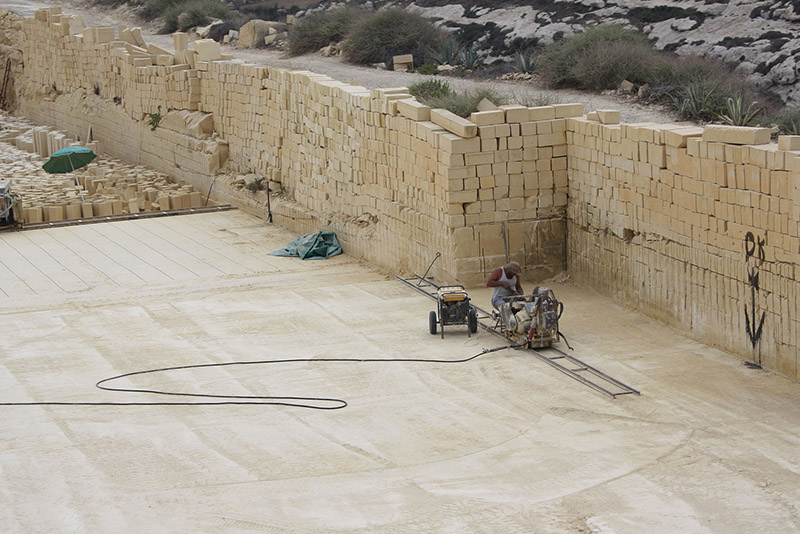
[Image: A Maltese limestone quarry, via Wikipedia].

At least two possibilities seem worth mentioning.

One is the creation of a kind of liquid quarry out of which solid rock could be extracted—a square mile or two of seawater where a slurry of calcium carbonate would snow down continuously, 24 hours a day, from the endless churning of invisible machines. Screen off a region of the coast somewhere, so that no fish can be harmed, then trawl those hazy waters for the raw materials of future rock, later to be cut, stacked, and sold for dry-land construction.

The other would be the possibility of, in effect, the large-scale depositional printing of new artificial reefs. Set loose these micromotors in what would appear to be a large, building-sized teabag that you slowly drag through the ocean waters, and new underwater landforms slowly accrete in its week. Given weeks, months, years, and you’ve effectively 3D-printed a series of new reefs, perfect for coastal protection, a new marine sanctuary, or even just a tourist site.

In any case, read more about the actual process over at UCSD or ScienceDaily.

Subterranean Saxophony

[Image: Photo by Steve Stills, courtesy of the Guardian].

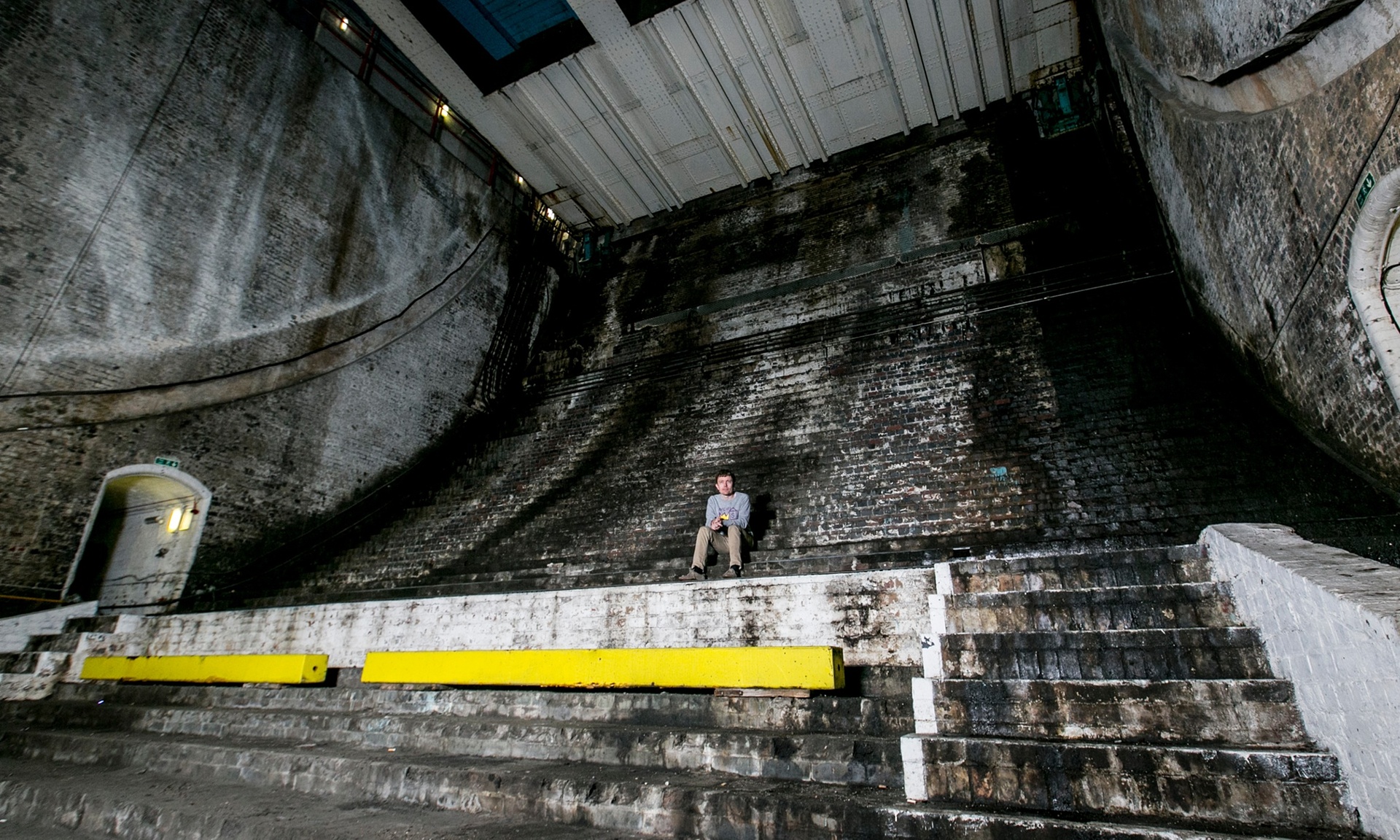
Over in London later today, the Guardian explains, composer Iain Chambers will premiere a new piece of music written for an unusual urban venue: “the caverns that contain the counterweights of [London’s Tower Bridge] when it’s raised.”

The space itself has “the acoustics of a small cathedral,” Sinclair told the newspaper, citing John Cage as an influence and urging readers “to listen to environmental sounds and treat them as music,” whether it’s the rumble of a bridge being raised or the sounds of boats on the river.

In fact, Chambers will be performing one of Cage’s pieces during the show tonight—but, alas, I suspect it is not this one:

It is rumored that the final, dying words of composer John Cage were: “Make sure they play my London piece… You have to hear my London piece…” He was referring, many now believe, to a piece written for the subterranean saxophony of London’s sewers.

Read much more at the Guardian—or, even better, stop by tonight for a live performance.

(Spotted via @nicolatwilley).

Abandoned Mines, Slow Printing, and the Living Metal Residue of a Post-Human World

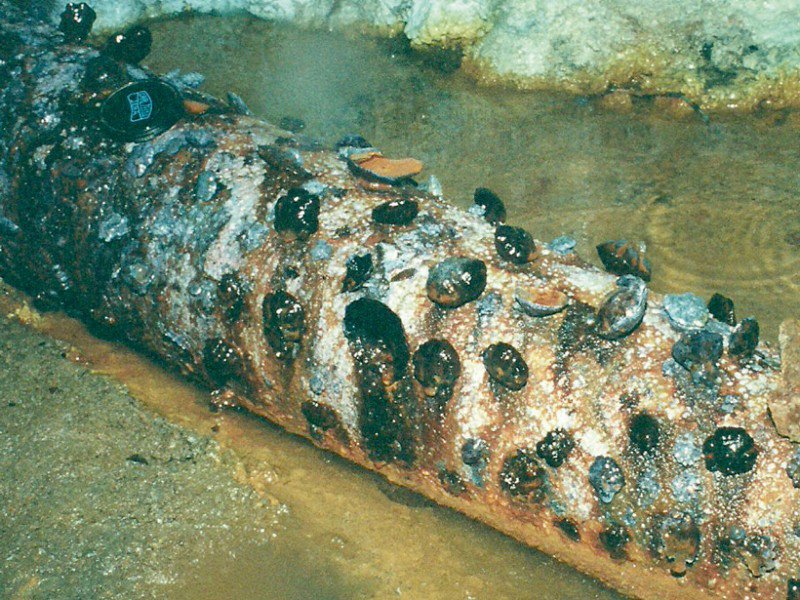
“High in the Pyrenees Mountains,” we read, “deep in abandoned mines, scientists discovered peculiar black shells that seem to crop up of their own accord on metal surfaces.”

[Image: Metal shells growing in the darkness of abandoned mines; photo by Joan Santamaría, via Eos].
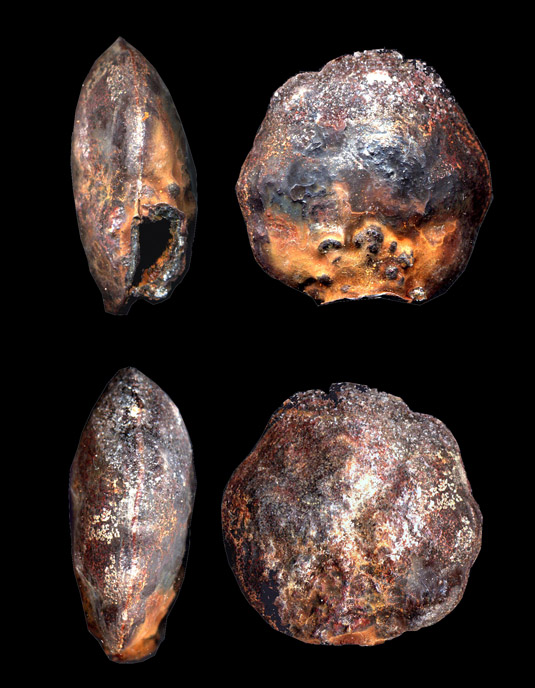
No, this is not a deleted scene from Jeff VanderMeer’s Southern Reach trilogy; it’s from research published in the Journal of Geophysical Research: Biogeosciences, recently reported by Eos.

It turns out that, under certain conditions, subterranean microbes can leave behind metallic deposits “as part of their natural metabolism.” Abandoned mines are apparently something of an ideal environment for this to occur within, resulting in “a rapid biomineralization process that sprouts iron-rich shells from the surface of steel structures.”

These then build up into reef-like deposits through a process analogous to 3D-printing: “Electron microscopy revealed small-scale, fiber-like crystals arranged into lines growing outward from the steel surface. The shells appear to be formed layer by layer, with crystal size and composition varying across layers.”

There are many, many interesting things to highlight here, which include but are not limited to:

Slow Printing

We could literalize the analogy used above by exploring how a controlled or guided version of this exact same process could be used as a new form of biological 3D-printing.

To put this another way, there is already a slow food movement—why not a slow printing one, as well?

Similar to the project John Becker and I explored a while back, using genetically-modified bees as living printheads, damp, metal-rich environments—microbial ovens, so to speak—could be constructed as facsimile mines inside of which particular strains of microbes and fungi would then be cultivated.

Geometric molds would be introduced as “seed-forms” to be depositionally copied by the microbes. Rather than creating the abstract, clamshell-like lumps seen in the below photograph, the microbes would be steered into particular shapes and patterns, resulting in discrete, recognizable objects.

Boom: a living 3D-printer, or a room of specially cultivated humidity and darkness out of which strange replicant tools and objects could be extracted every few years. At the very least, it would make a compelling art project—an object-reef sprouting with microbial facsimiles.

[Image: Metal shells growing in the darkness of abandoned mines; photo by Nieves López-Martínez, via Eos].
Dankness Instrumentalized

Historian David Gissen has written interestingly about the idea of “dankness” in architecture.

In an article for Domus back in 2010, Gissen explained that “dankness”—or “underground humidity,” in his words, a thick atmosphere of mold, rot, and stagnation usually found inside closed, subterranean spaces—was even once posited by architectural historian Marc-Antoine Laugier as a primal catalyst for first inspiring human beings to build cleaner, better ventilated structures—that is, architecture itself, in a kind of long-term retreat from the troglodyte lifestyle of settling in caves.

Dankness, to wildly over-simply this argument, so horrified our cave-dwelling ancestors that they invented what we now call architecture—and a long chain of hygienic improvements in managing the indoor atmospheric quality of these artificial environments eventually led us to modernism.

But dankness has its uses. “While modernists generally held dankness in suspect,” Gissen writes, “a few held a certain type of affection for this atmosphere, if only because it was an object of intense scrutiny. The earliest modernist rapprochements with dankness saw it as the cradle of a mythical atmosphere, an atmosphere that preceded modernity.” The “atmospheric depths of the cellar,” Gissen then suggests, might ironically be a sign of architectural developments yet to come:

Today, in the name of environmentalism, architects are digging into the earth in an effort to release its particular climatic qualities. Passive ventilation schemes often involve underground constructions such as “labyrinths” or “thermosiphons” that release the earth’s cool and wet air. The earth that architects reach into is one that has been so technified and rationalized, so measured and considered, that it barely contains mythical or uncanny aspects. However, this return to the earth’s substrate enables other possibilities.

In any case, I am not only quoting this essay because it is interesting and deserves wider discussion; I am also quoting all this in order to suggest that dankness could also be instrumentalized, or tapped as a kind of readymade industrial process, an already available microbial atmosphere wherein metal-depositing metabolic processes pulsing away in the dankest understructures of the world could be transformed into 3D-printing facilities.

The slow printheads for long-term object replication, mentioned above, would be fueled by and dependent upon Gissen’s spaces of subterranean humidity.

Heavy Metal Compost

If it is too difficult, too unrealistic, or simply too uselessly speculative to consider the possibility of 3D-printing with microbes, you could simply eliminate the notion that this is meant to produce recognizable object-forms, and use the same process instead as a new kind of compost heap.

Similar to throwing your old banana peels, coffee grounds, apple cores, and avocado skins into a backyard compost pile, you could throw metallic waste into a Gissen Hole™ and wait for genetically-modified microbes such as these to slowly but relentlessly break it all down, leaving behind weird, clamshell-like structures of purified metal in their wake.

Cropping teams would then climb down into this subterranean recycling center—or open an airlock and step inside some sort of controlled-atmosphere facility tucked away on the industrial outskirts of town—to harvest these easily commodified lumps of metal. It’d be like foraging for mushrooms or picking strawberries.

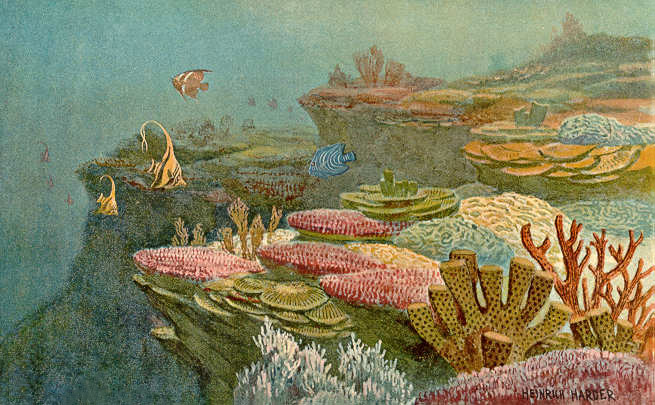
[Image: An “ancient coral reef,” illustrated by Heinrich Harder].

The Coming Super-Reef

Finally, this also seems to suggest at least one fate awaiting the world of human construction long after humans themselves have disappeared.

Basements in the ruined cores of today’s cities will bloom in the darkness with ever-expanding metallic reefs, as the steel frames of skyscrapers and the collapsed machinery of the modern world become source material—industrial soil—for future metal-eating microbes.

Quietly, endlessly, wonderfully, the planet-spanning dankness of unmaintained subterranean infrastructure—in the depths of Shanghai, London, New York, Moscow—humidly accumulates these strange metallic shells. Reefs larger than anything alive today form, crystallized from the remains of our cities.

A hundred million years go by, and our towers are reduced to bizarre agglomerations of metal—then another hundred million years and they’ve stopped growing, now hidden beneath hundreds of meters of soil or flooded by unpredictable shifts of sea level.

Clouds of super-fish unrecognizable to today’s science swim through the grotesque arches and coils of what used to be banks and highways, apartment blocks and automobiles, monstrous and oyster-like shells whose indirect human origins no future paleontologist could realistically deduce.

Forest Megaphone

[Image: Photo by Tõnu Tunnel].

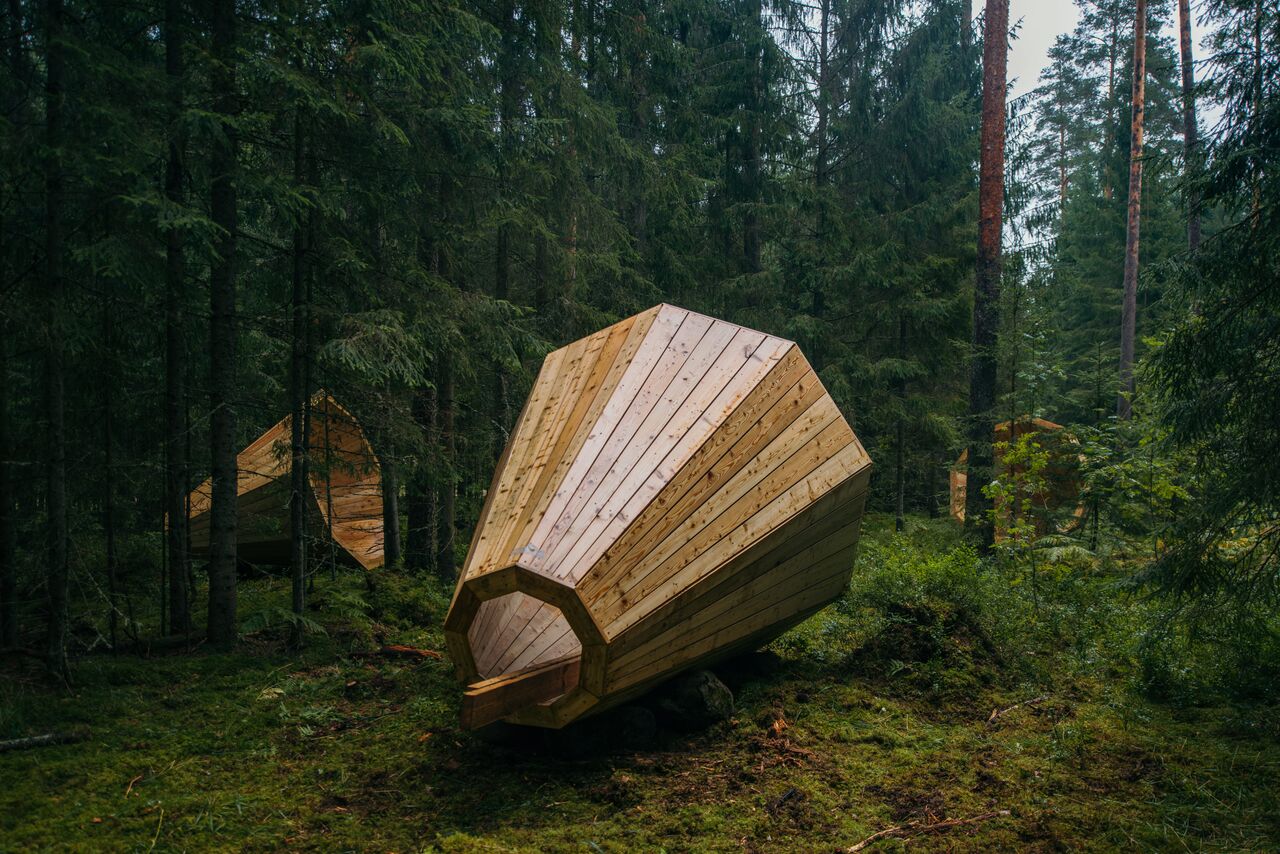
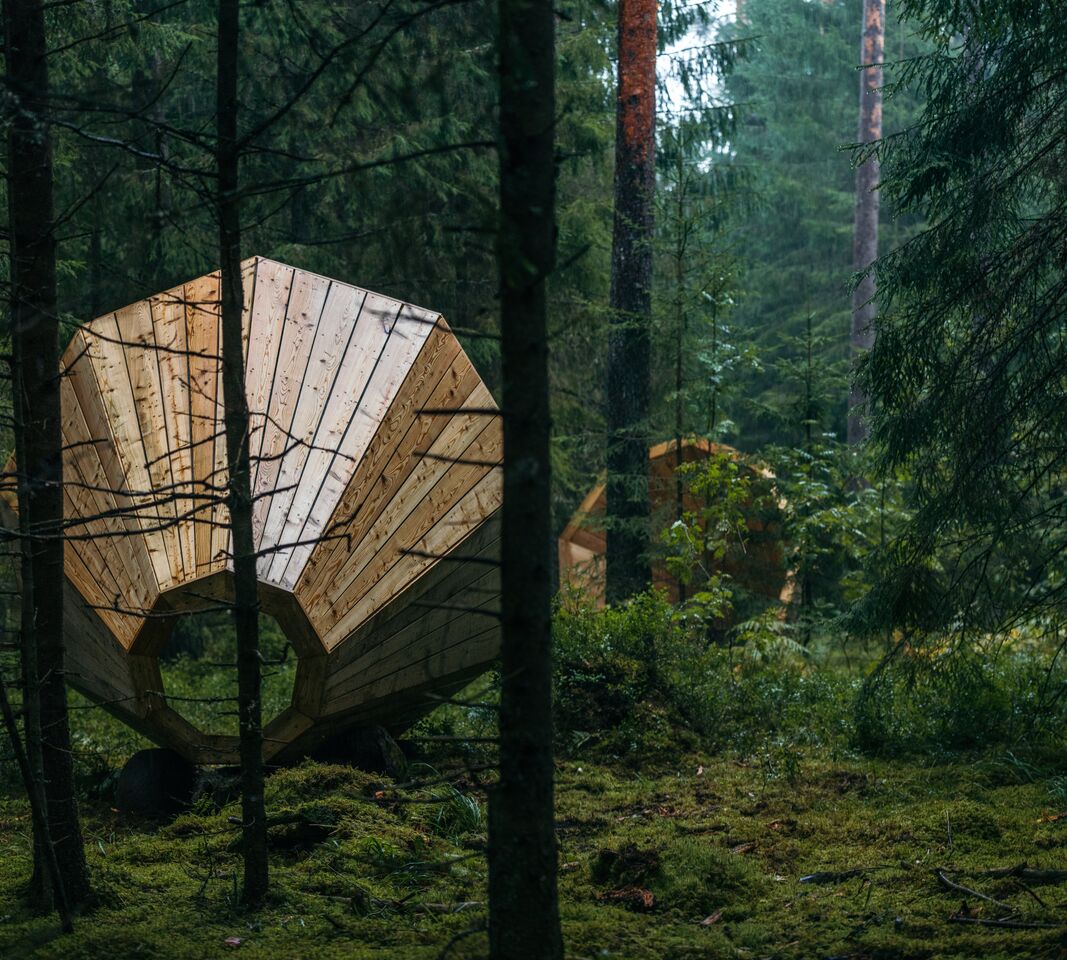
These architectural objects are “gigantic wooden megaphones” for the forest, part of an acoustic installation in Estonia’s gorgeous Pähni Nature Centre for amplifying the sounds of the landscape.

[Image: Photo by Tõnu Tunnel].

“According to interior architect Hannes Praks,” we read in a newly published press release, “who leads the Interior Architecture Department of the [Estonian Academy of Arts] that initiated the installation project, the three-metre diameter megaphones will operate as a ‘bandstand’ for the forest around the installation, amplifying the sounds of nature.”

The actual design is by a student named Birgit Õigus.

[Image: Photo by Tõnu Tunnel].

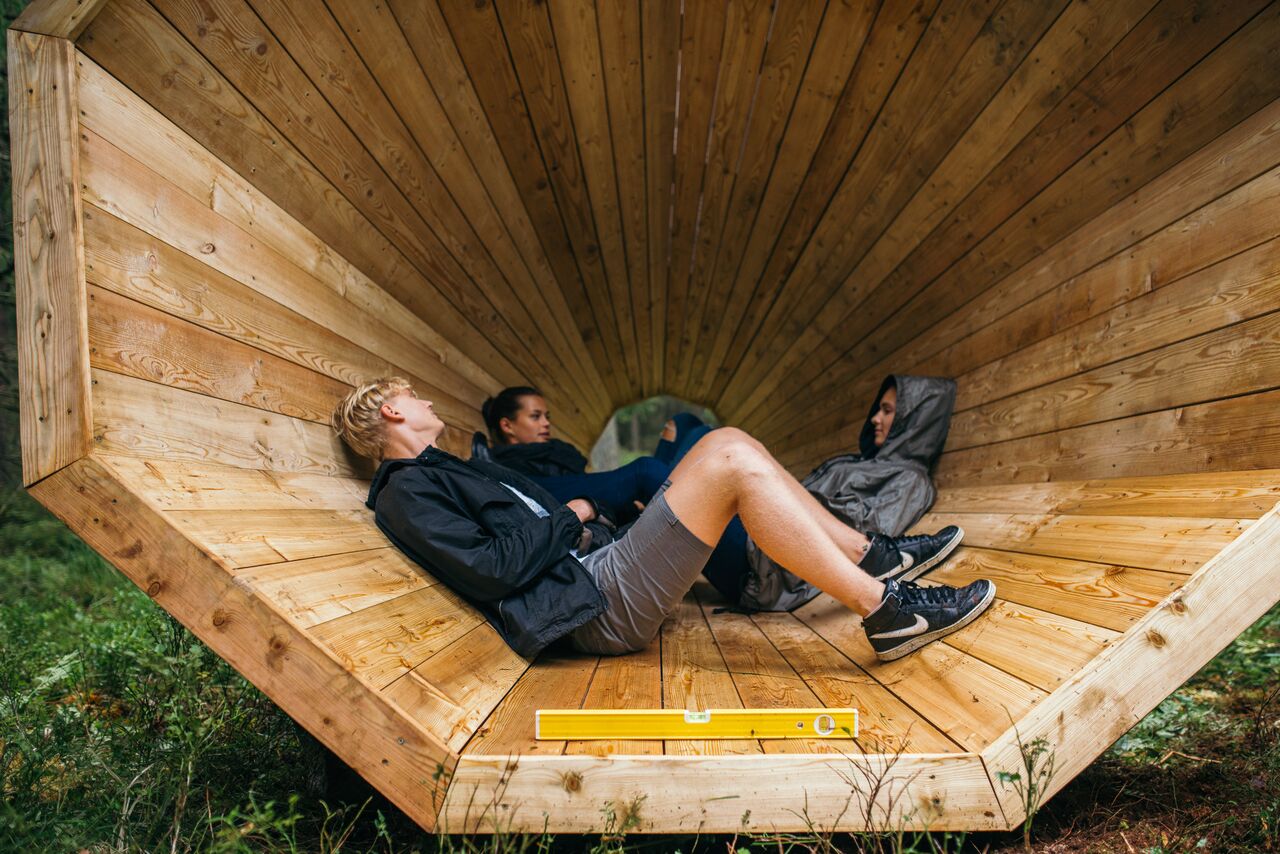
Part building, part furniture, part recreational folly, they’re meant to focus visitor attention on the smallest acoustic details of the site—rainfall, branches brushing against one another in the breeze, distant footsteps, thunder.

[Image: Photos by Tõnu Tunnel].

Sit in them, read books, whisper to friends, listen to birds.

[Image: Photo by Tõnu Tunnel].

Not having visited these in person, I can’t speak to their performance—i.e. whether they function as planned—and the relatively orderly placement of each structure in the woods might very well lead to some unfortunately conservative acoustic effects.

[Image: Photo by Tõnu Tunnel].

Nonetheless, it’s a great idea for a project, and the geometric simplicity of the stained timber frame is compelling.

[Image: Photo by Tõnu Tunnel].

Of course, these bring to mind the so-called “acoustic mirrors” of coastal Britain that we looked at here more than a decade ago.

[Image: Photo by Tõnu Tunnel].

In turn, makes me wonder how these forest megaphones might appear six or seven decades from now, when small groups of hikers stumble upon the moss-covered forms of this old acoustic infrastructure, trying to determine amongst themselves if the strange audio effects and interrupted echoes they notice still filtering through the wooden forms are a curious accident or an engineered goal.

[Image: Photo by Tõnu Tunnel].

Typographic Forestry and Other Landscapes of Translation

[Image: The cover for About Trees, edited by Katie Holten].

Artist Katie Holten—who participated in “Landscapes of Quarantine” a few years back—has just published an interesting book called About Trees.

It is essentially an edited compilation of texts about, yes, trees, but also about forests, landscapes of the anthropocene, unkempt wildness, altered ecosystems, and, more broadly speaking, the idea of nature itself.

It ranges from short texts by Robert Macfarlane—recently discussed here—to James Gleick, and from Amy Franceschini to Natalie Jeremijenko. These join a swath of older work by Jorge Luis Borges, with even Radiohead (“Fake Plastic Trees”) thrown in for good measure.

It’s an impressively nuanced selection, one that veers between the encyclopedic and the folkloric, and it has been given a great and memorable graphic twist by the fact that Holten, working with designer Katie Brown, generated a new font using nothing less than the silhouettes of trees.

Every letter of the alphabet corresponds to a specific species of tree.

[Image: The tree typeface from About Trees, edited by Katie Holten].

This has been put to good use, re-setting the existing texts using this new font—with the delightful effect of seeing the work of Jorge Luis Borges transcribed, in effect, into trees.

This has the awesome implication that someone could actually plant this: a typographic forestry of Borges translations.

[Image: Borges, translated into trees, from About Trees].

Speculative short stories realized as ornamental thickets in the backyards of arboreally inclined landowners.

Given all the urban parks, hedge mazes, and scientifically accurate themed gardens of the world—two of my favorites being the exquisite Silver Garden at Longwood Gardens and the scifi otherworldliness of the Desert Garden at the Huntington—surely there is room for a kind of translation landscape?

Stories and fables—koans, slogans, poems, wisecracks—planted as cryptoforests, literary labyrinths you could somehow, impossibly, read provided you know what each species is meant to signify.

Just take Holten’s typeface as a new kind of planting guide, and see what landscapes might result.

[Image: From About Trees].

Holten’s About Trees is available for purchase, of course, if you want to check it out; in the meantime, I’ll keep my fingers crossed that someone actually implements a typographic grove somewhere, a planted language of texts flipped into readable tree-signs, sequenced using the font from About Trees.

In fact, recall the myth of Odin discovering the Nordic runes: hanging upside-down from a tree and mistaking, in the especially complicated carpet of roots sprawled out beneath him, the beginnings of a new typeface, an arboreal symbol system that could be written down and shared with others. Runes came from roots—and, as Holten implies, every tree contains a library.

Informational Topographics

[Image: “FOGBAE.TWR4” by Mike Winkelmann, 07.06.15].

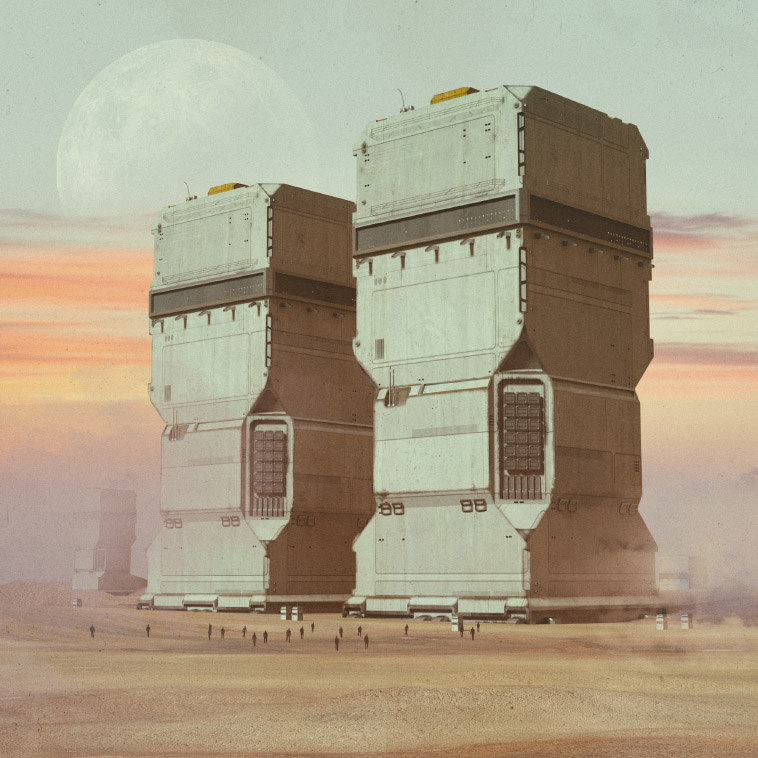
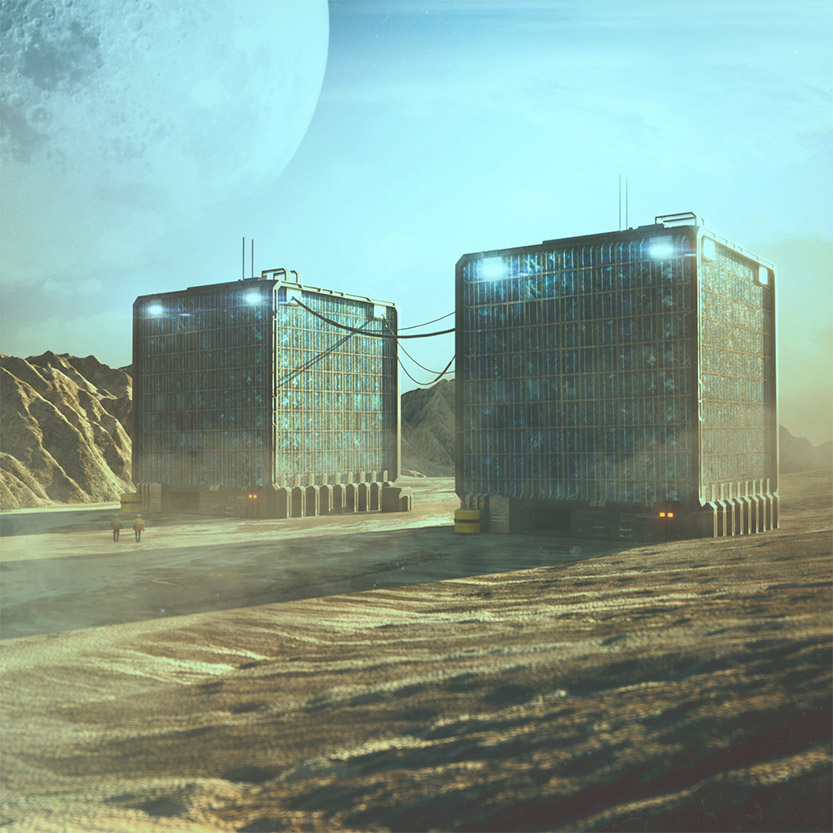
Since 2007, artist Mike Winkelmann has been producing an image a day, primarily using Cinema 4D, though all the specific tools differ year by year.

As Winkelmann justifiably boasts on his site, he has been working on the series for 3,030 consecutive days—of course, he also humbly refers to his work as just “a variety of art crap” produced “across a variety of media.”

[Image: “reopot seven-ten” by Mike Winkelmann, 05.04.15].

designboom just ran a quick survey of his work, and I thought I’d just piggyback on that with a few images here.

[Image: “pxil.two” by Mike Winkelmann, 05.12.15].

While I’m deliberately focusing on architectural or landscape-oriented imagery, his work is also strong with abstract technological scenes of circuits, robotized organic forms, abstract sprays of light, abandoned atmospheric-processing towers on floodplains, colossal elevator shafts, microscopic views of disturbed crystal growth, and more.

[Image: “OB TANK” by Mike Winkelmann, 07.26.15].

There are spheres of liquid metal, domed cities emerging from the desert floor, neon patent diagrams for purposeless machines, bristling mineral cliffs resembling dystopian housing blocks, and sublime landscape shots that appear to pull double-duty as bar graphs for otherwise unknown statistics. Informational topographics.

[Image: “FRIED GOBO” by Mike Winkelmann, 07.31.15].

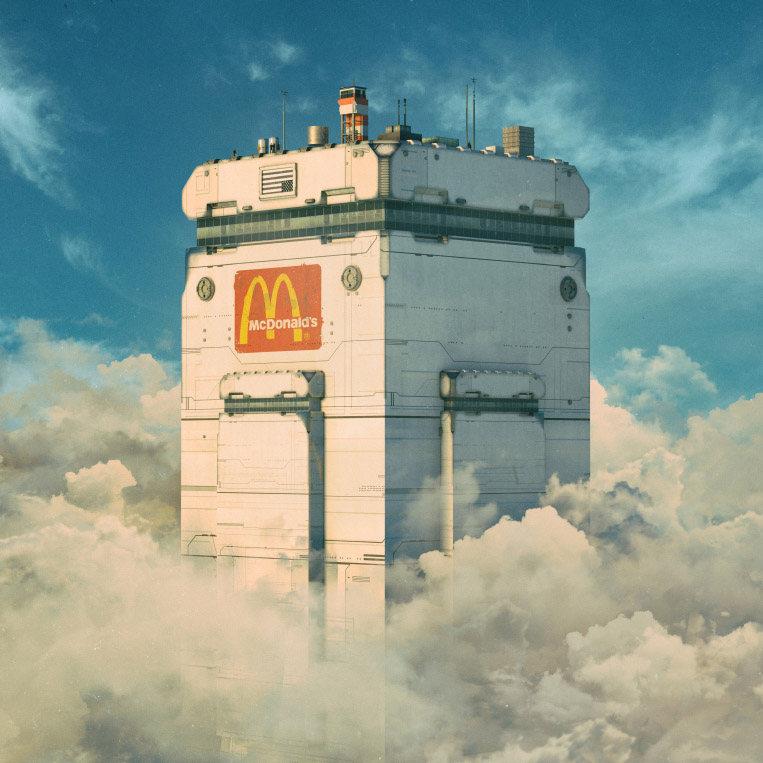
There is even a heavenly super-McDonald’s in the sky, a Mont Saint-McD of the clouds.

[Image: “MCD 2087” by Mike Winkelmann, 08.11.15].

Some, even a few I’ve included here, veer a little overtly in a Star Wars direction, while others look more like future album art. Black pyramids and doubled suns.

[Image: “orangetooth gutrot” by Mike Winkelmann, 11.29.14].

For others—and there are literally thousands of images, all the more impressive for the fact that they’re being produced once a day—check out designboom; for all of them, click through to Winkelmann’s site directly.

[Image: “BOXXX-3VV” by Mike Winkelmann, 07.01.15].

[Spotted by designboom].

Abandoned Basements as Stormwater Basins

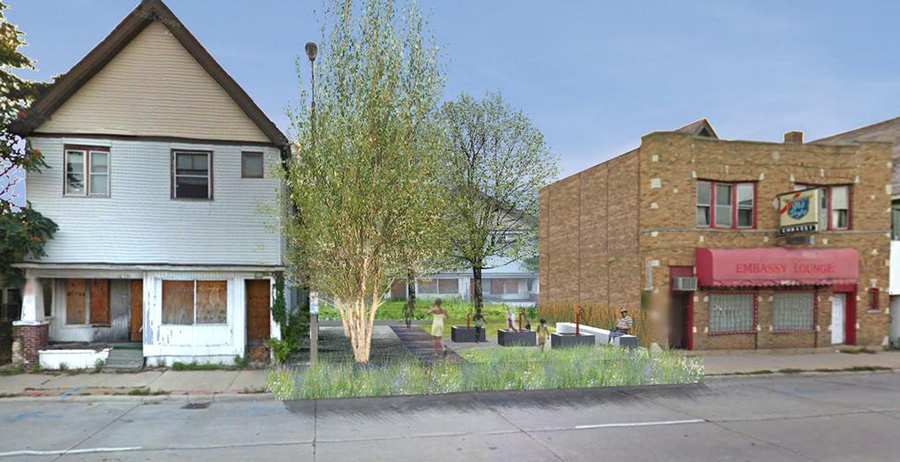
[Image: Rendering of a possible “BaseTern” landscape by students Brett Harris, Andrew D’Arcy, and Heidi Petersen, via Landscape Architecture Magazine].
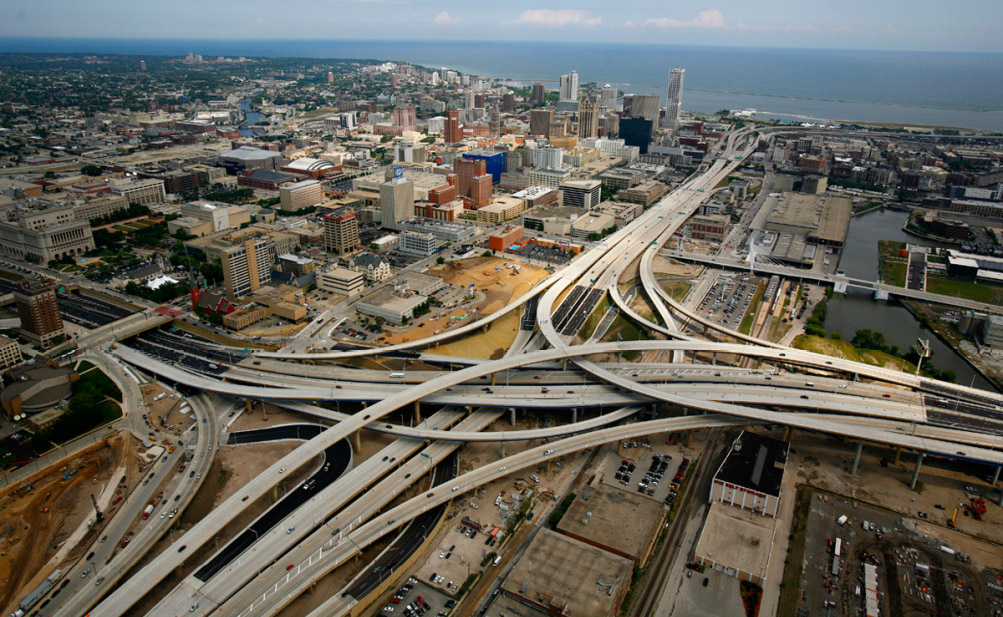
Not all the news coming out of Milwaukee involves misguided highway megaprojects or tax-funded crony capitalism—though there is that.

For example, Wisconsin governor Scott Walker—confusing an earlier generation’s urban mistakes with how a city is meant to function—has been plowing billions of dollars’ worth of taxpayer money into “freeway megaprojects” for which “the pricetag got so big that leaders from his own party rejected his plan as fiscally irresponsible, leaving the state budget in limbo,” Politico reports:

As the state has shifted resources into freeway megaprojects, 71 percent of [Wisconsin’s] roads are in mediocre or poor condition, according to federal data. Fourteen percent of its bridges are structurally deficient or functionally obsolete, which is actually better than the national average. Walker and his fellow Republicans have killed plans for light rail, commuter rail, high-speed rail, and dedicated bus lanes on major highways, so there is almost no public transportation connecting Milwaukee to its suburbs, intensifying divisions in one of the nation’s most racially, economically and politically segregated metropolitan areas. Yet Walker, who is running for president as a staunch fiscal conservative, has pushed a $250 million-per-mile plan to widen Interstate 94 between the Marquette and the Zoo despite fierce local opposition.

If that sounds both avoidable and unfortunate, consider the fact that “Walker also killed a ‘Complete Streets’ program that pushed road builders to accommodate bicyclists and pedestrians.”

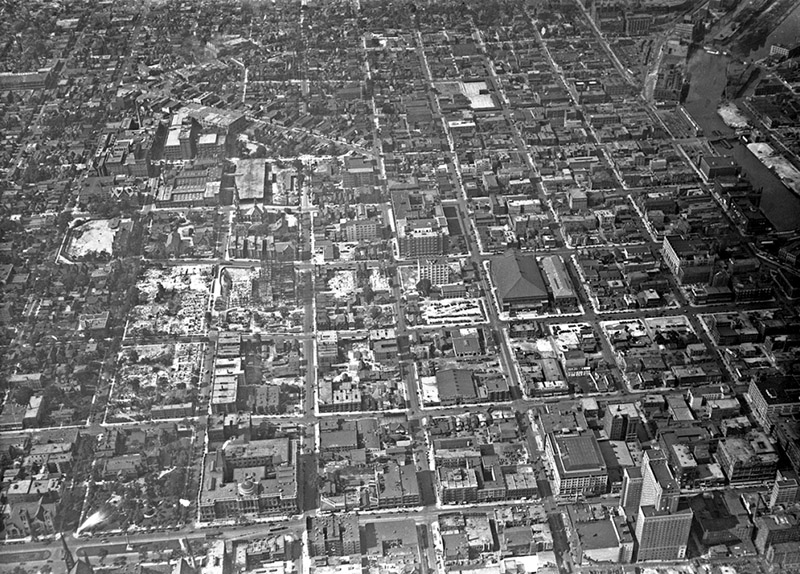
[Images: (top) Milwaukee’s Marquette interchange, nearly the same size as the city it cuts through; (bottom) Milwaukee before the interchange. Images via Politico].
At the same time, Walker has also “championed a high-profile proposal to spend a quarter of a billion dollars of taxpayer money to help finance a new Milwaukee Bucks arena—all while pushing to slash roughly the same amount from state funding for higher education,” the International Business Times reports.

But, hey, why does Wisconsin need universities when everyone can just go to an NBA game? Not that benefitting the public is even Walker’s goal: “One of those who stands to benefit from the controversial initiative is a longtime Walker donor and Republican financier who has just been appointed by the governor to head his presidential fundraising operation.”

In any case, an interesting landscape test-project is currently underway in Milwaukee, called the “BaseTern” program.

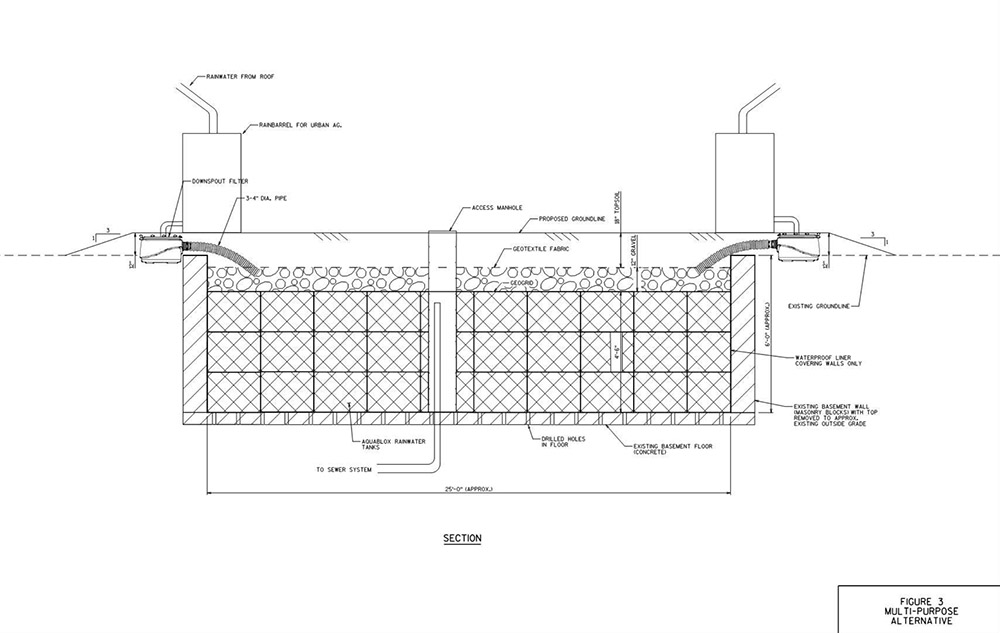
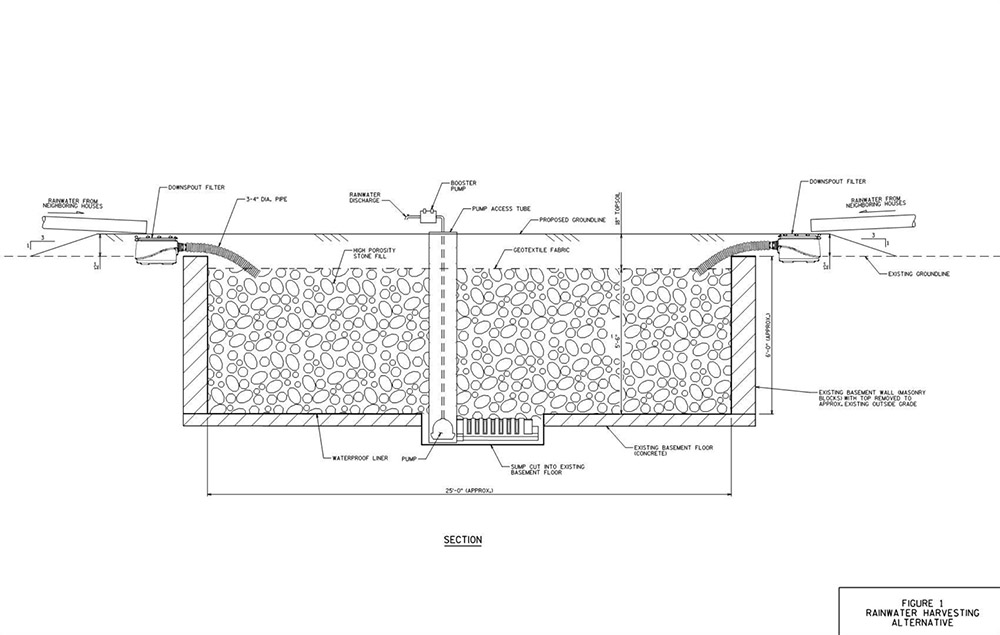
As the city explains it, a “BaseTern” is “an underground stormwater management or rainwater harvesting structure created from the former basement of an abandoned home that has been slated for demolition.” Why is the city doing this?

By using abandoned basements, the City saves the cost of demolition on these structures (filing the basement and grading the surface) and on excavation for the new structure. In addition, BaseTerns provide significant stormwater storage capacity on a single site, the equivalent of up to 600 rain barrels.

The result, the city is keen to add, is “not an open pit. Rather a BaseTern is a covered structure, which is covered with topsoil and grass, and will appear the same as conventional vacant lot.”

In their July 2015 issue, Landscape Architecture Magazine explained that this is, in fact, “the world’s first such system.” Conceived—and actually trademarked—by a city official named Erick Shambarger, the idea was inspired by a GIS-fueled discovery that the worst flooding in the city always “occurred in neighborhoods with high rates of foreclosures. The city controls roughly 900 foreclosed properties, many of which it plans to demolish. Shambarger figured the city could preserve the basement structure and put it to use.”

[Images: Two BaseTern design diagrams, taken from Milwaukee’s “Vacant Basements for Stormwater Management Feasibility Study“].

While there is something metaphorically unsettling in the idea that parts of a blighted, financially underwater neighborhood might soon literally be underwater—transformed into a kind of urban sponge for the rest of Milwaukee—the notion that the city can discover in its own economic misfortune a possible new engineering approach for dealing with seasonal flooding and super-storms is an inspiring thing to see.

The BaseTern program also potentially suggests a stopgap measure for coastal cities set to face rising sea levels well within the lifetimes of the coming generation.

In the all but inevitable managed retreat from the coast that seems set to kick off both en masse and in earnest by midcentury—something that is already happening in New York City, post-Sandy—perhaps the subterranean ruins of old neighborhoods left behind can be temporarily repurposed as minor additions to a broader coastal program intent on reducing flooding for residents further inland.

Before, of course, those underground voids—former guest bedrooms, dens, man caves, she sheds, and basements—are inundated for good.

Read more about BaseTerns over at Landscape Architecture Magazine.

Subterranean Lightning Brigade

[Image: “Riggers install a lightning rod” atop the Empire State Building “in preparation for an investigation into lightning by scientists of the General Electric Company” (1947), via the Library of Congress].

This is hardly news, but I wanted to post about the use of artificial lightning as a navigational aid for subterranean military operations.

This was reported at the time as a project whose goal was “to let troops navigate about inside huge underground enemy tunnel complexes by measuring energy pulses given off by lightning bolts,” where those lightning bolts could potentially be generated on-demand by aboveground tactical strike teams.

Such a system would replace the use of GPS—whose signals cannot penetrate into deep subterranean spaces—and it would operate by way of sferics, or radio atmospheric signals generated by electrical activity in the sky.

The proposed underground navigational system—known as “Sferics-Based Underground Geolocation” or S-BUG—would be capable of picking up these signals even from “hundreds of miles away. Receiving signals from lighting strikes in multiple directions, along with minimal information from a surface base station also at a distance, could allow operators to accurately pinpoint their position.” They could thus maneuver underground, even in hundreds—thousands—of feet below the earth’s surface in enemy caves or bunkers.

Hundreds of miles is a very wide range, of course—but what if there is no natural lightning in the area?

Enter artificial military storm generators, or the charge of the lightning brigade.

Back in 2009, DARPA also put out of a request for proposals as part of something called Project Nimbus. NIMBUS is “a fundamental science program focused on obtaining a comprehensive understanding of the lightning process.” However, it included a specific interest in developing machines for “triggering lightning”:

Experimental Set-up for Triggering Lightning: Bidders should fully describe how they would attempt to trigger lightning and list all potential pieces of equipment necessary to trigger lightning, as well as the equipment necessary to measure and characterize the processes governing lightning initiation, propagation, and attachment.

While it’s easy enough to wax conspiratorial here about future lightning weapons or militarized storm cells—after all, DARPA themselves write that they want to understand “how [lightning] ties into the global charging circuit,” as if “the global charging circuit” is something that could be instrumentalized or controlled—I actually find it more interesting to speculate that generating lightning would be not for offensive purposes at all, but for guiding underground navigation.

[Image: Lightning storm over Boston; via Wikimedia/NOAA].

Something akin to a strobe light begins pulsing atop a small camp of unmarked military vehicles parked far outside a desert city known for its insurgent activities. These flashes gradual lengthen, both temporally and physically, lasting longer and stretching upward into the sky; the clouds above are beginning to thicken, grumbling with quiet rolls of thunder.

Then the lightning strikes begin—but they’re unlike any natural lightning you’ve ever seen. They’re more like pops of static electricity—a pulsing halo or toroidal crown of light centered on the caravan of trucks below—and they seem carefully timed.

To defensive spotters watching them through binoculars in the city, it’s obvious what this means: there must be a team of soldiers underground somewhere, using artificial sferics to navigate. They must be pushing forward relentlessly through the sewers and smuggling tunnels, crawling around the roots of buildings and maneuvering through the mazework of infrastructure that constitutes the city’s underside, locating themselves by way of these rhythmic flashes of false lightning.

Of course, this equipment would eventually be de-militarized and handed down to the civilian sector, in which case you can imagine four friends leaving REI on a Friday afternoon after work with an artificial lightning generator split between them; no larger than a camp stove, it would eventually be set up with their other weekend caving equipment, used to help navigate through deep, stream-slick caves an hour and a half outside town, beneath tall mountains where GPS can’t always be trusted.

Or, perhaps fifty years from now, salvage teams are sent deep into the flooded cities of the eastern seaboard to look for and retrieve valuable industrial equipment. They install an artificial lightning unit on the salt-bleached roof of a crumbling Brooklyn warehouse before heading off in a small armada of marsh boats, looking for entrances to old maintenance facilities whose basement storage rooms might have survived rapid sea-level rise.

Disappearing down into these lost rooms—like explorers of Egyptian tombs—they are guided by bolts of artificial lightning that spark upward above the ruins, reflected by tides.

[Image: Lightning via NOAA].

Or—why not?—perhaps we’ll send a DARPA-funded lightning unit to one of the moons of Jupiter and let it flash and strobe there for as long as it needs. Called Project Miller-Urey, its aim is to catalyze life from the prebiotic, primordial soup of chemistry swirling around there in the Cthulhoid shadow of eternal ice mountains.

Millions and millions of years hence, proto-intelligent lifeforms emerge, never once guessing that they are, in fact, indirect descendants of artificial lightning technology. Their spark is not divine but military, the electrical equipment that sparked their ancestral line long since fallen into oblivion.

In any case, keep your eyes—and cameras—posted for artificial lightning strikes coming to a future military theater near you…

From Guns, Bridges

[Image: An otherwise unrelated shot of rebar used in road construction; via Wikipedia].

A quick news item from last month seems worth mentioning: “approximately 3,400 confiscated firearms” are being melted down and turned into rebar to be used for bridge and highway construction projects throughout the American Southwest.

As Global Construction Review reported, “The weapons will be melted into steel reinforcing bar, better known as ‘rebar,’ and transformed into elements of construction for upgrades in freeways and bridges in Arizona, California and Nevada.”

The event where this occurs is known as the “annual gun-melt,” and its future byproducts will be coming soon to a highway crossing near you: former armaments, from swords to plowshares, embedded in our everyday landscape.