Mountain Lab: An Interview with Scott McGuire

Photo courtesy Scott McGuire.

(This interview originally published on Venue).

Several years ago, while I was still on the editorial staff at Dwell magazine, I took a daytrip down to the head office of The North Face to visit their equipment design team and learn more about the architecture of tents.

“As a form of minor architecture,” the resulting short article explained, “tents are strangely overlooked. They are portable, temporary, and designed to withstand even the most extreme conditions, but they are usually viewed as simple sporting goods. They are something between a large backpack and outdoor lifestyle gear—certainly not small buildings. But what might an architect learn from the structure and design of a well-made tent?”

Amongst the group of people I spoke with that day was outdoor equipment strategist Scott McGuire, an intense, articulate, and highly focused advocate for all things outdoors. As seen through Scott’s eyes, the flexibility, portability, ease of use, and multi-contextual possibilities of outdoor equipment design began to suggest a more effective realization, I thought, of the avant-garde legacy of 1960s architects like Archigram, who dreamed of impossible instant cities and high-tech nomadic settlements in the middle of nowhere.

Scott McGuire talks to Venue in Lee Vining, California; Mono Lake can be seen in the background.

Intrigued by his perspective on the ways in which outdoor gear can both constrain and expand the ways in which human beings move around in and inhabit wild landscapes, and traveling with Nicola Twilley as part of our collaborative Venue project, I was thrilled to catch up with Scott at a deli in Lee Vining, California, near his home in the Eastern Sierra.

McGuire, who recently left The North Face to set up his own business, called The Mountain Lab, was beyond generous with his time and expertise, happily answering Nicola’s and my questions as the sun set over Mono Lake in the distance. His answers combined a lifelong outdoor enthusiast’s understanding of the natural environment with a granular, almost anthropological analysis of the activities that humans like to perform in those contexts, as well as a designer’s eye for form, function, and material choices.

Indeed, as Scott’s description of the design process makes clear in the following interview, a 40-liter mountaineering pack is revealed literally as a sculpture produced by the interaction between the human body and a particular landscape: the twist to squeeze through a crevasse, or the backward tilt of the head during a belay.

Our conversation ranged from geographic and generational differences in outdoor experiences to the emerging spatial technologies of the U.S. military, and from the rise of BMX and the X Games to the city itself as the new “outdoors,” offering a fascinating perspective on the unexpected ways in which technical equipment can both enable and redefine our relationship with extreme environments.

• • •

Geoff Manaugh: I’d like to start by asking you about the constraints you face in the design of outdoor athletic equipment, and how that affects the resulting product. For instance, in designing architecture, you might think about factors such as a building’s visual impact, its environmental performance, or the historic context of where your future structure is meant to be. But if you’re designing something like a tent—a kind of athletic architecture, if you will—then you’re talking about factors like portability, aerodynamism, cost, weather-proofing, etc.. What design constraints do you face, and how do you prioritize them?

Scott McGuire: The first thing is always the user. Everything has to be very user-centric, in a way that’s perhaps unlike conventional architecture. You might say, “I’m building a house; it’s about this site; it’s about this view; people are going to live in it in a certain way,” but you would rarely design a house based on whether or not someone has a propensity, for example, to use their kitchen utensils with their left hand or their right hand. But when you’re creating a technical product, you become really myopically focused on how that product interacts with an individual. It’s about establishing who that person is.

Of course, if I’m talking about doing a small technical pack that will hold 40 liters for someone who’s going mountaineering—well, I know that same pack may very well be used by someone riding on a bike as a commuter in New York City. Still, when we’re talking about that product, it’s very much about things like: what’s the person who’s going mountaineering wearing? What are they carrying? Where are they going? What environment are they going to be in? How much wear and tear is their pack going to get? As you study the user, you usually end up discovering a lot of nuances about the way they’ll use the product, and they’re often things you wouldn’t normally think about.
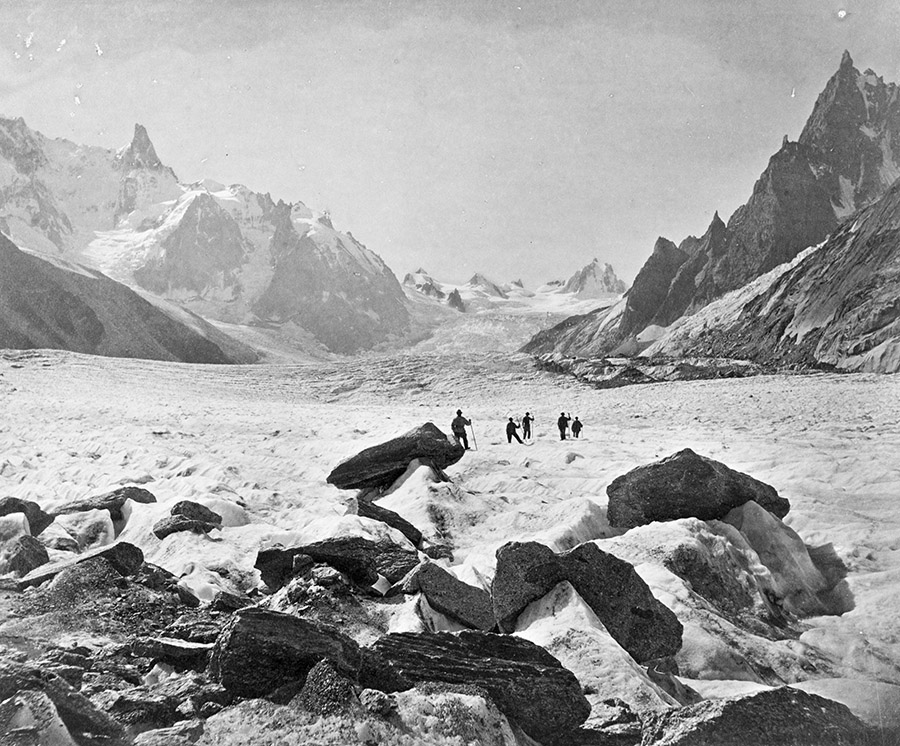
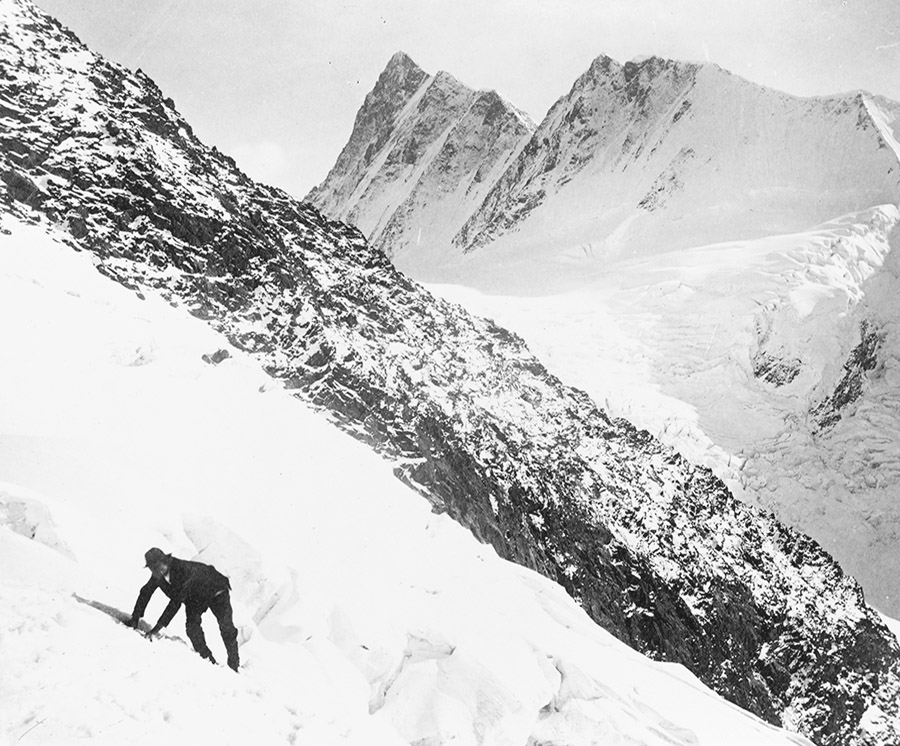
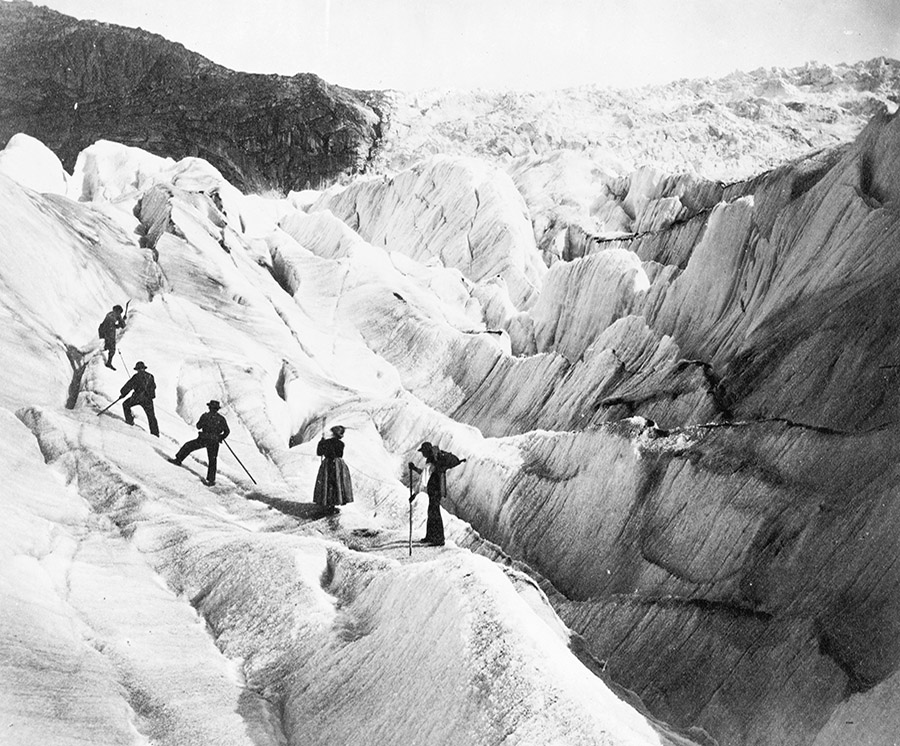
Mt. Blanc from Le Jardin“; “The Finsteraarhorn“; another view of the Finsteraarhorn; and “Glacier of the Rhone.” All photos taken between 1860 and 1890. Courtesy of the U.S. Library of Congress Prints and Photographs Division.

I’ll give you some examples of how that would work. I’ll stick with the 40-liter technical pack, which is the one you usually find in an area that’s high alpine, above 8000 feet, with year-round glaciers, where there’s lots of climbing and mountaineering. What you’re going to find, obviously, is that people are carrying it. They’re moving at a relatively athletic pace. They want to have the ability to fit the pack.

When we think about fit, it’s not as simple as saying: “This person’s got a 34″ waist, a 19″ back, a 42″ chest, and that’s what we need to focus on.” It’s also the fit based off the way someone moves—what I would call the interaction between the user and the device. The way a 65-liter pack fits someone who’s walking down a manicured trail, doing eight miles a day—the height that their knee climbs and the amount that their body twists—is different than the fit of a 40-liter pack for somebody who’s going up a mountain, where they might be climbing a 45-degree slope. Or they might have somebody on belay and they need to be able to look up, so they need to have a tiny pocket of space so that, with a helmet, they can crane their head back and look up at their partner. The pack can’t get in the way of that.

Three 65-liter packs by The North Face, High Sierra, and Kelty, respectively.

Then you add to all that not just an ability to carry weight, but questions like: what does it feel like when an arm comes up to reach for a hold? Or: what happens when you’re trying to twist through a crevasse? There’s a fair amount of time spent really thinking about all of those elements on the body.

And then you run into some really interesting places when you start thinking about how the pack comes off the body. What does everybody do when they come to a stop? They take their packs off, throw them on the ground, and sit on them. So you have to think about how your frame system can carry the load one way, while being carried on someone’s back, but also what happens to that frame system when someone sits on it when it’s on the ground. That really nice zipper pocket on the face, the one that’s so great for getting access at the front of the pack—well, what happens when that thing spends a year lying zipper-down, crammed full of mud, with 150 to 200 pounds of person sitting on top of it? A lot of these observations need to take place in the very beginning, to think through these things.

Mountain climbers, Zermatt, Switzerland (1954); photograph by Toni Frissell, courtesy of the U.S. Library of Congress Prints & Photographs Division.

That’s basically the fit component of the interaction to the person. The second element is really going to be: what goes into the product? What is the user carrying, and how do they access it? Those two questions live in a symbiotic relationship with each other. It’s also not just about what goes in the pack, but when it goes in, when it comes out, and how it goes back in again.

Taking a conventional top design, you have an open bucket; you open the lid; and you put stuff inside. There are shapes that inherently lend themselves to technical packs: they’re slightly tapered at the bottom, so they stay within the lumbar area, keeping the weight centered over the sacrum. That makes it a little easier when those narrow slots are on your waist, and the V-shape of the pack mimics the shape of your shoulders and chest. What it also does is it creates a bucket that can feed stuff down into the bottom. You want to keep your heavier stuff near your center of gravity—you want to keep it low and tight—preferably right underneath the shoulder blades.

But you also need to think about what’s going in there, in what order. Things like an extra shell, or your spare jacket, or the rope you may or may not need—those can all go in the bottom. But what are the things that are coming on and off, all the time? On a technical climb, if you’re wearing a puffy jacket, well, every time you’re hot, that jacket’s going to come off—maybe ten or fifteen times a day. So how does that go in and how do you maintain access to it in the easiest possible way? How do you make sure you’ve got easy access to things like a first aid kit, in case you’ve got to get to it quick? Where does your headlamp sit so that, when it’s late and you’re finally getting the headlamp out, and it’s probably already dark, you know, intuitively, that it’s in this pocket right here and you don’t have to fumble around and find the headlamp and risk having everything else dump out?

The view from Scott McGuire’s back porch; photo courtesy Scott McGuire.

And then there are even simpler things, like small pockets for access to things like a point-and-shoot camera that can go in and out quickly, or your lip balm, or that nutritional bar that allows you to get a shot of quick energy. A lot of thought needs to go into where those things go—where pocketing and storage should be, both from an organizational standpoint but also from a load-dispersion standpoint. These are all maybe a little comparable to how an architect might think: it’s about organizing the space, but down to a level of detail that takes into consideration very different people doing very different things with their gear.

Once you’re talking about the load—about what you’re carrying and how that gets managed—the next thing is going to be materials. The materials are so important. Like in conventional architecture and design, materials obviously have an aesthetic appeal. On the business side of it, the value equation is always about cost versus value. For example, there are things that can cost very little but have a very high value based off their perceived benefit: they’re lightweight, durable, attractive. Things can also have a very high cost but not necessarily have a value that the customer perceives, such as highly technical specialized fabrics that may not really contribute a benefit to your average end user. The benefit’s lost. It’s as if you build a house and you install gold pipes—no one sees it. Do they really make the water taste better?

You need to be really careful about those decisions. When you’re talking about the material selection and if somebody has to carry it, then there’s a balance not only in terms of cost versus value, but also around weight versus durability. In a general analysis, you’ve got price, weight, and durability—and, usually, you only get to pick two. You want something that’s really cheap and super lightweight? You give up durability. You want something that’s super durable and incredibly lightweight? It’s going to cost you a lot of money—you give up price.
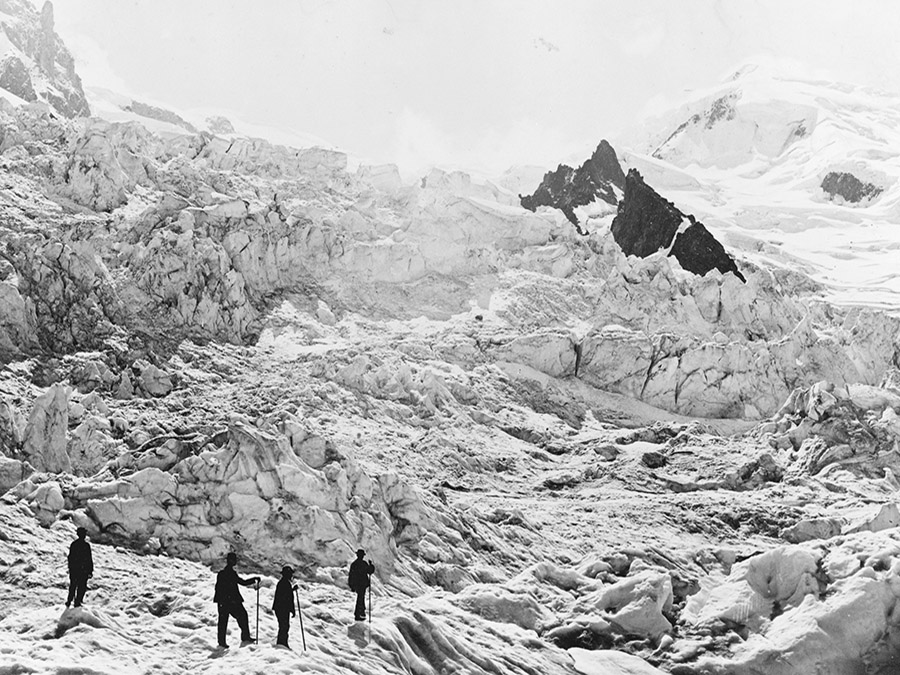
Ascension of Mt. Blanc” and Glacier of the Rhone.” Photos taken between 1860 and 1890. Courtesy of the U.S. Library of Congress Prints and Photographs Division.

To get back to the example of a 40-liter mountaineering pack, that customer typically is investing in a product that is high-quality, with high-durability, designed to take a lot of abuse. And there’s an expectation there that a slightly more expensive product, with greater durability and less failure potential, has higher value. It’s worth the extra money. There’s a huge difference between someone who’s going for their very first backpacking trip versus the person who’s been training for an objective for the last year. That person doesn’t want, after all the hours spent planning, looking at topo maps, and waiting for the weather window, to be hampered by gear. That person’s going to choose quality and durability over price.

Photo courtesy Scott McGuire.

Manaugh: When it comes to materials, I’m curious if there are things that you or the designers you work with are aware of, that are perfect for certain functions, but they’re so expensive or simply so foreign to the average consumer that the market can’t bear them. In other words, how do you navigate the market with new materials and new designs?

McGuire: One of the Holy Grails here, from a design standpoint, is the side-release buckle. From a functional standpoint, the ability to have a buckle, pop it, have it separate, put it back together, click it, including that audible signal that it’s now secure—that has a simplicity and intuitiveness to it. I think a lot of people in design still look at that and say, gosh, that’s one of the things that’s been around for a long time. But is it the best solution?
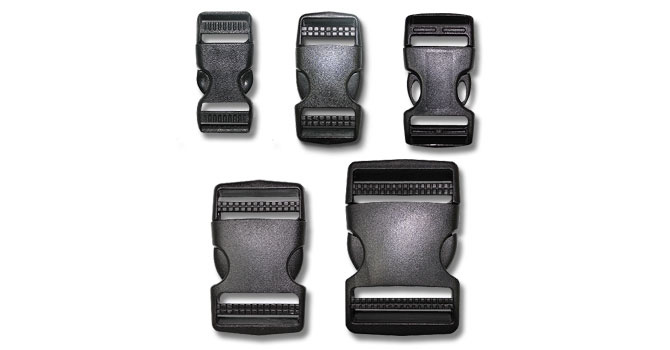

It’s always a question of whether you’re building a better mouse trap, or if you’re just trying to do something that’s different—something that’s gimmicky. You’re always balancing what’s unique for the sake of being unique—not necessarily because it’s providing a better solution—versus what’s unique because it’s actually offers a functional improvement.

There are a couple of examples like that. Nobody’s really figured out a better solution than a zipper. But zippers fail; they wear out over a certain period of time. The side-release buckle is a design that is ubiquitous across all packs, and there are different aesthetic treatments to it, but, functionally, they all do the same thing: a two-part click. But there are always people exploring what could be better in that space.

Manaugh: One of the things we talked about a few years ago when I first met you at The North Face was that there are differences in tent design between the North American and the European markets. You mentioned then that, in Europe, campgrounds are so crowded that a different level of privacy is expected from a tent, whereas, in the U.S., you can get away with using much more transparent materials, because you might be the only people at a certain campsite for two or three nights in a row and you don’t need as much privacy.

The REI Half Dome 2 Plus Tent, with and without cover; via REI.

I’m curious, now that you’re doing consulting with different companies, different regions, and different markets, how these sorts of cultural differences play out in the design of outdoor equipment in general.

McGuire: The commercial world has gotten a lot smaller, and the ability now to connect with people in those very different cultures has become much more commonplace. That’s true everywhere, I think. I mean, sitting where we are today, we have a lot of people coming through the Eastern Sierra who have traveled all the way from Europe.

I actually just talked to a guy over there in the parking lot on a motorcycle who’s over here from Germany, on his way to Jackson Hole. He said he happened to be swinging by here on his way from Atlanta. I still haven’t figured out the geographical connection to Atlanta, if you’re on your way to Wyoming, but…

Manaugh: [laughs] He was too embarrassed to ask for directions.

McGuire: But it is interesting to see a foreign product in a local environment—you can see where it seems a little odd, and you can try to find out why those little moments are there in the design. There’s also a need to expose yourself to those other places. That means being in Europe and seeing that user; it means being in Japan and seeing that user.

The Big Agnes Copper Spur UL1 Tent with and without cover; via REI.

Oftentimes, there are unique, local solutions to global problems, and these can influence global gear designs and become ubiquitous. Just as often, there are very specific needs to solve a local issue that are non-transferable. I’ll give you a classic case in point. We just talked about mountaineering in the Eastern Sierras. Well, all of our access is car-based. Everybody drives to a trail head, gets out of their car, and walks up a trail that is highly likely to have no one else on it, and, from there, they end up at the place they’re climbing, and so on. It’s not uncommon for people here to go out and, from the time they leave their car until they bag their peak and come back, they never see anybody—not even a trace of another person.

But in Chamonix, over in France, there’s a parade from 7:00 am every morning. If you sit at the base, where the trail goes up Mont Blanc, you can watch people coming down with their coffee and their croissant, and they’ve got their crampons in the back of their pack. They’ve got all of their gear. They’re going to climb into a tightly packed gondola with 50 or even 100 other people, and that’s all before they even start their climb.
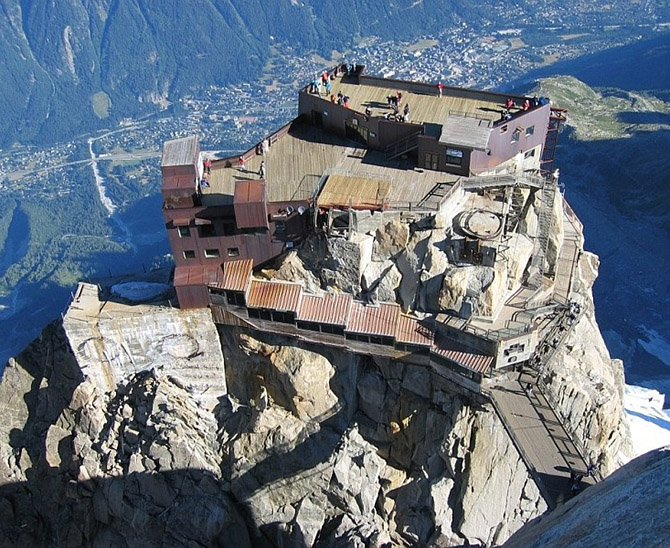
Two photos of architecture on the Aiguille du Midi in Chamonix, France; uncredited; found via Google Image Search.

So, here, in the Eastern Sierra, you can just say, Jed Clampett-style, eh, my crampons are over here, my ice axe is here, and, as long as my hiking partner isn’t within five feet of me, well—hook, swing—who cares? But when people start getting into a packed tram system in Chamonix, and they’ve all got to scoot together, you really need to start thinking about how you protect all those sharp points. How do you make sure no one’s exposed to those? You’ve got to know where those are.

Those differences are where I think a lot of the challenges are. It’s not necessarily intuitive that something that’s highly successful in one region will automatically have traction in another. Creating a globalized product in a highly specialized market can be very challenging and, oftentimes, there has to be a tolerance. You either have to have tolerance for a broader product assortment to meet regional needs, or you have to accept the fact that you may have a product that’s not specialized enough to hit the local super-user, because you’ve traded off specificity for an ambiguity that will reach more people.

Nicola Twilley: It seems to me that, although in your work you’re responding to the user, the user is also responding to the landscape—so, in effect, you’re responding to the landscape, too. When you look at a landscape, do you more typically see it in terms of what sort of activities you might do there, or are you looking at the landscape from the perspective of the gear you might need?

McGuire: In terms of gear, you do see the differences. I mean, take the west coast of the United States. The climbing conditions for a 40-liter pack in the North Cascades involve a much wetter environment, with much wetter snow and a more volatile climate all around, as far as sudden changes in weather go. But, here in the Eastern Sierra, you can probably plan on the fact that it’s not going to get any precipitation for the next 90 days. You don’t really have to think about bringing a ton of rain gear with you, because we just don’t get storms that show up out of nowhere or weather patterns that suddenly convert. That nuance in meteorological conditions will change what the customer’s wearing, which will change how their pack fits, which will change what they’re carrying, which will change how they store things inside the pack, because of what comes on and off and what they need access to. All those things come into effect.

Then you have geographic nuances—the way the different physical characteristics of the environment that you’re in are going to damage the pack. For example, if you are in a volcanic area, where you’re doing a lot of chimneying, you’re going to end up with a high abrasion area. The impacts of a granite environment and a lot of scree will have a different impact on gear than someone in a classic glacier environment.

So there are geologic elements and there are meteorological elements—and both have an impact on the product itself and an impact on what the user does there. The gear you need in a landscape and the activities you are going to do in that landscape are always going to feed into one another.

Twilley: So you can’t optimize a technical pack for the Eastern Sierra and for climbing in Washington State simultaneously, right? That wouldn’t be the same pack?

McGuire: True. All design at some point is a compromise. If you use vehicles as an analogy, the SUV is the ultimate compromise. It doesn’t really carry everything and it doesn’t drive like a sports car, but it’s still managed to fulfill this niche for people. It does enough things pretty well that it allows them to find their solution in one product. That’s an elusive role for packs. It’s why people who end up being pretty active rarely own one pack—they own two, three, or four of different literages, different weights, different carrying capacities, and different materials.

An early U.S. Geological Survey field camp; photo courtesy of the USGS/U.S. Department of the Interior.

Manaugh: This is a fairly silly question, but I’m curious if, on a day where you have a lot of free time—you’re lying in a hammock in the mountains somewhere—you ever find yourself thinking that you could design a pack that would be absolutely perfect, but only for a very, very specific place. It would be the ultimate pack for a particular trail in Arizona—but for that trail only. It would be useless in Utah or on a trail in the Alps. And maybe it would cost $5,000—but it’s the perfect pack. Do you have dream gear like that?

McGuire: [laughs, pauses] At the end of the day, that’s what every gear head does. Not just the pack—they’re on the quest for the perfect kit. Unfortunately, what happens is that a large factor in enjoying the outdoor environment is wanderlust. As soon as your kit is perfect in one place, not only does the gear itself change over time or through use, but, usually, your reaction is, “Great! Now that I’ve experienced this, let me go to this other place…” And all of your metrics have been thrown off. You start building the perfect kit all over again. So, as soon as that’s obtainable, your own interest level changes, and it goes away.

Of course, I’m not actually a designer, in that I don’t really put pen to paper. I work on strategy and process, with people who do the pen-to-paper side of things—people who are highly creative and sometimes even have an arts background.

Courtesy Osprey Packs.

One of the best examples of that kind of designer, and one of the people I admire the most in this space, is Mike Pfotenhauer, who’s the owner and designer of Osprey Packs. Mike is classically trained as a sculptor so, when you look at Mike’s pack design, there’s an aesthetic to his product that speaks to his ability as a sculptor. It’s very rare that you see straight lines. I’m convinced that if Mike could get someone to weave for him a curved webbing, his packs would all have curved webbing on them. He wants things to have this organic flow, which means there’s a signature to his packs, because he’s only worked on one brand as an owner and designer for his entire career.

Courtesy Osprey Packs.

But, when you look at the actual function of his designs, he’s a real user. He’s a backpacker. He doesn’t let his aesthetic override the fact that, as a user, he knows his end product has to work. Case in point: take the webbing. At the end of the day, something needs to be able to pull and compress. If the pieces of webbing that are the most effective at doing that require straight lines to pull, then he knows the pack’s aesthetic needs to give way to the fact that there’s a functional need calling for something different.

Courtesy Osprey Packs.

Twilley: Given the importance of the user and the landscape, can you talk a little about how this gear is tested? Are there labs filled with simulated environments where packs are repeatedly rubbed against things, or sprayed with water and then flash-frozen to see what happens?

McGuire: There are three legitimate forms of testing. There’s the ASTM/EN, with the ASTM being the American Standard Testing Method and EN being the European Norm. These are scientific methodologies around proving whether something’s working in the right way. Those are usually at an item level. Then, there are ASTM things around complete packages like insulation warmth ratings for sleeping bags. There are rules around how to properly gauge the square footage and volume of a tent or the volume of the inside of a pack. So these are metrics that can be tested.

On the testing from a durability standpoint, oftentimes it’s specific devices that measure individual materials.

Twilley: Oh, so it’s not the complete pack. You just test a particular buckle, for example.

McGuire: Yeah. You might pull-test the buckle to make sure it can survive a 300-pound pull test. You might take a piece of material and put it on a Taber machine and see how many cycles it takes until the machine rubs a hole through it to see what the material’s abrasion durability is. Or you might do a tensile tear strength test to see how a tear would propagate in a rip-stop and how functional the rip-stop is.

These are functional tests that are relatively close to reality, but then there are also reality tests. The classic example of that is a lot of factories and companies will have access to things like very, very large commercial dryers; somebody has taken the time to open them up and bolt 2x4s and climbing holds and all kinds of stuff to the inside of the dryer. Then you throw a pack or a piece of luggage onto it, turn the dryer on, and let it just beat the daylights out of something till you see where your failures are.

Or you’ll have jerk tests on handles, where you’ll have a weight that—over and over again—will simulate the grabbing of a shoulder strap with a 60-pound pack and throwing it over your shoulder. What does that do to that seam? You’ll simulate it over and over again, and you’ll see, as you grab the shoulder strap and yank on it, if you yank a little this way or you yank a little that way, you end up putting different seam stresses on each place.

These sorts of reality-based testing devices are, oftentimes, custom manufactured. They’re not necessarily scientific. They’ll run through the cycles so that you see where there need to be improvements, but there’s not really a standardized test to measure it against.

But, still, today, in this industry, nothing beats human use.

Twilley: You mean field-testing?

McGuire: Product failures in this space are rarely attributable only to one thing. It’s almost always systematic. For instance, the shoulder strap didn’t fail because it was getting pulled up and down; the shoulder strap failed because of the way it was stitched, and then the way it was worn by the user, which created a spot where it sat on the shoulder blade, and that wore the stitching down over the course of a 600-mile trip, which then exposed the motion to a failure. An abrasion test on its own or a jerk test on its own wouldn’t expose that, but, in real world use, those two things combined expose a weakness. This is where human testing really is the quintessential component to make sure things work right.

This is also why so many people in design—in fact, every single person I know who was an inventor of an outdoor product in the 50s and 60s, during the real heyday of our industry—came into prominence not because they were designers. They were users who, by necessity, turned to design to solve a problem.

Image courtesy of Skipedia.

This is how Scot Schmidt created the original Steep Tech gear for North Face. Scot didn’t want to be a clothing designer—at least, from everything I heard from him. Scot just wanted to be a skier who didn’t have to deal with duct taping his knees and shoulders because he was skiing in such horrendous conditions and he kept tearing the fabric.

The original North Face Mountain Light jacket with its “iconic black shoulder”; photo courtesy ZONE7STYLE.

The iconic black shoulder of the original North Face Mountain Light jacket came about not because someone thought, “Wow, straight lines and bold blocking is going to look awesome.” It came about because someone said, “I need a super-durable material because, when I throw my skis over my shoulder to hike up this ridge, the straight skis of the 1970s and 80s rub a hole through my jacket”—and the only thing available at the time was a 1680 ballistic nylon that only came in black because it was for the military.

You end up with an iconic design that was never intended to be an iconic design. It just happened that way because of a specific need, and it evolved to become an icon.

Photo courtesy The North Face.

Twilley: Are there landscapes that gear innovation has opened up, in a way? Obviously, there are extreme landscapes, like Mt. Everest or Antarctica, where the right gear can be the difference between making it or not, but are other types of landscapes now opening up through innovations in outdoors gear?

McGuire: For sure. I think ever since people started pushing the limits of where they could survive, the types of landscapes available to people have changed. There are the extremes, like you mention, of being up in the Himalayas—up at high altitude—where gear has had an absolutely huge impact. But I would say that one of the challenges in our industry has actually been that, for the most part, for better or worse, most of the impacts on design from extreme environments happened more than a decade ago.

What’s happening today, I think, that’s now driving some of the greatest innovation aren’t the extremes of the environment, but what people are trying to do in that environment on either end. It’s the book-ends of either extreme. In other words, design is being driven now by people who are going much farther, much faster, and much harder than they ever did before.

Take the idea of building a product for hiking the Pacific Crest Trail—which is 2,400 miles. Typically, that would take four to six months—and, in 1970 or 1980, that was a pretty extreme environment. Now, that environment hasn’t really changed—there’s global warming, of course, so there have been changes in the glaciers and so on—but, effectively, that trail is the same as it was for the past forty or fifty years. What has changed now is that people are coming in and saying: “I want to do the entire Pacific Crest Trail, and I want to do it in ninety days. Instead of doing eight to ten miles a day, I want to do twenty-five or thirty miles a day.” In order to do that, people who were comfortable with carrying a 60-pound pack on the trip are now saying that there’s no way they’d go out there with more than 30 pounds. In fact, on the far end of that, people are saying they should be perfectly comfortable, and fully safe and functional, with only a 15-pound pack. Put all that together, and that necessitates a new kind of design.
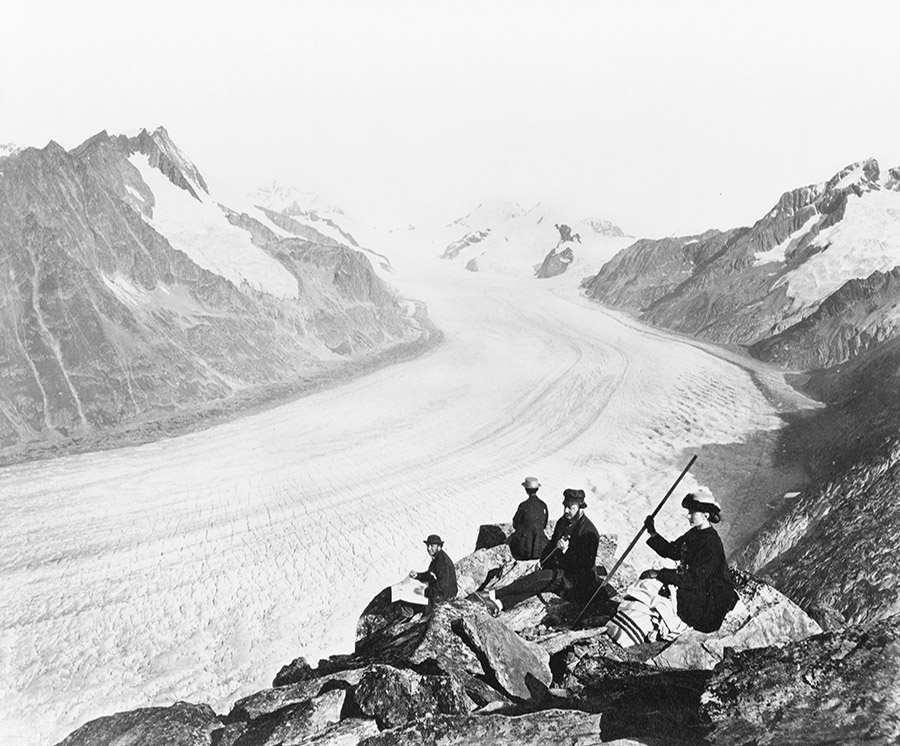
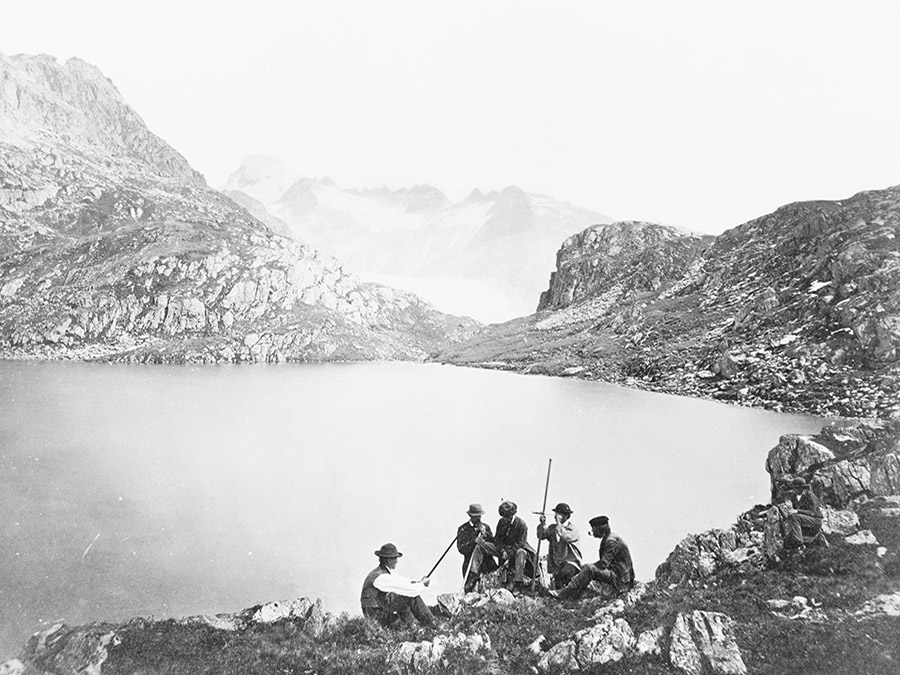
Aletsch Glacier“; “Lac des Morts, Grimsell“; and”Aletsch Glacier, Eggischorn.” All photos taken between 1860 and 1890. Courtesy of the U.S. Library of Congress Prints and Photographs Division.

But there’s also the other extreme. We have a society that is spending less and less time in the outdoors. What we’re finding, on the other end, is that the goal is to just make sure the approachability of the outdoors is simple enough, and convenient enough, and affordable enough, that, when people are trading a weekend in front of their Wii for a weekend taking their family camping on the side of a river, that it’s not intimidating. It’s not scary. For instance, how do you design a tent for someone who’s never set up a tent before, or who thinks a tent is so expensive that it’s a barrier to entry? A tent that’s not so complex that I can’t even imagine using it? Or a tent that’s not so small that I can’t stand up and change my clothes? What does that look like?

So you have these very divergent activities, these very different spaces, but, in each one, you have people who basically need something—they need a piece of gear or equipment—that can allow them to have this experience. That’s where I think most of the innovations have come from in the last decade. It’s not the middle ground. It’s these extreme fringes on either side.

Manaugh: Do you find, ironically, that the guy who wants to be home playing Wii all day in the suburbs is actually the more challenging design client?

McGuire: Well, let me back up a bit. If you go to a company like Procter & Gamble, for example, you find people there who are working as industrial designers, and they’re trying to think like a customer who they just might not be. But, in this industry, you have people who are really just trying to solve their own problems, in their own tinkering way.

Photos courtesy of the Outdoor Retailer show.

The Outdoor Retailer trade show is a very unique environment, in that regard. It’s like a tribe. You walk into that outdoor retailer environment and, if you’re in the outdoor industry, you can see straightaway who’s there and who’s not there—meaning, who’s part of the tribe and who’s a visitor. It’s a group of a lot of the same people, over decades now, doing a lot of the same things. You might see different companies and different brands over time, but what you don’t see is a lot of people from outside of that space showing up there. If you’re an outsider and you show up—if you’re trying to pose like you’re there, and trying to sell into that space—that group smells your inauthenticity right away. But, now, this tribe mentality is starting to recognize that the future of the industry is outside of our own doors. In fact, not enough people are finding their way into the tribe on their own and we have to bring in more people.
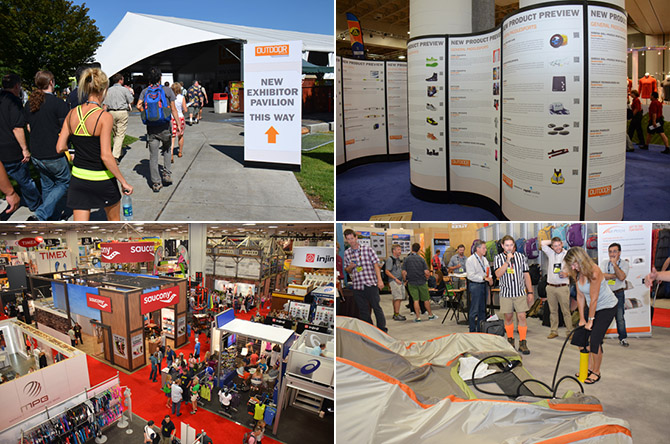
Photos courtesy of the Outdoor Retailer show.

So the industry itself has been wrestling with this. How do we go out and approach someone? I’ll use an analogy. In the industry, there have been three rings of people: there’s your hardcore ring of people who are absolute purists: “I make it all myself. And I’m so badass, no one even knows where I go.”

They’re almost elitist in their pursuit of their sport. But then you have another side, which is a group of people who like the outdoors, but they’ve recognized that there’s commercial value there. They are mostly driven by the business side of it. They’re people who want to work in the outdoor company sector because they like the idea of going to work in a T-shirt and jeans, versus wearing a suit, and their skills lend themselves to this space, but you also kind of know that a person like that isn’t really from here because their core motivation is: “Wow, we can make money off of this!”

So the ex-suits don’t get the hardcores, and the hardcores resent the fact that all these ex-suits are showing up. Then there’s this tiny group in the middle who are interested in the business side, but they also come from the hardcore side at one point—and, what’s interesting is that all of these people in this group of three circles in the industry right now are wondering: “Who’s going to come in from outside our three circles? Who’s going to drive the business going forward? Who are those people?”

Photos courtesy of the Outdoor Retailer show.

There were some good industry numbers that came out recently where, for the first time, we’re seeing the number of young people getting exposed to the outdoors is on a slight uptick. I would say it’s encouraging news. It’s not good news, because we still have a long way to go. But, from a design standpoint in the industry, that’s something that appeals both to the suits—“Wow, new customers! More money!”—and also that center group, along with the old hardcores, who love seeing the interest and the energy grow. They all see that, from a culture standpoint, we need this: the stronger our tribe is—the more people who come into it—the better it’s all going to be.

But I have a love/hate relationship with some of the solutions that have come up in the past few years. Here, in the Eastern Sierras, we have a pretty robust program where you can get on the phone in Los Angeles and call a company that will deliver a camping trailer to a campground here for you. You drive up in your little economy car from the city, and you pull into a campground, and the there’s this 26-foot trailer sitting there waiting for you, with all the comforts of home. It’s got a mattress; it’s got running water; it’s got a toilet; the refrigerator is eve pre-stocked. The stoves are there. There’s propane in the tanks. It’s like a pop-up hotel.

The “love” part of me is that more people are now actually making the trip. It’s like a gateway drug. Somebody who might not have got in their car is at least opening their door at 6:00 in the morning and smelling trees and not being in a parking lot at a hotel somewhere. So it’s a start.

The difference, though—the “hate” part of me—is that there’s nothing like being out there in the dark, putting a tent up, finding a site. You know, maybe I’m a little bit of a sadomasochist in this regard. But, for me, when you’re in the outdoors, tripping over the picnic table and trying to figure out where the guylines go, and dropping stakes and wondering if you remembered to put them all in… Not that I want to see people suffer! But part of it is actually about the dirt under the fingernails—it’s that sharp rock under the tent that keeps you awake at night.

But, as long as people are making the trip, and, from a design standpoint, as long as we’re making a product that eases that transition for people as much as possible…

The LogPlug and RokPlug projects by Archigram, courtesy of the Archigram Archival Project at the University of Westminster.

Manaugh: It’s funny, your trailer example actually reminded me of this group of architectural designers in England in the 1960s/early 70s called Archigram. They were somewhere between science fiction and Woodstock. They had this one series of designs—and it was all totally speculative—for fake logs with electrical outlets that could be put out in the woods somewhere, and even fake rocks that could act as speakers, and so on.

The LogPlug and RokPlug projects by Archigram, courtesy of the Archigram Archival Project at the University of Westminster.

But the funny thing is that the intention of the project was to get more people in 1960s England out of their middle-class houses and into the wilderness, to experience a non-urban environment. Of course, though, the perhaps unanticipated side effect of a proposal like that is that they were actually just extending the city out into the woods, letting you take all these ridiculous things, like TVs and toasters, in the great outdoors with you, things that you don’t ever really need in that environment in the first place.
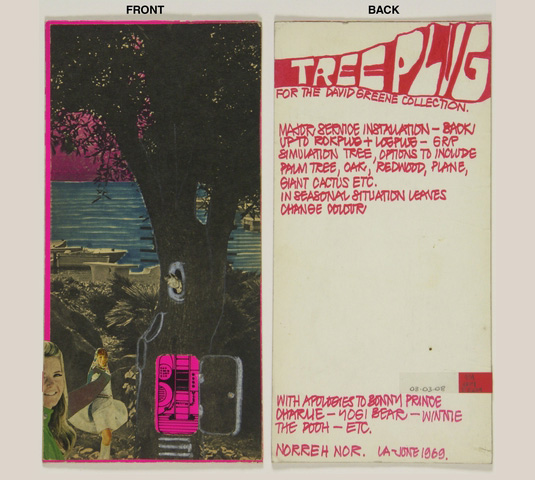
The LogPlug and RokPlug projects by Archigram, courtesy of the Archigram Archival Project at the University of Westminster.

In other words, it seems like an almost impossibly thin line between enticing people to go out into a new environment versus simply taking their ubiquitous home environment and infecting someplace new with it. The next thing you know, the woods are just like London and the Eastern Sierra are just like Los Angeles.

REI’s portable, pop-up, outdoor Camp Kitchen. Are outdoor equipment manufacturers the true inheritors of Archigram‘s speculative design mantle?

In any case, I wanted to return to something you said earlier about ballistic nylon materials that had originally been developed by the military. Are you still finding materials and technical innovations coming out of the military that can be “civilianized,” so to speak, for use by outdoors enthusiasts? For instance, I recently read that the military has developed silent Velcro, which seems like it could be useful for backpackers.

McGuire: Definitely, yes. On the military side of things, what’s different now, is that, except on very rare occasions, people today are not humping huge loads over long distances to fight wars. Soldiers are now incredibly mobile. They’re vehicle-based; they move in; they move out; they carry just what they need; they get the job done; and they’re gone. We have a lot of people coming back from wars today—and I’m not at all taking away from what they’re doing—but their war experience is unlike even just a few generations ago, where you put your pack on and everything you needed was in your pack and you were gone out in the wilderness somewhere for a year. We increasingly have soldiers who get in a Humvee, go out for a day, maybe two days, and then they’re back at base.

“New York Central Issue Facility Strives to Get National Guard Troops Latest Gear.” Image and caption courtesy of the U.S. Army.

What I think we’re seeing, culturally, is a lot like this. The patience for long-term adventures is waning. People want to go out and have an experience. They want it to be quick. They want it to be impactful. They want it to be memorable. And, to be honest, they want it to be easy. It’s the “I want to see Europe in five days and here are all my pictures” thing. It’s speed and efficiency. Well, one area where the military is lending some benefit is that they’re developing a lot of specialized gear for these in quick/out quick, intense experiences. You’re seeing things like the MOLLE system—what is it, Modular, Lightweight, Load-carrying Equipment?—and that modularity is seeping out of the military to influence outdoor gear design, where you’re able to have a base system that can increase or decrease in size, depending on the specifics of your day and what you’re going to go out and do. These are influences that that are now starting to show up.

“The Army is able to swiftly deploy soldiers where they’re needed and part of that is ensuring soldiers are properly equipped. The materials they need-they need fast, and that’s where a rapid fielding initiative team comes in.” Image and caption courtesy of the U.S. Army.

And there are some strong crossovers, in things like hydration, that are now becoming much more ubiquitous. We aren’t seeing that crossover quite as influentially as the original A-frame tents, or the development of sleeping bags coming out of World War I and World War II, but we’re certainly still seeing it. But I would say that the most significant recent impact are things like GPS—highly specialized technical solutions that make things work much better and much easier, and that don’t take up a lot of space.

GPS is military-based, and the ability to know where you are, where you’re going, and how to get back, without having to rely on map knowledge, has opened up all kinds of confidence for people to get into new places. Personally, I love using a GPS, but I still think you ought to know which way north is and how to read a map—because batteries die.

We’re also still seeing new materials come out of the military, like super-lightweight parachute fabrics that are allowing people to have highly tear-resistant, lighter-weight equipment. And, even with helmets, the foams used in lighter-weight, highly protective helmets are changing, mostly as a result of IEDs.

Combat helmets with sensors attached are part of “the next generation of protective equipment” for the U.S. Army. Image courtesy of the U.S. Army.

So, yes, we are seeing elements of the military trickle into outdoor gear. I just think that, with the needs of the military being what they are today, and the way that wars are being fought now, it just happens to serendipitously fall in line with a cultural desire for short, fast, light outdoors experiences—you’re done and you’re back. It is a bizarre overlap, but you’d be hard-pressed to say it’s attributable to one or the other.

Manaugh: To build on that question of cultural shifts, when you said that more kids are starting to go outdoors, I immediately wondered if at least part of that is due to a pretty huge rise in popularity of things like alternative sports: X Games, BMX, skateboarding, and so on, all those urban subcultures that I grew up with, but that had no real media attention at the time. They’re now becoming more and more mainstream. I suppose my question is: is the city its own form of “outdoors” now, and are alternative urban sports a kind of indirect way of getting kids interested in forests, or rock-climbing, or going bouldering?

Twilley: I might even add to that, to speculate that kids exploring sewers or breaking into abandoned steel mills are perhaps experiencing the same kind of thrills that the first generation of outdoors enthusiasts did in the West. Is urban exploration the next big opportunity for gear in the future, given our increasingly urbanized world?

McGuire: I think I’d say yes to both. Something that’s endemic to the outdoor industry is, first and foremost, the idea of having an experience. It’s about stretching where your comfort level is. So I would say pick whichever sport you want—skate, snowboard, mountain bike—those sports have allowed people to stretch what they believe they’re capable of. Whether you think that what people are doing on the west shore of Vancouver with mountain biking, and pushing the mountain biking free-ride space, is good or not, at the end of the day what we have is a generation of people who are having an experience that’s not inside of four walls. They’re pushing their comfort levels, and they’re having an experience and a memory that involves fresh air.

Martin Söderström in a timelapse jump, courtesy of Red Bull.

What we’re seeing among the youngest generation today is there is much less identity around sport specificity. I’m almost 40. When I grew up, you were a surfer or you were a skater or you were a climber or you were a road biker. But kids today don’t think anything like that—they think, “I do all of those things!” Why would I not be someone who is a skier who’s also into bouldering who’s taking up trail running and who competes in Wii dance competitions? Why can’t I be that person? There’s a sense that I will be whoever I want to be, whenever, and of course I will be multifaceted.

When we start talking about trying to build gear for those kids, you want to make sure that the gear allows them to do the current activity—and that might be more urban-influenced, like skating and biking—but, as they grow and stretch, it isn’t a hindrance to their next thing. Does your free-ride hydration pack let you try trail running? I think people are discovering on their own where their next challenge is, but the way they’re discovering it, and the tools they’re using to discover it, aren’t yet in the view of the popular side of the industry.

Spanish freerider Andreu Lacondeguy from Where The Trail Ends; photo by Blake Jorgenson for the Red Bull Content Pool, courtesy of Red Bull.

I’ll give you an example. I live in a place just down the road from here called McGee Canyon. It’s a beautiful canyon. I was going for a trail run the other morning; it was relatively early, about 7:30 in the morning, and I see these kids walking toward me. The guy is in jeans, Vans, his hat’s cocked off to the side; he’s got a hoodie, a t-shirt. It’s got some outdoor qualities to it, but it’s got some hip graphics. Kind of unshaven. He could just as easily have been walking down the street in the Mission District. His girlfriend’s in Toms shoes with knee-high, super bright-colored stockings, board shorts, a hoodie, big sunglasses, a hat. A very, very unlikely couple to see walking down this trail at sunrise. It was kind of surprising.

Photos courtesy of Poler.

I actually stopped running and I said, “Hey, where are you guys from?” They’re from Los Angeles. What they’d done is they’d taken their iPhones and they’d decided to go for a hike up to a place and take some Instagrams of waterfalls and flowers with their phones to share with their friends.

Photo courtesy of Poler.

So, are they hikers? I mean, she’s hiking in a pair of Toms and knee-highs, which are not really hiking products. But this is a generation who don’t see why they can’t leave the trail, go to town, have lunch, and go to the skate park and skate all afternoon, and not change gear. But the outdoor industry is having a hard time reconciling that.

Photos courtesy of Poler.

How do you talk to a customer who is that different from us? There is, right now, in the industry, a huge generational gap where most of the people in the industry, culturally, simply don’t understand their audience. What we’re seeing out of that is that new brands are starting to emerge that are able to translate the surf-skater or the city-hipster culture into this interest in outdoor experience in unique ways. Brands like Poler out of Portland, or Alite in San Francisco, with Tae Kim: these guys are actually starting to create brand identities that appeal to a customer that the outdoor industry still doesn’t get… You know, the outdoor industry has always tried to say, “Come to us!” And Poler and these other guys are saying: “We make a product that’s coming to you and to your aesthetic.”

Photos courtesy of Poler.

Twilley: Is figuring out how to serve that new kind of customer part of the work you do with Mountain Lab?

McGuire: What I’ve been doing is working with companies that know they need something, but they aren’t quite sure what it is yet. Of course, I don’t necessarily have all the answers for them, but my job is to help assemble the right teams of people—to find the people who can work on and solve that problem. I rely very heavily on a vast network of people: people who are professors of ethnography and cultural anthropology, people who are designers in Sweden and have a background in a very clean aesthetic, and people who are, you know, hipster skaters into trail running who live in New York City.

How do you take those people and put them together on a team with a common problem? Here’s the designer who has the right aesthetic, something that matches the brand value, and here’s the ethnographer who can say that this is who the customer is today, and this is what the design experience will need to look like, from a marketing standpoint, to communicate something to that customer.

The “lab” part of Mountain Lab is really the assembly. What are all the things that go in the pot to make the special sauce? It’s putting those things together.

Twilley: And what’s the product at the end? A recommendation? A prototype?

McGuire: It’s a mix of things. We’ve done things as simple as assembling business plans for startup companies, so they can go out and receive their second or third level of funding, to actually creating design briefs and pricing metrics, all the way through to completed design packages presented back for line review. Our main focus is not just what the solution is now, but what the solution will be—how things are changing, and how you know what customers need—that incremental step of asking “What does this look like in phases A, B, C and D?”

Manaugh: Finally, how does the internal structure of Mountain Lab work?

McGuire: It’s a revolving door. I’m the only constant within the Mountain Lab today. I would say that there are eight to ten people who, on any given week, are part of my regular repertoire of who I go to. Some I go to more than others, but, at this point, everyone is independent.

In Steven Johnson’s book, Where Good Ideas Come From, he talks about the coffee shops of the Renaissance period. For me, a lot of what Mountain Lab is about is having that kind of network of people—I know that I want to have these eight people around the coffee table to share ideas. And, on the next project, or even the next phase of the same project, it might be that these four need to stay, but then we need fresh insight from these other four. And we keep changing it up. There are times where I’m not part of the conversation at all. I may be introducing two or three people, setting the stage for their dialogue, but then just taking what they’ve reported back out and adding it into another dialogue next year.

That’s part of what allows me to live in the Eastern Sierra. I live in the middle of nowhere, where nobody I work with lives, but I also live in a place that, in my industry, is deeply rooted with all the customers I work with. So technology allows me to move well beyond the Eastern Sierra, but my proximity to the end-user here allows me to stay really focused on being close to what they do and what they need.

I didn’t think, though, when I started the Mountain Lab, that it was going to be quite the way it’s been. I thought there would be a lot more design work being done in-house with people. The virtual nature of the teams, and the success we’ve found in that virtual collaboration, has surprised me. I’ve also been really surprised—pleasantly surprised—by the people I’ve been able to connect with. I didn’t, in my wildest dreams, ever think I was going to have some of these opportunities twenty years ago, when I first got into the outdoor industry.

I remember going to the very first Outdoor Retailer show with a close friend of mine, walking through the doors, and looking around, and feeling like a kid in a candy store. Now I have friends in those companies, and I can call up these industry legends and say, “Hey, I’m working on this new idea. What do you think?” Or, “Do you know the right person? Where would you go?” I’m so grateful for that opportunity, and for being able to keep that creative stoke alive.

• • •

For more Venue interviews, on human interactions with the built, natural, and virtual environments, check out the Venue website in full.

They Come From Everywhere: An Interview with Mike Elizalde

Many of today’s most original and bizarre visions of alternative worlds and landscapes come from the workshops of Hollywood effects studios. Behind the scenes of nondescript San Fernando Valley offices and warehouse spaces (if not outside California altogether, in many of the other nodes in the ever-expanding global network of cinematic effects production, from suburban London to Wellington, New Zealand), lurk the multidisciplinary teams whose job it is to create tomorrow’s monsters.

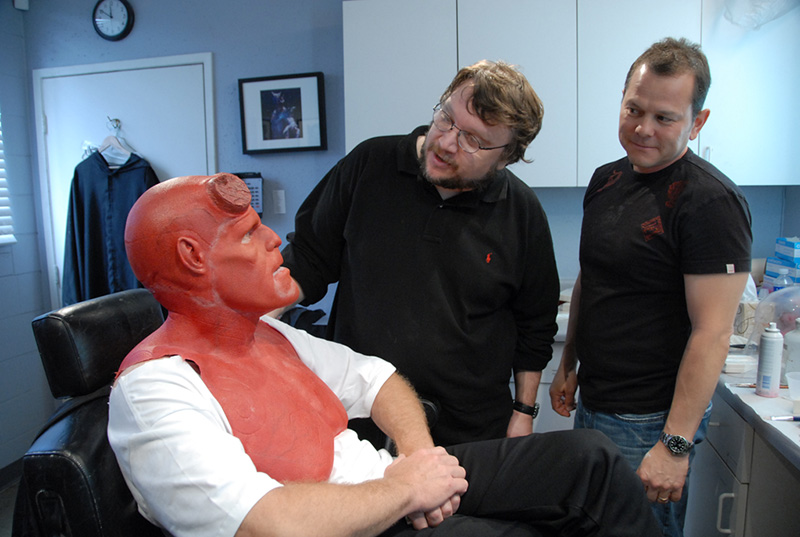
Mike Elizalde of Spectral Motion applies make-up to actor Ron Perlman, as Hellboy.

Spectral Motion, the effects house responsible for some of the most technically intricate and physically stunning animatronic creatures seen in feature film today, is no exception. Based in a small strip of anonymous one-story warehouse spaces squeezed in between a freeway and rail tracks, and overshadowed by a gargantuan Home Depot, Spectral Motion has developed monsters, effects, and other mechanical grotesqueries that have since become household nightmares, if not names.

Since its founding, by Mike & Mary Elizalde in 1994, the firm has worked on such films as Hellboy & Hellboy II: The Golden Army, Looper, Attack the Block, Blade 2 & Blade: Trinity, X-Men: First Class, The Watch, and this summer’s highly anticipated Pacific Rim.


This winter, while out in Los Angeles on a trip for Venue, I had the enormous pleasure of stopping by Spectral Motion with Nicola Twilley in order to interview Mike Elizalde, CEO of Spectral Motion, on a cloudy day in Glendale to talk all things monstrous and disturbing. To a certain extent, this interview thus forms the second part in a series with BLDGBLOG’s earlier interview with Hellboy creator Mike Mignola, and the present conversation, reproduced below, pairs well with Mignola’s thoughts on what we might call landscapes of monstrosity.

Our conversation with Elizalde ranged from the fine line that separates the grotesque and the alien to the possibility of planetary-scale creatures made using tweaked geotextiles, via the price of yak hair and John Carpenter’s now-legendary Antarctic thriller, The Thing.

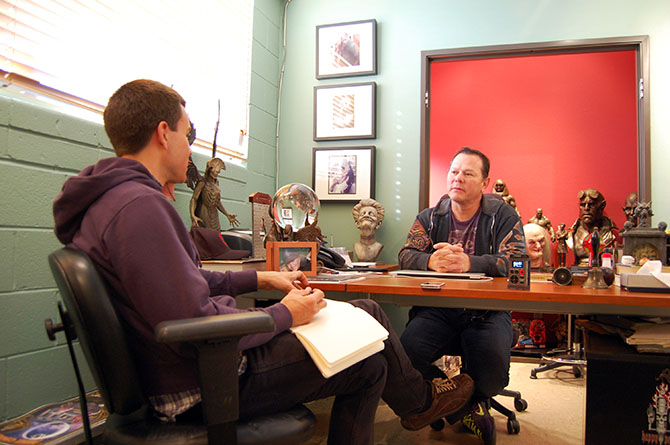
Mike Elizalde behind his desk at Spectral Motion.

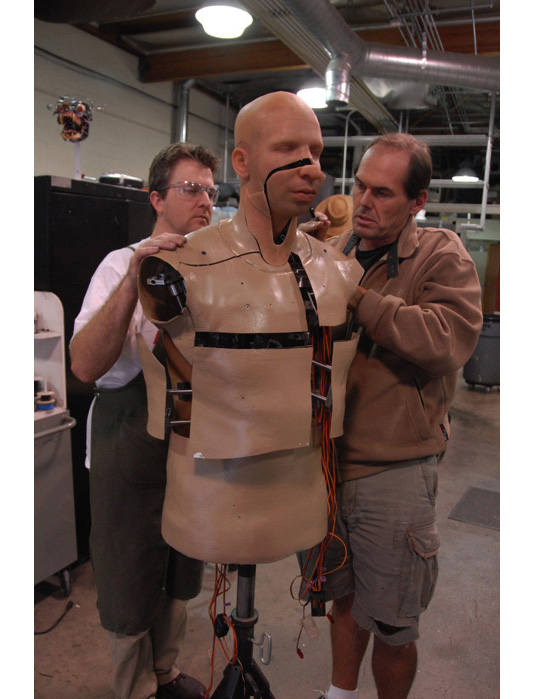
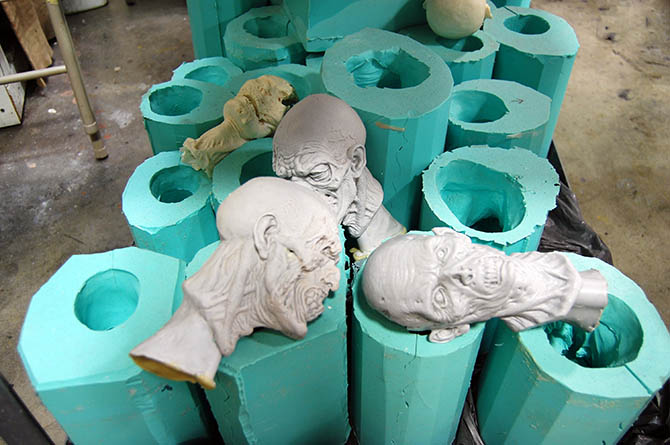
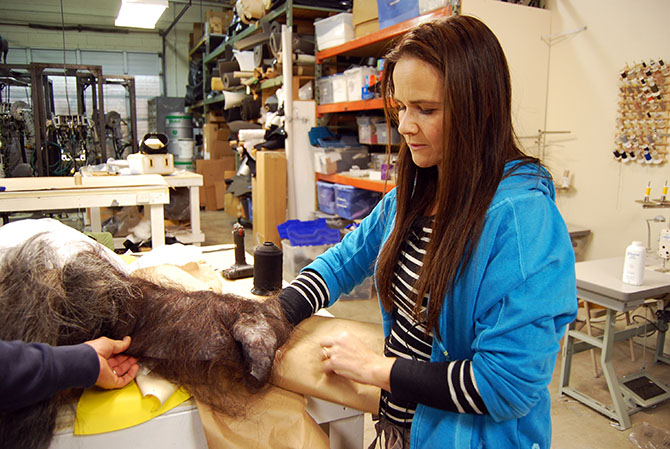
Elizalde, a good-humored conversationalist, not only patiently answered our many questions—with a head cold, no less—but then took us on a tour through Spectral Motion‘s surprisingly large workshop. We saw miniature zombie heads emerging from latex molds (destined for a film project by Elizalde’s own son), costumes being sewn by a technician named Claire Flewin for an upcoming attraction at Disneyland, and a bewildering variety of body parts—heads, torsos, claws, and even a very hairy rubber chest once worn by footballer Vinnie Jones in X-Men: The Last Stand—that were either awaiting, or had already performed, their celluloid magic.

The visit ended with a screening of Spectral Motion‘s greatest hits, so to speak, with in-house photographer and archivist Kevin McTurk—a chance to see the company’s creations in their natural habitat. We walked back out into the flat light and beige parking lots of the Valley, a landscape enlivened by our heightened sense of the combination of close observation and inspired distortion required to transform the everyday into the grotesque.

• • •

Geoff Manaugh: I’d love to start with the most basic question of all: how would you describe Spectral Motion and what the company does?

Mike Elizalde: We are principally a prosthetics, animatronics, and special effects creature studio, but we are also a multifaceted design studio. We do a lot of different kinds of work. Most recently, for example, in partnership with one of my long-time colleagues, Mark Setrakian, we built anthropomorphic bipedal hydraulic robots that engage in battle, for a reality show for Syfy. It’s called RCLRobot Combat League. It’s pretty astounding what these machines can do, including what they can do to each other.

Battling it out in Robot Combat League with two robots—”eight-feet tall, state-of-the-art humanoid robots controlled by human ‘robo-jockeys,'” in the words of Syfy—designed by Mark Setrakian of Spectral Motion.

Nicola Twilley: Are the robot battles choreographed, or do you genuinely not know which robot will win?

Elizalde: Oh, no, absolutely—it’s a contest. It really is about which robot will emerge as the victorious contender.

RCL is not only one of our most recent projects, but it also shows that, here at the studio, we can do everything from a very delicate prosthetic application on an actor, to an animatronic character in a film, to something that’s completely out of our comfort zone—like building battling robots.

I always tell people that, if they come in here with a drawing of a car, we could build that car. It is a very diverse group that we work with: artists, technicians, and, of course, we use all the available or cutting-edge technologies out there in the world to realize whatever it is that we are required to make.

Mike Elizalde of Spectral Motion shows us a creature.

Manaugh: What kind of design briefs come to you? Also, when a client comes to you, typically how detailed or amorphous is their request?

Elizalde: Sometimes it is very vague. But, typically, what happens is we’re approached with a script for a project. Our job is to go through the script and create a breakdown and, ultimately, a budget based on those breakdowns. We take whatever we think we should build for that script and we make suggestions as to how each thing should look—what should move, what the design should be, and so on.

Other times, we’ll be working with a director who’s very involved and who maybe even has some technical knowledge of what we do—especially someone like Guillermo del Toro. He’s completely savvy about what we do because he used to own a creature shop of his own, so working with someone like him is much more collaborative; he comes to us with a much more clear idea of what he wants to see in his films. Lots of times, he’ll even show us an illustration he’s done. He’s the first one to say, “I’m not an artist!” But he really is. He’s quite gifted.

The creature known as Wink from Hellboy II: The Golden Army, designed by Spectral Motion, including a shot of the mechanical understructure used inside Wink’s left hand.

So he’ll bring us his illustrations and say, you know, “You tell me if it’s going to be a puppet, an animatronic puppet, or a creature suit that an actor can wear.” And that’s where our knowhow comes in. That’s how it evolves.

There are also times—with the robot show, for example—where they know exactly what they need but they don’t know how to achieve it. In those cases, they come to us to do that for them.

Twilley: Can you talk us through one of the projects you’ve worked on where you had to create your vision based solely on what’s in the script, rather than more collaborative work with the director? What’s that process like?

Elizalde: Well, I’d actually say that ninety percent of our work is that way. For most of the projects we work on, we do, in fact, just get a script and the director says, “Show me what this looks like.” But we love that challenge. It’s really fun for us to get into the artistic side of developing what the appearance of something will end up looking like.

We had a lot of fun working with a director named Tommy Wirkola, for example, who directed Hansel & Gretel: Witch Hunters. He was the director of Dead Snow, a really strange Norwegian film that involved this group of young kids who go off to a cabin where they’re hunted down by a hoard of horrifying zombie Nazi monsters. It’s really grisly.

Anyway, although Tommy did have really good ideas about what he wanted his characters to look like for Hansel & Gretel, there were certain characters whose descriptions were much more vague—also because there was such a broad scope of characters in the film. So they did rely on us to come up with a lot of different looks based on loose descriptions. In the end, the principal characters in the film were total collaborations between Tommy, myself, and Kevin Messick, the producer, and the rest of my team here at Spectral Motion, of course.

I’d say that’s a good example of both worlds, where you have some clear ideas about a few characters, but, for another group of characters, there really isn’t a whole lot of information or a detailed description. You have to fill in a lot of blanks.

Mark Setrakian, Thom Floutz , and Mike Elizalde of Spectral Motion pose with Sammael from Hellboy.

Twilley: What kinds of things do you look for in a script to give you a clue about how a character might work—or is that something that simply comes out when you’re sketching or modeling?

Elizalde: In a script, we basically know what we’re looking for: “Enter a monster.” We know that’s what we’re going be doing, so we look for those moments in the script. Sometimes there’s a brief description—something like, “the monster’s leathery hide covered in tentacles.” That kind of stuff gives us an immediate visual as to what we want to create. Then we explore it with both two-dimensional artwork and three-dimensional artwork, and both digital and physical.

In fact [gestures at desk], these are some examples of two-dimensional artwork that we’ve created to show what a character will look like. This [points to statuette above desk] is a maquette for one of the characters in Hellboy II—the Angel of Death. This was realized at this scale so that del Toro could see it and say, “That’s it. That’s what I want. Build that.” This actually began as an illustration that Guillermo did in his sketchbook, a very meticulous and beautiful illustration that he came to us with.

The Angel of Death from Hellboy II: The Golden Army.

But that’s the process: illustration and then maquette. Sometimes, though, we’ll do a 3D illustration in the computer before we go to the next stage, just to be able to look at something virtually, in three dimensions, and to examine it a little bit more before we invest the energy into creating a full-blown maquette.

The maquette, as a tool, can be very essential for us, because it allows us to work out any bugs that might be happening on a larger scale, design-wise. Practically speaking, it doesn’t give us a lot of information as to how the wings are going to work, or how it’s going to function; but it does tell us that a human being could actually be inside of it and that it could actually work as a full-scale creature. It’s essential for those reasons.

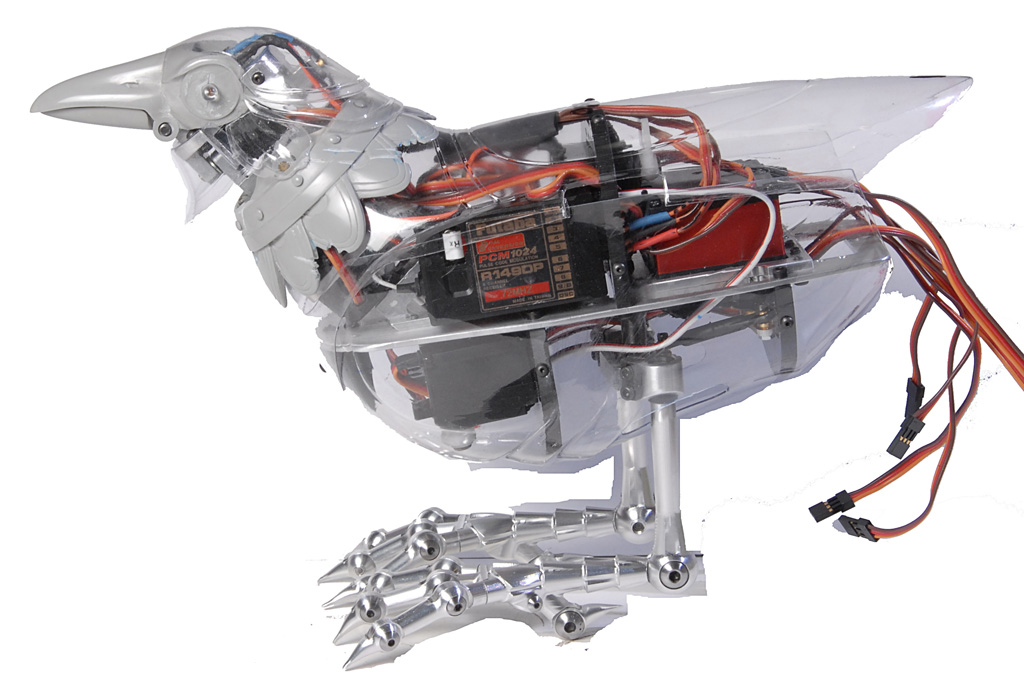
Simon, the mechanical bird from Your Highness, before paint has been applied, revealing the internal workings.

Because you can show a director a drawing, and it might look really terrific—but, when it comes to actually making it, in a practical application at scale, sometimes the drawing just doesn’t translate. Sometimes you need the maquette to help describe what the finished piece will look like.

Manaugh: You mentioned animatronics and puppeteering. We were just up at the Jet Propulsion Lab in Pasadena yesterday afternoon, talking to them about how they program certain amounts of autonomy into their instruments, especially if it’s something that they’re putting on Mars. It has to be able to act on its own, at times, because it doesn’t have enough time to wait for the command signal from us back on Earth. I’m curious, especially with something like the robot combat show, how much autonomy you can build into a piece. Can you create something that you just switch on and let go, so that it functions as a kind of autonomous or even artificially intelligent film prop?

Elizalde: It really depends on the application. For example, when we’re filming something, a lot of times there’s a spontaneity that’s required. Sometimes actors like to ad lib a little bit. If we need to react to something that an actor is saying via a puppet—an animatronic puppet—then that live performance really is required. But we always have the option of going to a programmable setup, one where we can have a specific set of parameters, performance-wise, to create a specific scene.

For live performances on a stage, we’d probably want to program that with the ability to switch over to manual, if required. But, if it’s scripted—if it’s a beat-by-beat performance—then we know that can be programmable. We can turn on the switch and let it go. In the middle of that, you can then stop it, and have a live show, with puppeteers in the background filling in the blanks of whatever that performance is, and then you can continue with the recorded or programmed performance.

It really goes back and forth, depending on what it is the people who are putting on the production need.

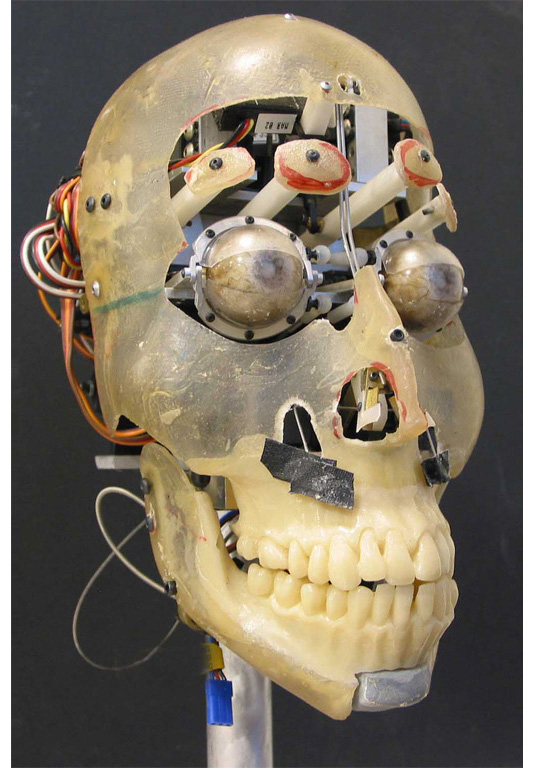
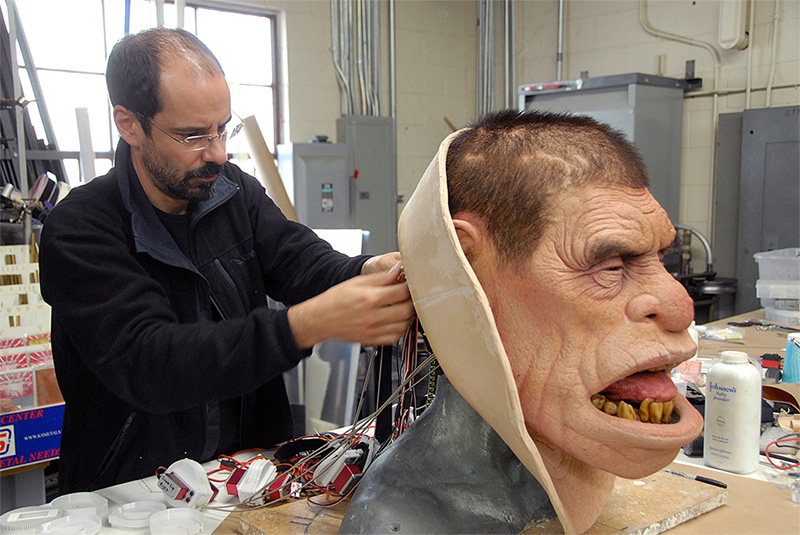
The mechanical skull under structure of the Ivan the Corpse from Hellboy.

Twilley: That’s an interesting point—the idea of how a live actor responds to your creatures. Have there been any surprises in how an actor has responded, or do they all tend to know what they’re getting into by the time you’re filming?

Elizalde: They do know what they’re getting into, but it’s always rewarding to have an actor go over to the thing that you built, and stare at it, and say, “Oh, my God! Look at that thing!” They can feed off of that. I think they are able to create a more layered performance, with a lot more depth in their reactions to something if it’s actually there—if it’s present, if it has life to it, and it’s tactile.

A lot of times people turn to digital solutions. That’s also good, if the application is correct. But, you know, a lot of directors that we talk to are of the mind that a practical effect is far better for exactly that reason—because the actor does have a co-actor to work with, to play off of, and to have feelings about.

That’s one of the things that keeps us going. And, the fact is, with this business, no matter what walks through that door we know that it’s going to be a completely different set of challenges from the last thing that we did.

Mechanical puppet of Drake from a Sprite commercial. Scott Millenbaugh and Jurgen Heimann of Spectral Motion are seen here making mechanical adjustments.

Manaugh: About six years ago, I interviewed a guy who did concept art for the Star Wars prequels, and he had a kind of pet obsession with building upside-down skyscrapers—that is, skyscrapers that grew downwards like stalactites. He kept trying to get them into a movie. He would build all of these amazing 3D models and show them to the director, and the director was always excited—but then he’d turn the model upside-down and say, “Let’s do it like this!” So all the upside-down skyscrapers would just be right-side up again. In any case, this artist was then working on the recent Star Trek reboot, and there’s a brief moment where you see upside-down skyscrapers on the planet Vulcan. It’s only on screen for about a second and a half, but he finally did it—he got his upside-down skyscrapers into a film.

Elizalde: [laughs] But, ohhh! For half-a-second! [laughter]

Manaugh: Exactly. Anyway, in the context of what you do here at Spectral Motion, I’m curious if there is something like that, that you’ve been trying to get into a movie for the last few years but that just never quite makes it. A specific monster, or a new material, or even a particular way of moving, that keeps getting rejected.

Elizalde: That’s an interesting question. [pauses] You know, I’d have to say no. I’d say it seems like the more freely we think, the better the result is. So it’s quite the contrary: most of the stuff we suggest actually does make it into the film, because it’s something that someone else didn’t think about. Or perhaps we’ve added some movement to a character, or we’ve brought something that will elicit a more visceral reaction from the audience—bubbly skin, for instance, or cilia that wiggle around.

I don’t think I’ve really encountered a situation where I thought something would look great, but, when I brought it to a director, they said, “Nah—I don’t think that’s going to go. Let’s not try that.” They always seem to say, “Let’s try it! It sounds cool!”

Mike Elizalde applies some last-minute touch-ups to actor Ron Perlman on the set of Hellboy.

We really haven’t had a whole lot of frustration—maybe only when it turns into a very large committee making a decision on the film. Then, I suppose, a certain degree of frustration is more typical. But that happens in every industry, not just ours: the more people are involved in deciding something, the more difficult it is to get a clear image of what it is we’re supposed to do.

Manaugh: When we first spoke to set-up this interview, I mentioned that we’d be touring the landfill over at Puente Hills this morning, on our way here to meet you—it’s the biggest active landfill in the United States. What’s interesting is that it’s not only absolutely massive, it’s also semi-robotic, in the sense that the entire facility—the entire landscape—is a kind of mechanical device made from methane vents and sensors and geotextiles, and it grows everyday by what they call a “cell.” A “cell” is one square-acre, compacted twenty feet deep with trash. Everyday!

But I mention this because, during our visit there, I almost had the feeling of standing on top of a mountain-sized creature designed by Spectral Motion—a strange, half-living, half-mechanical monstrosity in the heart of the city, growing new “cells” every day of its existence. It’s like something out of Hellboy II. So I’m curious about the possibilities of a kind of landscape-scale creature—how big these things can get before you need to rely on CGI. Is it possible to go up to that scale, or what are the technical or budgetary limitations?

A Tyrannosaurus rex in a bathtub in the back prep rooms of Spectral Motion.

Elizalde: We can’t build mountains yet but, absolutely, we can go way up in scale! Many times, of course, we have to rely, at least to some degree, on digital effects—but that just makes our job easier, by extending what is possible, practically, and completing it cinematically, on screen, at a much larger scale.

For example, on Pacific Rim, Guillermo del Toro’s new film that comes out this summer, we designed what are called Jaegers. They’re basically just giant robots. And we also designed the Kaiju, the monsters in the film. First, we created maquettes, just like the ones here, and we made several versions of each to reflect the final designs you’ll see in the film. Those were taken and re-created digitally so they could be realized at a much larger scale.

To that degree, we can create something enormous. There’s a maquette around here somewhere of a character we designed for the first Hellboy movie—actually, there are two of them. One of those characters is massive—about the size of a ten-story building—and the other one is much, much bigger. It’s the size of… I don’t know, a small asteroid. There really is no limit to the scale, provided we can rely on a visual effects company to help us realize our ultimate goal.

The animatronic jaws and bioluminescent teeth (top) of the alien creature (bottom) designed by Spectral Motion for Attack the Block.

But going the opposite direction, scale-wise, is also something that interests us. We can make something incredibly tiny, depending on what the film requires. There is no limit in one direction or the other as to what can be achieved, especially with the power of extension through digital effects.

Manaugh: Just to continue, briefly, with the Puente Hills reference, something that we’ve been interested in for the past few years is the design of geotextiles, where companies like TenCate in the Netherlands are producing what are, effectively, landscape-scale blankets made from high-quality mesh, used to stabilize levees or to add support to the sides of landfills. But some of these geotextiles are even now getting electromagnetic sensors embedded in them, and there’s even the possibility of a geotextile someday being given mechanical motion—so it’s just fascinating, I think, to imagine what you guys could do with a kind of monstrous or demonic geotextile, as if the surface of the earth could rise up as a monster in Hellboy III.

Elizalde: [laughs] Well, now that I know about it, I’ll start looking into it!

Twilley: Aside from scale, we’re also curious about the nature of monsters in general. This is a pretty huge question, but what is a monster? What makes something monstrous or grotesque? There seems to be such a fine line between something that is alien—and thus frightening—and something that is so alienating it’s basically unrecognizable, and thus not threatening at all.

Elizalde: Exactly. Right, right.

Twilley: So how do you find that sweet spot—and, also, how has that sweet spot changed over time, at least since you’ve been in the business? Are new things becoming monstrous?

Elizalde: Well, I think my definition of a monster is simply a distortion: something that maybe looks close to a human being, for example, but there’s something wrong. It can be something slight, something subtle—like an eye that’s just slightly out of place—that makes a monster. Even a little, disturbing thing like that can frighten you.

So it doesn’t take a lot to push things to the limit of what I would consider the grotesque or the monstrous. At that point, it runs the gamut from the most bizarre and unimaginable things that you might read in an H. P. Lovecraft story to something simple, like a tarantula with a human head. Now there’s something to make me scream! I think there’s a very broad range. But you’re right: it’s a huge question.

Mark Setrakian of Spectral Motion working on the animatronic head of Edward the Troll from Hansel and Gretel: Witch Hunters.

And sometimes the monstrous defies definition. I guess it’s more of a primal reaction—something you can’t quite put your finger on or describe, but something that makes you feel uneasy. It makes you feel uncomfortable or frightened. A distortion of what is natural, or what you perceive as natural, something outside what you think is the order of things—or outside what you think is acceptable within what we’ve come to recognize as natural things—then that’s a monster. That’s a monstrous thing.

Do you recall seeing John Carpenter’s The Thing?

Manaugh: It’s one of my favorite movies.

Elizalde: My goodness, the stuff in that film is the stuff of nightmares. It really is brilliantly executed, and it’s a great inspiration to all of the people in our industry who love monsters, and to all the fans all over the world who love monstrous things.

Actor Ron Perlman gets make-up applied for his role as Hellboy, as director Guillermo del Toro and Mike Elizalde from Spectral Motion stop in for a visit.

Twilley: Have there been trends over time? In other words, do you find directors look for a particular kind of monster at a particular moment in time?

Elizalde: I do think there are trends—although I think it’s mainly that there’s a tendency here in Hollywood where somebody hears a rumor that someone down the street is building a film around this particular creature, so that guy’s now got to write a similar script to compete. But sometimes the trends are set by something groundbreaking, like The Thing. Once that movie was released, everybody paid attention and a whole new area of exploration became available to create amazing moments in cinema.

Those are the real trends, you know. It’s a symbiosis that happens between the artistic community and the technological community, and it’s how it keeps advancing. It’s how it keeps growing. And it keeps us excited about what we do. We feed off of each other.

Technician Claire Flewin uses her hand to demonstrate how yak hair looks stretched over a mold.

Manaugh: Speaking of that symbiosis, every once in a while, you’ll see articles in a magazine like New Scientist or you’ll read a press release coming out of a school like Harvard, saying that they’ve developed, for instance, little soft robots or other transformable, remote-control creatures for post-disaster reconnaissance—things like that. I mention this because I could imagine that you might have multiple reactions to something like that: one reaction might be excitement—excitement to discover a new material or a new technique that you could bring into a film someday—but the other reaction might be something almost more like, “Huh. We did that ten years ago.” I’m curious as to whether you feel, because of the nature of the movies that you work on, that the technical innovations you come up with don’t get the attention or professional recognition that they deserve.

Elizalde: I think your assessment is accurate on both counts. There are times when we see an innovation, or a scientific development, that we think could be beneficial to our industry; in fact, that happens all the time. There’s cross-pollination like that going on constantly, where we borrow from other industries. We borrow from the medical industry. We borrow from the aerospace industry. We borrow, really, from whatever scientific developments there are out there. We seek them out and we do employ some of those methods in our own routines and systems.

In fact, one of our main designers, and a very dear friend of mine whom I’ve worked side by side with for years now, is Mark Setrakian. When he’s not working here with us, he is a designer at one of the labs you just described.

So there is a lot of crossover there.

The mechanical skull of the scrunt from Lady in the Water.

Manaugh: That’s interesting—do the people who work for you tend to come from scientific or engineering backgrounds, like Mark, or are they more often from arts schools? What kinds of backgrounds do they tend to have?

Elizalde: Generally speaking, I think they’re people like myself who just have a love for monsters. That’s honestly where a lot of people in our industry come from. There are people who started their careers as dental technicians and people who started out as mold-makers in a foundry. In all of those cases, people from those sorts of technical fields gravitate toward this work because of, first of all, a love for monsters and creatures, and, secondly, a technical ability that isn’t necessarily described as an art form per se. Electronics people love to work for us. People who design algorithms love to work for us. Even people with a background in dentistry, like I say, love to work for us.

There’s really no limit to the fields that bring people to this industry—they come from everywhere. The common thread is that we all love movies and we all love creatures. We love making rubber monsters for a living.

The shelves at Spectral Motion gives a good sense of the workshop’s range of reference. Highlights include the Third Edition of the Atlas of Clinical Dermatology (in color), The National Audubon Society: Speaking for Nature, Marvel’s Fantastic Four, The Graphic Works of Odilon Redon, and a Treasury of Fantastic and Mythological Creatures.

To go back to your previous question, there are definitely times when I think we don’t get a lot of exposure for what we do, but there is also, at some level, a kind of “don’t pay attention to the man behind the curtain” thing going on, where we don’t really want people to look backstage at what makes a movie work. We are creating a living creature for film, and that’s what we want to put across to the audience. In some ways, it’s actually better if there isn’t too much exposure as to how something was created; it’s like exposing a magic trick. Once you know the secret, it’s not that big a deal.

So we do live in a little bit of a shroud of secrecy—but that’s okay. After a film is released, it’s not unusual for more of what we did on that film to be exposed. Then, we do like to have our technicians, our artists, and what we’ve developed internally here to be recognized and shown to the public, just so that people can see how cool it all is.

I think, though, that my response to those kinds of news stories is really more of a happiness to see new technologies being developed elsewhere, and an eagerness to get my hands on it so I can see what we could do with it in a movie. And, of course, sometimes we develop our very own things here that maybe someone hadn’t thought of, and that could be of use in other fields, like robotics. And that’s kind of cool, too.

Mike Elizalde of Spectral Motion sculpting an old age Nosferatu as a personal project.

Manaugh: Finally, to bring things full circle, we’re just curious as to how Spectral Motion got started.

Elizalde: Well, I became involved in the effects industry back in 1987. It sort of just dawned on me one day that I wanted to do this for a living. I had been in the Navy for eight years when it really started getting to me—when I realized I wasn’t doing what I wanted to do with my life.

I decided that I’d come back to my home, which is Los Angeles, California, and look into becoming a creature effects guy. I was totally enamored of Frankenstein’s Monster when I was a kid. I grew up watching all the horror movies that I could see—a steady diet of Godzilla, Frankenstein, you name it. All the Universal monsters, and even more modern things like An American Werewolf in London. They just really fascinated me. That was a real catalyst for me to start exploring how to do this myself.

I also learned from books. I collected books and started using my friends as guinea pigs, creating very rudimentary makeup effects on them. And, eventually, I landed my first job in Hollywood.

Cut to fifteen years later, and I had my first experience on set with Guillermo del Toro. I was working with him on Blade II. I had done an animatronic device for the characters he was using in his film, and I was also on set puppeteering. We became very good friends. That’s when he offered me the script for Hellboy and that’s how we started Spectral Motion. I became independent. Prior to that I had worked for Rick Baker, and Stan Winston, and all the other big names in town. But this was our opportunity to make our own names—and here we are, today.

You know, this is one of those industries where you can come in with a desire and some ability, and people around you will instruct you and nurture you. That’s how it happened for me. I was taught by my peers. And it really is a great way to learn. There are schools where you can learn this stuff, as well, but my experience proved to me that the self-taught/mentored method is a very good way to go.

• • •

This interview was simultaneously published on Venue, where a long list of other interviews discussing the human relationship to the virtual, built, and natural landscapes can be found.

Landscape Futures

[Images: The cover of Landscape Futures; book design by Brooklyn’s Everything-Type-Company].

I’m enormously pleased to say that a book project long in the making will finally see the light of day later this month, a collaboration between ACTAR and the Nevada Museum of Art called Landscape Futures: Instruments, Devices and Architectural Inventions.

On a related note, I’m also happy to say simply, despite the painfully slow pace of posts here on the blog, going back at least the last six months or so, that many projects ticking away in the background are, at long last, coming to fruition, including Venue, and, now, the publication of Landscape Futures.

[Images: The opening spreads of Landscape Futures; book design by Everything-Type-Company].
Landscape Futures both documents and continues an exhibition of the same name that ran for a bit more than six months at the Nevada Museum of Art in Reno, from August 2011 to February 2012. The exhibition was my first solo commission as a curator and by far the largest project I had worked on to that point. It was an incredible opportunity, and I remain hugely excited by the physical quality and conceptual breadth of the work produced by the show’s participating artists and architects.

Best of all, I was able to commission brand new work from many of the contributors, including giving historian David Gissen a new opportunity to explore his ideas—on preservation, technology, and the environmental regulation of everyday urban space—in a series of wall-sized prints; finding a new genre—a fictional travelogue from a future lithium boom—with The Living; and setting aside nearly an entire room, the centerpiece of the 2,500-square-foot exhibition, for an immensely complicated piece of functioning machinery (plus documentary photographs, posters, study-models, an entire bound book of research, and much else besides) by London-based architects Smout Allen.

Those works joined pre-existing projects by Mason White & Lola Sheppard of Lateral Office and InfraNet Lab, whose project “Next North/The Active Layer” explored the emerging architectural conditions presented by climate-changed terrains in the far north; Chris Woebken & Kenichi Okada, whose widely exhibited “Animal Superpowers” added a colorful note to the exhibition’s second room; and architect-adventurer Liam Young, who brought his “Specimens of Unnatural History” successfully through international customs to model the warped future ecosystem of a genetically-enhanced Galapagos.

[Images: More spreads from Landscape Futures; book design by Everything-Type-Company].

But the book also expands on that core of both new and pre-existing work to include work by Rob Holmes, Alex Trevi (edited from their original appearance on Pruned), a travelogue through the lost lakes of the American West by Smudge Studio, a walking tour through the electromagnetic landscapes of Los Angeles by the Center for Land Use Interpretation, and a new short story by Pushcart Prize-winning author Scott Geiger.

These, in turn, join reprints of texts highly influential for the overall Landscape Futures project, including a short history of climate control technologies and weather warfare by historian James Fleming, David Gissen‘s excellent overview of the atmospheric preservation of artifacts in museums in New York City (specifically, the Temple of Dendur at the Metropolitan Museum of Art), and a classic article—from BLDGBLOG’s perspective, at least—originally published in New Scientist back in 1998, where geologist Jan Zalasiewicz suggests a number of possibilities for the large-scale fossilization of entire urban landscapes in the Earth’s far future.

Even that’s not the end of the book, however, which is then further augmented by a long look, in the curator’s essay, at the various technical and metaphoric implications of the instruments, devices, and architectural inventions of the book’s subtitle, from robot-readable geotextiles and military surveillance technologies to the future of remote-sensing in archaeology, and moving between scales as divergent as plate-tectonic tomography, radio astronomical installations in the the polar north, and speculative laser-jamming objects designed by ScanLAB Projects.

To wrap it all up and connect the conceptual dots set loose across the book, detailed interviews with all of the exhibition’s participating artists, writers, and architects fill out the book’s long middle—and, in all cases, I can’t wait to get these out there, as they are all conversations that deserve continuation in other formats. The responses from David Gissen alone could fuel an entire graduate seminar.

The spreads and images you see here all come directly from the book.

[Images: Spreads from Landscape Futures; book design by Everything-Type-Company].

Of course, the work itself also takes up a large section in the final third or so of the book; consisting mostly of photographs by Jamie Kingham and Dean Burton, these document the exhibition contents in their full, spatial context, including the double-height, naturally lit room in which the ceiling-mounted machinery of Smout Allen whirred away for six months. This is also where full-color spreads enter the book, offering a nice pop after all the pink that came before.

[Images: Installation shots from the Nevada Museum of Art, by Jamie Kingham and Dean Burton, including other views, from posters to renderings, from Landscape Futures; book design by Everything-Type-Company].

Which brings us, finally, to the Landscape Futures Sourcebook, the final thirty or forty pages of the book, filled with the guest essays, travelogues, walking tours, photographs, a speculative future course brief by Rob Holmes of Mammoth, and the aforementioned short story by Scott Geiger.

[Images: A few spreads from the Landscape Futures Sourcebook featured in Landscape Futures; book design by Everything-Type-Company].

Needless to say, I am absolutely thrilled with the incredible design work done by Everything-Type-Company—a new and rapidly rising design firm based in Brooklyn, founded by Kyle Blue and Geoff Halber—and I am also over the moon to think that this material will finally be out there for discussion elsewhere. It’s been a long, long time in the making.

In any case, shipping should begin later this month. Hopefully the above glimpses, and the huge list of people whose graphic, textual, or conceptual work is represented in the book, will entice you to support their effort with an order.

Enjoy!

(Thank you to all the people and organizations who made Landscape Futures possible, including the Nevada Museum of Art and ACTAR, supported generously by the Graham Foundation for Advanced Study in the Fine Arts, the National Endowment for the Arts, and the Andy Warhol Foundation for the Visual Arts).

Cross-Species Infrastructure

[Image: From “Assimilation” by Dillon Marsh].

I mentioned in the previous post the work of South African photographer Dillon Marsh, whose “Landscape Series” seeks “to find things that are out of the ordinary, picking them out of the landscape where they might otherwise blend in. I choose objects that can be found in multitude within their environment so that I can depict a family of objects in a series of photographs. By displaying each project as such, I feel I am able to show both the character of the individual members, and the characteristics that make these objects a family.”

[Image: From “Assimilation” by Dillon Marsh].

Marsh’s photos seen here were seemingly everywhere on the internet a few weeks ago, but I thought I’d post them nonetheless, as they’re not only interesting images in and of themselves, but they depict one of my favorite topics: human infrastructure claimed—or assimilated, in Marsh’s words—by nonhuman species, other builders and users of artificial environments, who construct their own homes on those underlying skeletons.

[Images: From “Assimilation” by Dillon Marsh].

It is an architecture of infestation, of creative reuse across species lines.

[Images: From “Assimilation” by Dillon Marsh].

So what is all this, more specifically? As Marsh explains, “In the vast barren landscapes of the southern Kalahari, Sociable Weaver Birds assume ownership of the telephone poles that cut across their habitat. Their burgeoning nests are at once inertly statuesque and teeming with life. The twigs and grass collected to build these nests combine to give strangely recognisable personalities to the otherwise inanimate poles.”

[Images: From “Assimilation” by Dillon Marsh].

Seen one way, these photos depict an entire form of architecture reduced to ornament, mere biological decoration; seen another, they just as powerfully reveal how the smallest and seemingly most inconsequential additions to the built environment—incremental 3D fabrics of twigs, grass, and weeds—serve to augment that built environment through inhuman architectural means.

Branch

[Image: From “Means to an End” by Dillon Marsh].

There are a few projects by the young South African photographer Dillon Marsh that seem worth a look.

[Image: From “Means to an End” by Dillon Marsh].

The first are his photos of “electricity pylons… criss-crossing the landscape around the city of Cape Town,” called “Means to an End.”

[Image: From “Means to an End” by Dillon Marsh].

Marsh is by no means the first photographer, artist, writer, architect, etc., to look at electricity pylons, but the resulting images are pretty stunning.

Meanwhile, Marsh has a variety of other series available for view on his website, but another one I want to feature briefly here is called “Limbo.”

[Image: From “Limbo” by Dillon Marsh].

In Marsh’s own words, “‘Limbo‘ is a series of photographs showing trees that have died, but not yet fallen. All these trees were photographed in various suburbs of the Cape Flats area of Cape Town, including Bridgetown, Bonteheuwel, Ruyterwacht, Windermere, and The Hague.”

The results perhaps recall the “Rise” filter, as well as the square format of Instagram, but, for me, that doesn’t take away from their visual or conceptual interest.

[Images: From “Limbo” by Dillon Marsh].

Oddly, these actually remind me of the trees in Hackney, a borough of London where I briefly lived more than a decade ago; the branches of almost every tree along the streets that I walked each morning to the local bus stop had been cut—or hacked, as it were—by the Council, apparently out of a mathematically impossible fear of liability should the branches someday fall and hit a car, a pedestrian, or a baby in a stroller, lending the neighborhood an even drearier feel of grey-skied Gothic horror than it would have had already on its own.

[Images: From “Limbo” by Dillon Marsh].

Somewhere between portraits and landscape photography, these two projects of Marsh’s go well together, depicting the starkly exposed branching peculiar to these two types of structures.

They are also both in Marsh’s “Landscape Series” of photographs, a series that, in his words, seeks “to find things that are out of the ordinary, picking them out of the landscape where they might otherwise blend in. I choose objects that can be found in multitude within their environment so that I can depict a family of objects in a series of photographs. By displaying each project as such, I feel I am able to show both the character of the individual members, and the characteristics that make these objects a family.”

I’ll do one more quick post about Marsh’s work, showing my favorite series of all.

London Laocoön

[Image: Machines slide beneath the streets, via Crossrail].
The Crossrail tunnels in London—for now, Europe’s largest construction project, scheduled to finish in 2018—continue to take shape, created in a “tunneling marathon under the streets of London” that aims to add 26 new miles of underground track for commuter rail traffic.

It’s London as Laocoön, wrapped in tunnel-boring machines, mechanical snakes that coil through their own hollow nests beneath the city.

[Image: Looking down through shafts into the subcity, via Crossrail].

What interested me the most in all this, however, was simply that fact that the first tunneling machine put to work in this round of excavation is called Phyllis—

[Image: Phyllis, via Crossrail].

—named after Phyllis Pearsall, widely (but incorrectly?) mythologized as the founder of the legendary A-Z book of London street maps.

There’s something very Psychogeography Lite™ in this, weaving your city together from below with a giant machine-needle named after the woman who (supposedly) first walked the streets of the capital, assembling her book of maps, as if the only logical direction to go, once you’ve mapped the surface of your city, is down, passing through those surfaces to explore larger and darker volumes of urban space.

Floating Cities and Site Surveys

[Image: Photo by Mark Smout of a photo by Mark Smout, for the British Exploratory Land Archive].
I’m delighted to say that work originally produced for the British Pavilion at last summer’s Venice Biennale will go on display this week at the Royal Institute of British Architects in London, beginning tomorrow, 26 February.

This will include, among many other projects, from studies of so-called “new socialist villages” in China to floating buildings in Amsterdam, to name but a few, the British Exploratory Land Archive (BELA) for which BLDGBLOG collaborated with architects Smout Allen in proposing a British version of the Center for Land Use Interpretation in Los Angeles. BELA would thus survey, catalog, explore, tour, document, and archive in one location the huge variety of sites in Britain altered by and used by human beings, from industrial sites to deserted medieval villages, slag heaps to submarine bases, smuggler’s hideouts to traffic-simulation grounds. A few of these sites have already been documented in massive photographs now mounted at the RIBA, also featuring architectural instruments designed specifically for the BELA project and assembled over the summer in Hackney.

[Image: From the British Exploratory Land Archive].

However, if you’re curious to know more and you happen to be in London on Thursday, 28 February, consider stopping by the Architectural Association to hear Smout Allen and I speak in more detail about the project. That talk is free and open the public, and it kicks off at 6pm; I believe architect Liam Young will be introducing things. Meanwhile, the aforementioned study of floating architecture in Amsterdam will be presented by its collaborative team—dRMM—at the RIBA on Tuesday night, 26 February, so make your calendars for that, as well (and check out the full calendar of related talks here).

The RIBA is at 66 Portland Place and the AA is in Bedford Square.

San Andreas: Architecture for the Fault

[Image: Lebbeus Woods, from San Francisco Project: Inhabiting the Quake, Quake City (1995)].
I thought I’d upload the course description for a studio I’ll be teaching this spring—starting next week, in fact—at Columbia University’s GSAPP on the architectural implications of seismic energy and the possibility of a San Andreas Fault National Park in California. The images in this post are just pages from the syllabus.

The overall idea is to look at architecture’s capacity for giving form to—or, in terms of the course description, its capacity to “make legible”—seismic energy as experienced along the San Andreas Fault. As the syllabus explains, we’ll achieve this, first, through the design and modeling of a series of architectural “devices”—not scientific instruments, but interpretive tools—that can interact with, spatially mediate, and/or augment the fault line, making the tectonic forces of the earth visible, audible, or otherwise sensible for a visiting public. From pendulums to prepared pianos, seismographs to shake tables, this invention and exploration of new mechanisms for the fault will fill the course’s opening three weeks.

The larger and more important impetus of the studio, however, is to look at the San Andreas Fault as a possible site for a future National Park, including all that this might entail, from questions of seismic risk and what it means to invite visitors into a place of terrestrial instability to the impossibility of preserving a landscape on the move. What might a San Andreas Fault National Park look like, we will ask, how could such a park best be managed, what architecture and infrastructure—from a visitors’ center to hiking way stations—would be appropriate for such a dynamic site, and, in the end, what does it mean to enshrine seismic movement as part of the historical narrative of the United States, suggesting that a fault line can be worthy of National Park status?

I’m also excited to say that we’ll be working in collaboration with Marc Weidenbaum’s Disquiet Junto, an online music collective who will be developing projects over the course of the spring that explore the sonic properties of the San Andreas Fault—a kind of soundtrack for the San Andreas. The results of these experiments will be uploaded to Soundcloud.

[Images: Lebbeus Woods, from San Francisco Project: Inhabiting the Quake, Quake City (1995) and an aerial view of the San Andreas Fault, looking south across the Carrizo Plain at approximately +35° 6′ 49.81″, -119° 38′ 40.98″].
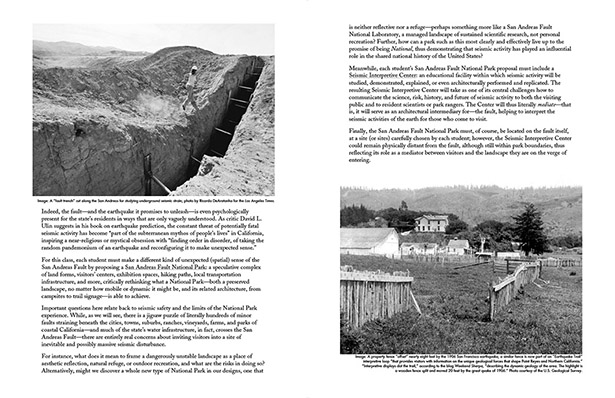
Course: Columbia University GSAPP Advanced Studio IV, Spring 2013
Title: San Andreas: Architecture for the Fault
Instructor: Geoff Manaugh

The San Andreas Fault is a roughly 800-mile tectonic feature cutting diagonally across the state of California, from the coastal spit of Cape Mendocino, 200 miles north of San Francisco, to the desert shores of the Salton Sea near the U.S./Mexico border. Described by geologists as a “transform fault,” the San Andreas marks a stark and exposed division between the North American and Pacific Plates. It is a landscape on the move—“one of the least stable parts of the Earth,” in the words of paleontologist Richard Fortey, writing in his excellent book Earth: An Intimate History, and “one of several faults that make up a complex of potential catastrophes.”

Seismologists estimate that, in just one million years’ time, the two opposing sides of the fault will have slid past one another to the extent of physically sealing closed the entrance to San Francisco Bay; at the other end of the state, Los Angeles will have been dragged more than 15 miles north of its present position. But then another million years will pass—and another, and another—violently and unrecognizably distorting Californian geography, with the San Andreas as a permanent, sliding scar.

In some places today, the fault is a picturesque landscape of rolling hills and ridges; in others, it is a broad valley, marked by quiet streams, ponds, and reservoirs; in yet others, it is not visible at all, hidden beneath the rocks and vegetation. In a sense, the San Andreas is not singular and it has no clear identity of its own, taking on the character of what it passes through whilst influencing the ways in which that land is used. The fault cuts through heavily urbanized areas—splitting the San Francisco peninsula in two—as well as through the suburbs. It cleaves through mountains and farms, ranches and rail yards. As the National Park Service reminds us, “Although the very mention of the San Andreas Fault instills concerns about great earthquakes, perhaps less thought is given to the glorious and scenic landscapes the fault has been responsible for creating.”

[Images: (left) A “fault trench” cut along the San Andreas for studying underground seismic strain; photo by Ricardo DeAratanha for the Los Angeles Times. (right) A property fence “offset” nearly eight feet by the 1906 San Francisco earthquake; a similar fence is now part of an “Earthquake Trail” interpretive loop “that provides visitors with information on the unique geological forces that shape Point Reyes and Northern California.” “Interpretive displays dot the trail,” according to the blog Weekend Sherpa, “describing the dynamic geology of the area. The highlight is a wooden fence split and moved 20 feet by the great quake of 1906.” Photo courtesy of the U.S. Geological Survey].
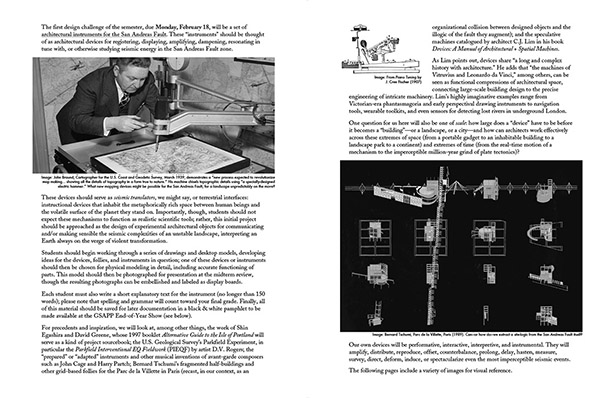
This is not a class about seismic engineering, however, nor is it a rigorous look at how architects might stabilize buildings in an earthquake zone. Rather, it is a class about making the seismic energies of the San Andreas Fault legible through architecture. That is, making otherwise imperceptible planetary forces—the tectonic actions of the Earth itself—physically and spatially sensible. Our goal is to make the seismic energy of the fault experientially present in the lives of the public, framing and interpreting its extraordinary geology by means of a new National Park: a San Andreas Fault National Park.

For generations, the fault has inspired equal parts scientific fascination and pop-cultural fear, seen—rightly or not—as the inevitable source of the “Big One,” an impending super-earthquake that will devastate California, flattening San Francisco and felling bridges, houses, and roads throughout greater Los Angeles.

From the 1985 James Bond film, A View to a Kill, in which the San Andreas Fault is weaponized by an eccentric billionaire, to the so-called Parkfield Experiment, “a comprehensive, long-term earthquake research project on the San Andreas fault” run by the U.S. Geological Survey to “capture” an earthquake, the fault pops up in—and has influence on—extremely diverse contexts: literary, poetic, scientific, photographic, and, as we will explore in this studio, architectural.

Indeed, the fault—and the earthquake it promises to unleash—is even psychologically present for the state’s residents in ways that are only vaguely understood. As critic David L. Ulin suggests in his book The Myth of Solid Ground, on the promises and impossibilities of earthquake prediction, the constant threat of potentially fatal seismic activity has become “part of the subterranean mythos of people’s lives” in California, inspiring a near-religious or mystical obsession with “finding order in disorder, of taking the random pandemonium of an earthquake and reconfiguring it to make unexpected sense.”

For this class, each student must make a different kind of unexpected (spatial) sense of the San Andreas Fault by proposing a San Andreas Fault National Park: a speculative complex of land forms, visitors’ centers, exhibition spaces, hiking paths, local transportation infrastructure, and more, critically rethinking what a National Park—both a preserved landscape, no matter how mobile or dynamic it might be, and its related architecture, from campsites to trail signage—is able to achieve.

Important questions here relate back to seismic safety and the limits of the National Park experience. While, as we will see, there is a jigsaw puzzle of literally hundreds of minor faults straining beneath the cities, towns, suburbs, ranches, vineyards, farms, and parks of coastal California—and much of the state’s water infrastructure, in fact, crosses the San Andreas Fault—there are entirely real concerns about inviting visitors into a site of inevitable and possibly massive seismic disturbance.

For instance, what does it mean to frame a dangerously unstable landscape as a place of aesthetic reflection, natural refuge, or outdoor recreation, and what are the risks in doing so? Alternatively, might we discover a whole new type of National Park in our designs, one that is neither reflective nor a refuge—perhaps something more like a San Andreas Fault National Laboratory, a managed landscape of sustained scientific research, not personal recreation? Further, how can a park such as this most clearly and effectively live up to the promise of being National, thus demonstrating that seismic activity has played an influential role in the shared national history of the United States?

Meanwhile, each student’s San Andreas Fault National Park proposal must include a Seismic Interpretive Center: an educational facility within which seismic activity will be studied, demonstrated, explained, or even architecturally performed and replicated. The resulting Seismic Interpretive Center will take as one of its central challenges how to communicate the science, risk, history, and future of seismic activity to both the visiting public and to resident scientists or park rangers.

Finally, the San Andreas Fault National Park must, of course, be located on the fault itself, at a site (or sites) carefully chosen by each student; however, the Seismic Interpretive Center could remain physically distant from the fault, although still within park boundaries, thus reflecting its role as a mediator between visitors and the landscape they are on the verge of entering.

[Images: (left) John Braund, Cartographer for the U.S. Coast and Geodetic Survey, March 1939, demonstrates a “new process expected to revolutionize map making… showing all the details of topography in a form true to nature.” His machine chisels topographic details using “a specially-designed electric hammer.” What new mapping devices might be possible for the San Andreas Fault, for a landscape unpredictably on the move? (right top) From Piano Tuning by J. Cree Fischer (1907). (right bottom) Bernard Tschumi, Parc de la Villette, Paris (1989). Can—or how do—we extract a site-logic from the San Andreas Fault itself?].
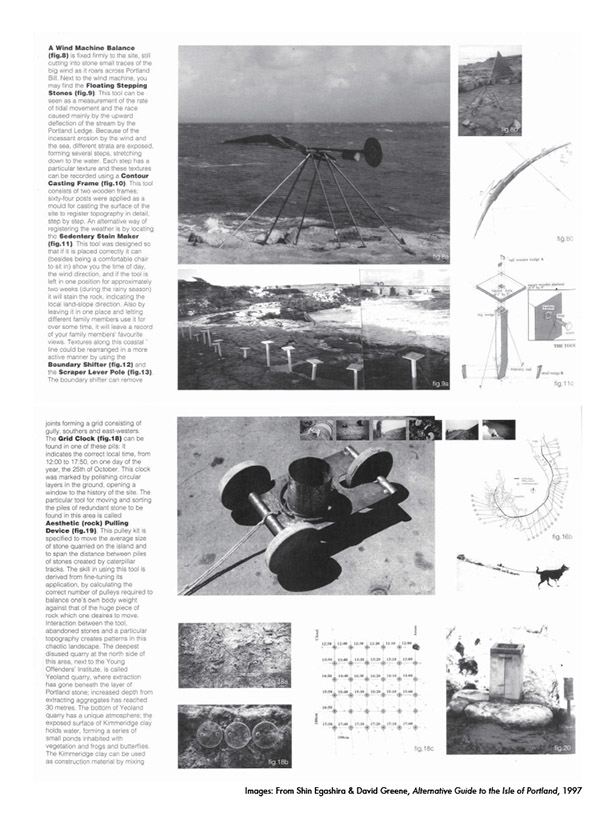
The first design challenge of the semester, due Monday, February 18, will be a set of architectural instruments for the San Andreas Fault. These “instruments” should be thought of as architectural devices for registering, displaying, amplifying, dampening, resonating in tune with, or otherwise studying seismic energy in the San Andreas Fault zone.

These devices should serve as seismic translators, we might say, or terrestrial interfaces: instructional devices that inhabit the metaphorically rich space between human beings and the volatile surface of the planet they stand on. Importantly, though, students should not expect these mechanisms to function as realistic scientific tools; rather, this initial project should be approached as the design of experimental architectural objects for communicating and/or making sensible the seismic complexities of an unstable landscape, interpreting an Earth always on the verge of violent transformation.

Students should begin working through a series of drawings and desktop models, developing ideas for the devices, follies, and instruments in question; one of these devices or instruments should then be chosen for physical modeling in detail, including accurate functioning of parts. This model should then be photographed for presentation at the midterm review, though the resulting photographs can be embellished and labeled as display boards. Each student must also write a short explanatory text for the instrument (no longer than 150 words).

Finally, all of this material should be saved for later documentation in a black & white pamphlet to be made available at the GSAPP End-of-Year Show.

For precedents and inspiration, we will look at, among other things, the work of Shin Egashira and David Greene, whose 1997 booklet Alternative Guide to the Isle of Portland will serve as a kind of project sourcebook; the U.S. Geological Survey’s Parkfield Experiment, in particular the Parkfield Interventional EQ Fieldwork (PIEQF) by artist D.V. Rogers; the “prepared” or “adapted” instruments and other musical inventions of avant-garde composers such as John Cage and Harry Partch; Bernard Tschumi’s fragmented half-buildings and other grid-based follies for the Parc de la Villette in Paris (recast, in our context, as an organizational collision between designed objects and the illogic of the fault they augment); and the speculative machines catalogued by architect C.J. Lim in his book Devices: A Manual of Architectural + Spatial Machines.

[Images: From Shin Egashira & David Greene, Alternative Guide to the Isle of Portland (1997)].
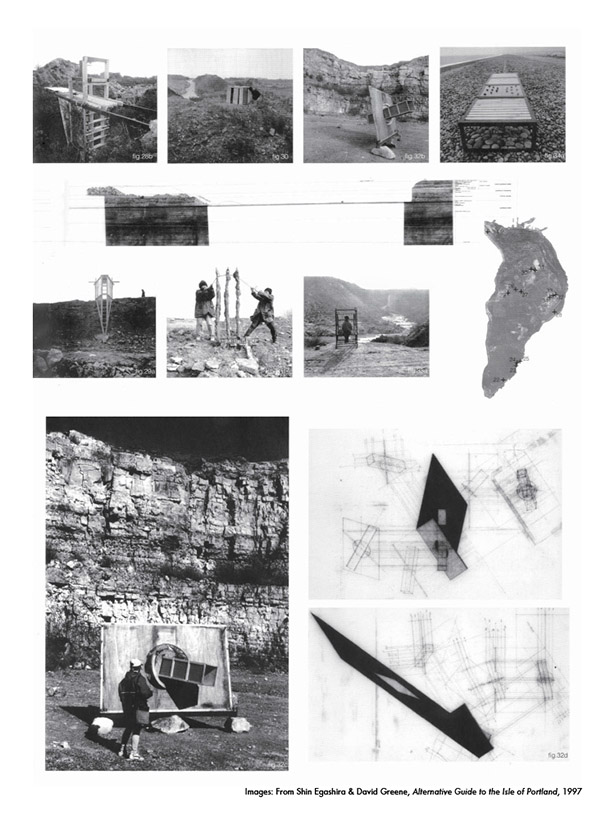
As Lim points out, devices share “a long and complex history with architecture.” He adds that “the machines of Vitruvius and Leonardo da Vinci,” among others, can be seen as functional compressions of architectural space, connecting large-scale building design to the precise engineering of intricate machinery. Lim’s highly imaginative examples range from Victorian-era phantasmagoria and early perspectival drawing instruments to navigation tools, wearable toolkits, and even sensors for detecting lost rivers in underground London.

[Images: From Shin Egashira & David Greene, Alternative Guide to the Isle of Portland (1997)].
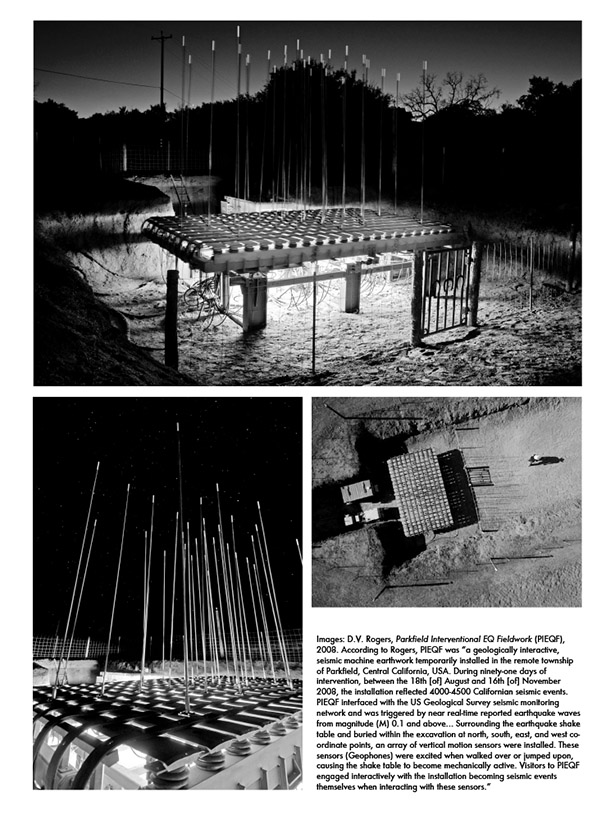
One question for us here will also be in reference to scale: how large does a “device” have to be before it becomes a “building”—or a landscape, or a city—and how can architects work effectively across these extremes of space (from a portable gadget to an inhabitable building to a landscape park to a continent) and extremes of time (from the real-time motion of a mechanism to the imperceptible million-year grind of plate tectonics)?

[Images: D.V. Rogers, Parkfield Interventional EQ Fieldwork (PIEQF), 2008. According to Rogers, PIEQF was “a geologically interactive, seismic machine earthwork temporarily installed in the remote township of Parkfield, Central California, USA. During ninety-one days of intervention, between the 18th [of] August and 16th [of] November 2008, the installation reflected 4000-4500 Californian seismic events. PIEQF interfaced with the US Geological Survey seismic monitoring network and was triggered by near real-time reported earthquake waves from magnitude (M) 0.1 and above… Surrounding the earthquake shake table and buried within the excavation at north, south, east, and west co-ordinate points, an array of vertical motion sensors were installed. These sensors (Geophones) were excited when walked over or jumped upon, causing the shake table to become mechanically active. Visitors to PIEQF engaged interactively with the installation becoming seismic events themselves when interacting with these sensors.”].

Our own devices will be performative, interactive, interpretive, and instrumental. They will amplify, distribute, reproduce, offset, counterbalance, prolong, delay, hasten, measure, survey, direct, deform, induce, or spectacularize even the most imperceptible seismic events.

[Images: Daniel Libeskind, Writing Machine (1980s). As Lebbeus Woods has written, describing Libeskind’s work: “Elaborately constructed and enigmatic in purpose, Libeskind’s machines are striking and sumptuous manifestations of ideas that were, at the time he made them, of obsessive interest to academics, critics, and avant-gardists in architecture and out. Principal among these was the idea that architecture must be read, that is, understood, in the same way as a written text.” In terms of our studio, what would a machine be that could “read,” “write,” or “translate” the San Andreas Fault?].

Again, these “instruments” should not be approached as realistic scientific tools, but rather as poetic, spatial augmentations of the San Andreas Fault. Students are being asked to use the problem-solving techniques of architectural design to imagine hypothetical devices at a variety of scales that will translate this unique site—a fault line between tectonic plates and an elastic zone of origin for millions of years of future terrain deformation—into a new kind of spatial and intellectual experience for those who encounter it.

[Images: Harry Partch, various stringed, percussive, and resonating instruments (1940s/1950s)].

Upon completing these devices, the second, most important, and largest project of the semester, due Wednesday, April 17, will be the San Andreas Fault National Park proposal and its associated Seismic Interpretive Center.

The Seismic Interpretive Center should be an educational facility, equivalent to 30,000 square feet. Here, seismic activity will be studied, demonstrated, interpreted, and otherwise explained to the visiting public and to a seasonal crew of scientist-researchers who use the facility in their work. It might be useful to think of the Seismic Interpretive Center as a direct outgrowth of the instruments developed in the previous project, either by housing or emulating those devices. In other words, the Center could passively display seismic instruments for public use but simultaneously operate as an active, building-scale mechanism for engaging with or tectonically explaining the San Andreas Fault.

In practical terms, the proposed Center should be a fully developed three-dimensional building or landscape project, no matter how speculative or straight-forward its underlying premise might be, whether it is simply a museum of the fault or something more provocative, such as a partially underground public test-facility for generating artificial earthquakes. In all cases—circulation, materials, program, site—students must demonstrate thorough knowledge of their own project in the form of, but not limited to, the appropriate use of plans, sections, elevations, axonometrics, physical models, and 3D diagrams.

[Images: (left) Harry Partch, two instruments, 1940s/1950s. (right) Doug Aitken’s “Sonic Pavilion” (2009), courtesy of the Doug Aitken Workshop].

To help develop ideas for the Seismic Interpretive Center, we will look at such precedents as artist Doug Aitken’s “Sonic Pavilion” in Brazil, where, in the words of The New York Times, Aitken “buried microphones sensitive to vibrations caused by the rotation of the planet,” or the artist’s own house in Venice, California, where, again quoting The New York Times, “geological microphones… amplify not just the groan of tectonic plate movements but also the roar of the tides and the rumble of street traffic. Guests can listen in on this subterranean world without putting an ear to the ground. Speakers installed throughout the house bring its metronomic clicks and extended drones to them whenever Aitken turns up the volume.”

More abstractly, students could perhaps think of the Center as a variation on “Solomon’s House,” a proto-scientific research facility featured in Sir Francis Bacon’s 17th-century utopian sci-fi novel The New Atlantis. In Solomon’s House, natural philosophers operate vast, artificial landscapes and complex machines—rivaling anything we read about in Dubai or China today—to examine the world in fantastic detail. Bacon offers a lengthy inventory of the devices available for use: “We have… great and spacious houses where we imitate and demonstrate meteors… We have also sound-houses, where we practice and demonstrate all sounds, and their generation… We have also engine-houses, where are prepared engines and instruments for all sorts of motions… We have also a mathematical house, where are represented all instruments, as well of geometry as astronomy, exquisitely made…”

The larger San Andreas Fault National Park proposal within which this Interpretive Center will sit must include all aspects of an existing park in the National Park Service network of managed sites; however, students must push the National Park typology in new directions, taking seriously the prospect of preserving and framing a landscape that moves.

[Images: (left top) AllesWirdGut Architektur, a Roman quarry in St. Margarethen, Austria, converted into public venue, park, and auditorium, 2006-2008. In a private email, responding to the image seen on the left, landscape blogger Alexander Trevi from Pruned suggested that perhaps it would be more interesting for us to think of the San Andreas Fault not in terms of a detached viewer—like the so-called Rückenfiguren (or figures seen from behind) in the paintings of Caspar David Friedrich—but, as Trevi suggested, more like dancer Fred Astaire, physically and whimsically engaging in a choreographed state of delight with the Earth’s shifting topography. (left bottom) “Ice Age Deposits of Wisconsin” (1964) and a photo, taken from Flickr, of an Ice Age National Scenic Trail marker (2007). (right top) National Tourist Route Geiranger-Trollstigen, Norway. Architect: Reiulf Ramstad Arkitekter. Photo: Per Kollstad. (right bottom, left to right, top to bottom, within grid) National Tourist Route Rondane. Architect: Carl-Viggo Hølmebakk. Photo: Vegar Moen. National Tourist Route Geiranger-Trollstigen, Norway. Architect: Reiulf Ramstad Arkitekter. Photo: Jarle Wæhler. National Tourist Route Aurlandsfjellet. Architect: Todd Saunders / Saunders-Wilhelmsen. Photo: Vegar Moen. National Tourist Route Ryfylke. Architect: Haga Grov / Helge Schjelderup. Photo: Per Kollstad. Courtesy of National Tourist Routes in Norway].

This means students must propose a working combination of such features as trails, lodging, visitors’ centers, educational programming, parking/camping, and other facilities that differentiate National Parks from their less developed counterparts, National Monuments, but with the addition of new types of structures and innovative landscape management techniques that might reveal future opportunities for the U.S. National Park system.

Here, we will look at a variety of precedents, including current plans for a “Manhattan Project National Park” (a National Park that will preserve three geographically diverse sites key to the development of nuclear weapons during World War II); a proposal by photographer Richard Misrach for a “Bravo 20 National Park” (a former U.S. Navy bombing range that would be preserved as a recreational landscape); the High Line here in New York City; an entirely underwater National Park Service “Maritime Heritage Trail” in Biscayne Bay, Florida; the extraordinary, multi-sensory “Taichung Gateway Park” proposal by landscape architects Catherine Mosbach and Philippe Rahm; the “Ice Age National Scenic Trail” in Wisconsin; and, of course, a handful of already existing state parks and recreation areas in California—such as the Los Trancos Open Space Preserve and the 206,000-acre Carrizo Plain National Monument—that feature hiking trails and other recreational facilities that cross the San Andreas Fault.

The “Ice Age National Scenic Trail” is what we might call a planetary interpretive trail: “More than 12,000 years ago,” we read, “an immense flow of glacial ice sculpted a landscape of remarkable beauty across Wisconsin. As the colossal glacier retreated, it left behind a variety of unique landscape features… The Ice Age National Scenic Trail is a thousand-mile footpath—entirely within Wisconsin—that highlights these Ice Age landscape features while providing access to some of the state’s most beautiful natural areas.”

However, no less useful in this context are the “National Tourist Routes” that now criss-cross the geologically rich landscapes of Norway. In essence, these are new scenic routes for automobiles constructed through extraordinary natural landscapes, including coastal fjords and precipitous mountain valleys; however, these routes have also been peppered with signature architectural interventions, including lookout towers, roadside picnic areas, trail infrastructure, geological overlooks, and more.

But how do we define—let alone locate—a park on the scale of a fault line? Landscape architect James Corner suggests that the virtue of a “large park”—which he defines as a park “greater than 500 acres”—is that it “allows for dramatic exposure to the elements, to weather, geology, open horizons, and thick vegetation, all revealed to the ambulant body in alternating sequences of prospect and refuge—distinctive places for overview and survey woven with more intimate spots of retreat and isolation.” He calls such parks “huge experiential reserves”—in terms of the San Andreas, we might say a kind of seismic commons.

Further, thinking about—let alone designing—architecture on this scale requires close attention to what landscape theorist Julia Czerniak calls legibility. “The concept of legibility,” she writes in her edited collection Large Parks, “extends from park design to the design process. In other words, to be realized, parks have to be legible to the people who pay for and use them.” After all, she adds, “in addition to questions of a park’s legibility that stem from recognizing its limits—‘where is the park?’—large park schemes with unconventional configurations provoke other uncertainties—‘how does it look?’ and ‘what can it do?’”

[Images: (left) One of only a few sites where the San Andreas Fault is designated with road signs; photographs by Geoff Manaugh. (right) Satellite view of the San Andreas Fault, rotated 90º (north is to the right)].
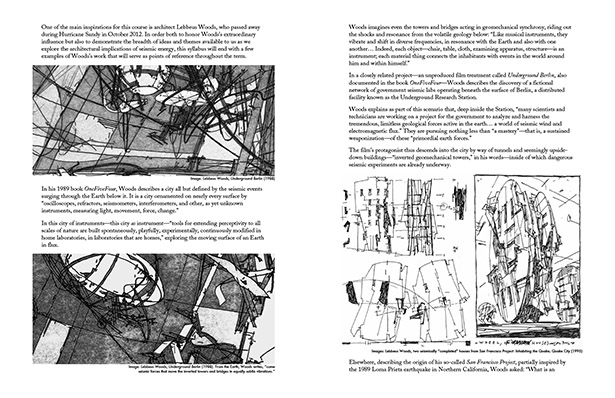
Complicating matters even more, we will also examine how National Park infrastructure—from interpretive trails to hotels and viewing platforms—function as immersive projects of landscape representation, even above, and possibly rather than, places of embodied physical experience. In other words, as Richard Grusin reminds us in his book Culture, Technology, and the Creation of America’s National Parks, “just as Yellowstone and Yosemite were created as national parks in accordance with late-nineteenth-century assumptions about landscape and representation, so a national park today (whether scenic or historic) must be created according to present-day assumptions about media, culture, and technology.” Indeed, he adds, “national parks have functioned from their inception as technologies for reproducing nature according to the scientific, cultural, and aesthetic practices of a particular historical moment—the period roughly between the Civil War and the end of the First World War.” How, then, would a 21st-century San Andreas Fault National park both represent and preserve the landscape in question?

To help us sort through these many complex questions, and to ease our transition from thinking and designing at the scale of a device or building to the scale of an entire landscape, we will be joined for one class by GSAPP’s Kate Orff, a landscape architect and co-editor of Gateway: Visions for an Urban National Park. Her experience with Gateway will be invaluable for all of us in conceptualizing what a San Andreas Fault National Park might be.

Finally, students must spend the last week of the semester, leading up to our final day of class on Wednesday, April 24, revisiting and refining all of their work produced over the term and, in the process, collecting all of their relevant project documentation. This project documentation will then be collected and published as a small black & white pamphlet, forming a kind of speculative architectural guide to the San Andreas Fault.

In addition to any boards and models necessary for explaining the resulting proposals, this black & white pamphlet will be produced in small quantities for guest critics and other attendees of our final review. It will also be made available to attendees of the GSAPP Year-End Show. Specific requirements—including number of images and length of accompanying descriptive texts—will be discussed during the semester. 

One of the main inspirations for this course is architect Lebbeus Woods, who passed away during Hurricane Sandy in October 2012. In order both to honor Woods’s extraordinary influence but also to demonstrate the breadth of ideas and themes available to us as we explore the architectural implications of seismic energy, this syllabus will end with a few examples of Woods’s work that will serve as points of reference throughout the term.

[Images: (left top and bottom) Lebbeus Woods, from Underground Berlin (1988). From deep inside the Earth, Woods writes, “come seismic forces that move the inverted towers and bridges in equally subtle vibrations.” (right) Lebbeus Woods, two seismically “completed” houses from his San Francisco Project: Inhabiting the Quake, Quake City (1995)].

In his 1989 book OneFiveFour, Woods describes a city all but defined by the seismic events surging through the Earth below it. It is a city ornamented on nearly every surface by “oscilloscopes, refractors, seismometers, interferometers, and other, as yet unknown instruments, measuring light, movement, force, change.”

In this city of instruments—this city as instrument—“tools for extending perceptivity to all scales of nature are built spontaneously, playfully, experimentally, continuously modified in home laboratories, in laboratories that are homes,” exploring the moving surface of an Earth in flux.

Woods imagines even the towers and bridges acting in geomechanical synchrony, riding out the shocks and resonance from the volatile geology below: “Like musical instruments, they vibrate and shift in diverse frequencies, in resonance with the Earth and also with one another… Indeed, each object—chair, table, cloth, examining apparatus, structure—is an instrument; each material thing connects the inhabitants with events in the world around him and within himself.”

In a closely related project—an unproduced film treatment called Underground Berlin, also documented in the book OneFiveFour—Woods describes the discovery of a fictional network of government seismic labs operating beneath the surface of Berlin, a distributed facility known as the Underground Research Station.

Woods explains as part of this scenario that, deep inside the Station, “many scientists and technicians are working on a project for the government to analyze and harness the tremendous, limitless geological forces active in the earth… a world of seismic wind and electromagnetic flux.” They are pursuing nothing less than “a mastery”—that is, a sustained weaponization—of these “primordial earth forces.”

The film’s protagonist thus descends into the city by way of tunnels and seemingly upside-down buildings—“inverted geomechanical towers,” in his words—inside of which dangerous seismic experiments are already underway.

Elsewhere, describing the origin of his so-called San Francisco Project, partially inspired by the 1989 Loma Prieta earthquake in Northern California, Woods asked: “What is an architecture that accepts earthquakes, resonating with their matrix of seismic waves—an architecture that needs earthquakes, and is constructed, transformed, or completed by their effects—an architecture that uses earthquakes, converting to a human purpose the energies they release, or the topographical transformations they bring about—an architecture that causes earthquakes, triggering microquakes in order that ‘the big one’ is defused—an architecture that inhabits earthquakes, existing in their space and time?”

[Image: A map in four sections (see below three images) shows the San Andreas Fault stretching from northern to southern California. The San Andreas “is just one of several faults that make up a complex of potential catastrophes,” paleontologist Richard Fortey writes in Earth: An Intimate History. It is “the flagship of a fleet of faults that run close to the western edge of North America… In places, maps of the interweaving faults look more like a braided mesh than the single, deep cut of our imagination.” Here, we see the San Andreas come to an end in Northern California at the so-called Mendocino Triple Junction. Maps courtesy of the U.S. Geological Survey, from The San Andreas Fault System, U.S.G.S. Professional Paper 1515 (PDF); see original paper for higher resolution].
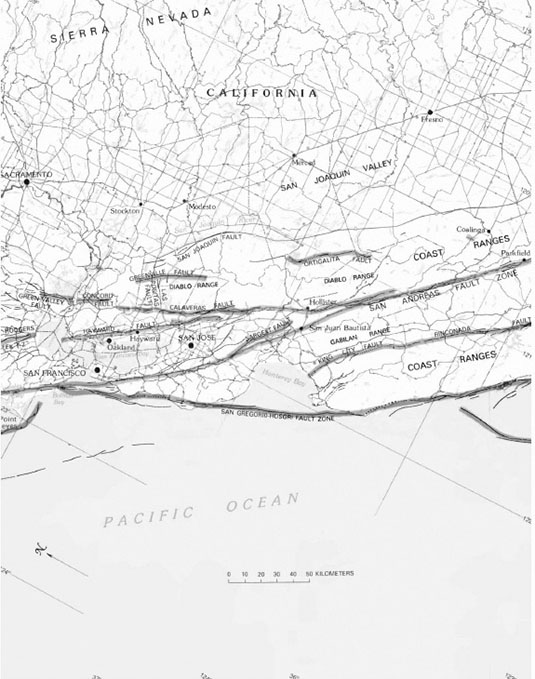
Readings & References

Online (Required Reading)

USGS Earthquake Hazards Program:
earthquake.usgs.gov

The San Andreas Fault System, U.S. Geological Survey Professional Paper 1515:
pubs.usgs.gov/pp/1990/1515/pp1515.pdf

The San Andreas Fault:
pubs.usgs.gov/gip/earthq3/contents.html

“San Andreas System and Basin and Range,” from Active Faults of the World by Robert Yeats (Cambridge University Press):
dx.doi.org/10.1017/CBO9781139035644.004

Where’s the San Andreas Fault? A Guidebook to Tracing the Fault on Public Lands in the San Francisco Bay Region:
pubs.usgs.gov/gip/2006/16/gip-16.pdf

Of Mud Pots and the End of the San Andreas Fault:
seismo.berkeley.edu/blog/seismoblog.php/2008/11/04/of-mud-pots-and-the-end-of-the-san-andre

U.S. Geological Survey Fault and Volcano Monitoring Instruments:
earthquake.usgs.gov/monitoring/deformation/data/instruments.php

[Image: Map courtesy of the U.S. Geological Survey, from The San Andreas Fault System, U.S.G.S. Professional Paper 1515 (PDF)].
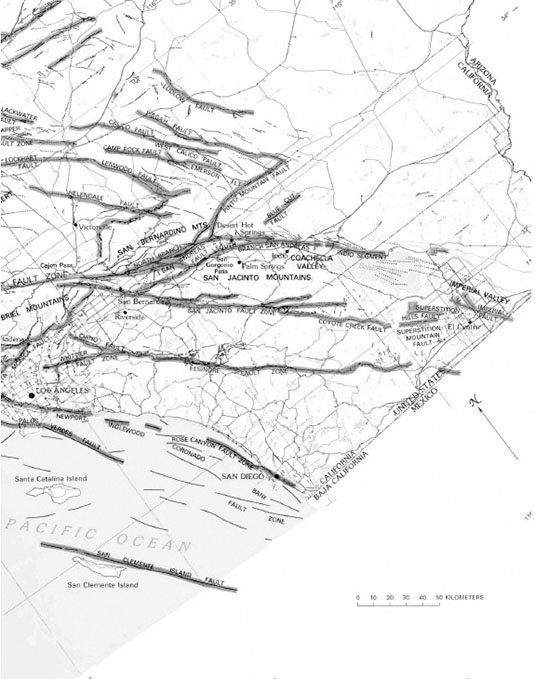
Online (Reference Only)

California Integrated Seismic Network and Southern California Seismic Network:
cisn.org | www.scsn.org

California Strong Motion Instrumentation Program:
conservation.ca.gov/cgs/smip/Pages/about.aspx

California Geotour Online Geologic Field Trip:
conservation.ca.gov/cgs/geotour/Pages/Index.aspx

Carrizo Plain National Monument maps and brochures:
blm.gov/ca/st/en/fo/bakersfield/Programs/carrizo/brochures_and_maps.html

Ken Goldberg, Mori and Ballet Mori:
memento.ieor.berkeley.edu | goldberg.berkeley.edu/art/Ballet-Mori

Doug Aitken, Sonic Pavilion:
dougaitkenworkshop.com/work/sonic-pavilion

[Image: Map courtesy of the U.S. Geological Survey, from The San Andreas Fault System, U.S.G.S. Professional Paper 1515 (PDF)].
Offline (Required Reading)

Smout Allen, Pamphlet Architecture 28: Augmented Landscapes (Princeton Architectural Press, 2007)

Ethan Carr, Wilderness by Design: Landscape Architecture and the National Park Service (University of Nebraska Press, 1999) — Introduction, Chapter 1, and Chapter 4

Julia Czerniak and George Hargreaves, eds., Large Parks (Princeton Architectural Press, 2007) — Foreword, Introduction, and Chapter Seven

Shin Egashira & David Greene, Alternative Guide to the Isle of Portland (Architectural Association, 1997)

Richard Fortey, Earth: An Intimate History (Vintage, 2004) — Chapter 9: “Fault Lines”

John McPhee, Assembling California (Farrar, Straus & Giroux, 1993)

David L. Ulin, The Myth of Solid Ground: Earthquakes, Prediction, and the Fault Line Between Reason and Faith (Penguin, 2004) — “The X-Files,” “A Brief History of Seismology,” and “Earthquake Country” (though entire book is recommended)

Lebbeus Woods, OneFiveFour (Princeton Architectural Press, 1989)

Offline (Reference Only)

Alexander Brash, Jamie Hand, and Kate Orff, eds., Gateway: Visions for an Urban National Park (Princeton Architectural Press, 2011)

C. J. Lim, Devices: A Manual of Architectural + Spatial Machines (Elsevier/Architectural Press, 2006)

Lebbeus Woods, Radical Reconstruction (Princeton Architectural Press, 2001) — “Radical Reconstruction” (pp. 13-31) and “San Francisco” (p. 133-155)

[Image: Map courtesy of the U.S. Geological Survey, from The San Andreas Fault System, U.S.G.S. Professional Paper 1515 (PDF)].

Film and Games (Entertainment Value Only!)

A View To A Kill, dir. John Glen (1985)

Fracture, LucasArts (2008)

Music (Required Listening)

Our work this Spring will be paralleled by a series of musical experiments led by Bay Area sound artist Marc Weidenbaum’s Disquiet Junto, an online music collective. The Disquiet Junto will be developing projects that explore the sonic properties of the San Andreas Fault and uploading the results of these seismic-acoustic experiments to Soundcloud. Students will be required to leave comments on these audio tracks as part of regular homework over the course of the Spring term.

The Disquiet Junto, a satellite operation of disquiet.com, “uses formal restraint as a springboard for creativity. In 2012, the year it launched, the Disquiet Junto produced over 1,600 tracks by over 270 musicians from around the world. Disquiet.com has operated at the intersection of sound, art, and technology since 1996.”

[Image: (left) A Rückenfigur looks at a highway cut through the San Andreas Fault in Palmdale, southern California; photograph by Nicola Twilley. (right) Aerial rendering of the San Andreas Fault, courtesy of NASA’s Shuttle Radar Topography Mission (2000). If an earthquake presents us with a turbulent condition similar to waves in the ocean or a storm at sea, is the ship a more appropriate structural metaphor than the building—even if it’s an ocean that only exists for sixty seconds? What does orientation mean for the minute-long intensity of an earthquake—the becoming-ocean of land—and how do we learn to navigate a planet that acts like the sea?].

Project Sanguine and the Dead Hand

[Image: One of the stations of Project ELF, via Wikipedia].
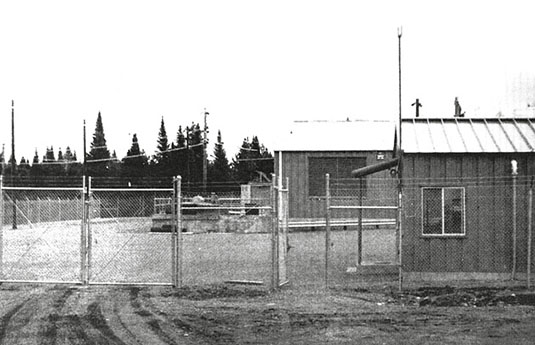
Further exploring the radio-related theme of the last few posts, Rob Holmes—author and co-founder of mammoth—has pointed our attention to something called Project Sanguine, a U.S. Navy program from the 1980s that “would have involved 41 percent of Wisconsin,” turning that state into a giant “antenna farm” capable of communicating with what Wikipedia calls “deeply-submerged submarines.”

Each individual antenna would have been “buried five feet deep” in the fertile soil of the Cheese State, the New York Times explains, creating a networked system with nearly 6,000 miles’ worth of cables and receiving stations.

The Navy was hoping, we read, for a system “that could transmit tactical orders one-way to U.S. nuclear submarines anywhere in the world, and survive a direct nuclear attack.” This would “normally… require an antenna many hundreds of miles in length,” according to the NYT, but Naval strategists soon “realized that a comparable effect could be achieved by using a large volume of the earth’s interior”—that is, “looping currents deep in the Earth”—”as part of the antenna.” The hard and ancient rock of the Laurentian Shield was apparently perfect for this.

[Image: From Roy Johnson, “Project Sanguine,” originally published in The Wisconsin Engineer (November 1969)].
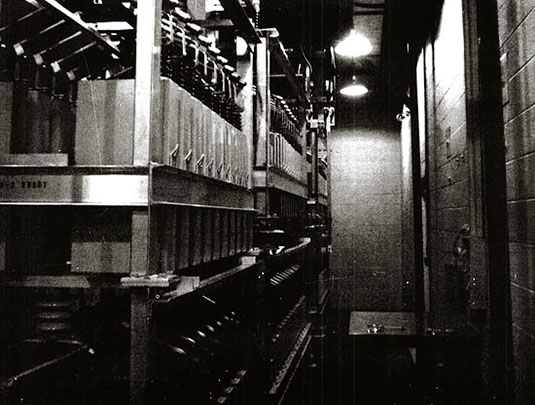
In other words, the bedrock of the Earth itself—not a mere island in the Antarctic—could be turned into a colossal radio station.

A similar system, installed for preliminary tests in North Carolina and Virginia, “apparently flickered lightbulbs in the area and caused spurious ringing of telephones,” like some regional poltergeist or a technical outtake from Cabin in the Woods.

At least two things worth pointing out here are that a “scaled-down version” of Project Sanguine was, in fact, actually constructed, becoming operational in the northern forests of Michigan and Wisconsin from 1989-2004; called Project ELF (for Extremely Low Frequency), it arrived just in time for the Soviet Union to collapse…

[Image: Inside Project Sanguine; photo from Roy Johnson, The Wisconsin Engineer (November 1969)].
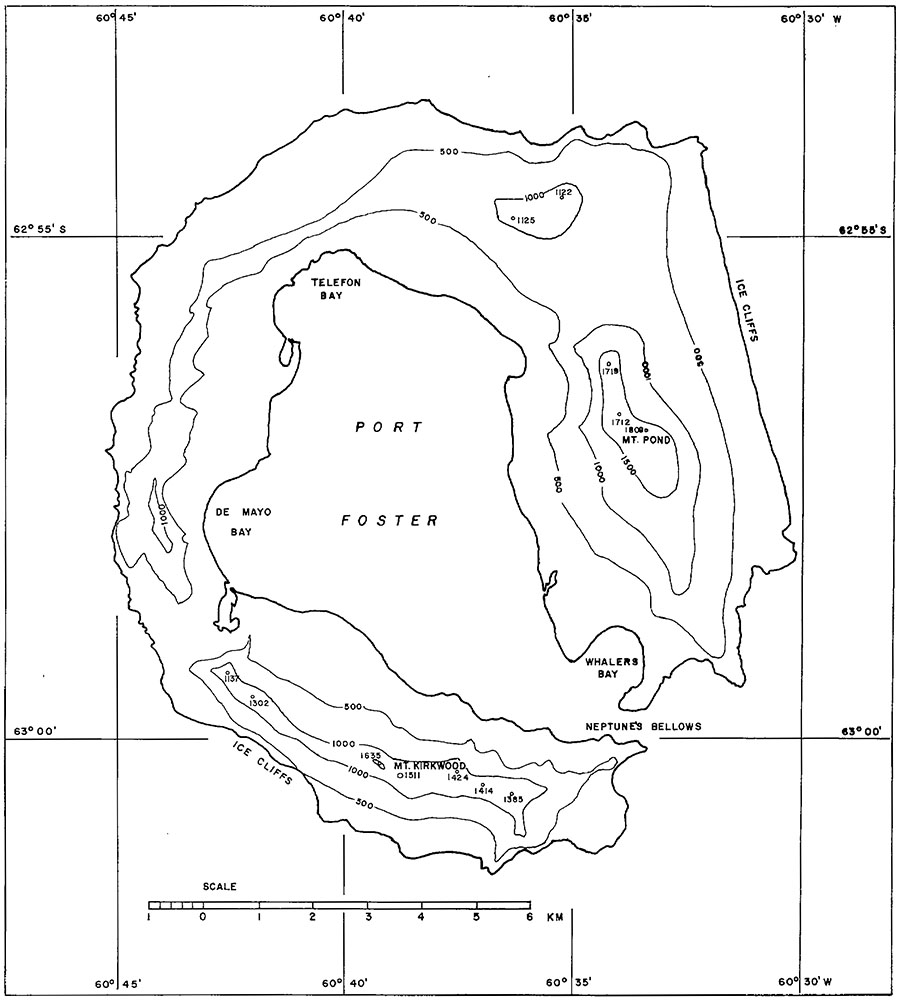
…which brings us to the second point worth mentioning: a strangely haunting program known as “The Dead Hand,” a doomsday device constructed by the Soviet Union.

In his Pulitzer Prize-winning book of that title, historian David Hoffman writes about a (still active) weapon of retaliation. The “Dead Hand” was built such that, if nuclear field commanders ever lost touch with military leaders back in Moscow during a time of war, a constellation of cruise missiles would automatically launch. This would happen not in spite of a lack of living military leaders, but precisely because everyone had been killed. That is, a machine would take over—thus the name “dead hand.”

Each cruise missile, however, flying over the lands of the USSR, would emit launch commands to all of the missile silos it passed over. Missile after missile would soon soar—thousands of them—arcing toward the United States, which would soon be obliterated, along with the rest of the world, in a nuclear holocaust controlled and commanded by nothing but preprogrammed machines.

In any case, Project Sanguine was its own version of an end-times radio, an “immense subterranean grid” transmitting to distant submarines by way of the Earth itself, humans using an entire planet as an apocalyptic radio device.

Antarctic Island Radio

[Image: Deception Island, from Millett G. Morgan’s September 1960 paper An Island as a Natural Very-Low-Frequency Transmitting Antenna].
Yesterday’s post reminded me of an interesting proposal from the 1960s, in which an entire Antarctic island would be transformed into a radio-conducting antenna. Signals of international (or military submarine) origin could thus be bounced, relayed, captured, and re-transmitted using the topographical features of the island itself, and naturally occurring ionospheric radio noise could be studied.

[Image: A map of Deception Island, taken from an otherwise unrelated paper called “Upper crustal structure of Deception Island area (Bransfield Strait, Antarctica) from gravity and magnetic modelling,” published in Antarctic Science (2005)].
In the September 1960 issue of IEEE Transactions on Antennas and Propagation, radio theorist Millett G. Morgan, a “leading researcher in the field of ionospheric physics” based at Dartmouth, speculated that he could generate artificial “whistlers”—that is, audial electromagnetic effects that are usually caused by lightning—if only he could find the right island.

“In thinking about how to generate whistlers artificially,” Morgan’s proposal leisurely begins, “it has occurred to me that an island of suitable size and shape, extending through the conducting sea, may constitute a naturally resonant, VLF slot antenna of high quality.”

[Image: Deception Island, from “Upper crustal structure of Deception Island area (Bransfield Strait, Antarctica) from gravity and magnetic modelling,” Antarctic Science (2005)].
He looked far and wide for this “naturally resonant, VLF slot antenna,” eventually settling on a remote island in the Antarctic. “Following this line of reasoning,” he explains, “I thought first of the annular Pacific atolls, but knowing of the fresh-water lenses in them”—that is, aquatic features that would destructively interfere with radio transmissions—”[I] rejected them as being too pervious to water to be satisfactory insulators. Also, of course, they are not found in suitable latitudes for generating whistlers.”

Morgan’s reasoning continued: “The Pacific atolls are built upon submerged volcanic cones and this led me to think of Deception Island in the SubAntarctic, a remarkable, similarly shaped, volcanic island in which the volcanic rock extends above the surface; and which is located in the South Shetland Islands where the rate of occurrence of natural whistlers has been found to be very great.”

Perhaps the island could be the geologic radio antenna he was looking for.

[Image: Deception Island, from “Upper crustal structure of Deception Island area (Bransfield Strait, Antarctica) from gravity and magnetic modelling,” Antarctic Science (2005)].
Morgan points out in detail that mathematical ratios amongst the island’s naturally occurring landscape features, including its ring-shaped lagoon, are perfect for supporting radio transmissions (even the relationship between the length of the island and the radio wavelengths Morgan would be using seems to work out). And that’s before he looks at the material construction of the island itself, consisting of volcanic tuff, which would help the terrain act as an “insulator.”

There is even the fact that the island’s small lagoon is coincidentally but unrelatedly named “Telefon Bay” (alas, named after a ship called the Telefon, not for the island’s natural ability to make telephone calls).

[Image: Deception Island, from “Upper crustal structure of Deception Island area (Bransfield Strait, Antarctica) from gravity and magnetic modelling,” Antarctic Science (2005)].
Morgan’s “proposed island antenna” would thus be a wired-up matrix of transmission lines and natural landscape features, bouncing radio wavelengths at the perfect angle from one side to the other and concentrating broadcasts for human use and listening.

You could tune into the sky, huddling in the Antarctic cold and listening to the curling electromagnetic crackle of the ionosphere, or you could use your new radio-architectural set-up, all wires and insulators like some strange astronomical harp, “to generate whistlers artificially,” as Morgan’s initial speculation stated, bursting forth with planetary-scale arcs of noise over a frozen sea, a wizard of sound alone and self-deafened at the bottom of the world.

(Deception Island proposal discovered via Douglas Kahn, whose forthcoming book Arts of the Spectrum: In the nature of electromagnetism looks fantastic, and who also gave an interesting talk on “natural radio” a few years ago at UCLA).

Tree Receivers

[Image: “The Trees Now Talk” cover story in The Electrical Experimenter (July 1919); image via rexresearch].

Way back in 1919, in their July 14th issue, Scientific American published an article on the discovery that trees can act “as nature’s own wireless towers and antenna combined.”

General George Owen Squire, the U.S. Army’s Chief Signal Officer, made his “strange discovery,” as SciAm phrases it, while sitting in “a little portable house erected in thick woods near the edge of the District of Columbia,” listening to signals “received through an oak tree for an antenna.” This realization, that “trees—all trees, of all kinds and all heights, growing anywhere—are nature’s own wireless towers and antenna combined.”

He called this “talking through the trees.” Indeed, subsequent tests proved that, “[w]ith the remarkably sensitive amplifiers now available, it was not only possible to receive signals from all the principle [sic] European stations through a tree, but it has developed beyond a theory and to a fact that a tree is as good as any man-made aerial, regardless of the size or extent of the latter, and better in the respect that it brings to the operator’s ears far less static interference.”

Why build a radio station, in a sense, when you could simply plant a forest and wire up its trees?

[Images: From George Owen Squire’s British Patent Specification #149,917, via rexresearch].
So how does it work? Alas, you can’t just plug your headphones into a tree trunk—but it’s close. From Scientific American:

The method of getting the disturbances in potential from treetop to instrument is so simple as to be almost laughable. One climbs a tree to two-thirds of its height, drives a nail a couple of inches into the tree, hangs a wire therefrom, and attaches the wire to the receiving apparatus as if it were a regular lead-in from a lofty copper or aluminum aerial. Apparently some of the etheric disturbances passing from treetop to ground through the tree are diverted through the wire—and the thermionic tube most efficiently does the rest.

Although “40 nails apparently produce no clearer signals than half a dozen,” one tree can nonetheless “serve as a receiving station for several sets, either connected in series with the same material or from separate terminals.”

[Image: Researching the possibility that whole forests could be used as radio stations—broadcasting weather reports, news from the front lines of war, and much else besides—is described by Scientific American as performing “tree radio work.” Image via IEEE Transactions on Antennas and Propagation (January 1975)].

In a patent filing called “British Patent Specification #149,917,” Squire goes on to explore the somewhat mind-bending possibilities offered by “radio transmission and reception through the use of living vegetable organisms such as trees, plants, and the like.” He writes:

I have recently discovered that living vegetable organisms generally are adapted for transmission and reception of radio or high frequency oscillations, whether damped or undamped, with the use of a suitable counterpoise. I have further discovered that such living organisms are adapted for respectively transmitting or receiving a plurality of separate trains of radio or high frequency oscillations simultaneously, in the communication of either or both telephonic or telegraphic messages.

This research—the field of “tree radio work”—has not disappeared or been forgotten.

[Image: A tree in the Panamanian rain forest wired up as a sending-receiving antenna; from IEEE Transactions on Antennas and Propagation (January 1975)].

In the January 1975 issue of IEEE Transactions on Antennas and Propagation, we read the test results of several gentleman who went down to the rain forests of the Panama Canal Zone to test “the performance of conventional whip antennas… compared with the performance of trees utilized as antennas in conjunction with hybrid electromagnetic antenna couplers.”

The authors specifically cite Squire’s work and quote him directly: “‘It would seem that living vegetation may play a more important part in electrical phenomena than has been generally supposed… If, as indicated above in these experiments, the earth’s surface is already generously provided with efficient antennae, which we have but to utilize for communications…’ These words were written in 1904 by Major George 0. Squire, U.S. Army Signal Corps, in a report to the Department of War in connection with military maneuvers in the Pacific Division.”

The authors of the IEEE Transactions report thus establish up a jungle-radio “Test Area” in a remote corner of Panama, complete with trees wired-up as dual senders & receivers. There, they think they’ve figured out what’s occurring on a large scale, as signals propagate through the forest canopy, writing that we should consider “the jungle as a maze of aperture-coupled screen rooms. In the jungle case, the screens, in the form of vertical tree and fern trunks, and the horizontal forest canopy are of variable thickness, have variable shaped apertures, and are composed of diverse substances that contain mostly water.”

[Image: Inside the Panamanian jungle-radio Test Zone; image via IEEE Transactions on Antennas and Propagation (January 1975)].

The design implication of all this is that an ideal radio-receiving forest could be planted and maintained, complete with spatially tuned “aperture-coupled screen rooms” (trees of specific branch-density planted at specific distances from one another) to allow for the successful broadcast of messages (and/or music) through the “living vegetable organisms” that Squire wrote about in his patent application.

What other creatures—such as birds, bats, wandering children, foxes, or owls—might make of such a landscape, planted not for aesthetic or ecological reasons, but for the purpose of smoothly relaying foreign radio transmissions and encrypted spy communications, is bewildering to contemplate.

In any case, this truly alien vision of forests silently crackling inside with unexploited radio noise is incredible, implying the existence of undiscovered “broadcasts” of biological noise, humming trunk to trunk amongst groves of remote forests like arboreal whale song, inaudible to human ears, as well as suggesting a near-miraculous venue for future concerts, where music would be played not through wireless headsets or hidden speakers lodged in the woods but through the actual trees, music shimmering from root to canopy, filling trees branch and grain with symphonies, drones, rhythms, songs, sounds occasionally breaking through car radios as they speed past on roads nearby.

[All links found via an old message from Shawn Korgan posted to the Natural Radio VLF Discussion Group of which I am a non-participating member. Vaguely related: The Duplicative Forest and Pruned’s Graffiti as Tactical Urban Wireless Network. See also a follow-up post: Antarctic Island Radio].