Celestial Detector

[Image: View larger! From “Celestial Detector,” 2025 Lisbon Architecture Triennale; all text by Geoff Manaugh, all images by John Becker/WROT Studio.]

I had a new piece of short fiction commissioned by the 2025 Lisbon Architecture Triennale that was just published last week over at e-flux.

The theme of the Triennale this year is “How Heavy is a City?” To address that, I wrote about a fictional German physicist named Wendell Brandt. During the Cold War, Brandt proposed using cosmic particles—known as muons—to spy under the Berlin Wall.

[Image: From “Celestial Detector,” 2025 Lisbon Architecture Triennale; all text by Geoff Manaugh, all images by John Becker/WROT Studio.]

Although Brandt (and the story’s first-person narrator) is entirely fictional, muon tomography—or muography—is a real visualization technique.

Muons are constantly passing through all of us—through our skin and bones, our cars and buildings, through the mountains and landforms around us. They are so small, moving so quickly, that they have little interaction with matter. We never feel them, though they are inside our muscle and bone; we never see them, though they pass through our pupils and optic nerves.

Although muons are everywhere, they are surprisingly few in number: every second, fewer than ten muons pass through an area the size of your palm, literally just a handful. With the right instrumentation, however, the passage of muons can be recorded, like light on a digital sensor, which means that, given enough time, muons can be used to create images. Similar to an X-ray, the resulting “muographs,” as they are known, reveal otherwise inaccessible voids inside even the densest of materials.

Muography allows people to peer inside dense materials and structures, from cathedrals and hydroelectric dams to Mayan temples and Egyptian pyramids. Or, of course, entire neighborhoods in Cold War Berlin.

[Images: From “Celestial Detector,” 2025 Lisbon Architecture Triennale; all text by Geoff Manaugh, all images by John Becker/WROT Studio.]

Brandt’s experiment in celestial espionage took advantage of an abandoned church near the Berlin Wall where, funded by the U.S. Department of Defense, he installed his first detector. As the data came in, however, Brandt became obsessed with exactly who he was spying on—perhaps even old friends and family members, now isolated in East Berlin by the construction of the Wall.

In a project notebook I obtained through a Freedom of Information Act request, I found that Brandt had used several pages as a personal journal, reflecting on his experience developing muographic techniques in Berlin. The notes—strangely, written in English, as if he had hoped his American sponsors would someday read them—suggested a scientific curiosity gradually becoming more philosophical. Whether muons could image strategically important military features gave way to speculation about families living in apartments nearby, about the quiet lives of fellow Germans separated by the Wall—people who, he believed, he would never meet face to face. All he would know of them were these shadows and blurs, etched by cosmic particles on secret electronics in the deep.

Brandt’s fixation with capturing the lives of strangers, using particles from space, led him onward from there to a series of increasingly ambitious scientific experiments. These included, after the fall of the Wall in November 1989, a purpose-built architectural facility for rigorously measuring the passage of muons.

[Images: From “Celestial Detector,” 2025 Lisbon Architecture Triennale; all text by Geoff Manaugh, all images by John Becker/WROT Studio.]

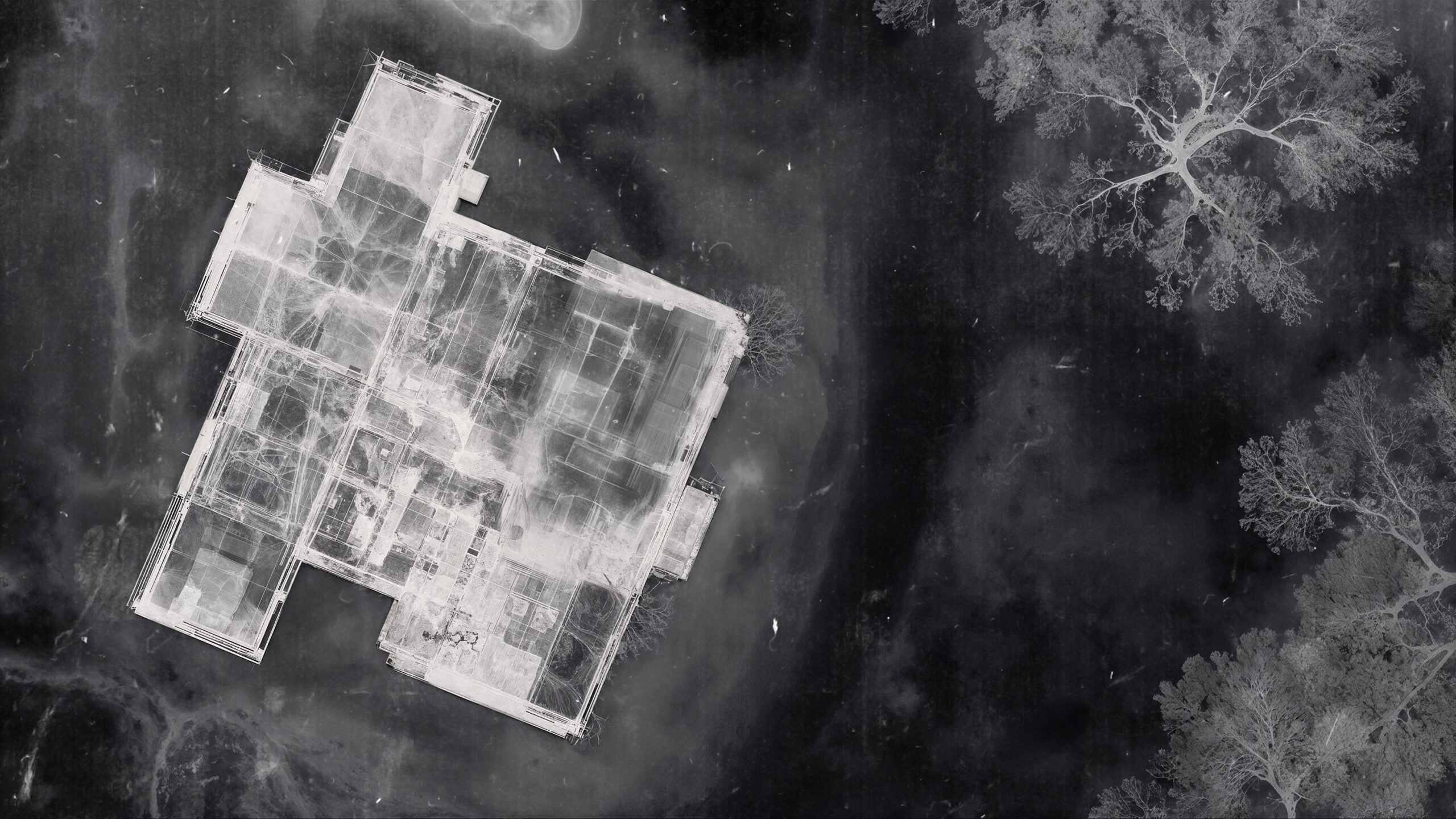
Although there is much more to the (fictional) story, Brandt’s experiments culminated in a massive lab constructed beneath a remote California town, within the San Andreas Fault.

[Image: From “Celestial Detector,” 2025 Lisbon Architecture Triennale; all text by Geoff Manaugh, all images by John Becker/WROT Studio.]

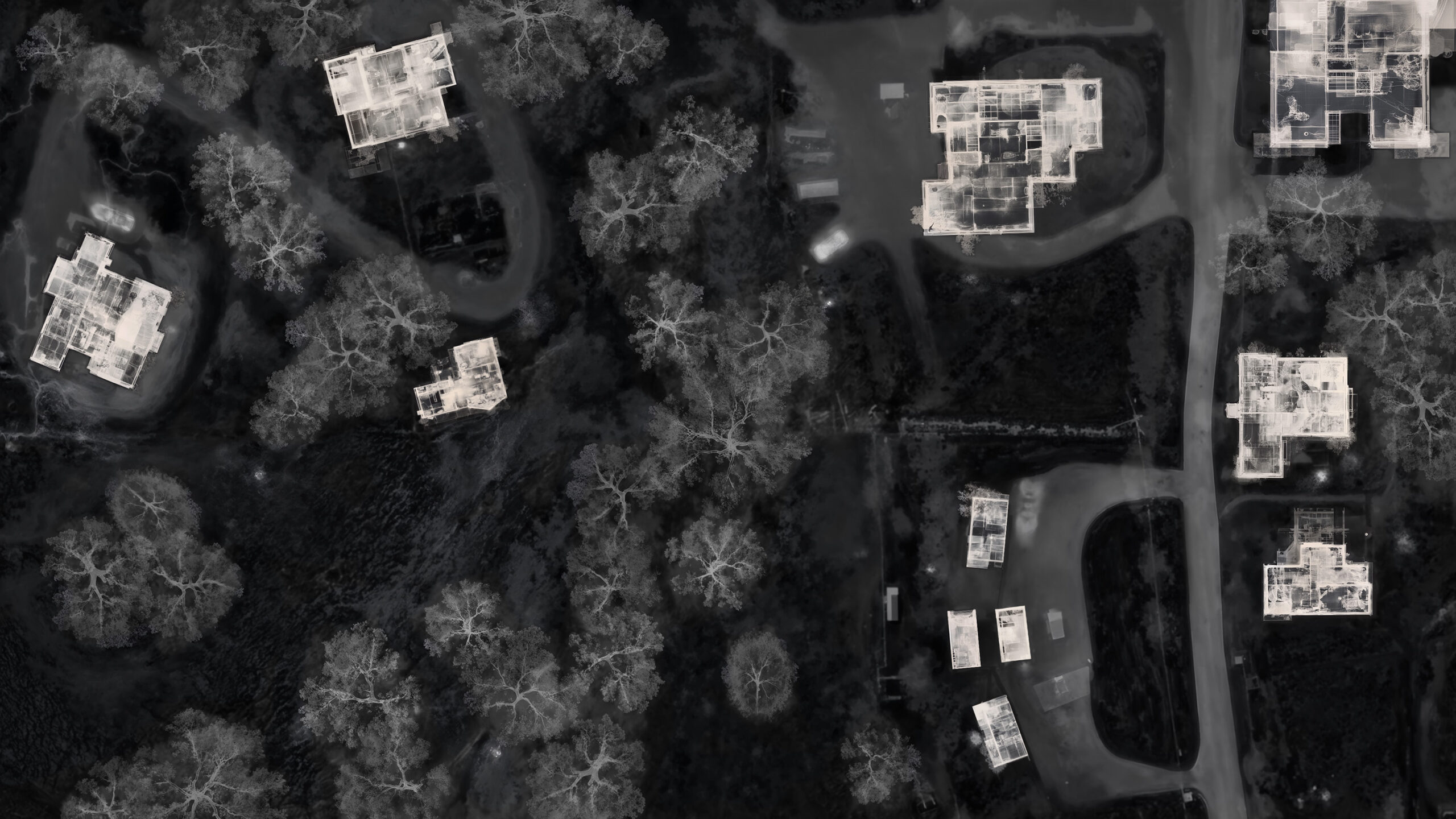
Although his scientific goal there was to see if muography could be used to image large-scale terrestrial phenomena, such as a moving tectonic fault, Brandt began to notice, within the data, the outlines of the town above, down to individual houses and rooms—even, over the course of fifteen years, specific pieces of furniture showing up in the resulting scans.

Once again, Brandt was looking into the lives of strangers from below, using particles from space.

[Image: From “Celestial Detector,” 2025 Lisbon Architecture Triennale; all text by Geoff Manaugh, all images by John Becker/WROT Studio.]

The story itself, I hope, is worth reading in full, but the visuals are a huge part of it. Those were all produced by John Becker of WROT Studio, a frequent collaborator of mine (for projects like the “Institute for Controlled Speleogenesis” and 3D-printing concrete bees).

John put together some spectacular depictions of architecture as imaged using muons, including short AI-generated film sequences and a larger animation that will be screened in Lisbon at the Triennale next month.

[Image: View larger! From “Celestial Detector,” 2025 Lisbon Architecture Triennale; all text by Geoff Manaugh, all images by John Becker/WROT Studio.]

The story was at least partially inspired by my old friend Lebbeus Woods, whose fictional projects—including his proposal for an unmade film called “Underground Berlin”—are never far from my mind.

Check it out, if you get a chance.

(Thanks to Nick Axel of e-flux for editorial guidance, and to Ann-Sofi Rönnskog and John Palmesino of Territorial Agency for commissioning the story in the first place.)

Terrestrial Oceanica

I’m grateful for two recent opportunities to publish op-eds, one for the Los Angeles Times back in May and the other just this morning in the New York Times. Both look at seismic activity and its poetic or philosophical implications, including fault lines as sites of emergence for a future world (“A fault is where futures lurk”).

They both follow on from the Wired piece about the Walker Lane, as well as this past weekend’s large earthquakes here in Southern California.

The L.A. Times op-ed specifically looks at hiking along fault lines, including the San Andreas, where, several years ago, I found myself walking alone at sunset, without cell service, surrounded by tarantulas. I was there in the midst of a “tarantula boom,” something I did not realize until I checked into a hotel room and did some Googling later that evening.

In any case, “Faults are both a promise and a threat: They are proof that the world will remake itself, always, whether we’re prepared for the change or not.”

The New York Times piece explores the philosophical underpinnings of architecture, for which solid ground is both conceptually and literally foundational.

The experience of an earthquake can be destabilizing, not just physically but also philosophically. The idea that the ground is solid, dependable—that we can build on it, that we can trust it to support us—undergirds nearly all human terrestrial activity, not the least of which is designing and constructing architecture… We might say that California is a marine landscape, not a terrestrial one, a slow ocean buffeted by underground waves occasionally strong enough to flatten whole cities. We do not, in fact, live on solid ground: We are mariners, rolling on the peaks and troughs of a planet we’re still learning to navigate. This is both deeply vertiginous and oddly invigorating.

To no small extent, nearly that entire piece was inspired by a comment made by Caltech seismologist Lucy Jones, who I had the pleasure of interviewing several years ago during a Fellowship at USC. At one point in our conversation, Jones emphasized to me that she is a seismologist, not a geologist, which means that she studies “waves, not rocks.” Waves, not rocks. There is a whole new way of looking at the Earth hidden inside that comment.

Huge thanks, meanwhile, to Sue Horton and Clay Risen for inviting me to contribute.

(Images: (top) Hiking at the San Andreas-adjacent Devil’s Punchbowl, like a frozen wave emerging from dry land. (bottom) A tarantula walks beside me at sunset along the San Andreas Fault near Wallace Creek, October 2014; photos by BLDGBLOG.)

Walker Lane Redux

It’s been an interesting few days here in Southern California, with several large earthquakes and an ensuing aftershock sequence out in the desert near Ridgecrest. Ridgecrest, of course, is at the very southern edge of the Walker Lane—more properly part of the Eastern California Shear Zone—a region of the country that runs broadly northwest along the California/Nevada state border that I covered at length for the May 2019 issue of Wired.

[Image: My own loose sketch of the Walker Lane, using Google Maps].

To make a story short, a handful of geologists have speculated, at least since the late 1980s, that the San Andreas Fault could actually be dying out over time—that the San Andreas is jammed up in a place called the “Big Bend,” near the town of Frazier Park, and that it is thus losing its capacity for large earthquakes.

As a result, all of that unreleased seismic strain has to go somewhere, and there is growing evidence—paleoseismic data, LiDAR surveys, GPS geodesy—that the pent-up strain has been migrating deep inland, looking for a new place to break.

That new route—bypassing the San Andreas Fault altogether—is the Walker Lane (and its southern continuation into the Mojave Desert, known as the Eastern California Shear Zone).

What this might mean—and one of the reasons I’m so fascinated by this idea—is that a new continental margin could be forming in the Eastern Sierra, near the California/Nevada state border, a future line of breakage between the Pacific and North American tectonic plates.

If this is true, the Pacific Ocean will someday flood north from the Gulf of California all the way past Reno—but, importantly, this will happen over the course of many millions of years (not due to one catastrophic earthquake). This means that no humans alive today—in fact, I would guess, no humans at all—will see the final result. If human civilization as we know it is roughly 15,000 years old, then civilization could rise and fall nearly 700 times before we even get to 10 million years, let alone 15 million or 20.

In any case, these recent big quakes out near Ridgecrest do not require that the most extreme Walker Lane scenario be true—that is, they do not require that the Walker Lane is an incipient continental margin. However, they do offer compelling and timely evidence that the Walker Lane region is, at the very least, more seismically active than its residents might want to believe.

I could go on at great length about all this, but, instead, I just want to point out one cool thing: the far northern route of the Walker Lane remains something of a mystery. If you’ve read the Wired piece, you’ll know that, for the Walker Lane to become a future continental edge, it must eventually rip back through California and southeastern Oregon to reach the sea. However, the route it might take—basically, from Pyramid Lake to the Pacific—is unclear, to say the least.

One place that came up several times while I was researching my Wired article was the northern California town of Susanville. Susanville is apparently a promising place for study, as geologists might find emergent faults there that could reveal the future path of the Walker Lane.

If you draw a straight line from the Reno/Pyramid Lake region through Susanville and keep going, you’ll soon hit a town called Fall River Mills. Interestingly, following the long aftershock sequence of these Ridgecrest quakes, there was a small quake in Fall River Mills this morning.

While seeing patterns in randomness—let alone drawing magical straight lines across the landscape—is the origin of conspiracy theory and the bane of serious scientific thinking, it is, nevertheless, interesting to note that the apparently linear nature of the Walker Lane could very well continue through Fall River Mills.

[Image: The Ridgecrest quakes and their aftershocks seem to support the idea of a linear connection along the Walker Lane; note that I have added a straight orange line in the bottom image, purely to indicate the very broad location of the Walker Lane].

While we’re on the subject, it is also interesting to see that, if you continue that same line just a little bit further, connecting Pyramid Lake to Susanville to Fall River Mills, you will hit Mt. Shasta, an active volcano in northern California. Again, if you’ve read the Wired piece, you’ll know that volcanoes seem to have played an interesting role in the early formation of the San Andreas Fault millions of years ago.

In any case, in cautious summary, I should emphasize that I am just an armchair enthusiast for the Walker Lane scenario, not a geologist; although I wrote a feature article about the Walker Lane, I am by no means an expert and it would be irresponsible of me to suggest anything here as scientific fact. It does interest me, though, that aftershocks appear to be illuminating a pretty dead-linear path northwest up the Walker Lane, including into regions where its future route are not yet clear.

Insofar as the locations of these aftershocks can be taken as scientifically relevant—not just a seismic coincidence—the next few weeks could perhaps offer some intriguing suggestions for the Walker Lane’s next steps.

Walker Lane

[Image: The shadow of the San Andreas Fault emerges near sunset at Wallace Creek; photo by BLDGBLOG].

All four long-term readers of BLDGBLOG will know that I am obsessed with the San Andreas Fault, teaching an entire class about it at Columbia and visiting it whenever possible as a hiking destination.

The San Andreas is often a naturally stunning landscape—particularly in places like Wallace Creek, Tomales Bay, or even the area near Devil’s Punchbowl—but the fault’s symbolism, as the grinding edge of two vast tectonic plates, where worlds slide past one another toward an unimaginable planetary future, adds a somewhat mystical element to each visit. It’s like hiking along a gap through which a new version of the world will emerge.

I was thus instantly fascinated several years ago when I read about something called the Walker Lane, a huge region of land stretching roughly the entire length of the Eastern Sierra, out near the California/Nevada border, which some geologists now believe is the actual future edge of the North American continent—not the San Andreas. It is an “incipient” continental margin, in the language of structural geology.

[Image: My own sketch of the Walker Lane, based on Google Maps imagery].

In fact, the Walker Lane idea suggests, the San Andreas is so dramatically torqued out of alignment at a place northwest of Los Angeles known as the “Big Bend” that the San Andreas might be doomed to go dormant over the course of several million years.

That’s good news for San Franciscans of the far future, but it means that a world-shattering amount of seismic strain will need to go somewhere, and that somewhere is a straight shot up the Eastern Sierra along the Walker Lane: a future mega-fault, like today’s San Andreas, that would stretch from the Gulf of California, up through the Mojave Desert, past Reno, and eventually back out again to the waters of the Pacific Ocean (most likely via southwest Oregon).

Much of this route, coincidentally, is followed closely by Route 395, which brings travelers past extinct volcanoes, over an active caldera, within a short drive of spectacular hot springs, and near the sites of several large earthquakes that have struck the region over the past 150 years.

That region—again, not the San Andreas—is where the true tectonic action is taking place, if the Walker Lane hypothesis is to be believed.

[Image: The gorgeous Hot Creek Geologic Site, along the Walker Lane; photo by BLDGBLOG].

In an absolute dream come true, I was able to turn this armchair obsession of mine into a new feature for Wired, and it went online this morning as part of their May 2019 issue.

For it, I spend some time out in the field with Nevada State Geologist James Faulds, a major proponent of the Walker Lane hypothesis. We visited a fault trench, we hiked along a growing rift southeast of Pyramid Lake, and we met several of his colleagues from the University of Nevada, Reno, including geodesist Bill Hammond and paleoseismologist Rich Koehler.

I also spoke with early advocates of the Walker Lane hypothesis, particularly Amos Nur and Tanya Atwater, both of whom have been suggesting, since at least the early 1990s, that something major might be in store for this under-studied region.

[Image: Coso Volcanic Field, near where the Eastern California Shear Zone meets the Walker Lane; photo by BLDGBLOG].

The Wired story is almost entirely focused on the science behind discovering the Walker Lane, from GPS geodesy to LiDAR, but there are also a few scattered thoughts on deep time and the vast imaginative horizon within which geologists operate. This comes mostly by way of Marcia Bjornerud’s new book Timefulness. There is also a brief look at indigenous seismic experience as allegedly recorded in Native American petroglyphs along the Walker Lane, via an interesting paper by Susan Hough.

But, on a more symbolic level, the Walker Lane totally captivates me, including how vertiginous and exciting it is to think about—let alone to hike along!—a new edge to the known world, a linear abyss emerging in the desert outside Los Angeles, slowly rifting north through hundreds of miles of dead volcanoes and disorganized fault lines, gradually pulling all of it together into one clear super-system, flooding with the waters of the Gulf of California, bringing a new version of the Earth’s surface into being in real-time.

In any case, check out the piece over at Wired if any of this sounds up your alley. The piece includes some great photos by Tabitha Soren.

Fieldworks

[Image: Via Space Saloon].

For the second year in a row, Space Saloon’s Fieldworks program will take place out in the Morongo Valley, in the California desert near both the San Andreas Fault and Joshua Tree National Park.

Fieldworks bills itself as an “experimental design-build festival,” hosted by a “traveling group that investigates perceptions of place.” The program includes guest lectures, hands-on workshops in digital site-documentation, charrettes, and an eventual build-out of a few pavilion-like proposals.

[Image: Via Space Saloon].

You can read more at the Fieldworks website, including this useful FAQ, but it looks like a great opportunity to get your hands dirty in an extraordinary landscape only two hours or so outside Los Angeles.

Click through for the registration page.

Gold Fault Laser

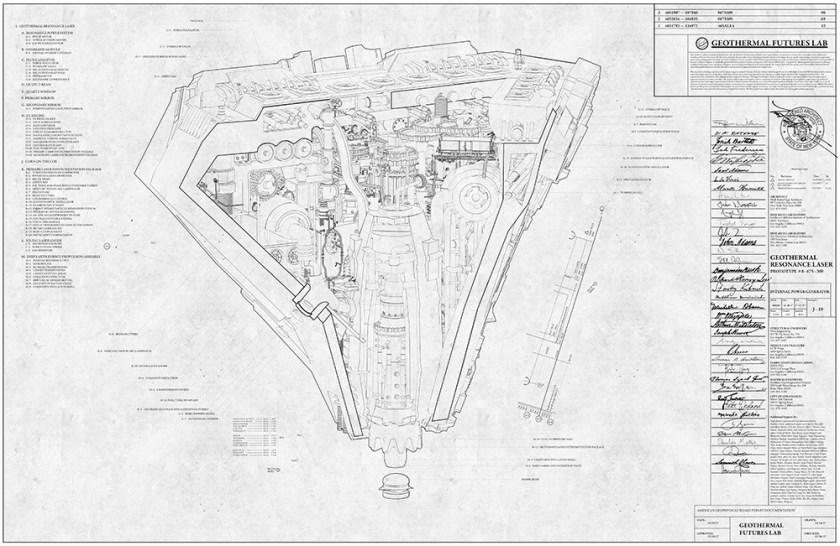
[Image: Drawing courtesy Geothermal Futures Lab].

In the general chaos of renovating a house here in Los Angeles, I missed this lecture and reception on Friday night, launching a semi-fictional “Geothermal Futures Lab” at SCI-Arc.

It involves installing a gold-plated laser somewhere deep in the San Andreas Fault to extract geothermal energy from the landscape. Think of it as a kind of gonzo version of the San Andreas Fault Observatory at Depth.

[Image: Drawing courtesy Geothermal Futures Lab].

The press release, from architect Mark Foster Gage, is a great example of a solipsistic inventor’s imagination at full blast—featuring “geothermal resonance technologies,” nano-gold foil-wrapped laser components, an “experimental phenolic cured resin foam,” and so on.

The functioning of the equipment would also rely, at least partially, on existing “metal deposits along the strike-slipping continental plates,” bringing to mind both the naturally occurring nuclear reactors in Gabon and the giant Earth-battery cells circulating beneath the forests of central Canada: landscapes whose geochemistry lends them to these sorts of giant, speculative energy installations.

Or see Norway’s extraordinary Hessdalen lights, a geologically electrified valley that seems ripe for a Mark Foster Gage-like architectural-energy proposal.

In all these cases, of course, what’s also worth noting is that, as fantastic as this sort of facility might seem—whether it’s a lab extracting electrical energy from the San Andreas Fault, as Foster Gage suggests, or one positioned above geochemical differentials in the Canadian soil—as soon as the power it supplies can be made available through the national grid, it would immediately pass from some sort of absolutely bonkers sci-fi vision of the near-future to, frankly, something utterly mundane. It would simply be where the power comes from, and people would shrug it off as a mere utility (if they think about it at all).

But what this also means is that we might already, right now, be missing out on seeing the truly otherworldly nature of our own power-generation facilities, which have all too easily disappeared into the infrastructural background of the modern world. Science fiction is already here, in other words, we just tend to refer to it as infrastructure. See, for example, Crescent Dunes or PS10. Or, for that matter, take a harder look at oil.

[Images: Drawings courtesy Geothermal Futures Lab].

In any case, here’s a sample from the project text, obligatory typos and all:

The exhibited technology capitalizes on the unique tungsten-saturated substrate of the San Andres fault through the use of a visible-light Q-switched Nd:YAG lasers, tuned to extract sustainable magno-electrical energy from a +678 degree Kelvin supercritical water deposits located adjacent to a stable magma chamber 4.4km beneath the Earths surface. This supercritical water, that behaves both as liquid and gas, is vaporized through 3,780 Kelvin bursts which at peak power induce a supercritical matter state releasing energy in exponential excess of its matter equivalent. The presence of heterogeneous frequency fields in metal deposits along the strike-slipping continental plates supercharges the pockets of supercritical water with magnetic nuons which are forced upwards with velocity µ as a result of the pressure gradient along the vertical faults. Due to the variable decay rate of metals in the presence of such high trajectory nuons, the prototype laser resonance mechanism itself is encased in an experimental phenolic cured resin foam (Cas no. 000050-00-0 with a normal specific gravity of 120 kg/m3) which insulates the process from outside magnetic interference. For rapid nuon decay protection the foam resin is additionally coated with the same seven µm micrometer nano-gold foil used to encase existing NASA satellites. This thick film of gold nano-molecules particles gives the machine its striking gold aesthetic appearance.

A nuon-resistant radiant machine buried in the San Andreas Fault, extracting energy from the friction between tectonic plates? With lasers? Yes, please.

[Images: Drawings courtesy Geothermal Futures Lab].

The exhibition itself is up until March 4; stop by SCI-Arc to see more or check out the project’s website.

(Earlier on BLDGBLOG: San Andreas: Architecture for the Fault. Thanks to Wayne Chambliss and Eva Barbarossa for the heads up!)

Drawing Science/Drawing Fiction

I’ve been remiss in posting about a graduate course I’ll be co-teaching with the brilliant Nicholas de Monchaux up at UC Berkeley for the 2018-2019 academic year. The application period is currently open through December 2017.

Called “Drawing Science/Drawing Fiction: The Future of Californian Ecology,” the year-long Master’s course will be a combination of architectural design, experimental drawing methods, and narrative speculation, exploring what de Monchaux calls a “new relationship between architecture, media, ecology, and craft.”

The idea is to look ahead, not just at the future of California, but at the future of what California represents: cutting-edge industrial design, the global cinematic imagination, unparalleled demographic integration, agricultural innovation, adaptive infrastructure, and, of course, the risks of climate change.

[Image: From David Maisel’s “The Lake Project”; used with permission of the artist].

With the entire state of California at their disposal, students will be able to focus on everything from the U.S./Mexico border to the San Andreas Fault, from Silicon Valley and space tourism to the sci-fi productions of Hollywood. Agriculture, Artificial Intelligence, electric cars; species loss, wildfire, drought; policing, governance, human labor.

There are architectural scenarios to design and explore for all of these.

[Image: California’s Ivanpah Solar Energy Generating System photographed by Ethan Miller for Getty Images, via The Atlantic].

In an interview with Boom California published in 2014, novelist Kim Stanley Robinson—who was also interviewed here on BLDGBLOG way back in 2007—commented on the science-fictional appeal of California. By the time he went to college, he remarked, the landscape of the state had fundamentally changed; it was being terraformed for human habitation by the forces of industry and suburban development.

California, he realized, was itself a design project.

[Images: From David Maisel’s “The Lake Project”; used with permission of the artist].

Robinson explained to Boom that, in the blink of an eye, California became a “completely different landscape. At that same time I started reading science fiction (…) and it struck me that it was an accurate literature, that it was what my life felt like; so I thought science fiction was the literature of California. I still think California is a science fictional place. The desert has been terraformed. The whole water system is unnatural and artificial. This place shouldn’t look like it looks, so it all comes together for me. I’m a science fiction person, and I’m a Californian.”

Science fiction is the literature of California.

[Image: Early rendering for Michael Maltzan’s Six Street Viaduct in Los Angeles].

Briefly, this theme was developed further by an essay by Michael Ziser published in the same issue of Boom. “Postwar science fiction is to a surprising degree a phenomenon of the western United States,” Ziser wrote. It was also quite specifically Californian.

“As the producers of Golden Age sci-fi were lured to the region by the new economic opportunities available to writers in the pulp, television, and film industries of Southern California,” Ziser continued, “they were also drawn into an imaginative relationship with California’s physical novelty as a place sprung de novo from the plans of hydraulic engineers, road builders, and tract housing developers.”

Many of the major themes of science fiction in this period—the experience of living in an arid Martian colony, the palpable sense of depending in a very direct way on large technological systems, unease with the scope and direction of the military and aeronautics industries, the navigation of new social rules around gender and race—can be read as barely veiled references to everyday life in California. For sci-fi writers, teasing out the implications of an era in which entire new civilizations could be conjured almost from nothing through astonishing feats of engineering and capital was a form of realism. They were writing an eyewitness account of what was the most radical landscape-scale engineering project in the history of the world.

This idea of an “imaginative relationship with California’s physical novelty” is something we will be exploring in architectural form throughout the Studio One experience. In the process, we will approach California itself as a subject of design and compare the state to other regions currently experiencing their own de novo re-inventions, whether it’s a thawing Arctic or China’s ongoing building boom.

[Image: Floating caisson during the construction of the original Bay Bridge; photo by Clyde Sunderland, courtesy Library of Congress].

To develop and articulate their visions, students will be pushed to experiment with new forms of architectural representation, modeling, and drawing—or, as de Monchaux writes, “Our chief medium will be drawing, but we will engage and embrace a world of devices and tools—from scripting through mapping and virtual reality-that are changing, and expanding, the capacity of architecture to influence the world.”

I will be up in the Bay Area multiple times for this throughout the academic year, although not on a full-time basis; if you’re a fan of de Monchaux’s work, of science fiction, of architecture, of design’s potential for conjuring radical visions of landscape futures, then please consider applying. You have roughly two more months to do so.

[Image: Farming California, via Google Maps].

More information is available over at UC Berkeley.

Wave Form

[Image: San Andreas Fault mechanics in Parkfield, California, visualized by Ricky Vega].

With the San Andreas Fault on the brain, I’ve been thinking a lot about a course I taught a few years ago at Columbia University exploring the possibility of a San Andreas Fault National Park.

The course was organized around a few basic questions, such as: what does it mean to preserve a landscape that, by definition, is always changing, even poised on the cusp of severe internal disruption? Are there moral, even philosophical, issues involved in welcoming a site of natural violence and potential catastrophe into our nation’s historical narrative? Further, what kind of architecture is most appropriate for a Park founded to highlight seismic displacement?

One of the most interesting things to come out of the course was a set of digital models produced by a student named Ricky Vega (with assistance from other students in gathering the necessary data).

Vega’s images showed the San Andreas Fault not as a line across the landscape, but as a three-dimensional, volumetric form within the Earth. A spatial environment reminiscent of a sinuous building. A serpentine pavilion, to use a bad pun.

[Image: San Andreas Fault mechanics in San Bernardino, California, visualized by Ricky Vega].

The point I was hoping to make by assigning this to my students was that spatial scenarios found far outside of what is normally considered “architecture” can nonetheless pose an interesting challenge for architectural thinking and representation.

In other words, if you, as an architect, are adept at visually depicting complex spaces—through various output such as sections and axonometric diagrams—then what would happen if you were to apply those skills to geology or plate tectonics? The layered relationship of one part of the Earth to another is intensely spatial—it is an explicitly, if metaphorically, architectural one.

Indeed, images such as the one seen immediately below, taken from the California Division of Mines and Geology, would not be out of place in an architectural studio.

[Image: An otherwise unrelated diagram taken from the California Division of Mines and Geology].

So the question was: by using architectural techniques to explore complicated geological scenarios such as the San Andreas Fault, what can architects learn about the possibilities—or, for that matter, limitations—of their most basic representational techniques?

Further, what might the resulting images be able to teach geologists—if anything—about how they can better represent and depict their own objects of study? Perhaps architects and geologists should collaborate more often.

[Image: San Andreas Fault mechanics in Watsonville, California, visualized by Ricky Vega].

Each of Vega’s original models is huge and cuts a mesmerizing, even aquatic profile, with equal shades of Zaha Hadid and Peter Eisenman. If you could reach into the planet and extract an entire fault line, what would it look like? A spine or a wave? A fallen branch or a river? These images are at least one interesting attempt at an answer.

(If you want to read more about the course—a class I would absolutely love to teach again, especially now that I am living within easy driving distance of the San Andreas Fault—check out the original write-up.)

Seismic Potential Energy

[Image: Photo by BLDGBLOG].

I got to hike with my friend Wayne last week through a place called the Devil’s Punchbowl, initially by way of a trail out and back from a very Caspar David Friedrich-ian overlook called the Devil’s Chair.

[Image: Wayne, Rückenfigur; photo by BLDGBLOG].

The Punchbowl more or less lies astride the San Andreas Fault, and the Devil’s Chair, in particular, surveils this violently serrated landscape, like gazing out across exposed rows of jagged teeth—terra dentata—or perhaps the angled waves of a frozen Hokusai painting. The entire place seems charged with the seismic potential energy of an impending earthquake.

[Image: It is difficult to get a sense of scale from this image, but this geological feature alone is at least 100 feet in height, and it is only one of hundreds; photo by BLDGBLOG].

The rocks themselves are enormous, splintered and looming sometimes hundreds of feet over your head, and in the heat-haze they almost seem buoyant, subtly bobbing up and down with your footsteps like the tips of drifting icebergs.

[Image: Looking out at the Devil’s Chair; photo by BLDGBLOG].

In fact, we spent the better part of an hour wondering aloud how geologists could someday cause massive underground rock formations such as these to rise to the surface of the Earth, like shipwrecks pulled from the bottom of the sea. Rather than go to the minerals, in other words, geologists could simply bring the minerals to them.

[Image: Photo by BLDGBLOG].

Because of the angles of the rocks, however, it’s remarkably easy to hike out amidst them, into open, valley-like groins that have been produced by tens of thousands of years’ worth of rainfall and erosion; once there, you can just scramble up the sides, skirting past serpentine pores and small caves that seem like perfect resting spaces for snakes, till you reach sheer drop-offs at the top.

There, views open up of more and more—and more—of these same tilted rocks, leading on along the fault, marking the dividing line between continental plates and tempting even the most exhausted hiker further into the landscape. The problem with these sorts of cresting views is that they become addictive.

[Image: Wayne, panoramically doubled; photo by BLDGBLOG].

At the end of the day, we swung by the monastic community at St. Andrew’s Abbey, which is located essentially in the middle of the San Andreas Fault. Those of you who have read David Ulin’s book The Myth of Solid Ground will recall the strange relationship Ulin explores connecting superstition, faith, folk science, and popular seismology amongst people living in an earthquake zone.

Even more specifically, you might recall a man Ulin mentions who once claimed that, hidden “in the pattern of the L.A freeway system, there is an apparition of a dove whose presence serves to restrain ‘the forces of the San Andreas fault’.”

This is scientifically cringeworthy, to be sure, but it is nonetheless interesting in revealing how contemporary infrastructure can become wrapped up in emergent mythologies of how the world (supposedly) works.

The idea, then, of a rogue seismic abbey quietly established in a remote mountainous region of California “to restrain ‘the forces of the San Andreas Fault’”—which, to be clear, is not the professed purpose of St. Andrew’s Abbey—is an idea worth exploring in more detail, in another medium. Imagine monks, praying every night to keep the rocks below them still, titanic geological forces lulled into a state of quiescent slumber.

[Image: Vasquez Rocks at sunset; photo by BLDGBLOG].

In fact, I lied: at the actual end of the day, Wayne and I split up and I drove back to Los Angeles alone by way of a sunset hike at Vasquez Rocks, a place familiar to Star Trek fans, where rock formations nearly identical to—but also less impressive than—the Devil’s Punchbowl breach the surface of the Earth like dorsal fins. The views, as you’d expect, were spectacular.

Both parks—not to mention St. Andrew’s Abbey—are within easy driving distance of Los Angeles, and both are worth a visit.

Inland Sea

For two closely related projects—one called L.A.T.B.D., produced for the USC Libraries, and the other called L.A. Recalculated, commissioned by the 2015 Chicago Architecture Biennial, both designed with Smout Allen—I wrote that Los Angeles could be approached bathymetrically.

Los Angeles is “less a city, in some ways, than it is a matrix of seismic equipment and geological survey tools used for locating, mapping, and mitigating the effects of tectonic faults. This permanent flux and lack of anchorage means that studying Los Angeles is more bathymetric, we suggest, than it is terrestrial; it is oceanic rather than grounded.”

pendulums
[Image: Underground seismic counterweights act as pendulums, designed to stabilize Los Angeles from below; from L.A. Recalculated by Smout Allen and BLDGBLOG].

Because of seismic instability, in other words, the city should be thought of in terms of depths and soundings, not as a horizontal urban surface but as a volumetric space churning with underground forces analogous to currents and tides.

This bathymetric approach to dry land came to mind again when reading last month that the land of Southern California, as shown by a recent GPS study, is undergoing “constant large-scale motion.”

It is more like a slow ocean than it is solid ground, torqued and agitating almost imperceptibly in real-time.

“Constant large-scale motion has been detected at the San Andreas Fault System in Southern California,” we read, “confirming movement previously predicted by models—but never before documented. The discovery will help researchers better understand the fault system, and its potential to produce the next big earthquake.”

fault
[Image: “Vertical velocities” along the San Andreas Fault; via Nature Geoscience].

This is true, of course, on a near-planetary scale, as plate tectonics are constantly pushing land masses into and away from one another like the slow and jagged shapes of an ice floe.

But the constant roiling motion of something meant to be solid is both scientifically fascinating and metaphorically rich—eliminating the very idea of being grounded or standing on firm ground—not to mention conceptually intriguing when put into the context of architectural design.

That is, if architecture is the design and fabrication of stationary structures, meant to be founded on solid ground, then this “constant large-scale motion” suggests that we should instead think of architecture, at least by analogy, more in terms of shipbuilding or even robotics. Architecture can thus be given an altogether different philosophical meaning, as a point of temporary orientation and solidity in a world of constant large-scale surges and flux.

Put another way, the ground we rely on has never been solid; it has always been an ocean, its motion too slow to perceive.

The Town That Creep Built

[Image: A curb in Hayward reveals how much the ground is drifting due to “fault creep”: the red-painted part is slowly, but relentlessly, moving north. Photo by Geoff Manaugh].

South of San Francisco, a whole town is being deformed by plate tectonics. These are the slow but relentless landscape effects known as “fault creep.”

An earlier version of this post was first published on The Daily Beast.

The signs that something’s not right aren’t immediately obvious, but, once you see them, they’re hard to tune out.

Curbs at nearly the exact same spot on opposite sides of the street are popped out of alignment. Houses too young to show this level of wear stand oddly warped, torqued out of synch with their own foundations, their once strong frames off-kilter. The double yellow lines guiding traffic down a busy street suddenly bulge northward—as if the printing crew came to work drunk that day—before snapping back to their proper place a few feet later.

This is Hollister, California, a town being broken in two slowly, relentlessly, and in real time by an effect known as “fault creep.” A surreal tide of deformation has appeared throughout the city.

[Image: “Fault creep” bends the curbs in Hollister; photo by Geoff Manaugh].

As if its grid of streets and single-family homes was actually built on an ice floe, the entire west half of Hollister is moving north along the Calaveras Fault, leaving its eastern streets behind.

In some cases, doors no longer fully close and many windows now open only at the risk of getting stuck (some no longer really close at all).

Walking through the center of town near Dunne Park offers keen observers a hidden funfair of skewed geometry.

[Image: 359 Locust Avenue, Hollister; photo by Geoff Manaugh].

For example, go to the house at 359 Locust Avenue.

The house itself stands on a different side of the Calaveras Fault than its own front walkway. As if trapped on a slow conveyor built sliding beneath the street, the walk is being pulled inexorably north, with the effect that the path is now nearly two feet off-center from the porch it still (for the time being) leads to.

[Image: The walkway is slowly creeping north, no longer centered with the house it leads to; photo by Geoff Manaugh].

In another generation, if it’s not fixed, this front path will be utterly useless, leading visitors straight into a pillar.

Or walk past the cute Victorian on 5th Street. Strangely askew, it seems frozen at the start of an unexpected metamorphosis.

[Image: Photo by Geoff Manaugh].

Geometrically, it’s a cube being forced to become a rhomboid by the movements of the fault it was unknowingly built upon, an architectural dervish interrupted before it could complete its first whirl.

Now look down at your feet at the ridged crack spreading through the asphalt behind you, perfectly aligned with the broken curbs and twisted homes on either side.

This is the actual Calaveras Fault, a slow shockwave of distortion forcing its way through town, bringing architectural mutation along with it.
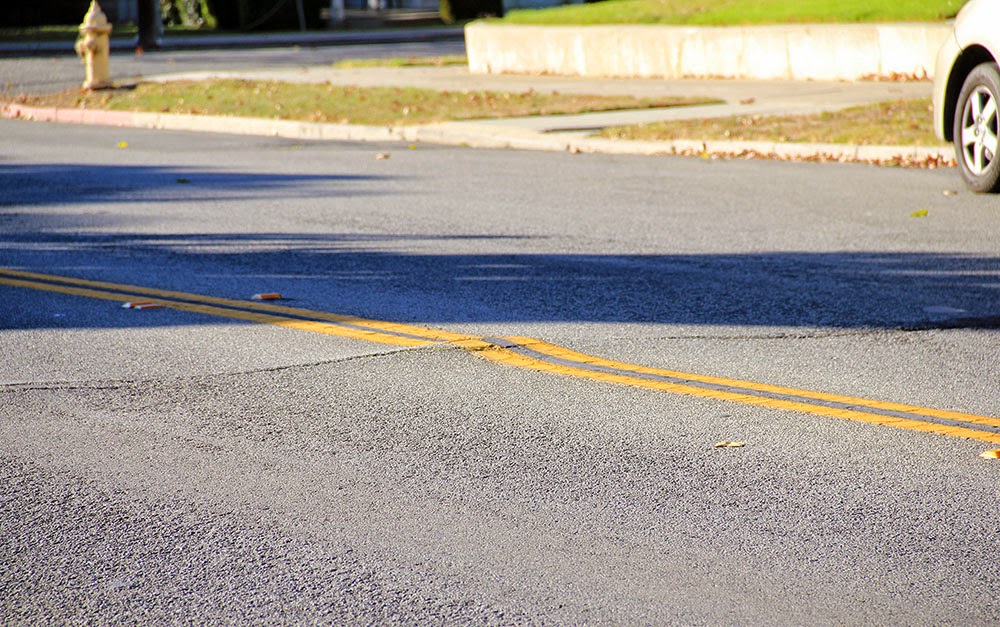
[Images: The Calaveras Fault pushes its way through Hollister; photos by Geoff Manaugh].

The ceaseless geometric tumult roiling just beneath the surface of Hollister brings to mind the New Orleans of John McPhee, as described in his legendary piece for The New Yorker, “Atchafalaya.”

There, too, the ground is active and constantly shifting—only, in New Orleans, it’s not north or south. It’s up or down. The ground, McPhee explains, is subsiding.

“Many houses are built on slabs that firmly rest on pilings,” he writes. “As the turf around a house gradually subsides, the slab seems to rise.” This leads to the surreal appearance of carnivalesque spatial side-effects, with houses entirely detached from their own front porches and stairways now leading to nowhere:

Where the driveway was once flush with the floor of the carport, a bump appears. The front walk sags like a hammock. The sidewalk sags. The bump up to the carport, growing, becomes high enough to knock the front wheels out of alignment. Sakrete appears, like putty beside a windowpane, to ease the bump. The property sinks another foot. The house stays where it is, on its slab and pilings. A ramp is built to get the car into the carport. The ramp rises three feet. But the yard, before long, has subsided four. The carport becomes a porch, with hanging plants and steep wooden steps. A carport that is not firmly anchored may dangle from the side of a house like a third of a drop-leaf table. Under the house, daylight appears. You can see under the slab and out the other side. More landfill or more concrete is packed around the edges to hide the ugly scene.

Like McPhee’s New Orleans, Hollister is an inhabitable catalog of misalignment and disorientation, bulging, bending, and blistering as it splits right down the middle.

And there’s more. Stop at the north end of 6th Street, for example, just across from Dunne Park, and look back at the half-collapsed retaining wall hanging on for dear life in front of number 558.

It looks like someone once backed a truck into it—but it’s just evidence of plate tectonics, the ground bulging northward without regard for bricks or concrete.

[Images: A fault-buckled wall and sidewalk bearing traces of planetary forces below; photos by Geoff Manaugh].

In fact, follow this north on Google Maps and you’ll find a clean line connecting this broken wall to the jagged rupture crossing the street in the photographs above, to the paper-thin fault dividing the house from its own front walk on Locust Avenue.

So what’s happening to Hollister?

“Fault creep” is a condition that results when the underlying geology is too soft to get stuck or to accumulate tectonic stress: in other words, the deep rocks beneath Hollister are slippery, more pliable, and behave a bit like talc. Wonderfully but unsurprisingly, the mechanism used to study creep is called a creepmeter.

The ground sort of oozes past itself, in other words, a slow-motion landslide at a pace that would be all but imperceptible if it weren’t for the gridded streets and property lines being bent out of shape above it.

[Image: A curb and street drain popped far out of alignment in Hollister; photo by Geoff Manaugh].

In a sense, Hollister is an urban-scale device for tracking tectonic deformation: attach rulers to its porches and curbs, and you could even take measurements.

The good news is that the large and damaging earthquakes otherwise associated with fault movement—when the ground suddenly breaks free every hundred years or so in a catastrophic surge—are not nearly as common here.

Instead, half a town can move north by more than an inch every five years and all that most residents will ever feel is an occasional flutter.

[Images: Crossing onto the Pacific Plate (heading west) in Parkfield; photo by Geoff Manaugh].

I spoke with Andy Snyder from the U.S. Geological Survey about the phenomenon.

Snyder works on an experiment known as the San Andreas Fault Observatory at Depth, or SAFOD, which has actually drilled down through the San Andreas Fault to monitor what’s really happening down there, studying the landscape from below through sensitive probes installed deep in the active scar tissue between tectonic plates.

On Snyder’s advice, I made my way out to one of the greatest but most thoroughly mundane monuments to fault creep in the state of California. This was in Parkfield, a remote town with a stated population of 18 where Snyder and SAFOD are both based, and where fault creep is particularly active.

In Parkfield there is a remarkable road bridge: a steel structure that has been anchored to either side of the San Andreas Fault like a giant, doomed staple. Anyone who crosses it in either direction is welcomed onto a new tectonic plate by friendly road signs—but the bridge itself is curiously bent, warped like a bow as its western anchorage moves north toward San Francisco.

It distorts more and more every day of the month, every year, due to the slow effects of fault creep. Built straight, it is already becoming a graceful curve.
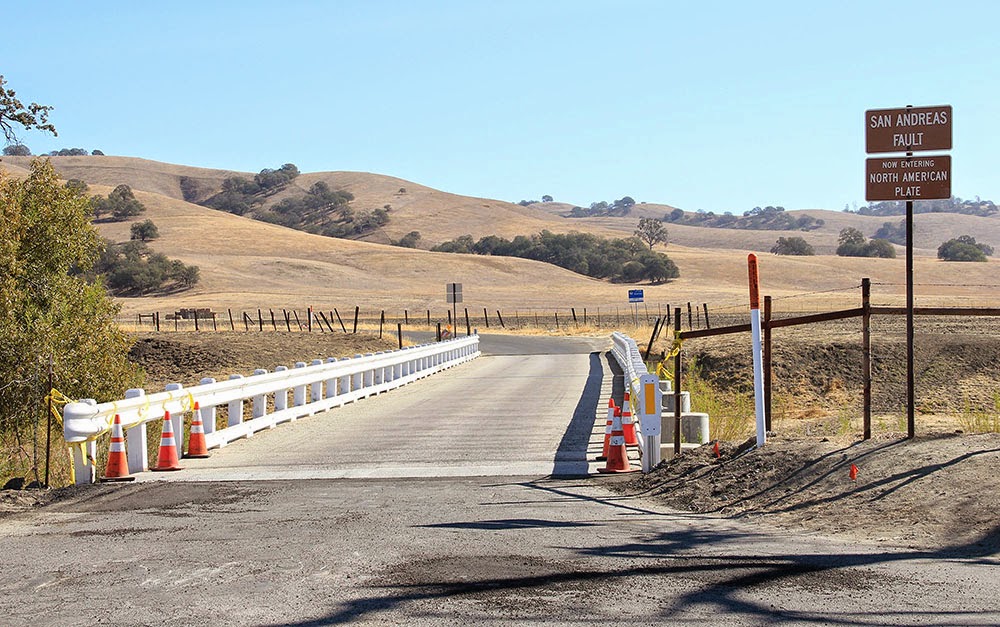
[Image: Looking east at the North American Plate in Parkfield; photos by Geoff Manaugh].

Parkfield is also approximately where fault creep begins in the state, Snyder explained, marking the southern edge of a zone of tectonic mobility that extends up roughly to Hollister and then begins again on a brief stretch of the Hayward Fault in the East Bay.

Indeed, another suggestion of Snyder’s was that I go up to visit a very specific corner in the city of Hayward, where the curb at the intersection of Rose and Prospect Streets has long since been shifted out of alignment.

Over the past decade—most recently, in 2011—someone has actually been drawing little black arrows on the concrete to help visualize how far the city has drifted in that time.

The result is something like an alternative orientation point for the city, a kind of seismic meridian—or perhaps doomsday clock—by which Hayward’s ceaseless cleaving can be measured.
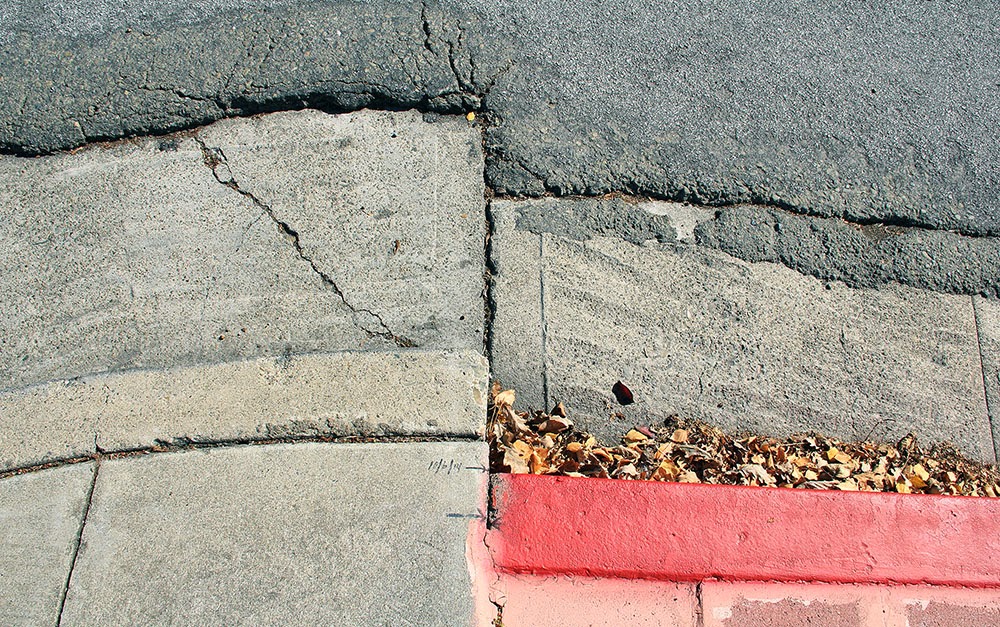
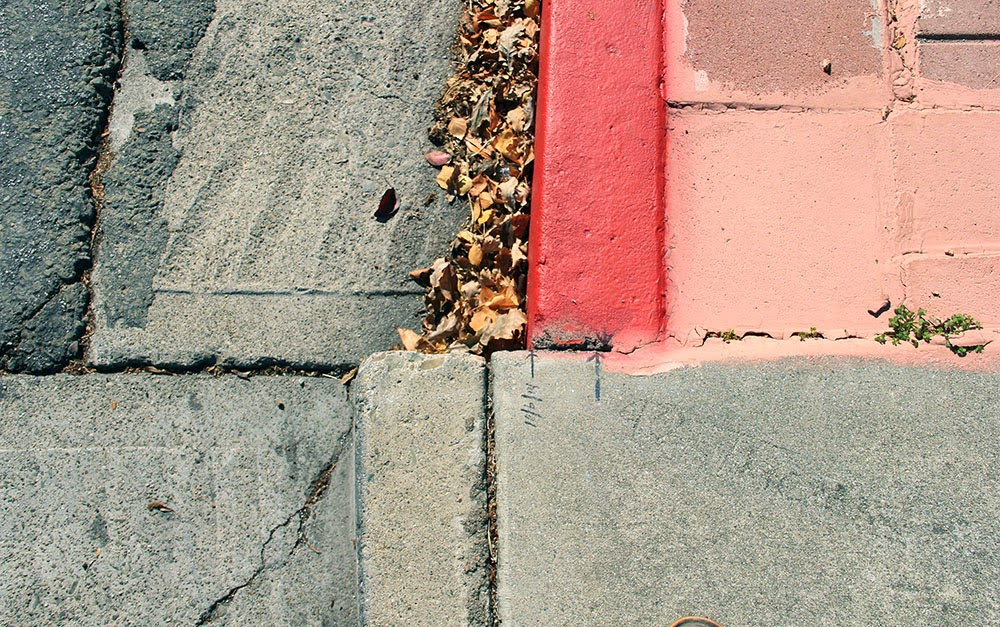
[Images: A moving curb becomes an inadvertent compass for measuring seismic energy in Hayward; photos by Geoff Manaugh].

Attempting to visualize earthquakes on a thousand-year time span, or to imagine the pure abstraction of seismic energy, can be rather daunting; this makes it all the more surprising to realize that even the tiniest details hidden in plain sight, such as cracks in the sidewalk, black sharpie marks on curbs, or lazily tilting front porches, can actually be real-time evidence that California is on the move.

But it is exactly these types of signs that function as minor landmarks for the seismic tourist—and, for all their near-invisibility, visiting them can still provide a mind-altering experience.

Back in Hollister, Snyder warned, many of these already easily missed signs through which fault creep is made visible are becoming more and more hard to find.

The town is rapidly gentrifying, he pointed out, and Hollister’s population is beginning to grow as its quiet and leafy streets fill up with commuters who can no longer afford to live closer to Silicon Valley or the Bay. This means that the city’s residents are now just a bit faster to repair things, just a bit quicker to tear down structurally unsound houses.

One of the most famous examples of fault creep, for example—a twisted and misshapen home formerly leaning every which way at a bend in Locust Avenue—is gone. But whatever replaces it will face the same fate.

After all, the creep is still there, like a poltergeist disfiguring things from below, a malign spirit struggling to make itself visible.

Beneath the painted eaves and the wheels of new BMWs, the landscape is still on the move; the deformation is just well hidden, a denied monstrosity reappearing millimeter by millimeter despite the quick satisfaction of weekend repair jobs. Tumid and unstoppable, there is little that new wallpaper or re-poured driveways can do to disguise it.

[Image: Haphazard concrete patchwork in a formerly straight sidewalk betrays the slow action of fault creep; photo by Geoff Manaugh].

Snyder remembered one more site in Hollister that he urged me to visit on my way out of town.

In the very center of Hollister’s Dunne Park, a nice and gentle swale “like a chaise longue,” in his words, has been developing.

Expecting to find just a small bump running through the park, I was instead surprised to see that there is actually a rather large grassy knoll forming there, a rolling and bucolic hill that few people would otherwise realize is an active tectonic fault.

[Image: A fault-caused grassy knoll rises in the center of Dunne Park in Hollister; photo by Geoff Manaugh].

In fact, he said, residents have been entirely unperturbed by this mysterious appearance of a brand new landform in the middle of their city, seeing it instead as an opportunity for better sunbathing. Fault creep is not without its benefits, he joked.

Snyder laughed as he described the sight of a dozen people and their beach towels, all angling themselves upward toward the sun, getting tan in a mobile city with the help of plate tectonics.

[Note: An earlier version of this piece was first published on The Daily Beast (where I did not choose the original headline). I owe a huge thanks to Andy Snyder for the phone conversation in which we discussed fault creep; and the book Finding Fault in California: An Earthquake Tourist’s Guide by Susan Elizabeth Hough was also extremely useful. Finally, please also note that, if you do go to Hollister or Hayward to photograph these sites, be mindful of the people who actually live there, as they do not necessarily want crowds of strangers gathering outside their homes].