Big Softy

Bracket 2 has been announced. This second issue of the annual design almanac seeks “critical articles and unpublished design projects that investigate physical and virtual soft systems, as they pertain to infrastructure, ecologies, landscapes, environments, and networks.”

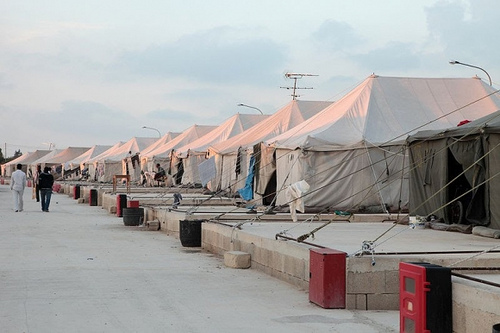
[Image: Fabric urbanism: a “tent city,” via Bracket].
If soft systems are, as the editors maintain, “a counterpoint to permanent, static and hard systems,” then what benefits do they bring, under what circumstances do they function best, and, of course, what do they look like (if they can be seen at all)?

While there is more information on Bracket‘s site, including some historical background on the emergence of soft systems in architectural planning and design, via figures such as Nicholas Negroponte and even Archigram, this issue of the journal is specifically looking for the following:

Bracket 2 seeks to critically position and define soft systems, in order to expand the scope and potential for new spatial networks, and new formats of architecture, urbanization and nature. From soft politics, soft power and soft spaces to fluid territories, software and soft programming, Bracket 2 questions the use and role of responsive, indeterminate, flexible, and immaterial systems in design. Bracket 2 invites designers, architects, theorists, ecologists, scientists, and landscape architects to position and leverage the role of soft systems and recuperate the development of the soft project.

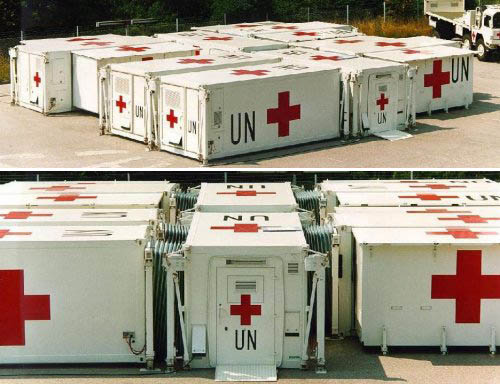
For my own part, I’m increasingly interested in the design and implementation of what might be called soft medical infrastructure—or temporary, sometimes even inflatable, field hospitals and other on-demand medical facilities.

[Image: A “containerized” field hospital by the Red Cross and UN].
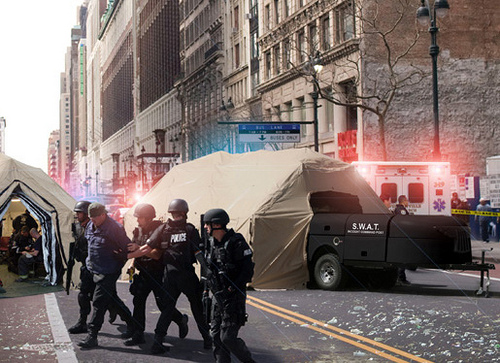
From a “modular air-transportable field camp” that has been “tested at the Arctic Circle” to first-responder architecture deployed on the scene of natural disasters, fires, acts of war, and terrorist attacks—and even by way of the somewhat ominous-sounding “systems for peacekeepers” devised by Kärcher Futuretech, down to the level of mobile catering units for use in remote landscapes and even inside warzones—how are architectural and infrastructural networks pushed into new design directions by extreme events?

[Image: Deployable Incident Command Post (ICP) by Reeves].

Submissions are due before December 10, 2010, with a Fall 2011 publication date; the resulting book will be designed by Thumb and published by Actar.

Consider picking up a copy of Bracket 1: On Farming, meanwhile, to see how the journal works and what sorts of projects they might be looking for.

Augmented Metropolis

Keiichi Matsuda, a recent graduate from the Bartlett School of Architecture, whose film Domestic Robocop was featured on BLDGBLOG several months ago, has a new project out: Augmented City. And it’s in 3D.

The film “focuses on the deprogramming of architecture and the spontaneous creation of customised, aggregated spaces,” Matsuda writes. We see its central protagonist surrounded by pop-up menus and projected touchscreens, able to switch urban backgrounds—graffiti to gardens—in an instant. From the project description:

The architecture of the contemporary city is no longer simply about the physical space of buildings and landscape, more and more it is about the synthetic spaces created by the digital information that we collect, consume and organise; an immersive interface may become as much part of the world we inhabit as the buildings around us.
Augmented Reality (AR) is an emerging technology defined by its ability to overlay physical space with information. It is part of a paradigm shift that succeeds Virtual Reality; instead of disembodied occupation of virtual worlds, the physical and virtual are seen together as a contiguous, layered and dynamic whole. It may lead to a world where media is indistinguishable from ‘reality’. The spatial organisation of data has important implications for architecture, as we re-evaluate the city as an immersive human-computer interface.

The film is even better, Matsuda points out, with 3D glasses. Watch it here, over at Vimeo, or on YouTube.

(Related: Transcendent City).

Pallet House

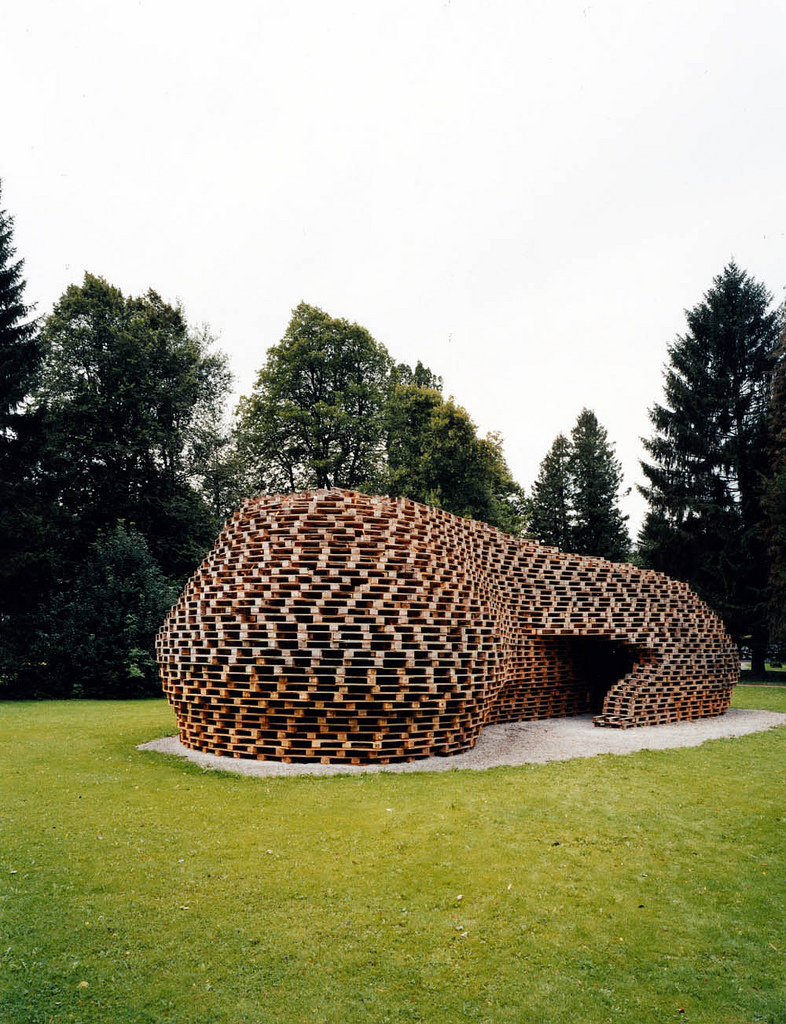
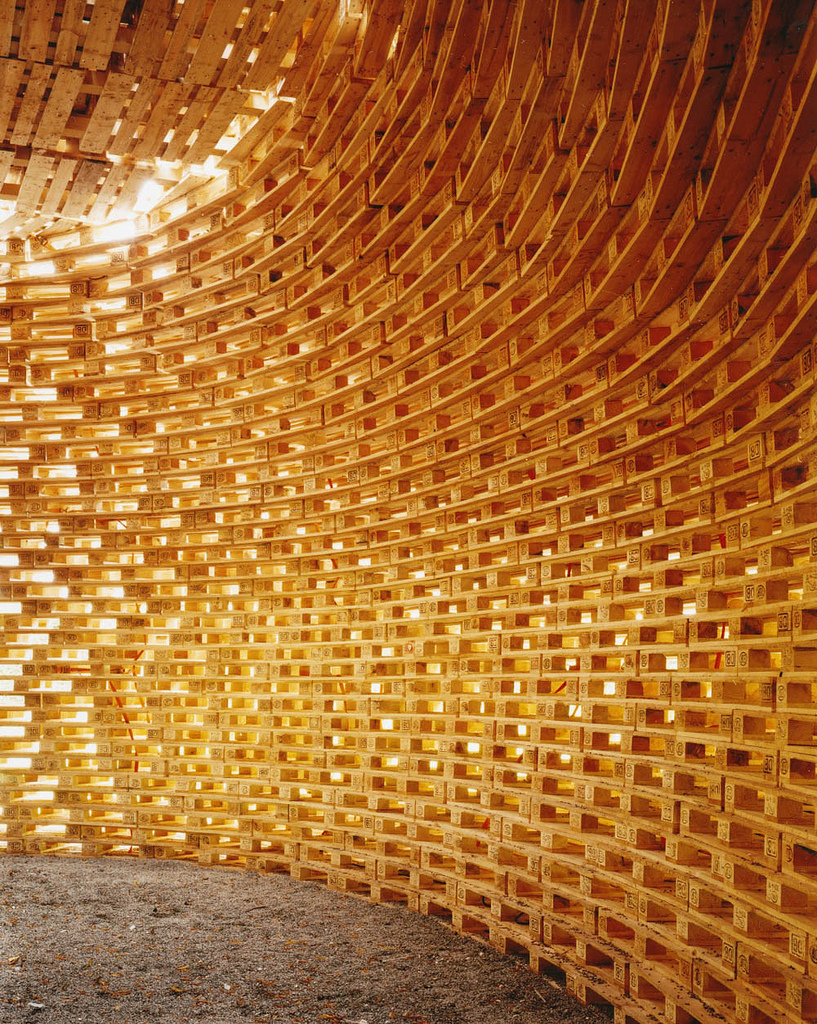
[Image: The Palettenpavillon by Matthias Loebermann, photographed/copyright by Mila Hacke, Berlin].

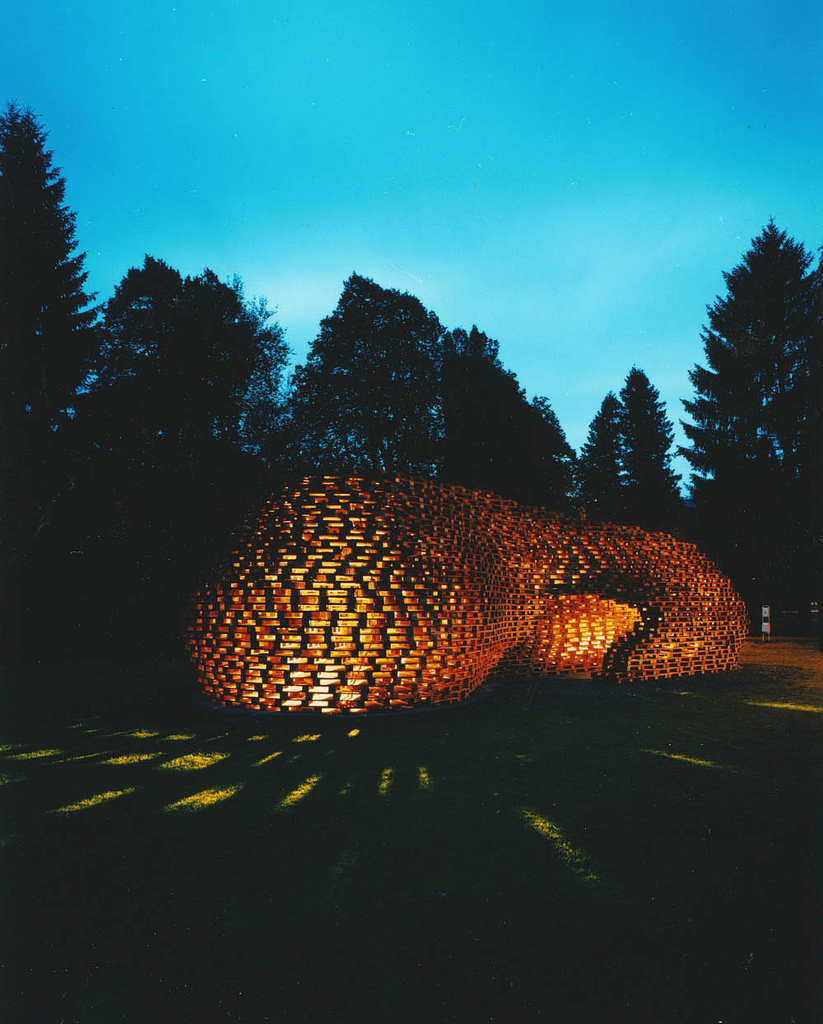
The Palettenpavillon by Matthias Loebermann is a structure made entirely from shipping pallets, ground anchors, and tie rods. Designed to be easily assembled and dismantled, and then entirely recycled at a later date, the resulting building is intended as a temporary meeting place.

[Image: The Palettenpavillon by Matthias Loebermann, photographed/copyright by Mila Hacke, Berlin].

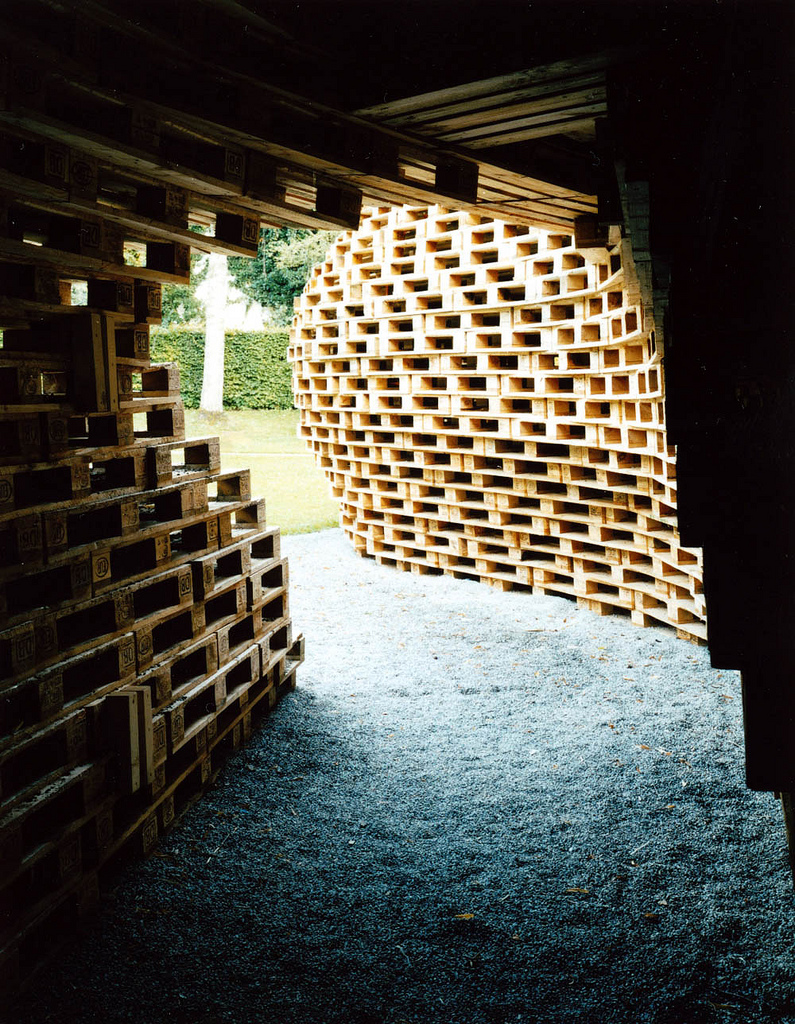
As the architect writes, the shipping pallets are “characterized by a complex geometry of open and closed surface portions,” with the effect that a staggered stacking of each unit produces “interesting netlike structures.” They add that the deceptively curvilinear form becomes a “cave.”

[Image: The Palettenpavillon by Matthias Loebermann, photographed/copyright by Mila Hacke, Berlin].

The unexpected modular reuse of everyday materials is nothing new in architecture—seemingly every term in architecture school brings with it experiments in the tiling of things like cable ties, styrofoam cups, plastic water bottles, and so on—but the spatially dramatic effects of this particular experiment in large-scale, off-kilter pallet-stacking are worth seeing. In fact, a kind of micro-village of equally fluid forms built entirely from pallets would be fascinating to see.

[Images: The Palettenpavillon by Matthias Loebermann, photographed/copyright by Mila Hacke, Berlin].

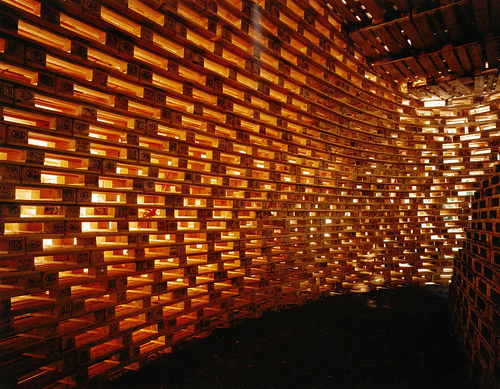
The pavilion at night, lit from within, is also pretty eye-popping—though it might be interesting to see if there’s some strange way to turn the whole structure into a stationary zoetrope of some sort, i.e. the light shining outward is given content, projecting images on the landscape outside. The pallet building as planetarium-machine.

[Images: The Palettenpavillon by Matthias Loebermann, photographed/copyright by Mila Hacke, Berlin].

On the other hand, perhaps pallet architecture is not universally interesting; this recent experiment in London is what Jonathan Glancey calls “a shrine to the humble timber pallet.”

Until a few weeks ago, these hundreds of pallets were being used to stack fruit and vegetables in Covent Garden market. Cheap, strong and hugely adaptable, they also happen to have a distinctly architectural look, especially when flipped on their sides and turned into walls. Some will be left as they are, others clad with sheets of plywood to keep the rain out and to usher in the darkness needed inside an auditorium.

In any case, for more info on the Palettenpavillon—albeit in German—stop by Loebermann’s website.

Documents, Maps, and Files of a Fictional Architecture

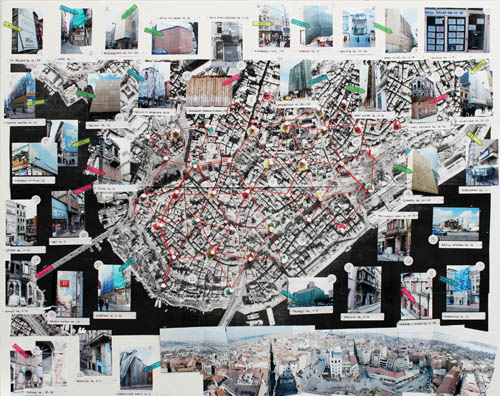
[Image: The Nesin Map by Protocol Architecture].

One of the more interesting student projects I’ve seen in a long time used a “document-based” approach to architecture to fabricate an entire fictional world—one in which top secret underground research labs, militarized bacteria, artificial earthquakes, and much more were all found conspiring beneath the streets of Berlin, Baghdad, and Istanbul.

A group project by three students at Columbia’s GSAPPYuval Borochov, Lisa Ekle, and Danil Nagy, under the guidance of professor Ed KellerProtocol Architecture was pitched as a team that “investigates potentials for future design through the creation and analysis of hyper-fictional documents. These document sets create evidence for future scenarios that string together a specific history of political, social, and technological developments.” As such, Protocol’s work becomes less architectural than it is archival:

By focusing on the space of the document, we can avoid simplistic predictions of the future while creating a database of potential evidence which can be analyzed and interpreted by a wider audience of designers.

The resulting fictional archives—or “fabricated histories,” as the architects describe them—allowed the group to question “the role that fact and evidence plays in how we perceive our own history and our place as designers within it.”

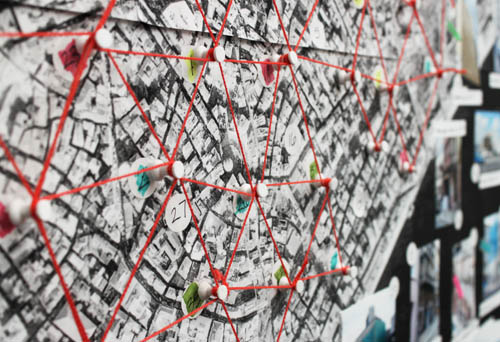
[Image: The Nesin Map (detail) by Protocol Architecture].

As Yuval Borochov explained to me in an email: “Protocol Architecture is a forum for investigations that challenge the traditional design process and situate every project in its own tangential line of history. We found that… the design opportunities within the plot holes of history are quite liberating. You know, I read a statement by Rem Koolhaas, in a book of his conversation with Peter Eisenman, where he explains his attempts to become the ‘architect as journalist.’ I think Protocol Architecture is akin to this mode of operation. Perhaps architects as historiographers.”

Their semester’s worth of work was remarkably varied—and mind-bogglingly prolific—and it can all be explored on their website. However, I want to focus here on three aspects of their document-based approach: The Rühmann Notebook, The Nesin Map, and The Wilbert Contracts.

Before I go much further, though, I have to say that I genuinely think this approach—and the resulting work—bears comparison to books by writers like China Miéville or Franz Kafka, even filmmakers like Guillermo del Toro, for whomever might find those coordinates intriguing. These fictional documents frame entirely self-contained imaginary worlds, and each one of these ideas deserves radical expansion elsewhere, in forms beyond architectural design; as such, they seem at least as appropriate for discussing with a literary agent as they are with the dean of an architecture school.

[Image: The Rühmann Notebook by Protocol Architecture].

The Rühmann Notebook
The first part of Protocol Architecture’s project, the so-called Rühmann Notebook, was produced, we’re told, in early 2002 when Berliner Martina Rühmann “documented her observations of a linear pathway across former East Berlin. The path connected the Berlin Wall in the north to the wall in the south, cutting across the site of the former Palace of the Republic.”

What Rühmann’s mapping project allowed her to discover was a linear network of “small but prominent science research centers” beneath the surface of the city.

It was believed that the hidden route (subsequently discovered and documented by Rühmann) was used for communication and transfer of scientific documents and material in the 1970s and 1980s between the East and West, a time when West German scientists were making significant early discoveries in the fields of microbiology and nanotechnology.

The story here has shades of Lebbeus Woods—for instance, Woods’s ingenious proposal for a film called Underground Berlin. That film revolves around a disillusioned architect, a missing twin brother, neo-Nazi activities in the divided city of Berlin, metallic underground tunnels connecting east to west, and “a top-secret underground research station rumored to be somewhere beneath the very center of Berlin.” There are even rogue planetary scientists investigating “tremendous, limitless geological forces active in the earth.”

In any case, Rühmann’s labs, we learn, were studying bacterial technologies—specifically the use of Bacillus Pasteurii, “a bacteria with adhesive qualities… to stabilize ground in earthquake-prone cities,” and Shewanella, “a bacteria capable of naturally producing electrically conductive nano-tube filaments, now able to produce nano-electric devices.” The architectural implications of these bacterial species begin to loom large in the overall narrative. (If you like the sound of this, by the way, don’t miss Magnus Larsson’s work, featured here on BLDGBLOG in April 2009, or our earlier look at geobatteries).

The locations of these underground biotechnological seismology research labs are what we see documented in the The Rühmann Notebook. The “notebook” itself consists of photos and notes collaged inside a Moleskine.

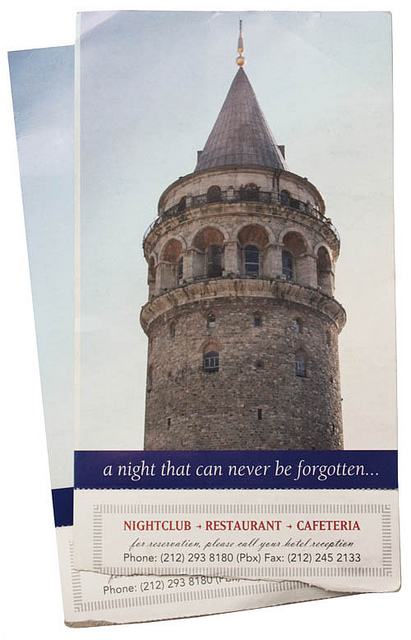
[Image: Istanbul’s Galata Tower, as depicted on ephemera related to The Nesin Map by Protocol Architecture].

The Nesin Map
We now move from Berlin to Istanbul, where The Nesin Map documents a seemingly unrelated network of “concealed buildings” in the city:

Harem Nesin, a Turkish journalist for the Istanbul newspaper Dünya Gazetesi, began photographing concealed buildings in Istanbul sometime in 2017 for his personal records. The buildings captured by Nesin had recently been destroyed by a fire or evacuated due to some other instability of the structure, and were later covered by scaffolding, tarps, or screens. Nesin correlated his collection of photographs to a map of Istanbul, indicating the location of each abandoned building. Through the mapped locations Nesin discovered a triangular geometric pattern across a portion of the city on the European side, from the Golden Horn to the Bosphorus. Nesin used the Galata Tower as a place to survey the buildings in question, indicated by his collage of aerial photographs taken from the Tower. Additionally, in his observations Nesin recorded the means of concealment (tarp, wood, fence, screen) and the address for each structure.

First of all, this is an amazing set-up for a story, somewhere between Borgesian urban paranoia and Debordian psychogeography; and, second, the map itself is very, very cool. Here are the two images of it again.

[Images: The Nesin Map by Protocol Architecture].

So what did Nesin discover as he correlated his data and began to map it all out? A diagrid of “injection points” located at geologically precise points around Istanbul: “Harem Nesin’s map reveals strategic locations used by the Istanbul Metropolitan Municipality as injection points for Bacillus Pasteurii, a microbe able to transform sand into sandstone by depositing calcite (calcium carbonate) throughout the granules, fusing them together.”

The authorities, in other words, were earthquake-proofing the city from below, in “the first application of the bacteria, which had been under development since the mid 1970s through joint research between Germany and the US.”

The Wilbert Contracts
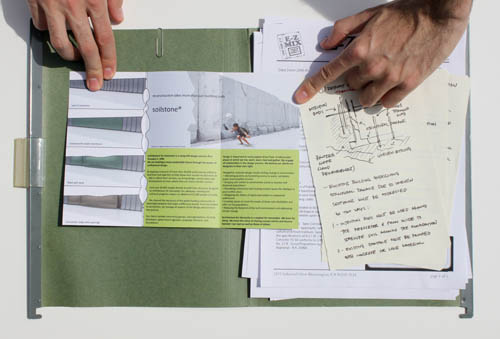
Finally, to Baghdad. The The Wilbert Contracts are a series of files tracing the work of John Wilbert and Co., a quasi-military subcontractor working on a project for Monsanto “between the years 2028 and 2031” in Iraq. Monsanto’s SoilStone® initiative used soil-stabilization biotechnologies to replace concrete walls with more flexible barriers, such as elastic membranes and bacterially-activated sand (i.e. SoilStone®).

[Images: The Wilbert Contracts by Protocol Architecture].

We learn, however, that “linear connections can be perceived” between the multiple sites at which Wilbert and Co. used this technology—indeed, “certain documents from the US Army which are still classified imply that underground tunnel systems were dug between 2028 and 2030.”

It is further inferred, the architects explain, that “pre-programmed nano-bots” were being used in the project as construction machines, selectively injecting Bacillus Pasteurii bacteria into the sands. This technique thus created a semi-mobile, makeshift system of subterranean spaces through which the US military could move. The Army is down there, in other words, stabilizing classified tunnels beneath the streets.

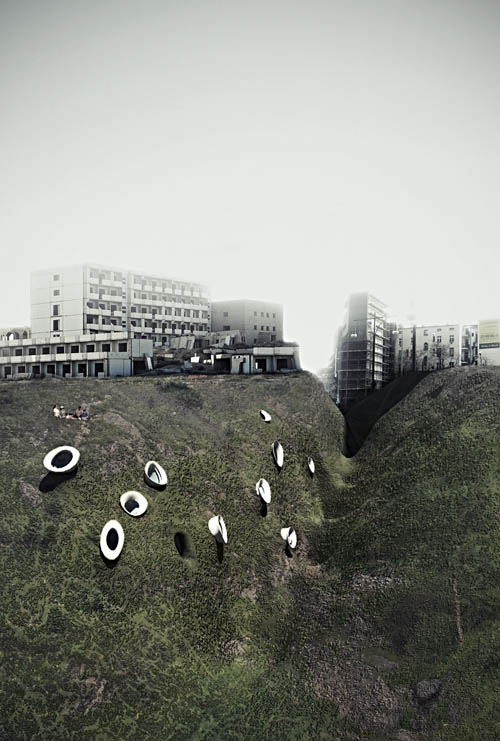
[Images: From Berlin 2050 by Protocol Architecture].

In the end, after a fascinating internal design competition that I simply don’t have the time to cover here—with a jury that included Reza Negarestani of Cyclonopedia fame and Jamie Kruse of smudge studio, among many others, and with entries that ranged from sentient clouds of nano-flies to stabilized earthquakes as a form of urban planning—the group assembled all of their ideas into a proposal for underground spaces in Berlin. These final proposals, however, as well-rendered as they are, simply don’t hold the imaginative appeal for me that the earlier studio material all but burns with.

And that’s the rub: at the end of the day, most architecture students—unsurprisingly—think they have to take this stuff, put it all together, and produce something clearly definable as a building. But the research, in many cases, is more worthy of attention (and well worth the time it takes to produce it). In other words, the research—the preliminary material, the periphery, the narrative excess, the unwanted fringe—is very often most provocative before it becomes a building, when that inchoate mass of possible future projects, storylines, techniques, and more offers a million alternative directions in which we have yet to go.

[Image: The Wilbert Contracts by Protocol Architecture].

I only say this here because it is extraordinarily exciting to see a project like this, that out-fictionalizes the contemporary novel and even puts much of Hollywood to shame—to realize, once again, that architecture students routinely trade in ideas that could reinvigorate the film industry and the publishing industry, which is all the more important if the world of private commissions and construction firms remains unresponsive or financially out of reach. The Nesin Map alone, given a screenwriter and a dialogue coach, could supply the plot of a film or a thousand comic books—and rogue concrete mixtures put to use by nefarious underground militaries in Baghdad is an idea that could be optioned right now for release in summer 2013. HBO should produce this immediately.

My point is not that architecture students should somehow be expected to stop doing the very thing they are in school for—i.e. to learn how artificial enclosures are designed and constructed. I just mean that they should never overlook the interest of their own preliminary ideas, notes, sketches, and scenarios. After all, with just a well-timed email or elevator pitch, all of that stuff—all those bulletin boards, browser tabs, sketchbooks, notes from late-night conversations, site maps, and more—needn’t become just more crap to get filed away in your parents’ house somewhere, but could actually be turned into the seed of a film, novel, game, or comic book in another cultural field entirely.

Don’t give up on your ideas—and don’t overlook the value of something simply because it can’t be turned into a building.

Check out Protocol Architecture’s work in their own words—and with many more images—over on their website. And consider supporting the trio by purchasing their book on Lulu.

(Thanks to Ed Keller for inviting me to see Protocol Architecture’s work as a guest critic).

Ghosts Of The Future: Borrowing Architecture From The Zone Of Alienation

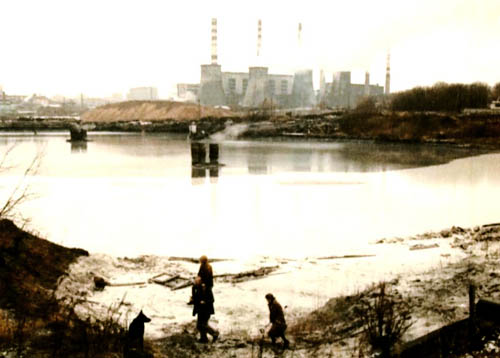
[Image: From Stalker, directed by Andrei Tarkovsky].

[Note: This is a guest post by Jim Rossignol].

During the period in which 3D videogames began to use textures imported from photography, rather than hand-drawn pixel tiles, it became common to hear game developers discuss their photo references.

Drew Markham, director of Return To Castle Wolfenstein, spent the 2001 pre-release press tour for his game talking about the time he had spent in Europe, sourcing textures from “real” locations that had played host to the war. Crumbling French flagstones, Teutonic concretes, and other useful built surfaces: these details would add a certain level of authenticity that other games lacked. When the Wolfenstein sequel finally arrived, British gaming journalists were amused to see the ubiquitous British “H” fire hydrant signs scattered deep within the occult bunkers of Himmler’s SS Paranormal Division.

[Image: Photo by Jim Rossignol].

A few years later, another photo-reference tour was being cited for the gaming press, only this time it was not a cheery holiday in Europe, but a trip to the Zone Of Alienation. This 30km area of Ukraine and Belarus remains poisoned and largely off-limits to mankind, thanks to the radioactive caesium that dusted it after the explosion at the Chernobyl Nuclear Power Plant in 1986.

While it has remained quarantined and closed to (legal) habitation, it hasn’t kept out sight-seers. The production team at GSC Gameworld, a games studio based in nearby Kiev, intended to use the derelict zone as the basis for environments in their action shooter, STALKER: Shadow Of Chernobyl. The team went into the zone and photographed urban dereliction: a snapshot of an abandoned Soviet Union. They would go on to fill their game world with the zone’s rusting fences and collapsing grain silos, but that was not all that came with the material: the landscape and its decaying architecture was already charged with mythology—with narrative.

Creative director Anton Bolshakov explained this in an interview in 2007: “The Soviet system was sealed, many facts were kept secret. Even the most harmless objectives or events generated unbelievable rumours and legends.” One example, he says, is

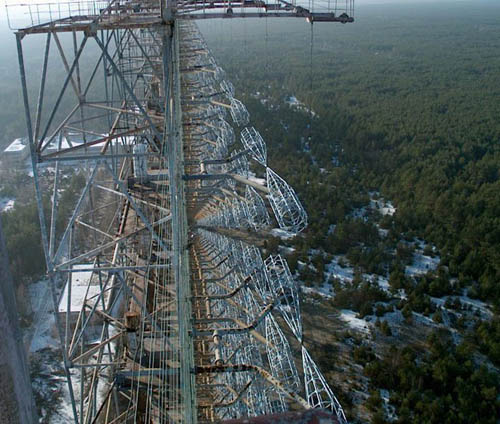
an existing gigantic antenna located within the Chernobyl exclusion zone. On some of our photos taken during the trip to Chernobyl the body of the antenna is seen on the horizon spanning several hundred meters across. So some unofficial sources claim, the waves emitted by the antenna were psychoactive. The antenna was directed onto Western Europe and preoccupied with a long-lasting military experiment on psychotropic influence onto human psyche.

[Images: The “steel giant” near Chernobyl; all photos via English Russia].
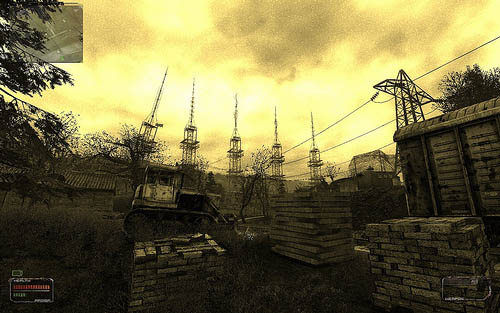
The antenna wall—actually an early-warning radar system developed for Cold War defense, which has been preserved thanks to being inside the zone—made it into the game as “the brain scorcher,” a device that must be shut down before the player can progress into the abandoned city of Pripyat. The environment of Chernobyl not only provided the game with an authentic atmosphere, it was also to influence the events that players could experience.

[Image: The “brain scorcher,” via Jim Rossignol].

However, the zone as an idea already existed before the explosion in 1986. It appeared, for instance, in a 1972 science fiction novel called Roadside Picnic. A mysterious, contaminated pocket of landscape, quarantined from the outside world, was the main theme of that book, which was written by two brothers, Boris and Arkady Strugatsky.

In the Strugatsky’s book, an alien visitation to the earth—an extra-terrestrial “roadside picnic”—has left dangerous and incomprehensible materials strewn across a zone of Northern Canada. Although sealed off for scientific research, this zone is raided by “Stalkers” who sell the unnatural trinkets for black-market cash. To do so, they brave bizarre dangers, because the zone has been transformed into a place that is utterly at odds with our own world. The alien is never seen or even described, and all the characters encounter is its terrible remainder: landscape made alien. Pools of jelly that will cripple a man lurk in basements, extra-terrestrial cobwebs that can stop a heart beating are strung across doorways, and gravitational mantraps will crush anyone who passes over the wrong patch of mud.

The zone of Roadside Picnic was seen by many as an allegory for the entire Soviet experiment: not simply in the literal sense of the poisoned landscapes created by the industrial excesses of the region, but the entire social order that was created by the Communist government. Polluted expanses, continually washed by acid rain, became shorthand for describing the bizarre political situation of a country in which Communism had failed, and yet robotically continued.

Russian film-maker Andrei Tarkovsky shot a movie, called Stalker, which told a story based on that of Roadside Picnic. A glacially slow, almost event-free film about landscape and longing, it’s a work that lingers for long minutes over broken wastelands of abandoned industry. It encapsulates Tarkovsky’s style, as well as his interest in dereliction and decay—themes that would be revisited by the STALKER videogame, thirty years on.

[Image: From Stalker, directed by Andrei Tarkovsky].

Tarkovsky’s film manages to imbue derelict industrial landscapes with a terrible sense of threat. Largely unable to realize the alien properties of artifacts in Roadside Picnic, Tarkovsky projected the danger into the architecture itself. Passive landscapes that could swallow a man. Tunnels which tear them to shreds. These effects were never demonstrated, but also never doubted, thanks to the tentative way the actors explored their surroundings.

In much the same way that the images of the real Chernobyl zone seem like lush vegetative scenes, despite being formidably radioactive, so Tarkovsky’s zone is calm and invisibly dangerous.

Cinematic legend had it that the power station shown in the final background scenes of the film was in fact Chernobyl NPP, although the truth is the entire film was shot in Estonia. That’s not to say that Stalker was without poisonous consequences of its own, however. The first version of the movie was shot entirely on corrupted film, which was unsalvageable when Tarkovsky’s production team returned to their Russian studios. Worse, the second shooting took place down stream from a poorly regulated chemical works. The effluent from the plant was responsible for many of the astonishing visuals in the river scenes from the movie, but team members came to suffer serious side-effects from this exposure, including cancer. They had, it seems, suffered side-effects from their time in the zone: just like the fate of the fictional Stalkers in the Strugatsky books. It was as if the fiction and reality were blurring back through each other. As if—to quote Alan Moore—the written page was too fragile a boundary.

Or perhaps, as Steven Shaviro suggests in his book Connected, Roadside Picnic, like all science fiction, actually exists to cast a shadow over the present. “It shows us how profoundly haunted we are by what has not yet happened,” says Shaviro of science fiction writing. In the specific case of Roadside Picnic and Tarkovsky’s film, what had not happened yet was the Chernobyl disaster.

After 1986, however, there were others for whom the ideas of Roadside Picnic were to be immediately accessible and useful in describing the world that they faced. People going into the Chernobyl exclusion zone, to loot buildings or show tourists around, began to call themselves “Stalkers.” For them, the zone of the Strugatsky’s vision was immediate and first-hand, a kind of fictional reference for the reality they were facing. They were living it—and it was strangely convenient to have the Stalker nomenclature to hand.

[Images: STALKER game images from this very extensive Flickr set].

As for Bolshakov and his creative team, borrowing from both the Strugatskys and the real world has proven fruitful. Real world ruins seem to connect with players far more readily than their fantasy counterparts. No one has been able to come away from STALKER without talking about the architectural waste that GSC borrowed from the zone. The game has now reached three iterations and supports an energetic fan community.

Bolshakov suggests that there is more to this than simply commerce or escapism, however: “The motif behind STALKER was to create a game which would remind people of the Chernobyl accident and at the same time warn mankind against any possible fatal mistakes in the future.” The warning seems likely to go unheard, but perhaps it has another message: to tell game developers that the architecture of the real world comes prefixed with meaning. Even now, when cities can be raised procedurally from the blank canvas of a game engine, perhaps it’s worth taking a look at the real world and the mythology that has been strewn around it. If borrowing architecture from the zone proves anything, it’s that simulation should not exist in a vacuum.

• • •

Jim Rossignol is a games critic, blogger, occasional guest writer on BLDGBLOG, and author of the excellent This Gaming Life: Travels in Three Cities, published by the University of Michigan Press. He is @jimrossignol on Twitter.

Pieces of the city are forming, like islands

[Image: “Shopping mall parking lot, Dubai,” (2009) by Bas Princen].

Photographer Bas Princen has a fantastic new exhibition, called “Refuge,” up at Storefront for Art and Architecture. Tonight, Tuesday, May 11, Princen will be at the gallery for a public event and opening, and it’s well worth checking out.

Storefront describes the show as a “photographic fiction”:

Although it is the result of extensive travels and research in five cities of the Middle East and Turkey—Istanbul, Beirut, Amman, Cairo and Dubai—it could just as easily pass as the pictorial record of a dérive through a single, imaginary city: a city without a center, populated by extraordinary and at times implausible architectural artefacts; an urban laboratory whose physical traits are defined by migratory flows, spatial transformation and geopolitical flux on a continental scale.

[Image: “Cooling plant, Dubai,” (2009) by Bas Princen].

As part of a poster published in tandem with the exhibition, former Storefront director Joseph Grima interviewed Princen about his work, starting off with an inquiry into how Princen’s own background in architectural studies might have affected his photographic approach to the built and natural environments (the interview is also available at Domus).

[Image: “Sand ridge, Amman,” (2009) by Bas Princen].

Princen remarks that, for him, “the camera [is] a tool to construct ideas on space or places, or ideas on architecture and landscape.” For “Refuge,” in particular, he explains that:

My main objective with this project was to create a series of photographs in which Amman, Beirut, Cairo, Dubai and Istanbul disappear as individual cities and as specific places, dissolving instead into a new kind of city, an imaginary urban entity in formation. This premise directed me to specific places in the periphery where pieces of the city are forming, almost like islands, and this accounts for my interest in the refugee camps and gated communities.

Zeroing in specifically on the architecture, Grima then asks him about “the ubiquity of the modernist reinforced-concrete slab-and-column structure,” a construction technique clearly visible in the photographs reproduced here.

[Images: “Former sugarcane field, Cairo,” (2009) and “Ringroad, Cairo,” (2009) by Bas Princen].

Grima suggests that, as a tactic for assembling buildings, this construction technique is “strongly reminiscent of Le Corbusier’s Maison Domino.” Princen’s response is brilliant, and worth quoting at length:

It is fascinating that Maison Domino, the quintessential modernist prototype conceived as a universal answer to the housing problem, has in the end inspired the method of choice for informal construction, with or without the help of architects. The many interpretations of the famous Maison Domino prototype I’ve seen are a clear indication that is has become the most universally successful type of construction, but nothing prepared me for Cairo, where this structural system is really pushed to the limits—not only because these buildings in red-brick-and-concrete grids rise to 16 or 17 floors, but also because three quarters of the city is constructed in this way. It is a mesmerizing fictional experience: driving on an elevated highway through this city of red brick towers, trying to imagine who is actually living there.

This latter remark—Princen’s difficulty in imagining these sorts of landscape humanly inhabited—sets the stage for a remark, later in the interview, when Princen mentions that he attempts to maintain a human presence in his photographs—in other words, they are not anthropologically empty landscapes.

[Images: “Mokkatam Ridge (garbage recycling city), Cairo,” (2009) by Bas Princen].

He adds that “the so-called ‘middle distance'”—the scale inhabited by humans—”has not been used much in recent architectural photography,” an industry that tends now to focus on one of two extremes: “the architectural object on the one hand and the cityscape on the other.” But “it is exactly in this middle distance,” Princen counters, “that the human figure becomes an interesting element: it cannot be shown as the main subject, but will always be defined by the relationship with its surroundings, to put an extra meaning or layer on the landscape or object that is photographed.”

As a result, Princen’s photos show us diminutive humans, stranded amidst incomprehensible architectural forms and massive landscapes, neither urban nor rural, pursuing admirably self-directed goals through which to give themselves meaning or, depending on how you look at it, utterly vacuous tasks that they refuse to admit should be abandoned.

[Images: Spreads from “Refuge” by Bas Princen].

Princen has rapidly become one of my favorite photographers; his earlier work, for instance, collected in the stunning Artificial Arcadia, shows, in Grima’s words, “the contemporary landscape as something invariably artificial, even when there is no sign of human intervention.”

What this means, more concretely, is that the book documents transitional landscapes scattered here and there around the Netherlands: “future suburbs,” highway overpass construction sites deep in forested housing estates, thickets planted for no ecological reason other than to block the sounds of a nearby airfield—landscapes that are at once highly abstract, yet ingeniously colonized by the local residents who have turned them into 4×4 race tracks, kite-flying grounds, fishing ponds, sites for paintball tournaments, and more.

They are also landscapes that have been generated, as if unconsciously, by industrial processes seated and operating elsewhere; as such, Princen shows us clay and sand depots, harbor excavation sites, and dumping grounds for contaminated silt and soil. But then, there, on top of those strange landforms, built on no recognizable human scale, there are weekend nature enthusiasts with their cameras out, stalking rare insects and birds that have settled these disrupted terrains.

The book, frankly, is pretty incredible. Take the “acoustic forest”: as mentioned above, it is a landscape “maintained to cushion the noise of a military base and airfield,” showing us an artificial ecosystem as military-sonic camouflage, like something out of Nick Sowers‘s research.

It’s the small humanist flips, however, that interest me so much; a sand dyke, for example, built ostensibly for the same purpose as above, “to shield a new housing estate from the noise of a military airfield,” but that has since been transformed into a communal meeting place where “residents gather on the sand dyke to watch the planes.”

[Images: Spreads from Artificial Arcadia by Bas Princen].

These makeshift, highly unexpected communities—such as model-airplane enthusiasts hanging out together in remote hardware store parking lots—are rampant throughout Artificial Arcadia and, indeed, Bas Princen’s work altogether. One of the most intriguing examples of this is the site of a new highway being constructed through forested suburbs; far from the paving stage, however, it is simply a muddy scar through the trees, looking more like a landslide, with no actual sense that the construction crews are even coming back to finish it. It is, Princen explains, “a 30-km long highway construction site, cutting through forests and farmlands, skirting villages,” that has since become “a gathering place,” like a piazza or churchyard.

The back of the book states that Princen is interested in documenting “the complex qualities that construct contemporary landscape, such as accessibility, wind direction, water currents and communication networks. In addition the use of certain products, such as kites, mountain bikes and GPS monitors, has a bearing on the way in which landscape is understood.” The landscape is instrumentalized, we might say, distilled through dense layers of technological abstraction to become, once again, a place inhabitable by human activity, however pathetic or impressively persistent it might be.

[Image: “Valley, Beirut,” (2009) by Bas Princen, from “Refuge“].
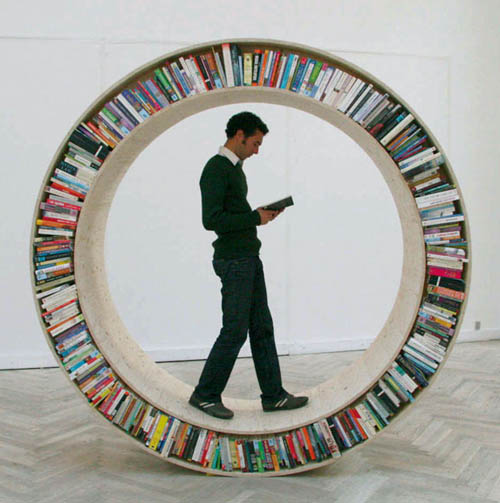
In any case, the exhibition opening tonight, May 11, at Storefront for Art and Architecture—where Bas Princen will be present in the gallery to kick things off and answer questions—features only his work for “Refuge,” but it promises to be one of the more compelling photography shows in New York this year.

Books Received

[Image: “Archive II” from the Archive Series by David Garcia Architect, Copenhagen].

When I started the “Books Received” series last year, I did so just in time to box all my books up, put them in storage for what was supposed to be a three-month trip—and then abandon the series with only two posts written. But now it’s May 2010, that “three-month” trip has still not ended (the one-year mark is in two weeks), my things are still out in an L.A. storage warehouse gathering dust, and I’ve managed to hoard a whole new collection of books and papers.

About to hit the road once again now, for a trip within the trip, heading north to spend the summer in Montreal, I thought I’d revive the “Books Received” posts with a look at some of the many, many pieces of reading material that have gathered in our apartment over the past half-year. As before, I have not read all of the following books, which means I cannot vouch for all of their quality (except in a few cases that I will note); also, as before, these are not all new books. They are newly purchased—or newly received as review copies—but they are not necessarily hot off the press.

And with that…

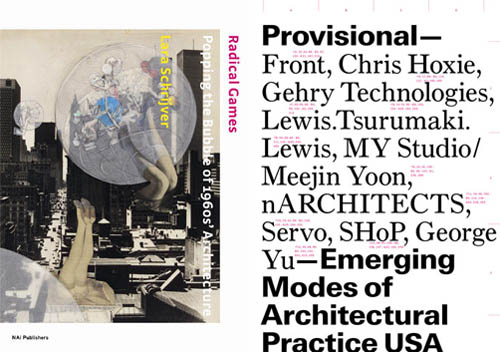
Radical Games by Lara Schrijver (Netherlands Architecture Institute). Schrijver looks back at the “radical movements” of the 1960s, to “a moment in the history of architecture when revolutionary ideals were paramount and dreams became drawings.” Her goal, however, is to uncover how the ideals of three specific groups—Archigram, the Situationists, and Venturi & Scott Brown—maintained a confusing dependency on the very Modernist philosophies they were trying to dispute. This continues to have effects today, Schrijver argues, in muddying the waters of both theoretical debate and experimental practice.

Provisional: Emerging Modes of Architectural Practice USA, edited by Elite Kedan, Jon Dreyfous, and Craig Mutter (Princeton Architectural Press). Speaking of architectural practice, this fantastically designed (by Project Projects) book shows how architects actually work and how their buildings come together, including nARCHITECTS’ extraordinary “Wind Shape.” A very useful and interesting look at the organizational innovations, technical breakthroughs, and work-flow challenges that architectural offices now face. In fact, if there are forthcoming titles, designed to the same fabulous standard, called Emerging Modes of Architectural Practice Europe, …Asia, …Africa, …South America, and so on, I would snap all of them up.

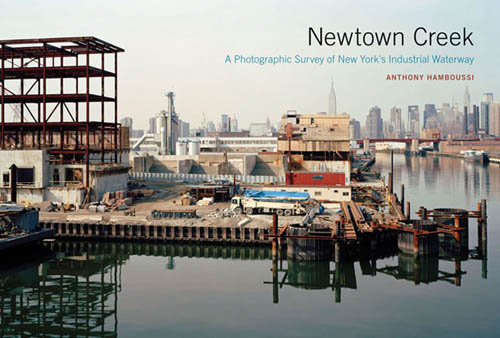
Newtown Creek: A Photographic Survey of New York’s Industrial Waterway by Anthony Hamboussi (Princeton Architectural Press). From gargantuan salt piles to paving yards, UPS loading docks to derelict oil terminals and the sludge tanks of the NY Department of Sanitation, Hamboussi leads a photogeographic tour through the industrial landscapes of Newtown Creek, dividing Brooklyn and Queens. “Having worked along the creek for about a decade,” Paul Parkhill writes in the book’s afterword, on the other hand, “I can say with some conviction that any assumptions about abandonment are misplaced. Behind the street walls and cyclone fencing, inside the shuttered factories and warehouses, there exists a world hidden to the casual observer. Newtown Creeks reflects, in the words of one waterfront planning official, the ‘backyard’ of New York City. Desolate in spots, disgusting in others, it is far from abandoned.”

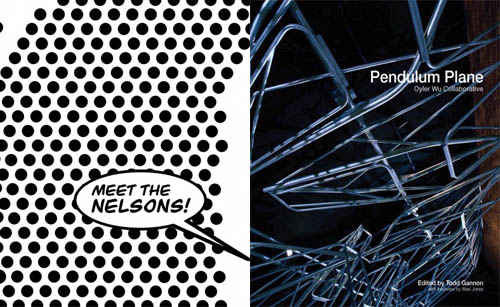
Meet The Nelsons by Wes Jones and Pendulum Plane by the Oyler Wu Collaborative (Los Angeles Forum for Architecture and Urban Design). These two pamphlets from the LA Forum unfortunately suffer from bad production, with almost instantly cracking spines and pages falling loose within minutes of reading. No matter, the Oyler Wu pamphlet in particular has some fantastic details, including beautiful shots of their Lebbeus Woods-like sketchbooks and some backstage glimpses of the “Live Wire” installation they did for SCI-Arc.

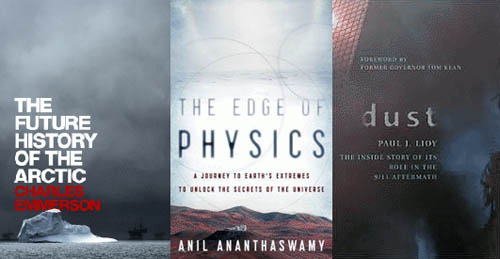
The Future History of the Arctic by Charles Emmerson (PublicAffairs). Emmerson takes us through the now-rapidly shifting geography north of the Arctic Circle, where nation-state territorial ambitions and private-sector mineral & gas claims—not to mention thawing international shipping lanes, package tourism, and global climate change—are beginning to collide.

The Edge of Physics: A Journey to Earth’s Extremes to Unlock the Secrets of the Universe by Anil Ananthaswamy (HMH). I’m halfway through this, and absolutely loving it. There are sensitive, remote, large-scale, and theoretically complex physics experiments going on all over the world, complete with massive pieces of infrastructure that such things require. So why not take a trip around the world and visit these extraordinary sites, as well as the unearthly landscapes in which they sit? Ananthaswamy does exactly that, taking us into an abandoned mine in Minnesota, to a neutrino detector deep beneath Russia’s Lake Baikal, up into the mountain deserts of South America, and past hulking telescopes in dark regions all over the world. All travel writing should be this interesting.

Dust: The Inside Story of its Role in the September 11th Aftermath by Paul Lioy (Rowman & Littlefield). In the book’s Prologue, Lioy writes that, “Within twenty-four hours of the September 11 attack on the World Trade Center (WTC) in New York City, representatives from several governmental agencies asked me about the dust that was released during the collapse of each tower.”

The thick gray and fluffy dust seemed to be everywhere, settling on all of the animate and inanimate objects in its path. It covered the skin and clothes of many of those who had survived but who had been trapped in harm’s way. You could see it being resuspended in the air after official vehicles drove through Manhattan. What was in that dust and its companion plume of smoke that was moving across Brooklyn and out to sea? At that time, I didn’t know the answer to this question.

Lioy—a “specialist in exposure science”—has thus written this investigative chemical analysis of the cloud: what was in it, its basic morphology, how it interacted with human tissue, and how long its residue actually stuck around in New York City.

Poets in a Landscape by Gilbert Highet (New York Review of Books). This brand new, NYRB edition revives Highet’s classic textual history of Roman poets, zooming in through the curtain of their words to focus on the background landscapes within which their poetic events took place—revealing a geography of lost place-names, gardens, villages, city fringes, and farms. An earlier edition of Highet’s book was praised in an old post on the excellent blog Some landscapes.

Traveling Heroes: In the Epic Age of Homer by Robin Lane Fox (Vintage). This book has been greeted with mixed reviews, but the premise still thrills me: Fox has written a survey of “traveling heroes”: “particular Greeks at a particular phase in the ancient world who travelled with mythical stories of gods and heroes in their minds.” Or this, from the back cover description: Fox “explores how the intrepid Mediterranean seafarers of eight-century B.C. Greece encountered strange new sights—volcanic mountains, vaporous springs, huge prehistoric bones—and weaved them into the myths of gods, monsters, and heroes that would become the cornerstone of Western civilization.”

The Routes of Man: How Roads Are Changing the World and the Way We Live Today by Ted Conover (Knopf). The premise of this book is fantastically simple: to travel the world’s roads, to ask how they have shaped human culture, and to reveal their literal resurfacing of the planet. After all, “Roads constitute the largest human-made artifact on earth,” Conover writes, so why not approach them as an anthropologist might? The execution so far, however, has left me underwhelmed. At the moment, Conover has just spent an awfully long time writing in a faux-naive voice about the South American jungle, telling us far less about roads, in any real sense, than about his own travels through this remote, intensely rural region that he can’t seem adequately to decipher. I’m finding myself wishing that Matthew Coolidge of the Center for Land Use Interpretation had written this book—or that a similarly themed book comes out soon, perhaps by the authors of mammoth—but I hope this sense of anticlimax dissipates as I continue reading.

The Road to Ubar: Finding the Atlantis of the Sands by Nicholas Clapp (Mariner). I picked this up after seeing a brief reference to it in Michael Welland’s excellent book Sand. At first, it sounds like total b.s.—a lost city called the “Atlantis of the Sands,” known only through rumors and myth, like something published by Weiser. But it turns out to be true: there is a lost trading city beneath the sand dunes of Oman, and the whole thing disappeared when it collapsed into a sinkhole. Read this old New York Times review if you’re not convinced; there, we read that Clapp

assembled a group of collaborators that included a remote-imaging geologist from J.P.L.; an Arabic-speaking expedition wrangler with a knighthood; a fund-raiser; a cameraman (the personal quest having meanwhile become a film project); a sound man; Clapp’s wife, Kay; and Juris Zarins, an archeologist with a special interest in the Arabian incense trade. In 1990, Sultan Qaboos ibn Said granted them access not just to a remote zone of desert but also to one of his helicopters. After some reconnaissance flights, a more laborious search in Land Rovers led the team to a fruitful dig site in the Omani desert—though at an unexpected location, under an unexpected name. Over the next four years, Zarins, with a crew of helpers, would excavate that site tellingly.
To reveal here just what they found, and where they found it, would betray the suspense of Clapp’s narrative.

Think of it as Indiana Jones meets subterranean desert hydrology.

The First Fossil Hunters: Paleontology in Greek and Roman Times by Adrienne Mayor. (Princeton University Press). What an amazing topic for a book: how did ancient cultures understand, collect, and eventually explain fossils from gigantic creatures that they had no scientific means of understanding? From myths of dragons to fossilized deities, what cultural reactions did these petrified remains inspire? Looking back at the fossil-hunting record of Mediterranean cultures 2000 years ago, Mayor attempts to answer those questions. On another note, Mayor’s most recent book, The Poison King, also looks great.

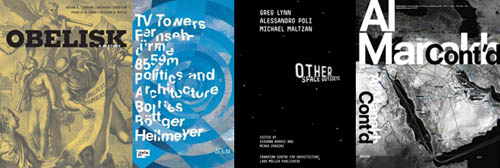
Obelisk: A History by Brian A. Curran, Anthony Grafton, Pamela O. Long, and Benjamin Weiss (MIT). An illustrated, multiply-authored account of how massive stone plinths were quarried, transported, publicly erected, and culturally adored from Ancient Egypt to Paris in the 21st century.

TV Towers by Friedrich von Borries, Matthias Böttger, and Florian Heilmeyer. This “architectural history of TV towers” tracks the political history and structural forms of television-broadcasting towers all over the world, primarily in Europe—yet, as the authors point out, “the most recent are being erected in up-and-coming Asian cities and in the Middle East.”

TV towers have been—and still are—the most visible symbols of an otherwise invisible technological revolution. The geographical spread of such towers traces twentieth century political history until this day: rivalry between political systems in East and West was followed by competition among global cities for touristic and economic appeal… TV towers are the cathedrals of a media society.

The book was published to coincide with an exhibition at the Deutsches Architekturmuseum that closed in March 2010.

Other Space Odysseys, edited by Mirko Zardini and Giovanna Borasi (Canadian Centre for Architecture/Lars Müller). I’m looking forward to seeing this exhibition in person up in Montreal next month. This pamphlet-sized accompanying booklet does a great job in portraying the loopy design history of architects who have directly engaged with the space program (and, specifically, with human experience on the moon). The Alessandro Poli chapter is a highlight.

Al Manakh 2 (Volume/Archis). A sober, recessionary note, kicked off right away by Rem Koolhaas’s introductory letter, haunts this sequel to Al-Manakh. Koolhaas sounds more like a defiant sports fan who knows his favorite team is having an off-season (but who has decided to cheer them on, nonetheless). “Dubai is an experiment that will never be repeated,” he writes; it is (was?) “an entirely different construct, the brainchild of a local minority that generously invited manpower and expertise from everywhere to assemble an artificial community, to test, explore and put into practice the relationship between Islam and modernity.” Whether or not this massive—and, physically, very nicely realized—book amplifies or eviscerates the “understandable Schadenfreude” Koolhaas mentions in his intro is something I will have to find out while reading it this summer.

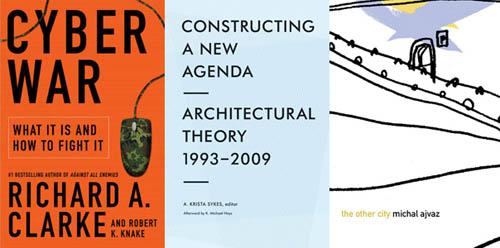
Cyber War: The Next Threat to National Security and What to Do About It by Richard Clarke and Robert Knake (Ecco). This is another book I’m roughly halfway through (and enjoying, precisely because of its alarming nature). If Clarke and Knake are to be believed—and they seem like reliable narrators—the U.S. is wildly underprepared for any sort of concentrated, militarized cyber-attack, whether from another nation-state or from an organized network of criminal hackers. “The U.S. military is no more capable of operating without the Internet than Amazon.com would be,” the authors write, and the eye-popping infrastructural vulnerabilities that they point out here and there—such as counterfeit routers, manufactured in China and sold throughout the U.S. market, with security flaws suspiciously (and deliberately?) well-placed for later attacks, or the “logic bombs” that have been found “all over our [the U.S.’s] electric grid”—are worth the price of the book alone.

Constructing a New Agenda for Architecture: 1993 to the Present, edited by A. Krista Sykes (Princeton Architectural Press). This is an historically valuable collection of essays commonly assigned by architecture professors over the past seventeen years—but, to be honest, if you want interesting ideas for future design projects, I think you’re better off reading even just a handful of the other titles mentioned above. This is not universally true for everyone reading this blog, of course, and I don’t mean to be idiotically dismissive of the past decade and a half of theoretical writing; after all, Sykes has put together an impressive survey. But, for my own needs, impulsive architectural speculation is a much more valuable, projective form of theorizing than the overly careful, citational micropolitics that too often passed for academic work in the 1990s.

—Finally, The Other City by Michal Ajvaz (Dalkey Archive). Ajvaz’s novel is a “strange and lovely hymn to Prague,” we read, falling somewhere between magic realism, Labyrinths, and perhaps Jeff VanderMeer. “Can there really exist a world in such close proximity to our own,” Ajvaz asks, “one that seethes with such strange life, one that was possibly here before our own city and yet we know absolutely nothing about it?” That is “indeed quite possible,” his narrator concludes, wandering through streets always on the verge of mutating into something else.

* * *

All Books Received: August 2015, September 2013, December 2012, June 2012, December 2010 (“Climate Futures List”), May 2010, May 2009, and March 2009.

The Switching Labyrinth

[Image: From “Labyrinths, Mazes and the Spaces Inbetween” by Sam McElhinney].

Sam McElhinney, a student at the Bartlett School of Architecture, has been building full-scale labyrinths in London and testing people’s spatial reactions to them. See photos of his constructions, below.

McElhinney explained his research to BLDGBLOG in a recent email, attaching a paper that he delivered earlier this month at a cybernetics conference in Vienna, where it was awarded best paper. Called “Labyrinths, Mazes and the Spaces Inbetween,” it describes McElhinney’s fascinating look at how people actually walk through, use, and familiarize themselves with the internal spaces of buildings, using mazes and labyrinths as his control studies.

In the process, McElhinney introduces us to movement-diagrams, Space Syntax, and other forms of architectural motion-analysis, asking: would a detailed study of user-behaviors help architects design more consistently interesting buildings, spaces that “might evoke,” he writes, “a sense of continual delight”? Pushing these questions a bit further, we might ask: should all our buildings be labyrinths?

[Images: Movement-typologies from “Labyrinths, Mazes and the Spaces Inbetween” by Sam McElhinney].

Early in the paper, McElhinney differentiates between the two types of interior experiences—between mazes and labyrinths.

A path system can be multicursal: a network of interconnecting routes, intended to disorient even the cunning. It may contain multiple branches and dead ends, specifically designed to confuse the occupant. This is a maze.

Alternatively, a path can form a single, monocursal route. Once embarked upon, this may fold, twist and turn, but will remain a constant and ultimately reach a destination; this is a labyrinth.

The experience of walking these two topologies is very different.

These basic definitions set the stage for McElhinney’s own “premise,” which is “that all space is found, experienced and inhabited in a state of ‘switching’ flux between the diametrically opposed topologies of maze and labyrinth. This offers insights into how we might evoke a sense of continual delight in the user [of the buildings that we go on to design].” Accordingly, he asks how architects might actually construct “a path that switches from a labyrinth into a maze (and vice-versa).”

How can architects design for this switch?

[Images: From “Labyrinths, Mazes and the Spaces Inbetween” by Sam McElhinney].
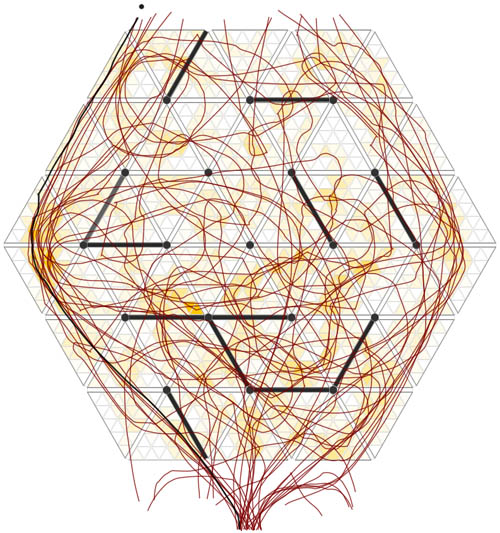
McElhinney’s argument segues through a discussion of Alasdair Turner’s Space Syntax investigations (and the limitations thereof). He describes how Turner put together a series of automated test-runs through which he could track the in-labyrinth behavior of various “maze-agents”; these reprogrammable “agents” would continually seek new pathways through the twisty little passages around them—a spatial syntax of forward movement—and Turner took note of the results.

Turner’s test-environments included, McElhinney explains, a maze that “was set to actively re-configure upon a door being opened, altering the maze control algorithms” behind the scenes, thus producing new route-seeking behavior in the maze-agents.

[Images: From “Labyrinths, Mazes and the Spaces Inbetween” by Sam McElhinney].

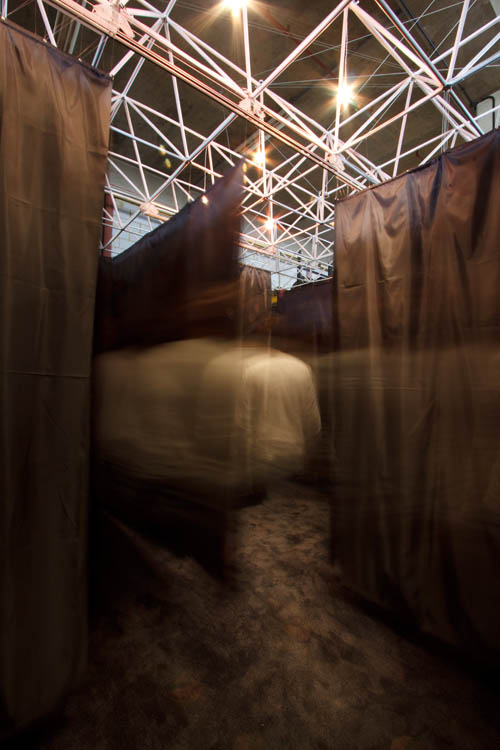
Unsatisfied with Turner’s research, however, McElhinney went on to build his own full-scale “switching labyrinth” near London’s Euston Station. Participants in this experiment “animated” McElhinney’s switching labyrinth by way of “a stepper motor and slide mechanism” that, together, were “able to periodically shift, ‘switching’ openings to offer alternative entrance and exit paths.”

The participants walked in and their routes warped the labyrinth around them.

[Image: Sam McElhinney’s “switching labyrinth,” or psycho-cybernetic human navigational testing ground, constructed near Euston Station].

After watching all this unfold, McElhinney suggested that further research along these lines could help to reveal architectural moments at which there is an “emergence of labyrinthine, or familiar, spatialities within an unknown or changing maze framework.”

There can be a place or moment within any building, in other words, at which the spatially unfamiliar will erupt—and from movement-pathway studies we can extrapolate architectural form, buildings that perfectly rest at the cognitive flipping point between maze and labyrinth, familiar and disorienting, adventurous and strange.

[Images: Sam McElhinney’s “switching labyrinth”].

The cybernetics of human memory and in-situ spatial decision-making processes provide a framework from which we can extract and assemble a new kind of architecture.

[Image: From “Labyrinths, Mazes and the Spaces Inbetween” by Sam McElhinney].

How we move through coiled, labyrinthine environments can be studied for insights into human navigation, physiology, and more.

[Image: From “Labyrinths, Mazes and the Spaces Inbetween” by Sam McElhinney].

McElhinney sent over a huge range of maze and labyrinth precedents that served as part of his research; some images from that research appear below.

[Images: Maze-studies from “Labyrinths, Mazes and the Spaces Inbetween” by Sam McElhinney].

It’s fascinating research, and I would love to see it scaled way, way up, beyond a mere test-maze in a warehouse into something both multileveled and city-sized.

The Archigram Archive

[Image: From an “ongoing speculative proposal exploring the implications of cones of vision and their interaction with an existing neoclassical ‘temple’ on the River Thames in Henley, Berkshire,” by Archigram/Michael Webb].
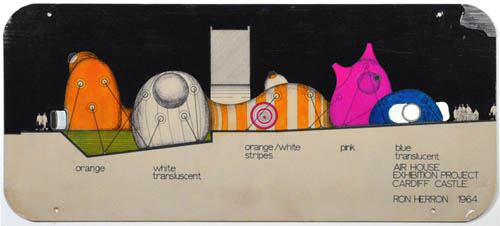
As of roughly 16 hours ago, the Archigram Archival Project is finally online and ready to for browsing, courtesy of the University of Westminster: the archive “makes the work of the seminal architectural group Archigram available free online for public viewing and academic study.”

The newly launched site includes more than 200 projects; “this comprises projects done by members before they met, the Archigram magazines (grouped together at no. 100), the projects done by Archigram as a group between 1961 and 1974, and some later projects.” There are also brief biographies of each participating member of the collaborative group: Warren Chalk, Peter Cook, Dennis Crompton, David Greene, Ron Herron, and Michael Webb.

[Image: “Proposal for a series of inflatable dwellings as part of an exhibition for the Commonwealth Festival, located in the lodge of Cardiff Castle,” by Archigram/Ron Herron].

Even at their most surreal, it feels as if Archigram did, in fact, accurately foresee what the architectural world was coming to. After all, if Chalk & Co. had built the things around us, there would be electricity supplies in the middle of nowhere and drive-in housing amidst the sprawl; for good or for bad, we’d all be playing with gadgets like the Electronic Tomato, that perhaps would not have given the iPhone a run for its money but was a “mobile sensory stimulation device,” nonetheless. We might even live together on the outer fringes of “extreme suburbs,” constructed like concentric halos around minor airports, such as Peter Cook’s “Crater City,” an “earth sheltered hotel-type city around central park,” or “Hedgerow Village,” tiny clusters of houses like North Face tents “hidden in hedgerow strips.”

There would be temporary, inflatable additions to whole towns and cities; pyramidal diagrid megastructures squatting over dead neighborhoods like malls; dream cities like Rorschach blots stretched across the sky, toothed and angular Montreal Towers looming in the distance; plug-in universities and capsule homes in a computer-controlled city of automatic switches and micro-pneumatic infrastructure.

At its more bizarre, there would have been things like the Fabergram castle, as if the Teutonic Knights became an over-chimneyed race of factory-builders in an era of cheap LSD, reading Gormenghast in Disneyworld, or this proposal “for technology enabling underwater farming by scuba divers, including chambers, floats and tubes for walking and farm control.” After all, Archigram asked, why live in a house at all when you can live in a submarine? Why use airplanes when you can ride a magic carpet constructed from shining looms in a “‘reverse hovercraft’ facility where a body can be held at an adjustable point in space through the use of jets of air”?

[Image: “Speculative proposal showing use of the ‘Popular Pak’, a kit of architectural parts for ‘tuning-up’ existing buildings, applied to an invented suburb,” by Archigram/Ron Herron].
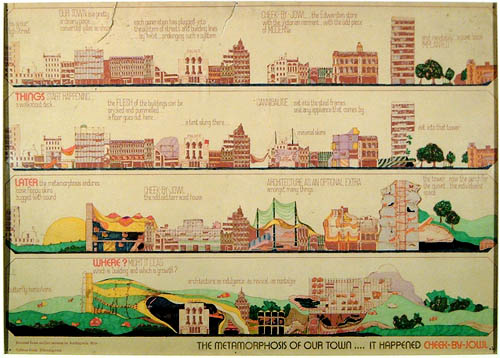
It might not be architects who have realized much of this fever dream of the world to come, but that doesn’t mean that these ideas have not, in many cases, been constructed. Archigram spoke of instant cities and easily deployed, reconfigurable megastructures—but the people more likely to own and operate such spaces today are Big Box retailers, with their clip-on ornaments, infinitely exchangeable modular shelving, and fleeting themes-of-the-week. Archigram’s flexible, just-in-time, climate-controlled interiors are not a sign of impending utopia, in other words, but of the reach of your neighborhood shopping mall—and the people airdropping instant cities into the middle of nowhere today are less likely to be algorithmically trained Rhino enthusiasts from architecture school, but the logistics support teams behind Bechtel and the U.S. military.

Another way of saying this is that Archigram’s ideas seem unbuilt—even unbuildable—but those ideas actually lend themselves surprisingly well to the environment in which we now live, full of “extreme suburbs,” drive-in everything, KFC-supplied army bases in the middle of foreign deserts, robot bank tellers, and huge, HVAC-dependent wonderlands on the exurban fringe.

The irony, for me, is that Archigram’s ideas have, in many ways, actually been constructed—but in most cases it was for the wrong reasons, in the wrong ways, and by the wrong people.

[Image: Proposal “fusing alternative and changing Archigram structures, amenities and facilities with traditional and nostalgic structures,” by Archigram/Peter Cook].

In any case, what was it about Archigram that promised on-demand self-transformation in an urban strobe of flashing lights but then got so easily realized as a kind of down-market Times Square? How did Archigram simply become the plug-in units of discount retail—or the Fun Palaces of forty years ago downgraded to Barnes & Noble outlets in the suburbs? How did the Walking City become Bremer Walls and Forward Operating Bases, where the Instant City meets Camp Bondsteel?

Archigram predicted a modular future propelled by cheap fuel, petrodollars, and a billion easy tons of unrecycled plastic—but, beneath that seamless gleam of artificial surfacing and extraterrestrial color combinations was a fizzy-lifting drink of human ideas—as many ideas as you could think of, sometimes imperfectly illustrated but illustrated nonetheless, and, thus, now canonical—all of it wrapped up in a dossier of new forms of planetary civilization. Archigram wasn’t just out on the prowl for better escalators or to make our buildings look like giant orchids and Venus Flytraps, where today’s avant-bust software formalism has unfortunately so far been mired; it wasn’t just bigger bank towers and the Burj Dubai.

Instead, Archigram suggested, we could all act differently if we had the right spaces in which to meet, love, and live, and what matters to me less here is whether or not they were right, or even if they were the only people saying such things (they weren’t)—what matters to me is the idea that architecture can reframe and inspire whole new anthropologies, new ways of being human on earth, new chances to do something more fun tomorrow (and later today). Architecture can reshape how we inhabit continents, the planet, and the solar system at large. Whether or not you even want inflatable attics, flying carpets, and underwater eel farms, the overwhelming impulse here is that if you don’t like the world you’ve been dropped into, then you should build the one you want.

In any case, the entire Archigram Archival Project is worth a look; even treated simply as an historical resource, its presence corrects what had been a sorely missing feature of online architecture culture: we can now finally link to, and see, Archigram’s work.

(Note: Part of the latter half of this post includes some re-edited bits from a comment I posted several months ago).

Cities Under Siege

[Image: Stephen Graham’s Cities Under Siege].

In a 2003 paper for the Naval War College Review, author Richard J. Norton defined the term feral cities. “Imagine a great metropolis covering hundreds of square miles,” Norton begins, as if narrating the start of a film pitch. “Once a vital component in a national economy, this sprawling urban environment is now a vast collection of blighted buildings, an immense petri dish of both ancient and new diseases, a territory where the rule of law has long been replaced by near anarchy in which the only security available is that which is attained through brute power.”

With the city’s infrastructure having collapsed long ago—or perhaps having never been built in the first place—there are no works of public sanitation, no sewers, no licensed doctors, no reliable food supply, no electricity. The feral city is a kind of return to medievalism, we might say, back to the future of a dark age for anyone but criminals, gangs, and urban warlords. It is a space of illiterate power—strength unresponsive to rationality or political debate.

From the perspective of a war planner or soldier, the feral city is also spatially impenetrable, a maze resistant to aerial mapping. Indeed, its “buildings, other structures, and subterranean spaces, would offer nearly perfect protection from overhead sensors, whether satellites or unmanned aerial vehicles,” Norton writes.

This is something Russell W. Glenn, formerly of the RAND Corporation—an Air Force think tank based in Southern California—calls “combat in Hell.” In his 1996 report of that name, Glenn pointed out that “urban terrain confronts military commanders with a synergism of difficulties rarely found in other environments,” many of which are technological. For instance, the effects of radio communications and global positioning systems can be radically limited by dense concentrations of architecture, turning what might otherwise be an exotic experience of pedestrian urbanism into a claustrophobic labyrinth inhabited by unseen enemy combatants.

Add to this the fact that military ground operations of the near future are more likely to unfold in places like Sadr City, Iraq—not in paragons of city planning like Vancouver—and you have an environment in which soldiers are as likely to die from tetanus, rabies, and wild dog attacks, Norton suggests, as from actual armed combat.

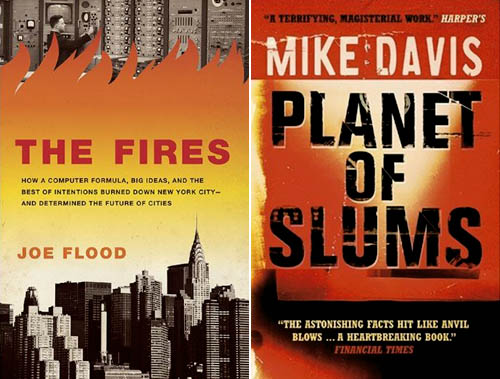
Put another way, as Mike Davis wrote in Planet of Slums, “the cities of the future, rather than being made out of glass and steel as envisioned by earlier generations of urbanists, are instead largely constructed out of crude brick, straw, recycled plastic, cement blocks, and scrap wood. Instead of cities of light soaring toward heaven, much of the twenty-first-century urban world squats in squalor, surrounded by pollution, excrement, and decay.”

But feral cities are one thing, cities under siege are something else.

[Images: The Fires by Joe Flood and Planet of Slums by Mike Davis].

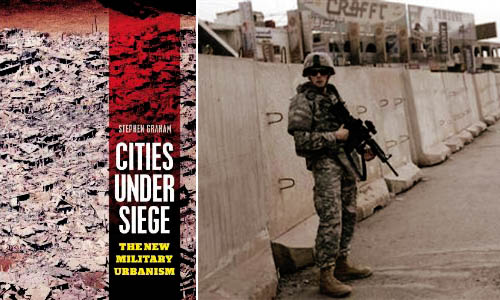
In his new book Cities Under Siege, published just two weeks ago, geographer Stephen Graham explores “the extension of military ideas of tracking, identification and targeting into the quotidian spaces and circulations of everyday life,” including “dramatic attempts to translate long-standing military dreams of high-tech omniscience and rationality into the governance of urban civil society.” This is just part of a “deepening crossover between urbanism and militarism,” one that will only become more pronounced, Graham fears, over time.

One particularly fascinating example of this encroachment of “military dreams… into the governance of urban civil society” is actually the subject of a forthcoming book by Joe Flood. The Fires tells the story of “an alluring proposal” offered by the RAND Corporation, back in 1968, “to a city on the brink of economic collapse [New York City]: using RAND’s computer models, which had been successfully implemented in high-level military operations, the city could save millions of dollars by establishing more efficient public services.” But all did not go as planned:

Over the next decade—a time New York City firefighters would refer to as “The War Years”—a series of fires swept through the South Bronx, the Lower East Side, Harlem, and Brooklyn, gutting whole neighborhoods, killing more than two thousand people and displacing hundreds of thousands. Conventional wisdom would blame arson, but these fires were the result of something altogether different: the intentional withdrawal of fire protection from the city’s poorest neighborhoods—all based on RAND’s computer modeling systems.

In any case, Graham’s interest is in the city as target, both of military operations and of political demonization. In other words, cities themselves are portrayed “as intrinsically threatening or problematic places,” Graham writes, and thus feared as sites of economic poverty, moral failure, sexual transgression, rampant criminality, and worse (something also addressed in detail by Steve Macek’s book Urban Nightmares). All cities, we are meant to believe, already exist in a state of marginal ferality. I’m reminded here of Frank Lloyd Wright’s oft-repeated remark that “the modern city is a place for banking and prostitution and very little else.”

In some of the book’s most interesting sections, Graham tracks the growth of urban surveillance and the global “homeland security market.” He points out that major urban events—like G8 conferences, the Olympics, and the World Cup, among many others—offer politically unique opportunities for the installation of advanced tracking, surveillance, and facial-recognition technologies. Deployed in the name of temporary security, however, these technologies are often left in place when the event is over: a kind of permanent crisis, in all but name, takes over the city, with remnant, military-grade surveillance technologies gazing down upon the streets (and embedded in the city’s telecommunications infrastructure). A moment of exception becomes the norm.

Graham outlines a number of dystopian scenarios here, including one in which “swarms of tiny, armed drones, equipped with advanced sensors and communicating with each other, will thus be deployed to loiter permanently above the streets, deserts, and highways” of cities around the world, moving us toward a future where “militarized techniques of tracking and targeting must permanently colonize the city landscape and the spaces of everyday life.”

In the process, any real distinction between a “homeland” and its “colonies” is irreparably blurred. Here, he quotes Michel Foucault: “A whole series of colonial models was brought back to the West, and the result was that the West could practice something resembling colonization, or an internal colonialism, on itself.” If it works in Baghdad, the assumption goes, then let’s try it out in Detroit.

This is just one of many “boomerang effects” from militarized urban experiments overseas, Graham writes.

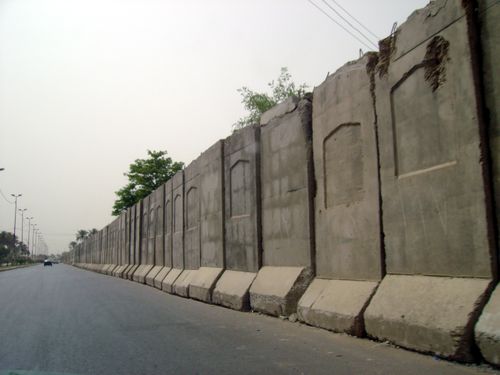
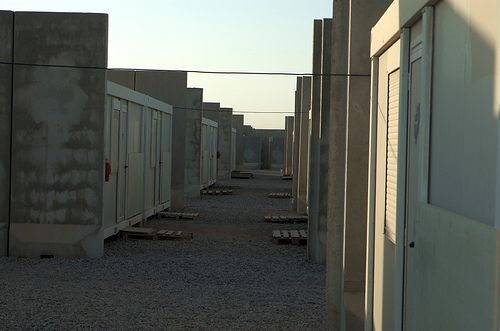
[Images: Blast walls in Iraq].

But what does this emerging city—this city under siege—actually look like? What is its architecture, its urban design, its local codes? What is its infrastructure?

Graham has many evocative answers for this. The city under siege is a place in which “hard, military-style borders, fences and checkpoints around defended enclaves and ‘security zones,’ superimposed on the wider and more open city, are proliferating.”

Jersey-barrier blast walls, identity checkpoints, computerized CCTV, biometric surveillance and military styles of access control protect archipelagos of fortified social, economic, political or military centers from an outside deemed unruly, impoverished and dangerous. In the most extreme examples, these encompass green zones, military prisons, ethnic and sectarian neighborhoods and military bases; they are growing around strategic financial districts, embassies, tourist and consumption spaces, airport and port complexes, sports arenas, gated communities and export processing zones.

Cities Under Siege also extensively covers urban warfare, a topic that intensely interests me. From Graham’s chapter “War Re-Enters the City”:

Indeed, almost unnoticed within “civil” urban social science, a shadow system of military urban research is rapidly being established, funded by Western military research budgets. As Keith Dickson, a US military theorist of urban warfare, puts it, the increasing perception within Western militaries is that “for Western military forces, asymmetric warfare in urban areas will be the greatest challenge of this century… The city will be the strategic high ground—whoever controls it will dictate the course of future events in the world.”

Ralph Peters phrased this perhaps most dramatically when he wrote, back in 1996 for the U.S. Army War College Quarterly, that “the future of warfare lies in the streets, sewers, high-rise buildings, industrial parks, and the sprawl of houses, shacks, and shelters that form the broken cities of our world.” The future of warfare, that is, lies in feral cities.

In this context, Graham catalogs the numerous ways in which “aggressive physical restructuring,” as well as “violent reorganization of the city,” is used, and has been used throughout history, as a means of securing and/or controlling a city’s population. At its most extreme, Graham calls this “place annihilation.” The architectural redesign of cities can thus be used as a military policing tactic as much as it can be discussed as a topic in academic planning debates. There are clearly echoes of Eyal Weizman in this.

On one level, these latter points are obvious: small infrastructural gestures, like public lighting, can transform alleyways from zones of impending crime to walkways safe for pedestrian use—and, in the process, expand political control and urban police presence into that terrain. But, as someone who does not want to be attacked in an alleyway any time soon, I find it very positive indeed when the cityscape around me becomes both safer by design and better policed. Equally obvious, though, when these sorts of interventions are scaled-up—from public lighting, say, to armed checkpoints in a militarized reorganization of the urban fabric—then something very drastic, and very wrong, is occurring in the city. Instead of a city simply with more cops (or fire departments), you begin a dark transition toward a “city under siege.”

I could go on at much greater length about all of this—but suffice it to say that Cities Under Siege covers a huge array of material, from the popularity of SUVs in cities to the blast-wall geographies of Baghdad, from ASBOs in London to drone helicopters in the skies above New York. Raytheon’s e-Borders program opens the book, and Graham closes it all with a discussion of “countergeographies.”

(Parts of this post, on feral cities, originally appeared in AD: Architectures of the Near Future, edited by Nic Clear).

Book Tower


[Images: House in Venice, California, by Bureau AA; photos by Larry Underhill].

This small and breezy house in Venice, California, designed by Robert Choeff and Krystyan Keck of the Bureau of Architectural Affairs, was completed in April 2009.


[Image: House in Venice, California; photo courtesy of Bureau AA].

The house’s transparent polycarbonate cladding, used to “expose the interactions” of the building elements, makes the house function like “a structural X-ray,” we read in a recent issue of Mark Magazine.

Tight quarters, a tight budget and further restrictions—including a height limit and required setbacks—navigated the architects toward their design solution: a 54-square-meter trapezoid perched above the existing structure on steel stilts, topped by a roof deck with views in all directions.

I’m reminded here of Francois Perrin’s Guest House for an Anthropologist, itself also very biblio-intensive: both are houses of exposed wood and polycarbonate, with lots of things to read.


[Image: House in Venice, California, by Bureau AA; photo by Larry Underhill].

The interior of the house seems solidly locked in place: “the upper story has no doors,” we read, “and its only piece of freestanding furniture is the dining table. Lean work desks and kitchen counters hug the perimeter, and built-in storage spaces double, discreetly, as screens.” This includes the bookshelves.

“Where there isn’t cabinetry and Sheetrock,” Mark Magazine adds, “there’s a window.”


[Images: Courtesy of the Bureau of Architectural Affairs].

I would feel compelled to add curtains, I’m afraid, and I would probably be a bit nervous with all those books over my head during an earthquake, but with a few minor adjustments I might put in an order for one, too, please…