Stealth Objects and Scanning Mist

The London-based architectural group ScanLAB—founded by Matthew Shaw and William Trossell—has been doing some fascinating work with laser scanners.

Here are three of their recent projects.

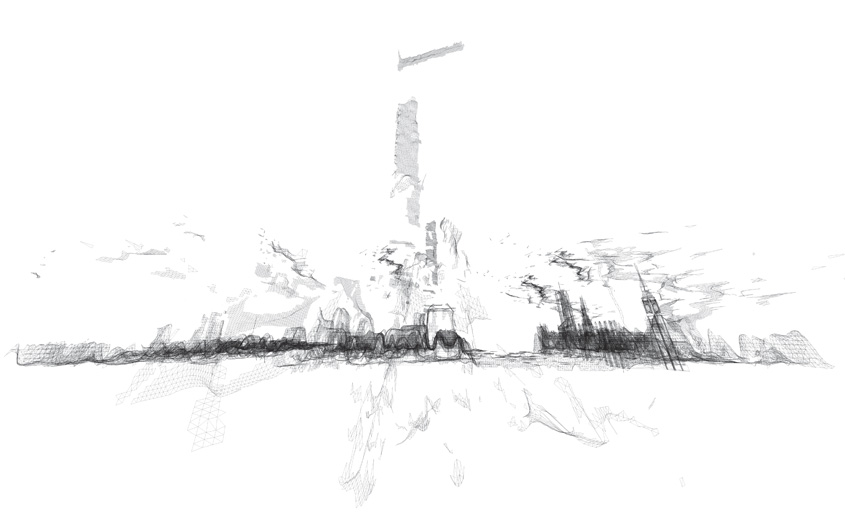
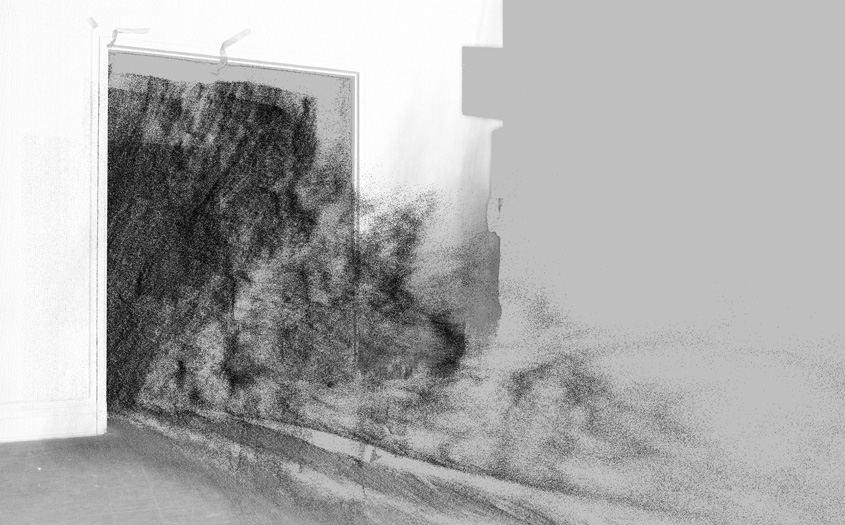
1) Scanning Mist. Shaw and Trossell “thought it might be interesting to see if the scanner could detect smoke and mist. It did and here are the remarkable results!

[Images: From Scanning the Mist by ScanLAB].

In a way, I’m reminded of photographs by Alexey Titarenko.

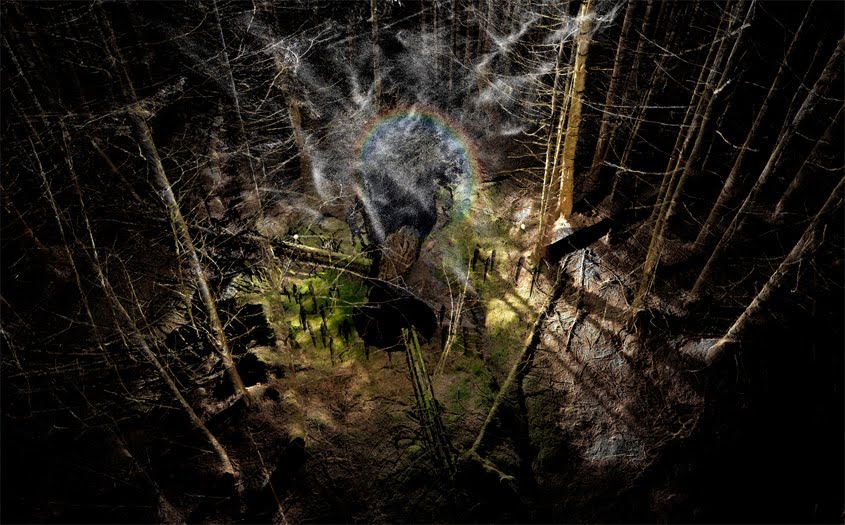
2) Scanning an Artificial Weather System. For this project, ScanLAB wanted to “draw attention to the magical properties of weather events.” They thus installed a network of what they call “pressure vessels linked to an array of humidity tanks” in the middle of England’s Kielder Forest.

[Image: From Slow Becoming Delightful by ScanLAB].

These “humidity tanks” then, at certain atmospherically appropriate moments, dispersed a fine mist, deploying an artificial cloud or fog bank into the woods.

[Image: From Slow Becoming Delightful by ScanLAB].

Then, of course, Shaw and Trossell laser-scanned it.

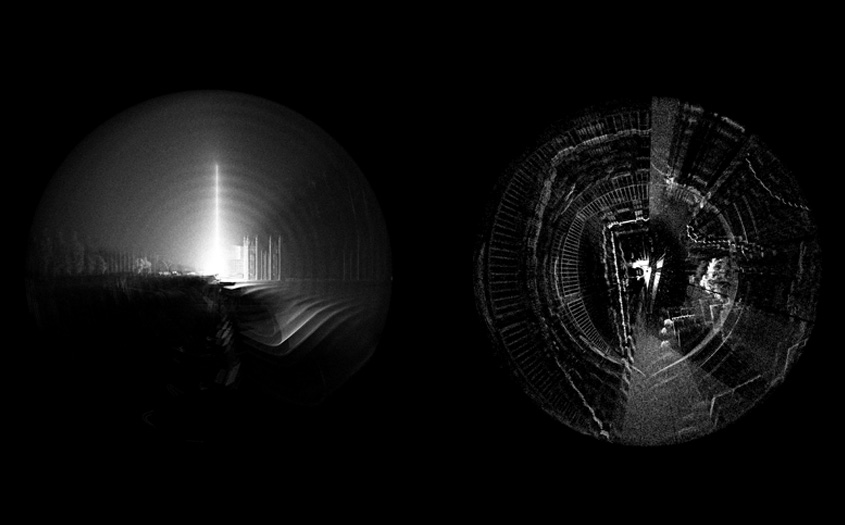
3) Subverting Urban-Scanning Projects through “Stealth Objects.” The architectural potential of this final project blows me away. Basically, Shaw and Trossell have been looking at “the subversion of city scale 3D scanning in London.” As they explain it, “the project uses hypothetical devices which are installed across the city and which edit the way the city is scanned and recorded.”

Tools include the “stealth drill” which dissolves scan data in the surrounding area, creating voids and new openings in the scanned urban landscape, and “boundary miscommunication devices” which offset, relocate and invent spatial data such as paths, boundaries, tunnels and walls.

The spatial and counter-spatial possibilities of this are extraordinary. Imagine whole new classes of architectural ornament (ornament as digital camouflage that scans in precise and strange ways), entirely new kinds of building facades (augmented reality meets LiDAR), and, of course, the creation of a kind of shadow-architecture, invisible to the naked eye, that only pops up on laser scanners at various points around the city.

[Images: From Subverting the LiDAR Landscape by ScanLAB].

ScanLAB refers to this as “the deployment of flash architecture”—flash streets, flash statues, flash doors, instancing gates—like something from a short story by China Miéville. The narrative and/or cinematic possibilities of these “stealth objects” are seemingly limitless, let alone their architectural or ornamental use.

Imagine stealth statuary dotting the streetscape, for instance, or other anomalous spatial entities that become an accepted part of the urban fabric. They exist only as representational effects on the technologies through which we view the landscape—but they eventually become landmarks, nonetheless.

For now, Shaw and Trossell explain that they are experimenting with “speculative LiDAR blooms, blockages, holes and drains. These are the result of strategically deployed devices which offset, copy, paste, erase and tangle LiDAR data around them.”

[Images: From Subverting the LiDAR Landscape by ScanLAB].

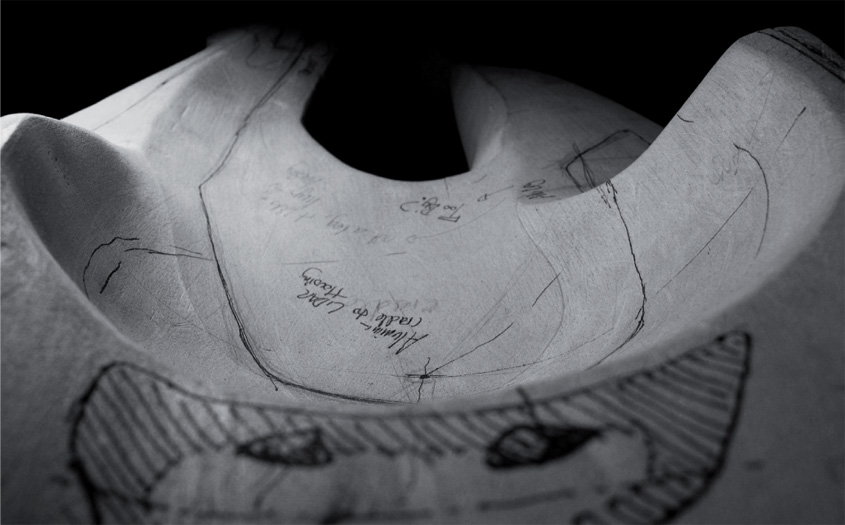
Here is one such “stealth object,” pictured below, designed to be “undetected” by laser-scanning equipment.

Of course, it is not hard to imagine the military being interested in this research, creating stealth body armor, stealth ground vehicles, even stealth forward-operating bases, all of which would be geometrically invisible to radar and/or scanning equipment.

In fact, one could easily imagine a kind of weapon with no moving parts, consisting entirely of radar- and LiDAR-jamming geometries; you would thus simply plant this thing, like some sort of medieval totem pole, in the streets of Mogadishu—or ring hundreds of them in a necklace around Washington D.C.—thus precluding enemy attempts to visualize your movements.

[Images: A hypothetical “stealth object,” resistant to laser-scanning, by ScanLAB].

Briefly, ScanLAB’s “stealth object” reminds me of an idea bandied about by the U.S. Department of Energy, suggesting that future nuclear-waste entombment sites should be liberally peppered with misleading “radar reflectors” buried in the surface of the earth.

The D.O.E.’s “trihedral” objects would produce “distinctive anomalous magnetic and radar-reflective signatures” for anyone using ground-scanning equipment above. In other words, they would create deliberate false clues, leading potential future excavators to think that they were digging in the wrong place. They would “subvert” the scanning process.

In any case, read more at ScanLAB’s website.

Seismic Decentralization

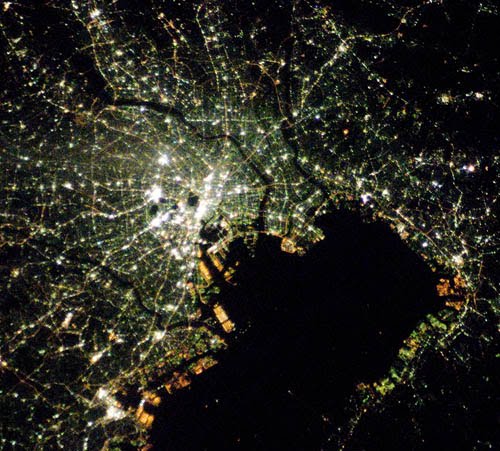
[Image: Tokyo at night, courtesy of NASA’s Earth Observatory].

At the height of the Cold War, the sprawling, decentralized suburban landscape of the United States was seen by many military planners as a form of spatial self-defense. As historian David Krugler explains in This Is Only a Test: How Washington D.C. Prepared for Nuclear War, “urban dispersal” was viewed as a defensive military tactic, one that would greatly increase the nation’s chance of survival in the event of nuclear attack.

Specially formatted residential landscapes such as “cluster cities” were thus proposed, “each with a maximum population of 50,000.” These smaller satellite cities would not only reshape the civilian landscape of the United States, they would make its citizens, its industrial base, and its infrastructure much harder to target.

“This might seem the stuff of Cold War science fiction,” Krugler writes, “but after World War II, many urban and civil defense planners believed cluster cities, also called dispersal, should be the future of the American metropolis.”

These planners, like the U.S. Strategic Bombing Survey, imagined atomic firestorms engulfing American cities and advocated preventive measures such as dispersal. Just one or two atomic bombs could level a concentrated metropolitan area, but cluster cities would suffer far less devastation: enemy bombers could strike some, but not all, key targets, allowing the unharmed cities to aid in recovery.

Krugler points out that this suburban dispersal was not always advised in the name of military strategy: “Many urban planners believed dispersal could spur slum clearance, diminish industrial pollution, and produce parks. Not only would dispersal shield America’s cities, it would save them from problems of their own making.”

However, the idea that urban dispersal might be useful only as a protective tactic against the horrors of aerial bombardment overlooks other threats, including earthquakes and tsunamis.

Earlier this week, Japanese prime minister Naoto Kan was advised “to decentralize Japan” out of fear of “Tokyo annihilation danger.” Indeed, we read, the recent 9.0 earthquake, tsunami, and partial nuclear meltdown at Fukushima together suggest that “the nation must reduce the role of its capital city to avert an even greater catastrophe.”

Takayoshi Igarashi, a professor at Hosei University, explains: “I told the prime minister that nationwide dispersal is the first thing we need to do as we rebuild. We have no idea when the big one’s going to hit Tokyo, but when it does, it’s going to annihilate the entire country because everything is here.” His conclusion: “The lesson we need to take away from this disaster is that we have to restructure Japan as an entire nation”—a seismic decentralization that relies as much on horizontal geography as on vertical building code. This could thus be “the nation’s biggest investment in urban planning in decades.”

The idea that urban design might find a reinvigorated sense of national purpose in response to a threat in the ground itself is fascinating, of course, perhaps especially for someone who also lives in an earthquake zone. But the prospect of large-scale urban dispersal remaking the urban landscape of Japan—that Tokyo itself might actually be broken up into smaller subcities, and that future urban planning permission might be adjusted to enforce nationwide sprawl as a form of tectonic self-defense, from megacity to exurban lace—presents an explicit spatialization of Japanese earthquake policy that will be very interesting to track over the years to come.

(Spotted via @urbanphoto_blog).

Forensic Geology

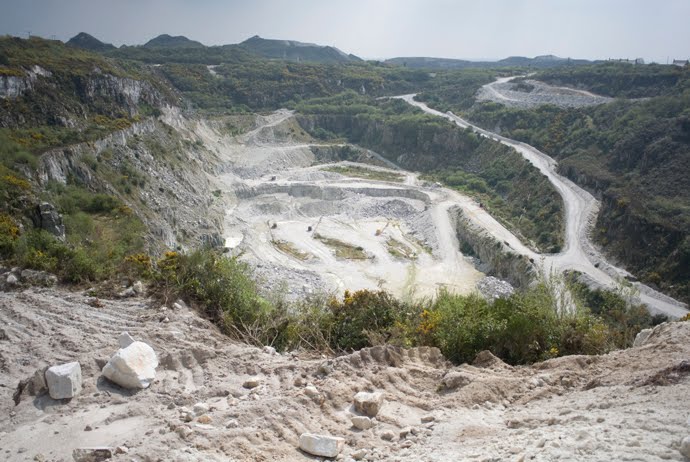
[Image: The “Trevisco pit,” Cornwall, from which the kaolinite used in space shuttle tiles comes from; photo by Hugh Symonds].

Photographer Hugh Symonds recently got in touch with a series of images called Terra Amamus, or “dirt we like,” in his translation, exploring mining operations in Cornwall.

“The granite moors of Cornwall,” Symonds explains, “were formed around 300 million years ago. Geological and climatic evolution have created a soft, white, earthy mineral called kaolinite. The name is thought to be derived from China, Kao-Ling (High-Hill) in Jingdezhen, where pottery has been made for more than 1700 years. Study of the Chinese model in the late 18th century led to the discovery and establishment of a flourishing industry in Cornwall.”

You could perhaps think of the resulting mines and quarries as a landscape falling somewhere between an act of industrial replication and 18th-century geological espionage.

[Image: Photo by Hugh Symonds].

As Symonds points out, kaolinite is actually “omni-present throughout our daily lives; in paper, cosmetics, pharmaceuticals, paints, kitchens, bathrooms, light bulbs, food additives, cars, roads and buildings. In an extraterrestrial, ‘Icarian’ twist, it is even present in the tiles made for the Space Shuttle.”

Indeed, the photograph that opens this post shows us the so-called Trevisco pit. Its kaolinite is not only “particularly pure,” Symonds notes; it is also “the oldest excavation in the Cornish complex.”

Even better, it is the “quarry from which the clay used for the Space Shuttle tiles came from.” This pit, then, is a negative space—a pockmark, a dent—in the Earth’s surface out of which emerged—at least in part—a system of objects and trajectories known as NASA.

Of course, the idea that we could trace the geological origins of an object as complex as the Space Shuttle brings to mind Mammoth‘s earlier stab at what could be called a provisional geology of the iPhone. As Mammoth wrote, “Until we see that the iPhone is as thoroughly entangled into a network of landscapes as any more obviously geological infrastructure (the highway, both imposing carefully limited slopes across every topography it encounters and grinding/crushing/re-laying igneous material onto those slopes) or industrial product (the car, fueled by condensed and liquefied geology), we will consistently misunderstand it.” These and other products—even Space Shuttles—are terrestrial objects. That is, they emerge from infrastructurally networked points of geological extraction.

[Images: Photos by Hugh Symonds].

In John McPhee’s unfortunately titled book Encounters with the Archdruid, there is a memorable scene about precisely this idea: a provisional geology out of which our industrial system of objects has arisen.

“Most people don’t think about pigments in paint,” one of McPhee’s interview subjects opines. “Most white-paint pigment now is titanium. Red is hematite. Black is often magnetite. There’s chrome yellow, molybdenum orange. Metallic paints are a little more permanent. The pigments come from rocks in the ground. Dave’s electrical system is copper, probably from Bingham Canyon. He couldn’t turn on a light or make ice without it.” And then the real forensic geology begins:

The nails that hold the place together come from the Mesabi Range. His downspouts are covered with zinc that was probably taken out of the ground in Canada. The tungsten in his light bulbs may have been mined in Bishop, California. The chrome on his refrigerator door probably came from Rhodesia or Turkey. His television set almost certainly contains cobalt from the Congo. He uses aluminum from Jamaica, maybe Surinam; silver from Mexico or Peru; tin—it’s still in tin cans—from Bolivia, Malaya, Nigeria. People seldom stop to think that all these things—planes in the air, cars on the road, Sierra Club cups—once, somewhere, were rock. Our whole economy—our way of doing things. Oh, gad! I haven’t even mentioned minerals like manganese and sulphur. You won’t make steel without them. You can’t make paper without sulphur…

We have rearranged the planet to form TVs and tin cans, producing objects from refined geology.

[Image: Photo by Hugh Symonds].

What’s fascinating here, however, is something I touched upon in my earlier reference to geological espionage. In other words, we take for granted the idea that we can know what minerals go into these everyday products—and, more specifically, that we can thus locate those minerals’ earthly origins and, sooner or later, enter into commerce with them, producing our own counter-products, our own rival gizmos and competitive replacements.

I was thus astonished to read that, in fact, specifically in the case of silicon, this is not actually the case.

In geologist Michael Welland‘s excellent book Sand, often cited here, Welland explains that “electronics-grade silicon has to be at least 99.99999 percent pure—referred to in the trade as the ‘seven nines’—and often it’s more nines than that. In general, we are talking of one lonely atom of something that is not silicon among billions of silicon companions.”

Here, a detective story begins—it’s top secret geology!

A small number of companies around the world dominate the [microprocessor chip] technology and the [silicon] market, and while their literature and websites go into considerable and helpful detail on their products, the location and nature of the raw materials seem to be of “strategic value,” and thus an industrial secret. I sought the help of the U.S. Geological Survey, which produces comprehensive annual reports on silica and silicon (as well as all other industrial minerals), noting that statistics pertaining to semiconductor-grade silicon were often excluded or “withheld to avoid disclosing company proprietary data.”

Welland thus embarks upon an admittedly short but nonetheless fascinating investigation, hoping to de-cloud the proprietary geography of these mineral transnationals and find where this ultra-pure silicon really comes from. To make a long story short, he quickly narrows the search down to quartzite (which “can be well over 99 percent pure silica”) mined specifically from a few river valleys in the Appalachians.

[Image: Photo by Hugh Symonds].

As it happens, though, we needn’t go much further than the BBC to read about a town called Spruce Pine, “a modest, charmingly low-key town in the Blue Ridge mountains of North Carolina, [that] is at the heart of a global billion-dollar industry… The jewellery shops, highlighting local emeralds, sapphires and amethysts, hint at the riches. The mountains, however, contain something far more precious than gemstones: they are a source of high-purity quartz.” And Spruce Pine is but one of many locations from which globally strategic flows of electronics-grade silicon are first mined and purified.

In any case, the geological origin of even Space Shuttle tiles is always fascinating to think about; but when you start adding things like industrial espionage, proprietary corporate landscapes, unmarked quarries in remote mountain valleys, classified mineral reserves, supercomputers, a roving photographer in the right place at the right time, an inquisitive geologist, and so on, you rapidly escalate from a sort of Economist-Lite blog post to the skeleton of an international thriller that would be a dream to read (and write—editors get in touch!).

And, of course, if you like the images seen here, check out the rest of Symond’s Terra Amamus series.

Books Received

[Image: Proposal for the Stockholm Public Library by Olivier Charles].

The “Books Received” series on BLDGBLOG continues apace, with short descriptions of interesting—but not necessarily new–books that have passed through the home office here. In all cases, these are books about architecture, landscape, and the built environment, albeit in an extended sense, encompassing paleontology, marine biophysics, space archaeology, geopolitics, infrastructural anthropology, museology, how-to guides for architectural design, and more.

Note, however, that these lists will always include books that I have not read in full—and the present rundown is no exception.

1) The Docks by Bill Sharpsteen (University of California Press).

2) Moby-Duck: The True Story of 28,800 Bath Toys Lost at Sea and of the Beachcombers, Oceanographers, Environmentalists, and Fools, Including the Author, Who Went in Search of Them by Donovan Hohn (Viking).

3) On Roads: A Hidden History by Joe Moran (Profile Books).

Three books about infrastructure and the humans (and plastic ducks) who inhabit it, from the docks of Long Beach to accidents at sea supplying an unexpected way to trace global trade networks, to a short history of the roads by which civilization is now defined.

4) Handbook of Space Engineering, Archaeology, and Heritage edited by Ann Garrison Darrin and Beth Laura O’Leary (CRC Press).

The Handbook is an endlessly fascinating mega-collection (1,015+ pages!) of essays about the science of space archaeology: the study and preservation of artifacts and sites related to human space exploration, including “everything from launch pads to satellites to landers on Mars.” Lost spacecraft, failed missions, “graveyard orbits,” and the Apollo 11 landing site all make extended appearances in the book, interpreted as examples of the space-archaeological record. “For example,” we read, “the location of one human footprint on the Moon in situ is an archaeological feature that defines one of the ultimate events of humankind and is a part of the physical and temporal record of all the engineering research and development that made it possible.”

The book is full of amazing factoids—we learn, for example, that, “Surprisingly, the Viking 1 lander, which remains on Mars, is considered part of the Smithsonian Air and Space Museum,” suggesting a distributed, inter-planetary museum of inaccessible earthly objects—and eye-popping new fields of study, such as “the role archaeologists might play in understanding the material culture of extraterrestrials or other intelligent species, once the physical evidence is scientifically verifiable.” The book even describes a kind of computational archaeology, by which “the heritage created by robots in the form of their artificial intelligence” would be both studied and preserved.

5) Alien Ocean: Anthropological Voyages in Microbial Seas by Stefan Helmreich (University of California Press).

Alien Ocean is an anthropological study of oceanographers, marine biologists, genetic researchers, and the way that they perform research, not an oceanographic study in itself. But if the idea of following a Donna Haraway-like narrator around the California coast, visiting gene-research labs, riding down in submarines, and opining about the chemical possibilities of life on other planets, where strange maritime organisms might swim through the dark currents of “extraterrestrial seas,” then you’ll find Helmreich’s book as hard to put down as I did.

6) The Planet in a Pebble: A Journey into Earth’s Deep History by Jan Zalasiewicz (Oxford University Press).

Jan Zalasiewicz, author of The Earth After Us: What Legacy Will Humans Leave in the Rocks?, is back with this book-length thought experiment: can the entire geological history of the planet be deduced from a single pebble? If so, what tools—what pieces of equipment and what scientific ideas—would you need at your disposal, and what might you find in the process?

7) The Alphabet and the Algorithm by Mario Carpo (MIT).

8) The Possibility of an Absolute Architecture by Pier Vittorio Aureli (MIT).

9) The Liberal Monument: Urban Design and the Late Modern Project by Alexander D’Hooge (Princeton Architectural Press).

MIT’s “Writing Architecture” series continues with two new titles influenced by Peter Eisenman. In one, Mario Carpo explores mechanical reproduction, robotics, and the historical status of the architectural copy (see also the recent book Anachronic Renaissance for a fascinating discussion of architectural duplication). In the other, Pier Vittorio Aureli dives into the political, in its most literal sense: where architecture intervenes in, and actively confronts, the city, the polis. Here, Aureli draws an interesting distinction between “the political dimension of coexistence (the city)” and “the economic logic of social management (urbanization).”

Finally, Alexander D’Hooge uses this expanded publication of his Ph.D. thesis to propose “a series of civic complexes” built within “the existing, vast net of suburban sprawl” that surrounds the contemporary city, in order to introduce public space and institutional communality “in a territory otherwise devoid of it.”

10) Divided Cities: Belfast, Beirut, Jerusalem, Mostar, and Nicosia by Jon Calame and Esther Charlesworth, with a foreword by Lebbeus Woods (University of Pennsylvania Press).

11) Walled States, Waning Sovereignty by Wendy Brown (ZONE Books).

12) A Wall in Palestine by René Backmann (Picador).

Three books about walls: architecture and urbanism used to separate and to neutralize the lives of a city’s human residents, not to catalyze vibrant communities or to bring neighboring people together.

As Jon Calame and Esther Charlesworth conclude in Divided Cities, “divided cities are not aberrations. Instead, they are the unlucky vanguard of a large and growing class of cities.” Indeed, the authors add, “Evidence gleaned from the five cities examined here suggests that, given similar circumstances and pressures, any city could undergo a comparable metamorphosis,” leading to the “dangerous, wasted spaces” of urban partition. The book includes several highly memorable images, including a sewage treatment system in the divided city of Nicosia, Cyprus—a subterranean network “where all the sewage from both sides of the city is treated.” A waste-management engineer quips that “the city is divided above ground but unified below.” It is a kind of infrastructural conjoined twin.

Wendy Brown—in what is ultimately a highly repetitive book that would have been more effective as an essay—suggests that the ongoing construction boom in border walls and other peripheral fortifications is actually a panicked response to the loss of power on behalf of the nation-state, not architectural proof that the nation-state has experienced a sovereign renaissance. “Thus,” she writes, “walls generate what Heidegger termed a ‘reassuring world picture’ in a time increasingly lacking the horizons, containment, and security that humans have historically required for social and psychic integration and for political membership.”

René Backmann’s much more journalistic Wall in Palestine follows the cultural, economic, religious, and psychological effects of the Israeli border fence, as Backmann walks its complicated routes often cutting straight through previously thriving Palestinian villages.

13) A Landscape Manifesto by Diana Balmori (Yale University Press).

14) Above the Pavement—The Farm! Architecture & Agriculture at PF1 edited by Amale Andraos and Dan Wood (Princeton Architectural Press).

15) L.A. Under the Influence: The Hidden Logic of Urban Property by Roger Sherman (University of Minnesota Press).

Exploring complex intersections where the city hits the land it’s built upon and both are irrevocably transformed, these three books take notably different rhetorical tones. From Balmori’s 25-point “manifesto” (#18: “Emerging landscapes are becoming brand-new actors on the political stage”) to the hands-on field notes of Work AC’s Public Farm 1, by way of Roger Sherman’s real-estate-based spatial survey of Los Angeles and the various rights of land access and title that financially define the ground of the modern metropolis, each of these books offers surprising suggestions for formal projects and future research. Above the Pavement also benefits from a great design by Project Projects.

16) The Art of Not Being Governed: An Anarchist History of Upland Southeast Asia by James C. Scott (Yale University Press).

17) Utopics: Systems and Landmarks edited by Simon Lamunière (JRP/Ringier).

18) Rage and Time: A Psychopolitical Investigation by Peter Sloterdijk (Columbia University Press).

19) Violence Taking Place: The Architecture of the Kosovo Conflict by Andrew Herscher (Stanford University Press).

These four books take an explicitly political approach to space and geography, including Peter Sloterdijk’s suggestion that rage is an underappreciated force of political motivation, one that can be traced back to the mythological origins of the European psyche, and Simon Lamunière’s edited catalog of utopian ideas and spaces.

James Scott’s The Art of Not Being Governed, meanwhile, is one of the most stimulating books I’ve read in the past six months. Scott writes about a region called “Zomia,” which encompasses “virtually all the lands at altitudes above roughly three hundred meters all the way from the Central Highlands of Vietnam to northeastern India and traversing five Southeast Asian nations (Vietnam, Cambodia, Laos, Thailand, and Burma) and four provinces of China (Yunnan, Guizhou, Guangxi, and parts of Sichuan). It is an expanse of 2.5 million square kilometers containing about one hundred million minority peoples of truly bewildering ethnic and linguistic variety.”

Scott explores how certain agricultural practices go hand-in-hand with “state-making projects”—and, conversely, how different forms of food cultivation, land management, and foraging offer what Scott calls “escape value.” That is, they allow for “state evasion”: spatial and agricultural techniques for “steering clear of being politically captured” by an empire or nation-state. “Far from being ‘left behind’ by the progress of civilization in the valleys,” Scott writes, “[the people of Zomia] have, over long periods of time, chosen to place themselves out of the reach of the state… There, they practiced what I will call escape agriculture: forms of cultivation designed to thwart state appropriation. Even their social structure could fairly be called escape social structure inasmuch as it was designed to aid dispersal and autonomy and to ward off political subordination.”

Given time, I hope to post about Scott’s book at greater length later this year; it is highly recommended.

20) Form+Code in Design, Art, and Architecture by Casey Reas, Chandler McWilliams, and LUST (Princeton Architectural Press).

21) Architectural Drawing by David Dernie (Laurence King Publishing).

22) Architectural Modelmaking by Nick Dunn (Laurence King Publishing).

All three of these books are useful overviews—even step-by-step guides—for creating architectural models and imagery, from the use of specific software packages to colored chalk, cardboard, and #2 lead. While Architectural Drawing and Architectural Modelmaking probably won’t teach you anything you don’t know already, it is nonetheless useful to have these around for flipping through, filled with visual ideas for how to approach a design project afresh.

23) Makeshift Metropolis: Ideas About Cities by Witold Rybczynski (Scribner).

24) Ten Walks/Two Talks by Jon Cotner and Andy Fitch (Ugly Duckling Presse).

25) Urban Underworlds: A Geography of Twentieth-Century American Literature and Culture by Thomas Heise (Rutgers University Press).

26) Monsterpieces: Once Upon a Time… of the 2000s! by Aude-Line Duliere and Clara Wong (ORO Editions).

In what could pass as a kind of zoologically-themed children’s book or architectural fairy tale—here, a good thing—Monsterpieces reimagines iconic buildings all over the world as everything but what those buildings were intended to be. A tour of monsters, spaceports, biomass plants, anaerobic hospitals, robo-arachnoid recycling centers, mutant spatial transformation, and more.

Thomas Heise, meanwhile, takes us down into the cultural underworld of the 20th-century literary metropolis, including “degenerate sex” and highly politicized urban race relations; Jon Cotner and Andy Fitch have assembled a series of dialogues framed by specific walks through the city, suggesting that friendship itself is a useful technique for maximizing the emotional effects of urban space; and Witold Rybczynski signs off on an ambitious new book, one that “summarizes what I have learned about city planning and urban development,” as he describes it. “Is the city the result of design intentions, or of market forces, or a bit of both?” Rybczynski asks, in an armchair question typical of the Theory Lite in which he traffics. “These are the questions I explore in this book.”

27) Visual Planning and the Picturesque by Nikolaus Pevsner (Getty Publications).

28) Limited Language: Rewriting Design by Colin Davies and Monika Parrinder (Birkhäuser).

29) A Guide to the New Ruins of Great Britain by Owen Hatherley (Verso).

30) A Peripheral Moment: Experiments in Architectural Agency: Croatia 1990-2010 by Ivan Rupnik et al. (Actar).

31) Worldchanging 2.0 edited by Alex Steffen (Abrams).

From the architectural “ruins” of New Labour to the influence and role of the Picturesque in the history of British town planning, this cluster of five titles gives us architecture both as historical practice and as subject of critique. In Croatia, for instance, we read that “political instability and creative innovation” have worked with equal intensity to generate new, experimental building typologies, while Limited Language explores a variety of “hybrid media forms” through which design can or should be communicated.

Worldchanging 2.0 is more explicitly practical. This new, bright yellow edition is a thorough revision—even a total rewrite—of the first version, suggesting new directions for ecologically aware design practices, community collaborations, and the ground-up spatial improvement of 21st-century life.

32) BIG by Bjarke Ingels Group (Archilife).

33) Archipiélago de Arquitectura by Miguel Mesa et al. (Mesa Editores).

34) Hylozoic Ground: Liminal Responsive Architecture edited by Pernilla Ohrstedt and Hayley Isaacs (Riverside Architectural Press).

35) Modern Ruins: Portraits of Place in the Mid-Atlantic Region by Shaun O’Boyle (Penn State University Press).

Finally, I wanted to give a shout-out to four recent books I had the pleasure of directly contributing to. Those contributions run the gamut from a discussion of the spatial strategies of football (both FIFA and NFL) and what I describe as “live-action crystallography” in the work of Bjarke Ingels, to plate tectonics reconsidered as an extreme form of long-term landscape design in Archipiélago de Arquitectura (another beautifully designed publication by Mesa Editores).

In Shaun O’Boyle’s photographs of the “modern ruins” of the Mid-Atlantic, meanwhile, including his explorations of Eastern State Penitentiary (an abandoned prison located mere blocks from where BLDGBLOG was born in Philadelphia), I ruminate on the psychological effects of architectural survival, when a seemingly doomed building or architectural type manages to live on for covert exploration by a new generation. Incidentally, O’Boyle’s book has a funny backstory involving the website Metafilter. And, in a multiply-authored book published to coincide with last year’s Venice Biennale, I take a look at the “synthetic geology” of architect Philip Beesley and his installation Hylozoic Ground.

If you happen to stumble upon any of these four last books, I’d love to know what you think of the essays.

* * *

All Books Received: August 2015, September 2013, December 2012, June 2012, December 2010 (“Climate Futures List”), May 2010, May 2009, and March 2009.

Unsolving the City: An Interview with China Miéville

The work of novelist China Miéville is well-known—and increasingly celebrated—for its urban and architectural imagery.

In his 2000 novel Perdido Street Station, for instance, an old industrial scrapyard on the underside of the city, full of discarded machine parts and used electronic equipment, suddenly bootstraps itself into artificial intelligence, self-rearranging into a tentacular and sentient system. In The Scar, a floating city travels the oceans, lashed together from the hulls of captured ships:

They were built up, topped with structure, styles and materials shoved together from a hundred histories and aesthetics into a compound architecture. Centuries-old pagodas tottered on the decks of ancient oarships, and cement monoliths rose like extra smokestacks on paddlers stolen from southern seas. The streets between the buildings were tight. They passed over the converted vessels on bridges, between mazes and plazas, and what might have been mansions. Parklands crawled across clippers, above armories in deeply hidden decks. Decktop houses were cracked and strained from the boats’ constant motion.

In his story “The Rope of the World,” originally published in Icon, a failed space elevator becomes the next Tintern Abbey, an awe-inspiring Romantic ruin in the sky. In “Reports Of Certain Events In London,” from the collection Looking for Jake, Miéville describes how constellations of temporary roads flash in and out through nighttime London, a shifting vascular geography of trap streets, only cataloged by the most fantastical maps.

And in his 2004 novel Iron Council, Miéville imagines something called “slow sculpture,” a geologically sublime new artform by which huge blocks of sandstone are “carefully prepared: shafts drilled precisely, caustic agents dripped in, for a slight and so-slow dissolution of rock in exact planes, so that over years of weathering, slabs would fall in layers, coming off with the rain, and at very last disclosing their long-planned shapes. Slow-sculptors never disclosed what they had prepared, and their art revealed itself only long after their deaths.”

BLDGBLOG has always been interested in learning how novelists see the city—how spatial descriptions of things like architecture and landscape can have compelling effects, augmenting both plot and emotion in ways that other devices, such as characterization, sometimes cannot. In earlier interviews with such writers as Patrick McGrath, Kim Stanley Robinson, Zachary Mason, Jeff VanderMeer, Tom McCarthy, and Mike Mignola, we have looked at everything from the literary appeal and narrative usefulness of specific buildings and building types to the descriptive influence of classical landscape painting, and we have entertained the idea that the demands of telling a good story often give novelists a more subtle and urgent sense of space even than architects and urban planners.

Over the course of the following long interview, China Miéville discusses the conceptual origins of the divided city featured in his recent, award-winning novel The City and The City; he points out the interpretive limitations of allegory, in a craft better served by metaphor; we take a look at the “squid cults” of Kraken (which arrives in paperback later this month) and maritime science fiction, more broadly; the seductive yet politically misleading appeal of psychogeography; J.G. Ballard and the clichés of suburban perversity; the invigorating necessities of urban travel; and much more.
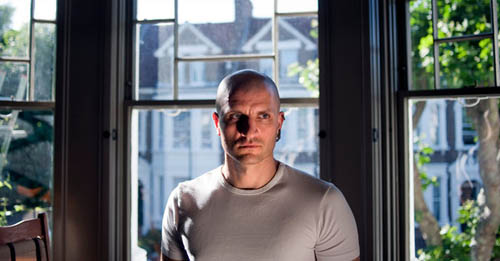
[Image: China Miéville, photographed by Andrew Testa, courtesy of the New York Times].

• • •

BLDGBLOG: I’d like to start with The City and The City. What was your initial attraction to the idea of a divided city, and how did you devise the specific way in which the city would be split?

China Miéville: I first thought of the divided city as a development from an earlier idea I had for a fantasy story. That idea was more to do with different groups of people who live side-by-side but, because they are different species, relate to the physical environment very, very differently, having different kinds of homes and so on. It was essentially an exaggeration of the way humans and rats live in London, or something similar. But, quite quickly, that shifted, and I began to think about making it simply human.

For a long time, I couldn’t get the narrative. I had the setting reasonably clear in my head and, then, once I got that, a lot of things followed. For example, I knew that I didn’t want to make it narrowly, allegorically reductive, in any kind of lumpen way. I didn’t want to make one city heavy-handedly Eastern and one Western, or one capitalist and one communist, or any kind of nonsense like that. I wanted to make them both feel combined and uneven and real and full-blooded. I spent a long time working on the cities and trying to make them feel plausible and half-remembered, as if they were uneasily not quite familiar rather than radically strange.

I auditioned various narrative shapes for the book and, eventually, after a few months, partly as a present to my Mum, who was a big crime reader, and partly because I was reading a lot of crime at the time and thinking about crime, I started realizing what was very obvious and should have been clear to me much earlier. That’s the way that noir and hard-boiled and crime procedurals, in general, are a kind of mythic urbanology, in a way; they relate very directly to cities.

Once I’d thought of that, exaggerating the trope of the trans-jurisdictional police problem—the cops who end up having to be on each other’s beats—the rest of the novel just followed immediately. In fact, it was difficult to imagine that I hadn’t been able to work it out earlier. That was really the genesis.

I should say, also, that with the whole idea of a divided city there are analogies in the real world, as well as precursors within fantastic fiction. C. J. Cherryh wrote a book that had a divided city like that, in some ways, as did Jack Vance. Now I didn’t know this at the time, but I’m also not getting my knickers in a twist about it. If you think what you’re trying to do is come up with a really original idea—one that absolutely no one has ever had before—you’re just kidding yourself.

You’re inevitably going to tread the ground that the greats have trodden before, and that’s fine. It simply depends on what you’re able to do with it.

BLDGBLOG: Something that struck me very strongly about the book was that you manage to achieve the feel of a fantasy or science fiction story simply through the description of a very convoluted political scenario. The book doesn’t rely on monsters, non-humans, magical technologies, and so on; it’s basically a work of political science fiction.

Miéville: This is impossible to talk about without getting into spoiler territory—which is fine, I don’t mind that—but we should flag that right now for anyone who hasn’t read it and does want to read it.

But, yes, the overtly fantastical element just ebbed and ebbed, becoming more suggestive and uncertain. Although it’s written in such a way that there is still ambiguity—and some readers are very insistent on focusing on that ambiguity and insisting on it—at the same time, I think it’s a book, like all of my books, for which, on the question of the fantastic, you might want to take a kind of Occam’s razor approach. It’s a book that has an almost contrary relation to the fantastic, in a certain sense.

[Image: The marbled intra-national sovereignties of Baarle-Hertog].

BLDGBLOG: In some ways, it’s as if The City and The City simply describes an exaggerated real-life border condition, similar to how people live in Jerusalem or the West Bank, Cold War Berlin or contemporary Belfast—or even in a small town split by the U.S./Canada border, like Stanstead-Derby Line. In a sense, these settlements consist of next-door neighbors who otherwise have very complicated spatial and political relationships to one another. For instance, I think I sent you an email about a year ago about a town located both on and between the Dutch-Belgian border, called Baarle-Hertog.

Miéville: You did!

BLDGBLOG: I’m curious to what extent you were hoping to base your work on these sorts of real-life border conditions.

Miéville: The most extreme example of this was something I saw in an article in the Christian Science Monitor, where a couple of poli-sci guys from the State Department or something similar were proposing a solution to the Arab-Israeli conflict. In the case of Jerusalem, they were proposing basically exactly this kind of system, from The City and The City, in that you would have a single urban space in which different citizens are covered by completely different juridical relations and social relations, and in which you would have two overlapping authorities.

I was amazed when I saw this. I think, in a real world sense, it’s completely demented. I don’t think it would work at all, and I don’t think Israel has the slightest intention of trying it.

My intent with The City and The City was, as you say, to derive something hyperbolic and fictional through an exaggeration of the logic of borders, rather than to invent my own magical logic of how borders could be. It was an extrapolation of really quite everyday, quite quotidian, juridical and social aspects of nation-state borders: I combined that with a politicized social filtering, and extrapolated out and exaggerated further on a sociologically plausible basis, eventually taking it to a ridiculous extreme.

But I’m always slightly nervous when people make analogies to things like Palestine because I think there can be a danger of a kind of sympathetic magic: you see two things that are about divided cities and so you think that they must therefore be similar in some way. Whereas, in fact, in a lot of these situations, it seems to me that—and certainly in the question of Palestine—the problem is not one population being unseen, it’s one population being very, very aggressively seen by the armed wing of another population.

In fact, I put those words into Borlu’s mouth in the book, where he says, “This is nothing like Berlin, this is nothing like Jerusalem.” That’s partly just to disavow—because you don’t want to make the book too easy—but it’s also to make a serious point, which is that, obviously, the analogies will occur but sometimes they will obscure as much as they illuminate.
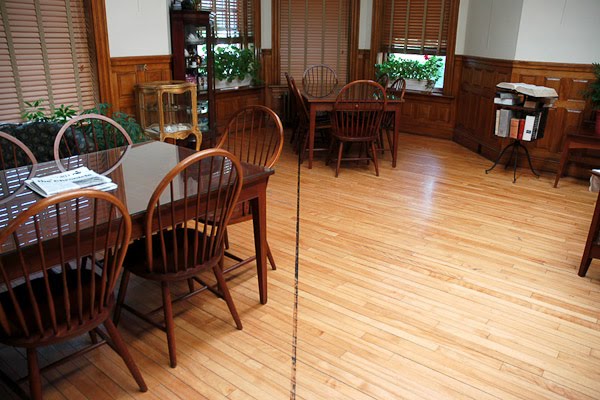
[Image: The international border between the U.S. and Canada passes through the center of a library; photo courtesy of the Center for Land Use Interpretation. “Technically, any time anyone crosses the international line, they are subject to having to report, in person, to a port of entry inspection station for the country they are entering,” CLUI explains. “Visiting someone on the other side of the line, even if the building is next door, means walking around to the inspection station first, or risk being an outlaw. Playing catch on Maple Street/Rue Ball would be an international event, and would break no laws presumably, so long as each time the ball was caught, the recipient marched over to customs to declare the ball.”].

BLDGBLOG: Your books often lend themselves to political readings, on the other hand. Do you write with specific social or political allegories in mind, and, further, how do your settings—as in The City and The City—come to reflect political intentions, spatially?

Miéville: My short answer is that I dislike thinking in terms of allegory—quite a lot. I’ve disagreed with Tolkien about many things over the years, but one of the things I agree with him about is this lovely quote where he talks about having a cordial dislike for allegory.

The reason for that is partly something that Frederic Jameson has written about, which is the notion of having a master code that you can apply to a text and which, in some way, solves that text. At least in my mind, allegory implies a specifically correct reading—a kind of one-to-one reduction of the text.

It amazes me the extent to which this is still a model by which these things are talked about, particularly when it comes to poetry. This is not an original formulation, I know, but one still hears people talking about “what does the text mean?”—and I don’t think text means like that. Texts do things.

I’m always much happier talking in terms of metaphor, because it seems that metaphor is intrinsically more unstable. A metaphor fractures and kicks off more metaphors, which kick off more metaphors, and so on. In any fiction or art at all, but particularly in fantastic or imaginative work, there will inevitably be ramifications, amplifications, resonances, ideas, and riffs that throw out these other ideas. These may well be deliberate; you may well be deliberately trying to think about issues of crime and punishment, for example, or borders, or memory, or whatever it might be. Sometimes they won’t be deliberate.

But the point is, those riffs don’t reduce. There can be perfectly legitimate political readings and perfectly legitimate metaphoric resonances, but that doesn’t end the thing. That doesn’t foreclose it. The text is not in control. Certainly the writer is not in control of what the text can do—but neither, really, is the text itself.

So I’m very unhappy about the idea of allegoric reading, on the whole. Certainly I never intend my own stuff to be allegorical. Allegories, to me, are interesting more to the extent that they fail—to the extent that they spill out of their own bounds. Reading someone like George MacDonald—his books are extraordinary—or Charles Williams. But they’re extraordinary to the extent that they fail or exceed their own intended bounds as Christian allegory.

When Iron Council came out, people would say to me: “Is this book about the Gulf War? Is this book about the Iraq War? You’re making a point about the Iraq War, aren’t you?” And I was always very surprised. I was like, listen: if I want to make a point about the Iraq War, I’ll just say what I think about the Iraq War. I know this because I’ve done it. I write political articles. I’ve written a political book. But insisting on that does not mean for a second that I’m saying—in some kind of unconvincing, “cor-blimey, I’m just a story-teller, guvnor,” type-thing—that these books don’t riff off reality and don’t have things to say about it.

There’s this very strange notion that a writer needs to smuggle these other ideas into the text, but I simply don’t understand why anyone would think that that’s what fiction is for.

BLDGBLOG: There are also very basic historical and referential limits to how someone might interpret a text allegorically. If Iron Council had been written twenty years from now, for instance, during some future war between Taiwan and China, many readers would think it was a fictional exploration of that, and they’d forget about the Iraq War entirely.

Miéville: Sure. And you don’t want to disavow these readings. You may think, at this point in this particular book, I actually do want to make a genuine policy prescription. With my hand on my heart, I don’t think I have ever done that, but, especially if you write with a political texture, you certainly have to take readings like this on the chin.

So, when people say: are you really talking about this? My answer is generally not no—it’s generally yes, but… Or yes, and… Or yes… but not in the way that you mean.
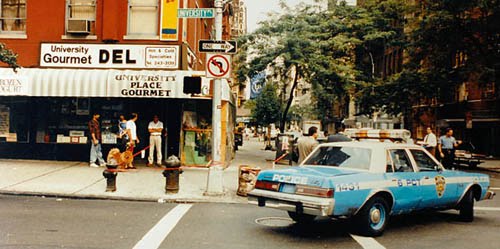
[Image: “The way a cop inhabits the city is doubtless a fascinating thing…” Photo courtesy of the NYPD].

BLDGBLOG: Let’s go back to the idea of the police procedural. It’s intriguing to compare how a police officer and a novelist might look at the city—the sorts of details they both might notice or the narratives they both might pick up on. Broadly speaking, each engages in detection—a kind of hermeneutics of urban space. How did this idea of urban investigation—the “mythic urbanology” you mentioned earlier—shape your writing of The City and The City?

Miéville: On the question of the police procedural and detection, for me, the big touchstones here were detective fiction, not real police. Obviously they are related, but they’re related in a very convoluted, mediated way.

What I wanted to do was write something that had a great deal of fidelity—hopefully not camp fidelity, but absolute rigorous fidelity—to certain generic protocols of policing and criminology. That was the drive, much more than trying to find out how police really do their investigations. The way a cop inhabits the city is doubtless a fascinating thing, but what was much more important to me for this book was the way that the genre of crime, as an aesthetic field, relates to the city.

The whole notion of decoding the city—the notion that, in a crime drama, the city is a text of clues, in a kind of constant, quantum oscillation between possibilities, with the moment of the solution really being a collapse and, in a sense, a kind of tragedy—was really important to me.

Of course, I’m not one of those writers who says I don’t read reviews. I do read reviews. I know that some readers were very dissatisfied with the strict crime drama aspect of it. I can only hold up my hands. It was extremely strict. I don’t mean to do that kind of waffley, unconvincing, writerly, carte blanche, get-out-clause of “that was the whole point.” Because you can have something very particular in mind and still fuck it up.

But, for me, given the nature of the setting, it was very important to play it absolutely straight, so that, having conceived of this interweaving of the cities, the actual narrative itself would remain interesting, and page-turning, and so on and so forth. I wanted it to be a genuine who-dunnit. I wanted it to be a book that a crime reader could read and not have a sense that I had cheated.

By the way, I love that formulation of crime-readers: the idea that a book can cheat is just extraordinary.

BLDGBLOG: Can you explain what you mean, in this context, by being rigorous? You were rigorous specifically to what?

Miéville: The book walks through three different kinds of crime drama. In section one and section two, it goes from the world-weary boss with a young, chippy sidekick to the mismatched partners who end up with grudging respect for each other. Then, in part three, it’s a political conspiracy thriller. I quite consciously tried to inhabit these different iterations of crime writing, as a way to explore the city.

But this has all just been a long-winded way of saying that I would not pretend or presume any kind of real policing knowledge of the way cities work. I suspect, probably, like most things, actual genuine policing is considerably less interesting than it is in its fictionalized version—but I honestly don’t know.
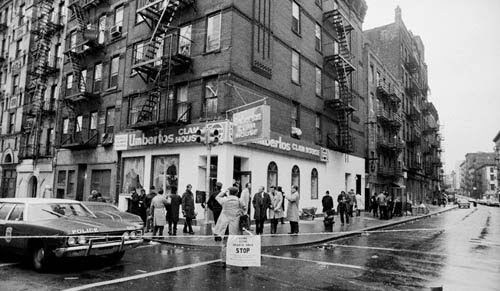
[Images: New York City crime scene photographs].

BLDGBLOG: There’s a book that came out a few years ago called The Meadowlands, by Robert Sullivan. At one point, Sullivan tags along with a retired detective in New Jersey who reveals that, now that he’s retired, he no longer really knows what to do with all the information he’s accumulated about the city over the years. Being retired means he basically knows thousands of things about the region that no longer have any real use for him. He thus comes across as a very melancholy figure, almost as if all of it was supposed to lead up to some sort of narrative epiphany—where he would finally and absolutely understand the city—but then retirement came along and everything went back to being slightly pointless. It was an interpretive comedown, you might say.

Miéville: That kind of specialized knowledge, in any field, can be intoxicating. If you experience a space—say, a museum—with a plumber, you may well come out with a different sense of the strengths and weaknesses of that museum—considering the pipework, as well, of course, as the exhibits—than otherwise. This is one reason I love browsing specialist magazines in fields about which I know nothing.

Obviously, then, with something that is explicitly concerned with uncovering and solving, it makes perfect sense that seeing the city through the eyes of a police detective would give you a very self-conscious view of what’s happening out there.

In terms of fiction, though, I think, if anything, the drive is probably the opposite. Novelists have an endless drive to aestheticize and to complicate. I know there’s a very strong tradition—a tradition in which I write, myself—about the decoding of the city. Thomas de Quincey, Michael Moorcock, Alan Moore, Neil Gaiman, Iain Sinclair—that type-thing. The idea that, if you draw the right lines across the city, you’ll find its Kabbalistic heart and so on.

The thing about that is that it’s intoxicating—but it’s also bullshit. It’s bullshit and it’s paranoia—and it’s paranoia in a kind of literal sense, in that it’s a totalizing project. As long as you’re constantly aware of that, at an aesthetic level, then it’s not necessarily a problem; you’re part of a process of urban mythologization, just like James Joyce was, I suppose. But the sense that this notion of uncovering—of taking a scalpel to the city and uncovering the dark truth—is actually real, or that it actually solves anything, and is anything other than an aesthetic sleight of hand, can be quite misleading, and possibly even worse than that. To the extent that those texts do solve anything, they only solve mysteries that they created in the first place, which they scrawled over the map of a mucky contingent mess of history called the city. They scrawled a big question mark over it and then they solved it.

Arthur Machen does this as well. All the great weird fiction city writers do it. Machen explicitly talks about the strength of London, as opposed to Paris, in that London is more chaotic. Although he doesn’t put it in these words, I think what partly draws him to London is this notion that, in the absence of a kind of unifying vision, like Haussmann’s Boulevards, and in a city that’s become much more syncretic and messy over time, you have more room to insert your own aestheticizing vision.

As I say, it’s not in and of itself a sin, but to think of this as a real thing—that it’s a lived political reality or a new historical understanding of the city—is, I think, a misprision.

BLDGBLOG: You can see this, as well, in the rise of psychogeography—or, at least, some popular version of it—as a tool of urban analysis in architecture today. This popularity often fails to recognize that, no matter how fun or poetic an experience it genuinely might be, randomly wandering around Boston with an iPhone, for instance, is not guaranteed to produce useful urban insights.

Miéville: Some really interesting stuff has been done with psychogeography—I’m not going to say it’s without uses other than for making pretty maps. I mean, re-experiencing lived urban reality in ways other than how one is more conventionally supposed to do so can shine a new light on things—but that’s an act of political assertion and will. If you like, it’s a kind of deliberate—and, in certain contexts, radical—misunderstanding. Great, you know—good on you! You’ve productively misunderstood the city. But I think that the bombast of these particular—what are we in now? fourth or fifth generation?—psychogeographers is problematic.

Presumably at some point we’re going to get to a stage, probably reasonably soon, in which someone—maybe even one of the earlier generation of big psychogeographers—will write the great book against psychogeography. Not even that it’s been co-opted—it’s just wheel-spinning.

BLDGBLOG: In an interview with Ballardian, Iain Sinclair once joked that psychogeography, as a term, has effectively lost all meaning. Now, literally any act of walking through the city—walking to work in the morning, walking around your neighborhood, walking out to get a bagel—is referred to as “psychogeography.” It’s as if the experience of being a pedestrian in the city has become so unfamiliar to so many people, that they now think the very act of walking around makes them a kind of psychogeographic avant-garde.

Miéville: It’s no coincidence, presumably, that Sinclair started wandering out of the city and off into fields.

[Image: Art by Vincent Chong for the Subterranean Press edition of Kraken].

BLDGBLOG: This brings us to something I want to talk about from Kraken, which comes out in paperback here in the States next week. In that book, you describe a group of people called the Londonmancers. They’re basically psychogeographers with a very particular, almost parodically mystical understanding of the city. How does Kraken utilize this idea of an occult geography of greater London?

Miéville: Yes, this relates directly to what we were just saying. For various reasons, some cities refract, through aesthetics and through art, with a particular kind of flamboyancy. For whatever reason, London is one of them. I don’t mean to detract from all the other cities in the world that have their own sort of Gnosticism, but it is definitely the case that London has worked particularly well for this. There are a couple of moments in the book of great sentimentality, as well, written, I think, when I was feeling very, very well disposed toward London.

I think, in those terms, that I would locate myself completely in the tradition of London phantasmagoria. I see myself as very much doing that kind of thing. But, at the same time, as the previous answer showed, I’m also rather ambivalent to it and sort of impatient with it—probably with the self-hating zeal of someone who recognizes their own predilections!

Kraken, for me, in a relatively light-hearted and comedic form, is my attempt to have it both ways: to both be very much in that tradition and also to take the piss out of it. Reputedly, throughout Kraken, the very act of psychogeographic enunciation and urban uncovering is both potentially an important plot point and something that does uncover a genuine mystery; but it is also something that is ridiculous and silly, an act of misunderstanding. It’s all to do with what Thomas Pynchon, in Gravity’s Rainbow, called kute korrespondences: “hoping to zero in on the tremendous and secret Function whose name, like the permuted names of God, cannot be spoken.”

The London within Kraken feels, to me, much more dreamlike than the London of something like King Rat. That’s obviously a much earlier book, and I now write very differently; but King Rat, for all its flaws, is a book very much to do with its time. It’s not just to do with London; it’s to do with London in the mid-nineties. It’s a real, particular London, phantasmagorized.

But Kraken is also set in London—and I wanted to indulge all my usual Londonisms and take them to an absurd extreme. The idea, for example, as you say, of this cadre of mages called the Londonmancers: that’s both in homage to parts of that tradition, and also, hopefully, an extension of it to a kind of absurdity—the ne plus ultra, you know?

BLDGBLOG: Kraken also makes some very explicit maritime gestures—the squid, of course, which is very redolent of H.P. Lovecraft, but also details such as the pirate-like duo of Goss and Subby. This maritime thread pops up, as well, in The Scar, with its floating city of linked ships. My question is: how do your interests in urban arcana and myth continue into the sphere of the maritime, and what narrative or symbolic possibilities do maritime themes offer your work?

Miéville: Actually, I think I was very restrained about Lovecraft. I think the book mentions Cthulhu twice—which, for a 140,000 or 150,000-word novel about giant squid cults, is pretty restrained! That’s partly because, as you say, if you write a book about a tentacular monster with a strange cult associated with it, anyone who knows the field is going to be thinking immediately in terms of Lovecraft. And I’m very, very impressed by Lovecraft—he’s a big presence for me—but, partly for that very reason, I think Kraken is one of the least Lovecrafty things I’ve done.

As to the question of maritimism, like a lot of my interests, it’s more to do with how it has been filtered through fiction, rather than how it is in reality. In reality, I have no interest in sailing. I’ve done it, I think, once.

But maritime fiction, from Gulliver’s Travels onward, I absolutely love. I love that it has its own set of traditions; in some ways, it’s a kind of mini-canon. It has its own riffs. There are some lovely teasings of maritime fiction within Gulliver’s Travels where he gets into the pornography of maritime terminology: mainstays and capstans and mizzens and so on, which, again, feature quite prominently in The Scar.
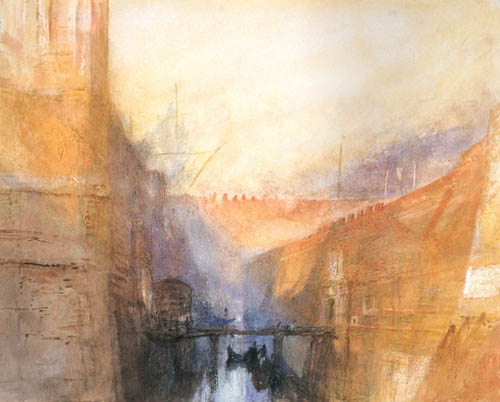
[Image: “An Imaginary View of the Arsenale” by J.M.W. Turner, courtesy of the Tate].

BLDGBLOG: In the context of the maritime, I was speaking to Reza Negarestani recently and he mentioned a Russian novella from the 1970s called “The Crew Of The Mekong,” suggesting that I ask you about your interest in it. Reza, of course, wrote Cyclonopedia, which falls somewhere between, say, H.P. Lovecraft and ExxonMobil, and for which you supplied an enthusiastic endorsement.

Miéville: Yes, I was blown away by Reza’s book—partly just because of the excitement of something that seems genuinely unclassifiable. It really is pretty much impossible to say whether you’re reading a work of genre fiction or a philosophical textbook or both of the above. There’s also the slightly crazed pseudo-rigor of it, and the sense that this is philosophy as inspired by schlocky horror movies as much as by Alain Badiou.

There’s a phrase that Kim Newman uses: post-genre horror. It’s a really nice phrase for something which is clearly inflected in a horror way, and clearly emerges out of the generic tradition of horror, but is no longer reducible to it. I think that Reza’s work is a very, very good example of that. As such, Cyclonopedia is one of my favorite books of the last few years.

BLDGBLOG: So Reza pointed me to “The Crew of the Mekong,” a work of Russian maritime scifi. The authors describe it, somewhat baroquely, as “an account of the latest fantastic discoveries, happenings of the eighteenth century, mysteries of matter, and adventures on land and at sea.” What drew you to it?

Miéville: I can’t remember exactly what brought me to it, to be perfectly honest: it was in a secondhand bookshop and I bought it because it looked like an oddity.

It’s very odd in terms of the shape of its narrative; it sort of lurches, with a story within a story, including a long, extended flashback within the larger framing narrative, and it’s all wrapped up in this pulp shell. In terms of the story itself, if I recall, it was actually me who suggested it to Reza because it has loads of stuff in it about oil, plastic resins, and pipelines, and one of the characters works for an institute called the Institute of Surfaces, which deals with the weird physics and uncanny properties of surfaces and topology.

Some of the flashback scenes and some of the background I’ve seen described as proto-steampunk, which I think is highly anachronistic: it’s more of an elective affinity, that, if you like retro-futurity, you might also like this. At a bare minimum, it’s a book worth reading simply because it’s very odd; at a maximum, some of the things going on it are philosophically interesting, although in a bizarre way.

But foreign pulp always has that peculiar kind of feeling to it, because you have a distinct cultural remove. At its worst, that can lead to an awful kind of orientalism, but it’s undeniably fascinating as a reader.

BLDGBLOG: It’s interesting that depictions of maritime journeys can maintain such strong mythic and imaginative resonance, even across wildly different cultures, eras, genres, and artforms—whether it’s “The Crew of the Mekong” or The Scar, Valhalla Rising or Moby Dick.

Miéville: The maritime world in general is an over-determined symbol of pretty much anything you want it to be—just fill in the blank: yearning, manifest destiny, whatever. It’s a very fecund field. My own interest in it comes pretty much through fiction and, to a certain extent, art. I wish I had a bit more money, in fact, because I would buy a lot of those fairly cheap, timeless, uncredited, late 19th-century, early 20th-century seascapes that you see on sale in a lot of thrift shops.

You also mentioned Goss and Subby. Goss and Subby themselves I never thought of as pirates, in fact. They were my go at iterating the much-masticated trope of the freakishly monstrous duo, figures who are, in some way that I suspect is politically meaningful, and that one day I’ll try to parse, generally even worse than their boss. They often speak in a somewhat odd, stilted fashion, like Hazel and Cha-Cha, or Croup and Vandemar, or various others. The magisterial TV Tropes has a whole entry on such duos called “Those Two Bad Guys.” The tweak that I tried to add with Goss and Subby was to integrate an idea from a Serbian fairy-tale called—spoiler!—“BasCelik.” For anyone who knows that story, this is a big give-away.

Again, though, I think you have to ration your own predilections. I have always been very faithful to my own loves: I look at my notebooks or bits of paper from when I was four and, basically, my interests haven’t changed. Left to my own devices, I would probably write about octopuses, monsters, occasionally Tarzan, and that’s really it. From a fairly young age, the maritime yarn was one of those.

But you can’t just give into your own drives, or you simply end up writing the same book again and again.

[Image: Mapping old London].

BLDGBLOG: Along those lines, are there any settings or environments—or even particular cities—that would be a real challenge for you to work with? Put another way, can you imagine giving yourself a deliberate challenge to write a novel set out in the English suburbs, or even in a place like Los Angeles? How might that sort of unfamiliar, seemingly very un-Miéville-like landscape affect your plots and characters?

Miéville: That’s a very interesting question. I really like that approach, in terms of setting yourself challenges that don’t come naturally. It’s almost a kind of Oulipo approach. It’s tricky, though, because you have to find something that doesn’t come naturally, but, obviously, you don’t want to write about something that doesn’t interest you. It has to be something that interests you contradictorally, or contrarily.

To be honest, the suburbs don’t attract me, for a bunch of reasons. I think it’s been done to death. I think anyone who tried to do that after J. G. Ballard would be setting themselves up for failure. As I tried to say when I did my review of the Ballard collection for The Nation, one of the problems is that, with an awful lot of suburban art today, it is pitched as this tremendously outré and radical claim to say that the suburbs are actually hotbeds of perversity—whereas, in fact, that is completely the cliché now. If you wanted to do something interesting, you would have to write about terribly boring suburbs, which would loop all the way back round again, out of interesting, through meta-interesting, and back down again to boring. So I doubt I would do something set in the suburbs.

I am quite interested in wilderness. Iron Council has quite a bit of wilderness, and that was something that I really liked writing and that I’d like to try again.

But, to be honest, it’s different kinds of urban space that appeal to me. If you’re someone who can’t drive, like I can’t, you find a lot of American cities are not just difficult, but really quite strange. I spend a lot of time in Providence, Rhode Island, and it’s a nice town, but it just doesn’t operate like a British town. A lot of American towns don’t. The number of American cities where downtown is essentially dead after seven o’clock, or in which you have these strange little downtowns, and then these quite extensive, sprawling but not quite suburban surroundings that all call themselves separate cities, that segue into each other and often have their own laws—that sort of thing is a very, very strange urban political aesthetic to me.

I’ve been thinking about trying to write a story not just set, for example, in Providence, but in which Providence, or another city that operates in a very non-English—or non-my-English—fashion, is very much part of the structuring power of the story. I’d be interested in trying something like that.

But countries all around the world have their own specificities about the way their urban environments work. I was in India recently, for example. It was a very brief trip, and I’m sure some of this was just wish fulfillment or aesthetic speculation, but I became really obsessed with the way, the moment you touched down at a different airport, you got out and you breathed the air, Mumbai felt different to Delhi, felt different to Kolkata, felt different to Chennai.

Rather than syncretizing a lot of those elements, I’d like to try to be really, really faithful to one or another city, which is not my city, in the hopes that, being an outsider, I might notice certain aspects that otherwise one would not. There’s a certain type of ingenuous everyday inhabiting of a city, which is very pre-theoretical for something like psychogeography, but it brings its own insights, particularly when it doesn’t come naturally or when it goes wrong.

There’s a lovely phrase that I think Algernon Blackwood used to describe someone’s bewilderment: he describes him as being bewildered in the way a man is when he’s looking for a post box in a foreign city. It’s a completely everyday, quotidian thing, and he might walk past it ten times, but he doesn’t—he can’t—recognize it.

That kind of very, very low-level alienation—the uncertainty about how do you hail a taxi, how do you buy food in this place, if somebody yells something from their top window, why does everyone move away from this part of the street and not that part? It’s that kind of very low-level stuff, as opposed to the kind of more obvious, dramatic differences, and I think there might be a way of tapping into that knowledge, knowledge that the locals don’t even think to tell you, that might be an interesting way in.

To that extent, it would be cities that I like but in which I’m very much an outsider that I’d like to try to tap.

• • •

Thanks to China Miéville for finding time to have this conversation, including scheduling a phone call at midnight in order to wrap up the final questions. Thanks, as well, to Nicola Twilley, who transcribed 95% of this interview and offered editorial feedback while it was in process, and to Tim Maly who first told me about the towns of Derby Line–Stanstead.

Miéville’s newest book, Embassytown, comes out in the U.S. in May; show your support for speculative fiction and pre-order a copy soon. If you are new to Miéville’s work, meanwhile, I might suggest starting with The City and The City.

Project Iceworm

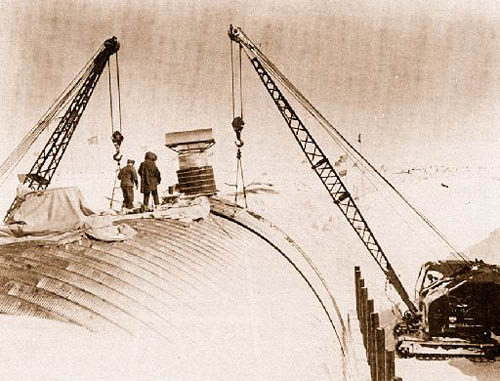
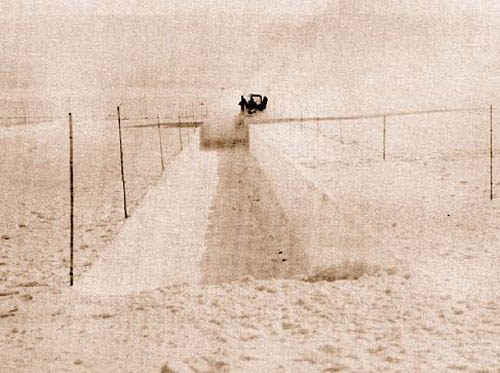
[Image: Camp Century under construction; photograph via Frank J. Leskovitz].
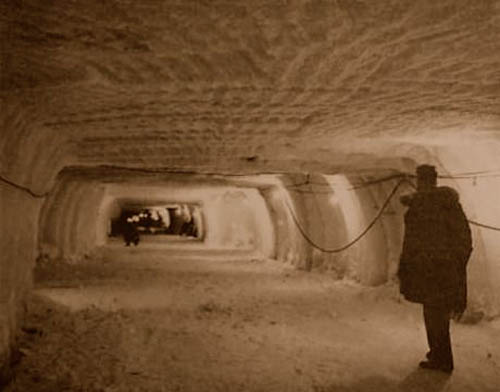
Camp Century—aka “Project Iceworm”—was a “city under ice,” according to the U.S. Army, a “nuclear-powered research center built by the Army Corps of Engineers under the icy surface of Greenland,” as Frank J. Leskovitz explains.

A fully-functioning underground city, Camp Century even had its own mobile nuclear reactor—an “Alco PM-2A”—that kept the whole thing lit up and running during the Cold War.

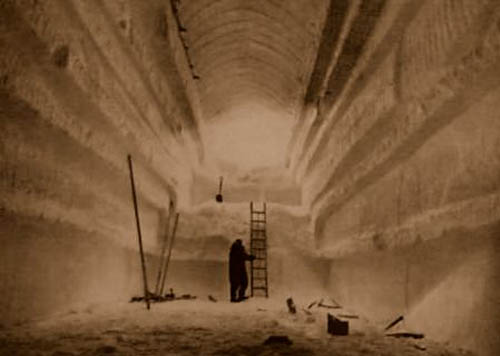
[Images: Camp Century under construction; photographs via Frank J. Leskovitz].
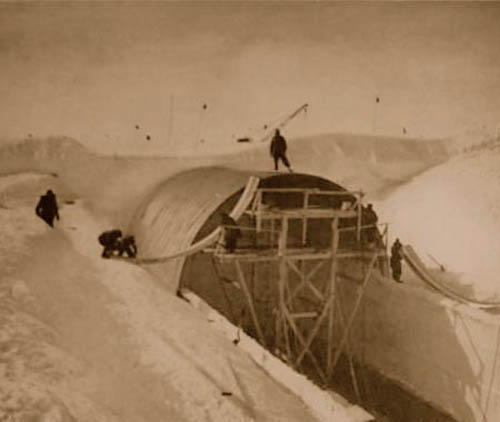
According to Leskovitz, the Camp’s construction crews “utilized a ‘cut-and-cover’ trenching technique” during the base’s infra-glacial assembly:

Long ice trenches were created by Swiss made “Peter Plows,” which were giant rotary snow milling machines. The machine’s two operators could move up to 1200 cubic yards of snow per hour. The longest of the twenty-one trenches was known as “Main Street.” It was over 1100 feet long and 26 feet wide and 28 feet high. The trenches were covered with arched corrugated steel roofs which were then buried with snow.

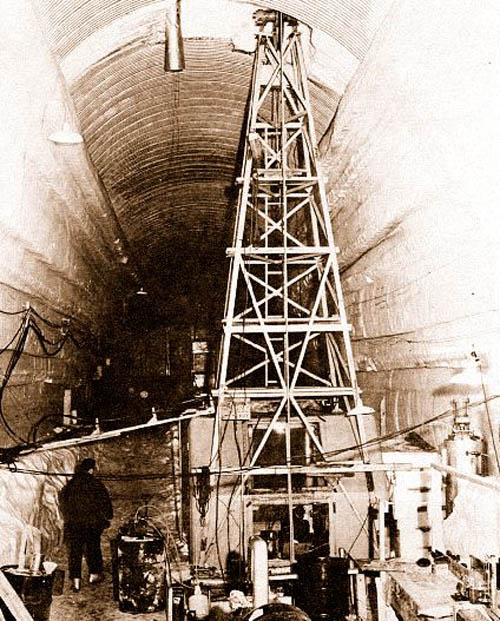
Prefab facilities were then added, with “wood work buildings and living quarters… erected in the resulting snow tunnels.”

[Images: Camp Century under construction; photographs via Frank J. Leskovitz].
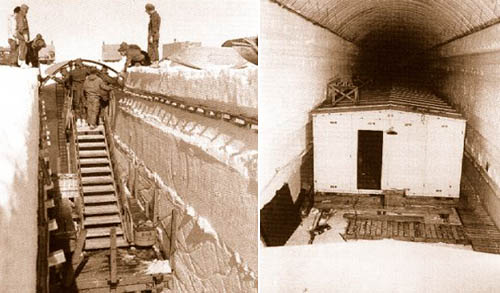
Leskowitz continues:

Each seventy-six foot long electrically heated barrack contained a common area and five 156 square foot rooms. Several feet of airspace was maintained around each building to minimize melting. To further reduce heat build-up, fourteen inch diameter “air wells” were dug forty feet down into the tunnel floors to introduce cooler air. Nearly constant trimming of the tunnel walls and roofs was found to be necessary to combat snow deformation.

Camp Century went from a scientific outpost to a potential U.S. Army site for hosting battle-ready nuclear missiles underneath the Greenland ice sheet—the so-called “Project Iceworm” mentioned earlier.

The following four short videos, produced by the U.S. military, explore the site’s strange technical circumstances as well as its complicated defensive history.


“During this period of the Cold War,” Leskovitz explains, “the U.S. Army was working on plans to base newly designed ‘Iceman’ ICBM missiles in a massive network of tunnels dug into the Greenland icecap. The Iceworm plans were eventually deemed impractical and abandoned,” and, “due to unanticipated movement of the glacial ice,” the entire subterranean complex was eventually left in ruins.

The idea that the moving terrain of a glacial ice sheet could be considered a stable-enough launching point for nuclear missiles is astonishing, and the idea that the U.S. Army once ran a top secret—and rather Metallica-sounding—”city under ice” just shy of the North Pole only adds to the story’s disarming surreality.

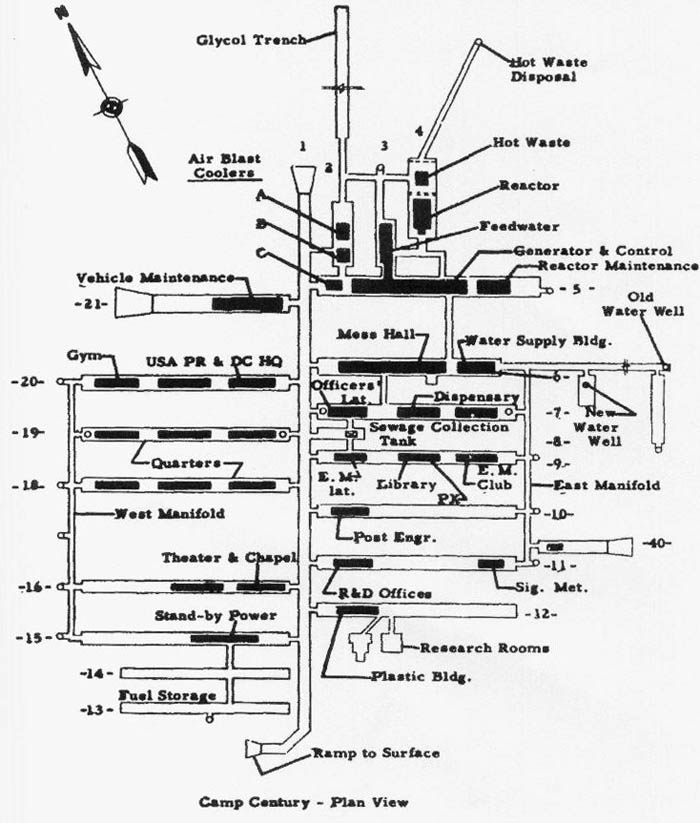
[Image: The plan of Camp Century; via Frank J. Leskovitz].

In any case, more photographs, including of the Army’s mobile nuclear reactor, are available on Leskovitz’s own site.

*Update* In August 2016, a study published in the journal Geophysical Research Letters suggested that “climate change could remobilize abandoned hazardous waste thought to be buried forever beneath the Greenland Ice Sheet,” specifically referring to the ruins of Camp Century.

“Camp Century could start to melt by the end of the century,” the American Geophysical Union summarizes. “If the ice melts, the camp’s infrastructure, as well as any remaining biological, chemical and radioactive waste, could re-enter the environment and potentially disrupt nearby ecosystems.”

[Image: U.S. Army photograph, via the American Geophysical Union].

Here is a PDF of the complete paper.

Landscape Futures Super-Dialogue

[Image: The electromagnetic infrastructure of Los Angeles; photo by the Center for Land Use Interpretation].

I’ve deliberately waited to the last minute to mention this event, simply because there will only be room for five or six people to join us, but the Landscape Futures Super-Workshop pops out in public today for a live event beginning at 1pm at the Center for Land Use Interpretation in Culver City.

It features, in order of appearance:

Matthew Coolidge, Center for Land Use Interpretation
David Gissen, Subnature / HTC Experiments / California College of the Arts
David Benjamin, The Living
Liam Young, Tomorrow’s Thoughts Today / Architectural Association
Mark Smout and Laura Allen, Smout Allen / Barlett School of Architecture
Elizabeth Ellsworth and Jamie Kruse, Smudge Studio / Friends of the Pleistocene

Students from the Arid Lands Institute will also have a casebook of research drawings on display, and the day will conclude with a panel discussion, kicking off at 4pm, featuring all of the above speakers in addition to Arid Lands Institute faculty and Los Angeles Times architecture critic Christopher Hawthorne.

[Image: “Topping-out ceremony” at the Onkalo nuclear-waste sequestration site, Finland; photo by Posiva/Jari Hakala, via Friends of the Pleistocene].

In addition to the work of each practitioner listed above, we’ll be discussing everything from the coastal-expansion infrastructures of Los Angeles, urban aridity, future climates and their spatial implications, and the architecture of dynamic landscapes to the cognitive difficulties associated with geologic time, the Super-Workshop‘s own recent experience of L.A., L.A. itself as a site for interventions both speculative and real, and the layered ecologies of the city.

Things kick off at 1pm at the Center for Land Use Interpretation. Due to the size of our own group, however, I should point out again that there will be limited space, and I’d thus suggest arriving early.

Peel Street Caves

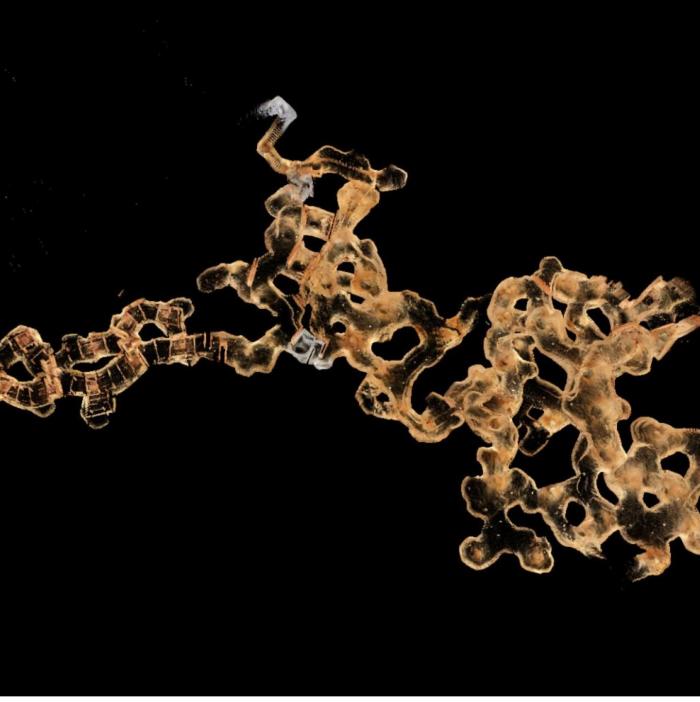
[Image: A 3D laser scan of the Peel Street Caves—actually a former sand mine beneath the city—courtesy of the Nottingham Caves Survey].

It’s hard to resist a note that says a “new cave” has been “uploaded,” but the Nottingham Caves Survey—previously mentioned here—has announced just that, putting 3D laser scans of the incredible Peel Street Caves on their website.

Like smoke rings breaking apart and slowly looping inside the planet, their near-endless recursivity makes it almost impossible to see where they begin.

[Image: Plan of the Peel Street Caves, courtesy of the Nottingham Caves Survey].

The “caves,” however, are really a former sand mine:

It is thought that the mine was in use from around 1780 to 1810. However it is possible that the mine was worked from an even earlier date, acting as a direct source of sand for a nearby glass works which was in operation until 1760. The mine was forgotten until about 1892 when the caves became a tourist attraction, “Robin Hood’s Mammoth Cave.” A map of 1844 shows a number of properties on Mansfield Road. Some of these have basements cut into the sandstone which open out into the sand mine.

The caves were transformed into bomb shelters during WWII. How spectacular to own one of those basements, though, that “open out into the sand mine”—and how doubly spectacular to discover such a connection only accidentally, tapping on a hollow wall downstairs or finally forcing open a door that had been rusted shut, finding, there both beneath and behind your house, this strange labyrinth of voids uncoiling through the city.

Read more at the Nottingham Caves Survey (or previously on BLDGBLOG).

Cryptoforests and Spatial Folklore

[Image: Photo by Gary Warner, from the cryptoforestry Flickr pool].

In his ongoing exploration of “the forest in the city,” Wilfried Hou Je Bek has produced a voluminous quantity of writings worth exploring in more detail, and so it is somewhat arbitrary to lead with this link; but the title of a recent post, “If the forest is empty so is the mind,” compelled me to point your attention to his blog Cryptoforestry (previously mentioned here).

Cryptoforesty, as Wilfried describes it in that post, emphasizes “the psychological effects of a forest” rather than the forest’s pure ecological function; indeed, he writes, “The point is not that wolfs and bears are needed to fulfill ecological functions that are now null and void, the point is that a forest with such animals fuels the imagination and adds zest to life, even to those who would never visit such a ‘full’ forest.” And, thus, he quips, “If the forest is empty,” devoid of its animal sentience, “so is the mind.”

Further, his point that European forests are now actually “being replenished from the east” with wild creatures is both politically symbolic and environmentally interesting.

[Image: Photo by Gary Warner, from the cryptoforestry Flickr pool].

The “What is a Cryptoforest?” essay is a virile and spirited defense of landscape ferality. Quoting at length and hoping to give a rhetorical sense of the writer’s interests, which range from the poetry of Gary Snyder to pre-Columbian rock art:

Cryptoforests are those parts of the city in which nature, in “secret,” has been given the space and the time to create its own millennia-millennia-old, everyday-everyday-new order by using the materials (seeds, roots, nutrients, soil conditions, waste, architectural debris) at hand. Cryptoforests are sideways glances at post-crash landscapes, diagrammatic enclaves through which future forest cities reveal their first shadows, laboratories for dada-do-nothingness, wild-type vegetable free states, enigma machines of uncivilized imagination, psychogeographical camera obscuras of primal fear and wanton desire, relay stations of lost ecological and psychological states. Cryptoforests are wild weed-systems, but wildness is equated not with chaos but with productiveness at a non-human level of organization. What starts with weed ends with a cryptoforest, and in between there is survivalism, with plants eking out a living against all odds, slowly but determinedly creating the conditions for the emergence of a network of biological relationships that is both flexible and stubborn, unique and redundant, fragile and resilient. Cryptoforests are honey pots for creatures that have no other place to go. Animals live there, the poor forage there, nomads camp there and the cryptoforester who has renounced the central planning commission re-creates there (free after Henri Thoreau). In the future, young people will no longer want to play in bands and they will become guerrilla gardeners and cryptoforesters instead.

“What starts with [a] weed ends with a cryptoforest”—the cryptoforest is a nearly all-encompassing botanical category for vegetation untamed. “The cardinal rule of cryptoforestry is that you can’t search for a cryptoforest,” we read. “You stumble upon them, they are already right in front of you.” Further, becoming sites of spatial folklore, cryptoforests are “always larger on the inside than they appear from the outside.”

[Image: Photo by Gary Warner, from the cryptoforestry Flickr pool].

Cryptoforestry offers fives diagnostic categories for this marginal terrain:

1) Feral forests (Planted tree zones, for instance along motorways, that have been allowed to become wild to the point that their wildness is outgrowing their manmadeness.) 2) In limbo forests (Tree-covered plots that feel like forests but technically probably aren’t; states of vegetation for which lay-language has no name.) 3) Incognito Forests (Forests that have gone cryptic and are almost invisible, forests in camouflage, forests with a talent for being ignored.) 4) Precognitive forests (Lands that are on the brink of becoming forested, a future forest fata morgana.) 5) Unappreciated forests (Forests regarded as zones of waste and weed, forests shaming planners, developers, and the neighbourhood. NIMBY forestry.)

These are less climax ecosystems than purgatorial ones, we might say—false gardens beyond cultivation, in which a different sort of nature is discovered growing “already right in front of you.”

The whole blog is worth bookmarking for later return.

(Consider joining the cryptoforestry Flickr pool).

Books Received: Climate Futures List

A rash of recent books about the geographic implications of climate change have crossed my desk. In this themed supplement to BLDGBLOG’s ongoing Books Received series, I thought I’d group them together into one related list.

[Image: Courtesy of the Wall Street Journal].

What many of the books described in this post have in common—aside from their shared interest in what a climatically different earth will mean for the future of human civilization—is their use of short, fictionalized narratives set in specific future years or geographic regions as a way of illustrating larger points.

These narrative scenarios—diagnostic estimates of where we will be at some projected later date—come with chapter titles such as “Russia, 2019,” “China, 2042,” “Miami Beached,” and “Holland 2.0 Depolderized.” Among the various spatial and geopolitical side-effects of climate change outlined by these authors are a coming depopulation of the American Southwest; a massive demographic move north toward newly temperate Arctic settlements, economically spearheaded by the extraction industry and an invigorated global sea trade; border wars between an authoritarian Russia and a civil war-wracked China; and entire floating cities colonizing the waters of the north Atlantic as Holland aims to give up its terrestrial anchorage altogether, becoming truly a nation at sea.

“Will Manhattan Flood?” asks Matthew E. Kahn in his Climatopolis: How Our Cities Will Thrive in the Hotter Future. What will Greenland look like in the year 2215, with atmospheric carbon dioxide levels at 1300 parts per million, according to Peter Ward’s The Flooded Earth: Our Future In a World Without Ice Caps? Will a “New North” rise as the Arctic de-ices and today’s economic powerhouses, from Los Angeles to Shanghai, stagnate under killer droughts, coastal floods, and heat waves, as Laurence C. Smith suggests in The World in 2050: Four Forces Shaping Civilization’s Northern Future?

[Image: Modeling sea-level rise in Florida, courtesy of Penn State].

However, climate change is only one of the world-altering forces under discussion in each of these six books. Demography, oil scarcity, natural resources, public hygiene, and accelerating globalization all play roles, to different extents, in these authors’ thinking. In one case, in particular—Float!: Building on Water to Combat Urban Congestion and Climate Change, the most practical book described here—new construction technologies, with immediate implications for architectural design, also take center stage.

In all cases, though, these books offer further evidence of an irresistible popular urge to discuss the future, and to do so through what can very broadly described as fiction. The recent speculative tone taken by much of today’s architecture writing is only part of this trend; from “design fiction” to speculative foreign policy blogs, and from “the world without us” to future food, a compulsion to understand what might happen to human civilization, in both the near and distant future, using fictional scenarios and speculative hypotheses seems to be at a high point of trans-disciplinary appeal.

As Heidi Cullen writes in The Weather of the Future: Heat Waves, Extreme Storms, and Other Scenes from a Climate-Changed Planet, there is something inherently difficult in comprehending the scale of climate change—what effects it might have, what systems it might interrupt or ruin. She thus imports lessons from cognitive psychology to understand what it is about climate change that keeps it so widely misinterpreted (though a hefty dose of media criticism, I’d argue, is far more apropos). It is interesting, then, in light of the apparent incomprehensibility of climate change, that fictional scenarios have become so popular a means of explaining and illustrating what Cullen calls our “climate-changed planet.”

This emerging narrative portraiture of climate change—exemplified by most of the books under discussion here, whether they present us with Atlanta running out of freshwater, frantic Chinese troops diverting rivers on the border with India, or a governmentally-abandoned Miami given over to anarchism and mass flooding—offers an imperfect but highly effective way of making a multi-dimensional problem understandable.

After all, if stories are an effective means of communicating culturally valuable information—if stories are pedagogically useful—then why not tell more stories about future climate change—indeed, why not tell more stories about architecture and buildings and emerging technologies and the spaces of tomorrow’s geopolitics?

Perhaps this is why so much of architecture writing today, both on blogs and elsewhere, so willfully crosses over into science fiction: if architecture literally is the design and proposal of a different world—one that might exist tomorrow, next year, next decade—then it is conceptually coextensive with the genre of scifi.

The current speculative turn in architecture writing is thus both unsurprising and highly appropriate to its subject matter—something worth bearing in mind by anyone hoping to find a larger audience for architectural critique.

[Image: “London as Venice” by Robert Graves and Didier Madoc-Jones, based on a photo by Jason Hawkes (part of an image series well-critiqued by the Guardian)].

An obvious problem with these preceding statements, however, is that we might quickly find ourselves relying on fiction to present scientific ideas to a popular audience; in turn, this risks producing a public educated not by scientists themselves but by misleading plotlines and useless blockbusters, such as The Day After Tomorrow and State of Fear, where incorrect popular representations of scientific data become mistaken for reports of verified fact.

In a way, one of the books cited in the following short list unwittingly demonstrates this very risk; Climate Wars: The Fight for Survival as the World Overheats would certainly work to stimulate a morally animated conversation with your friends over coffee or drinks, but there is something about its militarized fantasies of Arctic tent cities and Asian governments collapsing in civil free-fall that can’t help but come across as over-excitable, opening the door to disbelief for cynics and providing ammunition for extreme political views.

Indeed, I’d argue, the extent to which contemporary political fantasies are being narratively projected onto the looming world of runaway climate change has yet to be fully analyzed. For instance, climate change will cause the European Union to disband, we read in one book cited here, leaving Britain an agriculturally self-sufficient (though under-employed) island-state of dense, pedestrian-friendly urban cores; the U.S. will close its foreign military bases en masse, bringing its troops home to concentrate on large-scale infrastructural improvements, such as urban seawalls, as the middle class moves to high-altitude safety in the Rocky Mountains where it will live much closer to nature; Africa, already suffering from political corruption and epidemic disease, will fail entirely, undergoing a horrific population crash; and China will implode, leaving the global north in control of world resources once again.

It is important to note that all of these scenarios represent explicit political goals for different groups located at different points on the political spectrum. Perversely, disastrous climate change scenarios actually offer certain societal forces a sense of future relief—however misguided or short-term that relief may be.

Elsewhere, I’ve written about what I call climate change escapism—or liberation hydrology—which is the idea that climate change, and its attendant rewriting of the world’s geography through floods, is being turned into a kind of one-stop shop, like the 2012 Mayan apocalypse, for people who long for radical escape from today’s terrestrial status quo but who can find no effective political means for rallying those they see as forming a united constituency. Climate change thus becomes a kind of a deus ex machina—a light at the end of the tunnel for those who hope to see the world stood abruptly on its head.

Indeed, we might ask here: what do we want from climate change? What world do we secretly hope climate change will create—and what details of this world can we glimpse in today’s speculative descriptions of the future? What explicit moral lessons do we hope climate change will teach our fellow human beings?

[Image: “London-on-Sea” by Practical Action].

Of course, the six books listed below are by no means the only ones worth reading on these topics; in fact, the emerging genre of what I’ll call climate futures is an absolutely fascinating one, and these books should be seen as a useful starting place. I would add, for instance, that Charles Emmerson’s recent Future History of the Arctic clearly belongs on this list—however, I covered it in an earlier installment of Books Received. Further, Forecast: The Consequences of Climate Change, from the Amazon to the Arctic, from Darfur to Napa Valley by Stephan Faris is a commendably concise and highly readable introduction to what global climate change might bring, and Elizabeth Kolbert’s Field Notes from a Catastrophe: Man, Nature, and Climate Change has become something of a minor classic in this emerging field.

So, without further ado, here are six new books about climate futures.

The World in 2050: Four Forces Shaping Civilization’s Northern Future by Laurence C. Smith (Dutton). Smith’s book is a virtuoso example of what I would call political science fiction, extrapolating from existing trends in demography, natural-resource depletion, globalization, and climate change to see what will happen to the eight nations of the Arctic Rim—what Smith alternately calls the New North and the Northern Rim. “I loosely define this ‘New North,'” Smith writes, “as all land and oceans lying 45º N latitude or higher currently held by the United States, Canada, Iceland, Greenland (Denmark), Norway, Sweden, Finland, and Russia.”

I should point out that the book’s cover art depicts downtown Los Angeles being over-run by the cracked earth of a featureless desert, as clear an indication as any that Smith’s New North will benefit from negative—indeed, sometimes catastrophic—effects elsewhere.

In an article-slash-book-excerpt published last month in the Wall Street Journal, Smith wrote: “Imagine the Arctic in 2050 as a frigid version of Nevada—an empty landscape dotted with gleaming boom towns. Gas pipelines fan across the tundra, fueling fast-growing cities to the south like Calgary and Moscow, the coveted destinations for millions of global immigrants. It’s a busy web for global commerce, as the world’s ships advance each summer as the seasonal sea ice retreats, or even briefly disappears.” Further:

If Florida coasts become uninsurable and California enters a long-term drought, might people consider moving to Minnesota or Alberta? Will Spaniards eye Sweden? Might Russia one day, its population falling and needful of immigrants, decide a smarter alternative to resurrecting old Soviet plans for a 1,600-mile Siberia-Aral canal is to simply invite former Kazakh and Uzbek cotton farmers to abandon their dusty fields and resettle Siberia, to work in the gas fields?

Being an unapologetic fan of rhetorical questions—will speculative Arctic infrastructure projects be, in the early 2010s, what floating architecture was to the mid-2000s?—the overall approach of Smith’s book maintains a strong appeal for me throughout. The final chapter, in which, as Smith writes, we “step out of the comfort zone” into more open speculation, caps the book off nicely.

The Flooded Earth: Our Future In a World Without Ice Caps by Peter D. Ward (Basic Books). Ward, a paleontologist, has produced a disturbing overview of how terrestrial ecosystems might be fundamentally changed as sea levels rise—and rise, and rise. Ward has the benefit of calling upon data taken from extremely distant phases of the earth’s history, almost all of which becomes highly alarming when transposed to the present and near-future earth. “This book is based on the fact that the earth has flooded before,” he writes, including phases in which seas rose globally at rates of up to 15 feet per century.

Ward successfully communicates the fact that the stakes of climate change are urgent and huge. Indeed, he writes, “The most extreme estimate suggests that within the next century we will reach the level [of carbon dioxide in the atmosphere] that existed in the Eocene Epoch of about 55 million to 34 million years ago, when carbon dioxide was about 800 to 1,000 ppm. This might be the last stop before a chain of mechanisms leads to wholesale oceanic changes that are not good for oxygen-loving life.” That is, a cascade of terrestrial side-effects and uncontrollable feedback loops could very well begin, ultimately extinguishing all oxygen-breathing organisms and kickstarting a new phase of life on earth. Whatever those future creatures might be, they will live, as Ward has written in another book, under the specter of a “green sky.” Brief fictional scenarios—including future bands of human “breeding pairs” wandering through flooded landscapes—pepper Ward’s book.

The Weather of the Future: Heat Waves, Extreme Storms, and Other Scenes from a Climate-Changed Planet by Heidi Cullen (Harper). Cullen’s book is the one title listed here with which I am least familiar, having read only the opening chapter. But it, too, is organized by region and time frame: the Great Barrier Reef, California’s Central Valley, the Sahel in Africa, Bangladesh, New York City, and so on. The shared references to these and other locations in almost all contemporary books on climate change suggests an emerging geography of hotspots—a kind of climate change tourism in which authors visit locations of projected extreme weather events before those storms arrive. Cullen’s book “re-frightened” Stephen Colbert, for whatever that’s worth; I only wish I had had more time to read it before assembling this list.

Float!: Building on Water to Combat Urban Congestion and Climate Change by Koen Olthuis and David Keuning (Frame). When David Keuning sent me a review copy of this book he joked that “offshore architecture has been relatively depleted of its novelty over the last few years”—an accurate statement, as images of floating buildings bring back strong memories of the architectural blogosphere circa 2005.

However, Keuning and Olthuis needn’t be worried about depleting the reader’s interest. A remarkably stimulating read, Float! falls somewhere between design textbook, aquatic manifesto, and environmental exhortation to explore architecture’s offshore future. Water-based urban redesign; public transportation over aquatic roadways; floating barge-farms (as well as floating prisons); maneuverable bridges; entire artificial archipelagoes: none of these are new ideas, but seeing them all in one place, in a crisply designed hardback, is an undeniable pleasure.

The book is occasionally hamstrung by its own optimism, claiming, for instance, that “Once a floating building has left its location, there will be nothing left to remind people of its former presence,” an environmentally ambitious goal, to be sure, but, without a clear focus on maritime waste management (from sewage to rubbish to excess fuel) such statements simply seem self-congratulatory. Having said that, Float! is an excellent resource for any design studio or seminar looking at the future of floating structures in an age of flooding cities.

Climatopolis: How Our Cities Will Thrive in the Hotter Future by Matthew E. Kahn (Basic Books). Kahn’s book is at once hopeful—that cities will energetically reconfigure themselves to function smoothly in a decarbonized global economy—and cautionary, warning that whole regions of the world might soon become uninhabitable.

Kahn’s early distinction between New York City and Salt Lake City—the former considered high-risk, due to coastal flooding and extreme weather events, the latter an example of what Kahn calls “safe cities”—is useful for understanding the overall, somewhat armchair tone of the book. Climatopolis is not hugely rigorous in its exploration of what makes a city “climate-safe,” and it overestimates the descriptive value of using “Al Gore” as a personality type, seeming to cite the politician at least once every few pages, but if your interests are more Planetizen than Popular Science, this is a useful overview of the urban effects of climate change over disparate cities and regions.

Climate Wars: The Fight for Survival as the World Overheats by Gwynne Dyer (Oneworld Publications). Dyer writes that his awareness of climate change was kicked off by two things: “One was the realization that the first and most important impact of climate change on human civilization will be an acute and permanent crisis of food supply.” The other “was a dawning awareness that, in a number of the great powers, climate-change scenarios are already playing a large and increasing role in the military planning process.” Putting two and two together, Dyer has hypothesized, based on a close reading of military documents outlining climate-change contingency plans, what he calls climate wars: wars over food, water, territory, and unrealistic lifestyle guarantees.

Dyer’s book utilizes the most explicitly fictionalized approach of all the books under discussion here—to the extent that I would perhaps have urged him literally to write a novel—and he is very quick to admit that the outcome of his various, geographically widespread scenarios often contradict one another. For those of you with a taste for the apocalypse, or at least a voyeuristic interest in extreme survivalism, this is a good one. For those of you not looking for what is effectively a military-themed science fiction novel in journalistic form, you would do better with one of the titles listed above.

* * *

All Books Received: August 2015, September 2013, December 2012, June 2012, December 2010 (“Climate Futures List”), May 2010, May 2009, and March 2009.

Probe Field

[Image: From “Kielder Probes” by Phil Ayres, Chris Leung, and Bob Sheil, courtesy of sixteen*(makers)].

Beginning in 2003, architects Phil Ayres, Chris Leung, and Bob Sheil of sixteen*(makers) began experimenting with a group of “micro-environmental surveying probes” that he was later to install in Kielder Park, Northumbria, UK.

[Image: From “Kielder Probes” by Phil Ayres, Chris Leung, and Bob Sheil, courtesy of sixteen*(makers)].

The probes were “designed to act as dual monitors and responsive artefacts.” Which means what, exactly?

The probes were designed to measure difference over time rather than the static characteristics of any given instance. Powered by solar energy, the probes gathered and recorded ‘micro environmental data’ over time. The probes were simultaneously and physically responsive to these changes, opening out when warm and sunny, closing down when cold and dark. Thus not only did the probes record environmental change, but they demonstrated how these changes might induce a responsive behaviour specific to a single location.

After the probes were installed, they were filmed by “an array of high-resolution digital cameras programmed to record at regular intervals.”

[Images: From “Kielder Probes” by Phil Ayres, Chris Leung, and Bob Sheil, courtesy of sixteen*(makers)].

The resulting data—which took note of the climatic and solar situations in which the objects began to change—offers insights, Sheil suggests, into how “passively activated responsive architecture” might operate in other sites, under other environmental conditions.

[Images: From “Kielder Probes” by Phil Ayres, Chris Leung, and Bob Sheil, courtesy of sixteen*(makers)].

As DIY landscape-registration devices constructed from what appear to be off-the-shelf aluminum plates, they also cut an interesting formal profile above the horizon line, like rare birds or machine-flowers perched amidst the tree stumps.

[Image: From “Kielder Probes” by Phil Ayres, Chris Leung, and Bob Sheil, courtesy of sixteen*(makers)].