Books Received: Climate Futures List

A rash of recent books about the geographic implications of climate change have crossed my desk. In this themed supplement to BLDGBLOG’s ongoing Books Received series, I thought I’d group them together into one related list.
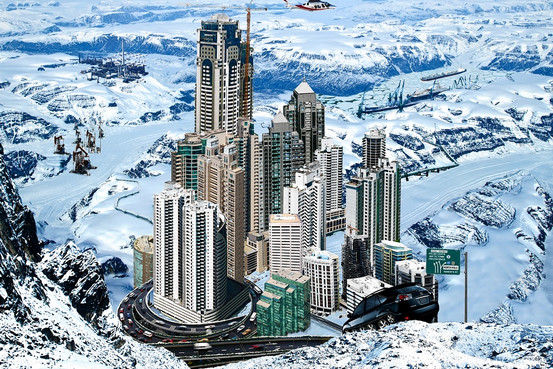
[Image: Courtesy of the Wall Street Journal].

What many of the books described in this post have in common—aside from their shared interest in what a climatically different earth will mean for the future of human civilization—is their use of short, fictionalized narratives set in specific future years or geographic regions as a way of illustrating larger points.

These narrative scenarios—diagnostic estimates of where we will be at some projected later date—come with chapter titles such as “Russia, 2019,” “China, 2042,” “Miami Beached,” and “Holland 2.0 Depolderized.” Among the various spatial and geopolitical side-effects of climate change outlined by these authors are a coming depopulation of the American Southwest; a massive demographic move north toward newly temperate Arctic settlements, economically spearheaded by the extraction industry and an invigorated global sea trade; border wars between an authoritarian Russia and a civil war-wracked China; and entire floating cities colonizing the waters of the north Atlantic as Holland aims to give up its terrestrial anchorage altogether, becoming truly a nation at sea.

“Will Manhattan Flood?” asks Matthew E. Kahn in his Climatopolis: How Our Cities Will Thrive in the Hotter Future. What will Greenland look like in the year 2215, with atmospheric carbon dioxide levels at 1300 parts per million, according to Peter Ward’s The Flooded Earth: Our Future In a World Without Ice Caps? Will a “New North” rise as the Arctic de-ices and today’s economic powerhouses, from Los Angeles to Shanghai, stagnate under killer droughts, coastal floods, and heat waves, as Laurence C. Smith suggests in The World in 2050: Four Forces Shaping Civilization’s Northern Future?

[Image: Modeling sea-level rise in Florida, courtesy of Penn State].

However, climate change is only one of the world-altering forces under discussion in each of these six books. Demography, oil scarcity, natural resources, public hygiene, and accelerating globalization all play roles, to different extents, in these authors’ thinking. In one case, in particular—Float!: Building on Water to Combat Urban Congestion and Climate Change, the most practical book described here—new construction technologies, with immediate implications for architectural design, also take center stage.

In all cases, though, these books offer further evidence of an irresistible popular urge to discuss the future, and to do so through what can very broadly described as fiction. The recent speculative tone taken by much of today’s architecture writing is only part of this trend; from “design fiction” to speculative foreign policy blogs, and from “the world without us” to future food, a compulsion to understand what might happen to human civilization, in both the near and distant future, using fictional scenarios and speculative hypotheses seems to be at a high point of trans-disciplinary appeal.

As Heidi Cullen writes in The Weather of the Future: Heat Waves, Extreme Storms, and Other Scenes from a Climate-Changed Planet, there is something inherently difficult in comprehending the scale of climate change—what effects it might have, what systems it might interrupt or ruin. She thus imports lessons from cognitive psychology to understand what it is about climate change that keeps it so widely misinterpreted (though a hefty dose of media criticism, I’d argue, is far more apropos). It is interesting, then, in light of the apparent incomprehensibility of climate change, that fictional scenarios have become so popular a means of explaining and illustrating what Cullen calls our “climate-changed planet.”

This emerging narrative portraiture of climate change—exemplified by most of the books under discussion here, whether they present us with Atlanta running out of freshwater, frantic Chinese troops diverting rivers on the border with India, or a governmentally-abandoned Miami given over to anarchism and mass flooding—offers an imperfect but highly effective way of making a multi-dimensional problem understandable.

After all, if stories are an effective means of communicating culturally valuable information—if stories are pedagogically useful—then why not tell more stories about future climate change—indeed, why not tell more stories about architecture and buildings and emerging technologies and the spaces of tomorrow’s geopolitics?

Perhaps this is why so much of architecture writing today, both on blogs and elsewhere, so willfully crosses over into science fiction: if architecture literally is the design and proposal of a different world—one that might exist tomorrow, next year, next decade—then it is conceptually coextensive with the genre of scifi.

The current speculative turn in architecture writing is thus both unsurprising and highly appropriate to its subject matter—something worth bearing in mind by anyone hoping to find a larger audience for architectural critique.

[Image: “London as Venice” by Robert Graves and Didier Madoc-Jones, based on a photo by Jason Hawkes (part of an image series well-critiqued by the Guardian)].

An obvious problem with these preceding statements, however, is that we might quickly find ourselves relying on fiction to present scientific ideas to a popular audience; in turn, this risks producing a public educated not by scientists themselves but by misleading plotlines and useless blockbusters, such as The Day After Tomorrow and State of Fear, where incorrect popular representations of scientific data become mistaken for reports of verified fact.

In a way, one of the books cited in the following short list unwittingly demonstrates this very risk; Climate Wars: The Fight for Survival as the World Overheats would certainly work to stimulate a morally animated conversation with your friends over coffee or drinks, but there is something about its militarized fantasies of Arctic tent cities and Asian governments collapsing in civil free-fall that can’t help but come across as over-excitable, opening the door to disbelief for cynics and providing ammunition for extreme political views.

Indeed, I’d argue, the extent to which contemporary political fantasies are being narratively projected onto the looming world of runaway climate change has yet to be fully analyzed. For instance, climate change will cause the European Union to disband, we read in one book cited here, leaving Britain an agriculturally self-sufficient (though under-employed) island-state of dense, pedestrian-friendly urban cores; the U.S. will close its foreign military bases en masse, bringing its troops home to concentrate on large-scale infrastructural improvements, such as urban seawalls, as the middle class moves to high-altitude safety in the Rocky Mountains where it will live much closer to nature; Africa, already suffering from political corruption and epidemic disease, will fail entirely, undergoing a horrific population crash; and China will implode, leaving the global north in control of world resources once again.

It is important to note that all of these scenarios represent explicit political goals for different groups located at different points on the political spectrum. Perversely, disastrous climate change scenarios actually offer certain societal forces a sense of future relief—however misguided or short-term that relief may be.

Elsewhere, I’ve written about what I call climate change escapism—or liberation hydrology—which is the idea that climate change, and its attendant rewriting of the world’s geography through floods, is being turned into a kind of one-stop shop, like the 2012 Mayan apocalypse, for people who long for radical escape from today’s terrestrial status quo but who can find no effective political means for rallying those they see as forming a united constituency. Climate change thus becomes a kind of a deus ex machina—a light at the end of the tunnel for those who hope to see the world stood abruptly on its head.

Indeed, we might ask here: what do we want from climate change? What world do we secretly hope climate change will create—and what details of this world can we glimpse in today’s speculative descriptions of the future? What explicit moral lessons do we hope climate change will teach our fellow human beings?
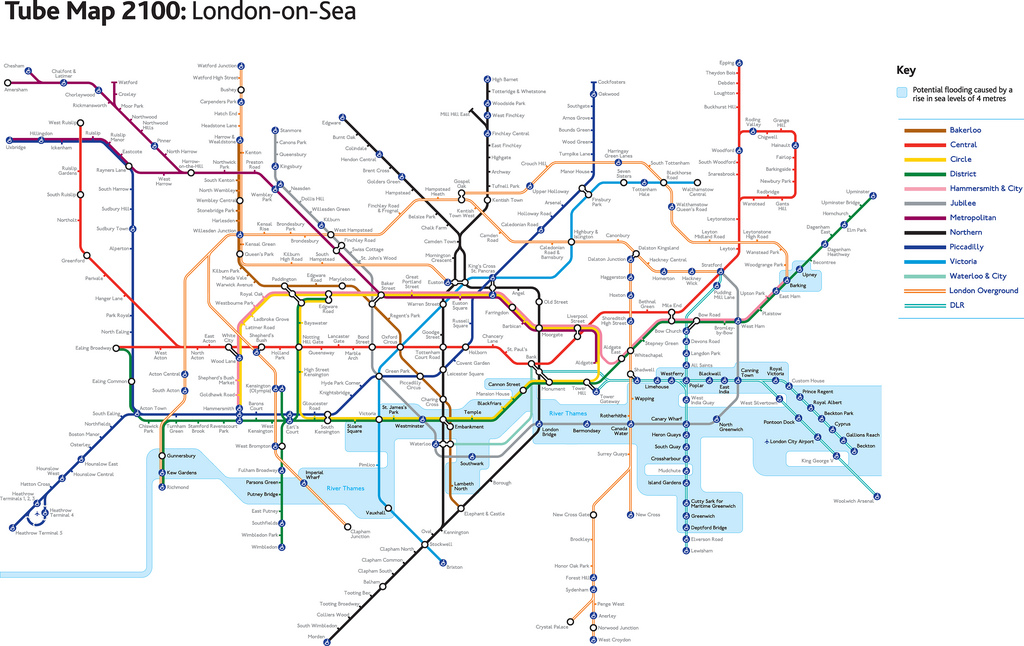
[Image: “London-on-Sea” by Practical Action].

Of course, the six books listed below are by no means the only ones worth reading on these topics; in fact, the emerging genre of what I’ll call climate futures is an absolutely fascinating one, and these books should be seen as a useful starting place. I would add, for instance, that Charles Emmerson’s recent Future History of the Arctic clearly belongs on this list—however, I covered it in an earlier installment of Books Received. Further, Forecast: The Consequences of Climate Change, from the Amazon to the Arctic, from Darfur to Napa Valley by Stephan Faris is a commendably concise and highly readable introduction to what global climate change might bring, and Elizabeth Kolbert’s Field Notes from a Catastrophe: Man, Nature, and Climate Change has become something of a minor classic in this emerging field.

So, without further ado, here are six new books about climate futures.
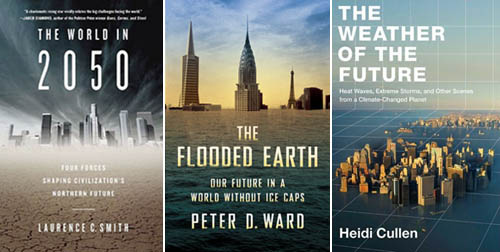
The World in 2050: Four Forces Shaping Civilization’s Northern Future by Laurence C. Smith (Dutton). Smith’s book is a virtuoso example of what I would call political science fiction, extrapolating from existing trends in demography, natural-resource depletion, globalization, and climate change to see what will happen to the eight nations of the Arctic Rim—what Smith alternately calls the New North and the Northern Rim. “I loosely define this ‘New North,'” Smith writes, “as all land and oceans lying 45º N latitude or higher currently held by the United States, Canada, Iceland, Greenland (Denmark), Norway, Sweden, Finland, and Russia.”

I should point out that the book’s cover art depicts downtown Los Angeles being over-run by the cracked earth of a featureless desert, as clear an indication as any that Smith’s New North will benefit from negative—indeed, sometimes catastrophic—effects elsewhere.

In an article-slash-book-excerpt published last month in the Wall Street Journal, Smith wrote: “Imagine the Arctic in 2050 as a frigid version of Nevada—an empty landscape dotted with gleaming boom towns. Gas pipelines fan across the tundra, fueling fast-growing cities to the south like Calgary and Moscow, the coveted destinations for millions of global immigrants. It’s a busy web for global commerce, as the world’s ships advance each summer as the seasonal sea ice retreats, or even briefly disappears.” Further:

If Florida coasts become uninsurable and California enters a long-term drought, might people consider moving to Minnesota or Alberta? Will Spaniards eye Sweden? Might Russia one day, its population falling and needful of immigrants, decide a smarter alternative to resurrecting old Soviet plans for a 1,600-mile Siberia-Aral canal is to simply invite former Kazakh and Uzbek cotton farmers to abandon their dusty fields and resettle Siberia, to work in the gas fields?

Being an unapologetic fan of rhetorical questions—will speculative Arctic infrastructure projects be, in the early 2010s, what floating architecture was to the mid-2000s?—the overall approach of Smith’s book maintains a strong appeal for me throughout. The final chapter, in which, as Smith writes, we “step out of the comfort zone” into more open speculation, caps the book off nicely.

The Flooded Earth: Our Future In a World Without Ice Caps by Peter D. Ward (Basic Books). Ward, a paleontologist, has produced a disturbing overview of how terrestrial ecosystems might be fundamentally changed as sea levels rise—and rise, and rise. Ward has the benefit of calling upon data taken from extremely distant phases of the earth’s history, almost all of which becomes highly alarming when transposed to the present and near-future earth. “This book is based on the fact that the earth has flooded before,” he writes, including phases in which seas rose globally at rates of up to 15 feet per century.

Ward successfully communicates the fact that the stakes of climate change are urgent and huge. Indeed, he writes, “The most extreme estimate suggests that within the next century we will reach the level [of carbon dioxide in the atmosphere] that existed in the Eocene Epoch of about 55 million to 34 million years ago, when carbon dioxide was about 800 to 1,000 ppm. This might be the last stop before a chain of mechanisms leads to wholesale oceanic changes that are not good for oxygen-loving life.” That is, a cascade of terrestrial side-effects and uncontrollable feedback loops could very well begin, ultimately extinguishing all oxygen-breathing organisms and kickstarting a new phase of life on earth. Whatever those future creatures might be, they will live, as Ward has written in another book, under the specter of a “green sky.” Brief fictional scenarios—including future bands of human “breeding pairs” wandering through flooded landscapes—pepper Ward’s book.

The Weather of the Future: Heat Waves, Extreme Storms, and Other Scenes from a Climate-Changed Planet by Heidi Cullen (Harper). Cullen’s book is the one title listed here with which I am least familiar, having read only the opening chapter. But it, too, is organized by region and time frame: the Great Barrier Reef, California’s Central Valley, the Sahel in Africa, Bangladesh, New York City, and so on. The shared references to these and other locations in almost all contemporary books on climate change suggests an emerging geography of hotspots—a kind of climate change tourism in which authors visit locations of projected extreme weather events before those storms arrive. Cullen’s book “re-frightened” Stephen Colbert, for whatever that’s worth; I only wish I had had more time to read it before assembling this list.
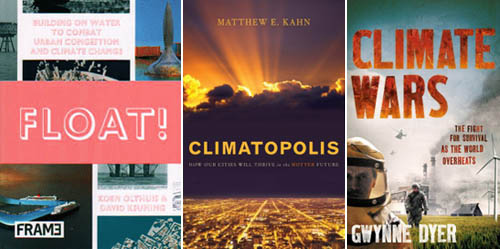
Float!: Building on Water to Combat Urban Congestion and Climate Change by Koen Olthuis and David Keuning (Frame). When David Keuning sent me a review copy of this book he joked that “offshore architecture has been relatively depleted of its novelty over the last few years”—an accurate statement, as images of floating buildings bring back strong memories of the architectural blogosphere circa 2005.

However, Keuning and Olthuis needn’t be worried about depleting the reader’s interest. A remarkably stimulating read, Float! falls somewhere between design textbook, aquatic manifesto, and environmental exhortation to explore architecture’s offshore future. Water-based urban redesign; public transportation over aquatic roadways; floating barge-farms (as well as floating prisons); maneuverable bridges; entire artificial archipelagoes: none of these are new ideas, but seeing them all in one place, in a crisply designed hardback, is an undeniable pleasure.

The book is occasionally hamstrung by its own optimism, claiming, for instance, that “Once a floating building has left its location, there will be nothing left to remind people of its former presence,” an environmentally ambitious goal, to be sure, but, without a clear focus on maritime waste management (from sewage to rubbish to excess fuel) such statements simply seem self-congratulatory. Having said that, Float! is an excellent resource for any design studio or seminar looking at the future of floating structures in an age of flooding cities.

Climatopolis: How Our Cities Will Thrive in the Hotter Future by Matthew E. Kahn (Basic Books). Kahn’s book is at once hopeful—that cities will energetically reconfigure themselves to function smoothly in a decarbonized global economy—and cautionary, warning that whole regions of the world might soon become uninhabitable.

Kahn’s early distinction between New York City and Salt Lake City—the former considered high-risk, due to coastal flooding and extreme weather events, the latter an example of what Kahn calls “safe cities”—is useful for understanding the overall, somewhat armchair tone of the book. Climatopolis is not hugely rigorous in its exploration of what makes a city “climate-safe,” and it overestimates the descriptive value of using “Al Gore” as a personality type, seeming to cite the politician at least once every few pages, but if your interests are more Planetizen than Popular Science, this is a useful overview of the urban effects of climate change over disparate cities and regions.

Climate Wars: The Fight for Survival as the World Overheats by Gwynne Dyer (Oneworld Publications). Dyer writes that his awareness of climate change was kicked off by two things: “One was the realization that the first and most important impact of climate change on human civilization will be an acute and permanent crisis of food supply.” The other “was a dawning awareness that, in a number of the great powers, climate-change scenarios are already playing a large and increasing role in the military planning process.” Putting two and two together, Dyer has hypothesized, based on a close reading of military documents outlining climate-change contingency plans, what he calls climate wars: wars over food, water, territory, and unrealistic lifestyle guarantees.

Dyer’s book utilizes the most explicitly fictionalized approach of all the books under discussion here—to the extent that I would perhaps have urged him literally to write a novel—and he is very quick to admit that the outcome of his various, geographically widespread scenarios often contradict one another. For those of you with a taste for the apocalypse, or at least a voyeuristic interest in extreme survivalism, this is a good one. For those of you not looking for what is effectively a military-themed science fiction novel in journalistic form, you would do better with one of the titles listed above.

* * *

All Books Received: August 2015, September 2013, December 2012, June 2012, December 2010 (“Climate Futures List”), May 2010, May 2009, and March 2009.

Probe Field

[Image: From “Kielder Probes” by Phil Ayres, Chris Leung, and Bob Sheil, courtesy of sixteen*(makers)].

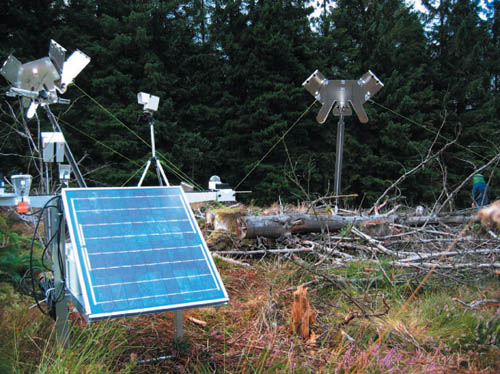
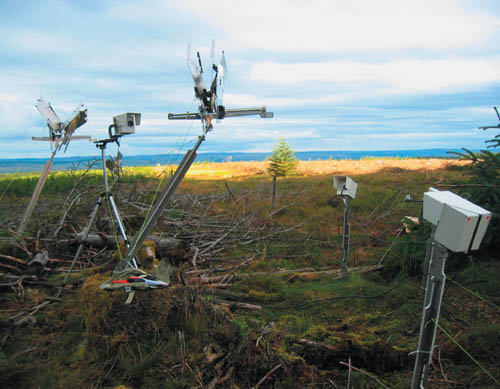
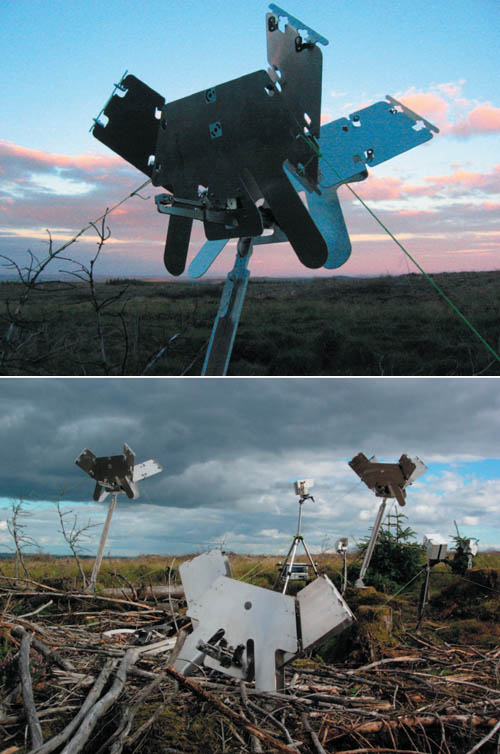
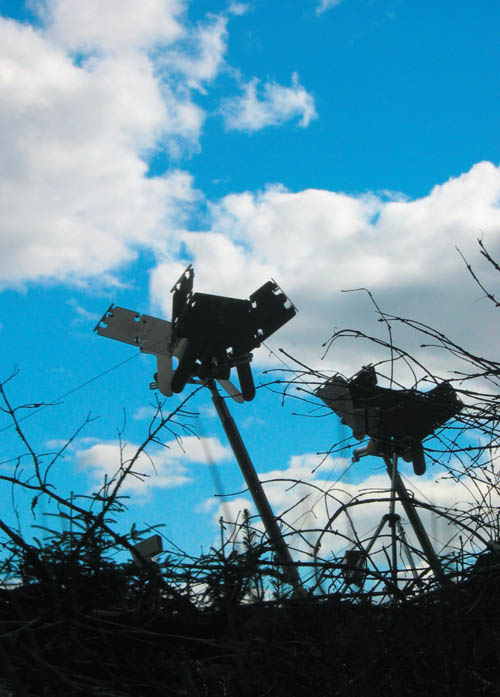
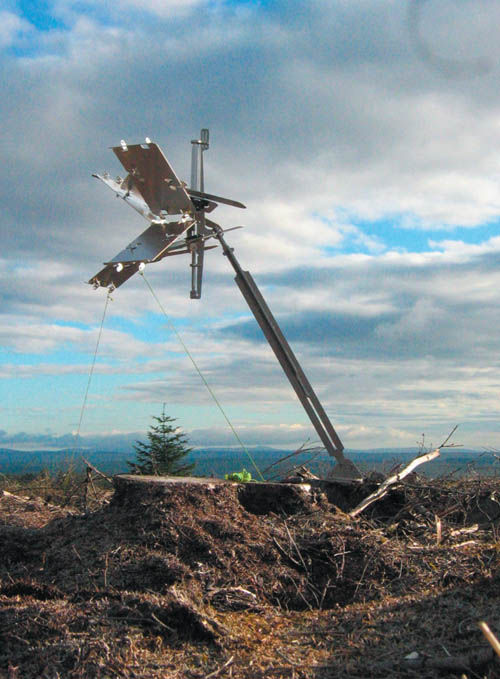
Beginning in 2003, architects Phil Ayres, Chris Leung, and Bob Sheil of sixteen*(makers) began experimenting with a group of “micro-environmental surveying probes” that he was later to install in Kielder Park, Northumbria, UK.

[Image: From “Kielder Probes” by Phil Ayres, Chris Leung, and Bob Sheil, courtesy of sixteen*(makers)].

The probes were “designed to act as dual monitors and responsive artefacts.” Which means what, exactly?

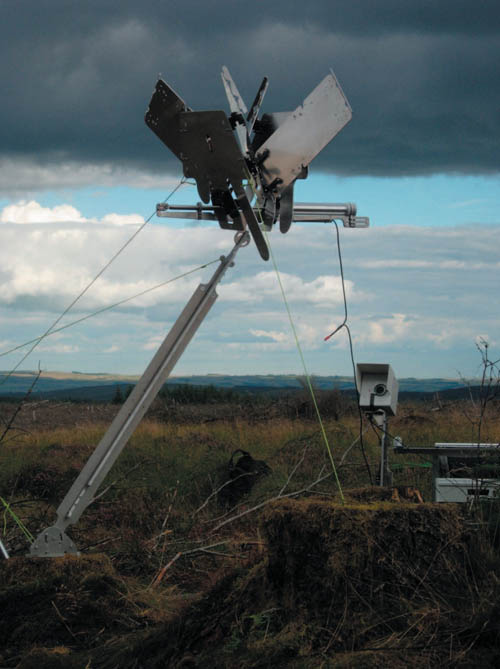
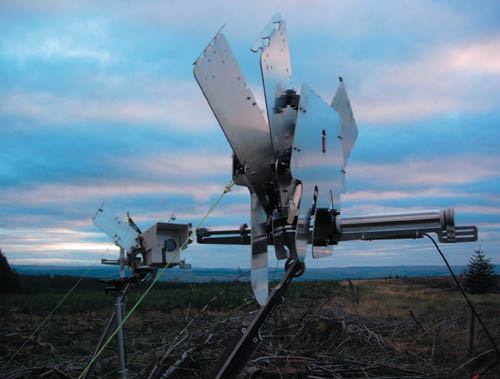
The probes were designed to measure difference over time rather than the static characteristics of any given instance. Powered by solar energy, the probes gathered and recorded ‘micro environmental data’ over time. The probes were simultaneously and physically responsive to these changes, opening out when warm and sunny, closing down when cold and dark. Thus not only did the probes record environmental change, but they demonstrated how these changes might induce a responsive behaviour specific to a single location.

After the probes were installed, they were filmed by “an array of high-resolution digital cameras programmed to record at regular intervals.”

[Images: From “Kielder Probes” by Phil Ayres, Chris Leung, and Bob Sheil, courtesy of sixteen*(makers)].

The resulting data—which took note of the climatic and solar situations in which the objects began to change—offers insights, Sheil suggests, into how “passively activated responsive architecture” might operate in other sites, under other environmental conditions.

[Images: From “Kielder Probes” by Phil Ayres, Chris Leung, and Bob Sheil, courtesy of sixteen*(makers)].

As DIY landscape-registration devices constructed from what appear to be off-the-shelf aluminum plates, they also cut an interesting formal profile above the horizon line, like rare birds or machine-flowers perched amidst the tree stumps.

[Image: From “Kielder Probes” by Phil Ayres, Chris Leung, and Bob Sheil, courtesy of sixteen*(makers)].

Spatial Gameplay in Full-Court 3D

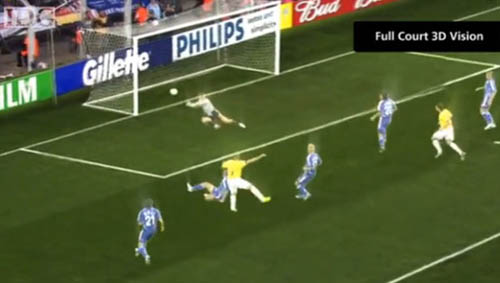
Japan is distinguishing its bid to host the 2022 World Cup with a plan to broadcast the entire thing as a life-size hologram.

[Image: Courtesy of the Japan Football Association/CNN].

“Japanese organizers say each game will be filmed by 200 high definition cameras, which will use ‘freeviewpoint’ technology to allow fans to see the action unfold from a player’s eye view—the kind of images until now only seen in video games,” CNN reports.

[Image: Courtesy of the Japan Football Association/CNN].

British football theorist Jonathan Wilson puts an interestingly spatial spin on the idea: “Speaking as a tactics geek,” he said to CNN, “the problem watching games on television is it’s very hard to see the shape of the teams, so if you’re trying to assess the way the game’s going, if you’re trying to assess the space, how a team’s shape’s doing and their defense and organization, then this will clearly be beneficial.”

Watching a sport becomes a new form of spatial immersion into strategic game geometries.

[Image: Courtesy of the Japan Football Association/CNN].

Of course, there’s open disbelief that Japan can actually deliver on this promise—it is proposing something based on technology that does not quite exist yet, on the optimistic assumption that all technical problems will be worked out in 12 years’ time.

But the idea of real-time, life-size event-holograms being beamed around the world as a spatial replacement for TV imagery is stunning.

(Thanks to Judson Hornfeck for the tip!)

First-Strike Reforestation

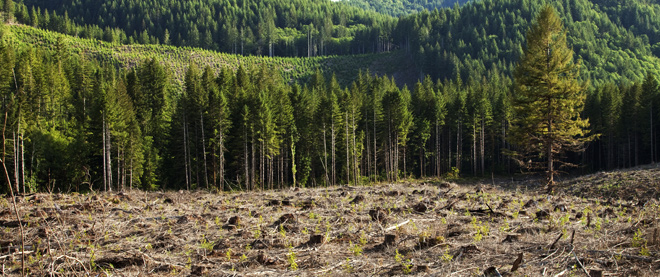
Earlier this month, Macleans looked at the idea of “aerial reforestation,” or the large-scale dropping of tree seedlings using decommissioned military aircraft. Of course, we looked at this same plan many, many years ago—and it turns out the same guy is behind this latest round of journalistic interest.

[Image: Courtesy of Getty Images/Macleans].

Moshe Alamaro, still affiliated with MIT, had previously been pushing his plan for “using a small fertilizing plane to drop saplings in plastic pods one at a time from a hopper,” Macleans explains. The biodegradable canisters would then have “hit the ground at 200 m.p.h.,” MIT explained back in 1997, “and imbed themselves in the soil. Then the canisters decompose and the young trees take root. A large aircraft could drop as many as 100,000 saplings in a single flight: Alamaro’s system could plant as many as a million trees in one day.”

But, Macleans points out, “it wasn’t very fruitful—most pods hit debris during pilot tests and failed to actually take root.”

The idea has thus now been “upgraded,” using different technical means “to create new forests on empty landscapes.”

The process Alamaro advocates places trees in metal pods that rot on contact with the ground, instead of the low-tech and less sturdy plastic version. He says the process can be adapted to plant shrubs, and would work best in places with clear, loose soil, such as sub-desert parts of the Middle East, or newly habitable Arctic tundra opened up by global warming. “What is needed is government policy to use old military aircraft,” he says, adding that thousands are in hangars across the globe. Although the original pitch failed, Alamaro says the growing carbon market is creating new interest, and he hopes to find funding for a large-scale pilot project soon. Once Alamaro gets planes in the air, the last step, says [Dennis Bendickson, professor of forestry], will be to simply “get people out of the way.”

In this context, it’s difficult to resist pointing out Iceland’s own soil-bombing campaign: “Iceland is big and sparsely populated,” the BBC reported in 2005. “There are few roads. So, Icelanders decided to ‘bomb their own country’,” dropping special mixtures of fertiliser and seeds “from a WWII DC 3 Dakota”—carpet-bombing subarctic desert in an attempt to make that emptiness flower.

I feel compelled here to point out a brief scene from the film Hellboy 2, in which we see a “forest god” killed in the streets of Brooklyn (roughly 2:36 in this clip); his green and bubbling blood blooms instantly into a carpet of soft roots and lichen, splashing onto the roofs of cars, sending seedpods from wildflowers and pollinating plants down in drifts along the New York sidewalks. Should a substance that fertile be developed in real life, Alamaro’s—and Iceland’s—plans could be realized in the blink of an eye.

In any case, will Alamaro finally succeed? Will we see whole new woodsy landscapes grow in the wake of sustained rural bombing campaigns—druidic warfare—cryptoforests spreading out from craters and abandoned fields far below? Will we launch seed grenades from sapling artillery, plant improvised explosive devices packed dense with forest nutrients?

(Story found via @treestrategist).

Stratigraphies of Infestation

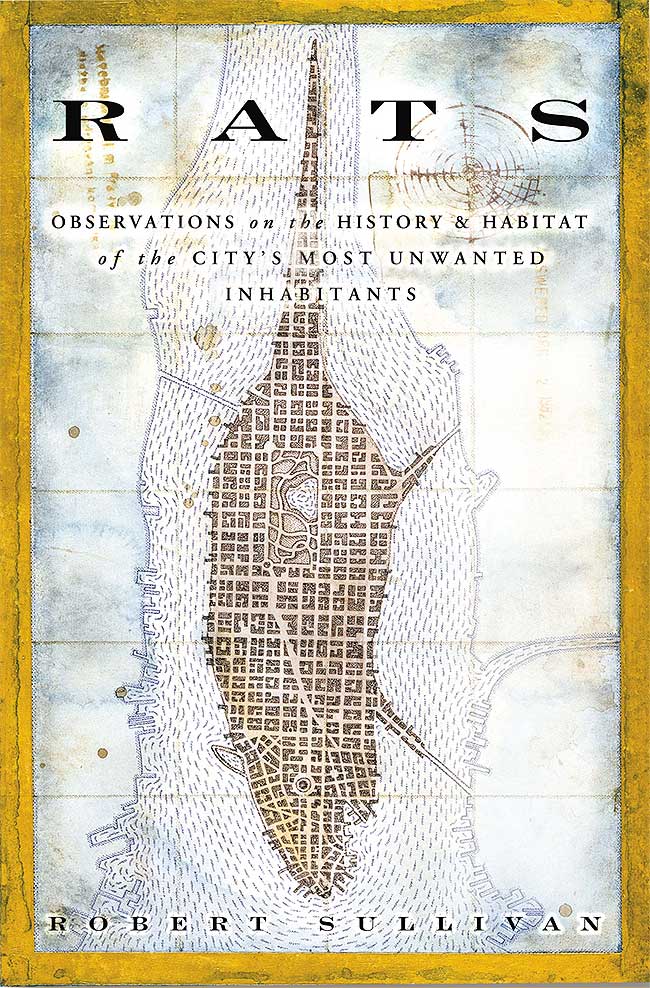
In his book Rats, Robert Sullivan—an author whose work we previously reviewed here—offers a glimpse of how the city is seen through the eyes of the pest-control industry.

[Image: Rats by Robert Sullivan].

Effective rodent control requires a very specific kind of spatial knowledge, Sullivan suggests, one that often eludes architects and city planners.

Sullivan quotes one rat-control professional, for instance, who “foresees a day when he will be hired to analyze a building’s weaknesses, vis-à-vis pests and rodents… ‘They design buildings to support pigeons and for infiltration by rodents because they don’t think about it. Grand Central Station, right? They just renovated it, right? Who knows what they spend on that, right? You know how much they spend on pest control? You know how much they budgeted? Nothing. I did all the extra work there, but they had to pay us out of the emergency budget.'”

Pest control here becomes an explicitly architectural problem, something you can design both for and against. Imagine an entire degree program in infestation-resistant urban design.

Sullivan points out that a massive, urban-scale architectural intervention, in the form of a quarantine wall fortifying all of New York City against rats, was once tentatively planned: “There was a time in New York, in the 1920s,” he writes, “when scientists proposed a great wall along the waterfront to shut out rats completely, to seal out rats and, thus, forever end rat fear. Eventually, though, the idea was deemed implausible and abandoned: rats will always get through.”

But it’s the particular subset of urban knowledge that has been actively cultivated within the pest control industry that fascinates me here. Sullivan spends a bit of time with a man named Larry Adams, a municipal rodent control expert. “If you hang around Larry long enough,” Sullivan says, “you realize that he sees the city in a way that most people don’t—in layers.” And what follows is well worth quoting in full:

He sees the parks and the streets and then he sees the subways and the sewers and even the old tunnels underneath the sewers. He sees the city that is on the maps and the city that was on the maps—the city’s past, the city of hidden speakeasies and ancient tunnels, the inklings of old streams and hills.
“People don’t realize the subterranean conditions out there,” he likes to say. “People don’t realize the levels. People don’t realize that we got things down there from the Revolution. A lot of people don’t realize that there’s just layers of settlers here, that things just get bricked off, covered up and all. They’re not accessible to people, but they are to rats. And they have rats down there that have maybe never seen the surface. If they did, then they’d run people out. Like in the movies. You see, we only see the tail end of it. And we only see the weak rats, the ones that get forced out to look for food.”

The book’s wealth of rat-catching anecdotes are often unbelievable. “More than anything,” Sullivan reflects, “I have learned from exterminators that history is crucial in effective rat analysis.”

In fact, history is everything when it comes to looking at rats—though it is not the history that you generally read; it is the unwritten history. Rats wind up in the disused vaults, in long underground tunnels that aren’t necessarily going anywhere; they wind up in places that are neglected and overlooked, places with a story that has been forgotten for one reason or another. And to find a rat, a lot of times you have to look at what a place was. One exterminator I know tells the story of a job on the Lower East Side in an old building where rats kept appearing, nesting, multiplying, no matter how many were killed. The exterminator searched and searched. At last, he found an old tunnel covered by floorboards, a passageway that headed toward the East River. The tunnel was full of rats. Later, he discovered that the building had housed a speakeasy during Prohibition.

Or this disconcerting image of an infested basement that was never fully demolished—it was simply forgotten, walled off beneath the surface of the city. Here, Sullivan visits an abandoned lot with a rat-catching expert named Isaac, writing that, “just before we drove off, two men walked by and stopped at the fence; they looked into the abandoned lot and spoke with Isaac in Spanish.”

They told Isaac that they remembered when the lot was the site of an old wooden house that had become abandoned and filled with rats. They remembered the house being demolished and partially buried—the basement was still there, they said. They pointed to the ground, saying that the old home was still beneath it, still rat-infested.

What a perfectly haunting line: They pointed to the ground, saying that the old home was still beneath it, still rat-infested. (And if anyone out there has read The Rats by James Herbert, you might remember that the novel begins with a vaguely similar urban image).

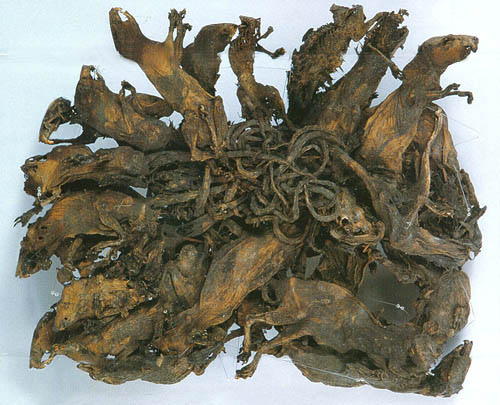
[Image: A “rat king,” via Wikimedia].

Speaking later with Mike, another rat-control expert, Sullivan learns how the stratigraphy of the city takes shape in the mind of the exterminator: “I was getting ready to leave—Mike was just too busy. But then Mike was reminded of an aspect of the nature of rats in the city, and as he put down the phone, he said, ‘You know, I heard there are three layers of sewer lines.’ He counted them off on his fingers. ‘There are the ones from the 1800s, the ones from the 1700s, and the ones they don’t have maps for anymore. Once in a while, they use that old line, when they’re doing construction or something, and you read in the papers that there are hundreds of rats coming up. Well, those rats that are in the third line, they haven’t even seen man before.’”

These stratigraphies of infestation are wonderfully horrifying—but also perfectly and immediately available to the architect and urban planner as practical design challenges. How does one deal with “what was on the maps,” as Sullivan phrases it, while at the same time designing a pest-unfriendly metropolis?

Taking as their design target rats and other “unwanted inhabitants” of the city, as Sullivan phrases it, what inspired collaborations could we develop amongst public health inspectors, urban ecologists, pesticide manufacturers, historical cartographers, city archivists, materials scientists (Sullivan writes, for instance, that Larry Adams, mentioned earlier, has actually developed his own special mix of rat-resistant concrete: “With his expertise, Larry has developed his own rat-eradication techniques, such as concrete mixed with broken glass to keep the rats from gnawing through the concrete. ‘Sometimes, they’ll still cut through before the concrete hardens. So sometimes, I use glass and industrial-strength steel wool and put it in with the concrete and make one big goop with it’”), and, of course, architects and planners? How realistic—let alone ethical—a design challenge is the rodent-free metropolis?

City of Holes

[Image: Courtesy of the Nottingham Caves Survey].

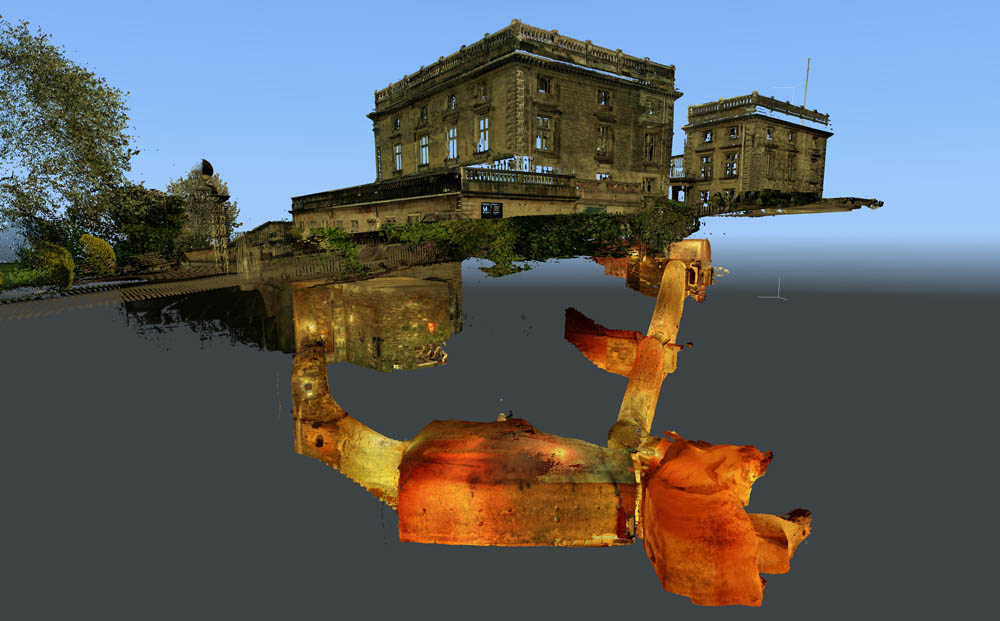
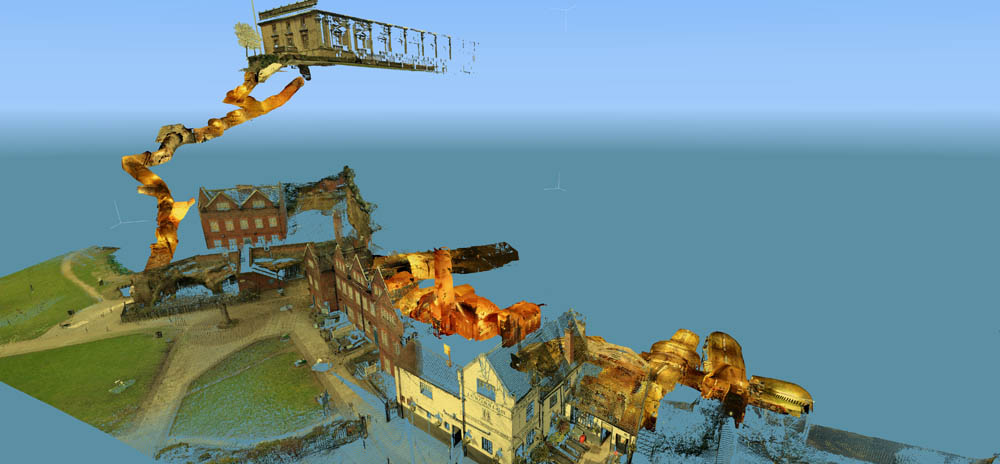
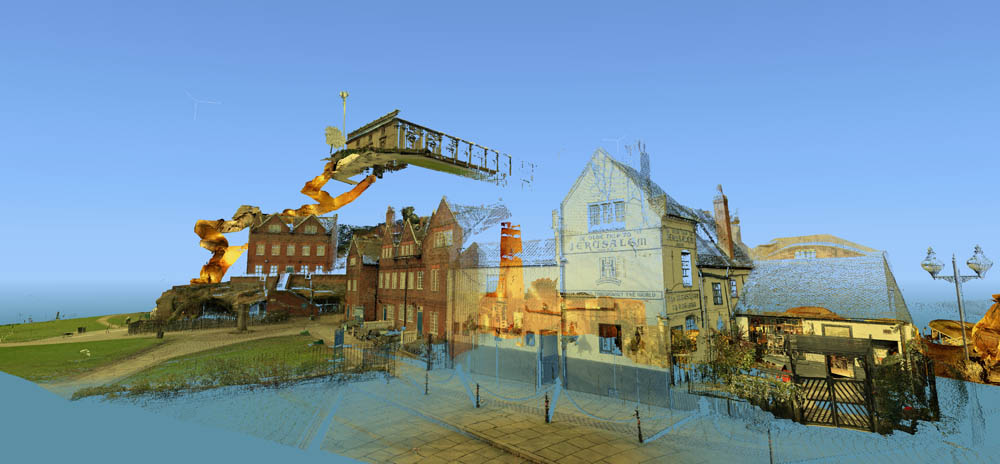
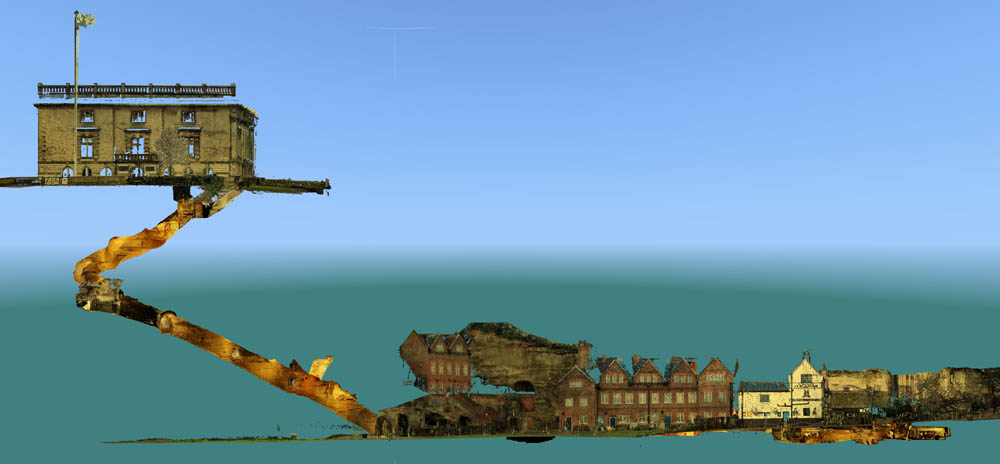
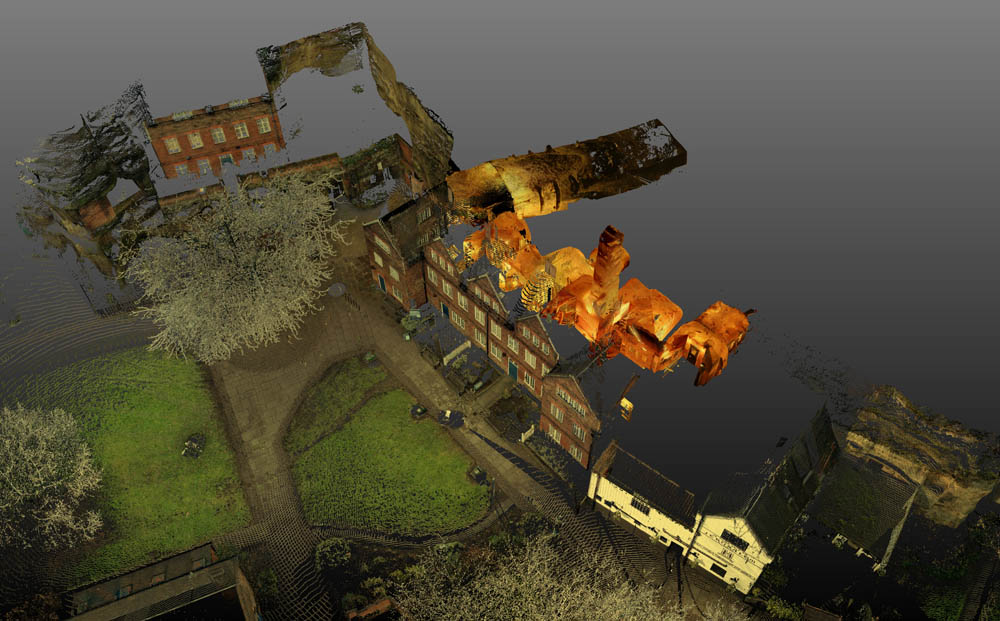
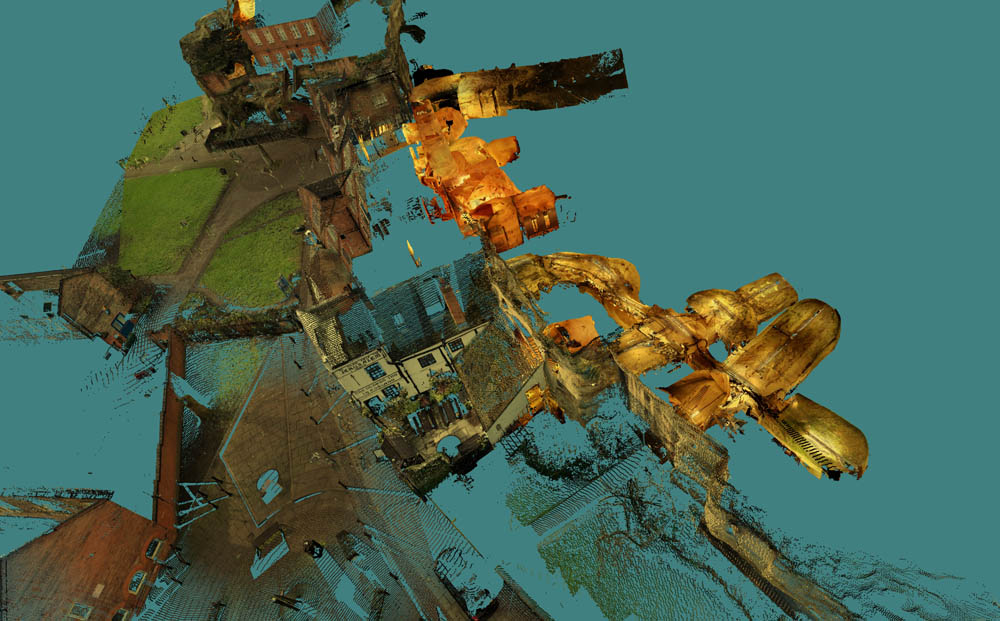
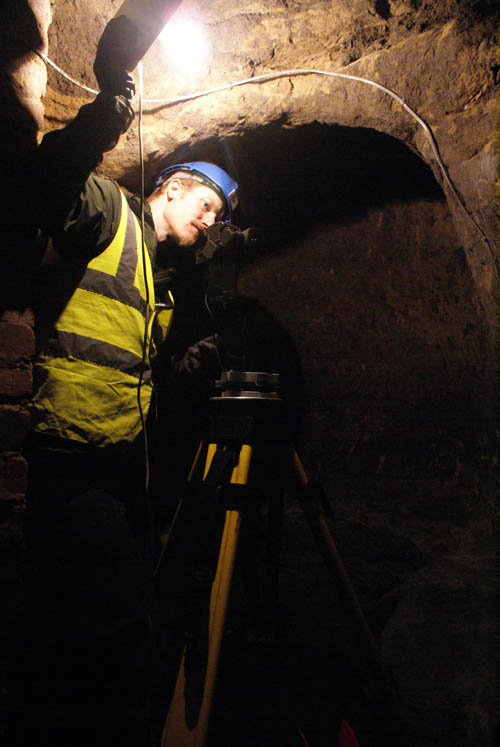
Some new images of the ongoing laser-scan project taking place in the caves beneath Nottingham, England, have been released. “The Nottingham Caves Survey is in the process of recording all of Nottingham’s 450+ sandstone caves,” the organizers explain.

From malting caves and circular kilns to a 19th-century underground butcher, via the Shire Hall and, of course, Mortimer’s Hole, it’s intoxicating to imagine a city whose most exciting discoveries lie somewhere far below its own streets and urban surfaces, in a delirious sprawl of artificially enlarged sandstone caves.

[Images: Courtesy of the Nottingham Caves Survey].

Check out this video, below, which is basically just a fly-and-walk-through of the resulting scans.

Like the short film La Subterranea, which we screened a few years back at the Silver Lake Film Fest, the video suggests a fundamentally porous urban world in which, as Alex Trevi writes, “day and night, laser scanners that have gone mobile will be deployed into these voids, and bit by pinprick bit, these labyrinths that once confounded, concealed and even consumed trespassers with their disorienting mazes will resolve into total comprehensibility. Every detail will be known to you.”

The city, CAT-scanned, becomes a labyrinth of complete transparency.

Imagine, for instance, a city consumed by its own archaeology—a hole complex of obsessive-compulsive excavation—where the streets are just the thinnest of bridges spanning a sponge-like void below.

[Images: Courtesy of the Nottingham Caves Survey].

For more, check out the site of the Nottingham Caves Survey, which has link after link after link to explore; perhaps start with their Cave Map and move onward from there.

[Image: The scanner at work; courtesy of the Nottingham Caves Survey].

All in all, this might be the best advertisement for a city—intentional or not—that I’ve ever seen: drawing people to visit based on quasi-holographic laser scans of that city’s underground history.

(Via Archaeology News).

The Reforestation of the Thames Estuary

[Image: “The Dormant Workshop” by Tom Noonan, courtesy of the architect].

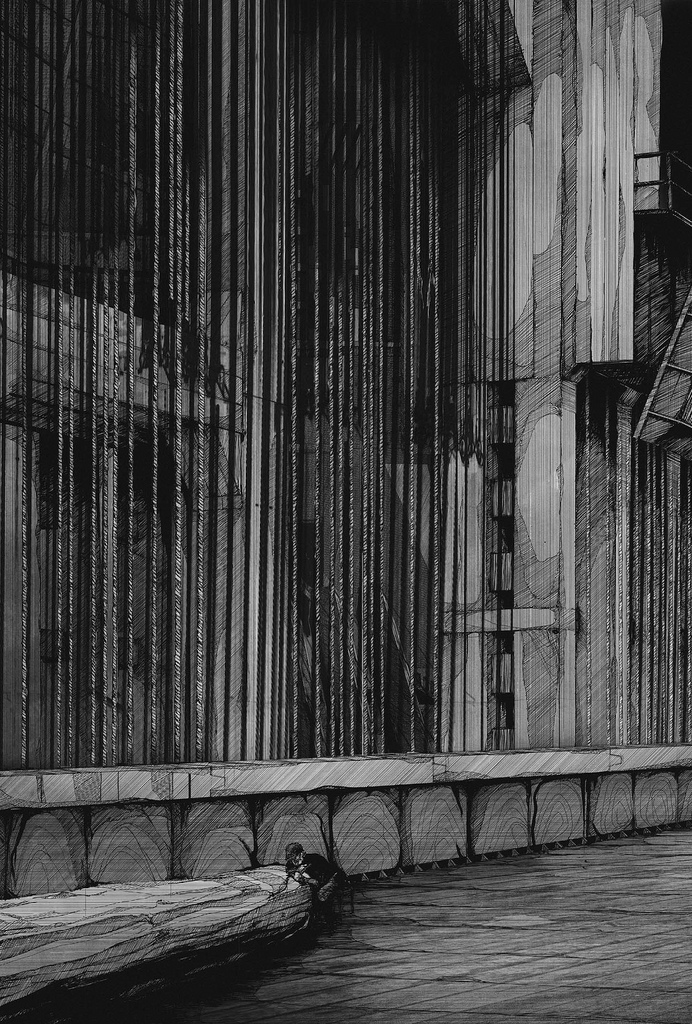
While studying at the Bartlett School of Architecture in London, recent graduate Tom Noonan produced a series of variably-sized hand-drawings to illustrate a fictional reforestation of the Thames estuary.

[Image: “Log Harvest 2041” by Tom Noonan, courtesy of the architect].

Stewarding, but also openly capitalizing on, this return of woodsy nature is the John Evelyn Institute of Arboreal Science, an imaginary trade organization (of which we will read more, below).

[Image: “Reforestation of the Thames Estuary” by Tom Noonan, courtesy of the architect].

The urban scenario thus outlined—imagining a “future timber and plantation industry” stretching “throughout London, and beyond”—is like something out of Roger Deakin’s extraordinary book Wildwood: A Journey Through Trees (previously described here) or even After London by Richard Jeffreys.

In that latter book, Jeffreys describes a thoroughly post-human London, as the ruined city is reconquered by forests, mudflats, aquatic grasses, and wild animals: “From an elevation, therefore,” Jeffreys writes, “there was nothing visible but endless forest and marsh. On the level ground and plains the view was limited to a short distance, because of the thickets and the saplings which had now become young trees… By degrees the trees of the vale seemed as it were to invade and march up the hills, and, as we see in our time, in many places the downs are hidden altogether with a stunted kind of forest.”

Noonan, in a clearly more domesticated sense—and it would have been interesting to see a more ambitious reforestation of all of southeast England in these images—has illustrated an economically useful version of Jeffreys’s eco-prophetic tale.

[Image: “Lecture Preparations” by Tom Noonan, courtesy of the architect].

From Noonan’s own project description:

The reforestation of the Thames Estuary sees the transformation of a city and its environment, in a future where timber is to become the City’s main building resource. Forests and plantations established around the Thames Estuary provide the source for the world’s only truly renewable building material. The river Thames once again becomes a working river, transporting timber throughout the city.

It is within these economic circumstances that the John Evelyn Institute of Arboreal Science can establish itself, Noonan suggests:

The John Evelyn Institute of Arboreal Scienc eat Deptford is the hub of this new industry. It is a centre for the development and promotion of the use of timber in the construction of London’s future architecture. Its primary aim is to reintroduce wood as a prominent material in construction. Through research, exploration and experimentation the Institute attempts to raise the visibility of wood for architects, engineers, the rest of the construction industry and public alike. Alongside programmes of education and learning, the landscape of the Institute houses the infrastructure required for the timber industry.

They are similar to an organization like a cross between TRADA and the Wooodland Trust, say.

[Image: “Urban Nature” by Tom Noonan, courtesy of the architect].

And the Institute requires, of course, its own architectural HQ.

[Image: “Timber Craft Workshop” by Tom Noonan, courtesy of the architect].

Noonan provides that, as well. He describes the Institute as “a landscape connecting Deptford with the river,” not quite a building at all. It is an “architecture that does not conform to the urban timeframe. Rather, its form and occupation is dependent on the cycles of nature.”

The architecture is created slowly—its first years devoid of great activity, as plantations mature. The undercroft of the landscape is used for education and administration. The landscape above becomes an extension of the river bank, returning the privatised spaces of the Thames to the public realm. Gaps and cuts into the landscape offer glimpses into the monumental storage halls and workshops below, which eagerly anticipate the first log harvest. 2041 sees the arrival of the first harvest. The landscape and river burst in a flurry of theatrical activity, reminiscent of centuries before. As the plantations grow and spread, new architectures, infrastructures and environments arise throughout London and the banks of the Thames, and beyond.

The drawings are extraordinary, and worth exploring in more detail, and—while Noonan’s vision of London transformed into a working forest plantation would have benefitted from some additional documentation, such as maps*—it is a delirious one.

[Image: “Thames Revival” by Tom Noonan, courtesy of the architect].

Considering the ongoing overdose of urban agriculture imagery passing through the architecture world these days, it is refreshing simply to see someone hit a slightly different note: to explore urban forestry in an aesthetically powerful way and to envision a world in which the future structural promise of cultivated plantlife comes to shape the city.

*I wrote this without realizing that the package of images sent to me did not include the entire project—which comes complete with maps.

Buy a Map

[Image: Photo by Barney Peterson, courtesy of the San Francisco Chronicle].

Something I meant to post three few weeks ago, before October became the Great Lost Month of constant busyness and over-commitment, is the story of a 70-ton relief map of California, unseen by the public for half a century, that has been re-discovered in San Francisco, sitting in “an undisclosed location on the city’s waterfront.”

[Image: Photo by Barney Peterson, courtesy of the San Francisco Chronicle].

In its time, the map was considered far too marvelous for simply cutting up and storing—but that’s exactly what’s happened to it.

It was as long as two football fields and showed California in all its splendor, from Oregon to Mexico, with snow-capped mountains, national parks, redwood forests, a glorious coastline, orchards and miniature cities basking in the sun. It was made of plaster, wire, paint, and bits of rock and sand. In the summer of 1924, Scientific American magazine said it was the largest map in the world.

However, we read, “The problem with the map is simple: it is huge and would cost a lot of money to move, restore and display it. The last estimate was in the range of $500,000. And that was 30 years ago. It is a classic white elephant, too valuable to scrap, but too expensive to keep.”

And, today, it’s not going anywhere: “The Port of San Francisco has no plans to be anything but stewards of its storage, and no one else has come forward in half a century to rescue the map.” If you have half-a-million dollars or so, and heavy moving equipment at your disposal, then perhaps it could soon be yours.

(Thanks to Steve Silberman for the link. In the archives: San Francisco Bay Hydrological Model; Buy a Torpedo-Testing Facility, Buy a Fort, Buy a Church, and Buy a Silk Mill].

Softcore

Just a quick reminder that you have till December 10 to submit to Bracket 2, published by Actar, Archinect, and InfraNet Lab:

Bracket 2 invites the submission of critical articles and unpublished design projects that investigate physical and virtual soft systems, as they pertain to infrastructure, ecologies, landscapes, environments, and networks… Bracket 2 seeks to critically position and define soft systems, in order to expand the scope and potential for new spatial networks, and new formats of architecture, urbanization and nature. From soft politics, soft power and soft spaces to fluid territories, software and soft programming, Bracket 2 questions the use and role of responsive, indeterminate, flexible, and immaterial systems in design. Bracket 2 invites designers, architects, theorists, ecologists, scientists, and landscape architects to position and leverage the role of soft systems and recuperate the development of the soft project.

Check out InfraNet Lab and the Bracket website for more info. Keep your eye out, as well, for InfraNet Lab‘s forthcoming Pamphlet Architecture installment, Coupling: Strategies for Infrastructural Opportunism.

The Museum of Speculative Archaeological Devices

Perhaps a short list of speculative mechanisms for future archaeological research would be interesting to produce.

[Image: A toy antique oscilloscope by Andrew Smith, courtesy of Gadget Master and otherwise unrelated to this post].

Ground-scanners, Transparent-Earth (PDF) eyeglasses, metal detectors, 4D earth-modeling environments used to visualize abandoned settlements, and giant magnets that pull buried cities from the earth.

Autonomous LIDAR drones over the jungles of South America. Fast, cheap, and out of control portable muon arrays. Driverless ground-penetrating radar trucks roving through the British landscape.

Or we could install upside-down periscopes on the sidewalks of NYC so pedestrians can peer into subterranean infrastructure, exploring subways, cellars, and buried streams. Franchise this to London, Istanbul, and Jerusalem, scanning back and forth through ruined foundations.

Holograph-bombs—ArchaeoGrenades™—that spark into life when you throw them, World of Warcraft-style, out into the landscape, and the blue-flickering ancient walls of missing buildings come to life like an old TV channel, hazy and distorted above the ground. Mechanisms of ancient light unfold to reveal lost architecture in the earth.

[Image: An LED cube by Pic Projects, otherwise unrelated to this post].

Or there could be football-field-sized milling machines that re-cut and sculpt muddy landscapes into the cities and towns that once stood above them. A peat-bog miller. Leave it operating for several years and it reconstructs whole Iron Age villages in situ.

Simultaneous milling/scanning devices that bring into being the very structures they claim to study. Ancient fortifications 3D-printed in realtime as you scan unreachable sites beneath your city’s streets.

Deep-earth projection equipment that impregnates the earth’s crust with holograms of missing cities, outlining three-dimensional sites a mile below ground; dazed miners stumble upon the shining walls of imaginary buildings like a laser show in the rocks around them.

Or a distributed iPhone app for registering and recording previously undiscovered archaeological sites (through gravitational anomalies, perhaps, or minor compass swerves caused by old iron nails, lost swords, and medieval dining tools embedded in the ground). Like SETI, but archaeological and directed back into the earth. As Steven Glaser writes in the PDF linked above, “We can image deep space and the formation of stars, but at present we have great difficulty imaging even tens of meters into the earth. We want to develop the Hubble into, not away from, the earth.”

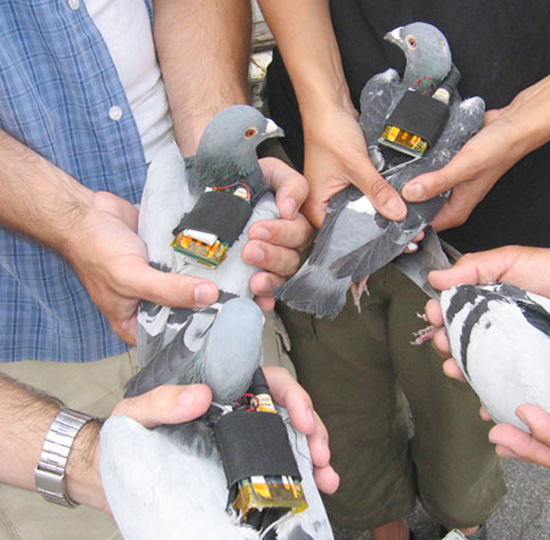
Artificially geomagnetized flocks of migratory birds, like “GPS pigeons,” used as distributed earth-anomaly detectors in the name of experimental archaeology.

[Image: “GPS pigeons” by Beatriz da Costa, courtesy of Pruned].

So perhaps there could be two simultaneous goals here: to produce a list of such devices—impossible tools of future excavation—but also to design a museum for housing them.

What might a museum of speculative archaeological devices look like? A Mercer Museum for experimental excavation?

(Thanks to Rob Holmes and Alex Trevi for engaging with some of these ideas over email).

Acoustic Forestry

[Image: From Acoustic Botany by David Benqué].

We saw David Benqué’s Fabulous Fabbers project here on BLDGBLOG a few months ago, but his more recent work, Acoustic Botany, deserves similar attention.

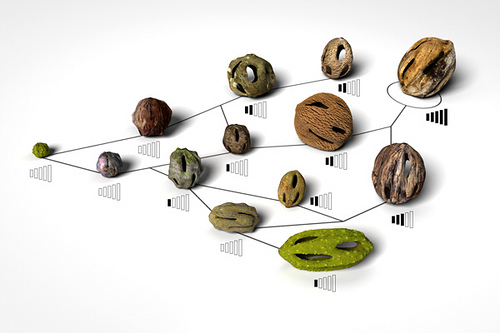
Acoustic Botany uses genetically modified plants to produce a “fantastical acoustic garden,” where sounds literally grow on trees. “Desired traits such as volume, timbre and harmony are acquired through selective breeding techniques,” the artist explains.

[Image: From Acoustic Botany by David Benqué].

As Benqué writes:

The debate around Genetic Engineering is currently centered around vital issues such as food, healthcare and the environment. However, we have been shaping nature for thousands of years, not only to suit our needs, but our most irrational desires. Beautiful flowers, mind altering weeds and crabs shaped like human faces all thrive on these desires, giving them an evolutionary advantage. By presenting a fantastical acoustic garden, a controlled ecosystem of entertainment, I aim to explore our cultural and aesthetic relationship to nature, and to question its future in the age of Synthetic Biology.

There are thus “singing flowers,” “modified agrobacteria” that ingeniously take “sugars and nutrients from the host plant to encourage the growth of parasitic galls and fill them with gas to produce sound,” and “string-nut bugs” that have been “engineered to chew in rhythm” inside hollow gourds.

[Image: From Acoustic Botany by David Benqué].

The symphonic range of sounds is then fine-tuned and modulated inside an acoustic lab using specialized equipment; out in the field, this takes the form of pruning trees into living chords, so that “harmonic note combinations” can bloom on a single branch.

Upscaling this to the level of all-out acoustic forestry would be an extraordinary thing to hear.

[Image: From Acoustic Botany by David Benqué].

I’m reminded of at least two quick things here:

1) Several years ago in the excellent British music magazine The Wire, there was an article about Brian Eno and “generative music,” in which the acoustic nature of backyard gardens was described quite beautifully based on the seasonal popping of seedpods, the rustle of leaf-covered fronds in evening breezes, and even, if I remember correctly, the specific insects that such plants might attract and support. Does anyone reading this have experience with planting a backyard garden based on its future acoustics?

2) Alex Metcalf’s Tree Listening project (which I have also covered elsewhere). “The installation,” Metcalf writes, “allows you to listen to the water moving up inside the tree through the Xylem tubes from the roots to the leaves.” Headphones hang down from the tree’s canopy like botanical iPods, and you put them on to lose yourself in arboreal surroundsound. Imagine a shortwave radio that allows you to tune not into distant stations sparkling with disembodied sounds and buzzing voices from the other side of the world, but into the syrupy tides of trees spiked with microphones in forests and sacred groves on every continent.

More images of Benqué’s project can be seen on the artist’s website.

(Spotted on Core77, thanks to a tweet from @soundscrapers).