Books Received

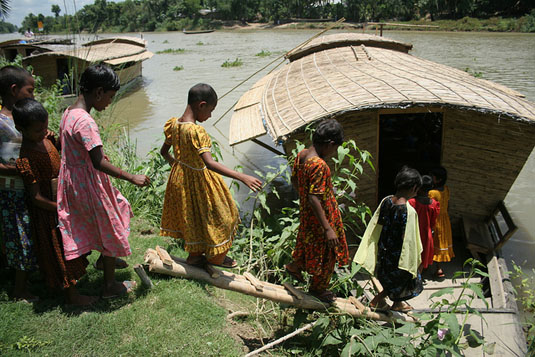
[Image: A riverboat library in Bangladesh; image courtesy of the Gates Foundation].

Many, many books have arrived at the home office here, and I’m thus once again woefully behind in tallying up all the titles that have come my way. Accordingly, there are still many more write-ups to come, but it will be next month, after some upcoming travels, before I get to those other books.

Meanwhile, as has always been the case with Books Received posts, I have not read all of the books linked here and not all of them are necessarily new. However, in all cases, these are included for the interest of their approach or subject matter, and the following list should easily give just about anyone at least one good book to read over the coming summer.


1) City: A Guidebook for the Urban Age by P.D. Smith (Bloomsbury) — P.D. Smith’s voluminous look at the history of urbanism stretches from the Sumerians to the 2012 London Olympics, from Tenochtitlán to Dubai, from the Code of Hammurabi to J.G. Ballard, and from the Italian Renaissance to the urban ruins of nuclear war. Smith has organized his book like a travel guide, albeit not for a particular metropolis but for the city in and of itself. Chapters are thus divided into overarching categories such as “arrival,” “where to stay,” “getting around,” and more, and while the result can sometimes conflate otherwise quite different urban phenomena found in disparate cities around the world, that slight sense that things are starting to blur is evened out by Smith’s eye for detail in the stories and anecdotes he relates, particularly in the book’s many boxed texts and sidebars. Migration, food security, global tourism, natural disasters, economic expansion, and war: these are all perennial influences on urban form—and urban futures—and Smith works hard to show their role in shaping the life of what he calls “the ape that shapes [its] environment, the city builders.” City comes out in the United States in June 2012.

2) Tubes: A Journey to the Center of the Internet by Andrew Blum (Ecco) — I had the pleasure of receiving periodic email updates from author Andrew Blum as he traveled to the unmarked buildings and coastal warehouses—amongst many other sites—that enable, store, and protect what we broadly refer to as the internet. The resulting book, released earlier this week, tells the story of those travels: it is Blum’s field guide to the physical infrastructure of contemporary data, tracking the internet’s actual geography, the sites where the switches are kept and the servers are cooled, where the cables come out of the sea and relay onward, deeper into cities and suburbs, into office and apartments like the one from which I’m posting this. “The Internet couldn’t just be everywhere,” Blum writes, questioning ethereal metaphors like “the cloud” or the abstract “tubes” of the book’s title. “But then where was it? If I followed the wire, where would it lead? What would that place look like? Why were they there? I decided to visit the Internet.” In one particularly memorable description, Blum quips that he “had begun to notice that the Internet had a smell, an odd but distinctive mix of industrial-strength air conditioners and the ozone released by capacitors,” as if even the most amorphous realms of data have their own peculiar body odor. This body—the “tubes” of the internet—leads Blum from underground London to the middle of nowhere in central Oregon, from downtown Milwaukee to locked rooms in Amsterdam, on the trail of the “pulses of light” that give the internet physical and geographic form.

3) The Appian Way: Ghost Road, Queen of Roads by Robert A. Kaster (University of Chicago Press) — As Kaster’s book claims on its opening page, “No road in Europe has been so heavily traveled, by so many different people, with so many different aims, over so many generations.” The Appian Way, which cuts broadly southeast from the old city walls of Rome, gives Kaster—a Classicist at Princeton—a long and meandering geography on which to base this otherwise concise, almost pamphlet-length look at the Italian landscape and how it has evolved over the past two millennia. From marshes and town centers to incongruously 21st-century wind farms where the ancient road all but disappears into gravel-strewn ruins, by way of endless crumbling tombs that will be familiar to any fan of Piranesi, Kaster’s book describes the sites, monuments, churches, cemeteries, and more that give readers an opportunity to explore the historical—usually archaeological—context for this legendary piece of transportation infrastructure. The Appian Way is part of the “Culture Trails” series from the University of Chicago Press.
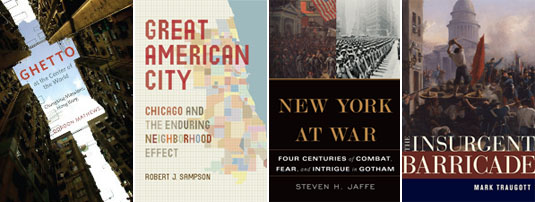

4) Ghetto at the Center of the World: Chungking Mansions, Hong Kong by Gordon Mathews (University of Chicago Press) — Mathews offers a kind of anthropological critique of globalization in the guise of architectural reportage, telling the story of Chungking Mansions, “a dilapidated seventeen-story commercial and residential structure in the heart of Hong Kong’s tourist district,” and using close descriptions of everyday life in the complex to build a cross-section of the global economy. “A remarkably motley group of people call the building home,” we read in the book’s own description: “Pakistani phone stall operators, Chinese guesthouse workers, Nepalese heroin addicts, Indonesian sex workers, and traders and asylum seekers from all over Asia and Africa live and work there—even backpacking tourists rent rooms. In short, it is possibly the most globalized spot on the planet.”

5) Great American City: Chicago and the Enduring Neighborhood Effect by Robert J. Sampson (University of Chicago Press) — Sampson’s very academic book—less narrative than statistical and analytic, and keenly based in empirical research—weighs the importance of community in defining, empowering, and uniting the city of Chicago, neighborhood by neighborhood.

6) New York at War: Four Centuries of Combat, Fear, and Intrigue in Gotham by Steven H. Jaffe (Basic Books) — Jaffe has written an incredibly interesting military history of New York City, beginning well before it was either New York or a city. Jaffe’s detailed accounts of early colonial battles and Revolutionary battlegrounds reveal the, to me, surprising number and topographic diversity of combat sites that dot the greater New York landscape. In the process, he offers little-known historical anecdotes—for instance, not only that Wall Street is so named after the defensive wall once constructed there, from one side of the island to the other, but that the wall was the first example of debt-financed urban infrastructure in what were then Dutch colonies. Jaffe’s look at a military urbanism peculiar to New York, from the 1600s to WWII to the security bollards of post-9/11 NYC, has proven hard to put down.

7) The Insurgent Barricade by Mark Traugott (University of California Press) — Traugott’s history of the barricade as a uniquely successful “technique of insurrection” is, first and foremost, a look at the spatial politics of the built environment. These politics operate in at least two primary, and clearly oppositional, ways, Traugott suggests. The first is the deliberate mis-use or counter-use of the city, transforming it into something that, through improvisatory re-design, can be express the political demands of an otherwise overlooked constituency. This is the production of barricades, which interfere with and strategically realign the internal movements of the city. The other side of this story, however, is the purposeful and systematic alteration of a city’s fabric precisely so that its everyday spaces cannot be used as outlets for political expression. In the latter example, streets can be widened or public spaces closely surveilled; in the former, makeshift tools and ad hoc materials, from cobblestones to wheelbarrows, can be transformed at a moment’s notice into walls that clog the city’s arteries and bring its streets to a halt. Traugott shows how all this has played out over more than four centuries of European urban history, also looking at what future spatial possibilities exist, on both sides of the barricade, for the political life of the metropolis.
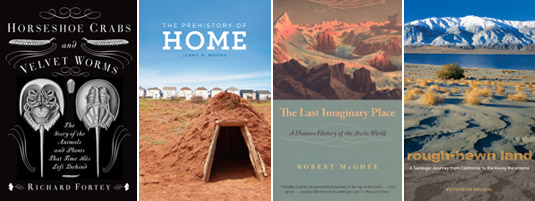

8) Horseshoe Crabs and Velvet Worms: The Story of the Animals and Plants That Time Has Left Behind by Richard Fortey (Alfred A. Knopf) — Fortey is easily one of my favorite natural history writers, and his Earth: An Intimate History remains high on my list of recommended books. With this new book, Fortey takes on the question of survival—or super-survival—in creatures whose wildly successful evolutionary paths mean they have had a disproportionately deep effect on whole ecosystems still thriving today. This is “life’s history told not through the fossil record but through the stories of organisms that have survived, almost unchanged, throughout time,” in the book’s own words. The horseshoe crabs and velvet worms of the title are only two of the most-cited creatures in Fortey’s unsurprisingly enjoyable book.

9) The Prehistory of Home by Jerry D. Moore (University of California Press) — Moore starts things off with the unfortunate claim that “various animals build shelters, but only humans build homes,” an unprovable statement that belongs on the sadly endless pile of false comparisons made about humans and animals. Indeed, only four pages later, Moore himself writes that “we [humans] have been building homes longer than we have been Homo sapiens,” which can literally only be true if animals—that is, non-humans or non-Homo sapiens—can, after all, build homes, not just shelters, and have been doing so all along. In any case, this minor but by no means inconsequential quibble shouldn’t hold you back from enjoying Moore’s engaging history of the home—that is, the symbolically rich personal shelter—which he takes on a wide and exciting run from hand-woven walls and mud floors on the coast of Peru all the way to maximum security prisons, from Mesopotamian walled cities to gated suburbs, and from bachelor pads to underground “dwellings” built for the recently deceased in globally diverse burial practices. Part archaeological survey dating back, as Moore explains, to before humans were Human, and part speculative treatise as to why humans have an emotional need for homes at all, Moore’s book spans hundreds of thousands of years and nearly every continent.

10) The Last Imaginary Place: A Human History of the Arctic World by Robert McGhee (Oxford University Press) — McGhee, an archaeologist at the Canadian Museum of Civilization, “paints a vivid portrait of Viking farmers, entrepreneurial Inuit, and Western explorers” in their encounter with, and long-term settling of, the Arctic. Though the book has been out for several years, it just crossed my desk and I look forward to jumping in over the summer.

11) Rough-Hewn Land: A Geologic Journey from California to the Rocky Mountains by Keith Heyer Meldahl (University of California Press) — Meldahl’s book is, in its own words, “a 1000-mile-long field trip back through more than 100 million years of deep time to explore America’s most spectacular and scientifically intriguing landscapes.” Those landscapes are the western plateaus, mountains, and deserts of the southwestern United States, a region whose terrain now verges on the over-exposed—hardly a season goes by without a new book on the subject—but, as Meldahl suggests, “geology is stranger than fiction,” and the book he’s built around that statement is a worthwhile read.
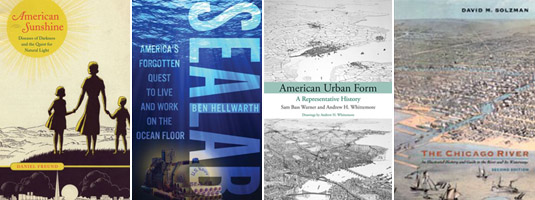

12) American Sunshine: Diseases of Darkness and the Quest for Natural Light by Daniel Freund (University of Chicago Press) — Freund’s book is a delightfully idiosyncratic look at the “quest for natural light” in American culture, from the earliest use of tanning beds as a kind of surrogate sun to the mainstream acceptance of “light therapy” as a cure for Seasonal-Affective Disorder, and from the marketing of climate tourism to the development of specialty lighting rigs for use in industrial food preparation. Freund explains in his introduction that the book was motivated by three otherwise unrelated historical figures—Akhenatan, Vitruvius, and Linnaeus—all of whom represent for Freund “the universality of sunlight as a subject for consideration.” The results are this unique look at the confluence of personal health, urban design, and near-religious popular beliefs about the purifying power of sunlight over roughly 150 years of American culture.

13) Sealab: America’s Forgotten Quest to Live and Work on the Ocean Floor by Ben Hellwarth (Simon & Schuster) — Hellwarth relates the surprisingly overlooked story of U.S. Navy “saturation divers” and the international oceanographers whose research helped to pioneer the construction of deepsea equipment and large-scale architectural environments that almost made living on the ocean floor an everyday reality. Equal parts tropical retro-futurism, complete with scenes of Jacques Cousteau assembling his Conshelf habitats in the Mediterranean Sea, and high-tech adventure story populated by military super-athletes and entrepreneurial gear manufacturers few of us even knew existed—including surreal high-pressure diving experiments involving presumably quite bewildered farm animals—Hellwarth’s book tells the true history of what have been (and what might still be) for human inhabitation of the oceans. Best of all, it’s almost entirely set in a quasi-utopian underwater world, like Archigram crossed with The Abyss.

14) American Urban Form: A Representative History by Sam Bass Warner and Andrew H. Whittemore (MIT Press) — Warner and Whittemore have produced an illustrated historical survey of U.S. urbanism, with short chapters ranging from “the city’s seventeenth-century beginnings” on the Atlantic coast to “the federally supported city” of the 1950s, ending with a somewhat obligatory overview of the “global city” and its suburban fringe. The book is a great introduction to the processes that have influenced and restrained urban development in the United States for more than three centuries, but it focuses more on presenting a coherent narrative—often reading more like a special issue of The Economist—as opposed to developing an original or otherwise surprising new interpretation of American urban form.

15) The Chicago River: An Illustrated History and Guide to the River and Its Waterways by David M. Solzman (University of Chicago Press) — Re-released in its current, second edition back in 2006, Solzman’s book will no doubt already be familiar to many readers of BLDGBLOG, but his history of the Chicago River, its ecological context and industrial re-engineering, complete with a hands-on guide for anyone who might want to explore it, was new to me.
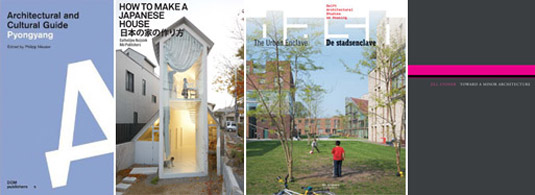

16) Pyongyang: Architectural and Cultural Guide edited by Philipp Meuser (DOM Publishers) — In print for less than three months, Meuser’s guide is already something of a cult classic in architectural circles, offering as it does a photographic and textual survey of the gonzo dictatorial postmodernism of Pyongyang, North Korea. A genuinely fascinating look at the political symbology of a capital city—Stefano Boeri’s memorable description of Pyongyang as a “rogue city” comes to mind—this slipcased, two-volume set offers “photographs and descriptions” in one book, including brief lessons on Pyongyang’s overall urban organization, and, in the other, what Meuser calls “background and comments.” These latter categories include—incredibly—excerpts from an architectural pamphlet written by the late Kim Jong-Il, who explains to his readers that, among other things, “architects are creative workers and operations officers,” spatially gifted functionaries of the State. Many of the photographs found in each volume can unfortunately resemble washed-out tourist postcards, and the buildings themselves are often striking for their super-ornamental, propagandistic absurdity—in a city whose natural setting makes it look oddly like Memphis, Tennessee—but to mock the city so easily and dismissively would be to miss the guide’s more interesting insight, which is that Pyongyang is, in fact, a remarkably assembled collection of processional spaces and monumental object-buildings, aesthetically arranged in a kind of 3-dimensional essay extolling the wonders of uncontested state power.

17) How to Make a Japanese House by Catherine Nuijsink (NAi Publishers) — Although architecture blogs have perfected the art of Japanese house fatigue over the past few years—in which it seems like a central server somewhere has been auto-feeding photos of small Japanese houses to the same design blogs over and over again every week—Nuijsink’s book is, refreshingly, a more substantive exploration of 21st-century domestic space in Japan, complete with one-on-one architectural interviews and occasional floor plans. Many of the projects you will already have seen online, but, given the breadth of context here, some great photographs, and three framing “monologues” written by architects Yoshiharu Tsukamoto, Taro Igarashi, and Jun Aoki, it more than justifies its publication.

18) Dash 5: The Urban Enclave edited and produced by Delft Architectural Studies on Housing (NAi Publishers) — Dash—not quite a magazine, more of a subscription book series—continued last autumn with this look at the “urban enclave,” which the editors have framed as an often progressively intended urban mega-project. These developments, both privately and publicly funded, can create what one of the book’s essays calls “a city-within-the-city” or a city “made up of miniature utopias”: social developments and architectural forms that appear, at first glance, to be entirely disconnected from one another but that, the authors argue, actually invigorate the city through these clear and obvious contrasts. The enclave offers—in fact, it does not let you avoid—”the proximity and the accessibility of ‘the other.'” Agree or disagree, it’s another well-produced issue in the ongoing Dash series, including an interesting look at Oswald Mathias Ungers’s notion of Grossform by historian Lara Schrijver, author of Radical Games.

19) Toward A Minor Architecture by Jill Stoner (MIT Press) — Stoner’s book looks to “dissect and dismantle prevalent architectural mythologies,” and to do so through a turn toward fiction—but the result is an often somewhat timid and unnecessarily academic entry in what should be a very rich conversation. Stoner relies too much on citations from the usual suspects found in your, mine, and everyone else’s thesis papers from the 1990s (Deleuze & Guattari, Walter Benjamin, Leibniz, Sigmund Freud, Italo Calvino, and even the now sadly over-exposed J.G. Ballard). But, having said that, it’s hard not to find pleasure in a book that takes, well, J.G. Ballard, Walter Benjamin, Sigmund Freud, Franz Kafka, James Joyce, and more—even the Berlin Wall—as fuel for a descriptive expansion of architecture into various other genres and media.
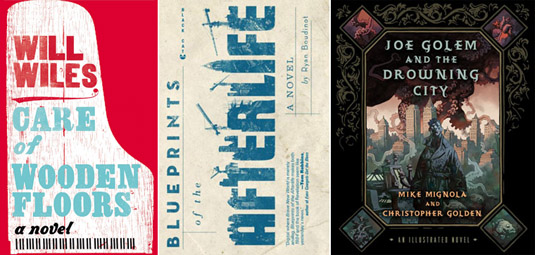

20) Care of Wooden Floors by Will Wiles (Amazon) — Many of you will recognize Will Wiles from his work as deputy editor of ICON magazine or his excellent though infrequent blog Spillway, but here he turns to fiction in a debut novel that tells the story of a man slowly going mad whilst house-sitting for a friend in Eastern Europe. From the book’s own description: “A British copywriter house-sits at his composer friend Oskar’s ultra-modern apartment in a glum Eastern European city. The instructions are simple: Feed the cats, don’t touch the piano, and make sure nothing damages the priceless wooden floors. Content for the first time in ages, he accidentally spills some wine. The apartment and the narrator’s sanity gradually fall apart in this unusual and satisfying novel.” The book has already been released in the UK, where it’s been receiving good reviews as a dark-humored “disaster novel,” but it’s not due out in the States until later this year, when it will become part of the first crop of books published directly and exclusively by Amazon.com.

21) Blueprints of the Afterlife by Ryan Boudinet (Grove Press) — Boudinet’s “bracingly weird new novel” has been receiving high praise and enviable comparisons for the author’s style, including to such writers as Philip K. Dick, William Burroughs, and Neal Stephenson, as Blueprints of the Afterlife picks up considerable buzz in the scifi/speculative fiction world. Fans of odd settings and spatial details will presumably appreciate the book’s “sentient glacier” or its “full-scale replica of Manhattan under construction in Puget Sound.” I’m looking forward to reading this while traveling over the next few weeks.

22) Joe Golem and the Drowning City by Mike Mignola and Christopher Golden (St. Martin’s Press) — It’s no secret that I’m a huge fan of Mike Mignola’s work, and his novelistic collaborations with Christopher Golden have so far been great, if not quite as gripping as Mignola’s own early Hellboy tales. Joe Golem tells the story of a flooded Manhattan, or, in the book’s own words: “In 1925, earthquakes and a rising sea level left Lower Manhattan submerged under more than thirty feet of water, so that its residents began to call it the Drowning City. Those unwilling to abandon their homes created a new life on streets turned to canals and in buildings whose first three stories were underwater.” The results, set 50 years after the flooding, are somewhere between H.P. Lovecraft and Central European urban folklore, featuring occasional black and white drawings by Mignola.

* * *

All Books Received: August 2015, September 2013, December 2012, June 2012, December 2010 (“Climate Futures List”), May 2010, May 2009, and March 2009.

Forensic Flowers

Two quick botanical stories in the news:

1) A short piece in The Scientist profiles artist Macoto Murayama, who “began applying the computer graphics programs and techniques he had learned while studying architecture at Miyagi University of Education in Sendai to illustrate, in meticulous detail, the anatomy of flowers.”

[Image: A flower by Macoto Murayama, via The Scientist].

Murayama physically dissects flowers in his studio, uncovering what he calls their “hidden mechanical and inorganic elements”; he then “sketches what he sees, photographs it, and models it on the computer using 3dsMAX software, a program typically used by architects and animators. Finally, he creates a composition of the different parts in Photoshop, and uses Illustrator to add measurements and other labels.” See more at The Scientist.

2) Archaeologists in Israel have used pollen trapped in plaster to reconstruct a “luxurious garden created by the Persians.” Their method reads like a rejected pitch for Jurassic Park 4: “Using a specialised technique for separating fossilized pollen trapped in the layers of plaster found in the garden’s waterways, researchers from Tel Aviv University’s Sonia and Marco Nadler Institute of Archaeology have now been able to identify exactly what grew in the ancient royal gardens of Ramat Rahel. By examining the archaeological evidence and the likely settings of specific plants they have also been able to reconstruct the lay-out of the garden.”

The hydrologically complex landscape, as reimagined by the archaeologists, was able to support a huge variety of species, including “ornamentals such as myrtle and water lilies, native fruit trees including the grape vine, the common fig, and the olive and imported citron, Persian walnut, cedar of Lebanon and birch trees. Researchers theorize that these exotics were imported by the ruling Persian authorities from remote parts of the empire to flaunt the power of their imperial administration.”

It would be interesting to reconstruct Central Park based solely on pollen grains trapped inside the painted walls and debris-filled lobbies of ruined hotels of a semi-submerged New York City 2,000 years from now. A Nobel Prize in Landscape Forensics.

(See also: Detection Landscapes).

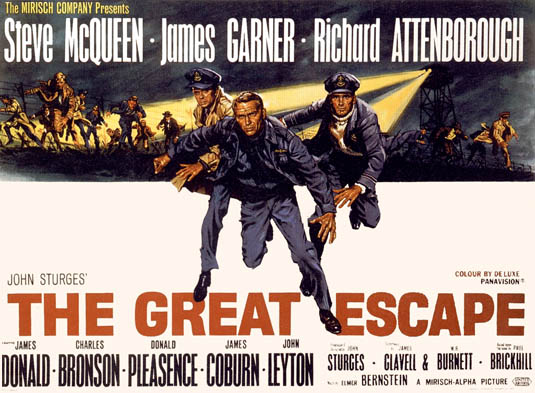
Ball Games: The Great Escape (1963)

[Image: The Great Escape from MGM].

Note: This is a guest post by Nicola Twilley, written as part of Breaking Out and Breaking In: A Distributed Film Fest of Prison Breaks and Bank Heists.

Alongside The Dam Busters and The Wooden Horse, The Great Escape was shown on British TV at least once a month when I was growing up. It is such familiar, comforting fare that, in a 2006 poll, Britons voted The Great Escape their third choice for a film worth watching on Christmas Day (It’s A Wonderful Life and The Wizard of Oz were first and second choice, respectively).

A large part of its appeal, at least for me, lies in the Boy’s Own adventure-style spirit and Heath Robinson-esque ingenuity of the Allied POWs.

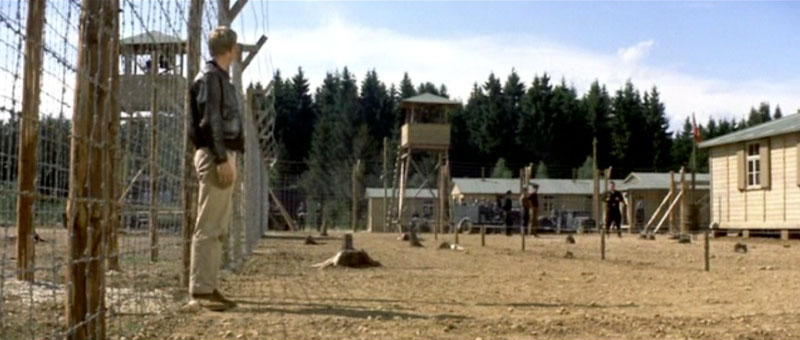
The movie begins with the most experienced and determined Allied escapologists arriving at the newly constructed, supposedly escape-proof Stalag Luft III. Its resistance to casual, opportunistic break outs is demonstrated in the first few minutes, as POWs unsuccessfully attempt to slip out hidden under tree branches, disguised as Russian laborers, and in the blind spots of the guard towers.

[Image: From The Great Escape, courtesy of MGM].

An altogether more rigorous approach is required, and, under the direction of Richard Attenborough’s Squadron Leader Bartlett, the entire camp is organized into a tunnel-digging machine, with a strict division of labor, assembly-line document- and clothing-production techniques, and a suite of redundant underground infrastructure (tunnels “Tom,” “Dick,” and the ultimately successful “Harry”).

As in A Man Escaped, breaking out requires “the strategic dismantling and reassembly of all designed objects that aren’t architecture”: powdered milk cans, socks, and bunk bed slats are transformed into tunnel ventilation pumps, supports, and trouser-mounted soil disposal devices.

And, as in Grand Illusion, there is a distinct sense that tunneling is a codified sport, bound to be played in prison camps. Certainly, the Allied POWs seem to be motivated as much by a boyish delight in outwitting the Germans through their own ingenuity and teamwork as by a sense of duty or passionate desire to return home. Stalag Luft III, in this view, is something like a game level, challenging seasoned players to apply their existing tunneling techniques in innovative new ways. (Intriguingly, the camp was used as the basis for Dulag IIIA in the first installment of Call of Duty).

If the design of prison camps and the sport of tunneling have co-evolved from World War I’s Grand Illusion to World War II’s Great Escape, then so, too, has the theater of war, from the defined battlefield of the trenches to a total war embedded into and dispersed throughout civilian landscapes.

The second half of The Great Escape, following the trajectories of those who successfully tunneled out of Stalag Luft III, reveals that, in fact, most of the European continent is a prison camp of sorts, booby-trapped with English-speaking Gestapo, and with its safe havens (Switzerland and Spain) ring-fenced with barbed wire and mountain ranges.

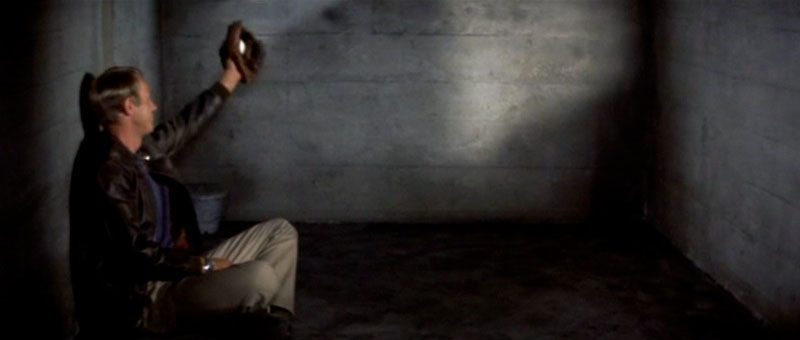
[Images: From The Great Escape, courtesy of MGM].

Finally, Steve McQueen, the “Cooler King,” provides future generations of filmmakers with an iconic image of the spatial and temporal experience of solitary confinement: a rubber ball, repetitively bounced off cell walls as if both defining and testing the limits those walls pose to free motion. From The Shining to The Simpsons to Ryan Reynolds in Safe House, the endlessly bouncing ball has since become visual shorthand, indicating that a character is trapped, whether their prison is mental, physical, or both.

(Nicola Twilley is the author of Edible Geography).

Loop Geography as Defensive Tactic

In a fascinating detail from a long series of articles published two years ago in the Washington Post, recently expanded as a stand-alone book called Top Secret America, we learn about one way to hide classified government infrastructure in plain sight.

[Image: Photo by Michael S. Williamson, courtesy of The Washington Post].

“[J]ust outside Washington,” authors Dana Priest and William Arkin explain, in the exurbs of depopulated office parks and “huge buildings with row after row of opaque, blast-resistant windows,” there can be found what the authors describe as “the capital of an alternative geography of the United States, one defined by the concentration of top-secret government organizations and the companies that do work for them.”

One such complex, called Fort Meade, “is the largest of a dozen such clusters across the United States.”

And it is cleverly camouflaged:

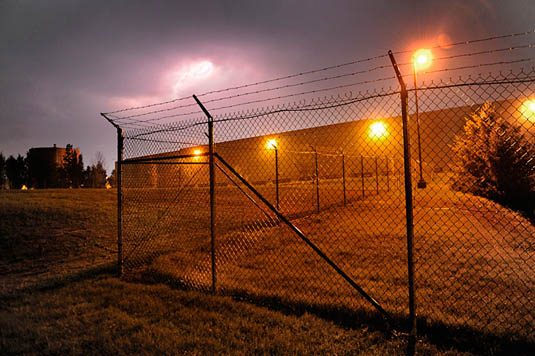
The existence of these clusters is so little known that most people don’t realize when they’re nearing the epicenter of Fort Meade’s, even when the GPS on their car dashboard suddenly begins giving incorrect directions, trapping the driver in a series of U-turns, because the government is jamming all nearby signals.

It’s an experiential trap street—an infinite loop—a deliberate cartographic error introduced into the mapping of the world so as to sow detour and digression. A kind of digital baffling, or recursive geography as state defensive tactic.

I’m also curious when we might see this privatized and domesticated—gated communities, for instance, blocking the GPS navigation of their streets in the misguided belief that this will help protect them from future burglary, effectively delisting themselves from public cartographic records. Perhaps the future of neighborhood security lies in the privatized repurposing of advanced signal-jamming technology, the misleading lamination of other, false maps onto the streets as they really exist.

(Detail spotted via @doingitwrong and [thisisaaronland]).

Detection Landscapes

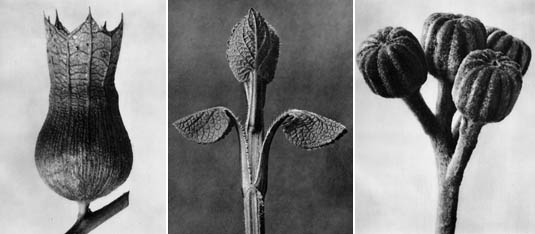
[Images: Botanical photogravures by Karl Blossfeldt].

I’ve been going through a lot of old files recently, including a short piece I clipped from New Scientist five years ago. I absolutely love stories like this, and I swoon a little bit when I read them; it turns out that “plants growing over old sites of human habitation have a different chemistry from their neighbors, and these differences can reveal the location of buried ruins.”

The brief article goes on to tell the story of two archaeologists, who, in collecting plants in Greenland, made the chemical discovery: “Some of their samples were unusually rich in nitrogen-15, and subsequent digs revealed that these plants had been growing above long-abandoned Norse farmsteads.”

The idea that your garden could be more like an indicator landscape for lost archaeological sites—that, below the flowers, informing their very chemistry, perhaps even subtly altering their shapes and colors, are the traces of abandoned architecture—is absolutely unbelievable.

[Images: More extraordinary photogravures by Karl Blossfeldt].

So why not develop a new type of flower in some gene lab somewhere, a designed species that reacts spectacularly to the elevated presence of nitrogen-15 from ruined settlements? Ruin Flowers® by Monsanto acting as deserted medieval village detection-landscapes, as thale cress does for mines.

You plant these flowers or trees or vineyards—future archaeological wine—and you wait three seasons for the traces to develop. Now imagine a modified tree that can only grow directly above ruined houses. Imagine an entire forest of these trees, curling and knurled to form floorplans, shaping out streets and alleyways, rooms instead of orchards and halls instead of groves. Now imagine the city beneath that forest becoming visible as the woods slowly spread, articulating whole lost neighborhoods over time.

[Image: Summer in a city by Jacek Yerka].

Genetically-modified plantlife used as non-invasive archaeological research tools would, at the very least, add a strange practicality to summer gardening activities, in the process turning whole surface landscapes into an unexpected new kind of data visualization program.

It’s the earth’s surface as browser for what waits undetected below.

(Blossfeldt images found via but does it float; see also Forensic Flowers).

Dye-Tracing Archaeology

Toxic chemicals leaking from an old wastewater treatment plant in Alabama have unexpectedly led to the discovery of a 1,700-year old “pre-historic village” buried in the ground nearby. Chemicals “have seeped into the ground surrounding the old plant,” according to a local news station, so “the soil needs to be removed and taken to a toxic waste facility.”

However, a survey of the contaminated site soon revealed that the ground also contained extremely well-preserved artifacts “from a village that once thrived” there. “Lo and behold,” the head excavator remarked to the news show: “we found a massive late-middle Woodland period village.”

It’s not hard to imagine someone another 1,700 years from now accidentally discovering the forgotten city of, say, New York—or Chicago, or Bangkok, swallowed by mud—after a chemical leak at a nearby factory: radioactive liquids drain down through the topsoil, flowing around buried walls and ruins, forming iridescent pools on floors in basements—slow and toxic streams tracing the shapes of old stairways, lighting a path for future excavation and descent. Like giving the earth a radiopharmaceutical, you fire up a ground-scanning machine, trace the pollution underground, and, lo and behold, the dark outlines of buried cities start to glow.

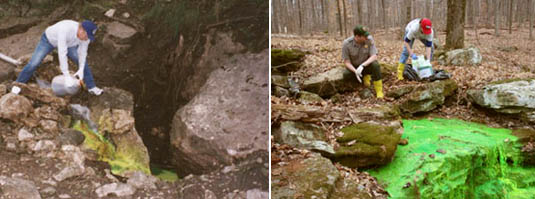
[Images: Dye-tracing cave systems; note that the chemical used is supposedly non-toxic].
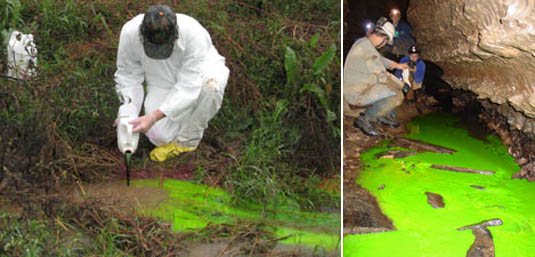
In fact, I’m reminded of dye-tracing techniques used for mapping otherwise impenetrable or overly complex cave systems. In James Tabor’s wildly uneven 2010 book Blind Descent, for instance, we read about legendary caver Alexander Klimchouk, who set about dye-tracing caves on the Arabika Massif, including Krubera Cave, currently the deepest known cave in the world.

“In 1984 and 1985,” Tabor explains, “[Klimchouk] poured fluorescein dye into several caves, including Krubera, high on the Arabika. Traces of that dye later flowed out of springs on the shore of the Black Sea far below. More traces tinged the water 400 feet beneath the surface of the Black Sea, miles offshore,” indicating genuinely—in fact, record-breakingly—huge dimensions for the overall system of caves.

[Images: Dye-tracing caves].

But even the most remote, fictional possibility that future spelunking archaeologists might someday map lost cities—London, Moscow, Beijing, Rome—by using dye-tracing packs to illuminate that underground world of collapsed halls and buried rooms is extraordinary. Cartographers in mountaineering gear and helmet-mounted floodlights descend into the New York subway system in 5,161 A.D., following luminescent trails of fluorescein dye, crawling, walking, rappelling into the underworld on the trail of shining rivers as subterranean ruins begin to shine.

(Alabama story found via @ArchaeologyTime).

Green Man

[Image: An unrelated photo by BLDGBLOG].
The other day I mentioned a poem by John Balaban, taken from his book Locusts at the Edge of Summer; but there’s another poem in that book with an incredible image that seems worth posting here.

In it, Balaban describes how villagers growing rice during the Vietnam War—where Balaban, a conscientious objector, served with the International Volunteer Corps—stumble upon an extraordinary feature in the landscape:

Beyond the last treeline on the horizon
beyond the coconut palms and eucalyptus
out in the moon-zone puckered by bombs
the dead earth where no one ventures,
the boys found it, foolish boys
riding buffaloes in craterlands
where at night bombs thump and ghosts howl.
A green patch on the raw earth.

This “green patch” has an usual shape, however. Balaban continues:

In that dead place the weeds had formed a man
where someone died and fertilized the earth, with flesh
and blood, with tears, with longing for loved ones.
No scrap remained; not even a buckle
survived the monsoons, just a green creature,
a viny man, supine, with posies for eyes,
butterflies for buttons, a lily for a tongue.

And the sight of this “green creature” proves too fertile, unforgettable, haunting all the villagers who’ve seen it:

Now when huddled asleep together
the farmers hear a rustly footfall
as the leaf-man rises and stumbles to them.

Out of the darkness, convinced by the life they give to the land around them that they might not yet be dead, the missing-in-action pull themselves from the tangle of the earth and rise and walk again.

Farmland World

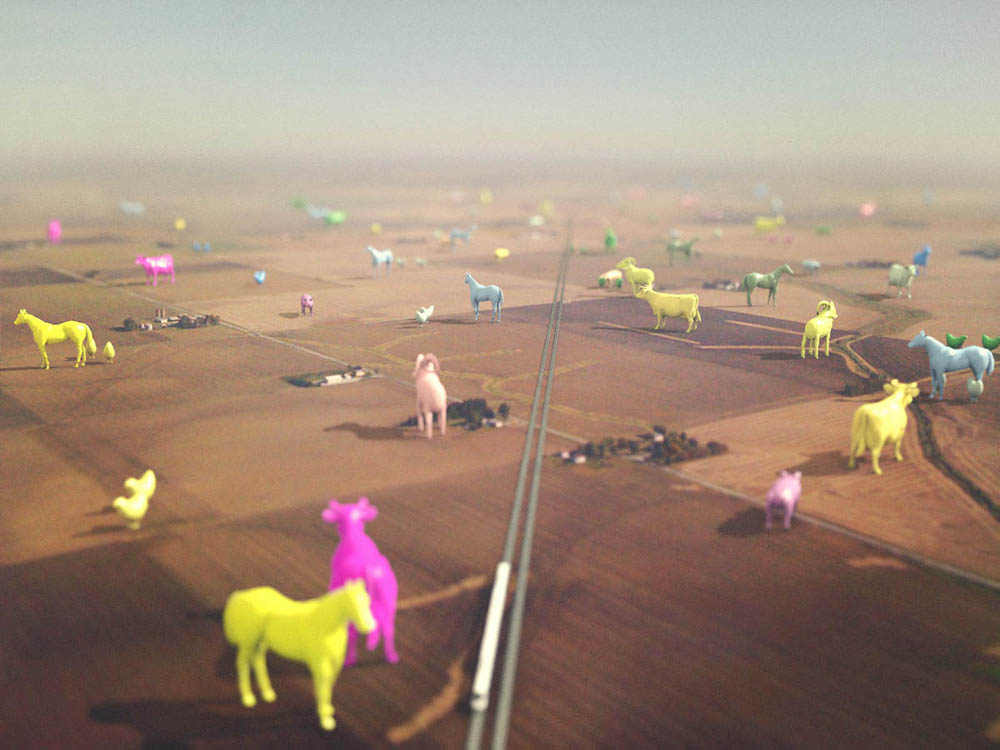
[Image: “Farmland World” by Design With Company (Allison Newmeyer and Stewart Hicks)].

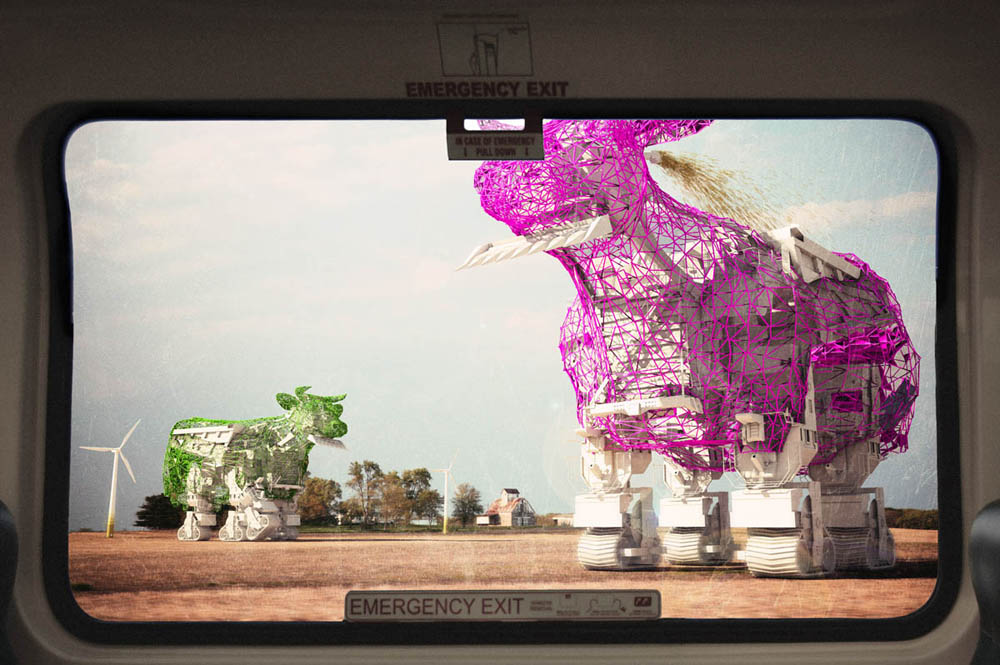
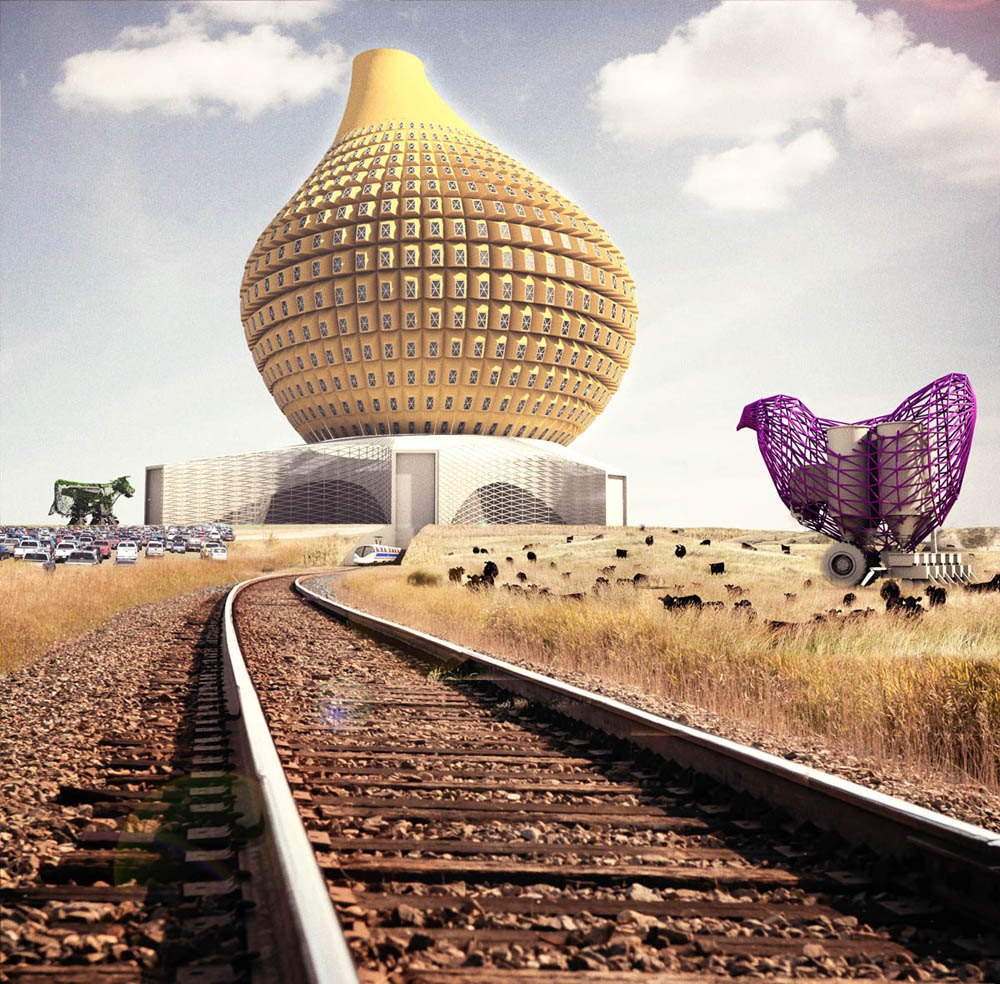
One of the runners-up for the recent Animal Architecture Awards is also one of my favorites from the competition: “Farmland World” by Allison Newmeyer and Stewart Hicks of the Chicago-based Design With Company.

The project is an ironic investigation of how humans relate to farm animals—more specifically, how the ongoing spatial separation between humans and the animals they rely on for food and other forms of agricultural work can make animals seem to be nothing more than utilitarian machines.

[Image: From “Farmland World” by Design With Company; view larger].

In the architects’ words:

The everyday life of the average American is almost completely disconnected from the land and animals that support them. Even farmers perform their duties primarily through automated mechanisms that remove them from the subject of their industry. The constructed distance between the human “us” and the animal “others” is increasing to the point that distinctions between machines and animals look blurry purely from distanced detachment. From our removed perspective, the extreme demand for cheap food production and the diversion of the pet economy distorts animals until they look more like utilitarian machines (bacon) or anthropomorphic projections to entertain and decorate (tea-cup terrier). As we relate to animals and machines similarly, where each begins to exhibit characteristics of the other, their converging trajectories point to an impending crisis at their collision.

Farmland World makes the human-animal encounter spectacular, proposing an absurdly over-the-top farm animal theme park—a “human/machine/animal hybrid adventure-land.”

[Image: From “Farmland World” by Design With Company].

Farmland World “is a chain of agro-tourist resorts sprinkled across the American Midwestern countryside”:

Part theme park and part working farm, guests arrive to the resort via train and stay as part of 1-day, 3-day or 5-day experience packages. Capitalizing on both recent governmental investments in high-speed rail infrastructure and the plentiful subsidies for farming, the network of resorts combine crowd-sourced farm labor with eco-tainment.

“As train-loads of itinerant fantasy farmers arrive,” Newmeyer and Hicks drily write, “they are herded to the Grazing Coliseum to receive their complimentary overalls. From there, the adventure begins.”

[Image: From “Farmland World” by Design With Company; view larger].

Foregrounding the idea that humans have increasingly come to confuse animals with machines, Farmland World is populated by robots, rides, and representations.

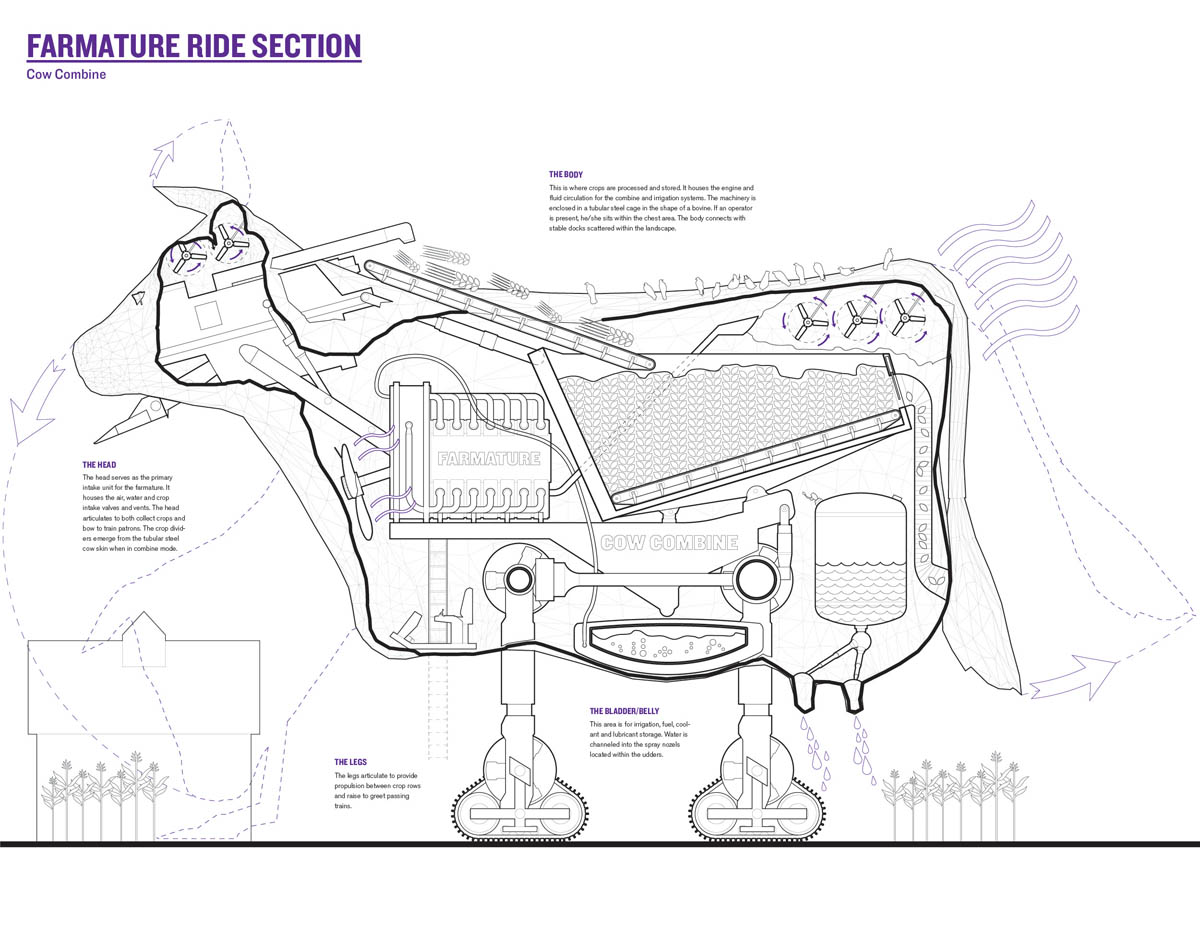
Inflatable mega-pigs and hollow, roving “cow combines” act as “robotic performers,” in the designers’ words. Animal replicants, these false creatures “extend the tradition of machines using and mimicking animals for moving, operating, branding and processing food crops.”

[Image: From “Farmland World” by Design With Company; view section in more detail].

Meanwhile, the architect adds, “temporary farm excursionists”—paying visitors—”work, sowing and harvesting fields, becoming part of the herd. Farmland World embraces this hybrid human-animal-machine relationship, reinvigorating the rural landscape.”

[Images: The robotic super-cows of “Farmland World” by Design With Company; view section in more detail].

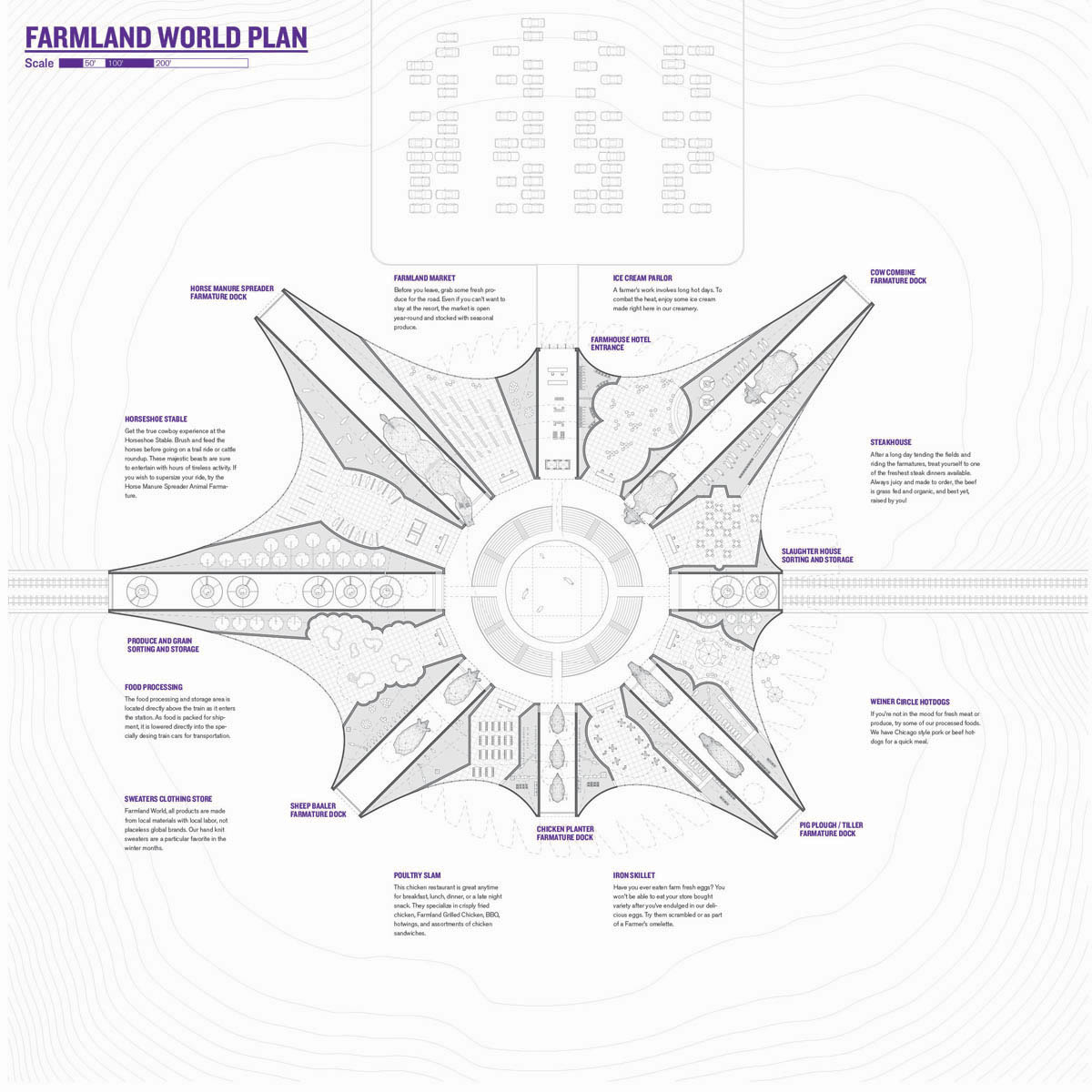
As you can see in the project’s overall guide, there are a whole series of these giant robot animals. A “chicken planter” stands beside a mechanical “sheep baaaler,” which, in turn, is neighbors with a pig plow and a mechanical horse that spreads real horse manure from its techno-derriere. Think of it as Westworld in an age of vast industrial farming—a livestock Disneyland.

[Image: From “Farmland World” by Design With Company; view larger].

On the project plan, you’ll also see such places as “Beeville” and “Veggie Row,” the latter promising an internally-animated range of machine-plants sprouting from beds of artificial soil.

Having gone to elementary school in a small town in rural Wisconsin, I vividly remember being taken to see farm animals over at UW-Madison, including one that had had a window surgically implanted into its side; you could actually watch the cow, in section, digesting its food.

To go from this—a bovine proto-cyborg—to Design With Company’s beautifully rendered “Farmland World” doesn’t actually seem like such a stretch.

In any case, congratulations to Allison Newmeyer and Stewart Hicks for placing as second runner-up in the Animal Architecture Awards; for more, see the Animal Architecture website as well as this earlier post today on BLDGBLOG.

The Weather Bank

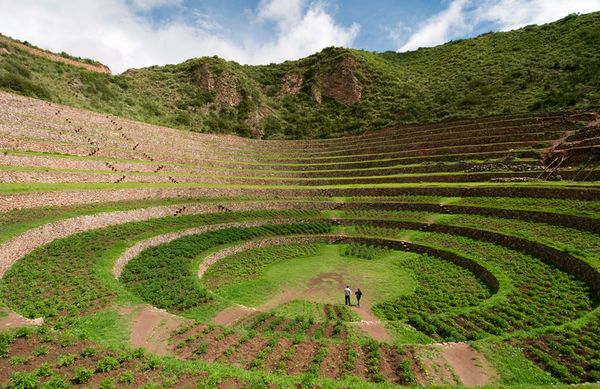
A slideshow over at National Geographic features this image by photographer Ian Wood, showing, in the magazine’s own words, “what might be called extreme Inca landscaping.”

[Image: The weather bowl at Moray, Peru; photo by Ian Wood/Alamy, courtesy of National Geographic].

“Three enormous pits, each with beautifully curved sides that staircase down like the interiors of titanic flowerpots have been carved out of the earth to depths of up to 100 feet and more,” the magazine adds. They are like Indian stepwells—only they concentrate thermal gradients—and this affects the local weather: “Air temperatures between the top and bottom layers can differ by more than 20 degrees, which has led some researchers to theorize that Moray was an Inca agricultural site where experiments on crops were conducted.”

It’s a site of experimental agriculture fueled by an act of microclimatic terrain deformation.

So does this mean that the weather at Moray should be subject not only to meteorological analysis, but to archaeological interpretation? The site you’re excavating seamlessly continues into the sky above it, turning the weather itself into an historic artifact—a whole new spin on paleotempestology.

But is the weather created by an historic site also part of that historic site? If so, should ancient microclimates such as these be subject to material preservation? Put another way, if there were a Museum of Ancient Microclimates, how would you design it and what would the visitor experience be?

Imagine a whole constellation of these oversized weather pits, meanwhile, distributed throughout the Andes, all interacting with and augmenting one another, producing continent-scale storm systems—and imagine being hit by a summer downpour, or sitting calmly throughout the winter as blizzards rage just one valley over, knowing that the atmospheric events around you are really long-lasting cultural gifts of the people who lived there centuries before. Weather designed by your ancestors still rages around you today.

[Image: From Sietch Nevada by Matsys; renderings by Nenad Katic].

Superficially, I’m reminded of the hexagonal “water storage banks” of Sietch Nevada, a speculative design by the San Francisco-based firm MATSYS. While the resemblance doesn’t go much beyond form, this comparison lets us borrow MATSYS’s idea of a water bank and, thus, reinterpret the Incan site at Moray as a kind of weather bank, storing temperatures and headwinds year round. It is a space to store climates in.

Extrapolating wildly from this, if the rise of the Himalayas radically altered the earth’s climate by changing weather patterns for thousands of miles in all directions, then perhaps we can imagine a scenario in which a network of artificial pits in the Andes begins to affect the jet stream, plunging Australia into drought and pushing rain far north into Mexico—and that, in turns out, is those pits’ very purpose, having been excavated by scientifically advanced, self-styled weather warriors more than 600 years ago for reasons still unclear today. Groups of elders would get together in the dark, sitting around their pits in tight circles as the winds picked up, burning incense, singing tales, hurling storms like artillery into the central Pacific.

(Thanks to Marilyn Terrell for the heads up!)

Calling All Agents

Here are some opportunities for writers, designers, and filmmakers, in case you’re looking for ways to challenge yourself over the summer.

[Image: “Angels” (2006) by Ruairi Glynn, one of the co-organizers of Stories of Change].

1) Arup Foresight and the Bartlett School of Architecture have teamed up to gather what they call “responses to some of the world’s most pressing issues as featured in the publication, Drivers of Change. We would like you to tell us your Stories of Change.” Original films, texts, and architectural designs are all eligible and welcome; the texts could even “be a poem, a letter, a blog-post, even a currated collection of tweets.” Which is good news, but the deadline is approaching quickly: Friday, 24 June 2011. See the Stories of Change website for more.

2) For its new call for papers, the Bauhaus-Universität’s Horizonte journal begins by quoting architect Raimund Abraham: “From earliest times,” Abraham writes, “architecture has complied with that order of logical forms which is contained in the nature of each material. That is to say: each material can only be used within the limits imposed by its organic and technical possibilities.” This fourth issue of the consistently well-designed journal explores the materiality of building: the issue thus “challenges the constraints and possibilities of architectural production, in order to reflect on the material and constructive methodologies of the present day.” I imagine essays and even speculative fiction covering everything from genetically engineered building materials to 3D printers—to new types of brick to artisanal craftwork—would be of interest. Your deadline is 8 July 2011.

3) The Architectural League wants to give New York the Greatest Grid:

On the occasion of the two hundredth anniversary of the 1811 Commissioners’ Plan for New York, the foundational document that established the Manhattan street plan from Houston Street to 155th Street, the Architectural League invites architects, landscape architects, urban designers, and other design professionals to use the Manhattan street grid as a catalyst for thinking about the present and future of New York. For two centuries, the Manhattan street grid has demonstrated an astonishing flexibility to accommodate the architectural gestures and urban planning theories of successive generations of architects, urban designers, private developers, and city officials. Given its capacity for reinvention, how might the Manhattan grid continue to adapt and respond to the challenges and opportunities—both large and small—that New York faces now and into the future?

Your deadline is 26 September 2011; see the competition website for much more information.

4) A new Advanced Architecture Contest has been announced, sponsored by the Institute for Advanced Architecture and Hewlett Packard. The theme this year is “CITY-SENSE: Shaping our environment with real-time data.” Aim to submit “a proposal capable of responding to emerging challenges in areas such as ecology, information technology, architecture, and urban planning, with the purpose of balancing the impact real-time data collection might have on sensor-driven cities.” Read more at the Advanced Architecture Contest website; the deadline is 26 September 2011.

5) The California Architectural Foundation, in partnership with the Arid Lands Institute and the Academy for Emerging Professionals, has launched what it calls “an open ideas competition for retrofitting the American West.” The Drylands Competition seeks new ways of “anticipating, mitigating, and adapting to projected impacts of climate change” and other “critical challenges” facing the region. These challenges include water scarcity, obsolete infrastructure, and even the growing gap between scientific knowledge and public policy. “Design teams are invited to generate progressive proposals that suggest to policy makers and the public creative alternatives for the American west, ideas that may be replicated throughout the world.” Register by 15 November 2011; see their website for much more info.

6) Meanwhile, across the pond, the Architects Journal is seeking essays of up to 1,500 words, by writers under the age of 35, for their £1,000 AJ Writing Prize (the money will be split amongst all winners). The jury consists of Christine Murray, Alan Berman, Joseph Rykwert, and Mary Banham; you only have until 30 June 2011 to participate, so get cracking.

7) Finally, this one doesn’t open till September 2011, but it sounds fascinating. Sponsored by Architecture for Humanity, [un]restricted access is “a design competition that will re-envision the future of decommissioned military space. This is an open invite to the global design and construction community to identify retired military installations in their own backyard, to collaborate with local stakeholders, and to reclaim these spaces for social, economic, and environmental good.” As I say, thought, it doesn’t launch until September, but keep your eyes on the [un]restricted access website for emerging info.

Landscape Futures Super-Trip

I’m heading off soon on a road trip with Nicola Twilley, from Edible Geography, to visit some incredible sites (and sights) around the desert southwest, visiting places where architecture, astronomy, and the planetary sciences, to varying degrees, overlap.

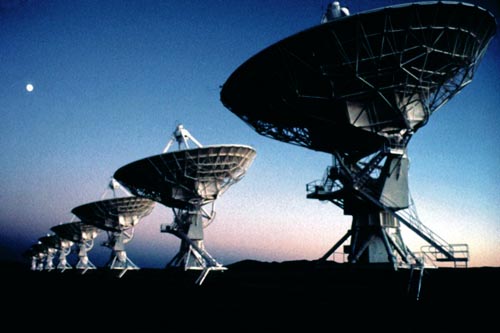
[Image: The Very Large Array].

This will be an amazing trip! Our stops include the “world’s largest collection of optical telescopes,” including the great hypotenuse of the McMath-Pierce Solar Telescope, outside Tucson; the Very Large Array in west-central New Mexico; the Controlled Environment Agriculture Center at the University of Arizona, aka the “lunar greenhouse,” where “researchers are demonstrating that plants from Earth could be grown without soil on the moon or Mars, setting the table for astronauts who would find potatoes, peanuts, tomatoes, peppers and other vegetables awaiting their arrival”; the surreal encrustations of the Salton Sea, a site that, in the words of Kim Stringfellow, “provides an excellent example of the the growing overlap of humanmade and natural environments, and as such highlights the complex issues facing the management of ecosystems today”; the Fred Lawrence Whipple Observatory, with its automated scanning systems used for “robotic searches for variable stars and exoplanets” in the night sky, and its gamma-ray reflectors and “blazar lightcurves” flashing nearby; the Grand Canyon; Red Rocks, outside Sedona; the hermetic interiorities of Biosphere 2; White Sands National Monument and the Trinity Site marker, with its so-called bomb glass; the giant aircraft “boneyard” at the Pima Air & Space Museum; and, last but not least, the unbelievably fascinating Lunar Laser-ranging Experiment at Apache Point, New Mexico, where they shoot lasers at prismatic retroreflectors on the moon, testing theories of gravitation, arriving there by way of the nearby Dunn Solar Telescope.

[Image: The “Electric Aurora,” from Specimens of Unnatural History, by Liam Young].
The ulterior motive behind the trip—a kind of text-based, desert variation on Christian Houge’s study of instrumentation complexes in the Arctic—is to finish up my curator’s essay for the forthcoming Landscape Futures book.

That book documents a forthcoming exhibition at the Nevada Museum of Art called Landscape Futures: Instruments, Devices and Architectural Inventions, featuring work by David Benjamin & Soo-in Yang (The Living), Mark Smout & Laura Allen (Smout Allen), David Gissen, Mason White & Lola Sheppard (Lateral Office), Chris Woebken, and Liam Young.

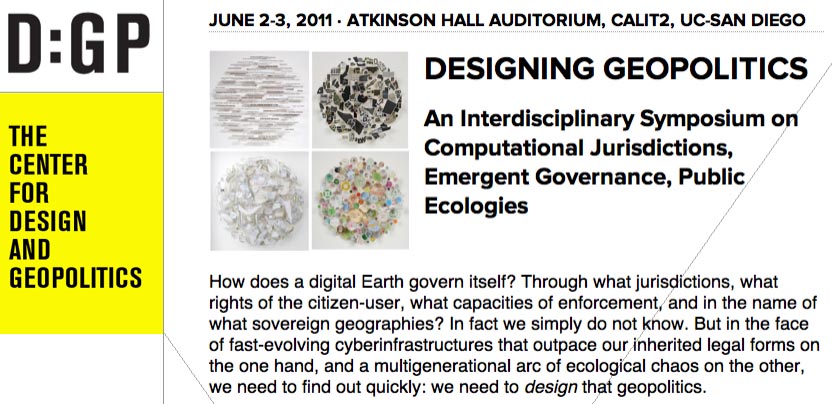
Finally, Nicola and I will fall out of the car in a state of semi-delirium in La Jolla, California, where I’ll be presenting at a 2-day symposium on Designing Geopolitics, “an interdisciplinary symposium on computational jurisdictions, emergent governance, public ecologies,” organized by Benjamin Bratton, Daniel Rehn, and Tara Zepel.

That will be free and open to the public, for anyone in the San Diego area who might want to stop by, and it will also be streamed online in its entirety; the full schedule is available at the Designing Geopolitics site.

(Earlier on BLDGBLOG: Landscape Futures Super-Workshop, Landscape Futures Super-Dialogue, and Landscape Futures Super-Media).