Urban Speculation in Los Angeles and Beyond

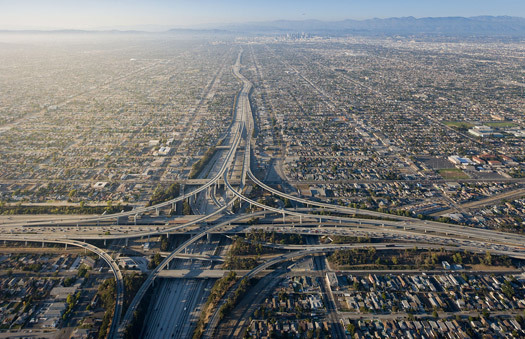
[Image: Photo by Iwan Baan, from No More Play: Conversations on Urban Speculation in Los Angeles and Beyond edited by Jessica Varner].

Last autumn, I had the pleasure of speaking with architects Michael Maltzan and Jessica Varner for the new book No More Play: Conversations on Urban Speculation in Los Angeles and Beyond.

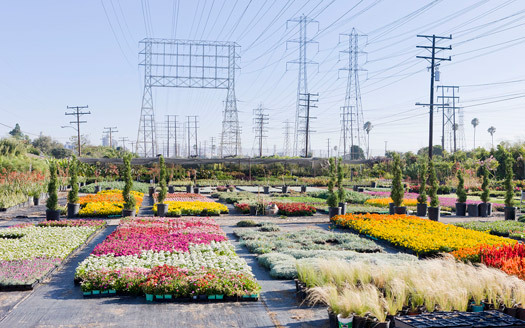
[Image: Photo by Iwan Baan, from No More Play: Conversations on Urban Speculation in Los Angeles and Beyond edited by Jessica Varner].

That conversation was then included in the book itself, alongside conversations about the city with such artists, architects, and writers as Catherine Opie, Matthew Coolidge, Mirko Zardini, Edward Soja, Charles Jencks, Qingyun Ma, Sarah Whiting, James Flanigan, and Charles Waldheim. It will surprise no one to read that my interview is the least interesting of the bunch, but it’s an honor even to have been invited to sit down as a blogger amidst that line-up.

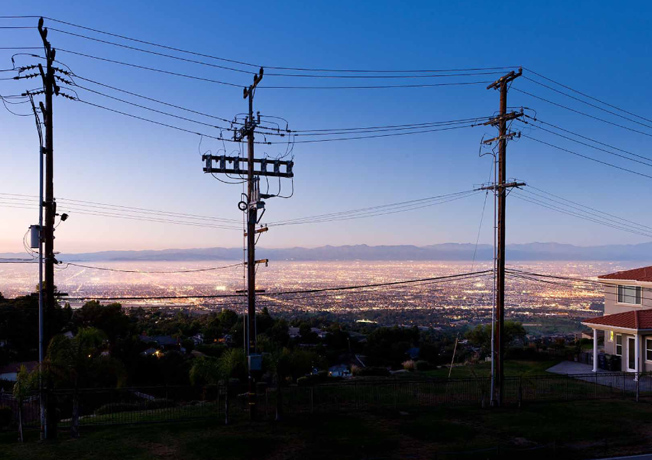
[Image: Photo by Iwan Baan, from No More Play: Conversations on Urban Speculation in Los Angeles and Beyond edited by Jessica Varner].

Overall, the book represents a series of interesting decisions: it doesn’t document Michael Maltzan’s work—though, with several recently completed, high-profile projects, including Playa Vista Park, Maltzan could easily could have spent the book’s 200+ pages discussing nothing but his own productions (in fact, Maltzan’s buildings are absent from the publication).

Instead, the book instead features newly commissioned photographs of greater Los Angeles by the ubiquitous Iwan Baan; further, Michael’s and Jessica’s introductory texts are not about the firm’s recent buildings but are about those buildings’ urban context. It is about the conditions in which those buildings are spatially possible.

[Image: Photo by Iwan Baan, from No More Play: Conversations on Urban Speculation in Los Angeles and Beyond edited by Jessica Varner].

In many ways, then, the book is astonishingly extroverted. It’s a book by an architecture office about the city it works in, not a book documenting that firm’s work; and, as such, it serves as an impressive attempt to understand and analyze the city through themed conversations with other people, in a continuous stream of partially overlapping dialogues, instead of through ex tempore essayistic reflections by the architects or dry academic essays.

[Image: Photo by Iwan Baan, from No More Play: Conversations on Urban Speculation in Los Angeles and Beyond edited by Jessica Varner].

Iwan Baan‘s photos also capture the incredible diversity of spatial formats that exist in Los Angeles—including camouflaged oil rigs on residential hillsides—and the range of anthropological subtypes that support them, down to fully-clothed toy dogs and their terrycloth-clad owners.

[Image: Photo by Iwan Baan, from No More Play: Conversations on Urban Speculation in Los Angeles and Beyond edited by Jessica Varner].

In an excerpt from Maltzan’s introduction to the book published today over at Places, Maltzan writes that the city’s “relentless growth has never paused long enough to coalesce into a stable identity.”

Los Angeles and the surrounding regions have grown steadily since the founding of the original pueblo, but the period immediately after World War II defined the current super-region. During this time, the economy accelerated, and Los Angeles became a national and international force. Today, innovation and development define the metropolis as the region multiplies exponentially, moment by moment, changing into an unprecedented and complex expansive field. The region continues to defy available techniques and terms in modernism’s dictionary of the city.

This latter point is a major subtheme in the interviews that follow: exactly what is it that makes Los Angeles a city, not simply a “large congregation of architecture,” in Ole Bouman’s words. As Bouman warns, “If you don’t distinguish between those two—if you think that applying urban form is the same as building a city, or even creating urban culture—then you make a very big mistake. First of all, I think it’s necessary for architectural criticism, in that sense, to find the right words for these very complicated processes, to distinguish between two processes or forms that, at first sight, appear the same, but that are, in reality, very different.”

At the end of his introductory notes, Maltzan remarks that “we have reached a point where past vocabularies of the city and of urbanism are no longer adequate, and at this moment, the very word city no longer applies” to a place like Los Angeles.

“Perhaps it is not a city,” he suggests. Perhaps something at least temporarily indescribable has occurred here.

[Image: Photo by Iwan Baan, from No More Play: Conversations on Urban Speculation in Los Angeles and Beyond edited by Jessica Varner].

You can read Maltzan’s essay in full over at Places; or I’d encourage you to pick up a copy of the book as a way of encouraging this kind of discursive engagement with the city—what Varner describes in her introduction as a set of outward-looking, nested narratives “which then fold back onto themselves” from conversation to conversation, and will only continue to develop “as the city advances forward.”

[Image: From No More Play: Conversations on Urban Speculation in Los Angeles and Beyond edited by Jessica Varner].

The book also comes with a small fold-out poster, one side of which you can see here.

(Earlier on BLDGBLOG: Agitation, Power, Space: An Interview with Ole Bouman).

Border Town

[Image: Photo by m.joedicke, via Border Town].

From Border Town, an independent research and design workshop to be held in Toronto this summer, from 16 June-18 August, now seeking applications:

Your farm is completely surrounded by a foreign country because the king lost it in a game of cards. You live in Cooch Behar.

You are eating at a café when you are informed that it must close. If you’ll just shift to a table in the other country, service is still available. This café is in Baarle/Hertog.

You work in the mayor’s office. Down the hall is a parallel mayor’s office with a whole mirror set of city officials to govern the other half of your city. You work in Texarkana.

We believe that a great deal can be learned by investigating the strange edge cases of the world. Border towns are the extreme edge of where geography and politics collide. They throw the abstractions of governance into sharp physical relief. They are a fertile site for investigation into questions of security, freedom, architecture, immigration, trade, smuggling, sovereignty, and identity.

Border Town is a 10-week, multi-participant collaborative design studio that will investigate the conditions that surround life in cities situated on borders, divided by borders, or located in conflict zones. By investigating these strange specimens of political geography, we can being to think and design about the interaction of legal and physical architecture and how these forces shape the built environment and the lives of the people living in it.

The workshop is organized by Tim Maly and Emily Horne, and applications are due by 2 June.

By way of my own hypothetical reading list for such a course, I might suggest checking out a few of the following books: The City & The City by China Miéville, Divided Cities: Belfast, Beirut, Jerusalem, Mostar, and Nicosia by Jon Calame and Esther Charlesworth, Hollow Land: Israel’s Architecture of Occupation by Eyal Weizman, City of Walls: Crime, Segregation, and Citizenship in São Paulo by Teresa P. R. Caldeira, Divided Kingdom by Rupert Thomson, A Wall in Palestine by René Backmann, and any number of other books, films, essays, and chapters elsewhere on the subjects of smuggling, demilitarized zones, police jurisdiction, international espionage, the Berlin Wall, the Jewish ghetto, quarantine, border survey teams (and the equipment they utilize), segregation and apartheid, political gerrymandering, micronations, and much more.

In any case, Border Town promises to be an interesting experience for all involved—and I should add that it’s great to see people putting together this kind of independent educational workshop outside of the university system. If you end up being one of the participants, I’d love to hear how it goes.

Infrastructural Opportunism

[Image: From Coupling: Strategies for Infrastructural Opportunism by Lateral Office/InfraNet Lab].

Going all the way back to the fall of 1997, my own interest in architecture was more or less reinvigorated—leading, by way of a long chain of future events, to the eventual start of BLDGBLOG—by Mary-Ann Ray’s installment in the great Pamphlet Architecture series, Seven Partly Underground Rooms and Buildings for Water, Ice, and Midgets.

To this day, the pamphlet format—short books, easily carried around town, packed with spatial ideas and constructive speculations—remains inspiring.

The 30th installment in this canonical series is thankfully a great one, authored by Lateral Office and InfraNet Lab, a design firm and its attendant research blog that I’ve been following for many years.

[Image: From Coupling: Strategies for Infrastructural Opportunism by Lateral Office/InfraNet Lab].

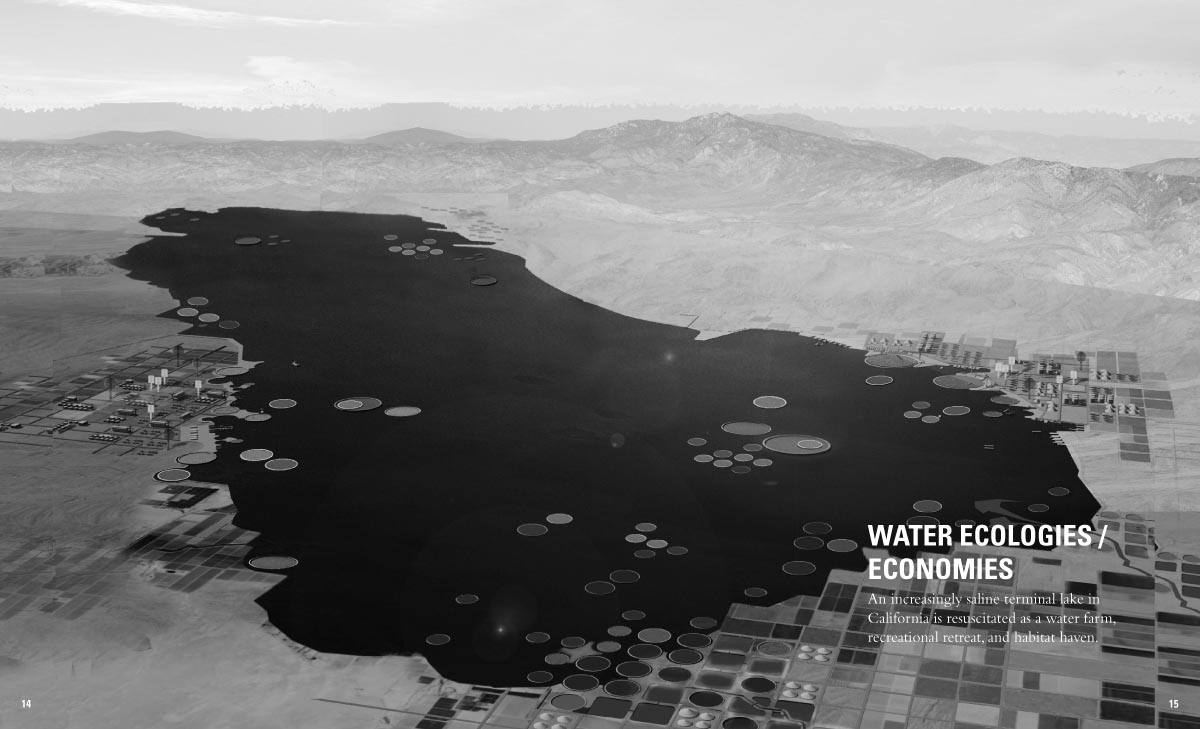
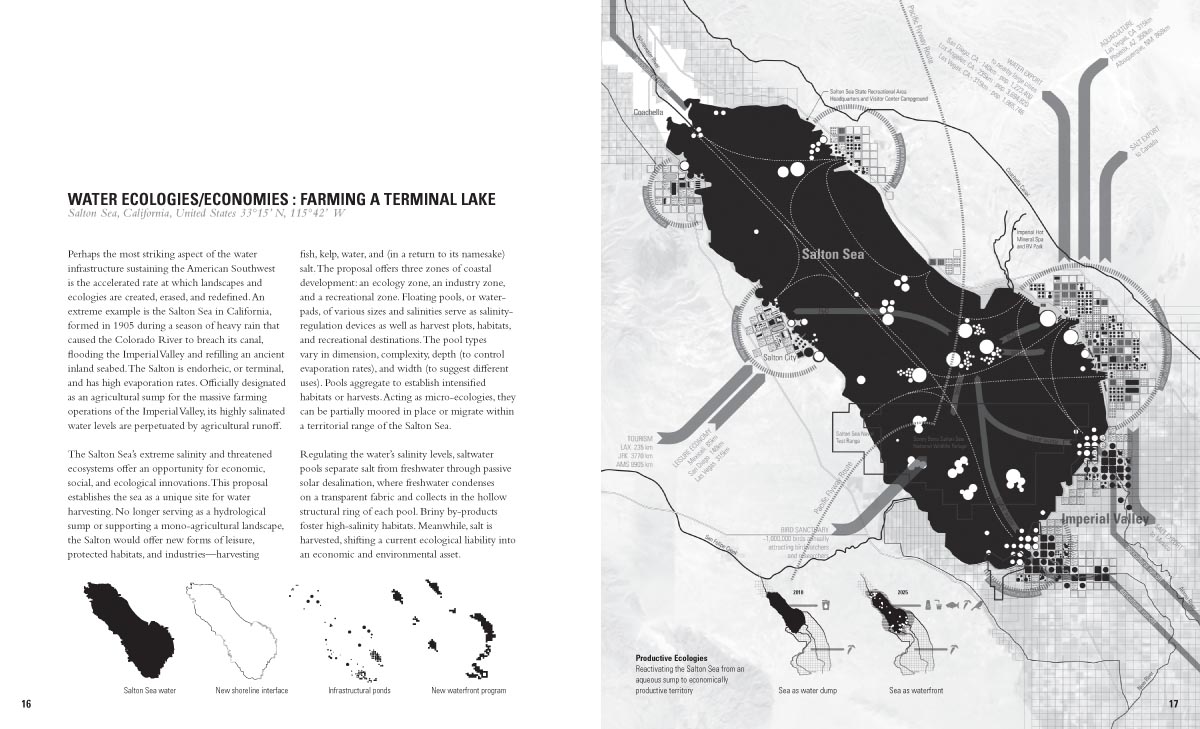
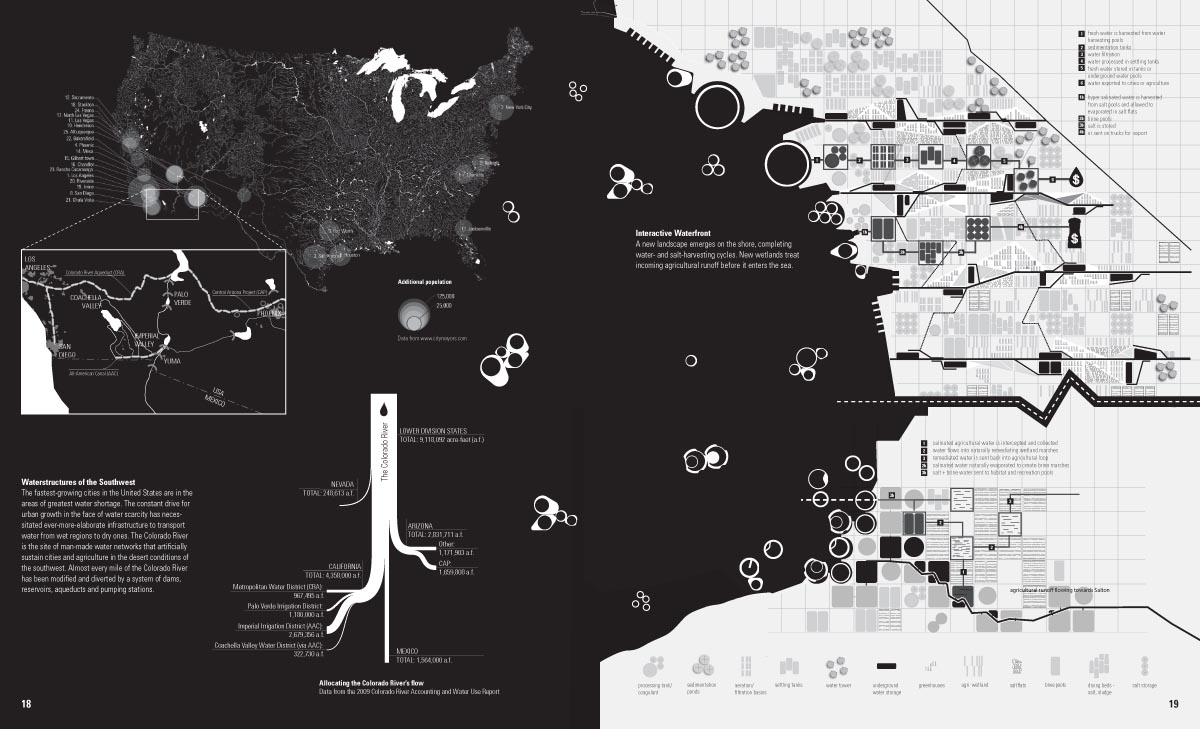
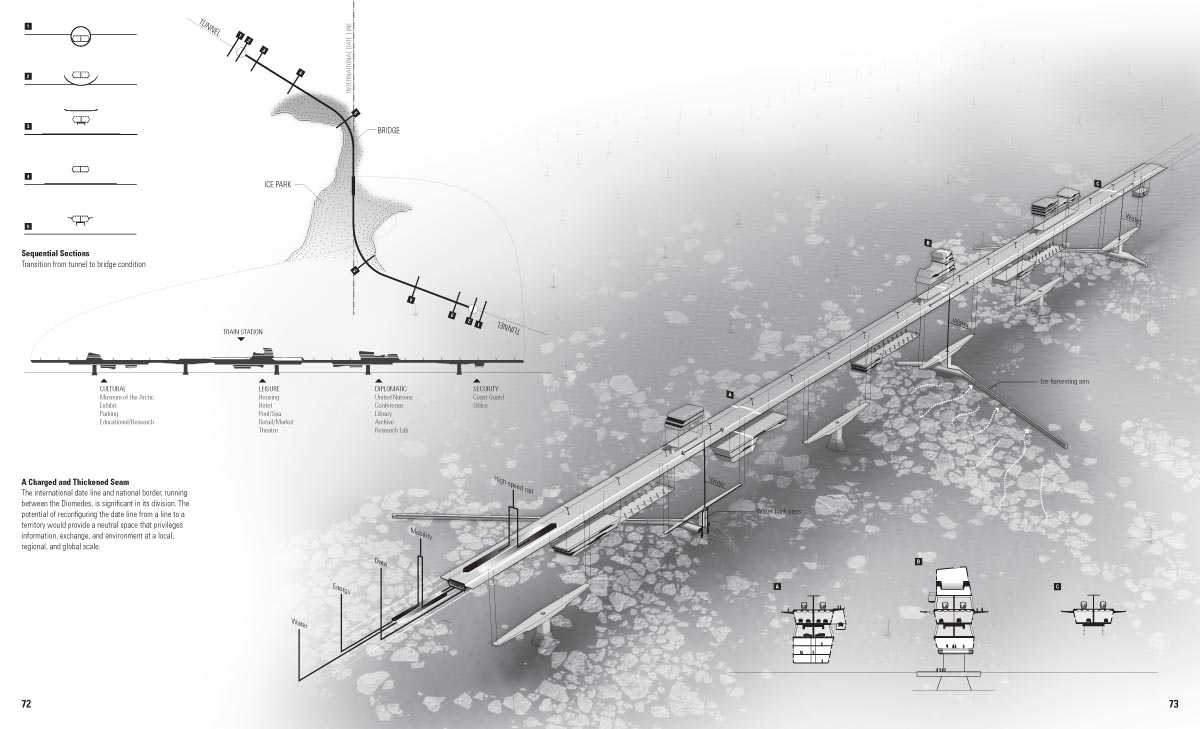
The premise of the work documented by their book, Coupling: Strategies for Infrastructural Opportunism, is to seek out moments in which architecturally dormant landscapes, from the Arctic Circle to the Salton Sea, can be activated by infrastructure and/or spatially reused. Their work is thus “opportunistic,” as the pamphlet’s title implies. It is architecture at the scale of infrastructure, and infrastructure at the scale of hemispheres and ecosystems—the becoming-continental of the architecture brief.

In the process, their proposed interventions are meant to augment processes already active in the terrain in question—processes that remain underutilized or, rather, below the threshold of spatial detection.

As the authors themselves describe it, these projects “double as landscape life support, creating new sites for production and recreation. The ambition is to supplement ecologies at risk rather than overhaul them.”

[Images: From Coupling: Strategies for Infrastructural Opportunism by Lateral Office/InfraNet Lab].

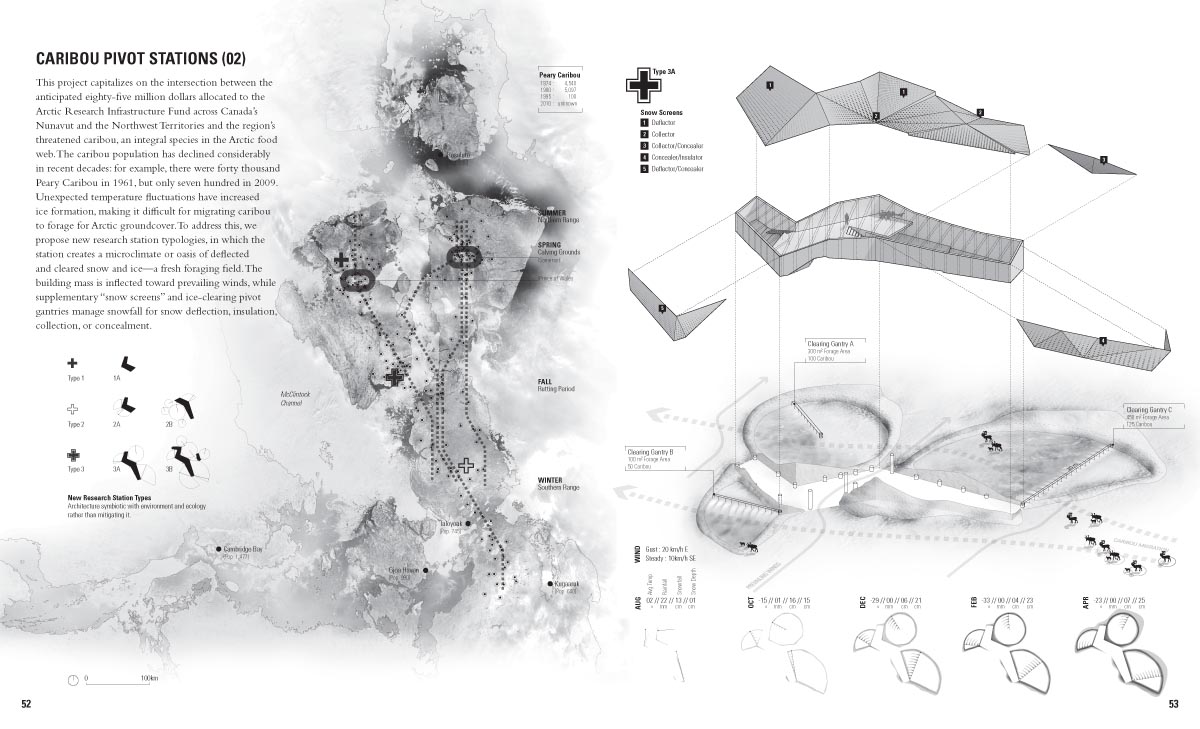
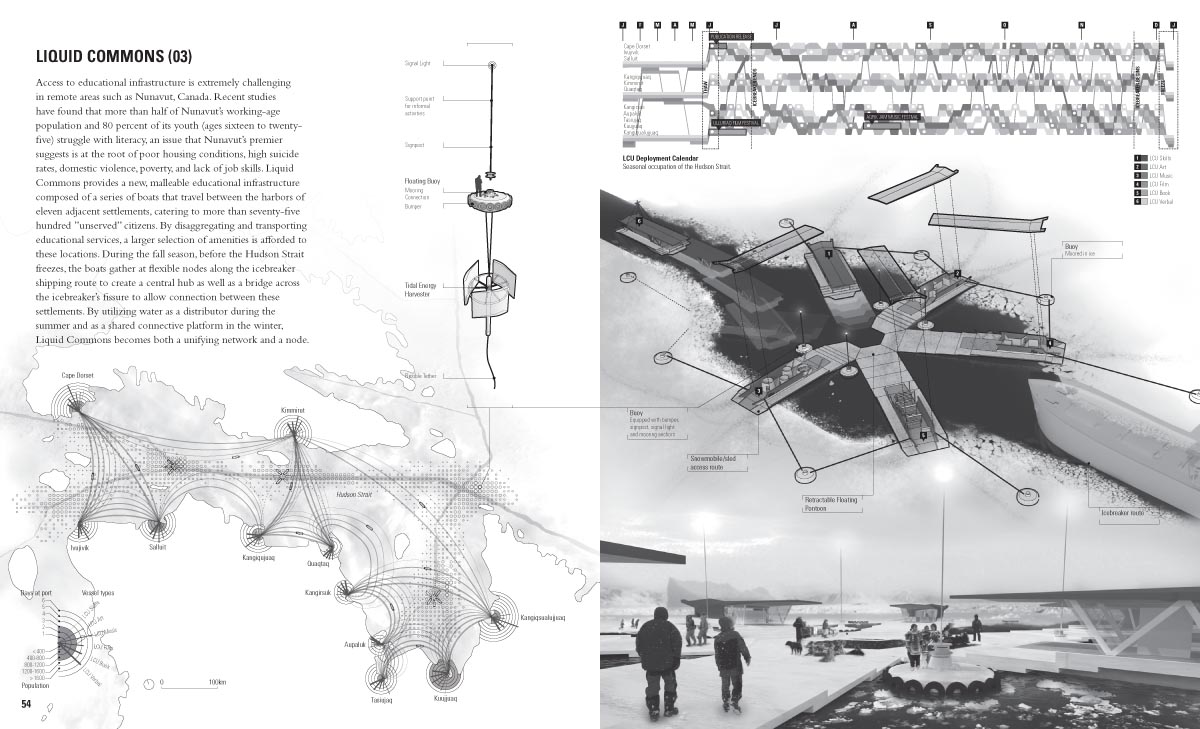
One of the highlights of the book for me is a section on the so-called “Next North.” Here, they offer “a series of proposals centered on the ecological and social empowerment of Canada’s unique Far North and its attendant networks.”

Throughout the twentieth century, the Canadian North had a sordid and unfortunate history of colonial enterprises, political maneuverings, and non-integrated development proposals that perpetuated sovereign control and economic development. Northern developments are intimately tied to the construction of infrastructure, though these projects are rarely conceived with a long-term, holistic vision. How might future infrastructures participate in cultivating and perpetuating ecosystems and local cultures, rather than threatening them? How might Arctic settlements respond more directly to the exigencies of this transforming climate and geography, and its ever-increasing pressures from the South? What is next for the North?

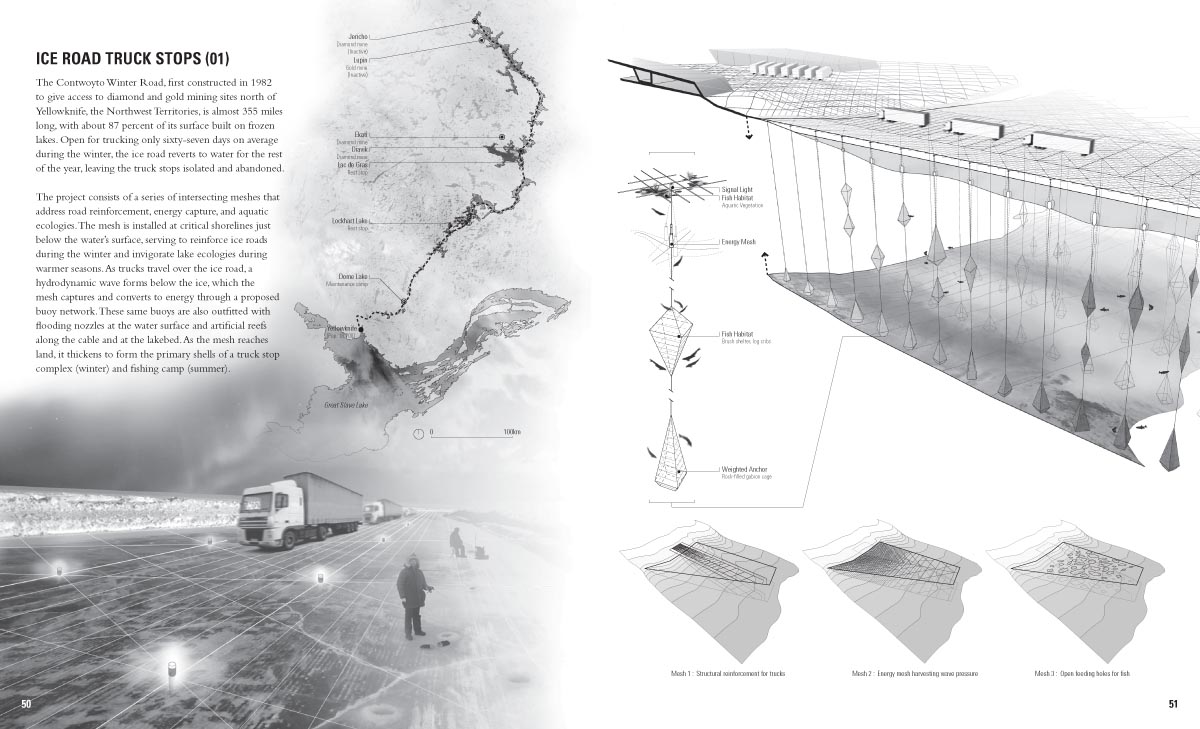
Three specific projects follow. One outlines the technical possibility of building “Ice Road Truck Stops.” These would use “intersecting meshes,” almost as a kind of cryotechnical rebar, inserted into the frozen surfaces of Arctic lakes to “address road reinforcement, energy capture, and aquatic ecologies.”

The mesh is installed at critical shorelines just below the water’s surface, serving to reinforce ice roads during the winter and invigorate lake ecologies during warmer seasons. As trucks travel over the ice road, a hydrodynamic wave forms below the ice, which the mesh captures and converts to energy through a proposed buoy network.

There is then a series of “Caribou Pivot Stations”—further proof that cross-species design is gathering strength in today’s zeitgeist—helping caribou to forage for food on their seasonal migrations; and a so-called “Liquid Commons,” which is a “malleable educational infrastructure composed of a series of boats that travel between the harbors of eleven adjacent communities.” It is a mobile, nomadic network bringing tax-funded educational opportunities to the residents of this emerging Next North.

[Images: From Coupling: Strategies for Infrastructural Opportunism by Lateral Office/InfraNet Lab].

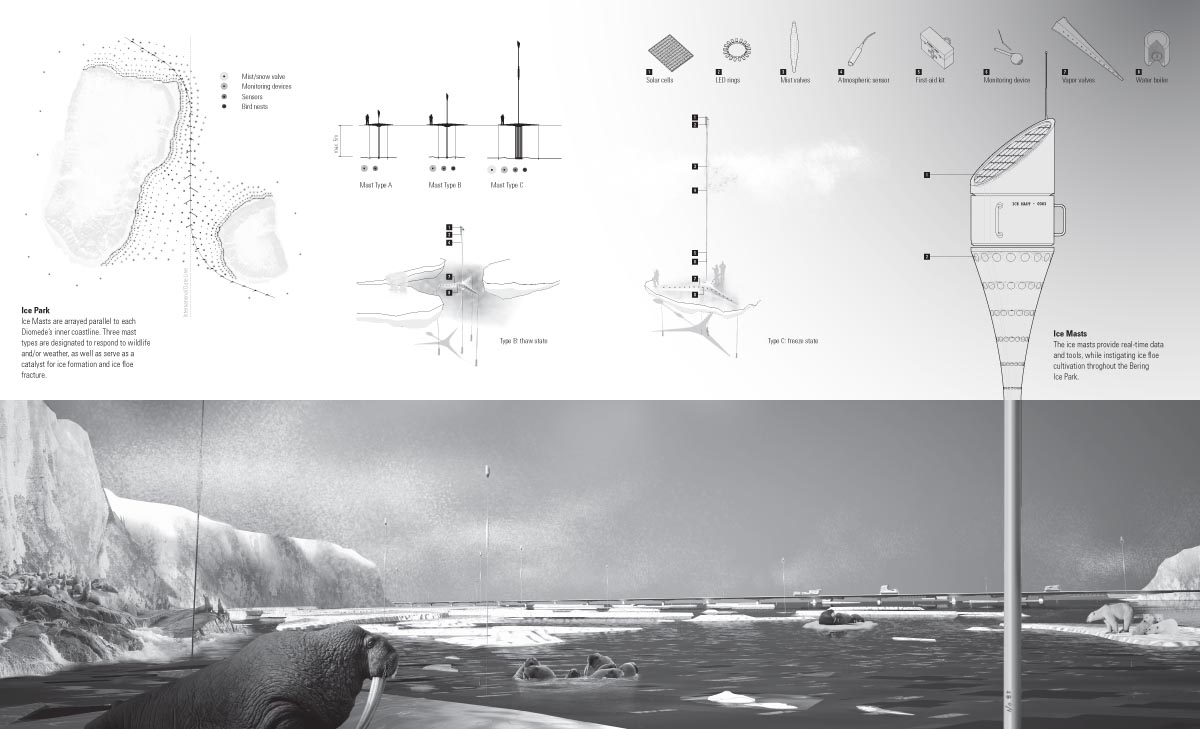
Here, I should point out that the book has an air of earnestness—everything is very serious and technical and not to be laughed at—but the projects themselves often belie this attitude. It’s as if the authors are aware of, and even revel in, the speculative nature of their ideas, but seem somehow rhetorically unwilling to give away the game. But the implication that these projects are eminently buildable—shovel-ready projects just waiting for a financial green light to do things like “cultivate” ice in the Bering Strait (duly illustrated with a Photoshopped walrus) or “harvest” water from the Salton Sea—is a large part of what makes the book such an enjoyable read.

After all, does presenting speculative work as if it could happen tomorrow—as if it is anything but speculative—increase its architectural value? Or should such work always hold itself at an arm’s length from realizability, so as to highlight its provocative or polemical tone?

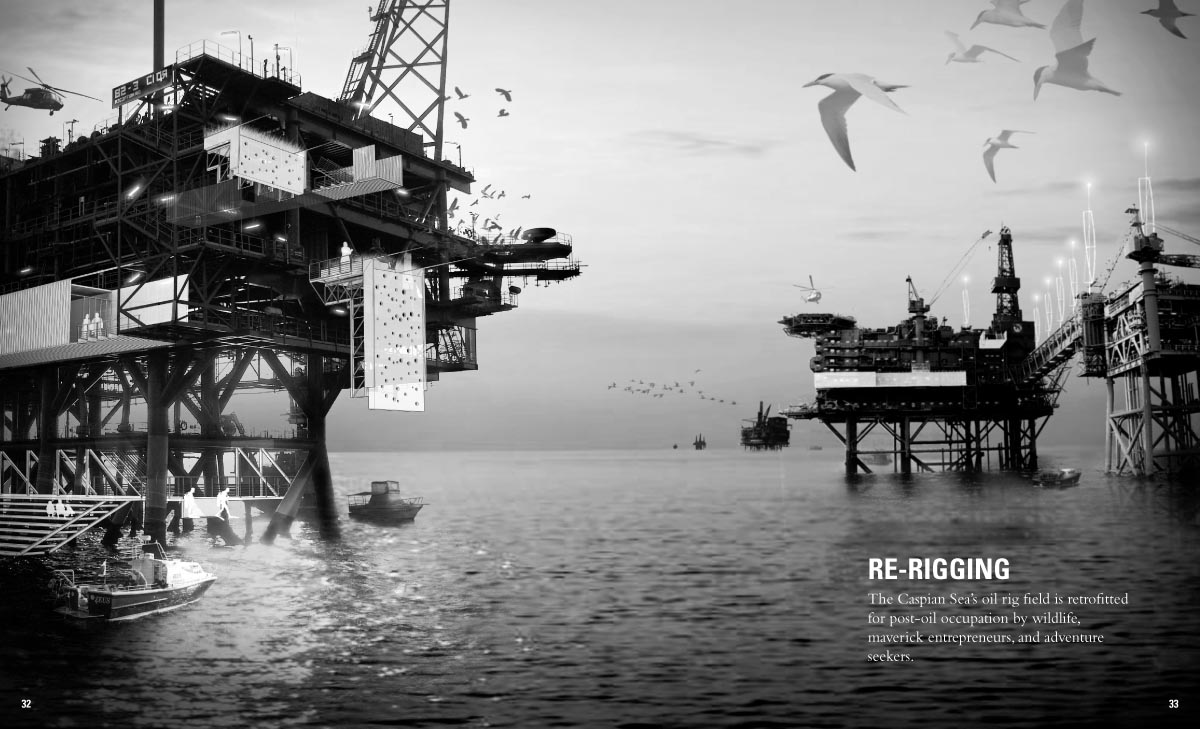
The projects featured in Coupling have an almost tongue-in-cheek buildability to them—such as recreational climbing walls on abandoned oil platforms in the Caspian Sea. This opens a whole slew of important questions about what rhetorical mode—what strategy of self-presentation—is most useful and appropriate for upstart architectural firms. (At the very least, this would make for a fascinating future discussion).

[Image: From Coupling: Strategies for Infrastructural Opportunism by Lateral Office/InfraNet Lab].

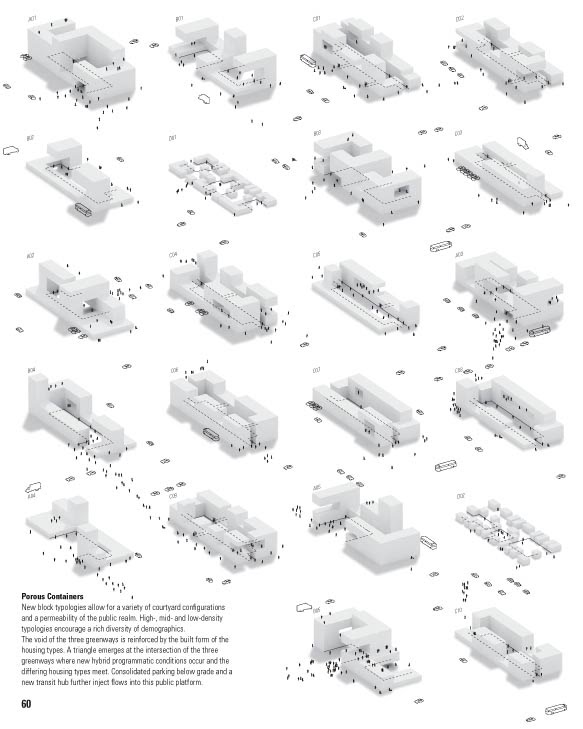
In any case, the book is loaded with diagrams, as you can see from the selections reproduced here, including a volumetric study (above) that runs through various courtyard typologies for a hypothetical mixed-use project in Iceland. For more on that particular work, see this older, heavily-illustrated BLDGBLOG post.

[Images: From Coupling: Strategies for Infrastructural Opportunism by Lateral Office/InfraNet Lab].

Essays by David Gissen, Keller Easterling, Charles Waldheim, and Christopher Hight round out the book’s content. It’s a solid pamphlet, both practical and imaginative—made even more provocative by its implied feasibility—and a fantastic choice for the 30th edition of this long-running series.

Books Received

[Image: Proposal for the Stockholm Public Library by Olivier Charles].

The “Books Received” series on BLDGBLOG continues apace, with short descriptions of interesting—but not necessarily new–books that have passed through the home office here. In all cases, these are books about architecture, landscape, and the built environment, albeit in an extended sense, encompassing paleontology, marine biophysics, space archaeology, geopolitics, infrastructural anthropology, museology, how-to guides for architectural design, and more.

Note, however, that these lists will always include books that I have not read in full—and the present rundown is no exception.

1) The Docks by Bill Sharpsteen (University of California Press).

2) Moby-Duck: The True Story of 28,800 Bath Toys Lost at Sea and of the Beachcombers, Oceanographers, Environmentalists, and Fools, Including the Author, Who Went in Search of Them by Donovan Hohn (Viking).

3) On Roads: A Hidden History by Joe Moran (Profile Books).

Three books about infrastructure and the humans (and plastic ducks) who inhabit it, from the docks of Long Beach to accidents at sea supplying an unexpected way to trace global trade networks, to a short history of the roads by which civilization is now defined.

4) Handbook of Space Engineering, Archaeology, and Heritage edited by Ann Garrison Darrin and Beth Laura O’Leary (CRC Press).

The Handbook is an endlessly fascinating mega-collection (1,015+ pages!) of essays about the science of space archaeology: the study and preservation of artifacts and sites related to human space exploration, including “everything from launch pads to satellites to landers on Mars.” Lost spacecraft, failed missions, “graveyard orbits,” and the Apollo 11 landing site all make extended appearances in the book, interpreted as examples of the space-archaeological record. “For example,” we read, “the location of one human footprint on the Moon in situ is an archaeological feature that defines one of the ultimate events of humankind and is a part of the physical and temporal record of all the engineering research and development that made it possible.”

The book is full of amazing factoids—we learn, for example, that, “Surprisingly, the Viking 1 lander, which remains on Mars, is considered part of the Smithsonian Air and Space Museum,” suggesting a distributed, inter-planetary museum of inaccessible earthly objects—and eye-popping new fields of study, such as “the role archaeologists might play in understanding the material culture of extraterrestrials or other intelligent species, once the physical evidence is scientifically verifiable.” The book even describes a kind of computational archaeology, by which “the heritage created by robots in the form of their artificial intelligence” would be both studied and preserved.

5) Alien Ocean: Anthropological Voyages in Microbial Seas by Stefan Helmreich (University of California Press).

Alien Ocean is an anthropological study of oceanographers, marine biologists, genetic researchers, and the way that they perform research, not an oceanographic study in itself. But if the idea of following a Donna Haraway-like narrator around the California coast, visiting gene-research labs, riding down in submarines, and opining about the chemical possibilities of life on other planets, where strange maritime organisms might swim through the dark currents of “extraterrestrial seas,” then you’ll find Helmreich’s book as hard to put down as I did.

6) The Planet in a Pebble: A Journey into Earth’s Deep History by Jan Zalasiewicz (Oxford University Press).

Jan Zalasiewicz, author of The Earth After Us: What Legacy Will Humans Leave in the Rocks?, is back with this book-length thought experiment: can the entire geological history of the planet be deduced from a single pebble? If so, what tools—what pieces of equipment and what scientific ideas—would you need at your disposal, and what might you find in the process?

7) The Alphabet and the Algorithm by Mario Carpo (MIT).

8) The Possibility of an Absolute Architecture by Pier Vittorio Aureli (MIT).

9) The Liberal Monument: Urban Design and the Late Modern Project by Alexander D’Hooge (Princeton Architectural Press).

MIT’s “Writing Architecture” series continues with two new titles influenced by Peter Eisenman. In one, Mario Carpo explores mechanical reproduction, robotics, and the historical status of the architectural copy (see also the recent book Anachronic Renaissance for a fascinating discussion of architectural duplication). In the other, Pier Vittorio Aureli dives into the political, in its most literal sense: where architecture intervenes in, and actively confronts, the city, the polis. Here, Aureli draws an interesting distinction between “the political dimension of coexistence (the city)” and “the economic logic of social management (urbanization).”

Finally, Alexander D’Hooge uses this expanded publication of his Ph.D. thesis to propose “a series of civic complexes” built within “the existing, vast net of suburban sprawl” that surrounds the contemporary city, in order to introduce public space and institutional communality “in a territory otherwise devoid of it.”

10) Divided Cities: Belfast, Beirut, Jerusalem, Mostar, and Nicosia by Jon Calame and Esther Charlesworth, with a foreword by Lebbeus Woods (University of Pennsylvania Press).

11) Walled States, Waning Sovereignty by Wendy Brown (ZONE Books).

12) A Wall in Palestine by René Backmann (Picador).

Three books about walls: architecture and urbanism used to separate and to neutralize the lives of a city’s human residents, not to catalyze vibrant communities or to bring neighboring people together.

As Jon Calame and Esther Charlesworth conclude in Divided Cities, “divided cities are not aberrations. Instead, they are the unlucky vanguard of a large and growing class of cities.” Indeed, the authors add, “Evidence gleaned from the five cities examined here suggests that, given similar circumstances and pressures, any city could undergo a comparable metamorphosis,” leading to the “dangerous, wasted spaces” of urban partition. The book includes several highly memorable images, including a sewage treatment system in the divided city of Nicosia, Cyprus—a subterranean network “where all the sewage from both sides of the city is treated.” A waste-management engineer quips that “the city is divided above ground but unified below.” It is a kind of infrastructural conjoined twin.

Wendy Brown—in what is ultimately a highly repetitive book that would have been more effective as an essay—suggests that the ongoing construction boom in border walls and other peripheral fortifications is actually a panicked response to the loss of power on behalf of the nation-state, not architectural proof that the nation-state has experienced a sovereign renaissance. “Thus,” she writes, “walls generate what Heidegger termed a ‘reassuring world picture’ in a time increasingly lacking the horizons, containment, and security that humans have historically required for social and psychic integration and for political membership.”

René Backmann’s much more journalistic Wall in Palestine follows the cultural, economic, religious, and psychological effects of the Israeli border fence, as Backmann walks its complicated routes often cutting straight through previously thriving Palestinian villages.

13) A Landscape Manifesto by Diana Balmori (Yale University Press).

14) Above the Pavement—The Farm! Architecture & Agriculture at PF1 edited by Amale Andraos and Dan Wood (Princeton Architectural Press).

15) L.A. Under the Influence: The Hidden Logic of Urban Property by Roger Sherman (University of Minnesota Press).

Exploring complex intersections where the city hits the land it’s built upon and both are irrevocably transformed, these three books take notably different rhetorical tones. From Balmori’s 25-point “manifesto” (#18: “Emerging landscapes are becoming brand-new actors on the political stage”) to the hands-on field notes of Work AC’s Public Farm 1, by way of Roger Sherman’s real-estate-based spatial survey of Los Angeles and the various rights of land access and title that financially define the ground of the modern metropolis, each of these books offers surprising suggestions for formal projects and future research. Above the Pavement also benefits from a great design by Project Projects.

16) The Art of Not Being Governed: An Anarchist History of Upland Southeast Asia by James C. Scott (Yale University Press).

17) Utopics: Systems and Landmarks edited by Simon Lamunière (JRP/Ringier).

18) Rage and Time: A Psychopolitical Investigation by Peter Sloterdijk (Columbia University Press).

19) Violence Taking Place: The Architecture of the Kosovo Conflict by Andrew Herscher (Stanford University Press).

These four books take an explicitly political approach to space and geography, including Peter Sloterdijk’s suggestion that rage is an underappreciated force of political motivation, one that can be traced back to the mythological origins of the European psyche, and Simon Lamunière’s edited catalog of utopian ideas and spaces.

James Scott’s The Art of Not Being Governed, meanwhile, is one of the most stimulating books I’ve read in the past six months. Scott writes about a region called “Zomia,” which encompasses “virtually all the lands at altitudes above roughly three hundred meters all the way from the Central Highlands of Vietnam to northeastern India and traversing five Southeast Asian nations (Vietnam, Cambodia, Laos, Thailand, and Burma) and four provinces of China (Yunnan, Guizhou, Guangxi, and parts of Sichuan). It is an expanse of 2.5 million square kilometers containing about one hundred million minority peoples of truly bewildering ethnic and linguistic variety.”

Scott explores how certain agricultural practices go hand-in-hand with “state-making projects”—and, conversely, how different forms of food cultivation, land management, and foraging offer what Scott calls “escape value.” That is, they allow for “state evasion”: spatial and agricultural techniques for “steering clear of being politically captured” by an empire or nation-state. “Far from being ‘left behind’ by the progress of civilization in the valleys,” Scott writes, “[the people of Zomia] have, over long periods of time, chosen to place themselves out of the reach of the state… There, they practiced what I will call escape agriculture: forms of cultivation designed to thwart state appropriation. Even their social structure could fairly be called escape social structure inasmuch as it was designed to aid dispersal and autonomy and to ward off political subordination.”

Given time, I hope to post about Scott’s book at greater length later this year; it is highly recommended.

20) Form+Code in Design, Art, and Architecture by Casey Reas, Chandler McWilliams, and LUST (Princeton Architectural Press).

21) Architectural Drawing by David Dernie (Laurence King Publishing).

22) Architectural Modelmaking by Nick Dunn (Laurence King Publishing).

All three of these books are useful overviews—even step-by-step guides—for creating architectural models and imagery, from the use of specific software packages to colored chalk, cardboard, and #2 lead. While Architectural Drawing and Architectural Modelmaking probably won’t teach you anything you don’t know already, it is nonetheless useful to have these around for flipping through, filled with visual ideas for how to approach a design project afresh.

23) Makeshift Metropolis: Ideas About Cities by Witold Rybczynski (Scribner).

24) Ten Walks/Two Talks by Jon Cotner and Andy Fitch (Ugly Duckling Presse).

25) Urban Underworlds: A Geography of Twentieth-Century American Literature and Culture by Thomas Heise (Rutgers University Press).

26) Monsterpieces: Once Upon a Time… of the 2000s! by Aude-Line Duliere and Clara Wong (ORO Editions).

In what could pass as a kind of zoologically-themed children’s book or architectural fairy tale—here, a good thing—Monsterpieces reimagines iconic buildings all over the world as everything but what those buildings were intended to be. A tour of monsters, spaceports, biomass plants, anaerobic hospitals, robo-arachnoid recycling centers, mutant spatial transformation, and more.

Thomas Heise, meanwhile, takes us down into the cultural underworld of the 20th-century literary metropolis, including “degenerate sex” and highly politicized urban race relations; Jon Cotner and Andy Fitch have assembled a series of dialogues framed by specific walks through the city, suggesting that friendship itself is a useful technique for maximizing the emotional effects of urban space; and Witold Rybczynski signs off on an ambitious new book, one that “summarizes what I have learned about city planning and urban development,” as he describes it. “Is the city the result of design intentions, or of market forces, or a bit of both?” Rybczynski asks, in an armchair question typical of the Theory Lite in which he traffics. “These are the questions I explore in this book.”

27) Visual Planning and the Picturesque by Nikolaus Pevsner (Getty Publications).

28) Limited Language: Rewriting Design by Colin Davies and Monika Parrinder (Birkhäuser).

29) A Guide to the New Ruins of Great Britain by Owen Hatherley (Verso).

30) A Peripheral Moment: Experiments in Architectural Agency: Croatia 1990-2010 by Ivan Rupnik et al. (Actar).

31) Worldchanging 2.0 edited by Alex Steffen (Abrams).

From the architectural “ruins” of New Labour to the influence and role of the Picturesque in the history of British town planning, this cluster of five titles gives us architecture both as historical practice and as subject of critique. In Croatia, for instance, we read that “political instability and creative innovation” have worked with equal intensity to generate new, experimental building typologies, while Limited Language explores a variety of “hybrid media forms” through which design can or should be communicated.

Worldchanging 2.0 is more explicitly practical. This new, bright yellow edition is a thorough revision—even a total rewrite—of the first version, suggesting new directions for ecologically aware design practices, community collaborations, and the ground-up spatial improvement of 21st-century life.

32) BIG by Bjarke Ingels Group (Archilife).

33) Archipiélago de Arquitectura by Miguel Mesa et al. (Mesa Editores).

34) Hylozoic Ground: Liminal Responsive Architecture edited by Pernilla Ohrstedt and Hayley Isaacs (Riverside Architectural Press).

35) Modern Ruins: Portraits of Place in the Mid-Atlantic Region by Shaun O’Boyle (Penn State University Press).

Finally, I wanted to give a shout-out to four recent books I had the pleasure of directly contributing to. Those contributions run the gamut from a discussion of the spatial strategies of football (both FIFA and NFL) and what I describe as “live-action crystallography” in the work of Bjarke Ingels, to plate tectonics reconsidered as an extreme form of long-term landscape design in Archipiélago de Arquitectura (another beautifully designed publication by Mesa Editores).

In Shaun O’Boyle’s photographs of the “modern ruins” of the Mid-Atlantic, meanwhile, including his explorations of Eastern State Penitentiary (an abandoned prison located mere blocks from where BLDGBLOG was born in Philadelphia), I ruminate on the psychological effects of architectural survival, when a seemingly doomed building or architectural type manages to live on for covert exploration by a new generation. Incidentally, O’Boyle’s book has a funny backstory involving the website Metafilter. And, in a multiply-authored book published to coincide with last year’s Venice Biennale, I take a look at the “synthetic geology” of architect Philip Beesley and his installation Hylozoic Ground.

If you happen to stumble upon any of these four last books, I’d love to know what you think of the essays.

* * *

All Books Received: August 2015, September 2013, December 2012, June 2012, December 2010 (“Climate Futures List”), May 2010, May 2009, and March 2009.

Fabricate

[Images: (top to bottom) Projects by Asbjørn Søndergaard , Marta Malé-Alemany, Wes Mcgee, and Nat Chard, courtesy of Fabricate].

Fabricate is the place to be in London next month, when a group of “pioneers in design and making within architecture, construction, engineering, manufacturing, materials technology and computation” all descend on the Bartlett School of Architecture for a two-day exchange of techniques and ideas.

As the conference organizers explain, topics “will include: how digital fabrication technologies are enabling new creative and construction opportunities, the difficult gap that exists between digital modeling and its realization, material performance and manipulation, off-site and on-site construction, interdisciplinary education, economic and sustainable contexts.”

[Image: A project by Amanda Levete Architects, courtesy of Fabricate].

Speakers include Philip Beesley, Neri Oxman, Nat Chard, Mette Ramsgard Thomsen, Matthias Kohler, Mark Burry, and many more. Follow their Twitter feed for further updates, and check out the conference website for information on attending.

In this context, I’m reminded of the “giant 3D loom” that’s been invented to “weave” parts for a “supercar.” More specifically, it’s “a high-tech circular loom, guided by lasers, that can weave 3D objects.”

The “supercar” in question, made by Lexus, “is being used as a test bed for newly-designed parts made from carbon fibre and plastic. Compared to steel or aluminium, it makes the car stronger and lighter but producing these components is much more time-consuming: only one car is currently being assembled per day.”

According to Lexus, 3D weaving technology reduces the volume of materials used by 50 per cent and increases their strength. The automated process should also make it easier to produce a large volume of parts in the future. They hope to use this machine, and other carbon fibre manufacturing technologies, to create more efficient cars.

Or more efficient buildings.

Get one of these circular superlooms in London for the Fabricate conference; Lexus can offer some corporate sponsorship to make it worthwhile, and you can weave a new structure in its entirety each day, unleashing this hypnotic race of machine-spiders and their laser-assisted loom.

Also, check out this video:

New industrial shapes emerge from a slow cyclone of threaded metal. Future silks for future objects.

In any case, if you’re in London on 15-16 April, be sure to check out Fabricate, and, if you see the organizers, tell them you read about it on BLDGBLOG.

The Robot and the Architect are Friends

[Image: The architect and his construction robots by Villemard].

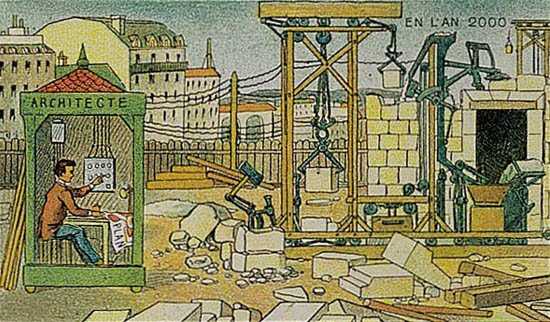
In 1910, French artist Villemard produced a series of illustrations depicting what life might be like in the year 2000, including an architect and his robotic construction crew.

In an article published last summer in Icon, called “The Robot and the Architect are Friends,” Will Wiles wrote that Swiss architects Gramazio & Kohler “have a vision: architecture using robotics to take command of all aspects of construction. Liberated from the sidelines, the profession would be freed to unleash all its creative potential—all thanks to its obedient servants, the robots. But first, architects must learn the robots’ language.”

[Image: Courtesy of Icon].

It all sounds deceptively easy at first: the architects have merely to program their robotic arm “to pick up a brick and place it, and then to repeat the process with variations. When this program runs, the result is a wall.”

The machine itself moves with the clipped grace we associate with robotics, performing neat, discrete actions that contain within them an assortment of fluid swivels and turns. These quick-slow, deliberate movements are hypnotic. It’s beautiful to watch but, because it moves in a way that looks animal while being unlike anything we know in nature, there’s something in it that’s inescapably unnerving.

Given multiple robots, sufficient bricks, complex instructions, and enough time, “extraordinary forms” can result, patterned and pixellated, brick-by-brick.

[Image: “Pike Loop” (2009) by Gramazio & Kohler].

“Considering the revolutionary potential of their work,” Wiles writes, “you might expect a note of utopian zeal from the pair.” He quickly adds, on the other hand, that, “if you want dazzling Wellsian predictions, delivered with glittering eyes, of future armies of architect-controlled mechanoids transforming the world, you’ve come to the wrong place.” Gramazio & Kohler’s vision is, instead, “understated, modest, [and] reasonable.”

Nonetheless, some combination of Villemardian enthusiasm—airborne tennis!—with rigorous architectural robotics, and perhaps even with emerging new brick designs and a new generation of 3D printers, is an enticing vision to pursue for the future of building construction.

(Villemard image originally seen via Selectism, thanks to a tip from Jon Bucholtz. Earlier on BLDGBLOG: Flying Robotic Construction Cloud).

Cathedral Scan

Artist Blake Carrington turns Gothic cathedrals into sound.

As Carrington explains it, his project Cathedral Scan—which will be performed live on Thursday, March 3, in the basilica of St. Patrick’s Old Cathedral in New York City—”translates the architectural plans of Gothic cathedrals into open-ended musical scores via custom software. Treating the plans as a kind of map, in the live performance Carrington navigates through them to create diverse rhythms, drones and textures.”

Groups of scanners filling the sonic spectrum may act in synch, forming a single harmonically-dense rhythm, or they may scan the plans at different speeds, resulting in complex polyrhythms. Each plan is treated as a modular score, with a distinct rhythm and timbre of its own. Also, by varying the speed and intensity of each scanning group, drone-like sounds may emerge based on the “resonant frequency” of the black and white plan.

Coming out later this month, March 2011, is an album version, on which Carrington’s work is “edited from a live concert in a large church space, and combines the direct signal created in software with the immense natural reverberation of the performance space.”

The video embedded above consists only of the “direct signal”—that is, “without spatial acoustics”—recorded during a concert in Montréal back in October 2009.

Of course, it’s difficult not to wonder what this might sound like applied to radically other architectural styles and structural types, from, say, the Seagram Building or the Forth Bridge to underground homes in Cappadocia. Further, it would be interesting to see this applied not just to plans or sections—not just to architectural representations—but to three-dimensional structures in real-time. Laser scans of old ruins turned from visual information to live sound, broadcast 24 hours a day on dedicated radio stations installed amidst the fallen walls of old temples, or acoustically rediscovering every frequency at which Mayan subwoofers once roared.

If you’re in NYC, be sure to check out Carrington’s concert.

(Thanks to Christophe Guignard, Sublamp, and Blake Carrington for the tip! Earlier: Listening to a machine made entirely from windows)

Modular Advances

[Image: Constructing with BeadBricks by Rizal Muslimin, courtesy of Brickstainable].

The winners of this year’s Brickstainable design competition were announced last week, and two of the technical award-winners are actually quite interesting.

[Images: BeadBricks by Rizal Muslimin, courtesy of Brickstainable].

I’m particularly taken by a submission called BeadBricks by Rizal Muslimin, described as able to facilitate the design of microclimates “in and around buildings” by allowing variable levels of porosity in the facade. BeadBricks could thus allow architects “to modulate the environmental factors including sunshine, wind, thermal mass, and evaporative cooling.”

The system, Muslimin explains, consists of “two bricks (A and B) with four basic rules that can generate shape in one, two and three dimensional space.” Further, “the bricks are decorated with a pattern that can generate various ornaments by rotating them along its vertical or horizontal axis.”

[Image: Constructing with BeadBricks by Rizal Muslimin, courtesy of Brickstainable].

The overall technical winner is also worth checking out: the EcoCeramic Masonry System, a “Recombinant and Multidimensional” molded terracotta brick devised by Kelly Winn and Jason Vollen.

[Image: The EcoCeramic Masonry System by Kelly Winn and Jason Vollen, courtesy of Brickstainable].

As Brickstainable describes it, their brick system “showcases the ability to look at new ceramic-based wall assemblies. Strategies include thermal dynamics, self-shading, moisture reduction, hydroscopic, evaporative, and termite behavior studies.”

[Images: The EcoCeramic Masonry System by Kelly Winn and Jason Vollen, courtesy of Brickstainable].

Meanwhile, a related project comes to us from designer Dror Benshetrit, who recently invented his own modular system, called QuaDror. On the other hand, it’s not really a “brick”; Fast Company describes it as “a structural joint that looks a little like a sawhorse, but can fold flat, making it both stunningly sturdy, remarkably flexible, and aesthetically pleasing.” Check out the video:

The suggested uses for QuaDror “include support trestles for bridges, sound buffer walls for highways, a speedy skeleton for disaster or low-income housing, and quirky public art.”

All in all, I would love to see more exploration with all three of these ideas, and I look forward to seeing all of them utilized in projects outside the design studio.

(Thanks to Thomas Rainwater for the tip about QuaDror and to Peter Doo for keeping me updated on Brickstainable).

Architectural Potential Energy

[Image: From the forthcoming Pamphlet Architecture #32 by Stasus].

The forthcoming Pamphlet Architecture #32, on the theme of “resilience,” will be authored by Matt Ozga-Lawn and James A. Craig of Stasus, a young design firm based in Edinburgh and London.

[Images: From the forthcoming Pamphlet Architecture #32 by Stasus].

The pamphlet, which will explore a series of post-industrial sites in the city of Warsaw—”a desolate area of disused freight rail tracks, commercial lots, gasometer buildings and other industrial apparatus,” as the architects describe it—is more explicitly narrative than the other pamphlets that have been most recently published.

“The scope and intent of our book,” Stasus writes, citing such influences as Piranesi and Andrei Tarkovsky’s film Stalker, “is to highlight the importance of forgotten landscapes in our cities and the potentialities that can be extracted from them.”

A sprawling, unplanned city centre threatens a desolate landscape that still embodies many resilient aspects of the city. In many ways, the “value” of this landscape, though barren, could be said to exceed that of the new centre. The profound additional meanings inherent to a disused rail track in Warsaw, for example, eclipse the meanings inherent to a city block of financial skyscrapers. Rather than replace or erase these attributes, we aimed to augment the resiliency of the meanings that were embodied in every element of the landscape we stumbled across. As our design process progressed this methodology spread to every aspect of our thinking.

Within this urban landscape “on the edge of oblivion,” as they describe it, “frozen, awaiting the imminent state of transition from one state to the next,” they focused on a series of found objects and particular locations—a kind of readymade architectural forensics of the city.

[Images: From the forthcoming Pamphlet Architecture #32 by Stasus].

Their chosen strategy seems to have arisen directly from a course taught at the University of Edinburgh by professor Mark Dorrian.

As Dorrian himself explains, his students were urged “to set aside all familiar hierarchies, and recognize that dust, a discarded piece of paper or a scratch on the floor is as important as a window, cornice, column or door. We are in a situation in which everything counts—or at least in which we can discount nothing.” Overlooked minor objects, apparently without use, and peripheral spaces of the city, apparently without residents, were thus taken as central to the course’s architectural intentions.

[Images: From the forthcoming Pamphlet Architecture #32 by Stasus].

For their part, Stasus interpreted this design brief as requiring the use of narrative in order to help them reveal their site’s future spatial possibilities. In their own words:

Once identified, the design process takes the form of a testing and investigation of the properties inherent to these existing landscapes of possibilities. The more resistant certain elements are to transformation, deletion, or manipulation, the more they are worked into the design process and become adapted within and integral to design “outputs.” The approach is therefore vastly different from a blank-paper methodology. Rather than creating our own clearing for design work, we aim to identify the most resilient elements within our field of exploration. These may be meanings passed through material context, implied mythical narratives, incidental connotations, historical and pre-historical implications.

“Our design process could therefore be described as an investigation of the resilient qualities of that which exists, a navigation of resilient landscapes,” they summarize.

And it is the work that came out of that course that thus forms the conceptual backbone for the work that will soon appear as Pamphlet Architecture #32.

[Images: Derelict landscapes and optical devices scaled up to the size of megastructures, by Stasus].

In his introductory essay for the pamphlets, Dorrian suggests that Stasus’s work “draws upon the strange imagined half-lives of obsolescent and anachronistic things” that are “charged with the future.”

Put another way, abandoned objects, locations, and spaces have a particular kind of architectural potential energy, a lack of precise definition that allows them to hover somewhere between promise and realization; however misleading it might actually be, then, dereliction implies a unique capacity for transformation—an ability to assume radically new spatial characteristics in the future—whilst simultaneously presenting what we could describe as fossils of an earlier world, one that has long since disappeared or ceased to operate.

[Images: From the forthcoming Pamphlet Architecture #32 by Stasus].

In any case, I’ve included some preliminary images from the pamphlet here, as well as some project images by Stasus; for more, check out Stasus’s website and keep your eye out for the Pamphlet itself, which I assume will be out sometime in the autumn.

Ruin, Space, and Shadow: An Interview with Mike Mignola

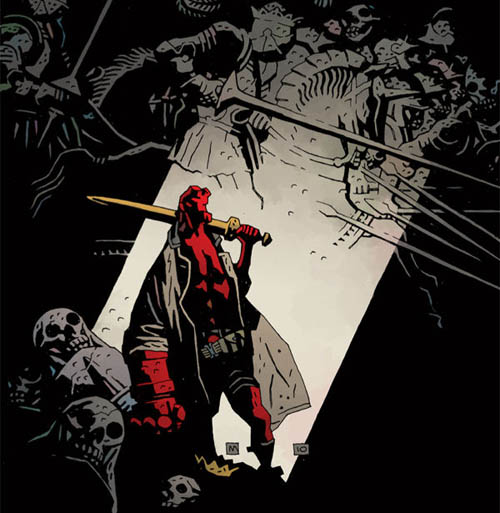
[Image: From a cover by Mike Mignola for Hellboy: The Storm, courtesy of Dark Horse Comics].

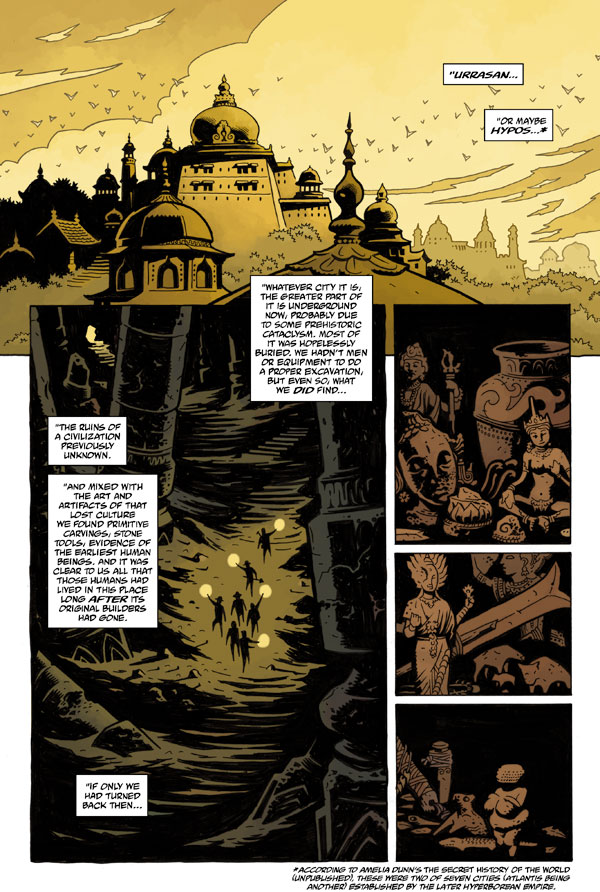
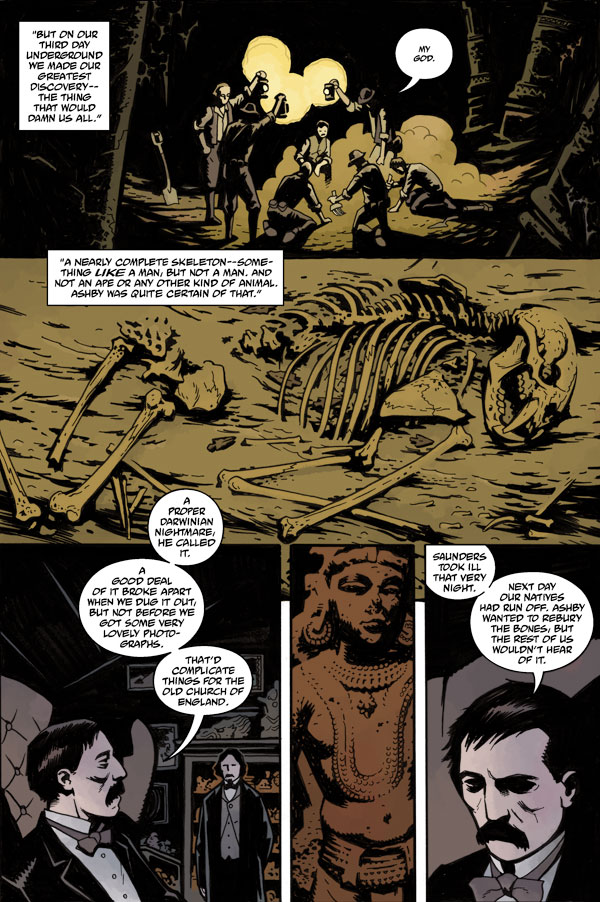
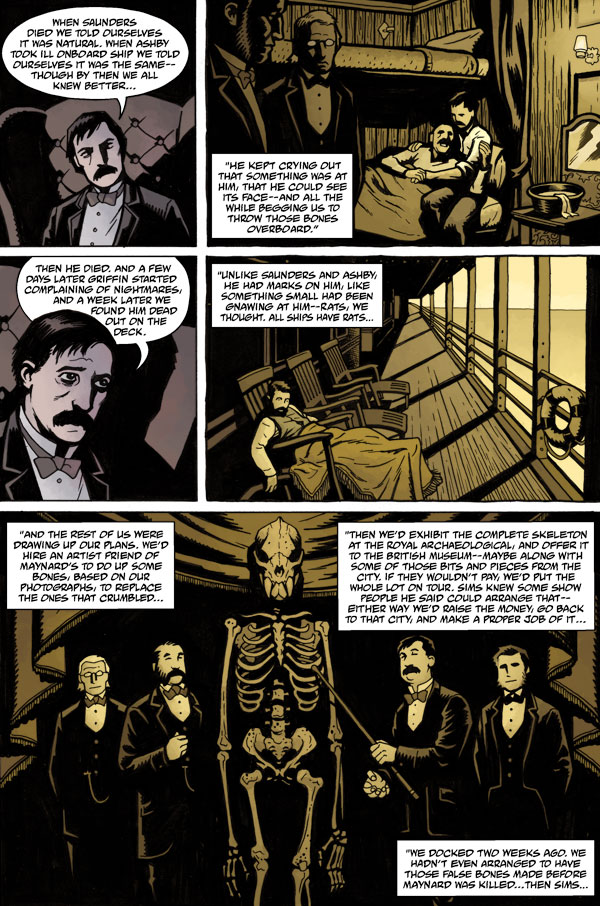
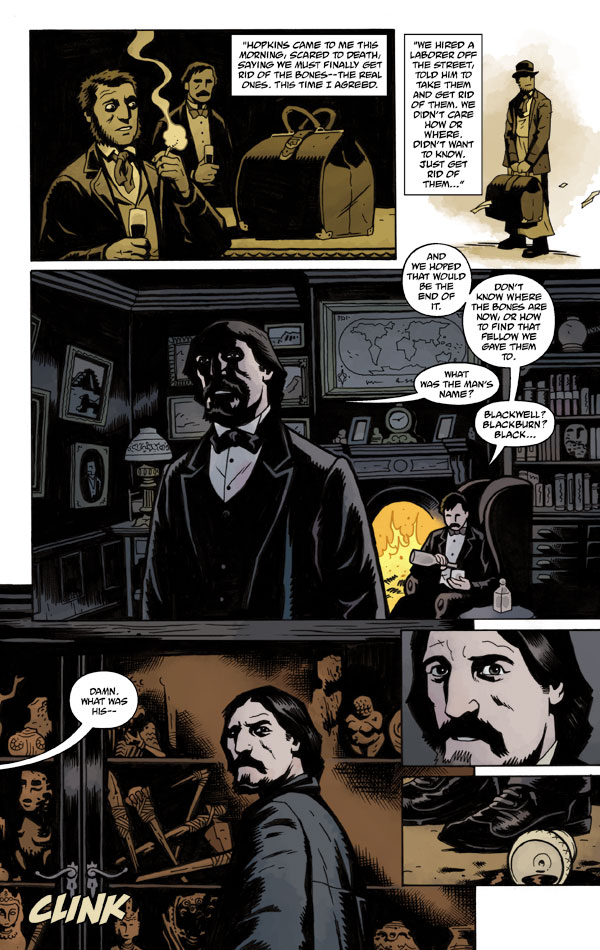
For half a decade now, I’ve been an avid fan of the work of Mike Mignola, creator of Hellboy, the B.P.R.D., and Abe Sapien, among many others, including, most recently, the new series Witchfinder and Baltimore. When my wife and I moved back to California last August, the heaviest boxes were the ones I’d stuffed full of graphic novels by Mike Mignola, which I’ve been hoarding whenever money allows. It’s become an addiction: the incredible old castle interiors and snowbound mountain landscapes of Conqueror Worm, the Mesoamerican design motifs emerging like mazes from pitch black walls of shadow in Seed of Destruction, the graveyards of ships wrecked on rocks before coastal citadels in Strange Places, and all of it shot through with Mignola’s dark sarcasm and humor.

Mignola’s work outlines an endlessly captivating world, somewhere between H.P. Lovecraft and Norse epics, Dracula—as rewritten by Jules Verne—and the Discovery Channel. Equal parts archaeology and horror fiction, Indiana Jones and The Thing, heretical mythology and conspiracy science, once Mignola’s work digs its plot lines and landscapes into you, it seems impossible to shake.

The buildings, terrains, and spaces Mignola’s plots take place within are equally extraordinary: there are remote, factory-like castles north of the Arctic Circle, wired floor-to-ceiling with arcane laboratory equipment; maritime plagues and New England shipwrecks; intelligent geological formations in space, larger than planets, signaling down to Army radar stations at the end of World War II; abandoned mines and ruined churches; Mayan fragments mounted on the luxurious, candlelit walls of Alpine mansions; Nazi conspiracies and fallen astronauts; derelict Victorian houses wrapped in fog on the coastal moor.

In addition to his prolific work as a graphic artist, Mignola has served as a visual consultant on three films by Guillermo Del Toro, each better than the previous: Blade II, Hellboy, and Hellboy 2: The Golden Army. With Christopher Golden, he is co-author of the recent novel Baltimore; he has drawn covers for Conan the Barbarian, X-Men, Aliens versus Predator, Superman, and dozens of others; and his Eisner Award-winning graphic novel, The Amazing Screw-On Head and Other Curious Objects, was republished in 2010.
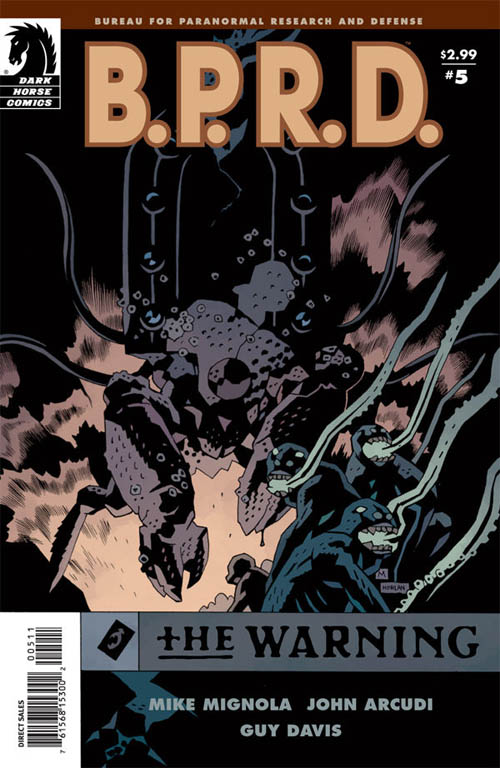
[Image: A cover by Mike Mignola for B.P.R.D.: The Warning, courtesy of Dark Horse Comics].

Mike Mignola recently talked to BLDGBLOG about his interests, including H.P. Lovecraft, wartime landscapes, and houses on the verge of collapse, with a specific focus on what it means to draw spaces of horror and mythology. We spoke by phone.

• • •

BLDGBLOG: I’ve long been interested in how people outside of the architectural world use buildings, landscapes, cities, and other spaces as a way to frame mood or character. Your own work, from Hellboy and the B.P.R.D. to Abe Sapien and Baltimore, is full of ruined churches, old battlefields, houses with flooded basements, warped floors and empty attics, and other straightforwardly Gothic landmarks. What draws you to these particular building types and locations, and how do these settings then affect your plot lines and characters?

Mike Mignola: Well, I am unapologetically old-fashioned in my use of Gothic settings. Ever since I was a kid, when I read Dracula, I’ve just loved those kinds of places.

I have never done a story in a shopping mall because, even if I’m not drawing it myself, I don’t want to see somebody draw a shopping mall. In the Hellboy world, and in other things I’ve done, those places almost don’t exist. When I do Eastern Europe—and I’ve been to Eastern Europe, and I’ve seen the shopping malls and the god-awful housing projects and things, and there are horror stories that take place in there, I have no doubt—but I gravitate toward the classic, clichéd, spooky places, whether they truly exist in this world or not.

But that’s the world I want to live in, and it’s the world my characters live in.
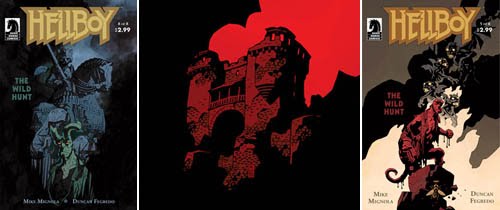
[Images: (left) A cover from Hellboy: The Wild Hunt; (middle) from the cover of Rex Mundi by Arvid Nelson and Juan Ferreyra; (right) a cover from Hellboy: The Wild Hunt. All artwork by Mike Mignola, courtesy of Dark Horse Comics].

BLDGBLOG: Beyond shopping malls, I’m curious if there are other sorts of anti-Mignola settings, so to speak—places where you just could never set a story, even if it’s just a bank in London.

Mignola: I’m not going to do any stories that I don’t want to draw—and, for the most part, those are places that also just aren’t particularly interesting for me to write about.

It’s interesting, because the spin-off book from HellboyB.P.R.D.—is written by another writer. I have some involvement there, but the books are written by somebody else. You look at that book now, and the current storyline takes place in a trailer park. It’s entirely made of the places I have no interest in writing about—but the other writer doesn’t have my overwhelming love of the Gothic. He’s a much more modern type of writer, so we differ on our choice of locations.

But, now, a haunted bank? You know, that would be cool—but it would have to be a really, really old bank. And preferably a bank that’s been abandoned for a bunch of years, so you have cobwebs and things. I just like those old, spooky settings.
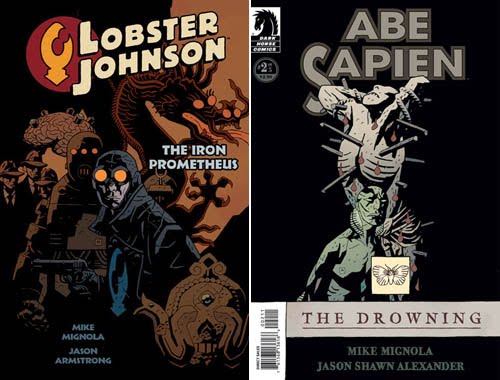
[Images: Covers by Mike Mignola, from Lobster Johnson: The Iron Prometheus and Abe Sapien: The Drowning, courtesy of Dark Horse Comics].

BLDGBLOG: There’s a maritime undercurrent in much of your work, including Hellboy, Abe Sapien, and, of course, the plague ships of Baltimore. It’s a kind of maritime Gothic—a world of shipwrecks and sea monsters and lighthouses on foggy coasts.

Mignola: Shipwrecks are great—but ships in general, even when they’re not wrecked, as long as they’re old school sailing ships, are wonderfully Gothic. I don’t know that I’ve done a lot of stories—if any stories—with ships that are 20th-century ships. I like the romance and the spookiness and the tragedy that goes with that old time sea travel. Those stories pertaining to ships are huge. I love them. They’re a big genre within ghost story fiction.

One of my favorite authors—a guy named William Hope Hodgson—most of his career, or a large chunk of his career, was writing supernatural ships-at-sea stories. There’s a romance in that old school, Gothic-y way to the world. And, basically, everything I love, I try to bring into my work. This world, or these different worlds that I’m creating, are entirely made of stuff that I love and think about.

Everything that I’m a fan of, I want to put into these worlds.
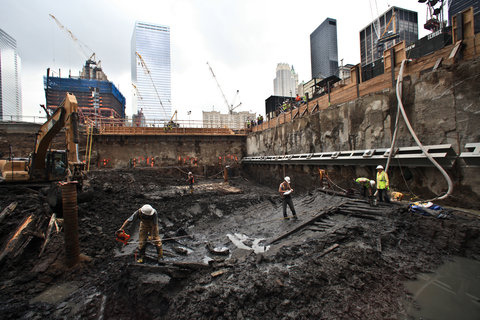
[Images: Photos by Fred R. Conrad, courtesy of The New York Times].

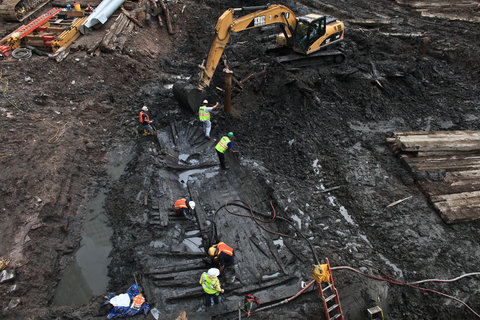
BLDGBLOG: Last summer, construction workers uncovered the remains of an old ship buried in the mud beneath the World Trade Center site in Manhattan, and some of the photos later printed in the New York Times, taken by Fred R. Conrad, were like something straight out of a Mike Mignola story. In some ways, it seemed like the perfect opening scene for a film version of Abe Sapien or for Hellboy 3—as if beneath, or even inside, the island of Manhattan we find this rotting, Gothic, semi-forgotten maritime history.

Mignola: Yeah, you know, I love history. I’m not a scholar—I’m not an historian—but it’s mostly because I just don’t have time. There’s too much other stuff I’m trying to keep on top of. But I love that sense of the buried past.
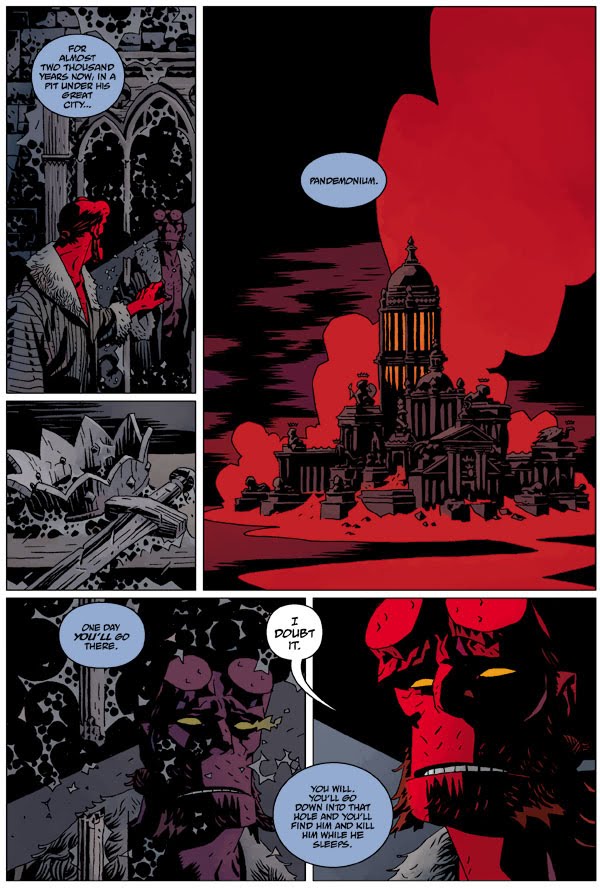
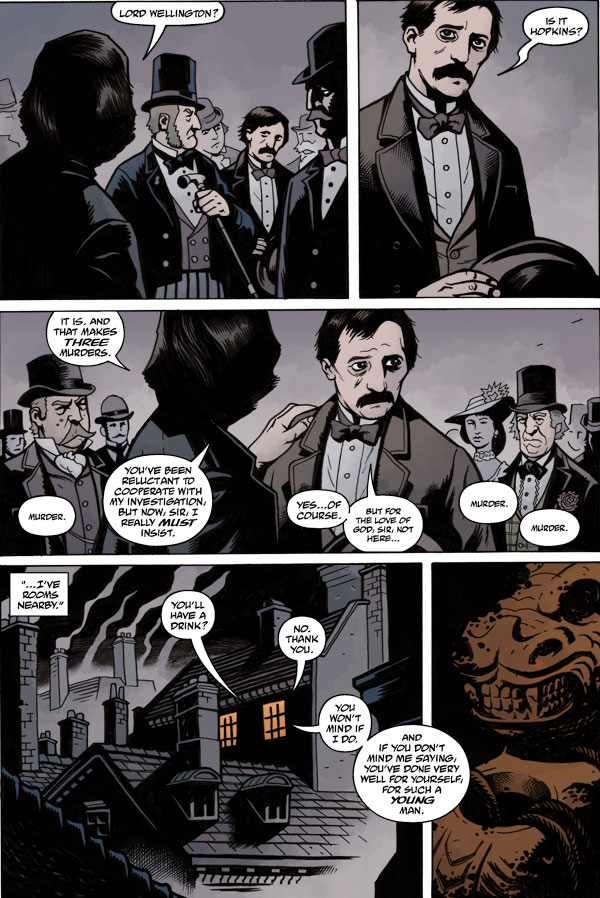
[Image: From Hellboy: The Wild Hunt, written by Mike Mignola and Scott Allie; art by Duncan Fegredo and Patric Reynolds. Courtesy of Dark Horse Comics].

BLDGBLOG: I want to go back to the idea of setting. Have you ever found yourself in a situation where a setting that you’ve devised for a certain storyline simply doesn’t work for Hellboy, say, so you have to use—or even invent—another character, or an entirely different plot, in order to use the architecture? In other words, how does setting—that is, how can architecture—affect plot and characterization, and vice versa?

Mignola: Well, part of the Baltimore series we’re doing now takes place on a World War 1 battlefield. I love that setting. It’s wonderfully rich in horror and drama—but it’s really hard for me to do a Hellboy story that takes place on a World War 1 battlefield. I could do it, and I’ve done stories like that, where it’s a time travel -slash- dream kind of thing—in fact, in an upcoming issue of Hellboy, I do have another character who I’ve tied to World War 1—but, to do it right, you need a World War 1 story.

So I came up with the Baltimore novel—and, now, the comic—to address that.

There’s also Victorian London, which I love. I came up with a Hellboy story once where he kind of time-traveled back to Victorian London—it seemed a little goofy to me—but I knew that I wanted to do Victorian London, so it was just a question of making a character who functioned in that world.

In a lot of cases, though, I am creating characters in order to see these places—these times, these settings. But, from the very beginning, I’ve known what kinds of stories I’ve wanted to do—so it’s also a question of finding the character who belongs to that world, as an excuse to draw that world.

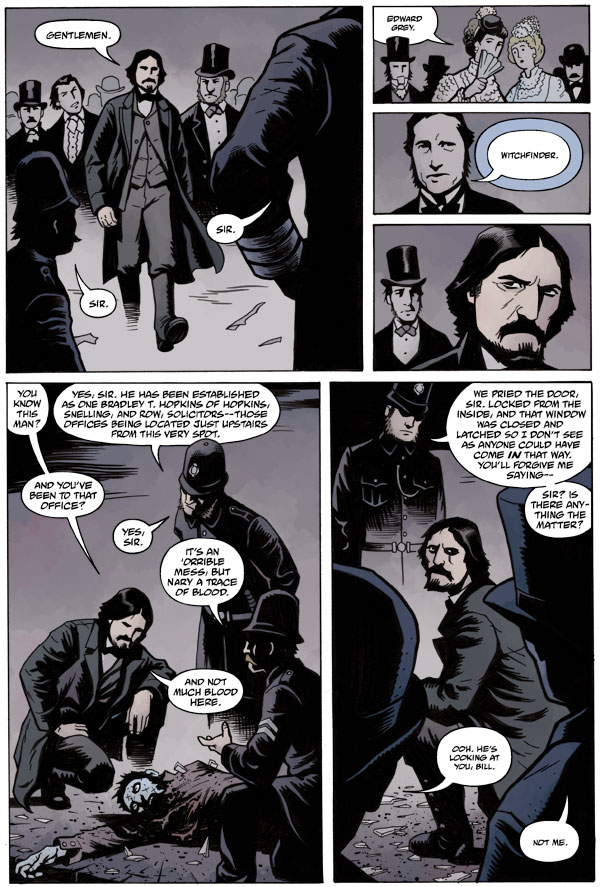
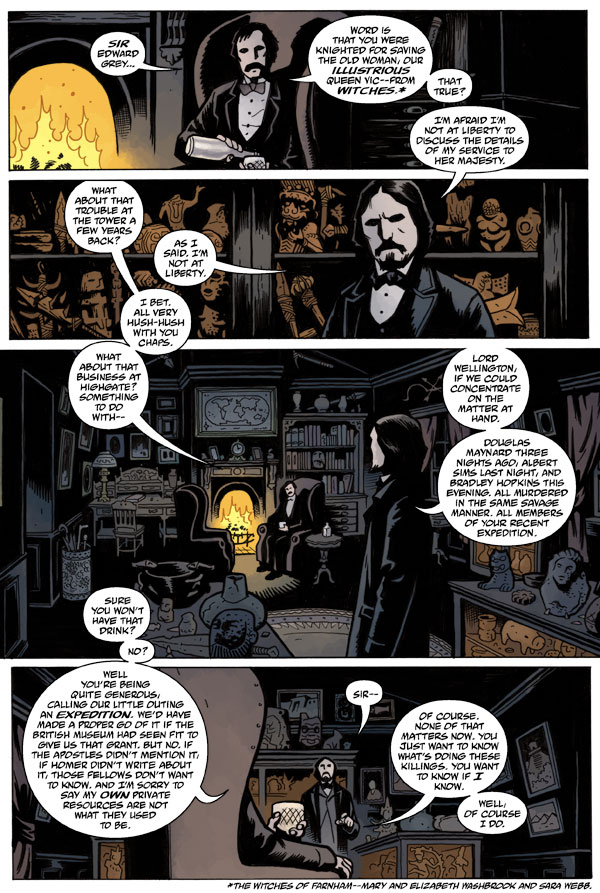
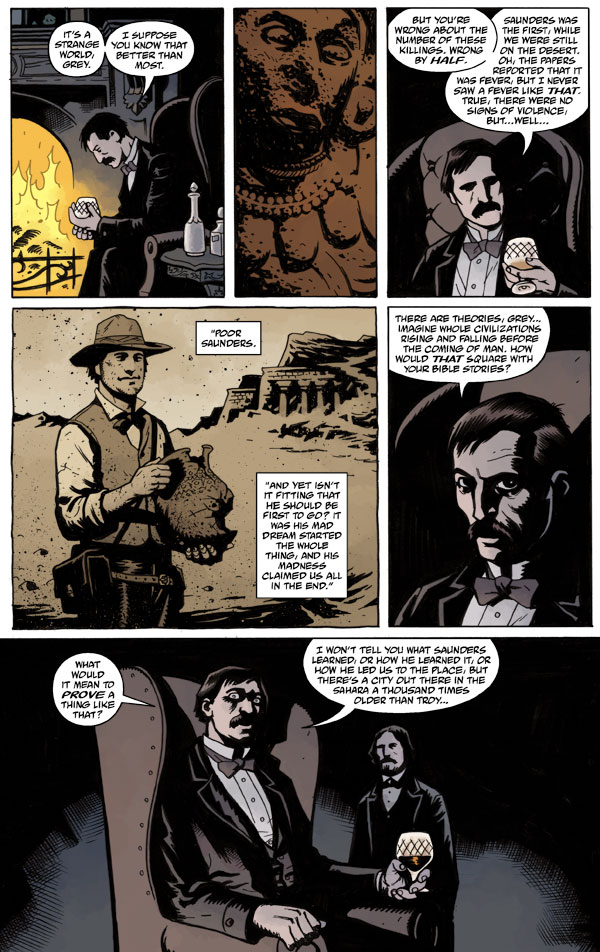
[Images: Preview spreads from Witchfinder: In the Service of Angels. Art by Ben Stenbeck, story by Mike Mignola, courtesy of Dark Horse Comics. If this gets you hooked, purchase the book].

BLDGBLOG: I’m curious about your work method, as far as nailing the details of these settings and landscapes. Do you travel a lot, watch a lot of movies, look at lots of photographs, talk to archaeologists—or it is really just an act of imagination?

Mignola: It’s a little bit of everything. I do watch a lot of films—which is great for getting the voice and the general character and the atmosphere—but I tend to come up with stories that are not super-specific to particular locations.

If I’m doing Victorian London, I’m not trying to do that story for a scholar of Victorian London. In a way, I say that this is more like a 1940s film version of London—in other words, I want to do at least the level of research that you’d see in an old Hollywood film. So I’ve given myself a little distance from reality with that.

But, as I say, I do like history. If I’m doing something specific, I’ve got a ton of reference books here in the studio, and I’ll try to make sure I get some of the names right and some of the dates right, if I’m referring to specific things. But, for the most part, I tend to shy away from plotting stories that are going to require a lot of very specific, historical research.

In Witchfinder, where I’m doing Whitechapel—well, I’ve been to Whitechapel. But I’m writing about 1880s, or maybe 1870s, Whitechapel, and I want it to seem like the real thing. So I did a little bit of homework on the East End. But the trouble with doing research for this stuff is that you start finding so much material that’s interesting, after you’ve already plotted the story, and you think, oh, I want to use this, and I want to use this, and I want to use this—well, uh oh, too late.

In terms of specifics, a little bit of dialogue, a little bit of color, a little bit of flavor, will give any story a certain amount of authenticity, but I’m not looking to make giant plot points out of that kind of stuff. It’s just background. Most of my buildings, and most of the things I do stories around—when I’m drawing these things, I’m trying to create objects, buildings, ships, whatever, with a particular background. I want it to feel like there is more to the story than can be told.

But, yes, you know, I have traveled a bit—and people love to think that what I’m doing comes from lots of traveling, and from talking to old monks and that sort of thing—

BLDGBLOG: [laughs]

Mignola: —and I have spent more time in Prague than I ever thought possible. But, other than a story I haven’t yet done—about a haunted couch—there are no experiences I’ve had that I’ve turned into stories. And the couch wasn’t haunted, you’ll be glad to hear; I think it was just infested with some kind of Eastern European insect.

For more exotic locations—like I did a story once set in Malaysia. It was entirely because I’d read a description years ago of a particular kind of Malaysian creature—a vampire—and I just knew I was going to do that story someday. But I needed pictures of Malaysia; I needed to do Malaysia research. That went back and forth for years, until, one day, I stumbled upon a book that just had really good photos of Malaysia. And that was it. It was the same with Norway: it was just a matter of some guy at a convention coming up to me with a book once that had great photos of Norway.

You know, I’m constantly looking for visual references. Story-wise, I’ve got all that stuff in my library—but I can never have enough photo references. There are still stories that are waiting to be told until I have the right references; and there are certain stories that I decided to set in a location just as an excuse for me to draw a particular place or building.

For instance, I did a story a couple of years ago called “In the Chapel of Moloch.” It was designed to take place almost entirely inside an old chapel. But the story wasn’t set in any particular location; it was just a matter of going to the books I had and looking for a building that would be fun to draw, or for a city that would be fun to draw, and I happened to have a book on Portugal. It had these great photos of decrepit hill towns, and a couple really good pictures of an old chapel. There was nothing about the story that was specific to Portugal—it was just that Portugal would be fun to draw. It was a nice, exotic location that I had never drawn before. And that’s usually how it works.

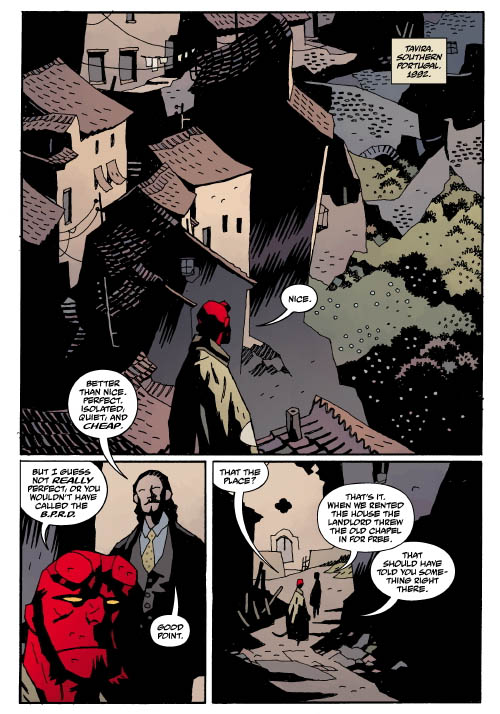
[Images: From Hellboy: In the Chapel of Moloch by Mike Mignola, courtesy of Dark Horse Comics].

BLDGBLOG: Stepping away from the idea of setting, I’m also interested in how you populate your stories with this constantly shifting catalog of sinister, yet natural, creatures: amphibians, frogs, worms, apes, gorillas. What is it about these particular species that works so well in terms of developing your mythological world?

Mignola: Well, I think monkeys are funny—that’s the easiest answer there. I don’t really love monkeys—but they’re kind of fun to draw. Something I always say is: monkeys always work. [laughter] People just like to see monkeys show up in these stories. I think it’s the absurdity of it.

In one of the first issues of Hellboy, I showed a 1940s scientist. I was drawing a bunch of scientists in a room, and one guy was actually just a severed head in a jar—but that wasn’t enough. The picture needed something else. So I drew a giant gorilla towering over them, with these Frankenstein-like bolts sticking out of his neck.

Oh—and you know what? Go back even earlier than that. Go back to one of the try-out stories—one of the teaser stories—before I even started the Hellboy series. It was a Frankenstein gorilla about to stick a needle in a girl’s neck—and, not that I stole the image from pulp magazines, but it’s such an old, clichéd, pulp magazine image. Making it a Frankenstein gorilla probably took it one step further, and made it my own, but it’s just… it’s funny. It’s so absurd it’s funny.

So, yeah, I use monkeys. And monkeys are usually the animal you associate with animal-testing. For instance, there’s another story where Hellboy’s blood is being extracted—and what are you going to inject Hellboy’s blood into? A rat? A rat just isn’t as much fun to draw turning into a giant hell-rat—actually, that’s not a bad idea—but it would be much more fun to take a monkey and turn it into a big demon-monkey, which is what I did.

As far as frogs and other amphibian stuff—that, again, is a reference to this kind of H.P. Lovecraft worldview where anything from the ocean is scary. Frogs, in a Lovecraft sense, are associated with some kind of unknowable world. They’re not from the ocean, but they’re also not from, you know, the woods. Where do they come from? And why are they always out there… chirping, or whatever the hell it is that frogs do? Lovecraft also uses birds that way—and birds are great—but I have a harder time drawing birds than frogs.

In the very first issue of Hellboy, I did a sequence with frogs in it, and it just sort of stuck. I established it early. Frogs will be my kind of icon characters; when frogs show up, you know something bad’s going to happen. They become symbolic of this kind of evil that’s always running around in the background.

And then things just tend to snowball. You know, you hear about something like a “rain of frogs,” which happens periodically for whatever reason—it’s one of those weird phenomena that gets written about—and, I thought, well, let me have a little bit of that kind of action. I mean, that’s a weird thing and it’s got a kind of authenticity to it: there’s something about it that’s unnatural, yet supposedly it does really happen. And I like that.

But I think you’ve put more thought into these questions than I have into why I do these things!
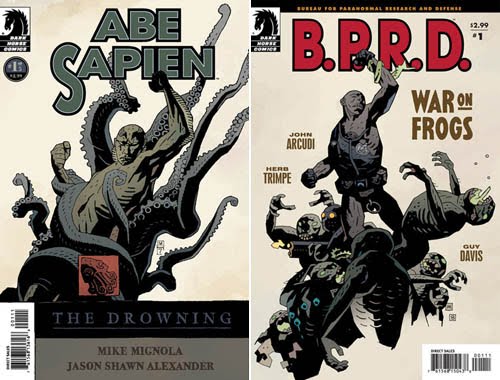
[Images: Covers by Mike Mignola, from Abe Sapien: The Drowning and B.P.R.D.: War on Frogs, courtesy of Dark Horse Comics].

BLDGBLOG: No, this is fascinating. It’s great to hear how you work. You mentioned H.P. Lovecraft: I’m curious to hear what you think it is about the Lovecraft universe—about the mythology of H.P. Lovecraft—that remains so appealing. In fact, it actually seems to be increasing in popularity today.

Mignola: For me, the monsters in Lovecraft are… you know, they’re fine. But what’s really appealing to me is his antiquarian sensibility. It’s the old houses in Rhode Island. It’s the fact that the guys are all scholars and they’re researching things, and there are references to different editions of this book or that book, and this edition is in that library, and a Latin translation of that book is in this other library. He writes about smart guys who spend a lot of time in libraries—and I love that.

His stories are set in a time when people are still wearing suits everyday. They even have upturned collars and things like that. There’s just a wonderfully old-fashioned, scholarly antiquarian feel to the stuff. It bridges the gap between modern horror and the old, classic M.R. James ghost stories—Lovecraft just added bigger monsters. Instead of some shadowy thing that skitters along the wall, it’s a giant octopus in space that makes people go crazy.

But it’s his obsession with old buildings, and shuttered windows, and climbing into church steeples—it’s his locations. I just love that.
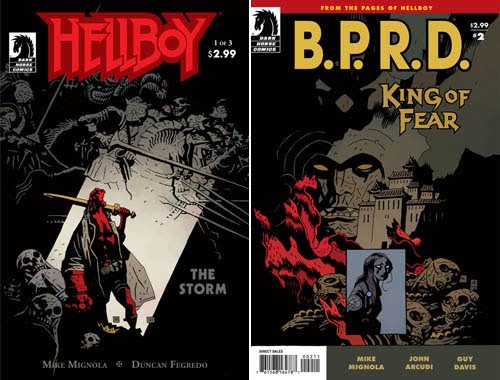
[Images: Covers by Mike Mignola, from Hellboy: The Storm and B.P.R.D.: King of Fear, courtesy of Dark Horse Comics].

BLDGBLOG: As well as things like abandoned fishing towns in New England, with collapsing wharves and moonlit salt marshes and that sort of thing.

Mignola: That’s actually one of my dream projects: to sit around and do half a dozen paintings of those towns. To do a series of drawings that’s just called Arkham, and it’s all about these buildings in creepy old coastal towns where the walls are falling over and they have these wonderful leans.
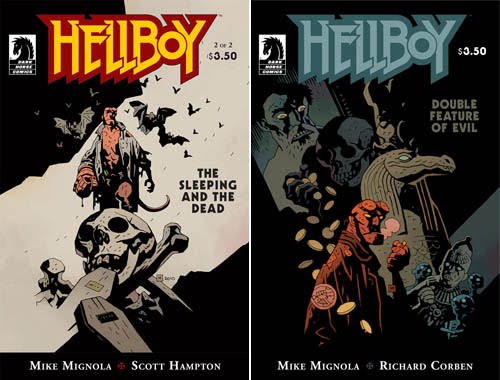
[Images: Covers by Mike Mignola, from Hellboy: The Sleeping and the Dead and Hellboy: Double Feature of Evil, courtesy of Dark Horse Comics].

BLDGBLOG: That brings us back to the idea of architecture and the role that architecture plays in your work. What brings you to draw a certain building or structure—and what do you add or exaggerate to make it more your own?

Mignola: [laughs] Well, once upon a time, when I started all this stuff, the one thing I didn’t want to draw at all was buildings. Because, growing up in California, buildings to me were an exercise in using a ruler and perspective, and shit like that. I just had no interest in drawing that kind of stuff.

It was only after having lived in New York for a while, around really old buildings—where you see that, actually, this building’s kind of sagging and that building’s kind of leaning against the other building next door and this chimney looks like, if those three wires weren’t there, it would all fall over, and that fire escape is at some odd angle—that’s when I really started to love architecture.

It’s one of those things that is still evolving in my work, as I become more and more comfortable drawing that sort of stuff: my buildings lean more.

Right now, I’m drawing an old house, and the house is leaning one way, the fence is leaning another way; I’m working from photo references, as I love to do, but I’m able to exaggerate it, and say, yeah, okay, this building’s kind of crooked in the photo, but let’s lean it way the hell over there. Let’s throw a couple of sticks out of it this way. Let’s make the building next door look like it’s about to fall over. And let’s make everything dark.

It’s really one of my favorite things to draw these days: old, crumbling architecture.
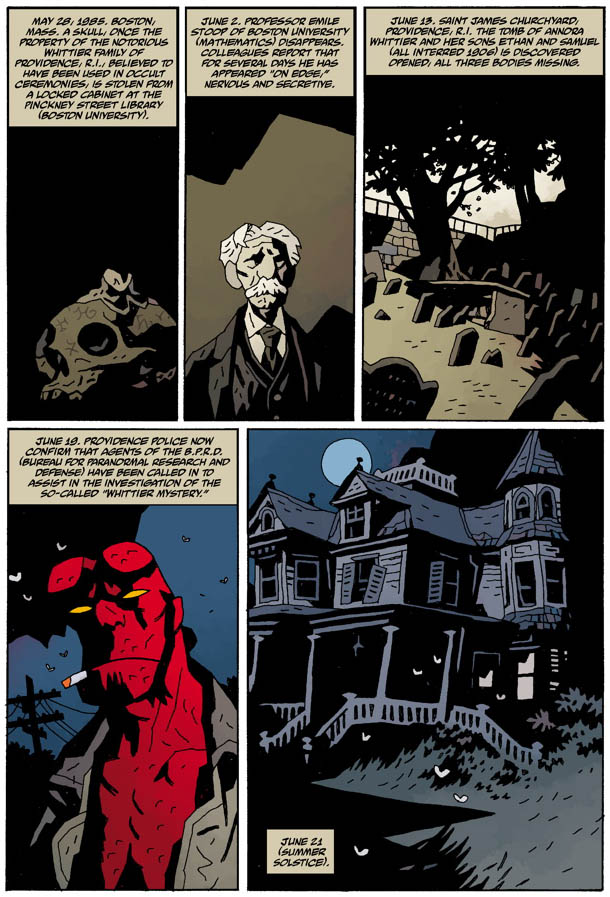
[Image: From “The Whittier Legacy” by Mike Mignola, courtesy of Dark Horse Comics; originally published in USA Today].

BLDGBLOG: Is there a particular building in your recent work that stands out this way?

Mignola: I recently did an 8-page story for USA Today called “The Whittier Legacy.” I said I was going to keep it simple for myself; I would set it almost entirely inside a house, in the dark. The way the story’s structured, we’re not going to spend a lot of time drawing furniture, little details, and things like that; it could just be an old, derelict house.

The most work that went into that story was going through my references and finding a really good house that would be fun to draw. I happened to have a book on Victorian houses that had a lot of really good texture to them and really nice angles, with things jutting out at weird angles. With the way I use shadow, it’s really important to me to have some sort of structure where things are going to be jutting out at different angles—because you can say, okay, if I light it on this side, that bit’s going to be in shadow; but if I light it on that side, then this is going to be in shadow. A square? You get light on one side and black on the other.

But if it’s a square with other things sort of jutting at you out of the shadows, and if you put a big porch on it, and, you know, it’s a derelict place so it’s all sort of sagging the way those old places start to do—then that’s a really good day for me, being able to draw stuff like that.

• • •

Thanks to Mike Mignola for taking the time to talk—and for producing so many awesome comics. Thanks, as well, to Jim Gibbons, Jeremy Atkins, and Scott Allie at Dark Horse Comics for their help with the images. If this interview piques your interest, consider picking up some of Mignola’s work for yourself.

Project Iceworm

[Image: Camp Century under construction; photograph via Frank J. Leskovitz].

Camp Century—aka “Project Iceworm”—was a “city under ice,” according to the U.S. Army, a “nuclear-powered research center built by the Army Corps of Engineers under the icy surface of Greenland,” as Frank J. Leskovitz explains.

A fully-functioning underground city, Camp Century even had its own mobile nuclear reactor—an “Alco PM-2A”—that kept the whole thing lit up and running during the Cold War.

[Images: Camp Century under construction; photographs via Frank J. Leskovitz].

According to Leskovitz, the Camp’s construction crews “utilized a ‘cut-and-cover’ trenching technique” during the base’s infra-glacial assembly:

Long ice trenches were created by Swiss made “Peter Plows,” which were giant rotary snow milling machines. The machine’s two operators could move up to 1200 cubic yards of snow per hour. The longest of the twenty-one trenches was known as “Main Street.” It was over 1100 feet long and 26 feet wide and 28 feet high. The trenches were covered with arched corrugated steel roofs which were then buried with snow.

Prefab facilities were then added, with “wood work buildings and living quarters… erected in the resulting snow tunnels.”

[Images: Camp Century under construction; photographs via Frank J. Leskovitz].

Leskowitz continues:

Each seventy-six foot long electrically heated barrack contained a common area and five 156 square foot rooms. Several feet of airspace was maintained around each building to minimize melting. To further reduce heat build-up, fourteen inch diameter “air wells” were dug forty feet down into the tunnel floors to introduce cooler air. Nearly constant trimming of the tunnel walls and roofs was found to be necessary to combat snow deformation.

Camp Century went from a scientific outpost to a potential U.S. Army site for hosting battle-ready nuclear missiles underneath the Greenland ice sheet—the so-called “Project Iceworm” mentioned earlier.

The following four short videos, produced by the U.S. military, explore the site’s strange technical circumstances as well as its complicated defensive history.


“During this period of the Cold War,” Leskovitz explains, “the U.S. Army was working on plans to base newly designed ‘Iceman’ ICBM missiles in a massive network of tunnels dug into the Greenland icecap. The Iceworm plans were eventually deemed impractical and abandoned,” and, “due to unanticipated movement of the glacial ice,” the entire subterranean complex was eventually left in ruins.

The idea that the moving terrain of a glacial ice sheet could be considered a stable-enough launching point for nuclear missiles is astonishing, and the idea that the U.S. Army once ran a top secret—and rather Metallica-sounding—”city under ice” just shy of the North Pole only adds to the story’s disarming surreality.

[Image: The plan of Camp Century; via Frank J. Leskovitz].

In any case, more photographs, including of the Army’s mobile nuclear reactor, are available on Leskovitz’s own site.

*Update* In August 2016, a study published in the journal Geophysical Research Letters suggested that “climate change could remobilize abandoned hazardous waste thought to be buried forever beneath the Greenland Ice Sheet,” specifically referring to the ruins of Camp Century.

“Camp Century could start to melt by the end of the century,” the American Geophysical Union summarizes. “If the ice melts, the camp’s infrastructure, as well as any remaining biological, chemical and radioactive waste, could re-enter the environment and potentially disrupt nearby ecosystems.”

[Image: U.S. Army photograph, via the American Geophysical Union].

Here is a PDF of the complete paper.