The Physics of Hell

inferno[Image: Dante’s great cyclotron of souls in the Inferno, a different sort of Hadron Collider; engraving by Gustave Doré].

In the context of all this talk about LIGO and gravitational waves, it’s interesting to look back at a 2011 article from the Boston Globe about an unexpected source of inspiration for Galileo Galilei.

“Galileo’s most important ideas might have their roots not in the real world, but in a fictional one,” we read, at least according to an argument “that Mount Holyoke College physics professor Mark Peterson has been developing for the past several years: specifically, that one of Galileo’s crucial contributions to physics came from measuring the hell of Dante’s Inferno. Or rather, from disproving its measurements.”

Ever since its 1314 publication, scholars had toiled to map the physical features of Dante’s Inferno—the blasted valleys and caverns, the roiling rivers of fire. What Galileo said, put simply, is that many commonly accepted dimensions did not stand up to mathematical scrutiny. Using complex geometrical analysis, he attacked a leading scholar’s version of the Inferno’s structure, pointing out that his description of the infernal architecture—such as the massive cylinders descending to the center of the Earth—would, in real life, collapse under their own weight.

Although Galileo himself would apparently soon realize that parts of his own debunking needed further debunking, Peterson points out that, in “applying mathematical models to Dante’s hell, Galileo was laying the groundwork for what would become theoretical physics.”

Peterson’s original 2002 paper on the matter is called “Galileo’s Discovery of Scaling Laws” (PDF).

The details of the Boston Globe article have been picked apart elsewhere, but the accuracy of its various historical claims is not what interests me; what seems worth posting about here, rather, is the wonderfully bizarre possibility that a culture could develop such an intense and otherworldly vision of eternal torture and damnation that it eventually inspires a new branch of physics.
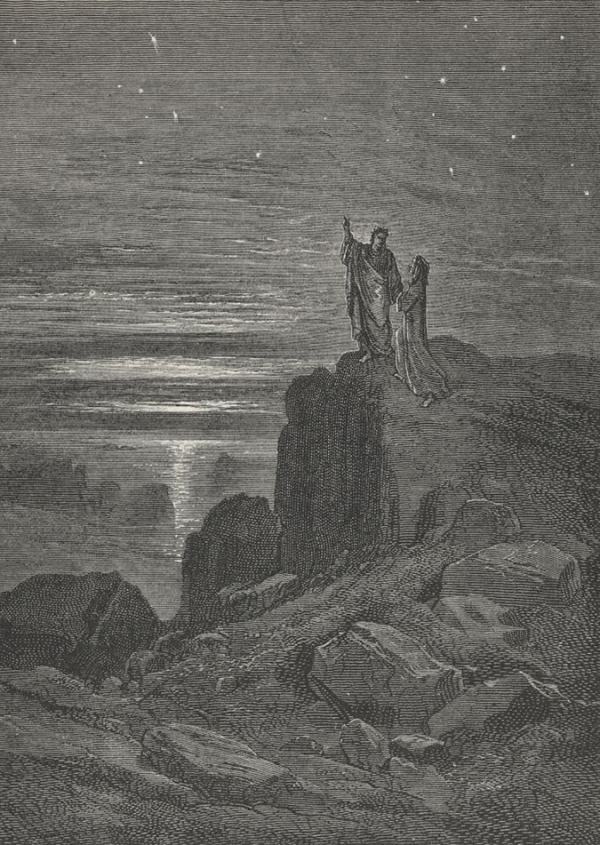
stellar[Image: After Hell, stars; from Dante’s Inferno, engraving by Gustave Doré].

In fact, one could easily imagine the strange molten geologies of such a landscape, this burning wasteland of semi-liquid rock, cut through with irradiated rivers and lakes, its temperatures on par with something more like a nuclear explosion, or perhaps just the electromagnetic atmospherics of a microwave; and one could just as easily imagine the mind-bendingly complex interpretive effort required to deduce actual, mathematically rigorous physical laws from such a nightmarish environment. Imagine scholars of Hell, sitting around immense tables made of black slate, calculating atmospheric pressures and the melting points of whole continents.

The idea, as well, that an entirely secular present-day science might actually have hidden within it a secret historical lineage dating back to descriptive measurements of Hell is, at the very least, a compelling framework for a work of speculative fiction. The mathematics used to describe the insides of stars, for example, actually originating with someone’s thesis on the burning points of angels, or the uncanny gravity of black holes traced back to field equations first written by someone trying to map the unstable angles of cliffs lining the uranium mines of the Inferno.

Of course, all of this could be theologically lightened quite a bit—a new branch of mathematics concerned, instead, with the idyllic meteorology of Paradise—but I guess I’ve always just been more interested in Hell.

Read the original Boston Globe article, as well as its rejoinder.

(Article spotted via @davidbmetcalfe).

Landscapes of Data Infection

seeds[Image: An otherwise unrelated seed x-ray from the Bulkley Valley Research Centre].

There’s a fascinating Q&A in a recent issue of New Scientist with doctor and genetic researcher Karin Ljubic Fister.

Fister studies “plant-based data storage,” which relies on a combination of artificially modified genes, bacteria, and “infected” tobacco plants.

Comparing genetic programming with binary code, Fister explains that, “First you need a coding system. A computer program is basically a sequence of 0s and 1s, so we transformed this into the four DNA ‘letters’—A, G, C and T—by turning 00 into A, 10 into C, 01 into G and 11 into T. Then we synthesised the resulting DNA sequence. We transferred this artificial DNA into a bacterium and infected the leaf of a tobacco plant with it. The bacterium transfers this artificial DNA into the plant.”

Even better, the resulting “infection” is heritable: “We took a cutting of the infected leaf, planted it, and grew a full tobacco plant from it. This is essentially cloning, so all the leaves of this new plant, and its seeds, contained the ‘Hello World’ program encoded in their DNA.” The plants thus constitute an archive of data.

In fact, Fister points out that “all of the archives in the world could be stored in one box of seeds.” Now put that box of seeds in the Svalbard Global Seed Vault, she suggests, and you could store all the world’s information for thousands of years. Seed drives, not hard drives.

It’s worth reading the Q&A in full, but she really goes for it at the end, pointing out at least two things worth highlighting here.

saguaros[Image: “Higashiyama III” (1989) by Kozo Miyoshi, courtesy University of Arizona Center for Creative Photography; via but does it float].

One is that specialized botanical equipment could be used as a technical interface to “read” the data stored in plants. The design possibilities here are mind-boggling—and, in fact, are reminiscent of the Landscape Futures exhibition—and they lead directly to Fister’s final, amazing point, which is that this would, of course, have landscape-scale implications.

After all, you could still actually sow these seeds, populating an entire ecosystem with data plants: archives in the form of forests.

“Imagine walking through a park that is actually a library,” she says, “every plant, flower and shrub full of archived information. You sit down on a bench, touch your handheld DNA reader to a leaf and listen to the Rolling Stones directly from it, or choose a novel or watch a documentary amid the greenery.” Information ecosystems, hiding in plain sight.

Christmas Tree Beach

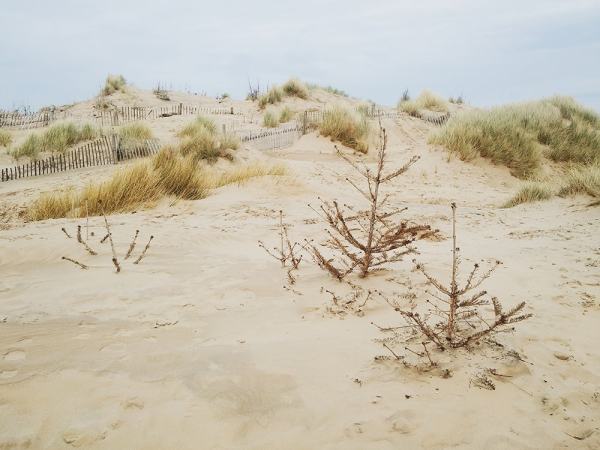
fionacroall1[Image: “Discarded Christmas trees were used to help rebuild the sand dunes around three years ago,” writes photographer Fiona Croall on her Instagram feed. “Now you can hardly see them!”].

While discarded Christmas trees here in New York City simply piled up on the sidewalks for more than two weeks after the holidays, forming strange—if still somewhat sadly picturesque—felled forests on the margins of the city, it turns out there’s an altogether more useful fate for those trees over in England.

There, the eroding beaches at Formby, just north of Liverpool, have been partially stabilized through Christmas tree donations.

formby[Image: The Christmas trees at Formby; photo courtesy National Trust/Robert Matthews].

“Our Rangers are asking people to bring their used real Christmas trees down to Formby so they can be used to help protect our internationally important sand dunes,” the National Trust explains.

The trees “help to mitigate [wind and erosion] by mimicking the action of the Marram grass, catching the sand blown on to the dunes from the beach and also dissipating the power of the wind as it blows across the surface of the dunes. Over time the trees become buried which helps to build up the dunes and they also help to partly stabilise the surface of the dunes which often allows the Marram grass to take hold again naturally.”

Below the beach, trees.

FionaCroall2[Image: The artificially stabilized beaches at Formby, with no sign of the displaced forest lurking below; photo by Fiona Croall].

Compare this approach, for example, to the widespread use of massive, industrially produced tetrapods for coastal erosion management—or even to the endless expense of so-called “beach nourishment”—and the idea of rebuilding the landscape using nothing more than linked chains of dead Christmas trees seems both tactically brilliant and cost-effective.

Not to mention archaeologically intriguing: it doesn’t take much to wonder how geotechnical assemblages such as these—huge arboreal lumps without a nearby forest to explain them—might appear to some distant researcher hoping to make sense of the stratigraphic record.

Like evidence of an ancient tsunami, the buried woods of Formby could surely sustain many a strange landscape theory to come.

(Huge thanks to photographer Fiona Croall who tweeted about the Christmas trees late last month).

The Labyrinth of Night, The Polar Gothic, and a Golden Age for Landscape Studies

It’s hard to resist a place called the Noctis Labyrinthus, or “the Labyrinth of Night,” especially when it’s on Mars.

NoctisLabyrinthus[Image: Courtesy ESA/DLR/FU Berlin].

“This block of martian terrain, etched with an intricate pattern of landslides and wind-blown dunes, is a small segment of a vast labyrinth of valleys, fractures and plateaus,” the European Space Agency reported earlier this week.

“As the crust bulged in the Tharsis province it stretched apart the surrounding terrain, ripping fractures several kilometres deep and leaving blocks—graben—stranded within the resulting trenches,” the ESA adds. “The entire network of graben and fractures spans some 1200 km, about the equivalent length of the river Rhine from the Alps to the North Sea.”

In other words, it’s an absolutely massive expanse of desert canyons and landslides, stretching roughly the distance from Switzerland to Rotterdam—a “700-mile labyrinth of fractures and landslides,” in the words of the reliably interesting Corey Powell on Twitter.

Imagine hiking there.

NoctisLabyrinthusAerial[Image: Courtesy ESA/DLR/FU Berlin].

We are living in something of a golden age for landscape studies. Over a remarkably short span of time, for example, we’ve learned that there are sinkholes on comets—that is, that comets have undergrounds. They have pores, caves, and tunnels, with sinkholes explosively airing this subterranean world into outer space. These “mysterious, steep-sided pits—one up to 600 feet wide and 600 feet deep,” as National Geographic described them, indicate that “there must be gaps inside.” Picture caves and tunnels evaporating in the darkness, before collapsing in on themselves in a crystalline flash.

Meanwhile, I have always loved the fact that there is a mountain range on Mars named after dead American astronauts, as if the Red Planet is somehow haunted in advance of human arrival by the mythological figures of explorers who never made it there. But this is just one small example of how a radically unfamiliar environment can gradually become known through the process of naming.

2016-01-01 22.59.25[Image: From India’s Mars Orbiter, via @coreyspowell].

My wife, Nicola Twilley, was actually at the Johns Hopkins Applied Physics Laboratory for the recent Pluto flyby, covering it for The New Yorker; she wrote a great description of how the former planet became a true landscape:

As the scientists traced tendrils of reddish brown and speculated as to the rate of melt at the edge of a two-toned ice patch near Pluto’s equator, the impossibly distant world came to life. Fed up with referring to features as, for instance, “the black circle at two o’clock” and “the big white patch,” the team had started to give them names—first nicknames, such as “the heart” and “the whale,” and then unofficial but more formal names drawn from the mythology of the underworld. The whale became Lovecraft’s Cthulhu, and a nearby dark smudge was christened Balrog, after the demons of Tolkien’s Middle-earth. An alien landscape had started to become a collection of places: knowable, if not yet known.

Interestingly, it seems that names come first, algorithms later.

In any case, while naming, of course, lends an air of familiarity to alien terrains—or knowability, we might say—the utterly bonkers nature of these landscapes remains extraordinary.

Nicky later revisited the subject, for example, writing that “the reddish patches” seen on Pluto might actually be “the organic material nicknamed ‘star tar,’ a precursor to life”—sludge awaiting sentience—and that “cryovolcanoes—volcanoes that spew slushy methane and nitrogen ice rather than molten rock,” might exist at the planet’s south pole.

There, this slow-moving matrix of frozen elements would circulate amongst other “exotic ices” in the distant cold, surely another kind of “labyrinth of night,” if there ever was one.

Think of what writer Victoria Nelson has called the “polar Gothic,” referring to an era of science-fictional representations of the Earth’s own polar regions as places of psychological menace and theological mystery; now picture weird slurries of nitrogen and star-tar sinkholes in a region named after Cthulhu, and it seems that perhaps the great age of landscape exploration has only now truly begun.

Consider, for example, this tweet by Rob Minchin, referring to the latest geological revelations coming from Pluto, a world of nitrogen glaciers and ice tectonics. “Water ice floats on nitrogen or CO ice,” he explains. This means, unbelievably, that “numerous mountains on Pluto appear to be floating.”

pluto[Image: Pluto, via @CoreySPowell].

Even within our own solar system, it seems, if you have an idea for a landscape so unreal it borders on pure fantasy, there is a planet, comet, or asteroid already exceeding it.

(In addition to @CoreySPowell, another good Twitter account for offworld landscape studies is @LoriKFenton, as the images seen at the link make clear).

Of Artificial Mountains, Revolutionary Politics, and Parisian Supreme Beings

“On 8 June 1794 (20 Prairial Year II) an artificial landscape was erected in the centre of Paris,” Andrew Ray writes at some LANDSCAPES. “This day had been chosen for the first Celebration of the Supreme Being, a new godhead devised by Robespierre, then at the zenith of power… What kind of mountain would be adequate for the Supreme Being? Not, it would seem from contemporary prints, a perfectly shaped one.” If this interests you, meanwhile, check out David Gissen’s project for a reconstruction of “The Mound of Vendôme.”

Nocturnes

merrell4[Image: Screen grab from Nocturnes].

Filmmaker Alec Earnest—who we last saw here for his short film about the death of a mysterious map collector in Los Angeles—is back with a mini-documentary about landscape painter Eric Merrell.

Merrell, we read, “might be best known for his rigorous approach to landscape painting. For several years Merrell has been working on Nocturnes, a series of abstract desert works that he has painted all over Southern California, each solely by the light of the moon.”

merrell6[Image: Screen grab from Nocturnes].

Earnest’s film follows Merrell into Joshua Tree National Park, “where night falls and the desert takes on a surreal and mysterious beauty, where edges blur and shapes transform, and solitude takes on a whole new meaning.”

The small crew used a new Sony A7S camera “that basically allowed us to shoot completely in the dark,” Earnest explained to me over email.

The film is embedded, below:

Of course, as the video makes clear, this is a slight—but only slight—exaggeration, in that Merrell uses a headlamp and small clip lights on his painting box to help illuminate the scene.

merrell11merrell2[Image: Screen grab from Nocturnes].

When those lights are switched off, however, the landscape takes on a silvered, almost semi-metallic lunar glow, as if bathed in ambient light.

merrell8merrell7[Image: Screen grab from Nocturnes].

Standing there in the darkness, Merrell comments on how working at night also comes with a peculiar kind of audio enhancement, with distant sounds riding the breeze with a peculiar clarity; and at one point a fortuitous lightning storm rolls by in the distance, as if to prove Merrell’s point with the atmospheric sonar of a thunder crash echoing over the otherworldly rocks of the National Park.

merrell12merrell13[Images: Paintings by Eric Merrell; screen grabs from Nocturnes].

Read a bit more at the L.A. Review of Books, and don’t miss Earnest’s earlier film here on BLDGBLOG.

(Related: In Search of Darkness: An Interview with Paul Bogard).

Secret Tunnels of England

The London Fortean Society, of all people, will be hosting a talk called “Secret Tunnels of England: Folklore and Fact” by Antony Clayton, author of the fascinating book Subterranean City: Beneath the Streets of London, on March 9. “So-called secret tunnels are a subject of perennial interest,” we read. “Are there really labyrinths of hidden passageways under our ancient buildings, towns and cities, or are these tunnel tales another seam of England’s rich folklore?” See, for example, BLDGBLOG’s earlier look at the Peterborough tunnels. There is still time to get on a waiting list for tickets. For what it’s worth, I also referred to Clayton’s book in my recent essay for The Daily Beast about the Hatton Garden heist. (Event originally spotted via @urbigenous).

Burial Grounds

Blogger Andrew Ray of Some Landscapes recently re-read The Wind in the Willows to his son, stumbling on “an intriguing passage that I’d forgotten all about, concerning Badger’s large underground home.” It is a scene where “the idea of the city has been literally buried,” where, “civilisations decline but nature endures,” an underground world of ruined architecture and vaulted halls disguised as forests.

Extra-Terrestrial Sand Dunes

Geologist Michael Welland has an interesting post up about the “first detailed examination of extra-terrestrial sand dunes” on Mars, coming later this year. His post also briefly discusses the life and career of Ralph Bagnold, after whom the Martian dunes are named, as well as the granular physics of a remote landscape that, in Welland’s words, “just seems, instinctively, to be unearthly.”

Marine Acoustic Zones

Outside looks at the idea of “acoustic sanctuaries” in the sea, designed to help marine life communicate free of “anthropogenic noise,” whether created by military sonar or commercial shipping. Meanwhile, how much would I love to visit an “acoustic sanctuary” on land—a landscape deliberately cleared of “anthropogenic noise”—almost like the sound gardens and acoustic forestry of a designer like David Benqué.

To roam hither and thither rather than plod a linear course

The blog Landscapism takes a look at the “integral but largely uncharted topography” of the combe, the “amphitheatre-like landform that can be found at the head of a valley.” There, the post’s author writes, amidst lichen-covered rubble and interrupted creeks, “these watery starting lines disguised as cul-de-sacs are a gift to the rural flâneur; sheep tracks, streams, crags, ruined sheep folds—all encourage the curious visitor to roam hither and thither rather than plod a linear course.”