Starfish City

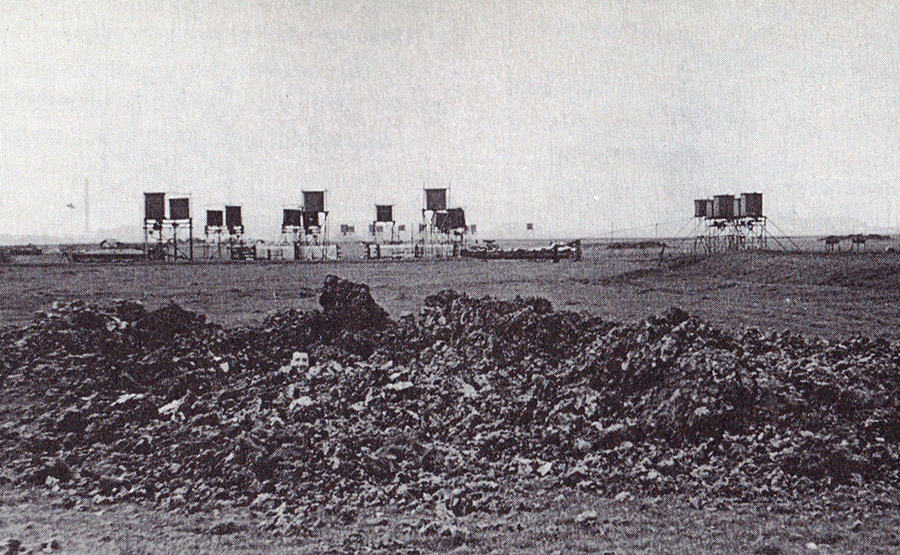
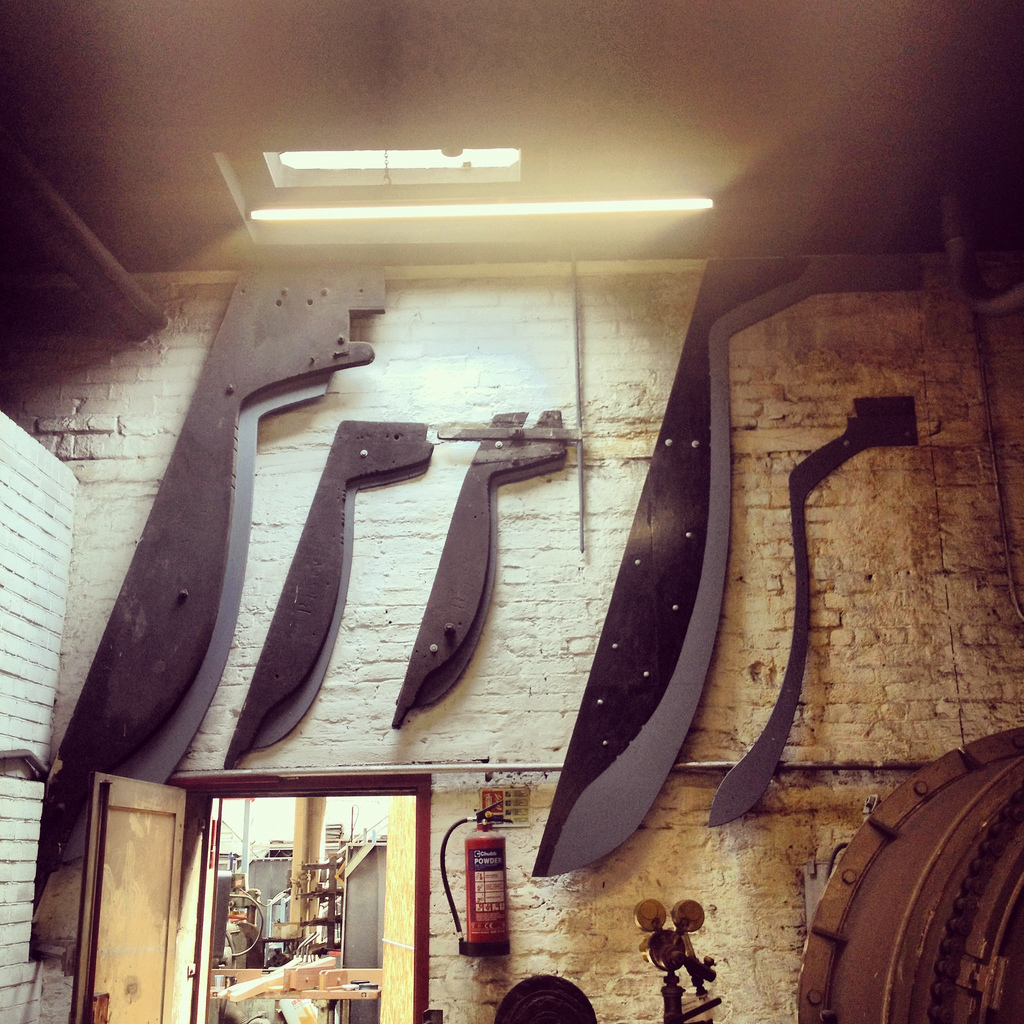
[Image: A Starfish site, like a pyromaniac’s version of Archigram, via the St. Margaret’s Community Website; view larger].

A few other things that will probably come up this evening at the Architectural Association, in the context of the British Exploratory Land Archive project, are the so-called “Starfish sites” of World War II Britain. Starfish sites “were large-scale night-time decoys created during The Blitz to simulate burning British cities.”

[Image: A Starfish site burning, via the St. Margaret’s Community Website; view larger].

Their nickname, “Starfish,” comes from the initials they were given by their designer, Colonel John Turner, for “Special Fire” sites or “SF.”

As English Heritage explains, in their list of “airfield bombing decoys,” these misleading proto-cities were “operated by lighting a series of controlled fires during an air raid to replicate an urban area targeted by bombs.” They would thus be set ablaze to lead German pilots further astray, as the bombers would, at least in theory, fly several miles off-course to obliterate nothing but empty fields camouflaged as urban cores.

They were like optical distant cousins of the camouflaged factories of Southern California during World War II.

Being in a hotel without my books, and thus relying entirely on the infallible historical resource of Wikipedia for the following quotation, the Starfish sites “consisted of elaborate light arrays and fires, controlled from a nearby bunker, laid out to simulate a fire-bombed town. By the end of the war there were 237 decoys protecting 81 towns and cities around the country.”

[Image: Zooming-in on the Starfish site, seen above; image via the St. Margaret’s Community Website].

The specific system of visual camouflage used at the sites consisted of various special effects, including “fire baskets,” “glow boxes,” reflecting pools, and long trenches that could be set alight in a controlled sequence so as to replicate the streets and buildings of particular towns—1:1 urban models built almost entirely with light.

In fact, in some cases, these dissimulating light shows for visiting Germans were subtractively augmented, we might say, with entire lakes being “drained during the war to prevent them being used as navigational aids by enemy aircraft.”

Operational “instructions” for turning on—that is, setting ablaze—”Minor Starfish sites” can be read, courtesy of the Arborfield Local History Society, where we also learn how such sites were meant to be decommissioned after the war. Disconcertingly, despite the presence of literally tons of “explosive boiling oil” and other highly flammable liquid fuel, often simply lying about in open trenches, we read that “sites should be de-requisitioned and cleared of obstructions quickly in order to hand the land back to agriculture etc., as soon as possible.”

The remarkable photos posted here—depicting a kind of pyromaniac’s version of Archigram, a temporary circus of flame bolted together from scaffolding—come from the St. Margaret’s Community Website, where a bit more information is available.

In any case, if you’re around London this evening, Starfish sites, aerial archaeology, and many other noteworthy features of the British landscape will be mentioned—albeit in passing—during our lecture at the Architectural Association. Stop by if you’re in the neighborhood…

(Thanks to Laura Allen for first pointing me to Starfish sites).

Books Received

[Image: The Wiederin bookshop in Innsbruck, Austria; photo by Lukas Schaller, courtesy of A10].

Barely in time for the holidays, here is a quick look at some of the many new or recent books that have passed through the home office here at BLDGBLOG.

As usual, I have not read all of the books listed here, but this will be pretty clear from the ensuing descriptions; those that I have read, and enjoyed, I will not hesitate to recommend.

And, as always, all of these books are included for the interest of their approach or subject matter as it relates to landscape, spatial sciences, and the built environment more generally.
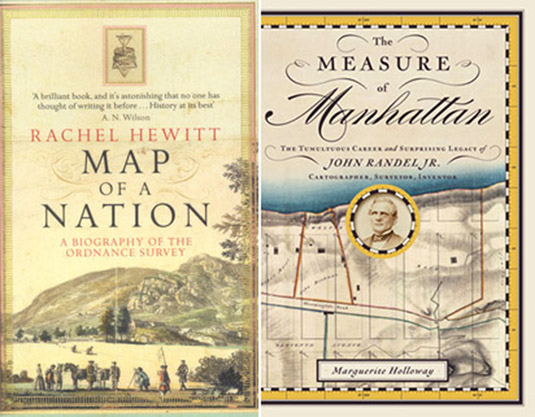
1) Map of a Nation: A Biography Of The Ordnance Survey by Rachel Hewitt (Granta).

2) The Measure of Manhattan: The Tumultuous Career and Surprising Legacy of John Randel, Jr., Cartographer, Surveyor, Inventor by Marguerite Holloway (W.W. Norton).

These two fantastic books form a nice, if coincidental, duo, looking at the early days of scientific cartography and the innovative devices and mathematical techniques that made modern mapping possible. In Rachel Hewitt’s case—a book I found very hard to put down, up reading it till nearly 2am several nights in a row—we trace the origins of the UK’s Ordnance Survey by way of the devices, tools, precision instruments, and imperialist geopolitical initiatives of the time.

Similarly, Marguerite Holloway introduces us to, among many other things, the first measured imposition of the Manhattan grid. I mentioned Holloway’s book the other day here on BLDGBLOG, and am also very happy to have been asked to blurb it. Here’s my description: “This outstanding history of the Manhattan grid offers us a strange archaeology: part spatial adventure, part technical expedition into the heart of measurement itself, starring teams of 19th-century gentlemen striding across the island’s eroded mountains and wild streams, implementing a grid that would soon enough sprout skyscrapers and flatirons, Central Park and 5th Avenue. Marguerite Holloway’s engaging survey takes us step by step through the challenges of obsolete land laws and outdated maps of an earlier metropolis, looking for—and finding—the future shape of this immeasurable city.”

For anyone at all interested in cartography, these make an excellent and intellectually stimulating pair.
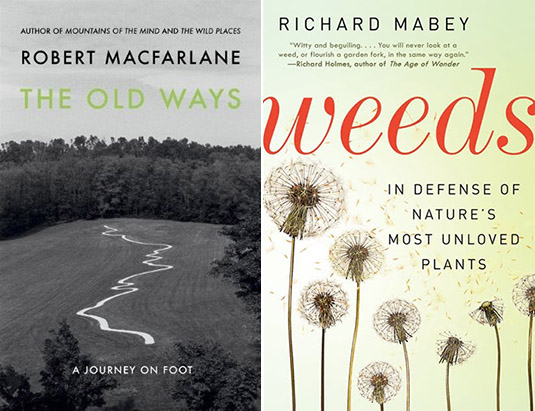
3) The Old Ways: A Journey on Foot by Robert Macfarlane (Viking).

4) Weeds: In Defense of Nature’s Most Unloved Plants by Richard Mabey (Ecco).

I’ve spoken highly of Robert Macfarlane’s writing before, and will continue to do so. His Wild Places remains one of my favorite books of the last few years, and I was thus thrilled to hear of his newest: a series of long walks (and a boat ride) through the British landscape, from coastal mudflats to chalk hills and peat bogs, following various kinds of well-worn routes and paths, the “old ways” of his book’s title. Macfarlane’s writing can occasionally strain for rapture when, in fact, it is precisely the mundane—nondescript earthen paths and overlooked back woods—that makes his “journeys on foot” so compelling; but this is an otherwise minor flaw in a highly readable and worthwhile new book.

Meanwhile, Richard Mabey has written an almost impossibly captivating history of weeds, “nature’s most unloved plants.” Covering invasive species, overgrown bomb sites in WWII London, and abandoned buildings, and relating stories from medieval poetry and 21st-century agribusiness to botanical science fiction, Mabey’s book is an awesome sweep through the world of out-of-place plant life.
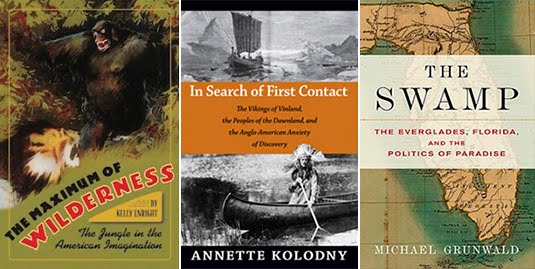
5) The Maximum of Wilderness: The Jungle in the American Imagination by Kelly Enright (University of Virginia Press).

6) In Search of First Contact: The Vikings of Vinland, the Peoples of the Dawnland, and the Anglo-American Anxiety of Discovery by Annette Kolodny (Duke University Press).

7) The Swamp: The Everglades, Florida, and the Politics of Paradise by Michael Grunwald (Simon & Schuster).

These three books variously describe encounters with the alien wilderness of a new world. Kelly Enright’s look at “the jungle in American imagination” reads a bit too much like a revised Ph.D. thesis, but its central premise is fascinating, looking not only at the complex differences between the meaning of a jungle and that of a rain forest, but exploring, as she phrases it, “some of the consequences of expanding an American image and ideology of wilderness beyond American shores,” from Theodore Roosevelt to the early days of tropical anthropology.

Annette Kolodny’s review of what can more or less be summarized as the Viking discovery of North America is incredibly rich. Quoting from the cover, Kolodny “offers a radically new interpretation of two medieval Icelandic tales, known as the Vinland Sagas. She contends that they are the first known European narratives about contact with North America.” However, in addition to these tales of “first contact,” Kolodny examines rock carvings in Maine and Canada, as well as Native American folktales, to try to geographically and historically locate the moment when Europeans first arrived in North America, sailing up the small coastal rivers and setting foot on foreign land. Kolodny convincingly demonstrates, in the process, that the Viking discovery of North America was more or less widely accepted by 19th-century historians, but that, she argues, following a large influx of Italian immigrants toward the end of that century and into the 20th, the national importance of Christopher Columbus—an Italian—began to grow. From this emerged, she shows, a kind of narrative contest in which rugged northerners from a stoic, military culture (the Norse) were pitted against royalist Catholic Mediterranean family men as the true cultural progenitors of the United States. It is also interesting here to note that Kolodny assigned these early Icelandic contact narratives to her English literature class, asking students “to consider the possibility that American literature really began in these early ‘contact’ narratives that constructed a so-called New World and its peoples through and for the contemporary cultural understandings of the European imagination.”

I read Michael Grunwald’s The Swamp under particular circumstances—traveling around Florida as part of Venue, along with Smout Allen and a group of students from the Bartlett School of Architecture (photos of that trip can be seen here and here)—which might have added to its appeal. But, either way, I was riveted. Grunwald’s book presents, in effect, all of Florida south of Orlando as a massive series of ecologically misguided—but, from an economic perspective, often highly successful—terraforming projects. Speaking only for myself, the book made it impossible not to notice waterworks everywhere, on all sides and at every scale: every canal, storm sewer, water retention basin, highway overpass, levee, reservoir, drainage ditch, coastal inlet, and flood gate, all parts of an artificially engineered peninsula that wants to—and should—be swamp. Environmentally sensitive without being a screed, and written at the pace of a good New Yorker article, The Swamp was easily one of my favorite discoveries this year, a book I’d place up there with Marc Reisner’s classic Cadillac Desert; it deserves the comparison for, if nothing else, its clear-eyed refocusing of attention onto a region’s hydrology and onto civilization’s larger attempts to manage wild lands (and waters), from the Seminole Wars to George W. Bush. Grunwald also makes clear something that I had barely even considered before, which is that south Florida is actually one of the most recently settled regions of the United States, far younger than the new states of the American West. South Florida, in many senses, is an event that only just recently happened—and Grunwald shows both how and why.
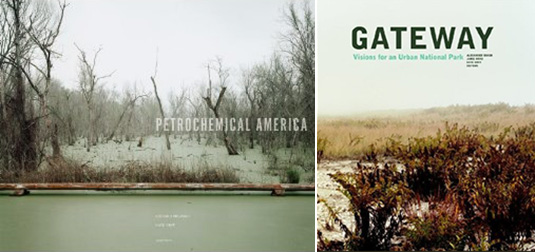
8) Petrochemical America by Richard Misrach and Kate Orff (Aperture Foundation).

9) Gateway: Visions for an Urban National Park edited by Alexander Brash, Jamie Hand, and Kate Orff (Princeton Architectural Press/Van Alen Institute).

Here are two new books, each connected to the work of landscape architect and Columbia GSAPP urban planner, Kate Orff.

The first is a split project with photographer Richard Misrach, looking both directly and indirectly at petrochemical infrastructure and the landscapes it passes through in the state of Louisiana. Misrach’s photos open the book with nearly 100 pages’ worth of views into the rapidly transforming nature of Louisiana’s so-called Cancer Alley, “showcasing the immediate plight of embattled local communities and surrounding industries.” Orff’s work follows in the second half of the book with what she calls an “Ecological Atlas” of the same region, mapping what currently exists, more thoroughly annotating Misrach’s photos, and proposing new interventions for ecologically remediating the spoiled landscapes of the region.

The second book is an edited collection of essays and proposals for New York’s Gateway National Recreational Area. Gateway is a strange combination of protected lands and artificial dredgescapes, at the border between ocean and land at the very edge of New York City. Photographs by Laura McPhee join essays by Ethan Carr, Christopher Hawthorne, and others to suggest a new role for parks in American urban life, and a new type of park in general, one that is distributed over discontinuous parcels of marginal land and includes large expanses of active waters.
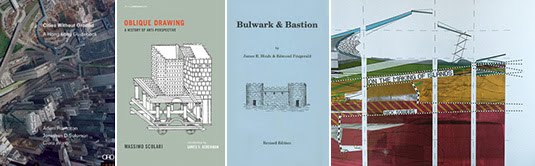
10) Cities Without Ground: A Hong Kong Guidebook by Adam Frampton, Jonathan D. Solomon, and Clara Wong (ORO Editions).

11) Oblique Drawing: A History of Anti-Perspective by Massimo Scolari (MIT Press).

12) Bulwark & Bastion: A Look at Musket Era Fortifications with a Glance at Period Siegecraft by James R. Hinds and Edmund Fitzgerald (Pioneer Press).

13) On the Making of Islands by Nick Sowers (self-published).

Cities Without Ground: A Hong Kong Guidebook was inspired by the revelation that a person can navigate the city of Hong Kong over great distances without ever leaving architecture behind, meandering through complex networks of internal space, from walkways and shopping malls to escalators and covered footbridges. Indeed, one can explore Hong Kong without really setting foot on the surface of the earth at all, making it a “city without ground.” The resulting labyrinthine spatial condition—consisting of “seemingly inescapable and thoroughly disorienting sequences” that cut through, around, between, and under nominally separate megastructures—has led the book’s authors to produce a series of visually dense maps dissecting the various routes a pedestrian can take through the city. A particular highlight comes toward the end, where they focus solely on the city’s air-conditioning, suggesting a kind of thermal cartography of indoor space and implying that temperature control and even humidity are better metrics for evaluating the success of a given project than mere visual or aesthetic concerns.

Massimo Scolari’s Oblique Drawing also pursues the idea that there are other, less well-explored methods for representing the built environment. Although I was disappointed to find that the chapters are, in effect, separate, not always related papers that happen to share a common interest in architectural representation, the book manages to tie together everything from ancient Egyptian hieroglyphs to the military drawings of Leonardo da Vinci, from medieval Christian landscapes to Chinese painting techniques and the Tower of Babel. Scolari’s book was also mentioned here on the blog last week in the context of architectural espionage.

I was actually given a copy of Bulwark & Bastion while out at the surreal and extremely remote site of Fort Jefferson, in the Dry Tortugas of Florida, and I read it on the 2-hour boat ride back to Key West. No more than a stapled pamphlet, like something you’d make at Kinko’s, it is, nonetheless, an extremely interesting look at built landscapes of warfare and defense. Unsurprisingly, it includes a history of walled cities and forts from Europe; but—and this topic alone deserves a full-length book from a publisher like Princeton Architectural Press—it discusses in detail the landscape defenses of the American Civil War, including massive brick citadels in Alabama, Maryland, South Carolina, and New York City. Star forts, bastions, casements, field works, and other geometries of assault and counter-attack are all illustrated and diagrammed, and they’re followed by a glossary of architectural defensive terms. Thoroughly enjoyable, in particular for anyone interested in military history.

Many of you will know Nick Sowers from his blogging at Archinect, where he explored the niche field of military landscapes and sound recordings. Nick was a deserving recipient of UC-Berkeley’s generous Branner Fellowship, which gave him the resources to travel the world for nearly a year, visiting overseas military bases, old battlefields, and urban fortresses from Japan and the South Pacific to Western Europe, including even the legendary Maunsell Towers in London’s Thames Estuary. At all of these sites, he made field recordings. Nick and I first met, in fact, down in Sydney, Australia, as part of Urban Islands back in 2009. This self-published book tells the story of those travels, including sketches and models from Nick’s own final thesis project at Berkeley, black & white photos from his long circumambulations of closed U.S. bases overseas, and a consistently interesting series of observations on the spatial implications of sound in landscape design. Weird visions of limestone caves being vibrated into existence by the tropical sonic booms of military aircraft give the book a dream-like feel as it comes to a close. Congrats to Nick not only for putting this book together, but for organizing such an interesting, planet-spanning trip in the first place.

14) Architecture for Astronauts: An Activity-based Approach by Sandra Häuplik-Meusburger (Springer Praxis).

15) The Textual Life of Airports: Reading the Culture of Flight by Christopher Schaberg (Continuum).

16) Urban Maps: Instruments of Narrative and Interpretation in the City by Richard Brook and Nick Dunn (Ashgate).

Sandra Häuplik-Meusburger’s Architecture for Astronauts has an accompanying website where we read that a “number of extra-terrestrial habitats have been occupied over the last 40 years of space exploration by varied users over long periods of time. This experience offers a fascinating field to investigate the relationship between the built environment and its users.” Häuplik-Meusburger goes on to definite extra-terrestrial habitat as “the ‘houses and vehicles’ where people live and work beyond Earth: non-planetary habitats such as a spacecraft or space station; and planetary habitats such as a base or vehicle on the Moon or Mars. These building types are set up in environments different from the one on Earth and can be characterized as ‘extreme environments.’ Multiple requirements arise for the architecture and design of such a habitat.” These requirements include different lines of sight, a shifted posture for humans in low-gravity, and different needs for visual clarity and even thermal insulation—a very different architecture, indeed. Her book is thus organized as an activity guide for thinking through things like sleep, food, and hygiene, and how architects can reimagine the spatial requirements of each for the “extreme environments” into which these houses and vehicles might go.

Christopher Schaberg’s Textual Life of Airports looks at the airport as a new kind of cultural space, one with its own emerging literature and its own untold stories, including what he calls “the secret stories of airports—the disturbing, uncomfortable, or smoothed over tales that lie just beneath the surface of these sites.” Citing Marc Augé and ambient music, the “airport screening complex” and Steven Spielberg, his book tries to clarify some of the “spatial ambivalence” travelers feel in an airport’s interconnected spaces. In the context of Häuplik-Meusburger’s book, one wonders what future literatures will emerge for the transitional sites of offworld infrastructure, the spaceports and gravity-free hotels that may or may not be forthcoming for the human future.

For Urban Maps, Richard Brook and Nick Dunn “use the term ‘map’ loosely to describe any form of representation that reveals unseen space, latent conditions or narratives in and of the city.” Their examples come from Google Street View, the photographs of urban explorers, advertisements, contemporary film, surveillance, and the art world, to name but a few.
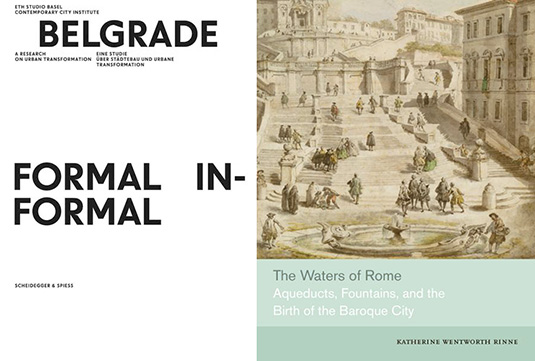
17) Belgrade, Formal/Informal: A Research on Urban Transformation by ETH Studio Basel Contemporary City Institute (Scheidegger & Spiess).

18) The Waters of Rome: Aqueducts, Fountains, and the Birth of the Baroque City by Katherine Wentworth Rinne (Yale University Press).

Using an awesome font called Warsaw Book/Poster, Belgrade, Formal/Informal zeroes in on “a city that was isolated on the European periphery, a city a long history that was as significant as it was turbulent,” to find what parts of a metropolis with such locally specific circumstances have managed to stay more or less the same, through both war and economic estrangement, and what parts were fundamentally transformed by larger, pan-European events and processes. Further, within this, and as the book’s title suggests, they break the city into formal and informal sectors, the generic and the specific. The book is extensively illustrated, and attractively designed by Ludovic Balland.

Katherine Rinne teaches architecture at the CCA in Oakland, though her online project on the waters of Rome is hosted by the University of Virginia. Her book, The Waters of Rome, coalesces much of that work into a detailed study of the city’s hydrological infrastructures, from the ancient to the nearly modern, with a particular emphasis on the city in its Baroque age. Her approach is “largely topographic,” she explains in the book’s introduction, tying even the innermost fountains and waterworks to the landscapes of hills and rivers outside the city. As she writes, “Rome’s fountains are so dazzling that it is easy for even dedicated to overlook the profound changes that their construction initiated in the social, cultural, and physical life of the city. The transformation was systematic and structural, reaching from ancient springs outside the city walls to include aqueducts, fountains, conduits, drains, sewers, streets, and the Tiber. Because of gravity, which dictated distribution, the water’s flow was constrained or encouraged by the existing topography, which influenced in part how the water was displayed or made available for use, who controlled it and who was served by it, what it cost, and obligations that attached to the people who were allowed to access it.” The book is a vital addition to any syllabus or library on hydraulic urbanism.

19) Foodprint Papers, Volume 1 by Nicola Twilley & Sarah Rich (Foodprint Project).

Last not but least, the Foodprint Papers, Volume 1 have been released, edited by Nicola Twilley (my wife) and Sarah Rich, documenting Foodprint NYC from back in 2010, “the first in [a] series of international conversations about food and the city.”

From a cluster analysis of bodega inventories to the cultural impact of the ice-box, and from food deserts to peak phosphorus, panelists examined the hidden corsetry that gives shape to urban foodscapes, and collaboratively speculated on how to feed New York in the future. The free afternoon program included designers, policy-makers, flavor scientists, culinary historians, food retailers, and others, for a wide-ranging discussion of New York’s food systems, past and present, as well as opportunities to transform our edible landscape through technology, architecture, legislation, and education.

The pamphlet is self-published through Lulu, and all purchases help Nicola & Sarah throw more such events in the future. And, while we’re on the subject of food, don’t miss Sarah’s own recent book, Urban Farms.

Happy reading!

* * *

All Books Received: August 2015, September 2013, December 2012, June 2012, December 2010 (“Climate Futures List”), May 2010, May 2009, and March 2009.

Lebbeus Woods, 1940-2012

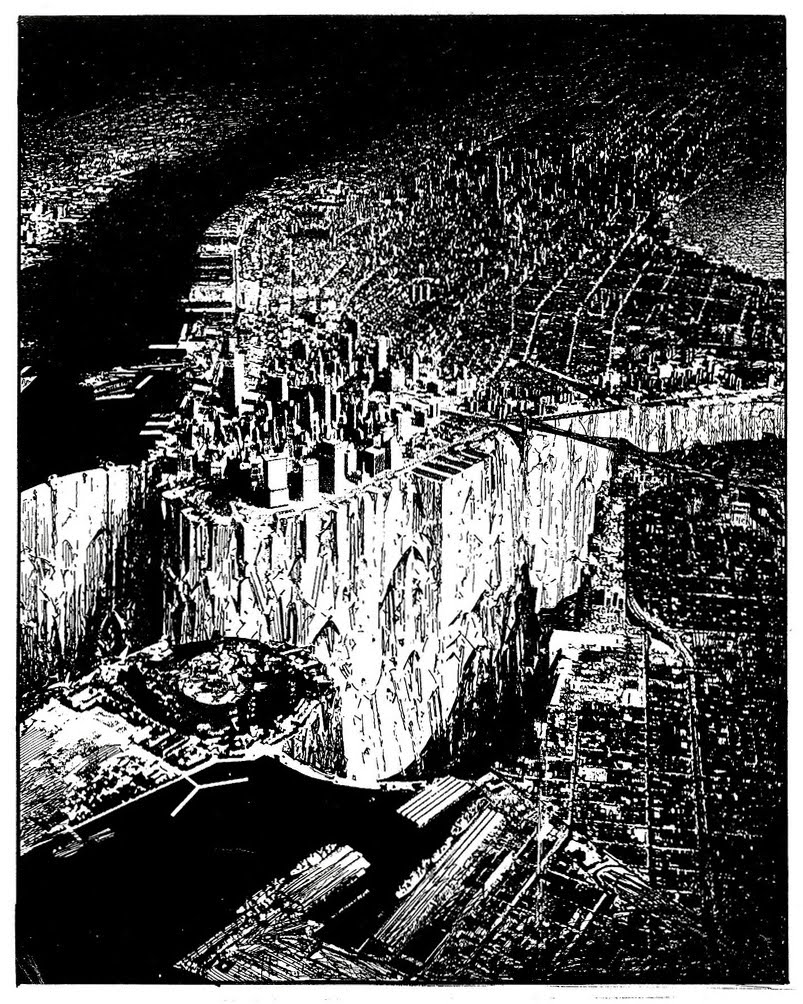
[Image: “Lower Manhattan” (1999) by Lebbeus Woods, discussed extensively here].
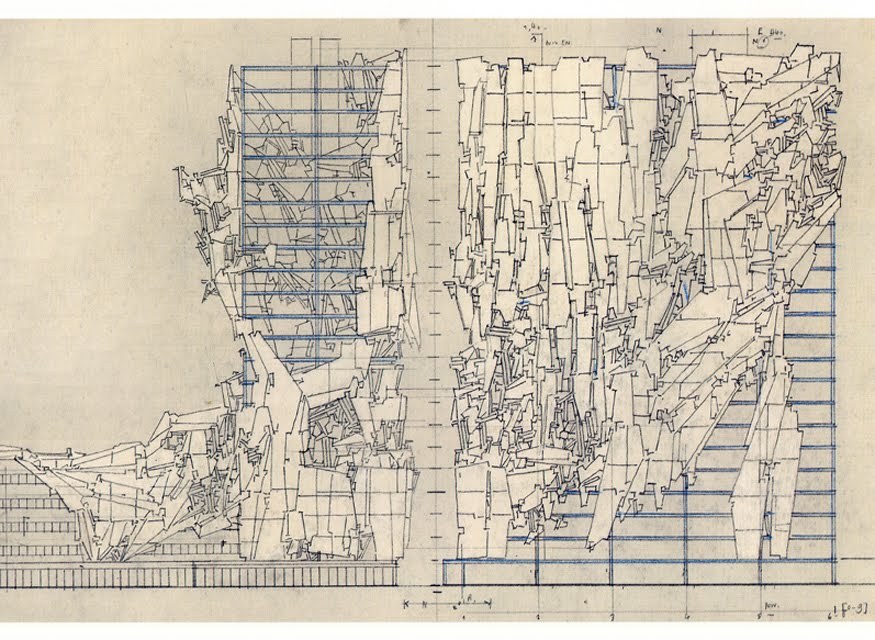
Like many people, I was—and remain—devastated to have learned that architect Lebbeus Woods passed away last night, just as the hurricane was moving out of New York City and as his very neighborhood, Lower Manhattan, had temporarily become part of the Atlantic seabed, floodwaters pouring into nearby subway tunnels and knocking out power to nearly every building south of 34th Street, an event seemingly predicted, or forewarned, by Lebbeus’s own work.

I can’t pretend to have been a confidant of his, let alone a professional colleague, but Lebbeus’s influence over my own interest in architecture is impossible to exaggerate and his kindness and generosity as a friend to me here in New York City was an emotionally and professionally reassuring thing to receive—to a degree that I am perhaps only now fully realizing. I say this, of course, while referring to someone whose New Year’s toast a few years ago to a room full of friends gathered down at his loft near the Financial District—in an otherwise anonymous building whose only remarkable feature, if I remember correctly, was that huge paintings by Lebbeus himself were hanging in the corridors—was that we should all have, as he phrased it, a “difficult New Year.” That is, we should all look forward to, even seek out or purposefully engineer, a new year filled with the kinds of challenges Lebbeus felt, rightly or not, that we deserved to face, fight, and, in all cases, overcome—the genuine and endless difficulty of pursuing our own ideas and commitments, absurd goals no one else might share or even be interested in.

This was the New Year’s wish of a true friend, in the sense of someone who believes in and trusts your capacity to become what you want to be, and someone who will help to engineer the circumstances under which that transformation might most productively occur.

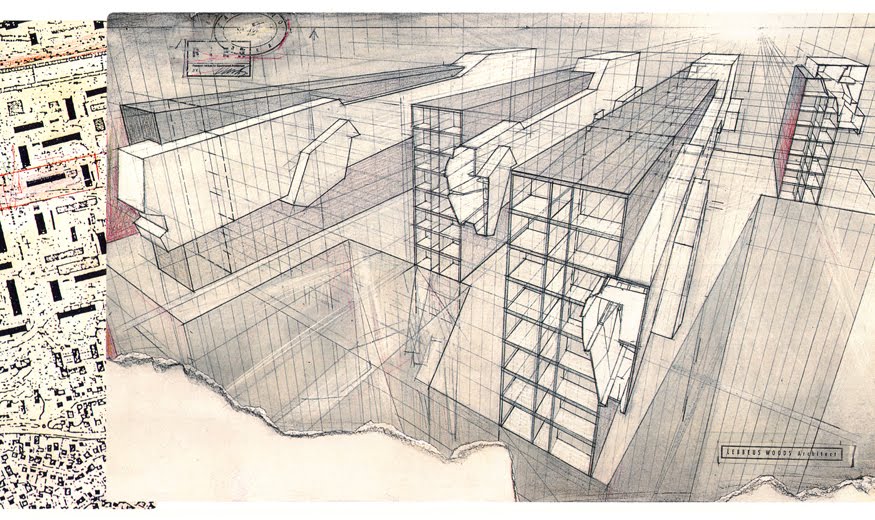
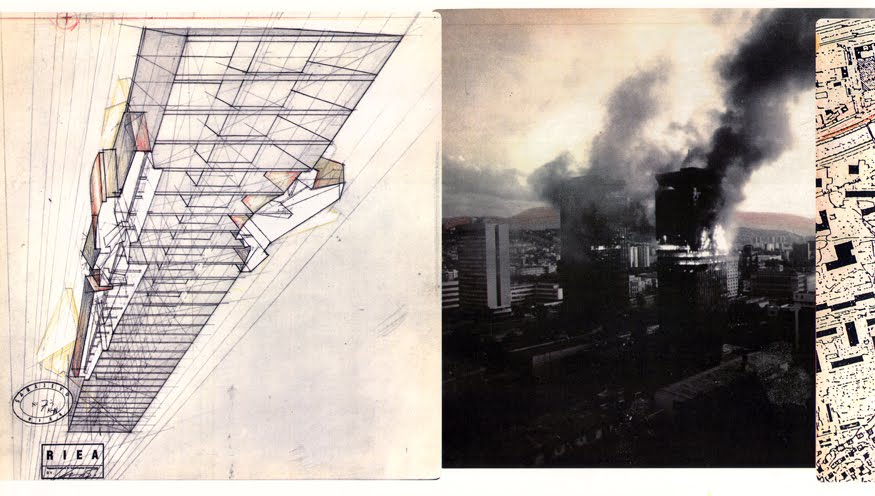
[Images: From War and Architecture by Lebbeus Woods].

Lebbeus mentored and taught many, many people, and I am, by every measure, the least qualified of any of them to write about his influence; but learning that Lebbeus has passed away, and under such utterly surreal circumstances, with his own city—literally, the streets all around him—flooding in the darkness as the oceans rose up, compelled me to write something for him, or about him, or because of him, or to him. I have been fortunate enough, or perhaps determined, to live a life where I’ve met several of my heroes in person, and Lebbeus is—he will always be—exactly that, a titanic and strangely omnipresent figure for me whose work set off special effects he himself would be puzzled—even slightly embarrassed—to learn that I’ve attributed to him.

Speaking only for myself, Lebbeus is a canonical figure in the West—and I mean a West not of landed aristocrats, armies, and regal blood-lines but of travelers, heretics, outsiders, peripheral exploratory figures whose missives and maps from the edges of things always chip away at the doomed fortifications of the people who thought the world not only was ownable, but that it was theirs. Lebbeus Woods is the West. William S. Burroughs is the West. Giordano Bruno is the West. Audre Lorde is the West. William Blake is the West. For that matter, Albert Einstein, as Leb would probably agree, having designed an interstellar tomb for the man, is the West. Lebbeus Woods should be on the same sorts of lists as James Joyce or John Cage, a person as culturally relevant as he was scientifically suggestive, seething with ideas applicable to nearly every discipline.

[Images: From War and Architecture by Lebbeus Woods].

In any case, it isn’t just the quality of Lebbeus’s work—the incredible drawings, the elaborate models—or even the engaged intensity of his political writings, on architecture as politics pursued by other means or architecture as war, that will guarantee him a lasting, multi-disciplinary influence for generations to come. There is something much more interesting and fundamental to his work that has always attracted me, and it verges on mythology. It verges on theology, in fact.

Here, if I can be permitted a long aside, it all comes down to ground conditions—to the interruption, even the complete disappearance, of the ground plane, of firm terrestrial reference, of terra firma, of the Earth, of the very planet we think we stand on. Whether presented under the guise of the earthquake or of warfare or even of General Relativity, Lebbeus’s work was constantly erasing the very surfaces we stood on—or, perhaps more accurately, he was always revealing that those dependable footholds we thought we had were never there to begin with. That we inhabit mobile terrain, a universe free of fixed points, devoid of gravity or centrality or even the ability to be trusted.

It is a world that can only be a World—that can only, and however temporarily, be internally coherent and hospitable—insofar as we construct something in it, something physical, linguistic, poetic, symbolic, resonant. Architectural.

[Image: “Einstein Tomb” by Lebbeus Woods].

Architecture, for Lebbeus, was a kind of counter-balance, a—I’m going to use the word—religious accounting for this lack of center elsewhere, this lack of world. It was a kind of factoring of the zero, to throw out a meaningless phrase: it was the realization that there is nothing on offer for us here, the realization that the instant we trust something it will be shaken loose in great convulsions of seismicity, that cities will fall—to war or to hurricanes—that subways will flood, that entire continents will be unmoored, split in two, terribly and irreversibly, as something maddeningly and wildly, in every possible sense outside of human knowledge, something older and immeasurable, violently shudders and wakes up, leaps again into the foreground and throws us from its back in order to walk on impatiently and destructively without us.

Something ancient and out of view will rapidly come back into focus and destroy all the cameras we use to film it. This is the premise of Lebbeus’s earthquake, Lebbeus’s terrestrial event outside measured comprehensibility, Lebbeus’s state of war.

[Image: “Einstein Tomb” by Lebbeus Woods].

Because what I like about Lebbeus’s work is its nearly insane honesty, its straight-ahead declaration that nothing—genuinely and absolutely nothing—is here to welcome us or accept us or say yes to us. That there is no solid or lasting ground to build anything on, let alone anything out there other than ourselves expecting us to build it.

Architecture is thus an act—a delirious and amazing act—of construction for no reason at all in the literal sense that architecture is outside rational calculation. That is, architecture—capital-A architecture, sure—must be seen, in this context, as something more than just supplying housing or emergency shelter; architecture becomes a nearly astronomical gesture, in the sense that architecture literally augments the planetary surface. Architecture increases (or decreases) a planet’s base habitability. It adds something new to—or, rather, it complexifies—the mass and volume of the universe. It even adds time: B is separated from C by nothing, until you add a series of obstacles, lengthening the distance between them. That series of obstacles—that elongated and previously non-existent sequence of space-time—is architecture.

[Image: “Einstein Tomb” by Lebbeus Woods].
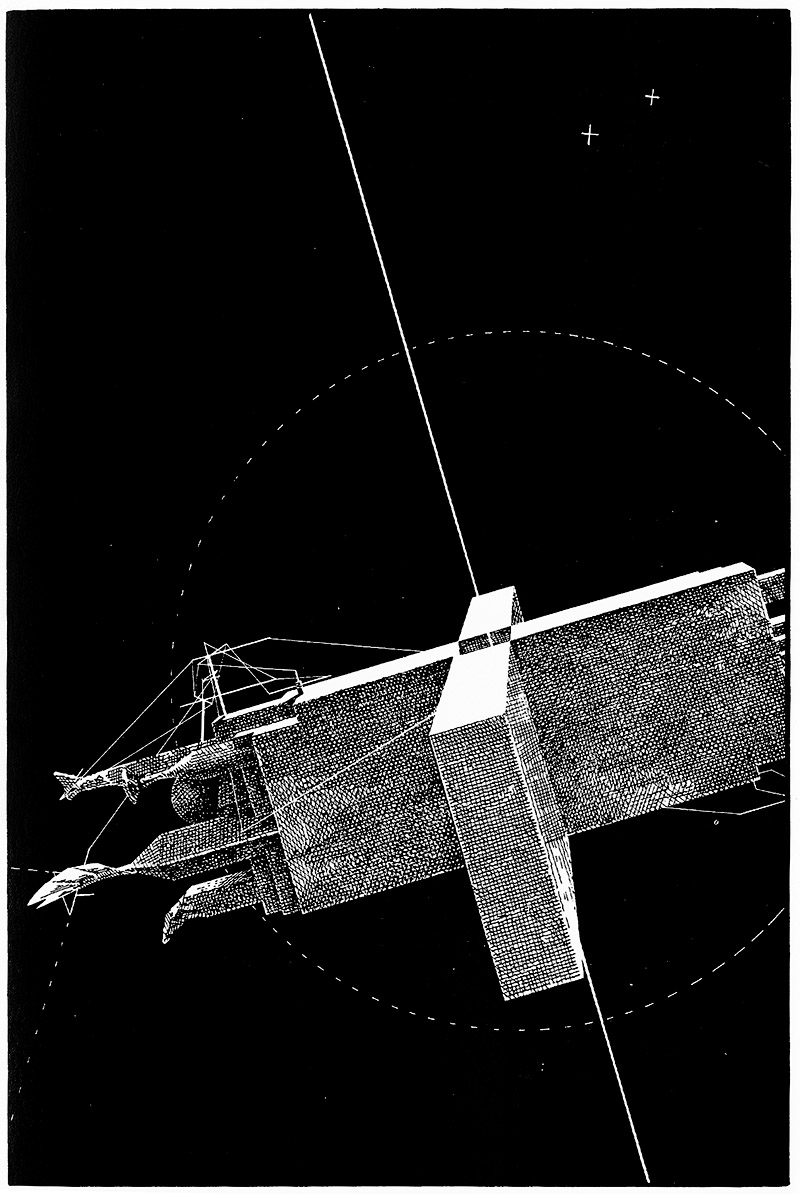
As Lebbeus himself once wrote, it is through architecture that humans realize new forms of spatial experience that would have been impossible under natural conditions—not in caves, not in forests, not even while out wandering through fog banks or deserts or into the frigid and monotonous vacuity of the Antarctic. Perhaps not even on the Earth. Architecture is a different kind of space altogether, offered, we could say, as a kind of post-terrestrial resistance against unstable ground, against the lack of a trustworthy planet. Against the lack of an inhabitable world.

Architecture, if you will, is a Wile E. Coyote moment where you look down and realize the universe is missing—that you are standing on empty air—so you construct for yourself a structure or space in which you might somehow attempt survival. Architecture is more than buildings. It is a spacesuit. It is a counter-planet—or maybe it is the only planet, always and ever a terraforming of this alien location we call the Earth.

In any case, it’s the disappearance of the ground plane—and the complicated spatial hand-waving we engage in to make that disappearance make sense—that is so interesting to me in Lebbeus’s work. When I say that Lebbeus Woods and James Joyce and William Blake and so on all belong on the same list, I mean it: because architecture is poetry is literature is myth. That is, it is equal to them and it is one of them. It is a way of explaining the human condition—whatever that is—spatially, not through stanzas or through novels or through song.

[Image: “Einstein Tomb” by Lebbeus Woods].

If you were to walk through an architecture school today—and I don’t recommend it—you’d think that the height of invention was to make your building look like a Venus flytrap, or that mathematically efficient triangular spaceframes were the answer to everything, every problem of space and habitability. But this is like someone really good at choosing fonts in Microsoft Word. It doesn’t matter what you can do, formally, to the words in your document if those words don’t actually say anything.

Lebbeus will probably be missed for his formal inventiveness: buildings on stilts, massive seawalls, rotatable buildings that look like snowflakes. Deformed coasts anti-seismically jeweled with buildings. Tombs for Einstein falling through space.

[Image: “Einstein Tomb” by Lebbeus Woods].
But this would be to miss the motivating absence at the heart of all those explorations, which is that we don’t yet know what the world is, what the Earth is—whether or not there even is a world or an Earth or a universe at all—and architecture is one of the arts of discovering an answer to this. Or inventing an answer to this, even flat-out fabricating an answer to this, meaning that architecture is more mythology than science. But there’s nothing wrong with that. There is, in fact, everything right with that: it is exactly why architecture will always be more heroic even than constructing buildings resistant to catastrophic rearrangements of the earth, or throwing colossal spans across canyons and mountain gorges, or turning a hostile landscape into someone’s home.

Architecture is about the lack of stability and how to address it. Architecture is about the void and how to cross it. Architecture is about inhospitability and how to live within it.

Lebbeus Woods would have had it no other way, and—as students, writers, poets, novelists, filmmakers, or mere thinkers—neither should we.

Caves of Nottingham

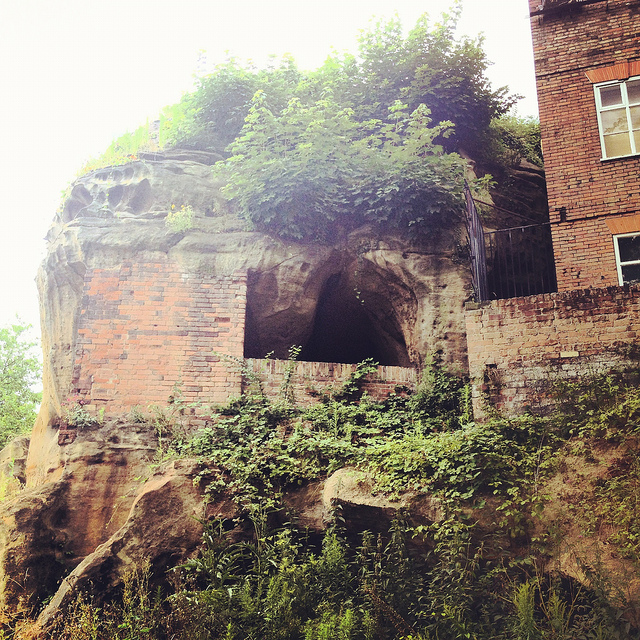
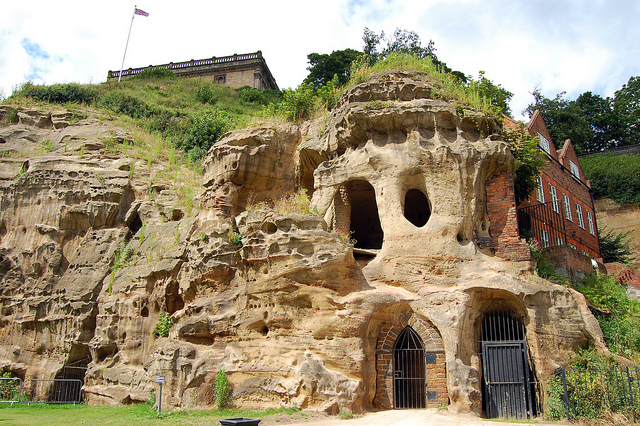
[Image: Cliffs and caves of Nottingham; photo by Nicola Twilley].
For several years now, I’ve admired from afar the ambitious laser-scanning subterranean archaeological project of the Nottingham Caves Survey.

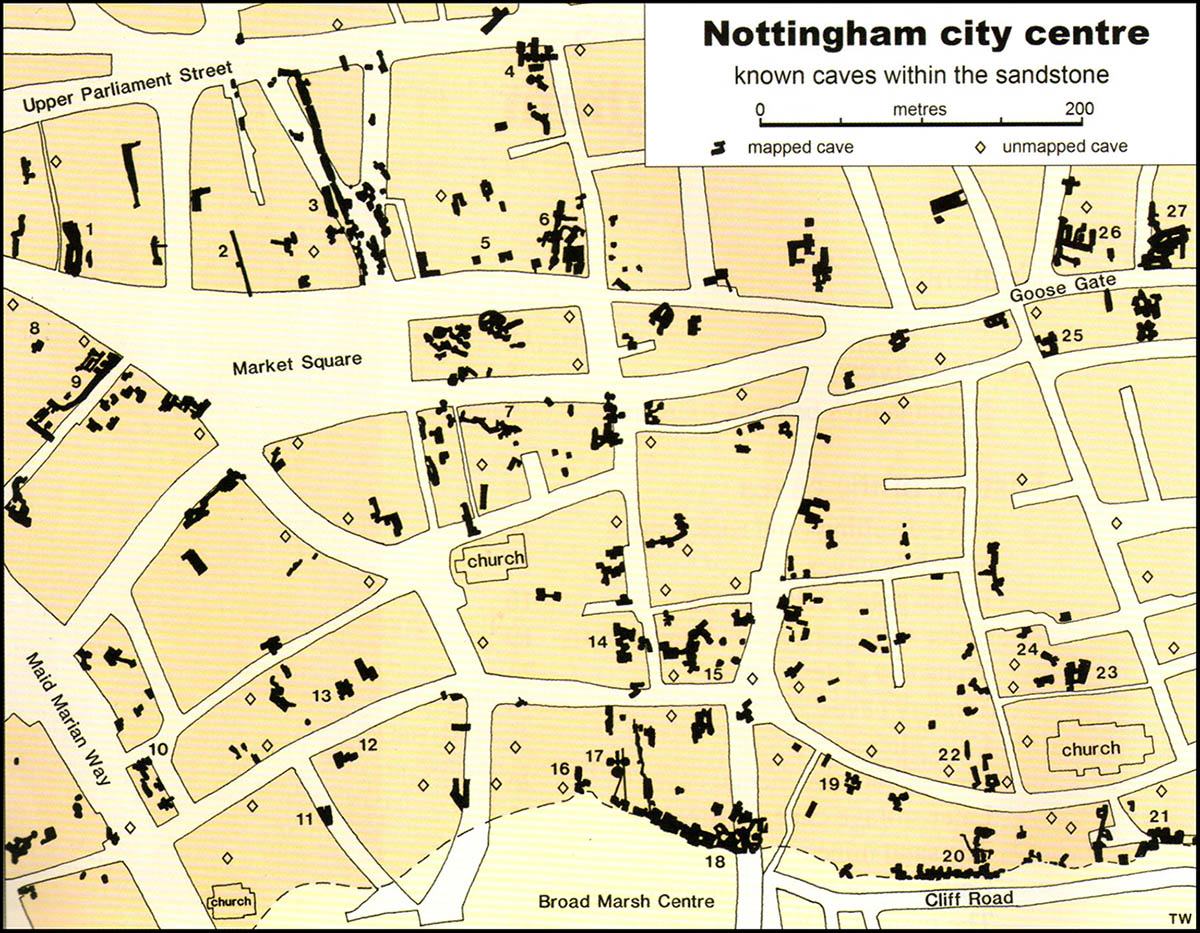
Incredibly, there are more than 450 artificial caves excavated from the sandstone beneath the streets and buildings of Nottingham, England—including, legendarily, the old dungeon that once held Robin Hood—and not all of them are known even today, let alone mapped or studied. The city sits atop a labyrinth of human-carved spaces—some of them huge—and it will quite simply never be certain if archaeologists and historians have found them all.

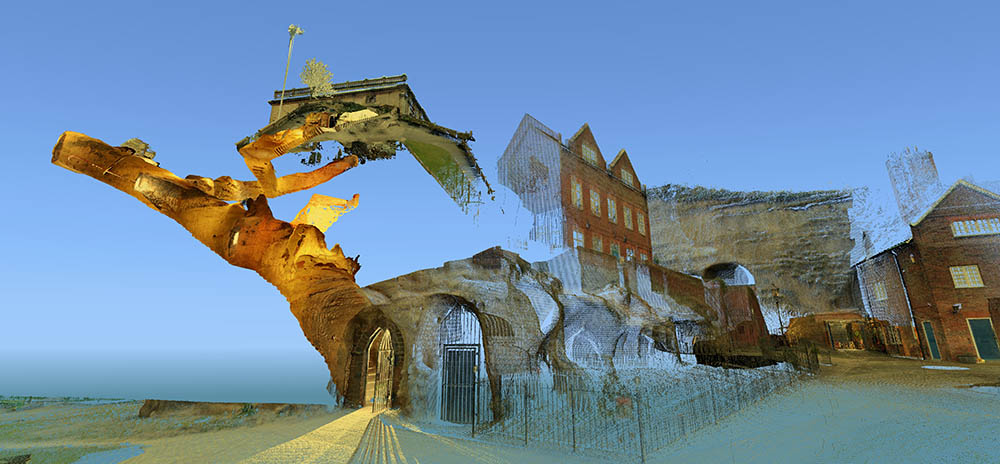
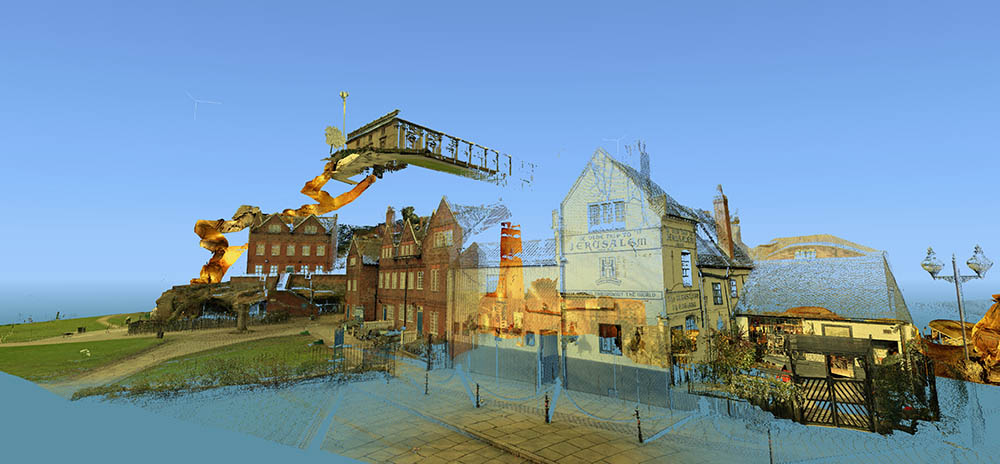
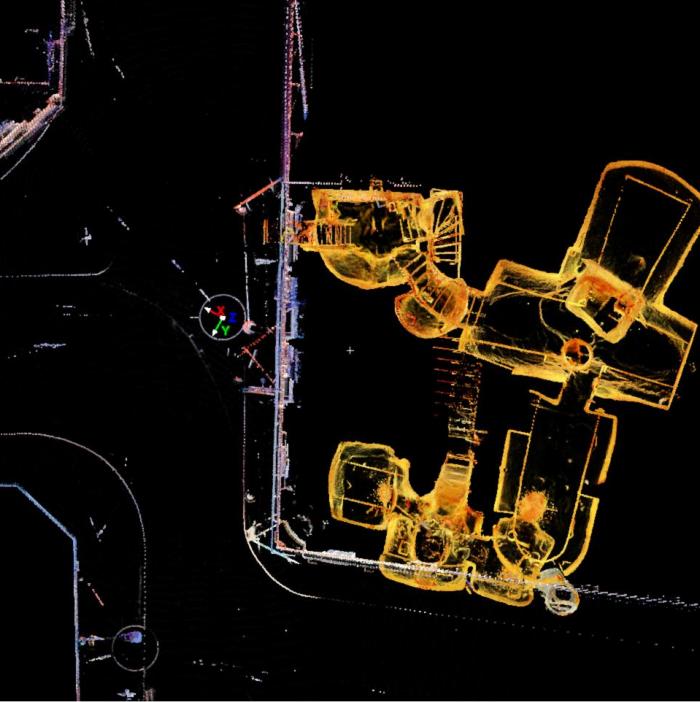
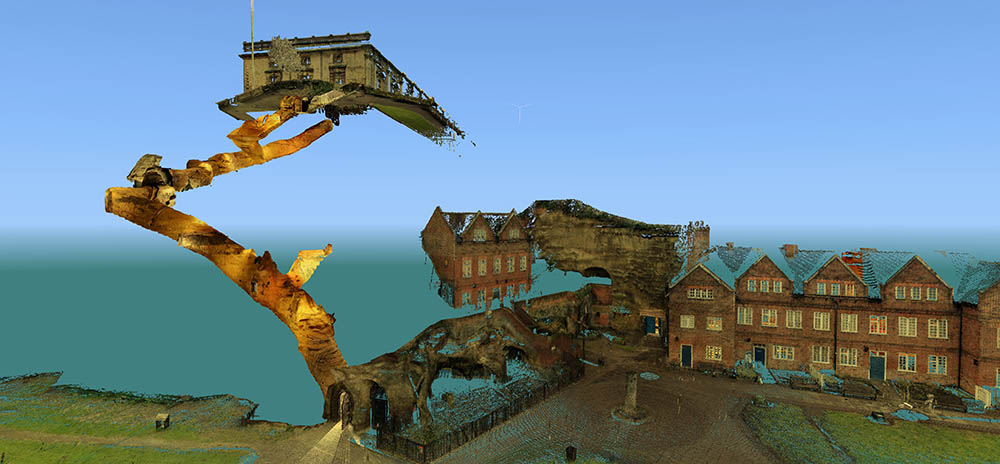
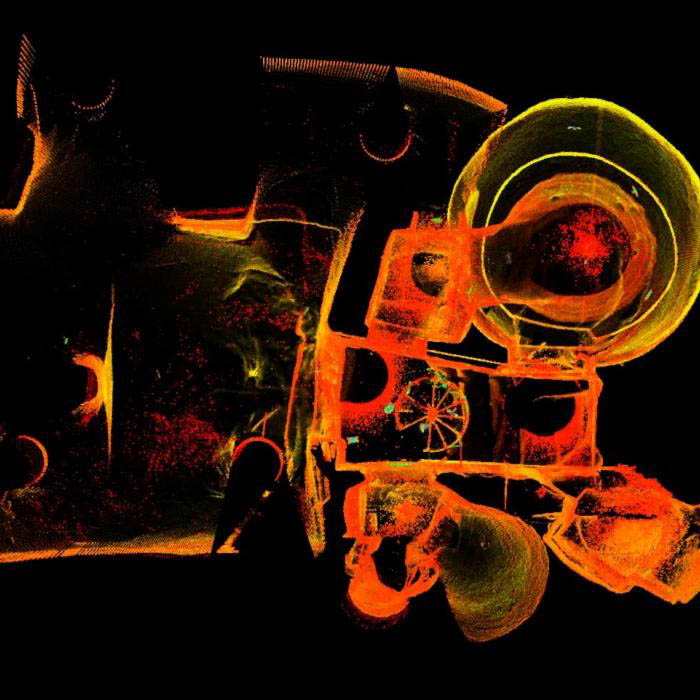
[Images: Laser scans from the Nottingham Caves Survey show Castle Rock and the Mortimer’s Hole tunnel, including, in the bottom image, the Trip to Jerusalem Pub where we met archaeologist David Strange-Walker; images like this imply an exhilarating and almost psychedelic portrait of the city as invisibly connected behind the scenes by an umbilical network of caves and tunnels. Scans courtesy of the Nottingham Caves Survey].

“Even back in Saxon times, Nottingham was known for its caves,” local historian Tony Waltham writes in his helpful guide Sandstone Caves of Nottingham, “though the great majority of those which survive today were cut much more recently.” From malt kilns to pub cellars, “gentlemen’s lounges” to jails, and wells to cisterns, these caves form an almost entirely privately-owned lacework of voids beneath the city.

[Image: Map of only the known caves in Nottingham, and only in Nottingham’s city center; map by Tony Waltham, from Sandstone Caves of Nottingham].
As Waltham explains, “Nottingham has so many caves quite simply because the physical properties of the bedrock sandstone are ideal for its excavation.” The sandstone “is easily excavated with only hand tools, yet will safely stand as an unsupported arch of low profile.”

In a sense, Nottingham is the Cappadocia of the British Isles.

[Image: The extraordinary caves at 8 Castle Gate; scan courtesy of the Nottingham Caves Survey].

The purpose of the Nottingham Caves Survey, as their website explains, is “to assess the archaeological importance of Nottingham’s caves. Some are currently scheduled monuments and are of great local and national importance. Some are pub cellars and may seem less vital to the history of the City.”

Others, I was soon to learn, have been bricked off, taken apart, filled in, or forgotten.

“All caves that can be physically accessed will be surveyed with a 3D laser scanner,” the Survey adds, “producing a full measured record of the caves in three dimensions. This ‘point cloud’ of millions of individual survey points can be cut and sliced into plans and sections, ‘flown through’ in short videos, and examined in great detail on the web.”


[Video: One of very many laser-scan animations from the Nottingham Caves Survey].

While over in England a few weeks ago, I got in touch with archaeologist David Strange-Walker, the project’s manager, and arranged for a visit up to Nottingham to learn more about the project. Best of all, David very generously organized an entire day’s worth of explorations, going down into many of the city’s underground spaces in person with David himself as our guide. Joining me on the trip north from London was Nicola Twilley of Edible Geography; architect Mark Smout of Smout Allen and co-author of the fantastic Pamphlet Architecture installment, Augmented Landscapes; and Mark’s young son, Ellis.

[Image: Artificially enlarged pores in the sandstone; photo by BLDGBLOG].
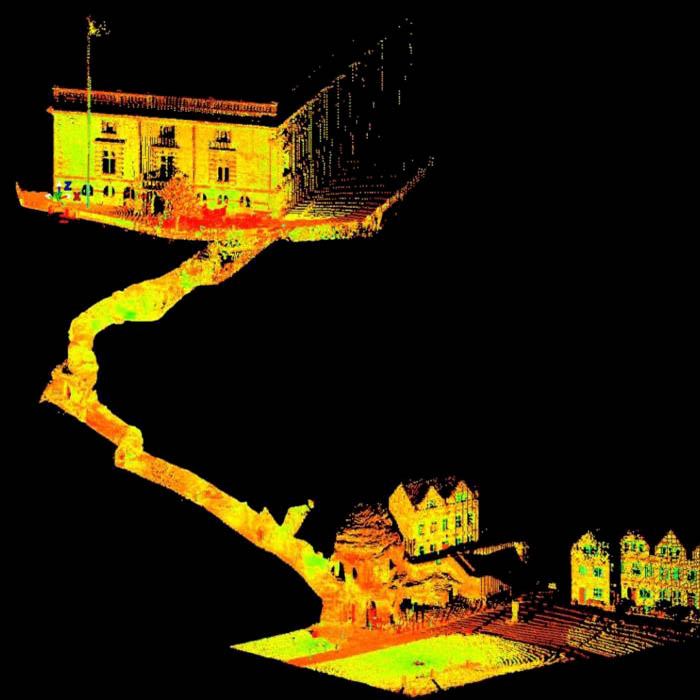
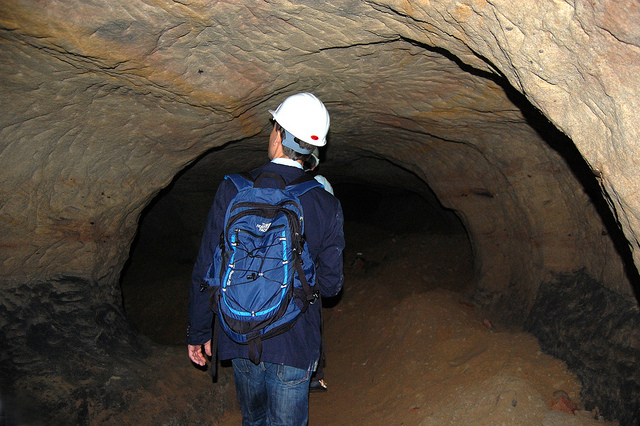
We met the very likable and energetic David—who was dressed for a full day of activity, complete with a well-weathered backpack that we’d later learn contained hard hats and floodlights for each of us—outside Nottingham’s Trip to Jerusalem pub.

Rather than kicking off our visit with a pint, however, we simply walked inside to see how the pub had been partially built—that is, expanded through deliberate excavation—into the sandstone cliffside.

The building is thus more like a facade wrapped around and disguising the artificial caves behind it; walking in past the bar, for instance, you soon notice ventilation shafts and strange half-stairways, curved walls and unpredictable acoustics, as the “network of caves” that actually constitutes the pub interior begins to reveal itself.

[Image: A laser scan showing the umbilical connection of Mortimer’s Hole, courtesy of the Nottingham Caves Survey].
My mind was already somewhat blown by this, though it was just the barest indication of extraordinary spatial experiences yet to come.

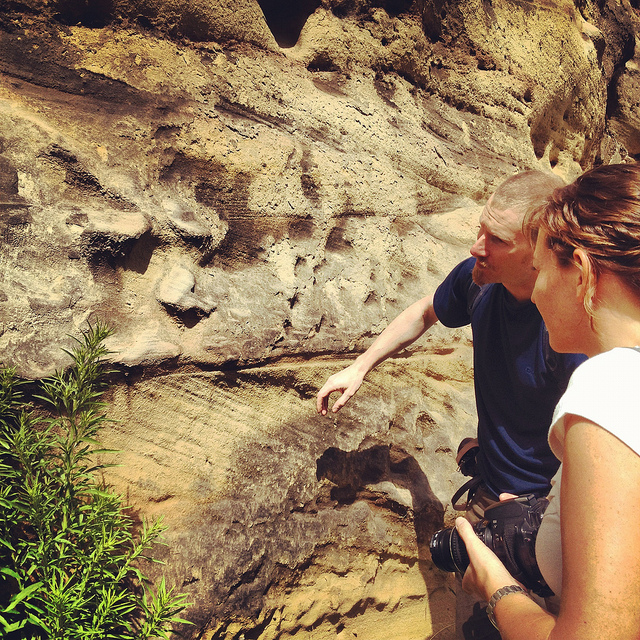
[Image: Examining sandstone with Dr. David Strange-Walker; photo by BLDGBLOG].
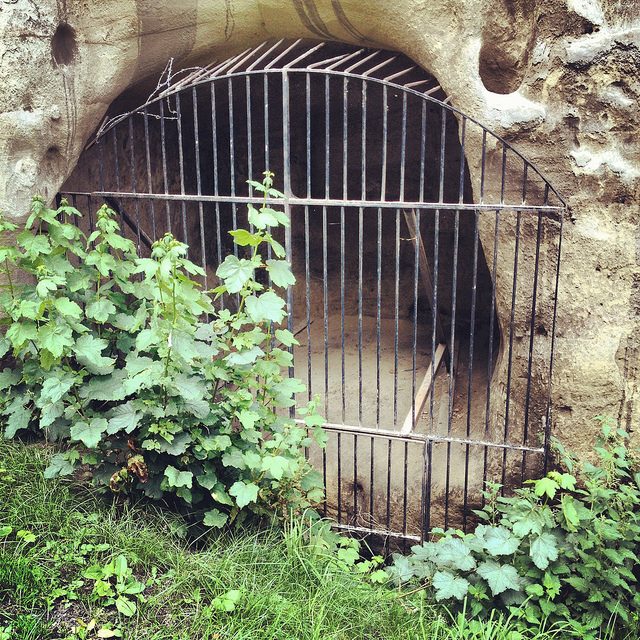
Wasting no time, we headed back outside, where afternoon rain showers had begun to blow in, and David introduced us to the sandstone cliff itself, pointing out both natural and artificially enlarged pores pockmarking the outside.

The sandstone formations or “rock units” beneath the city, as Tony Waltham explains, “were formed as flash flood sediments in desert basins during Triassic times, about 240 million years ago, when Britain was part of a hot and dry continental interior close to the equator. Subsequent eons of plate tectonic movements have brought Britain to its present position; and during the same time, the desert sediments have been buried, compressed and cemented to form moderately strong sedimentary rocks.”

The city is thus built atop a kind of frozen Sahara, deep into which we were about to go walking.

[Image: A gate in the cliff; photo by BLDGBLOG].
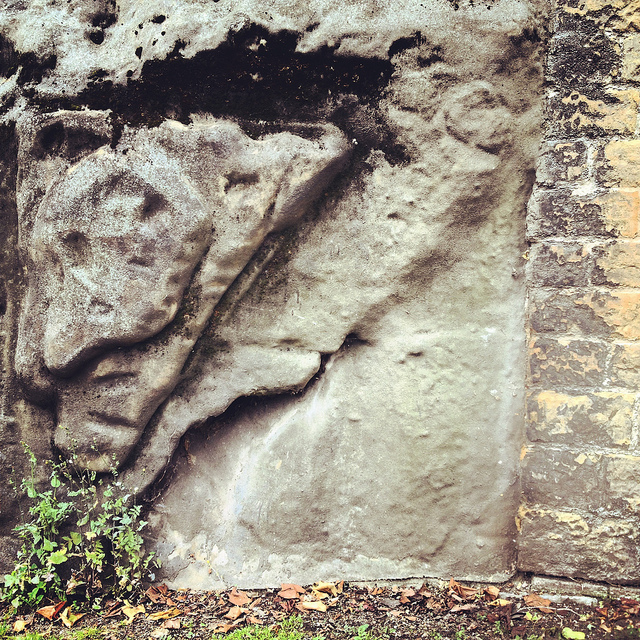
Outside here in the cliff face, small openings led within to medieval tunnels and stairs—including the infamous Mortimer’s Hole—that themselves curled up to the top of the plateau; doors in the rock further up from the Trip to Jerusalem opened onto what were now private shooting ranges, of all things; and, with a laugh, David pointed out shotcrete cosmetic work that had been applied to the outer stone surface.

[Image: Artificial shotcrete geology; photo by BLDGBLOG].
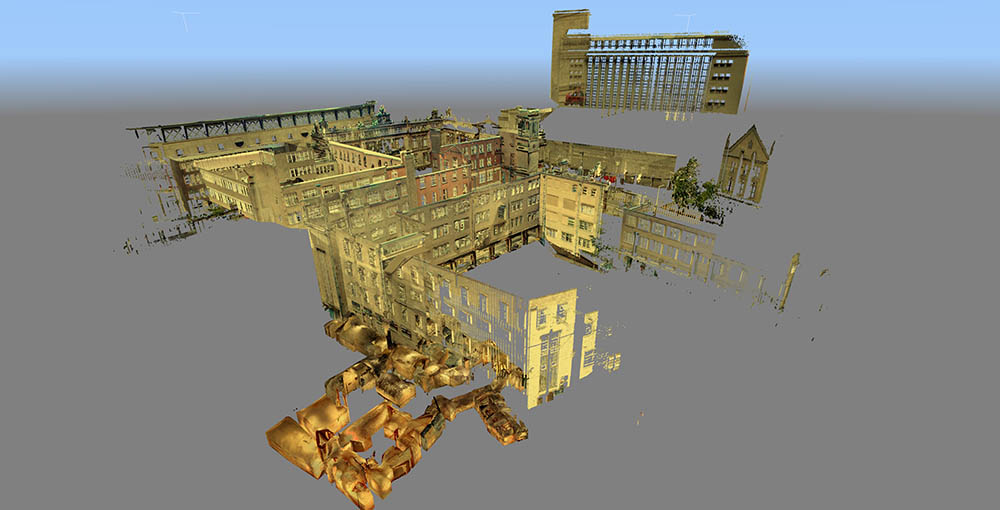
We headed from there—walking a brisk pace uphill into the town center—with David casually narrating the various basements, cellars, tunnels, and other urban perforations that lay under the buildings around us, as if we were traveling through town with a human x-ray machine for whom the city was an archaeologically rich cobweb of underground loops and dead-ends.

We soon ended up at the old jails of the Galleries of Justice. A well-known tourist destination, complete with costumed re-enactors, the building sits atop several levels of artificial caves that are well worth exploring.

[Image: Scan of the Guildhall caves, courtesy of the Nottingham Caves Survey].
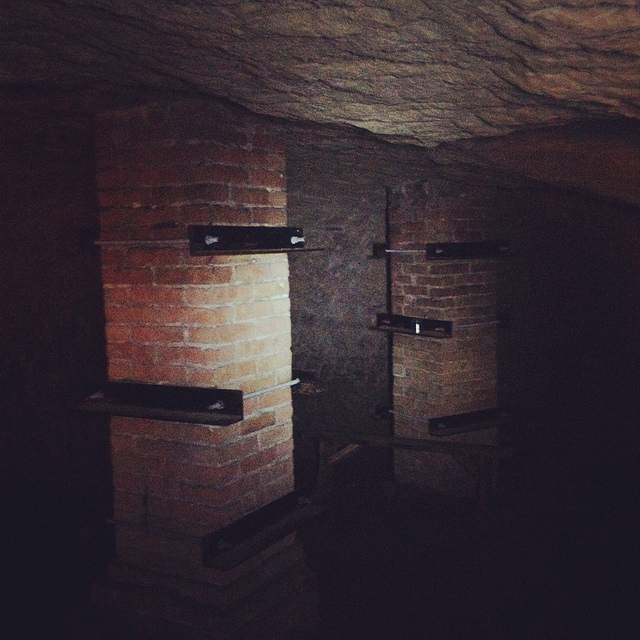
We were joined at this point by the site’s director, who generously took time out of his schedule to lead us down into parts of the underground complex that are not normally open to the general public.

Heading downward—at first by elevator—we eventually unlocked a door, stepped into a tiny room beneath even the jail cells, crouching over so as not to bang our heads on the low ceiling, and we leaned against banded brick pillars that had been added to help support all the architecture groaning above us.

Avoiding each other’s flashlight beams, we listened as our two guides talked about the discovery—and, sadly, the willful reburial—of caves throughout central Nottingham.

[Image: Brick pillars below Nottingham; photo by BLDGBLOG].
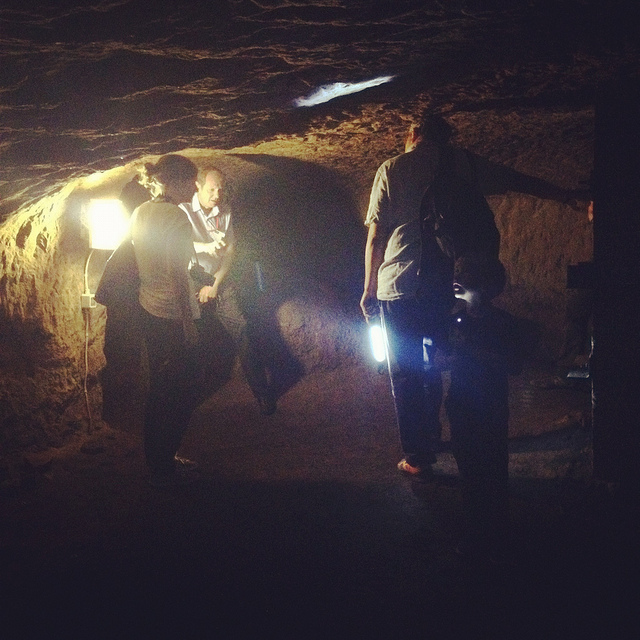
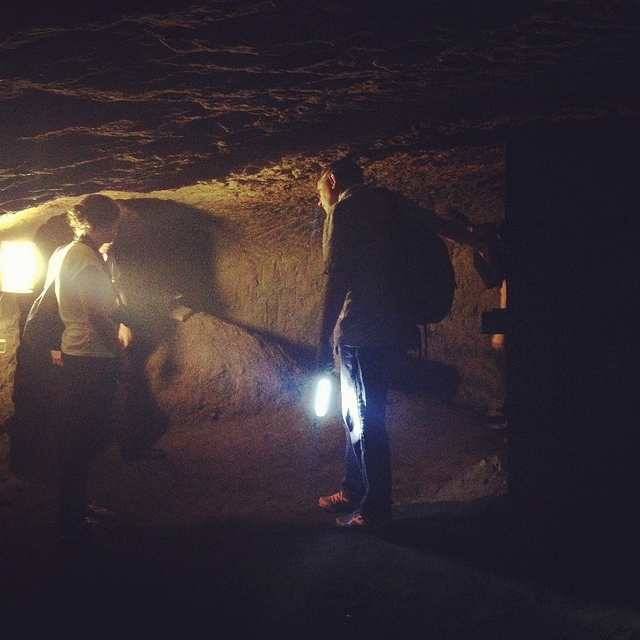
We learned, for instance, that, elsewhere in the city, there had once been a vacuum shop with a cave beneath it; if I remember this story correctly, the shop’s owners had the habit of simply discarding broken and unsold vacuum cleaners into the cave, inadvertently creating a kind of museum of obsolete vacuum parts. Discontinued models sat in the darkness—a void full of vacuums—as the shop went out of business.

We heard, as well, about a nearby site where caves had been discovered beneath a bank during a recent process of renovation and expansion—but, fearing discovery of anything that might slow down the bank’s architectural plans, the caves were simply walled up and left unexplored. They’re thus still down there, underneath and behind the bank, their contents unknown, their extent unmapped—a fate, it seems, shared by many of the caves of Nottingham.

Rather than being greeted by the subterranean and historical wonder that such structures deserve—and I would argue that essentially all of subterranean Nottingham should be declared a UNESCO World Heritage Site—the caves are too often treated as little more than annoying construction setbacks or anomalous ground conditions, suitable only for bricking up, filling with concrete, or forgetting. If the public thinks about them at all, in seems, it is only long enough to consider them threats to building safety or negative influences on property value.

[Images: Learning about caves; photos by BLDGBLOG].
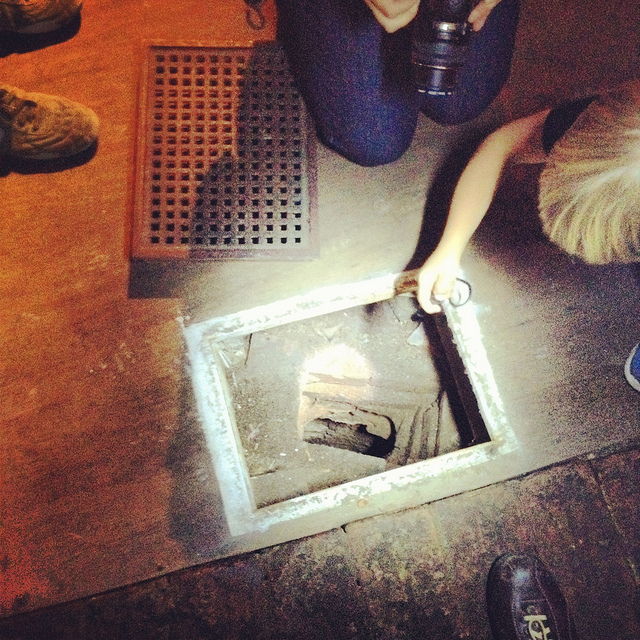
In any case, on our way out of the Galleries of Justice, we lifted up a ventilation grill in the floor and looked down into a small vertical shaft, too narrow and contorted even for Ellis to navigate, and we learned that there are urban legends that this particular shaft leads down to a larger room in which Robin Hood himself was once held… But we had only enough time to shine our flashlights down and wonder.

[Images: Ellis Smout looks for Robin Hood below; photos by BLDGBLOG].
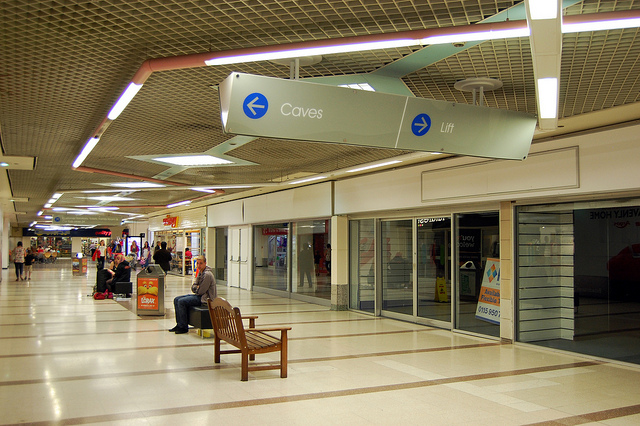
From here, we headed over to our final tourist-y site of the day, which is the awesomely surreal City of Caves exhibition, located in Nottingham’s Broad Marsh shopping mall.

You literally take an escalator down into an indoor mall, where, amidst clothing outlets and food courts, there is an otherwise totally mundane sign pointing simply to “Caves.”

If you didn’t know about Nottingham’s extensive sub-city, this would surely be one of the most inexplicable way-finding messages in mall history.

[Image: Caves; photo by Nicola Twilley].

Here, where we picked our copy of Tony Waltham’s Sandstone Caves of Nottingham pamphlet, from which I’ve been quoting, we learned quite a bit more about how the city has grown, how the caves themselves have often been uncovered (for example, during building expansions and renovations), and what role Nottingham’s underground spaces served during the Nazi bombings of WWII.

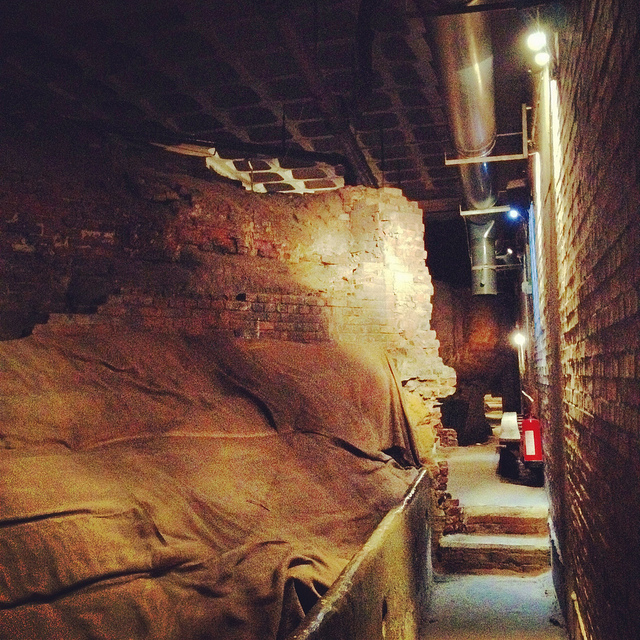
[Image: Beneath Broad Marsh shopping mall; photo by BLDGBLOG].
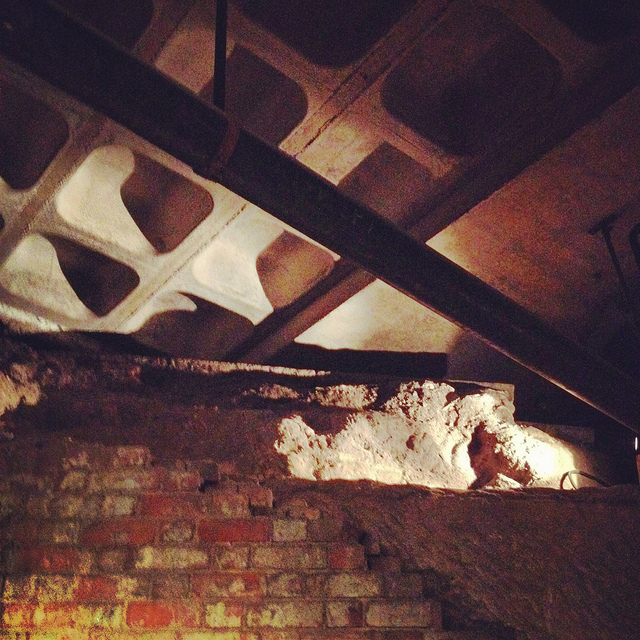
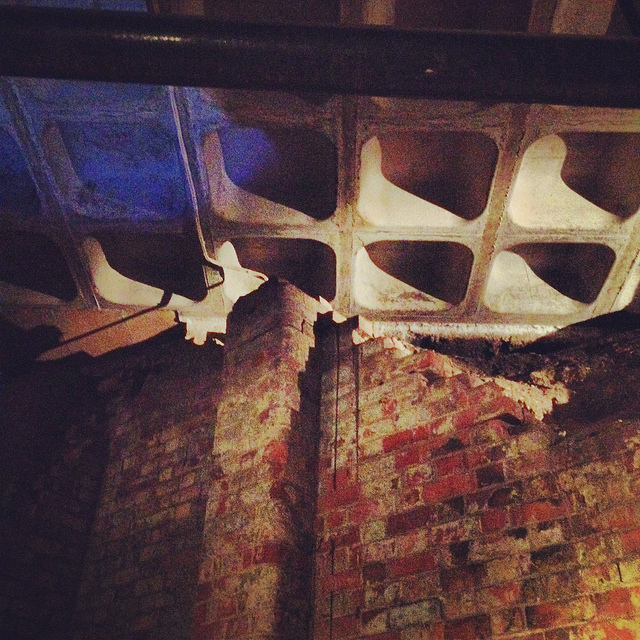
The specific underground complex beneath the shopping mall offers an interesting mix of old tanning operations and other semi-industrial, pre-modern work rooms, now overlapping with 20th-century living and basement spaces that were sliced open during the construction of the Broad Marsh mall.

[Images: Cave spaces beneath the Superstudio-like concrete grid of Nottingham’s Broad Marsh shopping Mall].
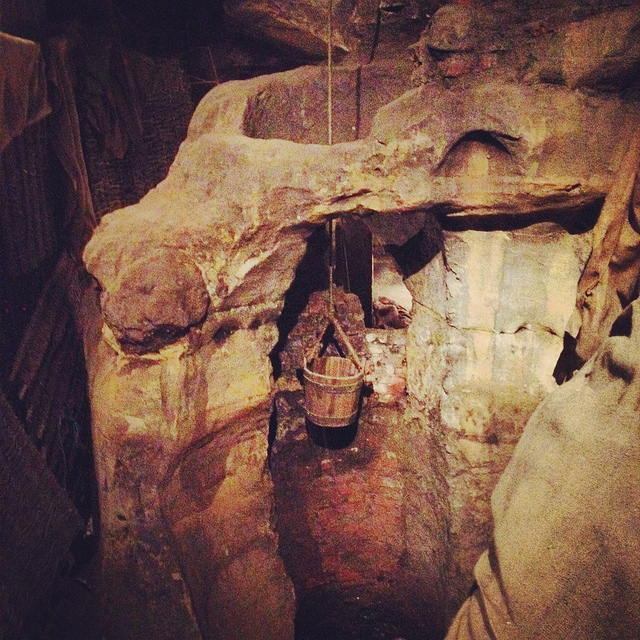
That these caves were preserved at all is testament to the power of local conservationists, as the historically rich and spatially intricate rooms and corridors would have been gutted and erased entirely during post-War reconstruction without their intervention.

As it now stands, the mall is perched above the caves on concrete pillars, with the effect that curious shoppers can wander down into the caves through an entrance that could just as easily lead to a local branch of Accessorize.

[Image: A well bucket in the caves beneath Broad Marsh; photo by BLDGBLOG].
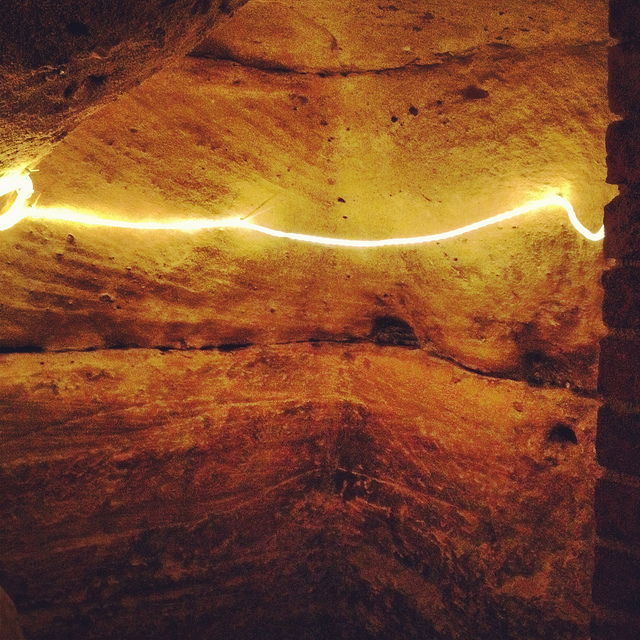
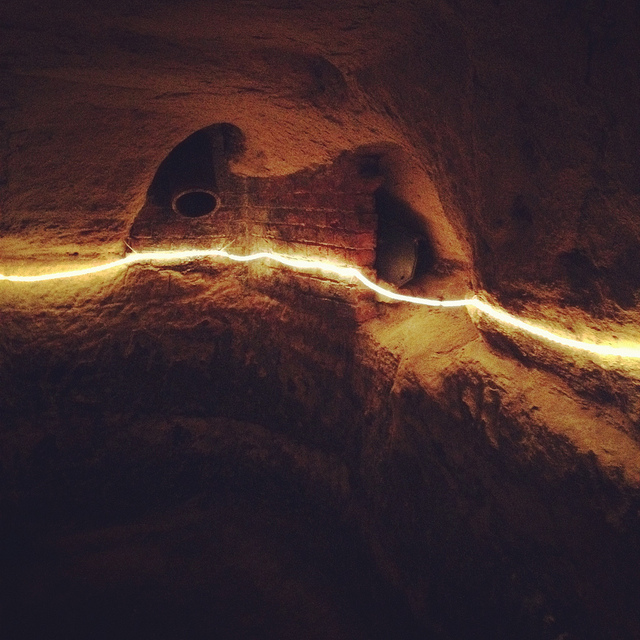
Again, we were fortunate to be taken down into some off-limits areas, stepping over lights and electric wires and peering ahead into larger rooms not on the tourist route.

[Images: Lines of lights we switched on in one of the off-limits rooms below Broad Marsh; photo by BLDGBLOG].
This included stepping outside at one point to wander through an overgrown alleyway behind the mall. Small openings even back here stretched beneath and seemingly into the backs of shops; one doorway, a short scramble up a hill of weed-covered rubble, appeared to contain a half-collapsed spiral staircase installed inside a brick-lined sandstone opening.

[Image: A doorway to voids behind Broad Marsh Centre; photo by BLDGBLOG].
At this point, we began to joke about the ease with which it seemed you could plan a sort of speleological super-heist, breaking into shops from below, as an entire dimension of the city seemed to lie unwatched and unprotected.

Nottingham, it appeared, is a city of nothing but doors and openings, holes, pores, and connections, complexly layered knots of space coiling beneath one building after another, sometimes cutting all the way down to the water table.

Incredibly, the day only continued to build in interest, reaching near-impossible urban sights, from catacombs in the local graveyard to a mind-bending sand mine that whirled and looped around like smoke rings beneath an otherwise quiet residential neighborhood.

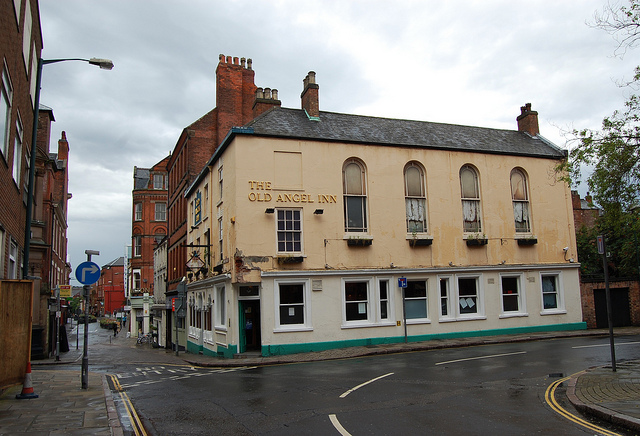
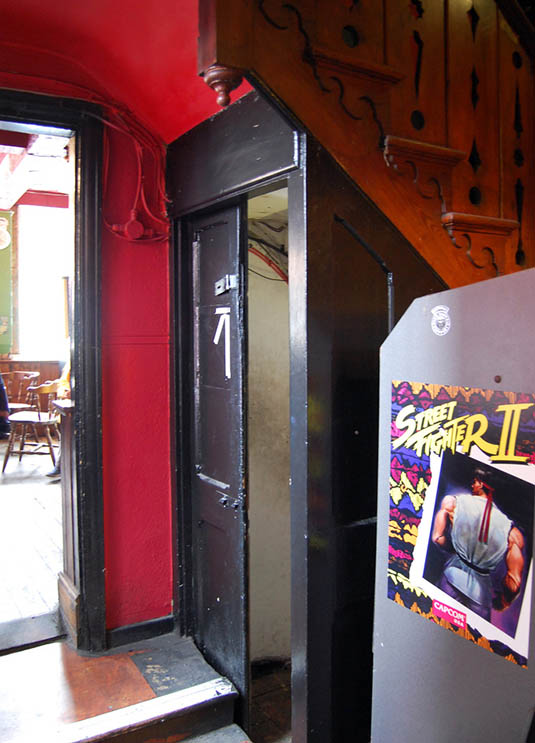
Leaving the mall behind, and maintaining a brisk pace, David took us further into the city, where our next stop was the Old Angel Inn, another pub with an extensive cellar of caves, in this case accessed through a deceptively workaday door next to an arcade game.

[Images: The Old Angel Inn (top), including the door inside the pub that leads down to the caves below; photos by Nicola Twilley].
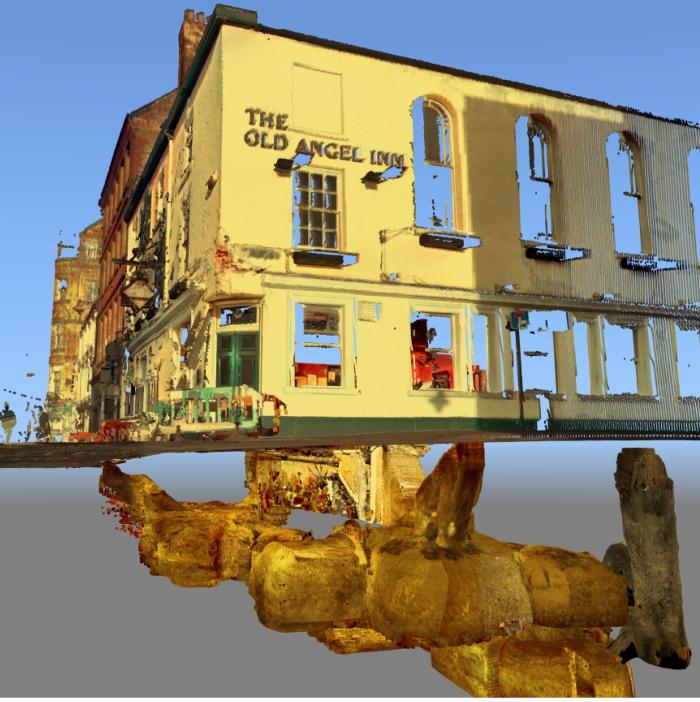
Once again, it can hardly be exaggerated how easy it would be to visit or even live in Nottingham and have absolutely no idea that underground spaces such as this can be found almost anywhere. As Tony Waltham points out, “It would be a fair assumption that every building or site within the old city limits either has or had some form of cave beneath it. About 500 caves are now known, and this may be only half the total number that have been excavated under Nottingham.”

[Images: The caves of the Old Angel Inn, courtesy of the Nottingham Caves Survey].
In any case, “Although the Old Angel is a ‘modern’ brick building,” as the Nottingham Caves Survey describes the pub on its website, “an investigation of the caves below reveals stone walls belonging to an earlier incarnation. It is likely that there were buildings on this site as far back as the Anglo-Saxon period. Whether the caves beneath are also this old cannot be demonstrated definitively.”

Typical, as well, for these types of pub caves, we found ventilation and delivery tunnels leading back up to the surface, and the walls themselves are lined with long benches, perfect for sitting below ground and, provided you have candles or a flashlight along with you, enjoying a smoke and a pint of beer. As Tony Waltham explains, pub cellars often include “perimeter thralls,” or “low ledges cut in the rock,” normally used for storing kegs and barrels of beer but quite easily repurposed for a quick sit-down.

But I sense I’m going on way too long about all this, especially because the two most memorable details of the entire day were yet to come.

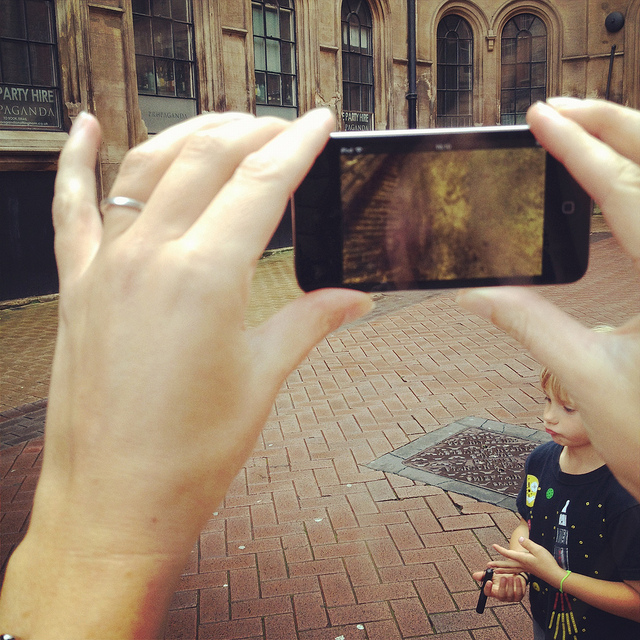
Jumping forward a bit, we left the Old Angel and followed some twists and turns in the street to find ourselves standing outside a nightclub called Propaganda.

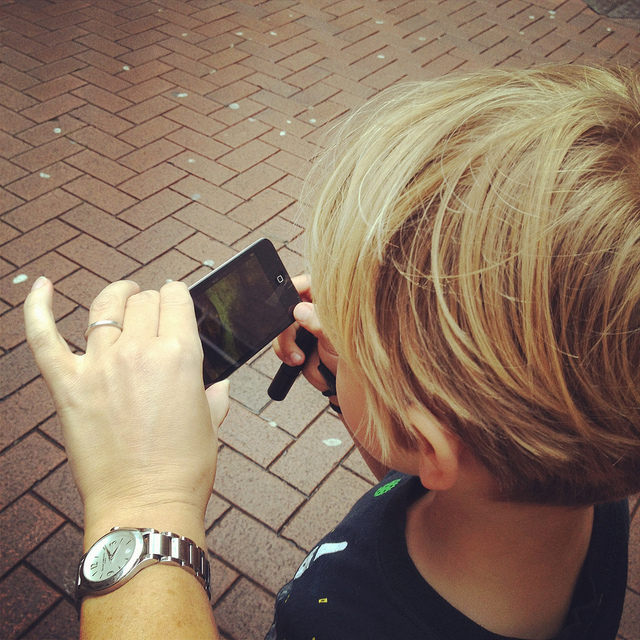
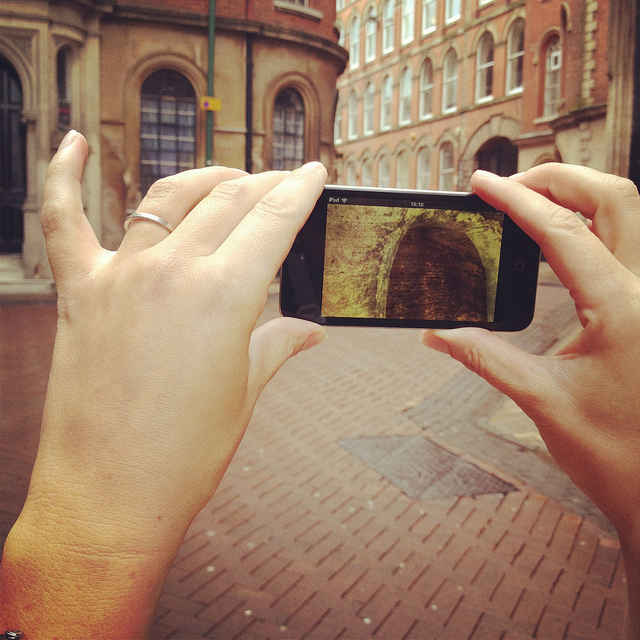
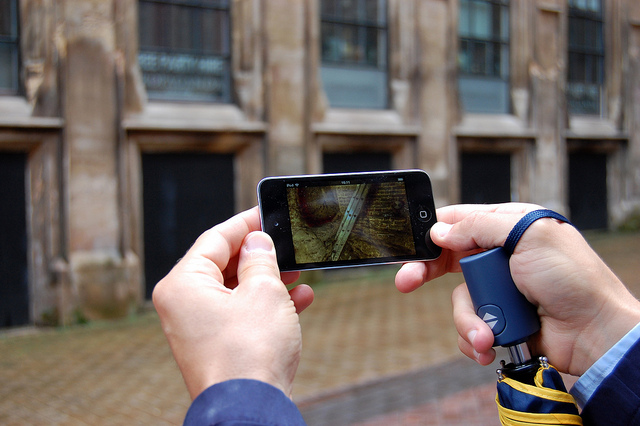
Here, David revealed that he has been working on what, in my opinion, will easily be one of the must-have apps of the year. In a nutshell, David has managed to make the subterranean 3D laser-scans of the Nottingham Caves Survey accessible by location, such that, holding up his iPod Touch, he demonstrated that you could, in effect, scan the courtyard we were standing in to see the caves, tunnels, stairways, cellars, vents, storage rooms, and more that lay hidden in the ground around us.

[Images: We test-drive the cave-spotting app; bottom photo by Nicola Twilley].
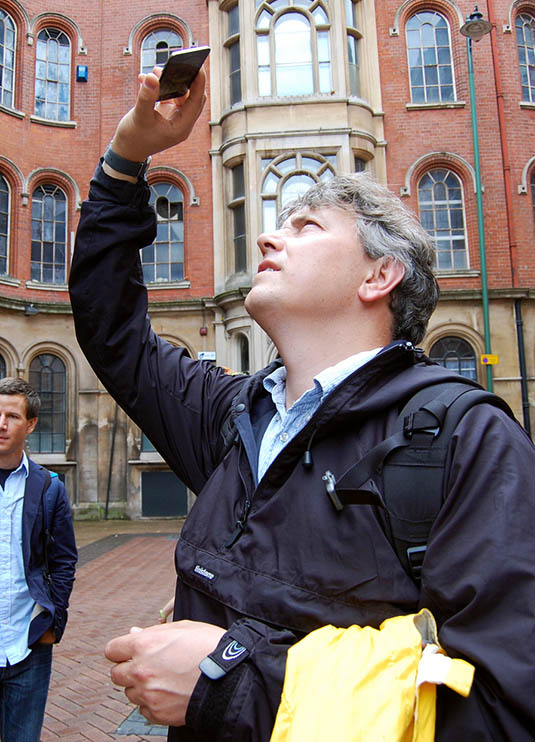
Ideally, once the Survey’s extensive catalog of 3D visualizations and laser point-clouds has been made available and the app is ready for public download, you will be able to walk through the city of Nottingham, smartphone in hand, revealing in all of their serpentine complexity the underground spaces of the city core.

For anyone who has ever dreamt of putting on x-ray glasses and using them to explore architectural space, this app promises to be a thrilling and vertiginous way to experience exactly that—peering right through the city to see its most ancient foundations.


[Video: A fly-through of the Propaganda Nightclub malting caves].

I, for one, can’t wait to see what David and the Nottingham Caves Survey do with the finished application and I eagerly await its public availability.

[Image: Mark Smout looks for caves in the sky; photo by Nicola Twilley].
I’ll wind up this already quite long post with just a few more highlights.

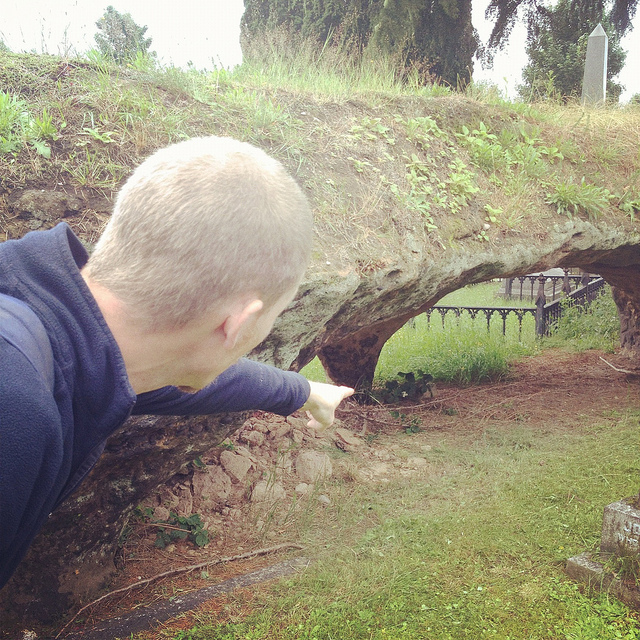
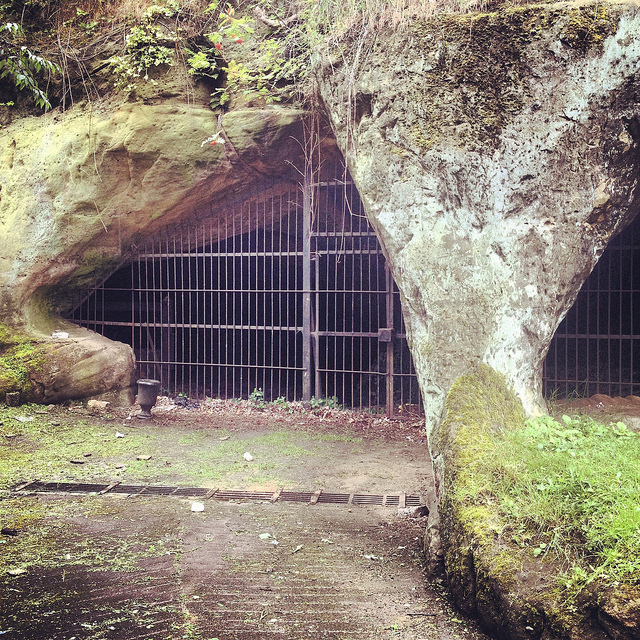
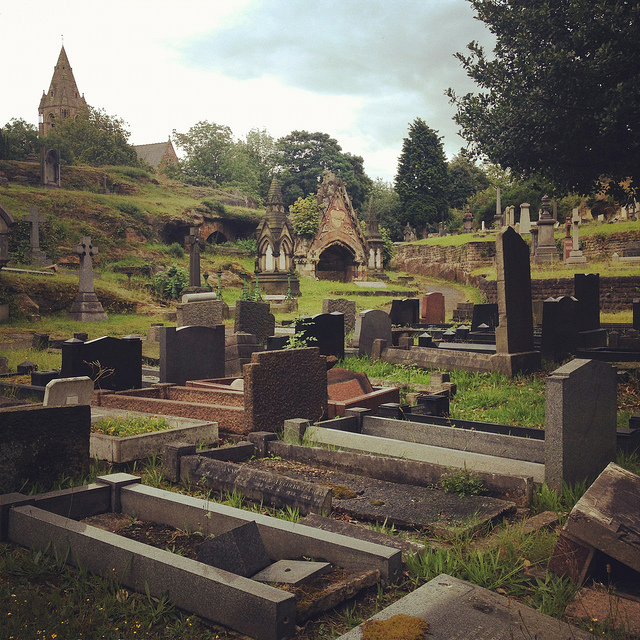
Nottingham’s Rock Cemetery, north from the center of town along the Mansfield Road, contains, among other things, the collapsed remains of a sand mine. Three of the mine’s old entrances are now gated alcoves surrounded by graves, like something out of Dante. They “are the only surviving remnants of the mine,” Waltham writes in his pamphlet.

[Images: Nottingham’s Rock Cemetery, where archaeologist David Strange-Walker explained the history of the local landscape].
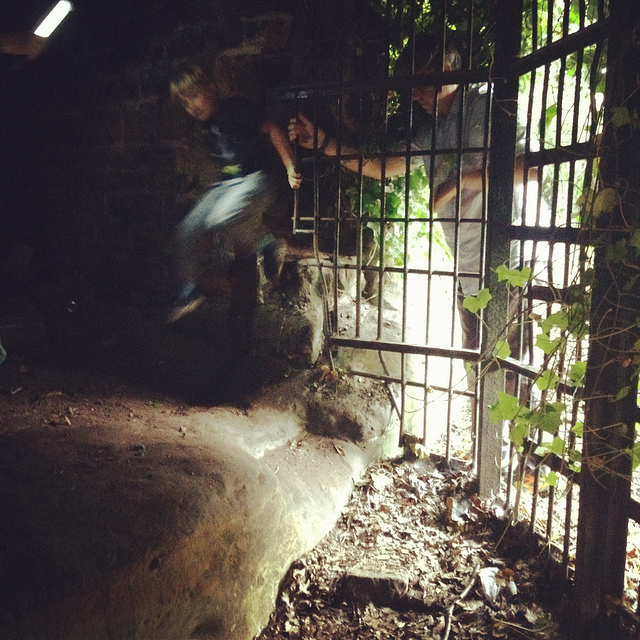
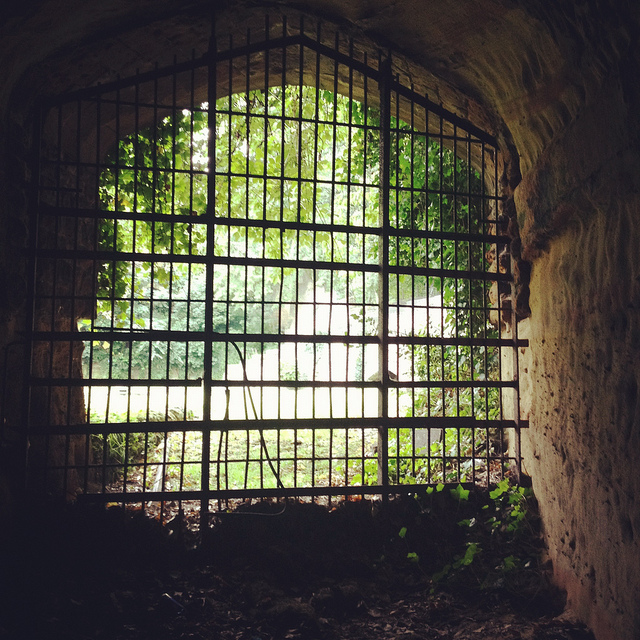
However, an ambitious plan to carve sizable catacombs, inspired by Paris and Rome, through the sandstone beds of the ancient desert here resulted in the never-completed Catacomb Caves, “probably done in 1859-63,” Waltham suggests. These long arched tunnels, accessible through one of the gates described above, eventually lead to a radial terminus from which branch the unused proto-catacombs.

The air there is cloudy with sand—leading me, several days later, to experience a brief attack of hypochondria, worried about developing silicosis—the walls are graffiti’d, and years of trash are piled on the sides of the sandy floor (which has since taken on the characteristics of a dune sea in places, as 150 years of footfall and a collapsing ceiling have led to the appearance of drifts).

[Images: The Rock Cemetery catacomb gates].
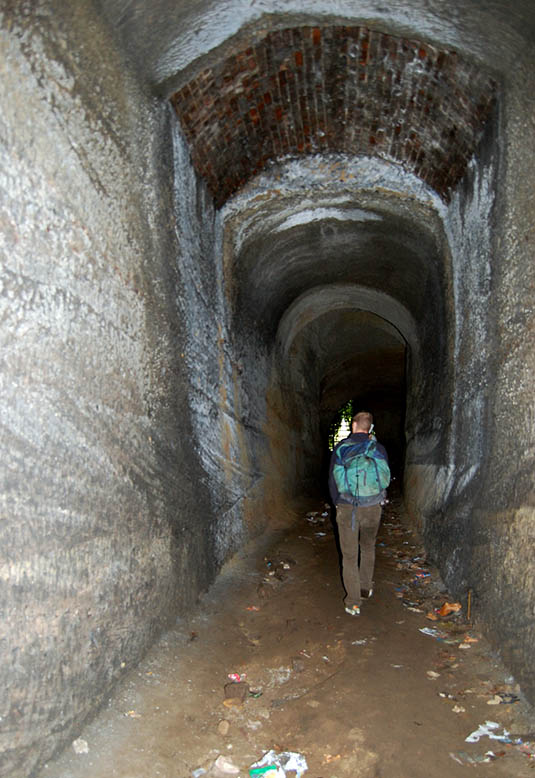
What was so extraordinary here, among many other things, was that, for most of this walk through the catacombs, we were actually walking below the graves, meaning that people were buried above us in the earth. At the risk of overdoing it, this felt not unlike becoming aware of an altogether different type of constellation, with bodies and all the stories their lives could tell held above us in a terrestrial sky like legends and heroes, like Orion and Cassiopeia, as we looked up at the vaulted ceiling, flashlights in hand.

[Image: Inside the catacombs; photo by Nicola Twilley].
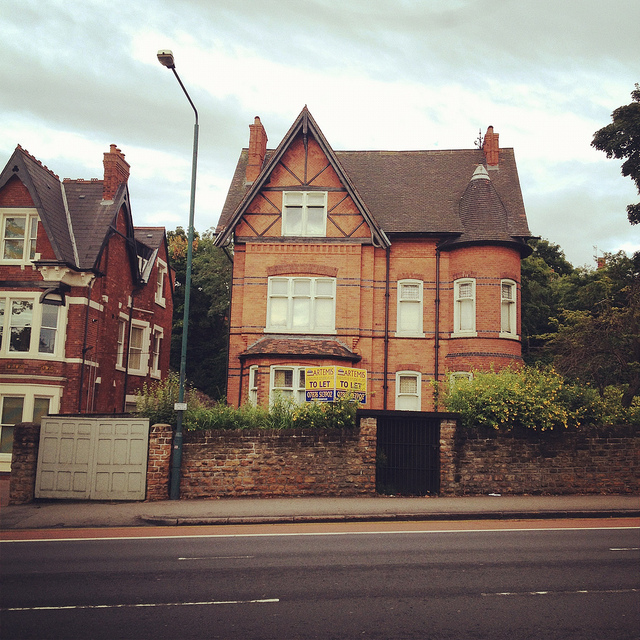
But the best site of all was next.

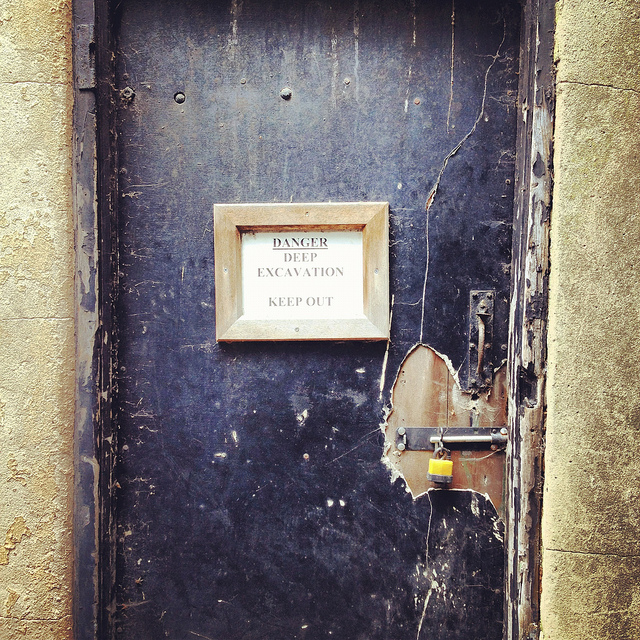
[Image: A door on the street—the black door with bars—leading down into a sand mine; photo by BLDGBLOG].
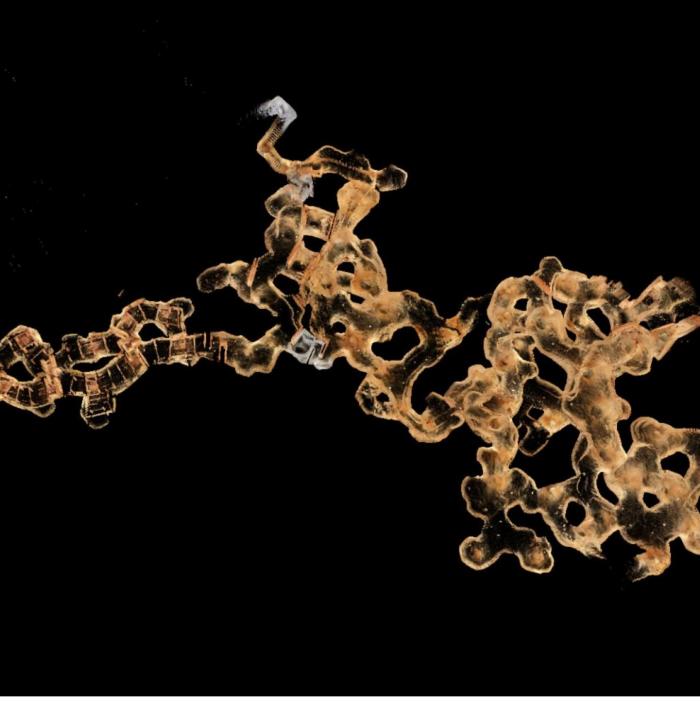
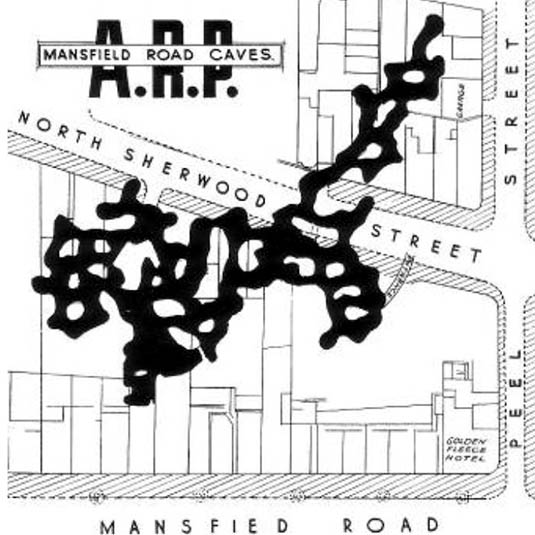
Serving as something of the ultimate proof that Nottingham is a city of overlooked doors that lead into the underworld, there were two locked doors—one of which (the black door, near the sidewalk) appears in the photo, above, another of which, on a street nearby, leads down into the Peel Street Caves—simply sitting there on the sidewalk that, if opened, will take you down into extensive and now defunct sand mines. David’s laser-scans of these for the Nottingham Caves Survey are absolutely gorgeous, as you can see, below.

[Image: The Peel Street Caves sand mine, courtesy of the Nottingham Caves Survey].

For a variety of reasons, I am going to avoid being too specific about some of the details here, but, aside from that, I can only enthuse about the experience of donning our hard hats and heading down several flights of comparatively new concrete steps into a coiling and vast artificial cavern from the 19th century, one we spent nearly an hour exploring.

[Image: Nicola Twilley and Mark Smout head down into the sand mine; photo by BLDGBLOG].
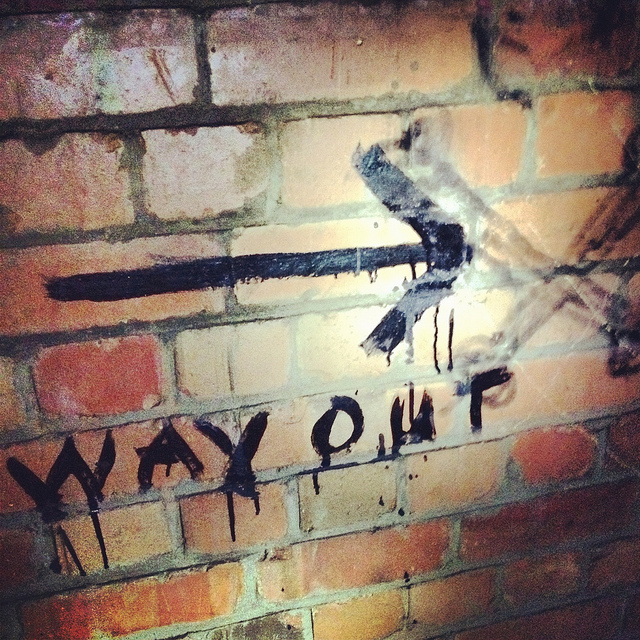
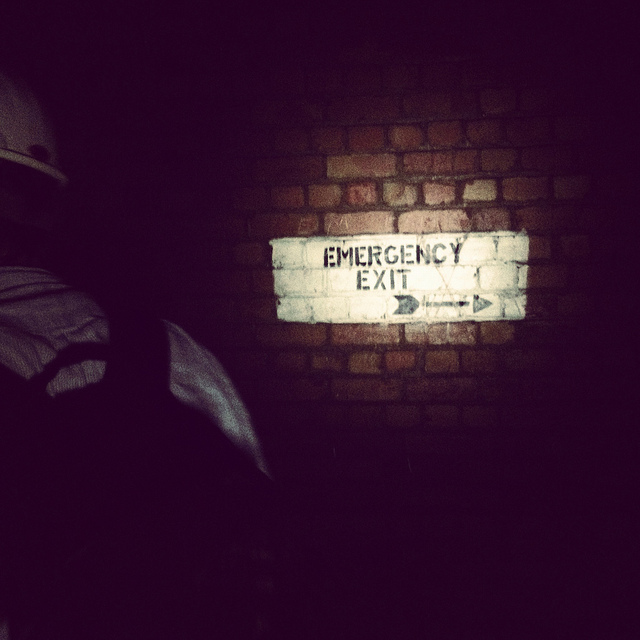
Getting lost down there would be so absurdly easy that it is frightening even to contemplate, and, in case the group of us somehow got split up or our batteries ran out of juice, we joked about—if only we could remember them—the easy techniques for navigating a labyrinth offered in Umberto Eco’s novel The Name of the Rose.

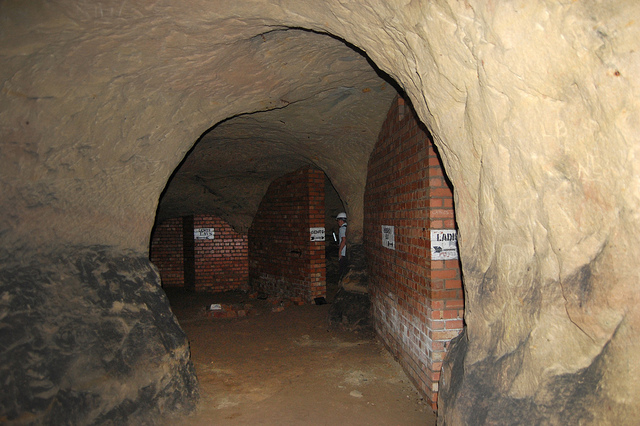
[Image: Many of these way-finding signs are actually incorrect, David explained, and seem to have been painted as a kind of sick joke by someone several years ago; photos by BLDGBLOG].
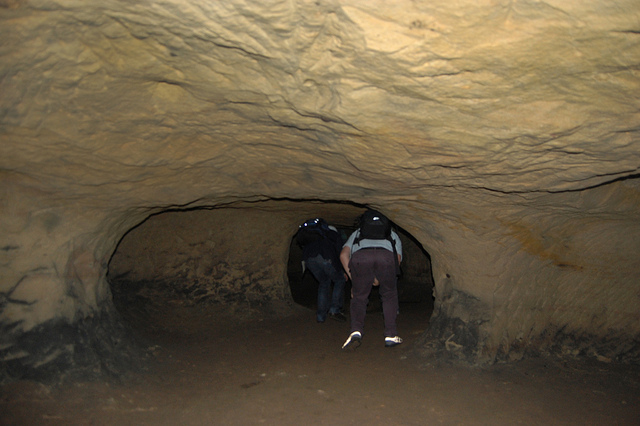
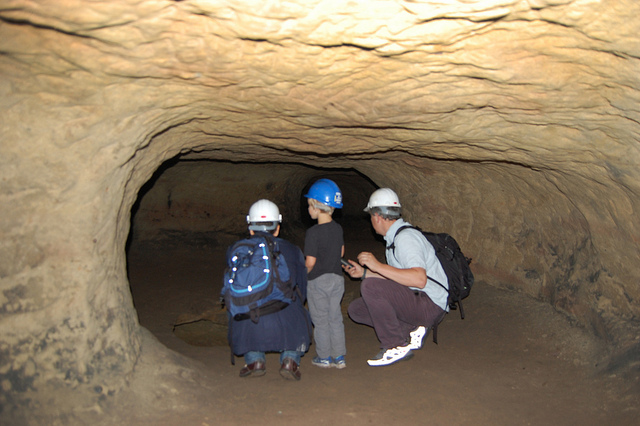
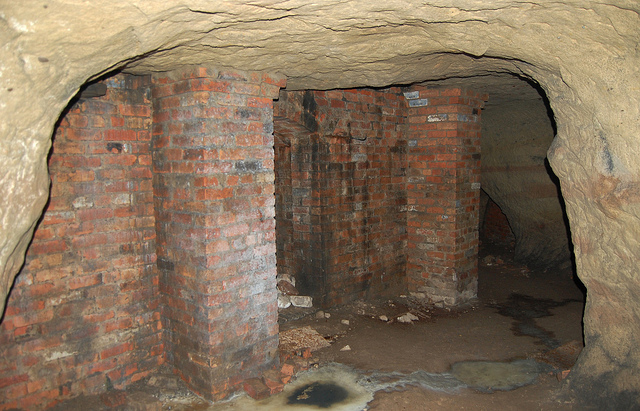
Avoiding such a fate, however, we found graffiti and men’s and women’s latrines; we popped our heads through holes allowing glimpse of other levels; and we cracked our helmets loudly against the low and rough roof more times than I could count.

[Images: Inside the sand mine; all photos by Nicola Twilley].
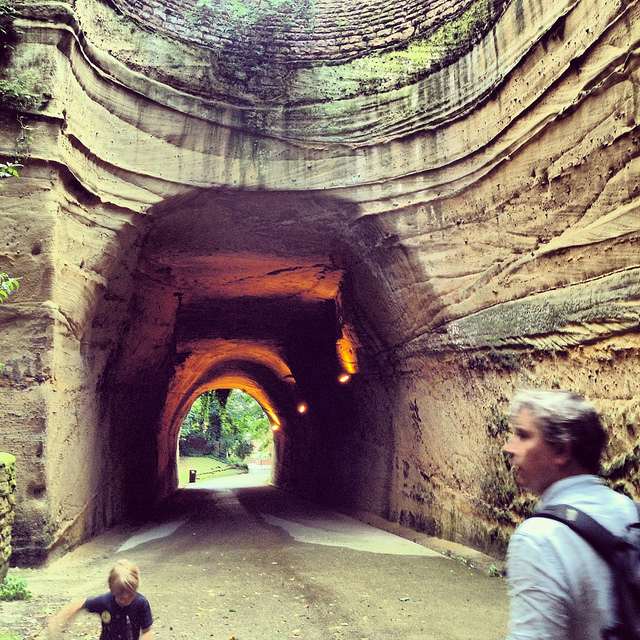
And even that doesn’t complete the day. From here, heading back out onto the street through a nondescript steel door, as if we had been doing nothing more than watching football in someone’s basement, we went on to eat pie and chips in a restaurant built partially into a cave; we walked back across town, returning to where we started, talking about the future and seemingly obvious possibility of Nottingham’s caves being declared a UNESCO World Heritage Site and thus saved from their all but inevitable destruction (it’s easy to imagine a future in which a tour like the one David gave us will be impossible for lack of caves to see); and we all said goodbye beneath an evening sky cleared of clouds as a late-day breeze began to cut through town.

[Image: Mark & Ellis Smout explore our final “underground” space of the day, the magnificent Park Tunnel; the banded strata clearly visible in the walls show how the tunnel was carved through the dunes of an ancient desert. Photo by BLDGBLOG].
David proved to be a heroic guide that day. His energy never flagged throughout the tour, and he never once appeared impatient with or exhausted by any of our often ridiculous questions—not to mention our tourists’ insistence on pausing every three or four steps to take photographs—and he remained always willing to stay underground far longer than he had originally planned, all this despite having never met any of us before in person and only communicating with me briefly via a flurry of emails the week before.

Meeting David left me far more convinced than I already was that the Nottingham Caves Survey fully deserves the financial support of individuals and institutions, so that it can complete its ambitious and historically valuable work of cataloging Nottingham’s underground spaces and making that knowledge freely accessible to the general public.

Weirdly, England has within its very heart a region deserving comparison to Turkish Cappadocia—yet very few people even seem to know that this subterranean world exists. There very well could be more than 1,000 artificial caves beneath the city, many of them fantastically elaborate, complete with fine carvings of lions and ornate stairwells, and it is actually somewhat disconcerting to think that people remain so globally unaware of Nottingham’s underground heritage.

With any luck, the work of David Strange-Walker, Trent & Peak Archaeology, and the Nottingham Caves Survey will help bring this extraordinary region of the earth the attention—and, importantly, the focused conservation—it is due.

(For further reading, don’t miss Nicola Twilley’s write-up of the tour on her own blog, Edible Geography; and Tony Waltham’s Sandstone Caves of Nottingham, cited extensively in this post, is worth a read if you can find a copy).

London Bells / Urban Instruments

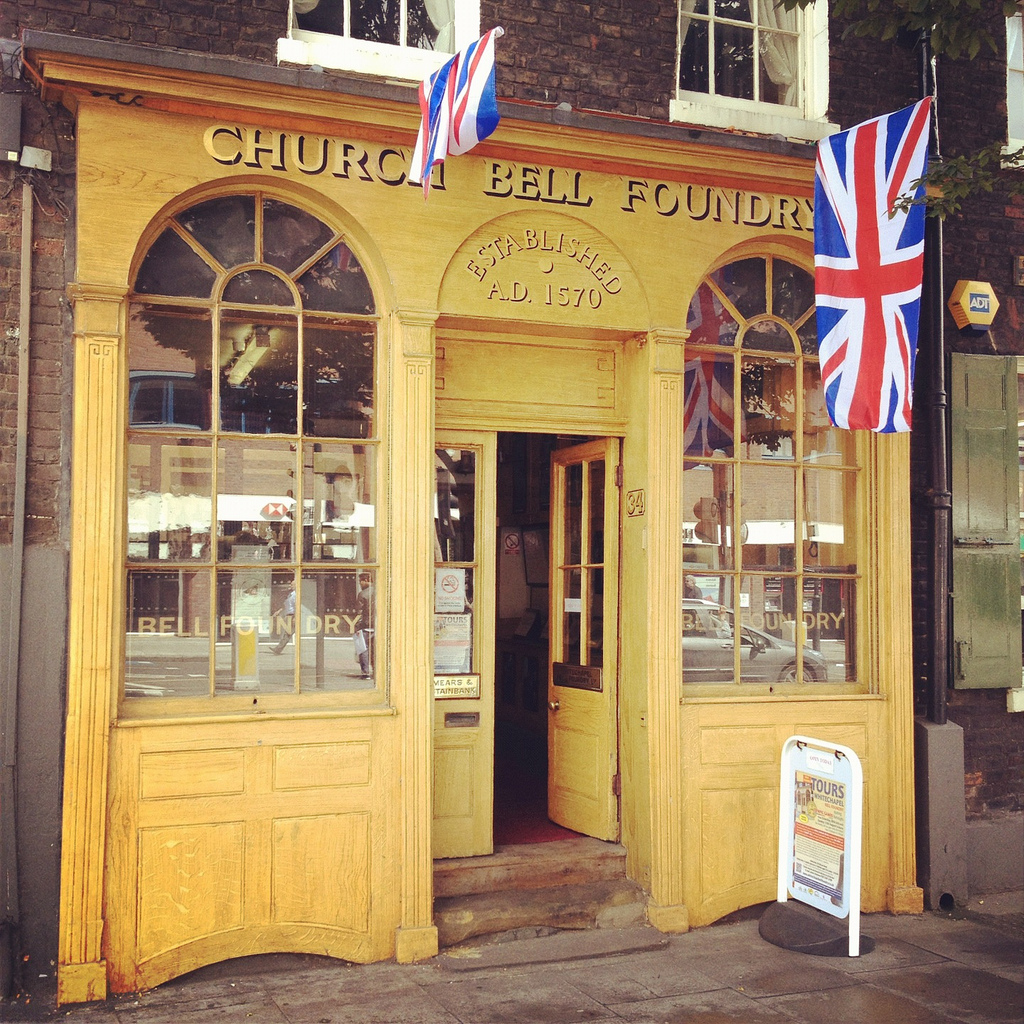
[Image: Outside the Whitechapel Bell Foundry, London; all photos by BLDGBLOG].
Before leaving London last week, I learned that the Whitechapel Bell Foundry was offering walk-in tours for the duration of the Olympics, so Nicola Twilley and I headed out to see—and hear—what was on offer.

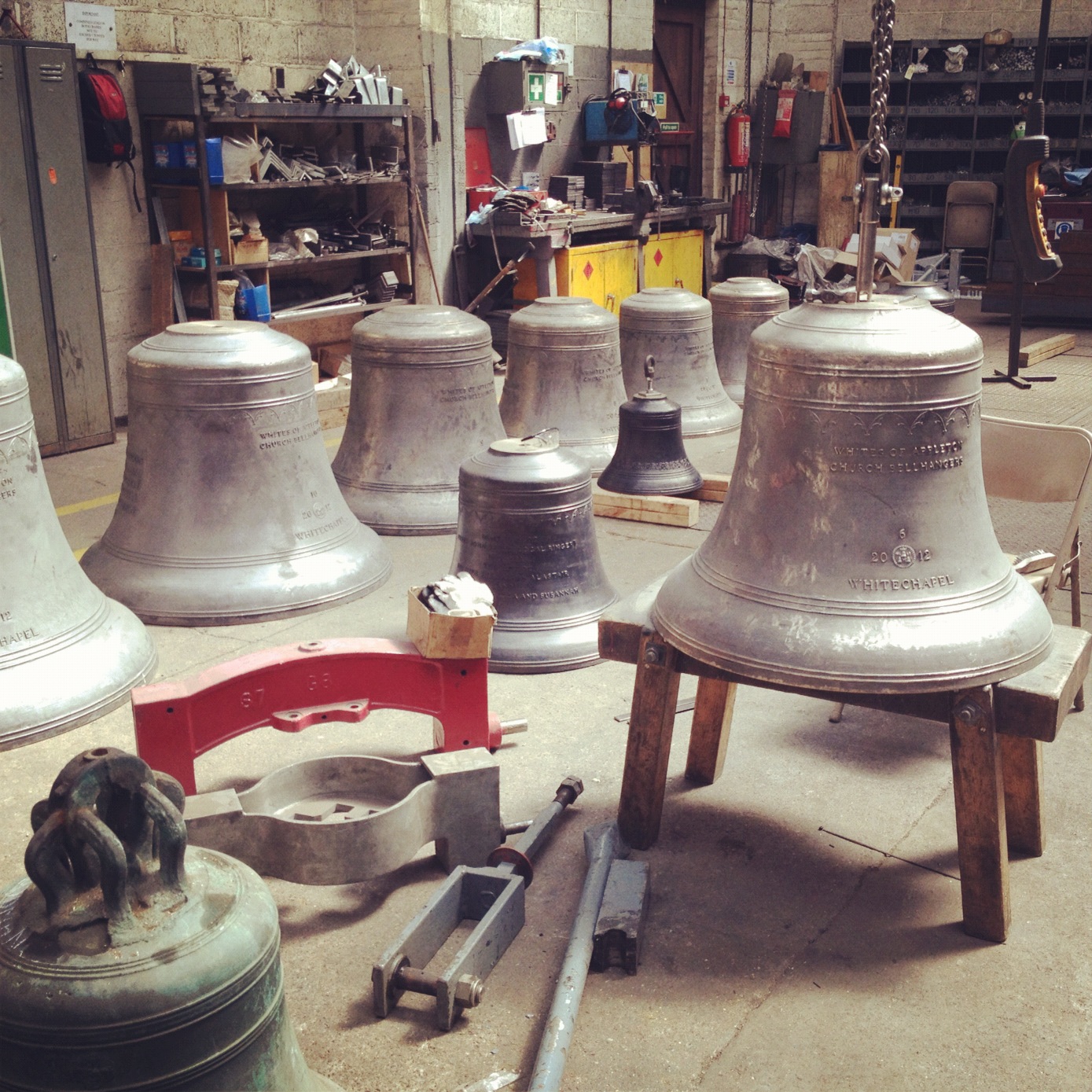
[Image: Inside the Whitechapel Bell Foundry].
I’d say, first off, that the tour is well worth it and that everyone on hand to help us along on the self-guided tour seemed genuinely pleased to have members of the public coming through. Second of all, if you have any interest at all in the relationship between cities and acoustics—say, the influence of bells on neighborhood identity or the subtle differences in city soundscapes based on different profiles moulded into church bells—then it’s a fabulous way to spend the afternoon.

We were there for nearly two hours, but I still felt like we were rushing.

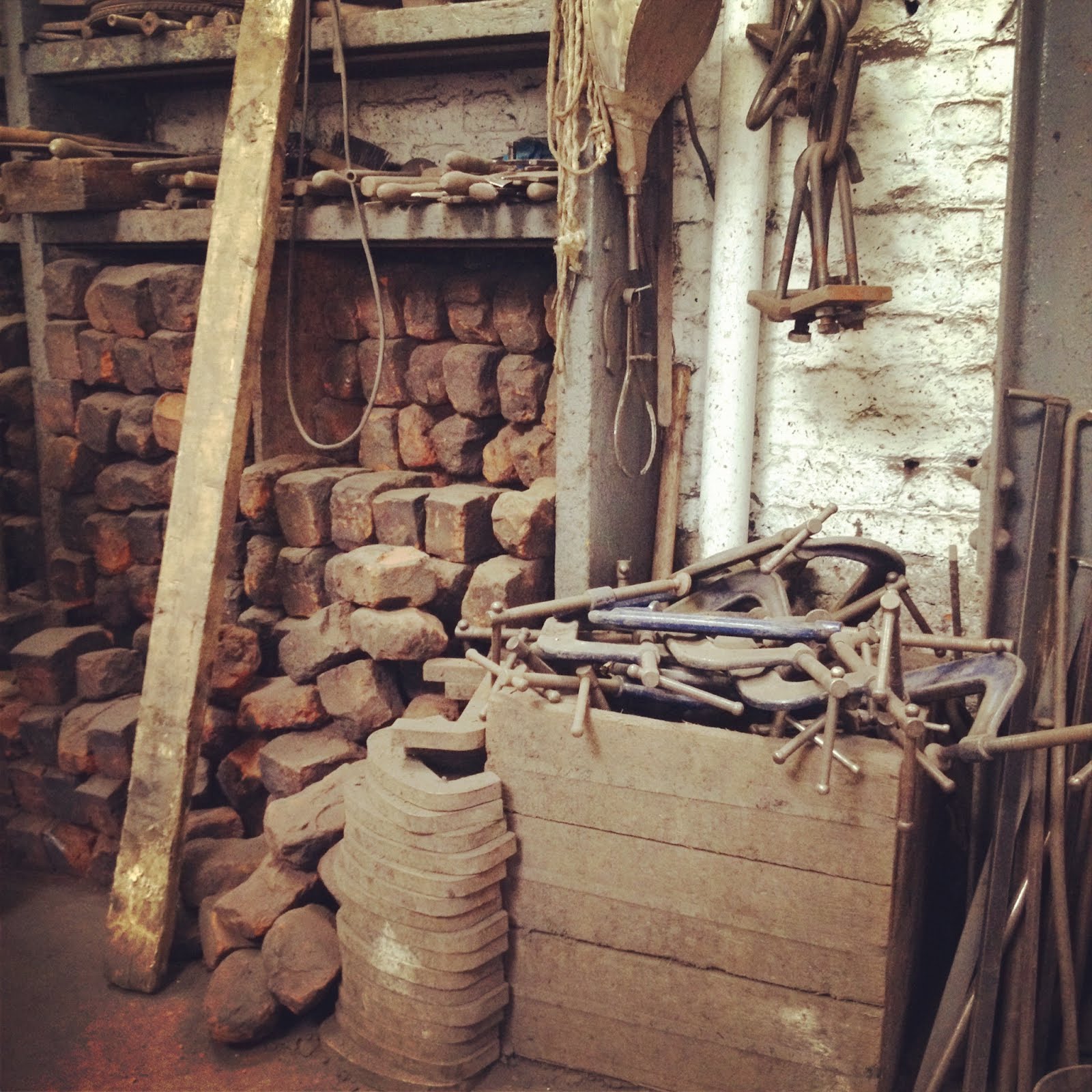
[Image: Bell-making tools at the Whitechapel Bell Foundry].
In any case, the Foundry bills itself, and is apparently recognized by the Guinness Book of World Records, as the oldest manufacturing company in Britain. They made Big Ben; they forged the first Liberty Bell; they created, albeit off-site, the absolutely massive 23-ton 2012 Olympic Bell; and, among thousands of other, less well-known projects, they even made the famed Bow bells whose ringing defines London’s Cockney stomping ground.

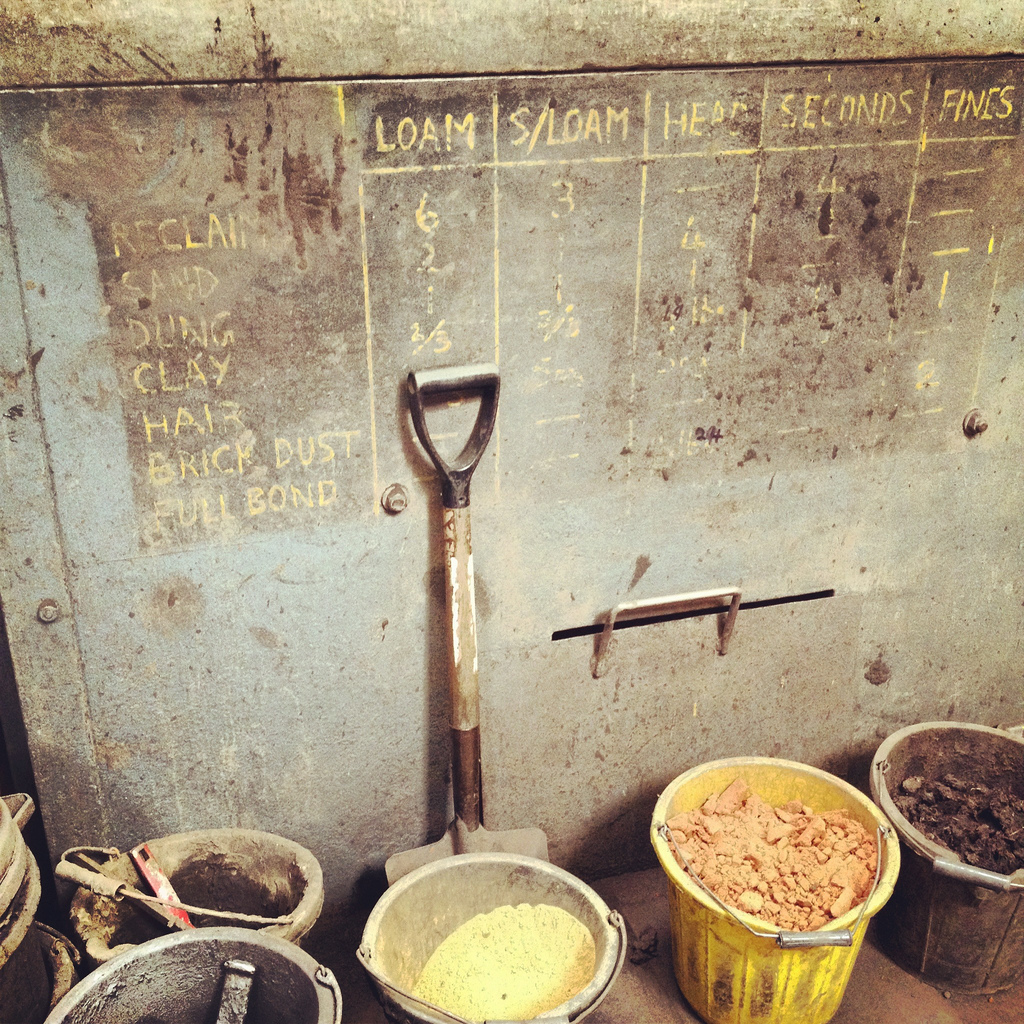
[Image: The ingredients of loam].

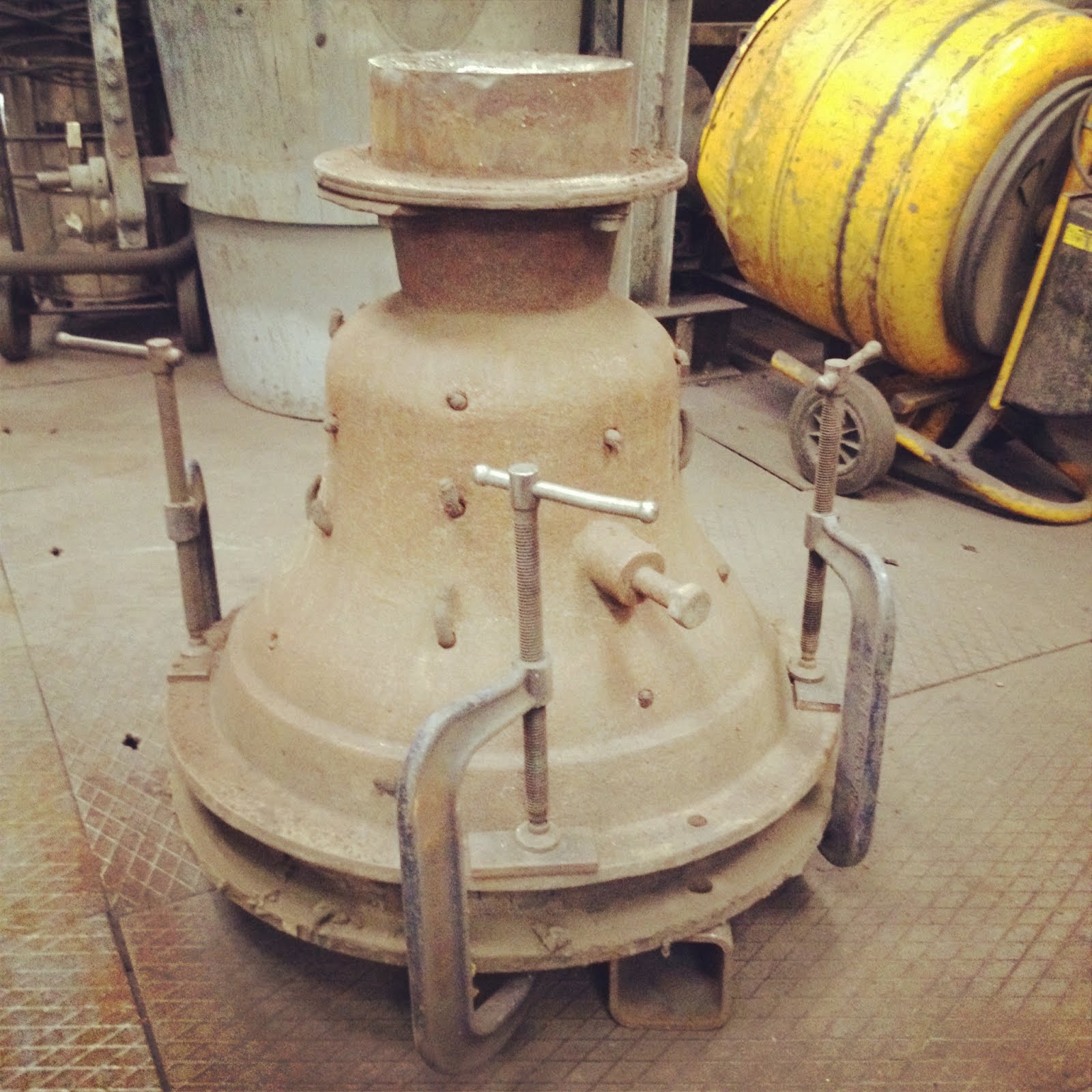
The self-guided tour took us from buckets of loam, used to shape the earthen moulds into which “bell metal” (an alloy of copper and tin) is later poured during casting, all the way to the mind-blowing final sight and sound of the bell-tuning station.

Here are some quick photos, then I’ll come back to the tuning process.

[Images: Interior of the Foundry, plus some of the casting/pouring equipment. In the bottom two images, the frames visible on the back wall were used to cast, from left to right, Big Ben; the original Liberty Bell; the Bow bells; the enormous 2012 Olympic Bell; and another bell, on the far right, that I unfortunately don’t remember].
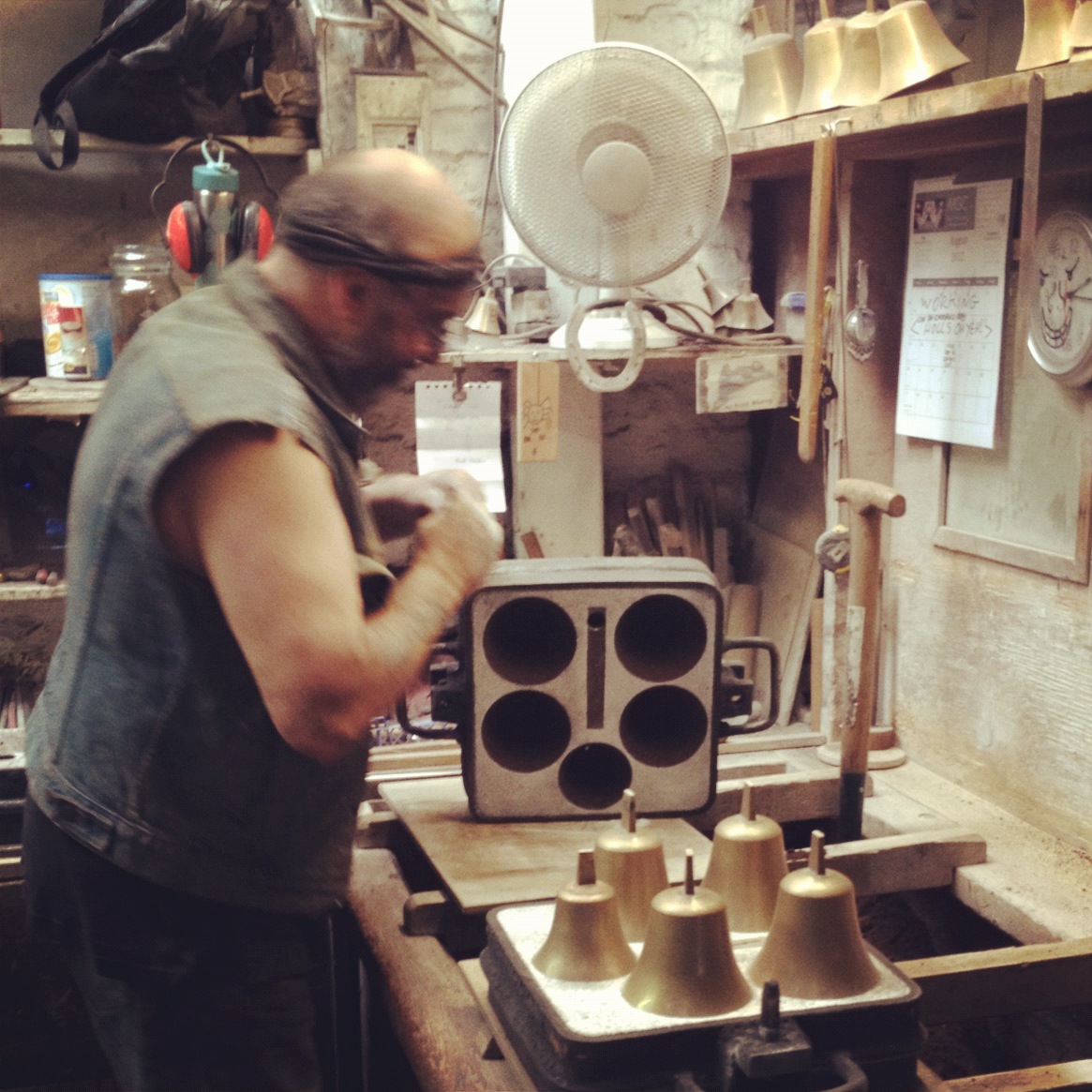
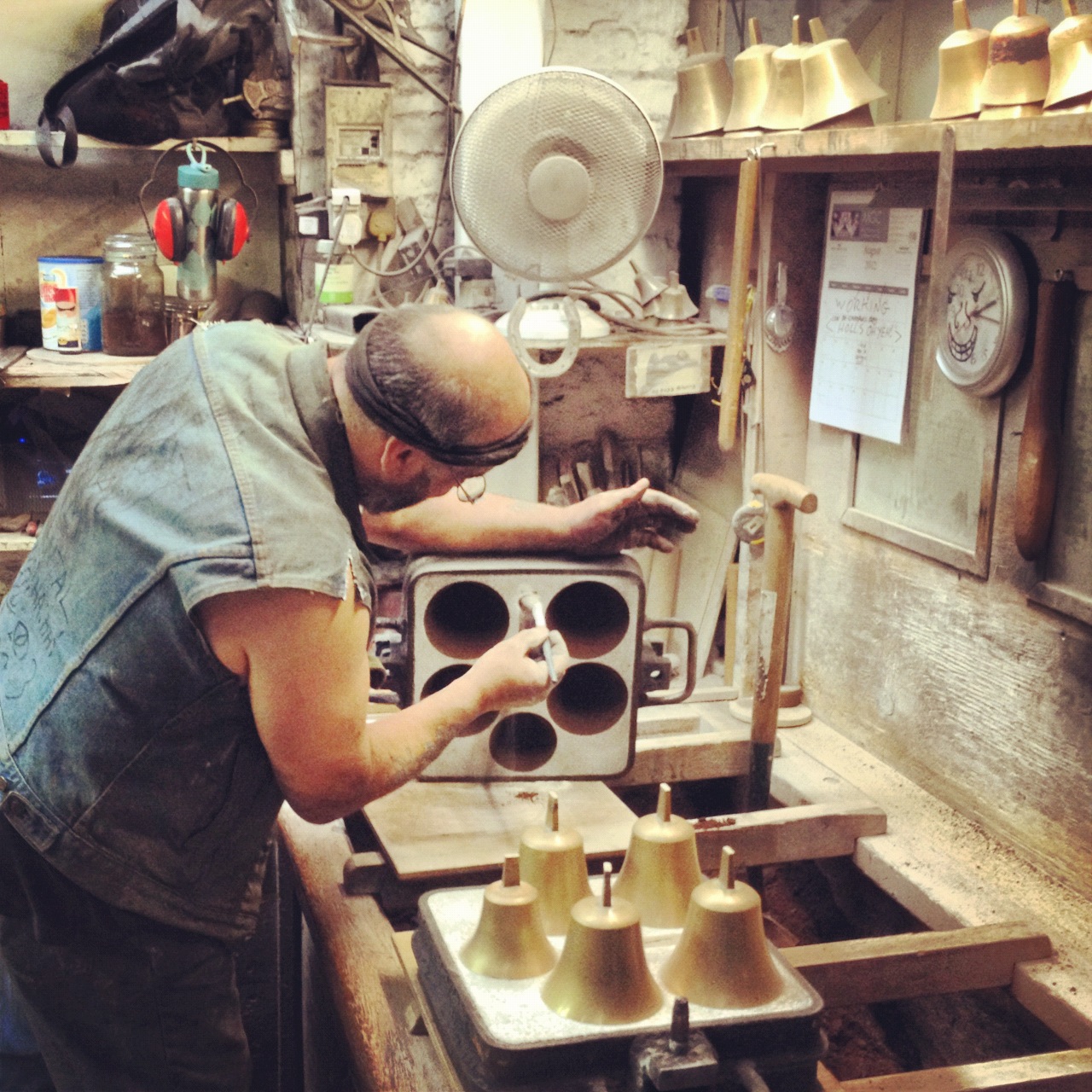
The next sequence shows the casting of hand bells. We were basically in the right place at the right time to see this process, as the gentleman pictured—whose denim vest had written on it in black marker, “I’m not mad, I’m mental, HA! HA! HA!”—pulled apart the suitcase-like casting frame seen in these photos to reveal gorgeously bright golden bells sitting silently inside.

Using powder, almost like something you’d use to sugar a cake, and an air-hose, he removed the bells from their loamy matrix and got the frame ready for another use.

[Image: The bells are revealed and powdered].
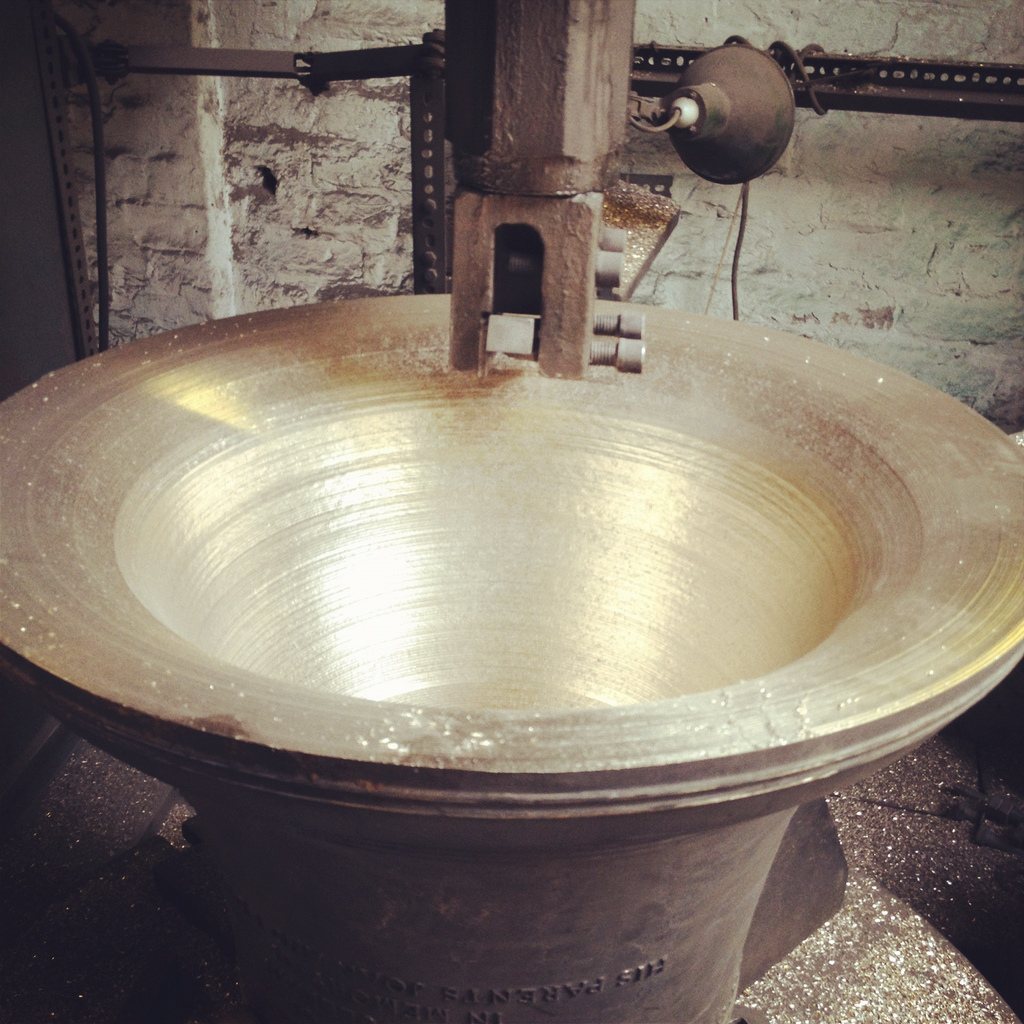
The whole thing was a kind of infernal combination of kilns and liquid metal, soundtracked by the sharp metallic ring of bells resonating in the background.

As the origin site for urban instruments—acoustic ornaments worn by the city’s architecture to supply a clockwork soundtrack that bangs and echoes over rooftops—the Foundry had the strange feel of being both an antique crafts workshop of endangered expertise (kept afloat almost entirely by commissions from churches) and a place of stunning, almost futuristic, design foresight.

In other words, the acoustic design of the city—something that isn’t even on the agenda of architecture schools today, considered, I suppose, too hard to model with Rhino—was taking place right there, and had been for centuries, in the form of vast ovens and casting frames out of which emerge the instruments—shining bells—that so resonantly redefine the experience of the modern metropolis.

So that brings us to the final stage of the Foundry tour, which was the tuning station.

[Images: Tuning a bell; note the shining flecks of metal on the floor, which have been scraped out of the bell in order to tune it. “Tuning” is thus a kind of mass reduction, or reductive sculpting].
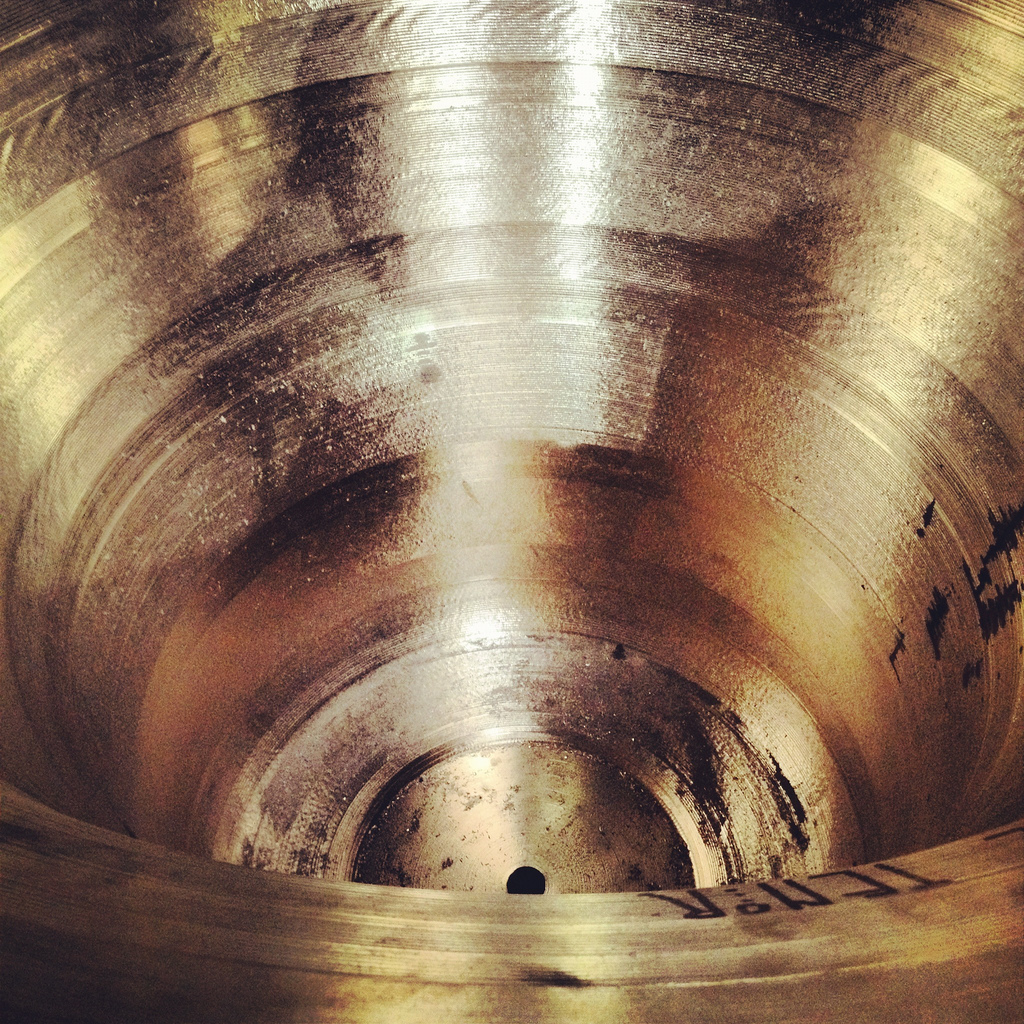
Assuming I remembered this correctly, modern bells are tuned by having tiny bits of metal—mere flecks at a time—scraped or cut away from the inside. This produces an incredible texture of bright, polished grooves incised directly, even violently, into the metal; the visual effect is absolutely magical.

[Image: The grooved interior of a recently tuned bell; in the bottom image, note the word “tenor” written on the bell’s inner rim].
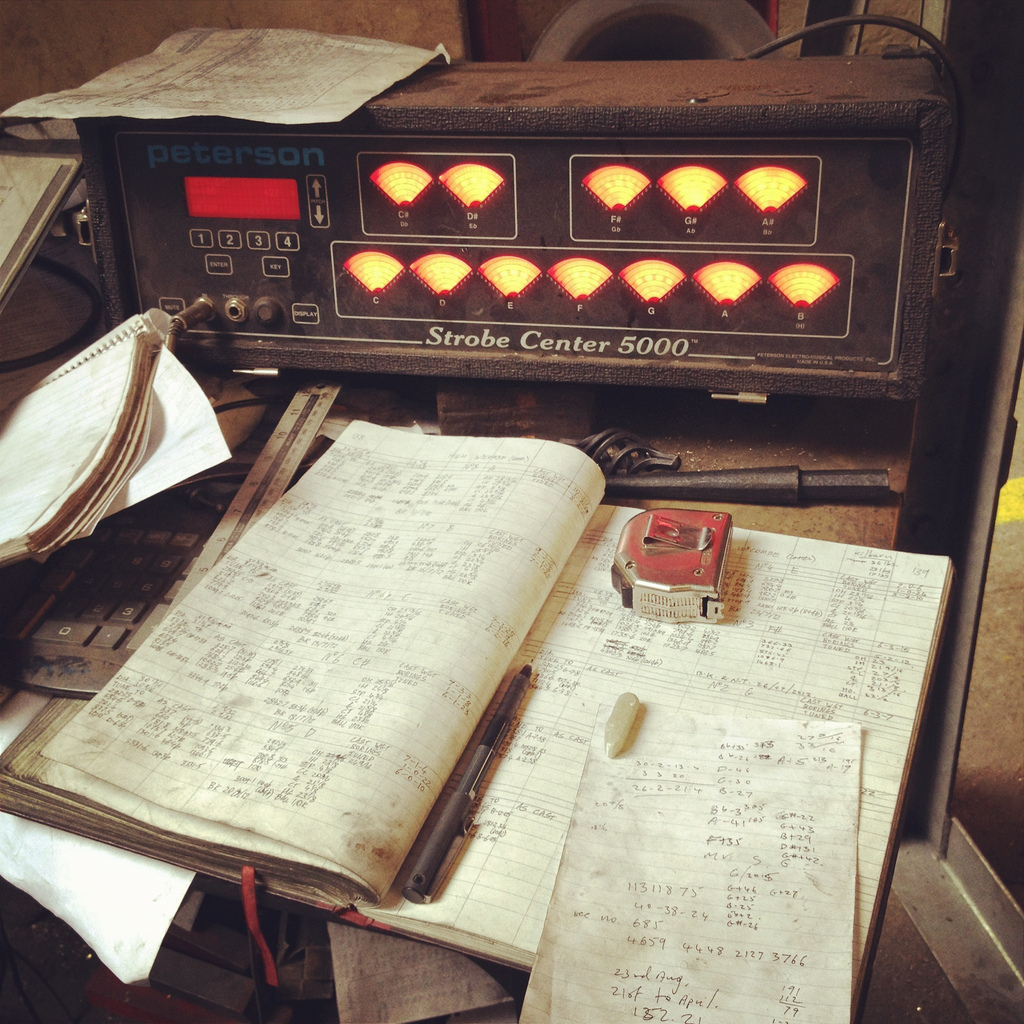
Even better, while these massive bells are rotating anti-clockwise on their turning plates, having their insides scraped away, they are actually ringing!

Deep below the abrasive droning roar of the bell turning you can make out the resonant tone of the bell itself. The effect was like listening to tuned rocks falling endlessly in a tumbler, polished into acoustically more beautiful versions of themselves. This process alone could make a new instrument: a full orchestra of bell-tuning stations, as if mining shaped metals for their sounds.

Finally, then, the tuning process is controlled by one of three ways, often used in combination. One uses software; you bang the bell with a mallet and the software tells you if it’s resonating at the right frequencies. The second method uses an oscilloscope, which looks like something straight out of a 1980s submarine-warfare movie.

[Image: As if looking for ghosts inside the bell, the oscilloscope spins and glows].
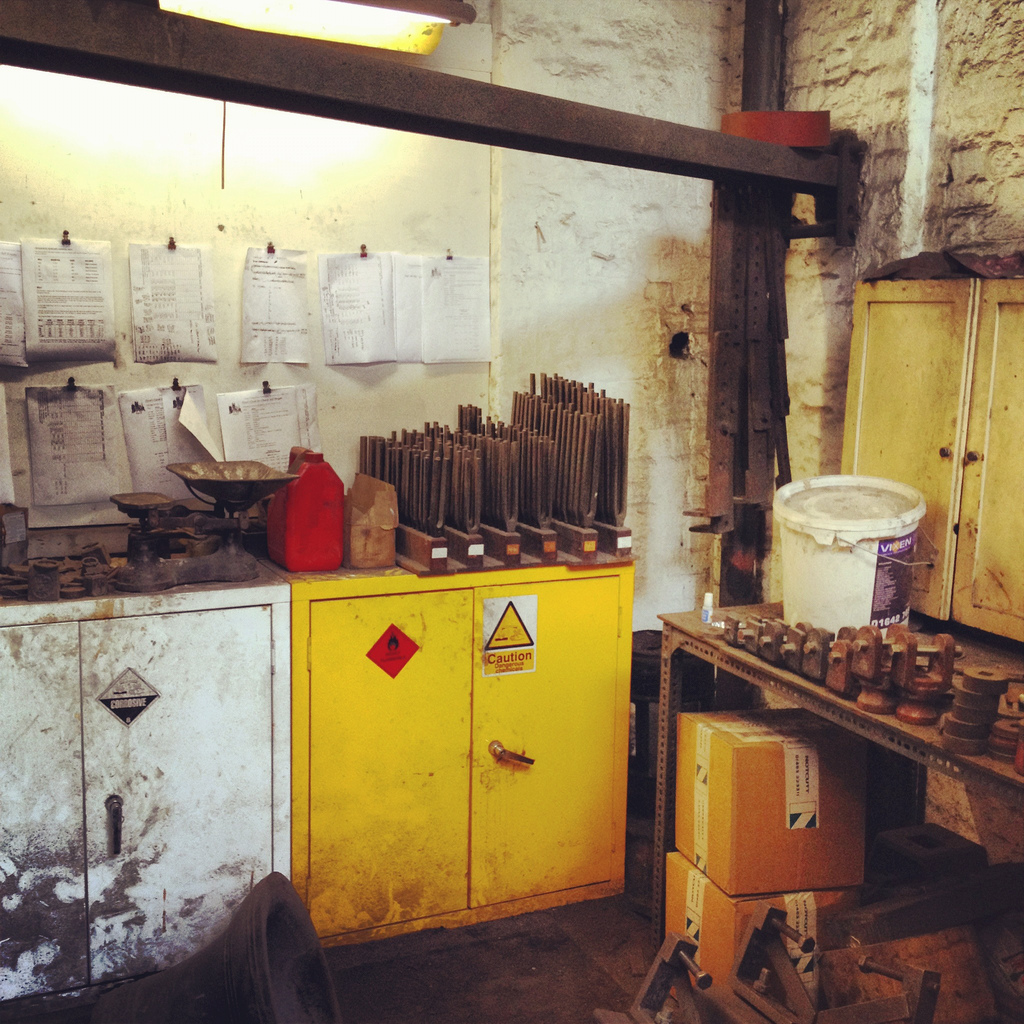
And the third is much more analogue, relying entirely on the tuner’s own sense of pitch and the use of tuning forks.

[Image: Tuning forks at the Whitechapel Bell Foundry].

At the risk of going on too long about this, there really was something almost indescribably beautiful about the tuning process: watching, and listening to, otherwise featureless metal surfaces be sculpted and inscribed from inside by an anti-clockwise machine as the weird circular howl of the bell grew gradually more distinct, more precisely pitched with every scraping away of unpolished metal.

Being, as you’ll know by now, prone to clichés, I can’t help but think of William Blake’s “Satanic Mills” of the Industrial Revolution every time I enter an industrial facility these days, and a vision of some titanic factory somewhere in the pollution of a future era, spinning raw metal into bells, golden and shrieking things droning as if enspirited or possessed, is almost too fantastical to contemplate.

Anyway, the Whitechapel Bell Foundry is open for walk-in tours, for £10 per adult, until the end of the 2012 Olympics, after which the tours go back to advance reservations only (and the ticket price goes up to £12). Enjoy!

Buy an Underground Kingdom

[Image: The Mole Man’s house in Hackney, via Wikipedia].

As most anyone who’s seen me give a talk over the past few years will know, I have a tendency to over-enthuse about the DIY subterranean excavations of William Lyttle, aka the Mole Man of Hackney.

Lyttle—who once quipped that “tunneling is something that should be talked about without panicking”—became internationally known for the expansive network of tunnels he dug under his East London house. The tunnels eventually became so numerous that the sidewalk in front of his house collapsed, neighbors began to joke that Lyttle might soon “come tunnelling up through the kitchen floor,” and, as a surveyor ominously relayed to an English court, “there is movement in the ground.”

From the Guardian, originally reported back in 2006:

No one knows how far the the network of burrows underneath 75-year-old William Lyttle’s house stretch. But according to the council, which used ultrasound scanners to ascertain the extent of the problem, almost half a century of nibbling dirt with a shovel and homemade pulley has hollowed out a web of tunnels and caverns, some 8m (26ft) deep, spreading up to 20m in every direction from his house.

What did he store down there? After Lyttle was forced from the house for safety reasons, inspectors discovered “skiploads of junk including the wrecks of four Renault 4 cars, a boat, scrap metal, old baths, fridges and dozens of TV sets stashed in the tunnels.”

But now the late Mole Man’s home is for sale.

[Image: An earlier Mole Man: Tunnel-Digging as a Hobby].

Alas, “most of the tunnels have been filled in” with concrete, and the house itself is all but certain to be torn down by its future owner, but I like to think that maybe, just maybe, some strange museum of subterranea could open up there, in some parallel world, complete with guided tours of the excavations below and how-to evening classes exploring the future of amateur home excavation. Curatorial residencies are offered every summer, and underground tent cities pop-up beneath the surface of the capital city, lit by candles or klieg lights, spreading out a bit more each season.

Briefly, I’m reminded of a scene from Georges Perec’s novel Life: A User’s Manual, in which a character named Emilio Grifalconi discovers “the remains of a table” that he hopes to salvage for use in his own home. “Its oval top, wonderfully inlaid with mother-of-pearl, was exceptionally well preserved,” Perec explains, “but its base, a massive, spindle-shaped column of grained wood, turned out to be completely worm-eaten. The worms had done their work in covert, subterranean fashion, creating innumerable ducts and microscopic channels now filled with pulverized wood. No sign of this insidious labor showed on the surface.”

Grifalconi soon realizes that “the only way of preserving the original base—hollowed out as it was, it could no longer suport the weight of the top—was to reinforce it from within; so once he had completely emptied the canals of the their wood dust by suction, he set about injecting them with an almost liquid mixture of lead, alum and asbestos fiber. The operation was successful; but it quickly became apparent that, even thus strengthened, the base was too weak”—and the table would thus have to be discarded.

At which point, Grifalconi has an idea: he begins “dissolving what was left of the original wood” in the table’s base in order to “disclose the fabulous arborescence within, this exact record of the worms’ life inside the wooden mass: a static, mineral accumulation of all the movements that had constituted their blind existence, their undeviating single-mindedness, their obsinate itineraries; the faithful materialization of all they had eaten and digested as they forced from their dense surroundings the invisible elements needed for their survival, the explicit, visible, immeasurably disturbing image of the endless progressions that had reduced the hardest of woods to an impalpable network of crumbling galleries.”

Somewhere beneath a new building in East London, then, some handful of years from now, the Mole Man’s “fabulous arborescence” will still be down there, a vast and twisting concrete object preserved in all its tentacular sprawl, like some unacknowledged tribute to Rachel Whiteread: a buried and elephantine sculpture that shows up on radar scans of the neighborhood, recording for all posterity “the endless progressions” of Lyttle’s eccentric and mysterious life.

(Via @SubBrit. Earlier adventures in real estate on BLDGBLOG: Buy a Prison, Buy a Tube Station, Buy an Archipelago, Buy a Map, Buy a Torpedo-Testing Facility, Buy a Silk Mill, Buy a Fort, Buy a Church,).

Secret Soviet Cities

[Images: From ZATO: Secret Soviet Cities during the Cold War at Columbia’s Harriman Institute; right three photographs by Richard Pare].

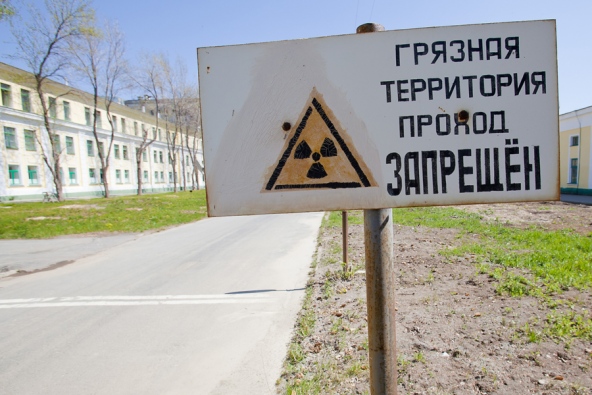
Speaking of Van Alen Books: earlier this week, they hosted a panel on the topic of “Secret Soviet Cities During the Cold War.” These were closed cities or ZATO, “sites of highly secretive military and scientific research and production in the Soviet Empire. Nameless and not shown on maps, these remote urban environments followed a unique architectural program inspired by ideal cities and the ideology of the Party.”

The ZATO, we read courtesy of an interesting post on the Russian History Blog, was a “Closed Administrative-Territorial Formation (Zakrytoe administrativno-territorial’noe obrazovanie, ZATO)”:

[T]he cities themselves were never shown on official maps produced by the Soviet regime. Implicated in the Cold War posture of producing weapons for the Soviet military-industrial complex, these cities were some of the most deeply secret and omitted places in Soviet geography. Those who worked in these places had special passes to live and leave, and were themselves occluded from public view. Most of the scientists and engineers who worked in the ZATOs were not allowed to reveal their place or purpose of employment.

In any case, there are two main reasons to post this:

[Image: Photo by I. Yakovlev/Itar-Tass, courtesy of Nature].
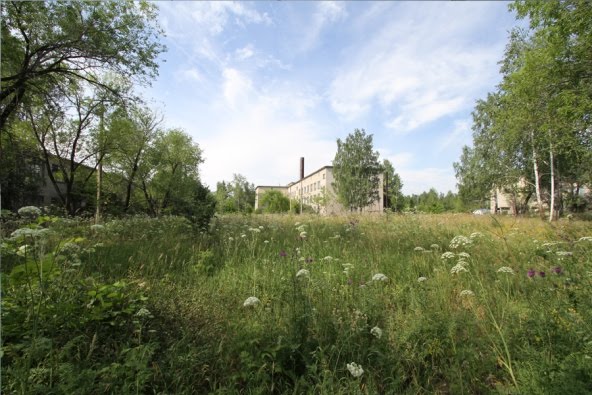
1) Just last week, Nature looked at Soviet-era experiments in these closed cities, where “nearly 250,000 animals were systematically irradiated” as part of a larger medical effort “to understand how radiation damages tissues and causes diseases such as cancer.”

In an article that is otherwise more medical than it is urban or architectural, we nonetheless read of a mission to the formerly closed city of Ozersk in order to rescue this medical evidence from the urban ruins: “After a long flight, a three-hour drive and a lengthy security clearance, a small group of ageing scientists led the delegation to an abandoned house with a gaping roof and broken windows. Glass slides and laboratory notebooks lay strewn on the floors of some offices. But other, heated rooms held wooden cases stacked with slides and wax blocks in plastic bags.” These slides and wax blocks “provide a resource that could not be recreated today,” Nature suggests, “for both funding and ethical reasons.”

Perhaps it goes without saying, but the idea of medical researchers helicoptering into the ruins of a formerly secret city in order to locate medical samples of fatally irradiated mutant animals is a pretty incredible premise for a future film.

[Images: (top) photo by Tatjana Paunesku; (bottom) photo by S. Tapio. Courtesy of Nature].

2) More relevant for this blog, you only have five days left to see the exhibition ZATO: Secret Soviet Cities during the Cold War up at Columbia University’s Harriman Institute, featuring “ZATO archival materials, camouflage maps of strategic sites, secret diagrams of changing ZATO names/numbers, [and] ZATO passports.”

That exhibition documents everything from the “special food and consumer supplements given as rewards for the secrecy and ‘otherness’ of the sites,” to the cities’ eerily suburbanized, half-abandoned state today: “Today there are 43 ZATO on the territory of the Russian Federation. Their future is uncertain: some may survive; others may disappear as urban formations within the context of Russian suburbs.” Check it out if you get a chance.

More info at the Harriman Institute.

Perhaps it is not a city

[Image: Michael Maltzan’s Inner City Arts building, Los Angeles; photo by Iwan Baan].

I’ll be speaking tonight, May 17th, at Van Alen Books with architect Michael Maltzan about his book No More Play: Conversations on Urban Speculation in Los Angeles and Beyond, edited by Jessica Varner, previously discussed on BLDGBLOG here. The book includes interviews with Matthew Coolidge of the Center for Land Use Interpretation, Charles Waldheim, Qingyun Ma, Catherine Opie, Edward Soja (who quips that “architects should think more like good geographers”), and many more, and will be available for sale this evening, if you can stop by.

Things kick off at 7pm at 30 W. 22nd Street, near the Flatiron Building; here’s a map.

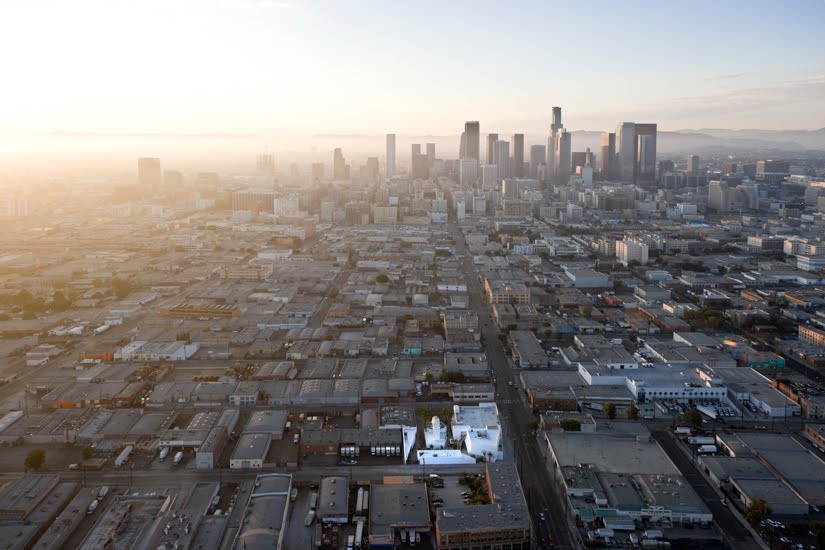
[Image: Los Angeles; photo by Iwan Baan, from No More Play].

As Maltzan writes in the book, “we have reached a point where past vocabularies of the city and of urbanism are no longer adequate, and at this moment, the very word city no longer applies” to Greater Los Angeles. “Perhaps it is not a city” at all, he suggests, but something altogether different and more formally interesting than that (see a slightly longer discussion of this earlier on BLDGBLOG).

When discussing this resistant, indefinable character of Los Angeles, I’m always reminded of a description from the beautifully written but, sadly, now scientifically out of date 2-part book The Music of the Spheres by Guy Murchie. At one point, Murchie describes the surprising lack of density in certain stars, even when those stars, nonetheless, seem structurally coherent to an outside observer.

He explains, for instance, that the surface of the sun “is really a thousand times more vacuous than a candle-flame on Earth, and even the concentrated moiling gases hidden a thousand miles below it are a hundred times thinner than earthly air.” In fact, other stars—such as E Aurigae I, so huge it could “contain most of our solar system, including the 5.5-billion-mile circumference of Saturn’s orbit”—are often “described as ‘red-hot vacuums,'” Murchie writes, “because their material, though hot, averages thousands of times thinner than earthly air and is normally invisible, so that you might fly through them for days in your insulated space ship without even realizing you were inside a star.”

You might fly through them for days without even realizing you are inside a star.

[Image: Los Angeles; photo by Iwan Baan, from No More Play].

Applying this to the urban condition of Los Angeles—a kind of sidereal city, measured by different stars, able to make you feel as if you will never really arrive—it becomes an oddly apt analogy for that region, with its loose outer edges and unclear points of entry into an often off-kilter system of road grids.

In any case, stop by Van Alen Books tonight at 7pm, where we’ll be discussing Los Angeles, density, crime, and, who knows, even my own willful misunderstanding of astrophysics—or, as Van Alen Books puts it, topics such as “real-estate speculation and future urban development, infrastructure, resources, site density, urban experience, political structure, commerce, and community, attempting to transform our understanding of how each affects present-day Los Angeles.”

Lost Lakes of the Empire State Building

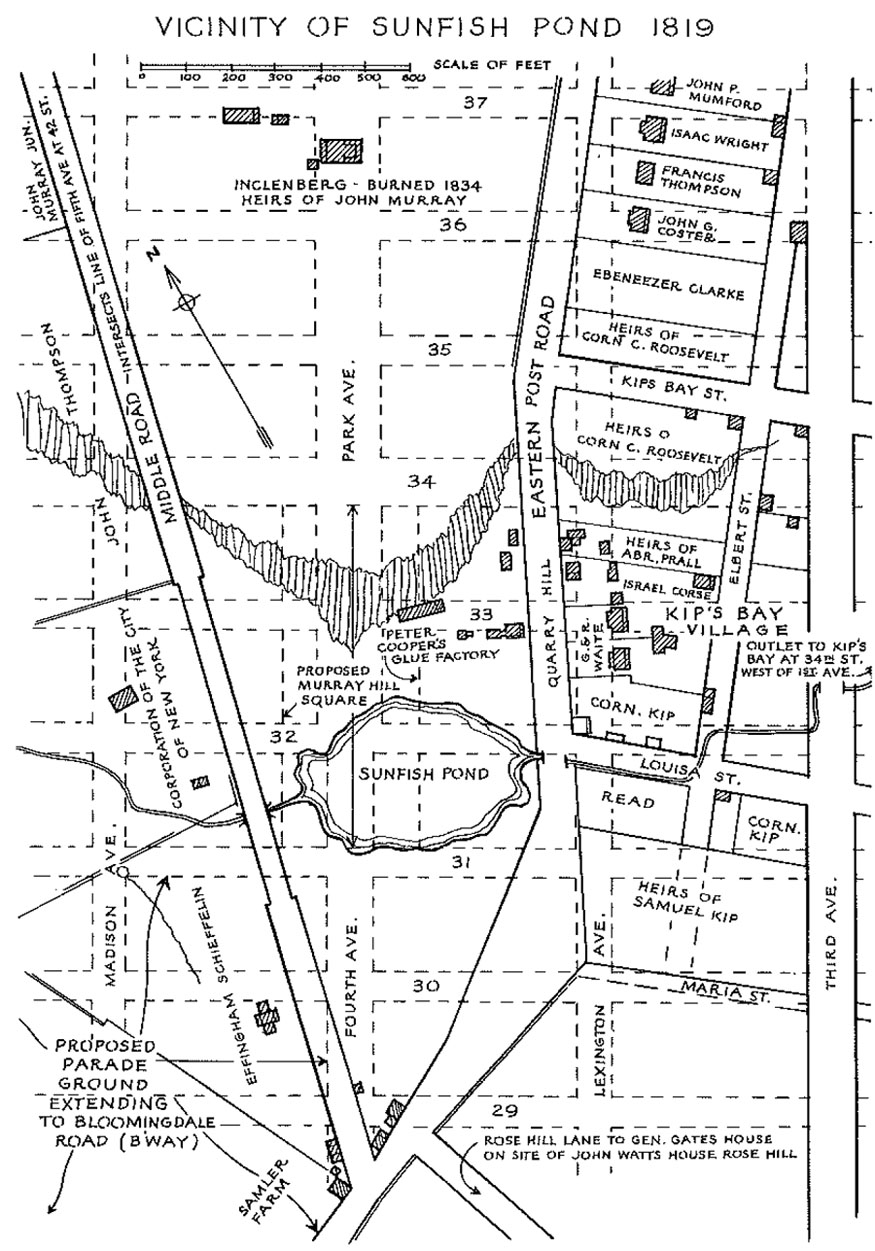
[Image: Sunfish Pond].

Something I’ve meant to post about for awhile—and that isn’t news at all—is the fact that there is a lost lake in the basement of the Empire State Building. Or a pond, more accurately speaking.

After following a series of links leading off from Steve Duncan’s ongoing exploration of New York’s “lost streams, kills, rivers, brooks, ponds, lakes, burns, brakes, and springs,” I found the fascinating story of Sunfish Pond, a “lovely little body of water” at the corner of what is now 31st Street and Fourth Avenue. “The pond was fed both by springs and by a brook which also carried its overflow down to the East River at Kip’s Bay.”

Interestingly, although the pond proper would miss the foundations of the Empire State Building, its feeder streams nonetheless pose a flood risk to the building: the now-buried waterway “leading from Sunfish Pond still floods the deep basement of the Empire State Building today.”

To a certain extent, this reminds me of a line from the recent book Alphaville: “Heat lightning cackles above the Brooklyn skyline and her message is clear: ‘You may have it paved over, but it’s still a swamp.'” That is, the city can’t escape its hydrology.

But perhaps this makes the Empire State Building as good a place as any for us to test out the possibility of fishing in the basements of Manhattan: break in, air-hammer some holes through the concrete, bust out fishing rods, and spend the night hauling inexplicable marine life out of the deep and gurgling darkness below.

Burying Bits of the City: Hong Kong Underground

Several months ago we looked at a network of artificial caves being built beneath Singapore that will, upon completion, extend the city’s energy infrastructure under the Pacific seabed; and, back in 2010, we took a very brief look at huge excavations underneath Chicago, courtesy of a feature article in Tunnel Business Magazine.

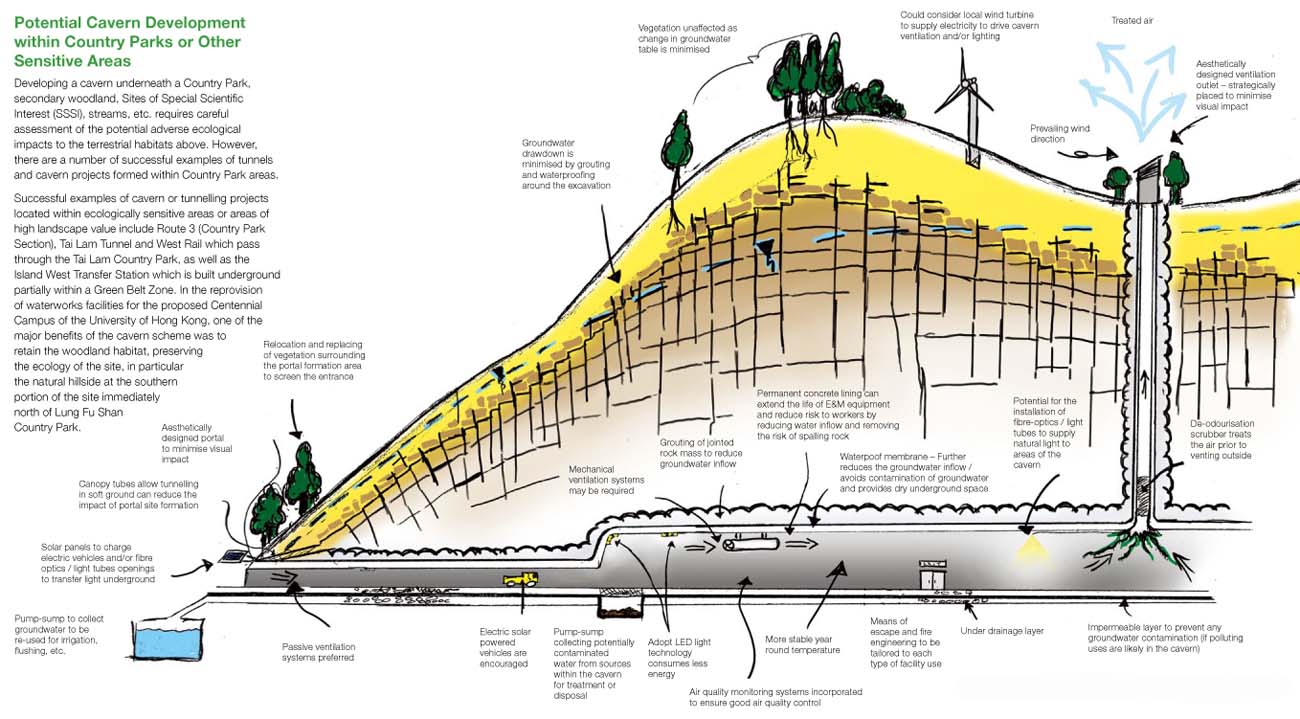
Now, according to the South China Morning Post, civil engineers in Hong Kong are exploring the possibility of developing large-scale underground spaces—artificial caves—for incorporation into the city’s existing infrastructure. In the full text of the article, available online courtesy of Karst Worlds, we read that the Hong Kong government “is moving towards burying bits of the city—the unsightly ones—in underground caverns, freeing up more land for housing and economic development.”

[Image: From the Enhanced Use of Underground Space in Hong Kong].

This is part of a larger undertaking called the Enhanced Use of Underground Space in Hong Kong initiative, a study, backed by Arup, that “would give the government a basis for policy guidelines to encourage cavern developments for both public and private sectors.” Private-sector caverns beneath the city!

[Image: From the Enhanced Use of Underground Space in Hong Kong; view bigger].

Specifically, city engineers “will begin by identifying suitable rock caverns to house 400 government facilities that can be relocated, notably the not-in-my-backyard utilities disliked by nearby residents.” These include “sewage treatment plants, fuel storage depots, refuse transfer stations and columbariums.” The University of Hong Kong, for instance, recently “hid a saltwater reservoir in an artificial cavern next to its Centenary Campus, in a project that cost HK$500 million”; these are referred to as “water caverns.”

Inspired by the fact that “caverns have been used as wine cellars, data centres and car parks in Finland and other countries,” Hong Kong’s Secretary of Development, Carrie Lam, has “called Hong Kong’s rock formations a ‘unique geological asset‘ and urged the city to take caverns into consideration.”

[Image: From the Guide to Cavern Engineering].

The awesome scale of some of the proposed excavations can be seen in this animation, where, at roughly the one-minute mark, we dive underground and begin to fly through linked 3D models of future freshwater reservoirs. A related PDF outlines a new landscape category—the Strategic Cavern Area—wherein “a strategic area is defined as being greater than 20 hectares in area and having the ability to accommodate multiple cavern sites.” (The idea that your neighborhood might be declared a Strategic Cavern Area, and thus cleared of its building stock, brings to mind a student project featured on BLDGBLOG last month, the “Lower East Side Quarry” by Rebecca Fode).

[Images: From the Guide to Cavern Engineering].

Sadly, we missed an opportunity to participate in a Hong Kong-based cave-design contest—its deadline was September 2011—called the “Rock Caverns—Unlimited Creativity” competition: “Competition entrants are required, with their unlimited creativity, to propose ideas related to the potential usage of underground space in Hong Kong.” A detailed design guide, called the Geoguide or Guide to Cavern Engineering, was published, and it remains available in full online.

This booklet is nothing less than a builder’s guide to artificial caves. As Chapter 4 helpfully explains, for instance, “In common with other complex constructions, the design of a large underground space is an iterative process where a series of factors influence the final result,” with prospective cave-designers required to use “numerous iterative loops” to create “a cost-effective cavern installation.” The rest of that chapter goes on to explore cavern cross-sections, layout, shape, rock bolts and pattern bolting, and even intra-cave pillars, all of which should find their way into an architecture school design studio somewhere soon.

[Image: From the Guide to Cavern Engineering].

In any case, while I feel compelled to point out the obvious—that a high-tech labyrinth of artificial caves dug beneath the rocky hills of an over-urbanized tropical archipelago is an incredible setting for future films, novels, and computer games—I should also mention, more prosaically, that Hong Kong’s impending subterranean expansion will doubtless offer many lessons relevant to cities elsewhere, as public-private underground partnerships increase in both number and frequency, with space-starved global mega-cities turning to partial self-burial as a volumetric infrastructural solution to the lack of available surface area.

Brooklyn Vent

[Image: Disguised infrastructure; photo by BLDGBLOG].
In the novel Foucault’s Pendulum, two characters discuss a house that is not what it appears to be. People “walk by” this house in Paris, we read, but “they don’t know the truth. That the house is a fake. It’s a facade, an enclosure with no room, no interior. It is really a chimney, a ventilation flue that serves to release the vapors of the regional Métro. And once you know this you feel you are standing at the mouth of the underworld…”

[Image: The door to the underworld; photo by BLDGBLOG].

Two days ago, Nicola Twilley and I went on an early evening expedition over to visit the house at 58 Joralemon Street in Brooklyn, with its blacked out windows and its unresponsive front door.

This “house” is actually “the world’s only Greek Revival subway ventilator.” It is also a disguised emergency exit for the New York City subway.

[Image: Disguised infrastructure; photo by BLDGBLOG].

According to a blog called the Willowtown Association, “the ventilator was a private brownstone dating from 1847. The substation was built in 1908 in conjunction with the start of subway service to Brooklyn. As reported in the BKLYN magazine article, the building’s ‘cavernous interior once housed a battery of electrical devices that converted alternating current to the 600-volt direct current needed to power the IRT.'”

[Image: A view through the front door of 58 Joralemon Street; photo by BLDGBLOG].
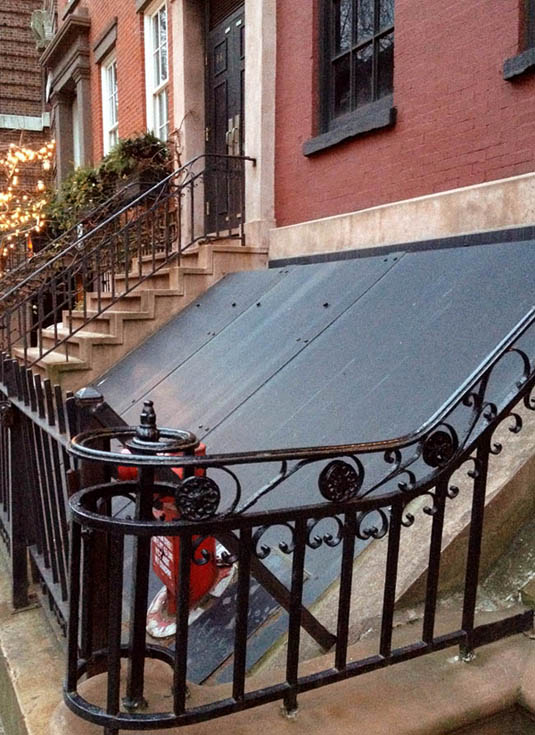
It is New York’s more interesting version of 23/24 Leinster Gardens in London. As the Brooklyn Daily Eagle wrote last year, “the exit disguised as a brownstone leads to a grimy-lit set of metal stairs that ascend past utility boxes and ventilation shafts into a windowless room with a door. If you opened the door, you would find yourself on a stoop, which is just part of the façade.”

[Image: Photo by BLDGBLOG].

You’ll notice on Google Maps that the 4/5 subway line passes directly beneath the house, which brings to mind an old post here on BLDGBLOG in which we looked at the possibility that repurposed subway cars could be used someday as extra, rentable basement space—that is, “temporary basements in the form of repurposed subway cars,” with the effect that “each private residence thus becomes something like a subway station, with direct access, behind a locked door, to the subterranean infrastructure of the city far below.”

Then, for a substantial fee—as much as $15,000 a month—you can rent a radically redesigned subway car, complete with closets, shelves, and in-floor storage cubes. The whole thing is parked beneath your house and braked in place; it has electricity and climate control, perhaps even WiFi. You can store summer clothes, golf equipment, tool boxes, children’s toys, and winter ski gear.
When you no longer need it, or can’t pay your bills, you simply take everything out of it and the subway car is returned to the local depot.
A veritable labyrinth of moving rooms soon takes shape beneath the city.

Perhaps Joralemon Street is where this unlikely business model could be first tried out…

In any case, Nicola and I walked over to see the house for a variety of reasons, including the fact that the disguised-entrance-to-the-underworld is undoubtedly one of the coolest building programs imaginable, and would make an amazing premise for an intensive design studio; but also because the surface vent structures through which underground currents of air are controlled have always fascinated me.

These vents appear throughout New York City, as it happens—although Joralemon, I believe, is the only fake house—serving as surface articulations of the larger buried networks to which they are connected.

[Image: Two views of the tunnel vent on Governors Island; photos by BLDGBLOG].
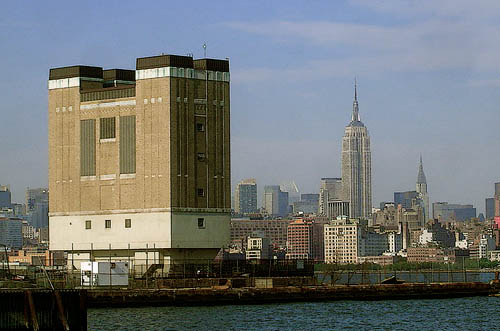
The Battery Tunnel has a particularly noticeable vent, pictured above, and the Holland Tunnel also vents out near my place of work.

[Image: Holland Tunnel exhaust tower; photo via SkyscraperPage.com].
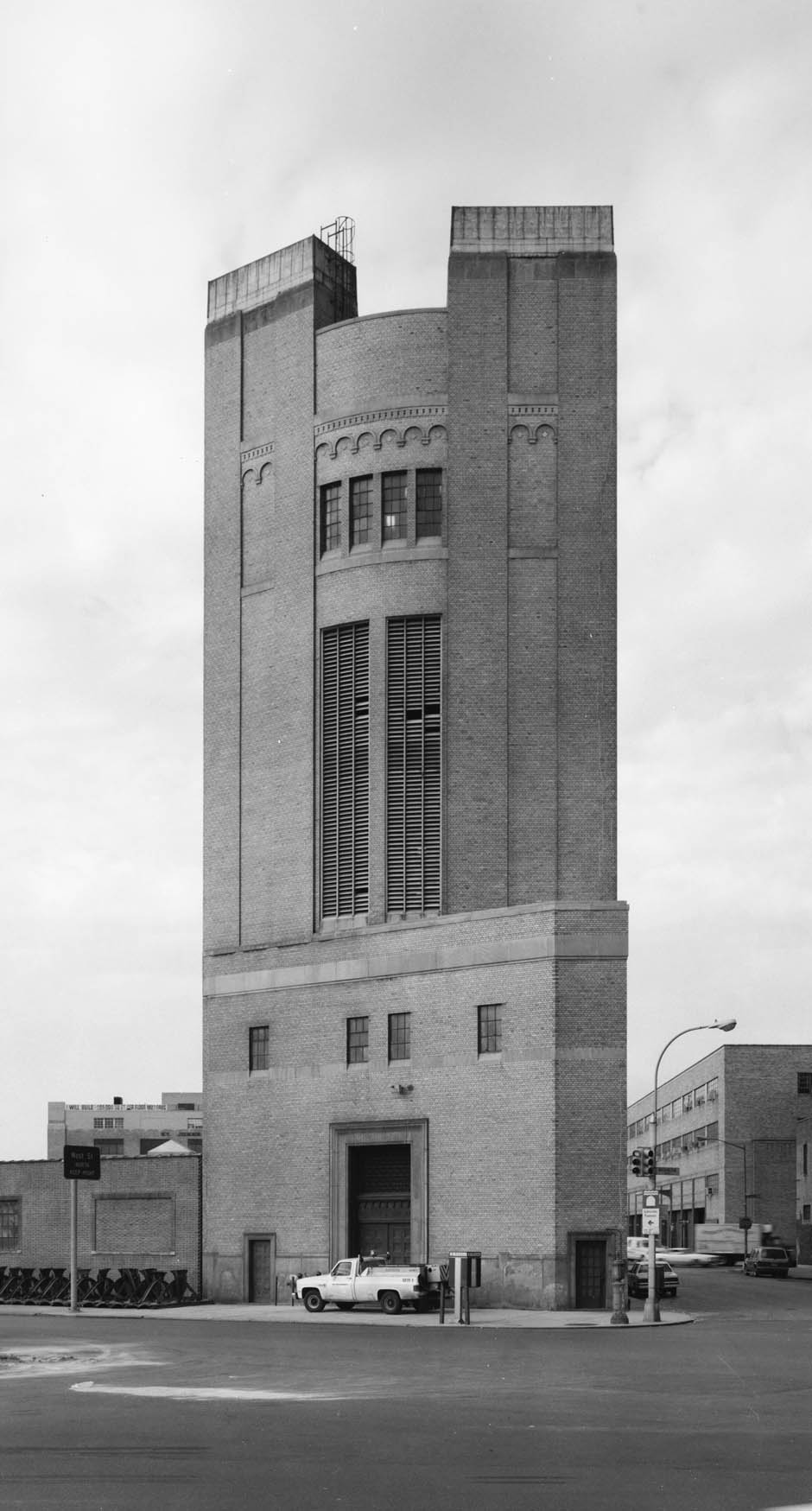
As historian David Gissen writes in his excellent book Subnature: Architecture’s Other Environments, New York’s ventilation control structures are “strange buildings” that have “collapsed” the difference between architecture and civil engineering:

The Holland Tunnel spanned an enormous 8,500 feet. At each end, engineers designed ten-story ventilation towers that would push air through tunnels above the cars, drawing the vehicle exhaust upward, where it would be blown back through the tops of the towers and over industrial areas of the city. The exhaust towers provided a strange new building type in the city—a looming blank tower that oscillated between a work of engineering and architecture.

As further described in this PDF, for instance, Holland Tunnel has a total of four ventilation structures: “The four ventilation buildings (two in New Jersey and two in New York) house a total of 84 fans, of which 42 are blower units, and 42 are exhaust units. They are capable, at full speed, of completely changing the tunnel air every 90 seconds.”

[Image: The Holland Tunnel Land Ventilation Building, courtesy of Wikipedia].
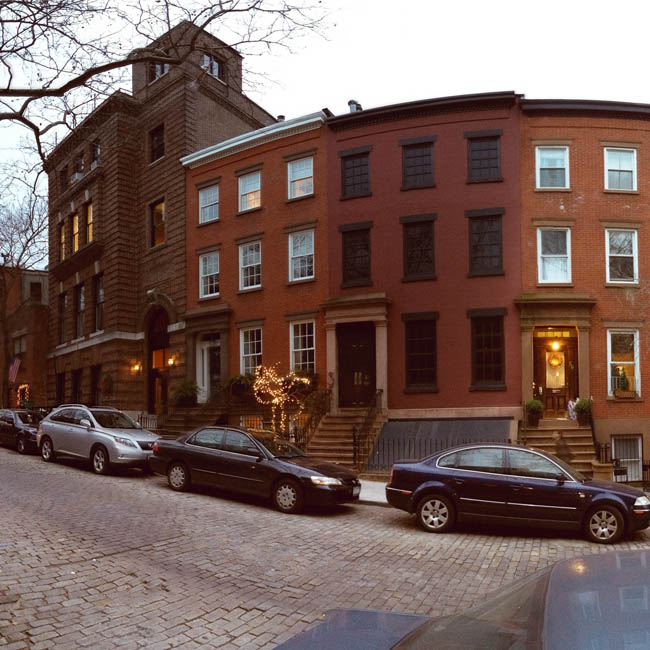
Several years ago a friend of ours remarked that she didn’t like staying in hotels near Columbus Circle here in New York because that’s the neighborhood, she said, where all the subways vent to—a statement that appears to be nothing more than an urban legend, but that nonetheless sparked off a long-term interest for me in finding where the underground weather systems of New York City are vented to the outside. Imagine an entire city district dedicated to nothing but ventilating the underworld!

[Image: The house on Joralemon Street; photo by BLDGBLOG].
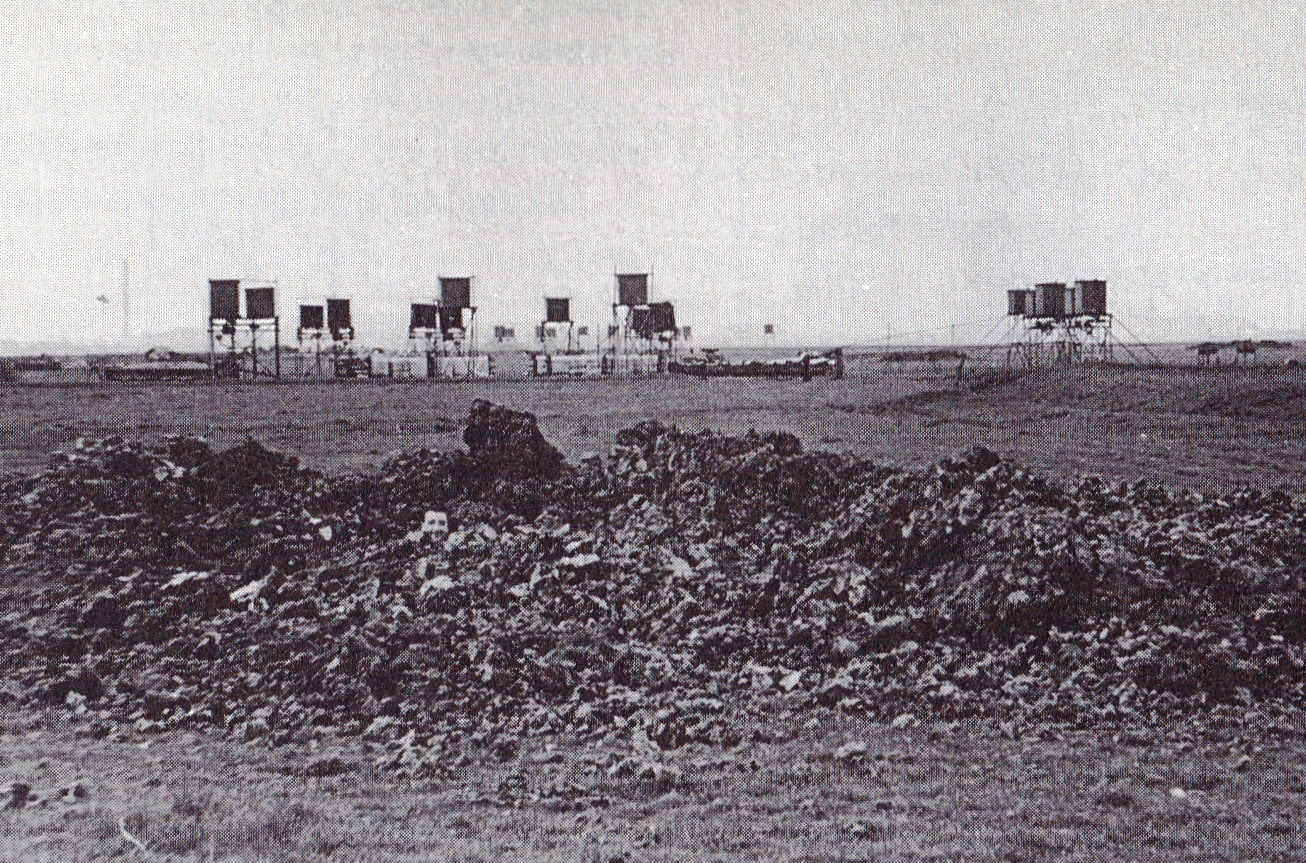
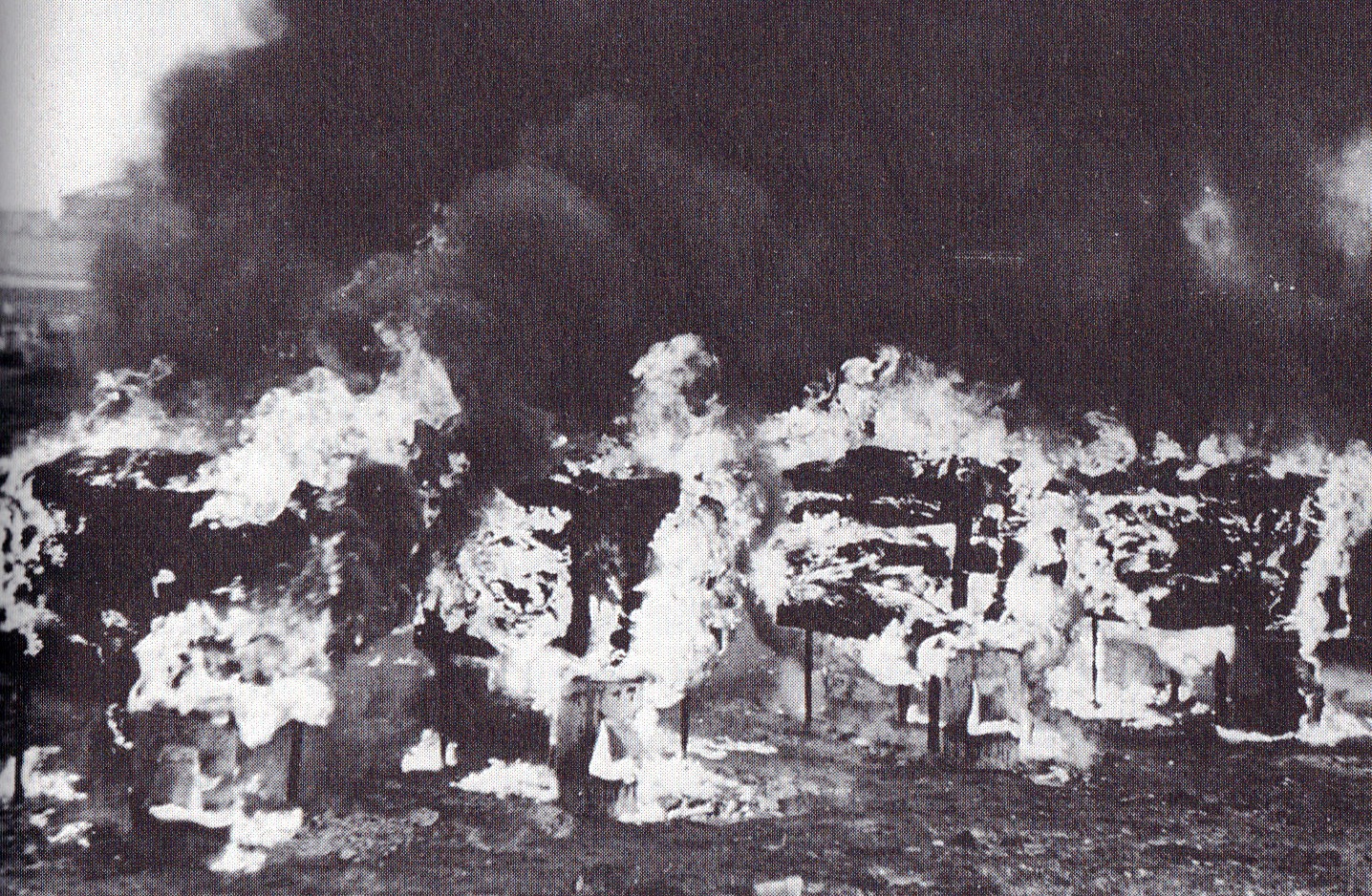
This is a topic I will no doubt return to at some point soon—but, for now, if you want to see a disguised entrance to the 4/5 line, walk down Joralemon Street toward the river and keep your eyes peeled soon after the street turns to cobblestones.

(The house on Joralemon Street first discovered via Curbed).