Where Borders Melt

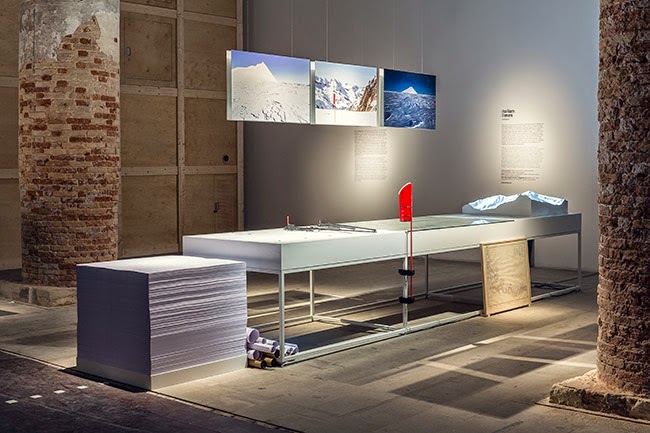
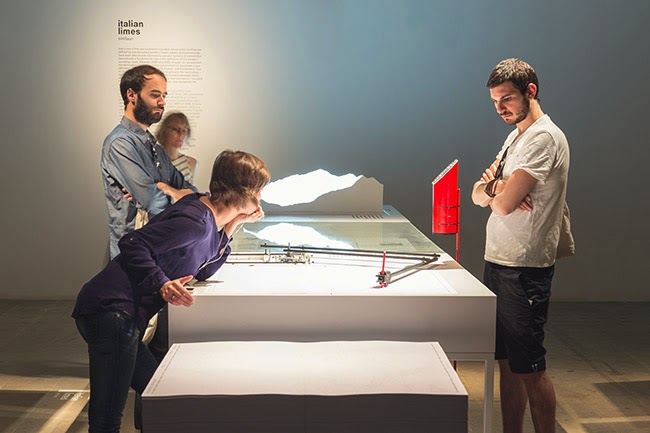
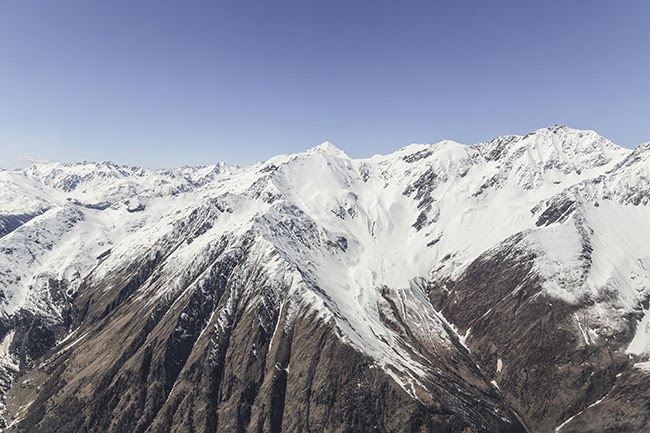
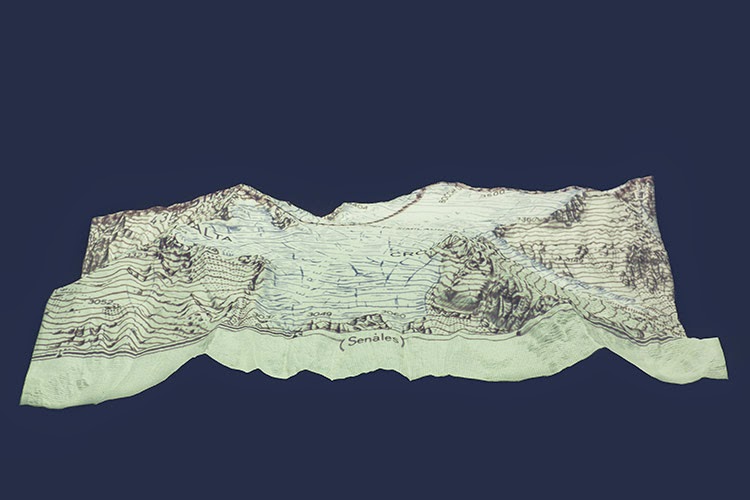
[Image: From Italian Limes. Photo by Delfino Sisto Legnani, courtesy of Folder].

One of the most interesting sites from a course I taught several years ago at Columbia—Glacier, Island, Storm—was the glacial border between Italy and Switzerland.

The border there is not, in fact, permanently determined, as it actually shifts back and forth according to the height of the glaciers.

This not only means that parts of the landscape there have shifted between nations without ever really going anywhere—a kind of ghost dance of the nation-states—but also that climate change will have a very literal effect on the size and shape of both countries.

[Image: Due to glacial melt, Switzerland has actually grown in size since 1940; courtesy swisstopo].
This could result in the absurd scenario of Switzerland, for example, using its famed glacier blankets, attempting to preserve glacial mass (and thus sovereign territory), or it might even mean designing and cultivating artificial glaciers as a means of aggressively expanding national territory.

As student Marissa Looby interpreted the brief, there would be small watchtowers constructed in the Alps to act as temporary residential structures for border scientists and their surveying machines, and to function as actual physical marking systems visible for miles in the mountains, somewhere between architectural measuring stick for glacial growth and modular micro-housing.

But the very idea that a form of thermal warfare might break out between two countries—with Switzerland and Italy competitively growing and preserving glaciers under military escort high in the Alps—is a compelling (if not altogether likely) thing to consider. Similarly, the notion that techniques borrowed from landscape and architectural design could be used to actually make countries bigger—eg. through the construction of glacier-maintenance structures, ice-growing farms, or the formatting of the landscape to store seasonal accumulations of snow more effectively—is absolutely fascinating.

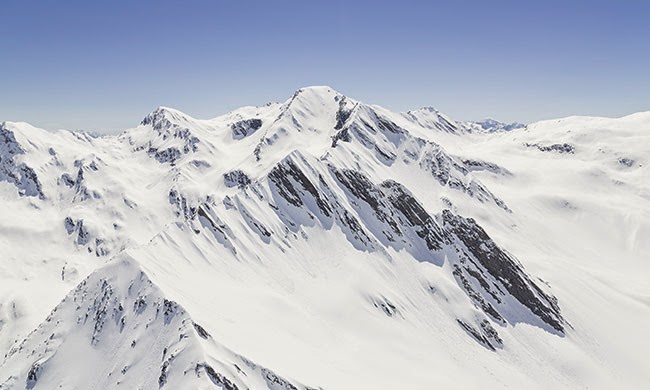
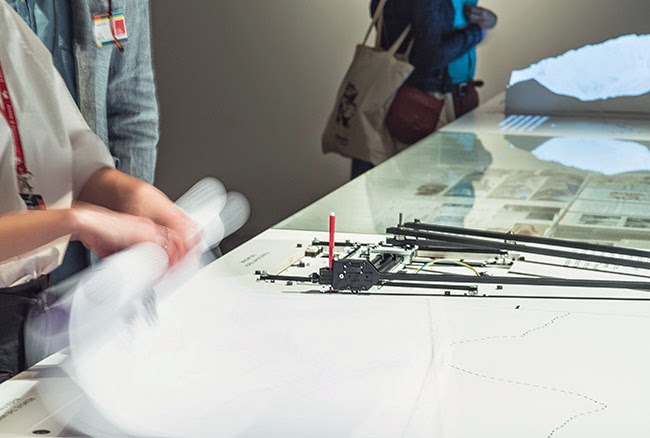
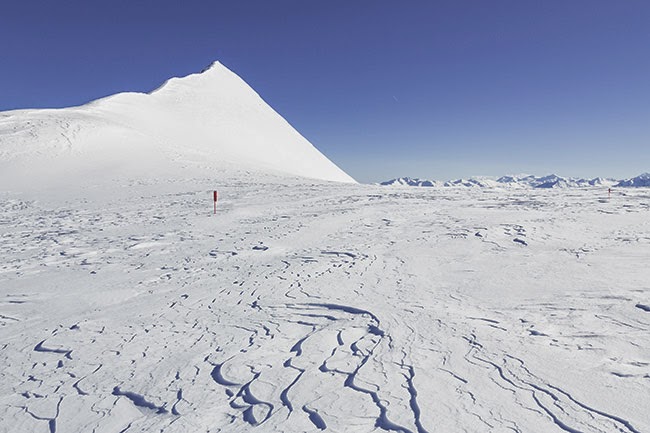
[Images: From Italian Limes. Photos by Delfino Sisto Legnani, courtesy of Folder].

I was thus interested to read about a conceptually similar but otherwise unrelated new project, a small exhibition on display at this year’s Venice Biennale called—in English, somewhat unfortunately—Italian Limes, where “Limes” is actually Latin for limits or borders (not English for a small acidic fruit). Italian Limes explores “the most remote Alpine regions, where Italy’s northern frontier drifts with glaciers.”

In effect, this is simply a project looking at this moving border region in the Alps from the standpoint of Italy.

[Image: From Italian Limes. Photo by Delfino Sisto Legnani, courtesy of Folder].

As the project description explains, “Italy is one of the rare continental countries whose entire confines are defined by precise natural borders. Mountain passes, peaks, valleys and promontories have been marked, altered, and colonized by peculiar systems of control that played a fundamental role in the definition of the modern sovereign state.”

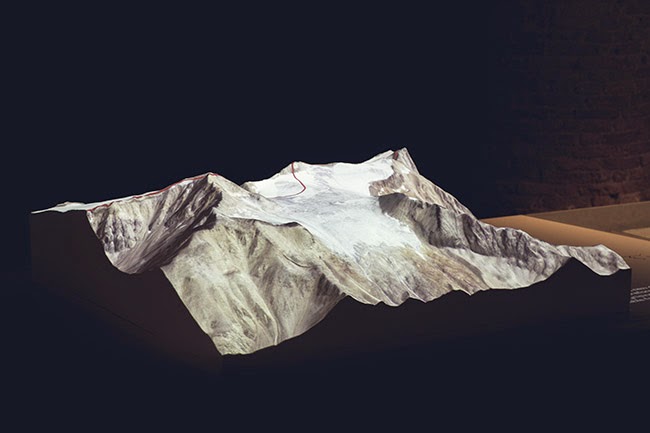
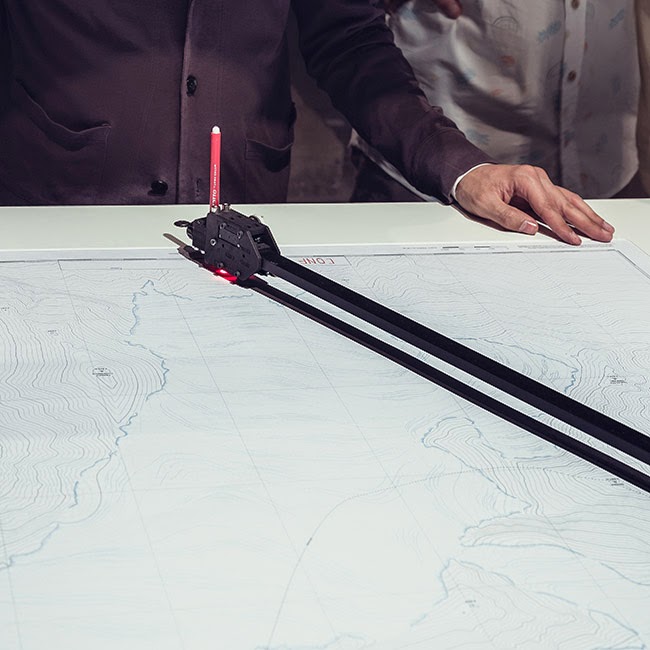
[Images: From Italian Limes. Photos by Delfino Sisto Legnani, courtesy of Folder].

However, they add, between 2008 and 2009, Italy negotiated “a new definition of the frontiers with Austria, France and Switzerland.”

Due to global warming and and shrinking Alpine glaciers, the watershed—which determines large stretches of the borders between these countries—has shifted consistently. A new concept of movable border has thus been introduced into national legislation, recognizing the volatility of any watershed geography through regular alterations of the physical benchmarks that determine the exact frontier.

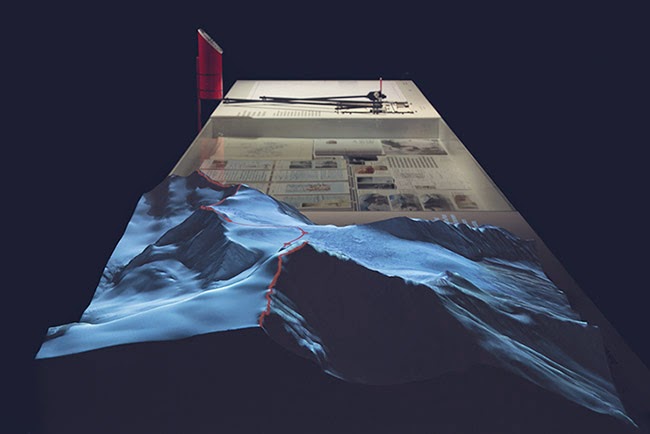
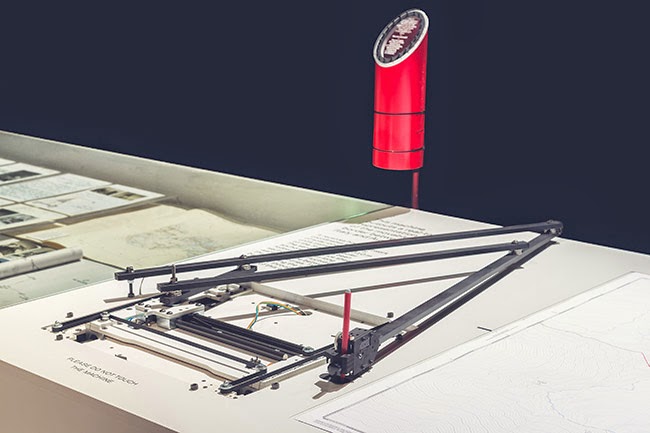
[Images: From Italian Limes. Photos by Delfino Sisto Legnani, courtesy of Folder].

The actual project that resulted from this falls somewhere between landscape surveying and technical invention—and is a pretty awesome example of where territorial management, technological databases, and national archives all intersect:

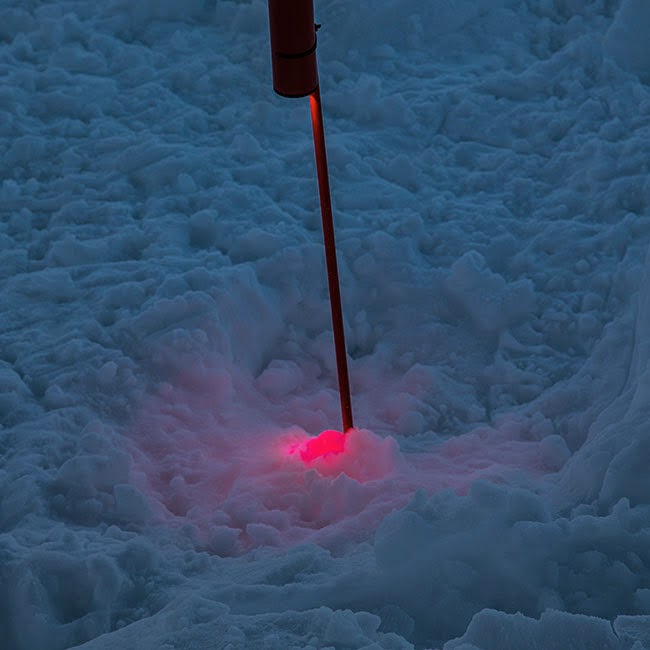
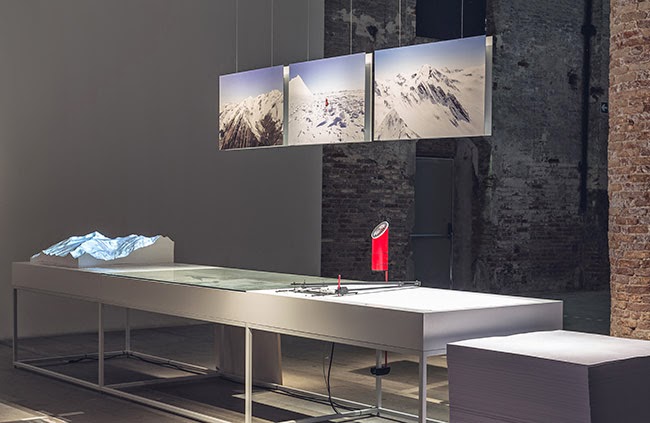
On May 4th, 2014, the Italian Limes team installed a network of solar-powered GPS units on the surface of the Similaun glacier, following a 1-km-long section of the border between Italy and Austria, in order to monitor the movements of the ice sheet throughout the duration of the exhibition at the Corderie dell’Arsenale. The geographic coordinates collected by the sensors are broadcasted and stored every hour on a remote server via a satellite connection. An automated drawing machine—controlled by an Arduino board and programmed with Processing—has been specifically designed to translated the coordinates received from the sensors into a real-time representation of the shifts in the border. The drawing machine operates automatically and can be activated on request by every visitor, who can collect a customized and unique map of the border between Italy and Austria, produced on the exact moment of his [or her] visit to the exhibition.

The drawing machine, together with the altered maps and images it produces, are thus meant to reveal “how the Alps have been a constant laboratory for technological experimentation, and how the border is a compex system in evolution, whose physical manifestation coincides with the terms of its representation.”

The digital broadcast stations mounted along the border region are not entirely unlike Switzerland’s own topographic markers, over 7,000 “small historical monuments” that mark the edge of the country’s own legal districts, and also comparable to the pillars or obelisks that mark parts of the U.S./Mexico border. Which is not surprising: mapping and measuring border is always a tricky thing, and leaving physical objects behind to mark the route is simply one of the most obvious techniques.

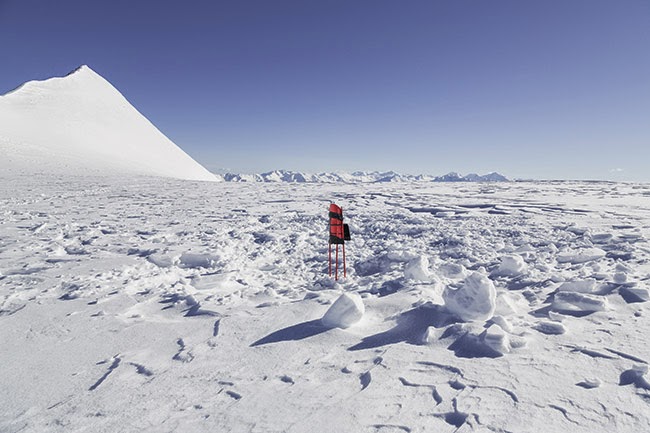
As the next sequence of images shows, these antenna-like sentinels stand alone in the middle of vast ice fields, silently recording the size and shape of a nation.

[Images: From Italian Limes. Photos by Delfino Sisto Legnani, courtesy of Folder].

The project, including topographic models, photographs, and examples of the drawing machine network, will be on display in the Italian Pavilion of the Venice Biennale until November 23, 2014. Check out their website for more.

Meanwhile, the research and writing that went into Glacier, Island, Storm remains both interesting and relevant today, if you’re looking for something to click through. Start here, here, or even here.

[Image: From Italian Limes. Photo by Delfino Sisto Legnani, courtesy of Folder].

Italian Limes is a project by Folder (Marco Ferrari, Elisa Pasqual) with Pietro Leoni (interaction design), Delfino Sisto Legnani (photography), Dawid Górny, Alex Rothera, Angelo Semeraro (projection mapping), Claudia Mainardi, Alessandro Mason (team).

Perspectival Objects

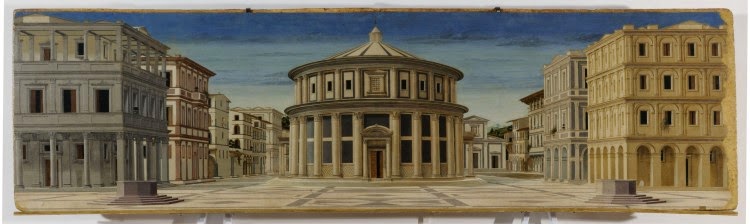
[Image: A perspectival representation of the “ideal city,” artist unknown].

There’s an interesting throwaway line in The Verge‘s write-up of yesterday’s Amazon phone launch, where blogger David Pierce remarks that the much-hyped public unveiling of Amazon’s so-called Fire Phone was “oddly focused on art history and perspective.”

As another post at the site points out, “Amazon CEO Jeff Bezos likened it to the move from flat artwork to artwork with geometric perspective which began in the 14th century.”

These are passing comments, sure, and, from Amazon’s side, it’s more marketing hype than anything like rigorous phenomenological theorizing. Yet there’s something strangely compelling in the idea that a seemingly gratuitous new consumer product—just another smartphone—might actually owe its allegiance to a different technical lineage, one less connected to the telecommunications industry and more from the world of architectural representation.

[Image: Jeff Bezos as perspectival historian. Courtesy of The Verge].

It would be a smartphone that takes us back to, say, Albrecht Dürer and his gridded drawing machines, making the Fire Phone a kind of perspectival object that deserves a place, however weird, in architectural history. Erwin Panofksy, we might say, would have used a Fire Phone—or at least he would have written a blog post about it.

In this context, the amazing image of billionaire Jeff Bezos standing on stage, giving a kind of off-the-cuff history of perspectival rendering surely belongs in future works of architectural history. Smiling and schoolteacher-like, Bezos gestures in front of an infinite grid ghosted-in over this seminal work of urban scenography, in one moment aiming to fit his product within a very particular, highly Western tradition of representing the built environment.

[Image: Courtesy of The Verge].

The launch of the Fire Phone did indeed give perspectival representation its due, showing how a three-dimensionally or relationally accurate perception of geometric space can change quite dramatically with only a small move of the viewer’s own head.

The phone’s “dynamic perspective,” engineered to correct this, seems a little rickety at best, but it is meant as way to account for otherwise inconsequential movements of the viewer through the landscape, whether it’s a crowded city street or the vast interiors of a hotel. To do so requires an almost comical amount of technical hand-waving. From The Verge:

The key to making dynamic perspective work is knowing exactly where the user’s head is at all times, in real time, many times per second, Bezos said. It’s something that the company has been working on for four years, and [the] best way to do it is with computer vision, he went on to note. The single, standard front-facing camera wasn’t sufficient because its field of view was too narrow—so Amazon included four additional cameras with a much wider field of view to continuously capture a user’s head. At the end of the day, it features four specialized front-facing cameras in addition to the standard front-facing camera found near the earpiece, two of which can be used in case the other cameras were covered; it uses the best two at any given time. Lastly, Amazon included infrared lights in each camera to allow the phone to work in the dark.

Five hundred years ago, we’d instead be reading about some fabulous new system of mirrors, lens, prisms, and strings, all tied back to or operated by way of complexly engineered works of geared furniture. Unfolding tables and adjustable chairs, with operable flaps and windows.

[Image: One of several perspectival objects—contraptions for producing spatially accurate drawings—by Albrecht Dürer].
These precursors of the Fire Phone, after seemingly endless acts of fine-tuning, would then, and only then, allow their users to see the scene before them with three-dimensional accuracy.

Now, replace those prisms and mirrors with multiple forward-facing cameras and infrared sensors, and market the resulting object to billions of potential users in front of gridded scenes of Western urbanism, and you’ve got the strange moment that happened yesterday, where a smartphone aimed to collapse all of Western art history into a single technical artifact, a perspectival object many of us will soon be carrying in our bags and pockets.

[Image: Another “ideal city,” artist unknown].

More interestingly, though, with its odd focus “on art history and perspective,” Amazon’s event raises the question of how electronic mediation of the built environment might be affecting how our cities are designed in the first place—how we see buildings, streets, and cities through the dynamic lens of automatic perspective correction and other visual algorithms.

Put another way, is there a type of architecture—Classical, Romanesque—particularly well-suited for perspectival objects like the Fire Phone, and, conversely, are there types of built space that throw these devices off altogether? Further, could artificial environments that exceed the rendering capacity of smartphones and other digital cameras be deliberately designed—and, if so, what would they “look like” to those sensors and objects?

Recall that, at one point in his demonstration, Bezos explained how Amazon’s new interface “uses different layers to hide and show information on the map like Yelp reviews,” effectively tagging works of architecture with digital metadata in a kind of Augmented Reality Lite.

But what this suggests, together with Bezos’s use of “ideal city” imagery, is that smartphone urbanism will have its own peculiar stylistic needs. Perhaps, if visually defined, that will mean that phones will require cities to be gridded and legible, with clear spatial differentiation between buildings and objects in order to function most accurately—in order to line up with the clouds of virtual tags we will soon be placing all over the structures around us. Perhaps, if more GPS-defined, that will mean overlapping buildings and spaces are just fine, but they nonetheless must allow unblocked access to satellite signals above so that things don’t get confused down at street level—a kind of celestial perspectivism where, from the phone’s point of view, the roof is the new facade, the actual “front” of the building through which vital navigational signals must travel.

Either way, the possibility that there is a particular type of space, or a particular type of urbanism, most suited to the perspectival needs of new smartphones is totally fascinating. Perhaps in retrospect, this photograph of Jeff Bezos, grinning at the world in front of a gigantic image of Western perspective, will become a canonical architectural image of where digital objects and urban design intersect.

An Occult History of the Television Set


The origin of the television set was heavily shrouded in both spiritualism and the occult, Stefan Andriopoulos writes in his new book Ghostly Apparitions. In fact, as its very name implies, the television was first conceived as a technical device for seeing at a distance: like the telephone (speaking at a distance) and telescope (viewing at a distance), the television was intended as an almost magical box through which we could watch distant events unfold, a kind of technological crystal ball.

Andriopoulos’s book puts the TV into a long line of other “optical media” that go back at least as far as popular Renaissance experiments involving technologically-induced illusions, such as concave mirrors, magic lanterns, disorienting walls of smoke, and other “ghostly apparitions” and “phantasmagoric projections” created by specialty devices. These were conjuring tricks, sure—mere public spectacles, so to speak—but successfully achieving them required sophisticated understandings of basic physical factors such as light, shadow, and acoustics, making an audience see—and, most importantly, believe in—the illusion.

A Magic Lantern for Watching Events at a Distance

What’s central to Andriopoulos’s argument is that these devices incorporated earlier experimental instruments devised specifically for pursuing supernatural research—for visualizing the invisible and showing the subtle forces at work in everyday life. In his words, these were “devices developed in occult research”—including explicitly “televisionlike devices”—that had been invented in the name of spiritualism toward the end of the 19th century and that, only a decade or two later, “played a constitutive role in the emergence of radio and television.”

[Image: From Etienne-Gaspard Robertson’s 1834 study of technical phantasmagoria, via Ghostly Apparitions].

In Andriopoulos’s words, this was simply part of “the reciprocal interaction between occultism and the natural sciences that characterized the cultural construction of new technological media in the late nineteenth century,” a “two-directional exchange between occultism and technology.” New forms of broadcast technology and belief in the occult? No big deal.

So, while the television itself—the object you and I most likely know as the utterly mundane fixture of family distraction sitting centrally ensconced in a nearby living room—might not be a supernatural mechanism, it nonetheless descends from a strange and convoluted line of esoteric experimentation, including early attempts at controlling electromagnetic transmissions, directing radio waves, and even experiencing various forms of so-called “remote viewing.”

The idea of a medium takes on a double meaning here, Andriopoulos explains, as the word refers both to the media—in the sense of a professional world of publishing and transmission—and to the medium, in the sense of a specific, vaguely shamanic person who acts as a psychic or seer. The medium thus acts as an intermediary between humans and the supernatural world in a very literal sense.

Indeed, in Andriopoulos’s version of television’s origin story, the notion of spiritual clairvoyance was very much part of the overall intention of the device.

Clairvoyance—a word that literally means clear vision, yet that has now come to refer almost exclusively to a supernatural ability to see things at a distance or before events even happen—offered an easy metaphor for this new mechanism.

Television promised clairvoyance in the sense that a TV could allow seeing without interference or noise. It would give viewers a way to tune into and clearly see a broadcast’s invisible signals—with the implication that an esoteric remote-viewing apparatus with forgotten supernatural intentions is now mounted and enshrined in nearly everyone’s home.

[Image: A “moving face” transmitted by John Logie Baird at a public demonstration of TV in 1926 (photo via the BBC)].

I’ll leave it to curious readers to look for Andriopoulos’s book itself—with the caveat that it is quite heavy on German idealism and rather light on real tech history—but it is worth mentioning the fact that at least one other technical aspect of the 20th-century television also followed a very bizarre historical trajectory.

Part Tomb, Part Church, Part Planetarium

The cathode ray—a vacuum tube technology found in early television sets—took on an unexpected and extraordinary use in the work of gonzo Norwegian inventor Kristian Birkeland. Birkeland used cathode rays in his attempt to build a doomed scale model of the solar system.

I genuinely love this story and I have written about it elsewhere, including both here on BLDGBLOG and in The BLDGBLOG Book, but it’s well worth retelling.

In a nutshell, Birkeland was the first scientist to correctly hypothesize the origins of the Northern Lights, rightly deducing from his own research into electromagnetic phenomena that the aurora borealis was actually caused by interactions between charged particles constantly streaming toward earth from the sun and the earth’s own protective magnetic field. This produced the extraordinary displays of light Birkeland had seen in the planet’s far north.

However, as Birkeland fell deeper into an eventually fatal addiction to extreme levels of caffeine and a slow-acting hypnotic drug called Veronal, he also—awesomely—became fixated on the weirdly impossible goal of precisely modeling the Northern Lights in miniature. He sought to build a kind of Bay Model of the Northern Lights.

[Image: Kristian Birkeland stares deeply into his universal simulator (via)].
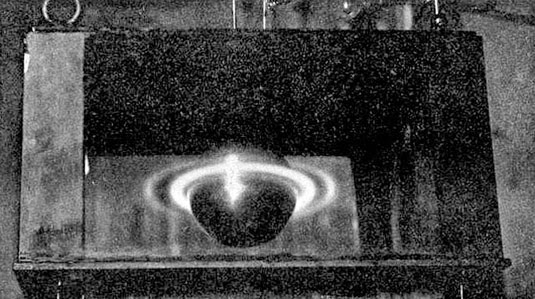
As author Lucy Jago tells Birkeland’s amazing story in her book The Northern Lights, he was intent on producing a kind of astronomical television set: a “televisionlike device,” in Andriopoulos’s words, whose inner technical workings would not just broadcast actions and characters seen elsewhere, but would actually model the electromagnetic secrets of the universe.

As Jago describes his project, Birkeland “drew up plans for a new machine unlike anything that had been made before.” It resembled “a spacious aquarium,” she writes, a shining box that would act as “a window into space.”

The box would be pumped out to create a vacuum and he would use larger globes and a more powerful cathode to produce charged particles. With so much more room he would be able to see effects, obscured in the smaller tubes, that could take his Northern Lights theory one step further–into a complete cosmogony, a theory of the origins of the universe.

It was a multifaceted and extraordinary undertaking. With it, Jago points out, “Birkeland was able to simulate Saturn’s rings, comet tails, and the Zodiacal Light. He even experimented with space propulsion using cathode rays. Sophisticated photographs were taken of each simulation, to be included in the next volume of Birkeland’s great work, which would discern the electromagnetic nature of the universe and his theories about the formation of the solar system.”

However, this “spacious aquarium” was by no means the end of Birkeland’s manic (tele)vision.

[Image: From Birkeland’s The Norwegian Aurora Polaris Expedition 1902-1903, Vol. 1: On the Cause of Magnetic Storms and The Origin of Terrestrial Magnetism (via)].

His ultimate goal—devised while near-death in a hotel room in Egypt—was to construct a vacuum chamber partially excavated into the solid rock of a mountain peak, an insane mixture of tomb, church, and planetarium.

The resulting cathedral-like space—think of it as a three-dimensionally immersive, landscape-scale television set carved directly into bedrock—would thus be an artificial cavern inside of which flickering electric mirages of stars, planets, comets, and aurorae would spiral and glow for a hypnotized audience.

Birkeland wrote about this astonishing plan in a letter to a friend. He was clearly excited about what he called a “great idea I have had.” It would be—and the emphasis is all Birkeland’s—”a museum for the discovery of the Earth’s magnetism, magnetic storms, the nature of sunspots, of planets—their nature and creation.”

His excitement was justified, and the ensuing description is worth quoting at length; you can almost feel the caffeine. “On a little hill,” he scribbled, presumably on his Egyptian hotel’s own stationery, perhaps even featuring a little image of the pyramids embossed in its letterhead, reminding him of the ambitions of long-dead pharaohs, “I will build a dome of granite, the walls will be a meter thick, the floor will be formed of the mountain itself and the top of the dome, fourteen meters in diameter, will be a gilded copper sphere. Can you guess what the dome will cover? When I’m boasting I say to my friends here ‘next to God, I have the greatest vacuum chamber in the world.’ I will make a vacuum chamber of 1,000 cubic metres and, every Sunday, people will have the opportunity to see a ring of Saturn ten metres in diameter, sunspots like no one else can do better, Zodiacal Light as evocative as the natural one and, finally, auroras… four meters in diametre. The same sphere will serve as Saturn, the sun, and Earth, and will be driven round by a motor.”

Every Sunday, as if attending Mass, congregants of this artificial solar system would thus hike up some remote mountain trail, heading deep into the cavernous and immersive television of Birkeland’s own astronomy, hypnotized by the explosive whirls of its peculiar, peacock-like displays of electromagnetism, shimmering cathedrals of artificially controlled planetary light.

[Image: Cropping in on the pic seen above (via)].

Seen in the context of the occult mechanisms, psychic TVs, and clairvoyant media technologies of Stefan Andriopoulos’s book, Birkeland’s story reveals just one particularly monumental take on the other-worldly possibilities implied by televisual media, bypassing the supernatural altogether to focus on something altogether more extreme: a direct visual engagement with nature itself, in all its blazing detail.

Of course, Birkeland’s cathode ray model of the solar system might not have conjured ghosts or visualized the spiritual energies that Andriopoulous explores in his book, but it did try to bring the heavens down to earth in the form of a 1,000 cubic meter television set partially hewn from mountain granite.

It was the most awesome TV ever attempted, a doomed and never-realized invention that nonetheless puts all of today’s visual media to shame.

(An earlier version of this post previously appeared on Gizmodo).

Proprietary Microcosms

[Image: Christophe Simon/AFP/Getty Images, via In Focus/The Atlantic].

Spaces of military simulation have long been a theme of interest here, including the desert test-cities of California’s Fort Irwin or the law enforcement training architecture of U.S. police departments, so this shot of Brazilian police training “in a mock favela set up in Rio de Janeiro” caught my eye as part of a recent round-up of shots looking at preparations for the 2014 World Cup.

Police simulations such as these offer a peculiarly spatial insight into the ways humans attempt to make sense of the world. Their interest is always both political (declaring whole neighborhoods spatial threats, quarantining their population from the rest of the metropolis, then “pacifying” the streets with military force) and philosophical (how humans engage in highly ritualized, repetitive behaviors deep inside these proprietary microcosms of the world, like little demigods of a model universe lording over labyrinths and copies).

Someone builds a surrogate or a stand-in—a kind of stage-set on which to test their most viable theories—then they control that replicant world down to every curb height and door frame. Architecture then comes along simply as ornamentation, in order to give this virtual world a physical footprint—to supply a testbed on which somebody else’s spatial ideas can be verified (or violently disproven).

Finally, like the 1:1 scale model in which Google self-driving cars operate, techniques learned inside these proto-cities are then imposed upon the very thing those sites were meant to model, tricking the real-world favela into resembling its denigrated copy: a wild space neutered by the decoy it played no role in authorizing.

Welcome to the World of the Plastic Beach

[Image: The new plastic geology, photographed by Patricia Corcoran, via Science].

Incredibly, a “new type of rock cobbled together from plastic, volcanic rock, beach sand, seashells, and corals has begun forming on the shores of Hawaii,” Science reports.

This new rock type, referred to as a “plastiglomerate,” requires a significant heat-source in order to form, as plastiglomerates are, in effect, nothing but molten lumps of plastic mixed-in with ambient detritus. Hawaii with its coastal and marine volcanoes, offers a near-perfect formational landscape for this artificially inflected geology to emerge—however, Patricia Corcoran, one of the discoverers of these uncanny rocks, thinks we’ll likely find them “on coastlines across the world. Plastiglomerate is likely well distributed, it’s just never been noticed before now, she says.”

We’ve been surrounded by artificial geologies all along.

But is it really geology? Or is it just melted plastic messily assembled with local minerals? Well, it’s both, it seems, provided you look at it on different time-scales. After heavier chunks of plastiglomerate form, fusing with “denser materials, like rock and coral,” Science writes, “it sinks to the sea floor, and the chances it will become buried and preserved in the geologic record increase.” It can even form whole veins streaking through other rock deposits: “When the plastic melts, it cements rock fragments, sand, and shell debris together, or the plastic can flow into larger rocks and fill in cracks and bubbles,” we read.

It doesn’t seem like much of a stretch to suggest that our landfills are also acting like geologic ovens: baking huge deposits of plastiglomerate into existence, as the deep heat (and occasional fires) found inside landfills catalyzes the formation of this new rock type. Could deep excavations into the landfills of an earlier, pre-recycling era reveal whole boulders of this stuff? Perhaps.

The article goes on to refer to the work of geologist Jan Zalasiewicz, which is exactly where I would have taken this, as well. Zalasiewicz has written in great detail and very convincingly about the future possible fossilization of our industrial artifacts and the artificial materials that make them—including plastic itself, which, he suggests, might very well leave traces similar to those of fossilized leaves and skeletons.

In a great essay I had the pleasure of including in the recent book Landscape Futures, Zalasiewicz writes: “Plastics, which are made of long chains of subunits, might behave like some of the long-chain organic molecules in fossil plant twigs and branches, or the collagen in the fossilized skeletons of some marine invertebrates. These can be wonderfully well preserved, albeit blackened and carbonized as hydrogen, nitrogen and oxygen are driven off under the effect of subterranean heat and pressure.” Plastiglomerates could thus be seen as something like an intermediary stage in the long-term fossilization of plastic debris, a glimpse of the geology to come.

Ultimately, the idea that the stunning volcanic beaches of Hawaii are, in fact, more like an early version of tomorrow’s semi-plastic continents and tropical archipelagoes is both awesome and ironic: that an island chain known for its spectacular natural beauty would actually reveal the deeply artificial future of our planet in the form of these strange, easily missed objects washing around in the sand and coral of a gorgeous beach.

(Spotted via Rob Holmes. Vaguely related: War Sand).

City of Buried Machines

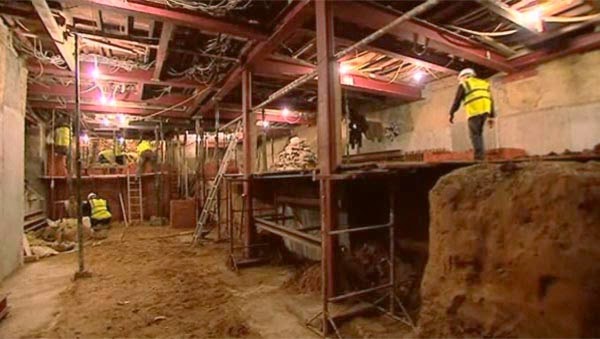
[Image: Courtesy of London Basement].

A story of buried digging machines made something of an unexpected splash over at New Statesman this week, quickly becoming their weekend’s most-read article.

It turns out that all those elaborate basements and artificial show caves built for Londons’ nouveau riche have led to an interesting spatial dilemma: contractors are unable to retrieve the excavation equipment they used to produce all those huge underground extensions in the first place, and they have thus developed a technique for simply abandoning their machines underground and burying them in place.

London is thus becoming a machine cemetery, with upwards of £5 million worth of excavators now lying in state beneath the houses of the 1%. Like tools invented by M.C. Escher, these sacrificial JCBs have excavated the very holes they are then ritually entombed within, turning the city into a Celtic barrow for an age of heroic machinery.

What will future archaeologists make of these interred devices, densely packed in earth and left behind in unmarked graves?

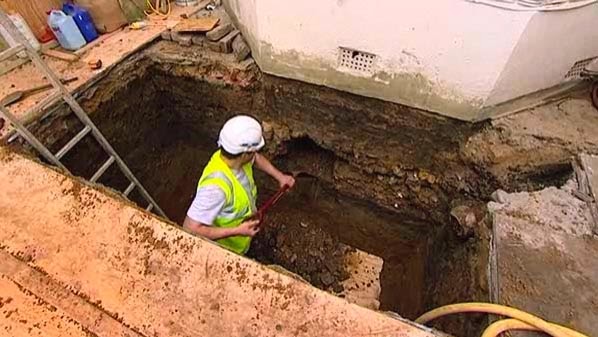
[Image: Courtesy of London Basement].

As we explored here on BLDGBLOG six years ago, deep below the mansions and row houses of the city’s wealthiest residents, colossal cave adventures are taking shape: massive swimming pools, TV rooms, personal gymnasia, full-scale cinemas, and whole subterranean flats are being constructed in order to side-step strict historic preservation laws on the earth’s surface.

Pioneered by firms such as the appropriately named London Basement, these massively expanded homes now feature “playrooms and cinemas, bowling alleys and spas, wine cellars and gun rooms—and even a two-storey climbing wall,” the Guardian reported in 2012. “It is leading to a kind of iceberg architecture, a humble mansion on the surface just the visible peak of a gargantuan underworld, with subterranean possibilities only limited by the client’s imagination.”

As the architect of one such mega-basement explained, “We analyzed the planning laws and realized that they cover everything about the surface of the ground, but nothing beneath it. There was nothing whatsoever that could stop us from drilling all the way down to the south pole.”

[Image: Courtesy of London Basement].

Those grand old piles you see lining the streets of Belgravia thus might hide vertically sprawling domestic labyrinths and basement mazes down in the soil and clay beneath their ever-growing foundations, as home ownership fractally expands downward into the planet by way of waterproof geotextiles and carefully buttressed retaining walls.

However, these vast catacombs are by no means uncontroversial and might yet see their era come to an end due to local frustration with the disruption caused by construction crews and because of ever-growing municipal fees and penalties.

Until then, though, this abyssal impulse is surely approaching the inevitable point where we will see a private home legally redefined as a mine, a site of excavation closer in spirit to the extraction industry than private housing.

(Thanks to Martin John Callanan, Peter Flint, Paul Black, and Nicola Twilley! Meanwhile, if you like this, you might also like Subterranean Machine Resurrections)

Guided By Voices

At last week’s inaugural Infrastructure Observatory conference, MacroCity, archivist Rick Prelinger delivered a fantastic opening lecture looking back at the history of telephony in the Bay Area.

From the earliest exposed copper wires vulnerable to shorting out in San Francisco’s morning fog to 1970s phone phreaks and the future of NSA surveillance, it was a great talk; you can view the slides here (and follow Rick on Twitter for yet more).

[Image: From the Ellensburg Daily Record, June 16, 1914].

Amidst dozens of examples and images in his talk, the one that really stood out for architectural purposes was his citation of something called the “human telephone,” as originally reported in the Ellensburg Daily Record on June 16, 1914. A reorganized and cleaned-up version of that article appears above.

As Prelinger described it, the human telephone was like an electromagnetic update to the oracle at Delphi: a lone female figure with access to distant voices, dancing slowly across a dance floor secretly wired from below, an interactive surface whose hidden technology extended up into her very clothing.

There were copper wires woven through her dress, copper-soled shoes on her feet, even copper nails hammered in the floor below, and this all effectively turned her into a living telephone network—the “human telephone” of the article’s title—receiving voices from some continent-scale network invisible to spectators’ eyes. Oracular and alluring, she would then invite members of the audience to join her in this choreography, where ghostly conversations-at-a-distance would ensue.

[Image: An otherwise irrelevant photo of people ballroom dancing, via Wikipedia].

In Prelinger’s own words:

Prior to the opening of PPIE [the Panama Pacific International Exhibition], Pacific Telephone was asked to furnish service to the Ball of All Nations in May 1914. They built a hidden network of wires under the floor, connected with copper nails set close apart in the floor. The spouse of a telco employee wore copper-soled shoes from which wires ran up through her clothing to a telephone set. She asked her dancing partners whom they’d like to talk with, and suddenly they were on the phone. A switchboard operator listened in on all conversations and whenever she heard a name rushed through a call on special lines.

This wired ballroom—like some telephonic update of the khôra, that Platonic dance floor and moving surface so mythologically important to the first days of Western architecture—presents us with an absolutely incredible image of people waltzing amidst voices, metallurgically connected to a matrix of wires and lines extending far beyond the room they first met within.

The copper woman in the center of it all becomes more like an antenna, stepping and turning inside a glossolalia of distant personalities all vying for time on the invisible network she controls with every move of her feet. Sheathed in metal, she is part golem, part conjurer, part modern oracle, kicking off the weird seance that was the early telephone system, guiding us through a switchboard of words from nowhere all woven together in this awesome dance.

A Building For Measuring Borders

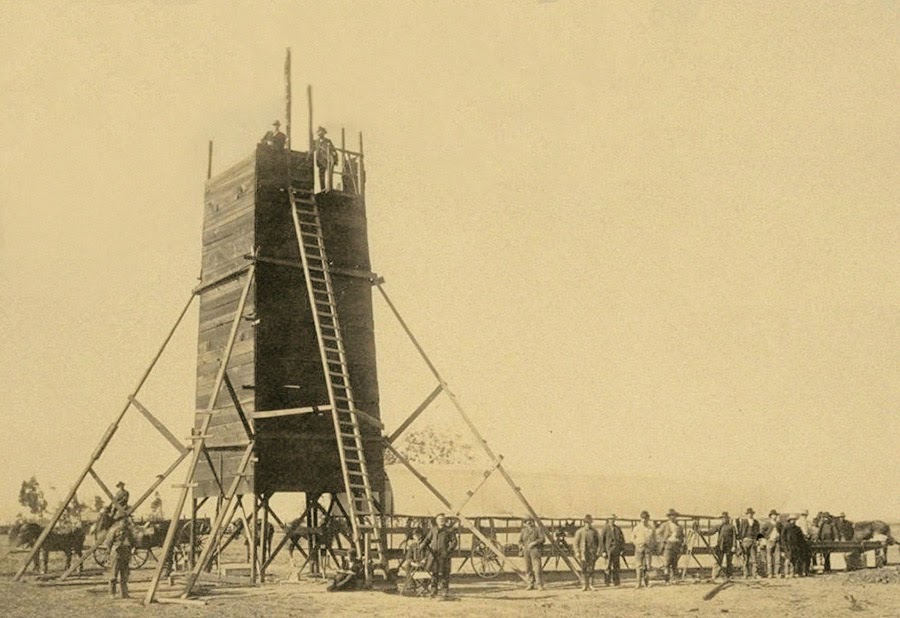
The so-called “Yolo Buggy” was not a 19th-century adventure tourism vehicle for those of us who only live once; it was a mobile building, field shelter, and geopolitical laboratory for measuring the borders of an American county. Yolo County, California.
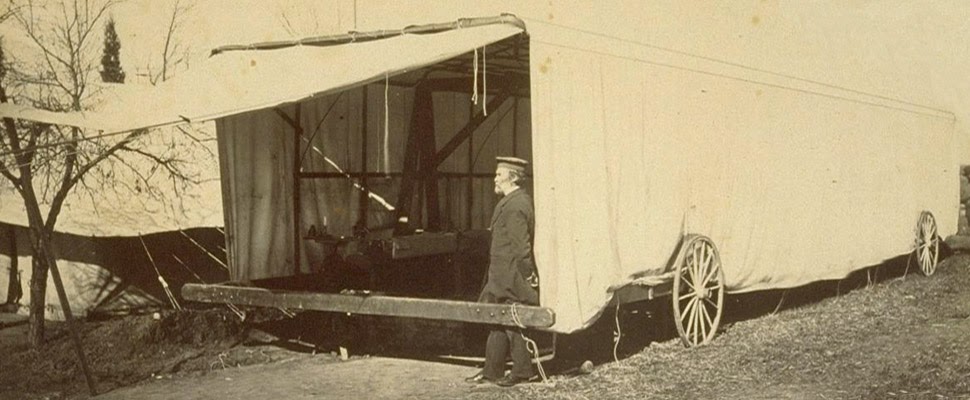
The “moveable tent or ‘Yolo Buggy,'” as the libraries at UC Berkeley describe it, helped teams of state surveyors perform acts of measurement across the landscape in order to mathematically understand—and, thus, to tax, police, and regulate—the western terrain of the United States. It was a kind of Borgesian parade, a carnival of instruments on the move.

The resulting “Yolo Baseline” and the geometries that emerged from it allowed these teams to establish a constant point of cartographic reference for future mapping expeditions and charts. In effect, it was an invisible line across the landscape that they tried to make governmentally real by leaving small markers in their wake. (Read more about meridians and baselines over at the Center for Land Use Interpretation).
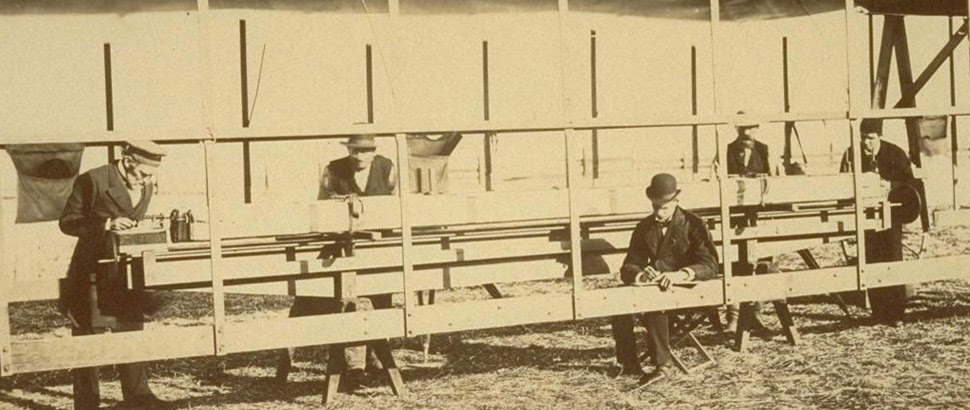
In the process, these teams carried architecture along with them in the form of the “moveable tent” seen here—which was simultaneously a room in which they could stay out of the sun and a pop-up work station for making sense of the earth’s surface—and the related tower visible in the opening image.
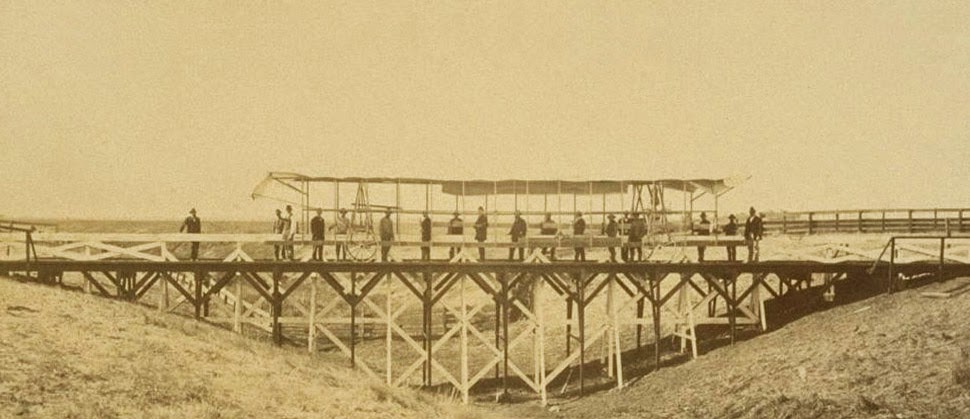
That control tower allowed the teams’ literal supervisors to look back at where they’d come from and to scan much further ahead, at whatever future calculations of the grid they might be able to map in the days to come. You could say that it was mobile optical infrastructure for gaining administrative control of new land.
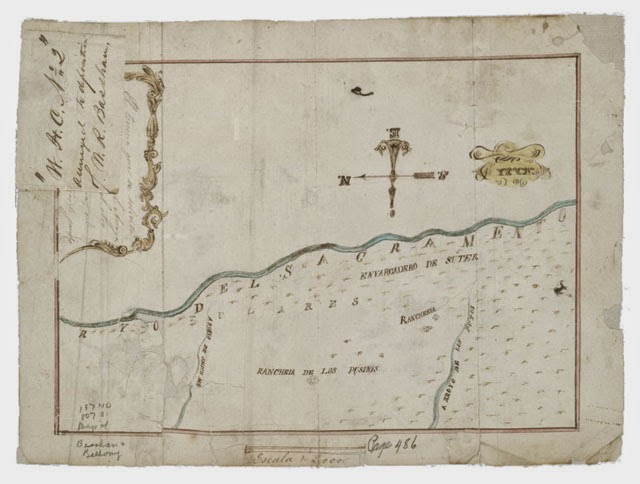
Like a dust-covered Tron of the desert, surrounded by the invisible mathematics of a grid that had yet to be realized, these over-dressed gentlemen of another century helped give rise to an abstract model of the state. Their comparatively minor work thus contributed to a virtual database of points and coordinates, something immaterial and totally out of scale with the bruised shins and splintered fingers associated with moving this wooden behemoth across the California hills.
(All images courtesy UC Berkeley/Calisphere).

100 Views of a Drowning World

[Image: Kahn & Selesnick, courtesy Yancey Richardson].

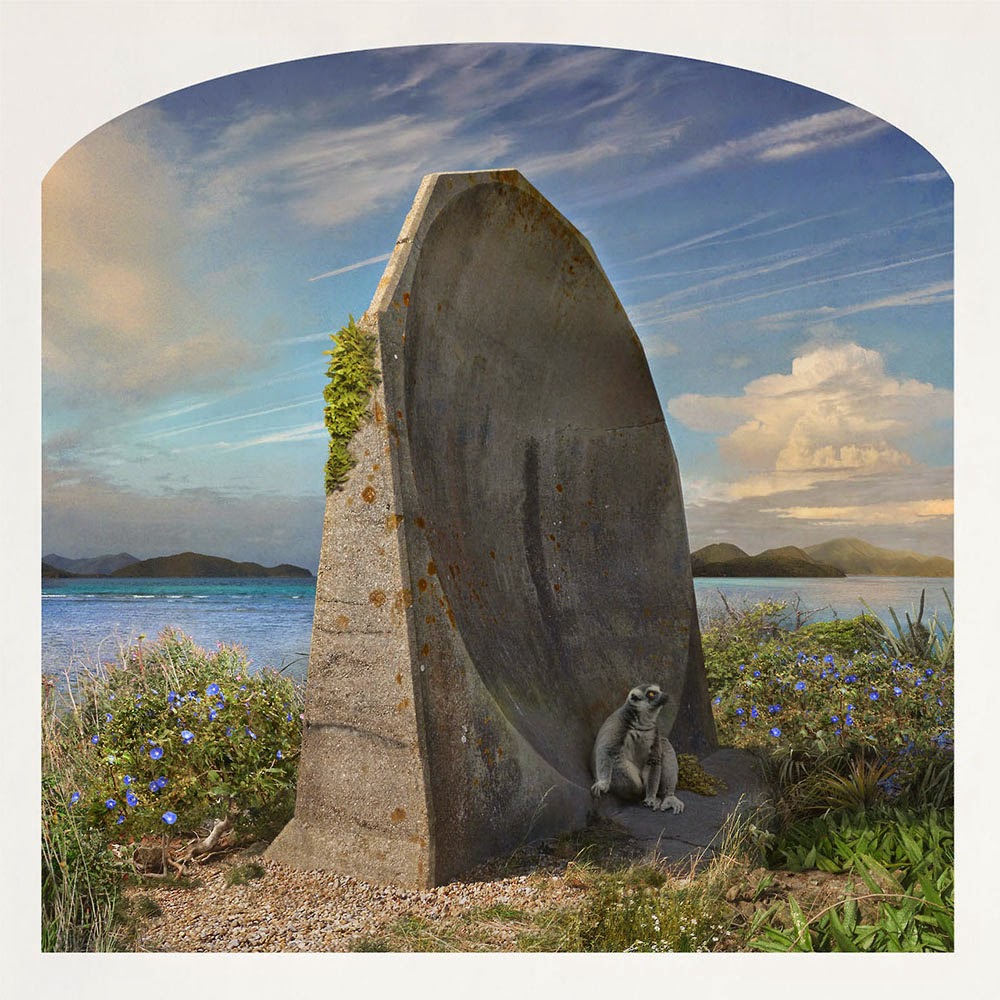
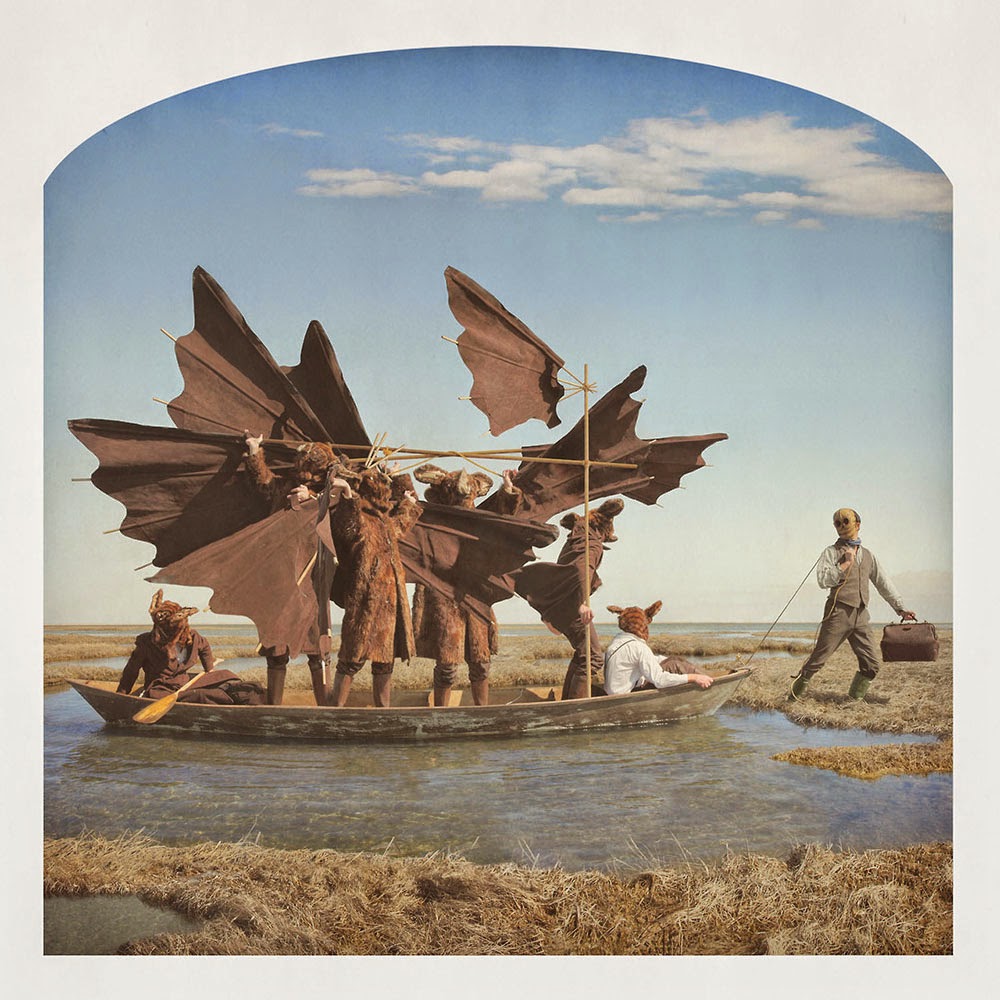
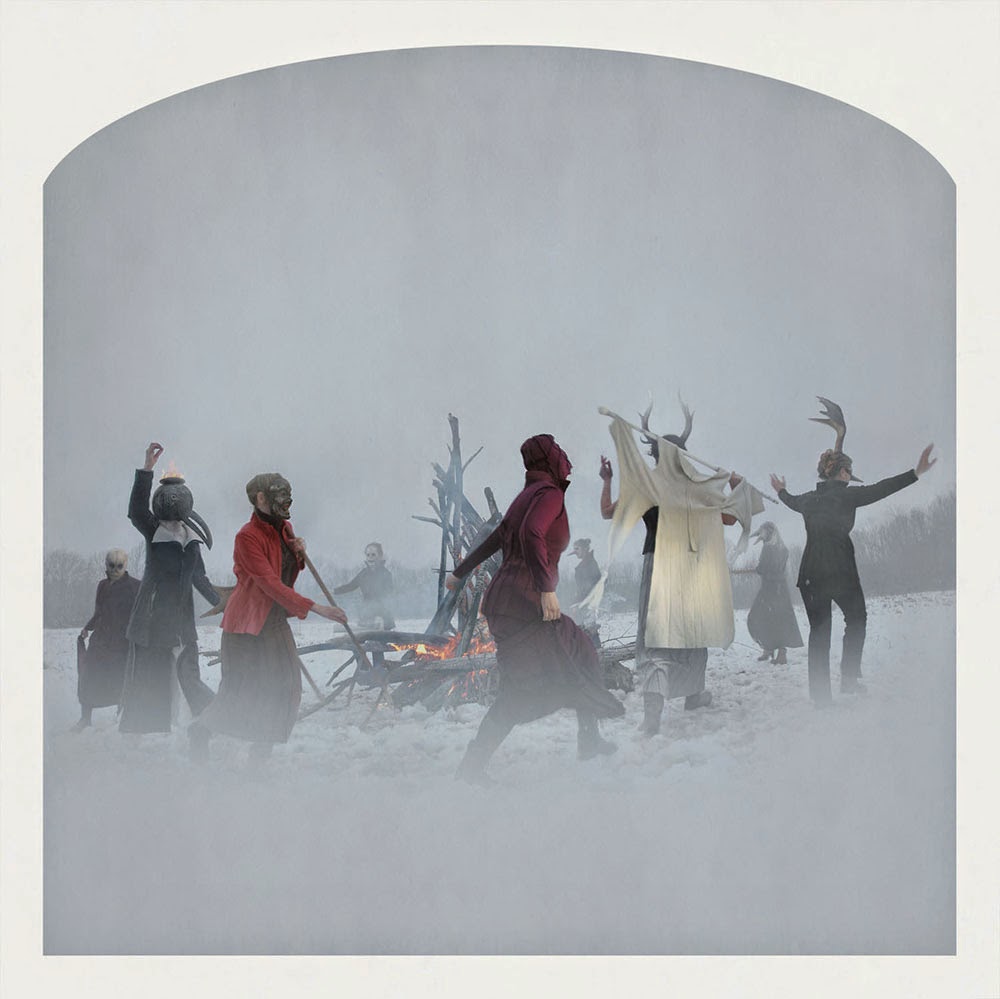
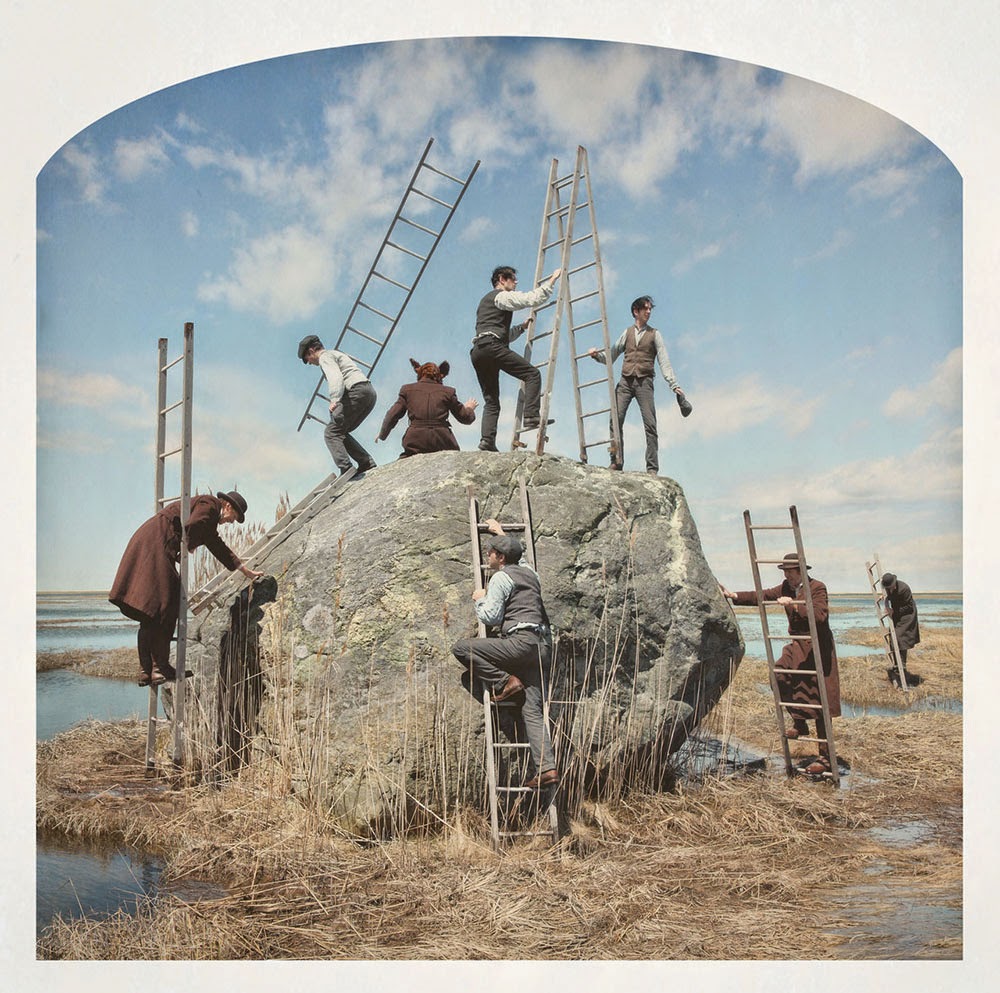
I’ve mentioned the work of artists Kahn & Selesnick before; their surreal narratives are illustrated with elaborately propped photos that fall somewhere between avant-garde theater and landscape fiction, with mountain glaciers, salt mines, alien planets, utopian cityscapes, and, as seen here, the slowly flooding marshes of an unidentified hinterland.

[Image: Kahn & Selesnick, courtesy Yancey Richardson].

These images are from a new project, called Truppe Fledermaus & The Carnival at the End of the World, that opened at New York’s Yancey Richardson gallery last week. “Utilizing photography, drawing, printmaking, sculpture and performance,” the gallery writes, “the artists create robust mythic realities for each project, building imaginary, character-driven fictions from kernels of obscure historical truth.”

Kahn & Selesnick’s latest project follows a fictitious cabaret troupe—Truppe Fledermaus (Bat Troupe)—who travel the countryside staging absurd and inscrutable performances in abandoned landscapes for an audience of no one. The playful but dire message presented by the troupe is of impending ecological disaster, caused by rising waters and a warming planet, the immediate consequences of which include the extinction of the Bat, in this mythology a shamanistic figure representing both nature and humanity. In one sense, the entire cabaret troupe can be seen as a direct reflection of the artists themselves, both entities employing farce and black humor to engage utterly serious concerns.

The particular scenes shown here, all on display until July 3, 2014, are from a sub-series within the project called “100 Views of a Drowning World.”

[Image: Kahn & Selesnick, courtesy Yancey Richardson].

Eccentric residents of a drowning landscape live lives indistinguishable from absurdist stagecraft, as they wander through seemingly wild landscapes that are actually ruins and that will eventually all disappear beneath the deceptively placid tidal flats flowing around them.

[Image: Kahn & Selesnick, courtesy Yancey Richardson].

These anonymous coastal dwellers simulate a nature that is already artificial—a kind of maritime grotesque of overgrown animal forms and humans buried beneath ropes and seaweed—and they set off on doomed expeditions through terrains whose original inhabitants have long been forgotten.

[Image: Kahn & Selesnick, courtesy Yancey Richardson].

Lone figures in boats look out into what will soon be sea, attempting to navigate land as if it is already an ocean.

[Images: Kahn & Selesnick, courtesy Yancey Richardson].

And others attempt to escape into some new strain of Romanticism, witnesses of large-scale terrestrial change who know that this moment on the Earth is rare—though not unique—for the extraordinary transitions that lie over the horizon.

[Image: Kahn & Selesnick, courtesy Yancey Richardson].

In the end, then, the idea is not that these characters’ actions somehow represent or propose a new humanist response to climate change, or that the artists are offering us any sort of practical or ethical insight into what futures might face us in a drowned world, but that these absurd rituals and dreamlike antics instead simply illustrate “a world that is sinking into a marsh.”

It is, as the show’s title suggests, just a carnival at the end of the world.

[Image: Kahn & Selesnick, courtesy Yancey Richardson].

The Yancey Richardson gallery is on W. 22nd Street, over near the High Line; be sure to stop by before July 3. Here is a map and here are more images.

The City and its Periphery

If you’re in the Bay Area at the end of month, consider attending an event called Macro City, organized and hosted by the Infrastructure Observatory. Its purpose is “to explore the vast, often overlooked networks of infrastructure that surround us,” and, in the process, “to celebrate the numerous people whose countless efforts shape the built landscape every day.”

Probably the most interesting part of the whole event is the ambitious program of local field trips, all of which take place on May 30th. They include guided tours of everything from the Zanker landfill & recovery facility down in San Jose to one of San Francisco’s wastewater treatment plants, and from a construction aggregate terminal and a kayak trip to an activist walking tour of the city’s many surveillance cameras.

[Image: The Dutra Group‘s extraordinary San Rafael rock quarry, a Macro City field trip site and striking reversal of the figure-ground relationship; photo courtesy of baycrossings/Macro City].

Tickets are available at various levels of price and access—and I should point out that I am also speaking at the event, alongside Nicola Twilley, so my opinion betrays some bias—but the conference has a great and important interpretive mission, and seems well worth attending: “We rarely see in full the cities that we live in,” the organizers write. “Focused on our daily lives, urban dwellers are often only dimly aware of the numerous, enmeshed layers of critical infrastructure that quietly hum in the background to make modern life possible.”

Come tour and talk about those hidden systems on May 30 and 31, at SPUR and the Brava Theater in San Francisco. See the Macro City site for more details.

Demolition Ground


I love this story of the mysterious disappearing sinkholes of Indiana’s Mount Baldy, where deep pits in the sand dunes are opening and closing for reasons as yet to be determined. These “strange holes” have “appeared since last year, only to collapse and be filled in with sand a day later. Some of the holes were so deep they could not be measured with the researchers’ measuring tapes,” Livescience reports.

The area has thus been closed to the public while EPA scientists scan the site with ground-penetrating radar; this will help them to develop an “understanding of the overall internal architecture of the dune, using multispectral GPR and coring.”


After all, one of the leading theories is actually that buried structures, consumed by the dune’s migration over the past century, might have collapsed deep below the sand, creating these temporary sinkholes.

Imagine small buildings imploding under the weight of the landscape, like little cubic tombs held in place all this time by a dry glacier of sand and gravel, finally bursting inward as the strain becomes too much for them to carry—as if, beneath us in weird labyrinths of negative space, the invisible, slow-motion demolition of old buildings proceeds apace, detectable only as momentary pores and sinkholes breathing open and closed in the earth’s mobile surface.

(Images courtesy National Park Service).