There’s a great story by Ed Yong over at The Atlantic about the fact that, as he explained on Twitter, “hundreds of undiscovered species lurk in the drawers of museums.” Natural history collections, Yong writes, are actually “time capsules that contain records of past ecosystems that are rapidly changing or disappearing. They are archives that provide clues about raging epidemics, environmental pollution, and hidden extinctions. And they are full of unknown species—like the sacred crocodile.” Check it out. If you like natural history museums as much as I do, meanwhile, you might also enjoy Richard Fortey’s book, Dry Storeroom No. 1: The Secret Life of the Natural History Museum.
Category: BLDGBLOG
“Building with metals not from Earth”
I missed the story last month that a company called Planetary Resources had successfully 3D-printed a small model using “metals not from Earth”—that is, metal harvested from a meteorite: “Transforming a chunk of space rock into something you can feed into a 3D printer is a pretty odd process. Planetary Resources uses a plasma that essentially turns the meteorite into a cloud that then ‘precipitates’ metallic powder that can be extracted via a vacuum system. ‘It condenses like rain out of a cloud,’ said [a company spokesperson], ‘but instead of raining water, you’re raining titanium pellets out of an iron nickel cloud.’ (…) ‘Everyone has probably seen an iron meteorite in a museum, now we have the tech to take that material and print it in a metal printer using high energy laser. Imagine if we could do that in space.’”
Landscapes of Data Infection
 [Image: An otherwise unrelated seed x-ray from the Bulkley Valley Research Centre].
There’s a fascinating Q&A in a recent issue of New Scientist with doctor and genetic researcher Karin Ljubic Fister.
Fister studies “plant-based data storage,” which relies on a combination of artificially modified genes, bacteria, and “infected” tobacco plants.
Comparing genetic programming with binary code, Fister explains that, “First you need a coding system. A computer program is basically a sequence of 0s and 1s, so we transformed this into the four DNA ‘letters’—A, G, C and T—by turning 00 into A, 10 into C, 01 into G and 11 into T. Then we synthesised the resulting DNA sequence. We transferred this artificial DNA into a bacterium and infected the leaf of a tobacco plant with it. The bacterium transfers this artificial DNA into the plant.”
Even better, the resulting “infection” is heritable: “We took a cutting of the infected leaf, planted it, and grew a full tobacco plant from it. This is essentially cloning, so all the leaves of this new plant, and its seeds, contained the ‘Hello World’ program encoded in their DNA.” The plants thus constitute an archive of data.
In fact, Fister points out that “all of the archives in the world could be stored in one box of seeds.” Now put that box of seeds in the Svalbard Global Seed Vault, she suggests, and you could store all the world’s information for thousands of years. Seed drives, not hard drives.
It’s worth reading the Q&A in full, but she really goes for it at the end, pointing out at least two things worth highlighting here.
 [Image: “Higashiyama III” (1989) by Kozo Miyoshi, courtesy University of Arizona Center for Creative Photography; via but does it float].
One is that specialized botanical equipment could be used as a technical interface to “read” the data stored in plants. The design possibilities here are mind-boggling—and, in fact, are reminiscent of the Landscape Futures exhibition—and they lead directly to Fister’s final, amazing point, which is that this would, of course, have landscape-scale implications.
After all, you could still actually sow these seeds, populating an entire ecosystem with data plants: archives in the form of forests.
“Imagine walking through a park that is actually a library,” she says, “every plant, flower and shrub full of archived information. You sit down on a bench, touch your handheld DNA reader to a leaf and listen to the Rolling Stones directly from it, or choose a novel or watch a documentary amid the greenery.” Information ecosystems, hiding in plain sight.
The Dam Industry’s Chernobyl
There’s an alarming new piece up at The New Yorker looking at two potential dam failures, in Iraq and Zambia, and the extraordinary effects these disasters would have. The collapse of Iraq’s Mosul Dam, for example, which the U.S. Army Corps of Engineers calls “the most dangerous dam in the world,” “could drown as many as five hundred thousand people downstream and leave a million homeless.” The collapse of Zambia’s Kariba Dam, meanwhile, and the resulting megaflood would be “the dam industry’s Chernobyl”: “three million people live in the flood’s path; most would die or lose their crops or possessions. About forty per cent of the electricity-generating capacity of twelve southern African nations would be eliminated.” (Spotted via @waltonwater)
Fly, Eagles, Fly
Speaking of animals being actively incorporated into urban infrastructure, Dutch police are training eagles to hunt drones. “What I find fascinating is that birds can hit the drone in such a way that they don’t get injured by the rotors,” explains a spokesperson for the National Audubon Society. “They seem to be whacking the drone right in the center so they don’t get hit; they have incredible visual acuity and they can probably actually see the rotors.”
Christmas Tree Beach
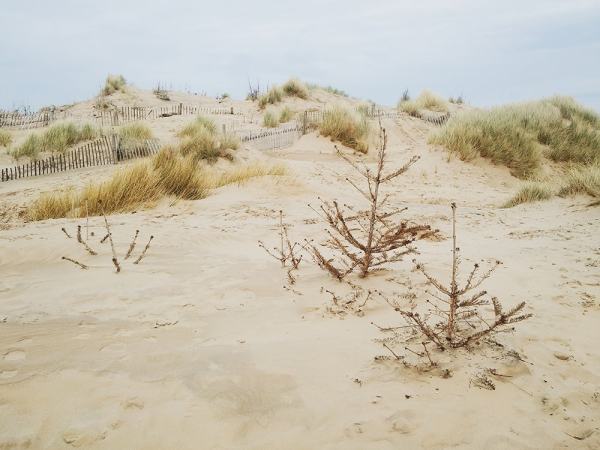 [Image: “Discarded Christmas trees were used to help rebuild the sand dunes around three years ago,” writes photographer Fiona Croall on her Instagram feed. “Now you can hardly see them!”].
While discarded Christmas trees here in New York City simply piled up on the sidewalks for more than two weeks after the holidays, forming strange—if still somewhat sadly picturesque—felled forests on the margins of the city, it turns out there’s an altogether more useful fate for those trees over in England.
There, the eroding beaches at Formby, just north of Liverpool, have been partially stabilized through Christmas tree donations.
 [Image: The Christmas trees at Formby; photo courtesy National Trust/Robert Matthews].
“Our Rangers are asking people to bring their used real Christmas trees down to Formby so they can be used to help protect our internationally important sand dunes,” the National Trust explains.
The trees “help to mitigate [wind and erosion] by mimicking the action of the Marram grass, catching the sand blown on to the dunes from the beach and also dissipating the power of the wind as it blows across the surface of the dunes. Over time the trees become buried which helps to build up the dunes and they also help to partly stabilise the surface of the dunes which often allows the Marram grass to take hold again naturally.”
 [Image: The artificially stabilized beaches at Formby, with no sign of the displaced forest lurking below; photo by Fiona Croall].
Compare this approach, for example, to the widespread use of massive, industrially produced tetrapods for coastal erosion management—or even to the endless expense of so-called “beach nourishment”—and the idea of rebuilding the landscape using nothing more than linked chains of dead Christmas trees seems both tactically brilliant and cost-effective.
Not to mention archaeologically intriguing: it doesn’t take much to wonder how geotechnical assemblages such as these—huge arboreal lumps without a nearby forest to explain them—might appear to some distant researcher hoping to make sense of the stratigraphic record.
Like evidence of an ancient tsunami, the buried woods of Formby could surely sustain many a strange landscape theory to come.
(Huge thanks to photographer Fiona Croall who tweeted about the Christmas trees late last month).
The Mirror War and the Light Brigade
 [Image: A cosmetically touched-up view of villages being set alight by mirrors; view slightly larger. From Deliciae physico (1636) by Daniel Schwenter].

Perhaps you remember the Austrian village of Rattenberg, so thoroughly hidden in the mountain shadows every winter that it installed a huge system of mirrors to bring the sun back in. The town of Rjukan, Norway, recently experimented with the same thing.
“High on the mountain opposite,” the Guardian reported back in 2013, “450 metres above the town, three large, solar-powered, computer-controlled mirrors steadily track the movement of the sun across the sky, reflecting its rays down on to the square and bathing it in bright sunlight.”
A far more sinister version of this exact sort of system was illustrated in a German book called Deliciae physico, published back in 1636, by Daniel Schwenter.
There, a woodcut shows a kind of reflective super-weapon mounted atop pillars, made of concave mirrors and magnifying lenses, setting fire to two distant buildings simultaneously the way a bumbling child might torture ants.
 [Image: The full original page; view larger. From Deliciae physico (1636) by Daniel Schwenter].

Interestingly, this Apollonian death ray—a frighteningly literal light brigade—is presented in the book’s much larger context of telescopes, astronomy, and other optical devices, including distorting mirrors and cameras obscura.
Check out all 650 pages of the book here, courtesy of the U.S. Library of Congress, including some very cool images.
(Originally spotted via the excellent Twitter feed, @HistAstro).
Wearable Furniture, Portable Rooms
 [Image: Archelis via the Tech Times].
“Japanese researchers have developed a wearable chair called Archelis that can help surgeons when they are performing long surgeries,” the Tech Times explains.
At first glance Archelis does not look like a chair at all. The wearable chair looks more like a leg brace. The wearer of Archelis will not get full comfort of sitting on a chair but the gadget actually wraps around the wearer’s buttocks and legs, providing support that effectively allows them to sit down wherever and whenever needed.
The developers of Archelis suggest that even though the chair is targeted for surgeons performing long surgeries, it can be used by anyone in fields that require a lot of standing. Moreover, the chair may also assist people who have to sit briefly after walking for a while.
Your leg braces, in other words, convert into furniture, as seen in the video below.
While this is already interesting, of course, the artistic and even architectural implications are pretty fascinating, with clear applications outside the realm of surgery. Crowds as coordinated super-furniture. A choreography of linked braces forming structural chains and portable rooms.
Give it a few years—and then why design and build certain types of furniture at all, when people can simply wear them? What would this do to how architects frame space?
Until that day, read more at the Tech Times.
(Spotted via @curiousoctopus).
Directions Might Not Terminate
Katherine Ye has posted short descriptions of “twenty tiny cities,” an homage to Italo Calvino, and some of them are so good. Clockwork City: “Buildings are constantly sliding, turning, merging, separating. Directions: ‘Your destination will arrive in 1.5 hours.’” Fractal City: “Directions are given recursively. ‘Go to the middle triangle, then to its top triangle. Repeat until you arrive.’ Directions might not terminate.” Desire Path City: “They covered the city with meadows of grass, then after a year, built roads where foot traffic had worn grass to dirt.” Nondeterministic City: “Every time you reach an intersection, you take all of them at once. There are few maps of the city, because you’ll always find what you’re looking for.” (Spotted via @katierosepipkin).
Hot Rock, Lost Rock, Router
 [Image: Keepalive by Aram Bartholl, from the artist’s Flickr page].
This past summer, Aram Bartholl installed a project called Keepalive in the woods of Neuenkirchen, Germany. Keepalive was a hollow boulder that contained “a thermoelectric generator which converts heat directly into electricity.”
Visitors are invited to make a fire next to the boulder to power up the wifi router in the stone which then reveals a large collection of PDF survival guides. The piratebox.cc-inspired router which is NOT connected to the Internet offers the users [an opportunity] to download the guides and upload any content they like to the stone database. As long as the fire produces enough heat the router will stay switched on.
First, a chamber was cut into a large rock; the router was then installed inside it.
 [Image: Keepalive by Aram Bartholl, from the artist’s Flickr page].
Next, the chamber was sealed with a piece of metal, and the rock itself was strapped to a delivery truck, to be dropped off in its new home in a wooded meadow.

 [Images: Keepalive by Aram Bartholl, from the artist’s Flickr page].
Finally, a small campfire was started—and, lo and behold, the secret documents made their electromagnetic way to a nearby iPhone, as if conjured into digital existence through the most primitive means of a campfire.
It’s a kind of library in waiting.
 [Image: Keepalive by Aram Bartholl, from the artist’s Flickr page].
While the actual, technical realization of the piece leaves something to be desired—by which I simply mean that there is just a large metal plate hiding the cavity inside of which the router is stored, which is visually disappointing—I love the idea that a better-hidden version of this might actually serve a real survivalist purpose someday.
Out on the remote periphery of the city, where you and your family agree to meet should there ever be an earthquake, a hurricane, or an act of terrorism or war, a cached collection of digital files waits utterly hidden from view, sealed inside a boulder with no visible exterior signs. When the Big One hits, out to your hot rock you go.
Of course, in real life, you’d doubtless lose track of the thing and spend two agonizing weeks lighting fire after fire after fire under every boulder in the region, desperately checking your dying phones to see if the digital documents appear… and they never do…
Think, for example, of the genuinely weird—and seemingly half-fictional—story of “Rocky II,” artist Ed Ruscha’s lost geological sculpture in the California desert.
As the Guardian explains, “Rocky II” is a “little-known and unexhibited work by the American artist Ed Ruscha: an artificial rock made out of resin and named ‘Rocky II’ after the Sylvester Stallone movie. A BBC crew filmed Ruscha during its creation for a 1980 documentary, which also captured him depositing the work somewhere in the Mojave desert, where it has apparently remained ever since, indistinguishable from all the other rocks around it.”
Ruscha’s rock is apparently more than just forgotten, it is seemingly nonexistent: “‘Rocky II’ is so mysterious it neither appears on the call for information about missing artworks listed on the artist’s website, nor in the catalogue listing all his known works—almost as if its existence has been intentionally obscured.”
 [Image: Keepalive by Aram Bartholl, from the artist’s Flickr page].
In any case, surely Bartholl’s Keepalive could also be used as an interesting geological tool for espionage, merely a different kind of spy rock, tucked away at a campsite somewhere, waiting for a foreign agent to come along and light a fire.
A few minutes later—invisibly, unexpectedly to anyone but the agent—a tiny router inside the rock whirs to life in the heat and an electromagnetic cache of classified files begins streaming.
(Originally spotted via @curiousoctopus).
Of Artificial Mountains, Revolutionary Politics, and Parisian Supreme Beings
“On 8 June 1794 (20 Prairial Year II) an artificial landscape was erected in the centre of Paris,” Andrew Ray writes at some LANDSCAPES. “This day had been chosen for the first Celebration of the Supreme Being, a new godhead devised by Robespierre, then at the zenith of power… What kind of mountain would be adequate for the Supreme Being? Not, it would seem from contemporary prints, a perfectly shaped one.” If this interests you, meanwhile, check out David Gissen’s project for a reconstruction of “The Mound of Vendôme.”