The novels of Jeff VanderMeer fall somewhere between science fiction, dark fantasy, magical realism, and even horror comedy. VanderMeer’s literary range becomes immediately apparent when you consider that he’s been “a two-time winner (six-time finalist) of the World Fantasy Award, as well as a past finalist for the Hugo Award, the Philip K. Dick Award, the International Horror Guild Award, the British Fantasy Award, the Bram Stoker Award, and the Theodore Sturgeon Memorial Award.”
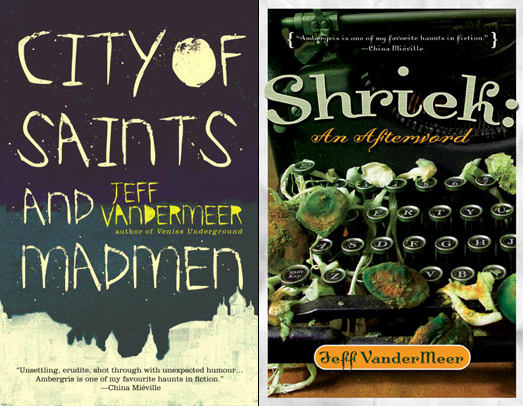 [Image: Jeff VanderMeer’s City of Saints & Madmen and Shriek: An Afterword. See Shriek‘s official website].
Among others, VanderMeer’s books include Veniss Underground, City of Saints & Madmen, and Shriek: An Afterword – the latter published in hardcover just last month. Author news, textual excerpts, MP3s, and imagery from Shriek are all available on that novel’s official website. Meanwhile, along with Mark Roberts, VanderMeer is also editor of The Thackery T. Lambshead Pocket Guide to Eccentric & Discredited Diseases, which includes work by dozens of contributors, from Neil Gaiman and Cory Doctorow to China Miéville and K.J. Bishop (official website here).
In light of my own conviction that many of today’s most original, historically unencumbered, and frankly exciting architectural ideas are to be found within videogames, films, and science fiction novels, I decided to talk to VanderMeer about his own inventive and novelistic use of the built environment. From his fungal city of Ambergris to the uniquely dark, medicalized underworld of Veniss, VanderMeer’s vision is architectural in the broadest – and best – sense.
In the following interview we discuss English cathedrals, “fungal technologies” and architectural infections, the Sydney opera house, Vladimir Nabokov, “The Library of Babel,” Monsanto, giant squids and geological deposits, nighttime walks through Prague, and even urban security after the attacks of 9/11.
• • •BLDGBLOG: To start with the most general question first: if architects, urban planners, and even film makers all look for something in a city – a certain quality to the space, a light, a texture, a density – what do you, as a novelist, look for?
Jeff VanderMeer: Every time I go to a new place, obviously it’s an inspiration of some kind – even if it’s the most awful place in the universe. Like, say, Blackpool, England. I think that when I go to a city I actually do look at texture, because texture is very important in the way I layer my writing. When I go to a city – it’s pretty basic: I literally start on the micro-level. I actually run my hand down the wall to get a sense of what things are like. [laughs] A great example, I think, is when we were in Sydney, and you see the opera house from afar and it’s kind of like this fairy tale creation – it looks so light – but then you get up close and it’s basically just a 1970s piece of concrete, with a very rough and kind of forbidding texture. It’s not what it appears from afar; it’s very much an illusion.
So I think when you get to the actual texture of things – when you actually get a chance to touch the stuff – you get a sense of what it’s actually about. That’s why I like traveling – because I think it’s very important, even when you’re writing a fantasy city, to base it on something real, some first-hand experience. I don’t like the idea that the basic core of what you’re writing about is somehow a reaction to another piece of fiction. I want it to be tactile. I want it to be something concrete, based on something in the real world, that you can extrapolate from. Then maybe you layer in some allusions or influences from other fictions – if it’s applicable in some way, if it adds some kind of resonance.
There’s not really a method beyond that; it’s just what strikes me. Like going to the York Minster, in England – which blew me away and inspired the cadaver cathedral in Veniss Underground. Standing inside that building, which was so absolutely amazing, like nothing I had ever seen before – because I had never had a chance to go inside an old cathedral – how alien it looked and how ethereal and yet so solid – and I literally just stood there looking at it, looking at the inside, looking at the ceiling, for more than an hour.
Being in there, and having been stalled on Veniss, that structure – that piece of architecture – saved my novel. I suddenly understood how to transform something from the real world into something imaginary.
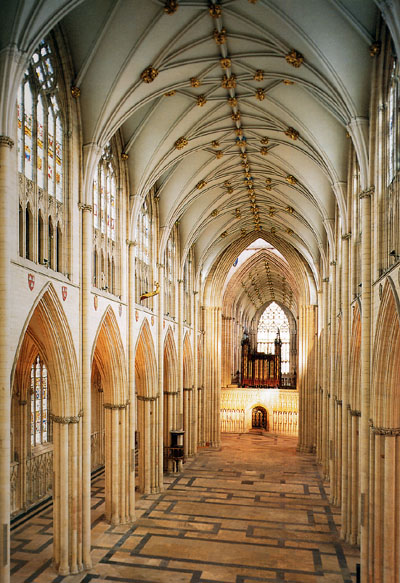 [Image: Interior view of the York Minster. VanderMeer: “Where the sculptures of saints would have been set into the walls, there were instead bodies laid into clear capsules, the white, white skin glistening in the light – row upon row of bodies in the walls, the proliferation of walls. The columns, which rose and arched in bunches of five or six together, were not true columns, but instead highways for blood and other substances: giant red, green, blue, and clear tubes that coursed through the cathedral like arteries. Above, shot through with track lighting from behind, what at first resembled stained-glass windows showing some abstract scene were revealed as clear glass within which organs had been stored: yellow livers, red hearts, pale arms, white eyeballs, rosaries of nerves disembodied from their host.” From Veniss Underground]
BLDGBLOG: How do you achieve – or hope to achieve – believability in an urban setting, giving readers something that (they think) might actually exist?
VanderMeer: As a novelist who is uninterested in replicating “reality” but who is interested in plausibility and verisimilitude, I look for the organizing principles of real cities and for the kinds of bizarre juxtapositions that occur within them. Then I take what I need to be consistent with whatever fantastical city I’m creating. For example, there is a layering effect in many great cities. You don’t just see one style or period of architecture. You might also see planning in one section of a city and utter chaos in another. The lesson behind seeing a modern skyscraper next to a 17th-century cathedral is one that many fabulists do not internalize and, as a result, their settings are too homogenous.
Of course, that kind of layering will work for some readers – and other readers will want continuity. Even if they live in a place like that – a baroque, layered, very busy, confused place – even if, say, they’re holding the novel as they walk down the street in London [laughter] – they just don’t get it. So you have to be careful how you do that. In the novel I’m working on now, I’ll be able to do much more layering because much more time will have passed. It’s set 500 or 1000 years after the events in City of Saints and Shriek. Though I don’t actually refer to specific architectural styles, or to a kind of macro-vision of buildings in the Ambergris universe; I just allude to things.
I also absorb a lot of research. Byzantine art and history. Venetian history. Roman. Etruscan. Indian. Southeast Asian. English. And some of the research was just seeing all of these amazing structures as a child. I mean, you see something like Machu Picchu when you’re eight and it sticks with you! But one thing I find interesting is what people choose to believe and not believe. In the early history of Ambergris, from City of Saints – which does actually have some architectural allusions – the more fantastical stuff is actually taken from Byzantine and other periods. A lot of stuff that’s true to life, people, in emails, will say how cool it is that I made that up. So you never know how someone will react to this stuff.
 [Image: John Coulthart, for Jeff VanderMeer’s City of Saints & Madmen].
BLDGBLOG: Do you actually draw, or map out, the cities and landscapes you describe?
VanderMeer: I do re-draw the city on occasion – and that’s why there’s no map. I don’t want to realize, writing a story later, that, oh, I can’t do that… But I do have a small, simple map – I would just never put it in a book. It’s more so that I can have a general idea of where things are.
The last time we went to New York, a friend of ours was talking about how quickly the neighborhoods change there. Things shift. An area that was a bunch of warehouses can suddenly be a new art district – and I also think of the city of Ambergris as shifting in that way. Neighborhoods will go fallow – almost like, in rural areas, how a field will go fallow – and then it comes back as something else.
I don’t like having too complete a map.
BLDGBLOG: That idea – that a whole neighborhood could go fallow – was actually the premise of an architectural project by a London firm called The Agents of Change. They came up with this almost science fictional scenario, saying: what would happen if Monsanto, or some other multinational genetic-engineering firm, bought the entirety of east London…? So they drew up this whole plan with rooftop gardens and streets turned into croplands – in other words, London itself gone fallow. What’s particularly interesting, though, is that they used a kind of novelistic device or fictional plot to stimulate their architectural design; it’s like where creative writing and urban planning intersect. In any case, speculative urban design seems to be a burgeoning literary genre in its own right, from Italo Calvino to China Miéville, or even Franz Kafka and H.G. Wells – or Plato’s Atlantis, for that matter. Thomas More’s Utopia. Are there any specific authors in that regard who have influenced your work?
VanderMeer: I get my inspiration from real life as much as possible, and then from history books and then from other writers. I find Italo Calvino’s Invisible Cities, for example, stultifyingly boring because of this idea of speculative urban design. Although I like the idea of a setting also being a character, it has to also be a character – not be the only thing in the book.
Sometimes I will use authors as something to react against – and say, well, okay: this is an interesting design for a city and this is an interesting design for a city, but neither of these actually work. By kind of cross-correlating them and looking at the differences I can figure out where it is that I want to go.
There have been definite examples where I feel like the city in question, in a piece of fiction, is not connected to anything real – and it’s almost like what happens in bad characterization. In bad characterization, you can’t really imagine anything happening to the character outside the pages of the book. There are cities in fantastical fiction that work the same way, where the writer has obviously put a lot of care into creating the city but it’s somehow inert. It’s simply there as a place for the author to set a story. I think the best cityscapes are kind of like characters. They’re slightly illogical. There’s much more to them than is described in the book. There’s all this stuff that you don’t know – and can’t possibly know.
The Mervyn Peake books, of course – Gormenghast – were pretty influential in terms of setting as character and the idea that a place can create a certain fatalism in the people who live there. That’s the way it is in a real city. In a real city you are, in some ways, reduced to one of many, many stories. And that’s something I think the Ambergris books try to convey: people are shaped, molded, and even overwhelmed by the location they’ve chosen to live in.
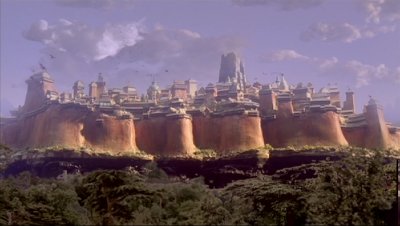 [Image: Gormenghast castle; from the BBC miniseries].
BLDGBLOG: What about Borges? There’s a “Borges Bookstore” in City of Saints, for instance – and his “Library of Babel” seems like a story you’d love.
VanderMeer: Borges, for some reason, always leads me to Ballard – at least how they both manipulate time and space in a way that messes with your head. But I think Nabokov is probably a bigger influence – although he and Borges are oddly similar, because they’re kind of like the godfathers of postmodernism. I think a lot of times, when people think they’re seeing Borges’s influence, they’re actually seeing Nabokov’s. But I don’t really like to be pinned down to one thing.
Again, first-hand experience – it seems, after every major trip, that I come back with just notebooks full of ideas, and sketches. And, it’s funny, because it really is a lot of buildings inspiring emotion, which is not something I’d really thought about till now. But it’s true. The contrasts of Bucharest, for instance, really affected me. There are parts of the city that look like Paris and parts that still bear the scars of Communist rule: these inhuman concrete blocks of apartments that look like they’re falling apart – and all of this around a very vital and energized populace that was unfailingly friendly. It looked like a city in complete transition, like you could find all possible things there, in both a good and a bad sense. And that impacts heavily on the more industrialized Ambergris of the future that I’m slowly working on now.
But before, when I said I don’t really map things out – I don’t – but every once in a while I will have to sketch a building if I don’t have a good sense for where each character is in the place, or what the place actually looks like. Sometimes I’ll get friends of mine who are artists and are much better at that – I’ll give them a description and they’ll come up with something – and then I’ll be able to visualize it better.
 [Image: A digital rendering of Borges’s Library of Babel].
BLDGBLOG: What non-architectural, or even non-human, spaces or structures have been influential? Reefs, mushrooms, geologic deposits, giant squids, manta rays…?
VanderMeer: That’s an excellent question. The forms of fungus. The wonderful streamlined beauty of a manta ray – these types of things come into play constantly in my fiction. They are constant influences on the cities I describe, especially Ambergris.
We don’t really see the beautiful, alien quality of the world in which we live. And it is the shapes and structures of this beauty that appeal to me. I mean, people laugh when I talk about squid, but, my god, what an amazing creature! What an amazing form! Geological deposits as well. And I sometimes feel as if there’s almost a linkage of form between all of these things that draws me to them.
My earliest memories are of Fiji, a volcanic atoll, where the reefs are just offshore. Our school was right near one of these reefs – and I remember, from like the age of six to ten, we would just walk out there, you know, at recess… And, in a sense, I feel like some of the Veniss Underground stuff was an inversion of that. There were so many crevices and hiding places and bizarre things sort of hidden in the reef. Sometimes my dad and mom would take us out there at night – which was amazing, because of the bioluminescence from a lot of the different creatures out there, including the squid. There was a sense of encountering something totally alien.
I just think this stuff is absolutely beautiful, and alien, and – in many cases – kind of horrific. You read about fungus, and there are certain types of fruiting bodies or mushrooms that you can feed different things. Like one of the strangest things in “King Squid,” I think, is a scene where the father of the narrator creates a mushroom that is mostly made of iron filings – because that’s what he feeds it: ground up little bits of iron. And that’s actually true. A mushroom actually will absorb these types of things. You can make a mushroom that is mostly made of iron. [laughs] I assume it dies relatively soon thereafter. [laughter]
The world is a very strange place. We shouldn’t take that for granted. That’s why I highlight some of this stuff, and write about it – because it’s just so fantastic.
BLDGBLOG: Fantastic – but also vaguely threatening in a way?
VanderMeer: I don’t see it as threatening. It’s just the context in which the character encounters it that makes it a hazard, or a threat. I think that confluences of the inorganic and the organic feel threatening to people for some primal reason that I can’t quite put a finger to.
 [Image: John Coulthart, for Jeff VanderMeer’s City of Saints & Madmen].
BLDGBLOG: In City of Saints you describe fungi – specifically, lichen – as a kind of living architectural ornament. You write how “much of the ‘gold’ covering the buildings was actually a living organism similar to lichen that the gray caps had trained to create decorative patterns.” Elsewhere in the book, those lichen “covered the walls in intricate patterns, crossed through with a royal red fungus that formed star shapes.” What do these examples imply about the possibilities for entire living cities, or even a reef-like architecture made entirely from organisms? What about architectural infections, or diseases and infestations that would act to enhance a manmade space?
VanderMeer: Scientists have already created buildings that are self-cleaning using certain types of bacteria, I believe. So this is as much a “science fictional” idea as a fantastical one, that’s for sure. I’m all about extrapolating fungal technologies. It creates an extra frisson of satisfaction in the reader, for one thing.
Something I’m working toward in the next Ambergris novels is this idea of how architecture and the organic interact. In fact, in the new novel, Shriek, there’s a whole passage devoted to this. At one point, the narrator comes to realize that there’s an entirely other city under the skin of what she can see – because her brother has constructed these glasses that kind of allow you to see with a sense that human beings don’t actually have. And what she sees is that every single building is just coated with fungus, invisible to the naked eye, and with living things forming separate symbols and signs. It’s on every wall that she looks at. It’s like a fungal architecture imposed on top of the city.
BLDGBLOG: Or urbanism in an age of microbacteria – when every surface is just covered with a film of germs and infectious organisms.
VanderMeer: I thought about that, too. There actually is all this micro-bacterial activity – things we can’t see – so it’s not too different from reality. And infections! Infections are so primal, symbolic, integral – whether infections of ideas or infections of the physical. In Ambergris, fungal infections are not just a physical thing but the physical manifestation of a deep psychic wound in the citizenry – a mixed guilt and dread.
I think infection is dealt with rather badly in current literature. You almost have to go back to the Decadents – to before we had vaccines and things of that nature – to see exploration of this theme in an interesting way. But I love the idea of mixing physical and mental infections. We all suffer from mental infections. So what if you breathe in a spore and you suddenly are infected with an idea? (Again, from a forthcoming book.)
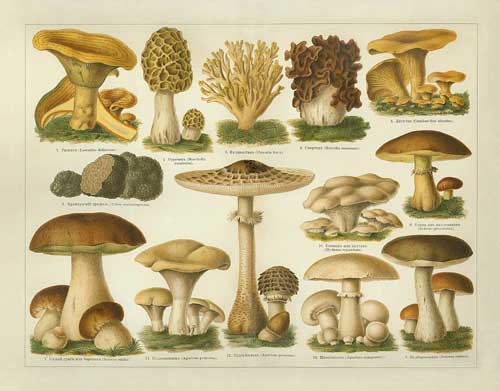 [Image: From Charting Nature].
BLDGBLOG: I’m curious if your enthusiasm for all things fungal comes from living in Florida?
VanderMeer: I think Florida creeps up on you in terms of the fungal. It’s there, but you don’t at first recognize it. You don’t recognize it because of the slow pace of life in subtropical climates. So you are lulled into forgetting about decay, and yet even though there is a slowness, or perceived slowness, because of the heat, etc., there is a ferocious and pitiless war of decay occurring at the same time – of decomposition. And it’s an awareness of this that helps fuel my fiction – the juxtaposition of these ideas and the kind of pathos of it, how it mimics the limited span of life.
BLDGBLOG: I’m also curious if the more densely knit and pedestrianized urban cores of cities you recently traveled through – like Prague – impressed you with their capacity for turning even a simple walk into an event, full of intrigue and coincidence – or if it just made you claustrophobic, longing for the massive, inhuman highways of the United States?
VanderMeer: Honestly, I don’t understand how we in the U.S. even have a sense of community, except in those cities that allow for a neighborhood bar and a neighborhood grocery store and the kind of walkability that you find in most European cities. We loved the walkability and playfulness of Prague. Prague was the city that, in its entirety, had the sense of mystery and puckishness and slight danger closest to Ambergris of any place we visited. We loved that sense of adventure and exploration in Prague. We loved that around any given street corner we might find a musician or a band or an art exhibit or a movie being shot. It seemed like a city completely alive with culture, to the point of being ruled by it.
That first night in Prague, where you’d spill out from some crooked, tiny medieval street into a courtyard full of light and clocktowers and people… that was pretty amazing.
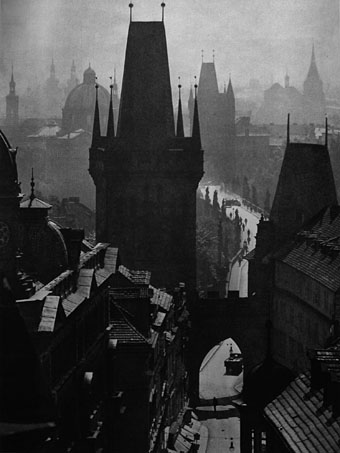 [Image: Prague, photographed by Karel Plicka; via John Coulthart’s Feuilleton].
BLDGBLOG: Finally, in Veniss, you describe how the “aboveground levels” of the city are “so divided into different governments that a trip from one end of the city to the other requires eighteen security stops.” In City of Saints, an ancient city called “Cinsorium” – a pun on both sin and sensorium – is razed, replaced by a city called “Sophia” – wisdom, reason. Below Ambergris are the gray caps, hallucinogenic mushroom-natives who kidnap unwary surface dwellers. Elsewhere, Tonsure encounters a city seemingly modeled after one of Terence McKenna‘s most extreme, drug-induced visions – a kind of psilocybin urbanism. So you’ve got post-9/11 politics, the War on Drugs, class division, allegorical commentary on the triumph of reason over the senses and the flesh – all of these topics seem encoded into your fictive descriptions of urban space. Could you talk a bit about how you use cities – or architecture in general – to communicate an implicit message, whether that’s socio-political, religious, or simply poetic?
VanderMeer: Well, it’s kind of as you describe – I let whatever’s happening in the world wash over me and into the urban space. I think the mistake in trying to incorporate 9/11, for example, into fiction is in having it be something characters talk about. It’s more about just hard-wiring stuff like that into the culture and cityscapes so it becomes something larger than the characters, that’s just part of the backdrop. I find that almost anything that comes along is fodder for Ambergris, for example. It can absorb just about anything, like a good city should.
But as for how I consciously do it, I couldn’t tell you. I am agnostic, cynical about capitalism and communism, and all for individuals over institutions, while recognizing that central government is necessary to provide social services, etc.
I’m sure that’s reflected in the cities I create.
 [Image: John Coulthart, for Jeff VanderMeer’s City of Saints & Madmen].
• • •You can read more about Jeff VanderMeer at his blog,
VanderWorld – where you’ll also find news about his forthcoming books and
Shriek: The Movie.
[With thanks to John Coulthart for the use of his extraordinary images (don’t miss Coulthart’s other work); to Neddal Ayad for helping me contact VanderMeer in the first place; and to Jeff VanderMeer himself, who energetically saw this interview through to completion].
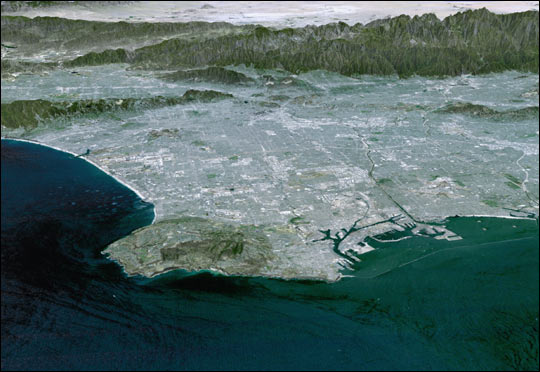 [Image: Los Angeles against the mountains; courtesy of SRTM Team NASA/JPL/NIMA].
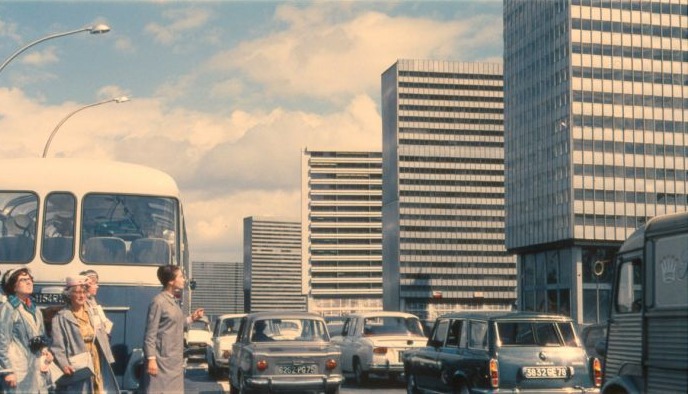 [Image: Tativille; a scene from
  [Image: Tativille; from
  [Image: A passing Illinois lightning storm and supercell, the clouds peeling away to reveal evening stars; photo ©
 [Image: “Beardmore Glacier, slicing its way through the Transantarctic Mountains.” Via
  [Image: The aurora borealis – yes, the Northern, not Southern, Lights. Sorry. Via
 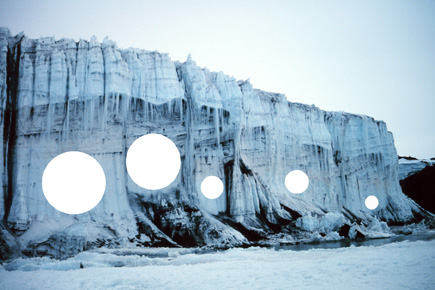 [Image: The BLDGBLOG glacial cathedral, adapted from








 [Image: Tambeni Mosque;
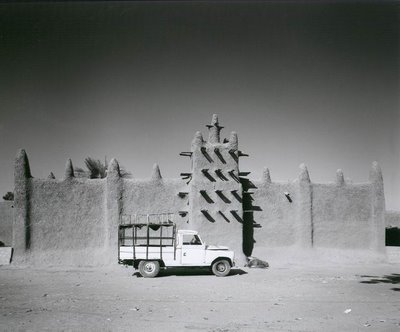 [Images: (top) Noga Mosque, (bottom) Tenenkou Mosque;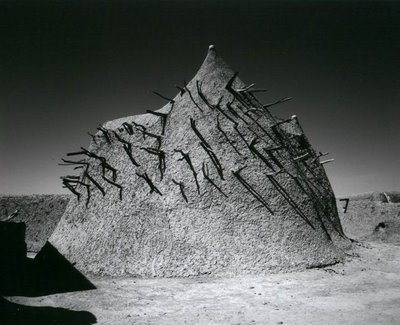
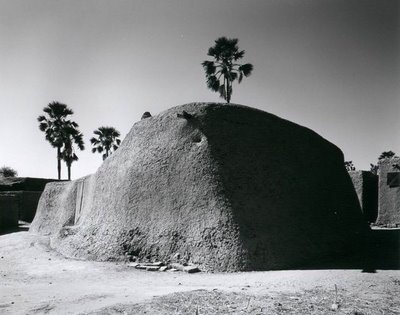 [Images: (top) Sébi Mosque, (bottom) Tilembeya Mosque;
 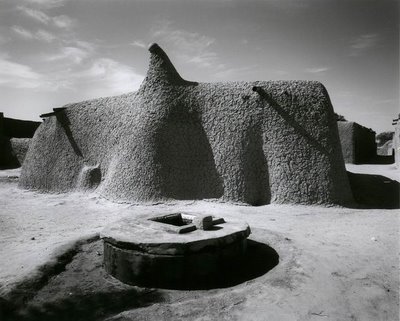 [Image: Sinam Mosque;