Watershed Down

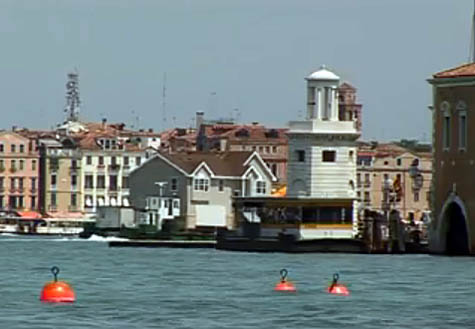
[Image: Mike Bouchet’s Watershed being towed through Venice towards the Arsenale basin, against a backdrop of Italian palazzi].

Note: This is a guest post by Nicola Twilley.

The 2009 Venice Biennale opened this week with an unexpected and quite beautiful piece of performance art. Artist Mike Bouchet had built a one-to-one scale replica of a typical American surburban home that he planned to install on floating pontoons in the Venice Arsenale basin. He called the project Watershed.

David Birnbaum, the Biennale’s curator, told camera crews filming the installation that he thought the project “sounded a bit megalomaniac,” but the sight of the oversized house, clad in beige vinyl, flimsily bobbing up and down against a backdrop of palazzi and piazzi as it was towed through Venice’s canals, was breathtaking. It was an architectural icon of the American Dream revealed in all its formulaic absurdity.

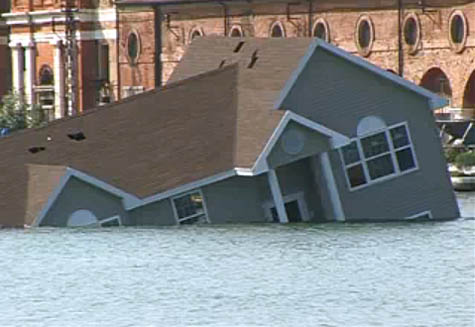
Amazingly, then, one of the pontoons capsized, and the entire house sank to the bottom of the canal—an unintentional yet utterly perfect coda to the house’s own built-in commentary. Now, a fake generic American suburban home will add its ruins to the underwater archaeology of Venice.

[Image: Mike Bouchet’s Watershed goes down].

A two-minute video of the house’s journey, and eventual fate, can be seen in full on YouTube.

(Originally spotted on Flavorwire).

Saddam’s Palaces: An Interview with Richard Mosse

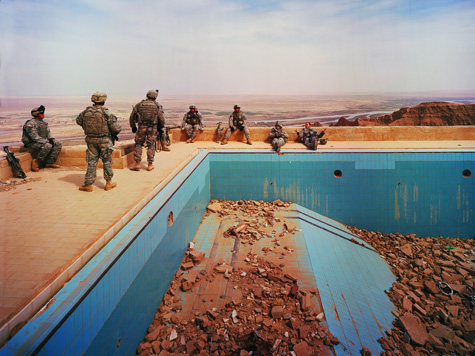
[Image: Ruined swimming pool at Uday’s Palace, Jebel Makhoul, Iraq (2009); photo by Richard Mosse].

Photographer Richard Mosse first appeared on BLDGBLOG last year with his unforgettable visual tour through the air disaster simulations of the international transportation industry.

He and I have since kept in touch—so, when Mosse returned from a trip to Iraq this spring, he emailed again with an unexpectedly intense new body of work. These extraordinary images—published here for the first time—show the imperial palaces of Saddam Hussein converted into temporary housing for the U.S military.

Vast, self-indulgent halls of columned marble and extravagant chandeliers, surrounded by pools, walls, moats, and, beyond that, empty desert, suddenly look more like college dormitories. Weight sets, flags, partition walls, sofas, basketball hoops, and even posters of bikini’d women have been imported to fill Saddam’s spatial residuum. The effect is oddly decorative, as if someone has simply moved in for a long weekend, unpacking an assortment of mundane possessions.

The effect is like an ironic form of camouflage, making the perilously foreign seem all the more familiar and habitable—a kind of military twist on postmodern interior design.

Of course, then you notice, in the corner of the image, a stray pair of combat boots or an abandoned barbecue or a machine gun leaned up against a marble wall partially shattered by recent bomb damage—amidst the dust of collapsed ceilings and ruined tiles—and this architecture, and the people who now go to sleep there every night, suddenly takes on a whole new, tragic narrative.

Fascinated by the dozens and dozens of incredible photos Mosse emailed—only a fraction of which appear here—I asked him to describe the experience of being a photographer in Iraq.
The ensuing dialogue appears below.


• • •

BLDGBLOG: What was the basic story behind your visit to Iraq? Was it self-funded or sponsored by a gallery?

Richard Mosse: The trip was backed by a Leonore Annenberg Fellowship in the Performing and Visual Arts, which I received after graduating from Yale last summer with an MFA in photography. The Fellowship provides enough to fund two full years of traveling to make new photographs, and I applied to shoot in a range of places, including Iraq. My proposal was to make work around the idea of the accidental monument. I’m interested in the idea that history is something in a constant state of being written and rewritten—and the way that we write history is often plain to see in how we affect the world around us, in the inscriptions we make on our landscape, and in what stays and what goes.
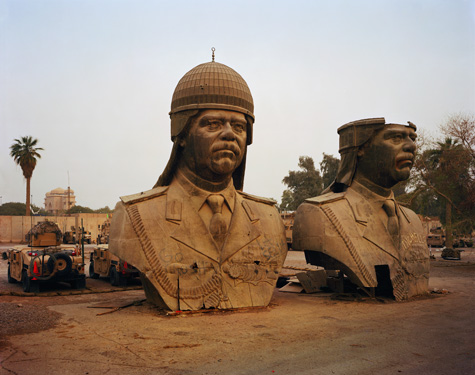
[Image: Saddam’s heads, taken from the roof of the Republican Guard Palace, now located at Al-Salam Palace, Forward Operating Base Prosperity, Baghdad, Iraq (2009); photo by Richard Mosse].

I suppose it’s an idea that captured me while traveling through Kosovo in 2004. I saw a building by the side of the road there that lay mined and shattered in a field of flowers. It was almost entirely collapsed—except for a church cupola which lay at a pendulous angle, though otherwise perfectly intact on a pile of rubble. It was a marvelously pictorial vision of the Kosovo Albanian desire to rewrite the history books. In other words, what I saw before me was not an act of mere vandalism, but a decisive act by the Kosovo Albanian community to disavow the fact of Serb Orthodox church heritage in the region. The removal of religious architecture is a terrible crime, and it constitutes an act of ethnic cleansing (remember Kristallnacht); yet I couldn’t help but interpret this as an attempt to create a brave new Kosovo Albanian world.

I began to see architecture as something that can reveal the ways in which we alter the past in order to construct a new future, as a site in which past, present, and future come together to be reformed. And it’s not the only one: language—our words and the way we use them—are another fine barometer of these things.

But architecture is something I felt I could research and portray using the dumb eye of my camera.
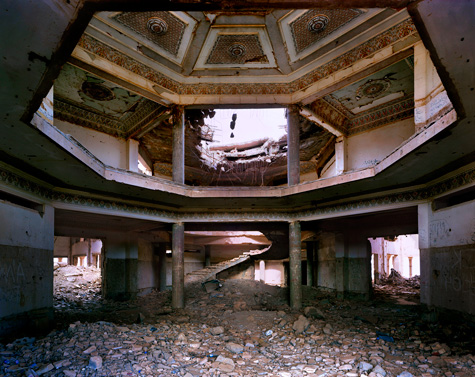
[Image: JDAM bomb damage within Saddam’s Palace interior, Jebel Makhoul, Iraq (2009); photo by Richard Mosse].

BLDGBLOG: Beyond the most obvious reasons—for instance, there’s a war going on—why did you go to Iraq? Was there something in particular that you were hoping to see? 

Mosse: I had heard plenty about Saddam’s palaces. They were the focus of the International Atomic Energy Association’s tedious investigations in the years preceding the invasion, and the news was always full of delegations being turned away from this or that palace. Why were we so keen to get inside Saddam’s palaces? Because he built so many—81 in total. Surely, we thought, he must be hiding something in those palace complexes. Surely he must be building subterranean particle accelerators. And, in the end, our curiosity got the better of us.
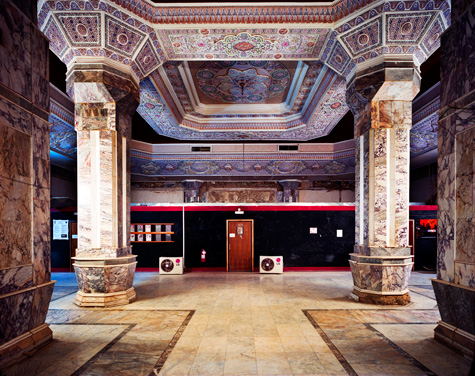
[Image: U.S.-built partition and air-conditioning units within Al-Salam Palace, Forward Operating Base Prosperity, Baghdad, Iraq (2009); photo by Richard Mosse].

In fact, Saddam was building palaces in every city as an expression of his authority. Palace architecture in Iraq served as a constant reminder of Saddam’s immanence. A palace in your city simply fed the sense that Saddam was not just nearby—he was everywhere. Saddam was omnipresent.

I once heard a Westerner tell me that, prior to the invasion, Iraqis driving near one of Saddam’s palaces would actually avert their eyes—they would refuse to look toward the palace. It was almost as if they were prisoners in a great outdoor version of Jeremy Bentham’s Panopticon. Curiously, the sentry towers along the perimeter walls of Al-Salam Palace in Baghdad face only outward; they’re screened from looking inward at the palace itself. People say it’s so the guards could not witness Saddam’s eldest son Uday’s relations with underage girls, but I rather like to think that it created a sense of the unseen authoritarian staring blankly outwards. It was like those ominous black turrets that the British army constructed over the hills of Belfast, packed with listening devices and telescopic cameras.
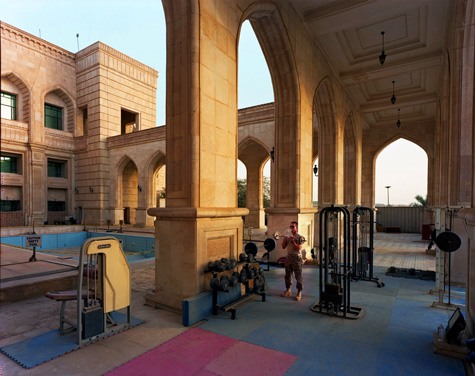
[Image: Outdoor gym, Al-Faw Palace, Camp Victory, Baghdad, Iraq (2009); photo by Richard Mosse].

But the idea of Iraqis averting their eyes from Saddam’s palace architecture also reminds me of something from W.G. Sebald’s book On the Natural History of Destruction.

BLDGBLOG: That’s an incredible book – I still can’t forget his descriptions of tornadoes of fire whirling through bombed cities and melting asphalt.

Mosse: Sebald recounts how the German population, after the end of WWII, would ride the trains, staring into their laps or at the ceiling—anywhere but out the window at the terrible wreckage of their cities. It was as if they were somehow disavowing the war by willing it away, by refusing to perceive it.

It’s interesting, then, that, in both instances—in both Iraq and in post-war Germany—it’s the tourist, or the outsider, who observes this blindness. I suppose that’s why I like to make photographs in foreign places: only the tourist notices the really dumb things that everyone else takes for granted.
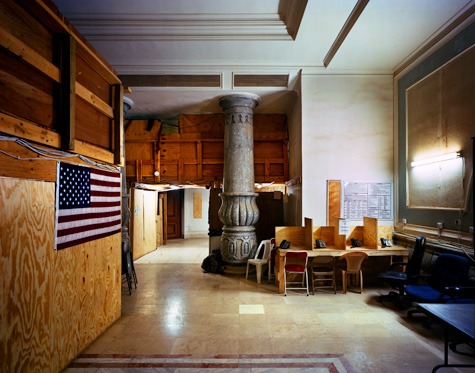
[Image: U.S. military telephone kiosks built within Birthday Palace interior, Tikrit, Iraq (2009); photo by Richard Mosse].

BLDGBLOG: The way these structures have been colonized is often amusing and sometimes shocking—the telephones, desks, and instant dormitories that turn an imperial palace into what looks like a suburban office or hospital waiting room. Can you describe some of the spatial details of these soldiers’ lives that most struck you? 

Mosse: It was extraordinary how some of the palace interiors had been transformed to accommodate the soldiers. Troops scurried beneath vaulted ceilings and glittering faux-crystal chandeliers. Lofty marble columns towered over rat runs between hastily constructed chipboard cubicles. Obama’s face beamed out of televisions overlooking the freezers and microwaves of provisional canteen spaces.

Many of the palaces have already been handed back to the Iraqis—but where Americans troops do remain, they live in very cramped conditions, pissing into a hole in the ground and waiting days just to shower. Life is hard on the front line, and it seems more than a little surreal to be ticking off the days in a dictator’s pleasure dome.
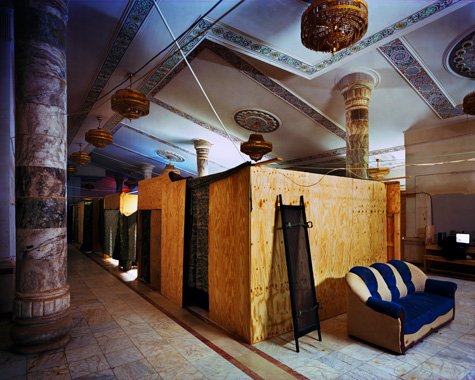
[Images: American dormitories built within Saddam’s Birthday Palace, Tikrit, Iraq (2009); photos by Richard Mosse].

The most interesting thing about the whole endeavor for me was the very fact that the U.S. had chosen to occupy Saddam’s palaces in the first place. If you’re trying to convince a population that you have liberated them from a terrible dictator, why would you then sit in his throne? A savvier place to station the garrison would have been a place free from associations with Saddam, and the terror and injustices that the occupying forces were convinced they’d done away with. Instead, they made the mistake of repeating history.

This is why I’ve titled this body of work Breach. “Breach” is a military maneuver in which the walls of a fortification (or palace) are broken through. But breach also carries the sense of replacement—as in, stepping into the breach. The U.S. stepped into the breach that it had created, replacing the very thing that it sought to destroy.

There are other kinds of breach—such as a breach of faith, a breach of confidence, or the breach of a whale rising above water for air. All of these senses were important to me while working on these photographs.
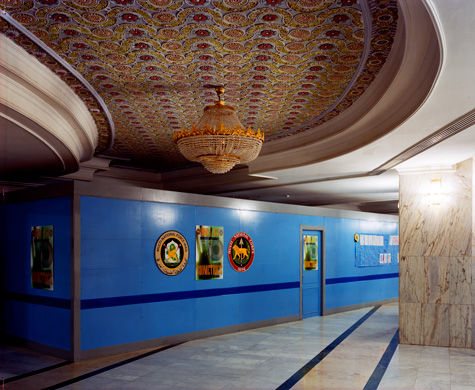
[Image: Provisional office wall partitions within Al-Faw Palace, Camp Victory, Baghdad, Iraq (2009); photo by Richard Mosse].

BLDGBLOG: In several of these photos, the soldiers are literally lifting tiles up from the floor as if the buildings had been left unfinished, or they’re peering through cracks in the palace walls. From what you could see, were Saddam’s palaces badly constructed or were they just heavily damaged during the war?

Mosse: Tiles simply fell from Al-Faw Palace because the cement used there had been poorly salinated. If that can happen to tiles, think what’s happening when the entire palace has been built on similarly salinated foundations! It’s just a matter of time before Al-Faw collapses in on itself.

You can already see arches cracking and walls beginning to sag.
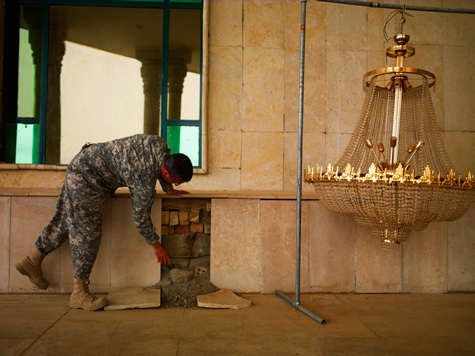
[Image: Fallen tiles and chandeliers, Al Faw Palace, Camp Victory, Baghdad, Iraq (2009); photo by Richard Mosse].

But I’m reluctant to include images of U.S. soldiers pointing out problems with Saddam’s architecture, because it’s fairly evident that those could be a form of propaganda—and it’s easy to forget that many of these palaces were built during times of terrible sanctions imposed by the West. It might not seem very clear why Saddam was busy building palaces in a time of sanctions, but remember how the WPA was set-up during the Great Depression? I don’t want to risk being called an apologist for Saddam, but there are many ways to read a story.
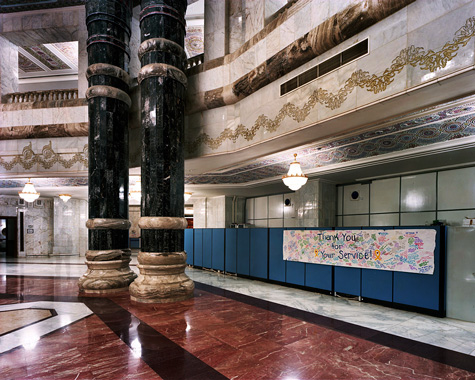
[Image: “Thank you for your service” banner, Al-Faw Palace interior, Camp Victory, Iraq (2009); photo by Richard Mosse].

That said, the palace is a fabulous monument to rushed construction, poor materials, and gaudy pomp. Saddam had apparently insisted that the palace be finished within two years, so many shortcuts were taken during construction. For example, the stairway banisters were made of crystallized gypsum—rather than carved marble—and where pieces didn’t quite fit together, they were just sanded down rather than replaced. Marble that was used in the palace (such as in the great spacious bathrooms) was imported from Italy, in spite of the trade embargo. And the plaster cast frescoes in the ceilings were imported from Morocco.
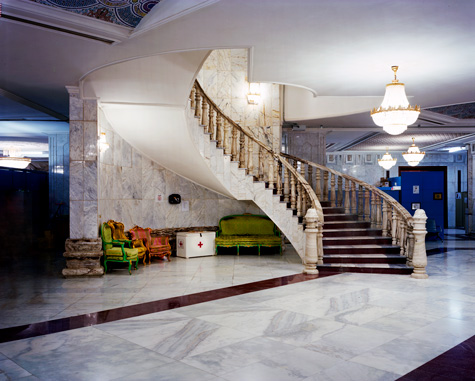
[Image: Stairway, Al-Faw Palace, Camp Victory, Baghdad, Iraq (2009); photo by Richard Mosse].

Al-Faw Palace later became the U.S, Army’s Command HQ, located at the heart of Camp Victory, near Baghdad International Airport. The palace is now teeming with generals, including General Odierno, the commander of coalition forces in Iraq. It’s a great, tiered wedding-cake structure, built around an inner hall with possibly the biggest and ugliest chandelier ever made. In fact, the chandelier is not made of crystal, but from a lattice of glass and plastic.
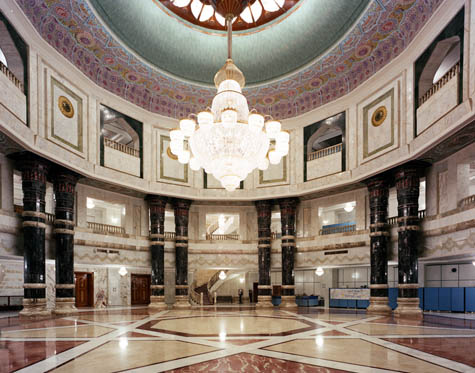
[Image: Chandelier, Al-Faw Palace, Camp Victory, Baghdad, Iraq (2009); photo by Richard Mosse].

The palace itself is then surrounded by a lake, which seems a bit like a moat—and it would be tempting to take a swim there, but the moat has been turned into a standing pool for Camp Victory’s sewage. In the summer, the place must be rather unpleasant: rank in all senses of the word, both military and sanitary. These artificial lakes surrounding the palace are also populated by the infamous “Saddam Bass.” It’s said that Saddam would feed the bodies of his political opponents to these monsters. In fact, they’re not bass at all, but a breed of asp fish. U.S. troops stationed at Camp Victory love to fish on these lakes, and a 105-pound specimen was recently caught.
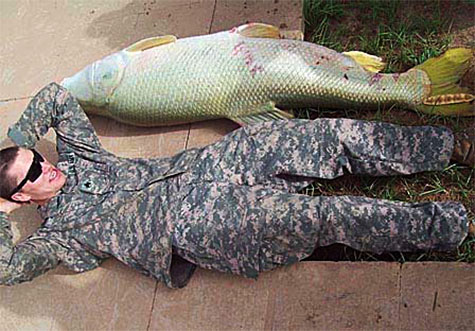
[Image: Tigris Salmon caught at Camp Victory Base, measuring 5 feet 10.5 inches and weighing 105 lbs. Image courtesy of the U.S. Army].

BLDGBLOG: How was your own presence received by those soldiers? Did you present yourself as a photojournalist or as an art photographer?

Mosse: The difference between art and journalism is, for me, of paramount importance—but twenty minutes in Iraq, and the dialectic recedes. I got a vague sense that Americans working there feel a little forgotten—unappreciated by people at home—so they’re very grateful for a camera, any camera, coming through. Even a big 8″x10″ bellows camera with an Irishman in a cape. There were a lot of rather obvious photographs that I chose not to make, and occasionally someone got offended by this.
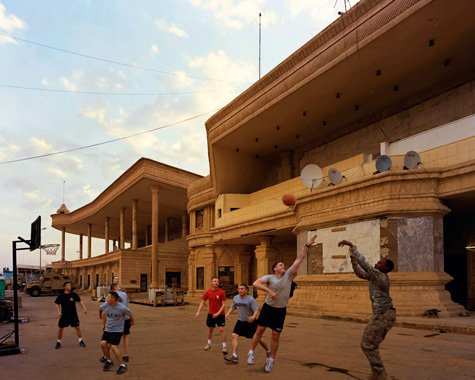
[Image: A game of basketball, Birthday Palace, Tikrit, Iraq (2009); photo by Richard Mosse].

BLDGBLOG: What was the soldiers’ opinion of these buildings? Did they ever just wander around and explore them, for instance, or was that a safety violation?

Mosse: I got the feeling that soldiers who occupied one of Saddam’s palaces were pretty interested in its original function. They seemed a lot more together, and happier with their job, compared with the troops I met on the massive, sprawling, purpose-built military bases in the Iraqi desert. Constant reminders of hierarchy and protocol were everywhere on the bigger bases—but on the more cramped and less comfortable palace bases, soldiers of different ranks seemed much closer and more capable of shooting the shit with each other, to borrow an American turn of phrase.

Though a far tougher environment, there seemed to be real job satisfaction—a sense that they were taking part in a piece of history.
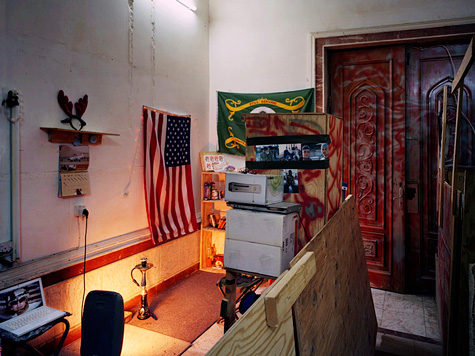
[Image: Detail of U.S. soldier’s living quarters, Birthday Palace interior, Tikrit, Iraq (2009); photo by Richard Mosse].

BLDGBLOG: Architect Jeffrey Inaba once joked, in an interview with BLDGBLOG, that Saddam’s palaces look a bit like McMansions in the suburbs of New Jersey. He quipped that “the architecture of state power and the architecture of first world residences don’t seem that far apart. Saddam’s palaces, while they’re really supposed to be about state power, look not so different from houses in New Jersey.” They’re not intimidating, in other words; they’re just tacky. They’re kitsch. Now that you’ve actually been inside these palaces, though, what do you think of that comparison? 

Mosse: Well, I’ve never been inside a New Jersey McMansion, so I can’t pass judgment. However, “McMansion” is a term borrowed by us in Ireland, where I’m from. Ireland was hard-hit by English penal laws, from the 17th century onward. One of those laws was the Window Tax. This cruel levy was imposed as a kind of luxury tax, to take money from anyone who had it; the result was that Irish vernacular architecture became windowless. The Irish made good mileage on the half-door, for instance, a kind of door that can be closed halfway down to keep the cattle out but still let the light in.

Aside from this innovation, and from subtleties in the method of thatching, Irish architecture never fully recovered—to the point that, even today, almost everyone in my country chooses their house from a book called Plan-a-Home, which you can buy for 15 euros. And if you have extra cash to throw in, you can flick to the back of the book and choose one of the more spectacular McMansions. Those are truly Saddam-esque.

[Image: Birthday Palace, Tikrit, Iraq (2009); photo by Richard Mosse].

BLDGBLOG: Finally, the “Green Zone,” as well as many of these palaces, are notoriously insular, cut-off behind security walls from the rest of Iraq. Did you actually feel like you were in Iraq at all—or in some strange architectural world, of walls and dormitories, surrounded by homesick Americans? 

Mosse: Not all of Saddam’s palaces are as isolated from reality as those situated in the green zone (or international zone, as it’s now called). One I visited near Tikrit—Saddam’s Birthday Palace—was even right at the heart of the city. Saddam was said to visit the palace each year on his birthday.

Wherever you go on the base, you’re eminently shootable—a fantastic sniper target—and can hear the coming and going of Iraqis in the surrounding neighborhoods. It’s a remarkable experience to go up to the roof with the pigeons at dusk and watch the changing light. You get a palpable impression of the great tragedy of the Iraq war, and you can see for yourself the fencing between neighborhoods, the rubbish strewn everywhere, the emptiness of the place, and you can hear the packs of dogs baying about. But you can also hear occasional shots fired in the distance, and you get the distinct feeling that you’re being watched.

I spent a very slow month in Iraq trying to reach as many of these palaces as possible. I only managed to visit six out of eighty-one palaces. It is impossibly slow going over there, working within the war machine. These palaces are currently being handed back to the Iraqis, and many of them will be repurposed, sold to private developers or demolished. If I could get the interest of a publisher, for instance, I would return to Iraq to complete the project before Saddam’s heritage, and the traces of U.S. occupation, are entirely removed.


• • •

Thanks again to Richard Mosse for the incredible opportunity to talk to him about this trip, and for allowing BLDGBLOG to publish these images for the first time.

Be sure to see the rest of Mosse’s work on his website. Hopefully the entirety of Breach will be coming soon to a book or gallery near you.
Zone for Cloud

[Image: Detail of a zoning map for New York City].

Earlier this month, mammoth – just two months old, but already one of the more interesting architecture blogs out there – cited climatological research that certain land use patterns can dramatically affect the formation of clouds above.

In other words, pastures, forests, suburbs, cities, farms, and so on, all affect the skies in very particular spatial ways. Deforestation, for instance, has “substantially altered cloud patterns” in the Amazon; specifically, we read that “patches of trees behave as ‘green oceans’ while cleared pastures act like ‘continents’,” generating a new marbling of the local atmosphere.

The same thing can be found to happen above cities, of course. Instead of “being zoned ‘R-3 Residential Low Density’,” mammoth continued, “a block might be zoned ‘Cumulus H-2’.” Or Mammatus H-3. In this tongue-in-cheek vision of sky-centric urban development, all new buildings would have to be cleared with a Meteorological Bureau to ensure that they produce the right types of cloud. Atmospheric retrofitting comes to mean attaching bizarre cantilevers, ramps, and platforms to the roofs and walls of existing houses till the clouds above look just right.

Sky vandals are people who deliberately misengineer the weather through the use of inappropriate roof ornamentation.

Over generations, you and your friends and the descendants of your friends sculpt vast, urban-scale volumes of air, guiding seasonal rain events toward certain building types – where, as mammoth‘s own earlier paper about fog farming suggests, “fog nets” might capture a new water source for the city.

(Incidentally, there is a short vignette in The BLDGBLOG Book about bespoke, privatized, and extremely local weather control).

London Future Green

Note: This is a guest post by Nicola Twilley.

During a brief Tube journey earlier today, this image stood out against a backdrop of mobile phone advertisements, travel insurance offers, and posters for English-language schools.

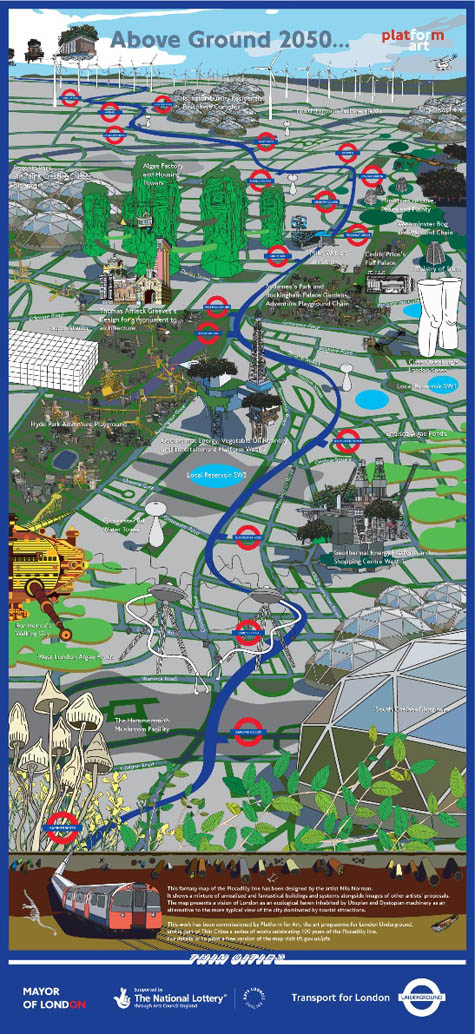
[Image: “Above Ground” by Nils Norman, commissioned by Platform for Art for Transport for London; view it as a 2.6MB PDF].

Designed by artist and architect Nils Norman, this fantasy map traces the Piccadilly line’s route through an alternate London whose landmarks consist of utopian eco-fantasies (mushroom farms and geothermal energy platforms) alongside various post-war avant-garde architects’ unrealized projects for the city.

Mike Webb’s Sin Centre and Cedric Price’s Fun Palace sit next to the Westminster Bog and Wetland Chain, while Thomas Affleck Greeves’ Monument to Commemorate the Passing of the Good Old Days of Architecture nestles in the shadow of a dual purpose algae factory and housing tower not far from George Orwell’s Ministries of Love, Peace and Plenty. The result is an interesting juxtaposition of hypothetical projects designed as critique or provocation, and equally imaginary proposals rooted in a utopian impulse toward sustainability: Superstudio’s Continuous Monument is set alongside the North London Turbine Fields and the South Kensington Vegetable Oil Refinery.

It turns out that the map dates from summer 2007, and was part of a year-long celebration of the Piccadilly line’s centenary. Transport for London commissioned multiple public art projects to mark the occasion, under the curatorial title “Thin Cities”—a reference to Italo Calvino’s invisible city of Armilla, in which a “forest of pipes… rise[s] vertically where the houses should be and spread[s] out horizontally where the floors should be.” This striking description highlights the Tube’s structural centrality to London—even if Calvino’s “underground veins” carry water, not commuters or tourists.

Other projects from the series include the first ever whole-Tube wrap, as well as the calls of fifty-two different migratory species (one per week) broadcast every twenty minutes over the Knightsbridge station tannoy. Taken from the British Library’s sound archive, these included the clicks of a bottle-nosed dolphin and the honks of a Whooper swan—and they were each introduced by the official voice of the Tube, Emma Clarke.

All the Thin Cities projects are now archived online; they’re presented alongside photos and anecdotes from each station on the Piccadilly line, such as the best place to watch planes take off and land at Heathrow (hint: it’s a small footbridge outside Hatton Cross) and the fate of Alfie the cat (he was adopted by a Station Supervisor after 10 years’ independent living at Cockfosters).

[Check out Archinect‘s interview with Nils Norman for more. Also vaguely related: Just Add Water. Previous posts by Nicola Twilley include Atmospheric Intoxication, Park Stories, and Zones of Exclusion].

The Enemy by Design

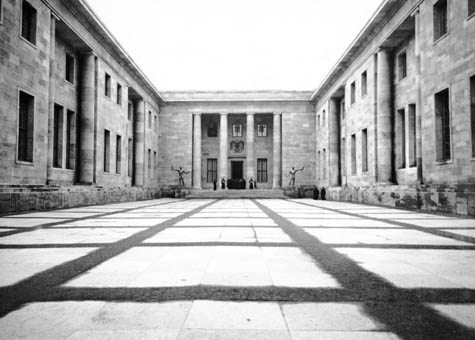
[Image: The Berlin Reich Chancellery, designed by Albert Speer].

Jim Rossignol’s recent guest post about the architecture of “evil lairs” reminded me of a brilliant vignette from Deyan Sudjic’s 2005 book The Edifice Complex.
In a chapter called “The Long March to the Leader’s Desk” – a virtuoso example of architectural writing, and easily the best chapter in the book – Sudjic describes how Emil Hácha, Prime Minister of what was then Czechoslovakia, came to visit Adolf Hitler in his Albert Speer-designed Reich Chancellery in Berlin.
The Chancellery – Hitler’s “evil lair,” if you will – proved so psychologically overpowering that Hácha, “a short man in his late sixties with thinning and receding hair,” according to Sudjic, suffered a heart attack and very nearly died after walking through it.

[Image: Hitler’s office in the Chancellery].

Quoting Sudjic at length:

Hácha was white faced, anxious, and dizzy as he made his way across the entrance lobby, completed just eight weeks earlier. He was exactly the kind of visitor the Chancellery was designed for. If ever architecture had been intended for use as a weapon of war, it was here. The grandeur of the Chancellery was an essential part of Hitler’s campaign to browbeat Hácha into surrender. Beyond the courtyard, itself a kind of summation of the Nazi state, was an elaborate sequence of spaces inside the Chancellery, carefully orchestrated to deliver official visitors to Hitler’s presence in a suitably intimidated frame of mind. After a quarter-mile walk, visitors were left in no doubt of the power of the new Germany.

Indeed, Sudjic suggests that Hácha experienced the building “like a spelunker, moving from one giant underground cavern to another, never sure exactly where he would find himself, or what he would have to confront next, as an intimidating and bewildering sequence of spaces unfolded in front of him.”

Past the chancellery guards and out of the way of the floodlights, [Hácha was led] across the porch and into a windowless hall beyond, its wall inlaid with the pagan imagery of mosaic eagles grasping burning torches garlanded with oak leaves, its floors slippery with marble. There was no furniture, nor even a trace of carpet to soften the severity of the hall. (…) Under the hovering glass and the massive marble walls, the bronze doors at the far end of the hall shimmered and beckoned and threatened. Visitors were propelled down its length as if being whirled through a wind tunnel. As Hácha walked, he was aware of his heart accelerating in rapid fluctuating beats.

At this point, Hitler’s Chancellery begins to sound like the boss level of a particularly unnerving video game:

The hall that they walked through was thirty feet high. On the left a parade of windows looked out over Voss Strasse, and on the right were five giant doorways, each seventeen feet high. They stopped at the central pair of double doors, guarded by two more SS men in steel helmets. On a bronze scroll above the door case were the initials AH.

Even here, at the very door to Hitler’s study, Speer’s spatial theatrics weren’t finished.
Passing through those gigantic doors, Hácha found himself standing at one end of a 4000-square-foot room, surrounded by “blood-red marble walls.” At the other end, in front of a fireplace, was “a sofa as big as a lifeboat, occupied by Joseph Goebbels and Hermann Göring” – and nearby was Hitler, seated at his desk.
Incredibly, “To walk from the door to the desk took a nerve-wracking full minute.”
By that point, though, Czechoslovakia’s fate was sealed: Hácha’s will collapsed as soon as Göring began to describe the Nazis’ military capabilities, and he suffered a heart attack.
Not before signing his country over to Hitler, of course – “a humiliation that he had ample time to reflect on,” Sudjic writes, “during his endless walk back through the marble and mosaic halls of the Chancellery.”

Evil Lair: On the Architecture of the Enemy in Videogame Worlds

[Note: This is a guest post by Jim Rossignol].

Game developers are unconstrained in their designs for the enemy. Such designers will be punished with poor sales, not death in the gulag, if their designs for the overlord are unpopular. They could go anywhere with the homes of evildoers: halls of electric fluorescence, palaces carved from corduroy, suburban back yards.

And yet, in spite of this freedom, most videogame designers choose to make a definite connection to familiar – or real-world – architecture. Perhaps they think that the evil lair must emanate evil. There’s surely no room for ambiguity with videogame evildoers: the gamer needs to know that it’s okay to aim for hi-score vengeance.

[Image: From World of Warcraft].

Conveniently, evil already has a visual language. Put another way: I have seen the face of evil, and it is a caricature of gothic construction. There’s barely a necromancer in existence whose dark citadel doesn’t in some way reflect real-world Romanian landmarks, such as Hunyad or Bran Castle. The visual theme of these games is so heavily dependent on previously pillaged artistic ideas from Dungeons & Dragons and Tolkien that evil ambiance is delivered by shorthand. (Of course, World of Warcraft‘s Lich King gets a Stone UFO to fly around in – but it’s still the same old prefab pseudo-Medieval schtick inside). Where the enemy is extra-terrestrial, HR Giger‘s influence is probably going to be felt instead.

[Images: (top) Bran Castle, (bottom) Hunyad Castle, all via Wikipedia].

But, I suspect, these signposts – or the ways in which game designers architecturally represent evil – are becoming too much a part of our everyday imaginative discourse to remain affecting. They’ve begun to lose their danger. The connection with the inhumanity that makes the enemy so thrilling has started to fade via over-familiarity.

Where the evil lair becomes a little more interesting is when its nature is ambiguous – but nevertheless disturbing. Half-Life 2‘s Citadel is an example of this. The brutal gunmetal skyscraper that looms over a nameless Eastern European city, below, appears deeply threatening. But, like everything else in the Half-Life 2 universe, it is unexplained. It does not seem inherently evil. The structure moves and groans; it is a machine of some kind. It is something constructed and mechanical, rather than the clear manifestation or emanation of an evil force. The Citadel is not a fire-rimmed portal to hell, nor a windswept ruin. Nor is it a volcano base. It could even be somehow utilitarian. In fact, it’s reminiscent of the real Moscow’s own television tower.

It is, perhaps, even incidental to the scourge that Half-Life‘s denizens face: alien infrastructure. It is only later, as the plot uncoils the inner architecture of the Citadel, that you come to realise that it is the enemy: the lair of an alien force that must, ultimately, be destroyed.

[Image: From Half-Life 2].

Where the lair is itself the enemy, games are able to excel.

This is the case in both System Shock and System Shock 2, the finest of SF horror games. Both are set aboard spacecraft, but these spacecraft are also the “bodies” of the enemy: SHODAN, a malevolent Artificial Intelligence that controls each vessel.

In a provocative climax of virtuality-within-virtuality, the final act of System Shock 2 is to enter into the cyberspace realm of the AI and defeat SHODAN inside the graphical representation of her own programming. The evil lair is within the mind of the enemy – a motif repeated even more literally in Psychonauts, a game about exploring the physically manifested psyches of various bizarre characters.

[Image: From System Shock 2].

More interesting visually, and far more ambiguous in its delivery of the evil lair, is the underwater city of Rapture, in Bioshock. The designers of this game (some of whom also worked on the System Shock series) poured the early part of the twentieth century into their designs, creating opulent, decaying, Art Deco corridors down which the genetically-enhanced super-human player goes thundering, searching for the enemy.

The ostentation of the city’s innards suggests that the city’s objectivist overseer, Andrew Ryan, must be the enemy we seek. He has, after all, created himself an entire city with a single, over-arching theme: a trademark act of the all-powerful videogame nemesis. Yet, as the story unfolds, it becomes clear that, although you will inevitably kill Ryan, his architecture tells you nothing about the nature of the enemy you face. Indeed, the true enemy has nothing to do with the stylised nature of this lair at all.

[Image: Channeling Ayn Rand, Andrew Ryan’s city banner announces “No Gods or Kings. Only Man.” From Bioshock].

But perhaps the most extraordinary and unearthly of evil videogame architectures are the wandering colossi of Shadow of the Colossus. Great, living structures, lonely behemoths, that stride magnificently across the game world. These sad, shaggy giants of stone and moss must be climbed and slain by the hero, often via use of the surrounding environment of ancient ruins and meticulously designed geological formations. Lairs within lairs.

[Image: From Shadow of the Colossus].

Of course, monsters are presumably evil, but the reality of the colossi remains ambiguous for much of the game. When the game is up, the player-character suffers a terrible price for destroying these strange, animate monuments. It is one of the few videogames in which the protagonist dies – horribly and permanently – when the game is over. It is a game where destroying the evil lair might well have been the wrong thing to do. And yet it is all you can do.

Such is the inexorable, linear fate of the videogame avatar.

[Jim Rossignol is a games critic for Offworld, an editor at Rock, Paper, Shotgun, and the author of the fantastic This Gaming Life: Travels in Three Cities. A full-length interview with Rossignol will appear on BLDGBLOG next week].

Books Received

[Image: The “renovation of an old barn into a library and studio” by MOS architects].

BLDGBLOG’s home office here is awash in books. Accordingly, I’ve started a new and more or less regular series of posts called “Books Received.” These will be short descriptions of, and links to, interesting – but not necessarily new – books that have crossed my desk.
Note that these lists will include books I have not read in full – but they will never include books that don’t deserve the attention.
Note, as well, that if you have a book you’d like to see on BLDGBLOG, get in touch – send us a copy, and, if it fits the site, we’ll mention your title in a future Books Received.
Note, finally, that even this list is barely the tip of the iceberg; if you’ve sent me a book recently, please wait till the next list before wondering if I’ll be covering your work. Thanks!

1) The Antarctic: From the Circle to the Pole by Stuart D. Klipper et al. (Chronicle Books) — Horizontally oriented – that is, you read it like a centerfold – The Antarctic is a genuinely beautiful collection of panoramic photographs taken of, on, and approaching the ice-locked continent. From clouds to empty stretches of black sea water to glacial abstractions – to penguins – Stuart Klipper’s work is a superb document of this frozen landscape. It’s 0º in widescreen. Includes a notable essay by William L. Fox.

2) Wildwood: A Journey Through Trees by Roger Deakin (Penguin) — The UK paperback edition has a wonderfully textured feel, as if the cover was printed on watercolor paper; that the paper itself, sourced from Forest Stewardship trees, has a distinct materiality to it, fits this book perfectly. The late Roger Deakin travels through the forests of Eurasia and Australia, from the willows of Cambridgeshire, past ruined churches in the Bieszczady Woods, to the towering walnut groves of Kazakhstan. The book had me hooked from page one, where Deakin writes that “the rise and fall of the sap that proclaims the seasons is nothing less than a tide, and no less influenced by the moon.” Deakin was an amazing writer. At one point he describes “the iceberg depths of the wood’s root-world,” just one mind-bending moment in a book so full of interesting sub-stories that I could post about it all month. Don’t miss the Deer Removal Act of 1851, the surreal Jaguar Lount Wood (a landscape sponsored by the automotive firm), the chainsaw-resistant oaks of the Bialowieza Forest – their trunks sparkling with shrapnel from WWII – and the unforgettable closing chapters about harvesting apples and walnuts in the giant forests of Kazakhstan and Kyrgyzstan.

3) The Wild Places by Robert Macfarlane (Penguin) — Robert Macfarlane was close friends with Roger Deakin, and Deakin’s presence is often cited throughout The Wild Places. Macfarlane’s frustratingly good book focuses on the natural landscapes of Britain, describing the author’s quest for sites of true wildness in today’s UK. Macfarlane is also a fantastic writer; this is another book that could easily be unspun into a whole month’s worth of blog posts. As but one example, Macfarlane finds himself exploring holloways, those deeply incised, sunken roads produced over decades by the passage of people, carts, and horses. Each holloway is “a route that centuries of use has eroded down into the bedrock,” Macfarlane explains, “so that it is recessed beneath the level of the surrounding landscape.” He continues, writing that “the holloways have come to constitute a sunken labyrinth of wildness in the heart of arable England. Most have thrown up their own defences, becoming so overgrown by nettles and briars that they are unwalkable, and have gone unexplored for decades.”

4) Dry Storeroom No. 1: The Secret Life of the Natural History Museum by Richard Fortey (Knopf) — Richard Fortey is one of my favorite authors; his Earth: An Intimate History should be required reading for anyone with even a passing interest in the planetary sciences. Here, Fortey takes us behind the scenes at the institution from which he has only recently retired: London’s Natural History Museum. His descriptions of the museum itself are worth quoting at length. “There seemed to be no end to it,” he writes, referring to the building’s sprawling rooms and corridors:

Even now, after more than thirty years of exploration, there are corners I have never visited. It was a place like Mervyn Peake’s rambling palace of Gormenghast, labyrinthine and almost endless, where some forgotten specialist might be secreted in a room so hard to find that his very existence might be called into question. I felt that somebody might go quietly mad in a distant compartment and never be called to account. I was to discover that this was no less than the truth.

Further:

Even to find one’s ways to the towers is an exercise in map reading. The visitor has to go through one door after another apparently leading nowhere. Then there are thin flights of steep stairs that go upwards from floor to floor; I am reminded of a medieval keep, where one floor was for feasting and the next one for brewing up boiling oil. I discovered part of one tower that could only be accessed by a ladder stretched over a roof. Nowadays, the towers do not have permanent staff housed there – something to do with them lacking fire escapes and not complying with some detail of the Health and Safety at Work Act of 1974. Instead there are empty rooms, or ones holding stacks of neglected stuff. A hermit could hide here, undiscovered.

As a way to slip behind the Staff Only doors at a major world museum, the book is unsurpassed.

5) Victory Gardens 2007+ by Amy Franceschini (Gallery 16 Editions) — For the most part, a photo-documentation of the “victory gardens” of Amy Franceschini, scattered amongst the various microclimates of San Francisco, this hardcover guide to urban gardening will make almost anyone want to go out and plant rows of buttercrunch lettuce. Locavores, guerilla gardeners, and revolutionary horticulturalists take note.

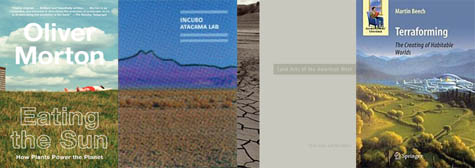
6) Eating the Sun: How Plants Power the Planet (Harper) — Of course, all these trees and gardens require sunlight – and the chemically transformative inner workings of photosynthesis are the subject of Oliver Morton’s newest book, Eating the Sun. Morton, a Features Editor at Nature, is also the author of the excellent Mapping Mars: Science, Imagination, and the Birth of a World.

7) Atacama Lab by Chris Taylor et al. (Incubo) and Land Arts of the American West by Chris Taylor and Bill Gilbert (University of Texas Press) — Two awesome books of landscape design, history, art, and theory, both involving the formidable talents of Chris Taylor. According to Taylor’s own introduction, Atacama Lab – which is bilingually printed in both Spanish and English, contrary to Amazon’s indications – documents “the interpretive frame and working methods of Land Arts of the American West in Chile to broaden our understanding of earthworks and open a dialog between arid lands along the north-south axis of the Americas. The book includes a wide variety of student landscape projects, as well as an essay by the ubiquitous William L. Fox. If you’re wondering what exactly Land Arts of the American West is, you’re in luck: this massive, textbook-like, quasi-monographic guide to the eponymous research institute is an explosive catalog of the terrestrial work of Bill Gilbert, the group’s founder, here in collaboration with Taylor. They write:

Land Arts of the American West is a field program designed to explore the large array of human responses to a specific landscape over an extended period of time… Moving between the land and studio, our inquiry extends from the geologic forces that shape the ground itself to the cultural actions that define place. Within this context, land art includes everything from pictographs and petroglyphs to the construction of roads, dwellings, and monuments as well as traces of those actions.

It’s immersive landscape theory, armed with duffel bags and tents. Sign me up.

8) Terraforming: The Creating of Habitable Worlds by Martin Beech (Springer) — Hampered only an appalling choice of paper and by its factory-preset graphic design, Martin Beech’s Terraforming is otherwise a refreshingly quantitative approach to how whole planets can be made habitable for human beings. “The ultimate aim of terraforming,” Beech writes, “is to alter a hostile planetary environment into one that is Earth-like, and eventually walk upon the surface of the new and vibrant world that you or I could walk freely about and explore.” Usually the realm of science fiction and/or moral speculation – indeed, even this book opens with a fictional scenario set in the year 2100 – the controversial idea of terraforming here takes on a numeric, chemical, and even topographic specificity.

9) Xenophon’s Retreat: Greece, Persia, and the End of the Golden Age (Harvard University Press) — Having been oddly obsessed with Xenophon’s Persian Expedition ever since learning that it was one of the inspirations for Sol Yurick’s novel The Warriors – check out BLDGBLOG’s interview with Yurick for more – I was excited to find Robin Waterfield’s micro-history of “Xenophon’s retreat.” The basic question: what do you do when you’re a highly trained mercenary fighting on the losing side in an unparalleled example of fratricidal desert warfare, and you now have to fight your way back home, on foot, temporarily living in caves, engaging in numerous minor skirmishes, followed by spies, passing from what would now be the suburbs of Baghdad to the western shores of Turkey? That’s exactly what Xenophon did – and he went on to a distinguished career as a writer and historian. In other words, it’s an absolutely incredible story. Waterfield’s descriptions of the physical reality of phalanx-based warfare are also awesomely intense.

10) After the City, This (Is How We Live) by Tom Marble (LA Forum) — At some point, architect Tom Marble had the ingenious idea of writing a book about the mysterious subcultures of real estate development and zoning in greater Los Angeles – but to write it as a screenplay. The results are both charming and readable. At times perhaps a bit too didactic to be put on screen by Steven Spielberg, as an experiment in mixing genres this is altogether brilliant, full of voice-over narratives and cuts from scene to scene and even color photographs. But to write this as a screenplay… I’m jealous.

EXT. REUNION — NIGHT
Nat walks up to the front door of a large Colonial house in Pasadena. He is about to knock when the door swings open, revealing a crowd of about twenty people.

Or:

EXT. SOFT ROCK CAFE — DAY
Nat and Jack sit at a restaurant table overlooking a koi pond. Consumer Jazz rises out of rock-shaped speakers. Nat can’t help notice beautiful twenty-something mothers swarm the bridges and banks of the pond, chatting with one another or chasing their kids.

As Nat bites into his sandwich, Jack smiles.

This is what I imagine might happen if Brand Avenue were to move to Hollywood and get a film deal. Again, genius.

11) Subterranean Twin Cities by Greg Brick (University of Minnesota Press) — I associate the underworlds of Minneapolis–St. Paul almost entirely with “Rinker’s Revenge,” an ailment peculiar to urban explorers mentioned by Michael Cook in his interview with BLDGBLOG. Rinker’s Revenge also makes an appearance in Greg Brick’s book-length journey through the city’s substructures, passing waterfalls, tunnels, wine cellars, and drains. “Let’s take an imaginary journey downward through the geological layers of Minnesota by way of a sewer,” Brick begins – before donning waterproof boots and making the descent himself.

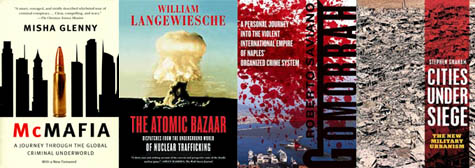
12) McMafia: A Journey Through the Global Criminal Underworld by Misha Glenny (Vintage) — A different kind of underworld comes to us in this book that I found absolutely impossible to put down. Wildly undersold by reviews on Amazon, I can’t recommend this book enough. A look at the global counter-economies of sex trafficking, drugs, illegitimate construction, counterfeit goods, and light weaponry, the otherwise somewhat embarrassingly titled McMafia shows us a planet riddled with labyrinthine networks of unregistered transactions, untraceable people, and even illegal building sites. Author Misha Glenny also has a wonderfully sober take on the U.S. War on Drugs, suggesting that is the War on Drugs itself that has allowed the hyper-explosive growth of narcotic black markets – which, in turn, fund wars, rape, violence, and kidnapping across dozens of other economic sectors, worldwide. Toward the end of the book, Glenny even implies that, if the U.S. were to change its approach to drugs, the knock-on effects would be instantly catastrophic for organized crime everywhere. Ignore the title; this is one of the most interesting books I’ve read all year.

13) The Atomic Bazaar: Dispatches from the Underground World of Nuclear Trafficking by William Langewiesche (Farrar, Straus and Giroux) — Continuing this Final Four of crime, war, and violence, William Langewiesche’s The Atomic Bazaar could be described as a very long Atlantic article about the growing threat of nuclear trafficking. In the U.S. paperback copy, pages 6-10 are a seering, microsecond-by-microsecond description of what actually happens when a nuclear bomb explodes in a city; if nothing else, go to your local bookstore and read those pages. The rest of the book, however, present a fascinating look at the nightmarish world of post-Soviet nuclear arms storage facilities (and what Langewiesche suggests are the strategically self-defeating U.S. efforts to fund their protection), and an over-long (but fascinating) introduction to the life of A.Q. Khan, the Dutch-trained metallurgist who went on to give Pakistan its first nuclear bomb (and subsequently to market those nuclear secrets to North Korea, Iran, Iraq, and beyond).

14) Gomorrah: A Personal Journey into the Violent International Empire of Naples’ Organized Crime System by Roberto Saviano (Picador) — The perfect accompaniment to Misha Glenn’s McMafia, Gomorrah by Roberto Saviano – the writing of which resulted in the author having to disappear into police protection – is an often horrific look at the counter-state of organized private crime in and around Naples, Italy. Stomach-turning descriptions of torture – including a spiked baseball bat and decapitation by metal grinder – punctuate what is otherwise a remarkably thoughtful guide to the administrative reality of urban gangsterism. This is what happens to cities when a) there is no state and b) there are lots of machine guns. I hope to post about this book – now also a film – in more detail later, so I will leave my description at that. Suffice it to say, though, it’s worth the read.

15) Cities Under Siege: The New Military Urbanism by Stephen Graham (Verso) — Stephen Graham’s Cities Under Siege has not even been released yet, so I don’t know if it’s good – but I can’t wait to read it. “Drawing on a wealth of original research,” the publishers write, “Stephen Graham shows how Western and Israeli militaries and security forces now perceive all urban terrain as a real or imagined conflict zone inhabited by lurking, shadow enemies, and urban inhabitants as targets that need to be continually tracked, scanned, controlled and targeted.” Release date in July 2009.

* * *

All Books Received: August 2015, September 2013, December 2012, June 2012, December 2010 (“Climate Futures List”), May 2010, May 2009, and March 2009.

The Rentable Basement Maze

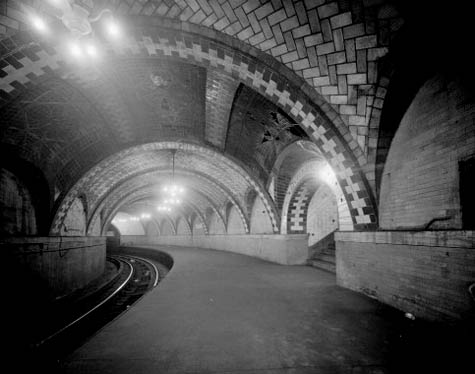
[Image: The subterranean vaults of Manhattan, seen here in City Hall station, which closed in December 1945; photo by David Sagarin (1978), via the Library of Congress, Prints and Photographs Division, Historic American Engineering Record of the Heritage Conservation and Recreation Service].
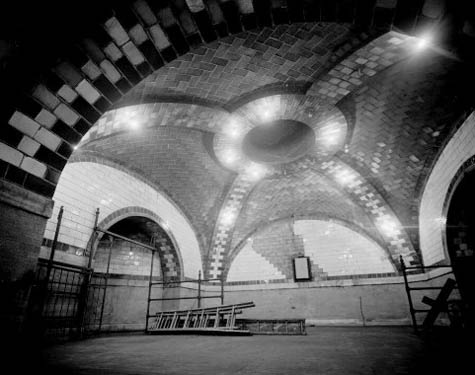
A city with an abandoned underground train line, one that cuts beneath some of the nicest townhouses in the city, develops an unexpected new real estate idea: renting out temporary basements in the form of repurposed subway cars.
Access stairs are cut down from each individual house till they connect up with the existing disused train tunnels below; each private residence thus becomes something like a subway station, with direct access, behind a locked door, to the subterranean infrastructure of the city far below.
Then, for a substantial fee – as much as $15,000 a month – you can rent a radically redesigned subway car, complete with closets, shelves, and in-floor storage cubes. The whole thing is parked beneath your house and braked in place; it has electricity and climate control, perhaps even WiFi. You can store summer clothes, golf equipment, tool boxes, children’s toys, and winter ski gear.
When you no longer need it, or can’t pay your bills, you simply take everything out of it and the subway car is returned to the local depot.
A veritable labyrinth of moving rooms soon takes shape beneath the city.

[Image: The great Manhattan underdome, photo by David Sagarin (1978), via the Library of Congress, Prints and Photographs Division, Historic American Engineering Record of the Heritage Conservation and Recreation Service (which includes many other incredible photographs of that subway line)].

Within a few years, the market matures.
You can then rent bar cars, home gyms, private restaurants, cheese caves, wine cellars, topless dancing clubs, recording studios, movie theaters, and even an aquarium. You can’t sleep in the middle of the night and so you wander downstairs to look at rare tropical fish, alone with fantastic webworks of coral beneath a slumbering metropolis.
Bespoke planetarium cars are soon developed; you step into your own personal history of the sky every night as the clanking metal of distant private rail switches echoes in the tunnels all around you, basements unlatching and moving on through urban darkness.
Shoe storage. Rare book libraries. Guest bedrooms. Growing operations. Swine flu quarantine facilities.
The catalog of newly mobile subterranean architectural typologies comes to include nearly anything the clients can imagine – or afford. Rumor has it, a particularly wealthy widower on the Upper West Side of Manhattan has whole exhibitions from the American Museum of Natural History parked beneath his house when the Museum closes at night; he goes down in his slippers, and he looks at dinosaur skeletons and gemstones as he thinks about his wife.
But then the economy crashes. The market in rentable basements dries up. The lovingly detailed personalized cars that once trolled around beneath the city are dismantled and sold for scrap.
Within a generation, the very idea that people once had personal access to a migratory maze of temporary rooms far below seems almost impossible to believe.

Atmospheric Intoxication

[Image: Photo by Jonathan Brown. Brown reviewed the launch on his blog, Around Britain with a Paunch, writing that he and his friends “mingled in the mist, like shadows on the set of Hamlet”].

Note: This is a guest post by Nicola Twilley.

A former boutique storefront in London has become the temporary home for a pop-up bar with a twist: 2 Ganton Street is currently the U.K.’s “first walk in cocktail.” Created by Bompas & Parr (known for their earlier experiments with glow-in-the-dark jello and scratch & sniff cinema), the “Alcoholic Architecture” bar features giant limes, over-sized straws, and most importantly, a gin-and-tonic mist.

Lucky ticket-holders (the event has now sold out) are equipped with plastic jumpsuits and encouraged to “breathe responsibly” before stepping into an alcoholic fog for up to 40 minutes – long enough to inhale “a fairly strong drink,” according to Wired UK.

The Guardian noted that “as far as taste goes, this is the real deal,” with some mouthfuls of air “sweeter with tonic and others nicely gin-heavy.” Sam Bompas explained to Wired that they chose to vaporize gin and tonic (rather than, say, an appletini) because of its “nice smell, botanical flavours and freshness.” St. John Ambulance volunteers are on hand, though the only reported casualties so far seem to have been hairstyles – victims of “gin-frizz”. The Guardian concluded that, “With no sentient ice cubes able to confirm it, one can only assume that this is what the inside of a G and T feels like.”

[Image: Antony Gormley’s Blind Light, 2007, courtesy of the artist and Jay Jopling/White Cube, London, ©Stephen White].

The project was inspired by Antony Gormley’s Blind Light, a fog box installed at the Hayward Gallery in 2007. Bompas & Parr, who describe their world as operating in “the space between food and architecture,” worked with the same company, JS Humidifiers, to adapt and install the ultrasonic humidifiers that create the thick, gin-based fog.

Though even typing “thick, gin-based fog” makes me feel a bit queasy, the experiment does seem to provide a perfect instantiation of London’s social history, the city’s prevailing damp, and its dense population. If the project is recreated elsewhere, perhaps local conditions will shape the installation: a freezing hail of neat vodka will form a layer of crystals on fur hoods and boots at a cavernous underground bar in Moscow; or a refreshing rum-and-coke mist will cool sunburned spring-breakers in the overcrowded hotel rooms of Daytona Beach.

[Image: JS Humidifiers].

Of course, the architectural manipulation of humidity is not limited to alcohol. As JS’s website boasts: “For precise control of humidity and temperature, extreme outputs, specialist construction for controlled environments or unusual control, whatever the requirement JS will design and manufacture a solution.” Existing clients for these bespoke humidification systems apparently include medical device manufacturing, offshore oil exploration, firearms production, specialist printing, pharmaceutical production and automotive manufacturing. It seems clear that custom atmosphere solutions are a product with endless applications: migrating from industry to art to retail, with the next step being high-end custom interior design for the very rich.

It can only be a matter of time before wealthy individuals are able to wake up to vaporized coffee, maintaining their multi-tasking edge by inhaling caffeine for that last half-hour of sleep, while the riders of Hollywood stars will routinely specify custom dressing rooms bathed in a fine mist of light-diffusing, age-defying elixirs.

[Other guest posts by Nicola Twilley include The Water Menu, Dark Sky Park, Park Stories, and Zones of Exclusion].

Nocturnal Projections

[Image: A dream of freeways above the city, at Postopolis! LA; I believe this was from Ted Kane‘s presentation. Photo by Dan Hill].

One Postopolis!, a minor car accident, and 500 miles later, I’m back in the rain of San Francisco. I owe a huge thanks to everyone who came out for the event last week, from my fellow bloggers (Bryan, Jace, David A./David B., Régine, and Dan) to Joseph Grima and the crew of Storefront for Art and Architecture, by way of ForYourArt, who found us the venue, organized several daytrips, and brought the whole thing into real time.
Thanks not only for coming along to see it unfold, but for sticking with us through microphone feedback, near-freezing rooftop temperatures, and the odd delay. If you get a chance, definitely visit the websites of the people who presented to learn more about their work; you can find links here.

Books Received

[Image: Bookstore for Shibuya Publishing, Japan, designed by Hiroshi Nakamura].

Through a combination of publisher review copies and the slow-to-end fire sale at my favorite local bookstore, Stacey’s – they’ve gone out of business and are selling everything at 50% off, including now even the furniture – BLDGBLOG’s home office is awash in books. Since there literally is not enough time left in a person’s life to read all of these, I decided that I would instead start a new, regular series of posts on the blog called “Books Received” – these will be short descriptions of, and links to, interesting books that have crossed my desk.
Note that these lists will include books I have not read in full – but they will never include books that don’t deserve the attention.
Note, as well, that if you yourself have a book you’d like to see on BLDGBLOG, get in touch – send us a copy, and, if it fits the site, we’ll mention your title in a future Books Received.

1) Oase #75 and #76Oase is an excellent architecture and urban studies journal published by the Netherlands Architecture Institute and designed by Karel Martens of Werkplaats Typografie. Oase #75 is the 25th anniversary issue, and includes essays from Jurjen Zeinstra (“Houses of the Future”), René Boomkens (“Modernism, Catastrophe and the Public Realm”), and Frans Sturkenboom (“Come una ola de fuerza y luz: On Borromini’s Naturalism”), among many, many others. To be honest, there is so much interesting material in this issue that it’s hard to know where to start; look for this in specialty architecture bookstores and definitely consider picking up a copy. Meanwhile, Oase #76 arrived just in time for me to quote part of its interview with photographer Bas Princen in The BLDGBLOG Book – but the entire issue, bilingually printed in both English and Dutch and themed around what the editors call “ContextSpecificity,” is worth reading. There’s a whole section on “In-Between Buildings,” itself coming between long looks at context, tradition, and the generation of architectural form. #76 also includes virtuoso displays of how to push the typographic grid. A new favorite.

2) Blank Spots on the Map: The Dark Geography of the Pentagon’s Secret World by Trevor Paglen (Dutton) — Trevor Paglen is an “experimental geographer” at UC-Berkeley, well-known – perhaps infamous – for his successful efforts in tracking unmarked CIA rendition flights around the world. Using optical equipment normally associated with astronomy, Paglen has managed to photograph the goings-on of deep desert military bases and has even been able to follow US spy satellites through what he calls “the other night sky.” This book serves more or less as an introduction to Paglen’s work, from Afghanistan to Los Alamos.

3) The Thief at the End of the World: Rubber, Power, and the Seeds of Empire by Joe Jackson (Penguin) — Jackon’s book, new in paperback, explores the industrial implications of monopoly plantlife, telling the story of Henry Wickham, who “smuggled 70,000 rubber tree seeds out of the rainforests of Brazil and delivered them to Victorian England’s most prestigious scientists at Kew Gardens.” This led directly to the “great rubber boom of the early twentieth century,” we read – which itself resulted in such surreal sites as Henry Ford’s failed utopian-industrial instant city in the rain forest, Fordlandia. Here, Jackson describes that city, now in ruins and like something from a novel by Patrick McGrath:

The American Villa still stands on the hill. The green and white cottages line the shady lane, but the only residents now are fruit bats and trap-door tarantulas. The state-of-the-art hospital shipped from Michigan is deserted. Broken bottles and patient records litter the floor. A towering machine shop houses a 1940s-era ambulance, now on blocks. A riverside warehouse built to hold huge sheets of processed rubber holds six empty coffins arranged in a circle around the ashes of a small campfire.

Check out Jackson’s website for a bit more.

4) Ghettostadt: Łódź and the Making of a Nazi City by Gordon J. Horwitz (Harvard University Press) — By choosing the historical experience of Łódź, Poland, during its political assimilation and ethnic ghettoization by the Nazis, Gordon Horwitz shows how a long series of seemingly minor bureaucratic decisions can radically alter the normal urban order of things, paving the way for something as nightmarish as the Final Solution. This latter fact Horwitz memorably describes as “a phenomenon so unexpected and outrageous in design and execution as to exceed the then-understood limits of organized human cruelty.” About Łódź itself, he writes: “Secured by German arms, reshaped by German planning and technical expertise, the city was to be remade inside and out.” Horwitz shows how property confiscation, spatial rezoning, and literal new walls transformed Łódź into a Ghettostadt.

5) Condemned Building by Douglas Darden (Princeton Architectural Press) — The late Douglas Darden’s work seems both underknown and underexposed (perhaps because so little of it can be found online). This book, published in 1993, collects ten speculative projects, including the Museum of Impostors, the Clinic for Sleep Disorders, and the Oxygen House, complete with plans, models, elevations, and historical engravings. Darden’s work is an interesting hybrid of narrative fiction, visual storytelling, and architectural design – and so naturally of great interest to BLDGBLOG. For instance, his “Temple Forgetful” project weds amnesia, flooding, and the mythic origins of Rome. Good stuff.

6) Architecture Depends by Jeremy Till (MIT Press) — Architectural theory written with the rhetorical pitch of a blog, Architecture Depends is a kind of from-the-hip philosophy of “rogue objects,” construction waste, massive landfills, “lo-fi architecture,” and the fate of buildings over long periods of time. As Till states in the book’s preface, “Mess is the law.”

7) Wired for War: The Robotics Revolution and Conflict in the Twenty-first Century by P.W. Singer (Penguin) — An extremely provocative look at the future of war in an age of robot swarms and autonomous weaponry, Singer’s book is nonetheless a bit too casual for its own good (reading that Singer wrote the book because robots are “frakin’ cool” doesn’t help me trust the author’s sense of self-editing). Having said that, there is so much here to discuss and explore further that it’s impossible not to recommend the book – eyepopping micro-histories of individual war machines come together with Singer’s on-the-scene anthropological visits to robotics labs and military testing grounds, by way of Artificially Intelligent snipers, drone “motherships” forming militarized constellations in the sky, and even “mud batteries” and automated undersea warfare. Like Singer’s earlier Corporate Warriors – another book I would quite strongly recommend – the often terrifying implications of Wired for War nag at you long after you’ve stopped reading. For what it’s worth, by the way, this book seems almost perfectly timed for the release of Terminator Salvation.

8) Sand: The Never-Ending Story by Michael Welland (University of California Press) — This book is awesome, and I hope to draw a much longer post out of it soon. Only slightly marred by an unfortunate subtitle, Welland’s book is disproportionately fascinating, considering its subject matter. On the other hand, “it has been estimated,” he writes, “that on the order of a billion sand grains are born around the world every second” (emphasis his) – so the sheer ubiquity of his referent makes the book worth reading. From the early history of sand studies to the aerial physics of dunes – by way of the United States’ little-known WWII-era Military Geology Unit – the interesting details of this book are inexhaustible.

9) A Passion for Nature: The Life of John Muir by Donald Worster (Oxford University Press) — Donald Worster has written a long biography of John Muir, the naturalist and writer who once famously climbed as high as he could into the canopy of a Californian forest during a lightning storm so that he could see what it was like to experience nature firsthand. At its most basic, Worster’s book explores the natural landscape of the American West as “a source of liberation.”

Going into wild country freed one from the repressive hand of authority. Social deferences faded in wild places. Economic rank ceased to matter so much. Bags of money were not needed for survival – only one’s wits and knowledge. Nature offered a home to the political maverick, the rebellious child, the outlaw or runaway slave, the soldier who refused to fight, and, by the late nineteenth century, the woman who climbed mountains to show her strength and independence.

Worster himself is an environmental historian at the University of Kansas.

10) Le Corbusier: A Life by Nicholas Fox Weber (Alfred A. Knopf) — I’m strangely excited to read this, actually – and I say “strangely” because I am not otherwise known for my interest in reading about Le Corbusier. But Nicholas Fox Weber’s approximately 765 pages of biographical reflection on Corbu’s life look both narratively satisfying, as a glimpse into the man’s daily ins and outs over eight decades, but also architecturally minded, contextualizing Le Corbusier’s spatial work within his other political (and libidinal) interests. I hope to dive into this one over the summer.

* * *

All Books Received: August 2015, September 2013, December 2012, June 2012, December 2010 (“Climate Futures List”), May 2010, May 2009, and March 2009.