Landscapes of Quarantine Studio: Participant Update

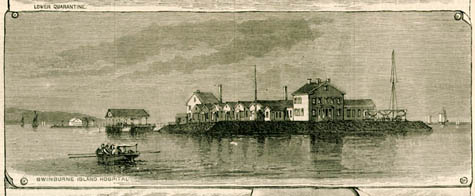
[Image: Quarantine facility and hospital ward on Swinburne Island, in the NYC archipelago].
It’s been an extremely eventful month since Edible Geography and BLDGBLOG teamed up to announce “Landscapes of Quarantine,” an eight-week, intensive, independent design studio to be hosted this fall in New York City; its brief is to create original and thought-provoking design projects that explore the spatial implications of quarantine. The results of the studio will then be the subject of an exhibition at Storefront for Art and Architecture in spring 2010.

The practice of quarantine extends far beyond questions of epidemic control and pest containment strategies to touch on urban planning, geopolitics, international trade, ethics, immigration, and more. In the early twentieth century, for example, “quarantine lines in Africa offered a clear and politically useful demarcation for new ‘international’ borders between Sudan and Egypt,” as historian Alison Bashford points out in her book Medicine at the Border.

From Boccaccio’s Decameron and disinfected mail protocols to bio-secure airlocks, plant smuggling, and Matt Leacock’s Pandemic boardgame, quarantine is a fertile territory for architects and designers to explore.

You can read more about the studio here.

Over the past few weeks, we have been blown away by the quality (and even quantity) of applicants interested in the studio. Indeed, narrowing the pool down to a manageable group of participants has been a very tricky process. We have been concerned all along with achieving a usefully diverse mix of backgrounds, media, and individual strategies of approach, while holding numbers low enough that the studio can still function as a weekly discussion group.

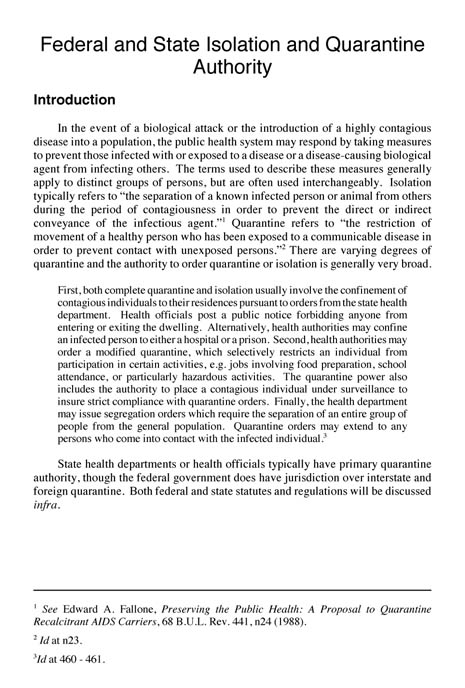
[Image: U.S. “Federal and State Isolation and Quarantine Authority,” updated January 18, 2005].
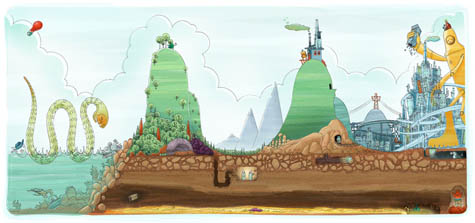
We are now excited to announce a truly amazing list of participants:

Joe Alterio — Illustrator, Animator, and Comic Book Artist (http://joealterio.com/)

Joe Alterio is an illustrator, animator, comic creator, and artist, interested in narrative structure, collective creativity, and the physical manifestations of story-telling. Joe has been at the forefront on using new technology to push forward the graphic narrative medium, from his early 2004 mobile comic The Basic Virus to his most recent work with Robots and Monsters. Alterio’s work has appeared in the Boston Globe, Rolling Stone, Boing Boing, Drawn!, The BLDGBLOG Book, and many other publications.

[Image: Joe Alterio, from Robots and Monsters].

Elizabeth Ellsworth and Jamie Kruse – Artists, smudge studio (http://smudgestudio.org/)

Elizabeth Ellsworth and Jamie Kruse are co-directors of smudge studio, a collaborative, non-profit media arts studio based in Brooklyn. Ellsworth is Associate Provost of Curriculum and Learning and Professor of Media Studies at The New School. Her recent book, Places of Learning: Media, Architecture, Pedagogy is about the aesthetics of mediated learning environments. Kruse is an artist, independent scholar, and freelance graphic designer.

Scott Geiger — Writer, Architecture Research Office (http://www.aro.net/)

Scott Geiger is the recipient of a Pushcart Prize for fiction. A contributor to magazines such as The Believer and Conjunctions, Geiger also writes for Architecture Research Office, a 2009 Finalist for the National Design Award for Architecture. As a Cleveland native, schemes to rescue America’s postindustrial cities stalk his work.

Yen Ha and Michi Yanagishita — Architects, Front Studio (http://www.frontstudio.com/) and “ladies who lunch” (http://lunchstudio.blogspot.com/)

Yen Ha and Michi Yanagishita are principals of Front Studio Architects, named one of the “world’s 50 hottest young architectural practices” by Wallpaper magazine. Their work has been featured internationally in Icon, AD: Cities of Dispersal, and the New York Times, and it was recently featured in the London Yields exhibition at the Building Centre in London. The Invisible Gate, their competition entry in the 2005 Gdansk International Outdoor Art Gallery, is currently under construction.

[Image: Front Studio, Farmadelphia].

Katie Holten — Artist (http://www.katieholten.com/)

Katie Holten has exhibited widely in Europe and the United States, and, in 2003, she represented Ireland at the Venice Biennale. She currently has a solo exhibition at The Bronx Museum of the Arts and a public artwork installed in the Bronx, called the Tree Museum. Holten was born in Dublin, Ireland, and is now based in New York City.

Jeffrey Inaba — Architect, INABA Projects (http://www.inabaprojects.com/), Director, C-LAB (http://c-lab.columbia.edu/), and Editor, Volume Magazine (http://volumeproject.org/)

Jeffrey Inaba is the Director of C-Lab, an architecture, policy and communications think tank at Columbia University‘s GSAPP, and he is Features Editor of Volume Magazine. With Rem Koolhaas, Inaba co-directed the Harvard Project on the City, a research program investigating contemporary urbanism and planning worldwide. Before starting INABA, he was a principal of AMO, the research consultancy founded by Koolhaas. Inaba has also taught at UCLA, Harvard, and SCI-Arc, and he lectures worldwide.

Ed Keller — Architect and Filmmaker, AUM Studio (http://www.aumstudio.org/)

Ed Keller is a designer, professor, writer, “media architect,” and former professional rock climber. He is co-founder with Carla Leitao of AUM Studio, an architecture and new media firm based in New York and Lisbon. Keller is an Associate Professor at Parsons School of Design, and he has taught at Columbia’s GSAPP, SCI-Arc, Pratt, the University of Pennsylvania, and more. Keller’s work has been featured in ANY, AD, Wired, Metropolis, Assemblage, among others.

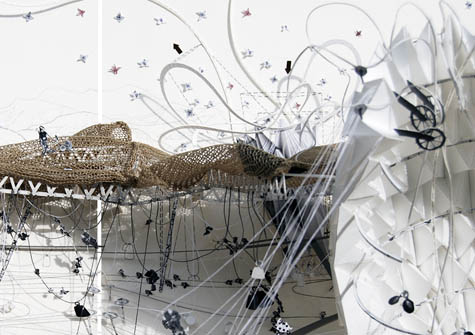
Mimi Lien — Set Designer (http://www.mimilien.com/)

Mimi Lien is a designer of sets and environments for theater, dance, and opera. After studying architecture at Yale University, she began making paintings, installations, objects, and designs for performance. Her work has been seen at The Joyce and The Kitchen, and she is a recipient of a 2007-2009 NEA/TCG Career Development Program award.

[Image: Mimi Lien, from a set design for Samuel Beckett’s Endgame].

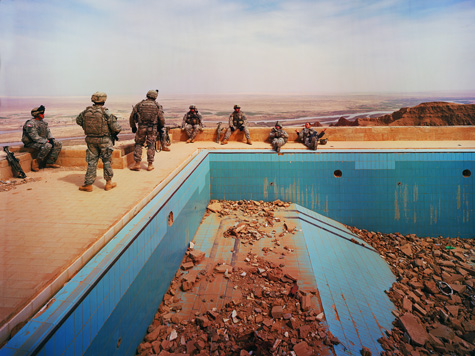
Richard Mosse — Photographer (http://www.richardmosse.com/)

Richard Mosse is an Irish photographer based in New York. He travels extensively with the assistance of a Leonore Annenberg Fellowship in the Performing and Visual Arts. Recent forays have taken him to Gaza, the Yukon Territories, and Iraq. Mosse has a forthcoming solo show at Jack Shainman Gallery, opening on November 19th, and new video work will be exhibited at Barcelona’s Ca L’Arenas, in a year-long exhibition cycle, investigating war and its representations.

[Image: Richard Mosse, ruined swimming pool at the palace of Uday Hussein, Jebel Makhoul, Iraq].

Daniel Perlin — Sound Designer, Perlin Studios (http://danielperlin.net/)

Daniel Perlin is a New York-based artist and sound designer. Perlin operates across media, creating video, objects, installations and performances. His work has been heard at Chelsea Art Museum, the Whitney Biennial 2006, D’Amelio Terras, TN Probe Tokyo, Temporary Contemporary Gallery, the Centre Pompidou, and BCA (Beijing), as well as in such films as Kelly Reichardt’s Old Joy, Errol Morris’s Fog Of War and Phil Morrison’s Junebug.

Thomas Pollman — Architect, NYC Office of Emergency Management (http://www.nyc.gov/oem and http://www.thomaspollman.com/)

Thomas Pollman is an architect and amateur cartographer based in New York City. He currently works in the Geographic Information Systems Division at the NYC Office of Emergency Management, where he works to enhance situational awareness for first responders through the deployment of geospatial technologies. Pollman is a registered architect in the State of New York.

Kevin Slavin — Urban Games Designer, Area/Code (http://areacodeinc.com/)

Kevin Slavin is managing director and co-founder of Area/Code. Working with media companies, museums, brands, and foundations around the world, Area/Code focuses on games with computers in them. Their work frequently extends game systems into the real world—and the other way around. Prior to founding Area/Code, Slavin was an artist and an advertising executive.

Brian Slocum — Architect, Polshek Partnership Architects (http://www.polshek.com/)

Brian Slocum is the recipient of a 2008 grant from the New York State Council on the Arts for ad hoc infrastructures, a design research project focusing on the deployment of scaffolding and alternatives for its spatial exploitation. Slocum was a contributor to Pamphlet Architecture #23 and is currently an Associate at Polshek Partnership Architects.

Amanda Spielman — Graphic Designer, Graphomanic (http://www.graphomanic.net/) and SpotCo (http://www.spotnyc.com/)

Amanda Spielman is a graphic designer at SpotCo, a New York-based design studio and ad agency that specializes in creating artwork for Broadway theater. Previously, she spent seven years in editorial design. Her work has appeared in The Design Entrepreneur, Fingerprint, Graphis, STEP, SPD, and metropolismag.com. Spielman graduated from the MFA Design program at the School of Visual Arts, and holds a BA from Vassar College.

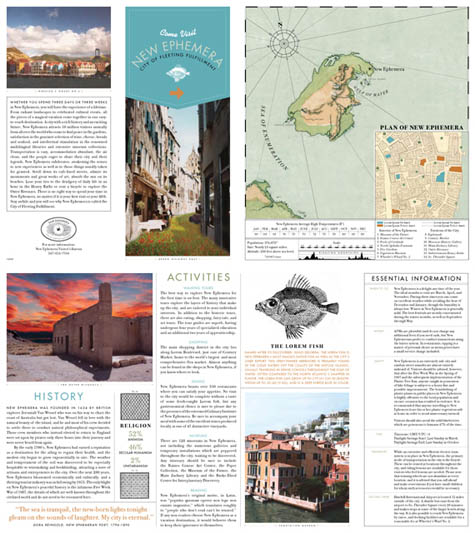
[Image: Amanda Spielman, Island of New Ephemera].

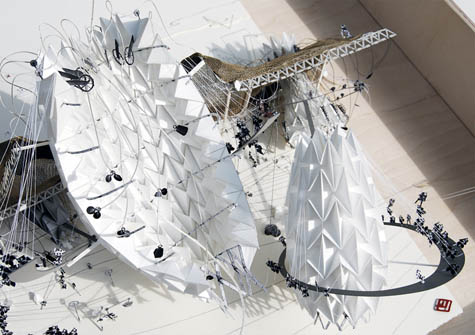
Lebbeus Woods — Architect, Author, and Educator (http://lebbeuswoods.wordpress.com/ and http://lebbeuswoods.net/)

Lebbeus Woods is an architect and educator. He is co-founder of RIEA.ch, an institute devoted to the advancement of experimental architectural thought and practice, and author of Pamphlet Architecture #6 and #15, among countless other articles and books. His works are held in private and public collections worldwide, including the Museum of Modern Art and the Austrian Museum of Applied Arts, Vienna. Woods has received the Progressive Architecture Award for Design Research, the American Institute of Architects Award for Design, and the Chrysler Award for Innovation in Design. He is currently Professor of Architecture at The Cooper Union in New York City.

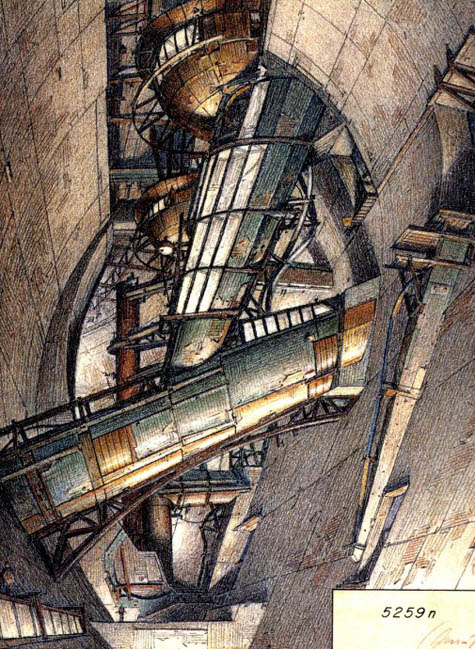
[Image: Lebbeus Woods, from a film treatment for Underground Berlin].

It’s hard to overstate how honored we are to work with practitioners of this caliber; we look forward to eight solid weeks of inspiring conversations and even more interesting work.

Expect frequent updates throughout the fall – in particular, during the week of October 5th, when we will begin to publish, both on Edible Geography and on BLDGBLOG, a series of original interviews with quarantine historians, public health policy experts, biosafety consultants, and more, placing quarantine into its unpredictably extensive context.

By making the studio discussions and our own research material public, we hope that anyone who has been inspired by the studio brief – and by the subject matter of quarantine – will be inspired to pursue their own projects, outside the necessarily limited walls of the studio.

Linkology

[Image: The Mobile Fabrication Unit by Gramazio & Kohler, soon to be building at Storefront for Art and Architecture].

Some things to read on a Monday afternoon:

—Architect Bjarke Ingels of BIG dominates the stage at TED. I was able to walk around BIG’s recently completed Mountain Dwellings in Copenhagen the other week, as part of an amazing drive around what felt like all of Denmark with Johan Hybschmann and Nicola Twilley. The building’s now-famous parking garage, we suggested only half-jokingly, would make an amazing venue for an architecture conference: its terraced parking decks overlook and focus upon a kind of inadvertent auditorium. Drive-in films, drive-in lectures, drive-in pirate radio concerts – it’s too fantastic a space not to try.

—Lebbeus Woods offers a glimpse of a film he outlined, designed, and later co-wrote with Olive Brown, called Underground Berlin. It involves a disillusioned architect, a missing twin brother, neo-Nazi activities in the divided city, metallic underground tunnels connecting east to west, and “a top-secret underground research station rumored to be somewhere beneath the very center of Berlin.” There are even rogue planetary scientists investigating “the tremendous, limitless geological forces active in the earth.” Woods’s graphic presentation of the idea is incredible, and absolutely worth a very long look.

—Meanwhile, farmers in the UK have been asked “to implement measures which would reverse the UK-wide decline in skylark numbers.” This means shaving small rectangular plots into the midst of productive cropland, because “rectangular uncropped patches in cereal fields allow skylarks to forage when crops become too dense for them.” We will prepare our landscapes for other species.

—Is your iPod maxing out the U.S. electrical grid? Perhaps it doesn’t matter: New Scientist looks at how to short-circuit the grid altogether – and would-be saboteurs the world over are still taking furious notes. Alternatively, just follow the fantastic On The Grid series by Adam Ryder and Brian Rosa to see where the electrical network really goes.

New Scientist also scanned beneath the south polar glaciers to find “Antarctica’s hidden plumbing” – and, as it happens, “the continent’s secret water network is far more dynamic than we thought.”

—Ruairi Glynn’s new book, Digital Architecture: Passages Through Hinterlands is now out; it documents Glynn’s related exhibition.

—Moving online, New York’s Architectural League has redesigned its website – joining the Canadian Centre for Architecture, who also redesigned their own site earlier this summer.

—Back in England, the BBC reports that pigs are being used “to help restore” parts of Worcestershire’s historic Wyre Forest. This comes at the same time that Cairo has realized that its absurd slaughter of every pig in the city last spring in order to guard against swine flu has led to an extraordinary garbage crisis. “The pigs used to eat tons of organic waste,” the New York Times reports. “Now the pigs are gone and the rotting food piles up on the streets of middle-class neighborhoods like Heliopolis and in the poor streets of communities like Imbaba.” Meanwhile, Edible Geography points our attention to the fascinating labyrinth of subsidiary products made from the bodies of dead pigs; welcome to “Pig Futures.”

—On io9 Matt Jones suggests that “the city is a battlesuit for surviving the future,” and he cites Archigram, Kevin Slavin, Dan Hill, Warren Ellis, the architecture of sci-fi, William Gibson, and much more to make his point. Speaking of Warren Ellis, Icon magazine recently published a long conversation between Warren, Francois Roche, and myself; you can check it out on Flickr.

—Were artificial hills, henges, and monumental earthworks a kind of “prehistoric sat nav” installed across the British landscape? And does this same question seem to be asked at least once every few years?

—The 2009 Solar Decathlon approaches.

—Gramazio & Kohler’s Mobile Fabrication Unit will arrive soon at New York’s Storefront for Art and Architecture. Between October 5 and October 27, it will be busy assembling “the first temporary public installation to be built on site by an industrial robot in New York.” Then, however, on Halloween, it will become possessed by incomprehensible forces from the Precambrian depths of the city, and, in a horrifying night of thunderous brickwork, it will wall off the island of Manhattan forever…

Digital Memory Palace

First thing tomorrow morning, I will be presenting at Ruairi Glynn’s Digital Architecture London conference, alongside Neil Spiller, Murray Fraser, and Alan Penn. Our topic is “Digital Architecture & Space.”

Anticipating a day filled with formal discussions, I’ll be speaking – albeit briefly – about what might be called the psychiatric effects of simulated environments. Specifically referring to the U.S. military’s Virtual Iraq project, I want to bring into the discussion the idea that “digital space” can be used for therapeutic purposes.

[Image: Brains].

To quote at length from a fascinating article in The New Yorker about the use of virtual reality as a treatment for Post-Traumatic Stress Disorder:

P.T.S.D. is precipitated by a terrifying event or situation—war, a car accident, rape, planes crashing into the World Trade Center—and is characterized by nightmares, flashbacks, and intrusive and uncontrollable thoughts, as well as by emotional detachment, numbness, jumpiness, anger, and avoidance. [A recently returned soldier from Iraq’s] doctor prescribed medicine for his insomnia and encouraged him to seek out psychotherapy, telling him about an experimental treatment option called Virtual Iraq, in which patients worked through their combat trauma in a computer-simulated environment. The portal was a head-mounted display (a helmet with a pair of video goggles), earphones, a scent-producing machine, and a modified version of Full Spectrum Warrior, a popular video game.

The purpose of discussing this is to look beyond formal analyses of digital architecture and virtual space, and to focus instead on their therapeutic possibilities. Put another way, to what extent could architectural simulations help to treat or even cure Post-Traumatic Stress Disorder?

With only a slight shift in emphasis, could you produce a building project that used the techniques of digital architecture to create an elaborate spatial memory system – a kind of RHINO mnemonics – that neurologically stimulated the act of remembering?

Of course, the use of architectural space as a road toward mental self-improvement, so to speak, is not at all new. A memory palace, for instance, is the art of remembering something by associating it with specific spatial details in a fantasy architectural structure, and this idea goes back at least to Cicero.

So is there a way to discuss the impact of digital design on architecture, with all of its implications of cinematic immersion and real-time animation, without getting stuck on questions of form? How might we discuss digital architecture’s impacts on things like memory – and can we do so in the context of experimental psychiatry and so-called exposure therapy?

I should add that each speaker will only be presenting for about five minutes – so the above remarks will be quite short, before turning into a much more general panel discussion.

Hexagonal Hydropolis

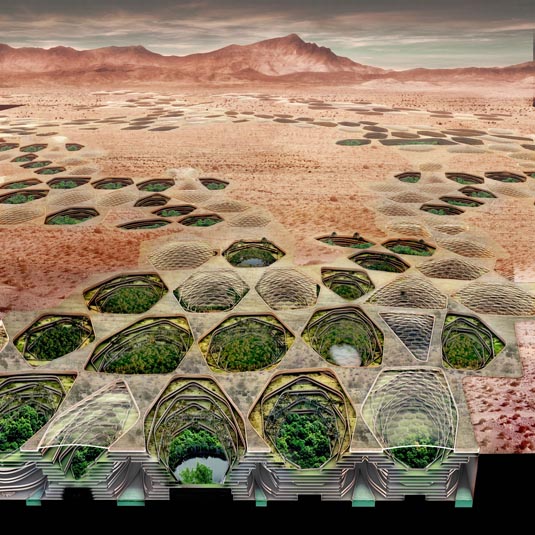
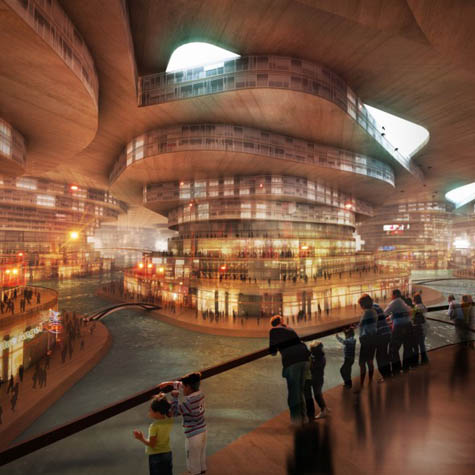
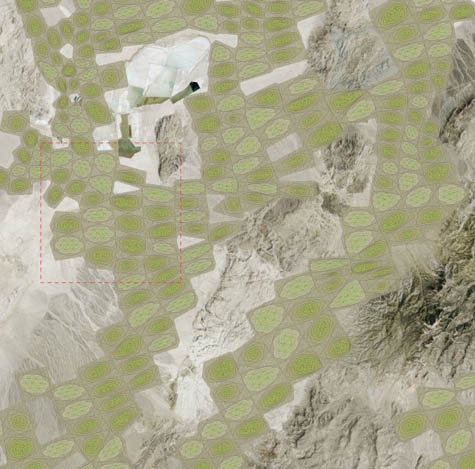
[Image: From Sietch Nevada by Matsys; renderings by Nenad Katic].

Andrew Kudless of Matsys recently proposed an extraordinary desert city of semi-subterranean terraces inspired by the novel Dune.

The images are fantastic, and the project description hooked me right away:

In Frank Herbert’s famous 1965 novel Dune, he describes a planet that has undergone nearly complete desertification. Dune has been called the “first planetary ecology novel” and forecasts a dystopian world without water. The few remaining inhabitants have secluded themselves from their harsh environment in what could be called subterranean oasises. Far from idyllic, these havens, known as sietch, are essentially underground water storage banks. Water is wealth in this alternate reality. It is preciously conserved, rationed with strict authority, and secretly hidden and protected.

The rest of the project combines an interest in drought hydropolitics in the U.S. southwest with the speculative architecture of “underground water banks.”

[Image: From Sietch Nevada by Matsys; renderings by Nenad Katic].

Continuing to quote at length:

Although this science fiction novel sounded alien in 1965, the concept of a water-poor world is quickly becoming a reality, especially in the American Southwest. Lured by cheap land and the promise of endless water via the powerful Colorado River, millions have made this area their home. However, the Colorado River has been desiccated by both heavy agricultural use and global warming to the point that it now ends in an intermittent trickle in Baja California. Towns that once relied on the river for water have increasingly begun to create underground water banks for use in emergency drought conditions. However, as droughts are becoming more frequent and severe, these water banks will become more than simply emergency precautions.

Accordingly, Kudless suggests that “waterbanking” will become “the fundamental factor in future urban infrastructure in the American Southwest.”

In this context, I would unhesitatingly recommend Marc Reisner’s classic book Cadillac Desert – the first hydrological page-turner I’ve ever read – as well as James Lawrence Powell’s recent Dead Pool: Lake Powell, Global Warming, and the Future of Water in the West (which I reviewed for The Wilson Quarterly earlier this year). Those two books are ideal references for Matsys’s project, as they each supply countless examples of hubristic, quasi-imperial waterbanking projects – projects that might still be functioning today but that are doomed, the authors convincingly show, to eventual dehydration.

Powell, in particular, offers genuinely disturbing descriptions of the looming silt-deposits that have accumulated behind the dams of the American west, amongst often extraordinarily poetic overviews of these dams’ inevitable failure. “One day every trace of the dams and their reservoirs will be gone,” Powell writes, “a few exotic grains of concrete the only evidence of their one-time existence.”

[Image: Matsys’s Sietch Nevada as seen from above; renderings by Nenad Katic].

In any case, the proposal seen here is “an urban prototype,” we read, “that makes the storage, use, and collection of water essential to the form and performance of urban life.”

A network of storage canals is covered with undulating residential and commercial structures. These canals connect the city with vast aquifers deep underground and provide transportation as well as agricultural irrigation. The caverns brim with dense, urban life: an underground Venice. Cellular in form, these structures constitute a new neighborhood typology that mediates between the subterranean urban network and the surface level activities of water harvesting, energy generation, and urban agriculture and aquaculture. However, the Sietch is also a bunker-like fortress preparing for the inevitable wars over water in the region.

Check out the full project on Matsys’s own website – and, while you’re there, the entire project database is worth a spin.

(Spotted on Architecture MNP. And read Dune!)

Extreme agricultural statuary

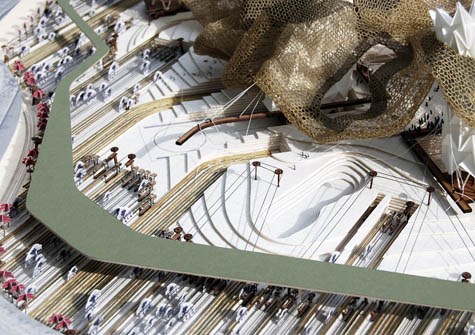
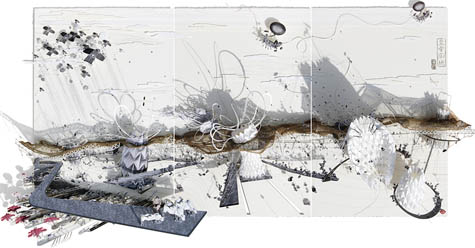
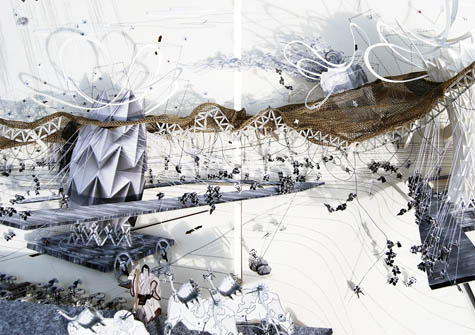
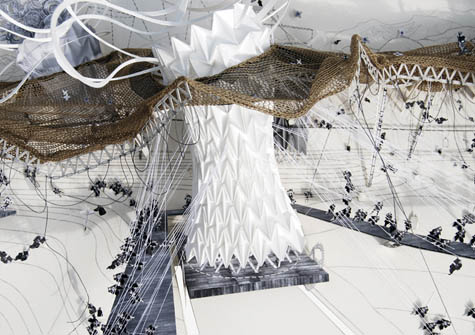
[Image: “Endothelium” by Philip Beesley & Hayley Isaacs].

I mentioned a recent issue of Mark Magazine the other day, but I deliberately saved one of the articles for a stand-alone post later on. That article was a long profile of the work of Philip Beesley, a Toronto-based architect and sculptor, whose project the “Implant Matrix” BLDGBLOG covered several years ago.

In issue #21 of Mark, author Terri Peters describes several of Beesley’s projects, but it’s the “Endothelium” that really stood out (and that you see pictured here).

[Image: “Endothelium” by Philip Beesley & Hayley Isaacs].

Peters refers to Beesley’s work as a “lightweight landscape of moving, licking, breathing and swallowing geotextile mesh” – a kind of pornography of ornament, or the Baroque by way of David Cronenberg. “Inspired by coral reefs,” she continues, “with their cycles of opening, clamping, filtering and digesting,” Beesley’s biomechanical sculpture-spaces are “immersive theatre environments” in which “wheezing air pumps create an environment with no clear beginning or end.”

I’m reminded of the penultimate scene in James Cameron’s film Aliens, when Ripley (Sigourney Weaver) meets the alien “queen.” The queen is laying eggs, we see, through a gigantic, semi-prosthetic, peristaltically-powered external ovarian sac – and the scene exemplifies the encounter with the grotesque in all its H.R. Giger-influenced, sci-fi extremes. Put another way, if organisms, too – not just buildings – can reach a point of ornamental excess, then James Cameron’s aliens are perhaps exhibit number one.

[Images: Screen grabs from James Cameron’s Aliens].

In any case, Beesley’s work is a fascinating hybrid of advanced textile design, geostructural modeling, and rogue biology experiment. Peters’s descriptions of the “Endothelium” are worth quoting at length:

[The structure consists of] a field of organic “bladders” that are self-powered and that move very slowly, self-burrowing, self-fertilizing and are linked by 3D printed joints and thin bamboo scaffolding. The bladders are powered using mobile phone vibrators and have LED lights. It works by using tiny gel packs of yeast which burst and fertilize the geotextile.

This latter detail – “using tiny gel packs of yeast which burst and fertilize the geotextile” – brings to mind something at the intersection of an improvised explosive device (or IED) and a green roof: you hire Philip Beesley to design a landscape-machine for installation atop a new building downtown, and, over the course of many decades, it vibrates, yeast-bursts, rotates, crawls, and grows through extraordinary cycles of grotesque architectural fertility. A solar-powered landscape of mold and microroots, generating its own soil. Within a few years, the original sculpture it all came from is gone, archaeologically undetectable beneath the vitality of the forms that have consumed it.

One wonders what Philip Beesley would think of the mushroom tunnel of Mittagong.

[Images: “Endothelium” by Philip Beesley & Hayley Isaacs].

Elsewhere in the article, Peters writes:

Endothelium is an automated geotextile, a lightweight and sculptural field housing arrays of organic batteries within a lattice system that might reinforce new growth. It uses a dense series of thin “whiskers” and burrowing leg mechanisms to support low-power miniature lights, pulsing and shifting in slight increments. Within this distributed matrix, microbial growth is fostered by enriched seed-patches housed within nest-like forms, sheltered beneath the main lattice units.

I’m a bit rhetorically stuck on “between” statements, I’m afraid, but it’s as if Beesley’s work falls somewhere between a loaf of sourdough bread and a sculpture by Jean Tinguely.

[Image: “Endothelium” by Philip Beesley & Hayley Isaacs].

I’m curious, meanwhile, if you could bury a Philip Beesley sculpture in the woods of rural England somewhere, and allowed it to articulate new ecosystems slowly, over the cyclic course of generations. In fact, I’m reminded of an article in the New York Times last week, spotted via mammoth, in which we learn that two abandoned landfills in Brooklyn have since been used as unlikely foundations for new ecosystems:

In a $200 million project, the city’s Department of Environmental Protection covered the Fountain Avenue Landfill and the neighboring Pennsylvania Avenue Landfill with a layer of plastic, then put down clean soil and planted 33,000 trees and shrubs at the two sites. The result is 400 acres of nature preserve, restoring native habitats that disappeared from New York City long ago.

“Once the plants take hold,” the article adds, “nature will be allowed to take its course, evolving the land into microclimates.” But what if those weren’t landfills down there but sculptures by Philip Beesley? Strategically sown seed-patches and gel packs of yeast wait underground for new roots to rediscover them.

It’s living geostatuary, buried beneath the surface of the earth – a kind of extreme agriculture, with soil-preparation by Philip Beesley.

[Images: “Endothelium” by Philip Beesley & Hayley Isaacs].

I’d genuinely like to see what Beesley might do if he was hired by, say, a NASA R&D program dedicated to terraforming other planets. Could you fly a modular, self-unfolding Philip Beesley sculpture into the depths of radiative space, land it on a planet somewhere, and watch as revolting pools of bacteriological mucus begin to coagulate and form new fungi?

Beesley’s whiskered vibrators begin to shiver with signs of piezoelectric life, as small crystals surrounded by radio transmitters and genetically engineerined space-seed-patches imperceptibly tremble, evolving into mutation-prone “organic batteries” unprotected beneath starlight. Give it a thousand years, and vast infected forests, the width of continents, take hold.

You’ve colonized a distant planet through architecture and yeast.

For more, check out Mark Magazine‘s issue #21. Beesley’s also got a book out, called Hylozoic Soil, that I would love to read.

Maunsell Towers

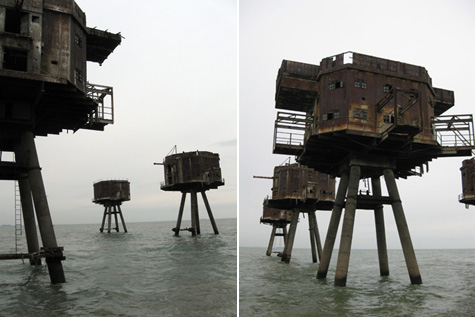
[Image: The Maunsell Sea Forts, photographed by Pete Speller, courtesy of Nick Sowers].
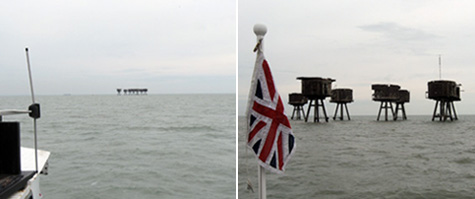
I missed an amazing opportunity the other week to visit the Maunsell Towers – aka the Maunsell Sea Forts – with Nick Sowers, author of an excellent Archinect school blog and one of my students from this summer’s studio down on Cockatoo Island in Sydney.

For the last year or so, Nick has been traveling around the world on a much-deserved John K. Branner Fellowship, documenting army bases, abandoned bunkers, and other sites of historical military interest. From South Korea to the Maginot Line, from classical war zones and medieval walled cities to “bunker recycling services” and D-Day, Nick’s itinerary is breath-taking. It is also, I hope, intriguing enough to catch the eye of future publishers or gallerists who might want to give Nick the space in which to break down all that he’s seen; there are very many of us who would love to learn more.

Of course, we could also hear more about his trip: Nick is acoustically-inclined, and he has been documenting the sounds of these militarized landscapes over on another blog he runs, called Soundscrapers.

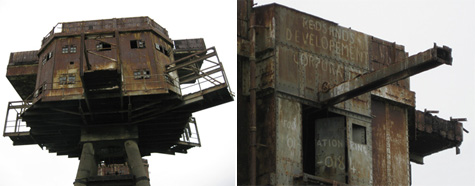
[Images: Photos by Nick Sowers].

So Nick and his wife were in England the other week, and we unfortunately missed meeting up – but they managed to take a boat tour out to the Maunsell Sea Forts, iconic architectural structures in the Thames Estuary, inspirations for Archigram, and one of the few real-life buildings (if you can call them that) that gave me the idea to start BLDGBLOG. In fact, I’ve mentioned these places in lectures and I’ve posted about them on the blog before – but I’ve never had a chance to visit.

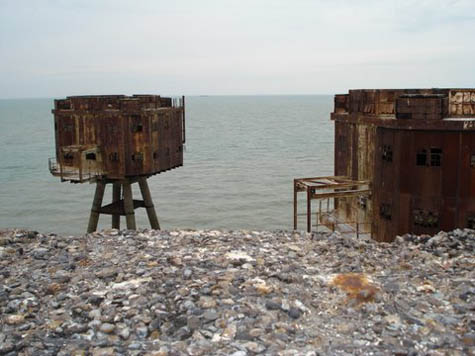
Nick’s photos, presented here, alongside photos by Pete Speller, will tell the story instead.

[Images: Photos by Nick Sowers].

As Underground Kent explains, “The Thames Estuary Army Forts were constructed in 1942 to a design by Guy Maunsell.”

Their purpose was to provide anti-aircraft fire within the Thames Estuary area. Each fort consisted of a group of seven towers with a walkway connecting them all to the central control tower. The fort, when viewed as a whole, comprised one Bofors tower, a control tower, four gun towers and a searchlight tower. They were arranged in a very specific way, with the control tower at the centre, the Bofors and gun towers arranged in a semi-circular fashion around it and the searchlight tower positioned further away, but still linked directly to the control tower via a walkway. All the forts followed this plan and, in order of grounding, were called the Nore Army Fort, the Red Sands Army Fort and finally the Shivering Sands Army Fort. All three forts were in place by late 1943, but Nore is no longer standing. Construction of the towers was relatively quick, and they were easily floated out to sea and grounded in water no more than 30m (100ft) deep.

They thus entered into the imaginations of speculative architects everywhere; they helped give visual shape to Archigram’s Walking City; and they continue to offer a kind of real-life spatial analogue for Constant’s New Babylon for anyone with access to a boat.

[Image: The Maunsell Sea Forts, photographed by Pete Speller, courtesy of Nick Sowers].

Nick explained in an email that he visited the structures with Tony Pine, a “sound engineer” – i.e. pirate radio operator – who spent the afternoon “telling stories of the days in the 60s when Archigram came out to visit the structures, and also about incredibly cold winters when they burned the wood-fibre linings of the tower interiors to stay warm.”

Also along for the ride was Robin Adcroft, director of Project Redsand, who “describes himself as the caretaker of the structures.” Adcroft points out the genealogical importance of these structures:

The Thames Sea Forts are the last in a long history of British Marine Defences. The Army Anti Aircraft forts have played a significant role in post World War 2 developments. Notably in offshore fuel exploration and drilling platforms. The successful rapid deployment of the Maunsell Forts soon after led to the construction of the first offshore oil platform in the Gulf of Mexico in the late 1940s.

Both conceptually and materially, the Maunsell Towers have an architectural legacy that seems oddly under-explored.

[Images: Inside the forts; photos by Pete Speller, courtesy of Nick Sowers].

But “it’s interesting,” Nick adds: “no one actually owns these things.”

Apparently the transport authority wanted to give Project Redsand a deed but they declined it, not wanting the liability. A ship crashed into Shivering Sand (an outpost which is visible from Redsand) in the 60s, taking out one of the towers and killing two maintenance personnel. Red Sand is not actually in the shipping lane, but it is very much a hazard. The original 1/4 inch plate steel is rusting through to a paper thickness. We had to wear hardhats when the boat pulled in next to the structures.

Project Redsand has more information about efforts to preserve the forts – and they link to this short YouTube video in which you can see how these clustered towers might be stabilized and maintained for generations to come.

[Images: Photos by Pete Speller, courtesy of Nick Sowers].
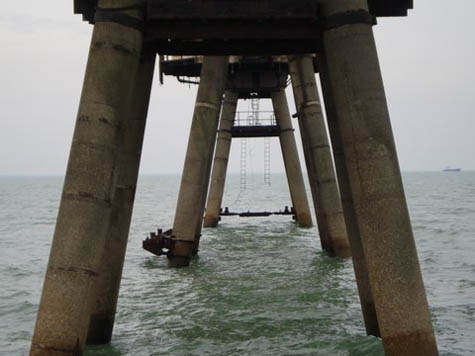
Meanwhile, be sure to follow Nick Sowers’s slowly-ending travels around the militarized world on his Archinect blog – and he can also be found on Twitter.

Pamphlet Infrastructure

[Image: From InfraNet Lab’s submission to the WPA 2.0 competition, “centered on the twin dilemma of rising population and water shortages in the US southwest.”]

As a longtime fan of Mason White’s and Lola Sheppard’s work both at InfraNet Lab – an amazing web resource for anyone interested in cities, infrastructure, built landscapes, hydrological processes, international communications networks, and more – and at their architecture firm, Lateral Office – mentioned many times on BLDGBLOG before, from IceLink and A.I.R. Unit to Reykjavík’s Runways to Greenways – and as an enthusiast for Princeton Architectural Press’s Pamphlet Architecture series, I was absolutely thrilled to learn last week that InfraNet Lab will be authoring Pamphlet Architecture 30. Their book will be called Coupling: Strategies for Infrastructural Opportunism, and it will be published in 2010.

Along with Lola and Mason, Neeraj Bhatia and Maya Przbylski from Lateral Office will also be contributing – and this promises to be one of the best pamphlets yet. It’s also fantastic news for Lateral Office, who well deserve this exposure for their ideas and work. Congrats, guys! I can’t wait to see the results.

(By way of a brief PS, Mason will actually be speaking at the North American launch of The BLDGBLOG Book on Saturday, September 26, at Storefront for Art and Architecture in New York, along with Lebbeus Woods, another Pamphlet Architecture author).

Book of Space

[Image: A project by Johan Hybschmann].

One of the pleasures of participating in Urban Islands this past summer was meeting Johan Hybschmann, a recent graduate of the Bartlett School of Architecture and co-instructor, with Mark Smout, of one of the design studios hosted down there in Sydney. Johan is contagiously good-humored; even our pre-coffee, breakfast-less 7am ferry rides through cold winds across the Sydney Harbor in a surging boat were spent laughing. In fact, when I told him that my wife and I were about to celebrate our 7-year wedding anniversary… he started laughing.

Johan’s projects at the Bartlett were a fascinating mixture of ornate technical detailing and abstract ideas: simulation, reproduction, and the nature of spatial perception. “The idea of visually connecting spaces has been my architectural obsession for a long time,” he wrote to me in an email after we had all returned from Sydney, “and I find that perceptual/referential recognition [of specific spatial details] often plays a key role.”

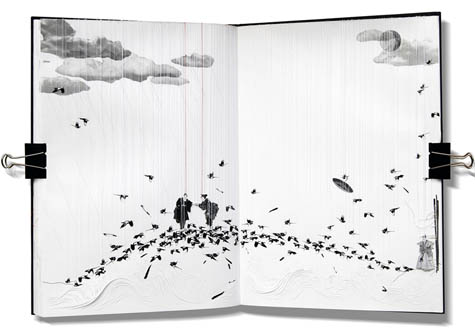
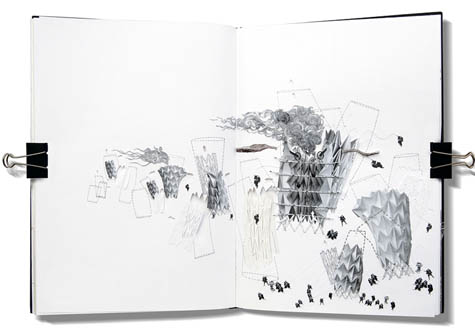
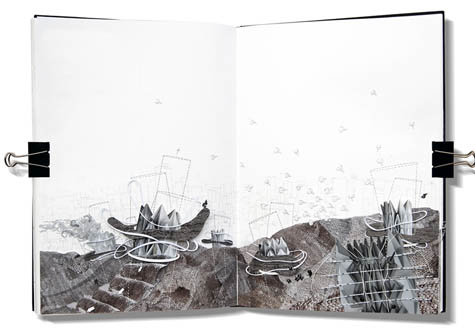
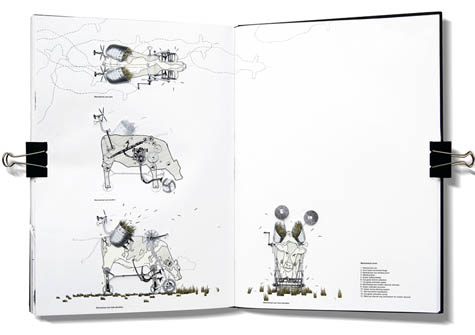
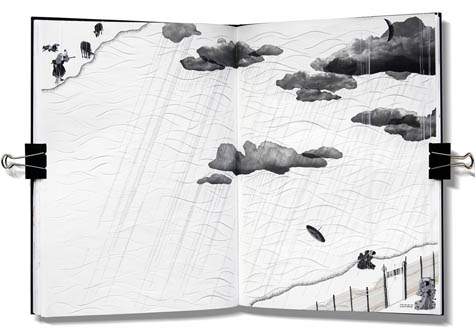
One of Johan’s student projects, in particular, continues to astound me. What you’re looking at in the images reproduced here (alongside Johan’s answers to a series of questions I had posed over email) are painstakingly precise laser-cuts made into the pages of a blank sketchbook. As the book is opened and its pages begin to turn, these cuts work together to form a spatial representation of the single, highly choreographed 90-minute shot that is Alexander Sokurov’s film Russian Ark.

The book’s “content” is thus a three-dimensional, perspectivally accurate space.

[Image: A project by Johan Hybschmann].

From Johan:

The inspiration came directly from the single shot film sequence in Sokurov’s Russian Ark, where the camera is taken through the timeless spaces of the Winter Palace, jumping decades from one room to another. The distortion of time is, of course, interesting in terms of the timelessness of the spaces – but I was interested in the way that the camera never looks back. Even though the viewer never sees the full dimensions of these spaces, we are still left with a sense of coherence and wholeness. But what if the back of the room was mindblowingly different? It’s as if we constantly use the previous space to create an understanding of what should be behind us.
The book is an attempt to spatially prolong that perceptual idea. Two different spaces from the film sequence have been cut into each half of the book, as constructed perspectives. When the pages spread, the silhouettes of the elements visually collide, and the space within the book changes in character as the user travels through it by flicking through the pages.

You pick up a book, and you open the covers… and a series of rooms begins to pass by, like the frames of a film or sequences in a flipbook, and it’s all due to laser-cut gaps and remainders. How amazing to think that we could slice entire works of architecture into all the books around us, so that “reading” a book would actually be a forward-moving optical journey through page-sized rooms and hallways.

[Image: A project by Johan Hybschmann].

The physical realization of this was actually quite difficult to work out. As Johan explained over email:

The book is made from layered silhouettes with inbuilt distorted perspectives that are laser-cut into the individual pages of a standard sketchbook. There is a drawing for each page, and these are all cut separately: turning the page, loading up a new drawing and cutting, page by page.

Aside from the seemingly overwhelming task of working out exactly how much or how little needed to change with each page, Johan also achieved a kind of spatial layering effect: the turning pages add (or subtract) from the structure of each “scene” you see.

[Image: The diagram of architectural outlines that was laser-cut into the book’s pages, recreating the illusory volume of a cinematic space].

Rooms and perspectives shift; spaces blur one into the other, edited by laser; and the book re-enacts, on a bibliographic level, the act of watching Sokurov’s film.

[Image: A project by Johan Hybschmann].

This project has a lot in common with another of Johan’s student works.

In the following project, called “Replicating a Replica,” he proposed “a redesign of the Federal Hall on Wall Street in New York City.” Johan basically created two buildings that would occupy the same place at the same time, visually interlocking but spatially separate.

As you walk through the building, Johan explained, you would pass through a series of “choreographed viewpoints,” or visual positions at which the spaces around you would shift. Here you would feel as if you are inside one particular building (a Museum of the Constitution, Johan suggests); there, even if only steps away, you would feel as if you were inside another building altogether (a Court of Law, for instance).

Each building would exist as if tucked inside the optically complicated spaces of the other. After all, Johan added, he is “interested in the spatial potential of being in-between.”

The resulting model of the project was thus more like a small machine, moving between two states of being. In one state, it was simply a pile of loose wire frames and disconnected vaults; in the other, a battery-powered act of reanimation has brought these apparently discarded parts whirling back to life, forming a functional building space.

[Images: Another project by Johan Hybschmann].

The final images are fantastic: a building comes to life from whirring motors stored below.

[Images: By Johan Hybschmann].

Tying all of this together, and bringing us back to the laser-cut book project, Johan writes:

There is a scene in the film Blade Runner where Rick Deckard uses a machine to visually move around corners within a regular photograph. The machine traces all reflective surfaces in the “still-life” setting, and it collects information from objects represented from different spatial positions – but only from one viewpoint. This allows the machine to travel around the corner of the threshold within the photograph, but also to give an assumed image of what otherwise cannot be seen. Even though Rick Deckard gets a picture of a woman laying in a bed, we still have to consider that the image is constructed from distorted surfaces of mirrors and glass objects.

In some ways, the above description of Blade Runner could also be a description of the convex mirrors deployed throughout the Sir John Soane Museum, which distort and re-reflect the sarcophagi and Egyptian statuary scattered all around the place, making even the definition of a single room somewhat hard to settle on.

But it also ties in very nicely with the optical themes from Johan’s and Mark’s studio this summer in Sydney (which I hope to write about before too much longer): how we see architecture, how we visually comprehend built space, and what we might try to design in order to make this everyday experience both more complicated and more interesting.

Fire Lookout Towers

[Image: Courtesy of the U.S. Forest Service].

Constituting their own architectural typology, and falling perhaps somewhere between Lew Welch and Tom Kundig (someone hire Kundig to design the next Serpentine, please!), are the fire lookout towers of the Pacific Northwest.

Search the photo archives – assembled and maintained by Rex Kamstra, complete with lookout tower trivia – from Oregon and Washington to the hills of South Dakota (or just check out the site’s newsfeed) to explore these often extraordinarily remote structures in all their minimalist – and historically fascinating – glory.

And did you know that you can actually adopt a fire lookout?

[Image: Courtesy of the U.S. Forest Service].

While you’re at it, don’t miss the U.S. Forest Service’s own catalog of these overlooked minor building types: fire lookout towers in Sequoia National Forest, for instance, and Umatilla.

The fact that there are any lookout towers still standing at all is, it seems, slightly amazing. “In their heyday during the 1930s,” the Forest Service explains, “there were over 8,000 fire lookouts that dotted mountain tops across the United States with over 600 in California. Today there are only a few hundred in operation. Once considered a proud symbol of our nation’s conservation heritage, fire lookouts are a fading legacy. There are 10 lookouts left on the Sequoia National Forest.”

[Image: Courtesy of the U.S. Forest Service].

A definitive history of these timber structures and lonely cabins has not yet been written (attention Princeton Architectural Press!), although they constitute not only a distinctive family of structures, they also have a regional, ecosystemic importance that only the best pieces of civic infrastructure attain.

They also figure into the national mythology in a way that few other forms of architecture do; from Jack Kerouac disappearing off into the mountains for a summer of fire-spotting, to the poems of Gary Snyder, these awesomely elevated perspectives on the natural world – as well as sites of enforced introspection – deserve their NorCalMod moment. That is, they deserve their architectural rediscovery.

[Image: Courtesy of the U.S. Forest Service].

Instead of a definitive reference work, there are simply books (albeit still fascinating) like How to Rent a Fire Lookout in the Pacific Northwest: A Guide to Renting Fire Lookouts, Guard Stations, Ranger Cabins, Warming Shelters and Bunkhouses in the National Forests of Oregon and Washington; Adirondack Fire Towers: Their History and Lore; Lookouts: Firewatchers of the Cascades and Olympics; and the so-called “fire lookout research” of David E. Lorenz (now out of print). So people are clearly still interested in these structures. For instance, check out this photo-log of a hike up to the spectacular mountain views of the Mule Peak Lookout.

[Image: Courtesy of the U.S. Forest Service].

Even better, take a long read through the Skagit River Journal‘s look at the fire lookout towers of the Cascades. This latter link includes some amazing material, including references to interviews with former fire watchers and their colleagues:

They told many unusual stories of the watchers, who were prepared to be alone on a mountain ridge in a tower measuring less than 200 square feet. Towers were sometimes built on nearby ridges so that two watchers could combine their observations of a section of forest, which enabled them to triangulate and more accurately call in resources to fight fires. A broad spectrum of watchers developed, from college students to housewives to hermits and those who loved to be surrounded by wilderness and mountains. The authors discovered one watcher who was so frightened during a lightning storm that he ran all the way down the mountain.

There is also the story of Maxine Meyers, a former forest lookout.

More architecturally, the Skagit River Journal also gets into the ways and means of these towers’ construction: “Before mountain roads were built of a size to accomodate trucks, the materials were largely packed in on backs or on mules, and then another team had to slog through the brush, stringing telephone wire before the use of two-way radios.” Thus were distant structures assembled in the woods.

[Image: Courtesy of the U.S. Forest Service].

Plus, where, now, are the people who actually lived in these structures – stationed there for whole seasons at a time to eat canned peaches and watch the stars, looking out for signs of distant fires? Are they still alive, and, like Maxine Meyers, could you interview them? It’s an architectural form that comes with its own anthropology: narratives of use and inhabitation.

Further, who designed these structures – based on what plan, and from what material inspiration? What would a fire lookout tower, built today, look like? Perhaps like the awesome “Prairie Ladder” by Anderson Anderson?

And how do these towers frame the landscape, and to what extent could you put them into the visual tradition of things like panoramas?

These towers, after all, aren’t just towers; they have a kind of optical functionality, built specifically for the purpose of viewing the landscape in a certain, specific, highly regulated way. They spatially frame this act of disciplined surveillance. In a sense, they are like the British watchtowers so beautifully photographed by Donovan Wylie.

[Image: Courtesy of the U.S. Forest Service].

But, more to the point, where do fire lookout towers – as a minor design typology – fit into architectural history?

Procedural Destruction and the Algorithmic Fiction of the City

[Image: From Procedural Modeling of Cities by Yoav Parish and Pascal Müller].

Note: This is a guest post by Jim Rossignol.

In 2001 Yoav Parish and Pascal Müller spoke at the SIGGRAPH conference in Los Angeles, California, to present a mathematical city. Their presentation contained an algorithmic approach for modeling city-like topologies. The results were remarkably realistic, and were one among a host of city-like generative systems to appear at the start of the decade.

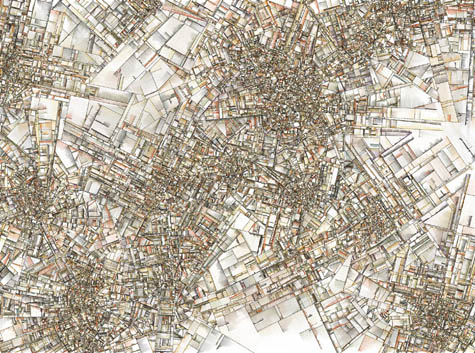
Another, Jared Tarbell’s Substrate (pictured) remains a fantastic example of how a mathematical approach to generating apparently urban patterns can also be artful.

[Image: From Jared Tarbell’s Substrate].

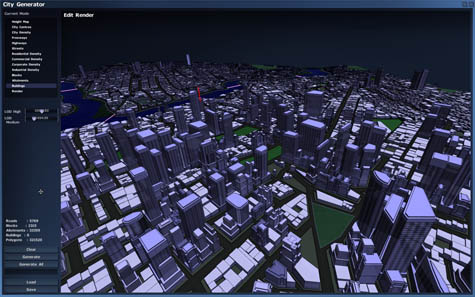
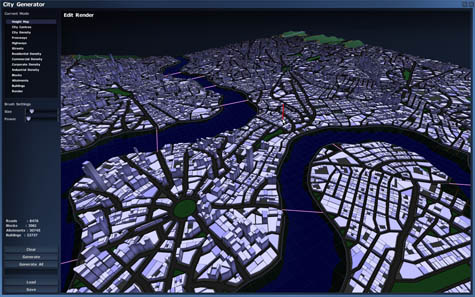
But it was looking at the work of Parish and Müller that inspired game designer Chris Delay to develop his most recent project: the cryptic (and as-yet-unexplained) Subversion, of which little is known, other than it relies on large, procedurally generated cities for the backbone of its game world.

Having already been burned by the problems of creating content “by hand,” Delay set out to let algorithms do the work of building buildings in his new game. Not only that, but he was determined to create an artistically interesting experience without artists.

[Images: From Chris Delay’s Subversion].

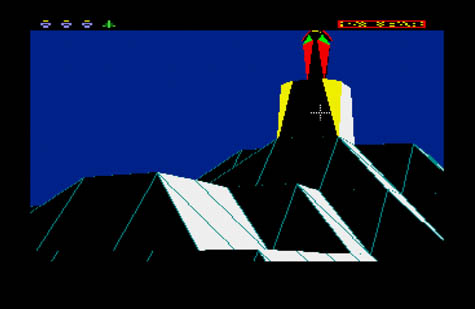
Of course, videogames have long been the home of procedurally generated landscapes where numbers and mathematical equations played the role of the visual designer. Early paranoid classic The Sentinel made use of these techniques to create an astonishingly atmospheric 10,000 levels in simple vector graphics, from just a few kilobytes of data. Other games have used similar techniques as a shortcut to creating solar systems and vast fractal landscapes.

But when it came to cities, well, it took a long time for anyone to take up the challenge.

[Image: From The Sentinel by Geoff Crammond].

Rather than opt for procedural techniques, game designers usually elect to build their cities by hand, often with startling results. The re-imagined contemporary New York that features in last year’s Grand Theft Auto 4 required a small army of well-paid artists and designers to hand-craft the entire world. Their accomplishment is unmatched, but the cost to the company behind the project is in the tens—and perhaps hundreds—of millions of dollars. To build up a living city from blank polygons is one of the most expensive possible projects in game design.

Delay, whose project is being undertaken with a tiny budget and by just a handful of staff based in Cambridge, UK, does not have the luxury of vast content teams. His vector-drawn city is far less realistic than Rockstar‘s textured, heaving metropolis, but there’s nevertheless a beauty to it. It’s a kind of mathematical map of the essential urban environment: there are roads, sidewalks, and a no-man’s land of corporate moats around great skyscrapers…

Identify the key equation that define urban patterns, and you, too, can summon a city into existence.

Delay has begun to show off how his cities emerge from the ground up in a series of videos, and he spoke to me about the process.

“I started out with road layouts, and then began to modify the parameters,” he explained. “Sometimes you’ll get lovely radial, spiral patterns, or you can tell it to create a really rigid Manhattan-style grid.” One set of numbers delivers the block logic of American cities, another is rather more like the spirals of Medieval European sprawls. The two merge to create something even more believable. “Every subsequent layer builds on the previous layer,” Delay points out, “so the very next layer looks for the spaces between layers, and makes judgments about ‘is this likely to be a skyscraper, or to be a house?’ Then you zoom in, and carry on. You do another procedural generation process for each layer of detail, filling in that world.”

[Image: From Chris Delay’s Subversion].

A few weeks after speaking with Delay I attended Thrilling Wonder Stories—a seminar at the Architectural Association in London, curated by Liam Young and BLDGBLOG—where I watched conceptual designer Viktor Antonov explain how he had created a science-fictionalized Paris (for a now-cancelled videogame called The Crossing).

Antonov approached the problem by altering just a few parameters in the standard architectural model. For instance, Antonov had noticed a few fundamental details about how the mid-nineteenth century neo-classical core of Paris had been constructed: big street-level floors, smaller attic spaces, complex chimney stacks. By increasing the emphasis on the lower floors, and stretching them out—and by emphasizing the height and complexity of the chimneys—Antonov was able to create a thematically consistent science fiction Paris.

Simply by altering a few basic architectural parameters, he said, you were able to fictionalize the city, whilst at the same time retaining its fundamental identity. His designs were still recognizably—even mathematically—Parisian, in other words, but they were also otherworldly.

[Image: By Viktor Antonov].

This idea instantly connected back to Delay’s project: what parameters would we need in order both to understand and create a science fiction Edinburgh, or Sao Paulo, or Vancouver? Identify the necessary fantasy logic within a procedural city-building system and you could recreate cities with their alternate identity in an instant. An accelerated future Moscow, or a retropunk Venice, instantly sprawling out of the monitor.

And perhaps this is not such an outlandish thing to aim for—especially when you consider the speed at which procedural city projects have been appearing across the tech landscape. Could one of these cities potentially be refitted to allow for this type of radical tweak?

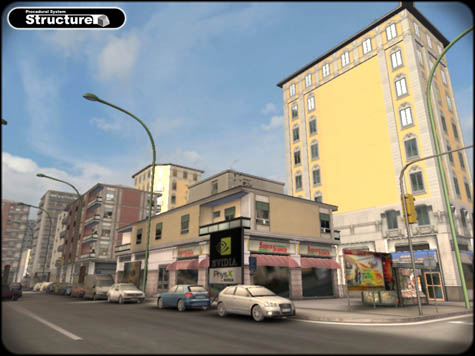
Projects like Shamus Young’s impressive PixelCity, or Marco Corbetta‘s Structure seem ripe for such strange fictions. Corbetta’s system is particularly impressive in its verisimilitude: he aims to create a basic engine for rapidly generating the kinds of cities that games like Grand Theft Auto 4 require, and consequently doing so for much cheaper.

Could Corbetta’s engine come with a Paris or a Barcelona preload, which could then be put through Photoshop-style filters for alternate reality logic in its architecture? A stronger skyline, weirder street furniture.

[Image: From Marco Corbetta’s Structure].

More exciting, at least for the thrill-seeking gamer in me, is the fact that Corbetta is aiming one notch higher than any of his peers: he’s aiming to make these cities procedurally destructible. His site contains a demonstration video of neatly arrange office interiors and a domestic library being blown to pieces with a machine-gun. What good is an imaginary city if you can’t go inside the buildings? What good is a virtual downtown if you can’t go crazy with a bazooka? Corbetta’s work preempts these questions.

Further, it conjures visions of massive demolition exercises in parallel worlds—entering an Antonov-algorithm for neo-Rome, where gladiatorial escapades see us going through the walls of the coliseum and into the randomly generated plazas beyond.

That, perhaps, is the greatest promise of procedural cities: that soon they’ll be real enough that their destruction will seem like tragedy.

[Jim Rossignol is a games critic for Offworld, an editor at Rock, Paper, Shotgun, and the author of the fantastic This Gaming Life: Travels in Three Cities. A full-length interview with Rossignol appeared on BLDGBLOG in May, and he has written a previous guest post, Evil Lair: On the Architecture of the Enemy in Videogame Worlds].

Landscapes of Quarantine: Call for Applications

[Image: President Nixon addresses quarantined astronauts from the Apollo program; via NASA].

I’m incredibly excited to announce not only that BLDGBLOG will be living in New York City this fall, but that my wife and I will be hosting a design studio there called Landscapes of Quarantine – the results of which will be the subject of a public exhibition at Storefront for Art and Architecture in early 2010.

Meeting one evening a week this autumn in Manhattan, from October 6 to December 5, 2009, up to 14 studio participants will discuss the spatial implications of quarantine, each developing an individual design project in response to the studio theme.

Quarantine is both an ancient spatial practice and a state of monitored isolation, dating back at least to the Black Death – if not to Christ’s 40 days in the desert – yet it has re-emerged today as an issue of urgent biological, political, and even architectural importance in an era of global tourism and flu pandemics.

[Image: “Fear of Flu” by Mike Licht].

Quarantine touches on serious constitutional issues associated with involuntary medical isolation, as well as on questions of governmental authority, regional jurisdiction, and the limits of inter-state cooperation. Quarantine is as much a matter of national security, public safety, and agricultural biodiversity as it is an entry point into discussions of race, purity, and unacknowledged discrimination.

Quarantine is also a plot device increasingly seen in novels and films – from the aptly named Quarantine and Albert Camus’s The Plague to I Am Legend and The Last Town on Earth – even as it has become a source of arcane technical debate within plans for Martian exploration and Antarctic drilling rights.

The design implications of quarantine stretch from the ballast water of ships to the way we shape our cities, from the clothes in travelers’ suitcases to stray seeds stuck in the boot treads of hikers. Quarantine affects the pets we keep, the programs we download, and the machines we use in food-processing warehouses, worldwide.

Quarantine is about managing perimeters, controlling influence, and stopping contamination.

[Image: Cages for the laboratory testing of rats and mice by Innovive].

So how do we treat quarantine as a design problem?

Whether we design something to demonstrate that the very notion of quarantine might not be possible; whether we produce actionable plans for quarantine units, ready for implementation by the World Health Organization in hot zones around the world; whether we create quarantine-themed graphic novels, barrier-based urban games, or a series of ironic public health posters to be mounted around the city, how can we design for quarantine?

Quarantine also offers fertile territory for investigation through cartography and cultural documentation. After all, if we mapped the contents and locations of quarantine facilities worldwide, designed infographics to analyze the spread of invasive species, or recorded the oral histories of the quarantined, what sorts of issues might we uncover?

Bringing these very different techniques, media, and approaches together in the confines of a dedicated design studio will give participants an exciting opportunity to explore the overlooked spatial implications of quarantine.

[Image: A poster for Quarantine, directed by John Erick Dowdle].

We have already confirmed a fantastic list of participants, whose backgrounds include architecture, photography, illustration, games design, sound, landscape, food, and more; we are now opening the studio to a general call for interested participants.

The brief – which you can download here as a PDF or that you read as a JPG on Flickr – explains more; but potential applicants will be working with a truly stellar group as they meet once a week this fall and produce work eligible for inclusion in the “Landscapes of Quarantine” exhibition to be held at Storefront for Art and Architecture in early 2010.

If you are interested, please download the brief – which includes all necessary application info – and contact us at futureplural @ gmail by September 19, 2009.

[Image: Australian quarantine signage].

For ease of reference, I have decided to include the studio brief in full below:

Landscapes of Quarantine is an independent, multi-disciplinary design studio, based in New York City, consisting of eight Tuesday evening workshops, from October 6 to December 5, 2009, in which up to 14 participants will gather to discuss the spatial implications of quarantine. Quarantine is an ancient spatial practice characterized by a state of enforced immobility, decontamination, and sequestration; yet it is increasingly relevant—and difficult to monitor—in an era of global trade, bio-engineering, and mass tourism.

Studio participants will explore a wide variety of spatial and historical examples, including airport quarantine facilities, Level 5 biohazard wards, invasive species, agricultural regulations, swine-flu infected tourists confined to their hotel rooms, lawsuits over citizens’ rights to resist involuntary quarantine, horror films, World Health Organization plans for controlling the spread of pandemics, lunar soil samples, and more.

During the studio, participants will develop individual design projects in response to the problem of quarantine, with guidance and inspiration provided by readings, screenings, group discussions, and an evolving line-up of guest speakers and critics. These projects will then be eligible for inclusion in “Landscapes of Quarantine,” an exhibition hosted by the internationally renowned Storefront for Art and Architecture in early 2010.

By the end of the studio, each participant will have produced a complete design project. This could range from the speculative (plug-in biosecurity rooms for the American suburbs) to the documentary (recording the items and animals detained for quarantine on the U.S./Mexico border), and from the fantastical (plans for extra-planetary quarantine facilities) to the instructional (a field guide to invasive species control).

Landscapes of Quarantine is looking for applicants who are intrigued by the spatial possibilities and contingencies of quarantine, and who already possess the technical skills necessary to produce an exhibition-quality final design project or installation in their chosen medium. We hope to hear from people at all stages of their careers—from graduate school to retirees—and from a wide variety of design backgrounds. We are particularly excited to announce that we have already confirmed a select group of talented participants from fields as diverse as architecture, illustration, gaming, photography, and sound design.

The studio is both unaffiliated and independent (there is no college credit), and it is also free (though applicants will be responsible for all costs associated with producing their final project). We will be reviewing applications on a rolling basis until Friday, September 18, 2009, or until all studio positions have been filled. To learn more, and to submit an application, please email futureplural @ gmail with the information listed below.

1) Name
2) Email address
3) Telephone number(s)
Please indicate the best time to reach you
4) Mailing address
5) Education
• University/college name and country
• Dates attended
• Degree
6) Current affiliations and/or employment
7) 50-word (maximum) bio
8) Publications and/or personal blog
9) Portfolio
Attach a PDF of no more than 8 pages, or supply a link to online work
10) 300-word (maximum) statement of interest in the topic of quarantine
11) Candidate’s declaration
By submitting your application, you declare the following:
• I certify that the work submitted is entirely my own and/or my role is clearly stated
• I declare that all the statements I have provided are correct
• I agree that, if accepted into the studio, I will participate fully, attend all studio meetings unless previously discussed with the studio directors, and produce a finished final design project
12) Email addresses for two references

Landscapes of Quarantine is produced and organized by Future Plural, a project-based, independent design lab launching in October 2009 from a temporary base in New York City. Future Plural is Geoff Manaugh (BLDGBLOG) and Nicola Twilley (Edible Geography).

Finally, a major motivation behind starting Future Plural and hosting the Landscapes of Quarantine studio is to found a new institution without permanent location, dependence on grants, or academic affiliation. After all, as bloggers, why can’t we create our own groups, faculties, cultural spaces, and more? By bringing people together, on a project-by-project basis, to explore ideas and issues in a cross-disciplinary environment, we hope to demonstrate that, even in a time of recession, there is a broadly shared enthusiasm for creating something new.