Space Jack

[Image: “White Elephant” by Jimenez Lai, via Archinect].

Archinect is currently featuring a project called “White Elephant (Privately Soft)” by Jimenez Lai.

Lai describes it as “a building inside a building,” falling “somewhere between super-furniture and a small house.” It’s a flippable object, able to be tilted and set on any side. It tumbles, in the architect’s words, its cowhide-padded interior offering a place to sit in any orientation.

[Images: “White Elephant” by Jimenez Lai].

I’m basically just posting this here as eye-candy, but there is something awesomely compelling about the notion of super-furniture: hypertrophied spatial objects that are more like portable rooms, perfectly inhabiting the otherwise inexact and under-explored midspace between architecture and a bed or couch, between a house and the ergonomic equipment that fills out.

In fact, the sight of this thing looming all alone in an empty room makes it seem more powerful than it really is, I’d suggest, as it appears, in many ways, to invalidate the walls around it. In other words, why use the walls at all—why even furnish your own apartment—when you can just drop two or three of these white elephants inside it, perhaps lit from within, completing the space with their bulk? Your “bedroom” becomes spatially and materially coextensive with the bed itself.

[Images: “White Elephant” by Jimenez Lai].

It’s a thus a kind of instant room you throw into your house, like spatial jacks, an inhabitable in-between, or burrow space, that both divides the place it sits within and defines an interior of its own.

[Images: “White Elephant” by Jimenez Lai].

There are more photographs on Archinect showing the spatial object being flipped, as the following, truncated sequence demonstrates—

[Images: “White Elephant” by Jimenez Lai].

—and Lai’s diagrams reveal the variety of facets the project requires.

[Images: “White Elephant” diagrammed, by Jimenez Lai].

But it would also be interesting, given more time, to see many more spatial variations on the same basic idea, but also to explore the effect of different materials, finishes, and colors. Imagine building out a family of these objects the way you might build a BMW or specify a Mini Cooper. You select the geometry, the interior, the upholstery—maybe even small, medium, or large—and soon enough your very own piece of super-furniture arrives, ready for assembly.

[Images: “White Elephant” by Jimenez Lai].

See more at Archinect.

The Baffler

[Image: From “Baffles and Bastions: The Universal Features of Fortifications” by Lawrence H. Keeley, Marisa Fontana, and Russell Quick, courtesy of the Journal of Archaeological Research (5 March 2007)].

In a paper called “Baffles and Bastions,” published in the Journal of Archaeological Research, anthropologists Lawrence H. Keeley, Marisa Fontana, and Russell Quick offer a detailed history of militarized building design features such as “V-sectioned ditches, defended gates, and bastions.”

All of the features they subsequently analyze occur at peripheries, borders, and thresholds. In their own words, “the militarily functional ditch and gate features and bastions discussed below, in fact and by definition, are all distinguished by being part of enceintes (that is, surrounding barriers or enclosures). Enceintes are barriers that prevent access to and, almost always, obscure vision of a particular location.”

Their diagrams of “baffled” entryways, seen above, are particularly interesting—a kind of archaeological variation on floor plan porn—revealing the various techniques used to at fortified points of entry to gain an advantage over invaders. Through a navigational encounter with architecture, attackers are forced to show their vulnerabilities. “Baffled gates force attackers who enter them to expose their flanks and rear to defenders’ fire,” the authors write. “Ideally, they require attackers to turn left exposing their unshielded right side. Left-turning baffles also were useful against (typically) right-handed bowmen.”

Return of the Brick Swarm

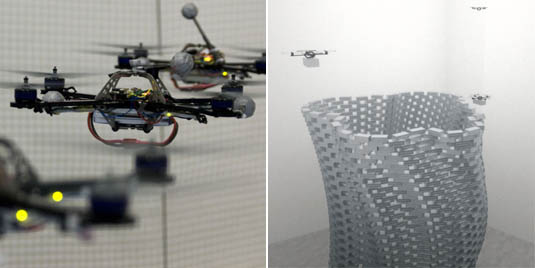
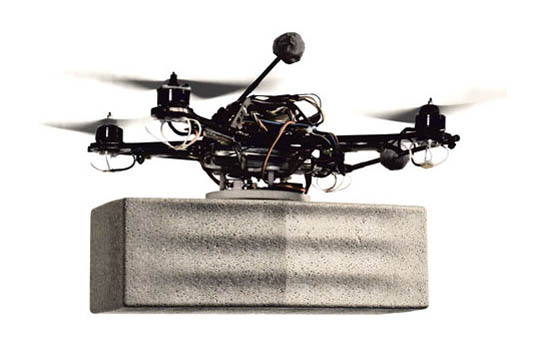
A short video has been released documenting the brick swarm project mentioned here last month, in which Swiss architects Gramazio & Kohler deploy semi-autonomous flying robots to assemble a structure of foam bricks. However, it’s as if the architects underestimate the interest of their own work, fast-forwarding through the bulk of the assembly process as if no one would want to watch such a thing (or perhaps their robots were less graceful than originally hoped). Either way, check out the results, embedded above.

(Thanks to phenrydelphia for the tip!)

Speleological Superparks

[Image: Downtown Reno on a Saturday night with people queuing up to climb the BaseCamp wall; photo by BLDGBLOG].

As part of an overall strategy to rebrand itself not as a city of gambling and slot machines—not another Las Vegas—but as more of a gateway to outdoor sports and adventure tourism—a kind of second Boulder or new Moab—Reno, Nevada, now houses the world’s largest climbing wall, called BaseCamp, attached to the side of an old hotel.

[Image: The wall; photo by BLDGBLOG].

BaseCamp is “a 164-foot climbing wall, 40 feet taller than the previous world’s highest in the Netherlands,” according to DPM Climbing. “The bouldering area will also be world-class with 2900 square feet of overhanging bouldering surface.”

You can see a few pictures of those artificial boulders over at DPM.

[Image: The wall; photo by BLDGBLOG].

Fascinatingly, though, the same company who designed and manufactured this installation—a firm called Entre Prises—also makes artificial caves.

One such cave, in particular, created for and donated to the British Caving Association, is currently being used “to promote caving at shows and events around the country. It is now housed in its own convenient trailer and is available for use by Member Clubs and organizations.”

[Image: The British Caving Association’s artificial cave, designed by Entre Prises; photo by David Cooke].

These replicant geological forms are modular, easily assembled, and come in indoor and outdoor varieties. Indoor artificial caves, we read, “are usually made from polyester resin and glass fibre as spraying concrete indoors is often not very practicable. Indoor caves provide the experience of caving without some of the discomforts of natural or outdoor caves: the air temperature can be relatively easily controlled, in most cases specialist clothing is not required [and] the passage walls are not very thick so more cave passage can be designed to go into a small area.”

Further, maintaining the exclamation point from the original text: “The modular nature of the Speleo System makes it possible to create any cave type and can be modified in minutes by simply unbolting and rotating a section! This means you can have hundreds of possible caving challenges and configurations for the price of one.”

It would be interesting to live in a city, at least for a few weeks, ruled by an insane urban zoning board who require all new buildings—both residential and commercial—to include elaborate artificial caves. Not elevator shafts or emergency fire exits or public playgrounds: huge fake caves torquing around and coiling through the metropolis. Caves that can be joined across property lines; caves that snake underneath and around buildings; caves that arch across corporate business lobbies in fern-like sprays of connected chambers. Plug-in caves that tour the city in the back of delivery trucks, waiting to be bolted onto existing networks elsewhere. From Instant City to Instant Cave. Elevator-car caves that arrive on your floor when you need them. Caves on hovercrafts and helicopters, detached from the very earth they attempt to represent.

This brings to mind the work of Carsten Höller, implying a project someday in which the Turbine Hall in London’s Tate Modern could be transformed into the world’s largest artificial cave system, or perhaps even a future speleo-superpark in a place like Dubai, where literally acres of tunnels sprawl across the landscape, inside and outside, aboveground and below ground, in unpredictably claustrophobic rearrangeable prefab whorls.

The “outdoor” varieties, meanwhile, are actually able “to be buried within a hillside”; however, they “must be able to withstand the bearing pressure of any overlying material, eg. soil or snow. This is usually addressed by making the caving structures in sprayed concrete that has been specifically engineered to withstand the loads. Alternatively the cave passages can be constructed in polyester resin and glass fibre but then they have to be within a structural ‘box’ if soil pressure is to be applied.”

In any case, here are some of the cave modules offered by Entre Prises, a kind of cave catalog called the Speleo System—though it’s worth noting, as well, that “To add interest within passages and chambers, cave paintings and fossils can be added. This allows for user interest to be maintained, creating an educational experience.”

[Image: The Speleo System by Entre Prises].

As it happens, Entre Prises is also in the field of ice architecture. That is, they design and build large, artificially maintained ice-climbing walls.

These “artificial ice climbing structures… support natural ice where the air temperature is below freezing point.” However, “permanent indoor structures,” given “a temperature controlled environment,” can also be created. These are described as “self generating real ice structures that utilize a liquid nitrogen refrigeration system.”

[Images: An artificial ice structure by Entre Prises for the Winter X Games].

Amongst many things, what interests me here is the idea that niche sports enthusiasts—specifically cavers and climbers—have discovered and, perhaps more importantly, financially support a unique type of architecture and the construction techniques required for assembling it that, in an everyday urban context, would appear quite eccentric, if not even avant-garde.

Replicant geological formations in the form of modular, aboveground caves and artificially frozen concrete towers only make architectural and financial sense when coupled with the needs of particular recreational activities. These recreational activities are more like spatial incubators, both inspiring and demanding new, historically unexpected architectural forms.

So we might say that, while architects are busy trying to reimagine traditional building typologies and architectural programs—such as the Library, the Opera House, the Airport, the Private House—these sorts of formally original, though sometimes aesthetically kitsch, designs that we are examining here come not from an architecture firm at all, or from a particular school or department, but from a recreational sports firm pioneering brand new spatial environments.

As such, it would be fascinating to see Entre Prises lead a one-off design studio somewhere, making artificial caves a respectable design typology for students to admit they’re interested in, while simultaneously pushing sports designers to see their work in more architectural terms and prodding architects to see niche athletes as something of an overlooked future clientele.

Brooklyn Vent

[Image: Disguised infrastructure; photo by BLDGBLOG].
In the novel Foucault’s Pendulum, two characters discuss a house that is not what it appears to be. People “walk by” this house in Paris, we read, but “they don’t know the truth. That the house is a fake. It’s a facade, an enclosure with no room, no interior. It is really a chimney, a ventilation flue that serves to release the vapors of the regional Métro. And once you know this you feel you are standing at the mouth of the underworld…”

[Image: The door to the underworld; photo by BLDGBLOG].

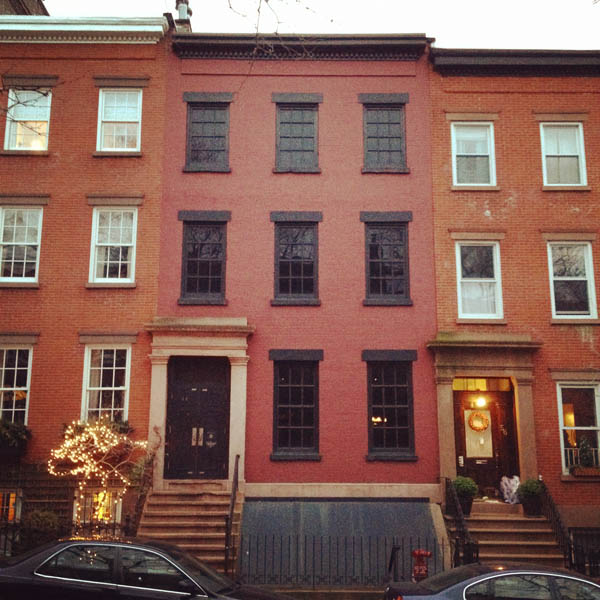
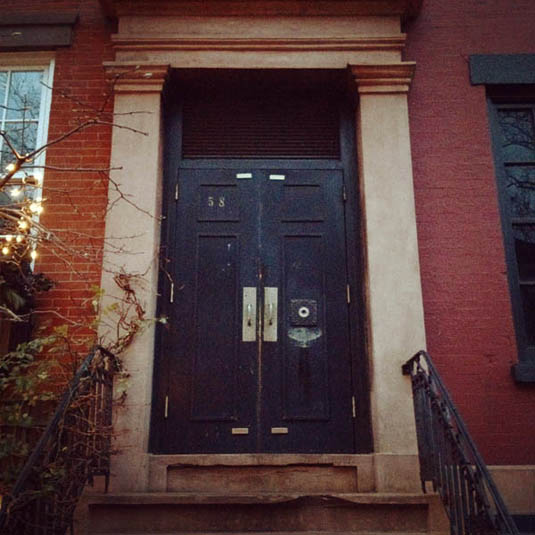
Two days ago, Nicola Twilley and I went on an early evening expedition over to visit the house at 58 Joralemon Street in Brooklyn, with its blacked out windows and its unresponsive front door.

This “house” is actually “the world’s only Greek Revival subway ventilator.” It is also a disguised emergency exit for the New York City subway.

[Image: Disguised infrastructure; photo by BLDGBLOG].

According to a blog called the Willowtown Association, “the ventilator was a private brownstone dating from 1847. The substation was built in 1908 in conjunction with the start of subway service to Brooklyn. As reported in the BKLYN magazine article, the building’s ‘cavernous interior once housed a battery of electrical devices that converted alternating current to the 600-volt direct current needed to power the IRT.'”

[Image: A view through the front door of 58 Joralemon Street; photo by BLDGBLOG].
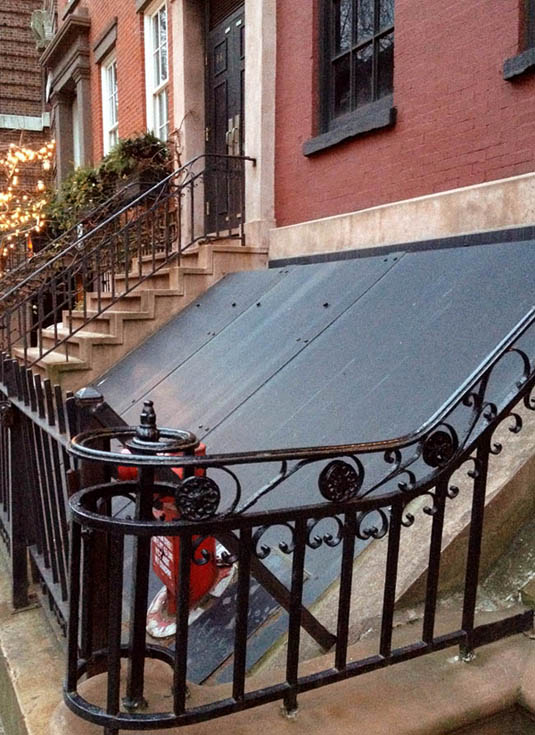
It is New York’s more interesting version of 23/24 Leinster Gardens in London. As the Brooklyn Daily Eagle wrote last year, “the exit disguised as a brownstone leads to a grimy-lit set of metal stairs that ascend past utility boxes and ventilation shafts into a windowless room with a door. If you opened the door, you would find yourself on a stoop, which is just part of the façade.”

[Image: Photo by BLDGBLOG].

You’ll notice on Google Maps that the 4/5 subway line passes directly beneath the house, which brings to mind an old post here on BLDGBLOG in which we looked at the possibility that repurposed subway cars could be used someday as extra, rentable basement space—that is, “temporary basements in the form of repurposed subway cars,” with the effect that “each private residence thus becomes something like a subway station, with direct access, behind a locked door, to the subterranean infrastructure of the city far below.”

Then, for a substantial fee—as much as $15,000 a month—you can rent a radically redesigned subway car, complete with closets, shelves, and in-floor storage cubes. The whole thing is parked beneath your house and braked in place; it has electricity and climate control, perhaps even WiFi. You can store summer clothes, golf equipment, tool boxes, children’s toys, and winter ski gear.
When you no longer need it, or can’t pay your bills, you simply take everything out of it and the subway car is returned to the local depot.
A veritable labyrinth of moving rooms soon takes shape beneath the city.

Perhaps Joralemon Street is where this unlikely business model could be first tried out…

In any case, Nicola and I walked over to see the house for a variety of reasons, including the fact that the disguised-entrance-to-the-underworld is undoubtedly one of the coolest building programs imaginable, and would make an amazing premise for an intensive design studio; but also because the surface vent structures through which underground currents of air are controlled have always fascinated me.

These vents appear throughout New York City, as it happens—although Joralemon, I believe, is the only fake house—serving as surface articulations of the larger buried networks to which they are connected.

[Image: Two views of the tunnel vent on Governors Island; photos by BLDGBLOG].
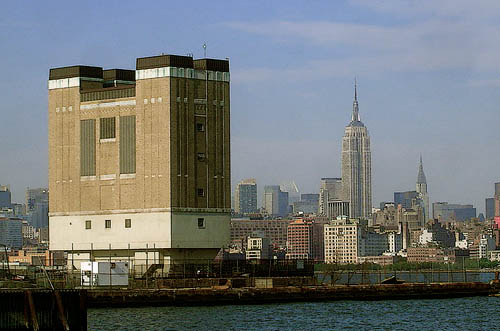
The Battery Tunnel has a particularly noticeable vent, pictured above, and the Holland Tunnel also vents out near my place of work.

[Image: Holland Tunnel exhaust tower; photo via SkyscraperPage.com].
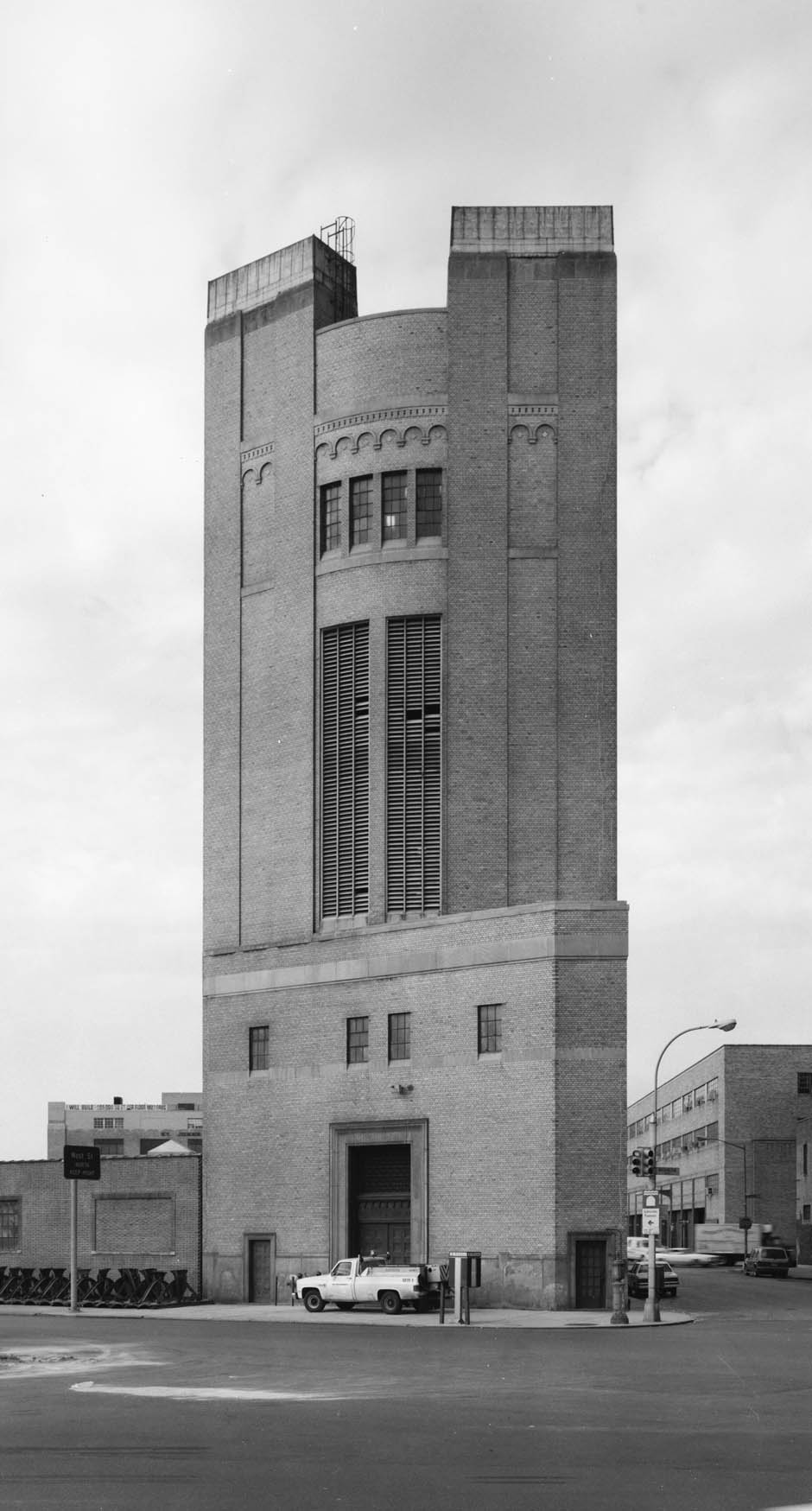
As historian David Gissen writes in his excellent book Subnature: Architecture’s Other Environments, New York’s ventilation control structures are “strange buildings” that have “collapsed” the difference between architecture and civil engineering:

The Holland Tunnel spanned an enormous 8,500 feet. At each end, engineers designed ten-story ventilation towers that would push air through tunnels above the cars, drawing the vehicle exhaust upward, where it would be blown back through the tops of the towers and over industrial areas of the city. The exhaust towers provided a strange new building type in the city—a looming blank tower that oscillated between a work of engineering and architecture.

As further described in this PDF, for instance, Holland Tunnel has a total of four ventilation structures: “The four ventilation buildings (two in New Jersey and two in New York) house a total of 84 fans, of which 42 are blower units, and 42 are exhaust units. They are capable, at full speed, of completely changing the tunnel air every 90 seconds.”

[Image: The Holland Tunnel Land Ventilation Building, courtesy of Wikipedia].
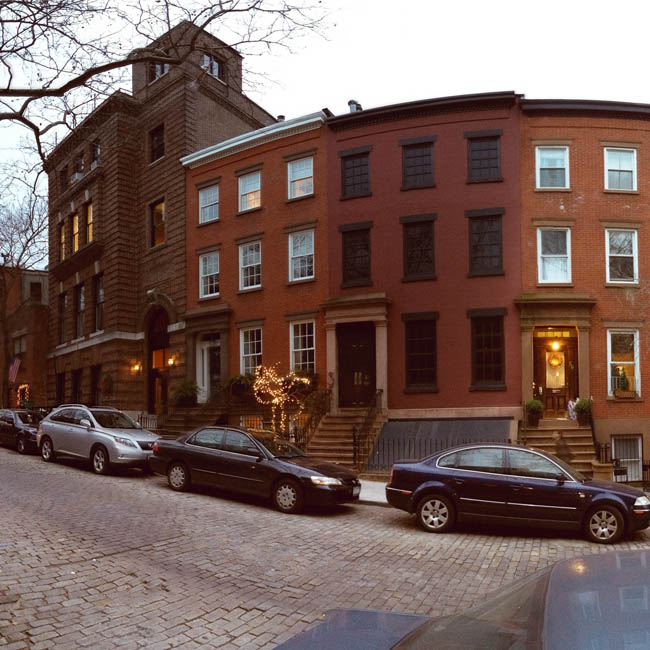
Several years ago a friend of ours remarked that she didn’t like staying in hotels near Columbus Circle here in New York because that’s the neighborhood, she said, where all the subways vent to—a statement that appears to be nothing more than an urban legend, but that nonetheless sparked off a long-term interest for me in finding where the underground weather systems of New York City are vented to the outside. Imagine an entire city district dedicated to nothing but ventilating the underworld!

[Image: The house on Joralemon Street; photo by BLDGBLOG].
This is a topic I will no doubt return to at some point soon—but, for now, if you want to see a disguised entrance to the 4/5 line, walk down Joralemon Street toward the river and keep your eyes peeled soon after the street turns to cobblestones.

(The house on Joralemon Street first discovered via Curbed).

Brick Swarm

[Image: From “Flight Assembled Architecture” by Gramazio & Kohler].

Semi-autonomous flying robots programmed by Swiss architects Gramazio & Kohler “will lift, transport and assemble 1500 polystyrene foam bricks” next month—starting 2 December 2011—at the FRAC Center in France. The result, they hope, will be a “3.5 meter wide structure.”

[Image: From “Flight Assembled Architecture” by Gramazio & Kohler].

According to the architects, this will serve as an experimental test-run for the construction of a hypothetical future megastructure—presumably requiring full-scale, autonomous, GPS-stabilized helicopters. However, I’d think that even a small insectile swarm of robot bricklayers piecing together a new low-rise condominium somewhere—its walls slowly materializing out of a cloud of rotors and drones—would be just as compelling.

(Earlier on BLDGBLOG: Flying Robotic Construction Cloud and Robotism, or: The Golden Arm of Architecture).

Sea Caverns of Singapore

[Image: Singapore expands beneath the Pacific Ocean; via the BBC].
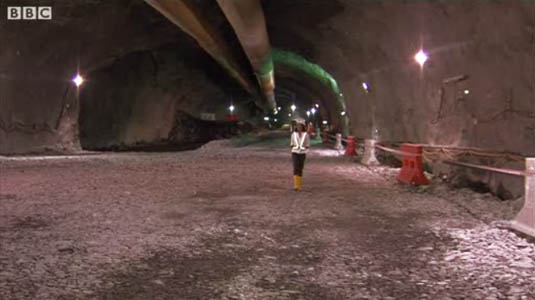
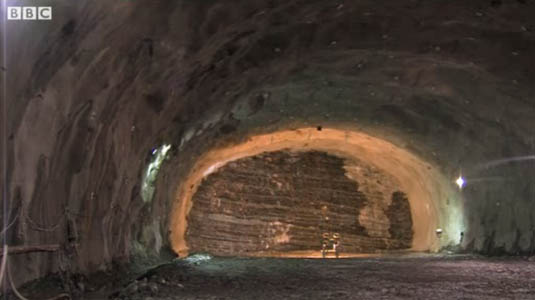
Singapore has embarked upon the excavation of an underground oil reserve, expanding the city’s industrial port beneath the floor of the Pacific Ocean. It is “no ordinary construction site,” the BBC tells us, but an elaborate project of engineering and infrastructure currently underway “several hundred feet underground, below the seabed in Singapore.”

There, workers are “laboring around the clock to carve out an enormous network of caverns that will eventually store vast amounts of oil.”

[Images: Singapore expands beneath the Pacific Ocean; via the BBC].
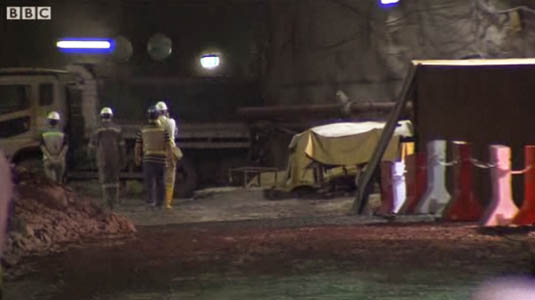
More specifically, “Five oil storage caverns are being dug out under the seabed of Banyan Basin, off Jurong island, a series of mostly-reclaimed islands that house most of Singapore’s petrochemical industry.”

Artificial caverns built offshore from manmade islands?

The terrestrial mechanics of Singapore’s existence are increasingly interesting, if ecologically problematic. As Pruned‘s recent look at the city’s sand-importation economy shows, the island-nation exists through a near-ceaseless act of geological accumulation, piecing itself together and expanding from the inside out using deposits of earth taken from neighboring countries.

Singapore, Pruned writes, “has been reclaiming land from the sea since the mid-1960s, expanding its total land area by nearly 25% as a result. And it’s still growing. With no hinterlands to supply it with natural resources, however, it has to import sand, the primary landfill material. But exactly where, the Singaporean government does not disclose. Its supply lines are not public information.”

Earlier this year, we looked at the idea of forensic geology, whereby even a single piece of sand can be tracked back to its terrestrial origins. As that link explains, the source of electronics-grade silicon is often deliberately occluded from public documents, treated as an industrial trade secret. Here, though, it is not microchips but internationally recognized political territory that is being mined, traded, and assembled—a black economy without audit or receipts.

Singapore’s off-the-books experiment in sovereign expansion—not through military conquest but through intelligent geotextiles, Herculean dredging projects, and, of course, new undersea caverns—is perhaps a kind of limit-case in how nation-states not only utilize natural resources but literally build themselves from the ground up (and down) as political acts of landscape architecture.

(Earlier on BLDGBLOG: Artificial Caverns Expanding Beneath Chicago).

Studio-X NYC

I am thrilled to say that I have moved east to New York City, leaving California after five unforgettable and productive years, to take on a new role as co-director, with Nicola Twilley, of Studio-X NYC at Columbia University. We both think this is an amazing opportunity to reengineer what it means to discuss cities today, and Nicola and I are committed to pursuing this goal in as wide-ranging and open a way as possible.

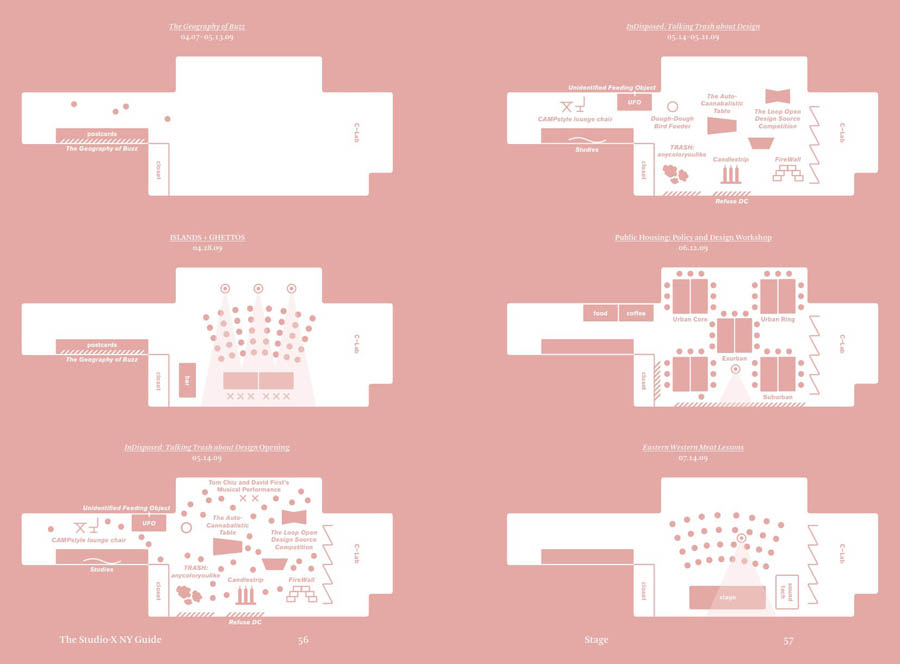
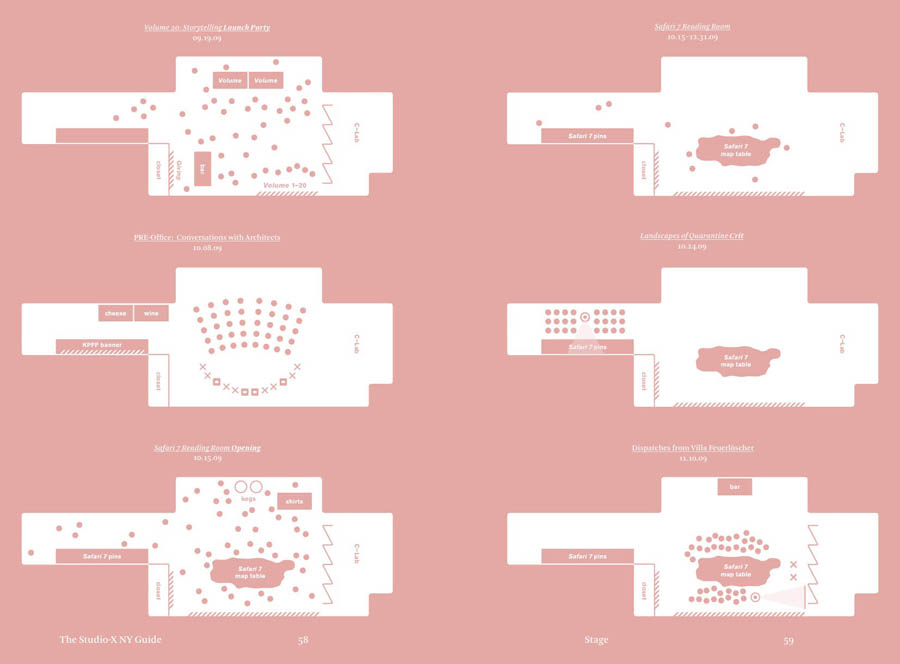
[Images: Spatial formats for events at Studio-X NYC, from Studio-X Guide to Liberating New Forms of Conversation].

Speaking for both Nicola and myself, one of the most invigorating aspects of all this is the ability to work with people in radically different fields and professions—from policing to public health, archaeology to architecture, literature to film, international finance to amateur sports, subway engineers to sidewalk eccentrics, mayoral candidates to venture capitalists—all of whom have a perspective on, and vested interests in, how cities function. Nicola and I thus anticipate a surge of new collaborations, friends, and, of course, critics—and we hope to see many of you in person, at any number of our forthcoming meetings, events, exhibitions, tours, film fests, book launches, panel discussions, and more.

In the very near term, we have a few things scheduled. Kicking off a new series of conversations that we call Live Interviews @ Studio-X—or LI@SX—we will be hosting a public conversation with Deborah Estrin at 12:30pm on Thursday, September 1st.

Deborah is director of the Center for Embedded Network Sensing at UCLA. She will be discussing her work with self-monitoring applications, participatory sensing campaigns for community data projects, and citizen science, as well as larger issues of surveillance, privacy, and information filtering in the digital city.

The live interview format will take the form of an informal, one-on-one conversation—moderated in this case by Nicola Twilley—which the public is invited both to attend and to join. For those of you unable to be there in person, the LI@SX series will be recorded for posterity, webcast whenever possible, and eventually transcribed and published online.

[Images: Liam Young installs “Specimens of Unnatural History” at the Nevada Museum of Art; photos by Jamie Kingman].
Later that same evening—at 6pm, Thursday, September 1st—we will be hosting a Landscape Futures Night School with London-based architect Liam Young. This is an experiment with a different format: the Night School is a more interactive exploration of ideas, by definition hosted in the evenings, taking the form of everything from lectures and slideshows to design challenges and debates. The Night School series will be flexibly themed and very different each time it’s run.

Liam Young is co-founder (with Darryl Chen) of the design collective and futures think tank Tomorrows Thoughts Today, as well as leader (with Kate Davies) of the Unknown Fields Division, a nomadic design studio based at the Architectural Association (newly returned from a summer expedition to Chernobyl and Baikonur). Liam will be joining us to introduce some of his Specimens of Unnatural History, recently installed as part of the Landscape Futures exhibition at the Nevada Museum of Art in Reno.

Following Liam’s presentation of his work, I’ll be engaging with him in a public conversation, whiteboard brainstorm, and armchair journey around the world, exploring fieldwork as a form of research, the role of the sketchbook, the importance of narrative in architectural design, and the architect as investigative traveler. Expect to hear about everything from Australian kangaroo culls and the control of invasive species to conflict metals, the open-pit gold mine as designed landscape, and the difficulties of piloting a boat up the Congo.

The Landscape Futures Night School kicks off at 6:00pm; however, you must RSVP if you would like to attend: studioxnyc AT gmail DOT com.

[Images: Spreads from Geologic City by Smudge Studio].

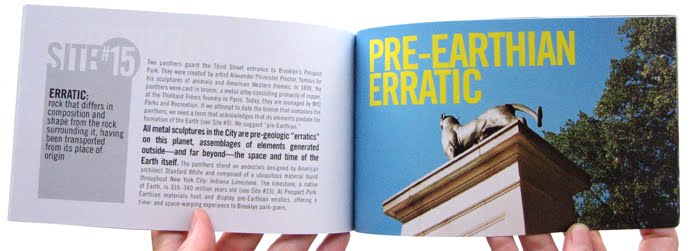
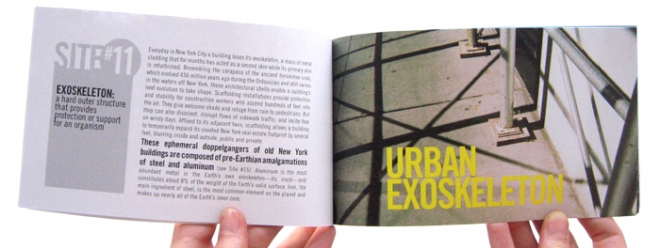
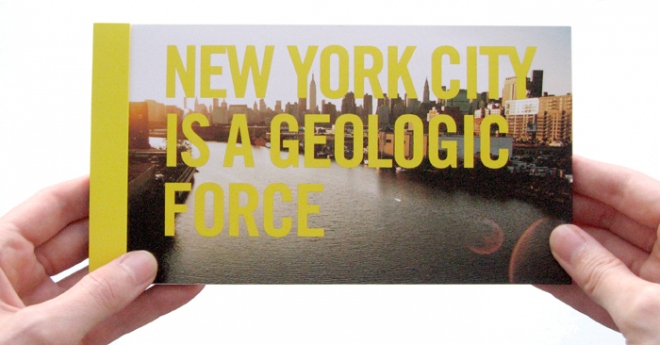
Next week, meanwhile, we will be hosting a launch party for Smudge Studio‘s new pamphlet, Geologic City, a look at the rocky underpinnings of New York, both temporary & abstract (gold reserves, fiber optics, magnetic strips on subway cards) and massively real (bedrock, landslides, urban mineralogy). Jamie Kruse and Elizabeth Ellsworth of Smudge Studio—co-authors of the blog Friends of the Pleistocene—will guide attendees through the pamphlet, as well as through the deep time of the city, utilizing Studio-X NYC’s 16th-floor windows overlooking southwestern Manhattan and the Hudson River to point out specific sites of geological influence on New York itself.

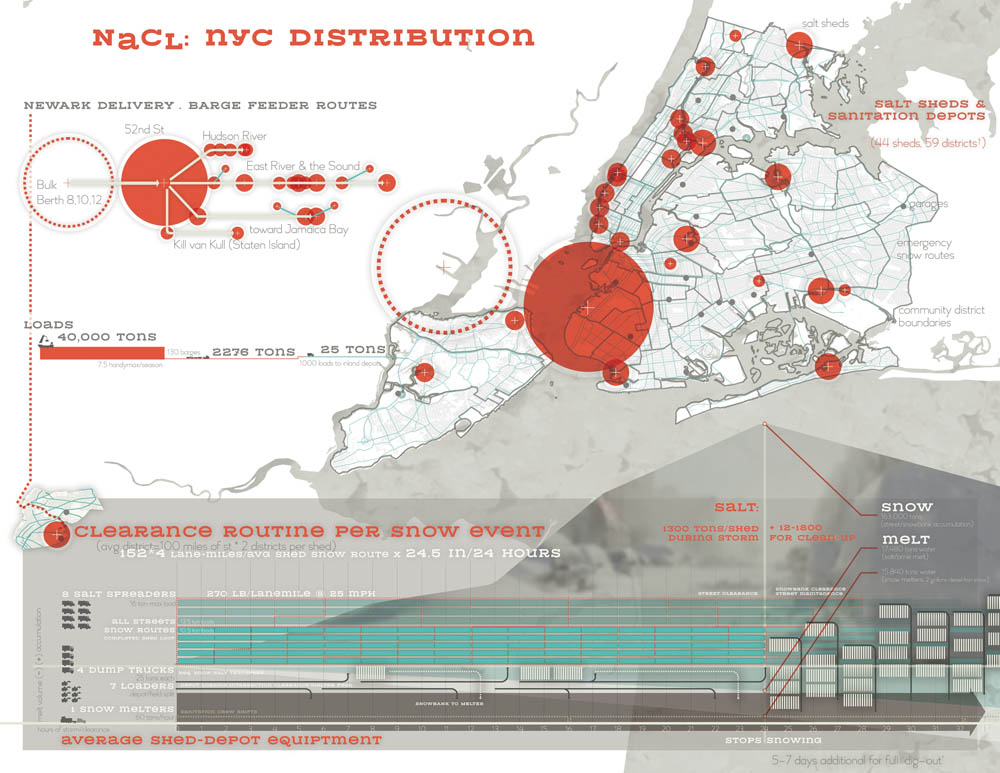
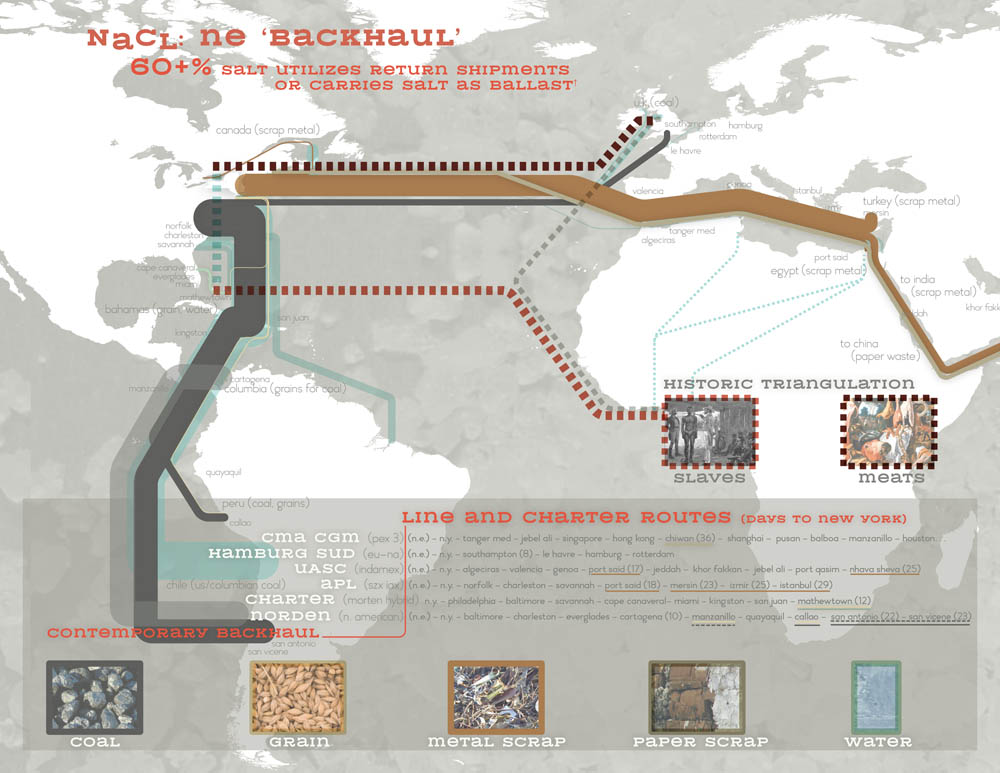
Jamie and Liz will be joined by Meg Studer, a designer and cartographer with a sustained interest in ecological systems, who has recently mapped the road-salt industry. The installations will remain in Studio-X NYC for two weeks, open to the public.

[Images: Salt maps by Meg Studer].

Also on our schedule for the near future is an evening with photographer Simon Norfolk, whose work should be familiar to long-term readers of this site; BLDGBLOG’s 2006 interview with Simon is still one of my personal favorites, and is well worth reading in full. Simon will be engaged in a wide-ranging discussion with Noah Shachtman—editor of Wired‘s excellent blog Danger Room—and this will kick off a longer series of events themed around conflict and the city: urban military action, urban violence, urban police technology, urban warfare, divided cities, and much more. (While he’s in town, don’t miss Simon’s lecture at the School of the Visual Arts on Wednesday, September 14).

The rest of the autumn promises a huge array of exhibitions, events, and public meetings—design charrettes, walking tours, all-day interviews, film fests, panel discussions, standalone lectures, slideshows, night schools, and more. To whet your appetite, our schedule is currently shaping up with a distributed film festival, exploring bank heists and prison breaks as architectural phenomena, co-organized with Filmmaker Magazine; a series of literary launches hosted in collaboration with GQ and Farrar, Straus and Giroux; live conversations with Benjamin Bratton, Luis Callejas, Christian Parenti, Janette Kim, Chris Woebken, and Bernard Tschumi, among many others, including ongoing collaborations with GSAPP’s own stellar faculty.

Farmland World

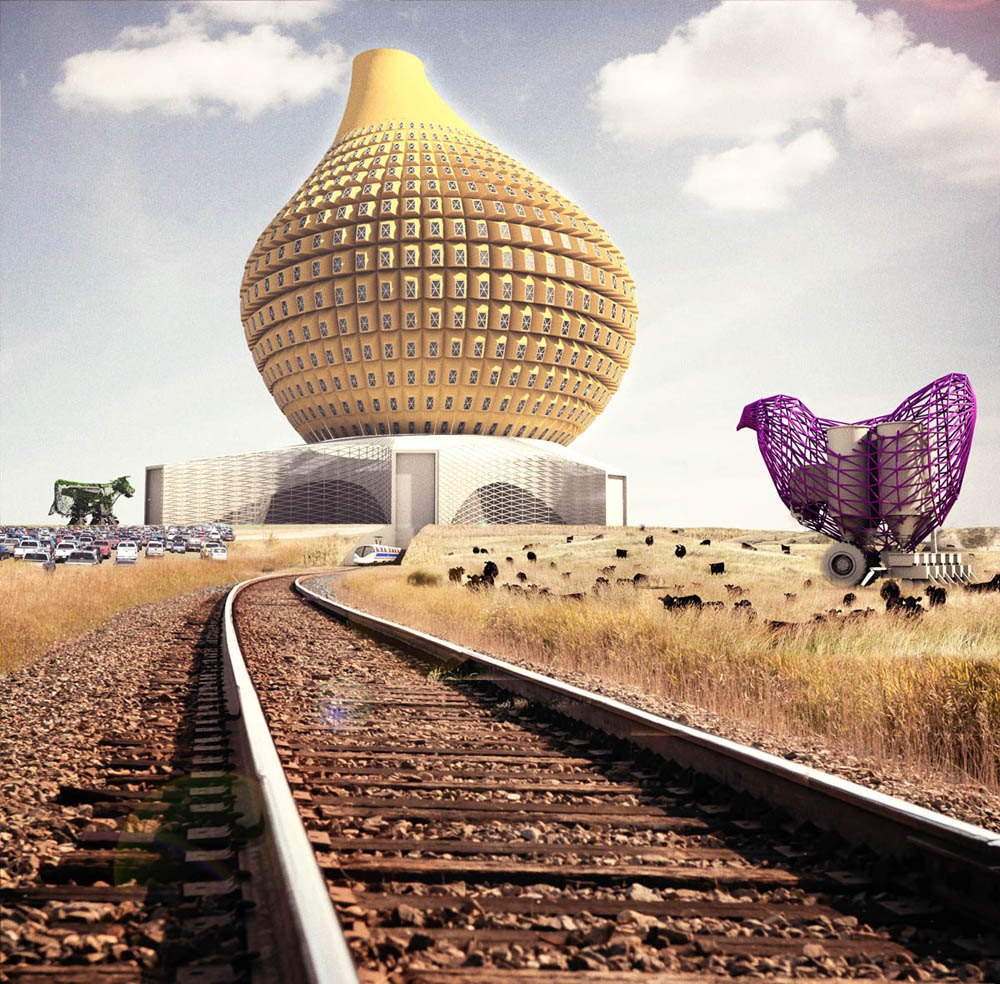
[Image: “Farmland World” by Design With Company (Allison Newmeyer and Stewart Hicks)].

One of the runners-up for the recent Animal Architecture Awards is also one of my favorites from the competition: “Farmland World” by Allison Newmeyer and Stewart Hicks of the Chicago-based Design With Company.

The project is an ironic investigation of how humans relate to farm animals—more specifically, how the ongoing spatial separation between humans and the animals they rely on for food and other forms of agricultural work can make animals seem to be nothing more than utilitarian machines.

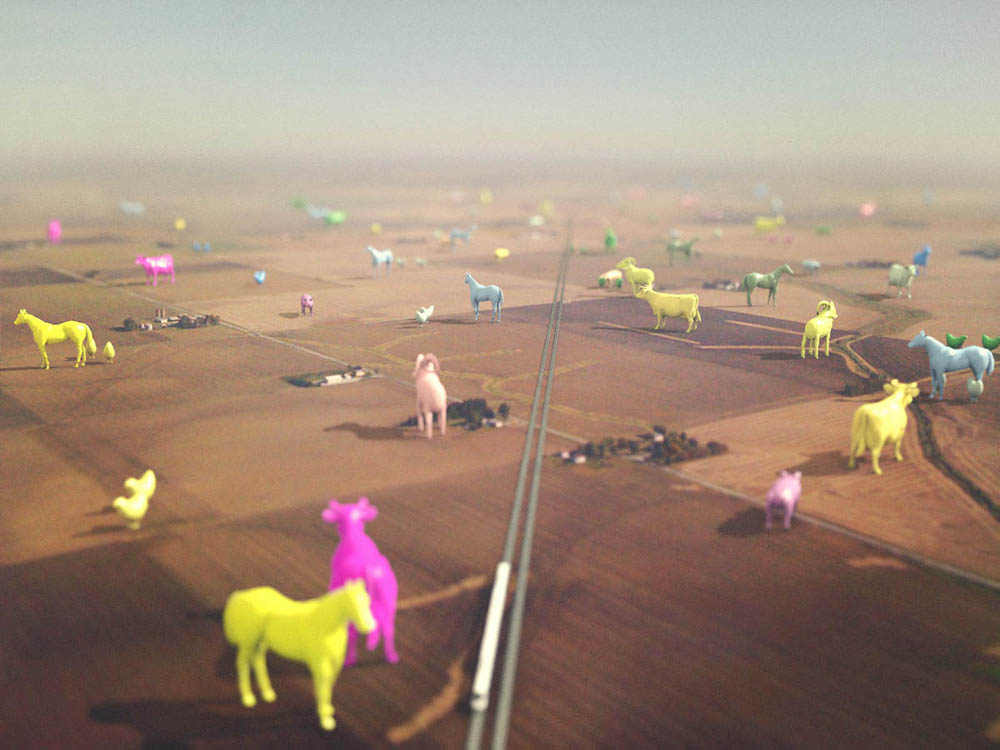
[Image: From “Farmland World” by Design With Company; view larger].

In the architects’ words:

The everyday life of the average American is almost completely disconnected from the land and animals that support them. Even farmers perform their duties primarily through automated mechanisms that remove them from the subject of their industry. The constructed distance between the human “us” and the animal “others” is increasing to the point that distinctions between machines and animals look blurry purely from distanced detachment. From our removed perspective, the extreme demand for cheap food production and the diversion of the pet economy distorts animals until they look more like utilitarian machines (bacon) or anthropomorphic projections to entertain and decorate (tea-cup terrier). As we relate to animals and machines similarly, where each begins to exhibit characteristics of the other, their converging trajectories point to an impending crisis at their collision.

Farmland World makes the human-animal encounter spectacular, proposing an absurdly over-the-top farm animal theme park—a “human/machine/animal hybrid adventure-land.”

[Image: From “Farmland World” by Design With Company].

Farmland World “is a chain of agro-tourist resorts sprinkled across the American Midwestern countryside”:

Part theme park and part working farm, guests arrive to the resort via train and stay as part of 1-day, 3-day or 5-day experience packages. Capitalizing on both recent governmental investments in high-speed rail infrastructure and the plentiful subsidies for farming, the network of resorts combine crowd-sourced farm labor with eco-tainment.

“As train-loads of itinerant fantasy farmers arrive,” Newmeyer and Hicks drily write, “they are herded to the Grazing Coliseum to receive their complimentary overalls. From there, the adventure begins.”

[Image: From “Farmland World” by Design With Company; view larger].

Foregrounding the idea that humans have increasingly come to confuse animals with machines, Farmland World is populated by robots, rides, and representations.

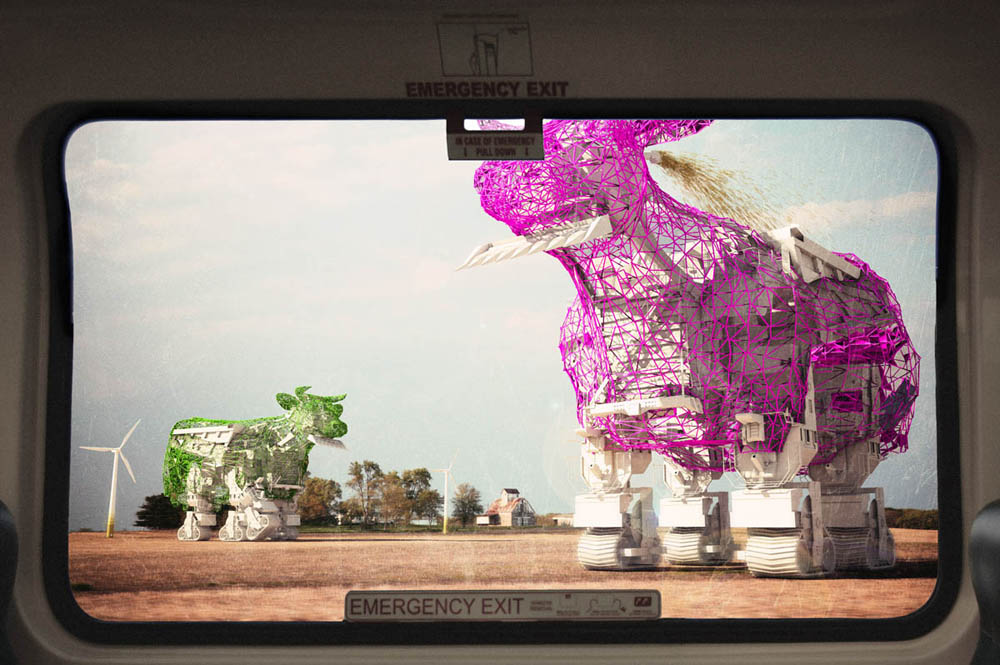
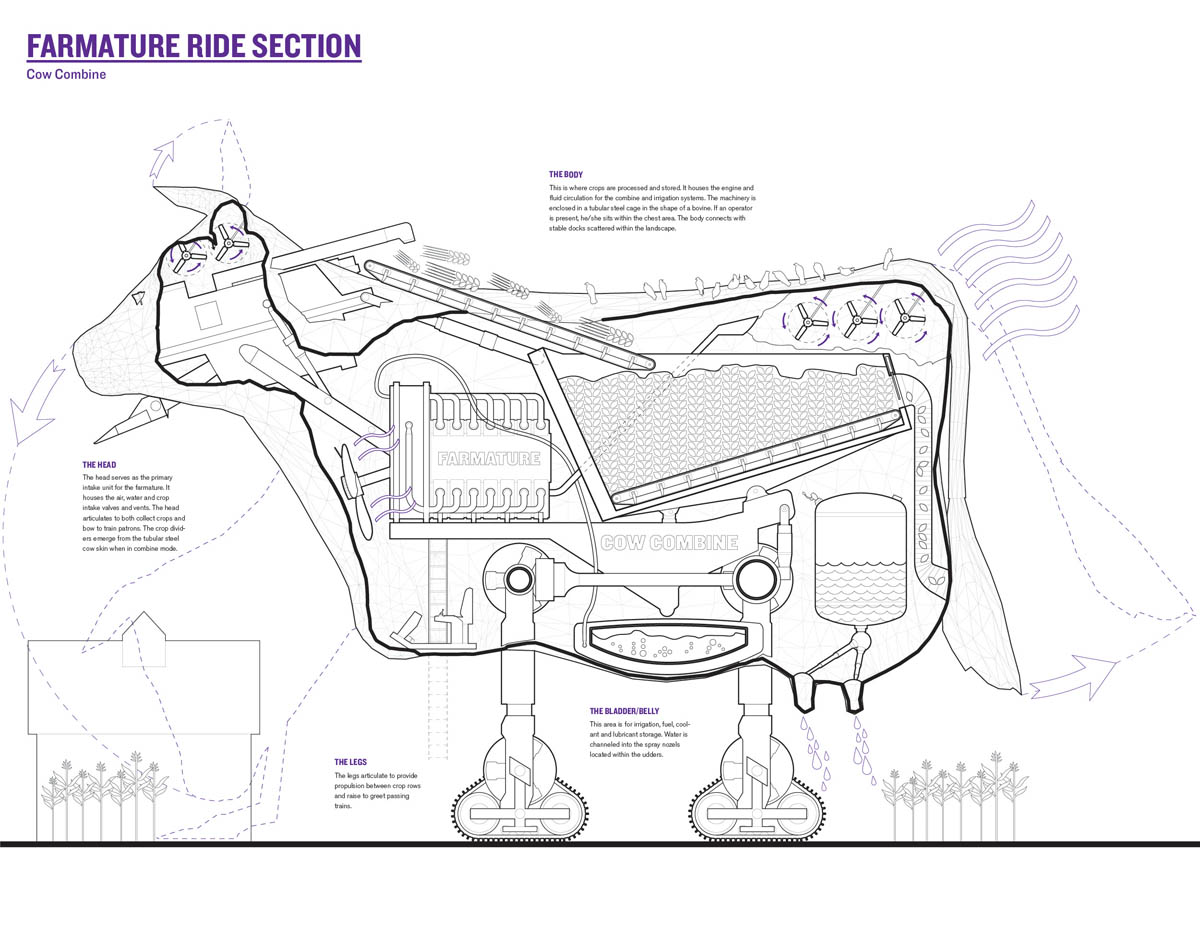
Inflatable mega-pigs and hollow, roving “cow combines” act as “robotic performers,” in the designers’ words. Animal replicants, these false creatures “extend the tradition of machines using and mimicking animals for moving, operating, branding and processing food crops.”

[Image: From “Farmland World” by Design With Company; view section in more detail].

Meanwhile, the architect adds, “temporary farm excursionists”—paying visitors—”work, sowing and harvesting fields, becoming part of the herd. Farmland World embraces this hybrid human-animal-machine relationship, reinvigorating the rural landscape.”

[Images: The robotic super-cows of “Farmland World” by Design With Company; view section in more detail].

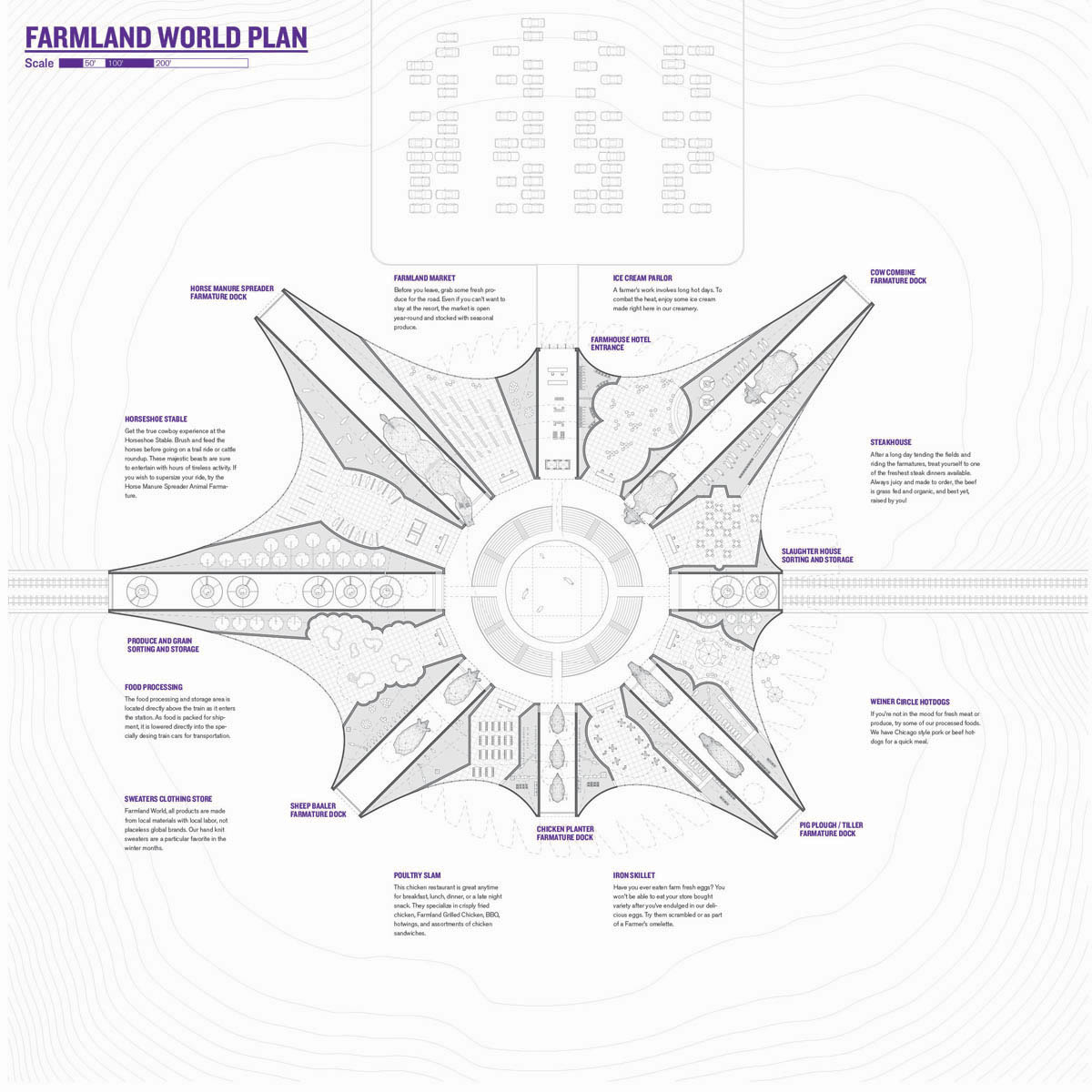
As you can see in the project’s overall guide, there are a whole series of these giant robot animals. A “chicken planter” stands beside a mechanical “sheep baaaler,” which, in turn, is neighbors with a pig plow and a mechanical horse that spreads real horse manure from its techno-derriere. Think of it as Westworld in an age of vast industrial farming—a livestock Disneyland.

[Image: From “Farmland World” by Design With Company; view larger].

On the project plan, you’ll also see such places as “Beeville” and “Veggie Row,” the latter promising an internally-animated range of machine-plants sprouting from beds of artificial soil.

Having gone to elementary school in a small town in rural Wisconsin, I vividly remember being taken to see farm animals over at UW-Madison, including one that had had a window surgically implanted into its side; you could actually watch the cow, in section, digesting its food.

To go from this—a bovine proto-cyborg—to Design With Company’s beautifully rendered “Farmland World” doesn’t actually seem like such a stretch.

In any case, congratulations to Allison Newmeyer and Stewart Hicks for placing as second runner-up in the Animal Architecture Awards; for more, see the Animal Architecture website as well as this earlier post today on BLDGBLOG.

Interpretation-Based Spatiality

[Image: A collage of various buildings by Robert Scarano, from photos by Gabrielle Plucknette for the New York Times].
After reading today that a New York appeals court has upheld a ban on architect Robert Scarano, preventing him from practicing in the city, I found this fascinating anecdote published a few months ago about one of the tactics Scarano has used to get his developments cleared by the Department of Buildings. Quoting the New York Times at length:

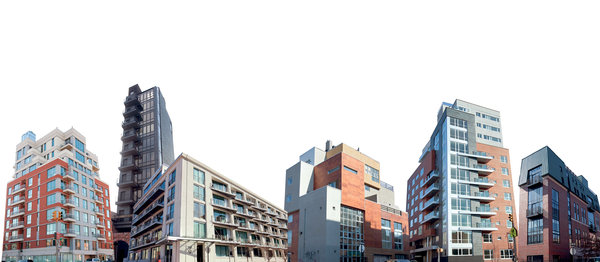
It’s the summer of 2008. A young couple decides to buy an 800-square-foot apartment in a new condo building on the gentrifying outer edge of a fashionable Brooklyn neighborhood. The buyers go to close on the place, and as they’re signing away half a million dollars, the building’s developer, keeping a wary eye on the hovering lawyers, leans over and whispers something. There’s a second bathroom in the apartment, he says, one that does not appear on the floor plan—its doorway is concealed behind an inconspicuous layer of drywall. At first, the buyers think the developer is kidding. This is before the crash, near the peak of the market, and no one’s giving away a square inch. But the developer says no, he’s dead serious, just look. So a few days after they buy the place, the couple takes a sledgehammer to their wall.

Like something out of House of Leaves—or a kind of architectural Advent calendar, in which various walls are knocked down at specific times of the year to reveal whole new rooms and corridors behind them—the building contained more space than its own exterior had indicated.

Later, the article’s author goes on to attend a party in another of Scarano’s buildings: “‘There’s a secret room,’ [the party’s host] told me, conspiratorially. Up on the mezzanine level, next to a pair of D.J.’s turntables, he knocked on a wall. It sounded hollow.”

I have to admit that this totally blows my mind. Imagine another room within that room whose doorway is also sealed behind drywall—and then other rooms within that room, and further corridors and stairs and entrances. Tap, tap, tap—you navigate by sound, knocking deeper and deeper into an architectural world you only reveal by means of careful deconstruction. Amidst this labyrinth of drywalled rooms, you realize the true extent of your property, which extends so far beyond what you originally thought was your building that you end up, at one point, standing in another zip code.

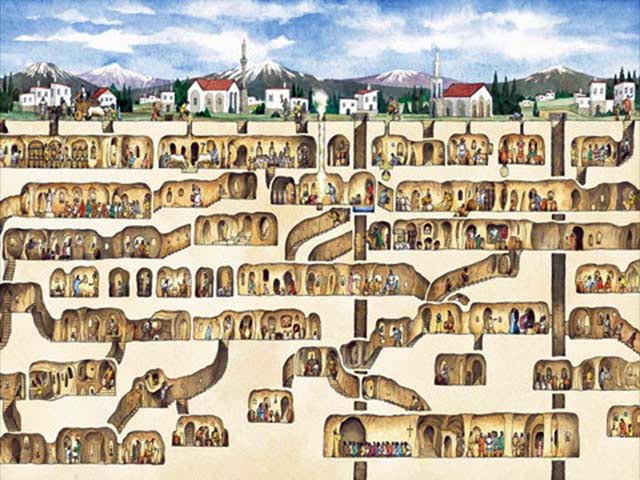
[Image: The underground city of Derinkuyu].

In a way, I’m reminded of the massive underground city of Derinkuyu, which, as Alan Weisman explains in The World Without Us, was discovered entirely by accident:

No one knows how many underground cities lie beneath Cappadocia. Eight have been discovered, and many smaller villages, but there are doubtless more. The biggest, Derinkuyu, wasn’t discovered until 1965, when a resident cleaning the back wall of his cave house broke through a wall and discovered behind it a room that he’d never seen, which led to still another, and another. Eventually, spelunking archeologists found a maze of connecting chambers that descended at least 18 stories and 280 feet beneath the surface, ample enough to hold 30,000 people—and much remains to be excavated. One tunnel, wide enough for three people walking abreast, connects to another underground town six miles away. Other passages suggest that at one time all of Cappadocia, above and below the ground, was linked by a hidden network. Many still use the tunnels of this ancient subway as cellar storerooms.

In any case, for Scarano it was not always about literally hiding extra rooms inside a building; it was often just a matter of using certain words—like basement—instead of others—like cellar—to hide his intentions. For instance, “Scarano tried to build a two-story addition to the roof of [an] old warehouse by transferring floor area from the building’s lowest level, which he planned to convert to parking, to the top of the roof. But the zoning code distinguished between a basement (which is partly above ground, defined as habitable, and therefore counted toward the floor-area ratio) and a cellar (which is underground and uninhabitable). Opponents accused Scarano of trying to finesse the difference, and eventually the Department of Buildings declared the space a cellar. New height limits have been established in the neighborhood, and the partly built addition is coming down.”

Or this: Scarano “adapted the zoning rules that applied to warehouse conversions. Under certain circumstances, the code classified loft mezzanines as storage space, not floor area, and Scarano assured developers their new building plans could slip through this loophole.”

It’s hermeneutics—as if the spatial expansion of whole neighborhoods is really just a graph of certain words used in different contexts. As if vocabulary itself materializes, precipitating out as alternative spatial futures for the city. Indeed, the New York Times writes, “in Scarano’s view, the city’s code was a Talmudic document, open to endless avenues of interpretation. Through a variety of arcane strategies, he could literally pull additional real estate out of the air.”

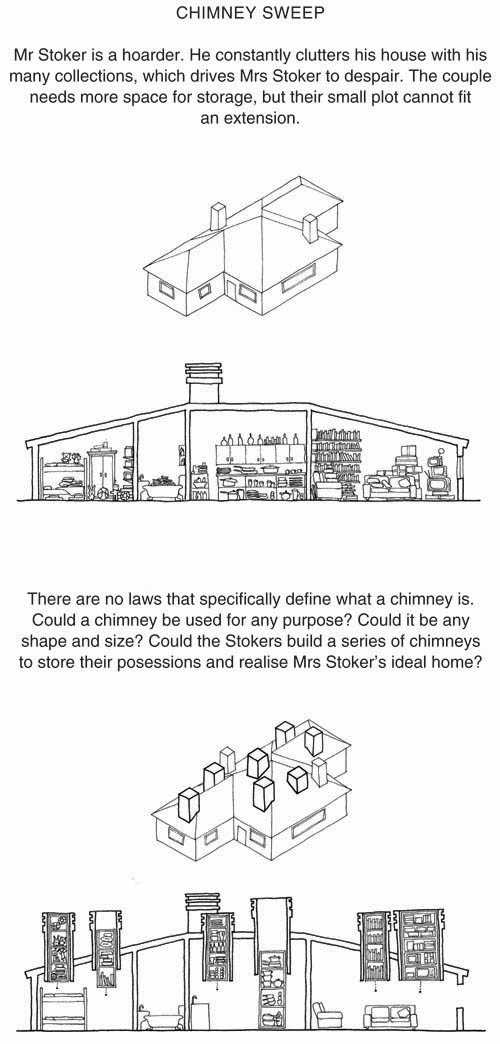
I’ve long been a fan of David Knight and Finn Williams, two London architects with an encyclopedic knowledge of that city’s building permissions and zoning codes (I highly recommend their book SUB-PLAN: A Guide to Permitted Development, as well as Knight’s recent guest post on Strange Harvest). The following image, taken from that book, is just one example of the type of interpretation-based spatiality so often abused by Scarano.

[Image: From SUB-PLAN: A Guide to Permitted Development by David Knight and Finn Williams].

Whether or not hiding entire rooms behind drywall is part of London’s “permitted development” is something we’ll have to ask Knight and Williams.

(Thanks to a tip from Nicola Twilley).

Calling All Agents

Here are some opportunities for writers, designers, and filmmakers, in case you’re looking for ways to challenge yourself over the summer.

[Image: “Angels” (2006) by Ruairi Glynn, one of the co-organizers of Stories of Change].

1) Arup Foresight and the Bartlett School of Architecture have teamed up to gather what they call “responses to some of the world’s most pressing issues as featured in the publication, Drivers of Change. We would like you to tell us your Stories of Change.” Original films, texts, and architectural designs are all eligible and welcome; the texts could even “be a poem, a letter, a blog-post, even a currated collection of tweets.” Which is good news, but the deadline is approaching quickly: Friday, 24 June 2011. See the Stories of Change website for more.

2) For its new call for papers, the Bauhaus-Universität’s Horizonte journal begins by quoting architect Raimund Abraham: “From earliest times,” Abraham writes, “architecture has complied with that order of logical forms which is contained in the nature of each material. That is to say: each material can only be used within the limits imposed by its organic and technical possibilities.” This fourth issue of the consistently well-designed journal explores the materiality of building: the issue thus “challenges the constraints and possibilities of architectural production, in order to reflect on the material and constructive methodologies of the present day.” I imagine essays and even speculative fiction covering everything from genetically engineered building materials to 3D printers—to new types of brick to artisanal craftwork—would be of interest. Your deadline is 8 July 2011.

3) The Architectural League wants to give New York the Greatest Grid:

On the occasion of the two hundredth anniversary of the 1811 Commissioners’ Plan for New York, the foundational document that established the Manhattan street plan from Houston Street to 155th Street, the Architectural League invites architects, landscape architects, urban designers, and other design professionals to use the Manhattan street grid as a catalyst for thinking about the present and future of New York. For two centuries, the Manhattan street grid has demonstrated an astonishing flexibility to accommodate the architectural gestures and urban planning theories of successive generations of architects, urban designers, private developers, and city officials. Given its capacity for reinvention, how might the Manhattan grid continue to adapt and respond to the challenges and opportunities—both large and small—that New York faces now and into the future?

Your deadline is 26 September 2011; see the competition website for much more information.

4) A new Advanced Architecture Contest has been announced, sponsored by the Institute for Advanced Architecture and Hewlett Packard. The theme this year is “CITY-SENSE: Shaping our environment with real-time data.” Aim to submit “a proposal capable of responding to emerging challenges in areas such as ecology, information technology, architecture, and urban planning, with the purpose of balancing the impact real-time data collection might have on sensor-driven cities.” Read more at the Advanced Architecture Contest website; the deadline is 26 September 2011.

5) The California Architectural Foundation, in partnership with the Arid Lands Institute and the Academy for Emerging Professionals, has launched what it calls “an open ideas competition for retrofitting the American West.” The Drylands Competition seeks new ways of “anticipating, mitigating, and adapting to projected impacts of climate change” and other “critical challenges” facing the region. These challenges include water scarcity, obsolete infrastructure, and even the growing gap between scientific knowledge and public policy. “Design teams are invited to generate progressive proposals that suggest to policy makers and the public creative alternatives for the American west, ideas that may be replicated throughout the world.” Register by 15 November 2011; see their website for much more info.

6) Meanwhile, across the pond, the Architects Journal is seeking essays of up to 1,500 words, by writers under the age of 35, for their £1,000 AJ Writing Prize (the money will be split amongst all winners). The jury consists of Christine Murray, Alan Berman, Joseph Rykwert, and Mary Banham; you only have until 30 June 2011 to participate, so get cracking.

7) Finally, this one doesn’t open till September 2011, but it sounds fascinating. Sponsored by Architecture for Humanity, [un]restricted access is “a design competition that will re-envision the future of decommissioned military space. This is an open invite to the global design and construction community to identify retired military installations in their own backyard, to collaborate with local stakeholders, and to reclaim these spaces for social, economic, and environmental good.” As I say, thought, it doesn’t launch until September, but keep your eyes on the [un]restricted access website for emerging info.