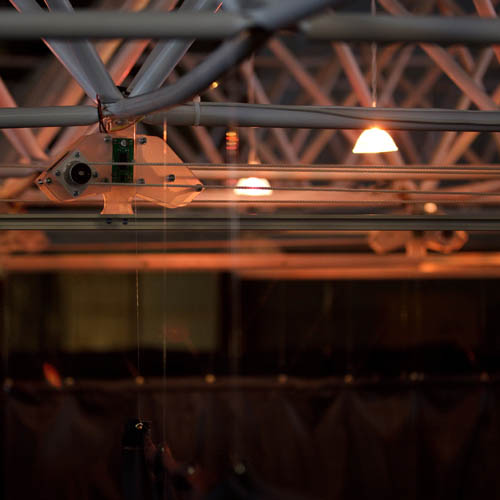
Storyboard

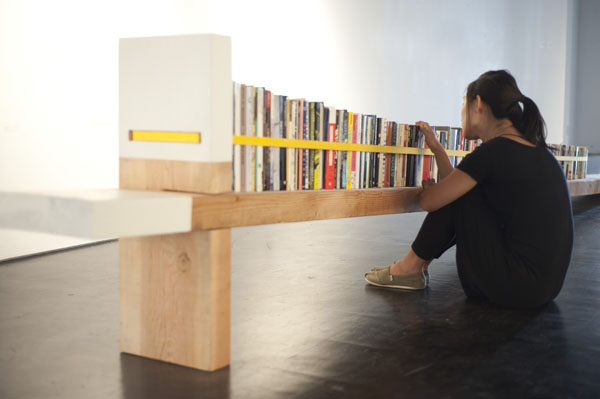
[Image: “Storyboard” by Tim Durfee; photo by Mikey Tnasuttimonkol].

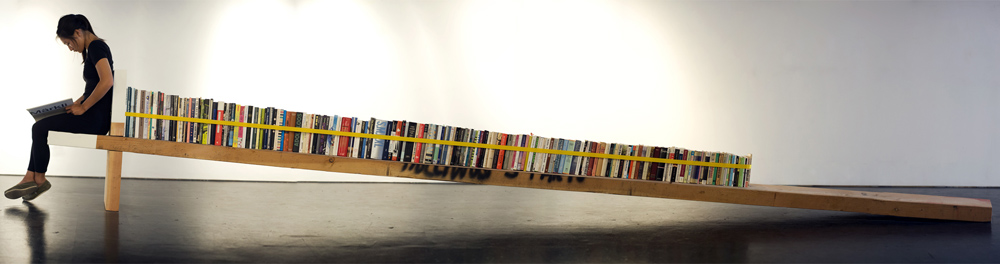
Designer Tim Durfee has produced what he calls “Storyboard,” a book-storage unit and chair built from a geometrically simple combination of reclaimed pine boards and a 40′-long nylon strap.

[Images: “Storyboard” by Tim Durfee; photos by Mikey Tnasuttimonkol].

It is “an object defined by creating a surface at the height of the knee, at the ideal angle for sitting,” Durfee writes. “Similar to the old style of carrying books with a strap, this object can be host to a personal library.” Multiple “Storyboards” variously arranged in different spatial combinations would also result in some interesting room designs.

[Image: “Storyboard” by Tim Durfee; photo by Mikey Tnasuttimonkol].

Durfee’s work will be on display at The Page, which opens tomorrow, Thursday, May 20; it is an exhibition sponsored by the LA Forum. Here is a map for how to find it.

Ghosts Of The Future: Borrowing Architecture From The Zone Of Alienation

[Image: From Stalker, directed by Andrei Tarkovsky].

[Note: This is a guest post by Jim Rossignol].

During the period in which 3D videogames began to use textures imported from photography, rather than hand-drawn pixel tiles, it became common to hear game developers discuss their photo references.

Drew Markham, director of Return To Castle Wolfenstein, spent the 2001 pre-release press tour for his game talking about the time he had spent in Europe, sourcing textures from “real” locations that had played host to the war. Crumbling French flagstones, Teutonic concretes, and other useful built surfaces: these details would add a certain level of authenticity that other games lacked. When the Wolfenstein sequel finally arrived, British gaming journalists were amused to see the ubiquitous British “H” fire hydrant signs scattered deep within the occult bunkers of Himmler’s SS Paranormal Division.

[Image: Photo by Jim Rossignol].

A few years later, another photo-reference tour was being cited for the gaming press, only this time it was not a cheery holiday in Europe, but a trip to the Zone Of Alienation. This 30km area of Ukraine and Belarus remains poisoned and largely off-limits to mankind, thanks to the radioactive caesium that dusted it after the explosion at the Chernobyl Nuclear Power Plant in 1986.

While it has remained quarantined and closed to (legal) habitation, it hasn’t kept out sight-seers. The production team at GSC Gameworld, a games studio based in nearby Kiev, intended to use the derelict zone as the basis for environments in their action shooter, STALKER: Shadow Of Chernobyl. The team went into the zone and photographed urban dereliction: a snapshot of an abandoned Soviet Union. They would go on to fill their game world with the zone’s rusting fences and collapsing grain silos, but that was not all that came with the material: the landscape and its decaying architecture was already charged with mythology—with narrative.

Creative director Anton Bolshakov explained this in an interview in 2007: “The Soviet system was sealed, many facts were kept secret. Even the most harmless objectives or events generated unbelievable rumours and legends.” One example, he says, is

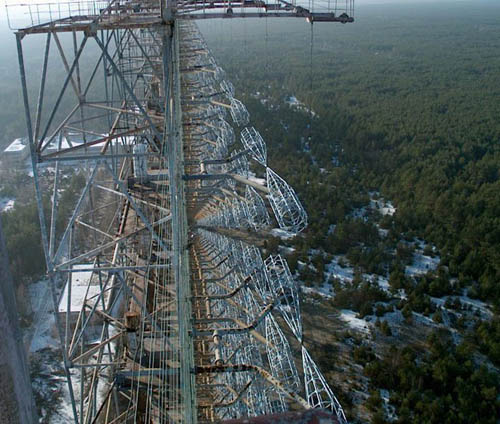
an existing gigantic antenna located within the Chernobyl exclusion zone. On some of our photos taken during the trip to Chernobyl the body of the antenna is seen on the horizon spanning several hundred meters across. So some unofficial sources claim, the waves emitted by the antenna were psychoactive. The antenna was directed onto Western Europe and preoccupied with a long-lasting military experiment on psychotropic influence onto human psyche.

[Images: The “steel giant” near Chernobyl; all photos via English Russia].

The antenna wall—actually an early-warning radar system developed for Cold War defense, which has been preserved thanks to being inside the zone—made it into the game as “the brain scorcher,” a device that must be shut down before the player can progress into the abandoned city of Pripyat. The environment of Chernobyl not only provided the game with an authentic atmosphere, it was also to influence the events that players could experience.

[Image: The “brain scorcher,” via Jim Rossignol].

However, the zone as an idea already existed before the explosion in 1986. It appeared, for instance, in a 1972 science fiction novel called Roadside Picnic. A mysterious, contaminated pocket of landscape, quarantined from the outside world, was the main theme of that book, which was written by two brothers, Boris and Arkady Strugatsky.

In the Strugatsky’s book, an alien visitation to the earth—an extra-terrestrial “roadside picnic”—has left dangerous and incomprehensible materials strewn across a zone of Northern Canada. Although sealed off for scientific research, this zone is raided by “Stalkers” who sell the unnatural trinkets for black-market cash. To do so, they brave bizarre dangers, because the zone has been transformed into a place that is utterly at odds with our own world. The alien is never seen or even described, and all the characters encounter is its terrible remainder: landscape made alien. Pools of jelly that will cripple a man lurk in basements, extra-terrestrial cobwebs that can stop a heart beating are strung across doorways, and gravitational mantraps will crush anyone who passes over the wrong patch of mud.

The zone of Roadside Picnic was seen by many as an allegory for the entire Soviet experiment: not simply in the literal sense of the poisoned landscapes created by the industrial excesses of the region, but the entire social order that was created by the Communist government. Polluted expanses, continually washed by acid rain, became shorthand for describing the bizarre political situation of a country in which Communism had failed, and yet robotically continued.

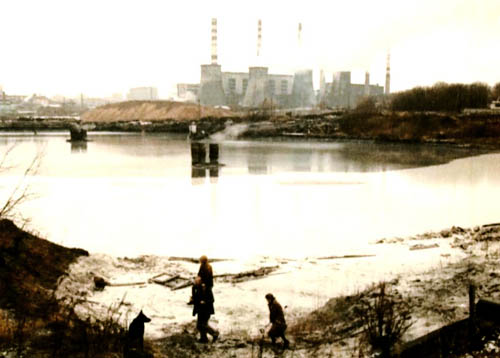
Russian film-maker Andrei Tarkovsky shot a movie, called Stalker, which told a story based on that of Roadside Picnic. A glacially slow, almost event-free film about landscape and longing, it’s a work that lingers for long minutes over broken wastelands of abandoned industry. It encapsulates Tarkovsky’s style, as well as his interest in dereliction and decay—themes that would be revisited by the STALKER videogame, thirty years on.

[Image: From Stalker, directed by Andrei Tarkovsky].

Tarkovsky’s film manages to imbue derelict industrial landscapes with a terrible sense of threat. Largely unable to realize the alien properties of artifacts in Roadside Picnic, Tarkovsky projected the danger into the architecture itself. Passive landscapes that could swallow a man. Tunnels which tear them to shreds. These effects were never demonstrated, but also never doubted, thanks to the tentative way the actors explored their surroundings.

In much the same way that the images of the real Chernobyl zone seem like lush vegetative scenes, despite being formidably radioactive, so Tarkovsky’s zone is calm and invisibly dangerous.

Cinematic legend had it that the power station shown in the final background scenes of the film was in fact Chernobyl NPP, although the truth is the entire film was shot in Estonia. That’s not to say that Stalker was without poisonous consequences of its own, however. The first version of the movie was shot entirely on corrupted film, which was unsalvageable when Tarkovsky’s production team returned to their Russian studios. Worse, the second shooting took place down stream from a poorly regulated chemical works. The effluent from the plant was responsible for many of the astonishing visuals in the river scenes from the movie, but team members came to suffer serious side-effects from this exposure, including cancer. They had, it seems, suffered side-effects from their time in the zone: just like the fate of the fictional Stalkers in the Strugatsky books. It was as if the fiction and reality were blurring back through each other. As if—to quote Alan Moore—the written page was too fragile a boundary.

Or perhaps, as Steven Shaviro suggests in his book Connected, Roadside Picnic, like all science fiction, actually exists to cast a shadow over the present. “It shows us how profoundly haunted we are by what has not yet happened,” says Shaviro of science fiction writing. In the specific case of Roadside Picnic and Tarkovsky’s film, what had not happened yet was the Chernobyl disaster.

After 1986, however, there were others for whom the ideas of Roadside Picnic were to be immediately accessible and useful in describing the world that they faced. People going into the Chernobyl exclusion zone, to loot buildings or show tourists around, began to call themselves “Stalkers.” For them, the zone of the Strugatsky’s vision was immediate and first-hand, a kind of fictional reference for the reality they were facing. They were living it—and it was strangely convenient to have the Stalker nomenclature to hand.

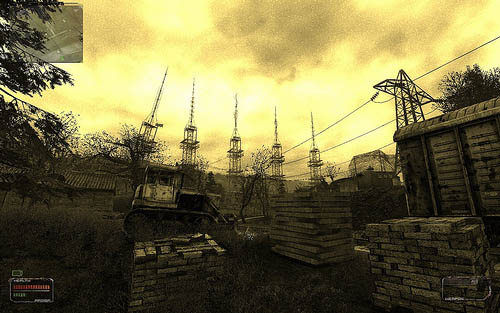
[Images: STALKER game images from this very extensive Flickr set].

As for Bolshakov and his creative team, borrowing from both the Strugatskys and the real world has proven fruitful. Real world ruins seem to connect with players far more readily than their fantasy counterparts. No one has been able to come away from STALKER without talking about the architectural waste that GSC borrowed from the zone. The game has now reached three iterations and supports an energetic fan community.

Bolshakov suggests that there is more to this than simply commerce or escapism, however: “The motif behind STALKER was to create a game which would remind people of the Chernobyl accident and at the same time warn mankind against any possible fatal mistakes in the future.” The warning seems likely to go unheard, but perhaps it has another message: to tell game developers that the architecture of the real world comes prefixed with meaning. Even now, when cities can be raised procedurally from the blank canvas of a game engine, perhaps it’s worth taking a look at the real world and the mythology that has been strewn around it. If borrowing architecture from the zone proves anything, it’s that simulation should not exist in a vacuum.

• • •

Jim Rossignol is a games critic, blogger, occasional guest writer on BLDGBLOG, and author of the excellent This Gaming Life: Travels in Three Cities, published by the University of Michigan Press. He is @jimrossignol on Twitter.

The Fires: Save the Date

Two weeks from now, on Tuesday, May 25, at powerHouse Books in Brooklyn, BLDGBLOG will co-host a live conversation with authors Joe Flood and Steven Johnson about Flood’s new book The Fires.


Come celebrate the publication of
The Fires: How a Computer Formula, Big Ideas, and the Best of Intentions Burned Down New York City—and Determined the Future of Cities by Joe Flood

At a BLDGBLOG event
Sponsored by Riverhead Books

The book—a “Best of May 2010” on Amazon—is an impressive look at city planning, disaster management, urban decay (from huge, poison-resistant rats to neighborhoods where 90% of the buildings burned down), internecine municipal politics, the rise of the corporate consulting class, and the South Bronx, all set in a NYC on the verge of collapse. It was, Flood writes, “A city burned by brilliance, idealism, and the best of intentions.”

[Image: Charlotte Street, South Bronx, photographed in 1975 by Neal Boenzi for the New York Times].

Here is the complete book description:

New York City, 1968. The RAND Corporation had presented an alluring proposal to a city on the brink of economic collapse: Using RAND’s computer models, which had been successfully implemented in high-level military operations, the city could save millions of dollars by establishing more efficient public services. The RAND boys were the best and brightest, and bore all the sheen of modern American success. New York City, on the other hand, seemed old-fashioned, insular, and corrupt—and the new mayor was eager for outside help, especially something as innovative and infallible as “computer modeling.” A deal was struck: RAND would begin its first major civilian effort with the FDNY.

Over the next decade—a time New York City firefighters would refer to as “The War Years”—a series of fires swept through the South Bronx, the Lower East Side, Harlem, and Brooklyn, gutting whole neighborhoods, killing more than two thousand people and displacing hundreds of thousands. Conventional wisdom would blame arson, but these fires were the result of something altogether different: the intentional withdrawal of fire protection from the city’s poorest neighborhoods—all based on RAND’s computer modeling systems.

Despite the disastrous consequences, New York City in the 1970s set the template for how a modern city functions—both literally, as RAND sold its computer models to cities across the country, and systematically, as a new wave of technocratic decision-making took hold, which persists to this day. In The Fires, Joe Flood provides an X-ray of these inner workings, using the dramatic story of a pair of mayors, an ambitious fire commissioner, and an even more ambitious think tank to illuminate the patterns and formulas that are now inextricably woven into the very fabric of contemporary urban life. The Fires is a must read for anyone curious about how a modern city works.

I will be posting much more about the book before the event, but I wanted to put a save-the-date out there. Steven Johnson—author of The Ghost Map, among many other things—will be introducing Joe and posing questions of his own, and I will be interviewing Joe about the book and its urban implications. From fire codes to the controversial role of military think-tanks in contemporary urban planning, it should be a great, and very wide-ranging, conversation.

The event is free and open to the public, kicks off at 7pm, and will be followed by a party. More about the book soon!

Pieces of the city are forming, like islands

[Image: “Shopping mall parking lot, Dubai,” (2009) by Bas Princen].

Photographer Bas Princen has a fantastic new exhibition, called “Refuge,” up at Storefront for Art and Architecture. Tonight, Tuesday, May 11, Princen will be at the gallery for a public event and opening, and it’s well worth checking out.

Storefront describes the show as a “photographic fiction”:

Although it is the result of extensive travels and research in five cities of the Middle East and Turkey—Istanbul, Beirut, Amman, Cairo and Dubai—it could just as easily pass as the pictorial record of a dérive through a single, imaginary city: a city without a center, populated by extraordinary and at times implausible architectural artefacts; an urban laboratory whose physical traits are defined by migratory flows, spatial transformation and geopolitical flux on a continental scale.

[Image: “Cooling plant, Dubai,” (2009) by Bas Princen].

As part of a poster published in tandem with the exhibition, former Storefront director Joseph Grima interviewed Princen about his work, starting off with an inquiry into how Princen’s own background in architectural studies might have affected his photographic approach to the built and natural environments (the interview is also available at Domus).

[Image: “Sand ridge, Amman,” (2009) by Bas Princen].

Princen remarks that, for him, “the camera [is] a tool to construct ideas on space or places, or ideas on architecture and landscape.” For “Refuge,” in particular, he explains that:

My main objective with this project was to create a series of photographs in which Amman, Beirut, Cairo, Dubai and Istanbul disappear as individual cities and as specific places, dissolving instead into a new kind of city, an imaginary urban entity in formation. This premise directed me to specific places in the periphery where pieces of the city are forming, almost like islands, and this accounts for my interest in the refugee camps and gated communities.

Zeroing in specifically on the architecture, Grima then asks him about “the ubiquity of the modernist reinforced-concrete slab-and-column structure,” a construction technique clearly visible in the photographs reproduced here.

[Images: “Former sugarcane field, Cairo,” (2009) and “Ringroad, Cairo,” (2009) by Bas Princen].

Grima suggests that, as a tactic for assembling buildings, this construction technique is “strongly reminiscent of Le Corbusier’s Maison Domino.” Princen’s response is brilliant, and worth quoting at length:

It is fascinating that Maison Domino, the quintessential modernist prototype conceived as a universal answer to the housing problem, has in the end inspired the method of choice for informal construction, with or without the help of architects. The many interpretations of the famous Maison Domino prototype I’ve seen are a clear indication that is has become the most universally successful type of construction, but nothing prepared me for Cairo, where this structural system is really pushed to the limits—not only because these buildings in red-brick-and-concrete grids rise to 16 or 17 floors, but also because three quarters of the city is constructed in this way. It is a mesmerizing fictional experience: driving on an elevated highway through this city of red brick towers, trying to imagine who is actually living there.

This latter remark—Princen’s difficulty in imagining these sorts of landscape humanly inhabited—sets the stage for a remark, later in the interview, when Princen mentions that he attempts to maintain a human presence in his photographs—in other words, they are not anthropologically empty landscapes.

[Images: “Mokkatam Ridge (garbage recycling city), Cairo,” (2009) by Bas Princen].

He adds that “the so-called ‘middle distance'”—the scale inhabited by humans—”has not been used much in recent architectural photography,” an industry that tends now to focus on one of two extremes: “the architectural object on the one hand and the cityscape on the other.” But “it is exactly in this middle distance,” Princen counters, “that the human figure becomes an interesting element: it cannot be shown as the main subject, but will always be defined by the relationship with its surroundings, to put an extra meaning or layer on the landscape or object that is photographed.”

As a result, Princen’s photos show us diminutive humans, stranded amidst incomprehensible architectural forms and massive landscapes, neither urban nor rural, pursuing admirably self-directed goals through which to give themselves meaning or, depending on how you look at it, utterly vacuous tasks that they refuse to admit should be abandoned.

[Images: Spreads from “Refuge” by Bas Princen].

Princen has rapidly become one of my favorite photographers; his earlier work, for instance, collected in the stunning Artificial Arcadia, shows, in Grima’s words, “the contemporary landscape as something invariably artificial, even when there is no sign of human intervention.”

What this means, more concretely, is that the book documents transitional landscapes scattered here and there around the Netherlands: “future suburbs,” highway overpass construction sites deep in forested housing estates, thickets planted for no ecological reason other than to block the sounds of a nearby airfield—landscapes that are at once highly abstract, yet ingeniously colonized by the local residents who have turned them into 4×4 race tracks, kite-flying grounds, fishing ponds, sites for paintball tournaments, and more.

They are also landscapes that have been generated, as if unconsciously, by industrial processes seated and operating elsewhere; as such, Princen shows us clay and sand depots, harbor excavation sites, and dumping grounds for contaminated silt and soil. But then, there, on top of those strange landforms, built on no recognizable human scale, there are weekend nature enthusiasts with their cameras out, stalking rare insects and birds that have settled these disrupted terrains.

The book, frankly, is pretty incredible. Take the “acoustic forest”: as mentioned above, it is a landscape “maintained to cushion the noise of a military base and airfield,” showing us an artificial ecosystem as military-sonic camouflage, like something out of Nick Sowers‘s research.

It’s the small humanist flips, however, that interest me so much; a sand dyke, for example, built ostensibly for the same purpose as above, “to shield a new housing estate from the noise of a military airfield,” but that has since been transformed into a communal meeting place where “residents gather on the sand dyke to watch the planes.”

[Images: Spreads from Artificial Arcadia by Bas Princen].

These makeshift, highly unexpected communities—such as model-airplane enthusiasts hanging out together in remote hardware store parking lots—are rampant throughout Artificial Arcadia and, indeed, Bas Princen’s work altogether. One of the most intriguing examples of this is the site of a new highway being constructed through forested suburbs; far from the paving stage, however, it is simply a muddy scar through the trees, looking more like a landslide, with no actual sense that the construction crews are even coming back to finish it. It is, Princen explains, “a 30-km long highway construction site, cutting through forests and farmlands, skirting villages,” that has since become “a gathering place,” like a piazza or churchyard.

The back of the book states that Princen is interested in documenting “the complex qualities that construct contemporary landscape, such as accessibility, wind direction, water currents and communication networks. In addition the use of certain products, such as kites, mountain bikes and GPS monitors, has a bearing on the way in which landscape is understood.” The landscape is instrumentalized, we might say, distilled through dense layers of technological abstraction to become, once again, a place inhabitable by human activity, however pathetic or impressively persistent it might be.

[Image: “Valley, Beirut,” (2009) by Bas Princen, from “Refuge“].

In any case, the exhibition opening tonight, May 11, at Storefront for Art and Architecture—where Bas Princen will be present in the gallery to kick things off and answer questions—features only his work for “Refuge,” but it promises to be one of the more compelling photography shows in New York this year.
Sukkah City

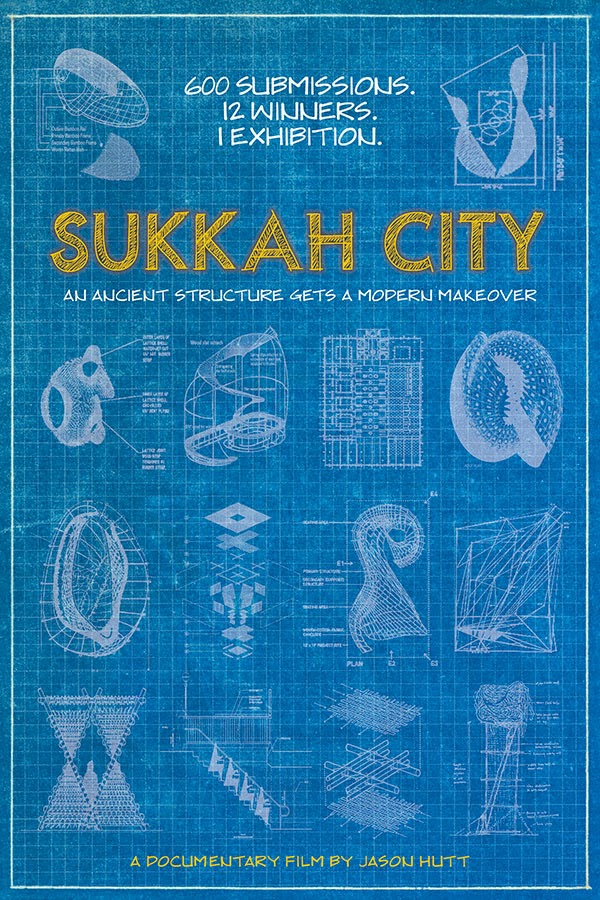
[Image: The official poster for Sukkah City by Jason Hutt].

A documentary film about the Sukkah City design competition from 2010 is finally on its way into the public eye, with a free outdoor premiere this weekend in New York City’s Union Square.

The filmmaker, Jason Hutt, will be on hand for the 7pm screening, and two further showings are planned for Monday and Tuesday of next week at Manhattan’s Jewish Community Center.

A short trailer for the film appears below:

I had the pleasure of serving on the design jury for the competition, which I still think back to fondly, as it was a brilliant premise for an architectural competition.

The sukkah itself is, in the words of competition organizer Joshua Foer, “an ephemeral, elemental shelter, erected for one week each fall, in which it is customary to share meals, entertain, sleep, and rejoice. Ostensibly the sukkah’s religious function is to commemorate the temporary structures that the Israelites dwelled in during their exodus from Egypt, but it is also about universal ideas of transience and permanence as expressed in architecture.”

For an architect, the constraints are both inspiring and extraordinary:

the structure must be temporary, have at least two and a half walls, be big enough to contain a table, and have a roof made of shade-providing organic materials through which one can see the stars. Yet a deep dialogue of historical texts intricately refines and interprets these constraints—arguing, for example, for a 27 x 27 x 38-inch minimum volume; for a maximum height of 30 feet; for walls that cannot sway more than one handbreadth; for a mineral and botanical menagerie of construction materials; and even, in one famous instance, whether it is kosher to adaptively reuse a recently deceased elephant as a wall. (It is.) The paradoxical effect of these constraints is to produce a building that is at once new and old, timely and timeless, mobile and stable, open and enclosed, homey and uncanny, comfortable and critical.

You can see the final, realized constructions in Union Square here:

The free screening is at 7pm on Sunday, September 22, on the north end of Union Square. Hope to see some of you there.

Uncorporate Identity

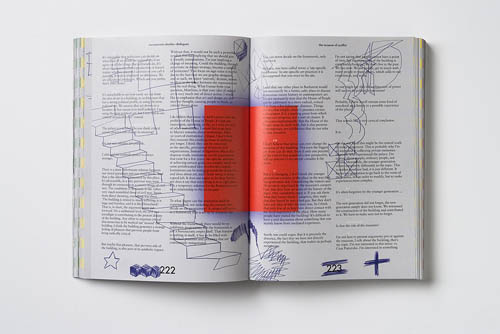
[Image: From Uncorporate Identity].

There will be a book launch party in New York City tonight for Metahaven’s Uncorporate Identity, a book that features guest contributions by Keller Easterling, China Miéville, Chantal Mouffe, Michael Taussig, Florian Schneider, Pier Vittorio Aureli, and many others. (On a vaguely related note, Miéville’s The City & The City just won the Arthur C. Clarke Award and is definitely worth a read this summer).

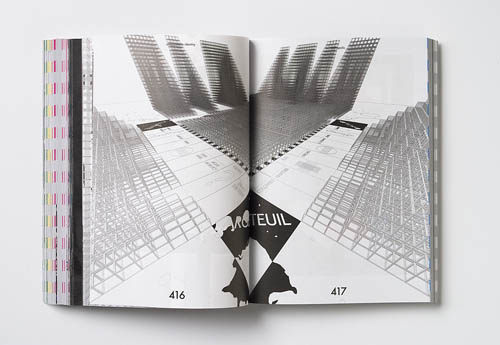
[Images: From Uncorporate Identity].

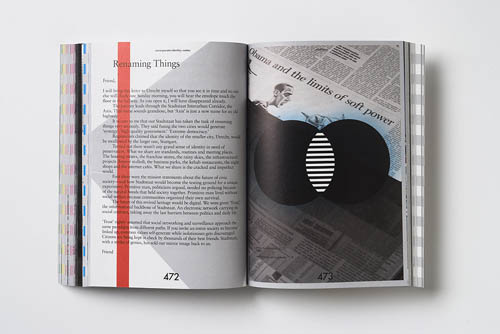
The book describes itself as “an adventurous collection of design projects [by Metahaven] around visual identity and politics… Organized as a sequence of five chapters, each comprising case studies, notes and essays, it explores, visually and textually, the paradoxes of identity in a networked world”—including border walls, “unrecognized states,” micronations, data centers and superstores, conceptual demolition and disappearing streets, black metal noise terror, military-urban monumentalism, and much more.

[Images: From Uncorporate Identity].

You can see some spreads from the book here; the launch itself will take place at e-flux, down at 41 Essex St., Front 1, Manhattan, starting at 7pm. That’s tonight, Friday, May 7. Here’s a map.

Concrete Honey and the Printing Room

[Image: “Beamer Bees” by Liam Young and Anab Jain].

I had an interesting and long conversation last week with John Becker, one of my students at Columbia’s GSAPP, about everything from the future of 3D printers, the possibility of permanently embedding such machines into the fabric of a building, and even the genetic manipulation of nonhuman species so that they could produce new, architecturally useful materials.

A few quick things about that conversation seem worth repeating here:

1) Famously, groups like Archigram proposed using construction cranes as permanent parts of their buildings. The crane could thus lift new modular rooms into place, add whole new floors to the perpetually incomplete structure, and otherwise act as a kind of functional ornament. The crane, “now considered part of the architectural ensemble,” Archigram’s Mike Webb wrote, would simply be embedded there, “lifting up and moving building components so as to alter the plan configuration, or replacing parts that had work out with a ‘better’ product.”

[Image: Plug-In City by Archigram/Warren Chalk, Peter Cook, Dennis Crompton; courtesy University of Westminster].

But 3D printers are the new cranes.

For instance, what if Enrico Dini’s sandstone-printing device—so interestingly profiled in Blueprint Magazine last month—could be installed somewhere at the heart of a building complex—or up on the roof, or ringed around the edge of a site—where it could left alone to print new rooms and corridors into existence, near-constantly, hooked up to massive piles of loose sand and liquid adhesives, creating infinite Knossic mazes? The building is never complete, because it’s always printing itself new rooms.

In fact, I think we’ll start to see more and more student projects featuring permanent 3D printers as part of the building envelope—and I can’t wait. A room inside your building that prints more rooms. It sounds awesome.

2) Several months ago, the Canadian Centre for Architecture, as part of their exhibition Actions: What You Can Do With the City, put up #77 in its list of things “you can do with the city”: they phrased it as Bees Make Concrete Honey.

My eyes practically fell out of my head when I saw that headline, imagining genetically modified bees that no longer produce honey, they produce concrete. They’d mix some strange new bio-aggregate inside their bellies. Instead of well-honeyed hives, you’d have apian knots of insectile concrete. Perhaps they could even print you readymade blocks of ornament: florid scrolls and gargoyle heads, printed into molds by a thousand bees buzzing full of concrete. Bee-printers.

Alas, it had nothing to do with apian concrete; it was simply a play on words: urban bees make urban honey… or concrete honey, if you want to be poetic. But no matter: using bees to create new forms of concrete—perhaps even new forms of sandstone (whole new geologies!)—is ethically horrific but absolutely extraordinary. After all, there are already bugs genetically modified to excrete oil, and even goats that have been made to produce spider silk.

What, though, are the architectural possibilities of concrete honey?

[Images: The Rosslyn Chapel hives; photos courtesy of the Times].
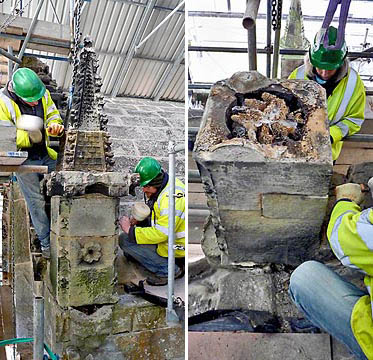
3) Last month, over at Scotland’s Rosslyn Chapel, it was announced that “builders renovating the 600-year-old chapel have discovered two beehives carved within the stonework high on the pinnacles of the roof. They are thought to be the first man-made stone hives ever found.”

It appears the hives were carved into the roof when the chapel was built, with the entrance for the bees formed, appropriately, through the centre of an intricately carved stone flower. The hives were found when builders were dismantling and rebuilding the pinnacles for the first time in centuries.

As the article goes on to point out, “Although human beings have collected honey from wild bee colonies since time immemorial, at some point they began to domesticate wild bees in artificial hives, made from hollow logs, pottery, or woven straw baskets. The Egyptians kept bees in cylindrical hives, and pictures in temples show workers blowing smoke into the hives, and removing honeycombs. Sealed pots of honey were found in Tutankhamun’s tomb.”

But, combining all these stories, what about bees that make concrete honey, artificially bred and housed inside hives in the spires of buildings? Hives that they themselves have printed?

High up on the roof of St. John the Divine sit six symmetrical stone hives, inside of which special bees now grow, tended by an architecture student at Columbia University; the bees are preparing their concrete to fix any flaw the building might have. No longer must you call in repair personnel to do the job; you simply tap the sides of your concrete-mixing beehives and living 3D printers fly out in a buzzing cloud, caulking broken arches and fixing the most delicate statuary.

Nearby homeowners occasionally find lumps of concrete on their rooftops and under the eaves, as if new hives are beginning to form.

4) In the opening image of this post, you see the so-called “Beamer Bees” that Liam Young, Anab Jain, and collaborators created for Power of 8. The beamer bees were “formulated by a community of biologists and hired bio-hackers to service under-pollinated trees, plants and vegetables due to the disappearance of honey bees.” And while the beamers don’t actually have much to do with the idea of mobile 3D-printing swarms, any post about designing with bees would be incomplete without them…

(Thanks to Steve Silberman for the Rosslyn Chapel hives link, and to John Becker for the conversation these ideas came from).

Theatre for One

[Image: Theater for One by Christine Jones and LOT-EK].

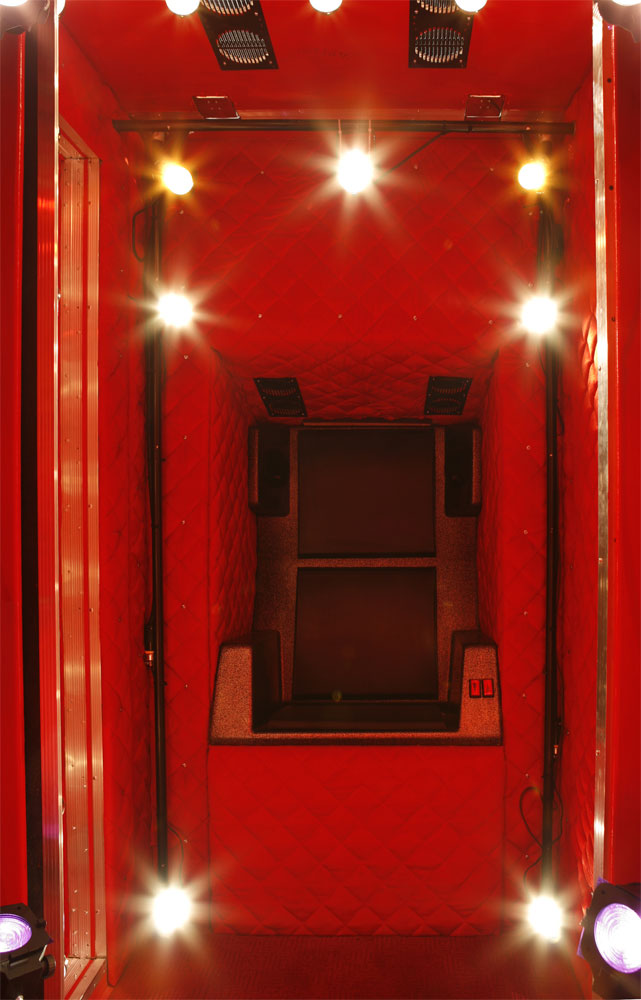
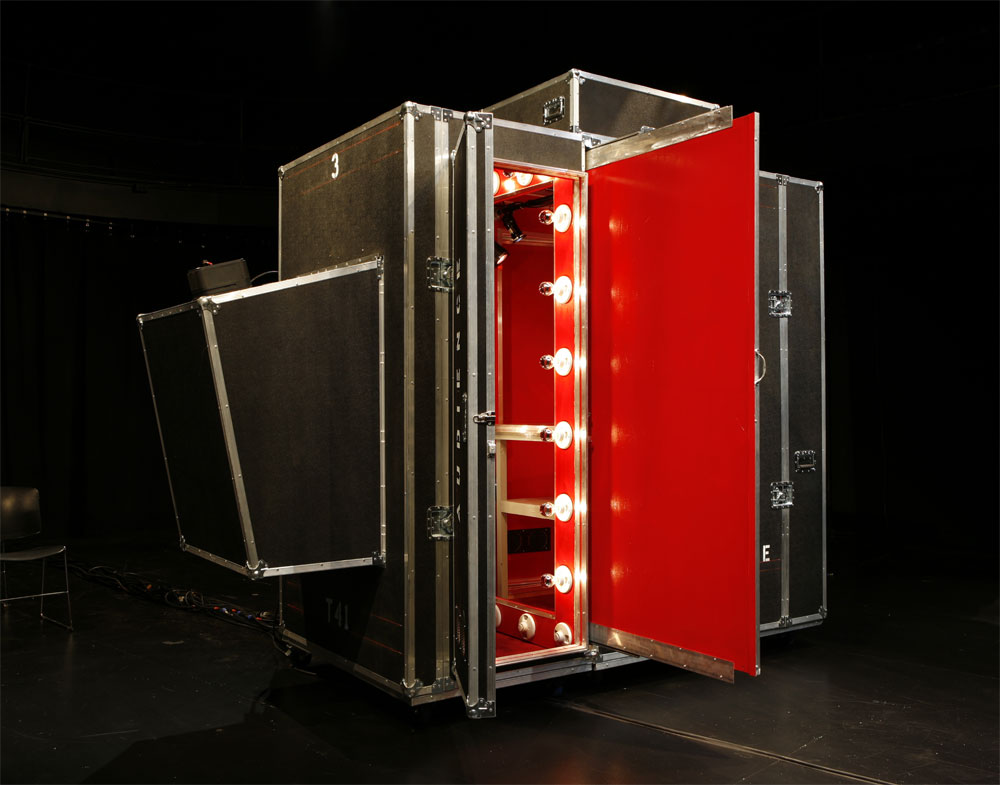
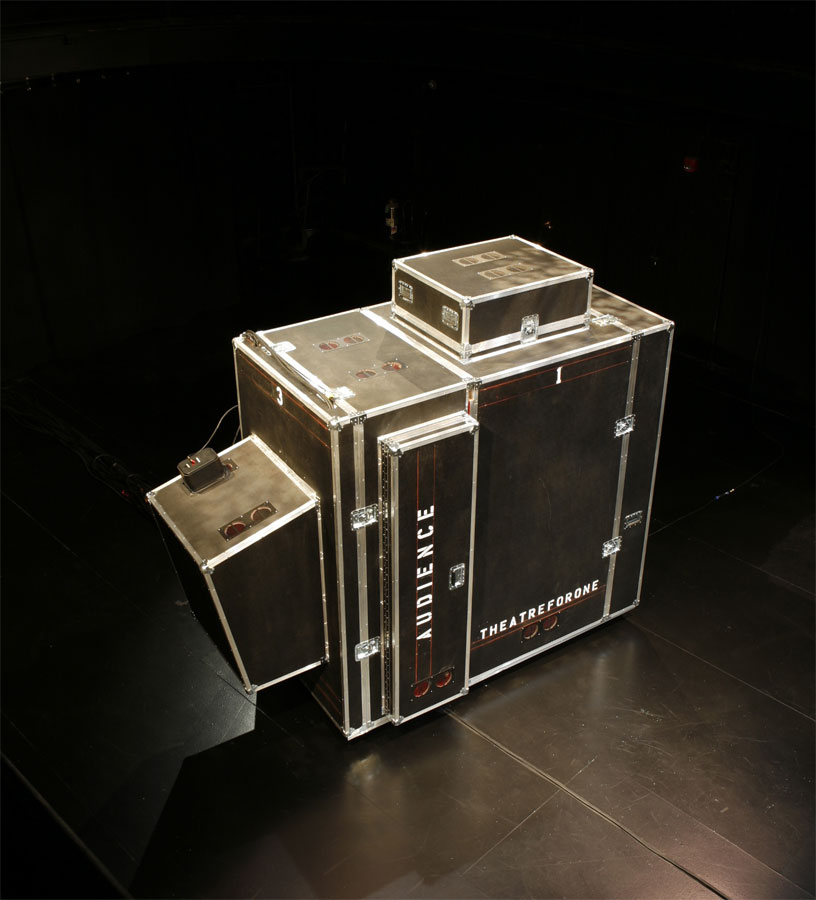
LOT-EK and set designer Christine Jones will be premiering their project Theater for One in Times Square, two weeks from now. It “will be up for 10 days, with performances open to the general public”—but, as the architects point out, the public is only invited “one at a time.”

[Image: Theater for One by Christine Jones and LOT-EK].

Specifically, the petite space is “a theater for one actor and one audience member. Inspired by small one-to-one spaces—such as the confessional or the sex peep-booth—Theater for One explores the intense emotion of live theater through the direct and intimate one-to-one interaction of actor and audience.”

[Images: Theater for One by Christine Jones and LOT-EK].

In many ways, I’m reminded of the dramatic intensity of Nancy Bannon’s Pod Project, which consisted of “13 private, one-on-one performances housed within 13 sculpted spaces.” In Bannon’s work, “the viewer actually enters the performance environment and experiences a one-on-one exchange in unconventional proximity. The interiors of the sculptures/pods are personalized”—but this also means that each pod has been architecturally stylized so as to fit the dramas involved.

[Image: Theater for One by Christine Jones and LOT-EK].

What I like about the LOT-EK/Christine Jones project is the blank architecturalization of this dramatic experience; portable, easily deployed, and externally neutral, the Theater for One could just as easily be reused as an interviewing station, a place for personal confrontation, or even a writing lab. It could be a dressing room, private cinema, or staging ground for psychedelic self-actualization—and I would actually love to see this thing hit the road someday, popping up all over the U.S. and abroad, to see what flexibly subjective uses people wish to put it to. NPR meets Storycorps, by way of a one-actor play.

The Church Below

[Images: Photos by Lawrence Looi/newsteam.co.uk].

A bored family in Shropshire, England, after having a few too many drinks one night, started playing around with an air grate in their living room floor—which they managed to lift up and out of its grid, crawl through and under the house, and there discover an entire church sitting in the darkness where a basement should be. It was a “dark chapel complete with a large wooden cross on the floor.”

Even better, after continuing to search, they found “a staircase in the chapel [that] came out of a cupboard in the dining room.” Hidden topologies surround us.

After posting this link on Twitter, meanwhile, Patrick Smith chimed in, asking: “I wonder if stuff in their house moves around?” A poltergeist, turning strange devices on an altarpiece below ground, with a whole family on remote control above.

(Via Tim Maly. Related: The Horrible Secret of Number 6 Whitten Street, Sounding Rooms, Architectural Dissimulation, and many more).

An edge over which it is impossible to look

[Image: The Ladybower bellmouth at full drain, photographed by Flickr user Serigrapher].

Nearly half a year ago, a reader emailed with a link to a paper by Andrew Crompton, called “Three Doors to Other Worlds” (download the PDF). While the entirety of the paper is worth reading, I want to highlight a specific moment, wherein Crompton introduces us to the colossal western bellmouth drain of the Ladybower reservoir in Derbyshire, England.

His description of this “inverted infrastructural monument,” as InfraNet Lab described it in their own post about Crompton’s paper—adding that spillways like this “maintain two states: (1) in use they disappear and are minimally obscured by flowing water, (2) not in use they are sculptural oddities hovering ambiguously above the water line”—is spine-tingling.

[Image: The Ladybower bellmouth, photographed by John Fielding, via Geograph].

“What is down that hole is a deep mystery,” Crompton begins, and the ensuing passage deserves quoting in full:

Not even Google Earth can help you since its depths are in shadow when photographed from above. To see for yourself means going down the steps as far as you dare and then leaning out to take a look. Before attempting a descent, you might think it prudent to walk around the hole looking for the easiest way down. The search will reveal that the workmanship is superb and that there is no weakness to exploit, nowhere to tie a rope and not so much as a pebble to throw down the hole unless you brought it with you in the boat. The steps of this circular waterfall are all eighteen inches high. This is an awkward height to descend, and most people, one imagines, would soon turn their back on the hole and face the stone like a climber. How far would you be willing to go before the steps became too small to continue? With proper boots, it is possible to stand on a sharp edge as narrow as a quarter of an inch wide; in such a position, you will risk your life twisting your cheek away from the stone to look downward because that movement will shift your center of gravity from a position above your feet, causing you to pivot away from the wall with only friction at your fingertips to hold you in place. Sooner or later, either your nerves or your grip will fail while diminishing steps accumulate below preventing a vertical view. In short, as if you were performing a ritual, this structure will first make you walk in circles, then make you turn your back on the thing you fear, then give you a severe fright, and then deny you the answer to a question any bird could solve in a moment. When you do fall, you will hit the sides before hitting the bottom. Death with time to think about it arriving awaits anyone who peers too far into that hole.

“What we have here,” he adds, “is a geometrical oddity: an edge over which it is impossible to look. Because you can see the endless walls of the abyss both below you and facing you, nothing is hidden except what is down the hole. Standing on the rim, you are very close to a mystery: a space receiving the light of the sun into which we cannot see.”

[Image: The Ladybower bellmouth, photographed by Peter Hanna, from his trip through the Peak District].

Crompton goes on to cite H.P. Lovecraft, the travels of Christopher Columbus, and more; again, it’s worth the read (PDF). But that infinitely alluring blackness—and the tiny steps that lead down into it, and the abyssal impulse to see how far we’re willing to go—is a hard thing to get out of my mind.

(Huge thanks to Kristof Hanzlik for the tip!)

The Switching Labyrinth

[Image: From “Labyrinths, Mazes and the Spaces Inbetween” by Sam McElhinney].

Sam McElhinney, a student at the Bartlett School of Architecture, has been building full-scale labyrinths in London and testing people’s spatial reactions to them. See photos of his constructions, below.

McElhinney explained his research to BLDGBLOG in a recent email, attaching a paper that he delivered earlier this month at a cybernetics conference in Vienna, where it was awarded best paper. Called “Labyrinths, Mazes and the Spaces Inbetween,” it describes McElhinney’s fascinating look at how people actually walk through, use, and familiarize themselves with the internal spaces of buildings, using mazes and labyrinths as his control studies.

In the process, McElhinney introduces us to movement-diagrams, Space Syntax, and other forms of architectural motion-analysis, asking: would a detailed study of user-behaviors help architects design more consistently interesting buildings, spaces that “might evoke,” he writes, “a sense of continual delight”? Pushing these questions a bit further, we might ask: should all our buildings be labyrinths?

[Images: Movement-typologies from “Labyrinths, Mazes and the Spaces Inbetween” by Sam McElhinney].

Early in the paper, McElhinney differentiates between the two types of interior experiences—between mazes and labyrinths.

A path system can be multicursal: a network of interconnecting routes, intended to disorient even the cunning. It may contain multiple branches and dead ends, specifically designed to confuse the occupant. This is a maze.

Alternatively, a path can form a single, monocursal route. Once embarked upon, this may fold, twist and turn, but will remain a constant and ultimately reach a destination; this is a labyrinth.

The experience of walking these two topologies is very different.

These basic definitions set the stage for McElhinney’s own “premise,” which is “that all space is found, experienced and inhabited in a state of ‘switching’ flux between the diametrically opposed topologies of maze and labyrinth. This offers insights into how we might evoke a sense of continual delight in the user [of the buildings that we go on to design].” Accordingly, he asks how architects might actually construct “a path that switches from a labyrinth into a maze (and vice-versa).”

How can architects design for this switch?

[Images: From “Labyrinths, Mazes and the Spaces Inbetween” by Sam McElhinney].
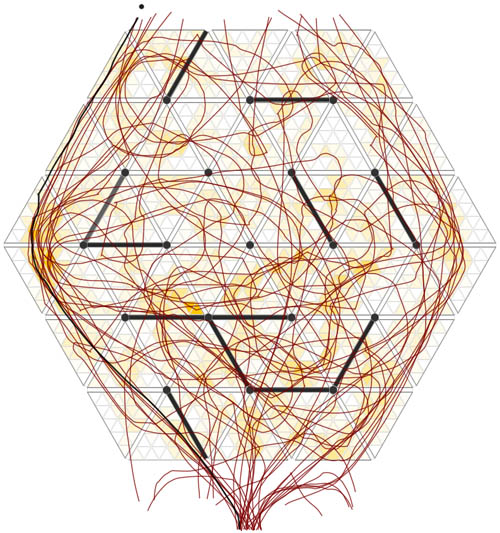
McElhinney’s argument segues through a discussion of Alasdair Turner’s Space Syntax investigations (and the limitations thereof). He describes how Turner put together a series of automated test-runs through which he could track the in-labyrinth behavior of various “maze-agents”; these reprogrammable “agents” would continually seek new pathways through the twisty little passages around them—a spatial syntax of forward movement—and Turner took note of the results.

Turner’s test-environments included, McElhinney explains, a maze that “was set to actively re-configure upon a door being opened, altering the maze control algorithms” behind the scenes, thus producing new route-seeking behavior in the maze-agents.

[Images: From “Labyrinths, Mazes and the Spaces Inbetween” by Sam McElhinney].

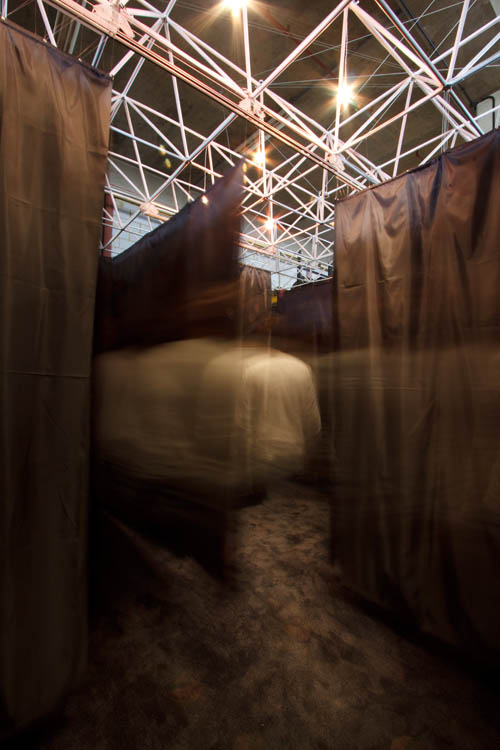
Unsatisfied with Turner’s research, however, McElhinney went on to build his own full-scale “switching labyrinth” near London’s Euston Station. Participants in this experiment “animated” McElhinney’s switching labyrinth by way of “a stepper motor and slide mechanism” that, together, were “able to periodically shift, ‘switching’ openings to offer alternative entrance and exit paths.”

The participants walked in and their routes warped the labyrinth around them.

[Image: Sam McElhinney’s “switching labyrinth,” or psycho-cybernetic human navigational testing ground, constructed near Euston Station].

After watching all this unfold, McElhinney suggested that further research along these lines could help to reveal architectural moments at which there is an “emergence of labyrinthine, or familiar, spatialities within an unknown or changing maze framework.”

There can be a place or moment within any building, in other words, at which the spatially unfamiliar will erupt—and from movement-pathway studies we can extrapolate architectural form, buildings that perfectly rest at the cognitive flipping point between maze and labyrinth, familiar and disorienting, adventurous and strange.

[Images: Sam McElhinney’s “switching labyrinth”].

The cybernetics of human memory and in-situ spatial decision-making processes provide a framework from which we can extract and assemble a new kind of architecture.

[Image: From “Labyrinths, Mazes and the Spaces Inbetween” by Sam McElhinney].

How we move through coiled, labyrinthine environments can be studied for insights into human navigation, physiology, and more.

[Image: From “Labyrinths, Mazes and the Spaces Inbetween” by Sam McElhinney].

McElhinney sent over a huge range of maze and labyrinth precedents that served as part of his research; some images from that research appear below.

[Images: Maze-studies from “Labyrinths, Mazes and the Spaces Inbetween” by Sam McElhinney].

It’s fascinating research, and I would love to see it scaled way, way up, beyond a mere test-maze in a warehouse into something both multileveled and city-sized.