Monumental

[Image: “Historical Monument of the American Republic” by Erastus Salisbury Field].

I just spent far too much time clicking around on Archi/Maps, where—amongst dozens of other images—this painting by Erastus Salisbury Field, showing a proposal for an “Historical Monument of the American Republic,” seemed worth a quick post.

Check out related images under the “utopia” or “monument” tags.

Under London

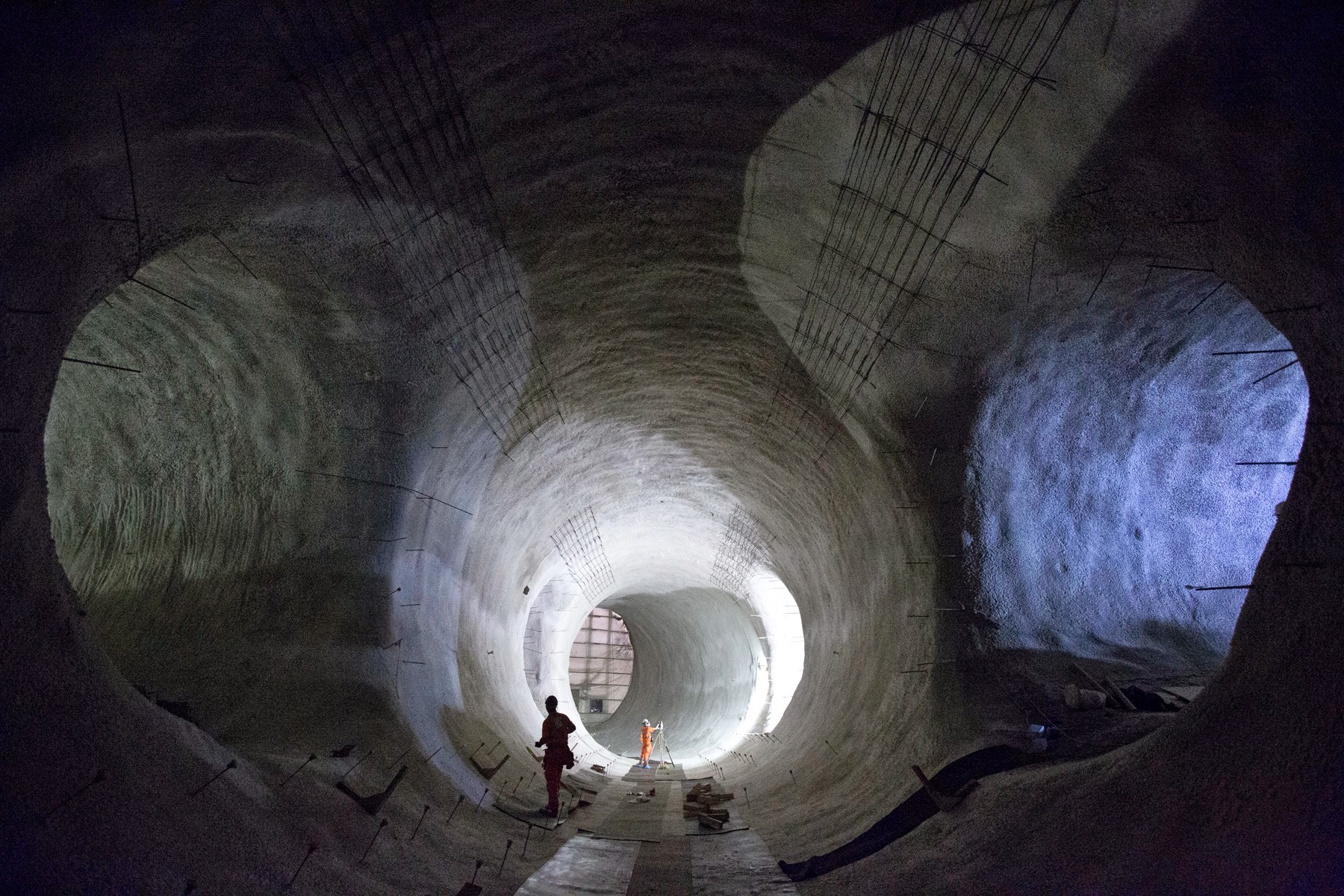
[Image: Bond Street platform tunnels, courtesy Crossrail].

Crossrail—the massive, 73-mile rail project currently underway in London, including twin-bore 13-mile tunnels—has released a handful of new photos showing the underground works.

[Images: Bond Street platform tunnels, courtesy Crossrail].
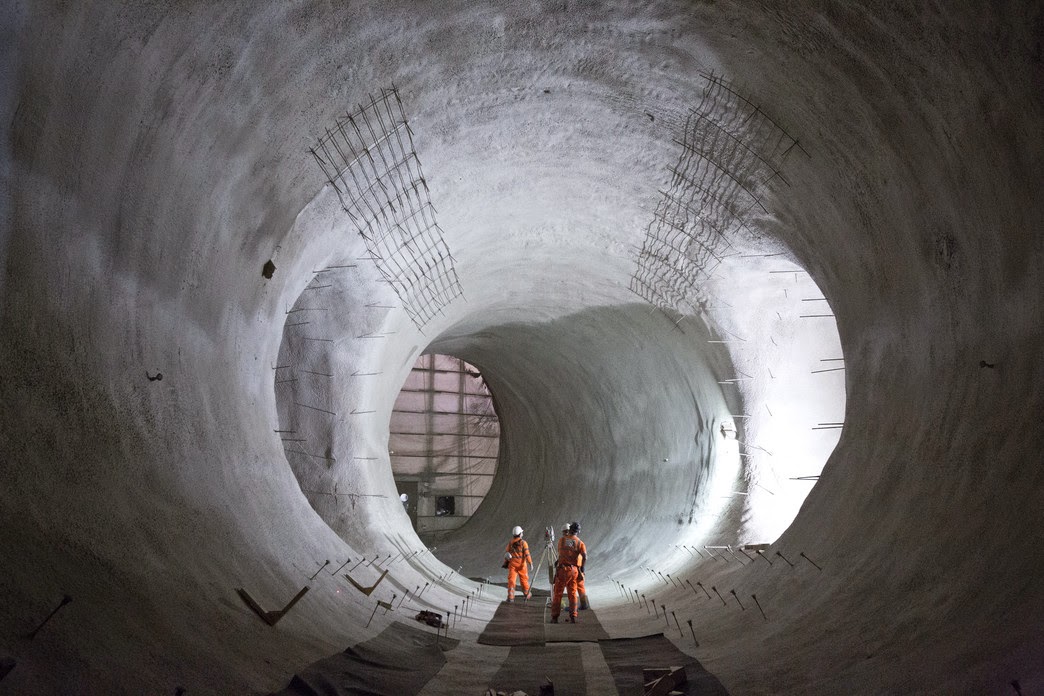
I’m a sucker for images of the human form stranded amidst the shadows of massive, dimensionally abstract spatial environments, so I thought I’d post these purely as eye candy.

[Image: Bond Street platform tunnels, courtesy Crossrail].
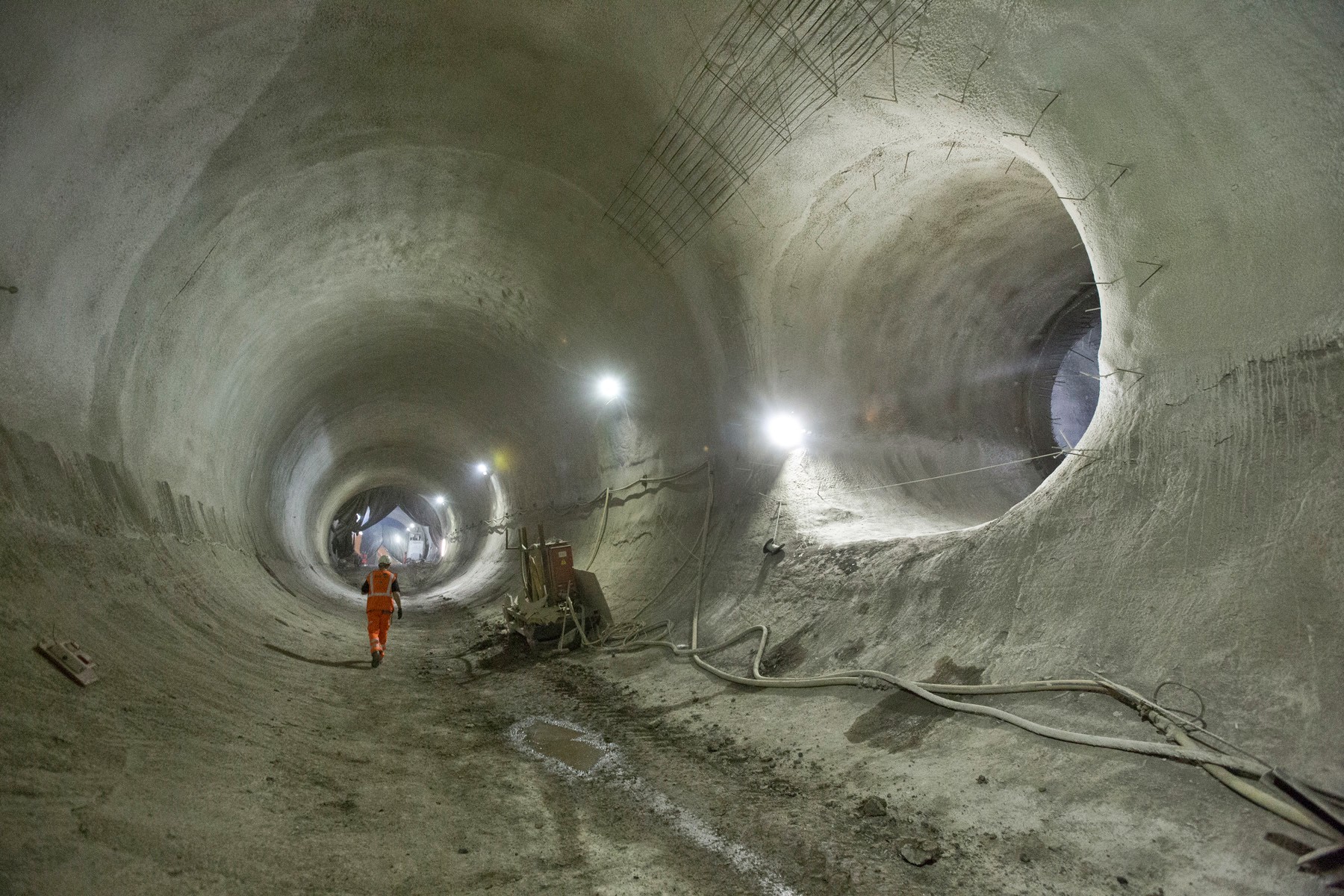
If you want a bit more info on Crossrail itself, consider reading “London Laöcoon” or the second half of “British Countryside Generator,” both earlier on BLDGBLOG, or simply clicking around on the Crossrail website, including a few more photographs.

(Spotted via @subbrit and Ian Visits).

The Neurological Side-Effects of 3D

[Image: Auguste Choisy].

France is considering a ban on stereoscopic viewing equipment—i.e. 3D films and game environments—for children, due to “the possible [negative] effect of 3D viewing on the developing visual system.”

As a new paper suggests, the use of these representational technologies is “not recommended for chidren under the age of six” and only “in moderation for those under the age of 13.”

There is very little evidence to back up the ban, however. As Martin Banks, a professor of vision science at UC Berkeley, points out in a short piece for New Scientist, “there is no published research, new or old, showing evidence of adverse effects from watching 3D content other than the short-term discomfort that can be experienced by children and adults alike. Despite several years of people viewing 3D content, there are no reports of long-term adverse effects at any age. On that basis alone, it seems rash to recommend these age-related bans and restrictions.”

Nonetheless, he adds, there is be a slight possibility that 3D technologies could have undesirable neuro-physical effects on infants:

The human visual system changes significantly during infancy, particularly the brain circuits that are intimately involved in perceiving the enhanced depth associated with 3D viewing technology. Development of this system slows during early childhood, but it is still changing in subtle ways into adolescence. What’s more, the visual experience an infant or young child receives affects the development of binocular circuits. These observations mean that there should be careful monitoring of how the new technology affects young children.

But not necessarily an outright ban.

In other words, overly early—or quantitatively excessive—exposure to artificially 3-dimensional objects and environments could be limiting the development of retinal strength and neural circuitry in infants. But no one is actually sure.

What’s interesting about this for me—and what simultaneously inspires a skeptical reaction to the supposed risks involved—is that we are already surrounded by immersive and complexly 3-dimensional spatial environments, built landscapes often complicated by radically diverse and confusing focal lengths. We just call it architecture.

Should the experience of disorienting works of architecture be limited for children under a certain age?

[Image: Another great image by Auguste Choisy].

It’s not hard to imagine taking this proposed ban to its logical conclusion, claiming that certain 3-dimensionally challenging works of architectural space should not be experienced by children younger than a certain age.

Taking a cue from roller coasters and other amusement park rides considered unsuitable for people with heart conditions, buildings might come with warning signs: Children under the age of six are not neurologically equipped to experience the following sequence of rooms. Parents are advised to prevent their entry.

It’s fascinating to think that, due to the potential neurological effects of the built environment, whole styles of architecture might have to be reserved for older visitors, like an X-rated film. You’re not old enough yet, the guard says patronizingly, worried that certain aspects of the building will literally blow your mind.

Think of it as a Schedule 1 controlled space.

[Image: From the Circle of Francesco Galli Bibiena, “A Capriccio of an Elaborately Decorated Palace Interior with Figures Banqueting, The Cornices Showing Scenes from Mythology,” courtest of Sotheby’s].

Or maybe this means that architecture could be turned into something like a new training regimen, as if you must graduate up a level before you are able to handle specific architectural combinations, like conflicting lines of perspective, unreal implications of depth, disorienting shadowplay, delayed echoes, anamorphic reflections, and other psychologically destabilizing spatial experiences.

Like some weird coming-of-age ceremony developed by a Baroque secret society overly influenced by science fiction, interested mentors watch every second as you and other trainees react to a specific sequence of architectural spaces, waiting to see which room—which hallway, which courtyard, which architectural detail—makes you crack.

Gifted with a finely honed sense of balance, however, you progress through them all—only to learn at the end that there are four further buildings, structures designed and assembled in complete secrecy, that only fifteen people on earth have ever experienced. Of those fifteen, three suffered attacks of amnesia within a year.

Those buildings’ locations are never divulged and you are never told what to prepare for inside of them—what it is about their rooms that makes them so neurologically complex—but you are advised to study nothing but optical illusions for the next six months.

[Image: One more by Auguste Choisy].

Of course, you’re told, if it ever becomes too much, you can simply look away, forcing yourself to focus on only one detail at a time before opening yourself back up to the surrounding spatial confusion.

After all, as Banks writes in New Scientist, the discomfort caused by one’s first exposure to 3D-viewing technology simply “dissipates when you stop viewing 3D content. Interestingly, the discomfort is known to be greater in adolescents and young adults than in middle-aged and elderly adults.”

So what do you think—could (or should?) certain works of architecture ever be banned for neurologically damaging children under a certain age? Is there any evidence that spatially disorienting children’s rooms or cribs have the same effect as 3D glasses?

Space Noir

[Image: The International Space Station at night, photographed by astronaut Alexander Gerst, courtesy of the ESA].

The European Space Agency recently released a group of photos taken by astronaut Alexander Gerst showing the International Space Station at night. The only real contextual information provided is that “the six astronauts on the weightless research centre live by GMT, and generally sleep at the same time.”

[Image: Photo by Alexander Gerst, courtesy of the ESA].

Gerst—so close to Geist!—thus took advantage of the downtime to produce some images that make the ISS look uninhabited, a dead mansion rolling through space.

[Image: Photo by Alexander Gerst, courtesy of the ESA].

This is perhaps what it would look like to arrive somewhere in the middle of night, hoping to say hello to your comrades, only to find that you’ve actually boarded the Mary Celeste.

[Image: Photo by Alexander Gerst, courtesy of the ESA].

The dimly lit corridors of this house of sleeping astronauts take on the atmosphere of film noir, as if this is secretly a crime scene, still flickering with the last lights of its drained batteries, and these are the first photos to be taken upon arrival.

[Image: Photo by Alexander Gerst, courtesy of the ESA].

Small details take on narrative suspense. Why was that cupboard door left open, its contents bare for all to see? And are those objects messily scattered about, as if a struggle has taken place, or is this just the normal state of things in zero-g?

Where is everyone? Imagine performing forensic crime-scene analysis in the absence of gravity, three-dimensionally reconstructing a moment of violence by tracking objects back along all of their possible trajectories; you would need holographic models of every legally admissible collision and variation.

[Images: Photos by astronaut Alexander Gerst, courtesy of the ESA].

In any case, to browse more of astronaut Gerst’s collection, you can basically start at this image and click backward through the rest; one or two, unfortunately, feature other astronauts drifting around, perhaps staring down at the earth through the red eyes of insomnia, which ruins the illusion of this being a ruin, but the photos are still worth a glimpse.

[Image: Photo by Alexander Gerst, courtesy of the ESA].

Finally, proving that international scientific organizations have an active sense of humor, the photos were actually released on Halloween.

Just-in-Case Informatics

[Image: A screen grab from the homepage of Orbital Insight].

Proving that some market somewhere will find a value for anything, a company called Orbital Insight is now tracking “the shadows cast by half-finished Chinese buildings” as a possible indicator for where the country’s economy might be headed.

As the Wall Street Journal explains, Orbital Insight is part of a new “coterie of entrepreneurs selling analysis of obscure data sets to traders in search of even the smallest edges.” In many cases, these “obscure data sets” are explicitly spatial:

Take the changing shadows of Chinese buildings, which Mr. Crawford [of Orbital Insight] says can provide a glimpse into whether that country’s construction boom is speeding up or slowing down. Mr. Crawford’s company, Orbital Insight Inc., is analyzing satellite images of construction sites in 30 Chinese cities, with the goal of giving traders independent data so they don’t need to rely on government statistics.

If watching the shadows of Chinese cities from space isn’t quite your cup of tea, then consider that the company “is also selling analysis of satellite imagery of cornfields to predict how crops will shape up and studies of parking lots that could provide an early indicator of retail sales and quarterly earnings of companies such as Wal-Mart Stores Inc. and Home Depot Inc.”

[Image: A screen grab from the homepage of Orbital Insight].

The resulting data might not even prove useful; but, in a great example of what we might call just-in-case informatics, it’s scooped up and packaged anyway.

The notion that there are fortunes to be made given advance notice of even the tiniest spatial details of the world is both astonishing and sadly predictable—that something as intangible as the slowly elongating shadows of construction sites in China could be turned into a proprietary data point, an informational product sold to insatiable investors.

Everything has a price—including the knowledge of how many cars are currently parked outside Home Depot.

Read more at the Wall Street Journal.

Art Arm

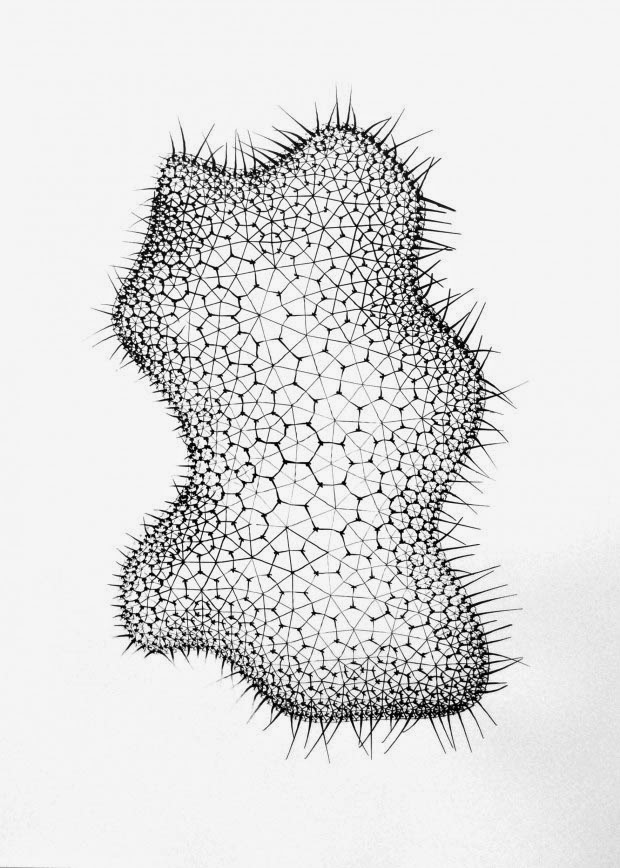
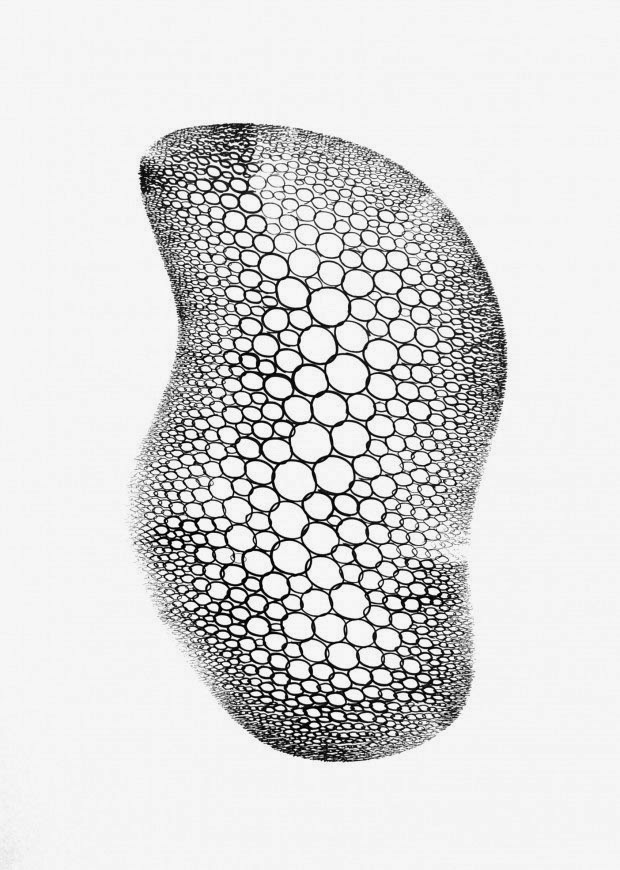
[Image: “Untitled #13,” from “Scripted Movement Drawing Series 1” (2014) by Andrew Kudless].

San Francisco-based designer and architect Andrew Kudless is always up to something interesting, and one of his most recent projects is no exception.

For a new group of small works called “Scripted Movement Drawing Series 1” (2014), Kudless is exploring how robots might make visual art—in this specific case, by combining the instructional art processes of someone like Sol Lewitt with the carefully programmed movements of industrial machinery.

[Image: The robot at work, from “Scripted Movement Drawing Series 1” (2014) by Andrew Kudless].

In Kudless’s own words, “The work is inspired by the techniques of artists such as Sol Lewitt and others who explored procedural processes in the production of their work. The script, or set of rules, as well as the ability or inability of the robot to follow these instructions is the focus of the work. There is almost a primitive and gestural quality to the drawings created through the tension between the rules and the robot’s physical movement. Precisely imprecise.”

[Image: “Untitled #16,” from “Scripted Movement Drawing Series 1” (2014) by Andrew Kudless].

These giant robot arms, he continues, “are essentially larger, stronger, and more precise version of the human arm. Made up of a series of joints that mimic yet extend the movements of shoulder, elbow, and wrist, the robot has a wide range of highly control[led] motion. The real value of these robots is that, like the human arm, their usefulness is completely determined by the tool that is placed in its hand.”

So why only give robots tools like “welding torches, vacuum grippers, and saws,” he asks—why not give them pencils or brushes?

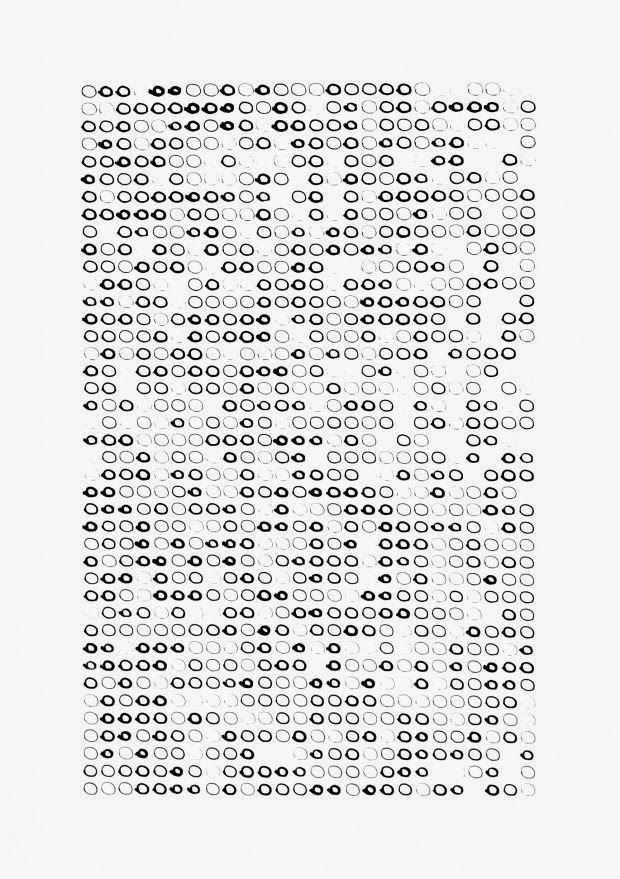
[Image: “Untitled #6 (1066 Circles each Drawn at Different Pressures at 50mm/s),” from “Scripted Movement Drawing Series 1” (2014) by Andrew Kudless].

The results are remarkable, but it’s specifically the unexpected combination of Lewittian instructional art with industrial robotics that I find so incredibly interesting. After all, Kudless ingeniously implies, it has always been the case that literally all acts of industrial assembly and production are, in a sense, Sol Lewitt-like activities—that conceptual art processes are hiding in plain sight all around us, overlooked for their apparent mundanity.

It’s as if, he suggests, every object fabricated—every car body assembled—has always and already been a kind of instructional readymade, or Sol Lewitt meets Marcel Duchamp on the factory floor.

With these, though, Kudless throws in some Agnes Martin for good measure, revealing the robot arms’ facility for minimalist lines and grids in a graceful set of two-dimensional drawings.

[Image: “Untitled #7 (1066 Lines Drawn between Random Points in a Grid),” from “Scripted Movement Drawing Series 1” (2014) by Andrew Kudless].

Kudless explains that “each of the works produced in this series was entirely programmed and drawn through software and hardware”:

None of the lines or curves was manually drawn either within the computer or in physical reality. Rather, I created a series of different scripts or programs in the computer that would generate not only the work shown here, but an infinite number of variations on a theme. Essential to the programming was understanding the relationships between the robot and human movement and control. Unlike a printer or plotter which draws from one side of the paper to the other, the robot produces the drawings similarly to how a human might: one line at a time. The speed, acceleration, brush type, ink viscosity, and many other variables needed to be considered in the writing of the code.

Various drawing styles were chosen to showcase this.

[Image: “Untitled #15 (Twenty Seven Nodes with Arcs Emerging from Each),” from “Scripted Movement Drawing Series 1” (2014) by Andrew Kudless].
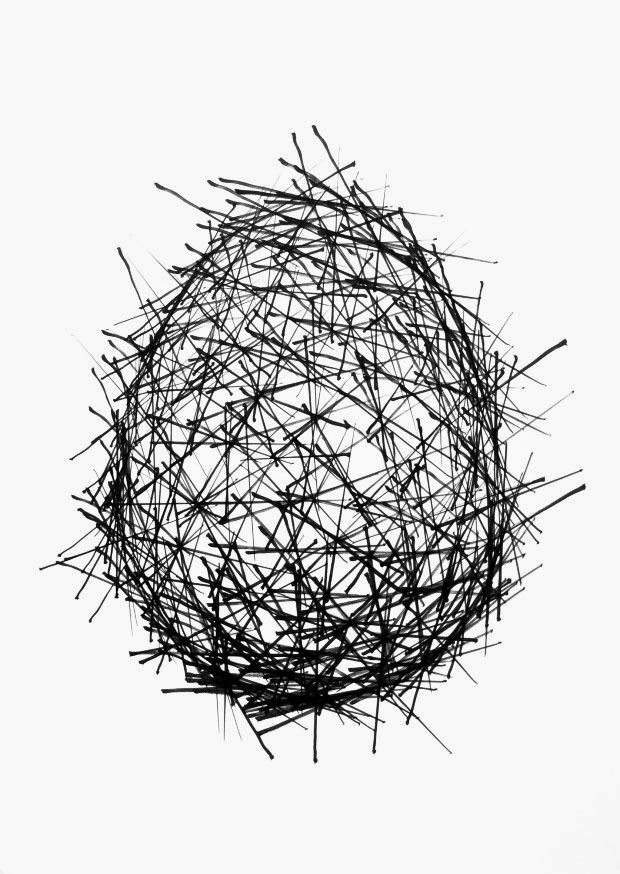
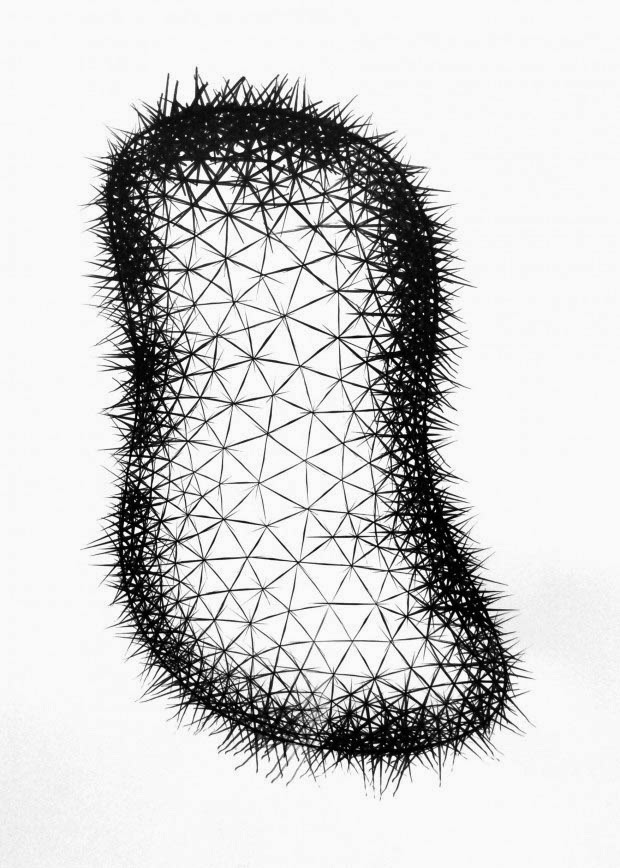
[Image: “Untitled #3 (Extended Lines Drawn from 300 Points on an Ovoid to 3 Closest Neigh[bor]ing Points at 100mm/s)” (2014) from “Scripted Movement Drawing Series 1” (2014) by Andrew Kudless].
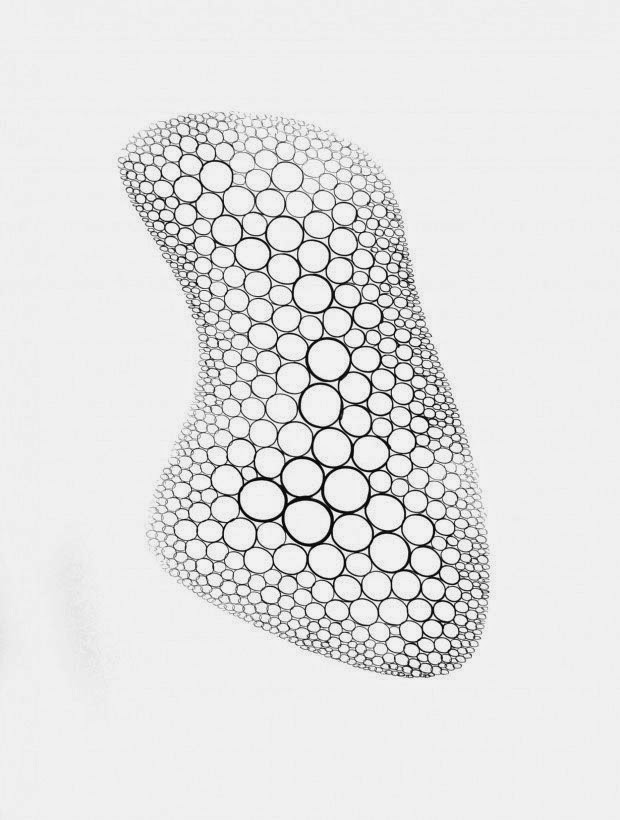
[Image: “Untitled #12,” from “Scripted Movement Drawing Series 1” (2014) by Andrew Kudless].

[Image: “Untitled #14,” from “Scripted Movement Drawing Series 1” (2014) by Andrew Kudless].

There are many more drawings visible on Kudless’s website, and I am already looking forward to “Scripted Movement Drawing Series 2.”

You can also purchase one of the prints, if you are so inclined; contact the Salamatina Gallery for more information.

(Very vaguely related: Robotism, or: The Golden Arm of Architecture).

Etch a Sketch

[Image: Laser-etched wood panel, design by Kris Davidson, etching by Clear Cut Creation].

This laser-etched wood panel designed by tattoo artist Kris Davidson is pretty awesome.

While the grain of the bamboo itself interferes in a few spots with the actual patterns—perhaps suggesting that something like stained hardwood would be a better choice to really make this thing pop—it’s nonetheless a fantastically intricate and obsessively detailed project.

Part mandala, part maze, it’s like the floor plan of an alien palace, the board of an incomprehensible game, or a construction diagram for some occult supercomputer.

[Image: Laser-etched wood panel, design by Kris Davidson, etching by Clear Cut Creation].

It would be great to see this blown up to the size of an entire wall or decorative panel—or even just used as the basis of a student architecture project. Milled landscapes, or site plans burned directly into wood, suitable for hanging once the semester is finally over.

There is one more shot over on Davidson’s website, and check out his tattoos while you’re there.

Spatial Basics

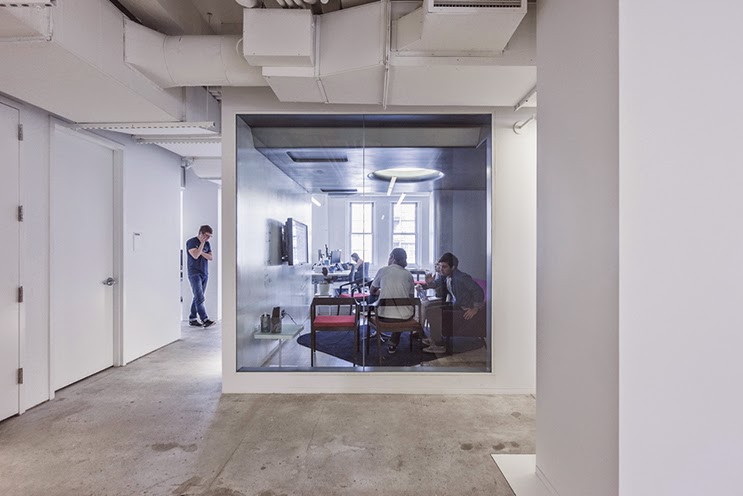
[Image: Red Bull New York offices by INABA; photo by Greg Irikura].

I got a handful of preview shots from the new Red Bull New York offices the other night, with interiors designed by INABA, and I thought I’d post them here.

[Image: Red Bull New York offices by INABA; photo by Greg Irikura].

INABA, of course, already designed the connected Red Bull Music Academy, and the private office space continues that aesthetic, albeit deliberately stripped even of the constrained maximalism of that project’s bold colors and public-facing spatial entertainments, down to a minimalist, calm workplace distinct from—or perhaps offsetting—Red Bull’s identity as an international energy drink monolith.

[Images: Red Bull New York offices by INABA; photos by Greg Irikura].

As architect Jeffrey Inaba explains, “the company wanted its New York offices to be low-key. The 16,800 SF project doesn’t celebrate the company’s values with eye-catching forms, nor is its layout inspired by recent theories of workplace productivity.”

[Image: Red Bull New York offices by INABA; photo by Naho Kubota].

“Instead,” he continues, “the design is simple and without the pretense of being on the cutting edge of cool tech office design. It responds to the quick cycling of trends in workplace interiors by steering clear of large-scale gestures, playful lounge zones, or urban-inspired ad hoc décor.”

[Image: Red Bull New York offices by INABA; photo by Greg Irikura].

From the architect:

If the new standard for corporate offices is to create a physical experience that builds on the brand qualities the company has successfully established in digital media, then Red Bull’s New York space is the antithesis of this best practice. There isn’t a reliance on storytelling or graphic imagery; the space is dialed back to reset the focus of the experience on the basic architectural qualities of scale and light.

Acknowledging that offices and technology are evolving quickly and the future functions of the work environment are unpredictable, the architects composed a layout of spaces with distinct, fixed features. The three types of spaces are large open zones, medium-sized enclosed areas, and small rooms. They are used now as open office seating, conference areas, and small meeting/workrooms, respectively. Designed to be unique in size and day lighting and not to any particular functions invites people to invent new uses for them in the future.

All the shots seen here were taken by Greg Irikura and Naho Kubota, as noted.

[Image: Red Bull New York offices by INABA; photo by Greg Irikura].

In Kubota’s case, she shot both digitally and on film, with the latter shots taking on a hazy, almost noir quality, like the set of a 21st-century Mad Men caught on a Sunday break.

[Images: Red Bull New York offices by INABA; photos by Naho Kubota].

Here are a final few shots—but click through to see the project on INABA’s own site.

[Images: Red Bull New York offices by INABA; photos by Naho Kubota].

Meanwhile, check out BLDGBLOG’s two interviews with Jeffrey Inaba—from 2007 and 2010, respectively—and congrats to INABA’s Darien Williams for appearing on Curbed‘s list of Young Guns finalists for 2014!

“We don’t have an algorithm for this”

[Image: Comet 67P, via ESA].

In the story of how European Space Agency researchers are scrambling to locate—and possibly move—the Philae probe, which they successfully landed on Comet 67P two days ago, there’s an interesting comment about computer vision and the perception of exotic landscapes.

[Image: Comet 67P, via New Scientist].

“We’re working our eyes off,” one of the scientists says to New Scientist, describing how they are personally and individually poring over photographs of the comet.

“It’s an entirely manual process,” New Scientist continues, “because the complex and bizarre landscape of comet 67P defies any kind of automated search. ‘We don’t have an algorithm for this,’ he says.”

We don’t have an algorithm for this.

[Image: The irregular terrain of Comet 67P, via ESA].

It would be interesting to develop a taxonomy of landscapes based on their recognizability to algorithms. This would tell you as much about how computers see the world as it would about the aesthetic assumptions—even the geological biases—of the people who programmed those computers.

Think, for example, of Adam Harvey’s work, asking When Is An Apple No Longer An Apple? That project explored the point at which machine-learning algorithms could no longer distinguish the iconic fruit from a jumble of colorful objects.

Or take Harvey’s more recent CV Dazzle experiment, which looked at how to prevent facial recognition software from identifying a face at all through the clever use of cosmetic camouflage.

However, in the case of Comet 67P and other extreme topographic environments, we would be looking at when a landscape is no longer a landscape, so to speak, at least in terms of the computer-vision algorithms programmed to analyze it.

[Image: Comet 67P, via ESA].

What other landscapes fall within this category—of spatial environments unrecognizable to machines—and what do those spaces reveal about the dimensional prejudices of the algorithm? Light and shadow; depth and range; foreground and background; geometry and complexity.

Bump Adam Harvey’s investigations up to the scale of a landscape, and a million potential design projects beckon. Learning from Comet 67P.

(Earlier on BLDGBLOG: The Comet as Landscape Art).

Preservation, Infrastructure, and the Museology of Crime

[Image: David Gissen, “Cross-Bronx Expressway,” with Victor Hadjikyriacou; from Landscape Futures].

In case you’re reading this near Ithaca, New York, I thought I’d mention that I’ll be speaking at a conference this weekend at Cornell, called Spolia: Histories, Spaces, and Processes of Adaptive Reuse. Things kick off this evening with a lecture by Kate Orff.

What are spolia? From the conference brief:

Spolia refers to using scavenged materials for new (and often originally unintended) purposes in constructed environment[s]. This practice is millennia old, dating back to Ancient Egypt and perhaps beyond. Both extremely pragmatic and symbolically charged, spolia is a complex phenomenon; beyond mere recycling, it also has social, cultural, and even political dimensions. Many sites, buildings, structures of antiquity were repurposed into newer edifices, not only to facilitate the production of new form, but also to claim the cultural and political heritage of the donor structures.

I’ll be speaking on a panel tomorrow morning with two people I’m very excited to meet: art historian Dale Kinney from Bryn Mawr College and co-editor of Reuse Value, and Abraham Thomas, the newly appointed director of the Sir John Soane Museum in London.

[Image: David Gissen, “Florence, Italy,” with Victor Hadjikyriacou; from Landscape Futures].

Here’s an excerpt from my abstract, in case you’re interested:

As the curator of a 2011 exhibition called Landscape Futures, I was able to commission new visual work from historian David Gissen. In the resulting project—called “Museums of the City”—Gissen explored what it would mean to foreground the apparatus of historical preservation in an urban environment. This meant populating downtown Florence, Italy, for example, with oversized lighting, display, and HVAC rigs, transforming the city’s center into an outdoor display; and doing the same in Central Park, such that carefully planted groves of trees and well-maintained lawns could be revealed for what they really are: an artificial landscape exhibition from the 19th century now hiding in plain sight as a recreational topography for present-day residents and tourists.

But it was Gissen’s look at what it would take to preserve the Cross-Bronx Expressway—a justifiably maligned urban megastructure—as a kind of stabilized ruin that seems most relevant here. Is the Cross-Bronx Expressway an example of spolia? More abstractly, to what extent can using a city’s transportation infrastructure become a museological experience?

Briefly, I’ll also discuss a half-serious proposal to preserve a freeway interchange in Baltimore, Maryland—not for reasons of aesthetics or historical significance, but, oddly enough, for reasons of topology. The interchange was due to be renovated, destroying its unique geometric arrangement, and a mathematician was thus calling for it to be saved. But are dysfunctional chunks of the city to be preserved even at the detriment of their intended use? How does infrastructure become museological?

Finally, I want to change topic altogether in order to look very briefly at one of the most remarkable private collections I have visited in recent years: a forensic collection of safes, vault doors, and entire sections of bank walls stored in a warehouse in New Jersey by a private security firm. Like something straight out of the work of artist Gordon Matta Clark—or perhaps a bizarre new version of the Sir John Soane Museum as rebuilt by the FBI—these broken doors, burnt safes, and heavily damaged architectural fragments are spolia under a different name.

I’ll use this example to discuss how architectural ruins and other spolia are used and reused in forensic analysis, exploring where forensics and archaeology become functionally indistinguishable.

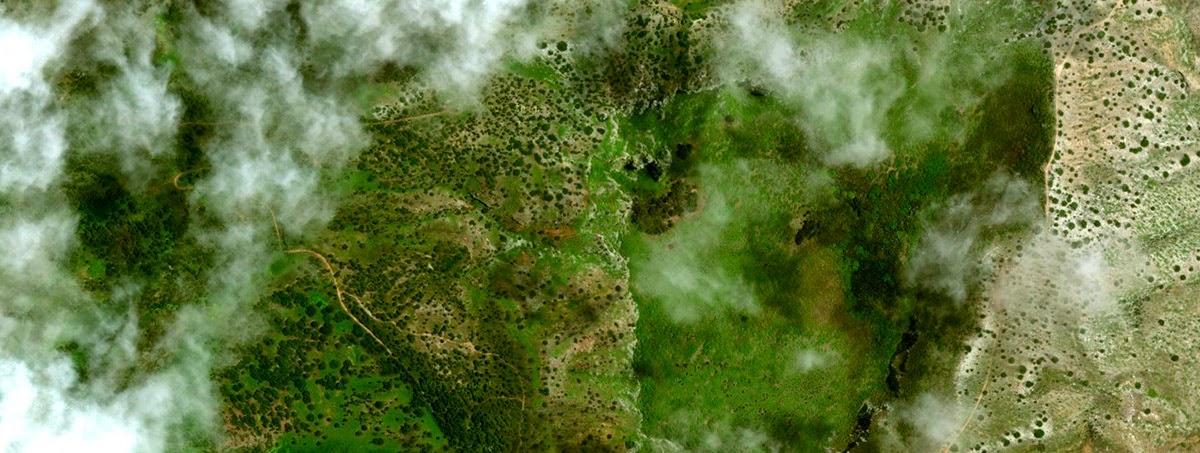
[Image: From a private collection of failed safes, vault walls, and other crime scene evidence; photo by Nicola Twilley].

In any case, it should be a fun discussion and a great conference overall. Read more at the official website, and stop by if you are near Cornell’s OMA-designed Milstein Hall, where the conference takes place.

Goldberg Robotics

[Image: From Science Daily/University of Oslo].

Robots emitting robots emitting robots: this is one way that machines will learn to navigate extreme spatial environments.

“In the future,” we read in a press release courtesy of Science Daily, “robots must be able to solve tasks in deep mines on distant planets, in radioactive disaster areas, in hazardous landslip areas and on the sea bed beneath the Antarctic”—as well as in the cracks of otherwise inaccessible archaeological sites.

Researchers at the University of Oslo think we need to send machines capable of not exactly of replication, but something more like budding or fruiting, using 3D printers.

Kyrre Glette, one of the researchers behind the press release, imagines a robot being sent into “the wreckage of a nuclear power plant,” for example, where it encounters a stairway it had not been anticipating needing to climb. For the moment, it’s stuck. So what does it do? “The robot takes a picture. The picture is analysed. The arms of one of the robots is fitted with a printer. This produces a new robot, or a new part for the existing robot, which enables it to negotiate the stairs.”

The original robot—which was thus not single but a crowd waiting to happen—moves forward through the landscape by sending detached variations of itself further ahead. You could think of it as Goldberg robotics: advancing through variation.

This is obviously not a new vision—the idea of 3D printers printing 3D printers that can 3D-print further 3D-printer-printing 3D printers, for example, is a long-running staple of stoner sci-fi. Nonetheless, it’s interesting to see this specifically discussed in terms of navigating spatial environments, be they mines, caves, or architecture, explored and mapped by an instant machine-ancestry self-produced specifically for the task at hand.