Fossil Reactors

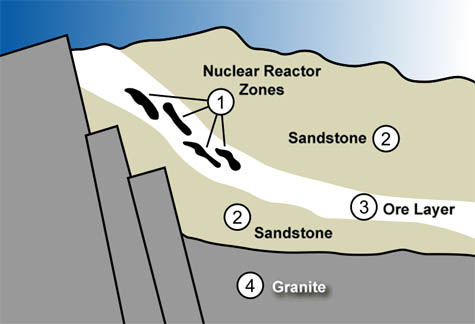
There are as many as sixteen 2-billion-year old nuclear reactors in the rocks beneath Gabon. Considering their age, they are also, unsurprisingly, completely natural.

[Image: The natural clocks and ticking stratigraphy of the Oklo uranium deposit, courtesy of the Curtin University of Technology].

“In 1972,” the Curtin University of Technology explains, “the very well preserved remains of several ancient natural nuclear reactors were discovered in the middle of the Oklo Uranium ore deposit.” The university adds that each of these equatorial African reactors “operated on an intermittent basis for a period ranging from a few years to hundreds of thousands of years. The total time period over which the reactors operated is thought to be about a million years.”

In one specific case, we read in a report published five years ago by Physical Review Focus, a chain reaction in the uranium-rich rocks “cycled on and off every three hours.”

The idea that radioactive deposits beneath the Earth could self-react and undergo fission was first proposed by physicist Paul Kazuo Kuroda. The internal clock of a geological formation, Kuroda suggested, given contact with water, could simply start ticking away:

In 1956, nuclear chemist Paul Kazuo Kuroda of the University of Arkansas in Fayetteville predicted that a chain reaction could develop in natural uranium deposits, generating heat just as the reactor in a nuclear power plant does. His suggestion proved prophetic when, in the 1970s, others discovered several burned-out natural reactors in the Oklo uranium mines in Gabon.

Amazingly, “researchers still don’t know precisely how the fossil reactors managed to burn slowly for more than 150,000 years, when they could have exploded violently.” The presence of underground water seems especially fortuitous in that regard—it helped to avoid a nuclear detonation.

That’s plausible because the water molecules would collide with neutrons whizzing through the uranium and slow them down, a process called moderation. Because slower neutrons more efficiently split the uranium nuclei in a chain reaction, the water would promote the reaction and cause the reactor to heat up. Eventually, however, the heat would boil away the water, shutting the reaction down until more water could collect.

It was a pulsing rhythm, a geologic throb: based on present-day chemical measurements taken of specific isotopes in the nearby rocks, “the researchers estimate that the reactor ran for 30 minutes and then shut down for two and a half hours.”

[Image: A diagram of the Oklo uranium deposit, courtesy of the U.S. Department of Energy].

I’m reminded again here of William Burroughs’s extraordinary and haunting suggestion, from his novel The Ticket That Exploded, that, beneath the surface of the earth, there is “a vast mineral consciousness near absolute zero thinking in slow formations of crystal.” Here, though, it is a mineral seam, or ribbon of heavy metal—a riff of uranium—that stirs itself awake in a regularized cycle of radiative insomnia that disguises itself as a planet. Brainrock.

Gabon’s “natural nuclear fission reactors,” according to Wikipedia, “are the only known sites in which natural nuclear reactors existed. Other rich uranium ore bodies would also have had sufficient uranium to support nuclear reactions at that time, but the combination of uranium, water and physical conditions needed to support the chain reaction was unique to the Oklo ore bodies.”

Of course, this process created what we would now call nuclear waste—including plutonium. These otherwise extraordinarily dangerous waste products, however, have been entombed within the earth for two billion years. The Curtin University of Technology points out that “this is so long that all of the radioactive waste products (even those with million year half lives) have decayed away.” They have also hardly even moved: the plutonium, according to the U.S. Department of Energy, “has moved less than 10 feet from where it was formed almost two billion years ago.”

Are there thus structural lessons to be learned from the rocks at Oklo? “By analyzing the remnants of these ancient nuclear reactors and understanding how underground rock formations contained the waste, scientists studying Oklo can apply their findings to containing nuclear waste today,” the DOE goes on to suggest. This is another way of saying that the Oklo uranium deposits are being studied as natural analogues for how high-level nuclear waste might behave in an artificial repository like Yucca Mountain (watch for a long and fascinating interview with a geophysicist from Yucca Mountain here on BLDGBLOG next week).

We might say, then, that a geological formation, like some nuclear version of Spanish architect Vicente Guallart’s notion of geologics, has partially inspired an architectural form.

The timescales are all wrong for this, meanwhile, but if geomythology is the study of ancient folk tales, oral traditions, and regional myths to see if they contain camouflaged references to real, but prehistoric, geological events—earthquakes, tsunamis, volcanic eruptions, and more—what geomythological influence might the throbbing and automechanized Oklo uranium mines play? How extraordinarily interesting would it be to come across a series of old myths about an intelligent presence in the rocks of equatorial Africa, a kind of mineralized Mother Nature winking at everyone from below—and to realize that they’re referring to the reactions at Oklo. A spirit in the Earth.

Finally, do these naturally occurring reactions come with the implication that our present-day nuclear reactors are, in a sense, simulated geological processes, not unlike artificial diamond-creation chambers? Nuclear reactors become models of already existing natural events. They are terrestrial reenactments, you might say.

Scientific American has a five-page article about the Oklo phenomenon, if you’d like to read more.

The Last Town on Earth: An Interview with Thomas Mullen

Thomas Mullen is the author of The Last Town on Earth, a novel set in a voluntarily quarantined village in the remote forests of the Pacific Northwest during the Spanish Flu pandemic of 1918.
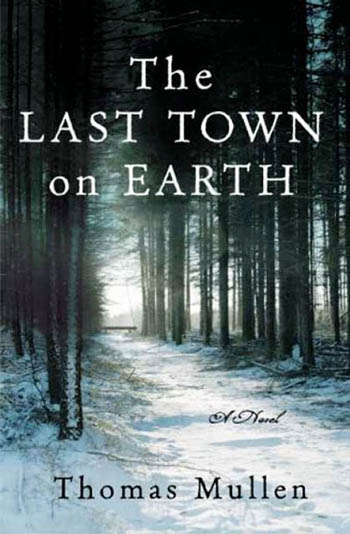
From the book’s description:

The year is 1918. America is fighting a war on foreign soil that has divided the nation. Meanwhile, rumors of the spread of the deadliest epidemic ever are causing panic on the home front. The uninfected town of Commonwealth, Washington, votes to quarantine itself, and two young friends are asked to guard the town entrance and keep strangers out.
One day, a starving, cold—and seemingly ill—soldier comes out of the woods begging for sanctuary, and the two guards are confronted with an agonizing moral dilemma.

The Last Town on Earth was named the Best Debut Novel of 2006 by U.S.A. Today – who describe it as “an absorbing depiction of a utopian town that attempts to keep the 1918 flu epidemic at bay” – and it won the James Fenimore Cooper Prize for Excellence in Historical Fiction.

As part of our ongoing series of quarantine-themed interviews, Nicola Twilley of Edible Geography and I spoke to Mullen about his novel, about the historical research that informed it, and about the moral implications of mass quarantine.

• • •

Edible Geography: What sort of research went into writing the novel?

Thomas Mullen: The impetus for the book was an article that I read many years ago about an AIDS virologist who had studied the 1918 flu earlier in his career. It also mentioned, parenthetically, that there had been healthy towns in the Rocky Mountain states and in the Pacific Northwest that were so terrified by stories about how contagious the flu was, and how fatal it was, that they decided their best recourse for staying healthy was to block off all the roads leading into town and to post armed guards to prevent anyone from coming in. That just blew me away—it was amazing to read that this had happened—and I thought it would be a very dramatic first scene.

I was hooked by the moral dilemma of quarantine: what happens if, one day, you and your buddy are standing guard over your town and you’re presented with a lost traveler? He’s freezing, and he’s starving, and he’s begging for your aid. He needs food and shelter, or he might die. What do you do? Do you bring this person in? Do you try to be charitable, even if you know he might be carrying this awful virus that you don’t really understand? Again, it was 1918 and their understanding of the virus was certainly worse than ours is today. Or do you tell you the person: “Hey, I’m sorry, but I need to think of my friends and family and my town. I don’t know what you might be carrying, and you’re just going to have to die in the woods.”

That’s what made me want to write the book. I sat down and I read a few books about the 1918 flu—although I couldn’t find many. It had become this overshadowed chapter in history. That’s starting to change now; with the new concern about avian flu and H1N1, there’s been much more discussion of the 1918 epidemic. But, back when I started my research, it was hard to find much information.

I tried to find out about these towns that had done this—these sort of reverse-quarantines. That’s just a phrase that I invented; I don’t know if there’s a real phrase for it. Normally, quarantine is when something or someone is ill and they’re quarantined off so that they don’t spread their germs to the rest of us. But in this situation, the town that closes itself off is healthy. I called that reverse-quarantine.

I couldn’t really find anything out about these towns. In fact, when I was about three-quarters done with the rough draft, a historian named John Barry wrote what is now the definitive history of the 1918 flu, called The Great Influenza. I got that book and I read it—and it’s about 600 pages long, but he only gives about half a page to this phenomenon of Western towns that had closed themselves off. He says that it worked for some and it didn’t work for others—and that’s it.
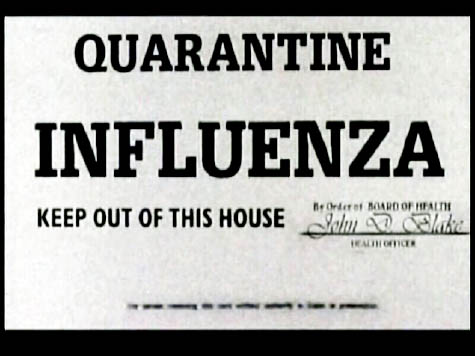
[Image: Historical quarantine marker].

Edible Geography: Was reverse-quarantine a common phenomenon and just under-reported, or was it actually fairly rare?

Mullen: It doesn’t sound like it was very common. After all, if it only got about half-a-page in a 600-page book… It’s just something I could not find reference to very often.

They were probably small towns that were already fairly isolated, and therefore might not have left such a good paper trail for historians to write about. It must have been fairly unusual in the first place, because the flu spread very, very quickly, so usually it was too late. By the time you were thinking that maybe you should close the borders, people were already getting sick in your town—so you missed the opportunity.

Meanwhile, because our nation was at war, there was censorship of the press. Newspapers didn’t want to report bad news. People didn’t often know what was happening until it was too late. Instead, newspapers would have a little pick-me-up story about how some soldiers in a nearby army base had a bad case of the flu… but they’re feeling much better now. Meanwhile, people are looking out their windows and seeing hearses! If there had been a free press, and if the government had not been distracted by a war and had shared information about it sooner, it’s possible that more towns would have tried quarantine. But for most people, by the time they realized what was happening, it was too late.

I think the reason why the towns that did this were in the Rocky Mountains and in the Pacific Northwest was that they were inland and fairly isolated. The flu had started, most epidemiologists believe at this point, in army bases, and then it had traveled along the rail lines, from army base to army base; and from port to port—meaning cities like Philadelphia and Boston and New Orleans and San Francisco—and it gradually trickled inland. Some of the mountain states were the last to get infected – and they were the ones where, finally, the story was out. They were the ones who knew what was happening, so some of them were able to make this decision.

Ultimately, though, because I’m a novelist—I write fiction, and I can make things up—I decided, okay, maybe it’s better that I don’t know exactly what happened in these towns. Maybe that frees me up a bit. I did as much research as I could into how the epidemic worked, how the disease itself worked, and what the political environment was like at that time in America—what these characters were doing and what they were thinking about. But, as for what had actually befallen towns that tried this, I was sort of unconstrained by historical fact—which, I think, was a good thing.

BLDGBLOG: That raises the question of your own interest, as a novelist, in the idea of quarantine. What are the narrative possibilities of quarantine that drew you to it, as a plot device?

Mullen: As a novelist, you need there to be some stress, because that creates the tension between the characters. It leads them to act – sometimes in inappropriate or regrettable ways.

One of the things that I was really interested in doing with this book was studying the way in which people act differently from the way they would like to think they act, under stress. We have this idea of ourselves as good people, and we have moral guidelines that we like to believe we follow, but when we feel threatened and we feel that our family is in danger, we tend to bend some of those rules. Whether that means shooting a stranger who’s trying to come into your town, or whether that means shutting out your neighbor because you think they might have a cold – things like that.

I was interested in looking at the stresses that these people would be under. First of all, externally, they feel they’re safe in their little town—but the world around them is dangerous, with everyone being ill. Also, in those political times, there were things happening that the utopians in my little mill town didn’t agree with; they’re very anti-war and anti-capitalist. They feel at odds with the world, and they’re closing themselves off from a world that they disagree with in many ways. But when the disease does get into the town, they’re at odds with each other: some are sick, some are healthy. New stresses are introduced; they start running out of food and out of things that they need to maintain their quarantine.

[Images: The town of Jerome, Arizona, during the 1918 flu outbreak; note the face masks. Courtesy of the Jerome Historical Society, via the Sharlot Hall Museum].

Edible Geography: Much of your book is focused on the moral dilemmas associated with implementing and enforcing quarantine. What drew you to that?

Mullen: That was something that I didn’t seek out to do, but, as I was writing the story, it came naturally. You have these utopian idealists and political activists who are anti-war and pro-union, and they’re early suffragists. Some of them support the quarantine because they want to stay healthy; they want to protect their families. But some of them, because their political beliefs are so strong, realize that, hey, I have these beliefs because I want to make the world a better place. I don’t want to just make my town a better place. And what are the moral implications of turning our back on a world that is suffering? Isn’t it our obligation to do something that would improve the world? Some people feel that the best way to make a better world is to focus on yourself, and on your own community, and to hope the world will emulate it. Others—more activist—think they need to get out there. I’m interested in that conflict.

And, of course, that line is itself blurred—because they all support the quarantine initially. Even those who opposed it refused to leave. So, theoretically, everyone in the town in chapter one is cool with the idea. But, as time goes on, some people are thinking, god, I’m bored, I want to get out of here; or we learn that they’ve been secretly sneaking out to visit women or buy booze. So even the people who had initially agreed with it came to feel that it had been imposed on them. They change their minds—but it’s too late.

BLDGBLOG: In a way, you illustrate the fundamental impossibility of a total quarantine: there’s always something getting in or getting out, usually due to human weakness or error.

Mullen: I can’t remember if that’s something that I always intended—that I was going to have these people sneaking out—or if that was something that came up halfway. But it just seemed right to me. The whole dilemma of utopian politics, in general, is: can we really make the world a perfect place? I think there is enough human frailty and vice out there that something will always sabotage it.

Medically speaking, I know that quarantine can work, but, with something on the scale of a whole town, I can’t help but wonder: would it really work? It didn’t in the book because it was this slapdash affair; you’ve got randomly chosen people standing guard. But I think if it were to happen now, with a city or a state, you’d have National Guard or police or army officers standing guard, and I don’t think they would bend quite the way my characters would bend. But then you have the other problem—where it becomes a police state—and people aren’t allowed to come and go. It might work to keep the disease out, and people might thank them for that, but they might also feel like their rights were being violated. It gets really complicated.

[Image: A sick ward for those infected with the 1918 Spanish flu].

Edible Geography: Why do you think there has been such a historical silence about the epidemic?

Mullen: My partly cynical answer is that we Americans just don’t know our history very well!

I did a panel once with two other writers who both had novels set during World War I, and they were both British. They talked about how World War I is a big deal in the UK: how everybody knows about it; you see plaques everywhere listing the dead; and there were some towns where, in one night, the entire population of young men died, because they had this idea that men in the same town could enlist together and fight in the same regiment. This meant that you got to enlist with your friends, and you got to fight with your friends, which was great for morale—but what it also meant it that you died with your friends. There were literally towns where all the young men died on the same day, in one of those major battles.

It was a profound experience for so much of Europe, where they fought the war for years on their home soil. For America, on the other hand, we were only involved militarily for about year. We declared war earlier on, but it took a while just to get an army together, because we didn’t even have a standing army. And, of course, it wasn’t fought on our own soil. So the flu took place during the war, and the war itself is just not very well-taught or well-understood here.

But, also, in terms of why do people know about the war and not the flu, can it be that history textbooks can only handle one big subject at once? They’re writing about the war and they just didn’t think they needed to mention the flu? A disease doesn’t have the geopolitical themes that you get to play with when you’re teaching about a war or a politician or a movement; it was this horrible thing that just happened.

Also, I wonder how much of it was simply the fact that the people who lived through it just wanted to build a wall around those memories; they didn’t have our mindset, where we need to come to terms with our past and expose our scars in order to find closure. I think the survivors, to some degree, probably felt that it’s over – and it was horrible – but the last thing to do was to talk about it.

At this point, it’s enough generations away that there’s very little memory of it left – people only remember being told about it. Another horrible thing about the flu was that it killed so many adults and it left so many orphans. A lot of the survivors were very young children, who really don’t remember it for themselves.

But it was interesting to me that so many of the great literary lions in the early 20th century were people who lived through this when they were teenagers or young adults—Hemingway, Faulkner, Fitzgerald, Dos Passos, Steinbeck—and none of them wrote about it. It now seems like of course you would write about this.

• • •

This autumn in New York City, Edible Geography and BLDGBLOG have teamed up to lead an 8-week design studio focusing on the spatial implications of quarantine; you can read more about it here. For our studio participants, we have been assembling a coursepack full of original content and interviews—but we decided that we should make this material available to everyone so that even those people who are not in New York City, and not enrolled in the quarantine studio, can follow along, offer commentary, and even be inspired to pursue projects of their own.

For other interviews in our quarantine series, check out Isolation or Quarantine: An Interview with Dr. Georges Benjamin, Extraordinary Engineering Controls: An Interview with Jonathan Richmond, On the Other Side of Arrival: An Interview with David Barnes, and Biology at the Border: An Interview with Alison Bashford.

Many more interviews are forthcoming.

Linkology

[Image: The Mobile Fabrication Unit by Gramazio & Kohler, soon to be building at Storefront for Art and Architecture].

Some things to read on a Monday afternoon:

—Architect Bjarke Ingels of BIG dominates the stage at TED. I was able to walk around BIG’s recently completed Mountain Dwellings in Copenhagen the other week, as part of an amazing drive around what felt like all of Denmark with Johan Hybschmann and Nicola Twilley. The building’s now-famous parking garage, we suggested only half-jokingly, would make an amazing venue for an architecture conference: its terraced parking decks overlook and focus upon a kind of inadvertent auditorium. Drive-in films, drive-in lectures, drive-in pirate radio concerts – it’s too fantastic a space not to try.

—Lebbeus Woods offers a glimpse of a film he outlined, designed, and later co-wrote with Olive Brown, called Underground Berlin. It involves a disillusioned architect, a missing twin brother, neo-Nazi activities in the divided city, metallic underground tunnels connecting east to west, and “a top-secret underground research station rumored to be somewhere beneath the very center of Berlin.” There are even rogue planetary scientists investigating “the tremendous, limitless geological forces active in the earth.” Woods’s graphic presentation of the idea is incredible, and absolutely worth a very long look.

—Meanwhile, farmers in the UK have been asked “to implement measures which would reverse the UK-wide decline in skylark numbers.” This means shaving small rectangular plots into the midst of productive cropland, because “rectangular uncropped patches in cereal fields allow skylarks to forage when crops become too dense for them.” We will prepare our landscapes for other species.

—Is your iPod maxing out the U.S. electrical grid? Perhaps it doesn’t matter: New Scientist looks at how to short-circuit the grid altogether – and would-be saboteurs the world over are still taking furious notes. Alternatively, just follow the fantastic On The Grid series by Adam Ryder and Brian Rosa to see where the electrical network really goes.

New Scientist also scanned beneath the south polar glaciers to find “Antarctica’s hidden plumbing” – and, as it happens, “the continent’s secret water network is far more dynamic than we thought.”

—Ruairi Glynn’s new book, Digital Architecture: Passages Through Hinterlands is now out; it documents Glynn’s related exhibition.

—Moving online, New York’s Architectural League has redesigned its website – joining the Canadian Centre for Architecture, who also redesigned their own site earlier this summer.

—Back in England, the BBC reports that pigs are being used “to help restore” parts of Worcestershire’s historic Wyre Forest. This comes at the same time that Cairo has realized that its absurd slaughter of every pig in the city last spring in order to guard against swine flu has led to an extraordinary garbage crisis. “The pigs used to eat tons of organic waste,” the New York Times reports. “Now the pigs are gone and the rotting food piles up on the streets of middle-class neighborhoods like Heliopolis and in the poor streets of communities like Imbaba.” Meanwhile, Edible Geography points our attention to the fascinating labyrinth of subsidiary products made from the bodies of dead pigs; welcome to “Pig Futures.”

—On io9 Matt Jones suggests that “the city is a battlesuit for surviving the future,” and he cites Archigram, Kevin Slavin, Dan Hill, Warren Ellis, the architecture of sci-fi, William Gibson, and much more to make his point. Speaking of Warren Ellis, Icon magazine recently published a long conversation between Warren, Francois Roche, and myself; you can check it out on Flickr.

—Were artificial hills, henges, and monumental earthworks a kind of “prehistoric sat nav” installed across the British landscape? And does this same question seem to be asked at least once every few years?

—The 2009 Solar Decathlon approaches.

—Gramazio & Kohler’s Mobile Fabrication Unit will arrive soon at New York’s Storefront for Art and Architecture. Between October 5 and October 27, it will be busy assembling “the first temporary public installation to be built on site by an industrial robot in New York.” Then, however, on Halloween, it will become possessed by incomprehensible forces from the Precambrian depths of the city, and, in a horrifying night of thunderous brickwork, it will wall off the island of Manhattan forever…

Hexagonal Hydropolis

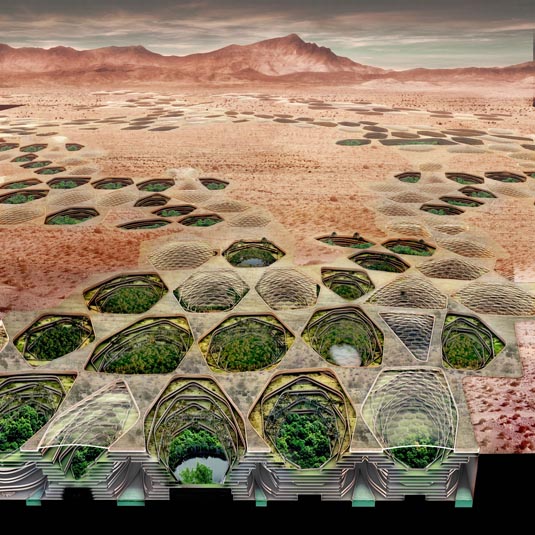
[Image: From Sietch Nevada by Matsys; renderings by Nenad Katic].

Andrew Kudless of Matsys recently proposed an extraordinary desert city of semi-subterranean terraces inspired by the novel Dune.

The images are fantastic, and the project description hooked me right away:

In Frank Herbert’s famous 1965 novel Dune, he describes a planet that has undergone nearly complete desertification. Dune has been called the “first planetary ecology novel” and forecasts a dystopian world without water. The few remaining inhabitants have secluded themselves from their harsh environment in what could be called subterranean oasises. Far from idyllic, these havens, known as sietch, are essentially underground water storage banks. Water is wealth in this alternate reality. It is preciously conserved, rationed with strict authority, and secretly hidden and protected.

The rest of the project combines an interest in drought hydropolitics in the U.S. southwest with the speculative architecture of “underground water banks.”

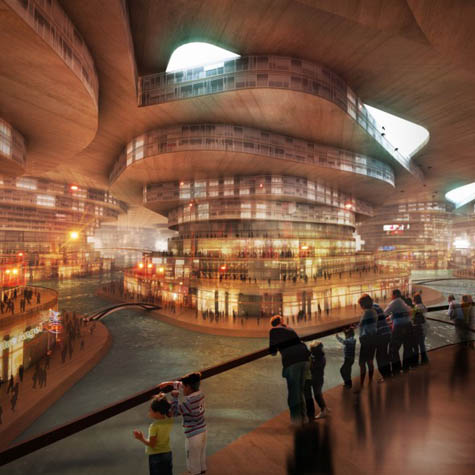
[Image: From Sietch Nevada by Matsys; renderings by Nenad Katic].

Continuing to quote at length:

Although this science fiction novel sounded alien in 1965, the concept of a water-poor world is quickly becoming a reality, especially in the American Southwest. Lured by cheap land and the promise of endless water via the powerful Colorado River, millions have made this area their home. However, the Colorado River has been desiccated by both heavy agricultural use and global warming to the point that it now ends in an intermittent trickle in Baja California. Towns that once relied on the river for water have increasingly begun to create underground water banks for use in emergency drought conditions. However, as droughts are becoming more frequent and severe, these water banks will become more than simply emergency precautions.

Accordingly, Kudless suggests that “waterbanking” will become “the fundamental factor in future urban infrastructure in the American Southwest.”

In this context, I would unhesitatingly recommend Marc Reisner’s classic book Cadillac Desert – the first hydrological page-turner I’ve ever read – as well as James Lawrence Powell’s recent Dead Pool: Lake Powell, Global Warming, and the Future of Water in the West (which I reviewed for The Wilson Quarterly earlier this year). Those two books are ideal references for Matsys’s project, as they each supply countless examples of hubristic, quasi-imperial waterbanking projects – projects that might still be functioning today but that are doomed, the authors convincingly show, to eventual dehydration.

Powell, in particular, offers genuinely disturbing descriptions of the looming silt-deposits that have accumulated behind the dams of the American west, amongst often extraordinarily poetic overviews of these dams’ inevitable failure. “One day every trace of the dams and their reservoirs will be gone,” Powell writes, “a few exotic grains of concrete the only evidence of their one-time existence.”

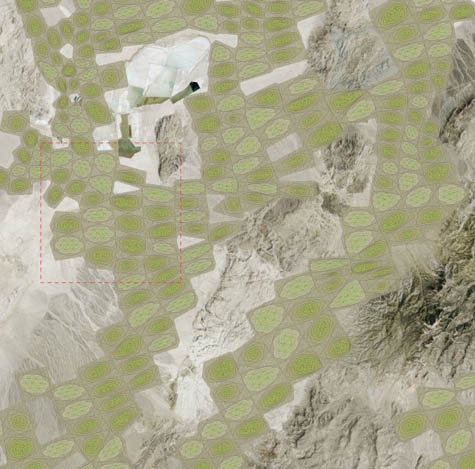
[Image: Matsys’s Sietch Nevada as seen from above; renderings by Nenad Katic].

In any case, the proposal seen here is “an urban prototype,” we read, “that makes the storage, use, and collection of water essential to the form and performance of urban life.”

A network of storage canals is covered with undulating residential and commercial structures. These canals connect the city with vast aquifers deep underground and provide transportation as well as agricultural irrigation. The caverns brim with dense, urban life: an underground Venice. Cellular in form, these structures constitute a new neighborhood typology that mediates between the subterranean urban network and the surface level activities of water harvesting, energy generation, and urban agriculture and aquaculture. However, the Sietch is also a bunker-like fortress preparing for the inevitable wars over water in the region.

Check out the full project on Matsys’s own website – and, while you’re there, the entire project database is worth a spin.

(Spotted on Architecture MNP. And read Dune!)

Extreme agricultural statuary

[Image: “Endothelium” by Philip Beesley & Hayley Isaacs].

I mentioned a recent issue of Mark Magazine the other day, but I deliberately saved one of the articles for a stand-alone post later on. That article was a long profile of the work of Philip Beesley, a Toronto-based architect and sculptor, whose project the “Implant Matrix” BLDGBLOG covered several years ago.

In issue #21 of Mark, author Terri Peters describes several of Beesley’s projects, but it’s the “Endothelium” that really stood out (and that you see pictured here).

[Image: “Endothelium” by Philip Beesley & Hayley Isaacs].

Peters refers to Beesley’s work as a “lightweight landscape of moving, licking, breathing and swallowing geotextile mesh” – a kind of pornography of ornament, or the Baroque by way of David Cronenberg. “Inspired by coral reefs,” she continues, “with their cycles of opening, clamping, filtering and digesting,” Beesley’s biomechanical sculpture-spaces are “immersive theatre environments” in which “wheezing air pumps create an environment with no clear beginning or end.”

I’m reminded of the penultimate scene in James Cameron’s film Aliens, when Ripley (Sigourney Weaver) meets the alien “queen.” The queen is laying eggs, we see, through a gigantic, semi-prosthetic, peristaltically-powered external ovarian sac – and the scene exemplifies the encounter with the grotesque in all its H.R. Giger-influenced, sci-fi extremes. Put another way, if organisms, too – not just buildings – can reach a point of ornamental excess, then James Cameron’s aliens are perhaps exhibit number one.

[Images: Screen grabs from James Cameron’s Aliens].

In any case, Beesley’s work is a fascinating hybrid of advanced textile design, geostructural modeling, and rogue biology experiment. Peters’s descriptions of the “Endothelium” are worth quoting at length:

[The structure consists of] a field of organic “bladders” that are self-powered and that move very slowly, self-burrowing, self-fertilizing and are linked by 3D printed joints and thin bamboo scaffolding. The bladders are powered using mobile phone vibrators and have LED lights. It works by using tiny gel packs of yeast which burst and fertilize the geotextile.

This latter detail – “using tiny gel packs of yeast which burst and fertilize the geotextile” – brings to mind something at the intersection of an improvised explosive device (or IED) and a green roof: you hire Philip Beesley to design a landscape-machine for installation atop a new building downtown, and, over the course of many decades, it vibrates, yeast-bursts, rotates, crawls, and grows through extraordinary cycles of grotesque architectural fertility. A solar-powered landscape of mold and microroots, generating its own soil. Within a few years, the original sculpture it all came from is gone, archaeologically undetectable beneath the vitality of the forms that have consumed it.

One wonders what Philip Beesley would think of the mushroom tunnel of Mittagong.

[Images: “Endothelium” by Philip Beesley & Hayley Isaacs].

Elsewhere in the article, Peters writes:

Endothelium is an automated geotextile, a lightweight and sculptural field housing arrays of organic batteries within a lattice system that might reinforce new growth. It uses a dense series of thin “whiskers” and burrowing leg mechanisms to support low-power miniature lights, pulsing and shifting in slight increments. Within this distributed matrix, microbial growth is fostered by enriched seed-patches housed within nest-like forms, sheltered beneath the main lattice units.

I’m a bit rhetorically stuck on “between” statements, I’m afraid, but it’s as if Beesley’s work falls somewhere between a loaf of sourdough bread and a sculpture by Jean Tinguely.

[Image: “Endothelium” by Philip Beesley & Hayley Isaacs].

I’m curious, meanwhile, if you could bury a Philip Beesley sculpture in the woods of rural England somewhere, and allowed it to articulate new ecosystems slowly, over the cyclic course of generations. In fact, I’m reminded of an article in the New York Times last week, spotted via mammoth, in which we learn that two abandoned landfills in Brooklyn have since been used as unlikely foundations for new ecosystems:

In a $200 million project, the city’s Department of Environmental Protection covered the Fountain Avenue Landfill and the neighboring Pennsylvania Avenue Landfill with a layer of plastic, then put down clean soil and planted 33,000 trees and shrubs at the two sites. The result is 400 acres of nature preserve, restoring native habitats that disappeared from New York City long ago.

“Once the plants take hold,” the article adds, “nature will be allowed to take its course, evolving the land into microclimates.” But what if those weren’t landfills down there but sculptures by Philip Beesley? Strategically sown seed-patches and gel packs of yeast wait underground for new roots to rediscover them.

It’s living geostatuary, buried beneath the surface of the earth – a kind of extreme agriculture, with soil-preparation by Philip Beesley.

[Images: “Endothelium” by Philip Beesley & Hayley Isaacs].

I’d genuinely like to see what Beesley might do if he was hired by, say, a NASA R&D program dedicated to terraforming other planets. Could you fly a modular, self-unfolding Philip Beesley sculpture into the depths of radiative space, land it on a planet somewhere, and watch as revolting pools of bacteriological mucus begin to coagulate and form new fungi?

Beesley’s whiskered vibrators begin to shiver with signs of piezoelectric life, as small crystals surrounded by radio transmitters and genetically engineerined space-seed-patches imperceptibly tremble, evolving into mutation-prone “organic batteries” unprotected beneath starlight. Give it a thousand years, and vast infected forests, the width of continents, take hold.

You’ve colonized a distant planet through architecture and yeast.

For more, check out Mark Magazine‘s issue #21. Beesley’s also got a book out, called Hylozoic Soil, that I would love to read.

Fire Lookout Towers

[Image: Courtesy of the U.S. Forest Service].

Constituting their own architectural typology, and falling perhaps somewhere between Lew Welch and Tom Kundig (someone hire Kundig to design the next Serpentine, please!), are the fire lookout towers of the Pacific Northwest.

Search the photo archives – assembled and maintained by Rex Kamstra, complete with lookout tower trivia – from Oregon and Washington to the hills of South Dakota (or just check out the site’s newsfeed) to explore these often extraordinarily remote structures in all their minimalist – and historically fascinating – glory.

And did you know that you can actually adopt a fire lookout?

[Image: Courtesy of the U.S. Forest Service].

While you’re at it, don’t miss the U.S. Forest Service’s own catalog of these overlooked minor building types: fire lookout towers in Sequoia National Forest, for instance, and Umatilla.

The fact that there are any lookout towers still standing at all is, it seems, slightly amazing. “In their heyday during the 1930s,” the Forest Service explains, “there were over 8,000 fire lookouts that dotted mountain tops across the United States with over 600 in California. Today there are only a few hundred in operation. Once considered a proud symbol of our nation’s conservation heritage, fire lookouts are a fading legacy. There are 10 lookouts left on the Sequoia National Forest.”

[Image: Courtesy of the U.S. Forest Service].

A definitive history of these timber structures and lonely cabins has not yet been written (attention Princeton Architectural Press!), although they constitute not only a distinctive family of structures, they also have a regional, ecosystemic importance that only the best pieces of civic infrastructure attain.

They also figure into the national mythology in a way that few other forms of architecture do; from Jack Kerouac disappearing off into the mountains for a summer of fire-spotting, to the poems of Gary Snyder, these awesomely elevated perspectives on the natural world – as well as sites of enforced introspection – deserve their NorCalMod moment. That is, they deserve their architectural rediscovery.

[Image: Courtesy of the U.S. Forest Service].

Instead of a definitive reference work, there are simply books (albeit still fascinating) like How to Rent a Fire Lookout in the Pacific Northwest: A Guide to Renting Fire Lookouts, Guard Stations, Ranger Cabins, Warming Shelters and Bunkhouses in the National Forests of Oregon and Washington; Adirondack Fire Towers: Their History and Lore; Lookouts: Firewatchers of the Cascades and Olympics; and the so-called “fire lookout research” of David E. Lorenz (now out of print). So people are clearly still interested in these structures. For instance, check out this photo-log of a hike up to the spectacular mountain views of the Mule Peak Lookout.

[Image: Courtesy of the U.S. Forest Service].

Even better, take a long read through the Skagit River Journal‘s look at the fire lookout towers of the Cascades. This latter link includes some amazing material, including references to interviews with former fire watchers and their colleagues:

They told many unusual stories of the watchers, who were prepared to be alone on a mountain ridge in a tower measuring less than 200 square feet. Towers were sometimes built on nearby ridges so that two watchers could combine their observations of a section of forest, which enabled them to triangulate and more accurately call in resources to fight fires. A broad spectrum of watchers developed, from college students to housewives to hermits and those who loved to be surrounded by wilderness and mountains. The authors discovered one watcher who was so frightened during a lightning storm that he ran all the way down the mountain.

There is also the story of Maxine Meyers, a former forest lookout.

More architecturally, the Skagit River Journal also gets into the ways and means of these towers’ construction: “Before mountain roads were built of a size to accomodate trucks, the materials were largely packed in on backs or on mules, and then another team had to slog through the brush, stringing telephone wire before the use of two-way radios.” Thus were distant structures assembled in the woods.

[Image: Courtesy of the U.S. Forest Service].

Plus, where, now, are the people who actually lived in these structures – stationed there for whole seasons at a time to eat canned peaches and watch the stars, looking out for signs of distant fires? Are they still alive, and, like Maxine Meyers, could you interview them? It’s an architectural form that comes with its own anthropology: narratives of use and inhabitation.

Further, who designed these structures – based on what plan, and from what material inspiration? What would a fire lookout tower, built today, look like? Perhaps like the awesome “Prairie Ladder” by Anderson Anderson?

And how do these towers frame the landscape, and to what extent could you put them into the visual tradition of things like panoramas?

These towers, after all, aren’t just towers; they have a kind of optical functionality, built specifically for the purpose of viewing the landscape in a certain, specific, highly regulated way. They spatially frame this act of disciplined surveillance. In a sense, they are like the British watchtowers so beautifully photographed by Donovan Wylie.

[Image: Courtesy of the U.S. Forest Service].

But, more to the point, where do fire lookout towers – as a minor design typology – fit into architectural history?

Procedural Destruction and the Algorithmic Fiction of the City

[Image: From Procedural Modeling of Cities by Yoav Parish and Pascal Müller].

Note: This is a guest post by Jim Rossignol.

In 2001 Yoav Parish and Pascal Müller spoke at the SIGGRAPH conference in Los Angeles, California, to present a mathematical city. Their presentation contained an algorithmic approach for modeling city-like topologies. The results were remarkably realistic, and were one among a host of city-like generative systems to appear at the start of the decade.

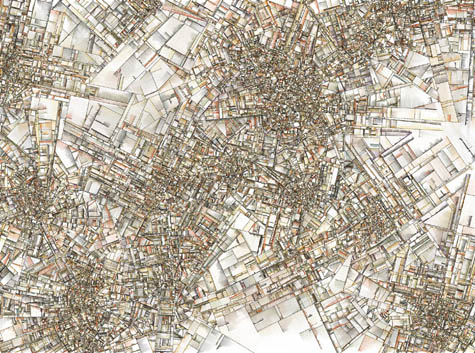
Another, Jared Tarbell’s Substrate (pictured) remains a fantastic example of how a mathematical approach to generating apparently urban patterns can also be artful.

[Image: From Jared Tarbell’s Substrate].

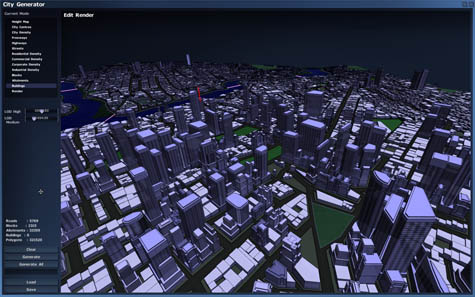
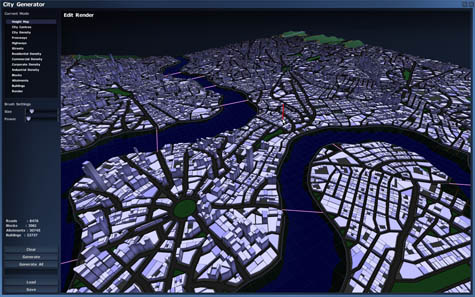
But it was looking at the work of Parish and Müller that inspired game designer Chris Delay to develop his most recent project: the cryptic (and as-yet-unexplained) Subversion, of which little is known, other than it relies on large, procedurally generated cities for the backbone of its game world.

Having already been burned by the problems of creating content “by hand,” Delay set out to let algorithms do the work of building buildings in his new game. Not only that, but he was determined to create an artistically interesting experience without artists.

[Images: From Chris Delay’s Subversion].

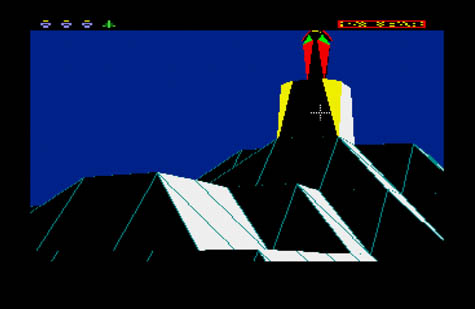
Of course, videogames have long been the home of procedurally generated landscapes where numbers and mathematical equations played the role of the visual designer. Early paranoid classic The Sentinel made use of these techniques to create an astonishingly atmospheric 10,000 levels in simple vector graphics, from just a few kilobytes of data. Other games have used similar techniques as a shortcut to creating solar systems and vast fractal landscapes.

But when it came to cities, well, it took a long time for anyone to take up the challenge.

[Image: From The Sentinel by Geoff Crammond].

Rather than opt for procedural techniques, game designers usually elect to build their cities by hand, often with startling results. The re-imagined contemporary New York that features in last year’s Grand Theft Auto 4 required a small army of well-paid artists and designers to hand-craft the entire world. Their accomplishment is unmatched, but the cost to the company behind the project is in the tens—and perhaps hundreds—of millions of dollars. To build up a living city from blank polygons is one of the most expensive possible projects in game design.

Delay, whose project is being undertaken with a tiny budget and by just a handful of staff based in Cambridge, UK, does not have the luxury of vast content teams. His vector-drawn city is far less realistic than Rockstar‘s textured, heaving metropolis, but there’s nevertheless a beauty to it. It’s a kind of mathematical map of the essential urban environment: there are roads, sidewalks, and a no-man’s land of corporate moats around great skyscrapers…

Identify the key equation that define urban patterns, and you, too, can summon a city into existence.

Delay has begun to show off how his cities emerge from the ground up in a series of videos, and he spoke to me about the process.

“I started out with road layouts, and then began to modify the parameters,” he explained. “Sometimes you’ll get lovely radial, spiral patterns, or you can tell it to create a really rigid Manhattan-style grid.” One set of numbers delivers the block logic of American cities, another is rather more like the spirals of Medieval European sprawls. The two merge to create something even more believable. “Every subsequent layer builds on the previous layer,” Delay points out, “so the very next layer looks for the spaces between layers, and makes judgments about ‘is this likely to be a skyscraper, or to be a house?’ Then you zoom in, and carry on. You do another procedural generation process for each layer of detail, filling in that world.”

[Image: From Chris Delay’s Subversion].

A few weeks after speaking with Delay I attended Thrilling Wonder Stories—a seminar at the Architectural Association in London, curated by Liam Young and BLDGBLOG—where I watched conceptual designer Viktor Antonov explain how he had created a science-fictionalized Paris (for a now-cancelled videogame called The Crossing).

Antonov approached the problem by altering just a few parameters in the standard architectural model. For instance, Antonov had noticed a few fundamental details about how the mid-nineteenth century neo-classical core of Paris had been constructed: big street-level floors, smaller attic spaces, complex chimney stacks. By increasing the emphasis on the lower floors, and stretching them out—and by emphasizing the height and complexity of the chimneys—Antonov was able to create a thematically consistent science fiction Paris.

Simply by altering a few basic architectural parameters, he said, you were able to fictionalize the city, whilst at the same time retaining its fundamental identity. His designs were still recognizably—even mathematically—Parisian, in other words, but they were also otherworldly.

[Image: By Viktor Antonov].

This idea instantly connected back to Delay’s project: what parameters would we need in order both to understand and create a science fiction Edinburgh, or Sao Paulo, or Vancouver? Identify the necessary fantasy logic within a procedural city-building system and you could recreate cities with their alternate identity in an instant. An accelerated future Moscow, or a retropunk Venice, instantly sprawling out of the monitor.

And perhaps this is not such an outlandish thing to aim for—especially when you consider the speed at which procedural city projects have been appearing across the tech landscape. Could one of these cities potentially be refitted to allow for this type of radical tweak?

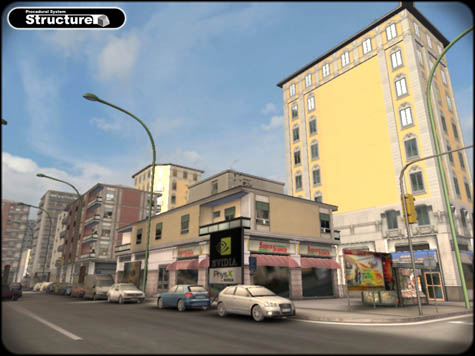
Projects like Shamus Young’s impressive PixelCity, or Marco Corbetta‘s Structure seem ripe for such strange fictions. Corbetta’s system is particularly impressive in its verisimilitude: he aims to create a basic engine for rapidly generating the kinds of cities that games like Grand Theft Auto 4 require, and consequently doing so for much cheaper.

Could Corbetta’s engine come with a Paris or a Barcelona preload, which could then be put through Photoshop-style filters for alternate reality logic in its architecture? A stronger skyline, weirder street furniture.

[Image: From Marco Corbetta’s Structure].
More exciting, at least for the thrill-seeking gamer in me, is the fact that Corbetta is aiming one notch higher than any of his peers: he’s aiming to make these cities procedurally destructible. His site contains a demonstration video of neatly arrange office interiors and a domestic library being blown to pieces with a machine-gun. What good is an imaginary city if you can’t go inside the buildings? What good is a virtual downtown if you can’t go crazy with a bazooka? Corbetta’s work preempts these questions.

Further, it conjures visions of massive demolition exercises in parallel worlds—entering an Antonov-algorithm for neo-Rome, where gladiatorial escapades see us going through the walls of the coliseum and into the randomly generated plazas beyond.

That, perhaps, is the greatest promise of procedural cities: that soon they’ll be real enough that their destruction will seem like tragedy.

[Jim Rossignol is a games critic for Offworld, an editor at Rock, Paper, Shotgun, and the author of the fantastic This Gaming Life: Travels in Three Cities. A full-length interview with Rossignol appeared on BLDGBLOG in May, and he has written a previous guest post, Evil Lair: On the Architecture of the Enemy in Videogame Worlds].

Romecore

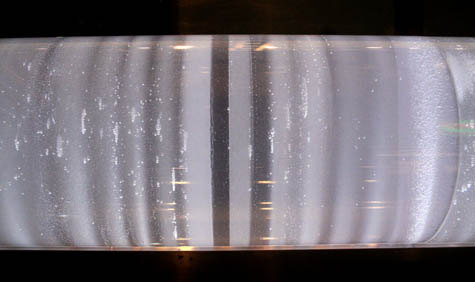
[Image: A Greenland ice-core at the Hayden Planetarium; for further reading, visit the U.S. National Ice Core Laboratory. Photo by Planet Taylor, used under a Creative Commons license].

Note: This is a guest post by Nicola Twilley.

The Crypta Balbi is a relatively recent, low-profile addition to Rome’s museum compendium. It’s billed variously—and confusingly—as a museum of archaeology, a museum of ancient Rome, and a museum of the Dark Ages. All of these descriptions are, in fact, cumulatively accurate, because the site is actually a city-block-sized core sample of Rome, threaded through with staircases, tunnels, and elevated walkways for visitors.

Crypta Balbi is located in an irregular pentagonal plot in the Campus Martius, an area that, unlike many regions in the ancient city, remained largely inhabited through the Middle Ages. In fact, according to Filippo Coarelli’s authoritative Rome and Environs: An Archaeological Guide, the Campus Martius was originally supposed to be kept free of buildings altogether and “reserved for military and athletic exercises.” However, historian Suetonius describes the city’s gradual encroachment, explaining that: “During his reign Augustus often encouraged the leading men of Rome to adorn the city with new monuments or to restore and embellish old ones.”

[Image: A satellite view of the city-block core sample, via Google Maps].
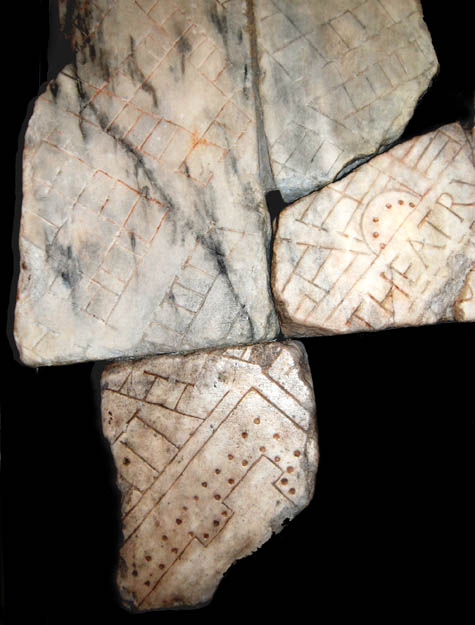
As a successful military general and favored member of Augustus‘s entourage, L. Cornelius Balbus the Younger stepped up to the plate, building a theater and attached crypta—a rectangular porticoed walkway where the theater’s scenery could be stored and around which the public might stroll, protected from the elements. Apparently, the Balbi Theater’s grand opening in 13 BC took place during one of the Tiber’s regular floods—meaning that it was, briefly, only accessible by boat. Nonetheless, the Theater and Crypta thrived, and they are depicted intact on a chunk of the Severan Forma Urbis, an amazing 60′-x-43′ incised marble map of the city created for public display in 203 AD.

Eventually, Rome’s earthquakes, fires, barbarian raids, and radical population shrinkage (from a million people in 367 AD to just 400,000 less than century later) combined with architectural re-use and the passage of time to take their toll. There isn’t much of the original Crypta left to see—a reconstructed stucco arch, and the massive travertine and tufa walls that now serve as foundations for modern houses in Via delle Botteghe Oscure and Via dei Delfini.

[Image: A fragment of the Forma Urbis, showing the Balbi Theater. For more on the Forma Urbis, visit the seemingly great but non-Mac-friendly Stanford Digital Forma Urbis Romae project].
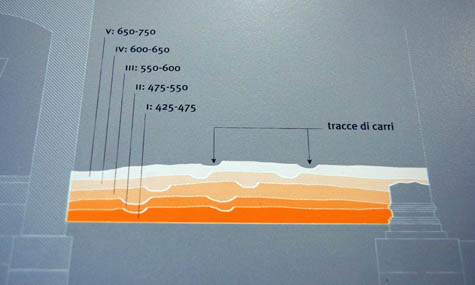
However, layered above the Crypta’s original floor plan are traces of this city block’s shifting usage—a condensed narrative of Rome’s destruction, accretion, and evolution. It is this series of transformations and reuses of both the Crypta and the urban space it occupies, rather than the fragmentary ancient ruins, that the museum aims to make visible. Like a series of stills from an impossible time-lapse film, the visitor who descends to the basement or climbs to the third floor can see this awkward cuboid chunk of city ruined, reshaped, reused, and reoriented over two thousand years of urban history.

Equally amazing are the expansive historical detours prompted by even trace elements in the urban core sample. For example, as early as the time of Hadrian, a “monumental” public latrine was inserted into a section of the Crypta. From the quantity of copper coins that fell, and weren’t worth recovering, archaeologists have extrapolated the amount of coinage in circulation in Western Europe during the latrine’s life-span. (Astonishingly, it was only in the 19th century that small change was to be this common again in Western Europe).

[Image: Museum display panel diagramming five distinct road levels wandering across the Crypta’s ruins (apologies for the quick snapshot)].

Two centuries later and a few feet higher, two graves bear witness to a city in ruins between the 5th and 7th centuries, as the prohibition against burial within city walls lapsed, and the dead were buried singly in abandoned buildings or beside roads. Ironically, in a museum that preserves the urban structures of each era equally, during the medieval period the Crypta actually housed one of the city’s largest lime-kilns, where the marble inscriptions, statues, and building blocks of classical Rome were brought to be crushed and melted down into lime (a key ingredient in the cement needed to build the city’s new Christian architecture).

In the 1940s, the convent that had occupied the site for the past four hundred years was demolished for a planned new Mussolini-era construction, which thankfully never materialized. Finally, in the 1980s, the Soprintendenza archeologica di Roma authorized the excavation of the abandoned city block; and, in 2002, the northwest corner was opened to the public, even as work continues on the rest of the site.

[Image: An interior view of the Crypta Balbi].

Aside from the execution, which is excellent, the very idea of a museum built into an urban core sample—a stratigraphic investigation of the shifting use of space over time—is incredibly exciting to me. Imagine a similar hollowing-out of urban space in Istanbul, Cairo, or Paris—residents as disoriented as tourists as they clamber through the hidden foundations and forms woven underneath and around their own city.

In New York, this might even be an idea whose time has come: as The New Yorker pointed out in December 2008, the expiration of a residential construction tax-abatement law encouraged builders to dig foundation trenches early, so as to secure better financing, but the subsequent recession has put many of these projects on hold, semi-permanently.

“What will become of the pits?” asks Nick Paumgarten, speculating that they could turn into “half-wild swimming holes, like the granite quarries of New England” or even “urban tar pits, entrapping and preserving in garbage and white brick dust the occasional unlucky passerby.” These are both attractive ideas, but with a little expenditure on zip-lines, elevated walkways, and interpretative signage, visitors could circulate around several millennia of Manhattan’s history, from the collision of the North African and American continental plates to the tangled evolution of New York’s water mains, via retreating glaciers and the housing bubble.

Meanwhile, back in Rome and less than a mile away from the Crypta, engineers have teamed up with the Soprintendenza to sink several new urban cores, this time in the guise of excavating the elevator and escalator shafts for a new subway line.

Angelo Bottini, director of the Soprintendenza, can hardly hide his excitement, telling the Wall Street Journal that, under usual circumstances, “We never get to dig in the center of Rome.” Sadly, it seems as though most of the finds will be documented and then destroyed, due to a shortage of museum space and the already astronomical construction costs (an estimated $375 million for one mile of track in the city center).

But how amazing would it be if the new subway station walkways and escalator shafts could themselves become Crypta Balbi-like museums of buried stratigraphy? Rome would be riddled with urban cores, awestruck tourists ascending and descending through sampled spatial histories across the city. Meanwhile the Sistine Chapel lies miraculously empty…

[Previous guest posts by Nicola Twilley include The Tree Museum, The Water Menu, Atmospheric Intoxication, and Park Stories].

The Tree Museum

Note: This is a guest post by Nicola Twilley.

Every tree is a living archive, its rings a record of rainfall, temperature, atmosphere, fire, volcanic eruption, and even solar activity. These arboreal archives together reach back in time over centuries, sometimes millennia. We can even map human history through them—and onto them—tracing famines, plagues, and the passing of our own lives.

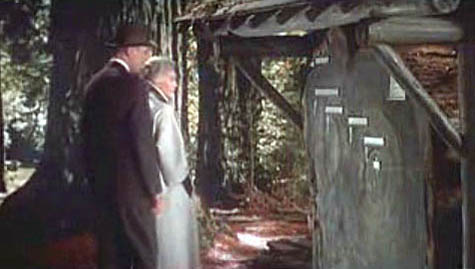
[Image: A scene from Alfred Hitchcock’s film Vertigo, with Jimmy Stewart and Kim Novak in Muir Woods, outside San Francisco, where Novak points to the concentric rings of the redwood trunk and says, “Here I was born… and here I died”].
For artist Katie Holten, trees were thus the natural starting point for an oral history of a city street in the Bronx. To mark the 100th anniversary of the Grand Concourse, a four-mile-long boulevard that connects Manhattan to the parks of the Northern Bronx, Holten has created the Tree Museum: 100 specially-chosen trees between 138th Street and Mosholu Parkway, each of which has a story to tell if you dial the number at its base.

The museum opens today, June 21, with a parade and street fair: for those of us not in New York, a podcast and brochure will be available for download, and you also can view each of the tree locations on Google Maps.

[Image: Trees in the museum each have their own sidewalk marker, which gives their name and extension number].
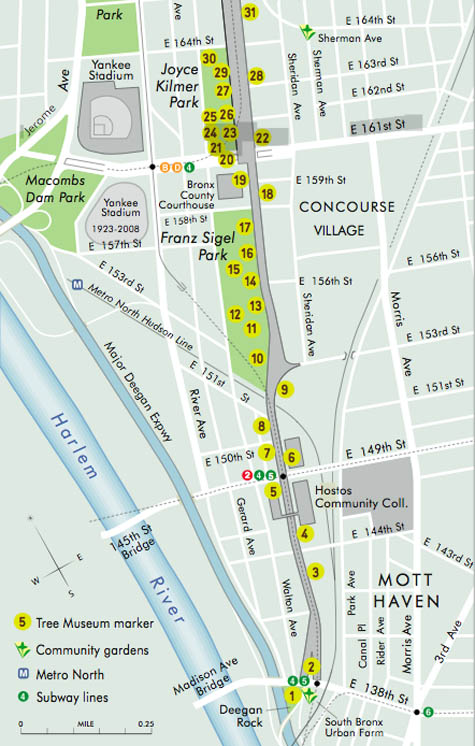
Only a handful of the one hundred “story-trees” date from the Concourse’s construction, when an avenue of Norwegian maples was planted to shade carriages and pedestrians strolling along the broad boulevard. In an email conversation, Holten explained to BLDGBLOG that most of these original trees were moved to Pelham Bay Park when the B/D subway line was built in the early ’30s. Twelve of the surviving maples are joined in the Tree Museum by representatives of fifty-nine other tree species, from an Amur Corktree in Joyce Kilmer park to a Kentucky Coffeetree just south of Tremont Avenue.

In fact, each tree is carefully identified by its species name, in Spanish, English, and Latin, to draw museum visitors’ attention to their variety. Holten told me that, early on in her community outreach, she realized how important naming the trees would be when a teacher in a local school confessed, incredibly, that it was only after he heard about the Tree Museum idea that “he noticed the next time he was walking that there were different kinds of trees. Before that he’d thought they were just ‘trees’.”

[Image: A section of the Tree Museum map; a much larger version can be seen here].

The trees were chosen for their variety, Holten says, but also for “location, age, and connection to a particular person or story.” Holten acted as matchmaker, pairing trees with former and current Bronx residents, as well as scientists, authors, and activists who have worked in the area. Among the 100 participants are well-known former Bronxites DJ Jazzy Jay and Daniel Libeskind, students at the Bronx Writing Academy, and Jonathan Pywell, Bronx Senior Forester, who helped Holten identify all the trees (not an easy task in mid-winter). Each has used their tree as the starting point for a personal anecdote, snippet of neighborhood history, song, or even a digital sound recording.

Taken together, the tree stories are part shared history, part personal memory, part science lesson—they form what Holten describes as “the whole ecosystem of the street.”

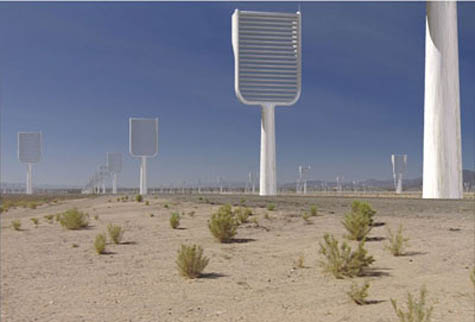
[Image: A computer-generated image of Klaus Lackner’s prototype “synthetic tree,” which would remove carbon dioxide directly from the air; image courtesy of Columbia University].

In her email, Holten went into some detail describing the range of stories you can hear as you dial each tree’s extension, from the sound of a Puerto Rican tree frog (No.73, a Gingko) to a local preservationist describing how he fought to turn an abandoned lot into the park that now surrounds No. 100, a Cottonwood. From her email:

Klaus Lackner (professor in the Department of Earth and Environmental Engineering at Columbia University and director of the Lenfest Center for Sustainable Energy) tells the story of the carbon cycle and his attempt to create a “fake plastic tree,” or air extractor, that would suck the CO2 out of the air and convert it into something we can put in a safe place. Eric Sanderson (a landscape ecologist based at the Bronx Zoo, and author of Mannahatta) needed a really old, native tree to talk about projecting the landscape backwards. I gave him No. 9, a beautiful American Elm outside Cardinal Hayes High School.

At the northern end of the Concourse, at 206th St, there’s a huge chunk of rock between two buildings; it’s like the side of a cliff. I had to give the tree there, No. 95, to Sid Horenstein, a geologist who recently retired from the American Museum of Natural History. He’s able to use the rock outcrop to explain the story of what the Concourse lies above—it was built on a ridge and that’s one of the main reasons the street was constructed here, because it was elevated and offered spectacular views of the countryside all around.

And Tree No. 45, a Little Leaf Linden, has a story told by Patricia Foody, a 95-year-old Bronxite. She remembers her dad bringing her for a walk to the Concourse to visit his brother’s tree in just this location—it was one of the original maples, and many of them had plaques for soldiers who had died in World War I.

Some of the stories come from people who work with the trees directly: Jennifer Greenfeld, director of Street Tree Planting for the Parks and Recreation department, uses No. 66, a Chinese Elm, to provide an overview of street trees throughout New York City and the policy battles they sometimes cause. Barbara Barnes, a landscape architect also with the Parks department, puts her tree in the context of the historic street tree canopy project she’s working on, to replant Joyce Kilmer and Franz Sigel parks as they were originally laid out.

[Image: Eric Sanderson pointing at a map of the Bronx; photo by Katie Holten].
For other participants, the trees function as more of a backdrop for personal history and community activism. Sabrina Cardenales is the real-life model for the character Mercedes in Adrian Nicole LeBlanc’s Random Family: Love, Drugs, Trouble, and Coming of Age in the Bronx, which documents extreme urban poverty in New York: both Sabrina and Adrian introduce themselves and read a passage from the book as part of the Tree Museum. Meanwhile, Majora Carter, an environmental justice activist and MacArthur fellow from the south Bronx, uses tree No. 6, a honey locust, to tell people: “You don’t have to leave your neighborhood to live in a better one, and trees are an important part of making that happen.”

The variety of voices and stories Holten describes accumulate into a sense that plenty of people really do care about these trees, this street, and the Bronx in general. They also act as a series of nudges to look at the urban landscape in a new light. The result is that the Tree Museum, at least in theory, will recreate some of the optimism of the Grand Concourse’s roots in the City Beautiful movement, while not glossing over the struggles and setbacks faced by the “Champs-Élysées of the Bronx” ever since.

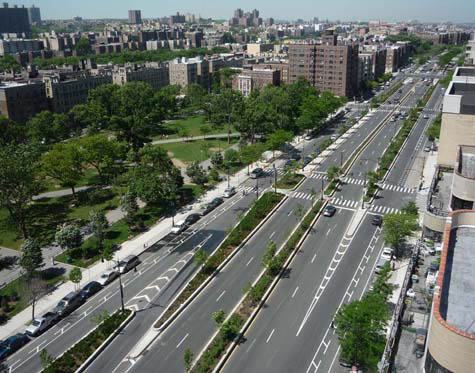
[Image: The Bronx Grand Concourse, looking north from 161st Street; photo by Katie Holten].

As part of the Concourse’s centenary celebrations, the Bronx Museum and New York’s Design Trust For Public Space are running a competition called Intersections: Grand Concourse Beyond 100, to gather new proposals for regenerating the street. Although the call for entries period is now closed, Katie Holten has set up a community forum for the Tree Museum, and clearly hopes the project will prompt action, as well as reflection.

Holten explains her most basic hope, which is that the Museum will encourage people to start using and enjoying their shared public space again:

One hundred years ago the Concourse was built for people to stroll along, under the shade of the trees, but in 2009 it takes quite an effort to get people out for a walk—hopefully we’ll get them strolling! There are a number of individuals who I met because they are interested in trees, or in “green” issues, and we’ve tried to use the momentum of the Tree Museum to help them make differences. For example, Fernando Tirado (tree No. 88) is district manager for Bronx Community Board #7 and he’s been prompted to establish a “Greening the Concourse” project. He’s organizing summer internships for youth in the area: giving them a job and training, and at the same time actually greening the street.

Perhaps more importantly, Holten’s Tree Museum (which she describes as “practically invisible—it’s part of the urban fabric”) demonstrates an intriguing way to re-imagine the landscape: finding ways to make the hidden layers and connections of a street’s story visible (or audible) might ultimately be as, if not more, important than installing a new swing set in the park.

[Previous guest posts by Nicola Twilley include Watershed Down, The Water Menu, Atmospheric Intoxication, and Park Stories].

London Yields, Harvested

Note: This is a guest post by Nicola Twilley.

As Geoff mentioned last month, London’s Building Center hosted a daylong seminar at the end of May called London Yields: Getting Urban Agriculture off the Ground.

[Image: From London Yields: Urban Agriculture].

The speakers covered a lot of terrain—so, instead of a full recap of the event, the following list simply explores some of the broader ideas, responses, and questions about urban agriculture that stood out from the day’s presentations.

1. Becoming public policy
The event was introduced and moderated by David Barrie, a sustainable development consultant, who framed the day as a collective opportunity to brainstorm ways in which urban agriculture could be moved from mere “sustainable accessory” to become a standard practice of both everyday life and city design. Interestingly, Mark Brearley, Head of Design at Design for London (DfL) and the day’s first speaker, provided confirmation of Barrie’s diagnosis, confessing that food production was a recent add-on to many of their open space projects. Why? “Because people were asking us about it,” he said.

Brearley’s presentation was an overview of DfL’s hundreds of urban regeneration and infrastructure improvement projects; these are, in themselves, interesting but, in aggregate, somewhat exhausting. However, as an office of the London Development Agency, working on behalf of the Mayor of London, Brearley was able to provide a fascinating insight into some of the current institutional priorities that need to be satisfied before urban agriculture can become a standard part of London public policy. For example, DfL’s main interest in food production today is in terms of its “public engagement potential” and their primary stumbling block is how to measure the scaleability of local initiatives. Any London-based urban agriculture projects hoping for a mayoral blessing, take note!

2. Food is a design tool
The second speaker was Carolyn Steel, author of the excellent book Hungry City: How Food Shapes Our Lives. Hungry City traces how food has shaped both the city and its productive hinterland throughout history, from the Sumerian city of Ur to today’s London via the markets and gates of ancient Rome. Steel provides a wide-ranging historical look of food production, importation, regulation, and culture, before putting forward her own intriguing and potentially revolutionary proposition: what would happen if we consciously used food as a design tool to create a “sitopic” city? Steel’s coinage here, sitopia—from “sitos” (food) and “topos” (place)—is derived from her realization that “food shares with utopia the quality of being cross-disciplinary… capable of transforming not just landscapes, but political structures, public spaces, social relationships, [and] cities.” And because “food is necessary,” a sitopian city (unlike its utopian cousin) would remain tied to reality and of universal relevance.

The quotations above come from Steel’s book, however, rather than her lecture; twenty-five minutes was enough time to provide fascinating examples of food’s role in shaping cities and urban life, but, sadly, not enough to explain (let alone explore) further thoughts about food’s use as an urban planning tool. More to come soon, I hope, on this topic…

[Image: Ebenezer Howard’s original scheme for the Garden Cities of To-morrow shows a landscape reimagined in terms of food production and supply. As Carolyn Steel explains in her own book Hungry City, Howard’s plans relied on land reform that was never carried out, and the garden cities of today (Letchworth, Welwyn, etc.) are, as a result, little more than green dormitory suburbs].

3. Partnerships as infrastructure
Anna Terzi, who runs London Food Link’s small grants scheme for Sustain, was the day’s third speaker; she described one of their current projects, demonstrating how key insights from both Mark Brearley’s and Carolyn Steel’s talks might look in action.

Sustain (a nonprofit alliance for better food and farming) is currently poised to create borough-wide institutional change by partnering with Camden Council and Camden Primary Care Trust (part of the National Health Service). This alliance—with its intriguing implication that the National Health Service might be the one institution with the most to gain by promoting urban agriculture—speaks to the impact of creating new interest groups for locally grown food. By partnering with institutions responsible for dealing with established urban challenges—issues such as public health, economic growth, community engagement, waste, and environmental sustainability—groups like Sustain have the potential to take urban agriculture from decorative hobby to investment-worthy infrastructure.

The Camden partnership’s report (still in draft stage) aims to outline a relatively coherent and holistic food program for the borough—a plan that promises to use food to reshape at least this part of the city, in terms of promoting social enterprise, meeting infrastructure needs, and reducing health inequalities.

[Image: A lemon grown in Dulwich; photograph by Jonathan Gales (2008), ©Bohn & Viljoen Architects].

4. Mapping and visualization tools
The last two presentations of the day agreed that successfully producing food in the city requires a detailed resource inventory combined with effective promotion efforts. Mikey Tomkins, a PhD candidate at the University of Brighton, described systematically mapping the rooftops, grass patches, vertical faces, and vacant lots of Elephant & Castle—whereupon he discovered that 30% of the area’s food needs could be met through the cultivation of found space alone.

Architects Katrin Bohn and Andre Viljoen, creators of the uninspiringly named CPUL (Continuous Productive Urban Landscapes), emphasized the need to think about spare inventory in terms of population and three dimensionality (their Urban Agriculture Curtain filled a display window one floor above us). Their research techniques included the accumulation of census data and questionnaires combined with GPS mapping and site visits in order to analyze a landscape’s food production capacity.

Both Tomkins and Bohn & Viljoen also showed several projects intended to help people read the city in terms of food, using tools as diverse as “edible maps” of London and visual analyses of urban agriculture in Havana, to installations and public events, such as the Continuous Picnic. This was a day-long event, part of the 2008 London Festival of Architecture, that included an “Inverted Market” (bring your own locally grown fruit and vegetables to be admired, judged, and then prepared), as well lessons in “Community Composting”; a giant public picnic then spread throughout Russell Square and Montague Place, with connecting corridors between.

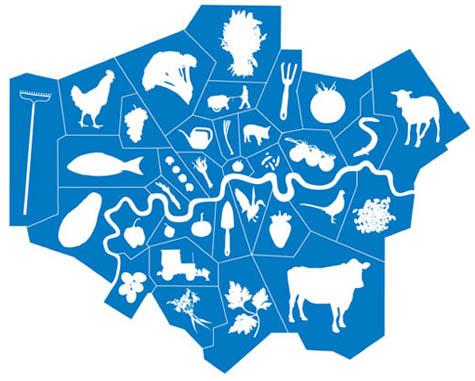
Meanwhile, for his Edible Maps series, an example of which appears below, Tomkins targets a new type of urban resident: the “food-flâneur,” who, map in hand, “could start to picture… the grassed areas around housing, the corners of parks, or the many flat rooftops of this quarter of Croydon spring into life with psychogeographic food.”

Another example of urban agriculture as an opportunity for community activation was Croydon Roof Divercity, Tomkins’s collaboration with AOC (previously discussed, along with other AOC projects, on BLDGBLOG here).

[Image: From Mikey Tomkins’s series of Edible Maps, this guide represents the area around Surrey Street car park, site of Croydon Roof Divercity, in terms of inventory and potential yield].

5. Easy, cheap, and somewhat under control
Both Anna Terzi and Bohn & Viljoen recognized the difficulty of maintaining urban agriculture projects, once the initial novelty has worn off. Bohn & Viljoen are currently working on a twelve-step program to prevent relapse, while Sustain are offering ongoing practical and financial support to new food growing spaces in London through their Capital Growth initiative.

Throughout the morning, David Barrie repeatedly registered his concern that urban agriculture needed to be economically viable, not just an upscale $64 Tomato lifestyle choice. Several of the presenters added a layer of nuance to Barrie’s formulation, noting that cheap food has simply had its costs externalized and hidden (Carolyn Steel) and that organizations like the New Economics Foundation are developing the much-needed tools to measure urban-agriculture-created value, such as increased community engagement and environmental sustainability, which is currently perceived as intangible and qualitative (Katrin Bohn). Mikey Tomkins argued against an economics-based one-size-fits-all approach to urban agriculture, explaining that the scale of a food growing project determines its possible benefits. Thus differentiated, food gardening generates educational and quality of life outcomes and should be measured accordingly, while market gardening creates recycling benefits, and urban agriculture can be evaluated in terms of yield.

Finally, the elephant in the room was the degree of coordination and regulation needed to transform London into a food-producing landscape. In an environment where, as Carolyn Steel said, the supermarkets where Londoners buy more than 80% of their groceries refused to participate in consultations with the Mayor’s London Food Strategy, it seems unlikely that sustainable food production and distribution will become the norm without legislative intervention.

In her book, Steel quotes Cassiodorus, a Roman statesman who wrote: “You who control the transportation of food supplies are in charge, so to speak, of the city’s lifeline, of its very throat.” At the moment, Steel tells us, roughly 30 agrifood conglomerates—unelected, and with no responsibility other than to their shareholders—have almost unfettered control over London’s food supply. Until that changes, urban agriculture can’t help but remain “at the artwork stage”—an inspiring, attractive, and completely optional extra.

[Other guest posts by Nicola Twilley include Watershed Down, The Water Menu, Atmospheric Intoxication, Park Stories, and Zones of Exclusion].

A Parking Lot to Last 16,000 Years

Perhaps proof that J.G. Ballard didn’t really die, he simply took an engineering job at MIT, scientists at that venerable Massachusetts institution have designed a new concrete that will last 16,000 years.

Called ultra-high-density concrete, or UHD, the material has so far proven rather strikingly resistant to deformation on the nano-scale – to what is commonly referred to as “creep.”

This has the (under other circumstances, quite alarming) effect that “a containment vessel for nuclear waste built to last 100 years with today’s concrete could last up to 16,000 years if made with an ultra-high-density (UHD) concrete.” (Emphasis added).

So how long until we start building multistory car parks with this stuff? 16,000 years from now, architecture bloggers camped out for the summer in rented apartments in Houston – the new Rome – get to visit the still-standing remains of abandoned airfields, dead colosseums, and triumphal arches that once held highway flyovers?

16,000 years’ worth of parking lots. 16,000 years’ worth of building foundations. Perhaps this simply means that we’re one step closer to mastering urban fossilization.

(Thanks, Mike R.!)