
Artist Kylie White has two new pieces up in a group show here in Los Angeles, called Grammars of Creation, on display at Moskowitz Bayse till March 16th, which I will return to in a second.
White had a great solo show at the same gallery almost exactly a year ago, featuring a series of geological faults modeled in richly veined, colored marble Most also incorporated brass details, acting as so-called “Earth fasteners.”


 [Images: From Six Significant Landscapes by Kylie White; photos courtesy Moskowitz Bayse.]
Gallery text explained at the time that White’s works “are at once sculptures, scale models, geologic diagrams, and proposals; each depicts an active fault line, a place of displaced terrain due to tectonic movement.”
The “proposal” in each work, of course, would be the fasteners: metal implants of a sort meant to span the rift of an open fault.
 [Image: “Model of Earth Fastener on a Transform Fault; 1”=10” (2017) by Kylie White; note that this piece was not featured in Six Significant Landscapes. Photo courtesy Moskowitz Bayse.]
White’s fasteners seemed to suggest at least two things simultaneously: that perhaps we could fix the Earth’s surface in place, if only we had the means to stop faults from breaking open, but also that human interventions such as these, in otherwise colossal planetary landscapes, would be trivial at best, more sculptural than scientific, just temporary installations not permanent features of a changing continent.
 [Image: From Six Significant Landscapes by Kylie White; photo courtesy Moskowitz Bayse.]
As I struggled to explain to my friends, however, while describing White’s work, the visual effect was strangely postmodern, almost tongue-in-cheek, as if her sculptures—all green marble blocks and inlaid brass—could have passed for avant-garde luxury furniture items from the 1980s (and, to be clear, I mean this in a good way: imagine scientific models masquerading as luxury goods).

 [Images: Details from Six Significant Landscapes by Kylie White; photos by BLDGBLOG.]
All of which means I sort of laughed when I saw these more recent works that seem to take this postmodern aesthetic to a new height, complete with two fault models mounted atop faux-Greek columns.

It’s like plate tectonics meets Learning From Las Vegas, by way of Greek mythology.
Because the columns are also a fitting reference to the pieces’ own subject matter: one, seen at the top of this post, is called “Model of an Earth Fastener on the Delphi Fault (Temple of Apollo)” and the other, immediately above, is “Model of an Earth Fastener on the Hierapolis Fault (Plutonion).” They perhaps suggest an entirely new approach to natural history museum displays—boldly gridded rooms filled with heroic blocks of the Earth’s surface, bathed in neon. Pomotectonics.
In any case, more information about the show is available at Moskowitz Bayse. It closes on March 16th, 2020, although White apparently has another, currently untitled solo show coming up in 2021.
 [Image: California, via Google Maps.]
 [Image: Florida, via Google Maps.]
 [Image: Ohio, via Google Maps.]
 [Image: Nickel-rich sap; photo by Antony van der Ent, courtesy

 [Images: Photos by BLDGBLOG.]
 [Image: From “
 [Image: Betelgeuse, before dimming; photo by ESO, M. Montargès et al, via
  [Image: Betelgeuse, during dimming; photo by ESO, M. Montargès et al, via
 [Image: Binnewater Kilns, photo by BLDGBLOG.]
 [Image: The Rosendale Trestle, photo by BLDGBLOG.]

 [Image: Caves everywhere! Photos by BLDGBLOG.]
 [Image: An entrance to the Widow Jane Mine; photo by BLDGBLOG.]
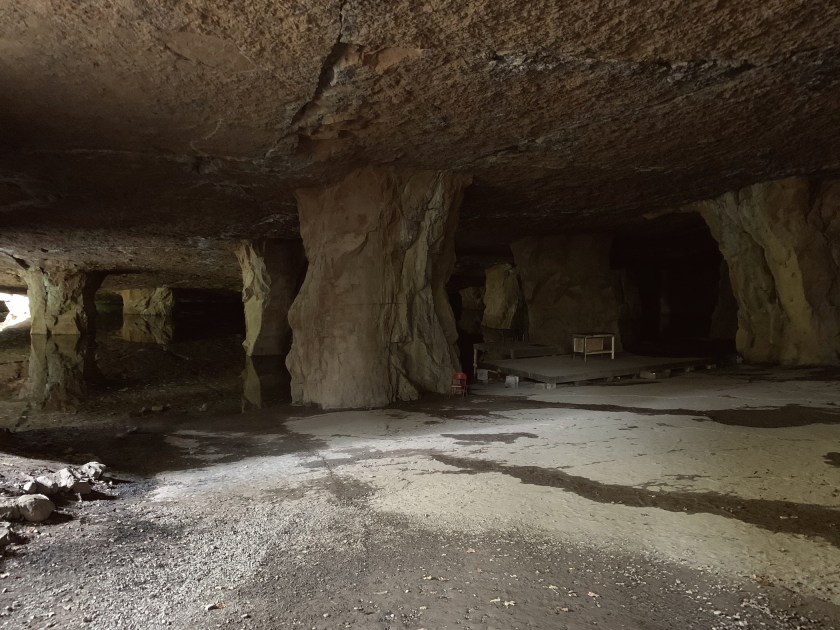

 [Image: Inside the Widow Jane Mine; photos by BLDGBLOG.]
 [Image: Flooding inside the Widow Jane Mine; photo by BLDGBLOG.]
 [Image: Lawn chairs facing the black waters of a flooded mine; photo by BLDGBLOG.]
 [Image: A creepy, ruined house in the woods, photo by BLDGBLOG.]
 [Image: Cement world; photos by BLDGBLOG.]
 [Image: “Born to Die”—it’s hard to argue with that, although when I texted this photo to a friend he thought it said “Born to Pie,” which I suppose is even better. Photo by BLDGBLOG.]
 [Image: Photos by BLDGBLOG.]
 [Image: “Minimal Republic nº3, Area: 100 m², Border: square, 10m side, defined with rope tied to pickaxes around a square of crushed rye, Population: 1 inhabitant, Location: 41.298691º, -3.400101º, Start: July 30, 2015, 19:15, End: July 31, 2015, 11:38,” from Minimal Republics by
  [Image: “Minimal Republic nº2, Area: 100 m², Population: 1 inhabitant, Border: equilateral triangle, side 15.19 m made of wooden slats assembled, Location: 40.039637º, -5.1146942º, Start: July 23, 2015, 12:21, End: July 23, 2015, 21:48,” from Minimal Republics by
  [Image: “Minimal Republic nº8, Area: 100 m2, Border: circle of 5.64 m radius of stacked stubble, Population: 1 inhabitant, Location: 41.4152292, -3.3632866, Start: September 8, 2017, 18:41, End: September 9, 2017, 18:40,” from Minimal Republics by
  [Image: An engraving of mining, from Diderot’s
  [Image: From the
  [Image: From
  [Image: A map of the
  [Image: A map of the
  [Image: