Tabletop Terrain

[Image: By Daniel Dendra of anOtherArchitect].

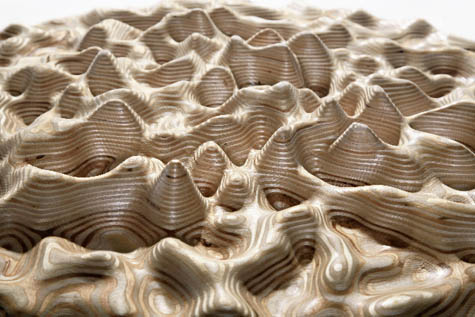
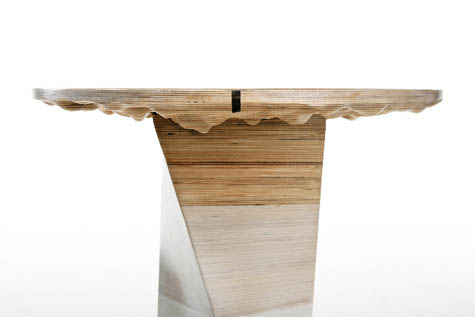
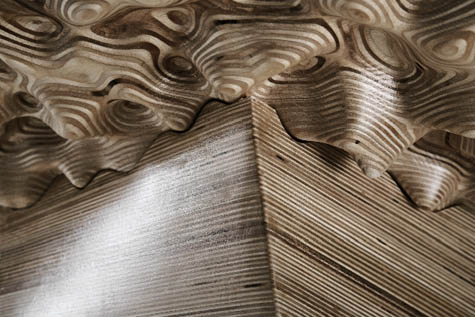
To produce this new tea table, Berlin-based designer Daniel Dendra of anOtherArchitect explains that he used sound recordings taken from the streets of Cairo to generate CNC-milling patterns – thus creating one of the most complex joins I’ve ever seen in carpentry.

In Dendra’s own words, he “recorded sound-snips from intersections in the city to generate a furniture piece.”

[Image: By Daniel Dendra of anOtherArchitect].

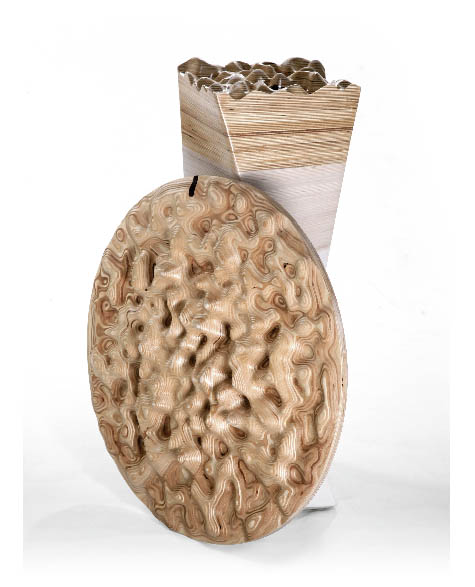
The acoustically-inspired topography fills the underside of the table, which meets flush and perfectly with the base (where Dendra has carved the exact opposite surface). It is the silence, so to speak, for the other surface’s noise.

[Images: By Daniel Dendra of anOtherArchitect].

Of course, if you get bored of drinking tea, or you simply don’t like the table, you can just separate the top from its base – and you’ve got a readymade milled noise-map of Cairo.

A Day at Storefront for Art and Architecture

I mentioned this about a month ago… but it’s nearly here: on Saturday, September 26, I’ll be hosting a daylong series of public talks and live interviews at Storefront for Art and Architecture in New York, featuring many of the people whose work appears in The BLDGBLOG Book. We’ve organized a stellar line-up of speakers, going from 3-6pm, and all of it will be followed by drinks.

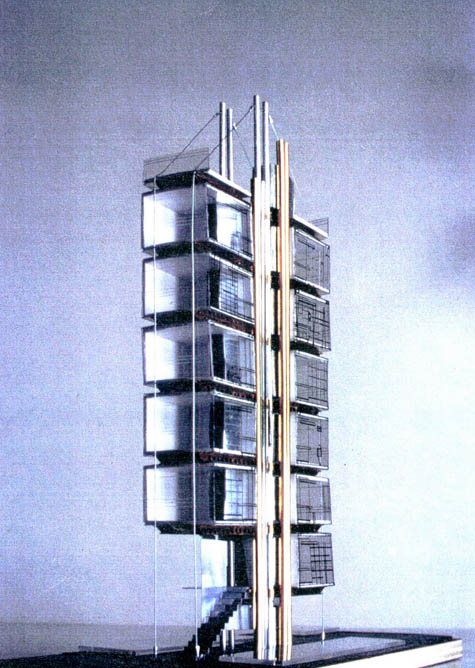
[Image: The Mix House by Joel Sanders Architect, Karen Van Lengen/KVL, and Ben Rubin/Ear Studio, as mentioned in The BLDGBLOG Book].

The complete schedule of presentations appears below; it’s free and open to the public. I’ll be introducing my own book around 6pm, but then we can all have a coffee or a glass of wine (or whatever’s around), and enjoy a Saturday evening in New York. I’d love to say hello, if you can make it.

3:00pm: Architect, William R. Kenan Jr. Professor of Architecture (and former Dean) at the University of Virginia’s School of Architecture, Karen Van Lengen

3:30pm: Live interview with musician Jace Clayton

4:00pm: Photographer Richard Mosse
May 2009 Interview with BLDGBLOG

4:30pm: Architect and writer Mason White

5:00pm: Live interview with novelist Patrick McGrath
July 2007 Interview with BLDGBLOG

5:30pm: Architect and educator Lebbeus Woods
October 2007 Interview with BLDGBLOG

6:00pm: Critic, blogger, and editor of The BLDGBLOG Book, Alan Rapp

6:05pm: Geoff Manaugh

6:30pm: Drinks

8:00pm: End

Copies of Patrick McGrath’s novels will be available for purchase, as well, and it’s a great opportunity to get them signed – in fact, if you already own a copy of The BLDGBLOG Book, or if you’re thinking of getting one, bear in mind that you can score at least three signatures on the Autographs page that night…

So, again, that’s Saturday, September 26, from 3pm to about 8pm, at Storefront for Art and Architecture in New York City. Here’s a map.

And thanks, by the way, for reading the blog, for being interested in the ideas presented here, for participating in some fantastic comments threads over the years, for all the tips for further reading/viewing/visiting/etc., and just for sticking around in general. I don’t mean to get misty-eyed, but I appreciate it, more than you might know. It’s not often that one runs into other people interested in things like bioluminescent urban ornaments or haunted telephone systems or rentable basement mazes or even “learning landscapes” – as many a negative commenter here has made clear. So, to the people who have been having fun with this website along with me: thanks.

Hexagonal Hydropolis

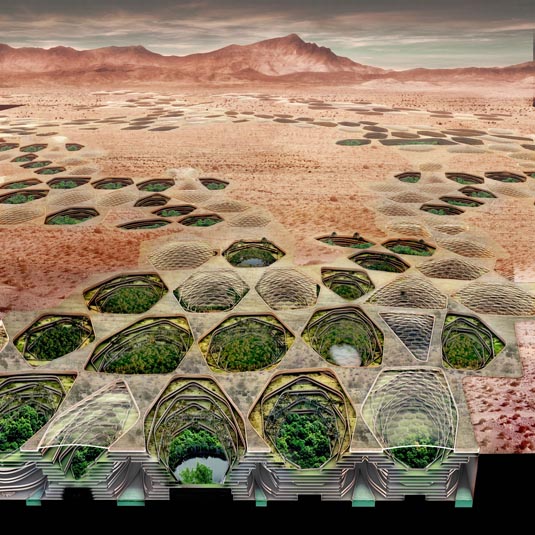
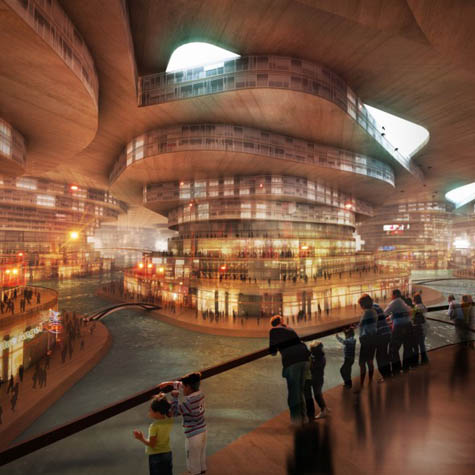
[Image: From Sietch Nevada by Matsys; renderings by Nenad Katic].

Andrew Kudless of Matsys recently proposed an extraordinary desert city of semi-subterranean terraces inspired by the novel Dune.

The images are fantastic, and the project description hooked me right away:

In Frank Herbert’s famous 1965 novel Dune, he describes a planet that has undergone nearly complete desertification. Dune has been called the “first planetary ecology novel” and forecasts a dystopian world without water. The few remaining inhabitants have secluded themselves from their harsh environment in what could be called subterranean oasises. Far from idyllic, these havens, known as sietch, are essentially underground water storage banks. Water is wealth in this alternate reality. It is preciously conserved, rationed with strict authority, and secretly hidden and protected.

The rest of the project combines an interest in drought hydropolitics in the U.S. southwest with the speculative architecture of “underground water banks.”

[Image: From Sietch Nevada by Matsys; renderings by Nenad Katic].

Continuing to quote at length:

Although this science fiction novel sounded alien in 1965, the concept of a water-poor world is quickly becoming a reality, especially in the American Southwest. Lured by cheap land and the promise of endless water via the powerful Colorado River, millions have made this area their home. However, the Colorado River has been desiccated by both heavy agricultural use and global warming to the point that it now ends in an intermittent trickle in Baja California. Towns that once relied on the river for water have increasingly begun to create underground water banks for use in emergency drought conditions. However, as droughts are becoming more frequent and severe, these water banks will become more than simply emergency precautions.

Accordingly, Kudless suggests that “waterbanking” will become “the fundamental factor in future urban infrastructure in the American Southwest.”

In this context, I would unhesitatingly recommend Marc Reisner’s classic book Cadillac Desert – the first hydrological page-turner I’ve ever read – as well as James Lawrence Powell’s recent Dead Pool: Lake Powell, Global Warming, and the Future of Water in the West (which I reviewed for The Wilson Quarterly earlier this year). Those two books are ideal references for Matsys’s project, as they each supply countless examples of hubristic, quasi-imperial waterbanking projects – projects that might still be functioning today but that are doomed, the authors convincingly show, to eventual dehydration.

Powell, in particular, offers genuinely disturbing descriptions of the looming silt-deposits that have accumulated behind the dams of the American west, amongst often extraordinarily poetic overviews of these dams’ inevitable failure. “One day every trace of the dams and their reservoirs will be gone,” Powell writes, “a few exotic grains of concrete the only evidence of their one-time existence.”

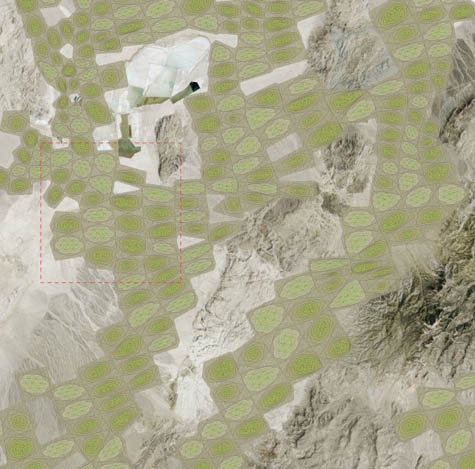
[Image: Matsys’s Sietch Nevada as seen from above; renderings by Nenad Katic].

In any case, the proposal seen here is “an urban prototype,” we read, “that makes the storage, use, and collection of water essential to the form and performance of urban life.”

A network of storage canals is covered with undulating residential and commercial structures. These canals connect the city with vast aquifers deep underground and provide transportation as well as agricultural irrigation. The caverns brim with dense, urban life: an underground Venice. Cellular in form, these structures constitute a new neighborhood typology that mediates between the subterranean urban network and the surface level activities of water harvesting, energy generation, and urban agriculture and aquaculture. However, the Sietch is also a bunker-like fortress preparing for the inevitable wars over water in the region.

Check out the full project on Matsys’s own website – and, while you’re there, the entire project database is worth a spin.

(Spotted on Architecture MNP. And read Dune!)

The Bay Line

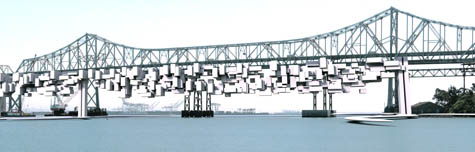
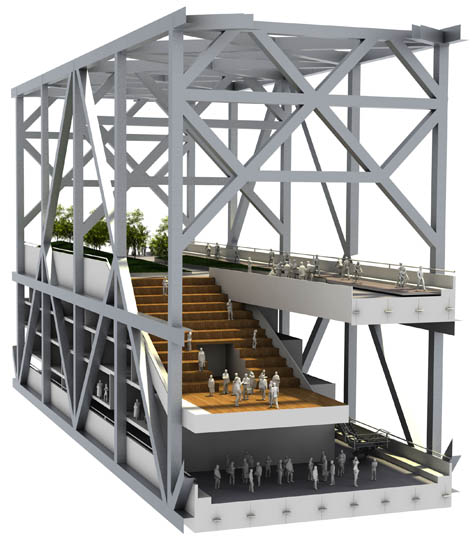
[Image: The Bay Line by Ronald Rael and Virginia San Fratello; modular additions can be seen bolted on from below. Read the project PDF].

Combining Rails to Trails, William Gibson’s Virtual Light, and the same repurposed-preservation strategies behind New York’s High Line, Bay Area architects Ronald Rael and Virginia San Fratello have called for stabilizing the disused – and soon to be entirely dismantled – portion of the Bay Bridge. They would then turn it into a pedestrianized urban park and outdoor sports attraction.

[Image: The Bay Bridge and its replacement; on the right is the piece that Rael San Fratello would like to see stabilized. Image via Wikipedia].

And if it works for the Bay Bridge, they suggest, it could work for other disused bridges elsewhere.

“This proposal seeks to repurpose abandoned and closed bridges as sites of potential for parks, cultural centers and housing,” the architects write in the project’s accompanying PDF. In the process, they hope “to demonstrate the potential for re-purposing historic American bridge infrastructure as possible sites for sustainable urban housing and linear parks.”

The immense load capacity of rail bridges allows for the support of program beyond that of parks, suggesting the urbanization of bridges. While the current economic climate suggests a surplus of housing, the economic reality also suggests a push towards urbanization and often the “affordable” housing constructed in suburban environments, which encroaches on the rural, is not what is needed. Instead, by using abandoned bridges in urban areas, we are creating opportunities for sustainable low-cost housing within the urban realm—creating the potential for creative speculation among housing developers by expounding upon the nascent potential of a layered housing-park-bridge typology.

While, on one level, this simply side-steps the immense financial implications associated with structurally maintaining these bridges, and, on another level, it bears an unfortunate resemblance to Boris Johnson’s recent – if not necessarily well-received – call for an inhabitable bridge across the Thames, it does also kick-start a conversation about what we might be able to do with the massive pieces of civic infrastructure that dot the U.S. and are currently scheduled for replacement and demolition.

[Images: (top) Tennis court, bicycle path, and observation module; (middle) Outdoor auditorium; (bottom) swimming pool on the Bay Line by Ronald Rael and Virginia San Fratello].

And, I have to admit, it would simply be cool:

Imagine housing, recreational and cultural facilities connected to a continuous, lushly planted, green strip, floating above the water—an aerial garden, as the city’s newest park through which you could walk and wander and enjoy the most spectacular views of the bay.

Of course, critics like James Howard Kunstler might suggest that reusing rail infrastructure – or, in this case, highway infrastructure – as anything other than a rejuvenated national rail service is “decadence at its purest,” it is surely just as decadent to watch as functional pieces of infrastructure rot on all sides, as you sit there with your arms crossed, waiting for the nation’s taxpayers to agree with your views on reuse.

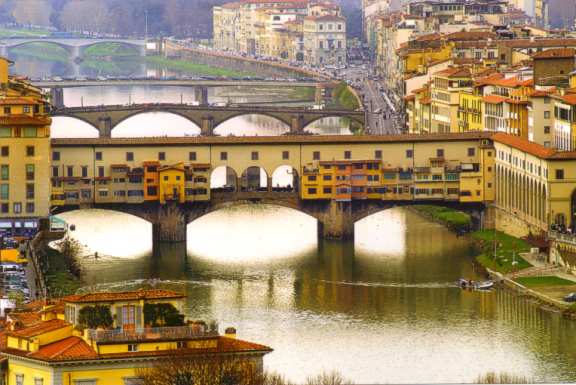
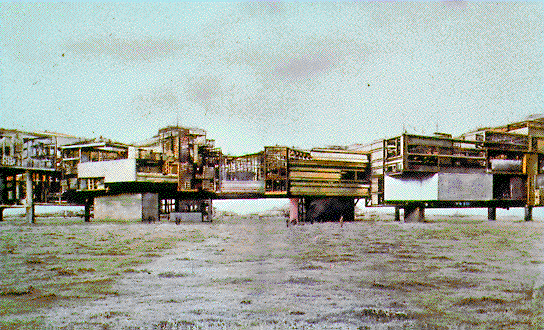
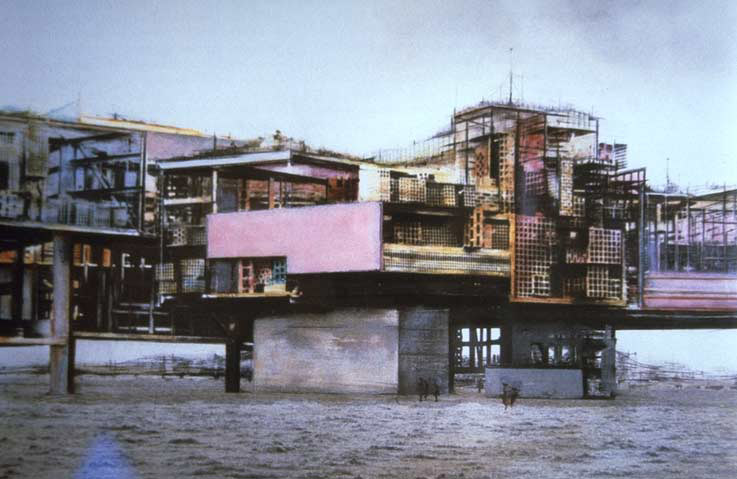
[Images: Other habitable bridge: (top) Florence’s Ponte Vecchio; (second) a painting by Peter Jackson of “Old London Bridge“; (third and bottom) Constant’s New Babylon].

In any case, as someone who literally never enjoyed driving across the Bay Bridge for seismic-safety reasons, I have to point out that this proposal still comes with its own set of earthquake-related issues. I was interested, however, to read in the Economist just this week that “there are few safe places to ride out an earthquake. Surprisingly, though, a recently constructed bridge is often one of them.”

Engineers have become good at designing bridges that are earthquake-resistant enough to preserve the lives of those caught crossing when a quake strikes. The problem is that the bridge is often unusable afterwards.

Nonetheless, if you had put millions of dollars’ worth of landscape and housing onto a bridge that was then left abandoned and “unusable” after an earthquake, it would be a very foolhardy investment, indeed.

[Image: Final render of the Bay Line by Ronald Rael and Virginia San Fratello].

But what of bridges in non-seismic zones? In Sydney, for instance, due to the peninsular nature of walks along Cremorne Point and through Kirribilli, there are places where the Sydney Harbor Bridge appears not to be crossing over water at all, but standing over the rooftops of the city, anchored into the neighborhood. It looks more like a new kind of inland megastructure, strung above the streets and restaurants, like something designed by Perdido Street Station-era China Miéville, than a harbor bridge. An industrial cathedral of exposed ribs and steel tension lines, arcing up into the skyline.

So what if you hung houses from it? What amazing typologies of bolt-on architectural prosthetics could we create, if bridges were aerial foundations and they carried not cars or locomotives but schools and piazzas?

In fact, I’m reminded of this unexpectedly inspiring – structurally speaking – proposal by Skidmore, Owings & Merrill, which sought to string the suspension cables of a new pedestrian bridge from inside the nearby buildings of a rebuilt Leamouth Peninsula (click through to their image gallery for more).

[Image: A proposal for London’s Leamouth Peninsula by Skidmore, Owings & Merrill].

Returning to Rael San Fratello‘s Bay Line, though, there are obviously still huge issues associated with the unusually catastrophic nature of structural failure when it comes to inhabitable bridges, as well as the financially prohibitive needs of regular maintenance, but treating suspension bridges simply as another type of district in the city is an undeniably interesting urban idea.

(Via Streetsblog SF and Ronald Rael. Meanwhile, Rael’s recently published book Earth Architecture is an excellent and thoughtful survey of earthen structures across the world and throughout building history; Rael’s old school blog, megablog, is also worth a read for its eye-popping and often literally world-altering architectural ambitions).

Extreme agricultural statuary

[Image: “Endothelium” by Philip Beesley & Hayley Isaacs].

I mentioned a recent issue of Mark Magazine the other day, but I deliberately saved one of the articles for a stand-alone post later on. That article was a long profile of the work of Philip Beesley, a Toronto-based architect and sculptor, whose project the “Implant Matrix” BLDGBLOG covered several years ago.

In issue #21 of Mark, author Terri Peters describes several of Beesley’s projects, but it’s the “Endothelium” that really stood out (and that you see pictured here).

[Image: “Endothelium” by Philip Beesley & Hayley Isaacs].

Peters refers to Beesley’s work as a “lightweight landscape of moving, licking, breathing and swallowing geotextile mesh” – a kind of pornography of ornament, or the Baroque by way of David Cronenberg. “Inspired by coral reefs,” she continues, “with their cycles of opening, clamping, filtering and digesting,” Beesley’s biomechanical sculpture-spaces are “immersive theatre environments” in which “wheezing air pumps create an environment with no clear beginning or end.”

I’m reminded of the penultimate scene in James Cameron’s film Aliens, when Ripley (Sigourney Weaver) meets the alien “queen.” The queen is laying eggs, we see, through a gigantic, semi-prosthetic, peristaltically-powered external ovarian sac – and the scene exemplifies the encounter with the grotesque in all its H.R. Giger-influenced, sci-fi extremes. Put another way, if organisms, too – not just buildings – can reach a point of ornamental excess, then James Cameron’s aliens are perhaps exhibit number one.

[Images: Screen grabs from James Cameron’s Aliens].

In any case, Beesley’s work is a fascinating hybrid of advanced textile design, geostructural modeling, and rogue biology experiment. Peters’s descriptions of the “Endothelium” are worth quoting at length:

[The structure consists of] a field of organic “bladders” that are self-powered and that move very slowly, self-burrowing, self-fertilizing and are linked by 3D printed joints and thin bamboo scaffolding. The bladders are powered using mobile phone vibrators and have LED lights. It works by using tiny gel packs of yeast which burst and fertilize the geotextile.

This latter detail – “using tiny gel packs of yeast which burst and fertilize the geotextile” – brings to mind something at the intersection of an improvised explosive device (or IED) and a green roof: you hire Philip Beesley to design a landscape-machine for installation atop a new building downtown, and, over the course of many decades, it vibrates, yeast-bursts, rotates, crawls, and grows through extraordinary cycles of grotesque architectural fertility. A solar-powered landscape of mold and microroots, generating its own soil. Within a few years, the original sculpture it all came from is gone, archaeologically undetectable beneath the vitality of the forms that have consumed it.

One wonders what Philip Beesley would think of the mushroom tunnel of Mittagong.

[Images: “Endothelium” by Philip Beesley & Hayley Isaacs].

Elsewhere in the article, Peters writes:

Endothelium is an automated geotextile, a lightweight and sculptural field housing arrays of organic batteries within a lattice system that might reinforce new growth. It uses a dense series of thin “whiskers” and burrowing leg mechanisms to support low-power miniature lights, pulsing and shifting in slight increments. Within this distributed matrix, microbial growth is fostered by enriched seed-patches housed within nest-like forms, sheltered beneath the main lattice units.

I’m a bit rhetorically stuck on “between” statements, I’m afraid, but it’s as if Beesley’s work falls somewhere between a loaf of sourdough bread and a sculpture by Jean Tinguely.

[Image: “Endothelium” by Philip Beesley & Hayley Isaacs].

I’m curious, meanwhile, if you could bury a Philip Beesley sculpture in the woods of rural England somewhere, and allowed it to articulate new ecosystems slowly, over the cyclic course of generations. In fact, I’m reminded of an article in the New York Times last week, spotted via mammoth, in which we learn that two abandoned landfills in Brooklyn have since been used as unlikely foundations for new ecosystems:

In a $200 million project, the city’s Department of Environmental Protection covered the Fountain Avenue Landfill and the neighboring Pennsylvania Avenue Landfill with a layer of plastic, then put down clean soil and planted 33,000 trees and shrubs at the two sites. The result is 400 acres of nature preserve, restoring native habitats that disappeared from New York City long ago.

“Once the plants take hold,” the article adds, “nature will be allowed to take its course, evolving the land into microclimates.” But what if those weren’t landfills down there but sculptures by Philip Beesley? Strategically sown seed-patches and gel packs of yeast wait underground for new roots to rediscover them.

It’s living geostatuary, buried beneath the surface of the earth – a kind of extreme agriculture, with soil-preparation by Philip Beesley.

[Images: “Endothelium” by Philip Beesley & Hayley Isaacs].

I’d genuinely like to see what Beesley might do if he was hired by, say, a NASA R&D program dedicated to terraforming other planets. Could you fly a modular, self-unfolding Philip Beesley sculpture into the depths of radiative space, land it on a planet somewhere, and watch as revolting pools of bacteriological mucus begin to coagulate and form new fungi?

Beesley’s whiskered vibrators begin to shiver with signs of piezoelectric life, as small crystals surrounded by radio transmitters and genetically engineerined space-seed-patches imperceptibly tremble, evolving into mutation-prone “organic batteries” unprotected beneath starlight. Give it a thousand years, and vast infected forests, the width of continents, take hold.

You’ve colonized a distant planet through architecture and yeast.

For more, check out Mark Magazine‘s issue #21. Beesley’s also got a book out, called Hylozoic Soil, that I would love to read.

Light Graphs in the Andes

[Image: From “Imprints on the Andes” by Studio Orta].

While writing a post earlier this week about an exhibition in Paris, called Uninhabitable? Art of Extreme Environments, I stumbled upon this project by Lucy and Jorge Orta, aka Studio Orta.

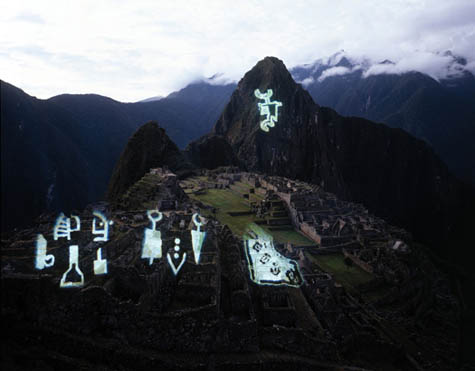
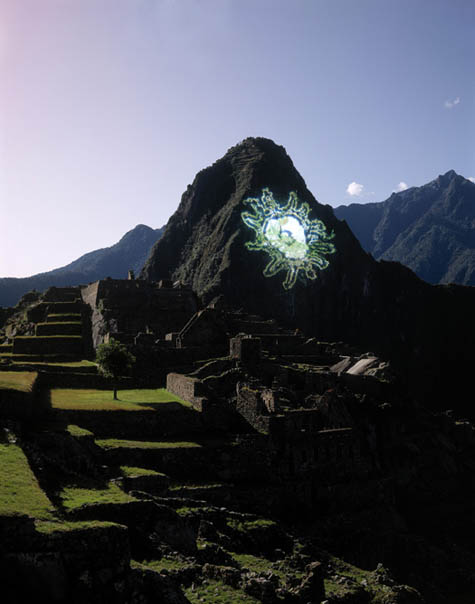
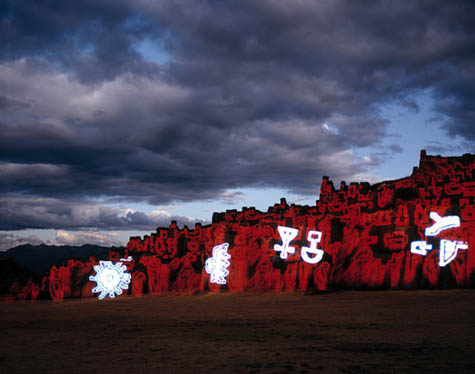
Performed fourteen years ago, “Imprints on the Andes” used “PAE light cannons,” which “enable[d] gigantic mobile images to be projected up to 1km in distance.” The artists thus projected massive hieroglyphic shapes onto the ruins of Macchu Picchu and on the mountainsides beyond.

In fact, the cannons are strong enough to be seen in broad daylight.

[Image: From “Imprints on the Andes” by Studio Orta].

The effect is quite amazing, especially if one were to encounter these things without foreknowledge of what they were or that they’d be there.

You hike over a remote rise in the mountainous deserts of Utah – and there, ahead, moving ever so slightly, is a strange shape, like an enemy ship from Space Invaders, a shining path of alien signs hovering on the geologies all around you.

[Images: From “Imprints on the Andes” by Studio Orta].

Unfortunately, the effect is not quite as exciting when used on buildings.

Gonzo Green

[Image: Preflooded Wetlands by Liam Young and Darryl Chen].

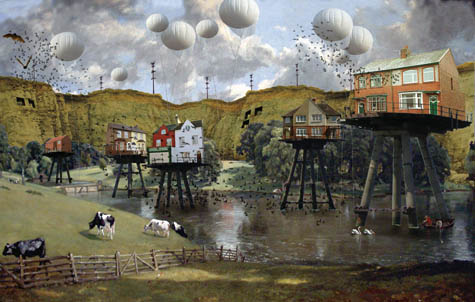
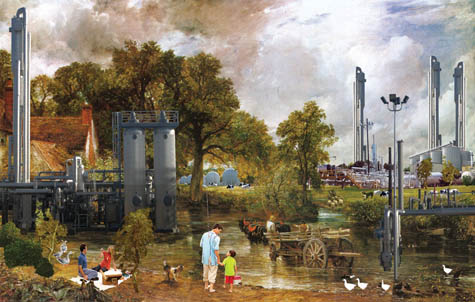
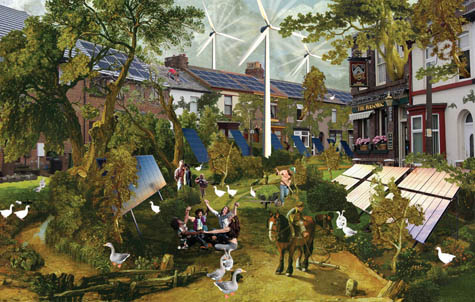
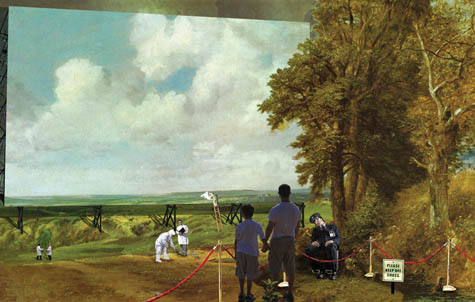
Unexpectedly apropos of the previous post, Liam Young of Tomorrow’s Thoughts Today, together with Darryl Chen, has created a series of quite beautiful images called “Postcards from a Green Future” – one of which, seen above, uses the Maunsell Sea Forts as a gantried foundation for suburban anti-flood design in an idyllic southeast England.

The entire suite of images is almost farcically green – it’s sustainability redone as Grand Guignol. These speculative scenes of “a green future” show us an over-the-top, solar-powered utopia of detached single-family houses and wind turbines, woven together with light rail and renewable energy technologies; it’s an Eden of sprawl spreading out into London’s most distant scattered cityscape.

[Image: Waste and Biogas and Permacultural Hinterland by Liam Young and Darryl Chen].

But the images also betray an interest in the murky borders between the synthetic and the geological, the organic and the mass-produced. What if those verdant fields of green out there are actually cloned and genetically-modified? What if that well-trimmed nature is simply an exhibition on display?

[Image: Primordial Garden Sanctuary and Incarceration Tower by Liam Young and Darryl Chen].

You can read about the entire project in new four-part series of blog posts over at Tomorrow’s Thoughts Today – just go to the righthand column (“Slow Thoughts”) and keep scrolling down…

Maunsell Towers

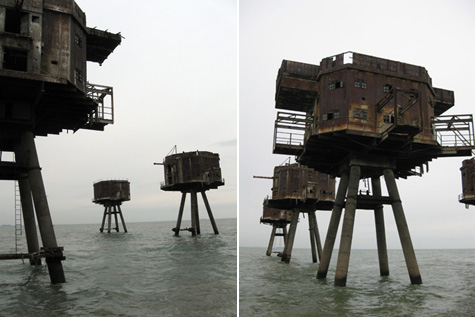
[Image: The Maunsell Sea Forts, photographed by Pete Speller, courtesy of Nick Sowers].

I missed an amazing opportunity the other week to visit the Maunsell Towers – aka the Maunsell Sea Forts – with Nick Sowers, author of an excellent Archinect school blog and one of my students from this summer’s studio down on Cockatoo Island in Sydney.

For the last year or so, Nick has been traveling around the world on a much-deserved John K. Branner Fellowship, documenting army bases, abandoned bunkers, and other sites of historical military interest. From South Korea to the Maginot Line, from classical war zones and medieval walled cities to “bunker recycling services” and D-Day, Nick’s itinerary is breath-taking. It is also, I hope, intriguing enough to catch the eye of future publishers or gallerists who might want to give Nick the space in which to break down all that he’s seen; there are very many of us who would love to learn more.

Of course, we could also hear more about his trip: Nick is acoustically-inclined, and he has been documenting the sounds of these militarized landscapes over on another blog he runs, called Soundscrapers.

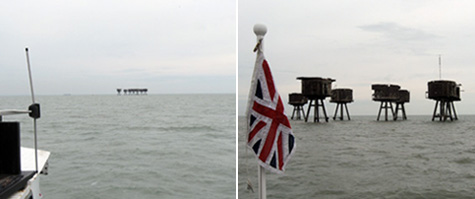
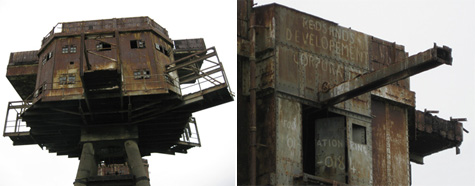
[Images: Photos by Nick Sowers].

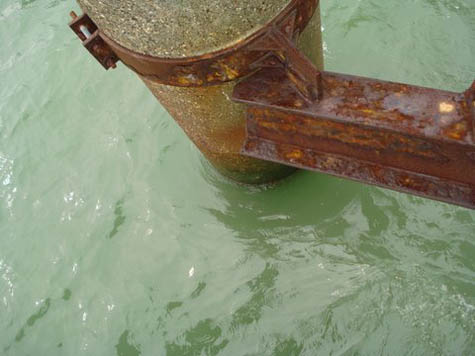
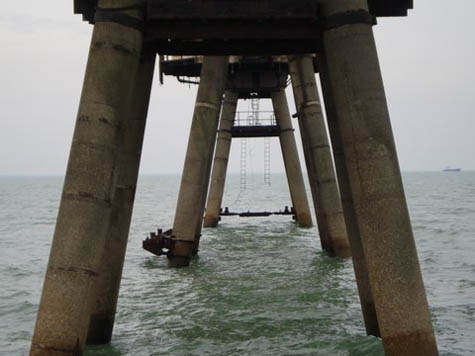
So Nick and his wife were in England the other week, and we unfortunately missed meeting up – but they managed to take a boat tour out to the Maunsell Sea Forts, iconic architectural structures in the Thames Estuary, inspirations for Archigram, and one of the few real-life buildings (if you can call them that) that gave me the idea to start BLDGBLOG. In fact, I’ve mentioned these places in lectures and I’ve posted about them on the blog before – but I’ve never had a chance to visit.

Nick’s photos, presented here, alongside photos by Pete Speller, will tell the story instead.

[Images: Photos by Nick Sowers].

As Underground Kent explains, “The Thames Estuary Army Forts were constructed in 1942 to a design by Guy Maunsell.”

Their purpose was to provide anti-aircraft fire within the Thames Estuary area. Each fort consisted of a group of seven towers with a walkway connecting them all to the central control tower. The fort, when viewed as a whole, comprised one Bofors tower, a control tower, four gun towers and a searchlight tower. They were arranged in a very specific way, with the control tower at the centre, the Bofors and gun towers arranged in a semi-circular fashion around it and the searchlight tower positioned further away, but still linked directly to the control tower via a walkway. All the forts followed this plan and, in order of grounding, were called the Nore Army Fort, the Red Sands Army Fort and finally the Shivering Sands Army Fort. All three forts were in place by late 1943, but Nore is no longer standing. Construction of the towers was relatively quick, and they were easily floated out to sea and grounded in water no more than 30m (100ft) deep.

They thus entered into the imaginations of speculative architects everywhere; they helped give visual shape to Archigram’s Walking City; and they continue to offer a kind of real-life spatial analogue for Constant’s New Babylon for anyone with access to a boat.

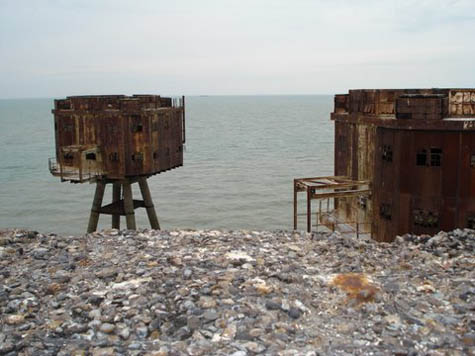
[Image: The Maunsell Sea Forts, photographed by Pete Speller, courtesy of Nick Sowers].

Nick explained in an email that he visited the structures with Tony Pine, a “sound engineer” – i.e. pirate radio operator – who spent the afternoon “telling stories of the days in the 60s when Archigram came out to visit the structures, and also about incredibly cold winters when they burned the wood-fibre linings of the tower interiors to stay warm.”

Also along for the ride was Robin Adcroft, director of Project Redsand, who “describes himself as the caretaker of the structures.” Adcroft points out the genealogical importance of these structures:

The Thames Sea Forts are the last in a long history of British Marine Defences. The Army Anti Aircraft forts have played a significant role in post World War 2 developments. Notably in offshore fuel exploration and drilling platforms. The successful rapid deployment of the Maunsell Forts soon after led to the construction of the first offshore oil platform in the Gulf of Mexico in the late 1940s.

Both conceptually and materially, the Maunsell Towers have an architectural legacy that seems oddly under-explored.

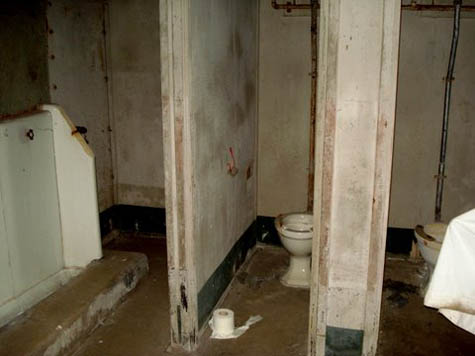
[Images: Inside the forts; photos by Pete Speller, courtesy of Nick Sowers].

But “it’s interesting,” Nick adds: “no one actually owns these things.”

Apparently the transport authority wanted to give Project Redsand a deed but they declined it, not wanting the liability. A ship crashed into Shivering Sand (an outpost which is visible from Redsand) in the 60s, taking out one of the towers and killing two maintenance personnel. Red Sand is not actually in the shipping lane, but it is very much a hazard. The original 1/4 inch plate steel is rusting through to a paper thickness. We had to wear hardhats when the boat pulled in next to the structures.

Project Redsand has more information about efforts to preserve the forts – and they link to this short YouTube video in which you can see how these clustered towers might be stabilized and maintained for generations to come.

[Images: Photos by Pete Speller, courtesy of Nick Sowers].

Meanwhile, be sure to follow Nick Sowers’s slowly-ending travels around the militarized world on his Archinect blog – and he can also be found on Twitter.

The Mushroom Tunnel of Mittagong

[Image: Shiitake logs on racks in the Mittagong mushroom tunnel. All photos by the author].

Note: This is a guest post by Nicola Twilley.

As Geoff mentioned here on BLDGBLOG a few weeks ago, we spent our last full day in Australia touring the Li-Sun Exotic Mushroom Farm with its founder and owner, Dr. Noel Arrold. Three weeks earlier, at a Sydney farmers’ market, we had been buying handfuls of his delicious Shimeji and Chestnut mushrooms to make a risotto, when the vendor told us that they’d all been grown in a disused railway tunnel southwest of the city, in Mittagong.

[Image: The mushroom tunnel, on the left, was originally built in 1886 to house a single-track railway line. By 1919, it had to be replaced with the still-functioning double-track tunnel to its right, built to cope with the rise in traffic on the route following the founding of Canberra, Australia’s purpose-built capital city. The tunnel is still state property: the mushroom farm exists on a five-year lease].

The idea of re-purposing abandoned civic infrastructure as a site for myco-agriculture was intriguing, to say the least, so we were thrilled when Dr. Arrold kindly agreed to take the time to give us a tour (Li-Sun is not usually open to the public).

Dr. Arrold has been growing mushrooms in the Mittagong tunnel for more than twenty years, starting with ordinary soil-based white button mushrooms and Cremini, before switching to focus on higher maintenance (and more profitable) exotics such as Shimeji, Wood-ear, Shiitake, and Oyster mushrooms.
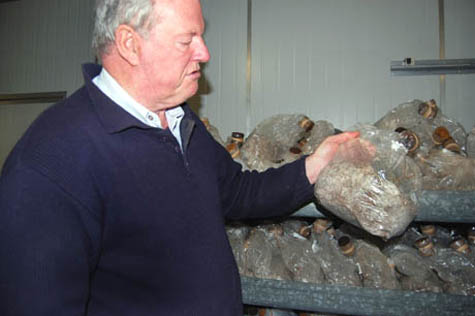
[Images: (top) Dr. Arrold with a bag of mushroom spawn. He keeps his mushroom cultures in test-tubes filled with boiled potato and agar, and initially incubates the spawn on rye or wheat grains in clear plastic bags sealed with sponge anti-mould filters before transferring it to jars, black bin bags, or plastic-wrapped logs; (middle) Shimeji and (bottom) pink oyster mushrooms cropping on racks inside the tunnel. Dr. Arrold came up with the simple but clever idea of growing mushrooms in black bin bags with holes cut in them. Previously, mushrooms were typically grown inside clear plastic bags. The equal exposure to light meant that the mushrooms fruited all over, which made it harder to harvest without missing some].

A microbiologist by training, Dr. Arrold originally imported his exotic mushroom cultures into Australia from their traditional homes in China, Japan, and Korea. Like a latter-day Tradescant, he regularly travels abroad to keep up with mushroom growing techniques, share his own innovations (such as the black plastic grow-bags shown above), and collect new strains.

He showed us a recent acquisition, which he hunted down after coming across it in his dinner in a café in Fuzhou, and which he is currently trialling as a potential candidate for cultivation in the tunnel. Even though all his mushroom strains were originally imported from overseas (disappointingly, given its ecological uniqueness, Australia has no exciting mushroom types of its own), Dr. Arrold has refined each variety over generations to suit the conditions in this particular tunnel.

Since there is currently only one other disused railway tunnel used for mushroom growing in the whole of Australia, his mushrooms have evolved to fit an extremely specialised environmental niche: they are species designed for architecture.

[Images: (top) Logs on racks (Taiwanese style) and mounted on the wall (Chinese style) in the tunnel; (bottom) Wood-ear mushrooms grow through diagonal slashes in plastic bags filled with chopped wheat straw].

The tunnel for which these mushrooms have been so carefully developed is 650 metres long and about 30 metres deep. Buried under solid rock and deprived of the New South Wales sunshine, the temperature holds at a steady 15º Celsius. The fluorescent lights flick on at 5:30 a.m. every day, switching off again exactly 12 hours later. The humidity level fluctuates seasonally, and would reach an unacceptable aridity in the winter if Dr. Arrold didn’t wet the floors and run a fogger during the coldest months.

In all other respects, the tunnel is an unnaturally accurate concrete and brick approximation of the prevailing conditions in the mushroom-friendly deep valleys and foggy forests of Fujian province. This inadvertent industrial replicant ecosystem made me think of Swiss architecture firm Fabric‘s 2008 proposal for a “Tower of Atmospheric Relations” (pdf).

[Image: Renderings of Fabric’s “Tower of Atmospheric Relations,” showing the stacked volumes of air and the resulting climate simulations].

Fabric’s ingenious project is designed to generate a varying set of artificial climates (such as the muggy heat of the Indian monsoon, or the crisp air of a New England autumn day) entirely through the movements of the air that is trapped inside the tower’s architecture (i.e. by means of convection, condensation, thermal inertia, and so on).

If you could perhaps combine this kind of atmosphere-modifying architecture with today’s omnipresent vertical farm proposals, northern city dwellers could simultaneously avoid food miles and continue to enjoy bananas.

[Images: (top) Li-Sun employees unwrap mushroom logs before putting them on racks in the tunnel. The logs are made by mixing steamed bran or wheat, sawdust from thirty-year-old eucalyptus, and lime in a concrete mixer, packing it into plastic cylinders, and inoculating them with spawn. (middle) Fruiting Shiitake logs on racks in the tunnel. Once their mushrooms are harvested, the logs make great firewood. (bottom) The Shiitake log shock tank – Dr. Arrold explained that the logs crop after one week in the tunnel, and then sit dormant for three weeks, until they are “woken up” with a quick soak in a tub of water, after which they are productive for three or four more weeks. “Shiitake,” said Dr. Arrold, in a resigned tone, “are the most trouble – and the biggest market.”]

Outside of the tunnel, Dr. Arrold also grows Enoki, King Brown, and Chestnut mushrooms. These varieties prefer different temperatures (6º, 17º, and 18º Celsius respectively), so they are housed in climate-controlled Portakabins.

[Images: (top) The paper cone around the top of the enoki jar helps the mushrooms grow tall and thin. (second) Chestnut mushrooms grow in jars for seven weeks: four to fruit, and three more to sprout to harvest size above the jar’s rim. (third) Thousands of mushroom jars are stacked from floor to ceiling. Dr. Arrold starting growing these mushroom varieties in jars two years ago, and hasn’t had a holiday since. (fourth) Empty mushroom jars are sterilised in the autoclave between crops, so that disease doesn’t build up. (bottom) The clean jars are filled with sterilised substrate using a Japanese-designed machine, before being inoculated with spawn].

The fact that the King Brown and Chestnut mushrooms only thrive at a higher temperature than the railway tunnel provides makes their cultivation much more expensive. Their ecosystem has to be replicated mechanically, rather than occuring spontaneously within disused infrastructure.

I couldn’t help but wonder whether there might be another tunnel, cave, or even abandoned bunker in New South Wales that currently maintains a steady 17º Celsius and is just waiting to be colonised by King Brown mushrooms growing, like ghostly thumbs, out of thousands of glass jars.

[Image: Temperature map of the London Underground system (via the BBC, where a larger version is also available), compiled by Transport for London’s “Cool the Tube” team].

In the UK, for instance, Transport for London has kindly provided this fascinating map of summertime temperatures on various tube lines. Most are far too hot for mushroom growing (not to mention commuter comfort). Nonetheless, perhaps the estimated £1.56 billion cost of installing air-conditioning on the surface lines could be partially recouped by putting some of the system’s many abandoned service tunnels and shafts to use cultivating exotic fungi. These mushroom farms would be buried deep under the surface of the city, colonizing abandoned infrastructural hollows and attracting foodies and tourists alike.

[Image: A very amateur bit of Photoshop work: Li-Sun Mushrooms as packaged for Australian supermarket chain Woolworths, re-imagined as Bakerloo Line Oyster Mushrooms].

Service shafts along the hot Central line might be perfect for growing Chestnut Mushrooms, while the marginally cooler Bakerloo line has several abandoned tunnels that could replicate the subtropical forest habitat of the Oyster Mushroom. And – unlike Dr. Arrold’s Li-Sun mushrooms, which make no mention of their railway tunnel origins on the packaging – I would hope that Transport for London would cater to the locavore trend by labeling its varietals by their line of origin.

[Images: Shiitake logs on racks in the Mittagong mushroom tunnel].

Speculation aside, our visit to the Mittagong Mushroom Tunnel was fascinating, and Dr. Arrold’s patience in answering our endless questions was much appreciated. If you’re in Australia, it’s well worth seeking out Li-Sun mushrooms: you can find them at several Sydney markets, as well as branches of Woolworths.

[Image: Nicola Twilley is the author of Edible Geography, where this post has been simultaneously published].
Extreme Environments

Opening today in Paris is a new exhibition called Uninhabitable? Art of Extreme Environments. Featured artists include Catherine Rannou, Connie Mendoza, and Studio Orta, among many others.

[Image: From Numerical Desert by Connie Mendoza].

Rannou’s work has ranged from speculative building projects for spatially challenging sites in the city (seen below) to her work Colonisation 2041, featured in the exhibition. This latter project is “an installation reflecting the active and actual occupation that the development of scientific stations in Antarctica represents; energy dependence, waste management, roads and tunnels, planes, tractors, helicopters, and building materials all point to a form of ‘urbanisation’ that is clearly in progress.”

[Image: Parentheses, an “habiter dans les interstices de la ville,” by Catherine Rannou].
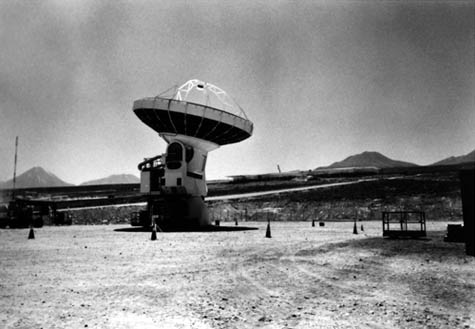
Meanwhile, Connie Mendoza produces diagrammatic artworks, analyses of the optical landscapes of mirages, and fascinating quasi-documentary photo-projects, including the stunning Moon Landscapes and Numerical Desert. Numerical Desert, which will be on display in Paris, explores the Atacama Large Millimeter Array through black-and-white photos; it comes with “drawings based on the data of the astronomical observation of stars and galaxies in coverage of the whole southern celestial hemisphere.” She’s also got a blog.

[Image: Antarctic Village by Studio Orta].

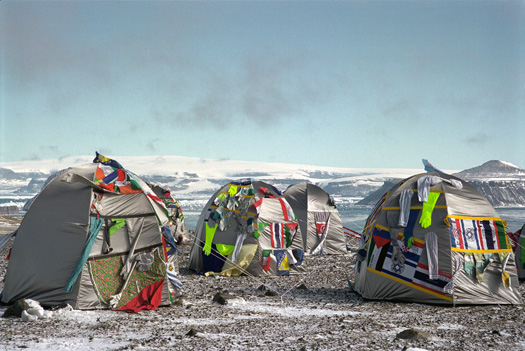
Studio Orta’s work touches on political questions associated with empty landscapes – including the question of whether or not one could ever be a citizen of Antarctica. Their Antarctic Village, for instance, pictured above, falls somewhere between an experiment in extreme camping and a stab at temporary utopian space unaffiliated with national governments.

Antarctic Village is emblematic of Ortas’ body of work, composed of what could be termed modular architecture and reflecting qualities of nomadic shelters and campsites. The dwellings themselves are hand stitched together by a traditional tent maker with sections of flags from countries around the world, along with extensions of clothes and gloves, symbolising the multiplicity and diversity of people.

For more information about the exhibition, check out the website.

(Thanks to William Fox for the tip!)