An Ancient Comedy of Urban Errors

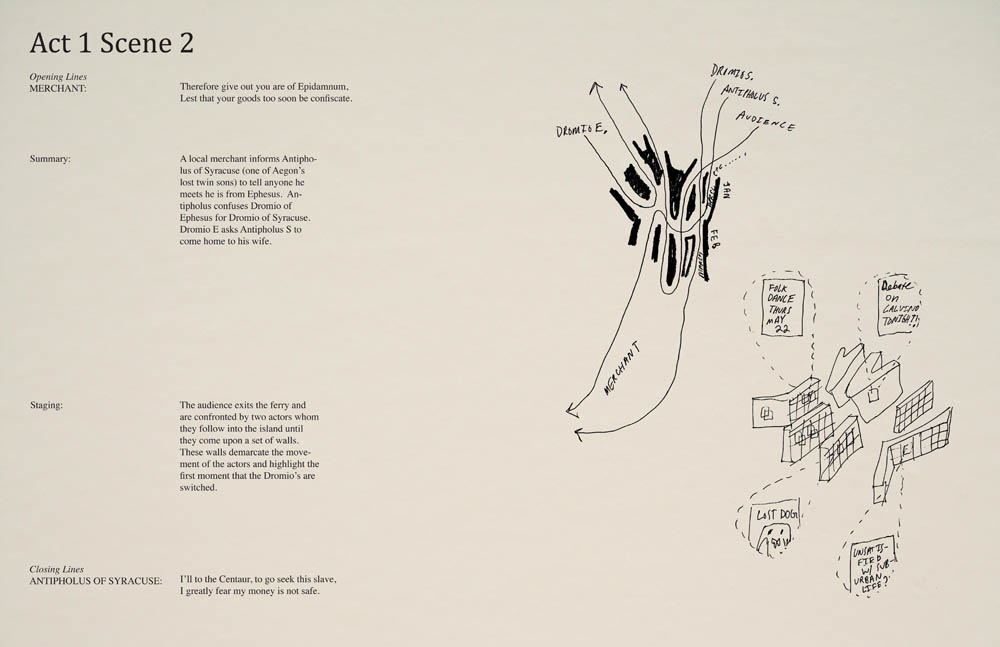
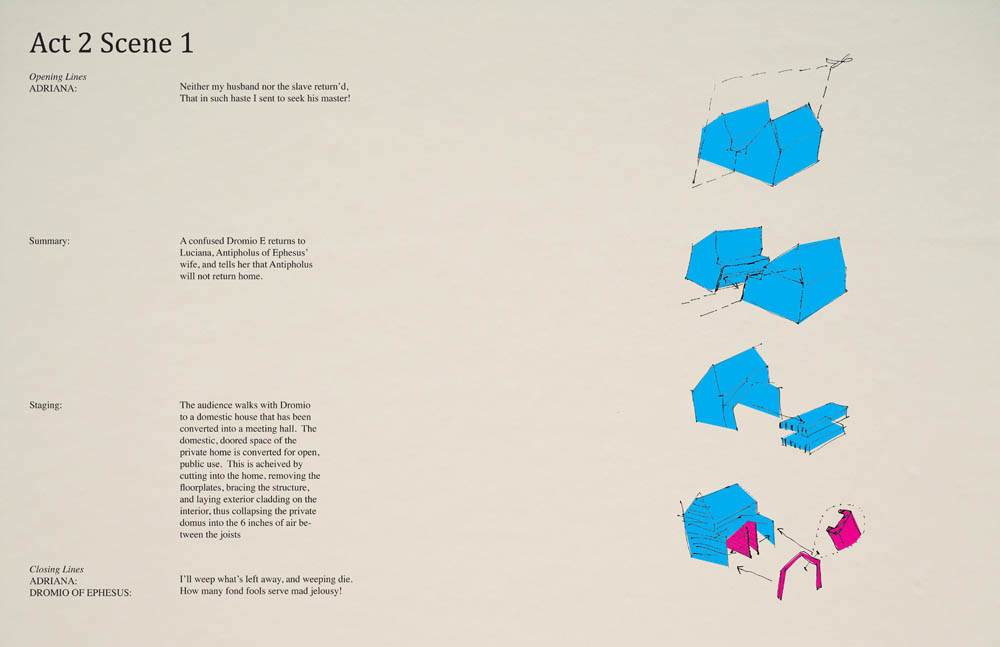
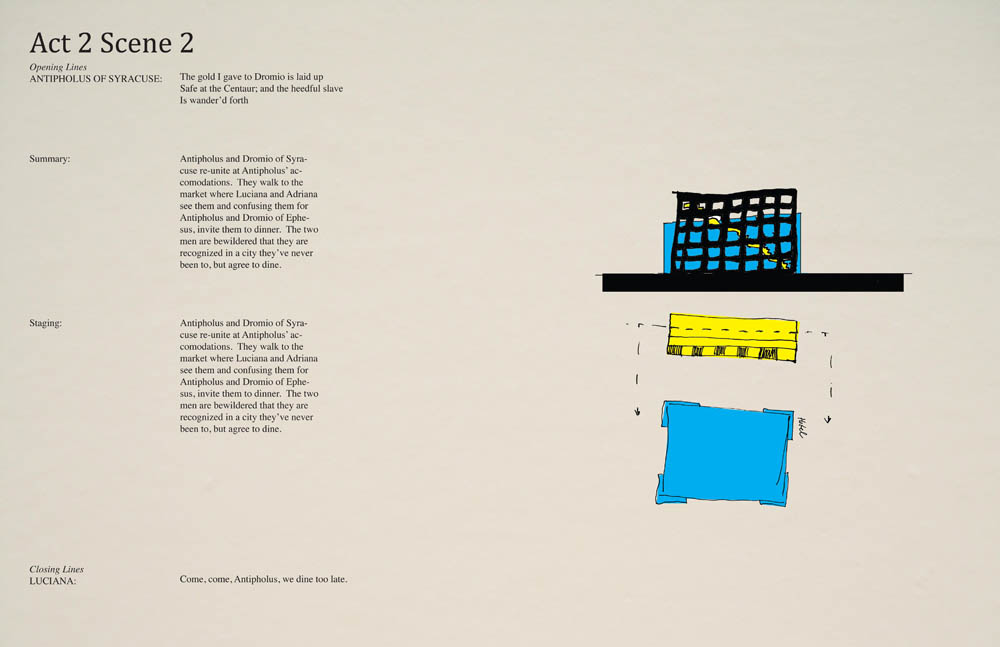
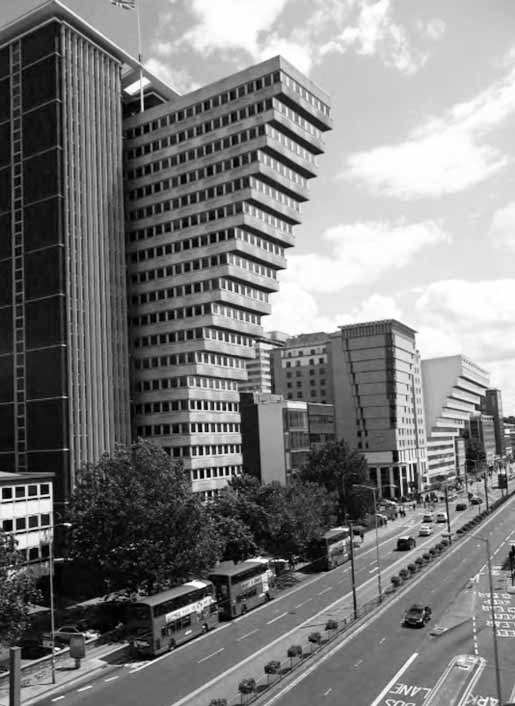
[Image: From Andrejs Rauchut’s thesis project at the Cooper Union].

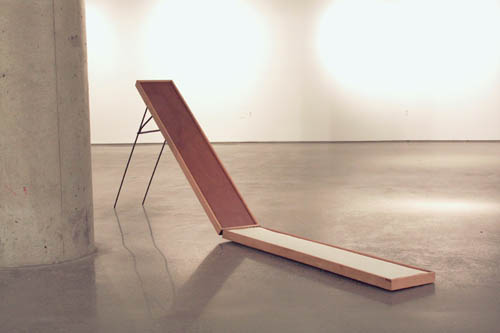
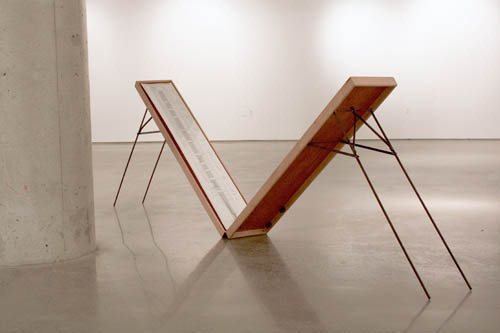
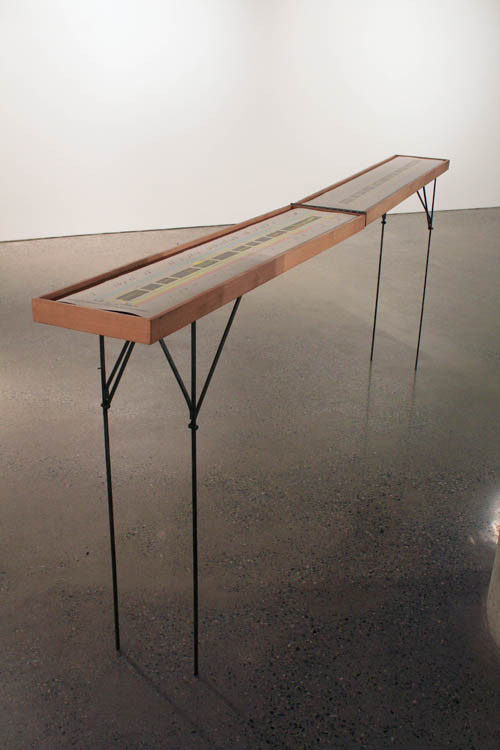
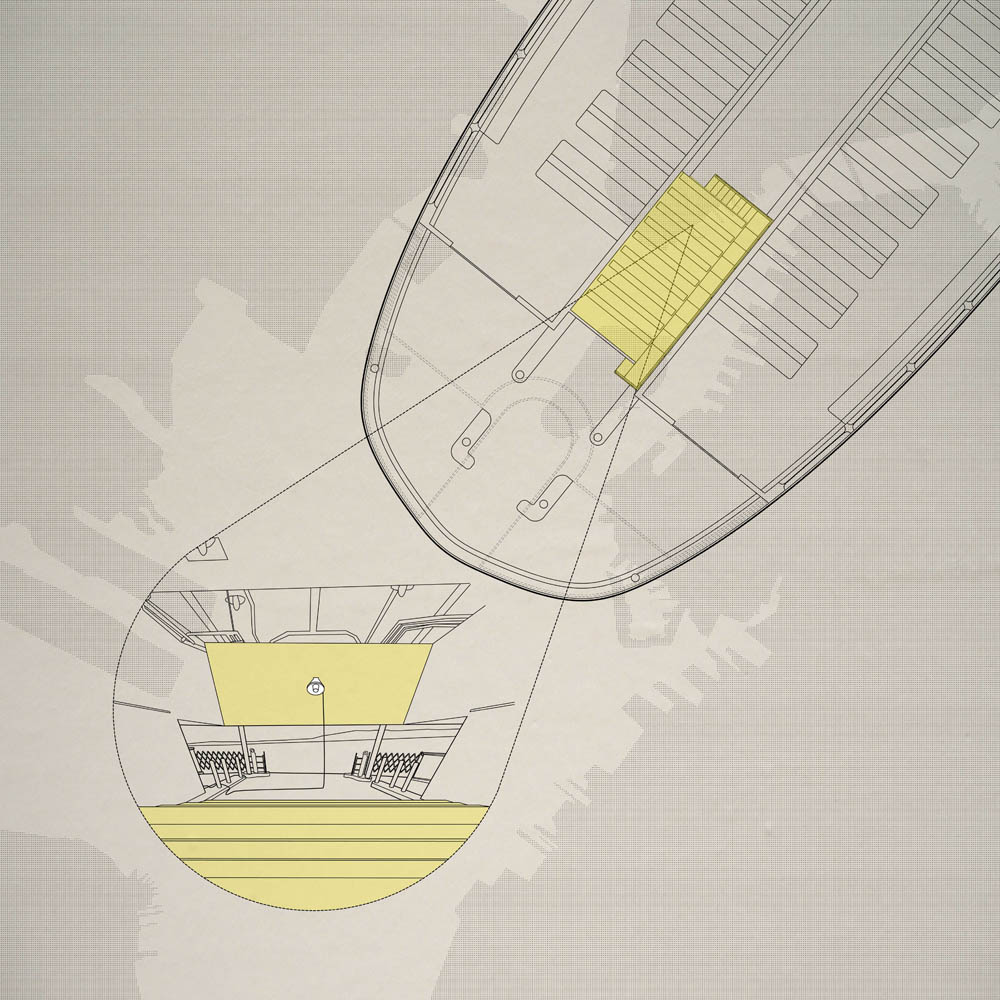
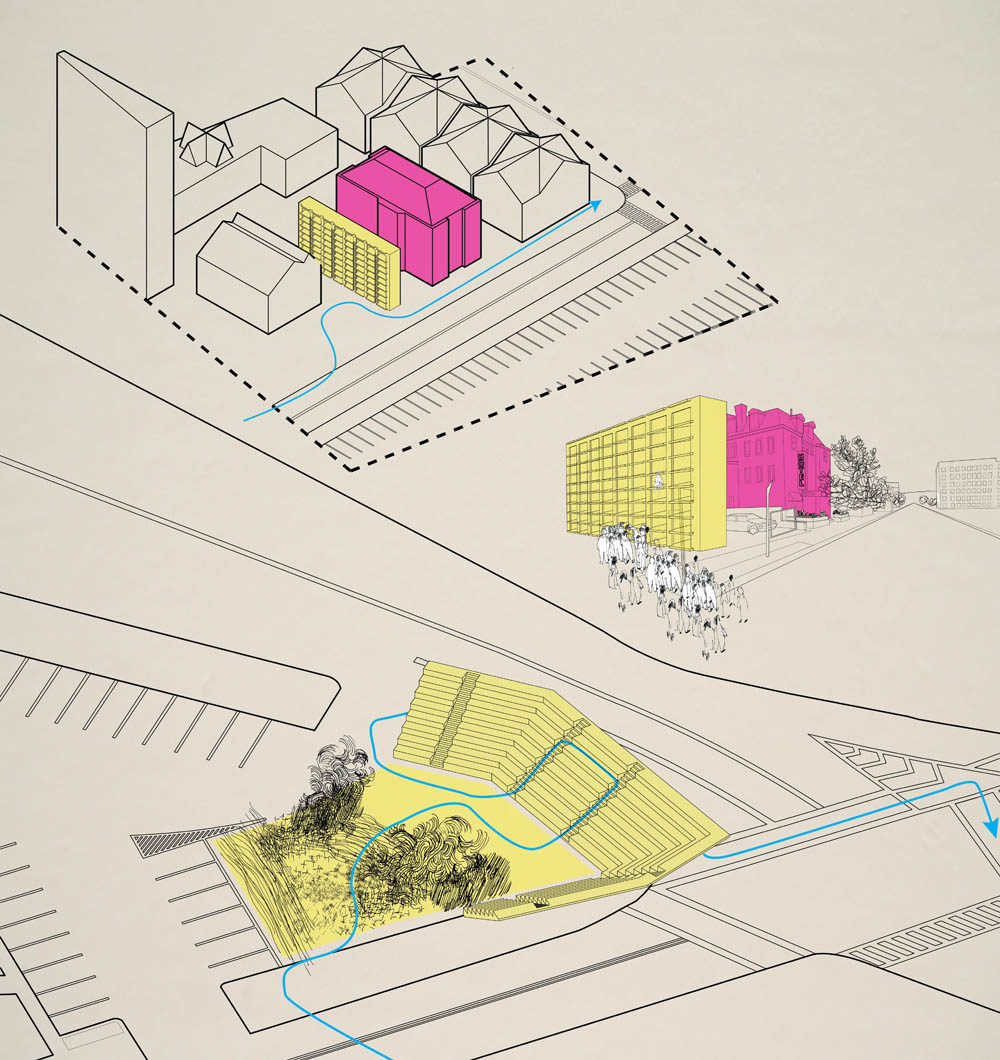
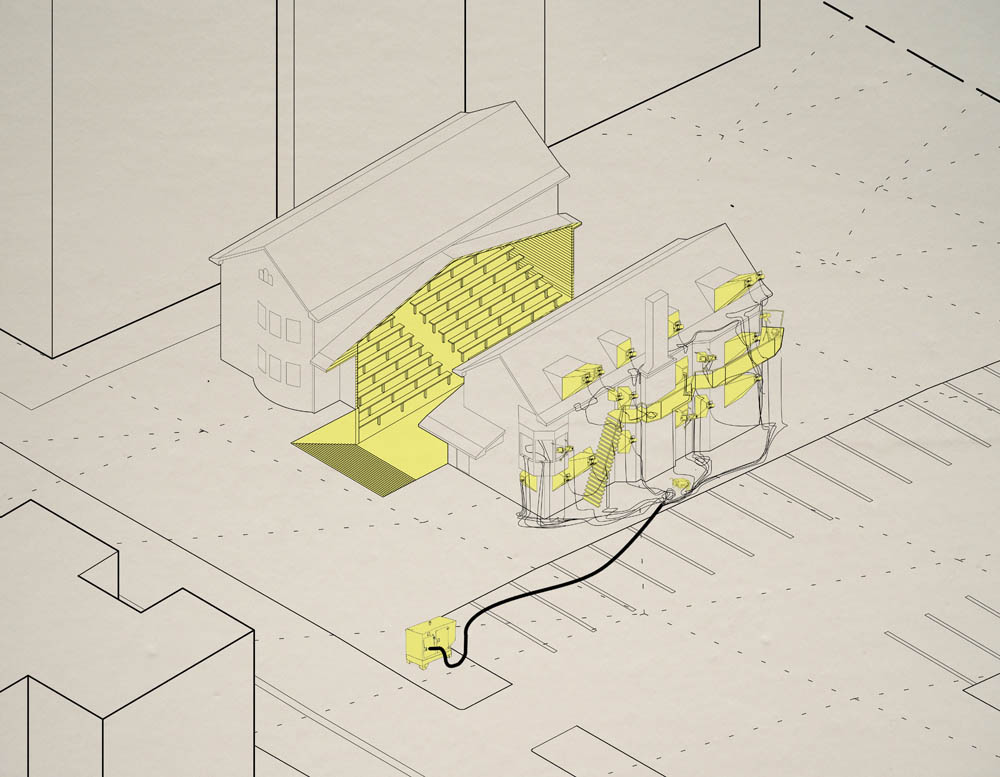
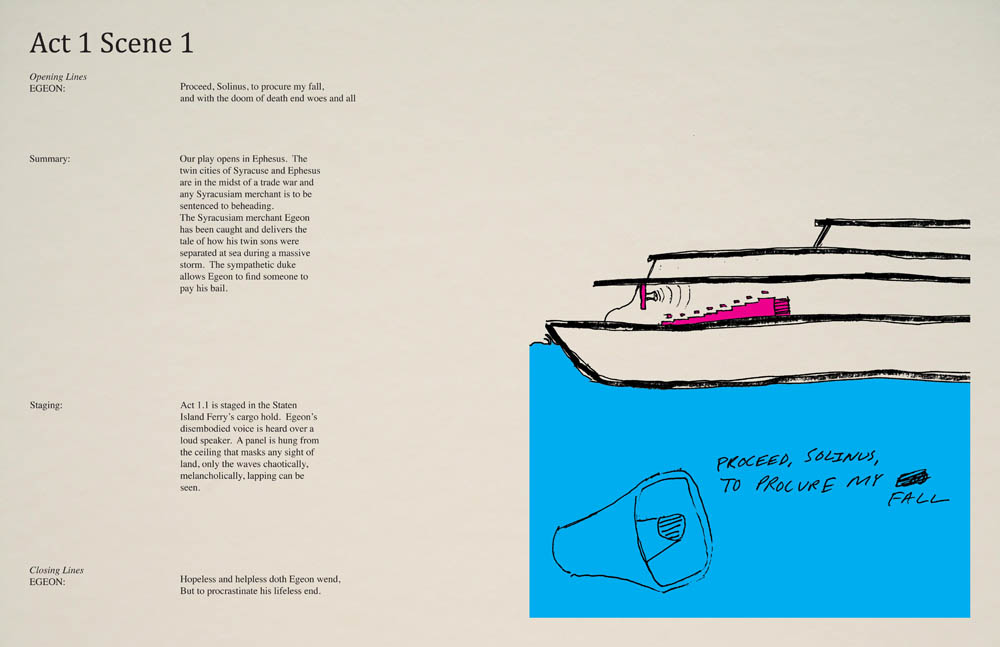
For his final thesis project this year at the Cooper Union in New York City, student Andrejs Rauchut diagrammed and modeled “a constellation of architectural set pieces” meant for “a day-long performance of The Comedy of Errors” by William Shakespeare. Rauchut’s project presentation included an absolutely massive, wood-bound book: it started off as a flat chest or cabinet, before opening up as its own display table.

[Images: From Andrejs Rauchut’s thesis project at the Cooper Union].

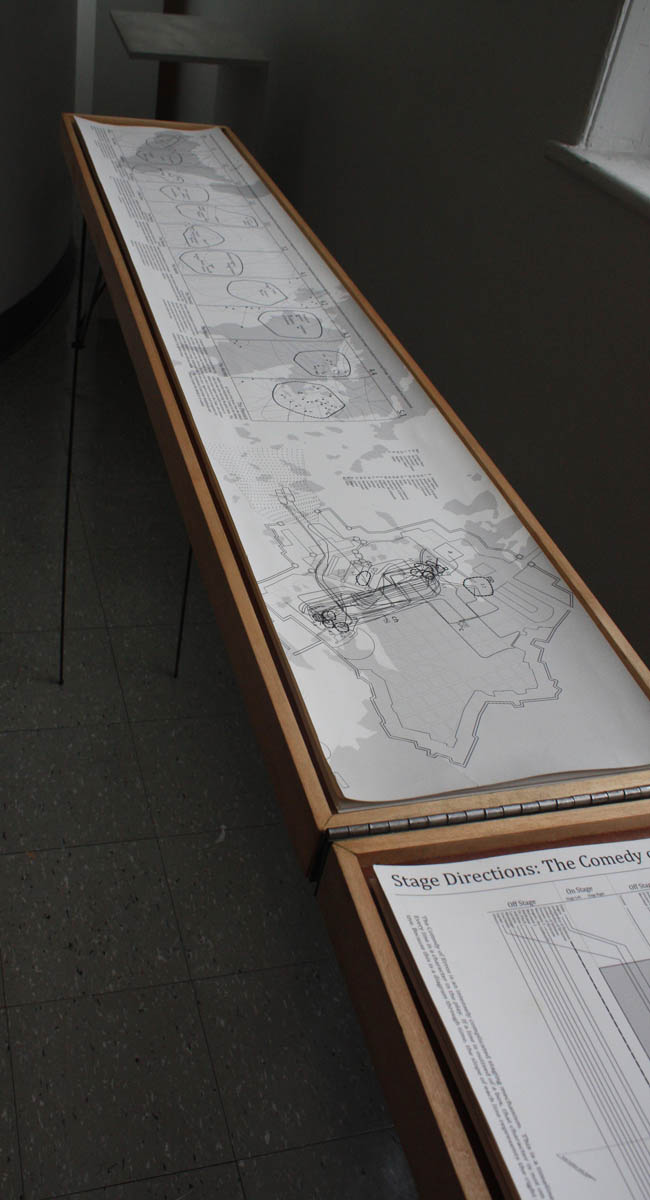
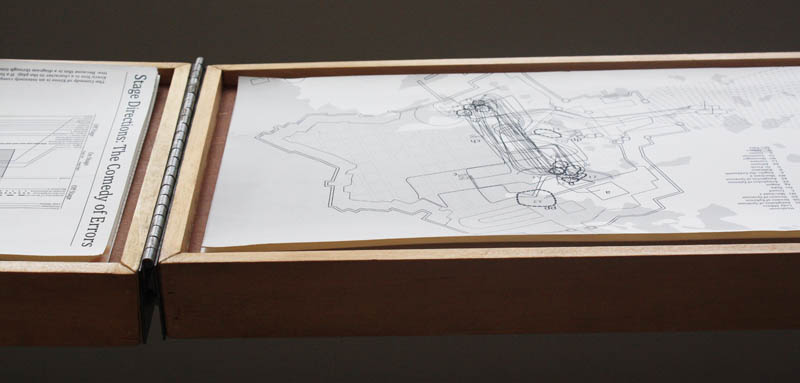
The diagrams therein are extraordinary: they map character movement not only through the ancient city of Ephesus, where Shakespeare’s play is set, but through the “constellation” of set pieces that Rauchut himself later designed.

[Image: From Andrejs Rauchut’s thesis project at the Cooper Union; view larger!].

As Rauchut describes it, The Comedy of Errors “follows a single day in the life of the port city of Ephesus through the eyes of its commuting citizens, from the high perch of the duke to the city’s prostitutes.” This has interesting spatial implications:

The shrewdest and most elaborate part of the play is its circuitous, knotted plot. The city starts to fold in on itself when a merchant named Antipholus arrives in Ephesus unaware that his long-lost twin brother now lives in Ephesus. The local citizenry misidentify the brothers as each Antipholus is shuffled in and out of scene. A complex strand of chaos breaks out throughout the city that climaxes with one of the brothers attempting to publicly murder his wife out of shear frustration. While the play investigates how the circulation patterns in a city can be hijacked to create chaos, it also demonstrates how, through the art of gathering, peace can be obtained via discussion and the exchange of information. We see this in the last act when all the characters gather and finally make sense of the day’s events.

Urban design becomes public dramaturgy.

[Image: From Andrejs Rauchut’s thesis project at the Cooper Union].

The bulk of Rauchut’s work went into producing a series of timelines and graphic depictions of character movement in Shakespeare’s play.

[Image: From Andrejs Rauchut’s thesis project at the Cooper Union].

In the massive image seen above, for instance, “Each box represents the time and space of an act and the crossing of a box by a line signals a character’s entrance onto the stage. One can see that it is in the final act, when nearly all the lines collectively intersect the last rectangle, and all the characters are on stage, that they can finally straighten out the events of their collective day. Up to this point, as the timeline demonstrates, the characters have been weaving in and out of contact with one another, multiplying the fragmented misinformation that spreads throughout the city.”

[Images: From Andrejs Rauchut’s thesis project at the Cooper Union].

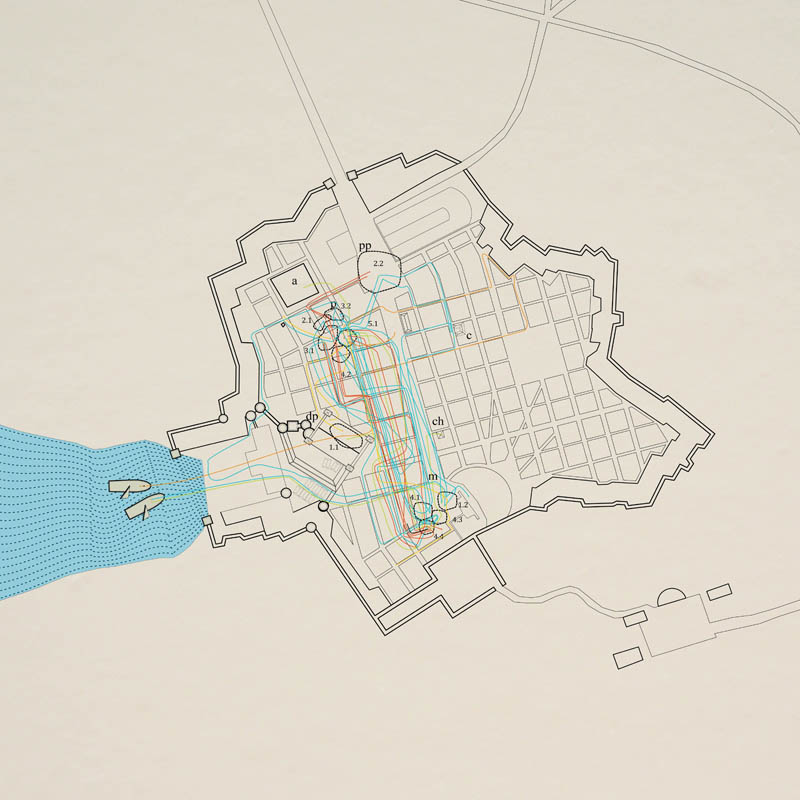
He then went on to experiment with overlaying these character paths onto Staten Island, part of the New York City archipelago, as if trying to draw an analogy between the seafaring, splintered island geography of the ancient Mediterranean—with its attendant heroes and unacknowledged gods—and the contemporary commuter landscape of greater New York.

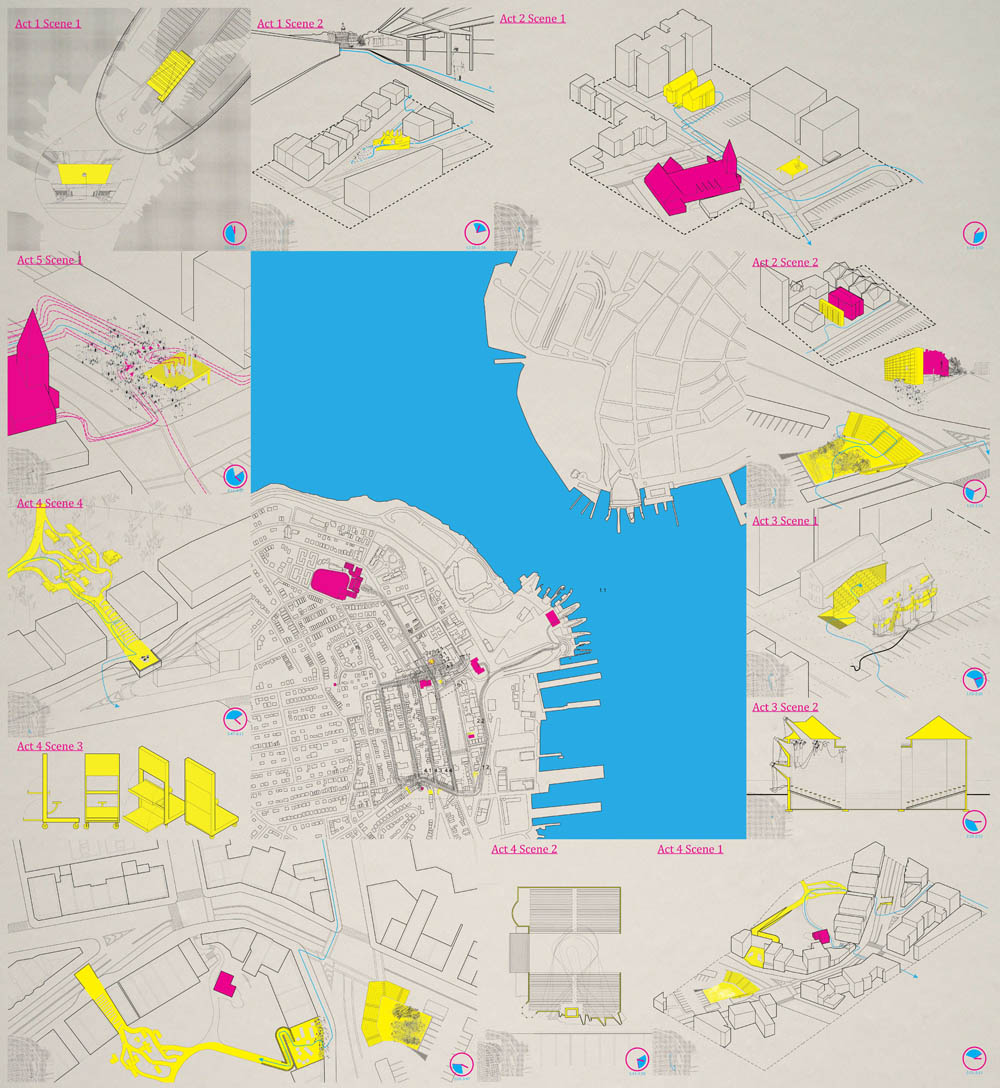
This transposition of Shakespeare’s characters’ movements onto Staten Island, Rauchut explains, became “the backbone for the design of a series of architectural set pieces inserted into the suburban fabric of Staten Island. At each of the points where characters interact, an architectural set is built.”

[Image: From Andrejs Rauchut’s thesis project at the Cooper Union].

Ultimately, the project aimed for the indirect choreographing of a public, urban event—it was to be a “guerilla instigator of public space,” as Rauchut describes it:

The final design is a constellation of architectural set pieces that would be used for a day-long performance of The Comedy of Errors. Actors would travel along their scripted routes through the city dressed in plain-clothes crossing paths and delivering lines. The audience would consist of interested citizens, gathering, following, growing, leaving, and occasionally returning as they continue through their daily routines.

“After the play is over,” he concludes, “the architecture would remain and would be used by the locals of Staten Island”—the remnants of a play incorporated into everyday urbanism.

To be honest, I’m not a huge fan of that sort of participatory street theater, but the spatial ideas underlying Rauchut’s project—that is, the precipitation of architectural forms from the public passing of an unannounced literary event—is certainly thought-provoking and could have some pretty awesome effects applied elsewhere, with different texts. Books become clouds, raining events and built forms onto the city.

(Thanks to Hayley Eber for inviting me to see Andrejs Rauchut’s project at midterm last spring! Of possible earlier interest: Bloomsday).

A Traffic Jam is a Collection of Rooms

[Images: The micro-culture of the motorway; images courtesy Associated Press/Wall Street Journal].

It was hard to miss the story last month that a 62-mile long traffic jam had formed in China, becoming a near-permanent feature of that nation’s roadway system. It lasted nine full days, in a state of almost perfect gridlock. NPR reported that drivers simply turned off their cars and slept for 8 hours at a time.

A temporary micro-culture of the motorway soon emerged: “Villagers along Highway 110 took advantage of the jam,” the Wall Street Journal reported, “selling drivers packets of instant noodles from roadside stands and, when traffic was at a standstill, moving between trucks and cars to hawk their wares. Truck drivers, when they weren’t complaining about the vendors overcharging for the food, kept busy playing card games.”

[Images: The traffic jam as scene from Dante; images courtesy Associated Press/Wall Street Journal].

But what if another such traffic jam were to form again? Where role might there be for architecture? Clip-on awnings, zip-up tent walls, velcro-connected halls and corridors spanning car-to-car and truck door to truck door, even crawlable tunnels for kids, with mobile parks on flatbed trucks, whole canopies held down by duct tape, antennas repurposed as anchors for tarps and makeshift roofs. Outdoor cinemas are formed. Social cliques develop.

The spatial infrastructure of the permanent traffic jam kicks in: guerrilla, unfoldable, pack-into-a-backpack-able, made from lightweight materials—ripstop fabrics and military-grade rope—a city takes shape on the highway, with every car, bus, truck, and motorcycle a luxury room or repurposed piece of home furniture.

[Image: Courtesy of Newscom and the Christian Science Monitor].

Lock this in place a few years and give it a postcode. Children are born there. Like Dan Hill‘s quip that “There are 500000 people airborne at any one time. A drifting airborne city, the size of Helsinki, a few meters tall, threaded around [the] globe,” this city-on-the-road would be named, memorialized, revisited. New highways would simply thread around it, abandoning the vehicles to their stationary fate as their tires drain of air and engines stall forever.

Generations later, the fact that, down in the mud and dust beneath your metropolis, you can find abandoned frames and chassis from the city’s founding traffic jam, will be impossible to believe—a run-of-the-mill urban legend. Archaeologists will argue over the best sites to excavate to find truck doors and ancient oil spills down there in the formerly mobile foundations of the city.

Even David Greene of Archigram once wrote that “a traffic jam is a collection of rooms.”

[Image: From Archigram].

“We also know that a traffic jam is a collection of rooms,” Greene wrote in a short text called “Gardener’s notebook,” and “so is a car park—they are really instantly formed and constantly changing communities. A drive-in restaurant ceases to exist when the cars are gone (except for cooking hardware). A motorized environment is a collection of service points.”

On the level of architecture, then, what could we do to prepare for the impending return of the near-permanent Chinese traffic jam? What prosthetic walls, floors, ceilings, and corridors—what new families of clip-on architectural forms—could we explore?

Traffic Walls™—an instant city brought to you by North Face and the GA Tech School of Architecture. Easily deployed. Houses up to 10,000 people. Machine-washable.

The Permission We Already Have

[Image: Courtesy of David Knight and Finn Williams].

David Knight and Finn Williams have been investigating what they call “minor development” in the field of architecture and urban planning for several years now, and their discoveries are absolutely fascinating. Last year they published a book called SUB-PLAN: A Guide to Permitted Development, exploring the world of building extensions, temporary structures, outdoor spaces, and other minor acts of home construction that fly beneath the radar of official town planning.

“How far does planning control what we build? And what can we build without planning?” the authors ask. “SUB-PLAN explores the legal possibilities of building outside the limits of legislation.”

The UK planning system has been swamped by minor applications for household extensions and outbuildings that cause a backlog of bureaucracy and dominate the limited resources of local planning authorities. On 1 October 2008 the government introduced changes to the General Permitted Development Order 2 to reduce the number of minor applications by expanding the definition of what can be built without planning permission.

But, they add, “are the implications of minor development more significant than planners imagine?”

[Images: Courtesy of David Knight and Finn Williams].

Knight and Williams will be participating in a public conversation next week in London, sponsored by the Architecture Foundation; called Permitted Development: The Planning Permission We Already Have, it will be an example of what we might call legislative forensics, looking into the law books—and the urban planning guidelines—to see what architectural possibilities already exist in the present day for residents to explore.

In that previous sentence, I almost wrote “for residents and homeowners to explore”—but I wonder if you really need to be a homeowner to take advantage of these unpublicized zones of building permission? Is simply being a citizen enough, or must you own property to participate in the realm of minor architecture? Or is there even an unacknowledged world of building practices legally open to construction by non-citizens—by people who, legally speaking, reside nowhere?

In the intersection between architecture and permission, what spaces are possible and who has the right to realize them? What are the possibilities for architectural insurrection—or, at the very least, aesthetic experimentation?

[Image: An awesome glimpse of “the permission we already have,” courtesy of SUB-PLAN by David Knight and Finn Williams; view larger].

In Sweden, for instance, there is a type of small garden shed known as the friggebod, named after Birgit Friggebo, Sweden’s former housing minister. “The term is a wordplay based on the common term bod: (tool) shed; shack,” Wiktionary explains. “The friggebod reform implied that anyone could build a shed of maximum 10 square meters on their premises without obtaining a construction permit from the municipality. In Sweden, the reform became a widely popular symbol of liberalization. From the onset of 2008, the area was increased to 15 square meters.”

These autonomous planning zones, so to speak, open up architectural production to non-architects in a possibly quite radical way. So how do we take advantage of them?

[Images: Another mind-bending example of “the permission we already have,” courtesy of SUB-PLAN by David Knight and Finn Williams].

Next week’s event in London bills itself as follows:

Though apparently at the humble end of the planning system, recent changes to Permitted Development rights are a treasure trove of architectural potential. The new breed of lean-tos, loft conversions, sheds and summerhouses they allow could have far-reaching and surprising consequences for UK towns and countryside. Finn Williams and David Knight will present recent projects which explore and exploit Permitted Development rules.

I’d love to hear how this goes, in case anyone there can report back. To be honest, I think this type of research is both jaw-dropping and urgently needed elsewhere. What unknown architectural permissions exist for the residents of Manhattan, LA, Beijing, São Paulo…?

What future DIY architectures have yet to arise around us—and when will we set about constructing them?

Artificial caverns expanding beneath Chicago

[Image: Tunneling beneath Chicago; view larger!].

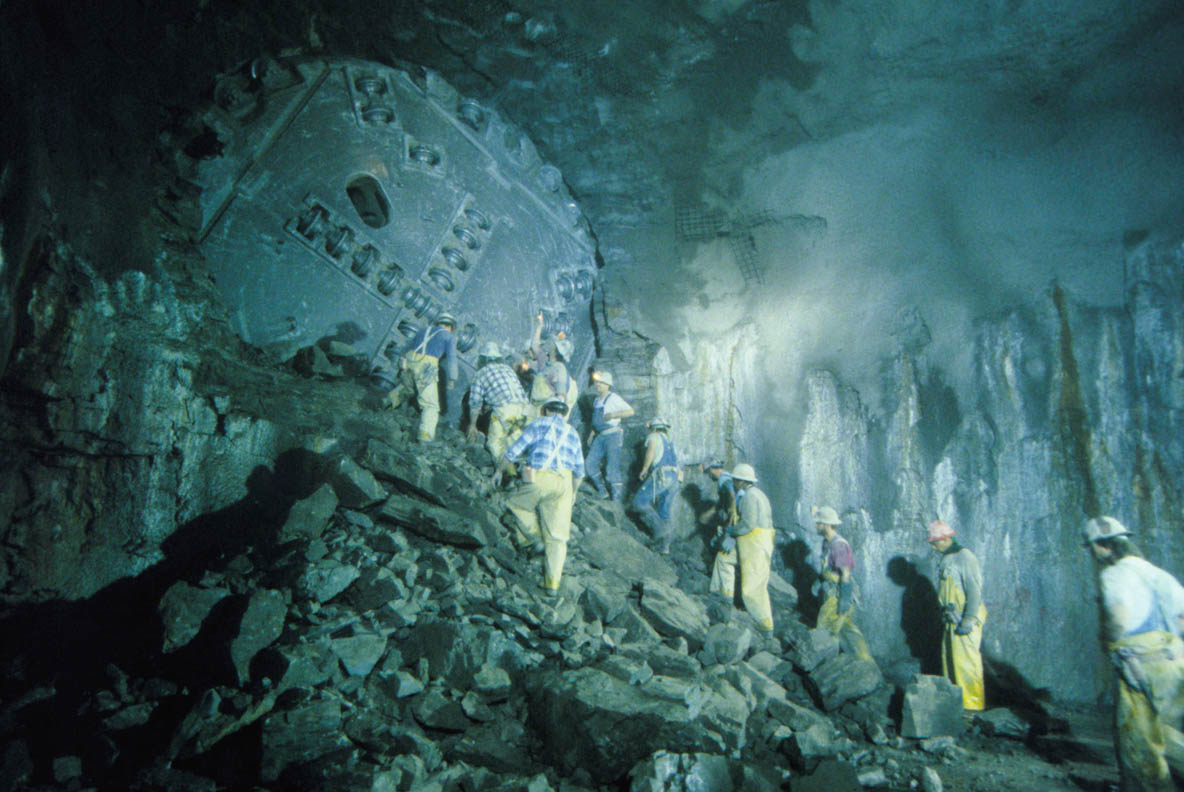
Due to Chicago’s ongoing TARP project—its Tunnel And Reservoir Plan—there are now “109.4 miles of tunnels bored beneath the Chicagoland area.” According to Tunnel Business Magazine, this massive network of new subterranean space includes “deep tunnels, drop shafts, near-surface connection and control structures and dewatering pump stations,” all embedded beneath the city. I would love to see Michael Cook sent there as a project photographer.

Until then, the above image shows us TARP’s first phase in action, with a tunneling machine breaking through and expanding the artificial caverns that now resonate below the streets of greater Chicago. TARP’s second phase—the so-called Chicago Underflow Plan—kicked off back in 2008, its work “consisting of [the] mining and construction of several reservoirs,” vast hollows that will occasionally fill with storm runoff and rain, reknitting urban hydrology from below.

(Thanks to Anya Domlesky for the link! Download back issues of Tunnel Business Magazine here).

Documents, Maps, and Files of a Fictional Architecture

[Image: The Nesin Map by Protocol Architecture].

One of the more interesting student projects I’ve seen in a long time used a “document-based” approach to architecture to fabricate an entire fictional world—one in which top secret underground research labs, militarized bacteria, artificial earthquakes, and much more were all found conspiring beneath the streets of Berlin, Baghdad, and Istanbul.

A group project by three students at Columbia’s GSAPPYuval Borochov, Lisa Ekle, and Danil Nagy, under the guidance of professor Ed KellerProtocol Architecture was pitched as a team that “investigates potentials for future design through the creation and analysis of hyper-fictional documents. These document sets create evidence for future scenarios that string together a specific history of political, social, and technological developments.” As such, Protocol’s work becomes less architectural than it is archival:

By focusing on the space of the document, we can avoid simplistic predictions of the future while creating a database of potential evidence which can be analyzed and interpreted by a wider audience of designers.

The resulting fictional archives—or “fabricated histories,” as the architects describe them—allowed the group to question “the role that fact and evidence plays in how we perceive our own history and our place as designers within it.”

[Image: The Nesin Map (detail) by Protocol Architecture].

As Yuval Borochov explained to me in an email: “Protocol Architecture is a forum for investigations that challenge the traditional design process and situate every project in its own tangential line of history. We found that… the design opportunities within the plot holes of history are quite liberating. You know, I read a statement by Rem Koolhaas, in a book of his conversation with Peter Eisenman, where he explains his attempts to become the ‘architect as journalist.’ I think Protocol Architecture is akin to this mode of operation. Perhaps architects as historiographers.”

Their semester’s worth of work was remarkably varied—and mind-bogglingly prolific—and it can all be explored on their website. However, I want to focus here on three aspects of their document-based approach: The Rühmann Notebook, The Nesin Map, and The Wilbert Contracts.

Before I go much further, though, I have to say that I genuinely think this approach—and the resulting work—bears comparison to books by writers like China Miéville or Franz Kafka, even filmmakers like Guillermo del Toro, for whomever might find those coordinates intriguing. These fictional documents frame entirely self-contained imaginary worlds, and each one of these ideas deserves radical expansion elsewhere, in forms beyond architectural design; as such, they seem at least as appropriate for discussing with a literary agent as they are with the dean of an architecture school.

[Image: The Rühmann Notebook by Protocol Architecture].

The Rühmann Notebook
The first part of Protocol Architecture’s project, the so-called Rühmann Notebook, was produced, we’re told, in early 2002 when Berliner Martina Rühmann “documented her observations of a linear pathway across former East Berlin. The path connected the Berlin Wall in the north to the wall in the south, cutting across the site of the former Palace of the Republic.”

What Rühmann’s mapping project allowed her to discover was a linear network of “small but prominent science research centers” beneath the surface of the city.

It was believed that the hidden route (subsequently discovered and documented by Rühmann) was used for communication and transfer of scientific documents and material in the 1970s and 1980s between the East and West, a time when West German scientists were making significant early discoveries in the fields of microbiology and nanotechnology.

The story here has shades of Lebbeus Woods—for instance, Woods’s ingenious proposal for a film called Underground Berlin. That film revolves around a disillusioned architect, a missing twin brother, neo-Nazi activities in the divided city of Berlin, metallic underground tunnels connecting east to west, and “a top-secret underground research station rumored to be somewhere beneath the very center of Berlin.” There are even rogue planetary scientists investigating “tremendous, limitless geological forces active in the earth.”

In any case, Rühmann’s labs, we learn, were studying bacterial technologies—specifically the use of Bacillus Pasteurii, “a bacteria with adhesive qualities… to stabilize ground in earthquake-prone cities,” and Shewanella, “a bacteria capable of naturally producing electrically conductive nano-tube filaments, now able to produce nano-electric devices.” The architectural implications of these bacterial species begin to loom large in the overall narrative. (If you like the sound of this, by the way, don’t miss Magnus Larsson’s work, featured here on BLDGBLOG in April 2009, or our earlier look at geobatteries).

The locations of these underground biotechnological seismology research labs are what we see documented in the The Rühmann Notebook. The “notebook” itself consists of photos and notes collaged inside a Moleskine.

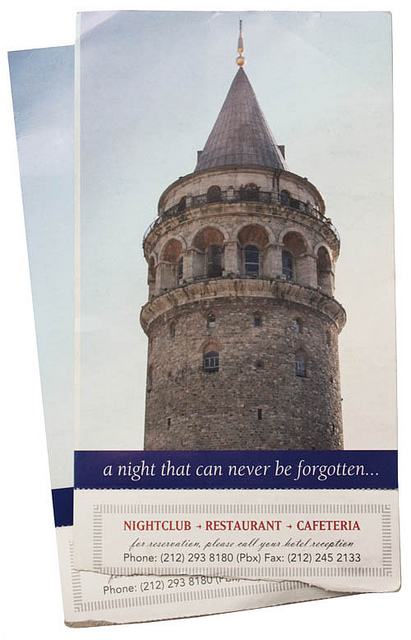
[Image: Istanbul’s Galata Tower, as depicted on ephemera related to The Nesin Map by Protocol Architecture].

The Nesin Map
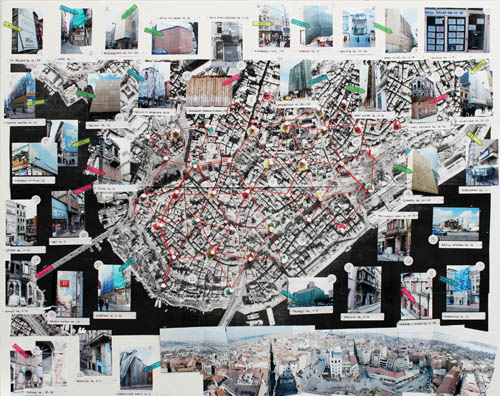
We now move from Berlin to Istanbul, where The Nesin Map documents a seemingly unrelated network of “concealed buildings” in the city:

Harem Nesin, a Turkish journalist for the Istanbul newspaper Dünya Gazetesi, began photographing concealed buildings in Istanbul sometime in 2017 for his personal records. The buildings captured by Nesin had recently been destroyed by a fire or evacuated due to some other instability of the structure, and were later covered by scaffolding, tarps, or screens. Nesin correlated his collection of photographs to a map of Istanbul, indicating the location of each abandoned building. Through the mapped locations Nesin discovered a triangular geometric pattern across a portion of the city on the European side, from the Golden Horn to the Bosphorus. Nesin used the Galata Tower as a place to survey the buildings in question, indicated by his collage of aerial photographs taken from the Tower. Additionally, in his observations Nesin recorded the means of concealment (tarp, wood, fence, screen) and the address for each structure.

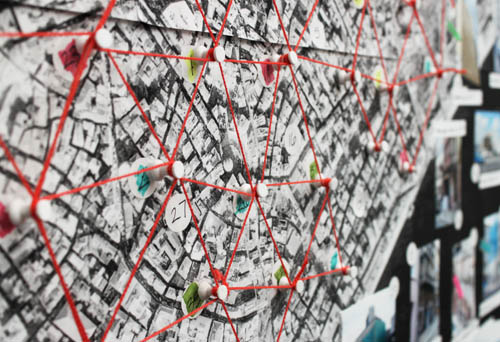
First of all, this is an amazing set-up for a story, somewhere between Borgesian urban paranoia and Debordian psychogeography; and, second, the map itself is very, very cool. Here are the two images of it again.

[Images: The Nesin Map by Protocol Architecture].

So what did Nesin discover as he correlated his data and began to map it all out? A diagrid of “injection points” located at geologically precise points around Istanbul: “Harem Nesin’s map reveals strategic locations used by the Istanbul Metropolitan Municipality as injection points for Bacillus Pasteurii, a microbe able to transform sand into sandstone by depositing calcite (calcium carbonate) throughout the granules, fusing them together.”

The authorities, in other words, were earthquake-proofing the city from below, in “the first application of the bacteria, which had been under development since the mid 1970s through joint research between Germany and the US.”

The Wilbert Contracts
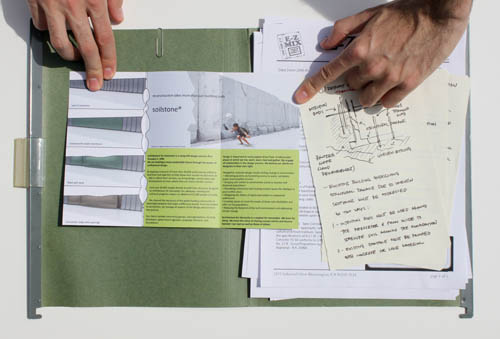
Finally, to Baghdad. The The Wilbert Contracts are a series of files tracing the work of John Wilbert and Co., a quasi-military subcontractor working on a project for Monsanto “between the years 2028 and 2031” in Iraq. Monsanto’s SoilStone® initiative used soil-stabilization biotechnologies to replace concrete walls with more flexible barriers, such as elastic membranes and bacterially-activated sand (i.e. SoilStone®).

[Images: The Wilbert Contracts by Protocol Architecture].

We learn, however, that “linear connections can be perceived” between the multiple sites at which Wilbert and Co. used this technology—indeed, “certain documents from the US Army which are still classified imply that underground tunnel systems were dug between 2028 and 2030.”

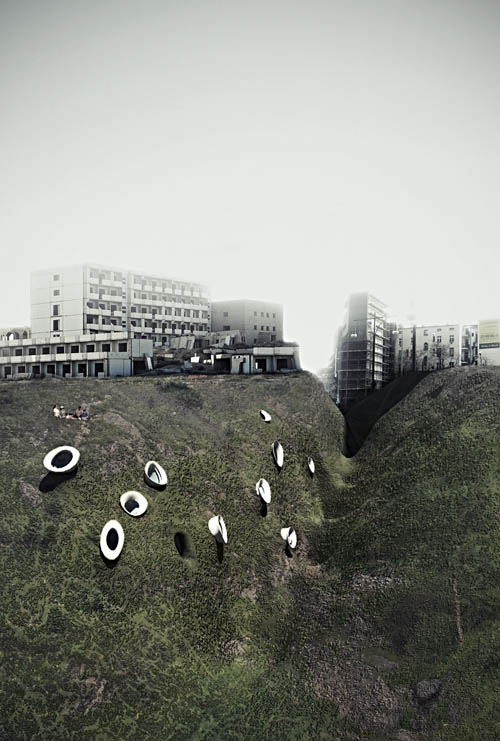
It is further inferred, the architects explain, that “pre-programmed nano-bots” were being used in the project as construction machines, selectively injecting Bacillus Pasteurii bacteria into the sands. This technique thus created a semi-mobile, makeshift system of subterranean spaces through which the US military could move. The Army is down there, in other words, stabilizing classified tunnels beneath the streets.

[Images: From Berlin 2050 by Protocol Architecture].

In the end, after a fascinating internal design competition that I simply don’t have the time to cover here—with a jury that included Reza Negarestani of Cyclonopedia fame and Jamie Kruse of smudge studio, among many others, and with entries that ranged from sentient clouds of nano-flies to stabilized earthquakes as a form of urban planning—the group assembled all of their ideas into a proposal for underground spaces in Berlin. These final proposals, however, as well-rendered as they are, simply don’t hold the imaginative appeal for me that the earlier studio material all but burns with.

And that’s the rub: at the end of the day, most architecture students—unsurprisingly—think they have to take this stuff, put it all together, and produce something clearly definable as a building. But the research, in many cases, is more worthy of attention (and well worth the time it takes to produce it). In other words, the research—the preliminary material, the periphery, the narrative excess, the unwanted fringe—is very often most provocative before it becomes a building, when that inchoate mass of possible future projects, storylines, techniques, and more offers a million alternative directions in which we have yet to go.

[Image: The Wilbert Contracts by Protocol Architecture].

I only say this here because it is extraordinarily exciting to see a project like this, that out-fictionalizes the contemporary novel and even puts much of Hollywood to shame—to realize, once again, that architecture students routinely trade in ideas that could reinvigorate the film industry and the publishing industry, which is all the more important if the world of private commissions and construction firms remains unresponsive or financially out of reach. The Nesin Map alone, given a screenwriter and a dialogue coach, could supply the plot of a film or a thousand comic books—and rogue concrete mixtures put to use by nefarious underground militaries in Baghdad is an idea that could be optioned right now for release in summer 2013. HBO should produce this immediately.

My point is not that architecture students should somehow be expected to stop doing the very thing they are in school for—i.e. to learn how artificial enclosures are designed and constructed. I just mean that they should never overlook the interest of their own preliminary ideas, notes, sketches, and scenarios. After all, with just a well-timed email or elevator pitch, all of that stuff—all those bulletin boards, browser tabs, sketchbooks, notes from late-night conversations, site maps, and more—needn’t become just more crap to get filed away in your parents’ house somewhere, but could actually be turned into the seed of a film, novel, game, or comic book in another cultural field entirely.

Don’t give up on your ideas—and don’t overlook the value of something simply because it can’t be turned into a building.

Check out Protocol Architecture’s work in their own words—and with many more images—over on their website. And consider supporting the trio by purchasing their book on Lulu.

(Thanks to Ed Keller for inviting me to see Protocol Architecture’s work as a guest critic).

Crypto-Forestry and the Return of the Repressed

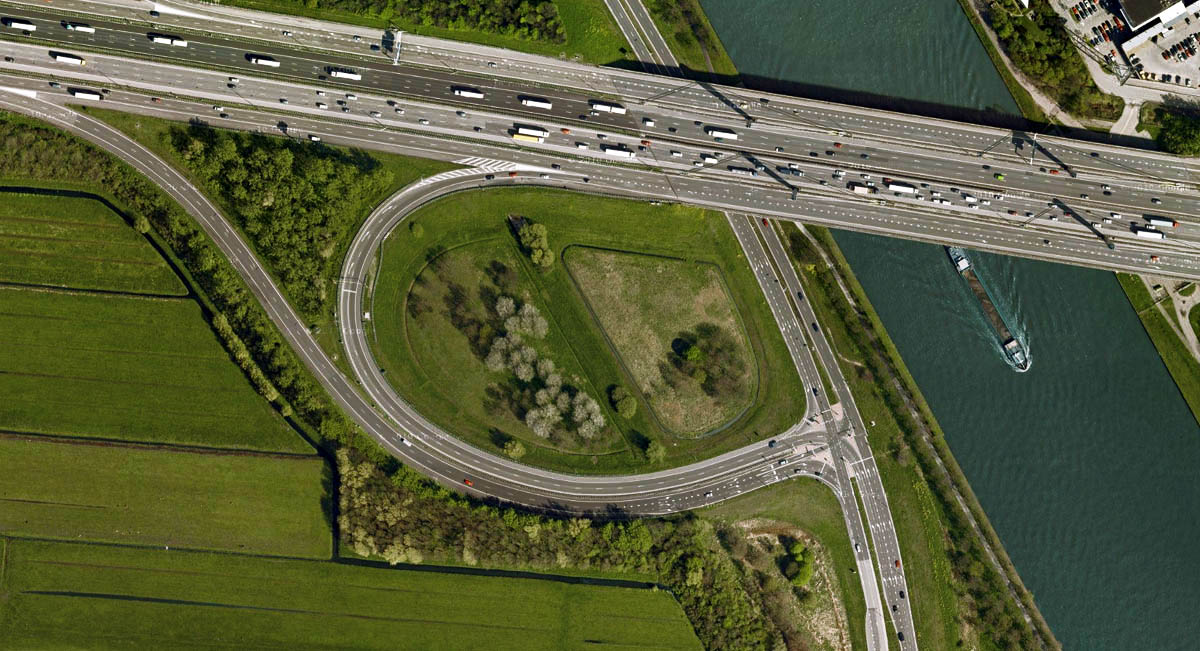
[Image: My own “crypto-forest of Utrecht,” via Google Maps].

While we’re on the subject of PrimatePoetics!, I’m intrigued by their “CryptoForests of Utrechtseries, which kicked off back in October 2009. It’s an ongoing exploration of botanical landscapes in and around Utrecht, Netherlands, that have sprung back from aggressive anthropological intervention. Weed patches in which the earliest emergent traces of a thicket can be found; clusters of trees growing semi-feral on the edges of railroad yards; forgotten courtyards sprouting with random saplings unplanted by any hand: these are all crypto-forests.

Each example of this type of landscape, PrimatePoetics! explains, is “almost entirely hidden from view and very few people know about it.” Each is “a forest grown in the shadow of neglect, private ownership and municipal refusal.” Each is a landscape that has been “left to fallow” but then spurts back in spikes of weedy regrowth, becoming “unnoteworthy from all angles, but pretty large when you are inside it.”

All of them together would make an amazing travel guide or landscape pamphlet—a short tour through minor quasi-forests around the city of Utrecht (or elsewhere). I’m tempted to launch a global “crypto-forestry” group on Flickr for documenting exactly this sort of thing—in fact, I’ve gone ahead and done so. Feel free to contribute, if you’re in the mood, burgeoning scholars of urban weeds. Photographic documents of minor landscapes on the rebound; urban forests in their earliest, stunted stage; insurgent fringes of suburbia coming back to vitality; derelict groves extending underground roots. The return of the botanical repressed.

Cities Under Siege

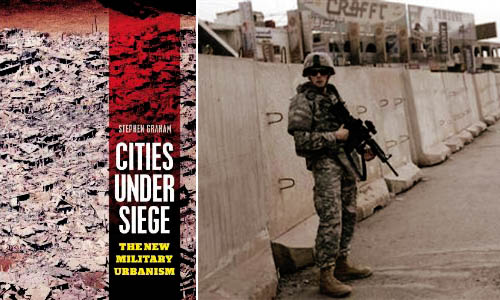
[Image: Stephen Graham’s Cities Under Siege].

In a 2003 paper for the Naval War College Review, author Richard J. Norton defined the term feral cities. “Imagine a great metropolis covering hundreds of square miles,” Norton begins, as if narrating the start of a film pitch. “Once a vital component in a national economy, this sprawling urban environment is now a vast collection of blighted buildings, an immense petri dish of both ancient and new diseases, a territory where the rule of law has long been replaced by near anarchy in which the only security available is that which is attained through brute power.”

With the city’s infrastructure having collapsed long ago—or perhaps having never been built in the first place—there are no works of public sanitation, no sewers, no licensed doctors, no reliable food supply, no electricity. The feral city is a kind of return to medievalism, we might say, back to the future of a dark age for anyone but criminals, gangs, and urban warlords. It is a space of illiterate power—strength unresponsive to rationality or political debate.

From the perspective of a war planner or soldier, the feral city is also spatially impenetrable, a maze resistant to aerial mapping. Indeed, its “buildings, other structures, and subterranean spaces, would offer nearly perfect protection from overhead sensors, whether satellites or unmanned aerial vehicles,” Norton writes.

This is something Russell W. Glenn, formerly of the RAND Corporation—an Air Force think tank based in Southern California—calls “combat in Hell.” In his 1996 report of that name, Glenn pointed out that “urban terrain confronts military commanders with a synergism of difficulties rarely found in other environments,” many of which are technological. For instance, the effects of radio communications and global positioning systems can be radically limited by dense concentrations of architecture, turning what might otherwise be an exotic experience of pedestrian urbanism into a claustrophobic labyrinth inhabited by unseen enemy combatants.

Add to this the fact that military ground operations of the near future are more likely to unfold in places like Sadr City, Iraq—not in paragons of city planning like Vancouver—and you have an environment in which soldiers are as likely to die from tetanus, rabies, and wild dog attacks, Norton suggests, as from actual armed combat.

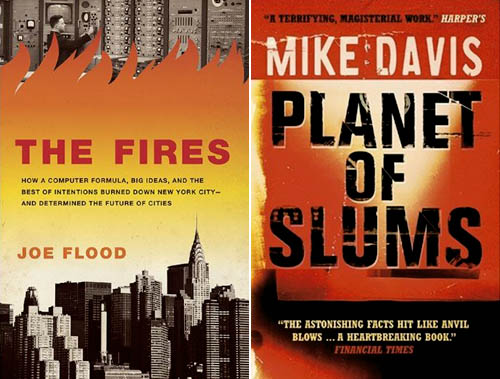
Put another way, as Mike Davis wrote in Planet of Slums, “the cities of the future, rather than being made out of glass and steel as envisioned by earlier generations of urbanists, are instead largely constructed out of crude brick, straw, recycled plastic, cement blocks, and scrap wood. Instead of cities of light soaring toward heaven, much of the twenty-first-century urban world squats in squalor, surrounded by pollution, excrement, and decay.”

But feral cities are one thing, cities under siege are something else.

[Images: The Fires by Joe Flood and Planet of Slums by Mike Davis].

In his new book Cities Under Siege, published just two weeks ago, geographer Stephen Graham explores “the extension of military ideas of tracking, identification and targeting into the quotidian spaces and circulations of everyday life,” including “dramatic attempts to translate long-standing military dreams of high-tech omniscience and rationality into the governance of urban civil society.” This is just part of a “deepening crossover between urbanism and militarism,” one that will only become more pronounced, Graham fears, over time.

One particularly fascinating example of this encroachment of “military dreams… into the governance of urban civil society” is actually the subject of a forthcoming book by Joe Flood. The Fires tells the story of “an alluring proposal” offered by the RAND Corporation, back in 1968, “to a city on the brink of economic collapse [New York City]: using RAND’s computer models, which had been successfully implemented in high-level military operations, the city could save millions of dollars by establishing more efficient public services.” But all did not go as planned:

Over the next decade—a time New York City firefighters would refer to as “The War Years”—a series of fires swept through the South Bronx, the Lower East Side, Harlem, and Brooklyn, gutting whole neighborhoods, killing more than two thousand people and displacing hundreds of thousands. Conventional wisdom would blame arson, but these fires were the result of something altogether different: the intentional withdrawal of fire protection from the city’s poorest neighborhoods—all based on RAND’s computer modeling systems.

In any case, Graham’s interest is in the city as target, both of military operations and of political demonization. In other words, cities themselves are portrayed “as intrinsically threatening or problematic places,” Graham writes, and thus feared as sites of economic poverty, moral failure, sexual transgression, rampant criminality, and worse (something also addressed in detail by Steve Macek’s book Urban Nightmares). All cities, we are meant to believe, already exist in a state of marginal ferality. I’m reminded here of Frank Lloyd Wright’s oft-repeated remark that “the modern city is a place for banking and prostitution and very little else.”

In some of the book’s most interesting sections, Graham tracks the growth of urban surveillance and the global “homeland security market.” He points out that major urban events—like G8 conferences, the Olympics, and the World Cup, among many others—offer politically unique opportunities for the installation of advanced tracking, surveillance, and facial-recognition technologies. Deployed in the name of temporary security, however, these technologies are often left in place when the event is over: a kind of permanent crisis, in all but name, takes over the city, with remnant, military-grade surveillance technologies gazing down upon the streets (and embedded in the city’s telecommunications infrastructure). A moment of exception becomes the norm.

Graham outlines a number of dystopian scenarios here, including one in which “swarms of tiny, armed drones, equipped with advanced sensors and communicating with each other, will thus be deployed to loiter permanently above the streets, deserts, and highways” of cities around the world, moving us toward a future where “militarized techniques of tracking and targeting must permanently colonize the city landscape and the spaces of everyday life.”

In the process, any real distinction between a “homeland” and its “colonies” is irreparably blurred. Here, he quotes Michel Foucault: “A whole series of colonial models was brought back to the West, and the result was that the West could practice something resembling colonization, or an internal colonialism, on itself.” If it works in Baghdad, the assumption goes, then let’s try it out in Detroit.

This is just one of many “boomerang effects” from militarized urban experiments overseas, Graham writes.

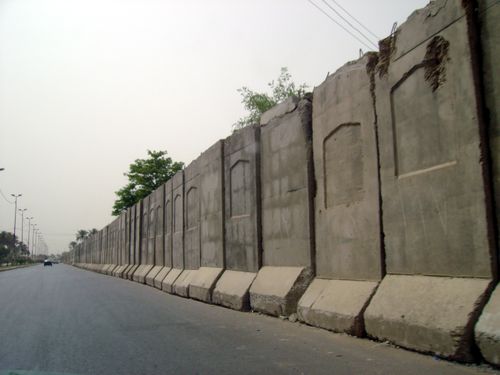
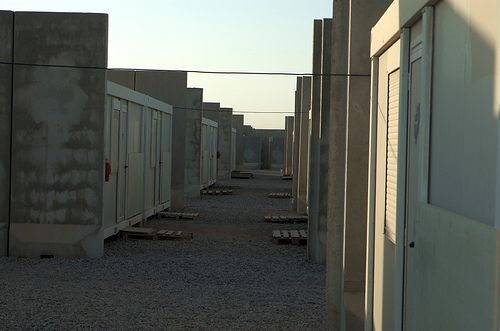
[Images: Blast walls in Iraq].

But what does this emerging city—this city under siege—actually look like? What is its architecture, its urban design, its local codes? What is its infrastructure?

Graham has many evocative answers for this. The city under siege is a place in which “hard, military-style borders, fences and checkpoints around defended enclaves and ‘security zones,’ superimposed on the wider and more open city, are proliferating.”

Jersey-barrier blast walls, identity checkpoints, computerized CCTV, biometric surveillance and military styles of access control protect archipelagos of fortified social, economic, political or military centers from an outside deemed unruly, impoverished and dangerous. In the most extreme examples, these encompass green zones, military prisons, ethnic and sectarian neighborhoods and military bases; they are growing around strategic financial districts, embassies, tourist and consumption spaces, airport and port complexes, sports arenas, gated communities and export processing zones.

Cities Under Siege also extensively covers urban warfare, a topic that intensely interests me. From Graham’s chapter “War Re-Enters the City”:

Indeed, almost unnoticed within “civil” urban social science, a shadow system of military urban research is rapidly being established, funded by Western military research budgets. As Keith Dickson, a US military theorist of urban warfare, puts it, the increasing perception within Western militaries is that “for Western military forces, asymmetric warfare in urban areas will be the greatest challenge of this century… The city will be the strategic high ground—whoever controls it will dictate the course of future events in the world.”

Ralph Peters phrased this perhaps most dramatically when he wrote, back in 1996 for the U.S. Army War College Quarterly, that “the future of warfare lies in the streets, sewers, high-rise buildings, industrial parks, and the sprawl of houses, shacks, and shelters that form the broken cities of our world.” The future of warfare, that is, lies in feral cities.

In this context, Graham catalogs the numerous ways in which “aggressive physical restructuring,” as well as “violent reorganization of the city,” is used, and has been used throughout history, as a means of securing and/or controlling a city’s population. At its most extreme, Graham calls this “place annihilation.” The architectural redesign of cities can thus be used as a military policing tactic as much as it can be discussed as a topic in academic planning debates. There are clearly echoes of Eyal Weizman in this.

On one level, these latter points are obvious: small infrastructural gestures, like public lighting, can transform alleyways from zones of impending crime to walkways safe for pedestrian use—and, in the process, expand political control and urban police presence into that terrain. But, as someone who does not want to be attacked in an alleyway any time soon, I find it very positive indeed when the cityscape around me becomes both safer by design and better policed. Equally obvious, though, when these sorts of interventions are scaled-up—from public lighting, say, to armed checkpoints in a militarized reorganization of the urban fabric—then something very drastic, and very wrong, is occurring in the city. Instead of a city simply with more cops (or fire departments), you begin a dark transition toward a “city under siege.”

I could go on at much greater length about all of this—but suffice it to say that Cities Under Siege covers a huge array of material, from the popularity of SUVs in cities to the blast-wall geographies of Baghdad, from ASBOs in London to drone helicopters in the skies above New York. Raytheon’s e-Borders program opens the book, and Graham closes it all with a discussion of “countergeographies.”

(Parts of this post, on feral cities, originally appeared in AD: Architectures of the Near Future, edited by Nic Clear).

Migratory Anagram

[Image: From “HLYWD” by Jeffrey Inaba and Darien Williams].

As part of the forthcoming UNPLANNED exhibition here in Los Angeles, opening March 25, Jeffrey Inaba and Darien Williams have produced “HLYWD,” a series of images in which the individual letters of the Hollywood sign break off, rearrange themselves, and appear here and there around the city.

It is, the creators write, a “proposal for the migratory distribution of the Hollywood sign across Los Angeles”—like mobile anagrams in a game of trans-neighborhood Scrabble.

[Images: From “HLYWD” by Jeffrey Inaba and Darien Williams].

After all, “why limit [the Hollywood sign] to a fixed location?”

Proposal: Let it roam? The sign’s simple structure and generic materiality lend it well to temporary erection on any number of sites throughout the city. Neighborhoods ‘borrow’ the sign or any subgroup of its letters for a determined period of time. Migration affords the sign a temporal dimension, which ensures its continued vitality as an unplanned landmark.

With one letter lent out at a time, it’d bear an urban-scale resemblance to Shelley Jackson’s Skin project, blown up and imposed on the roofs and hilltops of the city.

[Image: From “HLYWD” by Jeffrey Inaba and Darien Williams].

Or, like a new form of megastructural language poetry—perhaps an unexpected hybrid of Aram Saroyan and Ed Ruscha—the resulting project is a random species of unplanned words on the loose.

Expedition to the Geoglyphs of Nowhere


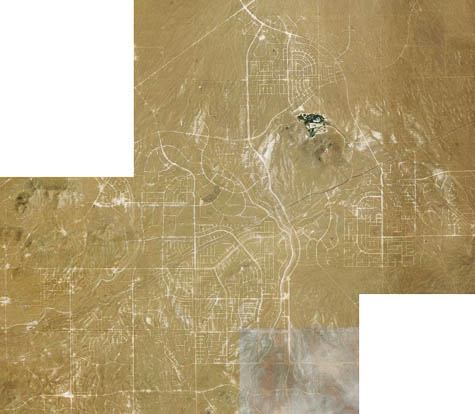
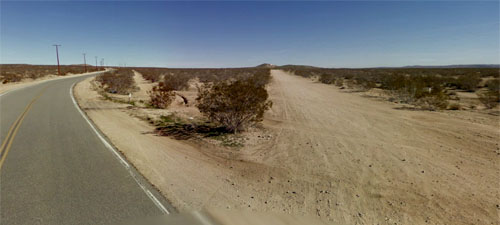
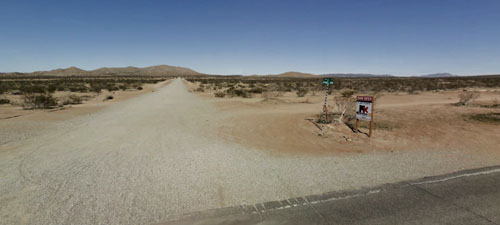
BLDGBLOG and Atlas Obscura have teamed up to lead an outing into the deserts of southern California on Saturday, March 20: an afternoon-long photographic expedition through the dusty grids of unpaved streets on the northeastern fringe of California City.


To quote from an earlier post here on BLDGBLOG:

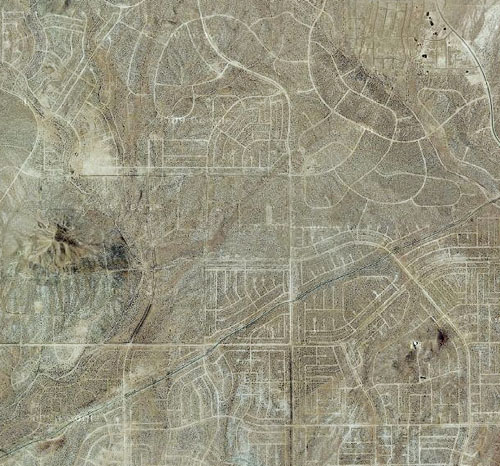
In the desert 100 miles northeast of Los Angeles is a suburb abandoned in advance of itself—the unfinished extension of a place called California City. Visible from above now are a series of badly paved streets carved into the dust and gravel, like some peculiarly American response to the Nazca Lines (or even the labyrinth at Chartres cathedral). Bill & Ted meet Cerne Abbas Man.

The uninhabited street plan has become an abstract geoglyph—unintentional land art visible from airplanes—not a thriving community at all.


Take a look.

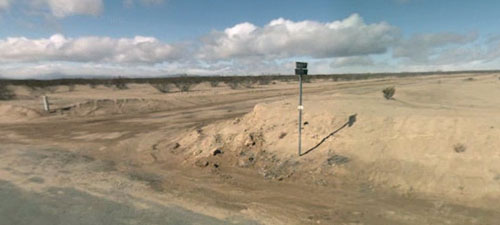
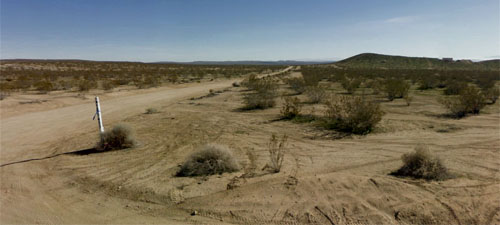
On Google Street View, distant structures like McMansions can be made out here and there amidst the ghost-grid, mirages of suburbia in the middle of nowhere. Meaningless STOP signs stand guard over dead intersections.


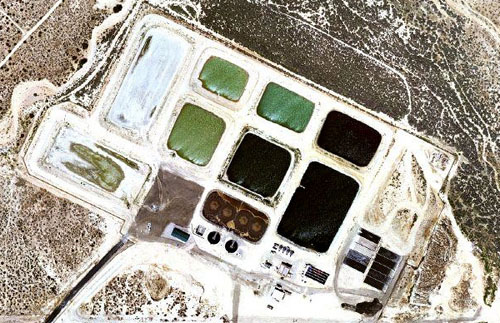
And it’s a weird geography: two of the most prominent nearby landmarks include a prison and an automobile test-driving facility run by Honda. There is also a visually spectacular boron mine to the southeast—it’s the largest open-pit mine in California, according to the Center for Land Use Interpretation—and an Air Force base.


To make things more surreal, in an attempt to boost its economic fortunes, California City hired actor Erik Estrada, of CHiPs fame, to act as the town’s media spokesperson.

The history of the town itself is of a failed Californian utopia—in fact, incredibly, if completed, it was intended to rival Los Angeles. From the city’s Wikipedia entry:

California City had its origins in 1958 when real estate developer and sociology professor Nat Mendelsohn purchased 80,000 acres (320 km2) of Mojave Desert land with the aim of master-planning California’s next great city. He designed his model city, which he hoped would one day rival Los Angeles in size, around a Central Park with a 26-acre (11 ha) artificial lake. Growth did not happen anywhere close to what he expected. To this day a vast grid of crumbling paved roads, scarring vast stretches of the Mojave desert, intended to lay out residential blocks, extends well beyond the developed area of the city. A single look at satellite photos shows the extent of the scarred desert and how it stakes its claim to being California’s 3rd largest geographic city, 34th largest in the US. California City was incorporated in 1965.

California City is now the site of a proposed mega-farm for solar energy harvesting, as well as for a bizarre plan to build the so-called Cannabis City of the Future.

Sign up to join us over at the Obscura Day site.


Note, however, that this is not a guided tour; it is simply an organized simultaneity of people all going out to investigate these streets en masse. Armed with cameras, microphones, sketchbooks, GPS devices, quickly scrawled notes for future blog posts, and more, we’ll be exploring the site at our own pace, perhaps even miles apart at various times. This is not a guided tour with an expert on the area.

As such, all questions of transportation (including tires suitable for travel over unsealed dirt roads); adequate food, fuel, and water; personal safety (including protection from sprained ankles and snakes); and navigation are up to individual participants.

We will meet at 1pm on Saturday, March 20, 2010, in the parking lot of Rite Aid in California City: 9482 California City Boulevard, California City, CA 93505. There will be a very brief group introduction there—and you can run inside to buy Cokes or whatever—before we set off to document the uninhabited streets outside town. Let’s photograph, film, blog, Lomo, Twitter, and audio-record the crap out of this place! I’ve started a Flickr group, which will be opened up soon. If you arrive late, simply head out Randsburg Mojave Road, onto 20 Mule Team Parkway, and look for the cars; our eventual cluster of destinations is approximately 15 minutes’ drive northeast of town.

And, in the unlikely event of torrential rains, I will post travel updates here on BLDGBLOG.


Meanwhile, the incomparable Atlas Obscura has a whole slew of amazing trips planned for March 20, all over the world, all part of their first annual “Obscura Day.” Definitely check out that list for sites closer to you, if you’re not in southern California.

(California City was originally pointed out to me by David Donald, and it was written up by The Vigorous North last year. The “cannabis city” and solar farm links come courtesy of Alexis Madrigal. All images in this post via Google Maps and Google Street View).

Three Trees

1) And then there was computational wood.

For his master’s thesis, produced last year under the direction of Timo Arnall, Matt Jones, Jack Schulze, Lennart Andersson, and Mikael Wiberg, designer Matt Cottam directed this short video about a technique for growing electrical circuitry inside the trunks of living trees. Just inject the right trace metals, Cottam’s mad scientist narrator explains, do some more techno-magic, and simply let the wood grow…

If only it were true. But the day will come, my t-shirt will read, when all the trees around us are computers.

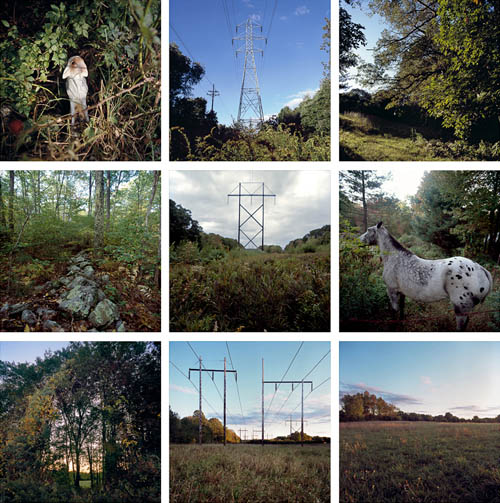
2) While researching blackouts for a seminar I am teaching this winter at Pratt, I stumbled on a strange anecdote from The New York Times, published back in 1986, about a plant physiologist at the Brooklyn Botanic Garden who was seeking a way to end the risk of “trees crashing down on power lines” (a major source of power interruptions).


[Images: All photos by Adam Ryder, from On the Grid].

“One of the things we’re looking at,” the scientist explained, “is something that will directly retard the growth of trees”—that is, chemicals “that interfere with the basic growth hormones.” He was trying to develop, he adds, “a mild chemical” that would deliberately slow tree growth, “and instead of spraying we’re injecting [it] directly into the tree.”

Who knows where that research has now led them, twenty-four years later, but I’d suggest someone might want to mail them a copy of The Death of Grass. ASAP.


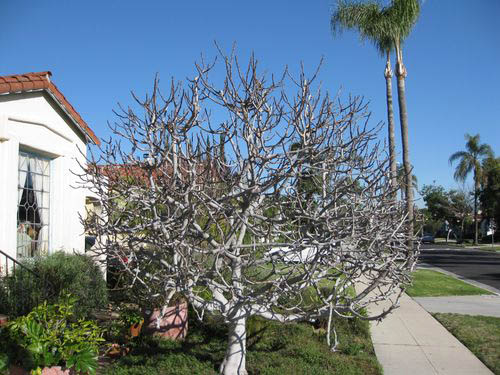
[Image: A fig tree grows in Los Angeles; photo by Pieter Severynen].

3) While going back through old bookmarks this morning, I rediscovered Tree of the Week, a series of articles run by the Los Angeles Times. The overall project could be described as a botanical cartography of the city: a catalog of Angeleno trees.

This week’s tree is the “highly productive fig“; last week’s was the Blackwood Acacia. With regard to the latter tree, Pieter Severynen, the series author, writes: “Given its negative properties it should be clear that a description of this tree, or for that matter any tree of the week, does not imply an endorsement to plant. Instead it is offered as a means to learn more about the existing trees that make up the fascinating urban forest surrounding us in the Southland.”

The “fascinating urban forest surrounding us in the Southland” includes the Weltwitschia, the “picturesque Aleppo pine,” and, of course, among many others, the apple, a tree genetically sculpted over the millennia through “hundreds of accidental and deliberate cross-hybridizations” around the world, Severynen writes.

Anyone interested in exploring the urban forests of Los Angeles would do well to check out the fruit maps of Fallen Fruit, who have discovered in the seemingly random dispersal of fruit trees around Silver Lake the remnant outlines of long-forgotten orchards; but if your curiosity goes further afield than L.A., the absolutely fantastic book Wildwood, by the late Roger Deakin, has truly unforgettable descriptions of walnut harvesting in Kazakhstan, old-growth Eastern European forests filled with war ruins and shrapnel, and Deakin’s own backyard in England. It is often astonishingly beautiful—and it also Deakin’s last major work.

Nakatomi Space

[Image: From Die Hard, directed by John McTiernan based on the novel Nothing Lasts Forever by Roderick Thorpe].

While watching Die Hard the other night—easily one of the best architectural films of the past 25 years—I kept thinking about an essay called “Lethal Theory” by Eyal Weizman—itself one of the best and most consequential architectural texts of the past decade (download the complete PDF).

In it, Weizman—an Israeli architect and prominent critic of that nation’s territorial policy—documents many of the emerging spatial techniques used by the Israeli Defense Forces in their high-tech, legally dubious 2002 invasion of Nablus. During that battle, Weizman writes, “soldiers moved within the city across hundred-meter-long ‘overground-tunnels’ carved through a dense and contiguous urban fabric.” Their movements were thus almost entirely camouflaged, with troop movements hidden from above by virtue of always remaining inside buildings. “Although several thousand soldiers and several hundred Palestinian guerrilla fighters were maneuvering simultaneously in the city,” Weizman adds, “they were so ‘saturated’ within its fabric that very few would have been visible from an aerial perspective at any given moment.”

Worthy of particular emphasis is Weizman’s reference to a technique called “walking through walls”:

Furthermore, soldiers used none of the streets, roads, alleys, or courtyards that constitute the syntax of the city, and none of the external doors, internal stairwells, and windows that constitute the order of buildings, but rather moved horizontally through party walls, and vertically through holes blasted in ceilings and floors.

Weizman goes on to interview a commander of the Israeli Paratrooper Brigade. The commander describes his forces as acting “like a worm that eats its way forward, emerging at points and then disappearing. We were thus moving from the interior of homes to their exterior in a surprising manner and in places we were not expected, arriving from behind and hitting the enemy that awaited us behind a corner.”

This is how the troops could “adjust the relevant urban space to our needs,” he explains, and not the other way around.

Indeed, the commander thus exhorted his troops as follows: “There is no other way of moving! If until now you were used to moving along roads and sidewalks, forget it! From now on we all walk through walls!”
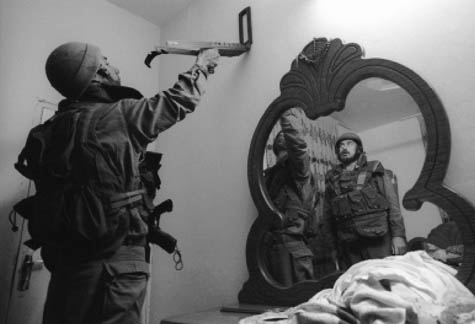
[Image: Israeli troops scan walls in a refugee camp; photo by Nir Kafri (2003), from Eyal Weizman’s essay “Lethal Theory”].

Weizman illustrates the other side of this terrifyingly dislocating experience by quoting an article originally published during the 2002 invasion. Here, a Palestinian woman, whose home was raided, recounts her witnessing of this technique:

Imagine it—you’re sitting in your living room, which you know so well; this is the room where the family watches television together after the evening meal. . . . And, suddenly, that wall disappears with a deafening roar, the room fills with dust and debris, and through the wall pours one soldier after the other, screaming orders. You have no idea if they’re after you, if they’ve come to take over your home, or if your house just lies on their route to somewhere else. The children are screaming, panicking. . . . Is it possible to even begin to imagine the horror experienced by a five-year-old child as four, six, eight, twelve soldiers, their faces painted black, submachine guns pointed everywhere, antennas protruding from their backpacks, making them look like giant alien bugs, blast their way through that wall?

In fact, I’m reminded of a scene toward the end of the recent WWII film Days of Glory in which we see a German soldier blasting his way horizontally through a house, wall by wall, using his bazooka as a blunt instrument of architectural reorganization—“adjusting the relevant space to his needs,” we might say—and chasing down the French troops without limiting himself to doors or stairways.

In any case, post-battle surveys later revealed that “more than half of the buildings in the old city center of Nablus had routes forced through them, resulting in anywhere from one to eight openings in their walls, floors, or ceilings, which created several haphazard crossroutes”—a heavily armed improvisational navigation of the city.

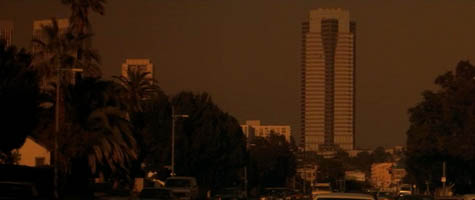
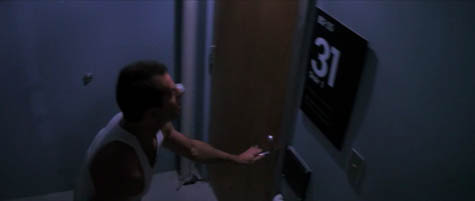
So why do I mention all this in the context of Die Hard? The majority of that film’s interest, I’d suggest, comes precisely through its depiction of architectural space: John McClane, a New York cop on his Christmas vacation, moves through a Los Angeles high-rise in basically every conceivable way but passing through its doors and hallways.
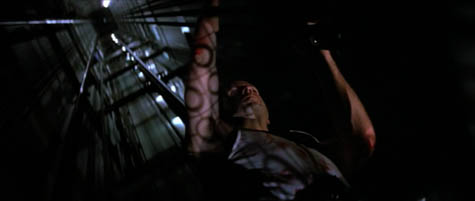
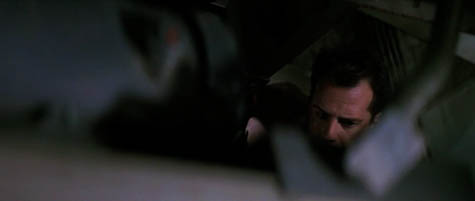
[Images: From Die Hard].

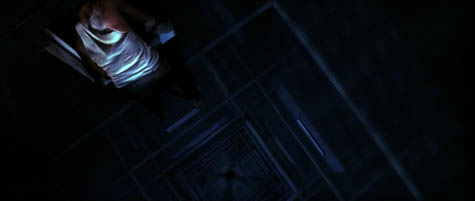
McClane explores the tower—called Nakatomi Plaza—via elevator shafts and air ducts, crashing through windows from the outside-in and shooting open the locks of rooftop doorways. If there is not a corridor, he makes one; if there is not an opening, there will be soon.
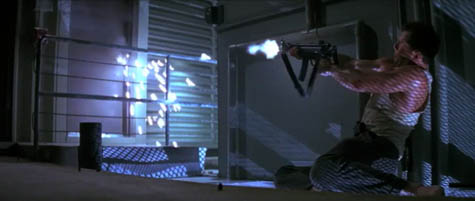

[Images: From Die Hard].

Over the course of the film, McClane blows up whole sections of the building; he stops elevators between floors; and he otherwise explores the internal spaces of Nakatomi Plaza in acts of virtuoso navigation that were neither imagined nor physically planned for by the architects.

His is an infrastructure of nearly uninhibited movement within the material structure of the building.

The film could perhaps have been subtitled “lessons in the inappropriate use of architecture,” were that not deliberately pretentious. But even the SWAT team members who unsuccessfully raid the structure come at it along indirect routes, marching through the landscaped rose garden on the building’s perimeter, and the terrorists who seize control of Nakatomi Plaza in the first place do so after arriving through the service entrance of an underground car park.
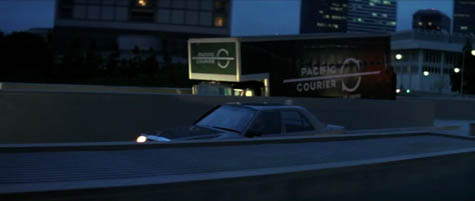
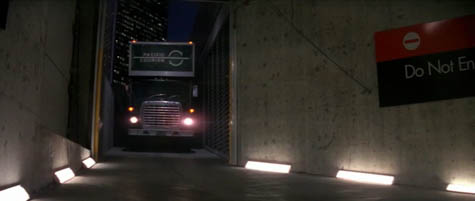
[Images: From Die Hard].

What I find so interesting about Die Hard—in addition to unironically enjoying the film—is that it cinematically depicts what it means to bend space to your own particular navigational needs. This mutational exploration of architecture even supplies the building’s narrative premise: the terrorists are there for no other reason than to drill through and rob the Nakatomi Corporation’s electromagnetically sealed vault.

Die Hard asks naive but powerful questions: If you have to get from A to B—that is, from the 31st floor to the lobby, or from the 26th floor to the roof—why not blast, carve, shoot, lockpick, and climb your way there, hitchhiking rides atop elevator cars and meandering through the labyrinthine, previously unexposed back-corridors of the built environment?

Why not personally infest the spaces around you?
[Images: From Die Hard].

I might even suggest that what would have made Die Hard 2 an interesting sequel—sadly, the series is unremarkable for the fact that each film is substantially worse than the one before—would have been if Die Hard’s spatial premise had been repeated on a much larger urban scale.

For example, Weizman outlines what the Israeli Defense Forces call “hot pursuit”—that is, to “break into Palestinian controlled areas, enter neighborhoods and homes in search of suspects, and take suspects into custody for purposes of interrogation and detention.” This becomes a spatially extraordinary proposition when you consider that someone could be kidnapped from the 4th floor of a building by troops who have blasted through the walls and ceilings, coming down into that space from the 5th floor of a neighboring complex—and that the abductors might only have made it that far in the first place after moving through the walls of other structures nearby, blasting upward through underground infrastructure, leaping terrace-to-terrace between buildings, and more.

An alternative-history plot for a much better Die Hard 2 could thus perhaps include a scene in which the rescuing squad of John McClane-led police officers does not even know what building they are in, a suitably bewildering encapsulation of this method of moving undetected through the city.

“Walking through walls” thus becomes a kind of militarized parkour.
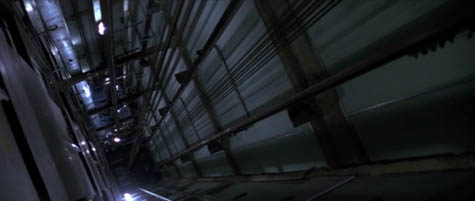
[Image: Inside Nakatomi space, from Die Hard].

Indeed, recent films like The Bourne Ultimatum, Casino Royale, District 13, and many others could be viewed precisely as the urban-scale realization of Die Hard’s architectural scenario. Even The Bank Job—indeed, any bank heist film at all involving tunnels—makes this Weizmanian approach to city space quite explicit.
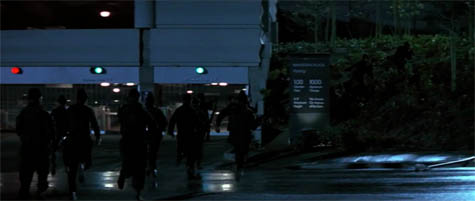
[Image: From Die Hard; it’s hard to see here, but an LAPD SWAT team is raiding the Nakatomi Building by way of lateral movements across the surrounding landscape].

Tangentially, I’m reminded of Matt Jones’s thought-provoking 2008 blog post about the urban differences between the Jason Bourne and James Bond film franchises. Jones writes that “there’s no travel in the new Bond”; there are simply “establishing shots of exotic destinations.” By the end of a Bond film, he adds, you simply “feel like you are in the international late-capitalist nonplace,” a geography with neither landmarks nor personal memory.

Compare the paradoxically unmoving, amnesiac geography of James Bond, then, to the compressed spaces of Paul Greengrass-directed Jason Bourne films. These films are “set in Schengen,” Jones writes, “a connected, border-less Mitteleurope that can be hacked and accessed and traversed—not without effort, but with determination, stolen vehicles and the right train timetables.” Indeed, Jones memorably suggests, “Bourne wraps cities, autobahns, ferries and train terminuses around him as the ultimate body-armor.”

Rather than Bond’s private infrastructure [of] expensive cars and toys, Bourne uses public infrastructure as a superpower. A battered watch and an accurate U-Bahn time-table are all he needs for a perfectly-timed, death-defying evasion of the authorities.

The space of the city is used in profoundly different ways by Bond and Bourne—but to this duality I would add John McClane of the original Die Hard.

If Jason Bourne’s actions make visible the infrastructure-rich, borderless world of the EU, then John McClane shows us a new type of architectural space altogether—one that we might call, channeling topology, Nakatomi space, wherein buildings reveal near-infinite interiors, capable of being traversed through all manner of non-architectural means. In all three cases—with Bond, Bourne, and McClane—it is Hollywood action films that reveal to us something very important about how cities can be known, used, and navigated: these films are filled with the improvisational crossroutes that constitute Eyal Weizman’s “Lethal Theory.”

As I wrote the other day, crime is a way to use the city.
[Image: From Die Hard].

On the other hand, as Weizman points out, this is not a new approach to built space at all:

In fact, although celebrated now as radically new, many of the procedures and processes described above have been part and parcel of urban operations throughout history. The defenders of the Paris Commune, much like those of the Kasbah of Algiers, Hue, Beirut, Jenin, and Nablus, navigated the city in small, loosely coordinated groups moving through openings and connections between homes, basements, and courtyards using alternative routes, secret passageways, and trapdoors.

This is all just part of “a ghostlike military fantasy world of boundless fluidity, in which the space of the city becomes as navigable as an ocean.”
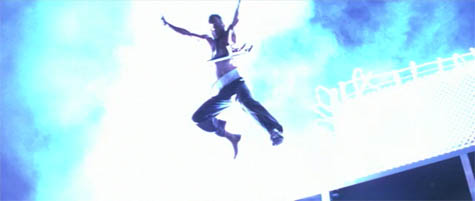
[Image: From Die Hard].

Treated as an architectural premise, Die Hard becomes an exhilarating catalog of unorthodox movements through space. I would suggest again, then, that where the various Die Hard sequels went wrong was in abandoning this spatial investigation—one that could very easily have been scaled-up to encompass a city—and following, instead, the life of one character: John McClane. But, when taken out of Nakatomi Plaza—that is, out of the boundless, oceanic fluidity of Nakatomi space—McClane is reduced to an action film cliché whose failing charisma no amount of wise-cracking can salvage.

(I remembered while writing this post that I actually discussed Die Hard on National Public Radio last year; you can listen to that show here).