Schrödinger’s Speleology, or the Stalking of “Entranceless Caves”


[Image: A cave entrance in France, via Wikipedia].

I recently finished reading Last Words by Michael Koryta, a detective novel largely centered on an unmapped fictional cave system in southern Indiana, part of the great karst belt near the border with Kentucky.

One interesting thing about the novel is that this cave, known in the book as “Trapdoor,” operates on many different narrative levels. Most obviously, of course, there’s the unreliable memory of a major character suspected—yet never officially accused—of committing a murder there, where the darkness of Trapdoor’s linked subterranean spaces becomes a kind of mental model for his own inability to recall what really happened, when a woman was (apparently) murdered in the cave’s depths.

There is also a subplot, though, revealed quite late in the book, in which disguised real estate deals and obscure land trust deeds have been premised on the subterranean potential of this land snaking along the region’s old creeks and rivers, transactions inked with the belief that Trapdoor’s passages might continue beneath distant parcels; in this way, the cave comes to represent the conspiratorial intentions of people otherwise unwilling to state their true goals.

Finding the true outer limits of the cave—that is, finding the land parcels that the cave secretly connects from below—becomes coextensive with discovering the truth about what occurred underground there so many years earlier.


[Image: Cave in Venezuela, photographed by Vittorio Crobu, courtesy European Space Agency].

It was these latter parts of the novel—including a handful of plot points I won’t get into—that reminded me of notes I’d taken from a book called the Encyclopedia of Caves several years ago. That book includes a short entry written by Nevin W. Davis, called “Entranceless Caves, Discovery of.”

As Davis describes them, “entranceless caves” are like speleological versions of Schrödinger’s cat: they exist, but they have not been verified. They are real—but perhaps not. They are both in the ground and nowhere.

At times, Davis’s text is almost like a koan: “Suppose the cave is totally unknown and has no entrance,” he writes. What exactly is such a thing, and how can we account for its presence (or absence) in the landscape? After all, these are caves that have not been—and perhaps cannot ever be—located.

He goes on to describe mathematical models used to generate a probability of subterranean connection: the calculated likelihood that physically inaccessible voids might exist beneath the surface of things, linking one part of the world to another.


[Image: Cave in Mexico, photographed by Vittorio Crobu, courtesy European Space Agency].

“Another consideration in searching for caves,” Davis continues, “is entrance lifetime. Caves are long-term features under the landscape with lifetimes measured in millions of years, whereas entrances to them are fleeting features with lifetimes measured in millennia.”

Cave entrances come and go, in other words, while the caves they once led to remain. They can be covered over, woven shut by tree roots, erased.

As Davis describes it, “leaves and twigs will soon cover and block small vertical entrances. Pits less than a meter in diameter”—tiny holes that can nonetheless lead to huge systems, such as the real-life Mammoth Cave or the fictional Trapdoor—“can be totally blocked in one season. Leaves blocking a small entrance are soon followed by roots and more leaves and it is not long before all traces of an entrance are gone.”

This leads to an activity he calls “stalking the elusive entranceless cave”—which, for what it’s worth, seems like a perfect metaphor for part of Koryta’s novel, in which the book’s amnesia-stricken potential murderer undergoes hypnosis. His memory is a cave with no entrance.


[Image: Cave in Venezuela, photographed by Vittorio Crobu, courtesy European Space Agency].

In any case, there can also be “false positives,” Davis warns. These would be caves that appear to have been detected but that are not, in fact, real. A “stalker” of previously unknown caves might find herself misled by patches of melted snow, for example, or by other signs that wrongly give the impression of warm air rising from empty passages below.

“The best condition to search for snow melt,” Davis suggests, instead, “is with a new snowfall in midwinter with an overcast sky, since sunlight can also give false positives by shining through snow cover onto rocks and melting the snow. This is a tried-and-true method that has led to countless new caves.” It’s cave-discovery weather.

In essence, this is a process of reading the landscape: interpreting its surface features in order to gain knowledge of these other, deeper dimensions.


[Image: An artificially enlarged entrance to Carlsbad Caverns; Instagram by BLDGBLOG].

The next entry in the Encyclopedia is also worth reading; it is simply called “Entrances,” by William B. White. “Some caves,” White writes, continuing the strangely existential thread of Davis’s work, “may have no entrances at all.”

White adds a new category here, what he calls the “concealed entrance.”

At least from an architectural point of view, what’s interesting is that this allows White and other speleologists to challenge the idea of there being a clean dividing line between inside and outside, between a cave and the Earth’s surface.

Instead, he suggests, a cave’s entrance should actually be thought of as a transition: the “cave entrance zone,” White writes, “is, in effect, a continuous sequence of microclimates,” one that eventually leads to a point at which there is no direct access to sunlight or to rainfall.

It is only at that point that you are truly “inside” the Earth. You have transitioned to the great interior.


[Image: Photographer unknown; image via Discovery Communications].

Briefly, White also points out that cave entrances are not only unstable in the temporal sense—as Davis mentioned, cave entrances can completely disappear over time.

However, they are also unstable spatially: that is, they can physically migrate through the landscape over thousands, or even tens, of years.

Due to continual rockfall, for example, a cave entrance “not only migrates deeper into the hill but also migrates upward as rocks break away,” Davis writes. This can potentially push a cave entrance dozens and dozens of feet from its original location, while the cave itself remains stationary. Imagine a mouth migrating across your body while your stomach stands still.

Of course, this also means that an entrance to a given cave system can abruptly migrate onto someone else’s property, or that it can even pop open, suddenly and dramatically changing the value of a particular piece of land.

The next thing you know, following an unusually intense summer rainstorm, you own the entrance to a cave.

[Image: A salt cave in Israel; image via Wikipedia].

Which brings us back to Michael Koryta’s novel. There, an unexpected opening into the unstable depths of Indiana’s fictional Trapdoor complex changes the lives of many characters not just for the worse, but for the tragic.

The cave, as Koryta depicts it, is a relentless and unsympathetic thing, a space always shifting, growing organically but not alive, invisible yet ubiquitous, moving beneath the surface of the landscape, connecting parcels of land, as well as the lives—and deaths—of the characters who thought they were just idly passing time above.

(Vaguely related: Life on the Subsurface: An Interview with Penelope Boston).

chill.once.waddle

what3words[Image: Screen-grab from what3words].

Using the bizarre three-word addressing system known as what3words, the now-destroyed curb in Hayward, CA, mentioned in the previous post, is located at a site called “chill.once.waddle.”

As you can tell, of course, what3words is not a descriptive language, and these phrases are not intended to mean anything: they are simply randomly-generated sets of words used to give any location on earth a physical address.

As Quartz explained the system back in 2015, it is, at heart, “a simple idea”:

…a combination of three words, in any language, could specify any three meter by three meter square in the world—more than enough to designate a hut in Siberia or a building doorway in Tokyo. Altogether, 40,000 words combined in triplets label 57 trillion squares. Thus far, the system has been built in 10 languages: English, Spanish, French, German, Italian, Swahili, Portuguese, Swedish, Turkish, and, starting next month, Arabic… All together, this lingua franca requires only five megabytes of data, small enough to reside in any smartphone and work offline. Each square has its identity in its own language that is not a translation of another. The dictionaries have been refined to avoid homophones or offensive terms, with short terms being reserved for the most populated areas

The addresses are poetically absurd—shaky.audit.detail, salsa.gangs.square, dozed.lamps.wing.

I mention this, however, because I meant to post last month that “Mongolia is changing all its addresses to three-word phrases.” Again, from Quartz:

Mongol Post is switching to the What3Words system because there are too few named streets in its territory. The mail network provides service over 1.5 million square km (580,000 square miles), an area that’s three times the size of Spain, though much of that area is uninhabited. Mongolia is among the world’s most sparsely populated countries, and about a quarter of its population is nomadic, according to the World Bank.

While, on one level, in an age of stacks and infinite addressability, this seems like a thrilling, almost science-fictional step forward for locating and mapping physical spaces, it also seems like an alarming example of national over-reliance on a proprietary address system, one that the state itself ultimately cannot control.

Imagine a nation-state losing influence over the physical coordinates of its own territory, or a population stuck living inside an outdated, even discontinued address network, and needing to start again, from scratch, renaming all its streets and buildings—not to mention all the lost local histories and significance of certain place names, from avenues to intersections, that need to be reclaimed.

Granted, in this particular case, the system is being adopted precisely because “there are too few named streets” in Mongolia, that does not change the fact that the country will soon be dependent upon the continued existence of what3words for its packages to be delivered, its services to run, and its spatial infrastructures to function. It will be interesting to see how the transition to the use of these peculiar place tags goes—but, even more so, how this decision looks in five or ten years’ time.

Curbed

10-HaywardCornerWEB[Image: Photo by Geoff Manaugh].

Lacking any sort of seismically-themed historic preservation plan, this seemed all but inevitable: a city works crew has fixed, and thus destroyed, the amazing offset curb at the intersection of Rose and Prospect in Hayward, California, where seismic “creep” has been inadvertently tracked for decades.

From the L.A. Times:

Since at least the 1970s, scientists have painstakingly photographed the curb as the Hayward fault pushed it farther and farther out of alignment. It was a sharp reminder that someday, a magnitude 7 earthquake would strike directly beneath one of the most heavily populated areas in Northern California.
Then, one early June day, a city crew decided to fix the faulty curb—pun intended. By doing what cities are supposed to do—fixing streets—the city’s action stunned scientists, who said a wonderful curbside laboratory for studying earthquakes was destroyed.

As you can see here, small black lines had been drawn on the curb as a visual aid for helping measure exactly how far its opposing sides had been displaced by so-called “fault creep.”

11-HaywardCornerWEB[Image: Photo by Geoff Manaugh].

The curb on the west is moving north—along with the rest of that part of Hayward, California—while the curb on the east basically marks the edge of a different tectonic plate.

I was there roughly two years ago, looking at fault creep up and down California—primarily along the San Andreas Fault—when I took these shots; at the time, I wrote that the intersection could be thought of as “something like an alternative orientation point for the city, a kind of seismic meridian—or perhaps doomsday clock—by which Hayward’s ceaseless cleaving can be measured.”

CurbsTwoWEBCurbsWEB[Images: Photos by Geoff Manaugh].

Alas, we’ll have to wait presumably until the 2050s before the curbs offset to anything like they were when these photographs were taken.

(Thanks to Wayne Chambliss for the heads up!)

Robot War and the Future of Perceptual Deception

tesla
[Image: A diagram of the accident site, via the Florida Highway Patrol].

One of the most remarkable details of last week’s fatal collision, involving a tractor trailer and a Tesla electric car operating in self-driving mode, was the fact that the car apparently mistook the side of the truck for the sky.

As Tesla explained in a public statement following the accidental death, the car’s autopilot was unable to see “the white side of the tractor trailer against a brightly lit sky”—which is to say, it was unable to differentiate the two.

The truck was not seen as a discrete object, in other words, but as something indistinguishable from the larger spatial environment. It was more like an elision.

Examples like this are tragic, to be sure, but they are also technologically interesting, in that they give momentary glimpses of where robotic perception has failed. Hidden within this, then, are lessons not just for how vehicle designers and computers scientists alike could make sure this never happens again, but also precisely the opposite: how we could design spatial environments deliberately to deceive, misdirect, or otherwise baffle these sorts of semi-autonomous machines.

For all the talk of a “robot-readable world,” in other words, it is interesting to consider a world made deliberately illegible to robots, with materials used for throwing off 3D cameras or LiDAR, either through excess reflectivity or unexpected light-absorption.

Last summer, in a piece for New Scientist, I interviewed a robotics researcher named John Rogers, at Georgia Tech. Rogers pointed out that the perceptual needs of robots will have more and more of an effect on how architectural interiors are designed and built in the first place. Quoting that article at length:

In a detail that has implications beyond domestic healthcare, Rogers also discovered that some interiors confound robots altogether. Corridors that are lined with rubber sheeting to protect against damage from wayward robots—such as those in his lab—proved almost impossible to navigate. Why? Rubber absorbs light and prevents laser-based navigational systems from relaying spatial information back to the robot.
Mirrors and other reflective materials also threw off his robots’ ability to navigate. “It actually appeared that there was a virtual world beyond the mirror,” says Rogers. The illusion made his robots act as if there were a labyrinth of new rooms waiting to be entered and explored. When reflections from your kitchen tiles risk disrupting a robot’s navigational system, it might be time to rethink the very purpose of interior design.

I mention all this for at least two reasons.

1) It is obvious by now that the American highway system, as well as all of the vehicles that will be permitted to travel on it, will be remade as one of the first pieces of truly robot-legible public infrastructure. It will transition from being a “dumb” system of non-interactive 2D surfaces to become an immersive spatial environment filled with volumetric sign-systems meant for non-human readers. It will be rebuilt for perceptual systems other than our own.

2) Finding ways to throw-off self-driving robots will be more than just a harmless prank or even a serious violation of public safety; it will become part of a much larger arsenal for self-defense during war. In other words, consider the points raised by John Rogers, above, but in a new context: you live in a city under attack by a foreign military whose use of semi-autonomous machines requires defensive means other than—or in addition to—kinetic firepower. Wheeled and aerial robots alike have been deployed.

One possible line of defense—among many, of course—would be to redesign your city, even down to the interior of your own home, such that machine vision is constantly confused there. You thus rebuild the world using light-absorbing fabrics and reflective ornament, installing projections and mirrors, screens and smoke. Or “stealth objects” and radar-baffling architectural geometries. A military robot wheeling its way into your home thus simply gets lost there, stuck in a labyrinth of perceptual convolution and reflection-implied rooms that don’t exist.

In any case, I suppose the question is: if, today, a truck can blend-in with the Florida sky, and thus fatally disable a self-driving machine, what might we learn from this event in terms of how to deliberately confuse robotic military systems of the future?

We had so-called “dazzle ships” in World War I, for example, and the design of perceptually baffling military camouflage continues to undergo innovation today; but what is anti-robot architectural design, or anti-robot urban planning, and how could it be strategically deployed as a defensive tactic in war?

The Architecture of Delay vs. The Architecture of Prolongation

timeship
[Image: A rendering of the “Timeship” cryogenic facility by architect Stephen Valentine, via New Scientist].

The primary setting of Don DeLillo’s new novel, Zero K, is a cryogenic medical facility in the mountainous deserts of Central Asia. There we meet a family that is, in effect, freezing itself, one by one, for reawakening in a speculative second life, in some immortally self-continuous version of the future.

First the mother goes; then the father, far before his time, willfully and preemptively ending things out of loneliness; next would be the son, the book’s ostensible protagonist, if he didn’t arrive with so many reservations about the procedure. Either way, it’s a question of what it means to delay one thing while prolonging another—to preserve one state as a means of preventing another from setting in. One is a refusal to let go of something you already possess; the other is a refusal to accept something you don’t yet have. An addiction to comfort vs. a fear of the new.

Without getting into too many of the book’s admittedly sparse details, it suffices to say that Zero K continues many of DeLillo’s most consistent themes—finance (Cosmopolis), apocalyptic religion (Mao II), the symbolic allure of mathematical analysis (Ratner’s Star).

What makes the book worth a mention here are some of the odder details of this cryogenic compound. It is a monumental space, described with references both to grand scientific and medical facilities—think the Salk Institute, perhaps—as well as to postmodern religious centers, this desert megachurch of the secular afterlife.

Yet its strangest details come from the site’s peripheral ornamentation: there are artificial gardens, for example, filled with resin-based and plastic plant life, and there is a surreal distribution of lifeless mannequins throughout the grounds, standing in penitential silence amongst the fake greenery. Unliving, they cannot die.

These stylized representations of biology, or replicant life forms that come across more like mockery than mimicry, expand the novel’s central conceit of frozen life—life reduced to absolute stillness, placed on pause, in hibernation, in temporal limbo, preserved—out into the landscape itself. It is an obvious symbolism, which is one of the book’s shortcomings; these deathless gardens with their plastic guards remain creepily poetic, nonetheless. These can also be seen as fittingly cynical flourishes for a facility founded on loose talk of singularities, medical resurrection, and quote-unquote human consciousness, as if even the designers themselves were in on the joke.

Briefly, despite my lukewarm feelings about the actual novel, I should say that I really love the title, Zero K. It is, of course, a thermal description—or zero K, zero kelvin, absolute zero, cryogenic perfection. Yet it is also refers to an empty digital file—zero k, zero kb—or, perhaps more accurately, a file saved with nothing in it, thus seemingly a quiet authorial nod to the idea that absolutely nothing about these characters is being saved, or preserved, in their quest for immortality. And it is also a nicely cross-literary reference to Frank Kafka’s existential navigator of European political absurdity, Josef K. or just K. From Josef K. to Zero K, his postmodern replacement.

The title, then, is brilliant—and the mannequins and the plastic plant life found at an end-times cryogenic facility in Central Asia make for an amazing set-up—but it’s certainly not one of DeLillo’s strongest books. In fact, I have been joking to people that, if you really want to read a novel this summer written by an aging white male cultural figure known for his avant-garde aesthetics, consider picking up Consumed, David Cronenberg’s strange, possibly too-Ballardian novel about murder, 3D printing, North Korean kidnapping squads, and more, rather than Zero K (or, of course, read both).

In any case, believe it or not, this all came out of the fact that I was about to tweet a link to a long New Scientist article about a cryogenic facility under construction in Texas when I realized that I had more to say than just 140 characters (Twitter, I have found, is actually a competitor to your writing masquerading as an enabler of it—alas, something I consistently re-forget).

There, Helen Thompson takes us to a place called Comfort, Texas.

timeship2
[Image: Rendering of the “Timeship” facility by architect Stephen Valentine].

“The scene from here is surreal,” Thompson writes. “A lake with a newly restored wooden gazebo sits empty, waiting to be filled. A pregnant zebra strolls across a nearby field. And out in the distance some men in cowboy hats are starting to clear a huge area of shrub land. Soon the first few bricks will be laid here, marking the start of a scientific endeavour like no other.” A “monolithic building” is under construction in Comfort, and it will soon be “the new Mecca of cryogenics.”

Called Timeship, the monolithic building will become the world’s largest structure devoted to cryopreservation, and will be home to thousands of people who are neither dead nor alive, frozen in time in the hope that one day technology will be able to bring them back to life. And last month, building work began.

The resulting facility will include “a building that would house research laboratories, DNA from near-extinct species, the world’s largest human organ biobank, and 50,000 cryogenically frozen bodies.”

The design of the compound is not free of the sort of symbolic details we saw in DeLillo’s novel. Indeed, Thompson explains, “Parts of the project are somewhat theatrical—backup liquid nitrogen storage tanks are covered overhead by a glass-floored plaza on which you can walk surrounded by a fine mist of clouds—others are purely functional, like the three wind turbines that will provide year-round back-up energy.” And then there’s that pregnant zebra.


[Image: An otherwise totally unrelated photo of a circuit, chosen simply for its visual resemblance to the mandala/temple/resurrection facility in Texas; via DARPA].

It’s a long feature, worth reading in full—so click over to New Scientist to check it out—but what captivates me here is the notion that a sufficiently advanced scientific facility could require an architectural design that leans more toward religious symbolism.

What are the criteria, in other words, by which an otherwise rational scientific undertaking—conquering death? achieving resurrection? simulating the birth of the universe?—can shade off into mysticism and poetry, into ritual and symbolism, into what Zero K refers to as “faith-based technology,” and what architectural forms are thus most appropriate for housing it?

In fact, DeLillo presents a political variation on this question in Zero K. At one point, the book’s narrator explains, looking out over the cryogenic facility, “I wondered if I was looking at the controlled future, men and women being subordinated, willingly or not, to some form of centralized command. Mannequined lives. Was this a facile logic? I thought about local matters, the disk on my wristband that tells [the facility’s administrators], in theory, where I am at all times. I thought about my room, small and tight but embodying an odd totalness. Other things here, the halls, the veers, the fabricated garden, the food units, the unidentifiable food, or when does utilitarian become totalitarian.” When does utilitarian become totalitarian.

When do scientific undertakings become religious movements? When does minimalism become a form of political control?

The World as a Hieroglyph of Spatial Relationships Yet to be Interpreted

drones
[Image: Courtesy Iris Automation].

In an interview published on the blog here a few years ago, novelist Zachary Mason, author of The Lost Books Of The Odyssey, pointed out something very interesting about the nearly limitless, three-dimensional space of the Earth’s atmosphere and how it relates to artificial intelligence.

“One of the problems with A.I.,” Mason explained back in 2010, “is that interacting with the world is really tough. Both sensing the world and manipulating it via robotics are very hard problems, and [these are] solved only for highly stripped-down special cases. Unmanned aerial vehicles, for instance, work well because maneuvering in a big, empty, three-dimensional void is easy—your GPS tells you exactly where you are, and there’s nothing to bump into except the odd migratory bird. Walking across a desert, though—or, heaven help us, negotiating one’s way through a room full of furniture in changing lighting conditions—is vastly more difficult.”

Another way of thinking about Mason’s comment—although Mason himself might disagree with the following statement—is that it is precisely the sky’s ease of navigation that makes it ideal for the emergence and testing of artificial intelligence. The Earth’s atmosphere, in other words—specifically because it is an unchallenging three-dimensional environment—is the perfect space for machine-vision algorithms and other forms of computational proto-intelligence to work out their most basic bugs.

Once they master the sky, then, autonomous machines can move on to more complicated environments, such as roads, mountains, forests. Cities.

In any case, I was thinking about Mason’s interview again earlier today when I read that drones are close to achieving “situational awareness”—albeit through visual, not artificially intelligent, means. In other words, it’s not AI—at least not yet—that will give unmanned aerial vehicles their much-needed ability to avoid colliding with other flying objects. Rather, it is a sufficiently advanced visual processing system that can identify and, more importantly, avoid potential obstacles.

Exactly such a system, TechCrunch claims, has been built by a Canadian firm called Iris Automation. Their system is able “to process visual data in real time, so it can see structures that suddenly appear, like a plane, flock of birds or another drone—not just static objects and waypoints that might be mapped using older technologies like GPS.” The company refers to this as “industrial drone collision avoidance,” which suggests a kind of on-board traffic management system for the sky. Air traffic control will be internal.

Now connect a drone’s “situational awareness” to sufficient processing power, and you could help steward into existence a computationally interesting form of autonomous intelligence.

To return to Zachary Mason’s computationally-inflected rewriting of The Odyssey, it would be AI as Athena, springing fully formed into the world from an empty sky.

Predatory Planetarium

waitomocave
[Image: Glow worms inside Waitomo Cave; photo by Jason Roehrig, via KQED].

Carnivorous glow worms catch their prey “by mimicking the night sky,” KQED reports. Think of it as a surrogate astronomy enacted to disorient other species, leading to their deaths—a predatory planetarium of creatures acting like someone else’s stars.

“The strategy is simple,” KQED explain. “Many of these insects, including moths, navigate by starlight. They keep the celestial bodies at a constant angle to fly in a straight line. ‘That works fine when the moon and stars are real,’ said Dave Merritt, a biologist at the University of Queensland in Brisbane, Australia, ‘but when the source is close they end up spiraling into it.’” When the moon and stars are real!

What a peculiar existential position to be in, needing to determine whether the night sky itself is—or is not—a decoy meant to lure and trap you.

Read more over at KQED.

(Vaguely related: The Bioluminescent Metropolis).

Skywalker Village


[Image: Tsovkra-1 via Google Maps].

“Flanked by the Caucasus Mountains on the highest plateau in Dagestan,” Kate Sutton wrote for the February issue of Artforum, “the village of Tsovkra-1 has parlayed the perils of its topography into a peculiar claim to fame: that every able-bodied member of its roughly four-hundred-person population can walk a tightrope. While locals say that this skill was first developed simply as a way to traverse the region’s slopes and crevices, tightrope walking is now considered an integral part of the republic’s cultural heritage.”

It’s like a deleted scene from, or an alternative version of, Italo Calvino’s Baron in the Trees, this village with such a precarious natural and geological setting that everyone becomes an acrobat.

The origins of the town’s peculiar talents are disputed. According to The Week, it might have been all about love: “While no one in Tsovkra-1 knows exactly how the tradition began, the most popular story is that more than 100 years ago, the village’s young men tired of trekking across the valleys that separated them from their female love interests in a neighboring community. So the men strung up a rope between the mountains and, after first pulling themselves across, eventually began to walk the rope, displaying their prowess for their waiting admirers.”

I would love to know the extent to which this has simply been overblown by curious journalists, especially as the only consistent takeaway from coverage of the town is that no one seems to know where the tightrope skills came from—although “all agree that it happened more than 200 years ago” and all seem to agree that Tsovkra-1’s acrobatics are on the verge of disappearing.

Subterranean Singapore

oil
[Image: A “Cavern Breathing Unit” from Subterranean Singapore by Finbarr Fallon, Bartlett School of Architecture, Unit 24].

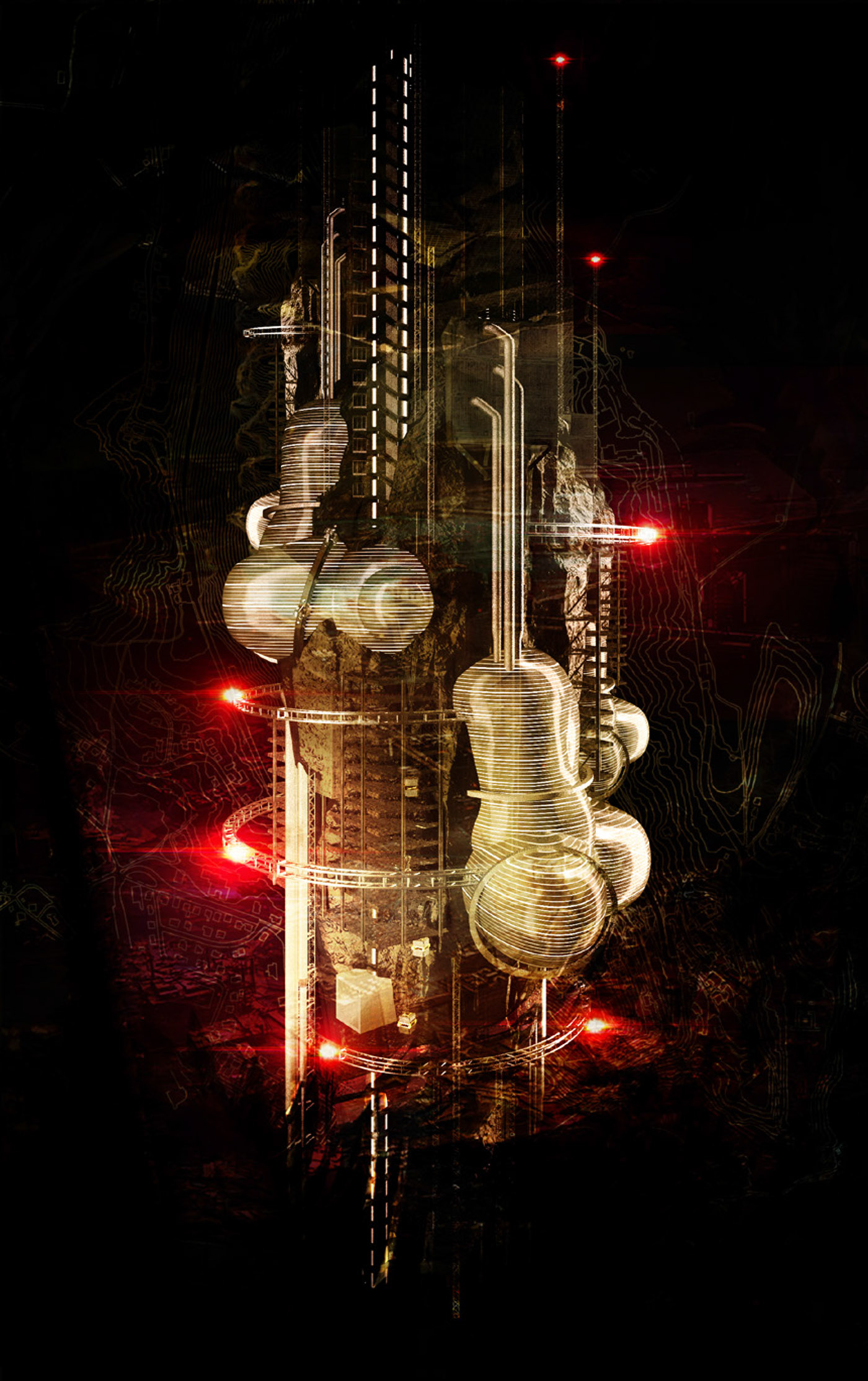
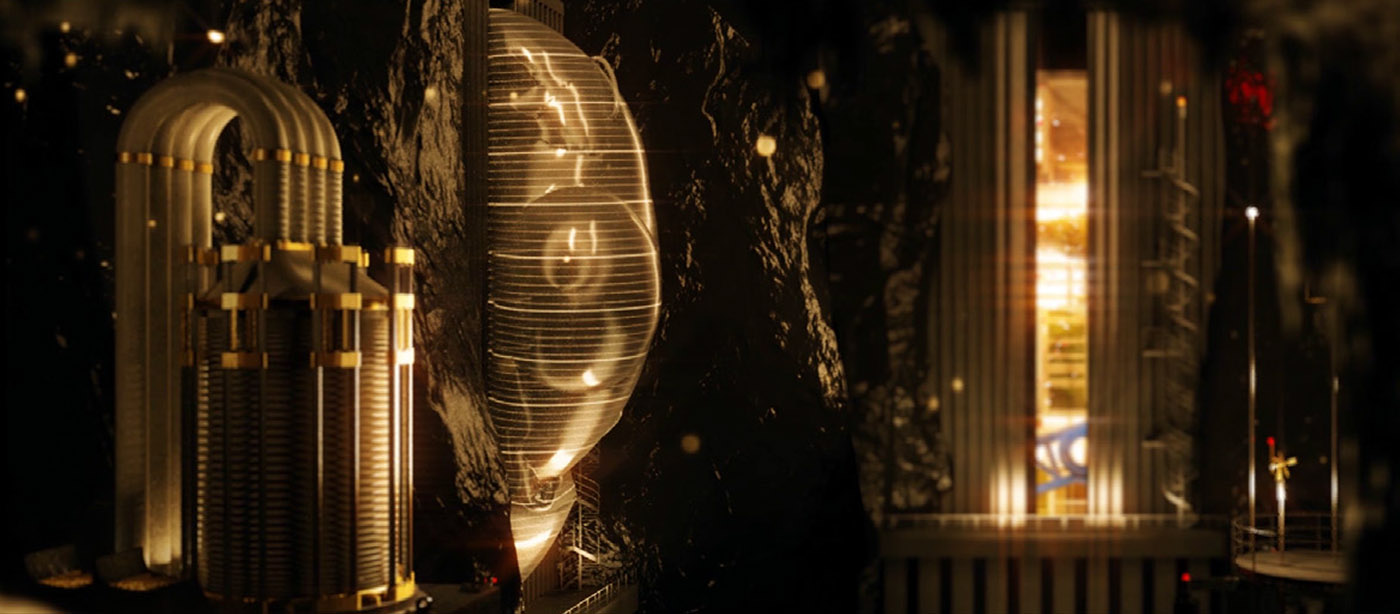
Here is another project from my reviews the other week at the Bartlett School of Architecture; this one is called Subterranean Singapore, and it is by Finbarr Fallon, produced for Unit 24, which is taught by Penelope Haralambidou, Simon Kennedy, and Michael Tite.


[Image: “Concept Breathing Towers” from Subterranean Singapore by Finbarr Fallon, Bartlett School of Architecture, Unit 24].

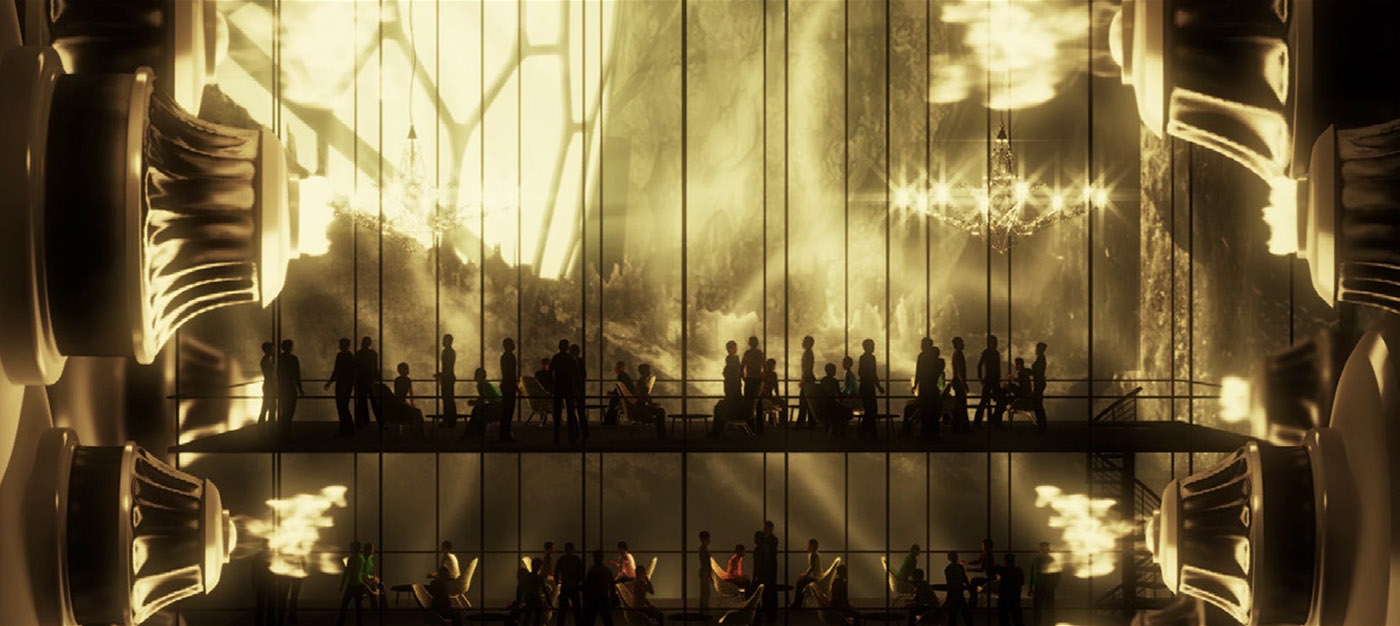
Subterranean Singapore is presented as a speculative look at massive underground residential development in the city-state of Singapore over the next few decades.


[Images: Glimpses of a “high grade recreational space within an inflatable cave unit,” from Subterranean Singapore by Finbarr Fallon, Bartlett School of Architecture, Unit 24].

The city has run out of room to expand into the sea, and is thus forced to look downward, into the depths of the continental shelf, excavating beneath the surface of the city and heading partially out below the seabed.


[Image: From Subterranean Singapore by Finbarr Fallon, Bartlett School of Architecture, Unit 24].

As Fallon describes it, the project explores “the city-state of Singapore’s subterranean ambitions to suggest an imagined masterplan and spatial typology for deep-level underground living. While it may seem utopian to imagine that extensive deep living will become viable, the pressures of chronic land scarcity in Singapore may necessitate this outcome.”


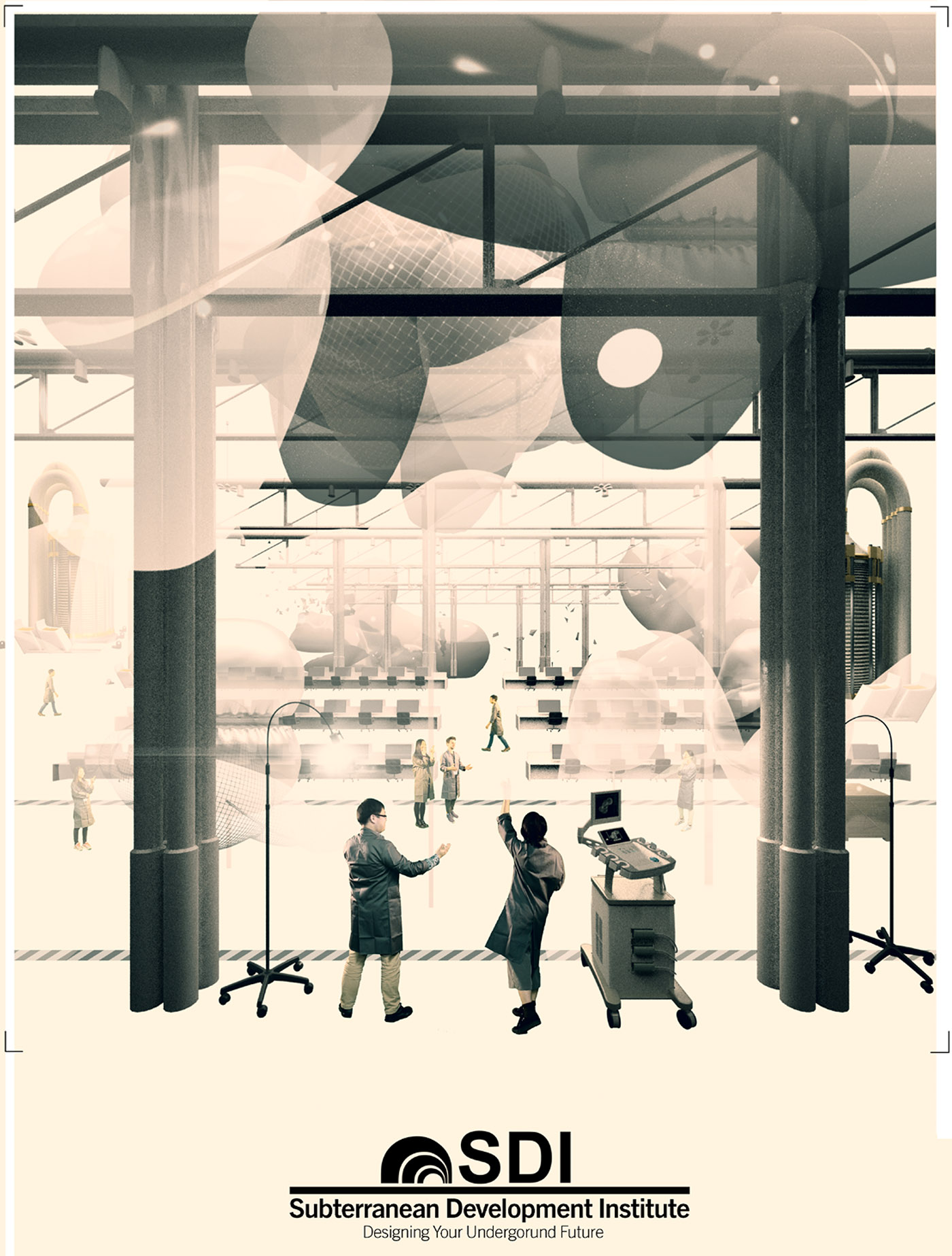
[Image: The “Subterranean Development Institute: Designing Your Underground Future,” from Subterranean Singapore by Finbarr Fallon, Bartlett School of Architecture, Unit 24].

The construction process is kicked off with great imperial fanfare, involving a parade of excavation machines and robot carving arms marching their way forward through clouds of confetti. There is even a celebratory pamphlet.


[Images: From Subterranean Singapore by Finbarr Fallon, Bartlett School of Architecture, Unit 24].

The idea is not entirely science fiction, of course: Singapore is already excavating huge oil-storage facilities underground, and nearby Hong Kong is actively experimenting with the design and implementation of entire underground infrastructural zones.


[Images: From Subterranean Singapore by Finbarr Fallon, Bartlett School of Architecture, Unit 24].

For Fallon, however, such a proposal cannot be divorced from the question of who will be able to afford these spaces of underground luxury—complete with fish ponds, spas, and the soothing presence of exotic mechanical animals meant to bring an ironic touch of the natural world to those below.


[Image: A light-well looking down at Subterranean Singapore by Finbarr Fallon, Bartlett School of Architecture, Unit 24].

Let alone, of course, the question of human labor. Who, after all, will physically construct these things? Whose backs will be broken?


[Image: From Subterranean Singapore by Finbarr Fallon, Bartlett School of Architecture, Unit 24].

The accompanying film—in fact, the film is the core of the proposal—suggests that not everyone is pleased to see this triumphant underground utopia take root beneath Singapore, and hacker-saboteurs appear to take things into their own hands.

While the plot itself is not unusually complex, many of the images successfully wed the cinematic and the architectural, and were worth posting here.


[Images: From Subterranean Singapore by Finbarr Fallon, Bartlett School of Architecture, Unit 24].

With any luck, I’ll post a few more student projects here in the days to come; for now, don’t miss Matthew Turner’s project for a “New London Law Court.”

Spaces of Guilt and Innocence

[Image: From “The New London Law Court” by Matthew Turner, Bartlett School of Architecture, Unit 12].

I was in London earlier this month, primarily for another year of external exams at the Bartlett School of Architecture. This consists for the most part in meeting with a large group of students from different design units across the school for one-on-one presentations of their work; much of that work was incredibly interesting and worth sharing here.

[Image: From “The New London Law Court” by Matthew Turner, Bartlett School of Architecture, Unit 12].

This first project is a design for a new London Law Court, by Matthew Turner for Unit 12. The class, taught by Jonathan Hill, Elizabeth Dow, and Matthew Butcher, looked at what it called “the public private house,” with a focus on civic institutions and their relationship to the larger city.

In this case, that institution is a court of law.

[Image: From “The New London Law Court” by Matthew Turner, Bartlett School of Architecture, Unit 12].

The entire project is built around a set of stark spatial polarities set up between public and private, accuser and accused, guilty and innocent.

Circulation—the actual path a visitor might take to pass from one room to another, or from one part of the facility to the next, or even what can or cannot be seen from specific standpoints, such as the witness box or the judge’s robing chambers—is thus the building’s major organizing principle.

It is all about sequence, connection, and adjacency.

[Images: From “The New London Law Court” by Matthew Turner, Bartlett School of Architecture, Unit 12].

Even better, the project is a rigorous exploration of brick, a hugely overlooked material, including micro-studies of structural bricklaying patterns and surface effects.

[Image: Brick patterns from “The New London Law Court” by Matthew Turner, Bartlett School of Architecture, Unit 12].

Turner explained that different surface treatments show up throughout the building almost as a kind of signage or way-finding tool, such that particular patterns come to signify types of interior spaces throughout the complex—a public waiting area, for example, or spaces for the accused.

[Image: From “The New London Law Court” by Matthew Turner, Bartlett School of Architecture, Unit 12].

These pattern-studies are rendered in a style that makes them deeply reminiscent of Auguste Choisy.

[Images: Brick patterns from “The New London Law Court” by Matthew Turner, Bartlett School of Architecture, Unit 12].

Turner really went for it with the axonometry, cutting gorgeous sections through sites of extreme structural complexity that reveal slices of the interior that seem more like Cubist abstractions than actual building plans.

Yet, as his thesis voluminously demonstrates, all of the spaces nonetheless maintain both architectural and narrative coherence.

[Image: From “The New London Law Court” by Matthew Turner, Bartlett School of Architecture, Unit 12].

The passage of light, as can be seen in this next image, is also given symbolic or explanatory weight. As Turner writes, “Distances are compressed and spaces seem to step through each other. Spaces are attenuated, echoed and re-echoed before their sources are experienced. Light in the building does not signify divine truth and justice but instead its shadows and effects are hard to define.”

As they day progresses, the interior is like a clock, and “shadows become spaces within themselves.”

[Image: From “The New London Law Court” by Matthew Turner, Bartlett School of Architecture, Unit 12].

The thesis is immensely detailed, and these selections are barely sufficient as an introduction to Turner’s work. As a study of how architecture itself—that is, the careful and deliberate sequencing of spatial experience—can be used to instill narrative sensations of guilt, resolution, privacy, institutional respect, and so much more, it was really commendable.

[Image: From “The New London Law Court” by Matthew Turner, Bartlett School of Architecture, Unit 12].

I’ll hope to post a few more projects from the Bartlett over the next couple of days.

Glitch City

oil[Images: Via Wired UK].

Sites of urban infrastructure and other industrial facilities integral to municipal management, from fire stations to fuel depots, appear to be the target of deliberate erasure in Baidu’s street maps.

As photographer Jonathan Browning—who noticed odd moments of incomplete blurring, cloning, and other visual camouflage a few years ago—explains to Wired, “I don’t know who does it, if it’s an algorithm that gets GPS co-ordinates for each place and then somehow wipes it, or if an actual person goes to each one and cleans it with Photoshop.”

Either way, he adds, “It would be great to meet these people and see what they think about it. If they wanted to do it, why didn’t they do it properly?”

oil[Images: Via Wired UK].

The effects are, in their own way, actually quite interesting, as if some sort of representational glitch has slipped into the world by way of sites of Chinese infrastructure—a scrambling algorithm crawling out of the depths of digital compression to target all these marginal, back-stage spaces that help a 21st-century city operate.

A wildly applied cloning tool in the top set of images for example, actually creates what appear to be reeds, an emergent landscape of the New Aesthetic breaking through the cracks between pixels.

Read more over at Wired UK.

(Spotted via @samanthaculp and @larsonchristina. Vaguely related: The Hit List).