 [Image: “Klaksvik. The whale head wall. Skulls of globiceps.” Photo from the Icelandic and Faroese Photographs of Frederick W.W. Howell, Cornell University Library].
A Wall of Walls
 [Image: River valley outside Kamdesh, Afghanistan, where the “Battle of Kamdesh” occurred, an assault that loosely serves as the basis for part of John Renehan’s novel, The Valley].
While we’re on the subject of books, an interesting novel I read earlier this year is The Valley by John Renehan. It’s a kind of police procedural set on a remote U.S. military base in the mountains of Afghanistan, fusing elements of investigative noir, a missing-person mystery, and, to a certain extent, a post-9/11 geopolitical thriller, all in one.
Architecturally speaking, the book’s includes a noteworthy scene quite late in the book—please look away now if you’d like to avoid a minor spoiler—in which the main character attempts to learn why a particularly isolated valley on the border between Afghanistan and Pakistan seems so unusually congested with insurgent fighters and other emergent sources of local conflict.
He thus hikes his way up through heavily guarded opium fields to what feels like the edge of the known world, as the valley he’s tracking steadily narrows ever upward until “there were no more river sounds. He’d gotten above the springs and runoff that fed it.” In the context of the novel, this scene feels as if the man has stepped off-stage, ascending to a world of solitude, clouds, and mountain silence.
 [Image: Photo courtesy U.S. Army, taken by Staff Sergeant Adam Mancini].
What he sees there, however, is that the entire valley, in effect, has been quarantined. A baffling and massive concrete wall has been constructed by the U.S. military across the entire pass, severing the connection between two neighboring countries and forming an absolute barrier to insurgent troop movements. The wall has also decimated—or, at least, substantially harmed—the local economy.
Attempts to blow it up have left visible scars on its flanks. It has become a blackened super-wall, one so far away from regional villages that many people don’t even know it’s there; they only know its side-effects.
“It was an impressive construction,” Renehan writes. “There was no way they got vehicles all the way up here. It must have been heavy-lift helicopters laying in all the pieces and equipment.”
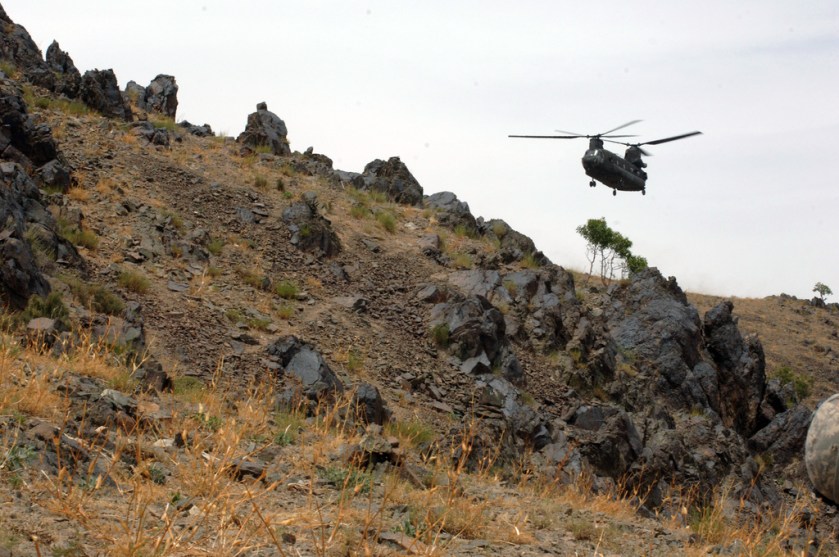 [Image: U.S. military helicopter in Afghanistan, courtesy U.S. Army, taken by by Staff Sgt. Marcus J. Quarterman].
It was a titanic undertaking, “a wall of walls,” in his words, an improvised barrier like something out of Mad Max:
Concrete blast barriers lined up twenty feet high, one against another on the slanting ground, shingled all across the gap, with another layer of shorter walls piled haphazardly atop, and more shoring up the gaps at the bottom. There must have been another complete set of walls built behind the one he could see, because the whole hulking thing had been filled with cement. It had oozed and dried like frosting at the seams, puddling through the gaps at the bottom.
The man puts his hand on the concrete, knowing now that the whole valley had simply been sealed off. It “was closed.”
There are many things that interest me here. One is this notion that a distant megastructure, of which few people are aware, nonetheless exhibits direct and tangible effects on their everyday lives; you might not even know such a structure exists, in other words, but your life has been profoundly shaped by it. The metaphoric possibilities here are obvious.
 [Image: Photo courtesy U.S. Army, taken by Spc. Ken Scar, 7th MPAD].
But I was also reminded of another famous military wall constructed in a remote mountain landscape to keep a daunting adversary at bay, the so-called “Alexander’s Gates,” a monumental—and entirely mythic—architectural project allegedly built by Alexander the Great in the Caucasus region to keep monsters out of Europe. This myth was the Pacific Rim of its day, we might say.
I first encountered the story of Alexander’s Gates in Stephen T. Asma’s book, On Monsters.
Alexander supposedly chased his foreign enemies through a mountain pass in the Caucasus region and then enclosed them behind unbreachable iron gates. The details and the symbolic significance of the story changed slightly in every medieval retelling, and it was retold often, especially in the age of exploration. (…) The maps of the time, the mappaemundi, almost always include the gates, though their placement is not consistent. Most maps and narratives of the later medieval period agree that this prison territory, created proximately by Alexander but ultimately by God, houses the savage tribes of Gog and Magog, who are referred to with great ambiguity throughout the Bible, and sometimes as individual monsters, sometimes as nations, sometimes as places.
On the other side of Alexander’s Gates was what Asma memorably calls a “monster zone.”
 [Image: Photo courtesy U.S. Army, taken by U.S. Army Pfc. Andrya Hill, 4th Brigade Combat Team].
In any case, you can learn a bit more about the gates in this earlier post on BLDGBLOG, but it instantly came to mind while reading The Valley.
Renehan’s bulging “wall of walls,” constructed by U.S. military helicopters in a hostile landscape so remote it is all but over the edge of the world, purely with the goal of sealing off an entire mountain valley, is a kind of 21st-century update to Alexander’s Gates.
In fact, it makes me wonder what sorts of megastructures exist in contemporary global military mythology—what urban legends soldiers tell themselves and each other about their own forces or those of their adversaries—from underground super-bunkers to unbreachable desert walls. What are the Alexander’s Gates of today?
In Case You Missed Them
There are a few books I wanted to mention here at the height of the holiday season, not because they’re new or even necessarily recent but because, selfishly, I simply wish more people had read them. If you’re looking for an extra gift, or just a last-minute surprise, for anyone with an interest in architecture, landscape, archaeology, acoustics, geopolitics, history, and more, here are eight titles to consider.

(1) The Strait Gate: Thresholds and Power in Western History by Daniel Jütte (Yale University Press)—This is an academic work, in both tone and approach, but of the ideal kind: nearly every page had something I wanted to underline, write down, or scramble to look up elsewhere. Put simply, The Strait Gate is a history of the door, but, as Jütte shows, this ultra-quotidian architectural detail—the dividing line between inside and outside—has political, psychological, Constitutional, philosophical, mythological, narrative, cultural, and even material implications that are easy to overlook. Whether it’s a controversial order that “all door handles and knobs be removed from homes and shops” so that the metal could be melted down for war materiel, divine gateways as described in the Book of Revelation, or the resonant phenomenon of Torschlusspanik—“panic of gate closure,” aka a fear of being locked out—Jütte’s book is a superb example of how we can still look at architecture afresh.
(2) The First Fossil Hunters: Dinosaurs, Mammoths, and Myth in Greek and Roman Times by Adrienne Mayor (Princeton University Press)—What did cultures without the benefit of modern scientific knowledge think of the monstrous skeletons and fossilized bones they occasionally unearthed? Quite a lot, as it happens. It turns out that huge chunks of human mythology, including the existence of dragons and the idea of an extinct race of titanic super-human ancestors, can all be traced back to misinterpretations of paleontology. Mayor’s writing is casually engaging—even quite funny, at times—and the book’s many examples of ancient human societies encountering monstrous, inexplicable, and possibly otherworldly things hidden in the earth stuck with me long after reading it.
(3) The Sound Book: The Science of the Sonic Wonders of the World by Trevor Cox (W.W. Norton)—If you have even a passing interest in sound, this is the book to read. Trevor Cox, an acoustic engineer, introduces readers to sonic phenomena around the world, both naturally occurring and artificially induced, from the frozen surface of Russia’s Lake Baikal to Stone Age tombs in rural England. There are examples of sound art, acoustic science, and even landscape-scale auditory effects that easily justify the subtitle, “sonic wonders of the world.” This would pair well with David Toop’s Ocean of Sound, for those of you interested not just in acoustics but in avant-garde composition and ambient music, as well.

(4) The Tomb of Agamemnon by Cathy Gere (Harvard University Press)—This slim book, part of classicist Mary Beard’s excellent (but, sadly, now hibernating) “Wonders of the World” series for Harvard University Press, hit so many sweet spots for me. Author Cathy Gere convincingly shows how Mediterranean archaeological discoveries over the course of the 19th century helped to shape an emerging European mythos of the glories of war and historical empire. These same emphases lent themselves extremely well, however, to tragic and grotesque distortions that soon fed into the twin ideologies of Nazism and 20th-century fascism. Along the way, Gere writes, Classical discoveries misinterpreted by modern biases helped to justify British involvement in World War I. Gere’s book includes a brief, beautiful, and monumentally sad description of young, Homer-quoting scholars being shipped off to war to fight a rising evil from the East—only to be annihilated in the sodden trenches of the Somme. The Tomb of Agamemnon is probably one of my favorite ten books of the past decade; no other book I’ve read in that time conveys the true political stakes of archaeological research and the clear and obvious risks in distorting history for ideological ends.
(5) Lawrence in Arabia: War, Deceit, Imperial Folly and the Making of the Modern Middle East by Scott Anderson (Anchor)—It’s a little disingenuous to suggest that this widely publicized book has been overlooked, but Lawrence in Arabia is nonetheless an uncannily well-timed history of the post-World War I Middle East and well worth taking the time to read. I was utterly absorbed by it for nearly a week. Part military adventure, part geopolitical biography of Lawrence of Arabia, part soul-crushing alternative history of a region that could have been—complete with agonizing descriptions of the infamous assault on Gallipoli—this book will make you see the entire 20th century differently, up to and including our own century’s Iraq War and the rise of ISIS.
(6) Map of a Nation: A Biography of the Ordnance Survey by Rachel Hewitt (Granta)—I mentioned this book in a recent post and I would recommend it again. Map of a Nation tells the story of the British Ordnance Survey, the institute’s original geopolitical context, and the experimental cartographic tools it used to make its imperial surveys more accurate. For anyone interested in geography, maps, landscape, or British history, Hewitt’s book is a must-read.

(7) Exploding the Phone by Phil Lapsley (Grove/Atlantic)—You don’t need to be interested in the wonkish details of the telephone system to be amazed by the weirdness of Exploding the Phone, Phil Lapsley’s introduction to so-called phone phreaking. On one level, it’s a story of bored teenagers using synthesized sound and DIY home electronics to hack the global telephone network; on another, it’s a story with hugely metaphoric, almost occult undertones. The phone system’s diffuse and labyrinthine system of “inward operators,” robotic mechanical test numbers, and secret military phone exchanges—to name only a few ingredients—takes on the air of something invented by Alan Moore or Grant Morrison: teens encountering a world of numerological connection and mechanical intelligence through handheld receivers in the long afternoons of the 1960s and 70s. So good.
(8) Sealab: America’s Forgotten Quest to Live and Work on the Ocean Floor by Ben Hellwarth (Simon & Schuster)—The only thing that makes me pause before recommending Ben Hellwarth’s Sealab right now is that a brand new paperback edition is due out in June 2017; but, that aside, I heartily endorse this one. Imagine Archigram teaming up with a secretive branch of the U.S. military to invent an utterly bonkers new version of human civilization on the ocean floor, and you’ve roughly pictured what this book is about. Whether it’s describing what were, in effect, moon bases at the bottom of the sea or bizarre experiments with farm animals, submerged ecological research stations or Cold War espionage in the Sea of Okhotsk, Sealab is as much outsider architectural history as it is a maritime geopolitical thriller. At the very least, preorder the forthcoming paperback if you want to wait before diving in.
Finally, it’s super-obnoxious to end with my own book, but if you’re looking for something to read this winter—or if you need a gift for someone who can be hard to shop for—consider picking up a copy of A Burglar’s Guide to the City. It’s a mix of true crime, architectural theory, and first-person reporting, from a Chicago lock-picking club to flying with the LAPD’s Air Support Division, from an architect who became the most prolific bank robber of the 19th century to fake apartments run by the British police. A Burglar’s Guide includes interviews with a Toronto burglar known for using the city’s fire code to help pick his next target, with renowned architect Bernard Tschumi, with game designers, and with FBI Special Agents, among others, and the whole thing is currently being adapted for TV by CBS Studios. Check it out, if you get the chance and let me know what you think.
Mass Effect
 [Image: The weight of a human being; courtesy U.S. Library of Congress].
Over at the consistently interesting Anthropocene Review, a group of geologists and urbanists have teamed up to calculate the total mass of all technical objects—from handheld gadgetry to agricultural equipment, from domesticated forests to architectural megastructures—produced by contemporary humanity.
 [Image: Courtesy U.S. Library of Congress].
Their seemingly impossible goal was to gauge “the scale and extent of the physical technosphere,” where they define the technosphere “as the summed material output of the contemporary human enterprise. It includes active urban, agricultural and marine components, used to sustain energy and material flow for current human life, and a growing residue layer, currently only in small part recycled back into the active component.”
The active technosphere is made up of buildings, roads, energy supply structures, all tools, machines and consumer goods that are currently in use or useable, together with farmlands and managed forests on land, the trawler scours and other excavations of the seafloor in the oceans, and so on. It is highly diverse in structure, with novel inanimate components including new minerals and materials, and a living part that includes crop plants and domesticated animals.
Their “preliminary” calculations of all this suggest a mass of 30 trillion tons.
 [Image: Interior of Hughes Aircraft Company cargo building, courtesy U.S. Library of Congress].
The authors immediately put this number into a darkly awe-inspiring perspective:
If assessed on palaeontological criteria, technofossil diversity already exceeds known estimates of biological diversity as measured by richness, far exceeds recognized fossil diversity, and may exceed total biological diversity through Earth’s history. The rapid transformation of much of Earth’s surface mass into the technosphere and its myriad components underscores the novelty of the current planetary transformation.
This “rapid transformation of much of Earth’s surface mass into the technosphere” means that we are turning the planet into technical objects, dismantling and recombining matter on a planetary scale. The idea that the results of this ongoing experiment “may exceed total biological diversity through Earth’s history” is sobering, to say the least.
Read the rest of the article over at The Anthropocene Review.
(Originally spotted via Chris Rowan).
Covert Cartographics
 [Image: Map Measuring Tool, CIA].
The U.S. Central Intelligence Agency has uploaded a massive set of images from their historic mapping unit to Flickr.
 [Image: Triangular 24-Inch Engineering Scale, CIA].
The collections include state-of-the-art graphic tools for producing maps and other measured cartographic products, as well as the maps themselves. Organized by the decade of its production—including batches from the 1940s, 1950s, and 1960s—“each map is a time capsule of that era’s international issues,” as Allison Meier points out.
 [Image: Terrain map of the Sinai Peninsula (1950s), CIA, CIA].
“The 1940s include a 1942 map of German dialects,” Meier writes, “and a 1944 map of concentration camps in the country. The 1950s, with innovative photomechanical reproduction and precast lead letters, saw maps on the Korean War and railroad construction in Communist China. The 1960s are punctuated by the Cuban Missile Crisis and Vietnam War, while the 1970s, with increasing map automation, contain charts of the Soviet invasion of Afghanistan, and the Arab oil embargo.”


 [Images: The Austin Photo Interpretometer, CIA].
But it’s the mapping tools themselves that really interest me here.
On one level, these graphic devices are utterly mundane—triangular rulers, ten-point dividers, and interchangeable pen nibs, for example, any of which, on its own, would convey about as much magic as a ballpoint pen.
 [Image: 10-Point Divider, CIA].
Nonetheless, there is something hugely compelling for me in glimpsing the actual devices through which a country’s global geopolitical influence was simultaneously mapped and strategized.

 [Images: Rolling Disc Planimeter, CIA].
As the CIA points out, their earliest mapping division “produced some 8,000 hand-drawn maps and 64 plaster topographic 3-D models in support of the war effort. Many of their products played crucial roles in the planning and execution of major military operations in the European, North African, and Asian Theaters. On display here are just some of the many tools that OSS cartographers employed in their production process.”
 [Image: Dietzgen Champion Drawing Instruments, CIA].
In a sense, it’s not unlike seeing the actual typewriter with which a particular author wrote her novels, or the battered, handheld sketchbooks a painter once carried with him to a distant mountaintop—only here, in art historical terms, we are looking at the graphic tools and visual documents through which a country’s overseas influence was realized and maintained.
It is a narrative of covert state power as relayed through cartographic objects, the outlines of an imperial nation-state arising from them like a ghost.
 [Image: Stanley Improved Pantograph, CIA].
I’m reminded of one of my favorite books on the subject of geopolitics, literally understood: Rachel Hewitt’s Map of a Nation: A Biography of the Ordnance Survey.
Among other things, Hewitt’s book reveals the often deeply strange tools—including surreal glass rods—through which British mapmakers and other agents of terrestrial exploration measured their nascent empire, helping to transform landscape into a mathematized system of coordinates and, in the process, conveying to British authorities the exact volumetric extent of their political domain.
There was the empire, in other words—but there were also these exotic objects of measurement through which that same empire was conjured, as if through cartographic magic.
 [Image: Keufel & Esser 20.5-inch Slide Rule, CIA].
In any case, check out more at the CIA’s “Cartography Tools” Flickr set.
(Originally spotted via Alessandro Musetta).
Transnational Corporate Sovereignty
With the expected nomination of ExxonMobil CEO Rex Tillerson to the position of U.S. Secretary of State, the recent book Private Empire: ExxonMobil and American Power by Columbia University dean of journalism Steve Coll seems newly relevant—so much so that, following Friday’s news about the nomination, Amazon has been temporarily sold out.
Coll has also just published a new piece over at The New Yorker looking at Tillerson’s legacy with the global oil firm. There, Coll describes ExxonMobil as resembling “an independent, transnational corporate sovereign in the world, a power independent of the American government, one devoted firmly to shareholder interests and possessed of its own foreign policy.”
Exxon’s foreign policy sometimes had more impact on the countries where it operated than did the State Department. Take, for example, Chad, one of the poorest countries in Africa. During the mid-two-thousands, the entirety of U.S. aid and military spending in the country directed through the U.S. Embassy in the capital, N’Djamena, amounted to less than twenty million dollars annually, whereas the royalty payments Exxon made to the government as part of an oil-production agreement were north of five hundred million dollars. Idriss Déby, the authoritarian President of Chad, did not need a calculator to understand that Rex Tillerson was more important to his future than the U.S. Secretary of State.
Should Tillerson be confirmed, Coll suggests, his new role “will certainly confirm the assumption of many people around the world that American power is best understood as a raw, neocolonial exercise in securing resources.”
The Guardian agrees, suggesting that, “In a very real sense, Tillerson has been a head of a state within a state. Exxon Mobil is bigger economically than many countries. It has its own foreign policy and its own contracted security forces.”
Consider picking up a copy of Private Empire and read more from Coll over at The New Yorker.
Rootkit
 [Image: Work by Diana Scherer, used to promote an event coming up on December 14th, in Wageningen, Holland, where the artist will be speaking].
The work of German-born artist Diana Scherer explores what she calls “the dynamics of belowground plant parts.” She uses plant roots themselves as a medium for creating patterns and networks, the purpose of which is to suggest overlaps between human technological activity and the embodied “intelligence” of living botanical matter. “This buried matter is still a wondrous land,” she writes.
The results are incredible. They feature roots woven like carpets or textiles, imitating Gothic ornament with floral patterns and computational arabesques underground.
 [Image: “Ornament with Thistle” by Daniel Hopfer; via Wikimedia].
.jpg)
Compare Scherer’s work, for example, to traditional Gothic plant ornament—that is, geometric shapes meant to imitate the movements and behaviors of plants—but here actually achieved with plants themselves.
Scherer calls this “root system domestication,” where, on the flipside of an otherwise perfectly “natural” landscape, such as an expanse of lawn grass, wonderfully artificial, technical patterns can be achieved.

 [Images: All images by Diana Scherer, from “Harvest: Exercises in Rootsystem Domestication”].
The idea that we could grow biological circuits and living rootkits is incredible, as if, someday, electronic design and gardening will—wonderfully and surreally—converge.
You simply step into your backyard, exhume some root matter as if harvesting potatoes, and whole new circuits and electrical networks are yours to install elsewhere.
 [Image: From “Harvest: Exercises in Rootsystem Domestication” by Diana Scherer].
After all, the soil is already alive with electricity, and plants are, in effect, computer networks in waiting.
Scherer’s work simply takes those observations to their next logical step, you might argue, using plants themselves as an intelligent form-finding technology with implications for the organic hardware of tomorrow.
For more images, click through to Diana Scherer’s website, and, for those of you near Wageningen, consider stopping by the artist’s live Q&A on December 14th. Someone please commission a landscape-scale work from Scherer soon!
Space Grain
 [Image: A micrometeorite, photographed by Donald Brownlee, University of Washington].
A paper published last month in Geology reported “the discovery of significant numbers (500) of large micrometeorites (>100 μm) from rooftops in urban areas”—or “cosmic dust grains,” in the words of New Scientist, that have been “found on city rooftops for the first time.”
Although the samples were “collected primarily from roof gutters in Norway,” according to the original paper, their presence there “demonstrates that, contrary to current belief, micrometeorites can be collected from urban environments.” That is, the dust of ruined cosmic objects can be found intermixed with autumn leaves, cigarette butts, and brake pad dust, perhaps even accumulating on your bedroom window sill.
 [Image: Gorgeous photograph of a micrometeorite by Matej Pašák].
Of course, it has long been possible to sample urban areas for micrometeorites, so this is not entirely new.
What’s fascinating, nonetheless, is that these micrometeorites are most likely to have arrived on Earth within the past six years, the study points out, but their size is notably larger than the average sample of micrometeorites from the recent geological record, indicating “variations in the extraterrestrial dust flux” on the scale of 800,000 years.
As New Scientist points out, this means that larger cosmic shifts can be deduced from the size and shape of these grains:
The differences [in size] may be linked to changes in the orbits of planets such as the Earth and Mars over millions of years, [researcher Matthew Genge] says. Resulting gravitational disturbances may have influenced the trajectory of the particles as they hurtled through space. This in turn would have an effect on the speed at which they slam into the Earth’s atmosphere and heat up.
“This find is important because if we are to look at fossil cosmic dust collected from ancient rocks to reconstruct a geological history of our solar system, then we need to understand how this dust is changed by the continuous pull of the planets,” Genge says.
Something’s changing in our local cosmic-dust environment, in other words, and evidence of this shift is slowly collecting on our roofs and sidewalks, accumulating in our gutters and sills.
(Conceptually related: War Sand).
The Silence of the Bells
 [Image: Instagram by BLDGBLOG].
Citing lack of new business and a changing marketplace, the Whitechapel Bell Foundry has put itself up for sale, the Financial Times reports.
“We are just commencing work on a new peal of bells for St Albans after 43 years of negotiation,” company owner Alan Hughes is quoted as saying. “That’s an example of the timescale we are working on—at least 10 years between order and delivery is normal.”
 [Image: The beautiful, gleaming interior of a newly tuned church bell; Instagram by BLDGBLOG].
However, the Financial Times adds, “the business has faced two other structural challenges. Bells, unlike modern devices, are made to last centuries. The other weakness of the company is that Whitechapel’s main customer, the Church of England, is in decline with congregations in the UK halving in the past 40 years.”
Check out BLDGBLOG’s visit to the Foundry back in 2012.
Piscine Virtual Reality
 [Image: From “Putting the Fish in the Fish Tank: Immersive VR for Animal Behavior Experiments” by Sachit Butail, Amanda Chicoli, and Derek A. Paley].
I’ve had this story bookmarked for the past four years, and a tweet this morning finally gave me an excuse to write about it.
Back in 2012, we read, researchers at Harvard University found a way to fool a paralyzed fish into thinking it was navigating a virtual spatial environment. They then studied its brain during this trip that went nowhere—this virtual, unmoving navigation—in order to understand the “neuronal dynamics” of spatial perception.
As Noah Gray wrote at the time, deliberately highlighting the study’s unnerving surreality, “Paralyzed fish navigates virtual environment while we watch its brain.” Gray then compared it to The Matrix.
The paper itself explains that, when “paralyzed animals interact fictively with a virtual environment,” it results in what are called “fictive swims.”
To study motor adaptation, we used a closed-loop paradigm and simulated a one-dimensional environment in which the fish is swept backwards by a virtual water flow, a motion that the fish was able to compensate for by swimming forwards, as in the optomotor response. In the fictive virtual-reality setup, this corresponds to a whole-field visual stimulus that is moving forwards but that can be momentarily accelerated backwards by a fictive swim of the fish, so that the fish can stabilize its virtual location over time. Remarkably, paralyzed larval zebrafish behaved readily in this closed-loop paradigm, showing similar behavior to freely swimming fish that are exposed to whole-field motion, and were not noticeably compromised by the absence of vestibular, proprioceptive and somatosensory feedback that accompanies unrestrained swimming.
Imagine being that fish; imagine realizing that the spatial environment you think you’re moving through is actually some sort of induced landscape put there purely for the sake of studying your neural reaction to it.
Ten years from now, experimental architecture-induction labs pop up at universities around the world, where people sit, strapped into odd-looking chairs, appearing to be asleep. They are navigating labyrinths, a scientist whispers to you, trying not to disturb them. You look around the room and see books full of mazes spread across a table, six-foot-tall full-color holograms of the human brain, and dozens of HD computer screens flashing with graphs of neural stimulation. They are walking through invisible buildings, she says.
 [Image: From “Putting the Fish in the Fish Tank: Immersive VR for Animal Behavior Experiments” by Sachit Butail, Amanda Chicoli, and Derek A. Paley].
In any case, the fish-in-virtual-reality setup was apparently something of a trend in 2012, because there was also a paper published that year called “Putting the Fish in the Fish Tank: Immersive VR for Animal Behavior Experiments,” this time by researchers at the University of Maryland. Their goal was to “startle” fish using virtual reality:
We describe a virtual-reality framework for investigating startle-response behavior in fish. Using real-time three dimensional tracking, we generate looming stimuli at a specific location on a computer screen, such that the shape and size of the looming stimuli change according to the fish’s perspective and location in the tank.
As they point out, virtual reality can be a fantastic tool for studying spatial perception. VR, they write, “provides a novel opportunity for high-output biological data collection and allows for the manipulation of sensory feedback. Virtual reality paradigms have been harnessed as an experimental tool to study spatial navigation and memory in rats, flight control in flies and balance studies in humans.”
But why stop at fish? Why stop at fish tanks? Why not whole virtual landscapes and ecosystems?
Imagine a lost bear running around a forest somewhere, slipping between birch trees and wildflowers, the sun a blinding light that stabs down through branches in disorienting flares. There are jagged rocks and dew-covered moss everywhere. But it’s not a forest. The bear looks around. There are no other animals, and there haven’t been for days. Perhaps not for years. It can’t remember. It can’t remember how it got there. It can’t remember where to go.
It’s actually stuck in a kind of ursine Truman Show: an induced forest of virtual spatial stimuli. And the bear isn’t running at all; it’s strapped down inside an MRI machine in Baltimore. Its brain is being watched—as its brain watches the well-rendered polygons of these artificial rocks and trees.
(Fish tank story spotted via Clive Thompson. Vaguely related: The Subterranean Machine Dreams of a Paralyzed Youth in Los Angeles).
The Totality That Remains Invisible
 [Image: Alice Aycock, “Project for Elevation with Obstructed Sight Lines” (1972)].
A few years ago, my wife and I went out to hike Breakneck Ridge when there was still a bunch of snow on the ground. It’s not, in and of itself, a hugely challenging hike, but between being ill-prepared for the slippery terrain, including a short opening scramble up snow-covered rocks, we found ourselves looking forward to the final vertical stretch before we could loop back down again to the road.
What was interesting, however, was that, from our point of view, each hill appeared to be the final one—until we got to the top of it and saw another one waiting there. Then it happened all over again: what appeared to be the final hill was actually just obstructing our view of the next one, and the next one, and the next one, and, next thing we knew, there were something like seven or eight different individual upward hikes, each hidden from view by the one leading up to it.
In 1972, earthworks artist Alice Aycock proposed a new, never-built work called “Project for Elevation with Obstructed Sight Lines.” It was part of a larger group, Aycock’s Six Semi-Architectural Projects, exhibited in 1973.
“Elevation with Obstructed Sight Lines” was meant to be a sculpted mound of earth, shaped for its optical effects.
 [Image: Alice Aycock, “Project for Elevation with Obstructed Sight Lines” (1972), courtesy White Columns].
“Only one side of the resulting structure can be climbed,” Aycock wrote in her brief instructions for realizing the conceptual project. “All other side slopes are steep enough to deter climbing. The elevation of each successive climbing slope is determined by the sight lines of a 6 ft. observer so that only as the observer completes the ascent of a given slope does the next slope become visible.”
The piece obviously lends itself quite well to Kafka-esque metaphors—this structure that deliberately hides itself from view, never once perceptible in its totality but, instead, always revealing more of itself the further you go.
However, it also interestingly weds conceptual land art with hiking—that is, with embodied outdoor athleticism, rather than detached aesthetic contemplation—implying that, perhaps, trail design is an under-appreciated venue for potential conceptual art projects, where a terrain’s symbolic power only becomes clear to those engaged with hiking it.
(Aycock’s project spotted via Ends of the Earth: Land Art to 1974).