Spaces of Food #4: Betel Nut Beauties

[Image: From Betel Nut Beauties by Magda Biernat, courtesy of Clic Gallery].

This rounds out today’s short series of posts written for GOOD’s online festival of food-related writing.

I first heard of the Taiwanese spatial subculture of betel nut shacks last autumn when a former student of mine at USC, Yu-Quan Chen, showed me a project he once proposed, inspired by these anomalous yet everyday spaces.

[Image: From Betel Nut Beauties by Magda Biernat, courtesy of Clic Gallery].

I was thus interested to see that Polish-born, New York-based photographer Magda Biernat will be exhibiting a group of images she’s made called Betel Nut Beauties, a few examples of which are seen here.

[Image: From Betel Nut Beauties by Magda Biernat, courtesy of Clic Gallery].

The Clic Gallery describes Biernat’s project as “a photoseries documenting the compelling phenomenon of roadside betel nut stands across Taiwan.”

A fixture on the streets of urban and suburban Taiwan, these brightly lit, often ramshackle huts sell a mild stimulant made from the nut of the areca palm and wrapped in betel leaves… Staffed almost exclusively by young women, the stands cater to longhaul truck drivers and, like taxi dancers or cigarette girls in casinos, the betel nut girls are encouraged to dress in skimpy clothes to lure in male customers. Snapped while waiting for their next sale, Biernat’s compassionate photographs capture the isolation and tedium of these sellers who themselves are on display, a daily existence bounded by walls of glass.

Biernat describes these buildings as “luminescent structures” where sex, economics, and food overlap—thus making the title of this post (“spaces of food…”) referentially problematic, as if the women themselves are objects of both bodily and aesthetic consumption. “The colorful shops,” Biernat writes, “with their scantily clad employees make for a startling contrast against Taiwan’s often drab urban landscape.”

[Images: From Betel Nut Beauties by Magda Biernat, courtesy of Clic Gallery].

“These are glass and neon jewels,” Biernat adds, “beckoning the customer with the high of not only the betel nut, but of the interaction with the betel nut girls.”

[Images: From Betel Nut Beauties by Magda Biernat, courtesy of Clic Gallery].

The exhibition opens February 7 at the Clic Gallery in New York, with an opening reception on February 10.

—Spaces of Food #5: Madeira Odorless Fish Market and the Tempelhof Ministry of Food
—Spaces of Food #4: Betel Nut Beauties
—Spaces of Food #3: The Mushroom Tunnel of Mittagong
—Spaces of Food #2: Inflatable Greenhouses on the Moon
—Spaces of Food #1: Agriculture On-The-Go and the Reformatting of the Planet

Spaces of Food #3: The Mushroom Tunnel of Mittagong

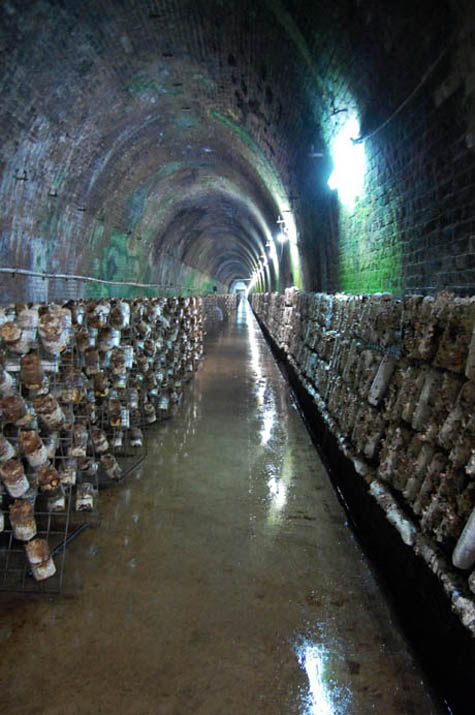
It seems appropriate, in the context of GOOD’s ongoing week of interdisciplinary food writing, to revisit an old favorite post of mine, written by Nicola Twilley, about the extraordinary mushroom tunnel of Mittagong, where disused industrial infrastructure and an emerging food-production system fortuitously intersect.

[Image: The mushroom tunnel of Mittagong; photo by Nicola Twilley].

To make a long story short, Nicola and I had the pleasure, back in 2009, of visiting an abandoned railway tunnel in the hills southwest of Sydney, Australia, a site that has since been turned into a commercial mushroom farm. Featuring no less than a linear kilometer of underground mycological cultivation—racks upon racks upon racks, fruiting with mushrooms in the semi-darkness—it extended as far as the eye could see.

So, to see what we saw, you really should check out Nicola’s post.

—Spaces of Food #5: Madeira Odorless Fish Market and the Tempelhof Ministry of Food
—Spaces of Food #4: Betel Nut Beauties
—Spaces of Food #3: The Mushroom Tunnel of Mittagong
—Spaces of Food #2: Inflatable Greenhouses on the Moon
—Spaces of Food #1: Agriculture On-The-Go and the Reformatting of the Planet

Spaces of Food #2: Inflatable Greenhouses on the Moon

Continuing today’s short series of posts, offered up as part of GOOD’s ongoing food-blogging week, I thought I’d point your attention to an interesting architectural experiment in the U.S. southwest.

[Image: Gene Giacomelli and his lunar greenhouse; photo by Norma Jean Gargasz courtesy of UANews].

Researchers at the University of Arizona’s Controlled Environment Agriculture Center have devised a “lunar greenhouse” that “could be the key to growing fresh and healthy food to sustain future lunar or Martian colonies,” Space reported back in October.

Under the guidance of Gene Giacomelli, “The team built a prototype lunar greenhouse in the CEAC Extreme Climate Lab that is meant to represent the last 18 feet (5.5 meters) of one of several tubular structures that would form part of a proposed lunar base. The tubes would be buried beneath the moon’s surface to protect the plants and astronauts from deadly solar flares, micrometeorites and cosmic rays. As such, the buried greenhouse would differ from conventional greenhouses that let in and capture sunlight as heat. Instead, these underground lunar greenhouses would shield the plants from harmful radiation.”

As Popular Science describes it:

The 18-foot, membrane-sheathed system collapses into a 4-foot wide disk for easy packing on an interplanetary mission. When extended, it is fitted with water-cooled lamps and seed packets prepped to sprout without soil. They hydroponic system needs little oversight, relying on automated systems and control algorithms to analyze data gathered by embedded sensors that optimize the controlled ecosystem. The whole system takes just ten minutes to set up and produces vegetables within a month.

Giacomelli himself explains that lunar rovers—or “robotic bulldozers”—would first bury the greenhouses, installing them in advance of human arrival. Then, “When the spacecraft sets down, the idea is that [the buried greenhouse] expands outwards, opens by itself, like a robot would. The seeds are already in place. We start it up, turn on the lights, turn on the water, and the plants can begin to grow, even in advance of when the astronauts arrive.”

Interestingly, Antarctica supplied a kind of natural test-environment for this architectural experiment: “the extreme conditions of the South Pole helped his team fine-tune their lunar greenhouse, and also allowed them to figure out how to remotely control conditions like temperature, humidity and light. He said similar technologies could also be used someday in cities—in a greenhouse in the middle floor of a skyscraper, for example. He added that, at least right now, the technology, and lighting, especially, are too expensive for daily commercial use.”

[Image: A glimpse inside the “oxygen garden” from Danny Boyle’s film Sunshine; courtesy of DNA Films].

A long time ago, meanwhile, we looked at the idea of an “oxygen garden,” pictured above, with its vision of locally networked plants, aeration devices, cylindrical growth chambers, and hydroponic vats for long-term space missions. But an oxygen garden is only one particular kind of non-terrestrial agriculture under cultivation right now.

As Popular Mechanics explain in their January 2011 issue, “Teams of scientists around the world—and above it, aboard the International Space Station—are trying to design farms for the diverse environments future explorers could encounter across the solar system.” From “robotic farmers with articulate hands” operating inside inflatable greenhouses on the moon to microgravitational peas and radishes grown by the fantastically named Roscosmos, by way of greenhouses “that can endure Mars’s low-pressure, high-carbon-dioxide environment” designed by the Italian Space Agency to the Arthur C. Clarke Mars Greenhouse (not mentioned by Popular Mechanics), these living experiments demonstrate how to use architecture as a way to frame unearthly environments here on earth—so that we can then bring earthly environments with us to other planets. It’s the referential topology of interplanetary simulation.

In fact, repeating myself from the earlier oxygen garden post, I remain fascinated by and slightly in awe of the idea of what I call surrogate earths, whereby the earth enters into a chain of substitutions—a standardized economy of counterfeits and stand-ins, experimental surrogates and scientific stunt-doubles, all of which refer to, re-enact, and simulate a superceded original. These portable versions of the planet, from its climate and its soil to its viruses and bacteria, pop up everywhere from plans for hydroponic gardens, terrariums, and floating greenhouses to complex manned missions to the moon. And, if only for the purpose of growing vegetables, it is nonetheless extraordinary that we can use a finely tuned technological apparatus–including specialty fertilizers, nanofabrics, and UV lights–to reproduce terrestrial conditions elsewhere, in miniature.

—Spaces of Food #5: Madeira Odorless Fish Market and the Tempelhof Ministry of Food
—Spaces of Food #4: Betel Nut Beauties
—Spaces of Food #3: The Mushroom Tunnel of Mittagong
—Spaces of Food #2: Inflatable Greenhouses on the Moon
—Spaces of Food #1: Agriculture On-The-Go and the Reformatting of the Planet

Spaces of Food #1: Agriculture On-The-Go and the Reformatting of the Planet

[Image: Like something out of the work of Vicente Guallart, a farm in Washington State; image via Wikipedia].

As a participant in GOOD‘s extremely wide-ranging food-blogging week, I wanted to look at a few things over the course of two or three posts today, starting with a quick look at the very idea of agriculture, as explored by natural historian Tim Flannery in his book The Future Eaters.

There, amongst many other things, Flannery explains what it means to be a quote-unquote “hunter-gatherer” vs. a sedentary agricultural society. He writes, for instance, that “the problem of defining just what constitutes agriculture is an acute one when examining the prehistory of New Guinea.”

Traditionally, the major crops of the region have been root crops such as taro, or suckering species such as bananas. In order to propagate these plants one simply needs to grub them up, cut off the tuber or sucker and stick the leafy top back into the ground. This simple act has probably been a part of the human behavioral repertoire for 100,000 years or more. Clearly it does not qualify a person as an agriculturalist. But what is to be said of the person who returns to the newly established plant occasionally and clears competing species (weeds) away from it? And what if they plant 10 taro tops together; does that qualify as a garden? Would it do so if they fenced the patch? Clearly the definition of agriculturalist merges insensibly into the definition of hunter-gatherer and it is impossible to say where one ends and the other begins.

This mobile cultivation of the landscape actually helped to generate, as Flannery goes on to explain, a substantial part of our contemporary, highly globalized fruit diet. Indeed, he writes, “Given the extremely long history of agriculture in New Guinea, it is not surprising that a number of plant foods appear to have originated there. Among these are certain varieties of taro, sago, some kinds of yams, bananas (particularly the cooking or plantain varieties), sugar cane and various nuts. Some of these crops were adopted by people as far afield as Africa, Asia and the Pacific Islands many hundreds of years before European colonization of the Pacific. New Guinean agriculture has thus made an important, if largely forgotten, contribution to the food crops of the world.”

This seemingly casual, on-the-go human interaction with the biosphere—simply replanting root stocks now and again, and returning every once in a while to harvest, replant, clear away, and prune—helped to bring into existence what are now highly refined, industrially useful plant species. Bananas, in particular, are an excellent example of a food that has become so thoroughly enmeshed in international economic systems of consumption and export that they bear little formal or nutritional resemblance to their genetic forebears.

[Image: Landscape as if subject to the spatial kerning and leading of an agricultural typography; via Wikipedia].

But what specifically interests me here is how the long-term re-formatting of the planet’s landscape, whereby the surface of the earth has slowly been made habitable almost solely for humans and the species they cultivate, began with something as small-scale—a field operation as micro-tactical and discrete—as pushing roots into the ground and then coming back a few days later to see how it’s all developed. Repeat this action for a hundred-thousand years, scaling it up each time, both mechanically and quantitatively, and what was once a lo-fi interaction with the forest has become an industrialized agriculture for an exponentially humanized earth.

—Spaces of Food #5: Madeira Odorless Fish Market and the Tempelhof Ministry of Food
—Spaces of Food #4: Betel Nut Beauties
—Spaces of Food #3: The Mushroom Tunnel of Mittagong
—Spaces of Food #2: Inflatable Greenhouses on the Moon
—Spaces of Food #1: Agriculture On-The-Go and the Reformatting of the Planet

Housing London’s Robot Workforce

[Image: “Southwyck House,” “inhabited by London’s new robot workforce,” by Kibwe X-Kalibre Tavares of Factory Fifteen].

Nic Clear, from Unit 15 of the Bartlett School of Architecture, recently got in touch with some links to his students’ newest work, all of which explores architecture through the lens of both narrative and abstract film. Clear, as you might recall, instructed both Keiichi Matsuda and Richard Hardy, and there’s some really fantastic work coming out of his studio.

Amongst short films by Paul D. Nicholls, Jonathan Gales, Richard Reginald Young, and Christopher Lees, I was particularly struck by the premise (and visual execution) of Kibwe X-Kalibre Tavares‘s “Southwyck House,” seen above.

It is part of what Tavares calls “a collection of images of what Brixton could be like if it were to develop as a disregarded area inhabited by London’s new robot workforce.” To accommodate the rapidly growing machine-population, “unplanned cheap quick additions have been made to the skyline.”

[Image: “Brixton High Street” by Kibwe X-Kalibre Tavares of Factory Fifteen].

Together with the image “Brixton High Street,” this mechanized borough presents a compelling visual backdrop for future narrative explorations—spatial, technical, economic, and sociopolitical—in a kind of robotization of favela chic.

Here is the setting in action, seen in Tavares’s short film, Robots of Brixton:

For more, see the Factory Fifteen website.

Project Iceworm

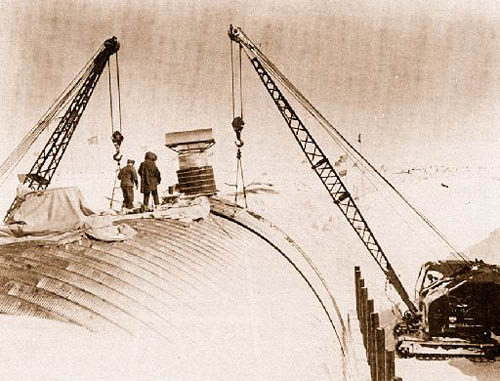
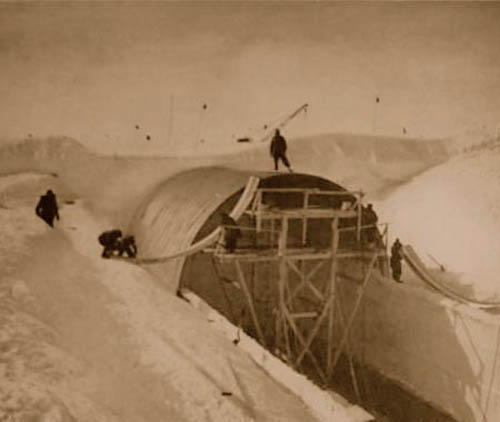
[Image: Camp Century under construction; photograph via Frank J. Leskovitz].

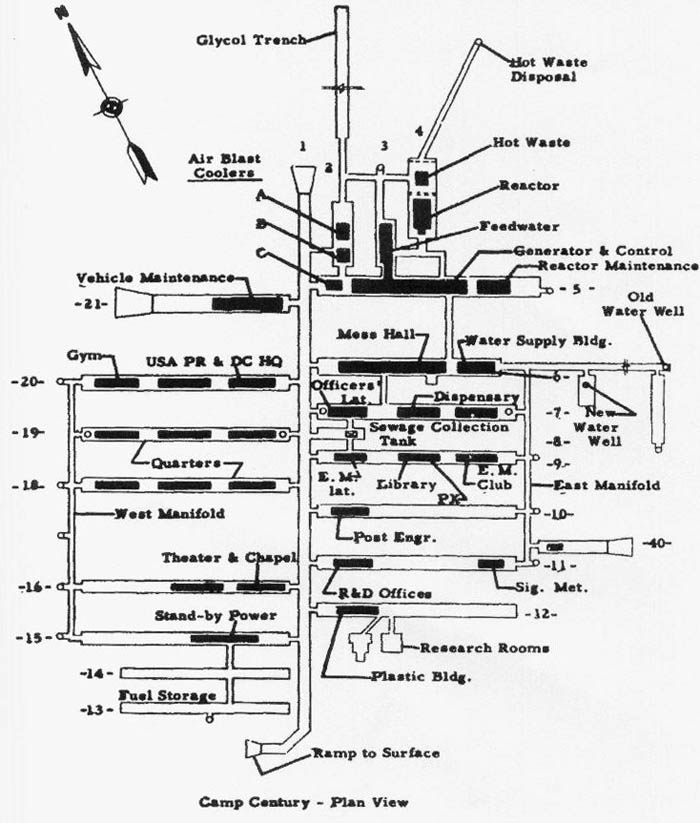
Camp Century—aka “Project Iceworm”—was a “city under ice,” according to the U.S. Army, a “nuclear-powered research center built by the Army Corps of Engineers under the icy surface of Greenland,” as Frank J. Leskovitz explains.

A fully-functioning underground city, Camp Century even had its own mobile nuclear reactor—an “Alco PM-2A”—that kept the whole thing lit up and running during the Cold War.

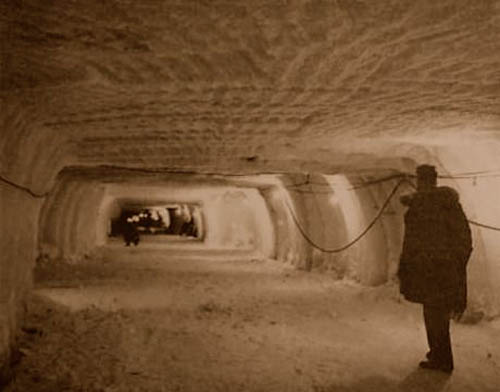
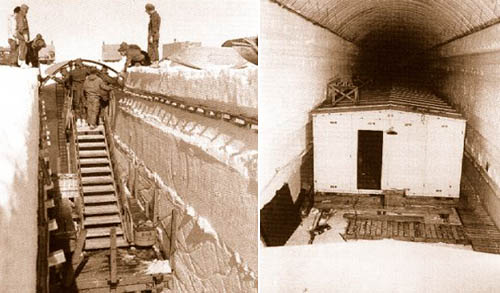
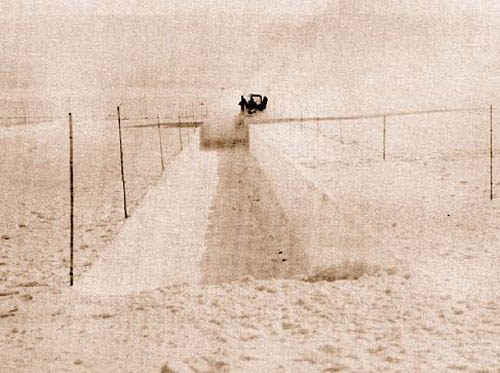
[Images: Camp Century under construction; photographs via Frank J. Leskovitz].

According to Leskovitz, the Camp’s construction crews “utilized a ‘cut-and-cover’ trenching technique” during the base’s infra-glacial assembly:

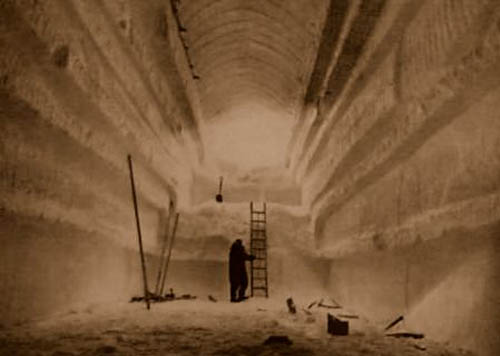
Long ice trenches were created by Swiss made “Peter Plows,” which were giant rotary snow milling machines. The machine’s two operators could move up to 1200 cubic yards of snow per hour. The longest of the twenty-one trenches was known as “Main Street.” It was over 1100 feet long and 26 feet wide and 28 feet high. The trenches were covered with arched corrugated steel roofs which were then buried with snow.

Prefab facilities were then added, with “wood work buildings and living quarters… erected in the resulting snow tunnels.”

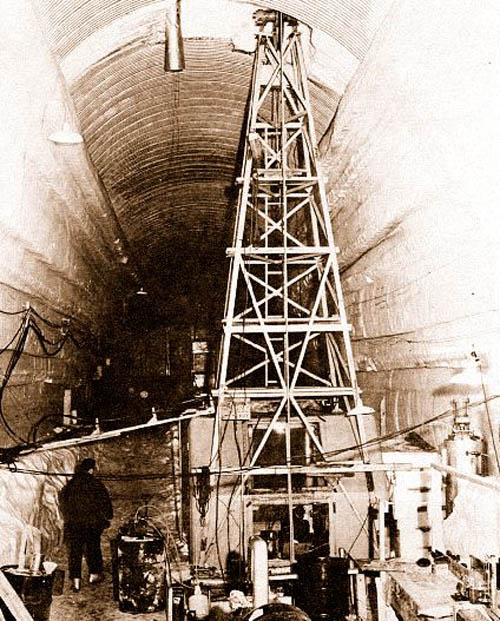
[Images: Camp Century under construction; photographs via Frank J. Leskovitz].

Leskowitz continues:

Each seventy-six foot long electrically heated barrack contained a common area and five 156 square foot rooms. Several feet of airspace was maintained around each building to minimize melting. To further reduce heat build-up, fourteen inch diameter “air wells” were dug forty feet down into the tunnel floors to introduce cooler air. Nearly constant trimming of the tunnel walls and roofs was found to be necessary to combat snow deformation.

Camp Century went from a scientific outpost to a potential U.S. Army site for hosting battle-ready nuclear missiles underneath the Greenland ice sheet—the so-called “Project Iceworm” mentioned earlier.

The following four short videos, produced by the U.S. military, explore the site’s strange technical circumstances as well as its complicated defensive history.


“During this period of the Cold War,” Leskovitz explains, “the U.S. Army was working on plans to base newly designed ‘Iceman’ ICBM missiles in a massive network of tunnels dug into the Greenland icecap. The Iceworm plans were eventually deemed impractical and abandoned,” and, “due to unanticipated movement of the glacial ice,” the entire subterranean complex was eventually left in ruins.

The idea that the moving terrain of a glacial ice sheet could be considered a stable-enough launching point for nuclear missiles is astonishing, and the idea that the U.S. Army once ran a top secret—and rather Metallica-sounding—”city under ice” just shy of the North Pole only adds to the story’s disarming surreality.

[Image: The plan of Camp Century; via Frank J. Leskovitz].

In any case, more photographs, including of the Army’s mobile nuclear reactor, are available on Leskovitz’s own site.

*Update* In August 2016, a study published in the journal Geophysical Research Letters suggested that “climate change could remobilize abandoned hazardous waste thought to be buried forever beneath the Greenland Ice Sheet,” specifically referring to the ruins of Camp Century.

“Camp Century could start to melt by the end of the century,” the American Geophysical Union summarizes. “If the ice melts, the camp’s infrastructure, as well as any remaining biological, chemical and radioactive waste, could re-enter the environment and potentially disrupt nearby ecosystems.”

[Image: U.S. Army photograph, via the American Geophysical Union].

Here is a PDF of the complete paper.

The Sixth Borough

This year’s One Prize is looking for maritime visions of New York City in which the region’s waterways—with nearly 600 miles of shoreline—have been compellingly re-envisioned as the city’s “sixth borough.” A liquid neighborhood, or aquatic interzone, for the future.

Specifically, the One Prize is looking for proposals that can link otherwise disconnected regions of the city through “a series of green transit hubs incorporating electric passenger ferries, water taxis, bike shares, electric car-share and electric shuttle buses.” Further, prospective designers are asked by the competition to consider a hypothetical “Clean Tech World Expo” for the summer of 2014; your proposed waterborne transit system should thus be resilient enough “to accommodate the 10 million visitors of the Clean Tech World Expo.”

You can read much more about submission requirements in the competition PDF, but I would also urge anyone interested in taking on this challenge to read Float!: Building on Water to Combat Urban Congestion and Climate Change, reviewed here last month, for structural and technical ideas of how you might expand the city into its waterways.

That book explores the “conviction,” its co-author David Keuning writes, “that living on water is essentially no different from living on land, just with a different foundation technique.”

The result of the “fully-fledged use of ‘water ground’ for urban developments,” as the book’s other author, Koen Olthuis, describes it, will be a “buoyant expansion of the urban grid,” opening “possibilities that reach further than [just] floating architecture or a new approach to water management. It changes the whole perspective of city planning.”

Escalators on the Move

A “hydraulic ladder,” or mobile escalator, has been developed for use in firefighting.

[Images: Illustrations by Kevin Hand for Popular Science].

According to Popular Science, the device is “a cross between a conveyer belt and a ladder,” and it “could help firefighters quickly shuttle victims out of burning buildings.”

In a rescue, firemen could extend Denison’s hydraulic ladder to windows as high as 113 feet. But rather than clamber up the ladder, the firefighter would hop on, and the rungs would roll up at 200 feet per minute—more than twice the average climbing speed of a firefighter weighed down by 130 pounds of gear. The firefighter would ride to a window, load unconscious victims into a rescue bag, hook the bag to the ladder, and shift it into reverse to bring the person to safety.

Extra “rungs” would be stored inside the firetruck down below, to be used as needed for reaching higher floors.

Beyond their role in firefighting, however, these escalators on the move—mechanical detachable staircases moving block to block—suggest interesting architectural possibilities for temporary diagonal passage through the city.

Flying Robotic Construction Cloud

Quentin Lindsey, Daniel Mellinger, and Vijay Kumar from the University of Pennsylvania’s GRASP Lab—General Robotics, Automation, Sensing and Perception—have devised a system whereby autonomous flying helicopters can assemble a rudimentary architectural grid using small magnetic beams.

This technology begs a series of questions, of course, including who might first pick up on and directly invest in this construction process (the field exploration wings of transnational oil-services firms? forward-operating base commanders of the 22nd-century U.S. military? rogue GSD students self-supported by a family trust fund?), what sorts of architectural styles might result given the technical and material limitations associated with magnetic cloud-construction (a return to the minimalist grid? Sol Lewitt as architectural progenitor?), and how successfully this could be scaled up to the dimensions of whole towns and cities.

It might not be altogether unfeasible, in other words, given enough time and investment, that we’ll someday see flocks of autonomous helicopters roaring off into western Australia, or into the Canadian Arctic, autonomously assembling supply-chain-governed grid-cities where every magnet, bolt, beam, and screw is dutifully accounted for and guided into place by intelligent airborne mechanisms. Then the humans move in.

Or, extending this into the clichéd territory where BLDGBLOG and the Terminator begin to overlap, perhaps the machines will construct factories for the production of more machines, which will then fly onward and further to build yet more factories, constructing a sovereign halo of autonomous machine-urbanism in the earth’s north polar latitudes.

(Via @WillWiles).

Incident Report

[Image: From a presentation by Smudge Studio (Elizabeth Ellsworth & Jamie Kruse) at the Center for Land Use Interpretation, 15 January 2011].

Yesterday’s event at the Center for Land Use Interpretation was recorded via multiple audio feeds, and each presentation will reappear later this year in some form as an edited transcript; for now, if you want to risk the pointillist abstraction and occasional typos associated with live Twitter commentary, you can read back through the bulk of notes taken yesterday via @bldgbloglive. Thanks again to everyone who came out, meanwhile, in particular to our host and participants.

Super-Workshop Update

[Image: A bubbling tar seep near Wilshire Boulevard].

We’re in the final few days of the Landscape Futures Super-Workshop now, heading out soon for another field trip this afternoon, after half a week of presentations, lectures, site visits, crits, walks, and much else besides.

By way of a rapid and by no means thorough update, I figured I’d give a rundown of some of the many, many things we’ve done so far, having hit the ground running on Tuesday morning with a tour through old oil sites to see the surface indications of L.A.’s subterranean petrology. We visited pumping stations, tar pits, and camouflaged drilling rigs, discussing explosive clouds of methane gas and the machines that monitor those invisible but toxic accumulations, and trying to understand the financial industries that have arisen to package and sell fossil fuels from windowless offices in Los Angeles, all during a series of drives led by architect and local oil-history expert Ben Loescher.

[Images: Skulls and bones at the La Brea Tar Pits].

We heard from students from the Bartlett, Columbia, and the Arid Lands Institute, seeing proposals for urban-scale fortresses made from freshwater injection wells, artificial troglodyte homesteads in Long Beach constructed with from rocks harvested from San Gabriel debris basins, crawling bagpipe-machines (actually built!) that walked around London powered by bike pumps and bleating like sheep, pollution-harvesting devices in the skies of southern California that will collect dust and carbon through electromagnetic attractors, future climate-prediction mechanisms and the networked sensorscapes that make them possible, synthetic orchards, mobile well heads, resistance-powered lamps in the chaparral monitoring seasonal windspeeds, “kit architectures” for unstable landscapes, “cloud dispensers” and other augmented climatologies, machine-cowboys overseeing herds of hydrotropic robots on the dry bed of Owens Lake, groundwater filtration interfaces for sites where the hills hit urban flatlands, open-source bio-fuel experimentation labs run by amateur genetic engineers, urban oxygen gardens, experimental greenhouses running test-climates for a future earth, and a dozen other projects, all of which will continue to be developed, tweaked, or abandoned as the workshop moves on.

[Image: A “satellite tracking station” near the headwaters of the L.A. River].

We’ve discussed cinema, time, repetition, noise, and landscape through the interpretive lens of Ed Keller, who introduced us to “the multiple, the nonlinear, [and] the demonic” as represented through non-narrative jumpcuts and other strange edits of logic and sense. We traced infrastructural maps of L.A.’s water supply with the Arid Lands Institute.

[Image: Learning about water infrastructure courtesy of the Arid Lands Institute].

And then we headed out on a cloudless Wednesday morning, in a five-car caravan from our hotel in Venice, to visit the headwaters of the L.A. River, photographing wake-engineering fins made of concrete and looking down at trembling pools of green algae.

[Image: The headwaters of the L.A. River].

We drove north to a suburb at the foot of the Cascades, its New Urbanist streets named after golfing legend Jack Nicklaus, its neighbors a surreal complex of municipal water-filtration ponds, DC-to-AC electrical conversion facilities, aqueducts, and warehouses, and we realized only after hiking far up above those mis-placed houses onto a hillside road and looking back down that the surrounding landscape was an abandoned golf course, with dead trees, clogged drains, and overgrown depressions that were once sand-traps, greens, and bunkers.

[Images: The Cascades, a dead tree, an abandoned golf course, a mirror].

We walked the rim of the Hansen Dam, hiking down the side of that mind-boggling field of piled rubble.

[Image: Super-workshoppers descend the Hansen Dam].

Driving in a caravan through the obliterated landscapes of industrial San Fernando, we visited spreading fields for rubble and saw gravel conveyers at work, and then we headed further northeast into the debris basins of the San Gabriels. We got an introduction to the functional geometry of these mud-filled reservoirs with a site manager for the Army Corps of Engineers, who told us about a “geologic problem” up in the hills that he worries will fill all of L.A.’s basins any storm now, eyeing the mountaintops warily. We saw artificial hills of flattened dirt growing into a new state park with panoramic views of nearly the entire L.A. region, and we drove through whole neighborhoods lined with modular concrete deflection walls to protect the houses from future rockslides.

[Image: Debris basin at the top of Pine Cone Road].

And then we headed back down into the city to walk along the L.A. River at sunset, underneath the 6th Street Bridge, unexpectedly overlapping with a crew filming CSI: NY, complete with fake NYPD cars driving by, as trains roared past the river and the concrete landscape turned orange, then purple, then black as evening arrived and we drove off for a final trip to see an oil-pumping site downtown, one where, decades ago, engineers over-pressurized the oil field causing black ooze to flow up and out through storm drains and collect inside neighborhood basements, as if Los Angeles had woken up some black, formless, Lovecraftian presence beneath the city.

[Images: The L.A. River at sunset].

And now, after more talks yesterday—about Owens Lake, regional water-supply systems, synthetic landscapes, and so on, after students had branched off to see local works by Frank Gehry, an active oil field in Culver City, and a church inside a converted bank (that used to be a film set)—we’re off to learn about robots in Pasadena. I’ll have more updates (and fewer pictures taken with Instagram) soon.