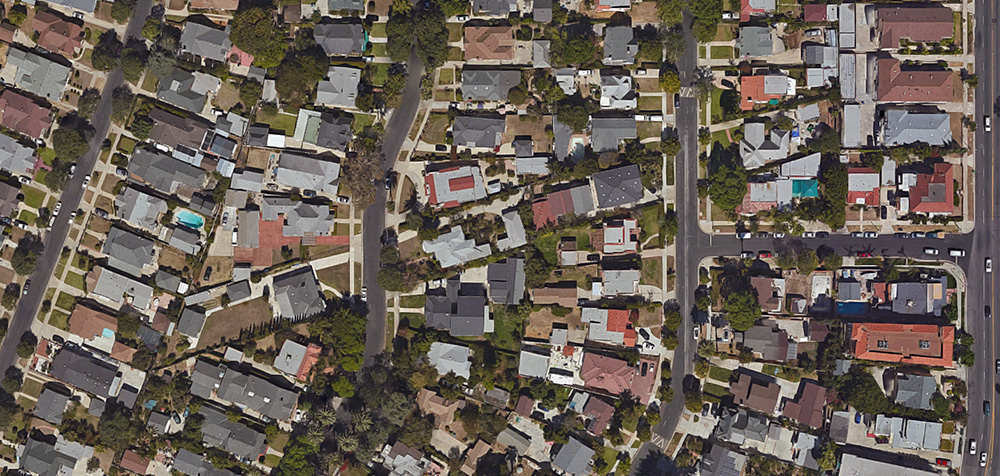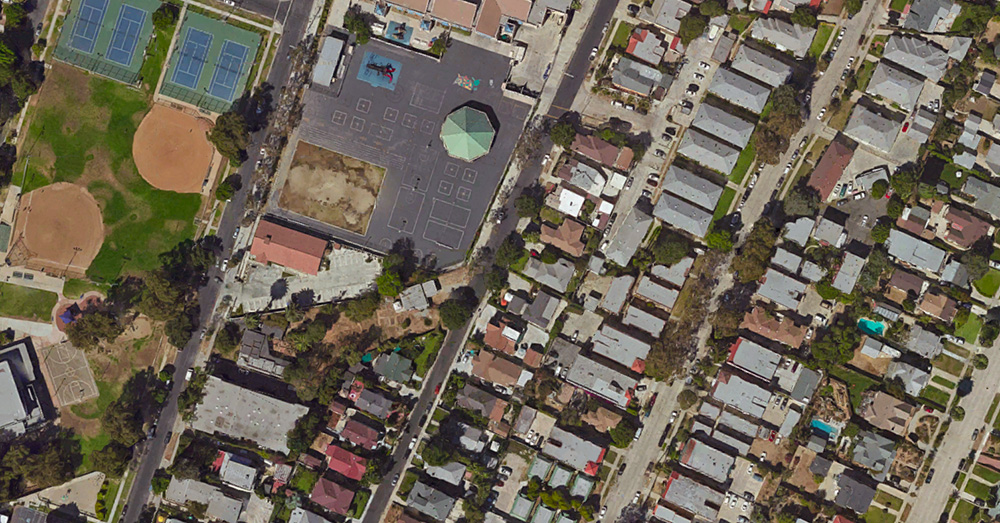
L.A.T.B.D.

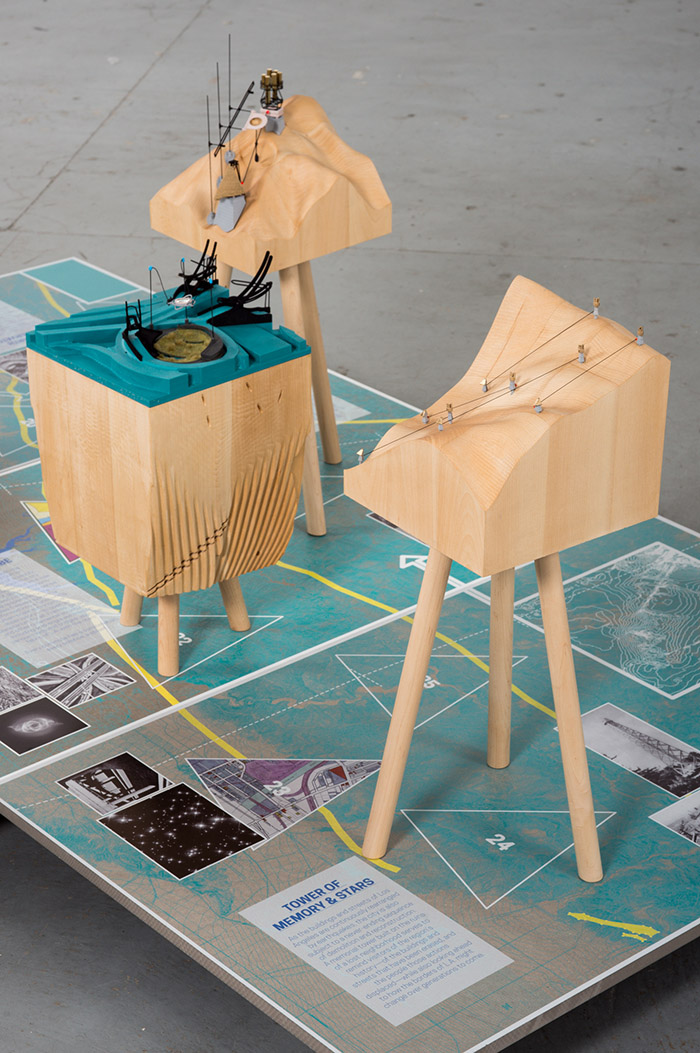
[Image: L.A.T.B.D. by Smout Allen for USC Libraries; photo by Stonehouse Photographic].

I wanted to give a quick heads up that a new collaborative exhibition will be opening to the public later today in the Doheny Memorial Library at USC here in Los Angeles, featuring work by myself and Smout Allen.

Called L.A.T.B.D., the project looks at diverse narrative, scientific, architectural, and landscape futures of Los Angeles. It is a city always yet to be determined—or L.A., T.B.D.

The exhibition actually comes at the very end of the 2015 USC Libraries Discovery Fellowship, which I’ve had the honor of holding this year, the challenge of which was to use the archival holdings of USC as a springboard for looking forward toward whatever Los Angeles might become.

Like plotting a ballistic trajectory, if we know where L.A. has been—if we can see the ingredients of its past, from its prehuman landscapes to the 2012 procession of the Space Shuttle—can we determine where the city might be, 10, 20, 100 years from now?

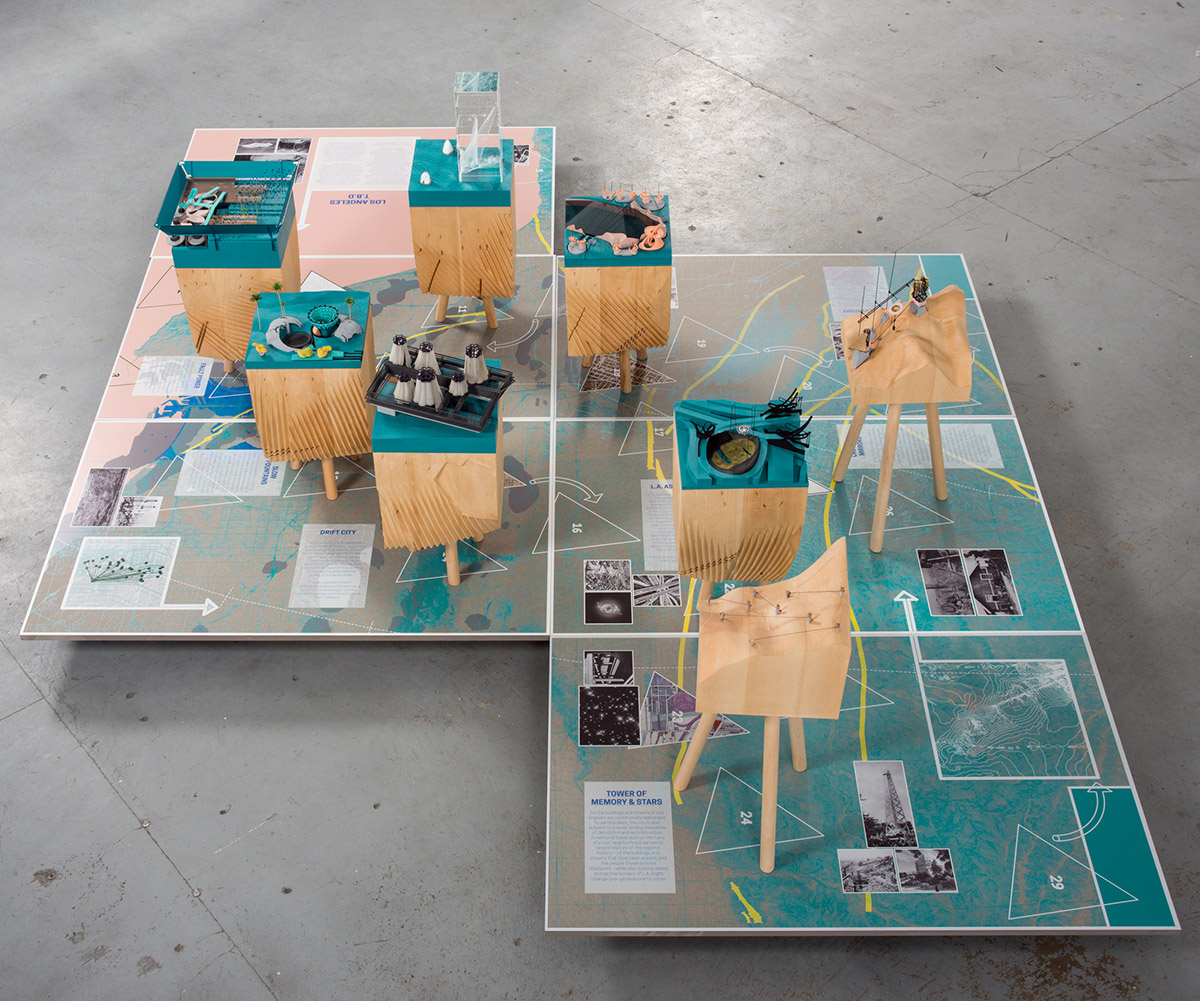
[Image: L.A.T.B.D. by Smout Allen for USC Libraries; photo by Stonehouse Photographic].

The overall curatorial idea was that, hidden within USC’s impressive and seemingly endless archival holdings, there might be glimpses of an L.A. yet to come, and that a project such as this should find a way of bringing that future version of the city into focus.

However, not one for prediction or prescriptive visions of tomorrow, I wanted this to be far more open-ended than that. We thus developed several parallel lines of materials for the show.

[Image: L.A.T.B.D. by Smout Allen for USC Libraries; photo by Stonehouse Photographic].

One, of course, are a series of gorgeous models designed and fabricated by Smout Allen, showing various hypothetical scenarios for the future city. In one, huge pendulums have been installed beneath the streets to act as seismic counterweights, protecting the city from earthquakes.

In another, the titanic forces released by plate tectonics can be captured by a new kind of power station, converting those otherwise threatening movements of the earth into a source of renewable energy.

In yet another, the city’s freeway system has been converted into a kind of immersive astronomical device, to help train the eyes of this city of stars on an older and more important firmament above.

This work also served as a direct source for the related project we did for this year’s inaugural Chicago Architecture Biennial.

[Image: L.A.T.B.D. by Smout Allen for USC Libraries; photo by Stonehouse Photographic].

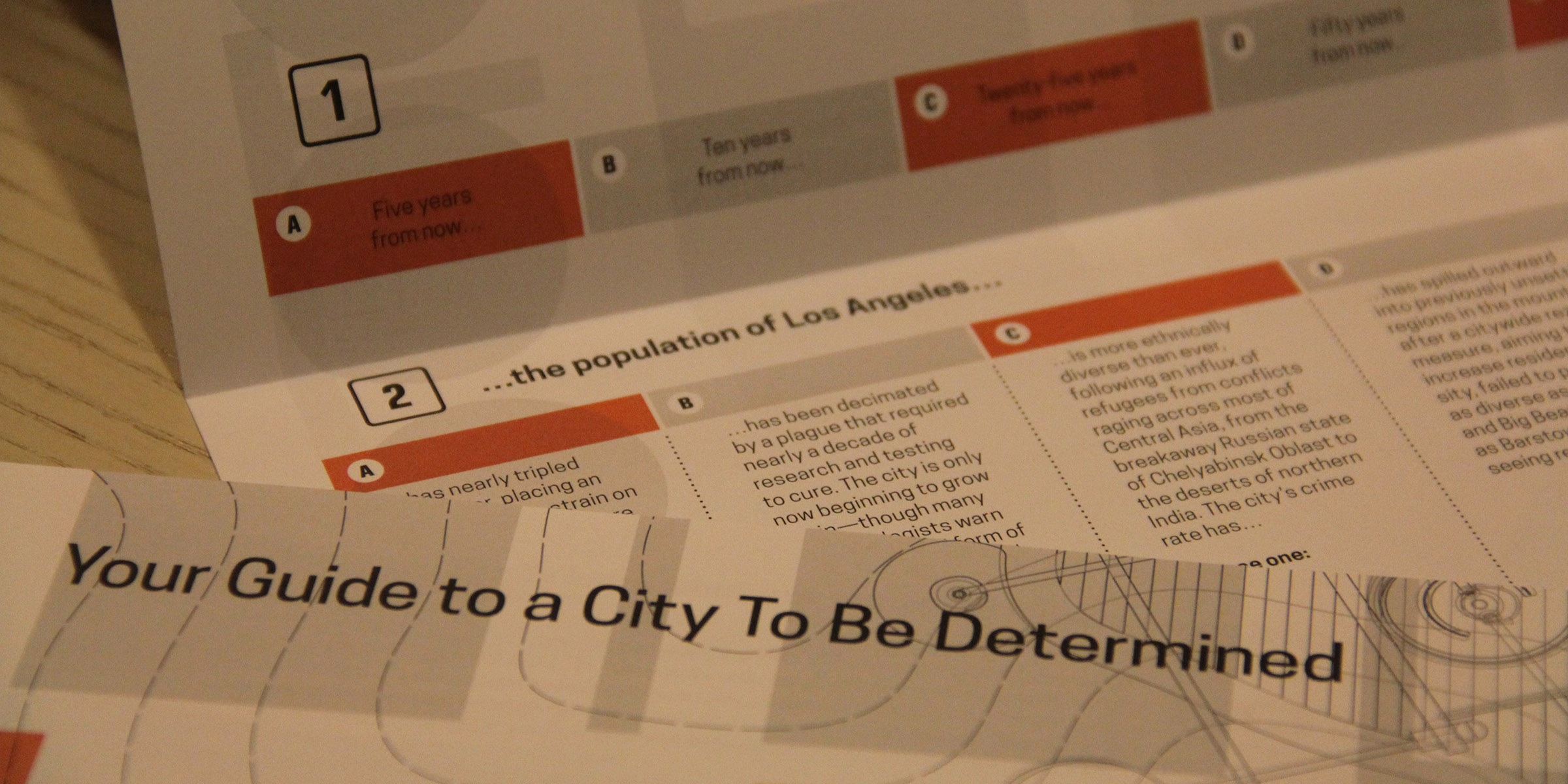
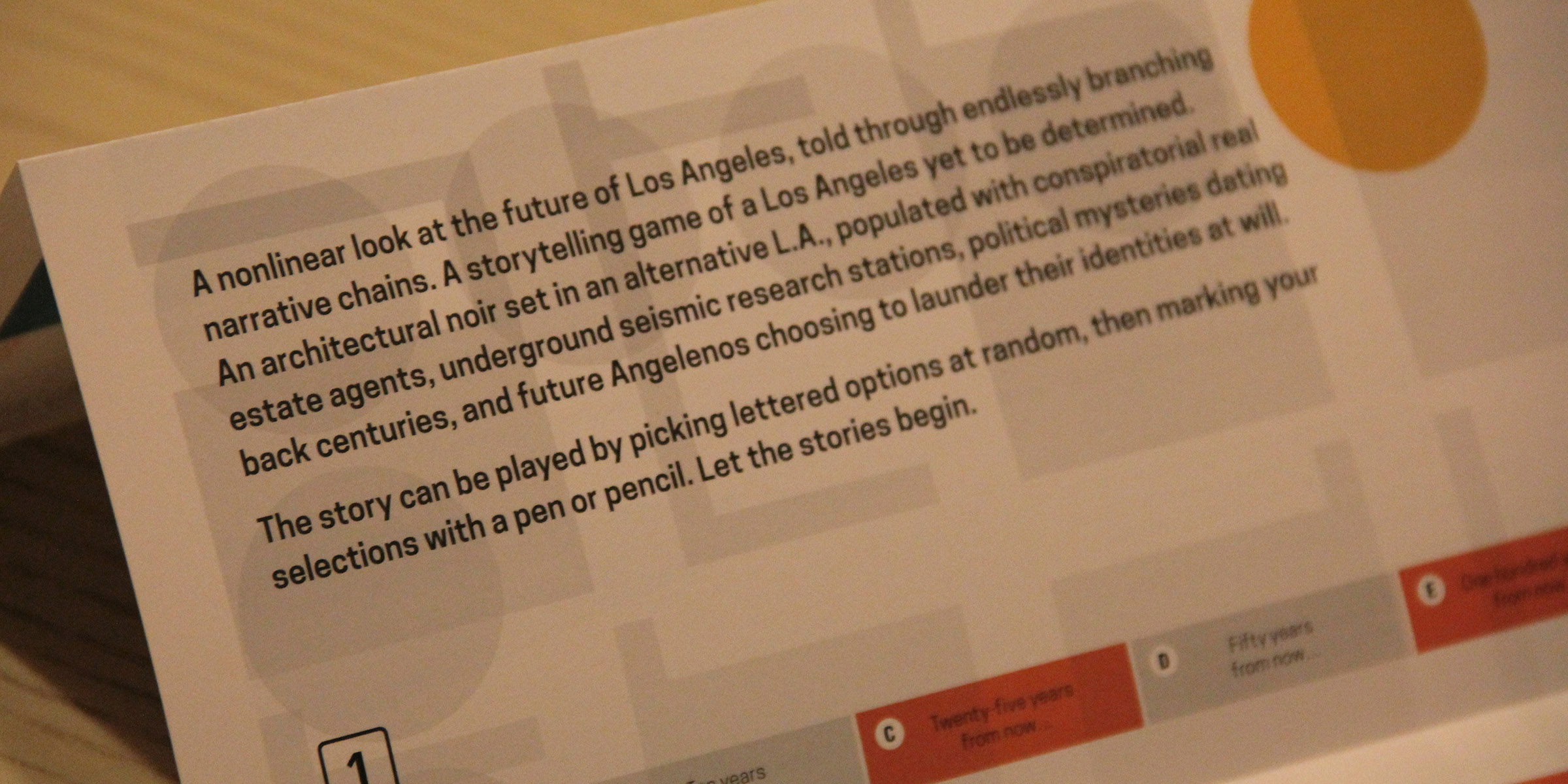
Another key part of the L.A.T.B.D. exhibition is an interactive text that allows visitors to, in a sense, choose their own future for the metropolis. This text combines a small-scale look at what sort of Los Angeles might yet greet our unborn descendants—complete with neighborhoods flooded by sea-level rise, widespread demographic shifts, and corrupt political machinations—with a subtext of noir or urban mystery.

Put another way, if this is a city known for its conspiracies and crimes—whether it’s Chinatown, O.J. Simpson, bank heists, or the novels of James Ellroy—can we use that same narrative register to explore the city’s future infrastructure?

[Images: L.A.T.B.D.‘s accompanying exhibition text, designed by David Mellen Design; terrible photos by Geoff Manaugh].

I started referring to this as a kind of architectural or infrastructural noir, and I’ve come to really like the phrase: the accompanying exhibition text is thus not at all what you’d expect to see in a typical gallery setting, but instead tells an endlessly branching “noir” about the next Los Angeles—by, in some ways, revealing what Los Angeles really was, all along.

[Image: L.A.T.B.D.‘s accompanying exhibition text, designed by David Mellen Design; terrible photo by Geoff Manaugh].

Finally, the exhibition includes a series of historical artifacts from the USC Libraries holdings, from old scientific reports to transportation policy papers, from obsolete urban predictions from the 1980s to board games set in a premodern L.A.

Here, working with designer David Mellen, we had a lot of fun, deliberately crossing and recrossing the line between fiction and reality: that is, not every artifact you see in the exhibition should be trusted, and things might not always be what they seem.

There’s much more to say about the exhibition, but I wanted to get a quick post up before the show opens later this afternoon. There is a reception tonight at 5:30pm in the library, or consider stopping by on Saturday, October 17, from noon to 1pm, to talk to myself and Smout Allen about the project. Saturday’s event is part of the “Archives Bazaar.”

L.A.T.B.D. was made possible by support from the USC Libraries Discovery Fellowship, the Bartlett School of Architecture, UCL, and the British Council. Special thanks are owed to Dean Catherine Quinlan; to Jeff Watson; to the USC Libraries staff; and to Harry Grocott, Doug Miller, and Sandra Youkhana.

Water & Power

[Image: Via the Library of Congress].

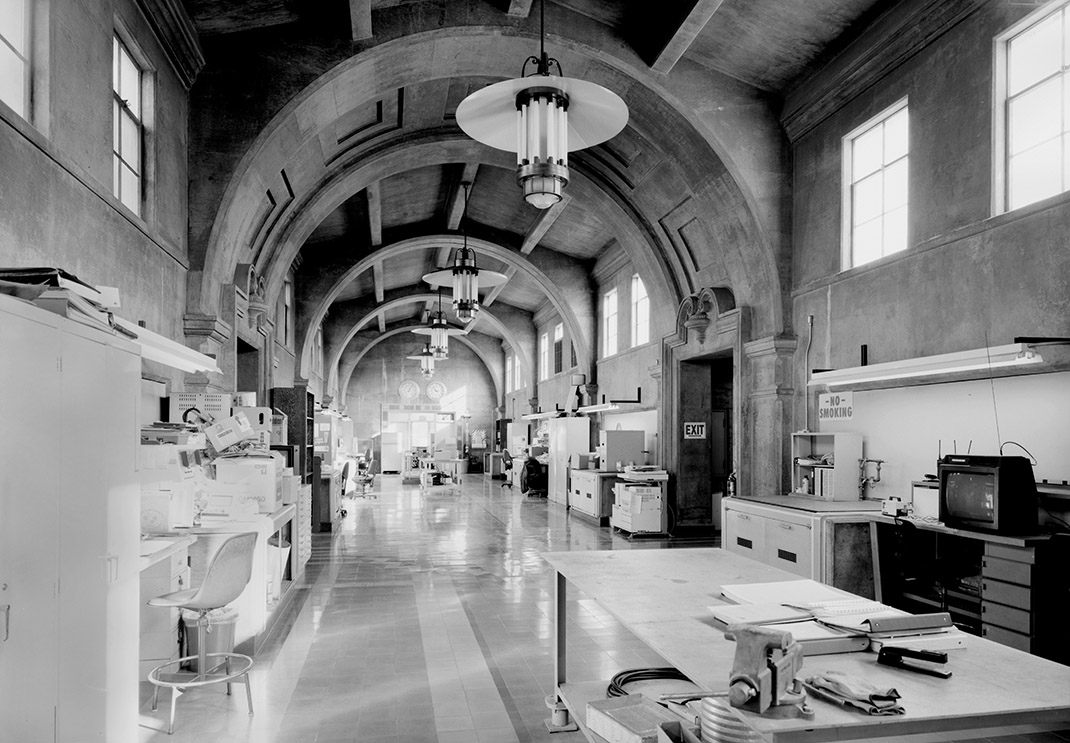
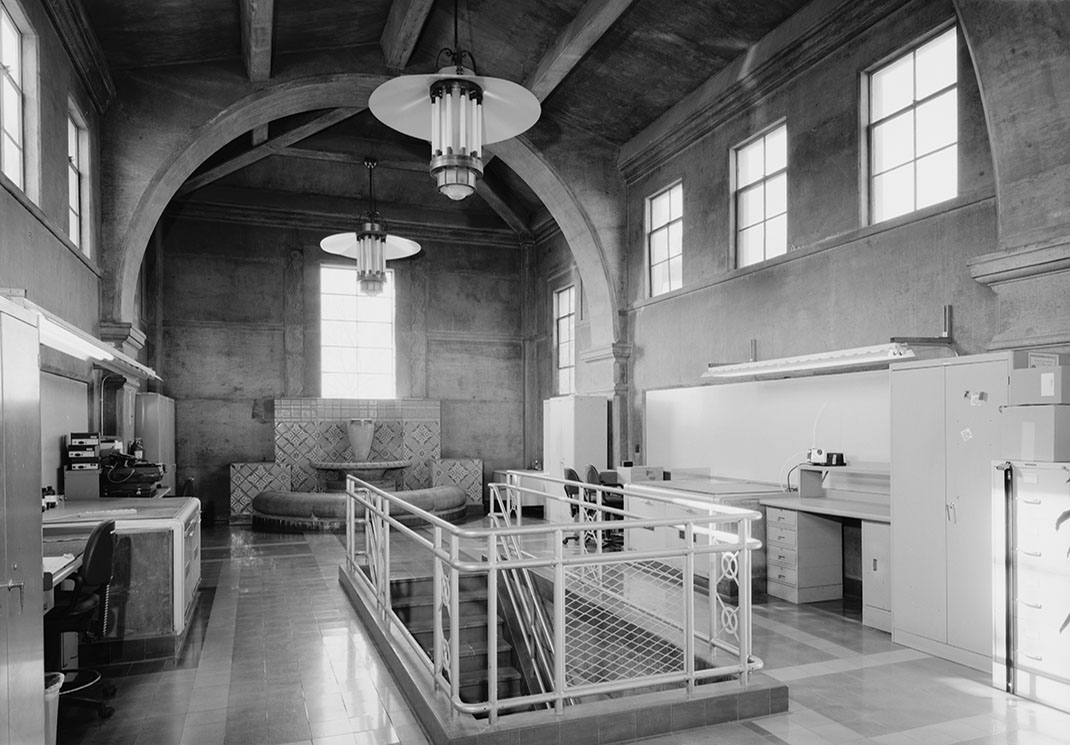
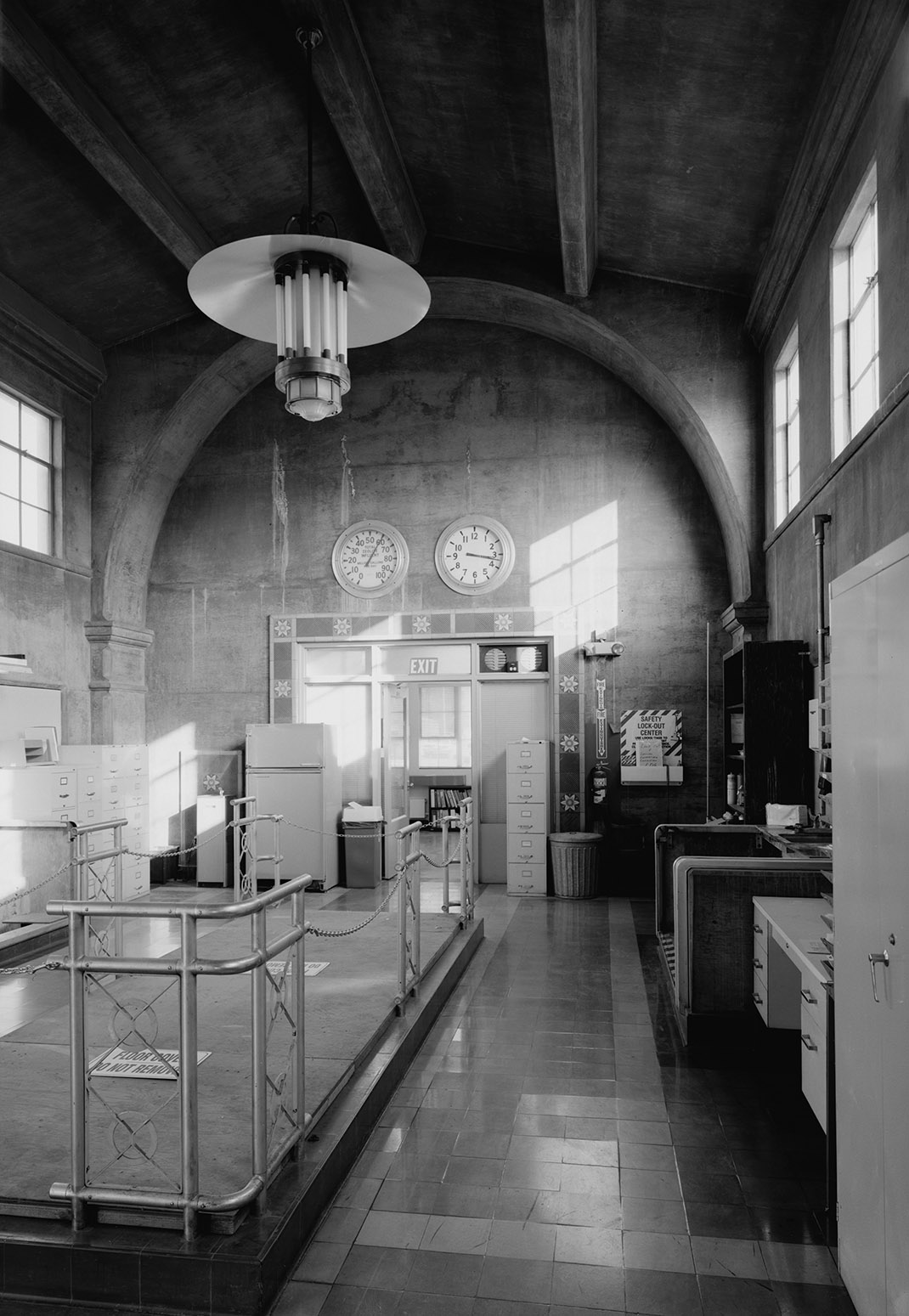
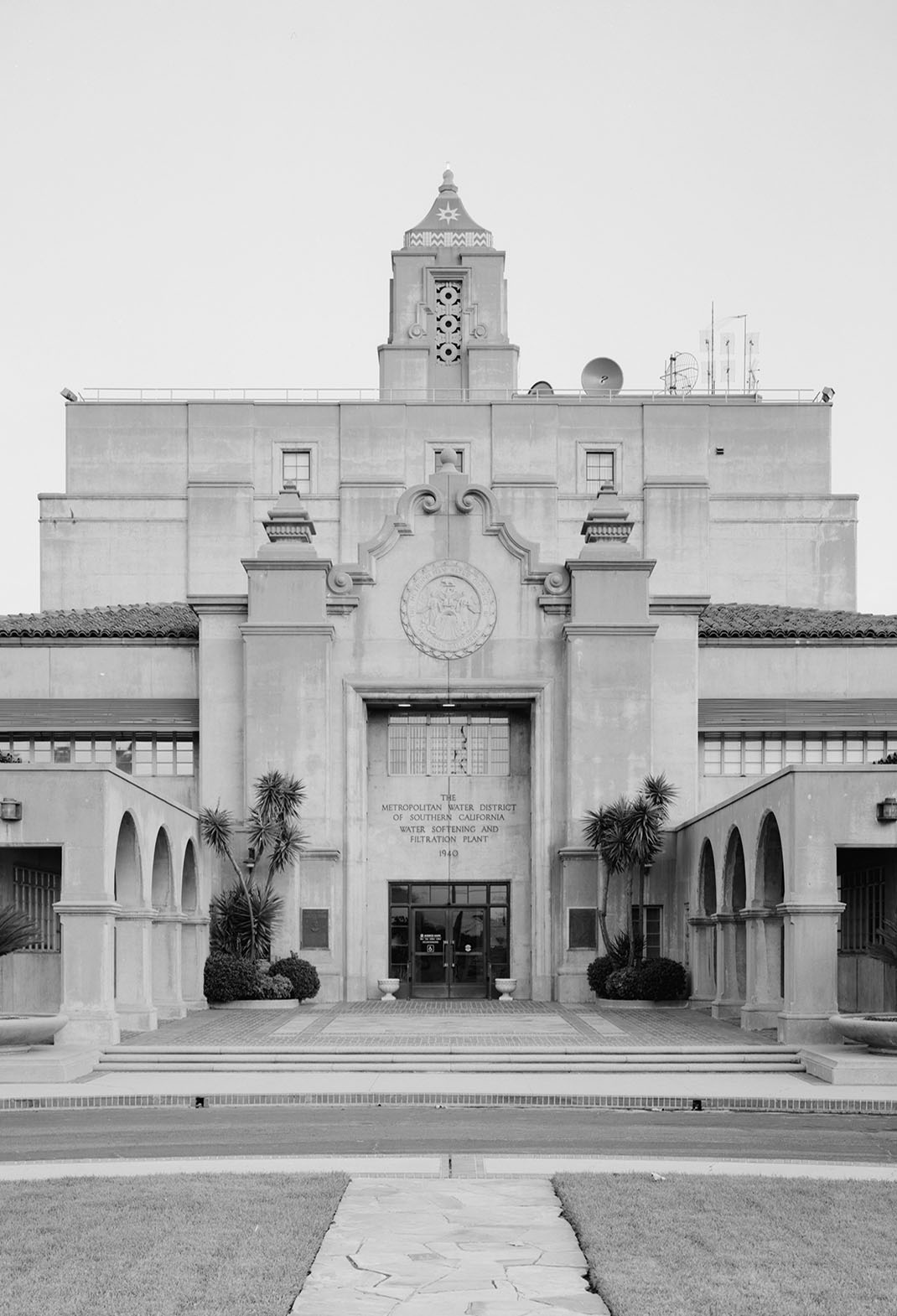
While going through a bunch of old photos of Los Angeles on the Library of Congress website for a project I’m doing at USC this year, I was amazed by these interior shots of the F. E. Weymouth Filtration Plant at 700 North Moreno Avenue in L.A.

Despite being designed for the administration of an urban water-processing site, the interiors seem to play with some strange, Blade Runner-like variation on Byzantine modernism, where federalist detailing meets a hydrological Babylon.

[Image: Via the Library of Congress].

As the open plan interior of a contemporary home, this place would almost undoubtedly show up on every design website today—imagine a better railing on the central staircase, a galley kitchen on one side, a bed lit by retro-styled fluorescent tubes at the far end, some bold moments of color—but it’s just a piece of everyday municipal infrastructure.

[Image: Via the Library of Congress].

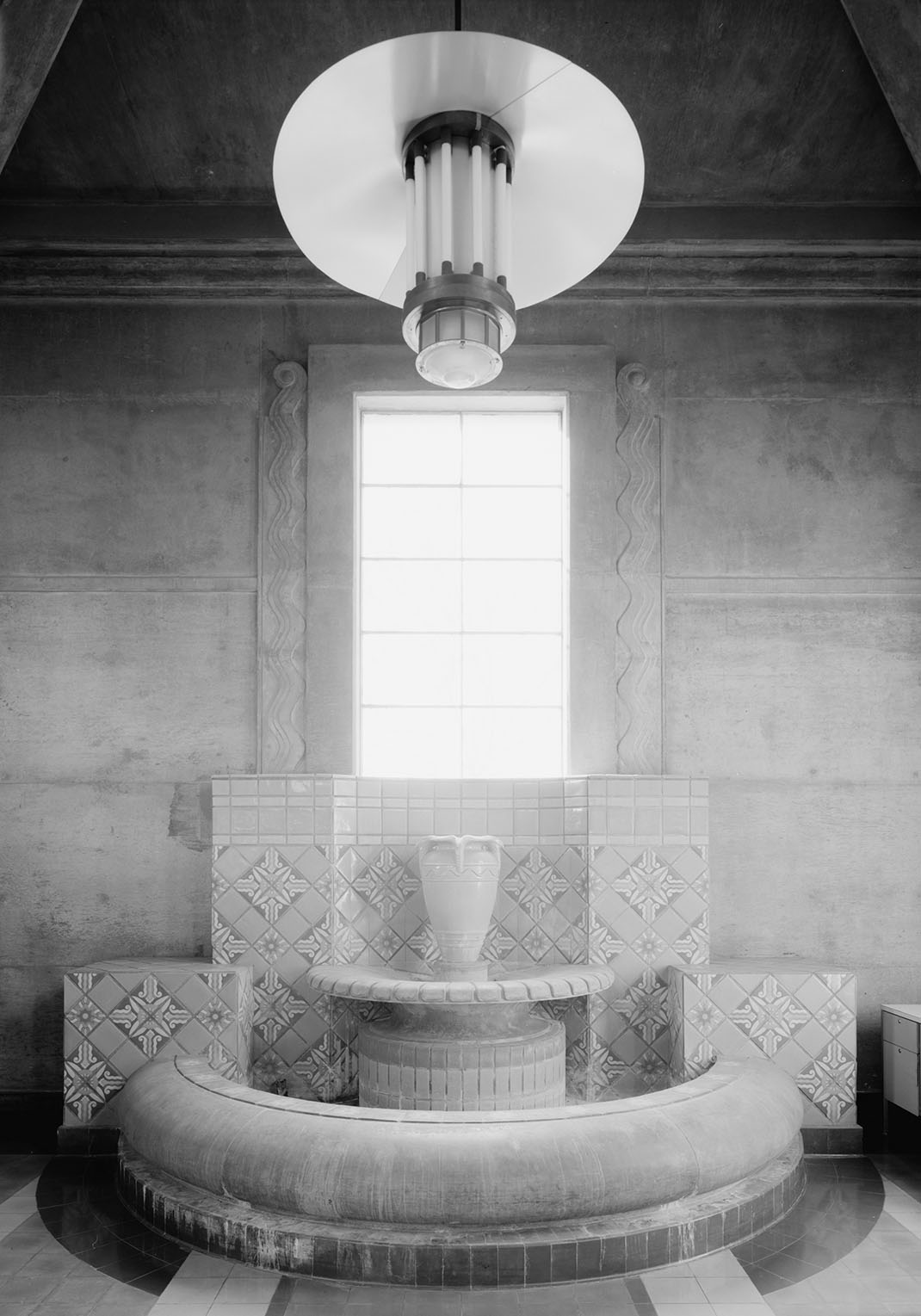
In any case, continuing the vaguely sci-fi feel, there is even a tiled fountain—a Mediterranean concession to the building’s role in water filtration—on one wall, emphasized by these amazing lighting features, yet it looks more like a film set, both ancient and futuristic.

[Image: Via the Library of Congress].

Alas, I’m not a huge fan of the exterior, although it is, in fact, a fairly amazing example of municipal design gone more sacred than profane. But an equally streamlined modernism in keeping with those interiors would have made this place totally otherworldly.

[Image: From the Library of Congress].

Finally, the marbled lobbies continue the surreal mix-up of styles, eras, and materials with something that could perhaps be described as Aztec corporatism with its huge graphic seal and other geometric motifs.

[Image: From the Library of Congress].

For shots of the actual waterworks, click through to the Library of Congress.

“It’s almost like he wanted to collect every map ever made”

Alec Earnest recently made an interesting documentary about a house in Los Angeles whose owner died, leaving behind a personal map collection so massive that, upon being acquired by the city’s public library, “it doubled the LAPL’s collection in a single day.”

When LAPL map librarian Glen Creason, interviewed for the film, first entered the house, his jaw dropped; “everywhere I looked in the house, there’s maps,” he explains in the film, including an entire floor that was “absolutely wall to wall with street guides.”

[Image: From Living History: The John Feathers Map Collection by Alec Earnest].

As the Los Angeles Times described Feathers’s house upon its discovery back in 2012, it held “tens of thousands of maps. Fold-out street maps were stuffed in file cabinets, crammed into cardboard boxes, lined up on closet shelves and jammed into old dairy crates. Wall-size roll-up maps once familiar to schoolchildren were stacked in corners. Old globes were lined in rows atop bookshelves also filled with maps and atlases.”

It went on and on and on: “A giant plastic topographical map of the United States covered a bathroom wall and bookcases displaying Thomas Bros. map books and other street guides lined a small den.”

Urban atlases, motoring charts, pre-Thomas Guide local street maps—Feathers collected seemingly any cartographic ephemera he could get his hands on.

[Image: From Living History: The John Feathers Map Collection by Alec Earnest].

Earnest’s short film has more information about Feathers himself, and can seen in full either above or over on YouTube.

Although the story of the collection would lend itself well to longer journalistic exploration—and map librarian Glen Creason has actually written up some thoughts for Los Angeles Magazine—it feels like an amazing jumping off point for a piece of fiction, either cinematic or literary.

Perhaps some sort of Chinatown or True Detective-like property speculation noir, where parcels of land and off-books deals are being tracked by a lone collector through generations of local maps, marking boundaries, street names, omissions; or perhaps something more like “X Marks the Spot,” where an old Spanish-affiliated property from the pre-Los Angeles era is rumored to have once had vast brick vaults stocked high with gold, buried beneath the main ranch house, a property long since absorbed into the supergrid of Greater Los Angeles… but the vaults are still down there—along with the gold—if only you can dig up the right map to go find it.

[Image: From Living History: The John Feathers Map Collection by Alec Earnest].

In fact, there could be a whole genre based purely on the unexpected narrative side-effects of people attempting—and failing—to map Los Angeles.

Buy a Los Angeles Sidewalk Corner

[Image: A sidewalk corner in Los Angeles, albeit not the one for sale; via Google Street View].

If you’ve been longing for a way to satisfy your inner Gordon Matta-Clark—the artist who, among many other things, once purchased an interstitial empire of “odd lots” throughout New York City, including the spaces between buildings and other “unusably small slivers of land sliced from the city grid through anomalies in surveying, zoning, and public-works expansion”—then now might be your chance.

Los Angeles is auctioning off a chunk of odd lots: “Offerings include transferable ‘air rights’ and, in one case, the corner of a sidewalk,” the Los Angeles Times reports, among what they describe as “tiny bits of land that were left over from big real estate developments, set aside like scraps of cloth cut from a garment.”

The properties for sale include a collection of oddly shaped and awkwardly encumbered lots acquired during decades of efforts to help developers build in blighted neighborhoods. A few of the parcels, though, are under name-brand Los Angeles institutions, such as the ground under the historic Angels Flight funicular railway on Bunker Hill and the land occupied by the Dolby Theatre in Hollywood, site of the Academy Awards.

You can peruse the full list of sites here. In all honesty, they are not immediately compelling. However, they do include an archipelago of air rights throughout the city; one property is only 26 square feet; and another appears to be the small strip of land located outside 1013 E. Adams Boulevard.

Purchase wisely.

(Previously on BLDGBLOG: Buy a Complex of Submarine Pits, Buy a Skyway, Buy a Fort, Buy a Lighthouse, Buy an Underground Kingdom, Buy a Prison, Buy a Tube Station, Buy an Archipelago, Buy a Map, Buy a Torpedo-Testing Facility, Buy a Silk Mill, Buy a Fort, Buy a Church).

The Los Angeles County Department of Ambient Music vs. The Superfires of Tomorrow

You might have seen the news last month that two students from George Mason University developed a way to put out fires using sound.

“It happens so quickly you almost don’t believe it,” the Washington Post reported at the time. “Seth Robertson and Viet Tran ignite a fire, snap on their low-rumbling bass frequency generator and extinguish the flames in seconds.”

Indeed, it seems to work so well that “they think the concept could replace the toxic and messy chemicals involved in fire extinguishers.”


There are about a million interesting things here, but I was totally captivated by two points, in particular.

At one point in the video, co-inventor Viet Tran suggests that the device could be used in “swarm robotics” where it would be “attached to a drone” and then used to put out fires, whether wildfires or large buildings such as the recent skyscraper fire in Dubai. But consider how this is accomplished; from the Washington Post:

The basic concept, Tran said, is that sound waves are also “pressure waves, and they displace some of the oxygen” as they travel through the air. Oxygen, we all recall from high school chemistry, fuels fire. At a certain frequency, the sound waves “separate the oxygen [in the fire] from the fuel. The pressure wave is going back and forth, and that agitates where the air is. That specific space is enough to keep the fire from reigniting.”

While I’m aware that it’s a little strange this would be the first thing to cross my mind, surely this same effect could be weaponized, used to thin the air of oxygen and cause targeted asphyxiation wherever these robot swarms are sent next. After all, even something as simple as an over-loud bass line in your car can physically collapse your lungs: “One man was driving when he experienced a pneumothorax, characterised by breathlessness and chest pain,” the BBC reported back in 2004. “Doctors linked it to a 1,000 watt ‘bass box’ fitted to his car to boost the power of his stereo.”

In other words, motivated by a large enough defense budget—or simply by unadulterated misanthropy—you could thus suffocate whole cities with an oxygen-thinning swarm of robot sound systems in the sky. Those “Ride of the Valkyries”-blaring speakers mounted on Robert Duvall’s helicopter in Apocalypse Now might be playing something far more sinister over the battlefields of tomorrow.

However, the other, more ethically acceptable point of interest here is the possible landscape effect such an invention might have—that is, the possibility that this could be scaled-up to fight forest fires. There are a lot of problems with this, of course, including the fact that, even if you deplete a fire of oxygen, if the temperature remains high, it will simply flicker back to life and keep burning.

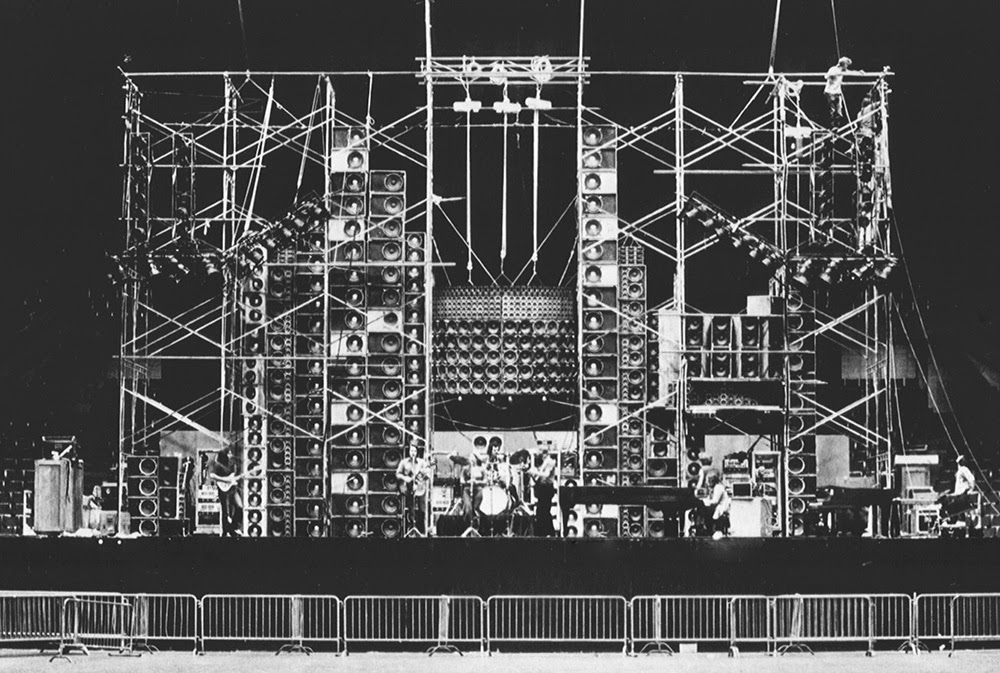
[Image: The Grateful Dead “wall of sound,” via audioheritage.org].

Nonetheless, there is something awesomely compelling in the idea that a wildfire burning in the woods somewhere in the mountains of Arizona might be put out by a wall of speakers playing ultra-low bass lines, rolling specially designed patterns of sound across the landscape, so quiet you almost can’t hear it.

A hum rumbles across the roots and branches of burning trees; there is a moment of violent trembling, as if an unseen burst of wind has blown through; and then the flames go out, leaving nothing but tendrils of smoke and this strange acoustic presence buzzing further into the fires up ahead.

Instead of emergency amphibious aircraft dropping lake water on remote conflagrations, we’d have mobile concerts of abstract sound—the world’s largest ambient raves—broadcast through National Parks and on the edges of desert cities.

Desperate, Los Angeles County hires a Department of Ambient Music to save the city from a wave of drought-augmented superfires; equipped with keyboards and effects pedals, wearing trucker hats and plaid, these heroes of the drone wander forth to face the inferno, extinguishing flames with lush carpets of anoxic sound.

(Spotted via New York Magazine).

It Came From Below

Formless and ancient things from the depths of our planet move beneath Los Angeles, unexpectedly setting fire to sidewalks and burning whole businesses to the ground. Welcome to urban life atop a still-active oil field.

This post was originally published on The Daily Beast.

Sliding around beneath the surface of Los Angeles is something dark, primordial, and without clear form. It seeps up into the city from below through even the smallest cracks and drains. Infernal, it can cause fires and explosions; toxic, it can debilitate, poison, and kill.

Near downtown Los Angeles, at 14th Place and Hill Street, a small extraction firm called the St. James Oil Corporation runs an active oil well. In 2006, the firm presided over a routine steam-injection procedure known as “well stimulation.” The purpose was simple: a careful and sustained application of steam would heat up, liquefy, and thus make available for easier harvesting some of the thick petroleum deposits, or heavy oil, beneath the neighborhood.

But things didn’t quite go as planned. As explained by the Center for Land Use Interpretation—a local non-profit group dedicated to documenting and analyzing land usage throughout the United States—“the subterranean pressure forced oily ooze and smells out of the ground,” causing a nauseating “goo” to bubble over “into storm drains, streets, and basements” as far as two blocks away.

The sudden appearance of this black tide beneath the neighborhood even destabilized the nearby road surface, leading to its emergency closure, and 130 people had to be evacuated. It took weeks to pump these toxic petroleum byproducts out of the basements and to resurface the street; the firm itself was later sued by the city.

While this was an industrial accident, hydrocarbons are, in fact, almost constantly breaking through the surface of Los Angeles, both in liquid and gaseous form. These are commonly known as seeps, and the most famous example is also an international tourist attraction: the La Brea Tar Pits, with its family-friendly museum on Wilshire Boulevard.

The “tar” here is actually liquid asphalt or pitch, and it is one of many reasons why humans settled the region in the first place. Useful both for waterproofing and for its flammability, this sticky substance has been exploited by humans in the region for literally thousands of years—and it has also given L.A. some of its most impressive paleontological finds.

[Image: Tar pushes up through cracks in the sidewalk on Wilshire Boulevard, near the La Brea Tar Pits; photo by Geoff Manaugh].

In other words, precisely because they are so dangerous, the tar pits are a veritable archive of extinct species; these include mastodons, saber-toothed tigers, and dire wolves, examples of which have been found fatally mired in the black mess seeping up from the deep. Groups of these now long-dead creatures once wandered across an otherworldly landscape of earthquakes and extinct volcanoes, an active terrain pockmarked with eerie bubbling cauldrons of flammable liquid asphalt.

What’s so interesting about contemporary life in Southern California is that this surreal, prehistoric landscape never really went anywhere: it’s simply been relegated to the background, invisibly buried beneath strip malls, car dealerships, and sushi restaurants. Every natural tar seep and artificial oil well here can be seen as an encounter with this older, stranger world trying to break back through into our present experience.

What humans choose to do with this primordial stuff leaking through the cracks can often be almost comical. Architect Ben Loescher, who has given tours of the region’s oil infrastructure for the Center for Land Use Interpretation, points out that many buildings near Lafayette Park must contend with a constant upwelling of asphalt. He sent me a photograph showing a line of orange utility buckets arranged as an ingenious but absurd stopgap measure against the endless and unstoppable goo.

[Image: A makeshift system for capturing the near-constant tar and liquid asphalt leaking up from below a building near Lafayette Park; photo by Ben Loescher].

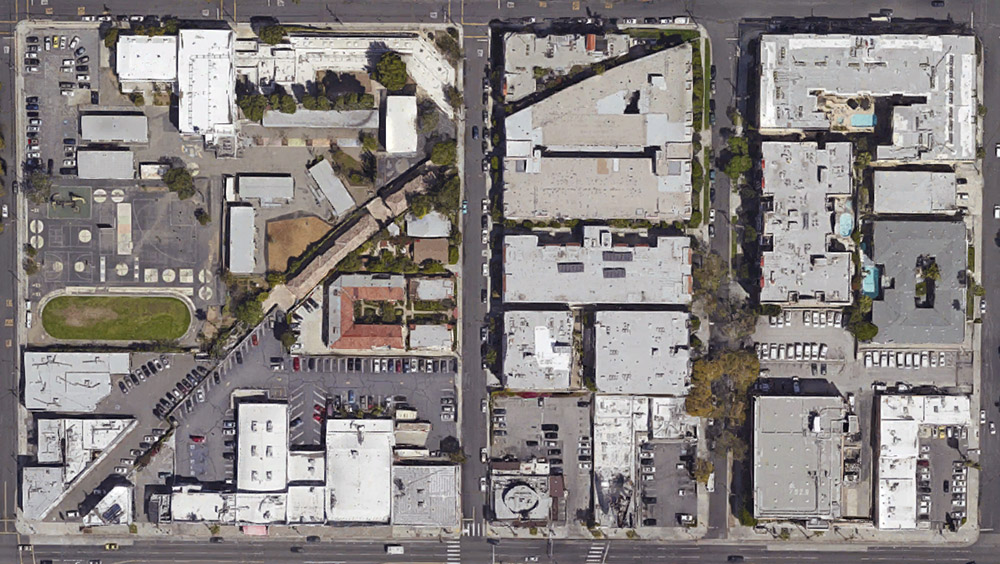
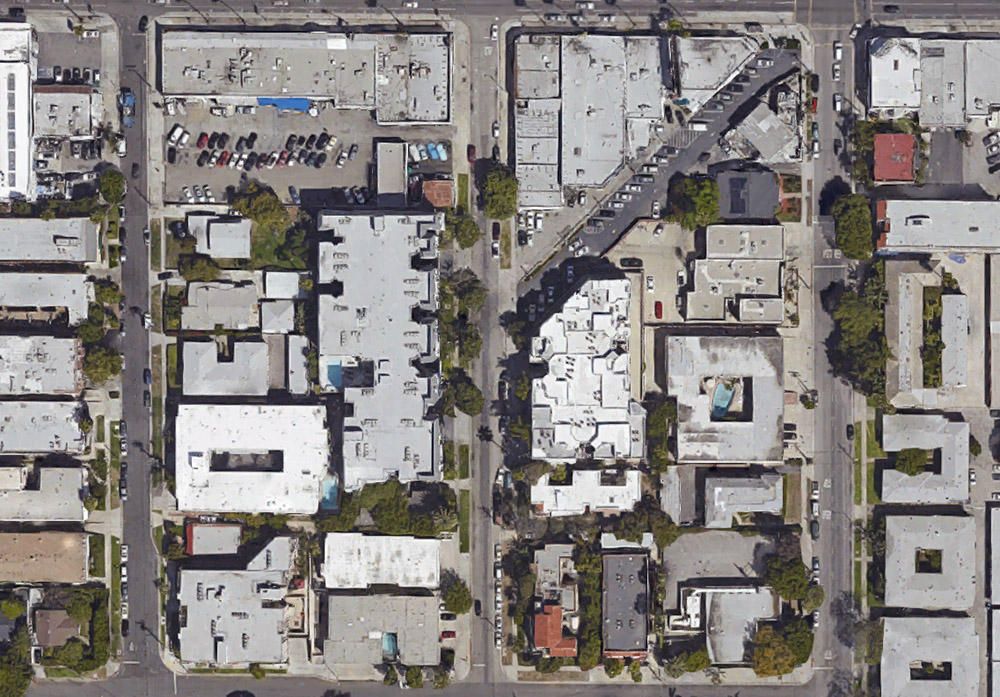
Nearby, Loescher added, parking lots are a great place to see the onslaught. Many are constantly but slowly flooding with tar and asphalt, to the point that one lot—run by a karaoke club—is struck so badly that the tar is actually visible on Google Maps. “That parking lot is riddled with seeps, as well. When it gets hot, the parking lot sort of re-asphalts itself,” Loescher explains, “and they have to put down tarps on top of it so the cars don’t get stuck.” A much larger gravel lot across the street also exhibits multiple sites of seepage, as if pixelating from below with black matter.

Loescher emphasized that these sites are by no means limited to the La Brea Tar Pits. They can be found throughout the Los Angeles basin, beneath sidewalks, yard, parking lots, and even in people’s basements. To exaggerate for dramatic effect, it’s as if the premise of The Blob was at least partially inspired by a true story—one that has been taking place for hundreds of thousands of years throughout Southern California, and that involves, instead of a visitor from space, something ancient and pre-human forcing its way up from below.

[Image: Liquid asphalt leaking upward into the parking lot of a Los Angeles karaoke club; photo by Geoff Manaugh].

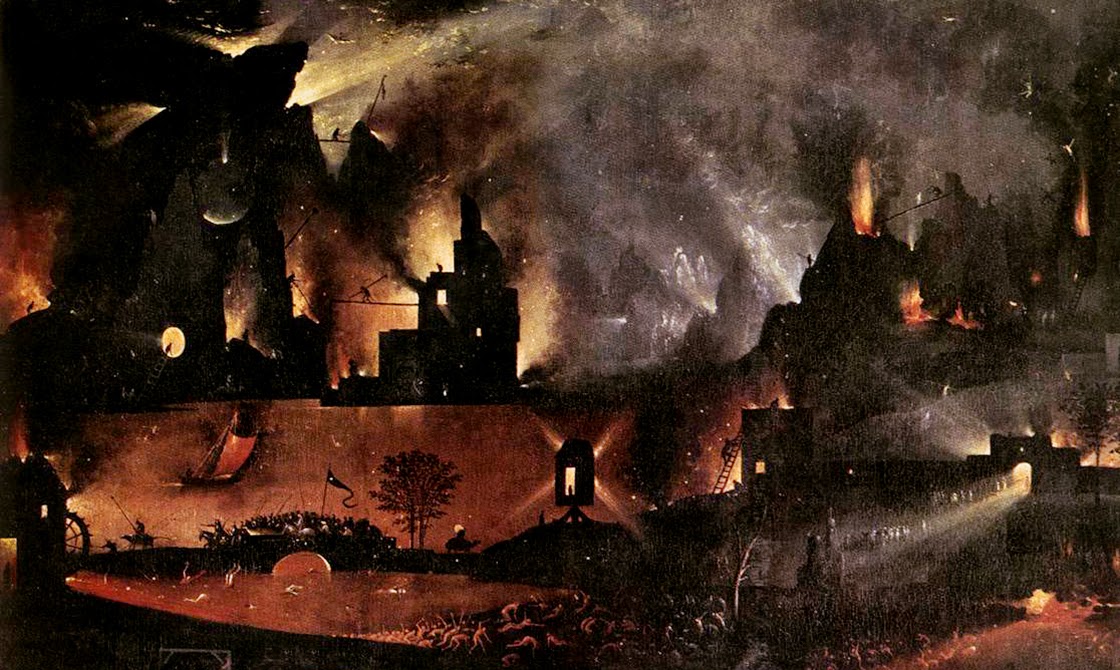
In a short book called Making Time: Essays on the Nature of Los Angeles, writer William L. Fox explores the remnant gas leaks and oil seeps of the city. At times, it reads as if he is describing the backdrop of a Hieronymus Bosch painting. Such is the strange and permanent apocalypse of 21st-century L.A.

Fox writes, for example, that “a methane vent opened up in the middle of Fairfax Street” back in 1985, and that it “burned uncontrollably for days before it could be put out.” At night, it was a world lit by flames. Astonishingly, he adds, in 1962 “a Hawthorne woman had a fire under her house—a house with no basement. She located the source of the problem when she went outside and touched a match to a crack in the sidewalk: A flame ran down to it.”

This city where sidewalks burn and sewers fill with oily ooze is a city built here almost specifically for that very reason; Los Angeles, in many ways, is a settlement founded on petroleum byproducts, and the oil industry for which the city was once known never actually left. It just got better at hiding itself.

It is already well known that there are oilrigs disguised in plain sight all over the city. The odd-looking tower behind Beverly Hills High School, for example, is actually a camouflaged oilrig; an active oil field runs beneath the classrooms and athletic fields. Even stranger, the enormous synagogue at Pico and Doheny is not a synagogue at all, but a movable drilling tower designed to look like a house of worship, as if bizarre ceremonies for conjuring a literal black mass out of the bowels of the Earth take place here, hidden from view. If you zoom in on Google Maps, you can just make out the jumbles of industrial machinery tucked away inside.

However, amidst all of this still-functional oil infrastructure, there are ruins: abandoned wells, capped drill sites, and derelict pumping stations that have effectively been erased from public awareness. These, too, play a role in the city’s subterranean fires and its poisonous breakouts of black ooze.

As Fox explains in Making Time, a labyrinth of aging pipelines and forgotten wells crisscrosses the city. He explains that the Salt Lake Oil Field—which underlies the La Brea Tar Pits, sprawls below an outdoor shopping center known as The Grove, and continues deep into the surrounding neighborhoods—once contained as many as 1,500 operative oil wells. However, most of these “have long since been abandoned and are virtually invisible,” he writes, and, alarmingly, “roughly 300 are unaccounted for.”

These “unaccounted for” oil wells are out of sight and out of mind—but it should not be assumed that they are safely or permanently capped. Indeed, the Salt Lake Oil Field actually “appears to be repressurizing with oil and water,” like an underground blister come back to life, Fox writes. This only raises the stakes of “a hazard already complicated by the lack of knowledge about the exact location of all the wells on the property.” Only 10 years ago, for example, “an orphaned well in Huntington Beach blew out in a gusher forty feet high, spraying oil and methane over one-half square mile, a hazardous-waste problem that will become more common.”
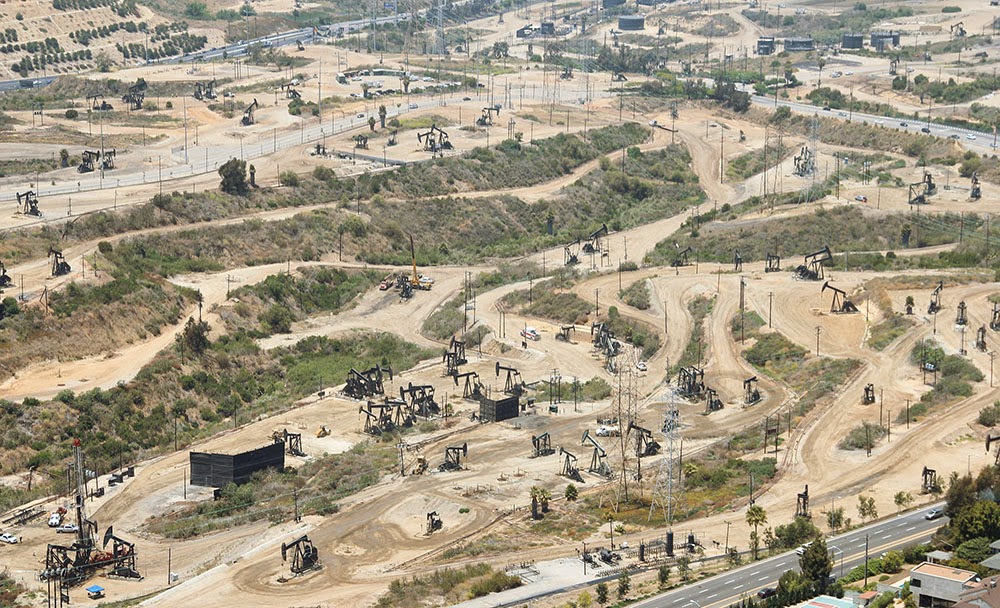
[Image: The Baldwin Hills old field; photo by Geoff Manaugh].

Due to its centrality, the Salt Lake field plays an outsized role in terms of strange petroleum events in the city. The Salt Lake was behind the multiday methane fire in the middle of Fairfax Avenue, for example, and behind arguably the most well known and certainly most destructive reminder of the city’s subterranean presence.

In 1989, in a busy strip mall at Fairfax and 3rd Street, a Ross Dress for Less began to fill with methane gas leaking up from a large pocket connected to the oil field below. Somehow, it had broken through the natural clay boundary that should have held it in place, and the methane thus easily seeped up into the storage rooms, closets, and retail galleries of the discount clothing giant.

Before long, the methane ignited and the entire store blew up.

[Image: Screen grab from YouTube].

This was by no means an insubstantial explosion—you should watch the aftermath on YouTube—as the entire façade of the building was blown to pieces, the roof collapsed, and dozens of people were disfigured by the detonation.

The resulting fires burned for hours. Small fires roared out of nearby sewer grates, and red and orange flames flickered out of even the tiniest cracks in the sidewalk, like some weird vision of Hell burning through the discount blouses and cheap drywall of this obliterated shopping center.
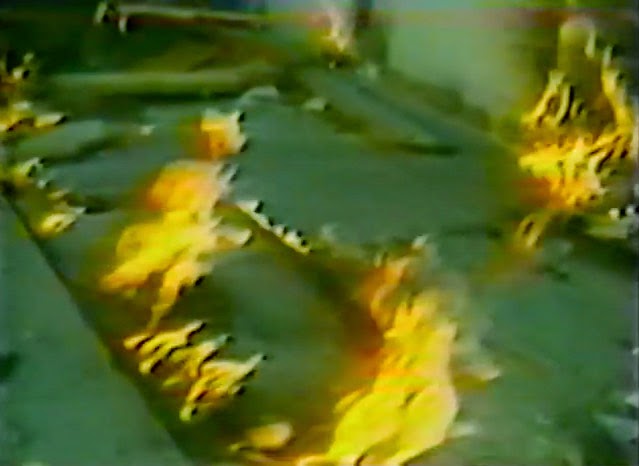
[Image: Flames burn through cracks in the sidewalk; screen grab from YouTube].

While reporting the tragedy, a local newscaster worryingly informed his viewers that it was simply “too early to tell where or when [the methane] might surface again”—in other words, that there could very well be further explosions. This paranoia—that there is something down there, some inhuman Leviathan stirring beneath the city, and that no one really knows when and where it will strike next—continues to this day.

Even at the time of the explosion, the possibility that city workers might inadvertently drill into a methane pocket beneath the neighborhood became one of the chief reasons for blocking the construction of a new subway line in the area. This same fear has recently resurfaced as the number one excuse for blocking a proposed subway through Beverly Hills.

Back in 2012, local parents released a video urging the city to stop the expansion of subterranean public transit through their neighborhood, concerned that it would cause Beverly Hills High School to explode. (The fact that stopping the subway would also keep certain economic undesirables out of their streets and shopping districts was just a fringe benefit.)

In any case, the narrative resonance of all this is impossible to deny. Formless and ancient things from the depths of our planet move beneath the city, unexpectedly setting fire to sidewalks and burning whole businesses to the ground. Taken out of context, this could be the plot of a new horror film—but it’s just urban life atop a still-active oil field.

As Matthew Coolidge, director of the Center for Land Use Interpretation, explained it to me, the city “is really just a giant scab of petroleum-fueled activities,” an impermanently sealed cap atop this buried monstrosity.

It is worth considering, then, next time you step over a patch of tar on the sidewalk, that the black gloom still bubbling up into people’s yards and basements, still re-asphalting empty gravel parking lots, is actually an encounter with something undeniably old and elementally powerful.

In this sense, Los Angeles is more than just a city; it is a kind of interface between a petrochemical lifestyle of cars and freeways and the dark force that literally fuels it, a subterranean presence that predates us all by millions of years and that continues to wander freely beneath L.A.’s tangled streets and buildings.

(Note: This piece was originally published on The Daily Beast. I have also written about the La Brea Tar Pits and William L. Fox’s book in Landscape Futures. Opening image: a close-up of Hell, from “The Garden of Earthly Delights” by Hieronymous Bosch, Museo del Prado, Madrid, Spain).

The Moving Mountain, or Terrain as Spectacle

[Image: Courtesy of the Los Angeles Times Photographic Archive, Department of Special Collections, Charles E. Young Research Library, UCLA, via KCET].
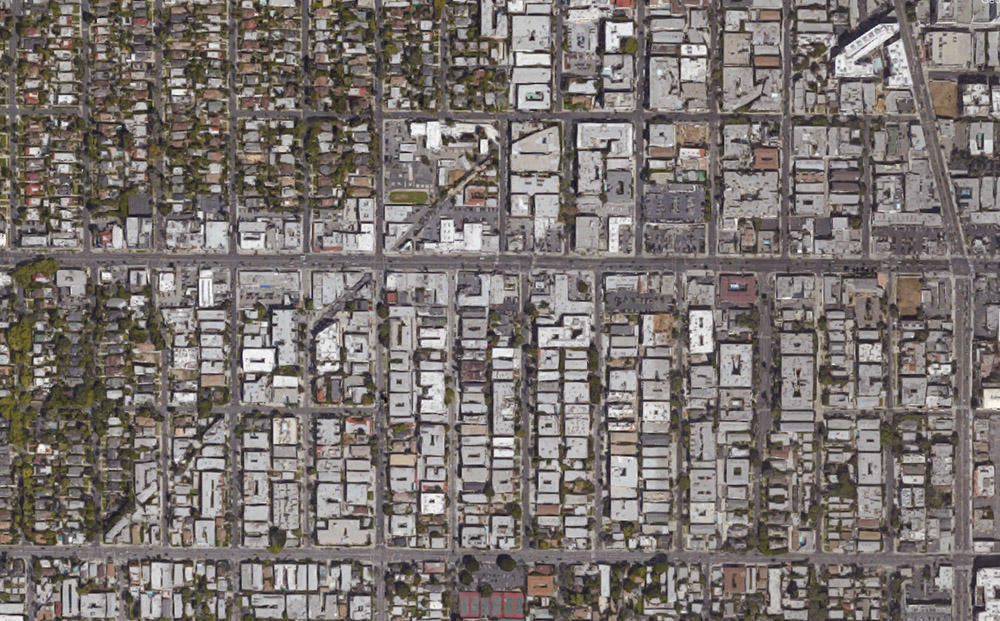
Nathan Masters remains one of the more interesting chroniclers of life and landscape in Southern California, as evidenced by his “L.A. as Subject” blog for KCET. I could (and should) just link to all his posts, to be honest—lost hills! buried rivers! conflicting grids!—but last week’s installment, albeit short, was particularly interesting.

“For a few days in late November 1937,” Masters writes, “it was the Southland’s greatest attraction—a landslide in slow motion, 1.5 million tons of an Elysian Park hillside creeping toward the Los Angeles River bed.”

Sensational news reports, printed in papers and broadcast on radio nationwide, described it as a “moving mountain,” and tourists came from afar to witness the geologic curiosity. One Oklahoma City police officer took a leave of absence to watch the slide. Two boys hopped freight trains from New York to see it. Some 10,000 sightseers came by the hour. Spectators pressed against police barricades along Riverside Drive, and enterprising vendors worked the throng like a baseball game, hawking peanuts, popcorn, and soda. Some even sold field glasses.

Even local astronomers showed up, telescopes in tow, in order to study the mobile mass, this blob of geology suddenly making a move into town.

After a catastrophic lurching of the slow-motion mountain, the terrain appeared to come to a standstill. “The next day, an estimated crowd of 500,000 converged on the site, munching on popcorn and hoping the mountain would move again.”

This pent-up dramaturgy of the landscape—the possibility that its newfound agency would continue—crawling, oozing, rolling, forcing its way into public consciousness—remains strong today, even if subsumed into other contexts.

In other words, I’d suggest that many Angelenos are still, in a sense, “munching on popcorn and hoping the [landscape] would move again,” and that this is the dark fascination of seismic instability, of what it means to live in an earthquake zone: that the land itself is active, motivated from within by a kind of a slow-motion sentience, a mineral energy that is as much an invigorating spectacle as it is an existential threat.

Read the rest of Masters’s post over at “L.A. as Subject.”

The Planetary Super-Surface of San Bernardino County

A surprisingly interesting business article in the Los Angeles Times this past weekend pointed out that an “industrial real estate boom” is underway east of the city: “Nestled on the windy plains at the foot of the San Bernardino Mountains,” we read, “once austere stretches of agricultural land have morphed into the country’s most desirable industrial real estate market, and it is growing faster than any other industrial region in the U.S.”

[Image: Construction work at a future Amazon.com warehouse in San Bernardino, courtesy of NBC Southern California].

What’s at stake? Eager buyers are snapping up “vast warehouses—some are bigger than 30 football fields under one roof—where they can store, process and ship merchandise such as clothes, books and toys to ever more online shoppers and handle the rising flood of goods passing through the ports of Los Angeles and Long Beach.”

It’s a logistics rush “so intense” that “developers are erecting more than 16 million square feet of warehouses on speculation, meaning they are gambling that buyers or renters will rush forward to claim the buildings by the time they are complete.”

As it happens, though, huge volumes of empty space framed by walls and ceilings are something of the ultimate testing ground for robot intelligence: “Once upon a time, a warehouse was where you stored things for weeks or months, such as toys and canned food that retailers would grab to restock their shelves. Sorting, organizing and moving the inventory was a constant challenge.”

However, now, in this age of empty architectural airspace, “Tracking goods in the modern age of bar codes, scanners and computers is a comparative breeze. The location of every widget can be identified with pinpoint accuracy and fetched by robots that can lift and carry 3,000-pound loads with ease.”

[Image: An unrelated warehouse photo from CCI Flooring].

I’m reminded of something novelist Zachary Mason said in an interview with BLDGBLOG three years ago. Mason, who has also worked in the field of artificial intelligence, pointed out the spatial problems faced by any truly emergent A.I.:

One of the problems with A.I. is that interacting with the world is really tough. Both sensing the world and manipulating it via robotics are very hard problems, and solved only for highly stripped-down special cases. Unmanned aerial vehicles, for instance, work well, because maneuvering in a big, empty, three-dimensional void is easy—your GPS tells you exactly where you are, and there’s nothing to bump into except the odd migratory bird. Walking across across a desert, though, or, heaven help us, negotiating one’s way through a room full of furniture in changing lighting conditions, is vastly more difficult.

The prospect of Artificial Intelligence finding its way into the world not by way of unmanned aerial vehicles flying in Mason’s “big, empty, three-dimensional void” but, instead, in the vast and echoing elsewhere of speculative warehouse space built in the desert outside Los Angeles is an incredible, and even somewhat frightening, thing to contemplate.

However, I started this post actually hoping to point out one small thing mentioned merely in passing at the end of the L.A. Times article.

One of these warehouses, it turns out, is actually so huge it must be laser-leveled against the curvature of the earth.

[Image: A laser-leveling target used for calibrating car scales, taken by someone named “Butt Dyno,” via an evolutionm.net forum].

The building in question “has 32-foot ceilings and enough doors to load or unload 124 trucks at the same time,” presenting insane combinatorial possibilities that would make the bridges of Königsberg blush; but, even more unbelievably, this “480,000-square-foot facility recently built for Quaker Oats Co. on land that used to be part of Norton Air Force Base in San Bernardino… is so long at 1,000 feet that contractors laying the concrete floor used lasers to gently follow the curve of the Earth and keep the floor level.”

Of course, this means that you could also work in reverse, and thus deduce, from the precise leveling of the warehouse floor, the curvature of the planet it rests on, which, bizarrely enough, makes studying this building—an empty warehouse in the California desert—an unexpected subset of astronomical calculation.

Last week, for instance, we looked at various “benchmarks” that have been used for measuring the circumference of the Earth, but perhaps future generations will simply drive out to a cluster of warehouses somewhere on the fringes of Los Angeles—next century’s Stonehenge, a new Solomon’s Temple, or Superstudio meets Eratosthenes—ritually laser-level the floor on a hot summer afternoon, and thus deduce the limits of our world itself, all by way of the most “fundamental” of architectural interventions: the floor.


The logistical super-surface as planetary analogue.

They Come From Everywhere: An Interview with Mike Elizalde

Many of today’s most original and bizarre visions of alternative worlds and landscapes come from the workshops of Hollywood effects studios. Behind the scenes of nondescript San Fernando Valley offices and warehouse spaces (if not outside California altogether, in many of the other nodes in the ever-expanding global network of cinematic effects production, from suburban London to Wellington, New Zealand), lurk the multidisciplinary teams whose job it is to create tomorrow’s monsters.

Mike Elizalde of Spectral Motion applies make-up to actor Ron Perlman, as Hellboy.

Spectral Motion, the effects house responsible for some of the most technically intricate and physically stunning animatronic creatures seen in feature film today, is no exception. Based in a small strip of anonymous one-story warehouse spaces squeezed in between a freeway and rail tracks, and overshadowed by a gargantuan Home Depot, Spectral Motion has developed monsters, effects, and other mechanical grotesqueries that have since become household nightmares, if not names.

Since its founding, by Mike & Mary Elizalde in 1994, the firm has worked on such films as Hellboy & Hellboy II: The Golden Army, Looper, Attack the Block, Blade 2 & Blade: Trinity, X-Men: First Class, The Watch, and this summer’s highly anticipated Pacific Rim.


This winter, while out in Los Angeles on a trip for Venue, I had the enormous pleasure of stopping by Spectral Motion with Nicola Twilley in order to interview Mike Elizalde, CEO of Spectral Motion, on a cloudy day in Glendale to talk all things monstrous and disturbing. To a certain extent, this interview thus forms the second part in a series with BLDGBLOG’s earlier interview with Hellboy creator Mike Mignola, and the present conversation, reproduced below, pairs well with Mignola’s thoughts on what we might call landscapes of monstrosity.

Our conversation with Elizalde ranged from the fine line that separates the grotesque and the alien to the possibility of planetary-scale creatures made using tweaked geotextiles, via the price of yak hair and John Carpenter’s now-legendary Antarctic thriller, The Thing.

Mike Elizalde behind his desk at Spectral Motion.

Elizalde, a good-humored conversationalist, not only patiently answered our many questions—with a head cold, no less—but then took us on a tour through Spectral Motion‘s surprisingly large workshop. We saw miniature zombie heads emerging from latex molds (destined for a film project by Elizalde’s own son), costumes being sewn by a technician named Claire Flewin for an upcoming attraction at Disneyland, and a bewildering variety of body parts—heads, torsos, claws, and even a very hairy rubber chest once worn by footballer Vinnie Jones in X-Men: The Last Stand—that were either awaiting, or had already performed, their celluloid magic.

The visit ended with a screening of Spectral Motion‘s greatest hits, so to speak, with in-house photographer and archivist Kevin McTurk—a chance to see the company’s creations in their natural habitat. We walked back out into the flat light and beige parking lots of the Valley, a landscape enlivened by our heightened sense of the combination of close observation and inspired distortion required to transform the everyday into the grotesque.

• • •

Geoff Manaugh: I’d love to start with the most basic question of all: how would you describe Spectral Motion and what the company does?

Mike Elizalde: We are principally a prosthetics, animatronics, and special effects creature studio, but we are also a multifaceted design studio. We do a lot of different kinds of work. Most recently, for example, in partnership with one of my long-time colleagues, Mark Setrakian, we built anthropomorphic bipedal hydraulic robots that engage in battle, for a reality show for Syfy. It’s called RCLRobot Combat League. It’s pretty astounding what these machines can do, including what they can do to each other.

Battling it out in Robot Combat League with two robots—”eight-feet tall, state-of-the-art humanoid robots controlled by human ‘robo-jockeys,'” in the words of Syfy—designed by Mark Setrakian of Spectral Motion.

Nicola Twilley: Are the robot battles choreographed, or do you genuinely not know which robot will win?

Elizalde: Oh, no, absolutely—it’s a contest. It really is about which robot will emerge as the victorious contender.

RCL is not only one of our most recent projects, but it also shows that, here at the studio, we can do everything from a very delicate prosthetic application on an actor, to an animatronic character in a film, to something that’s completely out of our comfort zone—like building battling robots.

I always tell people that, if they come in here with a drawing of a car, we could build that car. It is a very diverse group that we work with: artists, technicians, and, of course, we use all the available or cutting-edge technologies out there in the world to realize whatever it is that we are required to make.

Mike Elizalde of Spectral Motion shows us a creature.

Manaugh: What kind of design briefs come to you? Also, when a client comes to you, typically how detailed or amorphous is their request?

Elizalde: Sometimes it is very vague. But, typically, what happens is we’re approached with a script for a project. Our job is to go through the script and create a breakdown and, ultimately, a budget based on those breakdowns. We take whatever we think we should build for that script and we make suggestions as to how each thing should look—what should move, what the design should be, and so on.

Other times, we’ll be working with a director who’s very involved and who maybe even has some technical knowledge of what we do—especially someone like Guillermo del Toro. He’s completely savvy about what we do because he used to own a creature shop of his own, so working with someone like him is much more collaborative; he comes to us with a much more clear idea of what he wants to see in his films. Lots of times, he’ll even show us an illustration he’s done. He’s the first one to say, “I’m not an artist!” But he really is. He’s quite gifted.

The creature known as Wink from Hellboy II: The Golden Army, designed by Spectral Motion, including a shot of the mechanical understructure used inside Wink’s left hand.

So he’ll bring us his illustrations and say, you know, “You tell me if it’s going to be a puppet, an animatronic puppet, or a creature suit that an actor can wear.” And that’s where our knowhow comes in. That’s how it evolves.

There are also times—with the robot show, for example—where they know exactly what they need but they don’t know how to achieve it. In those cases, they come to us to do that for them.

Twilley: Can you talk us through one of the projects you’ve worked on where you had to create your vision based solely on what’s in the script, rather than more collaborative work with the director? What’s that process like?

Elizalde: Well, I’d actually say that ninety percent of our work is that way. For most of the projects we work on, we do, in fact, just get a script and the director says, “Show me what this looks like.” But we love that challenge. It’s really fun for us to get into the artistic side of developing what the appearance of something will end up looking like.

We had a lot of fun working with a director named Tommy Wirkola, for example, who directed Hansel & Gretel: Witch Hunters. He was the director of Dead Snow, a really strange Norwegian film that involved this group of young kids who go off to a cabin where they’re hunted down by a hoard of horrifying zombie Nazi monsters. It’s really grisly.

Anyway, although Tommy did have really good ideas about what he wanted his characters to look like for Hansel & Gretel, there were certain characters whose descriptions were much more vague—also because there was such a broad scope of characters in the film. So they did rely on us to come up with a lot of different looks based on loose descriptions. In the end, the principal characters in the film were total collaborations between Tommy, myself, and Kevin Messick, the producer, and the rest of my team here at Spectral Motion, of course.

I’d say that’s a good example of both worlds, where you have some clear ideas about a few characters, but, for another group of characters, there really isn’t a whole lot of information or a detailed description. You have to fill in a lot of blanks.

Mark Setrakian, Thom Floutz , and Mike Elizalde of Spectral Motion pose with Sammael from Hellboy.

Twilley: What kinds of things do you look for in a script to give you a clue about how a character might work—or is that something that simply comes out when you’re sketching or modeling?

Elizalde: In a script, we basically know what we’re looking for: “Enter a monster.” We know that’s what we’re going be doing, so we look for those moments in the script. Sometimes there’s a brief description—something like, “the monster’s leathery hide covered in tentacles.” That kind of stuff gives us an immediate visual as to what we want to create. Then we explore it with both two-dimensional artwork and three-dimensional artwork, and both digital and physical.

In fact [gestures at desk], these are some examples of two-dimensional artwork that we’ve created to show what a character will look like. This [points to statuette above desk] is a maquette for one of the characters in Hellboy II—the Angel of Death. This was realized at this scale so that del Toro could see it and say, “That’s it. That’s what I want. Build that.” This actually began as an illustration that Guillermo did in his sketchbook, a very meticulous and beautiful illustration that he came to us with.

The Angel of Death from Hellboy II: The Golden Army.

But that’s the process: illustration and then maquette. Sometimes, though, we’ll do a 3D illustration in the computer before we go to the next stage, just to be able to look at something virtually, in three dimensions, and to examine it a little bit more before we invest the energy into creating a full-blown maquette.

The maquette, as a tool, can be very essential for us, because it allows us to work out any bugs that might be happening on a larger scale, design-wise. Practically speaking, it doesn’t give us a lot of information as to how the wings are going to work, or how it’s going to function; but it does tell us that a human being could actually be inside of it and that it could actually work as a full-scale creature. It’s essential for those reasons.

Simon, the mechanical bird from Your Highness, before paint has been applied, revealing the internal workings.

Because you can show a director a drawing, and it might look really terrific—but, when it comes to actually making it, in a practical application at scale, sometimes the drawing just doesn’t translate. Sometimes you need the maquette to help describe what the finished piece will look like.

Manaugh: You mentioned animatronics and puppeteering. We were just up at the Jet Propulsion Lab in Pasadena yesterday afternoon, talking to them about how they program certain amounts of autonomy into their instruments, especially if it’s something that they’re putting on Mars. It has to be able to act on its own, at times, because it doesn’t have enough time to wait for the command signal from us back on Earth. I’m curious, especially with something like the robot combat show, how much autonomy you can build into a piece. Can you create something that you just switch on and let go, so that it functions as a kind of autonomous or even artificially intelligent film prop?

Elizalde: It really depends on the application. For example, when we’re filming something, a lot of times there’s a spontaneity that’s required. Sometimes actors like to ad lib a little bit. If we need to react to something that an actor is saying via a puppet—an animatronic puppet—then that live performance really is required. But we always have the option of going to a programmable setup, one where we can have a specific set of parameters, performance-wise, to create a specific scene.

For live performances on a stage, we’d probably want to program that with the ability to switch over to manual, if required. But, if it’s scripted—if it’s a beat-by-beat performance—then we know that can be programmable. We can turn on the switch and let it go. In the middle of that, you can then stop it, and have a live show, with puppeteers in the background filling in the blanks of whatever that performance is, and then you can continue with the recorded or programmed performance.

It really goes back and forth, depending on what it is the people who are putting on the production need.

The mechanical skull under structure of the Ivan the Corpse from Hellboy.

Twilley: That’s an interesting point—the idea of how a live actor responds to your creatures. Have there been any surprises in how an actor has responded, or do they all tend to know what they’re getting into by the time you’re filming?

Elizalde: They do know what they’re getting into, but it’s always rewarding to have an actor go over to the thing that you built, and stare at it, and say, “Oh, my God! Look at that thing!” They can feed off of that. I think they are able to create a more layered performance, with a lot more depth in their reactions to something if it’s actually there—if it’s present, if it has life to it, and it’s tactile.

A lot of times people turn to digital solutions. That’s also good, if the application is correct. But, you know, a lot of directors that we talk to are of the mind that a practical effect is far better for exactly that reason—because the actor does have a co-actor to work with, to play off of, and to have feelings about.

That’s one of the things that keeps us going. And, the fact is, with this business, no matter what walks through that door we know that it’s going to be a completely different set of challenges from the last thing that we did.

Mechanical puppet of Drake from a Sprite commercial. Scott Millenbaugh and Jurgen Heimann of Spectral Motion are seen here making mechanical adjustments.

Manaugh: About six years ago, I interviewed a guy who did concept art for the Star Wars prequels, and he had a kind of pet obsession with building upside-down skyscrapers—that is, skyscrapers that grew downwards like stalactites. He kept trying to get them into a movie. He would build all of these amazing 3D models and show them to the director, and the director was always excited—but then he’d turn the model upside-down and say, “Let’s do it like this!” So all the upside-down skyscrapers would just be right-side up again. In any case, this artist was then working on the recent Star Trek reboot, and there’s a brief moment where you see upside-down skyscrapers on the planet Vulcan. It’s only on screen for about a second and a half, but he finally did it—he got his upside-down skyscrapers into a film.

Elizalde: [laughs] But, ohhh! For half-a-second! [laughter]

Manaugh: Exactly. Anyway, in the context of what you do here at Spectral Motion, I’m curious if there is something like that, that you’ve been trying to get into a movie for the last few years but that just never quite makes it. A specific monster, or a new material, or even a particular way of moving, that keeps getting rejected.

Elizalde: That’s an interesting question. [pauses] You know, I’d have to say no. I’d say it seems like the more freely we think, the better the result is. So it’s quite the contrary: most of the stuff we suggest actually does make it into the film, because it’s something that someone else didn’t think about. Or perhaps we’ve added some movement to a character, or we’ve brought something that will elicit a more visceral reaction from the audience—bubbly skin, for instance, or cilia that wiggle around.

I don’t think I’ve really encountered a situation where I thought something would look great, but, when I brought it to a director, they said, “Nah—I don’t think that’s going to go. Let’s not try that.” They always seem to say, “Let’s try it! It sounds cool!”

Mike Elizalde applies some last-minute touch-ups to actor Ron Perlman on the set of Hellboy.

We really haven’t had a whole lot of frustration—maybe only when it turns into a very large committee making a decision on the film. Then, I suppose, a certain degree of frustration is more typical. But that happens in every industry, not just ours: the more people are involved in deciding something, the more difficult it is to get a clear image of what it is we’re supposed to do.

Manaugh: When we first spoke to set-up this interview, I mentioned that we’d be touring the landfill over at Puente Hills this morning, on our way here to meet you—it’s the biggest active landfill in the United States. What’s interesting is that it’s not only absolutely massive, it’s also semi-robotic, in the sense that the entire facility—the entire landscape—is a kind of mechanical device made from methane vents and sensors and geotextiles, and it grows everyday by what they call a “cell.” A “cell” is one square-acre, compacted twenty feet deep with trash. Everyday!

But I mention this because, during our visit there, I almost had the feeling of standing on top of a mountain-sized creature designed by Spectral Motion—a strange, half-living, half-mechanical monstrosity in the heart of the city, growing new “cells” every day of its existence. It’s like something out of Hellboy II. So I’m curious about the possibilities of a kind of landscape-scale creature—how big these things can get before you need to rely on CGI. Is it possible to go up to that scale, or what are the technical or budgetary limitations?

A Tyrannosaurus rex in a bathtub in the back prep rooms of Spectral Motion.

Elizalde: We can’t build mountains yet but, absolutely, we can go way up in scale! Many times, of course, we have to rely, at least to some degree, on digital effects—but that just makes our job easier, by extending what is possible, practically, and completing it cinematically, on screen, at a much larger scale.

For example, on Pacific Rim, Guillermo del Toro’s new film that comes out this summer, we designed what are called Jaegers. They’re basically just giant robots. And we also designed the Kaiju, the monsters in the film. First, we created maquettes, just like the ones here, and we made several versions of each to reflect the final designs you’ll see in the film. Those were taken and re-created digitally so they could be realized at a much larger scale.

To that degree, we can create something enormous. There’s a maquette around here somewhere of a character we designed for the first Hellboy movie—actually, there are two of them. One of those characters is massive—about the size of a ten-story building—and the other one is much, much bigger. It’s the size of… I don’t know, a small asteroid. There really is no limit to the scale, provided we can rely on a visual effects company to help us realize our ultimate goal.

The animatronic jaws and bioluminescent teeth (top) of the alien creature (bottom) designed by Spectral Motion for Attack the Block.

But going the opposite direction, scale-wise, is also something that interests us. We can make something incredibly tiny, depending on what the film requires. There is no limit in one direction or the other as to what can be achieved, especially with the power of extension through digital effects.

Manaugh: Just to continue, briefly, with the Puente Hills reference, something that we’ve been interested in for the past few years is the design of geotextiles, where companies like TenCate in the Netherlands are producing what are, effectively, landscape-scale blankets made from high-quality mesh, used to stabilize levees or to add support to the sides of landfills. But some of these geotextiles are even now getting electromagnetic sensors embedded in them, and there’s even the possibility of a geotextile someday being given mechanical motion—so it’s just fascinating, I think, to imagine what you guys could do with a kind of monstrous or demonic geotextile, as if the surface of the earth could rise up as a monster in Hellboy III.

Elizalde: [laughs] Well, now that I know about it, I’ll start looking into it!

Twilley: Aside from scale, we’re also curious about the nature of monsters in general. This is a pretty huge question, but what is a monster? What makes something monstrous or grotesque? There seems to be such a fine line between something that is alien—and thus frightening—and something that is so alienating it’s basically unrecognizable, and thus not threatening at all.

Elizalde: Exactly. Right, right.

Twilley: So how do you find that sweet spot—and, also, how has that sweet spot changed over time, at least since you’ve been in the business? Are new things becoming monstrous?

Elizalde: Well, I think my definition of a monster is simply a distortion: something that maybe looks close to a human being, for example, but there’s something wrong. It can be something slight, something subtle—like an eye that’s just slightly out of place—that makes a monster. Even a little, disturbing thing like that can frighten you.

So it doesn’t take a lot to push things to the limit of what I would consider the grotesque or the monstrous. At that point, it runs the gamut from the most bizarre and unimaginable things that you might read in an H. P. Lovecraft story to something simple, like a tarantula with a human head. Now there’s something to make me scream! I think there’s a very broad range. But you’re right: it’s a huge question.

Mark Setrakian of Spectral Motion working on the animatronic head of Edward the Troll from Hansel and Gretel: Witch Hunters.

And sometimes the monstrous defies definition. I guess it’s more of a primal reaction—something you can’t quite put your finger on or describe, but something that makes you feel uneasy. It makes you feel uncomfortable or frightened. A distortion of what is natural, or what you perceive as natural, something outside what you think is the order of things—or outside what you think is acceptable within what we’ve come to recognize as natural things—then that’s a monster. That’s a monstrous thing.

Do you recall seeing John Carpenter’s The Thing?

Manaugh: It’s one of my favorite movies.

Elizalde: My goodness, the stuff in that film is the stuff of nightmares. It really is brilliantly executed, and it’s a great inspiration to all of the people in our industry who love monsters, and to all the fans all over the world who love monstrous things.

Actor Ron Perlman gets make-up applied for his role as Hellboy, as director Guillermo del Toro and Mike Elizalde from Spectral Motion stop in for a visit.

Twilley: Have there been trends over time? In other words, do you find directors look for a particular kind of monster at a particular moment in time?

Elizalde: I do think there are trends—although I think it’s mainly that there’s a tendency here in Hollywood where somebody hears a rumor that someone down the street is building a film around this particular creature, so that guy’s now got to write a similar script to compete. But sometimes the trends are set by something groundbreaking, like The Thing. Once that movie was released, everybody paid attention and a whole new area of exploration became available to create amazing moments in cinema.

Those are the real trends, you know. It’s a symbiosis that happens between the artistic community and the technological community, and it’s how it keeps advancing. It’s how it keeps growing. And it keeps us excited about what we do. We feed off of each other.

Technician Claire Flewin uses her hand to demonstrate how yak hair looks stretched over a mold.

Manaugh: Speaking of that symbiosis, every once in a while, you’ll see articles in a magazine like New Scientist or you’ll read a press release coming out of a school like Harvard, saying that they’ve developed, for instance, little soft robots or other transformable, remote-control creatures for post-disaster reconnaissance—things like that. I mention this because I could imagine that you might have multiple reactions to something like that: one reaction might be excitement—excitement to discover a new material or a new technique that you could bring into a film someday—but the other reaction might be something almost more like, “Huh. We did that ten years ago.” I’m curious as to whether you feel, because of the nature of the movies that you work on, that the technical innovations you come up with don’t get the attention or professional recognition that they deserve.

Elizalde: I think your assessment is accurate on both counts. There are times when we see an innovation, or a scientific development, that we think could be beneficial to our industry; in fact, that happens all the time. There’s cross-pollination like that going on constantly, where we borrow from other industries. We borrow from the medical industry. We borrow from the aerospace industry. We borrow, really, from whatever scientific developments there are out there. We seek them out and we do employ some of those methods in our own routines and systems.

In fact, one of our main designers, and a very dear friend of mine whom I’ve worked side by side with for years now, is Mark Setrakian. When he’s not working here with us, he is a designer at one of the labs you just described.

So there is a lot of crossover there.

The mechanical skull of the scrunt from Lady in the Water.

Manaugh: That’s interesting—do the people who work for you tend to come from scientific or engineering backgrounds, like Mark, or are they more often from arts schools? What kinds of backgrounds do they tend to have?

Elizalde: Generally speaking, I think they’re people like myself who just have a love for monsters. That’s honestly where a lot of people in our industry come from. There are people who started their careers as dental technicians and people who started out as mold-makers in a foundry. In all of those cases, people from those sorts of technical fields gravitate toward this work because of, first of all, a love for monsters and creatures, and, secondly, a technical ability that isn’t necessarily described as an art form per se. Electronics people love to work for us. People who design algorithms love to work for us. Even people with a background in dentistry, like I say, love to work for us.

There’s really no limit to the fields that bring people to this industry—they come from everywhere. The common thread is that we all love movies and we all love creatures. We love making rubber monsters for a living.

The shelves at Spectral Motion gives a good sense of the workshop’s range of reference. Highlights include the Third Edition of the Atlas of Clinical Dermatology (in color), The National Audubon Society: Speaking for Nature, Marvel’s Fantastic Four, The Graphic Works of Odilon Redon, and a Treasury of Fantastic and Mythological Creatures.

To go back to your previous question, there are definitely times when I think we don’t get a lot of exposure for what we do, but there is also, at some level, a kind of “don’t pay attention to the man behind the curtain” thing going on, where we don’t really want people to look backstage at what makes a movie work. We are creating a living creature for film, and that’s what we want to put across to the audience. In some ways, it’s actually better if there isn’t too much exposure as to how something was created; it’s like exposing a magic trick. Once you know the secret, it’s not that big a deal.

So we do live in a little bit of a shroud of secrecy—but that’s okay. After a film is released, it’s not unusual for more of what we did on that film to be exposed. Then, we do like to have our technicians, our artists, and what we’ve developed internally here to be recognized and shown to the public, just so that people can see how cool it all is.

I think, though, that my response to those kinds of news stories is really more of a happiness to see new technologies being developed elsewhere, and an eagerness to get my hands on it so I can see what we could do with it in a movie. And, of course, sometimes we develop our very own things here that maybe someone hadn’t thought of, and that could be of use in other fields, like robotics. And that’s kind of cool, too.

Mike Elizalde of Spectral Motion sculpting an old age Nosferatu as a personal project.

Manaugh: Finally, to bring things full circle, we’re just curious as to how Spectral Motion got started.

Elizalde: Well, I became involved in the effects industry back in 1987. It sort of just dawned on me one day that I wanted to do this for a living. I had been in the Navy for eight years when it really started getting to me—when I realized I wasn’t doing what I wanted to do with my life.

I decided that I’d come back to my home, which is Los Angeles, California, and look into becoming a creature effects guy. I was totally enamored of Frankenstein’s Monster when I was a kid. I grew up watching all the horror movies that I could see—a steady diet of Godzilla, Frankenstein, you name it. All the Universal monsters, and even more modern things like An American Werewolf in London. They just really fascinated me. That was a real catalyst for me to start exploring how to do this myself.

I also learned from books. I collected books and started using my friends as guinea pigs, creating very rudimentary makeup effects on them. And, eventually, I landed my first job in Hollywood.

Cut to fifteen years later, and I had my first experience on set with Guillermo del Toro. I was working with him on Blade II. I had done an animatronic device for the characters he was using in his film, and I was also on set puppeteering. We became very good friends. That’s when he offered me the script for Hellboy and that’s how we started Spectral Motion. I became independent. Prior to that I had worked for Rick Baker, and Stan Winston, and all the other big names in town. But this was our opportunity to make our own names—and here we are, today.

You know, this is one of those industries where you can come in with a desire and some ability, and people around you will instruct you and nurture you. That’s how it happened for me. I was taught by my peers. And it really is a great way to learn. There are schools where you can learn this stuff, as well, but my experience proved to me that the self-taught/mentored method is a very good way to go.

• • •

This interview was simultaneously published on Venue, where a long list of other interviews discussing the human relationship to the virtual, built, and natural landscapes can be found.

Floating Cities and Site Surveys

[Image: Photo by Mark Smout of a photo by Mark Smout, for the British Exploratory Land Archive].

I’m delighted to say that work originally produced for the British Pavilion at last summer’s Venice Biennale will go on display this week at the Royal Institute of British Architects in London, beginning tomorrow, 26 February.

This will include, among many other projects, from studies of so-called “new socialist villages” in China to floating buildings in Amsterdam, to name but a few, the British Exploratory Land Archive (BELA) for which BLDGBLOG collaborated with architects Smout Allen in proposing a British version of the Center for Land Use Interpretation in Los Angeles. BELA would thus survey, catalog, explore, tour, document, and archive in one location the huge variety of sites in Britain altered by and used by human beings, from industrial sites to deserted medieval villages, slag heaps to submarine bases, smuggler’s hideouts to traffic-simulation grounds. A few of these sites have already been documented in massive photographs now mounted at the RIBA, also featuring architectural instruments designed specifically for the BELA project and assembled over the summer in Hackney.

[Image: From the British Exploratory Land Archive].

However, if you’re curious to know more and you happen to be in London on Thursday, 28 February, consider stopping by the Architectural Association to hear Smout Allen and I speak in more detail about the project. That talk is free and open the public, and it kicks off at 6pm; I believe architect Liam Young will be introducing things. Meanwhile, the aforementioned study of floating architecture in Amsterdam will be presented by its collaborative team—dRMM—at the RIBA on Tuesday night, 26 February, so make your calendars for that, as well (and check out the full calendar of related talks here).

The RIBA is at 66 Portland Place and the AA is in Bedford Square.

Striper

Speaking of the accidental artistry of colorful street markings, artist Simon Rouby became fascinated by the ongoing painting and repainting of traffic lines on the freeways and streets of Los Angeles, like some vast and unacknowledged readymade art project.

[Images: Photos by Simon Rouby for “Yellow Line“].

Could this huge urban painting apparatus be temporarily repurposed, Rouby wondered—leading him to contact Caltrans directly and embark upon a project with the rather straightforward name of “Yellow Line.”

That project, Rouby explains, introduced him “to the California Transportation ‘Striping Crew.’ I followed them while they poured miles of yellow paint onto the concrete of Los Angeles. With them I got to know the biggest and most congested network of freeways in the United States, and built my understanding of Los Angeles, a gigantic city where people meet everyday, but at 60 miles per hour on the freeways. Millions of cars per day, from which 75% drive alone, despite traffic and smog.”

“We also did canvases,” Rouby adds, “painted directly with their trucks.”

[Image: From “Yellow Line” by Simon Rouby].

Nonetheless, it’s not those canvases but the project’s most basic conceptual move—putting the Caltrans striping crews into the same context as, say, Jackson Pollack or Marcel Duchamp—that interests me the most here, implying new possibilities for interpretation, even whole new futures for art history and landscape criticism, with this recognition of avant-garde projects going on disguised as the everyday environment.

[Image: From “Yellow Line” by Simon Rouby].

Pushing this further, the transportation system itself becomes an earthworks project that dwarfs the—by contrast—embarrassingly unambitious Michael Heizer or Robert Smithson, revealing Caltrans, not Field Operations or any other white-collar design firm, as one of the most high-stakes landscape practitioners—a parallel civilization of mound builders hidden in plain sight—at work in the world today.

In any case, Simon Rouby’s “Yellow Line” is on display at the Caltrans District 7 Building—100 South Main Street, Los Angeles—until 28 September 2012.