The Landscape Architecture of Auroras on Demand

I’ve mentioned the following story to so many people, I thought I might as well put up a quick post about it. There are strong Kristian Birkeland vibes with this—and, of course, anything involving an entire mountain transformed into a kind of passive-cosmic megamachine is bound to get my attention.

[Image: Watercolor by Karl Lemström, taken from the paper “From laboratory to mountaintop: Creating an artificial aurora in the late nineteenth century” by Fiona Amery.]

Karl Lemström was a 19th-century Finnish physicist who believed that he had figured out how the Northern Lights—and planetary auroras, more generally—were produced.

Lemström was convinced the lights were an electromagnetic phenomenon, Graham Lawton writes for New Scientist, while others argued for things like “meteoric dust” combusting in the sky. Lemström, Lawton writes, “was determined to prove them wrong. Not with a tabletop simulation, but by creating an actual, full-sized aurora in one of its natural habitats, the frigid mountains of Lapland.”

[Image: Extraordinary watercolor by Karl Lemström, taken from the paper “From laboratory to mountaintop: Creating an artificial aurora in the late nineteenth century” by Fiona Amery; also seen via New Scientist]

In November 1871, Lemström installed a kind of super-antenna on a mountain known as Luosmavaara, in what is now Sweden (in fact, Luosmavaara is right above the mining city of Kiruna, which is now infamous for being moved, building by building, to avoid collapsing into the ever-expanding mine).

Lemström’s device “consisted of a 2-square-metre spiral of copper wire held aloft on steel poles about 2 metres tall. Soldered to the wire were a series of metal rods that pointed skywards. He ran another copper wire 4 kilometres down the mountain, to which he attached a galvanometer to measure the current and a metal plate to ground the device. This elaborate apparatus was designed to channel and amplify the electric current that Lemström fervently believed was flowing from the atmosphere into the earth, and hence bring forth an aurora.”

As with Kristian Birkeland, Lemström’s experiments only got more ambitious from there. He ended up on a different mountain, known as Orantunturi, where he unfurled what Lawton calls a “copper wreath” nearly 900 square meters in size.

[Image: Watercolor by Karl Lemström, taken from the paper “From laboratory to mountaintop: Creating an artificial aurora in the late nineteenth century” by Fiona Amery.]

Lawton’s full article is worth reading for more details and context, but I would strongly urge you to read historian Fiona Amery’s paper, “From laboratory to mountaintop: Creating an artificial aurora in the late nineteenth century,” from which Lawton pulled the majority of his material.

There, Amery refers to “a tradition of mimetic experimentation in the late nineteenth century, whereby morphologists sought to scale down sublime natural phenomena to tabletop devices in the laboratory.” The story of Lemström, she quickly adds, is about a “different kind of imitation,” or the production of a 1:1 simulation that would “materialize at the same scale as the original phenomenon.”

Of particular interest in Amery’s piece is the central question of whether or not Lemström did, in fact, successfully model—that is, trigger—an aurora, or whether the instrumentation he installed on these mountains was simply coincidentally present during otherwise unrelated auroral displays, or, indeed, whether Lemström saw an aurora at all, not a similar effect known as St. Elmo’s Fire.

My own imagination, for whatever it’s worth, remains totally captivated by the idea of mountain-scale atmospheric machinery, where vast copper wreaths, perhaps resembling the fine metalwork of royal jewelry, have been draped down a mountainside as a means for calling titanic curtains of electricity down from space.

What’s more, I can’t stop thinking about what might have happened if a passive experimental apparatus of this scale had been left, operational but abandoned, in the distant woods somewhere, forgotten entirely by local generations, such that rich auroral displays burning above the local mountains every season are only later discovered to be, in a sense, artificial. Then local teenagers—or an intrepid grad student, or, for that matter, a lost cross-country skier—come through, pulling aside dead branches only to discover an enormous machine covered in two century’s worth of vegetation, perhaps wondering if what they’ve found was built by humans at all.

(Of very tangential but potentially related interest: Shining Path; less related but still cool: A Voice Moving Over The Waters.)

Instrumental Revelation and the Architecture of Abandoned Physics Experiments

Semi-abandoned large-scale physics experiments have always fascinated me: remote and arcane buildings designed for something other than human spatial expectations, peppered with inexplicable instruments at all scales meant to detect an invisible world that surrounds us, its dimensions otherwise impenetrable to human senses.

[Image: Photo by Yulia Grigoryants, courtesy New York Times.]

Although the experiments he visits in the book are—or, at least, at the time of writing, were—still active, this is partly what made me a fan of Anil Ananthaswamy’s excellent The Edge of Physics: A Journey to Earth’s Extremes to Unlock the Secrets of the Universe, published in 2010. The book is a kind of journalistic pilgrimage to machines buried inside mines, installed atop remote mountain peaks, woven into the ground beneath European cities: sites that are incredibly evocative, religious in their belief that an unseen world is capable of revelation, but scientific in their insistence that this unveiling will be achieved through technological means.

A speculative architectural-literary hybrid I often come back to is Lebbeus Woods’s (graphically uneven but conceptually fascinating) OneFiveFour, which I’ve written about elsewhere. In it, Woods depicts an entire city designed and built as an inhabitable scientific tool. Everywhere there are “oscilloscopes, refractors, seismometers, interferometers, and other, as yet unknown instruments, measuring light, movement, force, change.” Woods describes how “tools for extending perceptivity to all scales of nature are built spontaneously, playfully, experimentally, continuously modified in home laboratories, in laboratories that are homes.”

Instead of wasting their lives tweeting about celebrity deaths, residents construct and model their own bespoke experiments, exploring seismology, astronomy, electricity, even light itself.

In any case, both Ananthaswamy’s and Woods’s books came to mind last week when reading a piece by Dennis Overbye in the New York Times about a still-active but seemingly forgotten observatory on Mt. Aragats in Armenia. There, in “a sprawling array of oddly shaped, empty buildings,” a tiny crew of scientists still works, looking for “cosmic rays: high-energy particles thrown from exploding stars, black holes and other astrophysical calamities thousands or millions of light-years away and whistling down from space.”

In the accompanying photographs, all taken by Yulia Grigoryants, we see black boxes perched atop pillars and ladders, in any other context easy to mistake for an avant-garde sculptural installation but, here, patiently awaiting “cosmic rain.” Grigoryants explores tunnels and abandoned labs, hiking around dead satellite-tracking stations in the snow, sometimes surrounded by stray dogs. Just think of the novels that could be set here.

As Overbye writes, despite advances in the design and construction of particle accelerators, such as CERN—which is, in effect, a giant Lebbeus Woods project in real life—“the buildings and the instruments at Aragats remain, like ghost ships in the cosmic rain, maintained for long stretches of time by a skeleton crew of two technicians and a cook. They still wait for news that could change the universe: a quantum bullet more powerful than humans can produce, or weirder than their tentative laws can explain; trouble blowing in from the sun.”

In fact, recall another recent article, this time in the Los Angeles Times, about a doomed earthquake-prediction experiment that has come to the end of its funding. It was “a network of 115 sensors deployed along the California coast to act as ears capable of picking up these hints [that might imply a coming earthquake], called electromagnetic precursors… They could also provide a key to understanding spooky electric discharges known ‘earthquake lights,’ which some seismologists say can burst out of the ground before and during certain seismic events.”

Like menhirs, these abandoned seismic sensors could now just stand there, silent in the landscape, awaiting a future photographer such as Grigoryants to capture their poetic ruination.

Speaking of which, click through to the New York Times to see her photos in full.

Landscape Futures Arrives

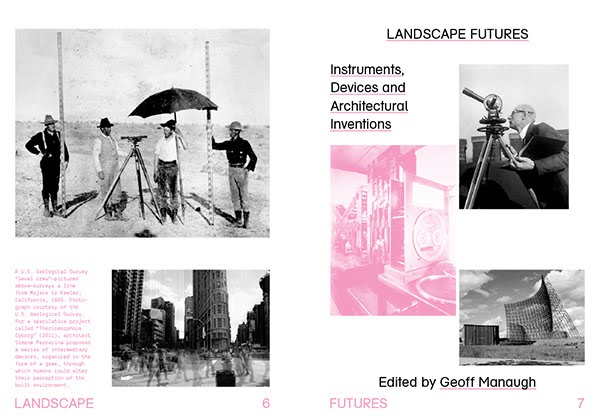
[Image: Internal title page from Landscape Futures; book design by Everything-Type-Company].

At long last, after a delay from the printer, Landscape Futures: Instruments, Devices and Architectural Inventions is finally out and shipping internationally.

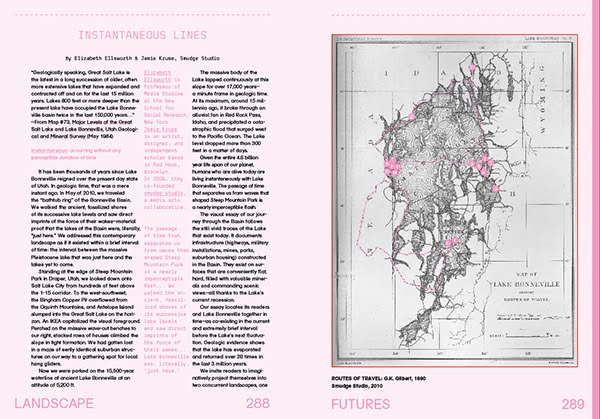
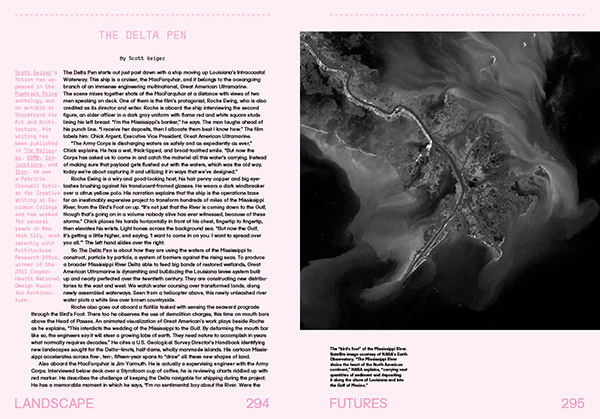
I am incredibly excited about the book, to be honest, and about the huge variety of content it features, including an original essay by Elizabeth Ellsworth & Jamie Kruse of Smudge Studio, a short piece of landscape fiction by Pushcart Prize-winning author Scott Geiger, and a readymade course outline—open for anyone looking to teach a course on oceanographic instrumentation—by Mammoth’s Rob Holmes.

These join reprints of classic texts by geologist Jan Zalasiewicz, on the incipient fossilization of our cities 100 million years from now; a look at the perverse history of weather warfare and the possibility of planetary-scale climate manipulation by James Fleming; and a brilliant analysis of the Temple of Dendur, currently held deep in the controlled atmosphere of New York’s Metropolitan Museum of Art, and its implications for architectural preservation elsewhere.

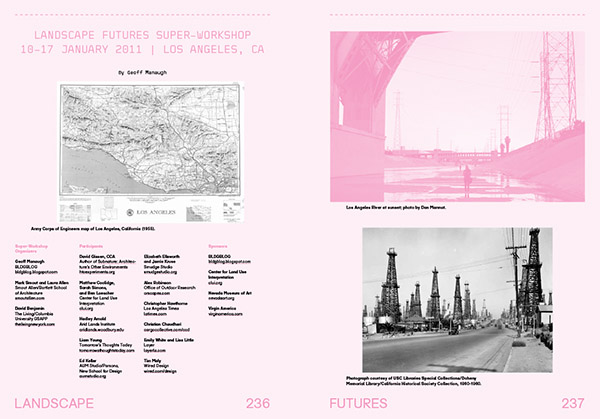
And even these are complemented by an urban hiking tour by the Center for Land Use Interpretation that takes you up into the hills of Los Angeles to visit check dams, debris basins, radio antennas, and cell phone towers, and a series of ultra-short stories set in a Chicago yet to come by Pruned‘s Alexander Trevi.

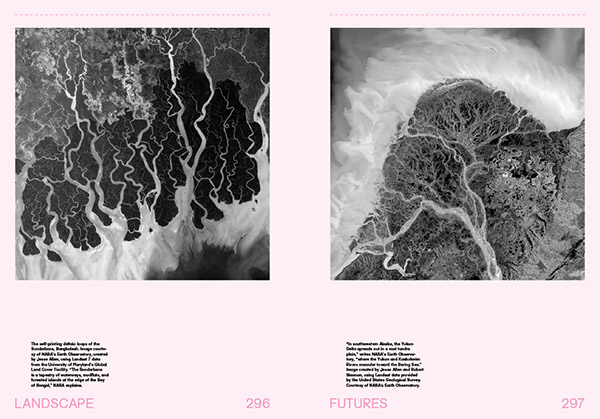
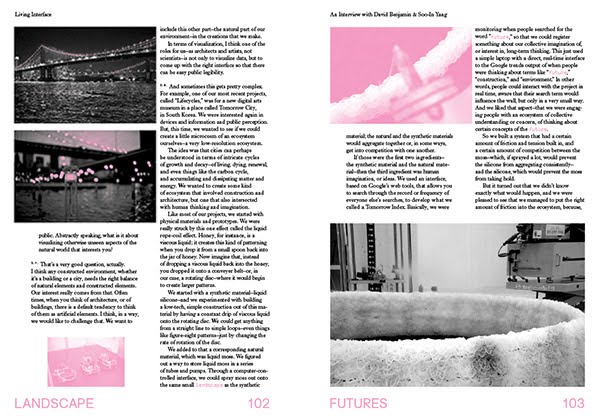
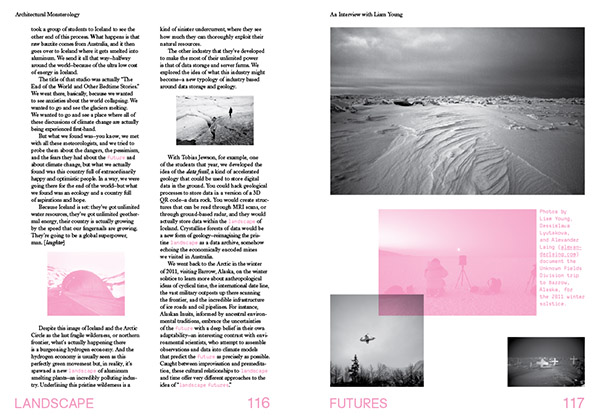
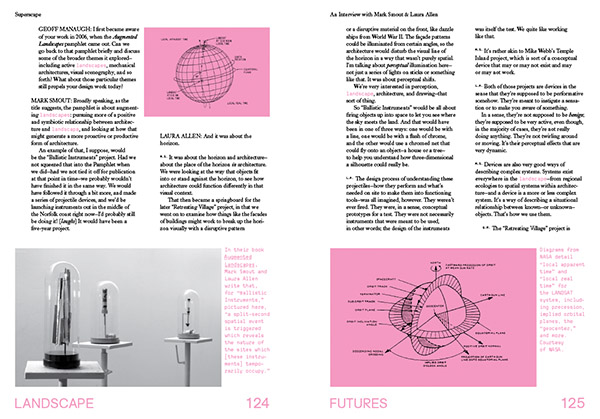
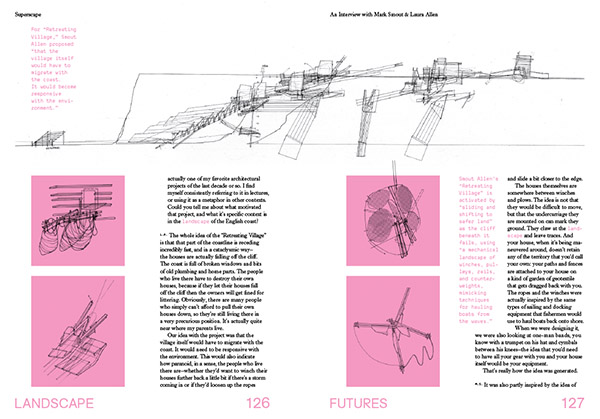
[Images: A few spreads from the “Landscape Futures Sourcebook” featured in Landscape Futures; book design by Everything-Type-Company].
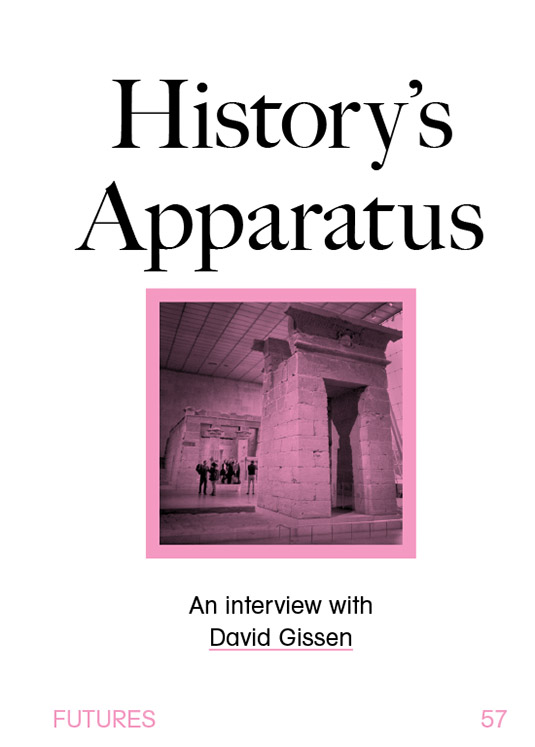
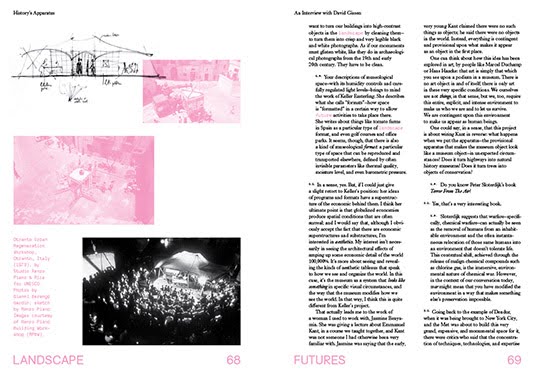
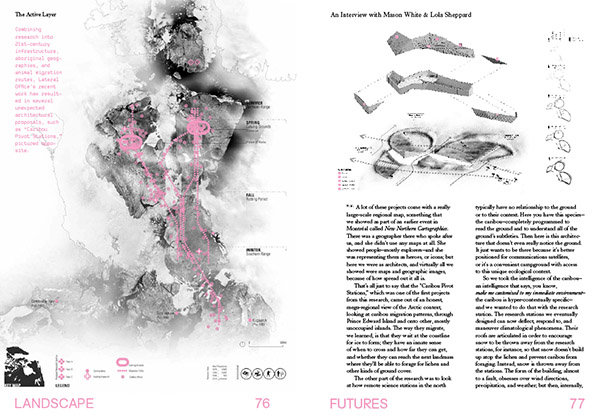
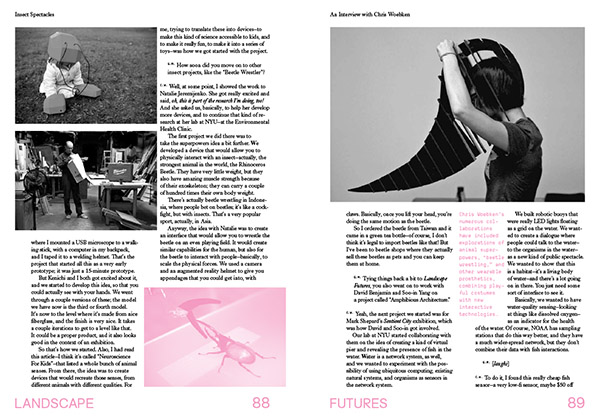
Of course, everything just listed supplements and expands on the heart of the book, which documents the eponymous exhibition hosted at the Nevada Museum of Art, featuring specially commissioned work by Smout Allen, David Gissen, and The Living, and pre-existing work by Liam Young, Chris Woebken & Kenichi Okada, and Lateral Office.

Extensive original interviews with the exhibiting architects and designers, and a long curator’s essay—describing the exhibition’s focus on the intermediary devices, instruments, and spatial machines that can fundamentally transform how human beings perceive and understand the landscapes around them—complete the book, in addition to hundreds of images, many maps, and an extensive use of metallic and fluorescent inks.

The book is currently only $17.97 on Amazon.com, as well, which seems like an almost unbelievable deal; now is an awesome time to buy a copy.

[Images: Interview spreads from Landscape Futures; book design by Everything-Type-Company].

In any case, I’ve written about Landscape Futures here before, and an exhaustive preview of it can be seen in this earlier post.

I just wanted to put up a notice that the book is finally shipping worldwide, with a new publication date of August 2013, and I look forward to hearing what people think. Enjoy!