Landscape Futures

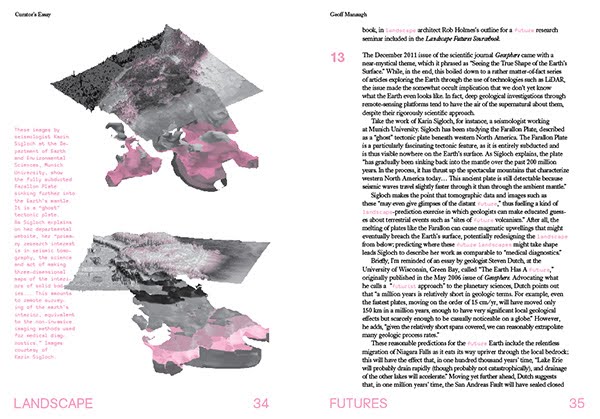
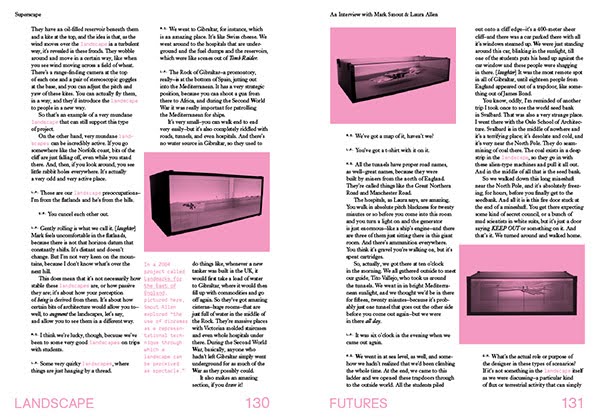
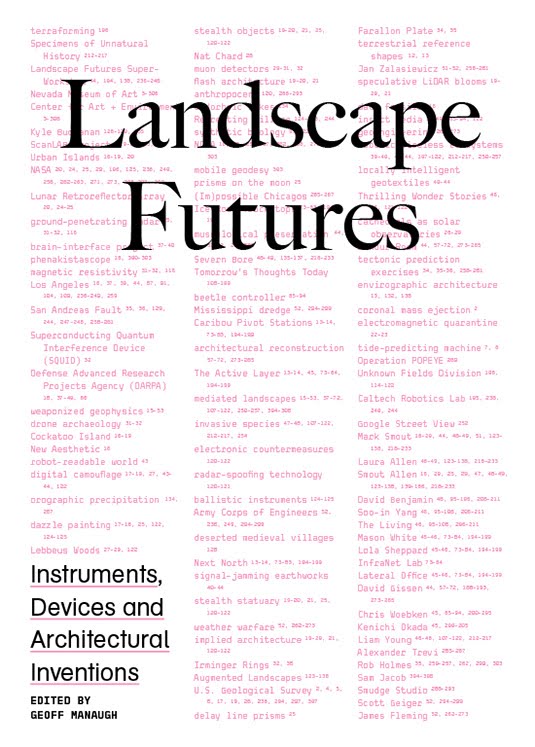
[Images: The cover of Landscape Futures; book design by Brooklyn’s Everything-Type-Company].

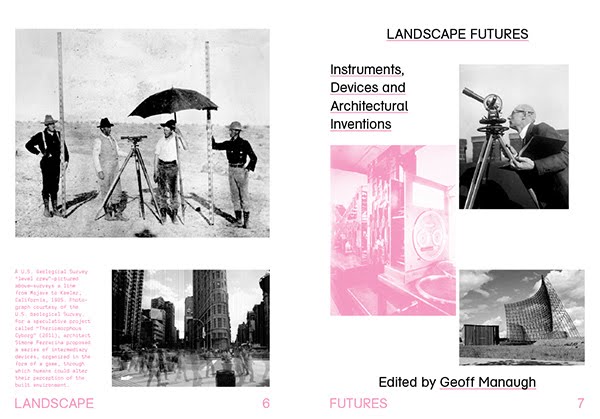
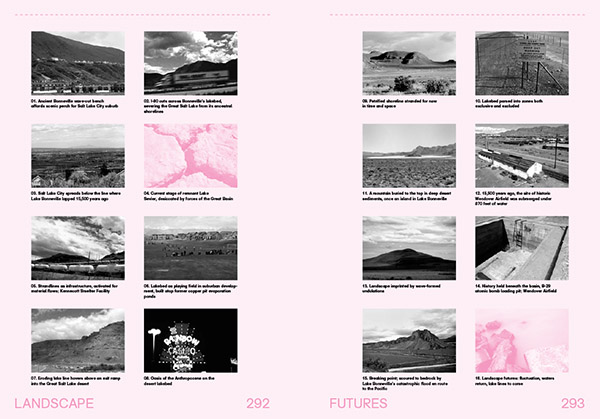
I’m enormously pleased to say that a book project long in the making will finally see the light of day later this month, a collaboration between ACTAR and the Nevada Museum of Art called Landscape Futures: Instruments, Devices and Architectural Inventions.

On a related note, I’m also happy to say simply, despite the painfully slow pace of posts here on the blog, going back at least the last six months or so, that many projects ticking away in the background are, at long last, coming to fruition, including Venue, and, now, the publication of Landscape Futures.

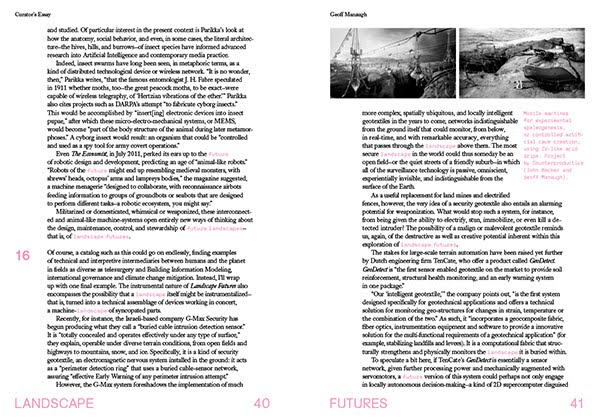
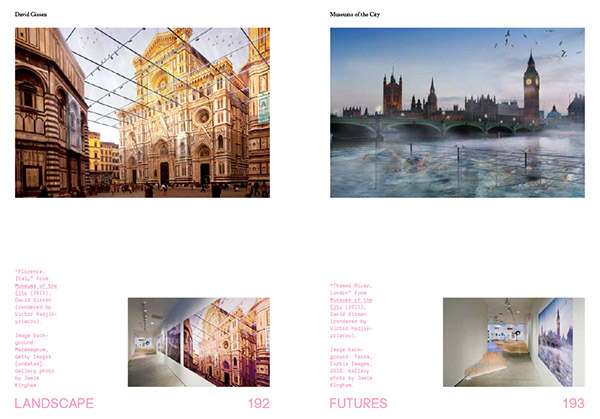
[Images: The opening spreads of Landscape Futures; book design by Everything-Type-Company].

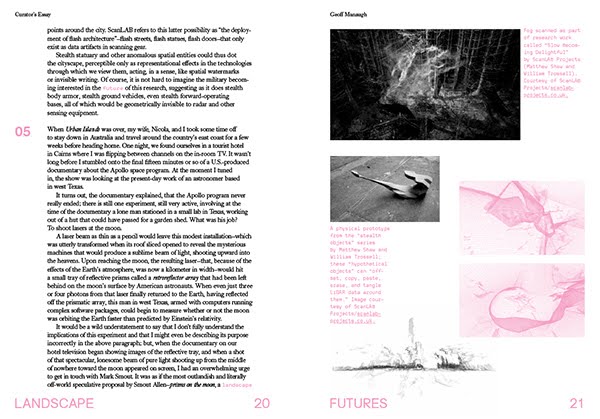
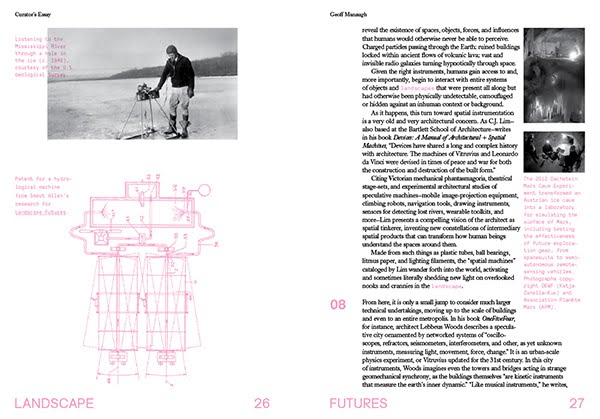
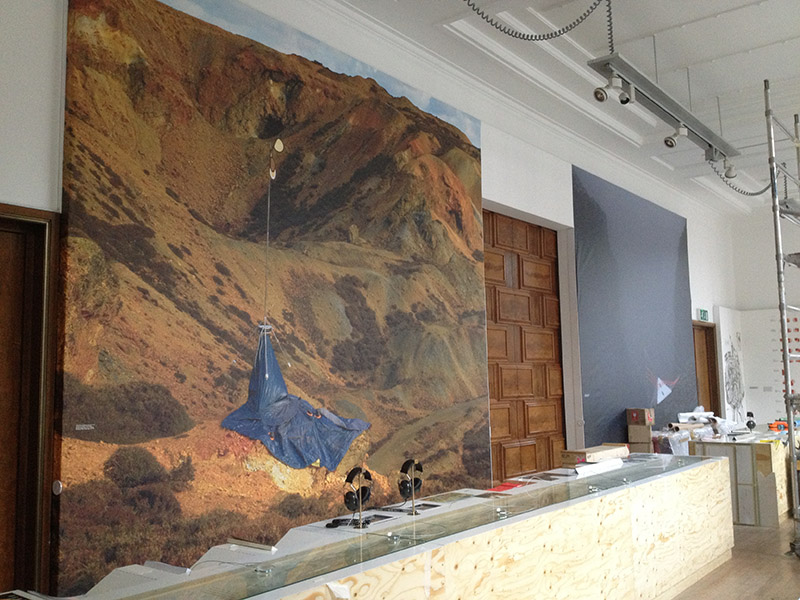
Landscape Futures both documents and continues an exhibition of the same name that ran for a bit more than six months at the Nevada Museum of Art in Reno, from August 2011 to February 2012. The exhibition was my first solo commission as a curator and by far the largest project I had worked on to that point. It was an incredible opportunity, and I remain hugely excited by the physical quality and conceptual breadth of the work produced by the show’s participating artists and architects.

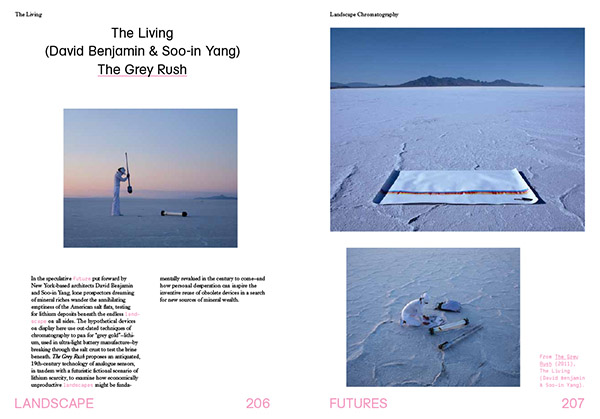
Best of all, I was able to commission brand new work from many of the contributors, including giving historian David Gissen a new opportunity to explore his ideas—on preservation, technology, and the environmental regulation of everyday urban space—in a series of wall-sized prints; finding a new genre—a fictional travelogue from a future lithium boom—with The Living; and setting aside nearly an entire room, the centerpiece of the 2,500-square-foot exhibition, for an immensely complicated piece of functioning machinery (plus documentary photographs, posters, study-models, an entire bound book of research, and much else besides) by London-based architects Smout Allen.

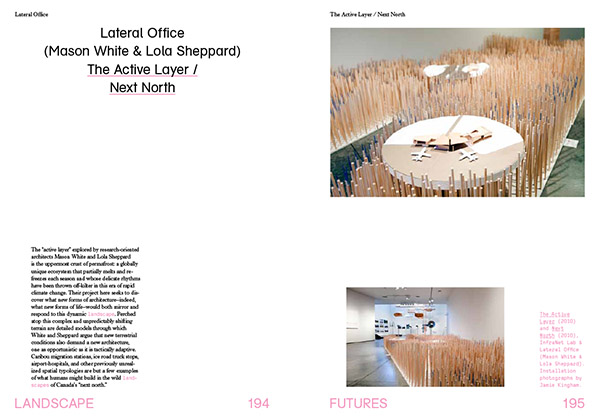
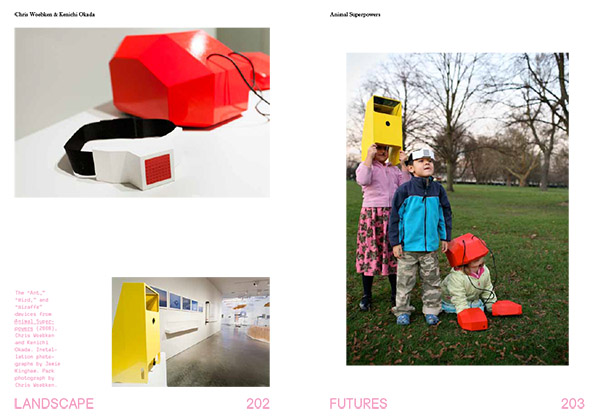
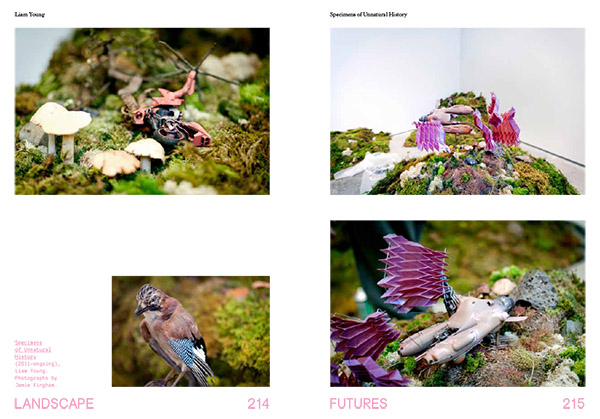
Those works joined pre-existing projects by Mason White & Lola Sheppard of Lateral Office and InfraNet Lab, whose project “Next North/The Active Layer” explored the emerging architectural conditions presented by climate-changed terrains in the far north; Chris Woebken & Kenichi Okada, whose widely exhibited “Animal Superpowers” added a colorful note to the exhibition’s second room; and architect-adventurer Liam Young, who brought his “Specimens of Unnatural History” successfully through international customs to model the warped future ecosystem of a genetically-enhanced Galapagos.
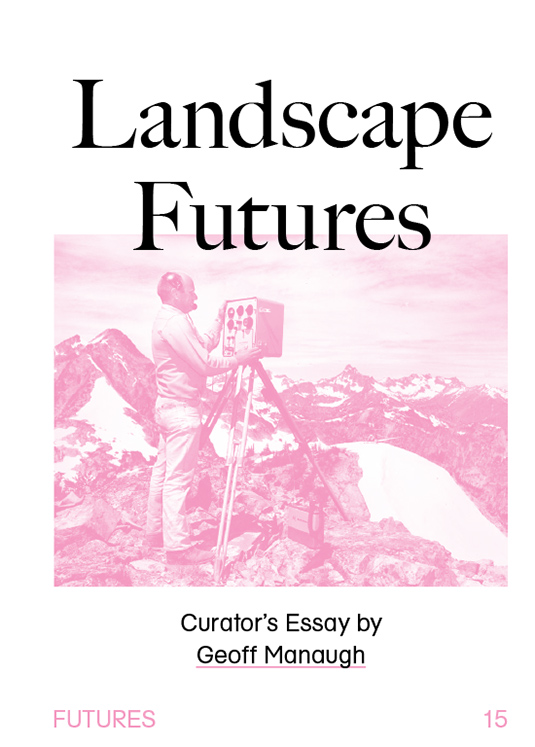
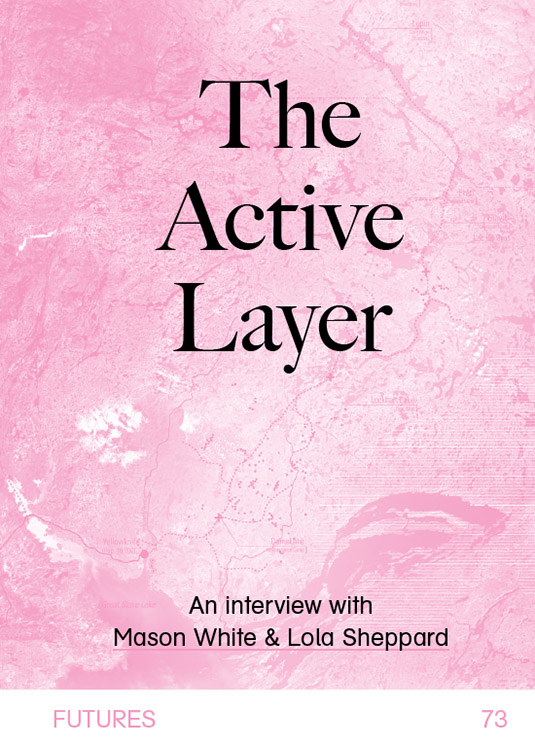
[Images: More spreads from Landscape Futures; book design by Everything-Type-Company].

But the book also expands on that core of both new and pre-existing work to include work by Rob Holmes, Alex Trevi (edited from their original appearance on Pruned), a travelogue through the lost lakes of the American West by Smudge Studio, a walking tour through the electromagnetic landscapes of Los Angeles by the Center for Land Use Interpretation, and a new short story by Pushcart Prize-winning author Scott Geiger.

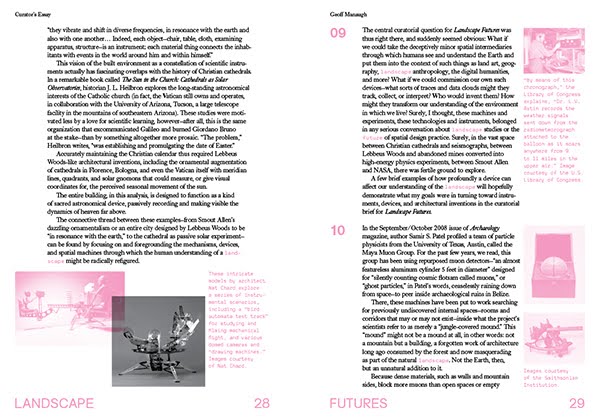
These, in turn, join reprints of texts highly influential for the overall Landscape Futures project, including a short history of climate control technologies and weather warfare by historian James Fleming, David Gissen‘s excellent overview of the atmospheric preservation of artifacts in museums in New York City (specifically, the Temple of Dendur at the Metropolitan Museum of Art), and a classic article—from BLDGBLOG’s perspective, at least—originally published in New Scientist back in 1998, where geologist Jan Zalasiewicz suggests a number of possibilities for the large-scale fossilization of entire urban landscapes in the Earth’s far future.

Even that’s not the end of the book, however, which is then further augmented by a long look, in the curator’s essay, at the various technical and metaphoric implications of the instruments, devices, and architectural inventions of the book’s subtitle, from robot-readable geotextiles and military surveillance technologies to the future of remote-sensing in archaeology, and moving between scales as divergent as plate-tectonic tomography, radio astronomical installations in the the polar north, and speculative laser-jamming objects designed by ScanLAB Projects.

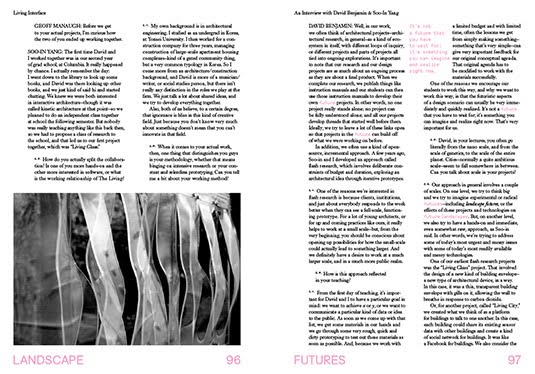
To wrap it all up and connect the conceptual dots set loose across the book, detailed interviews with all of the exhibition’s participating artists, writers, and architects fill out the book’s long middle—and, in all cases, I can’t wait to get these out there, as they are all conversations that deserve continuation in other formats. The responses from David Gissen alone could fuel an entire graduate seminar.

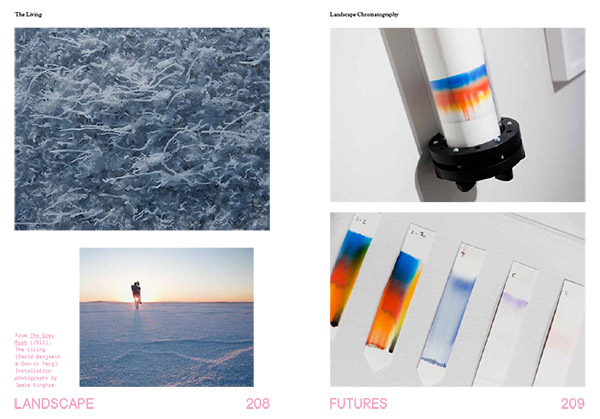
The spreads and images you see here all come directly from the book.

[Images: Spreads from Landscape Futures; book design by Everything-Type-Company].

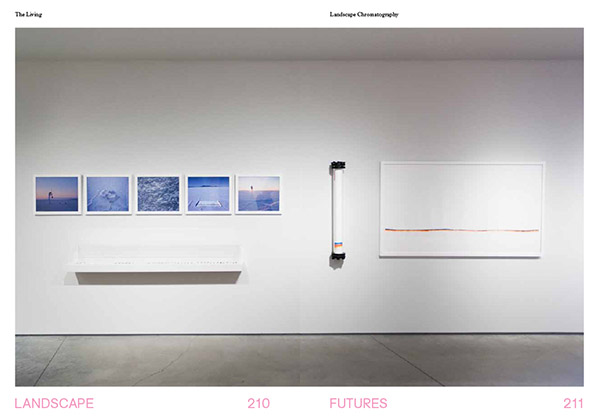
Of course, the work itself also takes up a large section in the final third or so of the book; consisting mostly of photographs by Jamie Kingham and Dean Burton, these document the exhibition contents in their full, spatial context, including the double-height, naturally lit room in which the ceiling-mounted machinery of Smout Allen whirred away for six months. This is also where full-color spreads enter the book, offering a nice pop after all the pink that came before.
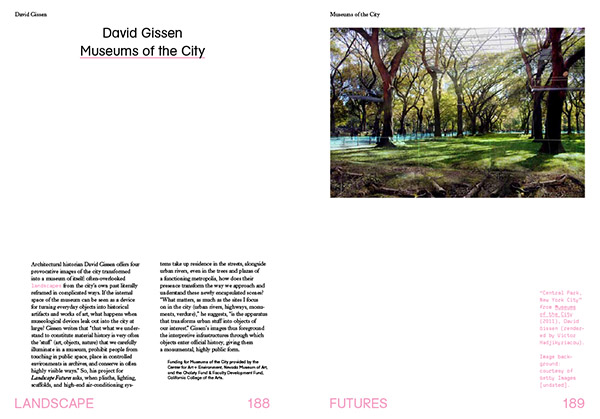
[Images: Installation shots from the Nevada Museum of Art, by Jamie Kingham and Dean Burton, including other views, from posters to renderings, from Landscape Futures; book design by Everything-Type-Company].

Which brings us, finally, to the Landscape Futures Sourcebook, the final thirty or forty pages of the book, filled with the guest essays, travelogues, walking tours, photographs, a speculative future course brief by Rob Holmes of Mammoth, and the aforementioned short story by Scott Geiger.

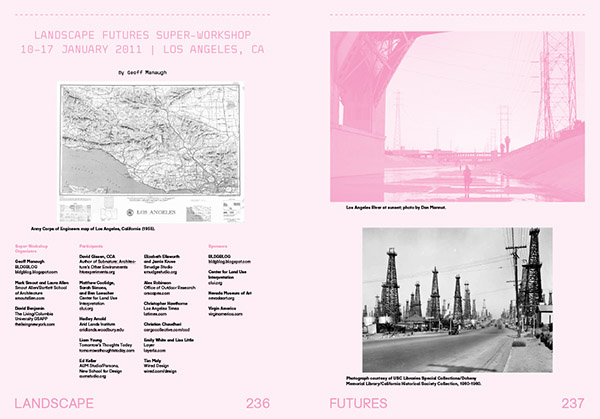
[Images: A few spreads from the Landscape Futures Sourcebook featured in Landscape Futures; book design by Everything-Type-Company].

Needless to say, I am absolutely thrilled with the incredible design work done by Everything-Type-Company—a new and rapidly rising design firm based in Brooklyn, founded by Kyle Blue and Geoff Halber—and I am also over the moon to think that this material will finally be out there for discussion elsewhere. It’s been a long, long time in the making.

In any case, shipping should begin later this month. Hopefully the above glimpses, and the huge list of people whose graphic, textual, or conceptual work is represented in the book, will entice you to support their effort with an order.

Enjoy!

(Thank you to all the people and organizations who made Landscape Futures possible, including the Nevada Museum of Art and ACTAR, supported generously by the Graham Foundation for Advanced Study in the Fine Arts, the National Endowment for the Arts, and the Andy Warhol Foundation for the Visual Arts).

Cross-Species Infrastructure

[Image: From “Assimilation” by Dillon Marsh].

I mentioned in the previous post the work of South African photographer Dillon Marsh, whose “Landscape Series” seeks “to find things that are out of the ordinary, picking them out of the landscape where they might otherwise blend in. I choose objects that can be found in multitude within their environment so that I can depict a family of objects in a series of photographs. By displaying each project as such, I feel I am able to show both the character of the individual members, and the characteristics that make these objects a family.”

[Image: From “Assimilation” by Dillon Marsh].

Marsh’s photos seen here were seemingly everywhere on the internet a few weeks ago, but I thought I’d post them nonetheless, as they’re not only interesting images in and of themselves, but they depict one of my favorite topics: human infrastructure claimed—or assimilated, in Marsh’s words—by nonhuman species, other builders and users of artificial environments, who construct their own homes on those underlying skeletons.

[Images: From “Assimilation” by Dillon Marsh].

It is an architecture of infestation, of creative reuse across species lines.

[Images: From “Assimilation” by Dillon Marsh].

So what is all this, more specifically? As Marsh explains, “In the vast barren landscapes of the southern Kalahari, Sociable Weaver Birds assume ownership of the telephone poles that cut across their habitat. Their burgeoning nests are at once inertly statuesque and teeming with life. The twigs and grass collected to build these nests combine to give strangely recognisable personalities to the otherwise inanimate poles.”

[Images: From “Assimilation” by Dillon Marsh].

Seen one way, these photos depict an entire form of architecture reduced to ornament, mere biological decoration; seen another, they just as powerfully reveal how the smallest and seemingly most inconsequential additions to the built environment—incremental 3D fabrics of twigs, grass, and weeds—serve to augment that built environment through inhuman architectural means.

Branch

[Image: From “Means to an End” by Dillon Marsh].

There are a few projects by the young South African photographer Dillon Marsh that seem worth a look.

[Image: From “Means to an End” by Dillon Marsh].

The first are his photos of “electricity pylons… criss-crossing the landscape around the city of Cape Town,” called “Means to an End.”

[Image: From “Means to an End” by Dillon Marsh].

Marsh is by no means the first photographer, artist, writer, architect, etc., to look at electricity pylons, but the resulting images are pretty stunning.

Meanwhile, Marsh has a variety of other series available for view on his website, but another one I want to feature briefly here is called “Limbo.”

[Image: From “Limbo” by Dillon Marsh].

In Marsh’s own words, “‘Limbo‘ is a series of photographs showing trees that have died, but not yet fallen. All these trees were photographed in various suburbs of the Cape Flats area of Cape Town, including Bridgetown, Bonteheuwel, Ruyterwacht, Windermere, and The Hague.”

The results perhaps recall the “Rise” filter, as well as the square format of Instagram, but, for me, that doesn’t take away from their visual or conceptual interest.

[Images: From “Limbo” by Dillon Marsh].

Oddly, these actually remind me of the trees in Hackney, a borough of London where I briefly lived more than a decade ago; the branches of almost every tree along the streets that I walked each morning to the local bus stop had been cut—or hacked, as it were—by the Council, apparently out of a mathematically impossible fear of liability should the branches someday fall and hit a car, a pedestrian, or a baby in a stroller, lending the neighborhood an even drearier feel of grey-skied Gothic horror than it would have had already on its own.

[Images: From “Limbo” by Dillon Marsh].

Somewhere between portraits and landscape photography, these two projects of Marsh’s go well together, depicting the starkly exposed branching peculiar to these two types of structures.

They are also both in Marsh’s “Landscape Series” of photographs, a series that, in his words, seeks “to find things that are out of the ordinary, picking them out of the landscape where they might otherwise blend in. I choose objects that can be found in multitude within their environment so that I can depict a family of objects in a series of photographs. By displaying each project as such, I feel I am able to show both the character of the individual members, and the characteristics that make these objects a family.”

I’ll do one more quick post about Marsh’s work, showing my favorite series of all.

London Laocoön

[Image: Machines slide beneath the streets, via Crossrail].
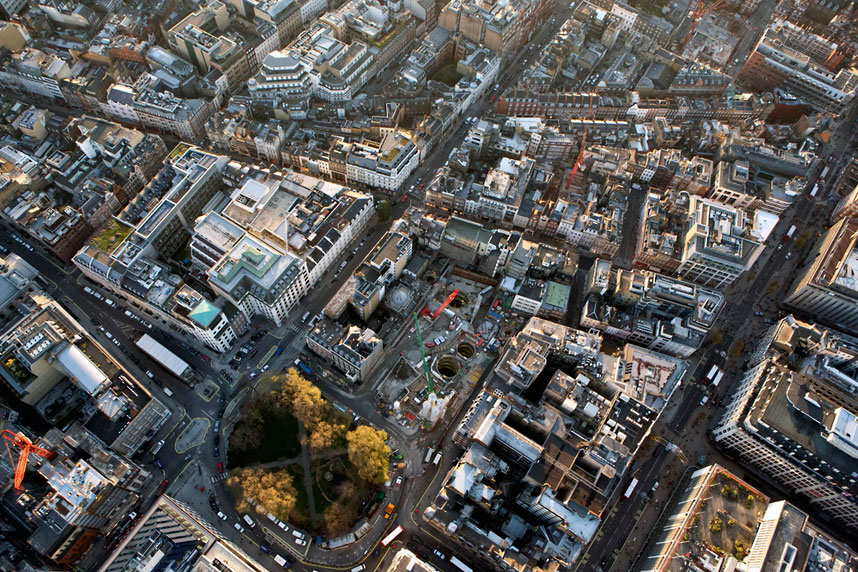
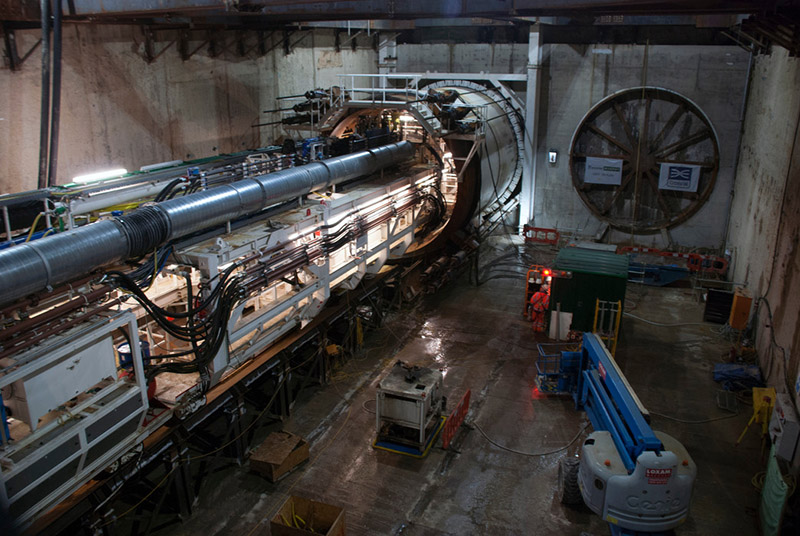
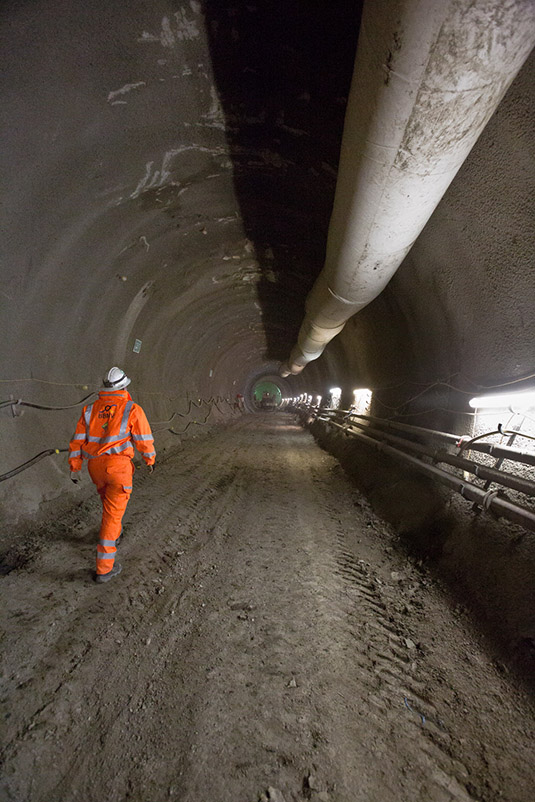
The Crossrail tunnels in London—for now, Europe’s largest construction project, scheduled to finish in 2018—continue to take shape, created in a “tunneling marathon under the streets of London” that aims to add 26 new miles of underground track for commuter rail traffic.

It’s London as Laocoön, wrapped in tunnel-boring machines, mechanical snakes that coil through their own hollow nests beneath the city.

[Image: Looking down through shafts into the subcity, via Crossrail].

What interested me the most in all this, however, was simply that fact that the first tunneling machine put to work in this round of excavation is called Phyllis—

[Image: Phyllis, via Crossrail].

—named after Phyllis Pearsall, widely (but incorrectly?) mythologized as the founder of the legendary A-Z book of London street maps.

There’s something very Psychogeography Lite™ in this, weaving your city together from below with a giant machine-needle named after the woman who (supposedly) first walked the streets of the capital, assembling her book of maps, as if the only logical direction to go, once you’ve mapped the surface of your city, is down, passing through those surfaces to explore larger and darker volumes of urban space.

Space in the Adaptive Plastic

[Image: An otherwise irrelevant photo of early night-vision technology used during the Vietnam War; courtesy of the U.S. Army].

So where were we?

Just clearing out a few old links for a fresh start. Last spring, Danger Room reported that DARPA had been hoping to step into the world of “battlefield illusions,” developing “technologies that will ‘manage the adversary’s sensory perception’ in order to ‘confuse, delay, inhibit, or misdirect [his or her] actions.'” This includes “frontline illusions intended to disrupt enemy warfighters’ thought patterns.”

The program—a kind of military-sensory complex—is based on the belief that “if researchers can better understand ‘how humans use their brains to process sensory inputs,’ the military should be able to develop ‘auditory and visual’ hallucinations that will ‘provide tactical advantage for our forces.'”

But what might the architectural—or the more generally urban, the very broadly spatial—implications of such a technology be? Can managing or choreographing perception through shared hallucinations and techniques of sensory misdirection in the built environment be a tool increasingly useful for designers today? Even DARPA refers to this sub-class of programs as “Shaping the Environment“—so is there a civilian, or, more accurately, a deweaponized, version of these deployable “illusions” that could be used by architects or even by set & interior designers for real-time augmentations of everyday space? For “engineering ghosts” in the rooms around us, where the rooms themselves are sometimes ghosts?

After all, urban design as a hand-me-down technology from the military is nothing new, so adapting battlefield misperceptions to architectural use on the homefront would hardly be surprising.

Perhaps it’d be like Microsoft’s patented Immersive Display Experience, an architecture of overlapping stitched projections such that “the peripheral image appears as an extension of the primary image,” and, in the process, the room you’re standing in becomes a game display.

[Image: Microsoft’s Immersive Display Experience].

How could this be used by architects?

While we’re on the subject of DARPA, meanwhile, another even older piece of news from their designers’ desks was this 2011 announcement that they’d begun constructing “an entirely new class of electronic systems that can meet the demands of dynamic environments.” These would be called Systems of Neuromorphic Adaptive Plastic Scalable Electronics (or SyNAPSE), a “program [that] aims to fundamentally alter conventional designs by developing biological-scale neuromorphic electronic systems that mimic important functions of a human brain.” A strange future of neuromorphic plastic brains illusioneering streets into existence—invisible cities, flickering and disruptive—we humans will try and, haplessly, fail to navigate.

Starfish City

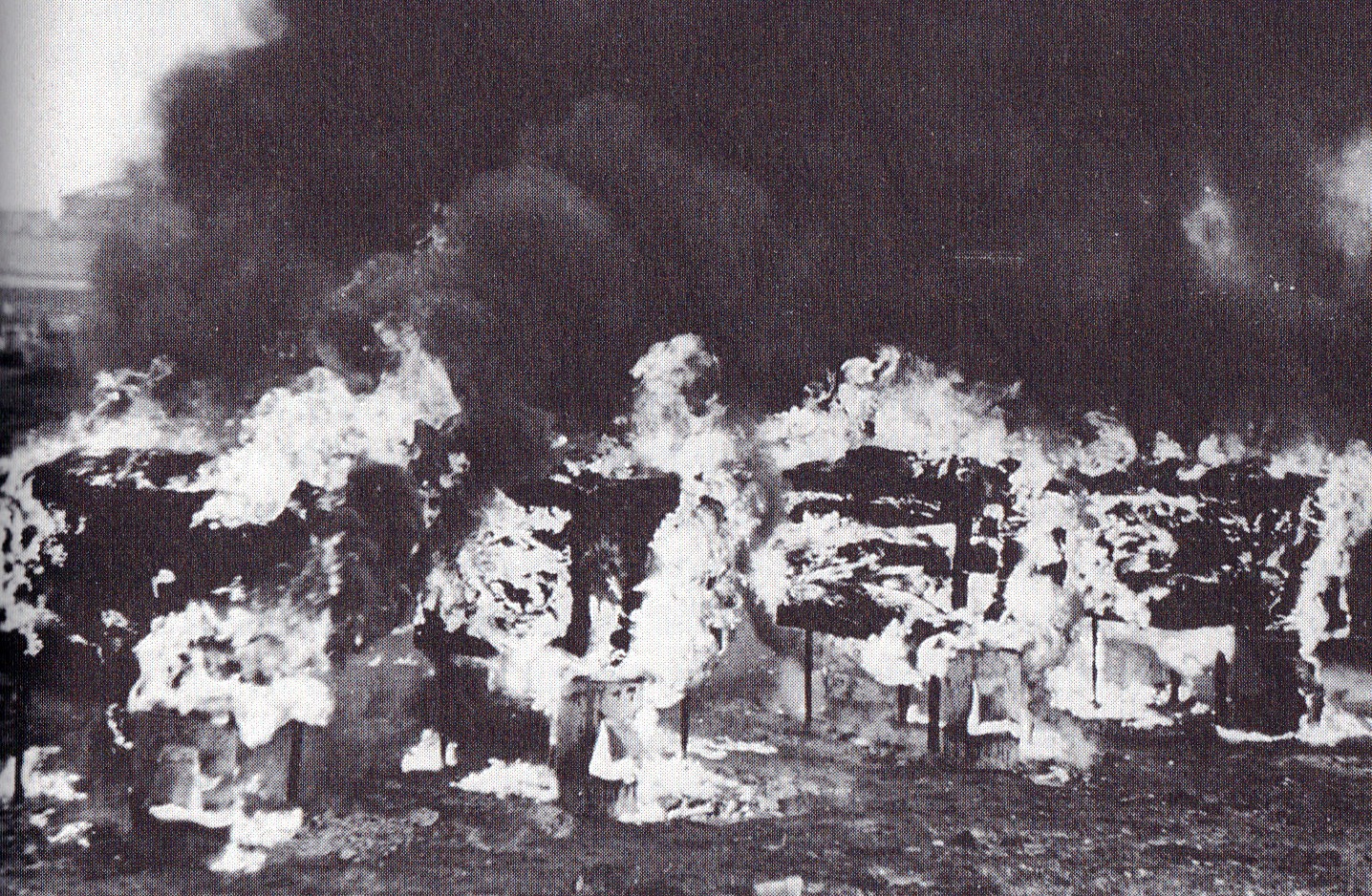
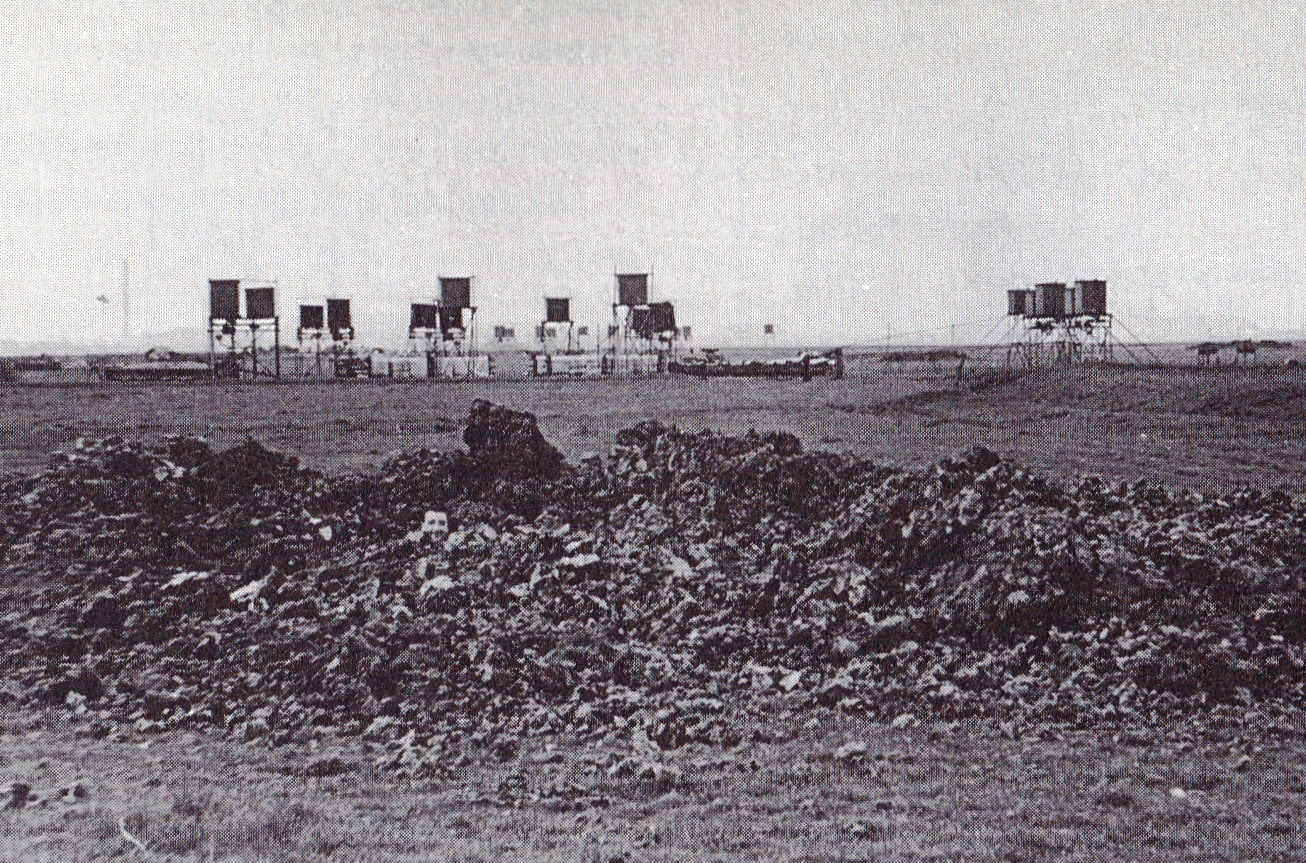
[Image: A Starfish site, like a pyromaniac’s version of Archigram, via the St. Margaret’s Community Website; view larger].

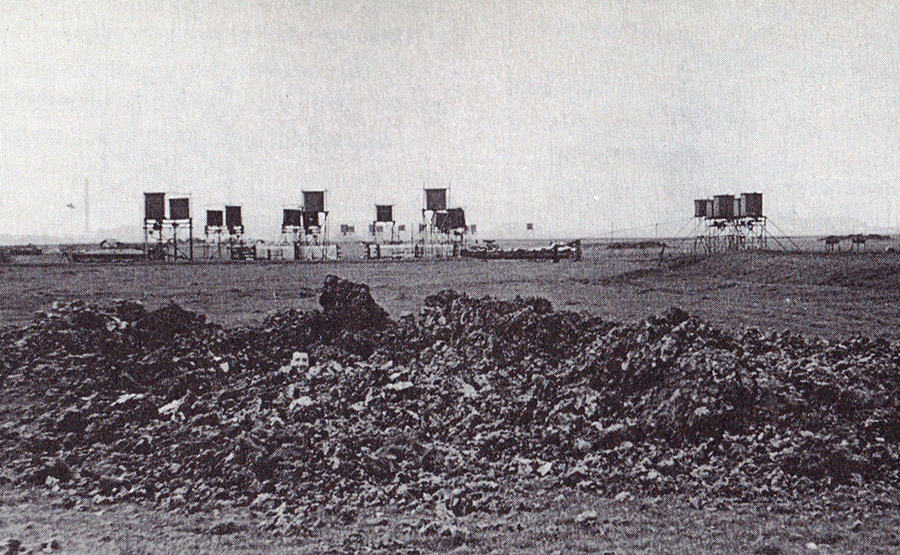
A few other things that will probably come up this evening at the Architectural Association, in the context of the British Exploratory Land Archive project, are the so-called “Starfish sites” of World War II Britain. Starfish sites “were large-scale night-time decoys created during The Blitz to simulate burning British cities.”

[Image: A Starfish site burning, via the St. Margaret’s Community Website; view larger].

Their nickname, “Starfish,” comes from the initials they were given by their designer, Colonel John Turner, for “Special Fire” sites or “SF.”

As English Heritage explains, in their list of “airfield bombing decoys,” these misleading proto-cities were “operated by lighting a series of controlled fires during an air raid to replicate an urban area targeted by bombs.” They would thus be set ablaze to lead German pilots further astray, as the bombers would, at least in theory, fly several miles off-course to obliterate nothing but empty fields camouflaged as urban cores.

They were like optical distant cousins of the camouflaged factories of Southern California during World War II.

Being in a hotel without my books, and thus relying entirely on the infallible historical resource of Wikipedia for the following quotation, the Starfish sites “consisted of elaborate light arrays and fires, controlled from a nearby bunker, laid out to simulate a fire-bombed town. By the end of the war there were 237 decoys protecting 81 towns and cities around the country.”

[Image: Zooming-in on the Starfish site, seen above; image via the St. Margaret’s Community Website].

The specific system of visual camouflage used at the sites consisted of various special effects, including “fire baskets,” “glow boxes,” reflecting pools, and long trenches that could be set alight in a controlled sequence so as to replicate the streets and buildings of particular towns—1:1 urban models built almost entirely with light.

In fact, in some cases, these dissimulating light shows for visiting Germans were subtractively augmented, we might say, with entire lakes being “drained during the war to prevent them being used as navigational aids by enemy aircraft.”

Operational “instructions” for turning on—that is, setting ablaze—”Minor Starfish sites” can be read, courtesy of the Arborfield Local History Society, where we also learn how such sites were meant to be decommissioned after the war. Disconcertingly, despite the presence of literally tons of “explosive boiling oil” and other highly flammable liquid fuel, often simply lying about in open trenches, we read that “sites should be de-requisitioned and cleared of obstructions quickly in order to hand the land back to agriculture etc., as soon as possible.”

The remarkable photos posted here—depicting a kind of pyromaniac’s version of Archigram, a temporary circus of flame bolted together from scaffolding—come from the St. Margaret’s Community Website, where a bit more information is available.

In any case, if you’re around London this evening, Starfish sites, aerial archaeology, and many other noteworthy features of the British landscape will be mentioned—albeit in passing—during our lecture at the Architectural Association. Stop by if you’re in the neighborhood…

(Thanks to Laura Allen for first pointing me to Starfish sites).

Ice Age Aerial

[Image: Photo: The “cemetery and church at Teampull Eion, Isle of Lewis,” courtesy of the Royal Commission on the Ancient and Historical Monuments of Scotland].

One of many things I was excited to discover while working on the British Exploratory Land Archive project, and while getting ready for tonight’s lecture at the Architectural Association, is the “Scotland’s Landscapes” collection of aerial archaeology photographs from the Royal Commission on the Ancient and Historical Monuments of Scotland.

[Image: (top) The “remains of White Castle Fort“; (bottom) the “remains of the Northshield Rings.” Photos courtesy of the Royal Commission on the Ancient and Historical Monuments of Scotland].

“As the glaciers of the last Ice Age receded,” we read, “Scotland’s earliest ancestors ventured northwards, exploring a wild, fertile territory. Nomadic hunter-gatherers at first, they made the decision to stay for good—to farm and to build. From that moment on, people began to write their story firmly into the fabric of the landscape.” Indeed, today, “every inch of Scotland—whether remote hilltop, fertile floodplain, or storm-lashed coastline—has been shaped, changed and moulded by its people.”

[Image: Photo: The (modernday) “Fife Earth Project at St. Ninian’s Open Cast Site,” courtesy of the Royal Commission on the Ancient and Historical Monuments of Scotland].

Quoting at length:

The landscapes they lived on were remarkable in their diversity. Vast forests of pine and birch ran through one of the world’s oldest mountain ranges—once as high as the Himalayas but over millennia scoured and compressed by sheets of ice a mile thick. On hundreds of islands around a saw-edged coastline, communities flourished, linked to each other and the wider world by the sea, the transport superhighway of ancient times.

Many of the resulting settlements have the appearance of inland islands, isolated shapes and ringed perimeters still visible from the air.

[Image: Photo: The “remains of the lazy beds and enclosures at Muidhe on the Isle of Skye,” courtesy of the Royal Commission on the Ancient and Historical Monuments of Scotland].

In any case, here are some of the photos—just a random selection of eye-candy for a Thursday afternoon.

[Images: Aerial view of Lochindorb Castle, courtesy of the Royal Commission on the Ancient and Historical Monuments of Scotland].

Meanwhile, these and many other photos are available in a new book by James Crawford, called Scotland’s Landscapes: The National Collection of Aerial Photography, and you can see more online here.

Floating Cities and Site Surveys

[Image: Photo by Mark Smout of a photo by Mark Smout, for the British Exploratory Land Archive].
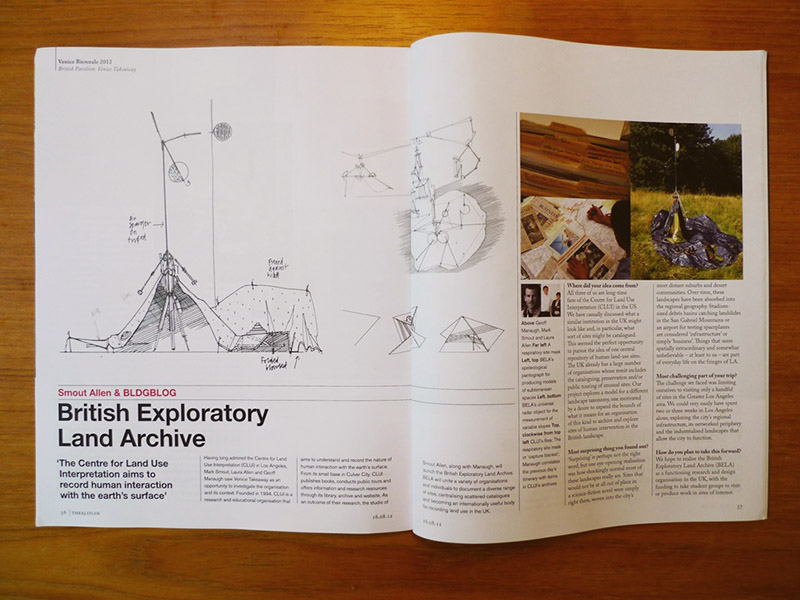
I’m delighted to say that work originally produced for the British Pavilion at last summer’s Venice Biennale will go on display this week at the Royal Institute of British Architects in London, beginning tomorrow, 26 February.

This will include, among many other projects, from studies of so-called “new socialist villages” in China to floating buildings in Amsterdam, to name but a few, the British Exploratory Land Archive (BELA) for which BLDGBLOG collaborated with architects Smout Allen in proposing a British version of the Center for Land Use Interpretation in Los Angeles. BELA would thus survey, catalog, explore, tour, document, and archive in one location the huge variety of sites in Britain altered by and used by human beings, from industrial sites to deserted medieval villages, slag heaps to submarine bases, smuggler’s hideouts to traffic-simulation grounds. A few of these sites have already been documented in massive photographs now mounted at the RIBA, also featuring architectural instruments designed specifically for the BELA project and assembled over the summer in Hackney.

[Image: From the British Exploratory Land Archive].

However, if you’re curious to know more and you happen to be in London on Thursday, 28 February, consider stopping by the Architectural Association to hear Smout Allen and I speak in more detail about the project. That talk is free and open the public, and it kicks off at 6pm; I believe architect Liam Young will be introducing things. Meanwhile, the aforementioned study of floating architecture in Amsterdam will be presented by its collaborative team—dRMM—at the RIBA on Tuesday night, 26 February, so make your calendars for that, as well (and check out the full calendar of related talks here).

The RIBA is at 66 Portland Place and the AA is in Bedford Square.

The Fifth Wall

[Image: Green screen; image via Geek Magazine].

Earlier this week, Petro Vlahos, described by the BBC as “the pioneer of blue- and green-screen systems” in cinema, passed away. Vlahos’s highly specific recoloring of certain surfaces in the everyday built environment allowed “filmmakers to superimpose actors and other objects against separately filmed backgrounds”; they are walls that aren’t really there:

He called his invention the colour-difference travelling matte scheme. Like pre-existing blue-screen techniques it involves filming a scene against an aquamarine blue-coloured background. This is used to generate a matte—which is transparent wherever the blue-colour features on the original film, and opaque elsewhere. This can then be used to superimpose a separately filmed scene or visual effects to create a composite.

Special effects, animated actors, entire sets and spaces that weren’t physically present during filming: these aquamarine-colored surfaces are almost conjuring windows through which other environments can be optically inserted into filmed representations of the present moment.

These sorts of walls and surfaces are not architecture, we might say, but pure spatial effects, a kind of representational sleight of hand through which the boundaries and contents of a location can be infinitely expanded. There is no “building,” then, to put this in Matrix-speak; there are only spatial implications. Green screen architecture, here, would simply be a visual space-holder through which to substitute other environments entirely: a kind of permanent, physically real special effect that, in the end, is just a coat of paint.

It’s interesting, in this interpretation, that “green screens” or a rough optical equivalent are not more commonly utilized in architectural or interior design—even if only as an ironic gesture toward the possibility that, say, a group of friends taking photographs in your living room, with its weird green wall on one side, or in the lobby of that hotel, with its green screen backdrop, might somehow be able to insert into the resulting photographs otherwise non-present spatial realities, as if they had been photographed in front of a Stargate or a Holodeck, a window creaking open between worlds.

In fact, this was exactly the strange feeling I had when living just two buildings away from a green screen lot in Los Angeles, as if the painted green surface there, looming over the empty lot on our street corner, was standing sentinel, patiently awaiting new worlds to appear, all the while being nothing more than a wall of green plywood.

Optical Calibration Targets

[Image: “Three tri-bar targets remaining at Cuddeback Lake… the flat surfaces are peeling, crumbling and sprouting, producing dimensionality, and relief.” Photo by and courtesy of the Center for Land Use Interpretation].

“There are dozens of aerial photo calibration targets across the USA,” the Center for Land Use Interpretation reports, “curious land-based two-dimensional optical artifacts used for the development of aerial photography and aircraft. They were made mostly in the 1950s and 1960s, though some apparently later than that, and many are still in use, though their history is obscure.”

These symbols—like I-Ching trigrams for machines—are used as “a platform to test, calibrate, and focus aerial cameras traveling at different speeds and altitudes,” CLUI explains, similar to “an eye chart at the optometrist, where the smallest group of bars that can be resolved marks the limit of the resolution for the optical instrument that is being used.”

[Image: A tri-bar array at Eglin Air Force Base, Florida; via CLUI].

Formally speaking, the targets could be compared to mis-painted concrete parking lots in the middle of the nowhere, using “sets of parallel and perpendicular bars duplicated at 15 or so different sizes.” This “configuration is sometimes referred to as a 5:1 aspect Tri-bar Array, and follows a similar relative scale as a common resolution test chart known as the 1951 USAF Resolving Power Test Target, conforming to milspec MIL-STD-150A. This test pattern is still widely used to determine the resolving power of microscopes, telescopes, cameras, and scanners.”

[Image: A “standard tri-bar test pattern on the Photo Resolution Range at Edwards that has been greatly expanded,” CLUI writes; via CLUI].

CLUI points out that the history and location of the tri-bar patterns corresponds to the rise of high-altitude “flying cameras” developed during the Cold War—i.e. spy planes whose purpose was not to deliver ordnance to the far side of the world but simply to take detailed photographs.

[Image: An “especially exotic” expanded tri-bar array at Fort Huachuca, Arizona; via CLUI].

Further, “the largest concentration of calibration targets in one place is on the grounds of Edwards Air Force Base” in California, “in an area referred to as the photo resolution range, where 15 calibration targets run for 20 miles across the southeast side of the base in a line, so multiple targets can be photographed in one pass. There is some variation in the size and shape of the targets at Edwards, suggesting updates and modifications for specific programs. A number of the targets there also have aircraft hulks next to them, added to provide additional, realistic subjects for testing cameras.”

A quick scan of Google Maps locates the photo resolution range relatively easily; broadly speaking, just go up to the right and down to the left from, say, this point and you’ll find the targets.

[Image: Calibration targets from the photo resolution range, Edwards Air Force Base; from Google Maps].

Although I am truly fascinated by what sorts of optical landmarks might yet be developed for field-testing the optical capabilities of drones, as if the world might soon be peppered with opthalmic infrastructure for self-training autonomous machines, it is also quite intriguing to realize that these calibration targets are, in effect, ruins, obsolete sensory hold-overs from an earlier age of film-based cameras and less-powerful lenses. Calibrating nothing, they are now just curious emblems of a previous generation of surveillance technology, robot-readable hieroglyphs whose machines have all moved on.

Fault Wall

With my eyes on all things fault-related these days, as we’re now in the third week of the San Andreas Fault National Park studio up at Columbia, I was interested in a brief moment from poet Simon Armitage’s new memoir, Walking Home.

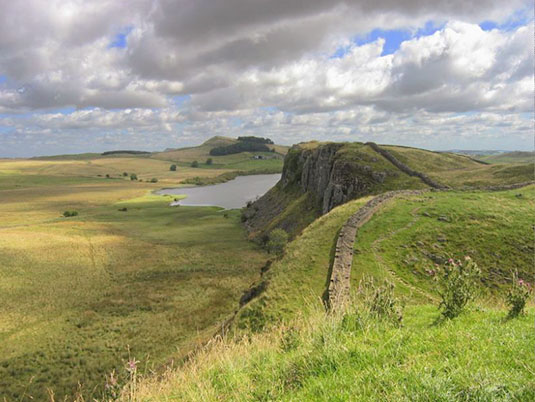
[Image: Hadrian’s Wall (not the wall described below) on the Whin Sill, via Wikipedia].
While hiking with a friend across a geological formation called the Whin Sill, in the northern Pennines, Armitage learns something extraordinary:

Stopping to appreciate a high and long dry-stone wall that bisects two valleys, [his fellow hiker] Chris explains how the shape, size, colour and consistency of the stones begins to change along its course, a consequence of wall-builders using the nearest available material while quarrying across a fault-line, so the wall becomes a kind of cross-section of the bedrock below us, and a timeline also, and after a few minutes of looking I almost convince myself that I can see the difference.

Whether or not this is even geologically true—and Armitage himself seems hesitant to accept the insight—the idea that fissures in the earth can be made visible in architecture is an implication worth contemplating, as if human spatial constructions, or, more importantly, the materials from which they’re made, can act as signs or perhaps symptoms for long-dead titanic events of incredible force and violence otherwise invisible inside the planet.

(Thanks to Nicola Twilley for the tip!)