Buying, Selling, and Building Air

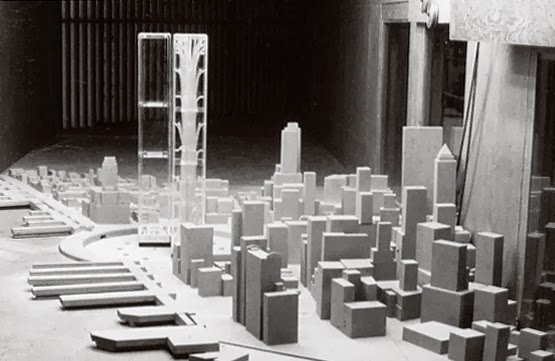
[Image: A “wind tunnel model of the New York Trade Center (study by Drs. J.E.Cermak and A.G. Davenport in the Colorado State University boundary layer wind tunnel for L.E. Robertson of Worthington, Skilling, Helle and Jackson (1964),” via Studio-X NYC].

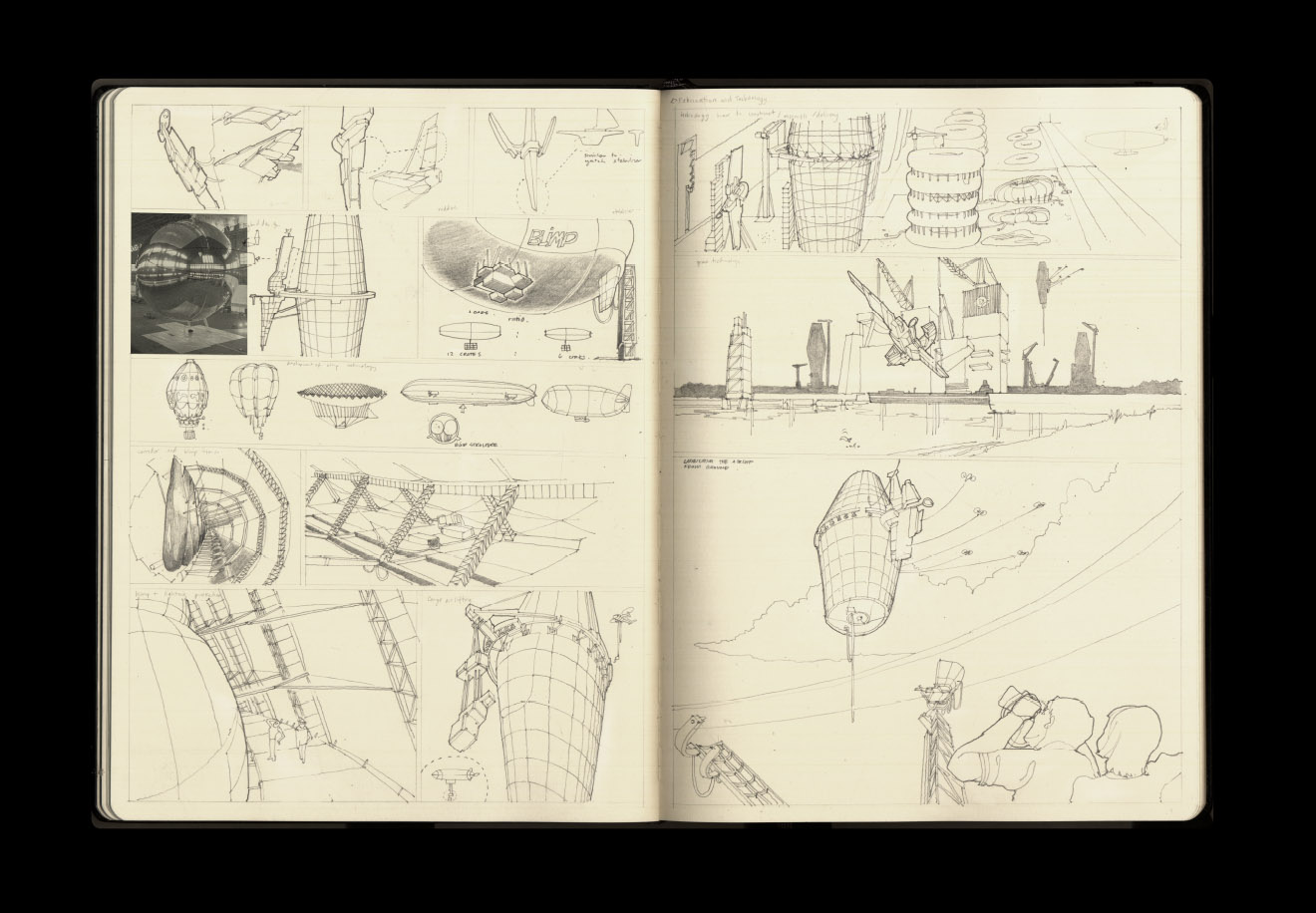
Nicola Twilley of Edible Geography has put together an amazing event this coming Tuesday evening, October 8, at my former employer, Studio-X NYC, an event space run by the architecture department at Columbia University. Called “Air: Its Contents, Value, and Motion,” the event looks at air rights in New York, the challenge of structurally engineering against air, winds, and hurricanes in some of the world’s largest buildings, and a slightly more philosophical take on air’s contents—its pollen, pollution, and even aerosolized fats.

A pretty jaw-dropping cast of panelists—writer William Bryant Logan, air rights lawyer Robert Von Ancken, and legendary structural engineer Leslie Robertson—will discuss, as the event describes it, air, “the stuff between buildings.”

In the process, they “will share their perspective on the curious logic of the city’s air rights economy, how the wind has sculpted its facades, and how the content of its air differs by neighborhood.”

The event is free, kicks off at 7pm, and is at 180 Varick Street, Suite 1610, on the 16th floor. Here’s a map.

Out of the Mountains

[Image: David Kilcullen, from Out of the Mountains].

Military strategist David Kilcullen was in New York City earlier this week to talk about the future of urban warfare at the World Policy Institute. I tagged along to learn more about “future conflicts and future cities,” as Kilcullen describes it, and to see what really happens when urban environments fail: when cities fall apart or disintegrate into ungovernable canyons of semi-derelict buildings ruled by cartels, terrorist groups, and paramilitary gangs.

Kilcullen’s overall thesis is a compelling one: remote desert battlegrounds and impenetrable mountain tribal areas are not, in fact, where we will encounter the violence of tomorrow. For Kilcullen—indeed, for many military theorists writing today—the war in Afghanistan was not the new normal, but a kind of geographic fluke, an anomaly in the otherwise clear trend for conflicts of an increasingly urban nature.

The title of Kilcullen’s book—Out of the Mountains—suggests this. War is coming down from the wild edges of the world, driving back toward our lights and buildings from the unstructured void of the desert, and arriving, at full force, in the hearts of our cities, in our markets and streets. The recent siege in Nairobi and the Mumbai attacks, to name only two examples that came up in Kilcullen’s discussion, are evidence of the urbanization of violence and war. 

But if cities—particularly in the world’s coastal, developing regions—are a hotbed for future aggression, as Kilcullen and other military theorists suggest, then is it possible that we could somehow design away this growing problem? Kilcullen, a former soldier with the Australian military, said repeatedly that there is no military solution here. If we want to war-proof our cities, so to speak, then we’ll need more than guns and ammo.

So violence is coming down out of the mountains, Kilcullen explained, and it is taking root in the spaces of everyday life, in cities and suburbs where both infrastructure and governance have failed. This is the “future environment” or operational theater that military planners both fear and rigorously prepare for, one populated by feral cities—one of my favorite phrases of all time, coined in 2003 by Richard Norton—dystopian urban wastelands ruled over by loose constellations of gangs.

However, these same military planners are not the ones who should be most closely focused on the darkening horizon: rather, Kilcullen emphasized, we need to push civilian designers and professionals into thinking about “urban environments that are dramatically under stress,” as he phrased it during his talk. 

Kilcullen’s own professional role—a member of the executive team at Caerus Associates, a “strategy and design firm” working with architects and urban planners from its base in Washington D.C.—is, in and of itself, a vote of confidence in a non-military solution. “We help clients understand and thrive in complex, conflict-afflicted, and disaster-affected environments,” they write. 

[Image: David Kilcullen, from Out of the Mountains].

An articulate and precise speaker—his somewhat menacing message, of overpopulated cities trapped in death spirals, tempered only slightly by a soothing and intact Aussie accent—Kilcullen outlined where the cities of the world are going, how violence is following them, and where this conflict comes from in the first place. There were multiple take-aways. 

Crime is Warfare on Another Scale

There has been “a blurring of the distinction between crime and warfare” in urban environments, he pointed out. Armed gangs and paramilitary terrorist groups are blurring together. Look no further than cartel violence in northern Mexico and you can see that a sufficiently organized criminal is no different than a warlord.

We might say that a large enough crime spree is indistinguishable from an insurgency—a revolution against order in the city.

Feral Suburbs

It is not always correct to call these environments “cities,” on the other hand, nor to assume that all of the violence is, in fact, truly “urban”—rather, much of these conflicts are bred in what Kilcullen described as “diffuse” environments, or informal settlements on the “peri-urban” edge of the metropolis.

So, while we might say feral cities or cities gone wild, the problem is actually the violence of the diffuse and the decentered—the disorganized and the anti-urban—unexpectedly popping up in the city core.

Urban Embassies

We need to move beyond the nation-state and to think, instead, at the level of cities. Kilcullen here made the observation that, rather than having an India desk or an Egypt desk, for example, whether at a major newspaper or in the U.S. State Department, we should think much more specifically: assigning groups of analysts to particular conurbations for their unique urban needs. A Mumbai desk, a Nairobi desk.

As but one example, Kilcullen mentioned the NYPD has established what are, in effect, “New York embassies,” in Kilcullen’s words, in cities abroad. These overseas branches of the New York Police Department form a global circuit of city-to-city intelligence gathering operations; these are important sources of coordination and local expertise, both more subtle and far cheaper than a military operation.  

Even beyond this, Kilcullen emphasized the growing political importance of cities, as administrative units, and the urgency with which we need to understand their functioning. His analysis also suggests a new and surprising geopolitical actor in the world: the mayor. The mayor of a mega-city like New York can be far more important on the international stage than even the leader of a nation-state, and the city itself—whether it’s Lagos or Mexico City—can often punch far above the weight of the nation-state it’s found within. 

Failure From Above

During the Q&A, Kilcullen briefly mentioned the work of Crisis Mappers, who have developed tools for visually analyzing urban form using satellite photos. According to Kilcullen, they are able to do this with an astonishing degree of accuracy, diagnosing what parts of cities seem most prone to failure. Whether this is due to empty lots and abandoned buildings or to infrastructural isolation from the rest of the city, the factors that determine “ferality” in the built environment is a kind of aerial application of the Broken Windows theory.

The implication—conceptually fascinating, but by no means convincing, at least for me—was that we could, in theory, develop a visual algorithm for identifying environments tending toward failure, and thus find a way to intervene before things truly fall apart. Teams of architects with their own dedicated satellites could thus scan the cities of the world from above, algorithmically identifying urban regions prone to collapse, then intervening with a neighborhood redesign. It sounds great—it’s very high-tech and would make a great comic book—but it seems highly unlikely as the true way forward.  

In the end, then, it was this larger notion of “intervening” that became the elephant in the room. How is it to be done? What is intervention in the first place? How do we de-stress an urban landscape through design?

Again, this is something not achieved by blowing things up with cruise missiles, Kilcullen made clear, but by reorganizing the city, strengthening local lines of communication and governance, and treating urban planning as an alternative to war. 

In any case, Kilcullen himself is a better advocate of his ideas, and his book is a better place to start, delving into all of the above points in greater detail (and including further examples, such a series of drug raids in Kingston, Jamaica, and their spatial legacy in British colonialism).  

(This post originally appeared on Gizmodo; reproduced with permission.)

Sukkah City

[Image: Sukkah City as it could be].

Joshua Foer, co-founder of Atlas Obscura and author of the forthcoming book Moonwalking with Einstein, has put together an awesome design competition called “Sukkah City.”

A sukkah is a temporary architectural structure with Biblical origins; it is “an ephemeral, elemental shelter, erected for one week each fall,” Foer writes, “in which it is customary to share meals, entertain, sleep, and rejoice. Ostensibly the sukkah’s religious function is to commemorate the temporary structures that the Israelites dwelled in during their exodus from Egypt, but it is also about universal ideas of transience and permanence as expressed in architecture.” The modern-day sukkah is thus both nostalgia and reenactment, substitution and performance (to put it in terms explored by the recent book Anachronic Renaissance).

With this historical background, you can imagine that the brief includes some very particular constraints, design limits that should prove oddly exhilarating to anyone willing to take them on:

The basic constraints seem simple: the structure must be temporary, have at least two and a half walls, be big enough to contain a table, and have a roof made of shade-providing organic materials through which one can see the stars. Yet a deep dialogue of historical texts intricately refines and interprets these constraints—arguing, for example, for a 27 x 27 x 38-inch minimum volume; for a maximum height of 30 feet; for walls that cannot sway more than one handbreadth; for a mineral and botanical menagerie of construction materials; and even, in one famous instance, whether it is kosher to adaptively reuse a recently deceased elephant as a wall. (It is.) The paradoxical effect of these constraints is to produce a building that is at once new and old, timely and timeless, mobile and stable, open and enclosed, homey and uncanny, comfortable and critical.

The idea of there being a long-running interpretive tradition associated with this specific but highly abstract architectural structure is amazing to me: an oral tradition, or architectural midrash, spanning centuries, through which even the most basic parameters—and thus the building’s most wild, soaring, and structurally unexpected instantiations, its walls made from dead elephants, its roof a meshed hole through which to spy on stars—can be determined.

More from the brief:

Sukkah City: New York City” will re-imagine this ancient phenomenon, develop new methods of material practice and parametric design, and propose radical possibilities for traditional design constraints in a contemporary urban site. Twelve finalists will be selected by a panel of celebrated architects, designers, and critics to be constructed in a visionary village in Union Square Park from September 19-21, 2010.
One structure will be chosen by New Yorkers to stand and delight throughout the week-long festival of Sukkot as the Official Sukkah of New York City. The process and results of the competition, along with construction documentation and critical essays, will be published in the forthcoming book Sukkah City: Radically Temporary Architecture for the Next Three Thousand Years.

You must register by July 1, and your design proposal will be due by August 1. I’m a bit biased here, but the jury includes some heavyweights, including Paul Goldberger, Ron Arad, Natalie Jeremijenko, Steven Heller, Maira Kalman, Thom Mayne, Ada Tolle, Thomas de Monchaux (co-coordinator of Sukkah City), and many others. I can’t wait to see what comes in, and I’d strongly encourage all sorts of approaches to this, from sprawling plastic plant forms to blocks of plug-in modularity, from a showerhead that 3D-prints the building below it to DIY assemblages of found materials. The collaged image, above, shows how formally interesting some of this could get.

And anyone is able to join in—as Foer writes, “If you’re an architect, designer, artist, engineer, backyard builder, or just someone with a clever idea, I hope you’ll consider entering.”

Almost Nature

[Image: From “Almost Nature” by Gerco de Ruijter].

The previous post reminded me of the work of Dutch photographer Gerco de Ruijter, whose fantastic images of gridded, altered, and semi-artificial landscapes have been featured here on the blog before, first with a stunning series of low-altitude aerial shots of tree farms, taken with cameras mounted on kites and fishing rods, then with a video of circular crop-irrigation landscapes in the western U.S., and, last but not least, with a disorienting urban video shot by a flying pigeon.

[Images: From “Almost Nature” by Gerco de Ruijter].

For the current project seen here, called “Almost Nature,” de Ruijter took aerial photos of a tree nursery in Boskoop, “the nursery center of Holland,” where nearly 2,200 acres’ worth of controlled tree growth is underway at any given time.

[Image: From “Almost Nature” by Gerco de Ruijter].

Fascinatingly—although unrelated to de Ruijter’s work—we read that “construction in Boskoop is very expensive, because Boskoop sits on an ancient bog.”

Construction must either be anchored into the ancient sea bed, which is about 60 feet deep in this area, or “float” in place on the bog on a special kind of raft. Until fairly recently, heavy structures were built on the top of alternating layers of logs (which float) and cow hides (which seal out the water). Even some old cathedrals were built in this manner. Gouda Cathedral is an example.

The Gouda cathedral is thus a kind of earth-ship, a vessel floating unanchored on a “special kind of raft” easy to mistake for architectural foundations.

[Images: From “Almost Nature” by Gerco de Ruijter].

In any case, the short text de Ruijter wrote for the series points out, in fact, that “all these little plants are clones” and that “each color descends from the same source. Standing in a square tray they resemble the photographic pixel.”

With this in mind, you could presumably undertake a project to plant these trees in a way that would produce an eventual, albeit very low-resolution, JPG—or, given the lifetime growth and seasonal changes of the trees, an animated GIF, combining digital representation with forestry and turning the aerial view into a new kind of living cinema.

[Images: From “Almost Nature” by Gerco de Ruijter].

You can see Boskoop on Google Maps, where the pixellation de Ruijter describes is obvious—if not as immediately captivating as it appears in his own photos—in the carefully managed greenhouses, nurseries, and local agriculture of the area.

The landscape from above is almost more like a series of polychromatic test-swatches, like something you might use to check the sensors of satellites with.

[Image: From “Almost Nature” by Gerco de Ruijter].

Meanwhile, de Ruijter’s CROPS video is currently on display at the Hirschhorn Museum in Washington D.C., where he will also be speaking about his work on Tuesday, October 8th, at 8pm, at an event that is free and open to the public, and there will also be a short presentation in the gallery space itself on Friday, October 11th, at 12:30pm.

[Image: From “Almost Nature” by Gerco de Ruijter].

Michel Banabila, the composer for CROPS, will be performing a live ambient music set on Friday, September 20th, at 12:30pm, as well.

If you’re in D.C., stop by.

Offworld Glaciology

[Image: Photo by Gerco de Ruijter, via but does it float].

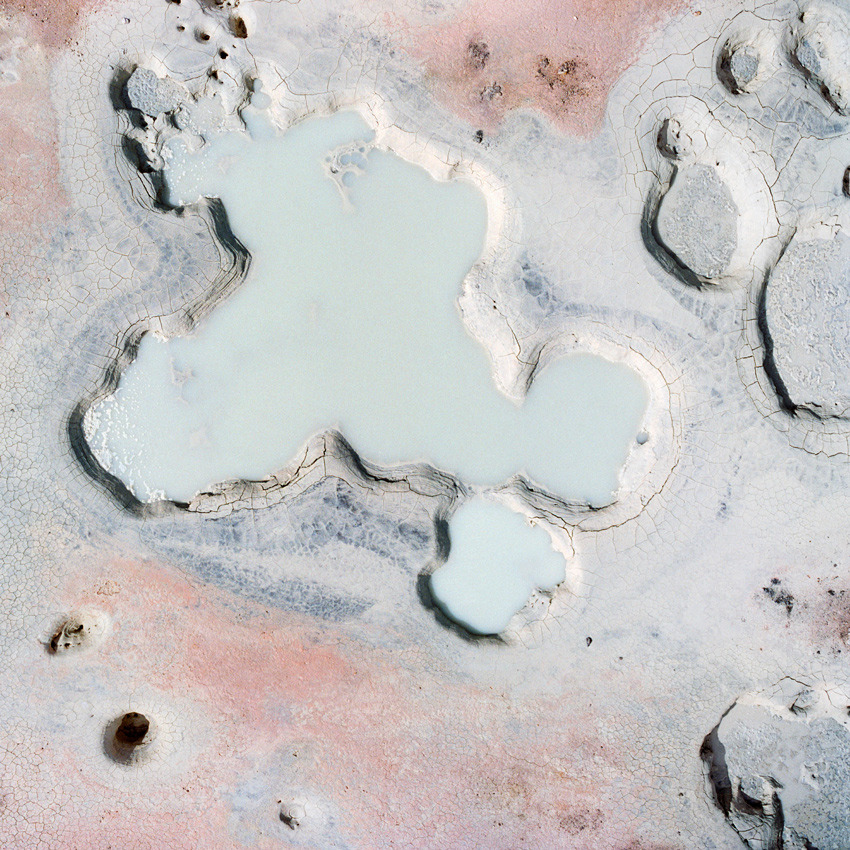
A short article by Sam Kean for the Chemical Heritage Foundation in Philadelphia explores the world of “bizarro ice—ice that burns, ice that sinks instead of floating, ice literally out of this world.” For the most part, these are ices that have formed under extraordinary pressure, whether naturally or artificially applied, which “forc[es] H2O molecules into rhombuses, tetragons, and other alternative geometries.”

In some cases, the pressure is so great that the resulting ice “can stay solid at temperatures of thousands of degrees—a true freezer burn. If you could somehow plop chunks of these ices into a glass of liquid water, they’d vaporize it.” Incredibly, we read that, “at super-high pressures, some chemists predict that ice transforms into a metal.”

There is an ice “that’s structurally similar to diamonds,” Kean explains, that “probably exists in the upper atmosphere.” And there are exotic ices on other planets: “The dense, hot interiors of Neptune and Uranus probably contain chunks of nonhexagonal ices, as do exoplanets around distant stars, a potentially important consideration as we search for life beyond our solar system.”

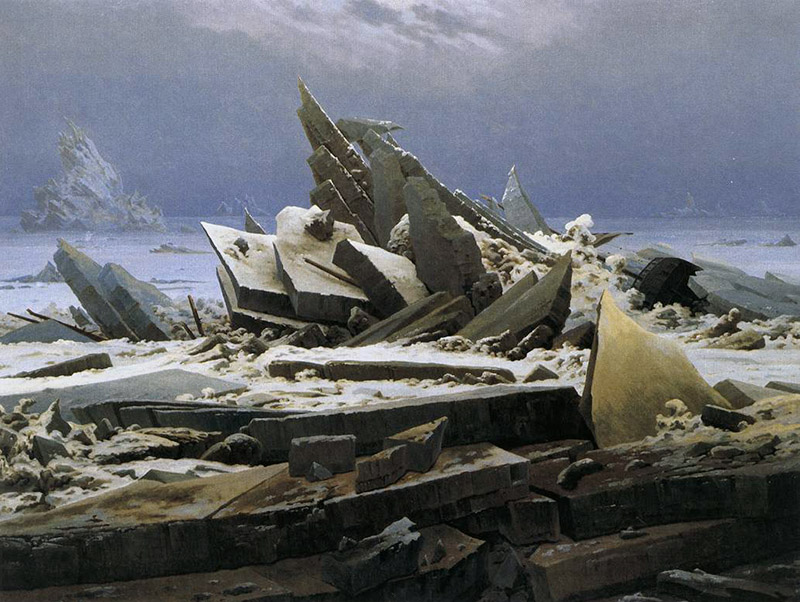
[Image: The Sea of Ice by Caspar David Friedrich].

This latter remark brings to mind a book I downloaded in my recent PDF binge called The Science of Solar System Ices, edited by Murthy S. Gudipati and Julie Castillo-Rogez. It’s a mammoth book—more than 650 pages—that explores exotic ices found in comets, on exoplanets, on moons, and elsewhere in our solar system.

“The largest deposits of carbon dioxide ice,” we learn, “is on Mars. Sulfur dioxide ice is found in the Jupiter system. Nitrogen and methane ices are common beyond the Uranian system. Saturn’s moon Titan probably has the most complex active chemistry involving ices, with benzene and many tentative or inferred compounds,” including a long list of chemicals I can’t even pronounce let alone recognize or describe, forming ices with “unusual colors and spectral shapes.” There are even “organic” ices made of hydrocarbons.

[Image: The Monk by the Sea by Caspar David Friedrich].

How these ices produce landscapes is by far the most interesting aspect here, at least from the point of view of BLDGBLOG: how they glaciate, experience gravitational tides and weathering, melt from below due to volcanoes, reflect the alien skies shining down on them in distorted shapes and angled echoes, and even how they tectonically fracture into karst-like networks of sinkholes and caves.

Imagining snow storms of frozen methane on other planets while thinking about, for example, human artistic traditions of landscape representation, from the Hudson Valley School to Caspar David Friedrich—picturing massive and extraordinary widescreen scenes of glacial hills and valleys steaming in the outer darkness of the solar system and the paintings or photographs or even animated GIFs that might result—would extend the idea of the sublime to non-terrestrial landscapes and the sights they might someday reveal to human explorers.

[Image: Walking into a glacier: “Grindelwald Grotto, Bernese Oberland, Switzerland,” courtesy of the Library of Congress Prints & Photographs Division].

Art historians would gaze in awe at offworld glaciers of carbon dioxide ice and howling massifs of frozen nitrogen, where volcanoes erupt not with liquid rock but with “ice slurries” and groundwater exploding onto the landscape with the force of a Kilauea.

Perhaps someday you’ll be able to get a degree in the field of exploratory xenoglaciology, the study of rare and incredible landforms made of frozen chemicals in space.

(“Wild Ice” story spotted via @nicolatwilley).

Ride the Lightning

[Image: From the paper “Lightning-Induced Remanent [sic] Magnetic Anomalies in Low-Altitude Aeromagnetic Data” by Les P. Beard, Jeannemarie Norton, and Jacob R. Sheehan].

While lightning is on the brain, two random articles I stumbled across this weekend, coming off a nearly 48-hour binge of PDF downloads from various academic journals, refer to two examples of lightning strikes mistaken for, in one case, the discovery of unexploded ordnance in New Mexico and, in another, a minor earthquake in Germany.

In the former, from a paper originally published in 2009 in the Journal of Environmental & Engineering Geophysics, we read how an “airborne magnetic survey for unexploded ordnance,” searching for magnetic anomalies in New Mexico, came across a series of inexplicable blips.

[Image: From the paper “Lightning-Induced Remanent [sic] Magnetic Anomalies in Low-Altitude Aeromagnetic Data” by Les P. Beard, Jeannemarie Norton, and Jacob R. Sheehan].

As the paper’s abstract explains, however, these magnetic anomalies were not unexploded bombs; they were, in fact, scars in the data most likely induced by lightning strikes.

“Lightning-strike magnetic anomalies are not necessarily rare,” the authors explain, “but may be spaced so widely as to make their detection unlikely in a ground survey.”

[Image: From the paper “Lightning-Induced Remanent [sic] Magnetic Anomalies in Low-Altitude Aeromagnetic Data” by Les P. Beard, Jeannemarie Norton, and Jacob R. Sheehan].

In other words, surveys elsewhere have likely also recorded lightning strikes as anomalous magnetic formations in the landscape—as physical landforms, whether mineral (metal in the ground) or artificial (in this case, unexploded bombs)—when, in reality, they are side-effects of storms.

Lightning here takes on a mapped, physical presence, whereas, in reality, it is nothing but an event in the sky mistaken for something terrestrial.

[Image: From the paper “Lightning-Induced Remanent [sic] Magnetic Anomalies in Low-Altitude Aeromagnetic Data” by Les P. Beard, Jeannemarie Norton, and Jacob R. Sheehan].

Fascinatingly, the authors hypothesize that this might be because lightning often leaves remnant magnetic effects in the landscape, or “remanent magnetization,” for days after the original strike.

It leaves glitches, fingerprints, or marks, in other words, that can only be read and deciphered by specialty equipment. So, on certain maps, something is there—some aspect of the landscape—but, in reality, it was just a passing electrical event. It was just a cartographic error, a kind of electrical time-object mistaken for the Earth.

The second paper worth mentioning here describes the fortuitous coincidence of a lightning strike hitting a poplar tree on the grounds of a seismological research station at Cologne University in Germany.

According to a short paper published in Seismological Research Letters, we read that the lightning strike “exploded” a poplar tree, whose fragments then “impaled” themselves in the trees around it. This sequence of events was mistaken, however, or recorded, as a minor earthquake.

[Image: The stricken poplar tree, from “Seismological Analysis of a Lightning Strike” by Klaus-G. Hinzen].

In the words of Klaus-G. Hinzen, the paper’s author, “the electrical field of the lightning induced a signal, most likely in the seismometer cable, that the instrument electronics interpreted as the command to start calibration.” The equipment thus began to record as if a “real” seismic event was taking place. However, Hinzen goes on to explain, “the signal of the lightning and the thunder is visible after the application of a highpass filter”—that is, you can filter out the Earth from data and you will find pure sky.

So there was no earthquake—at least not tectonically speaking—but the precise moment at which an event in the sky (lightning and thunder) intersected with a landscape on the ground (the poplar tree outside the laboratory) was both recorded as and equipmentally mistaken for an earthquake.

There’s no point in going on about this at great length, but I was interested to see how, in both cases, a fleeting moment of electricity in the atmosphere could be misinterpreted by machines constructed for reading the earth. Or, putting this in mythological terms, the sky temporarily deceived the earth by way of electricity, entering human awareness as something apparently terrestrial, a measurable feature in the landscape.

Lightning Farm

[Image: Triggered lightning technology at the University of Florida’s Lightning Research Group].

This past winter, I had the pleasure of traveling around south Florida with Smout Allen, Kyle Buchanan, and nearly two dozen students from Unit 11 at the Bartlett School of Architecture.

Florida’s variable terrains—of sink holes, swamps, and eroding beaches—and its Herculean infrastructure, from canals and freeways to theme parks and rocket facilities, served as the narrative backdrop for the many architectural projects ultimately produced by the class (in addition, of course, to the 2012 U.S. Presidential election, the results of which we watched live from the bar of a tropical-themed hotel near Cape Canaveral, next door to Ron Jon).

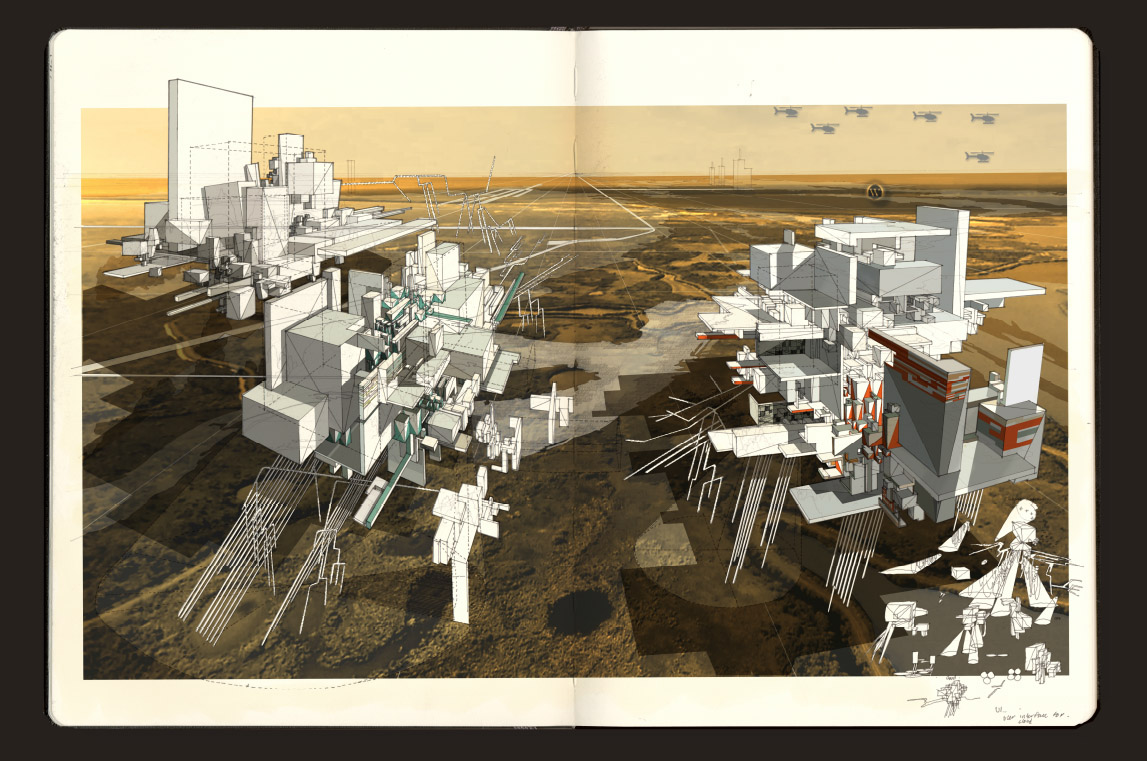
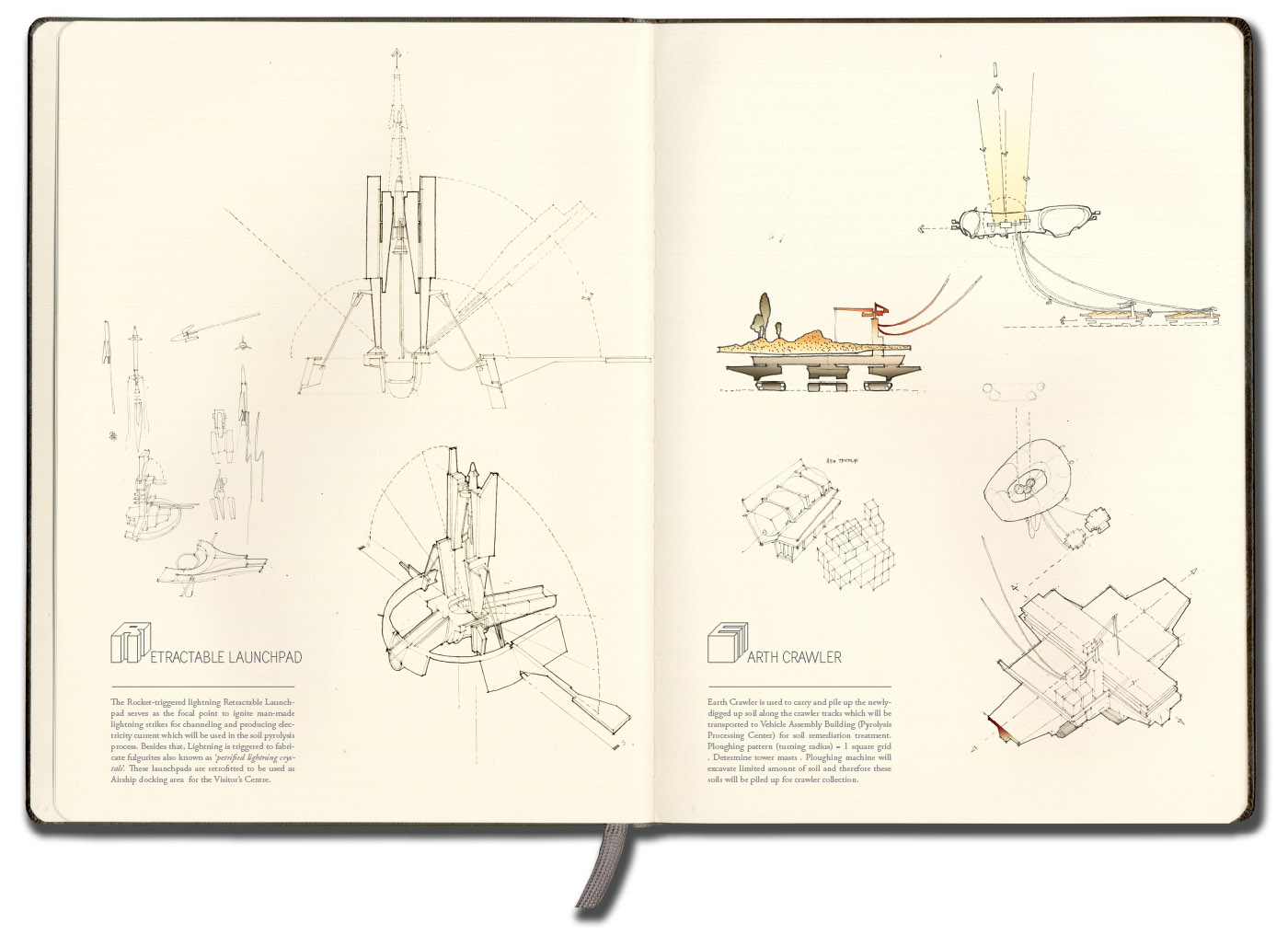
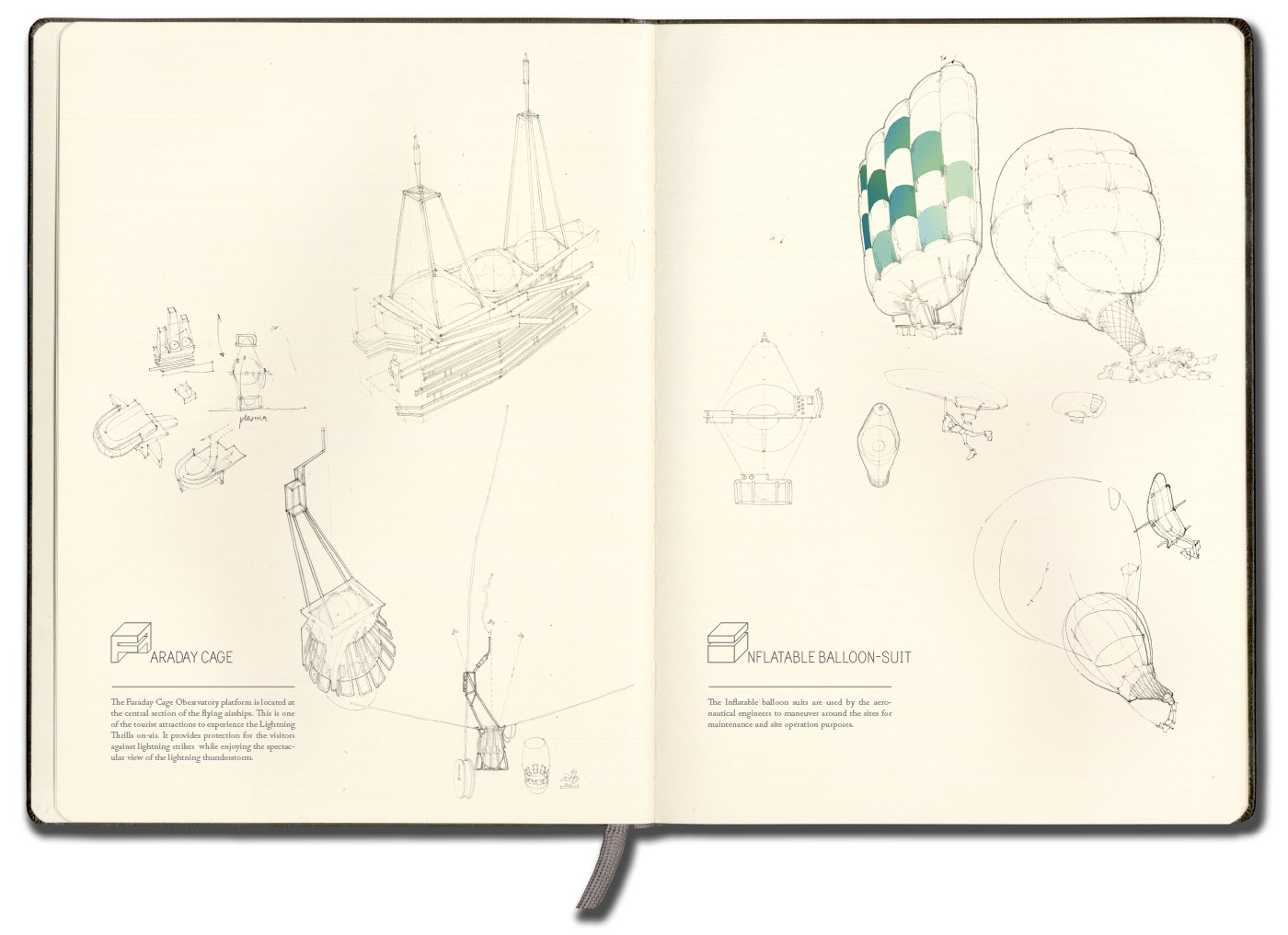
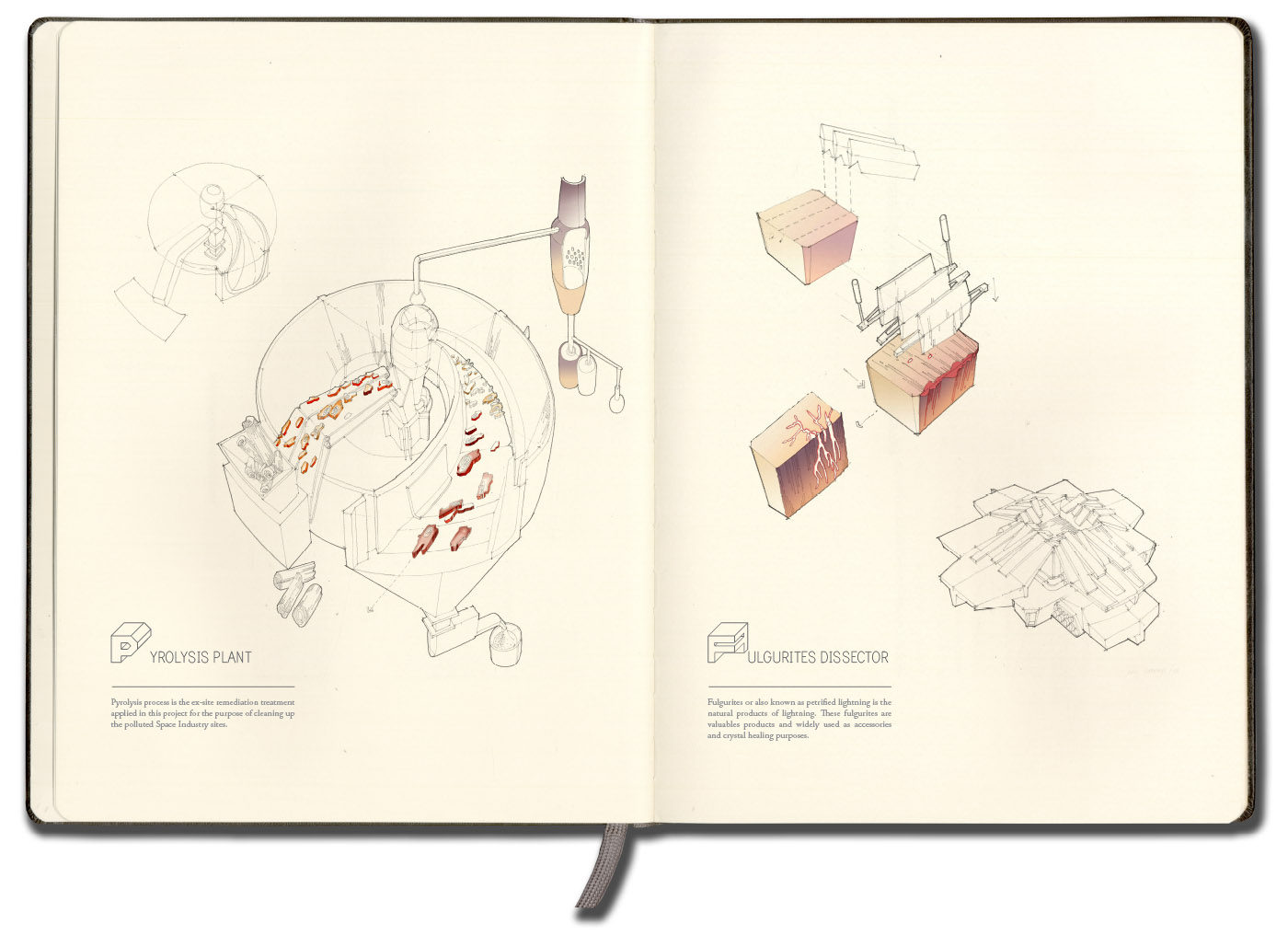
While there were many, many interesting projects resulting from the trip, and from the Unit in general, there is one that I thought I’d post here, by student Farah Aliza Badaruddin, particularly for the quality of its drawings.

[Images: From a project by Farah Aliza Badaruddin at the Bartlett School of Architecture].

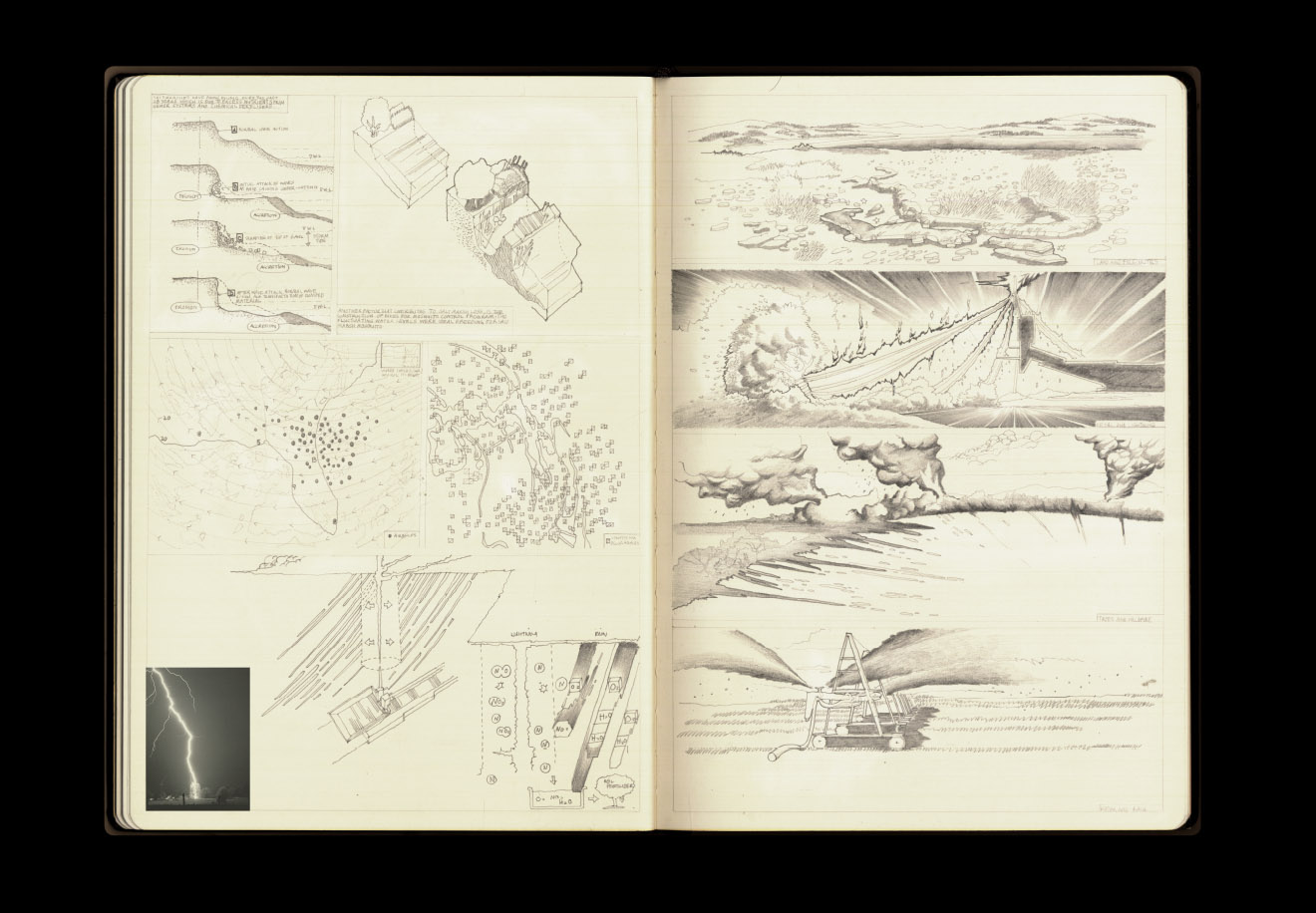
Badaruddin’s project explored the large-scale architectural implications of applying radical weather technologies to the task of landscape remediation, asking specifically if Cape Canaveral’s highly contaminated ground water—polluted by a “viscous toxic goo” made from tens of thousands of pounds of rocket fuels, chemical plumes, solvents, and other industrial waste products over the decades—could be decontaminated through pyrolysis, using guided and controlled bursts of lightning.

In her own words, Badaruddin explains that the would test “the idea that lightning can be harnessed on-site to pyrolyse highly contaminated groundwater as an approach to remediate the polluted site.”

These controlled and repetitive lightning strikes would also, in turn, help fertilize the soil, producing a kind of bio-electro-agricultural event of truly cosmic (or at least Miller-Ureyan) proportions.

[Image: Triggered lightning technology at the University of Florida Lightning Research Group].

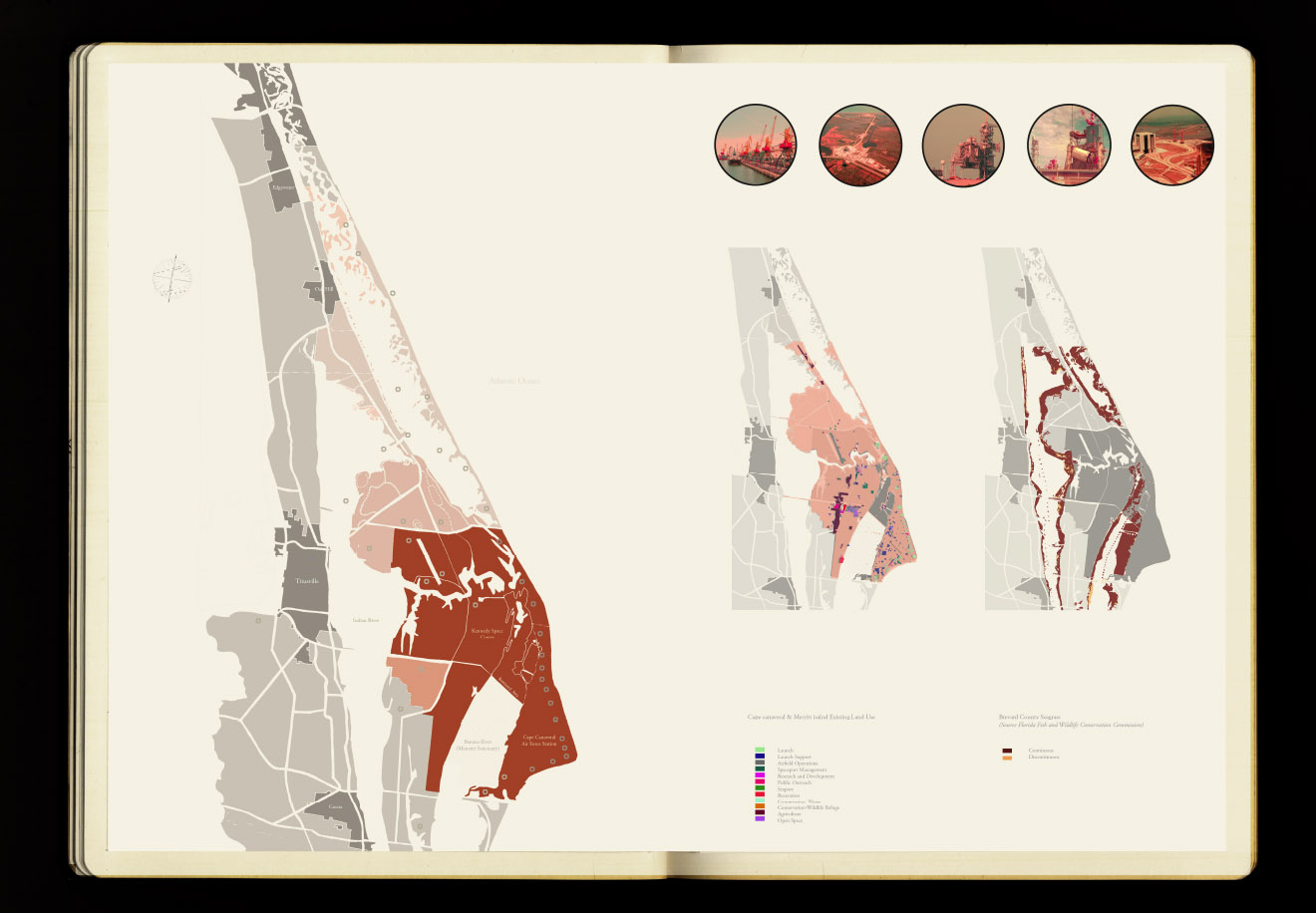
Her maps of the area—which she presents as if drawn in a Moleskine notebook—show the terrestrial borders of the proposal (although volumetric maps of the sky, showing the project’s fully three-dimensional engagement with regional weather systems, would have been an equally, if not more, effective way of showing the project’s spatial boundaries).

This raises the awesome question of how you should most accurately represent an architectural project whose central goal is to wield electrical influence on the atmosphere around it.

[Images: From a project by Farah Aliza Badaruddin at the Bartlett School of Architecture].

In short, her design proposes a new infrastructure of “rocket-triggered lightning technology,” assisted and supervised by a peripheral network of dirigibles—floating airships that “surround the site and serve as the observatory platform for a proposed lightning visitor centre and the weather research center.”

The former was directly inspired by real-world lightning research equipment found at the University of Florida’s Lightning Research Group.

[Image: Triggered lightning technology at the University of Florida’s Lightning Research Group].

Badaruddin’s own rocket triggers would be used both to attract and “to provide direct lightning strikes to the proposed sites,” thus pyrolizing the landscape and purifying both ground water and soil.

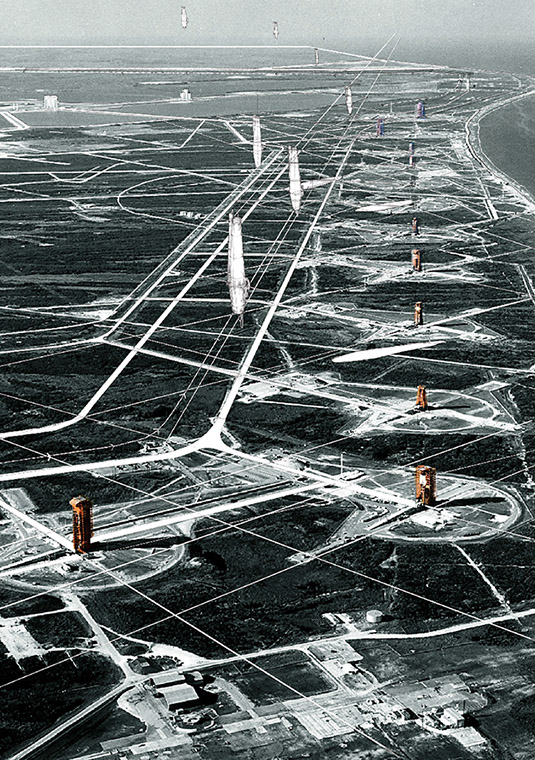
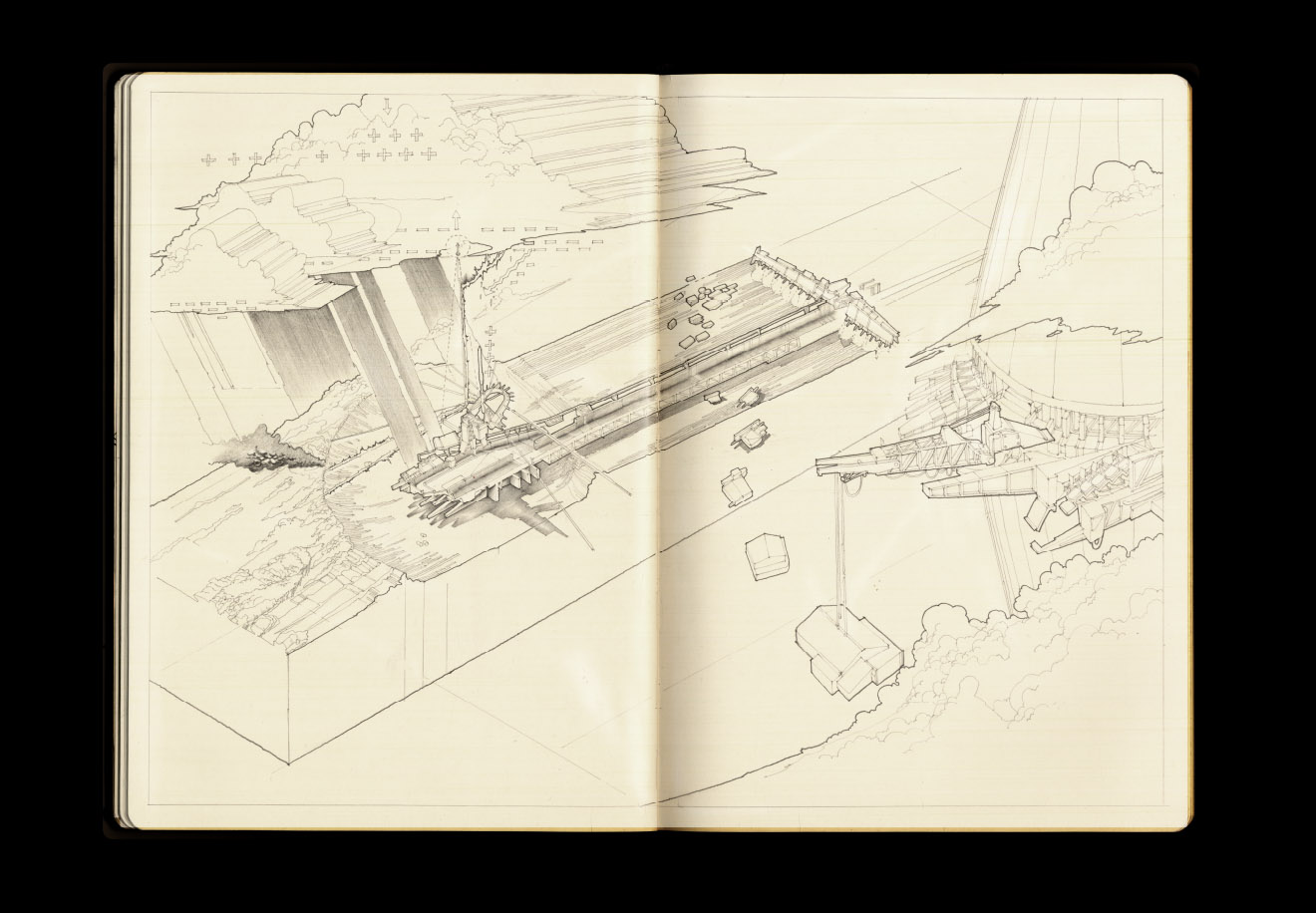
[Image: Aerial collage view of the lightning farm, by Farah Aliza Badaruddin at the Bartlett School of Architecture].

The result would be a lightning farm, a titanic landscape tuned to the sky, flashing with controlled lightning strikes as the ground conditions are gradually remediated—an unmoving, nearly permanent, artificial electrical storm like something out of Norse mythology, cleansing the earth of toxic chemicals and preparing the site for future reuse.

[Image: Collage of the lightning farm, by Farah Aliza Badaruddin at the Bartlett School of Architecture].

I should say that my own interest in these kinds of proposals is less in their future workability and more in what it means to see a technology taken out of context, picked apart for its spatial implications, and then re-scaled and transformed into a speculative work of landscape architecture. The value, in other words, is in re-thinking existing technologies by placing them at unexpected scales in unexpected conditions, simultaneously extracting an architectural proposal from that and perhaps catalyzing innovative new ways for the original technology itself to be redeveloped or used.

[Image: Farah Aliza Badaruddin].

It’s not a question of whether or not something can be immediately realized or built; it’s a question of how open-ended, fictional design proposals can change the way someone thinks about an entire field or class of technologies.

[Images: From a project by Farah Aliza Badaruddin at the Bartlett School of Architecture].

But I’ll let Badaruddin’s own extraordinary visual skills tell the story. Most if not all of these images can be seen in a much larger size if you open the images in their own windows; they’re well worth a closer look—

[Images: From a project by Farah Aliza Badaruddin at the Bartlett School of Architecture].

—including what amount to a short graphic novel telling the story of her proposed controlled-lightning landscape-decontamination facility.

[Images: From a project by Farah Aliza Badaruddin at the Bartlett School of Architecture].

All in all, whether or not architecturally-controlled lightning storms will ever purify the land and water of south Florida, it’s a wonderfully realized and highly imaginative project, and I hope Badaruddin finds more opportunities, post-Bartlett, to showcase and develop her skills.

Climate Change Archaeology

New archaeological discoveries continue to be made as glacial ice patches melt, revealing their previously unknown contents. Teams of archaeologists and historians have taken to wandering around newly exposed ground in locations as diverse as Norway, the Alps, and Glacier National Park.

Animal bones and cultural artifacts, including 3,000-year old woven bark baskets and old wooden tools, are most prevalent.

[Image: Courtesy Oppland County Council. Photo by Johan Wildhagen/Palookaville, via Archaeology].

“Prehistoric ice is melting and revealing artifacts and organic materials like wood, feather, and bone that have been frozen within the snow for thousands of years,” Kevin Grange writes in National Parks magazine. “As temperatures continue to rise, researchers and Native people are racing to find these materials before they vanish.”

“Enter the ice patch archaeologist,” Grange continues. “These explorers don’t sift through the dirt for artifacts—they prowl the retreating edges of ice patches and glaciers, searching for ancient tools, weapons, wood fragments, bones, and even animal dung. Glaciers move, sort, and grind material down, but ice patches—the result of windblown snow accumulating on alpine slopes—are unique for their ability to stay put and preserve anything frozen within them.”

But there is a justified sense of urgency, as many of the organic materials begin to decay as soon as they’re exposed; if they aren’t found soon after being revealed, they might not be found at all.

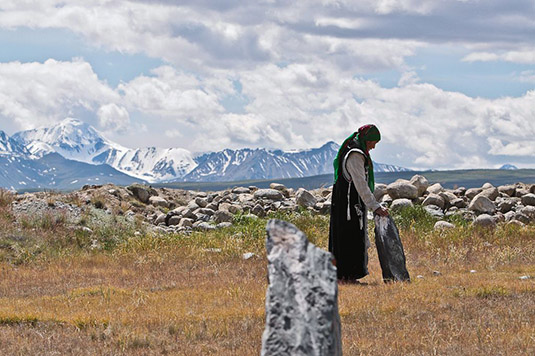
The loss of cultural heritage as ice patches give up their archaeological goods was the subject of a 2011 letter to the editors of Nature Geoscience by Kathryn Molyneaux and Dave S. Reay. “In the central Asian Altai Mountains,” Molyneaux and Reay write, “approximately 700 tombs have been preserved for 2,500 years by ice lenses or permafrost. They contain frozen mummies, wood, leather and textiles, which are very rarely preserved and can provide a unique insight into the culture of prehistoric societies in this region. As a result of increasing ground and surface temperatures over the past century, these tombs and their deposits are now within only a few degrees of melting.”

Although I suppose this sounds like the set-up for a new supernatural thriller—in which ancient kings arise from the ice of Central Asia, stepping forth from their melting tombs—in reality, it often has tense emotional and political consequences.

[Image: A shot of the Golden Mountains of Altai UNESCO World Heritage Site by Gleb Raygorodetsky, courtesy of Our World 2.0].

Here, the authors refer to the rise of “rescue archaeology,” where artifacts are rapidly and even haphazardly removed from an endangered site, in operations “carried out under less than ideal conditions with limited funding and a lack of long-term goals. For example,” they add, “a coastal cemetery near Barrow, Alaska is eroding at rates of up to 20 [meters per year], because the sea ice that used to protect the coastline has receded. As a result, indigenous people’s remains that date back to the fourth century AD are being exposed at a rapid rate. At present, rescue work is carried out annually in an attempt to document, stabilize and relocate the cemetery material that is being washed away owing to high beach erosion.”

In the Altai region itself, meanwhile, the exhumation of a “princess” led to “political unrest in the local shaman community,” Molyneaux and Reay write. These disturbed and literally geopolitical circumstances are only set to grow.
[Image: Two shots from the Golden Mountains of Altai UNESCO World Heritage Site by Gleb Raygorodetsky, courtesy of Our World 2.0].

Writing for the somewhat unfortunately named publication Our World 2.0, Gleb Raygorodetsky reiterates the point that the changing ground conditions of the region that once so effectively “preserved the remains of the Altai’s ancestors in burial kurgans [or tombs] for thousands of years is disappearing, melting away because of steadily rising air and ground temperatures in the region. Climate change is literally melting away the cultural heritage of the Altai people, a rich and irreplaceable part of the global heritage.”

It’s worth noting that there have been some architectural proposals for helping with the in-situ preservation of these frozen tombs. As Raygorodetsky writes, “UNESCO and Ghent University, along with their Russian partners, have been cataloguing the Altai’s frozen tombs to help develop conservation and preservation plans. Some of the proposed solutions include elaborate schemes to shade each individual tomb from direct sunlight to stabilize its temperature.”
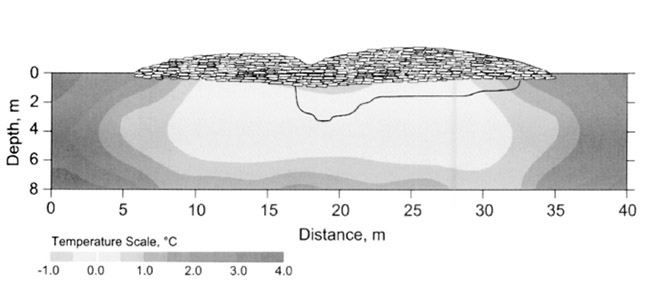
[Image: Diagram of the thermal effects of an Altai rock tomb or kurgan, from “Saving the Frozen Scythian Tombs of the Altai Mountains” by Jean Bourgeois, Alain De Wulf, Rudi Goossens and Wouter Gheyle].

Here, Raygorodetsky refers to a 2007 paper originally published in World Archaeology, called “Saving the Frozen Scythian Tombs of the Altai Mountains,” where the possibility of constructing thermal shading devices to protect the tombs from melting is explored.

However, considering the visually intrusive nature of such shelters, not to mention the expense of construction and upkeep, the authors instead suggest what amounts to refrigerating the ground: proposing a solution that would involve “self-regulating seasonally acting cooling devices or thermosyphons. They act like refrigerators but without needing an external power source. By extracting heat from the ground and dissipating it into the air, they lower the ground temperature and prevent the degradation of permafrost.”

As such, these would be not unlike the ground-refrigeration columns currently used to artificially englaciate the ground beneath the epic Beijing-Lhasa high-altitude, pressurized train in China & Tibet, or artificial glaciation as a form of architectural design.
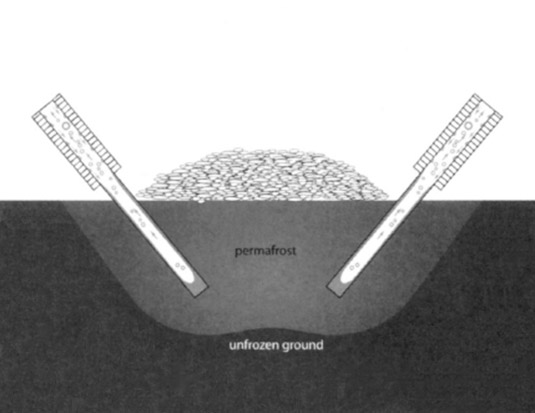
[Image: Diagram of archaeological ground-refrigeration techniques, from “Saving the Frozen Scythian Tombs of the Altai Mountains” by Jean Bourgeois, Alain De Wulf, Rudi Goossens and Wouter Gheyle].

But perhaps precise cataloging of the exposed artifacts really is all that can be done in most locations.

In the most recent issue of Archaeology, journalist Andrew Curry tags along with a team of surveyors and archaeologists as they explore the Jotunheim Mountains of Norway.

As the ice fields recede due to changing temperatures, ancient artifacts, such as 3,400-year old leather shoes, are being uncovered more and more frequently, now found just sitting there on the rocks. Finding these and other soon-to-be-disturbed objects is, Curry writes, “an effort that combines high-tech mapping, glaciology, climate science, and history. When conditions are right, it’s as simple as picking the past up off the ground.”

[Image: Courtesy Espen Finstad/Oppland County Council. Photos by Johan Wildhagen/Palookaville and Andrew Curry, via Archaeology].

Growing beards and loaded down with survey gear, the archaeologists Curry traveled with hiked up into the mountains, following meltwater streams to the ice patches they came from. At one of their camps, sleeping inside “Everest-rated” tents, one of the scientists tells Curry of an experience from a prior year’s survey work.

They had been ready to return home, the archaeologist explains, hiking carefully through a heavy fog, when they noticed a woven tunic and scattered leather goods lying on the rocks down at their feet.

Then the fog lifted and they saw the landscape around them, “littered with leather, textiles, wood, and animal dung”—artifacts everywhere—an archaeological site newly exposed from its frozen burial like a fully-stocked stage set dramatically revealed, dream-like, on all sides, an ancient open-air exhibition that had only recently been hidden from view.

(For more things locked in ice, suddenly revealed, see Ice Patch Archaeology earlier on BLDGBLOG).

Combat Preservation

[Image: A SWORDS unit firing; photo via National Defense Magazine].

A U.S. ground combat robot has been accessioned by the Smithsonian Institution to form part of a future museum display, National Defense Magazine reports. The robot, one of the first to be sent into live combat—specifically, into Iraq in 2007, where the machines were seen “roaming the streets… carrying guns”—is part of the SWORDS system, or “special weapons observation remote reconnaissance direct action system.”

While this should come as no surprise, considering the already exhaustive collections of arms and armor found in museums around the world, it’s nonetheless interesting to watch as semi-autonomous combat machines become subject to the Q-Tip-wielding fragility of museum restoration techniques, which will no doubt seek to preserve these machines as if they were never meant to be altered or broken.

But it’s also a slightly haunting conceptual moment in military history, as the earliest examples of armed ground devices less than a decade old now stand shrouded in the halls of national memory, like returned soldiers from a war no one wants to think about, encased alongside medieval knights holding onto their own swords well into the afterlife.

[Image: Knights at the Metropolitan Museum of Art].

The news also makes it hard not to imagine a Museum of Military Robotics on the horizon somewhere, its displays filled with heavily armed sentinels standing there, polished and dormant, behind glass, sleeping artifacts that unstoppably emerged from cracks in the laws of war and the possibilities of sentient machinery.

Google Glass-wearing parents take their kids to the Tomb of the Unknown Robot, while algorithmically patterned bursts of artillery soar over the laser-leveled landscape, a former test range for ground drones.

Perhaps we’ll even see 4-star generals someday buried with their favorite combat machines, like Viking conquerors, not lying next to loyal falcons or warhorses but SWORDS units and Raven drones.

Offworld Metallurgy

[Image: Ancient Egyptian jewelry made from meteorites; photo courtesy of UCL Petrie Museum/Rob Eagle].

X-ray analysis has found that “ancient Egyptian iron beads held at the UCL Petrie Museum were hammered from pieces of meteorites, rather than iron ore,” Science Daily reports. “The objects, which trace their origins to outer space, also predate the emergence of iron smelting by two millennia.”

By scanning the beads with beam of neutrons and gamma-rays, the team were able to reveal the unique texture and also high concentration of nickel, cobalt, phosphorus and germanium—which is only found in trace amounts in iron derived from ore—that is characteristics of meteoric iron, without having to attempt invasive analysis which could potentially damage these rare objects.

The “meteoric ore”—that, presumably, at least in some instances, had been seen falling from the sky like heavenly precipitation—was hammered and rolled into pieces of ceremonial jewelry to be worn like gifts from the sky.

This brings to mind the famed “space buddha” of last year: “An ancient Buddhist statue which was first recovered by a Nazi expedition in 1938 has been analyzed by a team of scientists,” Science Daily wrote last summer, revealing “that the priceless statue was carved from an ataxite, a very rare class of iron meteorites.”

[Image: Space buddha! Photo by Dr. Elmar Buchner, via Science Daily].

Fabricating objects from chunks of metal that have fallen from space—or humans artifacts emerging from astral wreckage scattered across the surface of the planet—is a pretty compelling design scenario, I have to say, and to read that some of humanity’s “earliest known iron artifacts come from outer space” only adds a new, strange gleam to an already fascinating civilization.

However, we can only speculate what it might like in several generations’ time if industrial super-projects like offworld mining and post-planetary extraction do, in fact, take off—if geochemical reserves on the moon, for instance, are harvested for use in terrestrial power stations, batteries, and other pieces of electrical infrastructure—to know that, in that power plant humming away quietly in the forest north of New York City, surrounded by old trees and cliffs on the riverside, pieces of the moon and captured asteroids are burning, becoming fuel and light for our cities. Our devices will glow with the light of alien worlds, rocks alchemically scorched and purified in huge ovens run by ConEd.

And, in 5,000 years, archaeologists will uncover the crumbled dust of other planets in our factories, still glistening amongst the ruins in which they burned, perhaps wondering what religious connotation the power system played for us, this shining network where we ritually incinerated the heavens, computational clouds run with unearthly fuels that, like the Egyptian jewelry this post started with, can “trace their origins to outer space.”

Tensioned Suspension

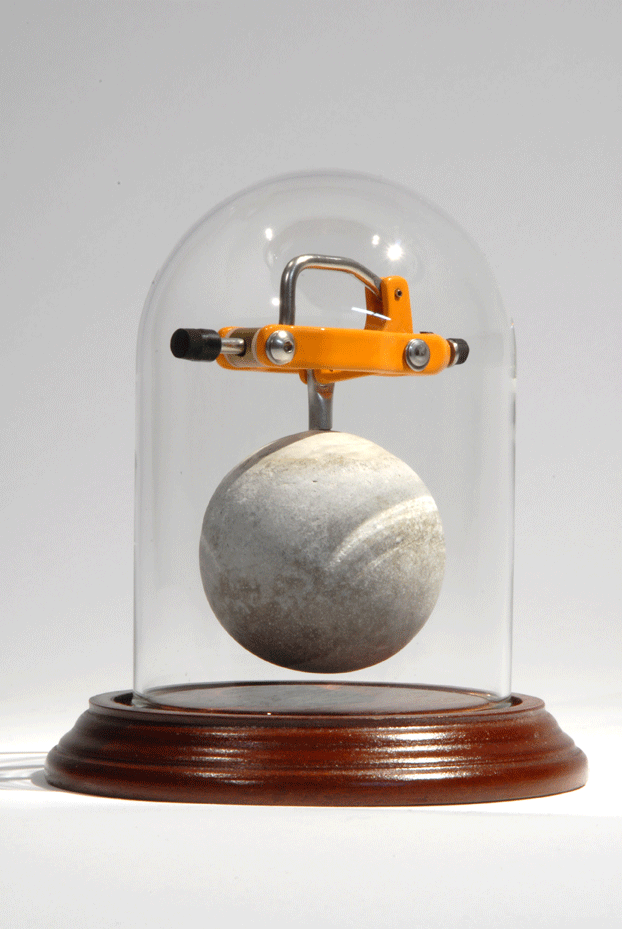
[Image: “Cavity Mechanism #12 w/ Glass Dome” (2013) by Dan Grayber].

We’ve looked at the work of Bay Area sculptor Dan Grayber here before, but he’s got a small show of new work opening up at Oakland’s Johansson Projects gallery next month and it seems worth stopping by.

[Image: Another view of “Cavity Mechanism #12 w/ Glass Dome” (2013) by Dan Grayber].

Grayber describes his work as a study in “self-resolving problems,” where highly-tensioned devices hold themselves aloft inside glass vitrines, as if floating in space, fighting their own weight while pushing relentlessly against the walls that contain them.

[Images: “Cavity Mechanism #9 w/ Glass Dome” (2013) by Dan Grayber].

Graybar uses an over-arching description for many of pieces seen here, writing, for example, that each piece is “a counterweight driven mechanism that wedges itself into the inside of a cavity (the glass dome in this case), suspending itself.”

[Image: “Cavity Mechanism #11 w/ Glass Dome” (2013) by Dan Grayber].

They are as much displays of gravitational potential energy—like staged moments in some avant-garde machine-ballet whose only plot and purpose is to resist the pull of the earth—as they are “art objects.”

[Images: “Cavity Mechanism #10 w/ Glass Dome” (2013) by Dan Grayber].

While the highly contained, desktop scale of each piece adds to the overall feel of pent-up force and concentration, it’s hard not to want to see this guy working at Richard Serra-like proportions, scaled-up to the point of architecture.

[Image: “Display Case Mechanism #1” (2013) by Dan Grayber].

You walk into Madison Square Park in Manhattan only to see a giant steel mantis weighing five or six tons, painted in fluorescent construction orange, poised kite-like inside a polarized glass dome, holding boulders the size of Fiats, sprung, tensioned, and impossibly buoyant, as if somehow lighter than air.

[Image: “Cavity Mechanism #7 w/ Glass Dome” (2013) by Dan Grayber].

There is an artist’s reception and opening on October 4, so mark your calendars ahead of time and stop in to meet the machines. More examples of his work can be seen here on BLDGBLOG or at the artist’s own website.