The Great Age of Clouds

[Image: A “hurricane” at Saturn’s south pole, via NASA; see also The Planetary Weather Report].

In Frédéric J. Pont’s new book Alien Skies, he describes the atmospheres of other planets: what storms are like, what the clouds are made of, how a sunset might appear through a chemical haze at high pressure on another world.

He points out, for example, that many of these “alien skies” would likely consist of wildly unfamiliar shapes and formations, as different elements would be capable of condensing to form clouds at ever-increasing heights.

As he puts it, “The type of compound likely to condense into clouds depends on the temperature, and varies from planet to planet. Earth has water clouds. Carbon dioxide clouds sometimes grace the Martian sky, and Venus is shrouded in sulphuric acid clouds. On the giant planets, successive cloud decks are made of different compounds as the temperature increases in the deeper layers.”

[Image: J.M.W. Turner, “Storm at Sea” (1824), courtesy of Tate Britain].
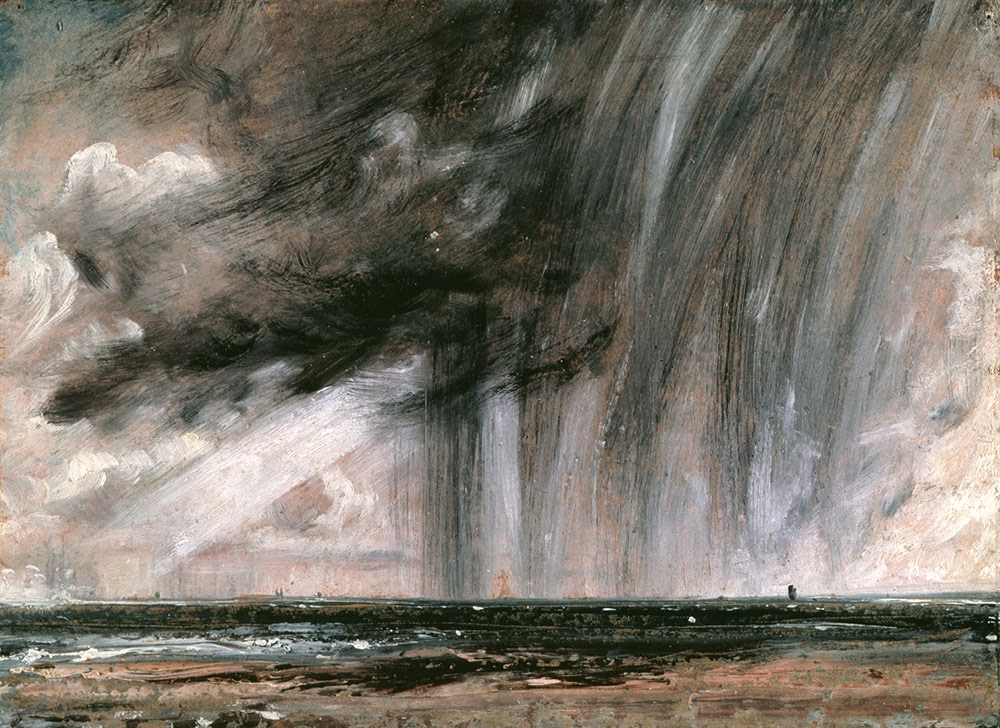
However, I should emphasize that all of this stuff needs to be put into the context of the Hudson River School and European Romanticism, of so-called “representational exploration art” of earlier scientific expeditions, where humans attempted to visually depict the wild worlds they’d plunged themselves into.

You shouldn’t see this stuff and think of astronomy, in other words. You should think of J.M.W. Turner or John Constable, of huge coastal storms and mountain passes lit by lightning, of ships dashed on the rocks as wrathful pillars of dark cloud spiral into the blackness of space above terrified figures for whom weather bears traces of omnipotence.

Only now the weather is even more spectacular, and it is glimpsed on planets more exotic than any continent to which artists have traveled before.

The weather on other planets should not be left only to scientists, in other words, but needs always to be considered in the context of art and landscape history.

[Image: John Constable, “Seascape Study with Rain Cloud” (c. 1824), via Wikipedia].
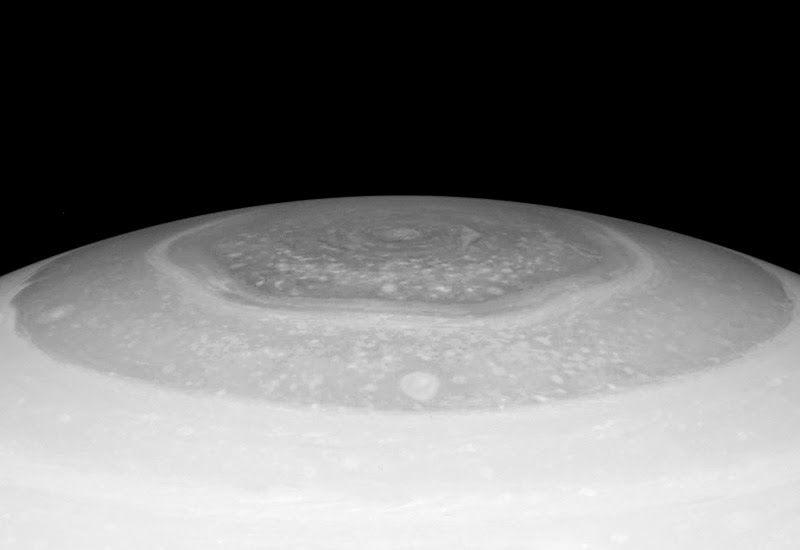
In any case, Pont explains that, as you move higher into some of the otherworldly atmospheres he describes, you would continually pass into entirely new elements—carbon dioxide, methane, ammonia—now frozen or condensed, billowing and moving about in the wind, capable of assuming structures unlike anything seen on Earth, vast “waves, spirals and tentacles,” or “unpredictable storm patterns” and even giant hexagons, as weird configurations unlock through a chemical sky.

[Image: The great hexagon at Saturn’s north pole, via Universe Today].

The book is less landscape poetry, however—sadly, after all, as what an incredible book of poems it would be, simply describing the skies of other worlds—than a scientific introduction to atmospheric chemistry, including here on Earth. But don’t hold that against it.

For instance, during Pont’s survey of the atmosphere of the early Earth, he makes an interesting and particularly evocative observation, one worth repeating here.

As he points out, the early Earth—for a period that lasted nearly a billion years—was quite boring, geologically speaking, “because nothing much happened to the rocks in a billion years.” But the skies were another matter.

[Image: A false-color image of the “hurricane” at Saturn’s south pole, via NASA; the eye is estimated to be 1,250 miles wide].

“The oxygen content in the atmosphere was stable,” Pont explains, “at around 0.1 percent. This was not enough to produce an ozone layer. Therefore the stratospheric lid that kept the clouds below ten miles in the present Earth did not operate.”

This had at least one spectacular side-effect:

Convection must have extended much higher into the atmosphere. This would have been called “the Great Age of Clouds” by any visitor, since the high temperatures, large oceans and lack of stratospheric lid would have produced the most magnificent cloud formations and the most awesome storms.

Imagine standing on the shore of some rocky archipelago billions of years before any other humans were born, as massive and otherworldly storms four or five times taller than anything you’d ever seen come rolling over the horizon, torqued into strange tropical towers, flashing in every crevice with lightning to reveal vast humid interiors where air roars upward in near-permanent mushroom clouds, breaking open to reveal shells of orange and red storms within storms boiling continuously for weeks at a time. The Great Age of Clouds would be in full performance.

Pont’s book is also available through SpringerLink if you have academic access.

Minecraft

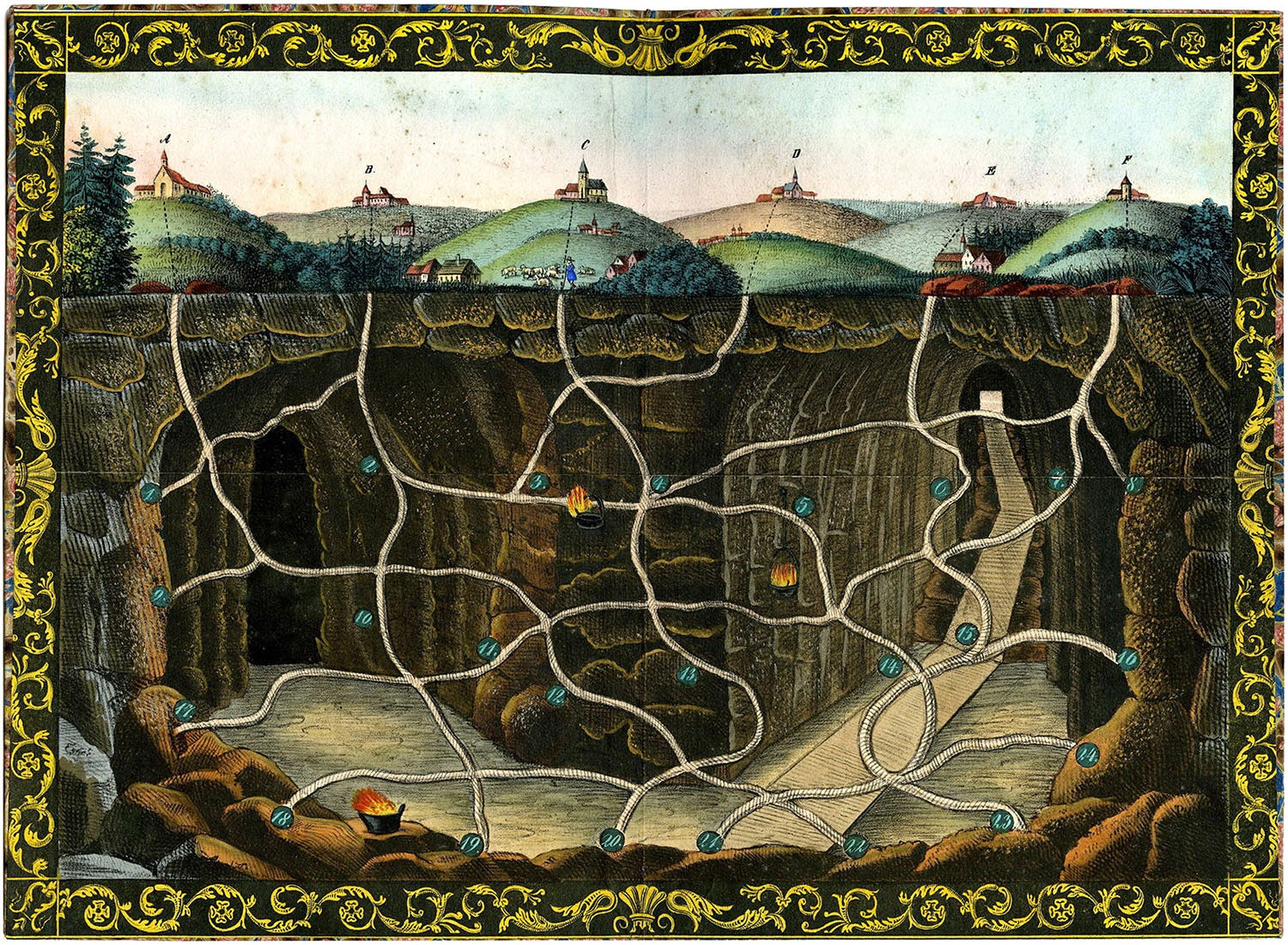
[Image: Der Bergbau, courtesy of the British Museum; view larger].

Der Bergbau is a beautiful 19th-century German board game set in a mine, currently in the collection of the British Museum. They describe it as a “game-board showing a cross-section of a mine and the network of tunnels leading down from 6 buildings, along the tunnels, various numbers which represent ore.”

The rules are not given, unfortunately, but the board itself is a gorgeous image in its own right, worth viewing in full.

(Originally spotted via @SubBrit).

Survey Says

[Image: Screen-grab from The New York Times].

Peruvian archaeologist Luis Jaime Castillo Butters “has created a drone air force to map, monitor and safeguard his country’s ancient treasures,” according to the New York Times.

Researchers in Peru “struggle to protect the country’s archaeological heritage from squatters and land traffickers, who often secure property through fraud or political connections to profit from rising land values,” we read. “Experts say hundreds, perhaps thousands of ancient sites are endangered by such encroachment.”

What’s needed, it seems, is a kind of standing army or reserve corps of mechanical eyes, ready to take flight at a moment’s notice and document abuses or vandalism at historic sites, and this, the article implies, is at least one of the ultimate goals. Indeed, “drones can address the problem, quickly and cheaply, by providing bird’s-eye views of ruins that can be converted into 3-D images and highly detailed maps.”

At least that’s the goal. Actually watching the “drone air force” at work, however, doesn’t quite live up to rhetorical expectations. Instead, sand grains cause mechanical failure, batteries need to be checked and replaced, the geometrically skewed images coming back from the camera are difficult to reconcile with one another, and the small team of archaeological operators only manages to perform a short flight over the targeted valley before calling their DJI Phantom back to base.

Having said that, though, aerial landscape data culled not just from UAVs but from cameras and scanning equipment carried by kites, helium balloons, satellites, light aircraft, and even helicopter patrols has had a transformative effect on archaeological fieldwork.

[Image: A glimpse of the balloon rig, from Mozas-Calvache et al., Journal of Archaeological Science].
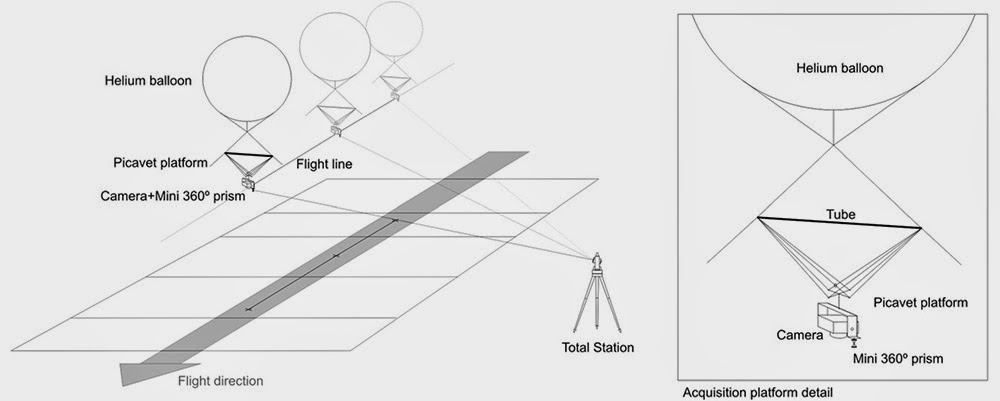
Just one example of this—and there are literally hundreds, as any search through publications such as the Journal of Archaeological Science or World Archaeology will reveal—was an exploration of how the images produced by balloon-based “light aerial platforms” could be made more useful.

Of course, the possible uses for this technique in contemporary architectural or urban documentation and analysis should not be overlooked.

[Image: The balloon rig diagrammed, from Mozas-Calvache et al., Journal of Archaeological Science].
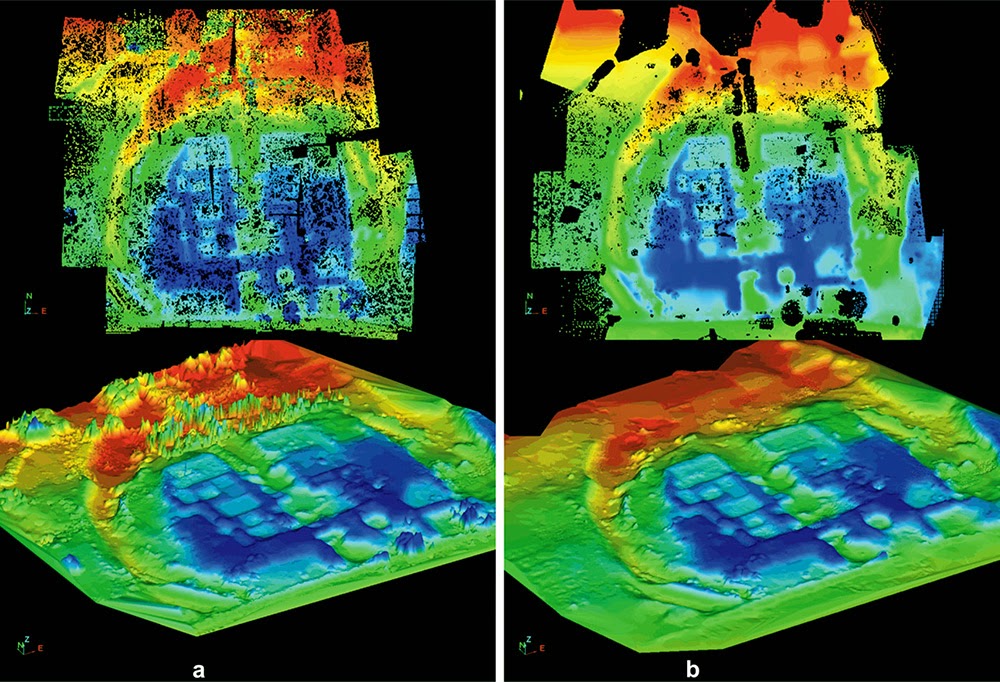
As authors A.T. Mozas-Calvache et al., from the University of Jaen in Spain, explain in a paper for the Journal of Archaeological Science, they have developed “a complete methodology for performing photogrammetric surveying of archaeological sites using light aerial platforms or unmanned aerial vehicle (UAV) systems. Traditionally, the main problem with using these platforms is the irregular geometry of the photographs obtained.”

This can make combining the resulting images into a comprehensible map or visual survey fantastically time-consuming, if not sometimes impossible; by comparison, think of a badly stitched panorama on your smartphone, now multiple that times a hundred and you can imagine some of the difficulty involved.

Instead, Mozas-Calvache and Co. built a helium-balloon-based “light aerial platform” whose “spatial coordinates are incorporated in the memory card of a robotized total station for automatic tracking of a 360 º mini reflector prism installed in the camera platform”—all of which is just a more precise way of saying that the location of the camera or scanner is precisely known at every step of its passage over the site, and the resulting, well-gridded images can thus be more easily reconciled.

[Image: Some resulting images, from Mozas-Calvache et al., Journal of Archaeological Science].

But now we’re getting off-topic. For more about the “drone air force” of Peru, check out The New York Times.

Emergency Exit

[Image: The SkySaver backpack in action via Kit Up!].

The SkySaver is a kind of emergency exit in a bag: a controlled-descent backpack loaded with hundreds of feet of fire-resistant cable. Just hook the line onto some fixed point in the structure behind you and lower yourself, two meters per second, to safety.

Marketed as a tool for urban warfare with—wouldn’t you know it—handy civilian uses on the side, the SkySaver system’s goal is to let you escape from, say, a building siege or a hotel fire. But, of course, it would also allow you to don your night-vision goggles and raid a high-rise from above, not escaping from but breaking into a building.

It’s not cheap—retailing for $499 and $849, depending on how much cable you need—but its possible use in urban exploration or even burglary seems to be a market the company is not (yet) aiming to cultivate.

Military Cave Logistics

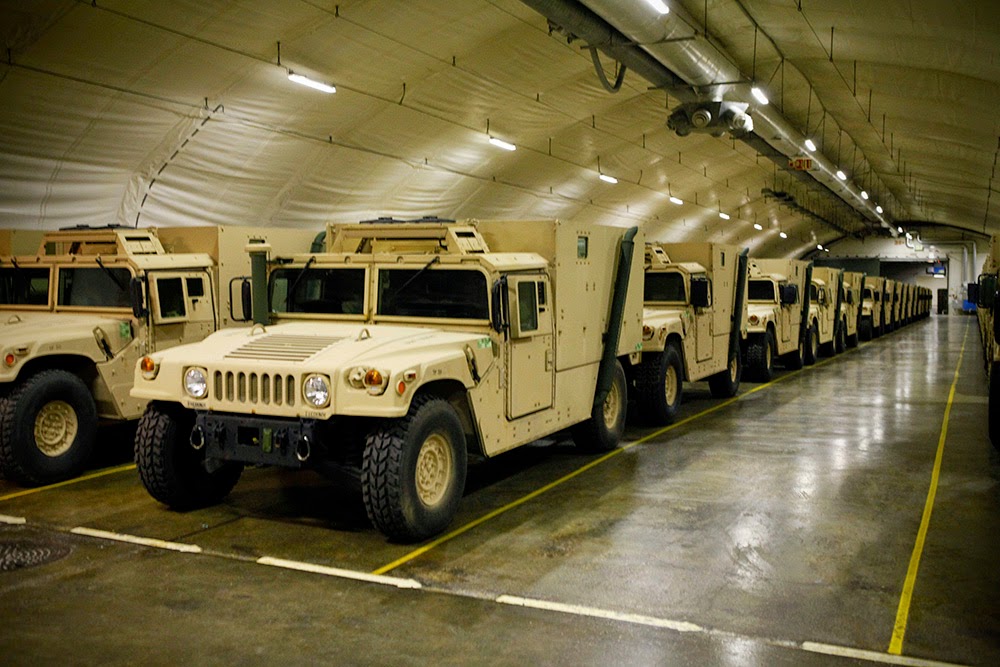
[Image: “Humvees are stored inside the Frigaard Cave in central Norway. The cave is one of six caves that are part of the Marine Corps Prepositioning Program-Norway, which supports the equipping of Marine Expeditionary Brigade consisting of 15,000 Marines and with supplies for up to 30 days.” U.S. Marine Corps photo by Lance Cpl. Marcin Platek].
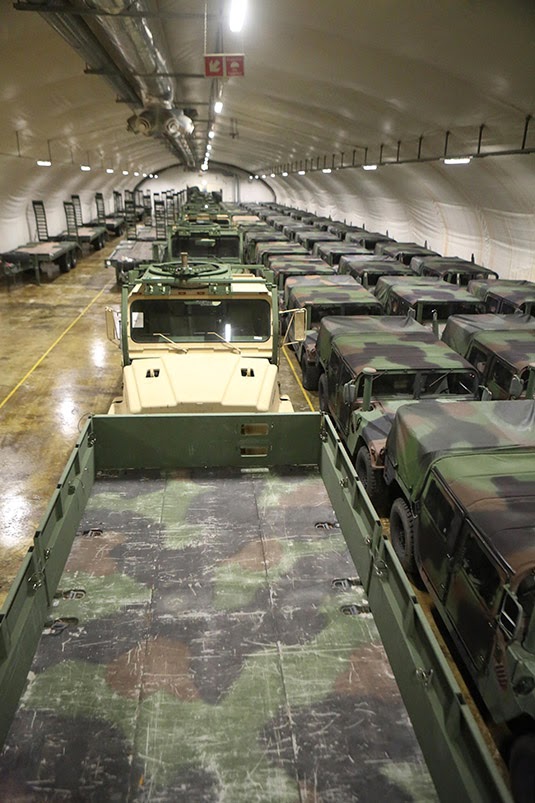
Norwegian caves are being stuffed full of U.S. military equipment, including armored Humvees, tanks, and cargo containers full of weaponry, all part of a vast and semi-subterranean supply chain maintained to help wage future wars around the world.

The Marines have “stashed weapons and equipment in the Norwegian countryside since the 1980s,” War is Boring explains, in sites that include artificially enlarged and fortified caves. It’s all about logistics: “With this setup, Marines can fly in and be ready for a fight in no time.”

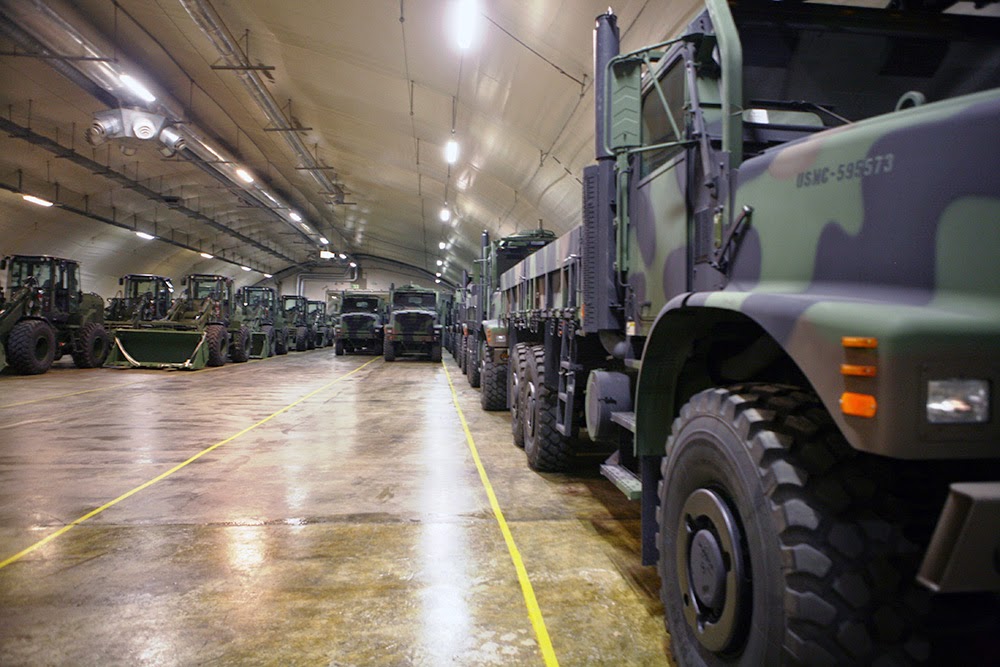
[Image: “Rows of front loaders and 7-ton trucks sit, gassed up and ready to roll in one of the many corridors in the Frigard supply cave located on the Vaernes Garrison near Trondheim, Norway. This is one of seven [see previous caption!] caves that make up the Marine Corps Prepositioning Program-Norway facility. All the caves total more than 900,000 sq. ft. of storage space, full of enough gear to outfit 13,000 Marines for up to 30 days.” U.S. Marine Corps photo by Sgt. Matt Lyman].
These facilities are commonly described as “supply caves,” and they hold warfighting gear in a state of indefinite readiness, “reserved for any time of crisis or war.”

Marines can simply fly in, unlock their respective caves, and grab the keys to one of hundreds, if not thousands, of combat-ready vehicles, all “gassed up and ready to roll in one of the many corridors” of this subterranean empire on the edges of American influence.

Among many other points of interest, the Marines identify six such supply caves in the caption of one image and seven caves in the caption of another, as if—assuming this is not just a minor clerical error—the Marines themselves don’t even know how many caves they have.

Instead, there’s just Norway, some faraway land of underground voids we’ve stuffed full of combat gear, like emperors stocking our own tombs in advance of some future demise—the actual number of caves be damned, for who will be left counting at the end of the world?

[Image: “Medium Tactical Vehicle Replacements, High Mobility Multipurpose Wheeled Vehicles and trailers, which belong to Marine Corps Prepositioning Program-Norway are staged in a storage cave at Tromsdal, Norway, Feb. 24, 2014. Marine Corps began storing equipment in several cave sites throughout Norway in the 1980s to counter the Soviets, but the gear is now reserved for any time of crisis or war.” U.S. Marine Corps photo by Lance Cpl. Sullivan Laramie].
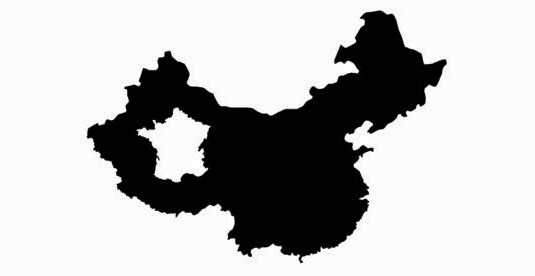
On one level, I’m reminded of Marcus Trimble’s old joke that France has been constructing a back-up version of itself in China. It is a frenzied act of “pre-emptive preservation,” led by the cultural ministers of that sclerotic nation of well-tended chateaux who realized that la belle France could only survive if they built immediately ready copies of themselves elsewhere.

Only, in France’s case, it wasn’t willful self-burial in Norwegian caves, but in the real estate free-for-all of urban China. After all, Trimble suggested, that country’s “construction industry seems perfect for the task of backing up bricks rather than bits—cheap and powered by the brute force of sheer population. Copies of places may be made in a fraction of the time that it took to create them. If, in the event of a catastrophic episode, the part of France in question could be restored and life would go on as it was before.”

[Image: “China: ample space for a spare copy of France”; image by Marcus Trimble].

Militarize this, secret it away in a cave in Scandinavia, and you have something roughly approximately what’s called the Marine Corps Prepositioning Program.

However, I was also reminded of a recent paper by Pierre Belanger and Alexander Scott Arroyo at Harvard’s GSD. There, Belanger and Arroyo describe the U.S. military as a kind of planetary logistics challenge. (A PDF of their paper is available here courtesy of the U.S. Department of Defense).

Specifically, it is the problem of building and often violently maintaining “logistics islands,” as Belanger and Arroyo describe them, that now characterizes much of the U.S. military’s global behavior, an endless quest for finding and protecting “a secure staging ground adjacent to the theater of operations,” in an era when adjacency is increasingly hard to define. As they explain:

While logistical acquisitions are managed by the Defense Logistics Agency (DLA), logistical operations in the field are predominantly coordinated by USTRANSCOM. On average, the command oversees almost 2,000 air missions and 10,000 ground shipments per week, with 25 container ships providing active logistical support. From October 2009 through September 2010 alone, USTRANSCOM flew 37,304 airlift missions carrying over 2 million passengers and 852,141 tons of cargo; aerially refueled 13,504 aircraft with 338,856,200 pounds of fuel on 11,859 distinct sorties; and moved nearly 25 million tons of cargo in coordinated sea-land operations. DLA and USTRANSCOM and their civilian partners are responsible for the largest, most widespread, and most diverse sustained logistics operation in history.

The largest, most widespread, and most diverse sustained logistics operation in history.

The obvious and intended resonance here is that military operations perhaps now most closely resemble complicated UPS deliveries than anything like actual ground combat. However, we can also infer from this that establishing new and ever more convenient logistics islands is vital to U.S. national security.

A literal archipelago of shipping hubs is thus key to the country’s global military activities, and this not only requires sites like Diego Garcia, which Belanger and Arroyo specifically write about, or even the “mobile offshore bases” they also describe, where the pop-up urbanism of Archigram has been inadvertently realized by the U.S. military, but artificially fortified caves near the Arctic Circle where truly daunting amounts of military materiel are now kept on hand, as if held frozen in some imperial freezer, awaiting the day when global tensions truly heat up.

Read a bit more at War is Boring.

(This is more or less irrelevant, but you might also like Kiln, earlier on BLDGBLOG).

The Future T.B.D.

[Image: The TBD Catalog from the Near Future Laboratory].

The TBD Catalog soon to be published by the Near Future Laboratory is a fictional catalog of possible products, all described and illustrated like mail-order props in some unrealized everyday life of tomorrow.

Part satire, part industrial brainstorm, it’s a mix of impractical ideas and thought-provoking future goods, whether that means the absurd weather-sensing hair extensions or (entirely plausible) DIY home-bioluminescence kits.

[Image: The TBD Catalog from the Near Future Laboratory].

The New Future Lab’s goal was to “take the things that seemed liminal, the things in the laboratories, in the public media, in science-fiction films, in economic projections and then extrapolate these ideas and prototypes and make them into ‘things’ in the near future.” They sought “to design-develop prototypes and shape embryonic concepts in order to discard them, make them better, reconsider what we may take for granted.” To come up with tomorrow’s products today.

It is the catalog as speculative literature, or the inventor’s notebook as a mode of critical inquiry. Call it counter-production: something that creatively mocks and toys with the idea that we can only experience futurity through the cyclical release and ritual consumption of new commodities.

[Image: The TBD Catalog from the Near Future Laboratory].

The resulting objects, services, home goods, and even new forms of food are not just “hyperbolic perfections,” as the authors write, or sleek and empty new corporate products, but “things as they would exist as part of normal, ordinary, everyday life. If you stopped today and [were] transported to the near future, what would the world look like?”

What products would you buy? What services would you rely on? What would sit at home on your shelves?

The group’s hope was that, in answering these questions, they might discover—even if only in parody—the outline of the world to come and reveal many of the false assumptions built into a market-based vision of tomorrow.

Along those lines, for example, they posit something called algoriture, or an emergent library of algorithmically-written literature, AI-generated on the fly.

[Image: The TBD Catalog from the Near Future Laboratory].

These are like little machine folktales produced through some narrative averaging of other written works, priced by genre and archetype.

Each text is thus “a guaranteed unique, custom book for you based on books you’ve read and enjoyed—and a matrix of genre specifications you provide. Each book is guaranteed unique and guaranteed enjoyable—or your money back. Only works of fiction. Genres: romance, technothriller, science-fiction, fantasy, thriller, young adult (incl. fairy tale), mystery and more.”

[Image: The TBD Catalog from the Near Future Laboratory].

The actual catalog—which begins shipping on September 1, 2014—is “not your near future of superlative Silicon Valley exuberance,” they write, “where you happily 3D-print a perfect set of lease-licensed Opinel steak knives or blissfully commute to work in your fascistically sleek Google-powered, chem-battery fueled autonomous vehicles. Nor is this the abysmal near future where you huddle in the smoldering foxholes of apocalyptic ruin. TBD Catalog runs through the middle. It is neither extreme. It is a design fiction about a normal, ordinary everyday near future.”

[Images: The TBD Catalog from the Near Future Laboratory].

In the end, the authors write, “A report (or catalog, such as TBD) offers a way to normalize those extraordinary ideas and represent them as entirely ordinary. We imagined it to be a catalog of some sort, as might appear in a street vending box in any neighborhood, or in a pile next to the neighborhood real estate guides or advertising-based classified newspapers near the entrance to your local convenience store.”

Consider ordering a copy to see if it has the desired effect.

Buy a Fort

“365 acres with frontage on, and under, Lake Champlain is for sale in northern New York,” the Center for Land Use Interpretation reports.

“The property comes with a 19th century fortification, Fort Montgomery, that while in need of some repair, is still largely intact. Furthermore, the property abuts the Canadian Border, making this an excellent opportunity to add to the defense of the nation.”
And it can be yours for a mere $10 million.
Best of all, Fort Montgomery is located “on an artificial island, linked to the shore by a causeway.” Further, the fort “was built in a five-pointed star formation, in a manner more typical of a coastal fortification, and a type that is rarely found in the interior of the country. It has 40 foot tall stone walls projecting out of the water, though portions of it were removed in the 1930s during the construction of a nearby bridge.”
So why not add it to your portfolio – along with this lovely ghost town?

Right to Light

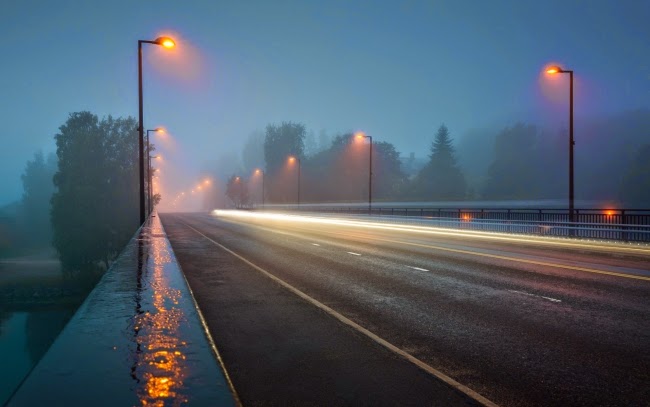
[Image: Random image of street lights].

Parts of Copenhagen are being turned into an outdoor night-lighting experiment, aiming to determine exactly how—even to what extent—cities should be illuminated at night, not only to use resources most efficiently but to increase urban security.

A mix of context-sensitive and remotely controlled lighting systems will be deployed, and each light will have its own IP address for outside monitoring. “Sensors that track traffic density, air quality, noise, weather conditions and UV radiation will also be fitted throughout the site to see what sort of environment the lights are operating in,” New Scientist explains. “All this will help work out which lights are making the biggest difference in terms of lowering costs and emissions.”

The visual results will be not unlike an outdoor museum of experiential light art, a kind of an “Urban Light” sculpture blown up to the scale of a neighborhood, and the Danish Outdoor Lighting Lab—or DOLL as it’s known—is even meant to be toured as such. While “engineers will have freedom to toy with the different products,” we also read that “foreign officials who are curious about the technology can comparison-shop for their hometown.”

[Image: Another random image of a street light].

But these networked and responsive urban lighting systems also come with political implications, including an effect on how the city can be monitored by authorities.

Indeed, “Fitting street lamps with complex sensors—and hooking them up to a larger network that controls the city—will have implications far outside of lighting,” the article explains. “If a street lamp senses a sudden rush of people in an area that’s usually deserted at night, police could be tipped off to go check the area out.” And, by extension, those streets could be dramatically flooded with blazing incandescence, transforming the city’s infrastructure into a kind of giant police spotlight.

It’s not hard to imagine life in one of these smart-lit neighborhoods of the future where, one evening, a suspect—perhaps you—has been chased by police; whole streets light up strategically, one by one, tracking the suspect—guilty or not—as he or she attempts to flee, small emergency lights even turning on in spots where they had previously been invisible. Other streets and alleys dim to help hide police in the darkness. Infrastructure becomes not just civic but tactical.

Recall Evgeny Morozov’s look at the smart city as a kind of urban police state. Writing for The Guardian earlier this summer, Morozov suggested that, “As both cars and roads get ‘smart,’ they promise nearly perfect, real-time law enforcement. Instead of waiting for drivers to break the law, authorities can simply prevent the crime.” They can simply darken entire neighborhoods—or flood them with the brilliance of a thousand LED suns.

[Image: One more random street light image].

Police-enabled pieces of urban infrastructure are, for Morozov, “emblematic of transformations in many other domains, from smart environments for ‘ambient assisted living’ where carpets and walls detect that someone has fallen, to various masterplans for the smart city, where municipal services dispatch resources only to those areas that need them.”

Thanks to sensors and internet connectivity, the most banal everyday objects have acquired tremendous power to regulate behavior. Even public toilets are ripe for sensor-based optimisation: the Safeguard Germ Alarm, a smart soap dispenser developed by Procter & Gamble and used in some public WCs in the Philippines, has sensors monitoring the doors of each stall. Once you leave the stall, the alarm starts ringing—and can only be stopped by a push of the soap-dispensing button.

Perhaps the DOLL experiment reveals that we can now add street lights to that list: smart targeting systems that make decisions in real-time as to which residents and neighborhoods have a right to light and who shall be punished by the induced darkness of an infrastructure that no longer wants to turn on for them.

Seismic Suburb

[Image: Screengrab from Stuff showing the test-suburb, a kind of seismic Operation Doorstep].

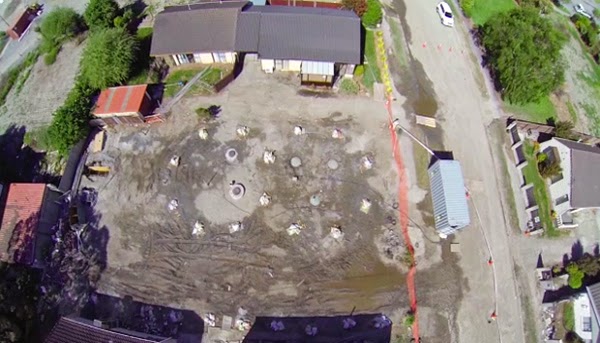
An empty suburb of Christchurch, New Zealand, abandoned after the 2011 earthquake, was bombed from below last autumn, as a series of carefully timed underground explosions set off an artificial earthquake. The controlled seismic event was part of a closely studied experiment to test how soil liquefaction could be reduced or even eliminated by better geotechnical design.

As Next City explains, it was a 70-year old former resident of the neighborhood named Martin Howman who kicked off the event, triggering the buried necklace of explosives beneath his own street and the houses of his neighbors.

“As he pressed the buttons,” Charles Anderson writes for Next City, “a piece of Howman’s old neighborhood, long since abandoned, jumped and jostled just like it had the day of the 2011 quake. Cameras inside the homes showed floor boards shaking and kitchen benches being thrown from their foundations. Drones hovering above captured images of roof tiles being shaken loose and shock waves thudding through the earth. Signs had been placed throughout the wider area to reassure passersby that the sounds were just science in action. Many gathered at a safe distance to watch the spectacle unfold.”

In video footage of the event, small clouds of dust can be seen bucking upward from the roofs of houses to drift away in a light breeze as the soil continues to jolt and shudder.

Stuff reported at the time that Howman’s initial response to the near-total abandonment of his neighborhood after the 2011 earthquake was that “he might buy a tractor and some cows and revert the land back to dairy farm”—but, instead, he stuck around just long enough to see the empty streets transformed into a seismic research facility like something out the work of Lebbeus Woods.

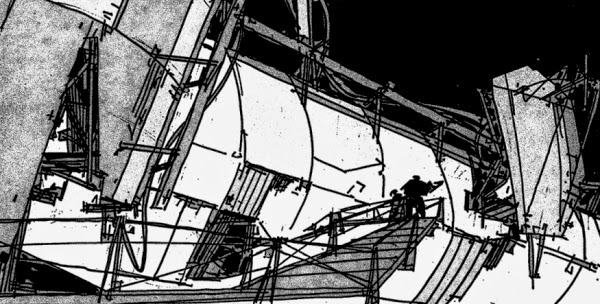
Recall, for example, the ideas behind Woods’s film treatment, Underground Berlin. There—as we explored here on BLDGBLOG back in 2013—Woods posited a fictional network of government seismic labs secretly operating beneath the surface of Berlin, called the Underground Research Station.

[Image: From Underground Berlin by Lebbeus Woods].

Inside the Station, Woods’s unmade film would have shown, “many scientists and technicians are working on a project for the government to analyze and harness the tremendous, limitless geological forces active in the earth… a world of seismic wind and electromagnetic flux.” Their eventual goal is to achieve “a mastery”—that is, to weaponize—the “primordial earth forces” they actively study.

In his book OneFiveFour, Woods pushes these ideas further, describing a city so defined by the seismic energy destabilizing the ground beneath it that almost every building and surface has been covered in “oscilloscopes, refractors, seismometers, interferometers, and other, as yet unknown instruments, measuring light, movement, force, change.”

The entire city has become a seismic instrument where “tools for extending perceptivity to all scales of nature are built spontaneously, playfully, experimentally, continuously modified in home laboratories, in laboratories that are homes… Indeed, each object—chair, table, cloth, examining apparatus, structure—is an instrument; each material thing connects the inhabitants with events in the world around him and within himself.”

In a video posted on Stuff, the ground rhythmically ripples and pops from below, as if a living creature has stirred beneath the cracked foundations of this empty neighborhood, “primordial earth forces” intent on resisting the architecture so flimsily built upon their shoulders.

(Thanks to mike.m.d. for the heads up!)

Cultivating the Map

[Image: “Cultivating the Map” by Danny Wills].

For his final thesis project at the endangered Cooper Union, Danny Wills explored how survey instruments, cartographic tools, and architecture might work together at different scales to transform tracts of land in the geographic center of the United States.

[Images: “Cultivating the Map” by Danny Wills].

Called “Cultivating the Map,” his project is set in the gridded fields, sand hills, playas, and deep aquifers of the nation’s midland, where agricultural activity has left a variety of influential marks on the region’s landscapes and ecosystems.

[Images: “Cultivating the Map” by Danny Wills].

Its final presentation is light on text and heavy on models, maps, and diagrams, yet Wills still manages to communicate the complex spatial effects of very basic physical tools, how things as basic as survey grids and irrigation equipment can bring whole new regimes of territorial management into existence.

It’s as if agriculture is actually a huge mathematical empire in the middle of the country—a rigorously artificial world of furrows, grids, and seasons—dedicated to reorganizing the surface of the planet by way of relatively simple handheld tools and then rigorously perfecting the other-worldly results.

[Images: “Cultivating the Map” by Danny Wills].

Wills produced quite a lot of material for the project, including a cluster of table-sized landscapes that show these tools and instruments as they might be seen in the field.

[Image: “Cultivating the Map” by Danny Wills].

In many ways, parts of the project bring to mind the work of Smout Allen, who also conceive of architecture as just one intermediary spatial product on a scale that goes from the most intricate of handheld mechanisms to super-sized blocks of pure infrastructure.

Imagine Augmented Landscapes transported to the Great Plains and animated by a subtext of hydrological surveying and experimental agriculture. Deep and invisible bodies of water exert slow-motion influence on the fields far above, and “architecture” is really just the medium through which these spatial effects can be cultivated, realized, and distributed.

This, it seems, is the underlying premise of Wills’s project, that architecture is like a valve through which new landscapes pass.

[Images: “Cultivating the Map” by Danny Wills].

In any case, I’ve included a whole bunch of images here, broadly organized by tool or, perhaps more accurately, by cartographic idea, where the system of projection suggested by Wills’s devices have had some sort of spatial effect on the landscape in which they’re situated.

However, I’ve also been a little loose here, organizing these a bit by visual association, so it’s entirely possible that my ordering of the images has thrown off the actual narrative of the project—in which case, it’s probably best just to check out Wills’s own website if you’re interested in seeing more.

[Images: “Cultivating the Map” by Danny Wills].

The project includes land ordinance survey tools and irrigation mechanisms, a “Mississippi River levee tool” and the building-sized “grain elevator tool.”

[Images: “Cultivating the Map” by Danny Wills].

In Danny’s own words, the project “finds itself in the territory of the map, proposing that the map is also a generative tool. Using the drawing as fertile ground, this thesis attempts a predictive organization of territory through the design of four new tools for the management of natural resources in the Great Plains, a region threatened with the cumulative adverse effects of industrial farming. Each tool proposes new ways of drawing the land and acts as an instrument that reveals the landscape’s new potential.”

These “new potentials” are often presented as if in a little catalog of ideas, with sites named, located, and described, followed by a diagrammatic depiction of what Wills suggests might spatially occur there.

[Images: “Cultivating the Map” by Danny Wills].

The ambitious project earned Wills both the Henry Adams AIA Medal & Certificate of Merit, and the school’s Yarnell Thesis Prize in Architecture.

[Images: “Cultivating the Map” by Danny Wills].

I’ll wrap up here with a selection of images of the landscapes, tools, and instruments, but click over to Danny’s site for a few more. Here are also some descriptions:

Tool 1: Meanders, Fog Fences, Air Wells

Tool 1 attaches itself to the groundwater streams, both proposing tools to redirect and slow down the flow, as well as tools to collect atmospheric water through technological systems like air wells and fog fences, forming new bodies and streams of water. The new air wells collect atmospheric water through a system of cooling and heating a substrate core inside of a ventilated exterior shell. The air wells also become spaces to observe the re-directing flow of water, as overflow quantities are appropriately managed.

Tool 2: Aquifer Irrigation Ponds

Tool 2 uses the center pivot irrigation rigs to reconstruct the ground, making bowls in the landscape that act as dew ponds. At the same time, the wells become tools and markers to survey the levels of the aquifer below, signifying changes in the depth through elevational changes above. New forms of settlement begin to appear around each ring as a balance is reached between extraction and recharge of the aquifer.

Tool 3: Sand Dunes, Grazing Fields

Tool 3 uses gas wells as new geo-positioning points, redrawing boundaries and introducing controlled grazing and fallowing zones into the region. Walls are also built as markers of the drilling wells below, creating a dune topography to retain more ground water. Each repurposed oil rig becomes an architectural element that both provides protection and feed for grazing animals as well as a core sample viewing station. The abandoned rigs suspend cross sections of the earth to educate visitors of the geological history of the ground they stand on.

Tool 4: Water Recycling Station

Tool 4 converts the grain elevator into a water recycling station, filling the silos with different densities of sand and stone to filter collected types of water- rain, ground run-off, grey, brackish, etc. Large pavilion like structures are built between houses, collecting water and providing shade underneath. Some housing is converted into family-run markets; the new social space under the pavilions provide for market space. The repurposed grain elevator becomes the storage center for the region’s new water bank. Economic control is brought back to the local scale.

[Images: “Cultivating the Map” by Danny Wills].

The Comet as Landscape Art

[Image: Photo courtesy ESA].

Intrigued by these images as an example of how the tradition of landscape representation has rapidly progressed—from the Romantics and the Hudson River School to Rosetta—I felt compelled to post a few photos of the craggy and glacial surface of Comet 67P/Churyumov–Gerasimenko, sent back to Earth yesterday from the European Space Agency’s Rosetta spacecraft.

The surface of the comet “is porous, with steep cliffs and house-sized boulders,” making it earth-like yet deeply treacherous, an irregular terrain to photograph and a dangerous place to land.

[Image: Photo courtesy ESA].

It is the notion of “land” here that is most interesting, however, as this is really just the imposition of a terrestrial metaphor onto a deeply alien body. Yet the comet is, in effect, literally a glacier: a malleable yet permanently frozen body of ice hurtling through space, occasionally exploding in comas and tails of vapor.

It is “an ancient landscape,” we read, “and yet one that looks strangely contemporary as the sun vaporizes ice, reworking the terrain like a child molding clay.”

Think Antarctica in a winter storm, not southern Utah—or Glacier National Park, not the Grand Canyon.

[Image: Photo courtesy ESA].

Along those lines, some of the most provocative writing on what it means to visually represent the frozen and hostile landscapes of the Antarctic is by writer William L. Fox, whose work offers some useful resonance here.

Fox has written, for example, about the technical and even neurological difficulties in accurately representing—let alone comprehending or simply navigating—Antarctic space and the vast forms that frame it.

Distant landscapes distorted by thermal discontinuities; white levels pushed to the absolute limit of film chemistry; impossible contours throwing off any attempt at depth perception; even the difficulty of distinguishing complicated mirages from actual landforms: these are all part of the challenge of creating images of an exotic landscape such as the Antarctic.

As Fox writes, it was even specifically the tradition of Dutch landscape painting, combined with the maritime practice of sketching coastal profiles, that first introduced the visual world of the Antarctic to western viewers: it was thus seen as an ominous, ice-clogged horizon of fog and low clouds looming always just slightly out of ship’s reach at the bottom of the world.

He calls this the genre of “representational exploration art.”

[Image: Photo by Stuart Klipper from his fantastic book, The Antarctic: From the Circle to the Pole, with a foreword by William L. Fox].

In one interesting passage in his book Terra Antarctica, he suggests that the south polar landscape is so extreme, it often resists natural analogy. As Fox describes it, the wind-carved boulders and isolated pillars and cliffs of ice are more like “artworks by Salvador Dalí and Henry Moore, evoking the spirit of surrealism with the former and modernist forms with the latter. The Antarctic is so extreme to our visual expectations that, once we attempt to move beyond measurement to describe it, analogies with other parts of nature fall short, and we resort to comparisons with cultural artifacts that push at the boundaries of our perceptions.”

These include “cultural artifacts such as sculpture and architecture, products more of the imagination than of nature.”

Consider, for instance, that comet 67P is widely known today as the “rubber-duck comet” due to its bifurcated structure, implying, as Fox suggests with the Antarctic, that no natural analogy seemed adequate for describing the comet’s geometry.

[Image: The gateway arches of the Antarctic; photo by Stuart Klipper from, The Antarctic: From the Circle to the Pole, foreword by William L. Fox].

But what are we to make of comet 67P now that we can see it as a physical landscape, not just an ephemeral optical phenomenon passing, at great distance, through the sky? When a blur becomes focused as terrain, what is the best way to describe it? What visual or textual traditions are the most useful or evocative—vedas and sutras or laboratory reports?

Put another way, is poetry as appropriate as a scientific survey in such a circumstance—should “we attempt to move beyond measurement to describe it,” in Fox’s words—and, if not, what new genres of exploration art might result from this spatial encounter?

I’m reminded here of poet Christian Bök’s wry remark on Twitter: “I am still amazed that poets insist on writing about their divorces, when robots are taking pictures of orange, ethane lakes on Titan…”

Now that humans are beginning to land semi-autonomous camera-ships on the frozen ice fields of passing comets, sending back the (off)world’s strangest landscape art—as if a direct line runs from, say, the pastoral landscapes of Claude Lorrain or the elemental weirdness of J.M.W. Turner to the literally extraterrestrial boulders and gullies depicted by Rosetta—how should our own descriptive traditions adapt? What, we might ask, is comet 67P’s role in art history?

[Image: Approaching 67P, via the ESA].