“It’s almost like he wanted to collect every map ever made”

Alec Earnest recently made an interesting documentary about a house in Los Angeles whose owner died, leaving behind a personal map collection so massive that, upon being acquired by the city’s public library, “it doubled the LAPL’s collection in a single day.”

When LAPL map librarian Glen Creason, interviewed for the film, first entered the house, his jaw dropped; “everywhere I looked in the house, there’s maps,” he explains in the film, including an entire floor that was “absolutely wall to wall with street guides.”

[Image: From Living History: The John Feathers Map Collection by Alec Earnest].

As the Los Angeles Times described Feathers’s house upon its discovery back in 2012, it held “tens of thousands of maps. Fold-out street maps were stuffed in file cabinets, crammed into cardboard boxes, lined up on closet shelves and jammed into old dairy crates. Wall-size roll-up maps once familiar to schoolchildren were stacked in corners. Old globes were lined in rows atop bookshelves also filled with maps and atlases.”

It went on and on and on: “A giant plastic topographical map of the United States covered a bathroom wall and bookcases displaying Thomas Bros. map books and other street guides lined a small den.”

Urban atlases, motoring charts, pre-Thomas Guide local street maps—Feathers collected seemingly any cartographic ephemera he could get his hands on.

[Image: From Living History: The John Feathers Map Collection by Alec Earnest].

Earnest’s short film has more information about Feathers himself, and can seen in full either above or over on YouTube.

Although the story of the collection would lend itself well to longer journalistic exploration—and map librarian Glen Creason has actually written up some thoughts for Los Angeles Magazine—it feels like an amazing jumping off point for a piece of fiction, either cinematic or literary.

Perhaps some sort of Chinatown or True Detective-like property speculation noir, where parcels of land and off-books deals are being tracked by a lone collector through generations of local maps, marking boundaries, street names, omissions; or perhaps something more like “X Marks the Spot,” where an old Spanish-affiliated property from the pre-Los Angeles era is rumored to have once had vast brick vaults stocked high with gold, buried beneath the main ranch house, a property long since absorbed into the supergrid of Greater Los Angeles… but the vaults are still down there—along with the gold—if only you can dig up the right map to go find it.

[Image: From Living History: The John Feathers Map Collection by Alec Earnest].

In fact, there could be a whole genre based purely on the unexpected narrative side-effects of people attempting—and failing—to map Los Angeles.

Abandoned Basements as Stormwater Basins

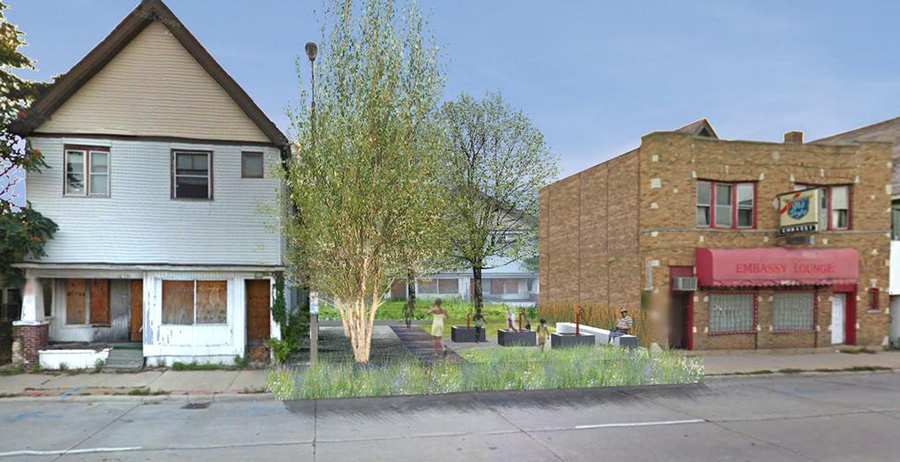
[Image: Rendering of a possible “BaseTern” landscape by students Brett Harris, Andrew D’Arcy, and Heidi Petersen, via Landscape Architecture Magazine].

Not all the news coming out of Milwaukee involves misguided highway megaprojects or tax-funded crony capitalism—though there is that.

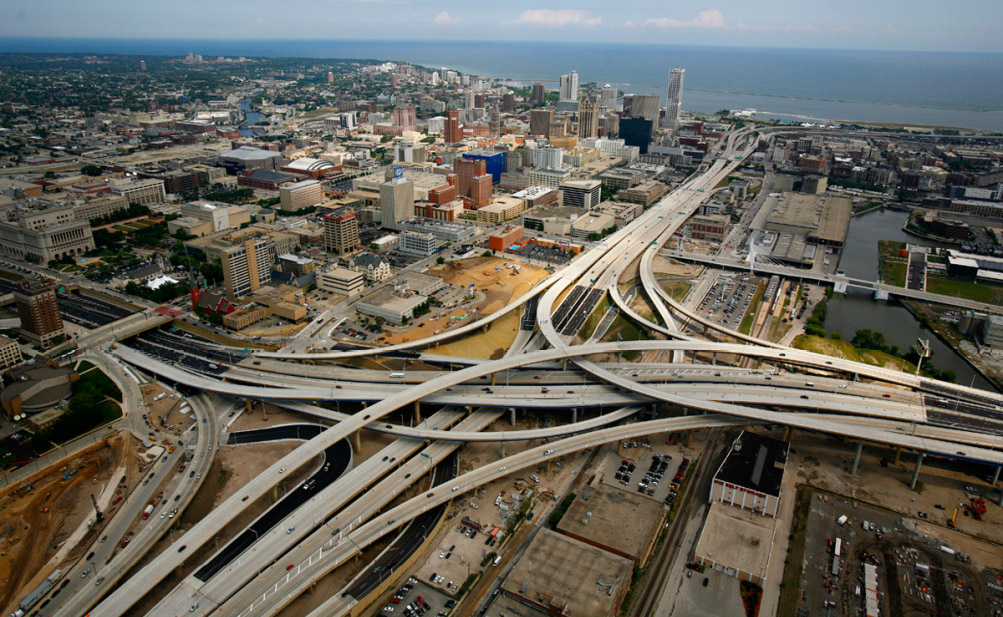
For example, Wisconsin governor Scott Walker—confusing an earlier generation’s urban mistakes with how a city is meant to function—has been plowing billions of dollars’ worth of taxpayer money into “freeway megaprojects” for which “the pricetag got so big that leaders from his own party rejected his plan as fiscally irresponsible, leaving the state budget in limbo,” Politico reports:

As the state has shifted resources into freeway megaprojects, 71 percent of [Wisconsin’s] roads are in mediocre or poor condition, according to federal data. Fourteen percent of its bridges are structurally deficient or functionally obsolete, which is actually better than the national average. Walker and his fellow Republicans have killed plans for light rail, commuter rail, high-speed rail, and dedicated bus lanes on major highways, so there is almost no public transportation connecting Milwaukee to its suburbs, intensifying divisions in one of the nation’s most racially, economically and politically segregated metropolitan areas. Yet Walker, who is running for president as a staunch fiscal conservative, has pushed a $250 million-per-mile plan to widen Interstate 94 between the Marquette and the Zoo despite fierce local opposition.

If that sounds both avoidable and unfortunate, consider the fact that “Walker also killed a ‘Complete Streets’ program that pushed road builders to accommodate bicyclists and pedestrians.”

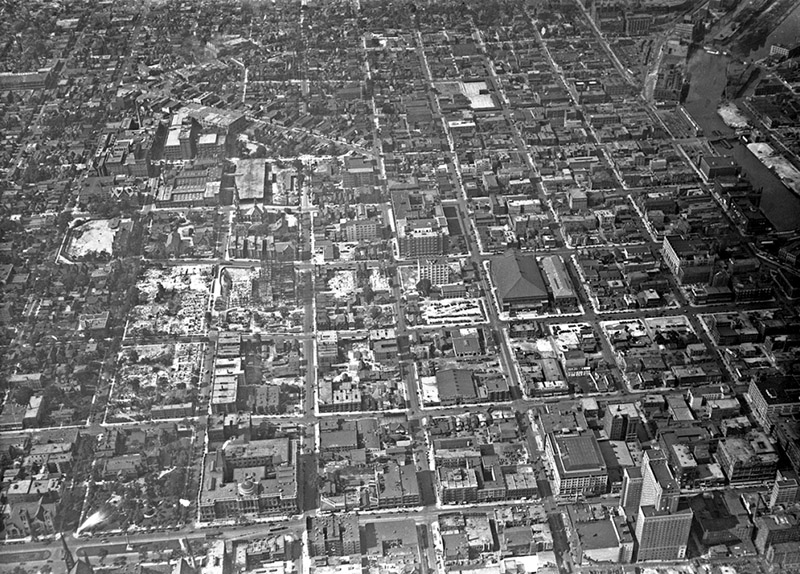
[Images: (top) Milwaukee’s Marquette interchange, nearly the same size as the city it cuts through; (bottom) Milwaukee before the interchange. Images via Politico].

At the same time, Walker has also “championed a high-profile proposal to spend a quarter of a billion dollars of taxpayer money to help finance a new Milwaukee Bucks arena—all while pushing to slash roughly the same amount from state funding for higher education,” the International Business Times reports.

But, hey, why does Wisconsin need universities when everyone can just go to an NBA game? Not that benefitting the public is even Walker’s goal: “One of those who stands to benefit from the controversial initiative is a longtime Walker donor and Republican financier who has just been appointed by the governor to head his presidential fundraising operation.”

In any case, an interesting landscape test-project is currently underway in Milwaukee, called the “BaseTern” program.

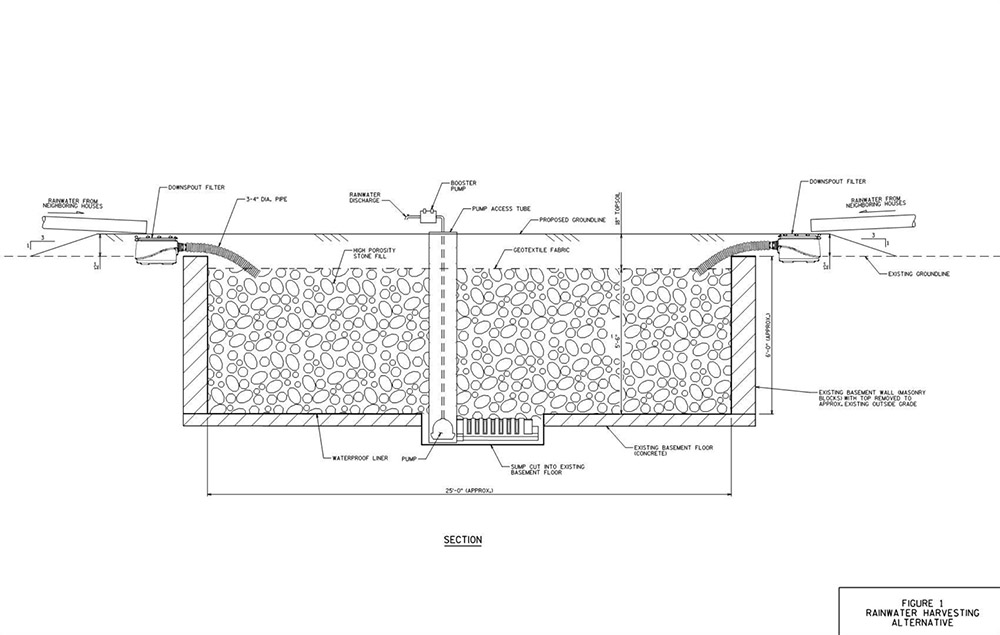
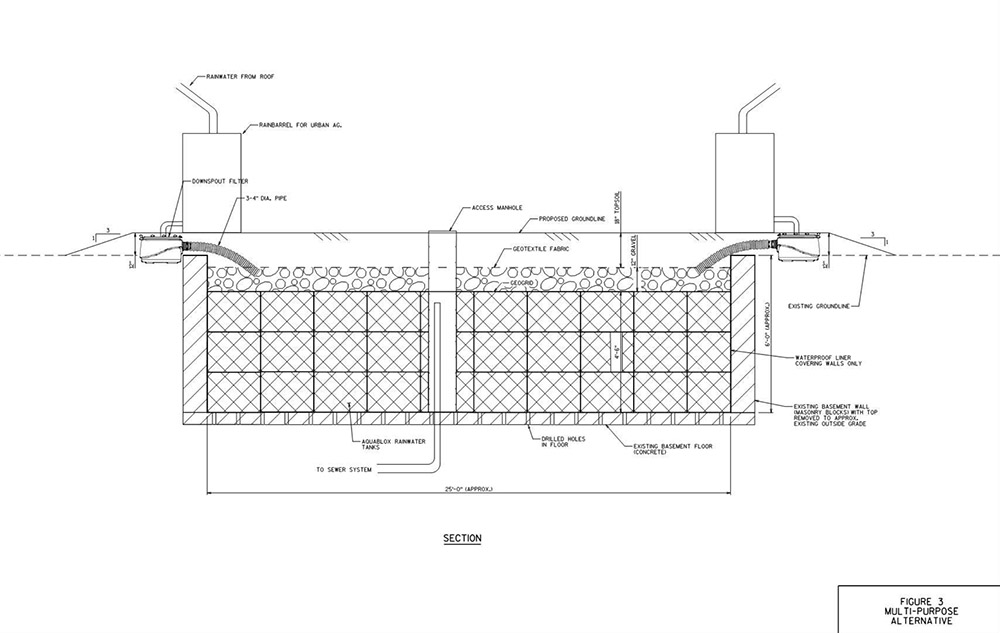
As the city explains it, a “BaseTern” is “an underground stormwater management or rainwater harvesting structure created from the former basement of an abandoned home that has been slated for demolition.” Why is the city doing this?

By using abandoned basements, the City saves the cost of demolition on these structures (filing the basement and grading the surface) and on excavation for the new structure. In addition, BaseTerns provide significant stormwater storage capacity on a single site, the equivalent of up to 600 rain barrels.

The result, the city is keen to add, is “not an open pit. Rather a BaseTern is a covered structure, which is covered with topsoil and grass, and will appear the same as conventional vacant lot.”

In their July 2015 issue, Landscape Architecture Magazine explained that this is, in fact, “the world’s first such system.” Conceived—and actually trademarked—by a city official named Erick Shambarger, the idea was inspired by a GIS-fueled discovery that the worst flooding in the city always “occurred in neighborhoods with high rates of foreclosures. The city controls roughly 900 foreclosed properties, many of which it plans to demolish. Shambarger figured the city could preserve the basement structure and put it to use.”

[Images: Two BaseTern design diagrams, taken from Milwaukee’s “Vacant Basements for Stormwater Management Feasibility Study“].

While there is something metaphorically unsettling in the idea that parts of a blighted, financially underwater neighborhood might soon literally be underwater—transformed into a kind of urban sponge for the rest of Milwaukee—the notion that the city can discover in its own economic misfortune a possible new engineering approach for dealing with seasonal flooding and super-storms is an inspiring thing to see.

The BaseTern program also potentially suggests a stopgap measure for coastal cities set to face rising sea levels well within the lifetimes of the coming generation.

In the all but inevitable managed retreat from the coast that seems set to kick off both en masse and in earnest by midcentury—something that is already happening in New York City, post-Sandy—perhaps the subterranean ruins of old neighborhoods left behind can be temporarily repurposed as minor additions to a broader coastal program intent on reducing flooding for residents further inland.

Before, of course, those underground voids—former guest bedrooms, dens, man caves, she sheds, and basements—are inundated for good.

Read more about BaseTerns over at Landscape Architecture Magazine.

Transecting Amsterdam

[Image: From Project 360º by Frank Dresmé].

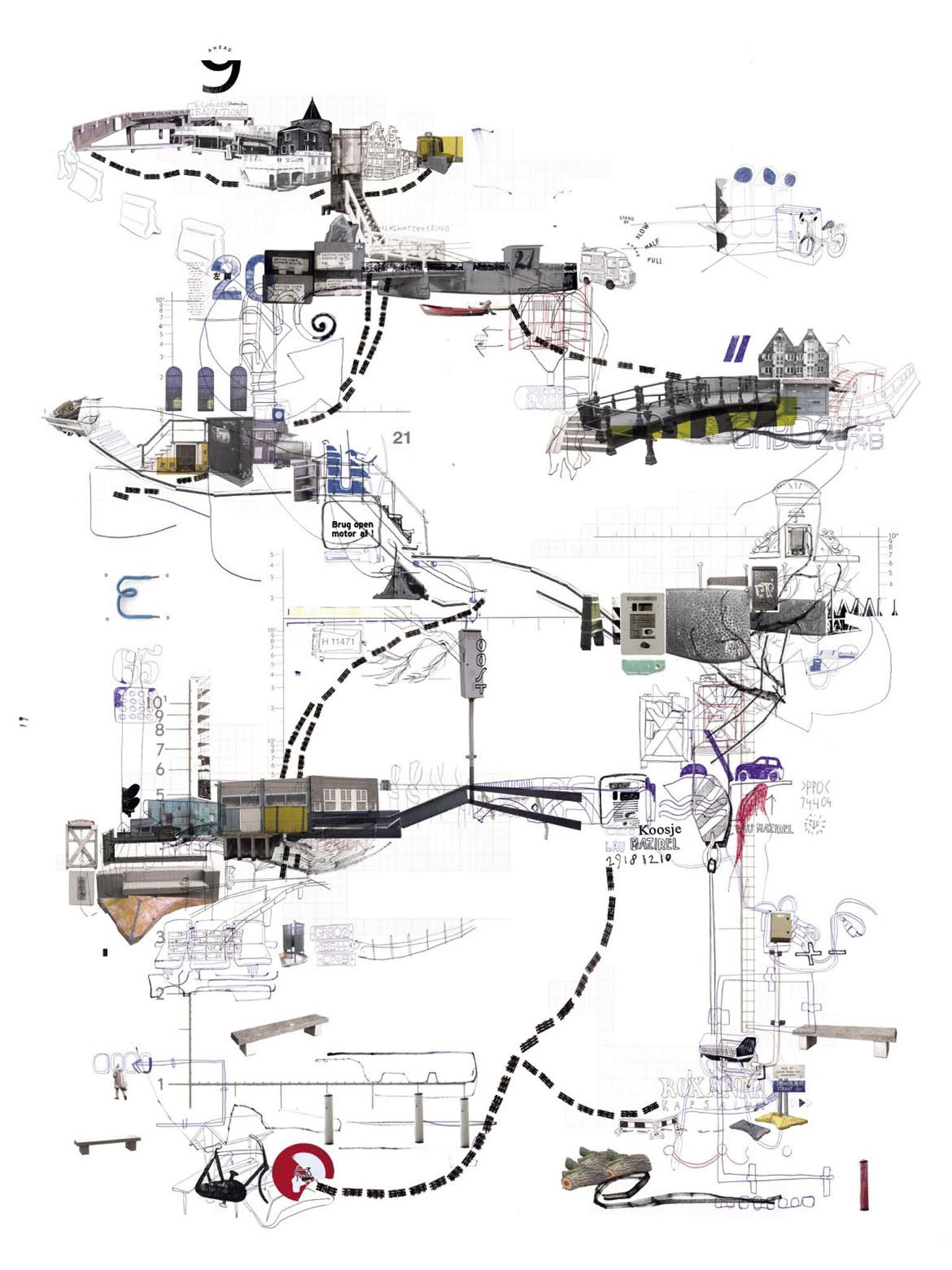
Here’s an old project by Dutch graphic designer Frank Dresmé. Called Project 360º, it used the idea of the “transect” as a way to map and graphically depict pedestrian movement through urban space.

[Image: From Project 360º by Frank Dresmé].

As Dresmé explains, he found existing maps of Amsterdam both navigationally inadequate and conceptually boring, so he sought to find a new way to represent how the city really feels as a sequence of spatial opportunities and physical obstacles.

This meant, among other things, focusing on and highlighting the signs, paths, turns, landmarks, and other bits of the city that stand out to someone intent on moving through it.

[Image: From Project 360º by Frank Dresmé].

The results was “four psychogeographical maps,” as he described them, that unpeeled and restitched Amsterdam back together again.

“These maps are the routes between personal destinations in Amsterdam,” he explained. “Every destination in a different wind direction; north /east /south /west back to the north.”

While the final images are perhaps not navigationally useful for other pedestrians, they are certainly visually striking; what is more important, in any case, would not be the use-value you can extract from Dresmé’s project, but the methods and techniques it suggests for breaking down and understanding your own use of the city.

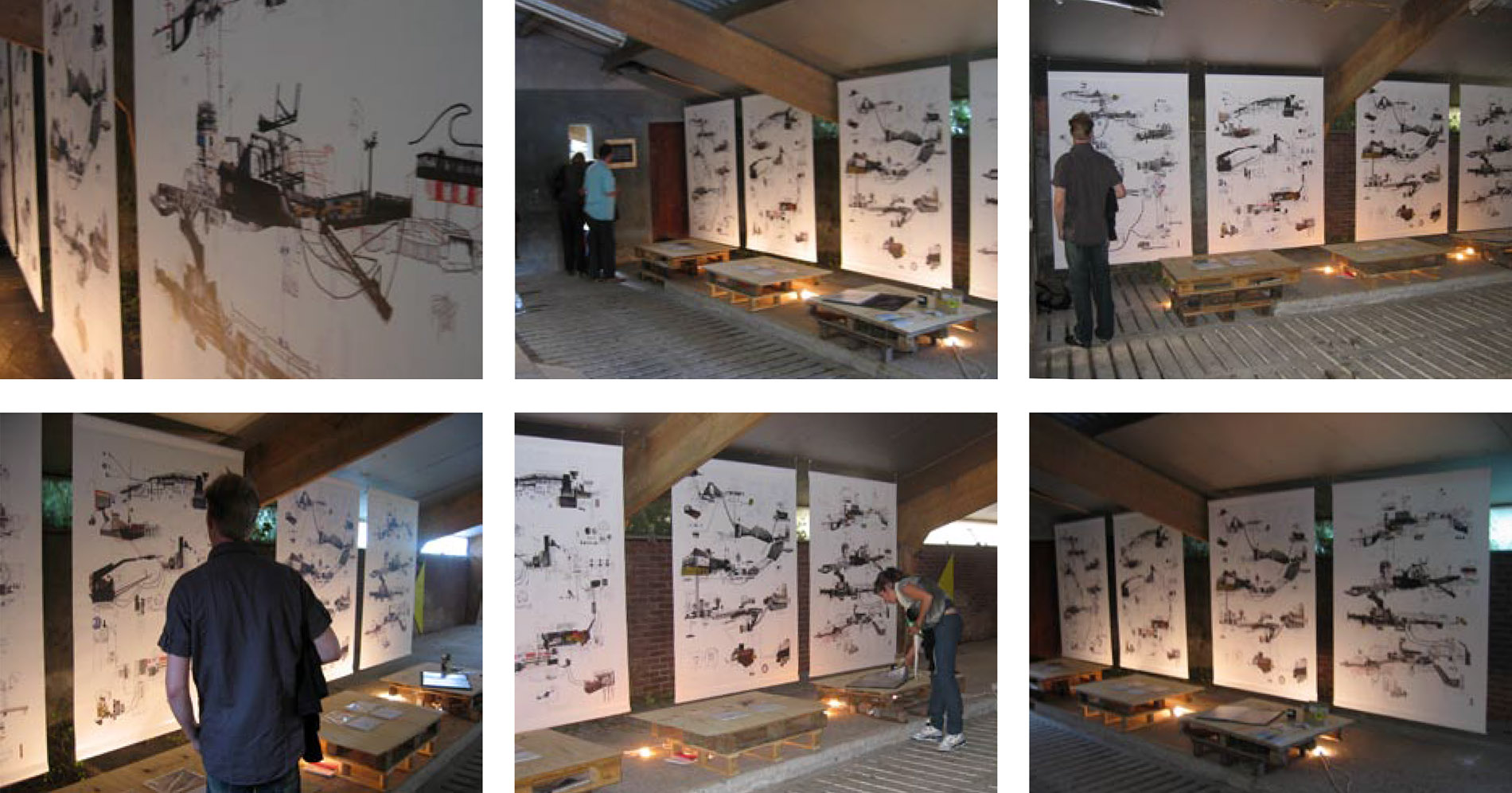
[Image: Exhibiting Project 360º by Frank Dresmé].

Given all of the spatial data now available about ourselves, whether we want it to be or not, it seems particularly timely to imagine new ways of engaging with, mapping, and representing that geographic information.

Part trail map, part daily diary, Dresmé’s transect offers as good an option as any. Download a PDF of the project over at his site.

[Note: Brent Milligan of Free Association Design used these and other graphic representations of urban space as a launching point for a long post back in 2009].

Composite Archaeology

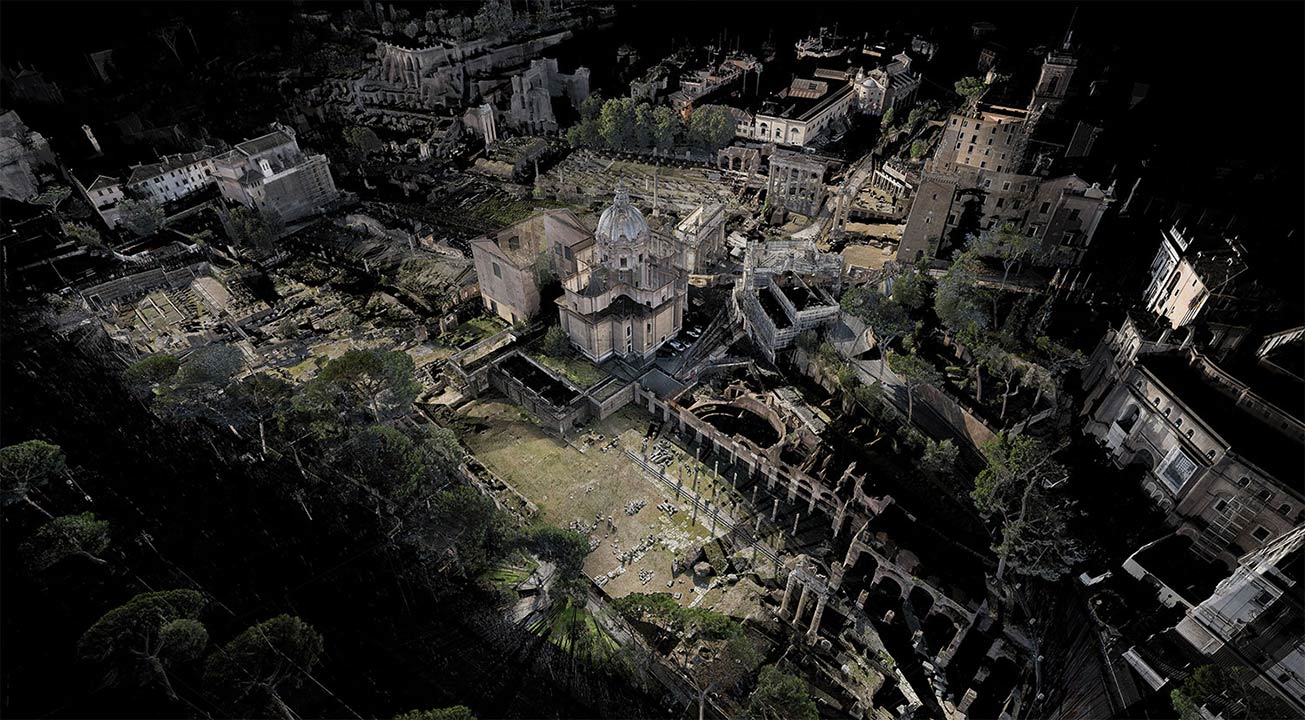
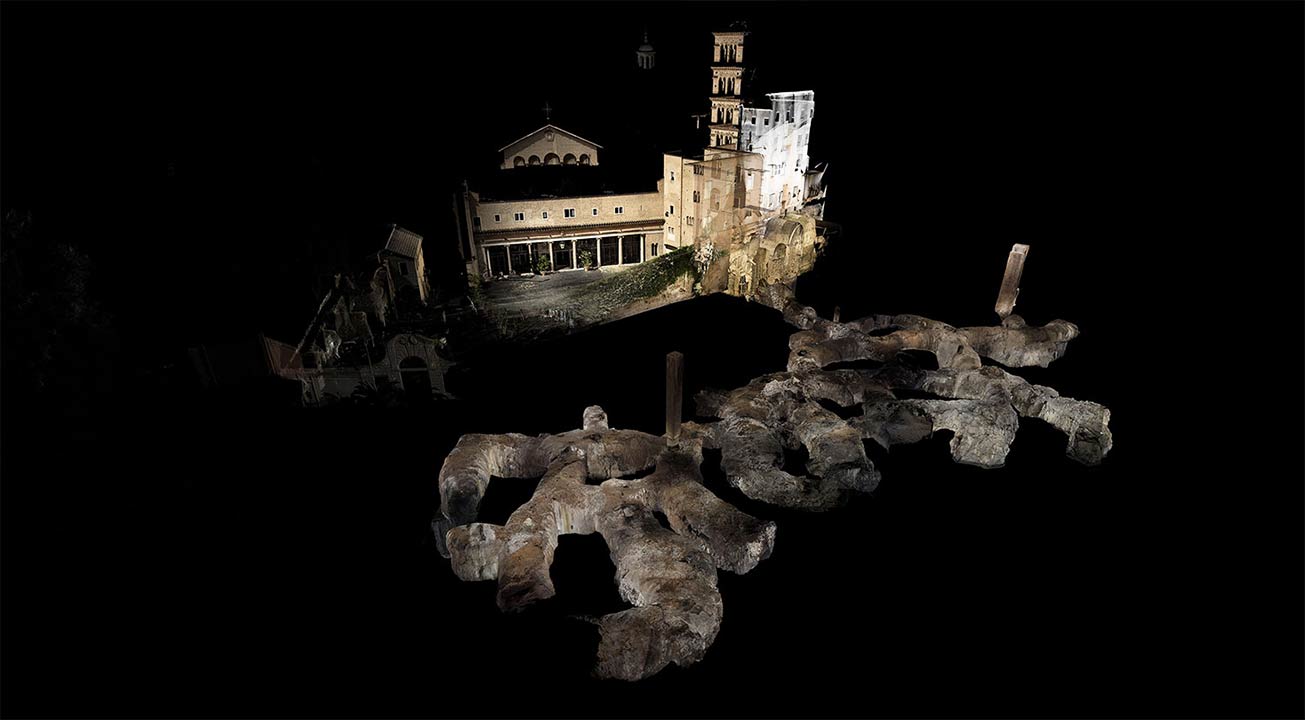
[Image: A laser scan of the Pantheon, courtesy ScanLAB Projects and the BBC; view larger!].

ScanLAB Projects, focus of a long article on Wired last month, are back in the news with a BBC documentary exploring the infrastructure of ancient Rome.

The show “explores Roman infrastructure and ingenuity, all below ground level”:

We journeyed via the icy, crystal clear waters of subterranean aqueducts that feed the Trevi fountain and two thousand year old sewers which still function beneath the Roman Forum today, to decadent, labyrinthine catacombs. Our laser scans map these hidden treasures, revealing for the first time the complex network of tunnels, chambers and passageways without which Rome could not have survived as a city of a million people.

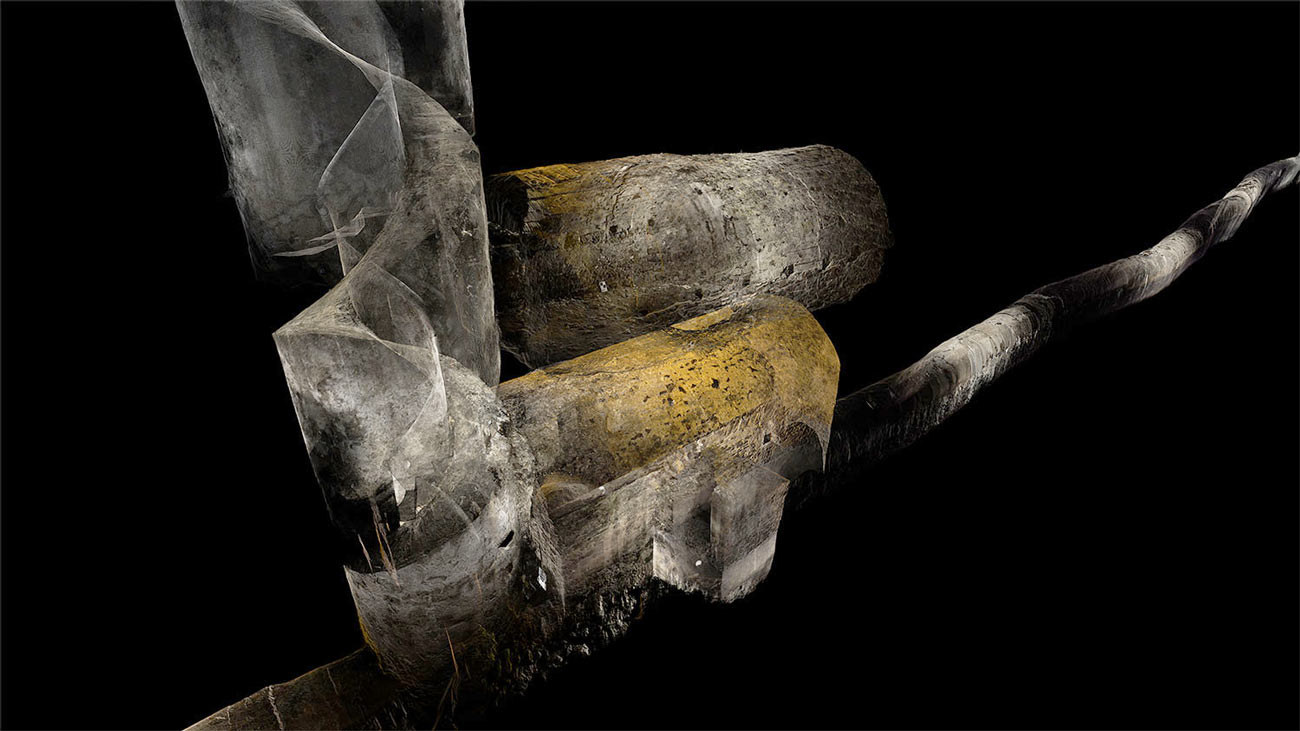
The results, as usual, are both breathtaking and bizarre.

[Image: Courtesy ScanLAB Projects and the BBC].

The surface of the city is scraped away, a kind of archaeological dermabrasion, to reveal sprawling networks of knotted masonry and old corridors spliced together in a translucent labyrinth less below than somehow in the city.

[Image: Courtesy ScanLAB Projects and the BBC].

One of the most interesting points made in Mary-Ann Ray’s excellent Pamphlet Architecture installment—1997’s Seven Partly Underground Rooms and Buildings for Water, Ice, and Midgets—is when she describes her use of composite photography as a way to experiment with new forms of archaeological documentation.

Indeed, the pamphlet itself is as much architecture as it is archaeology—perhaps even suggesting a new series of historical site documents someone should produce called Pamphlet Archaeology—looking at wells, baths, cisterns, and spherical refrigeration chambers, in various states of ruin.

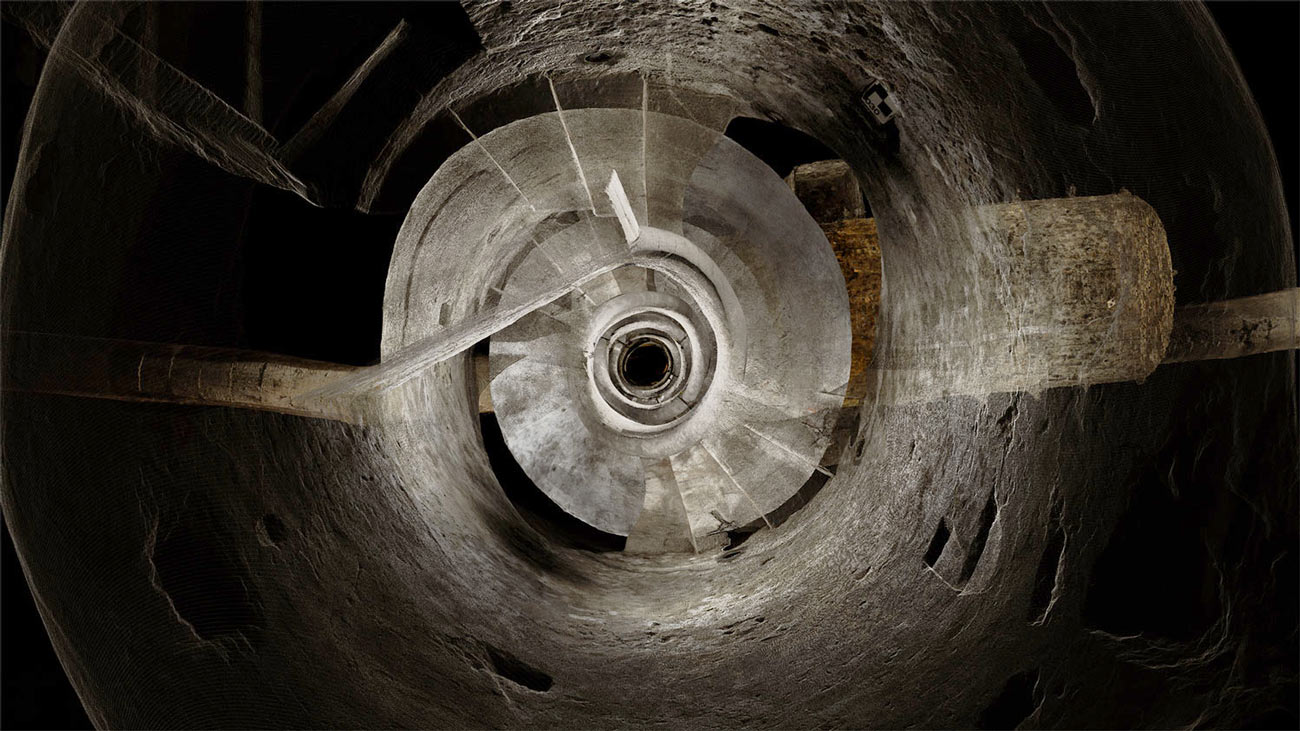
All of these are representationally difficult spaces, Ray explains, either curving away from the viewer in a manner that is nearly impossible to photograph or presenting constrictions of perspective that make even wide-angle photographs inadequate.

[Image: Courtesy ScanLAB Projects and the BBC].

Ray writes that the spatial complexity of the buildings, quarries, basements, and other excavations that she explores are, in a sense, an entirely different kind of space: knotty, interconnected, unstable. “They were also spaces,” she writes, “which seemed to have the ability to ‘flip-flop’ in and out of multiple spatial or constructional readings.”

What appears to be near is revealed to be far; what seems far away is suddenly adjacent.

[Image: Courtesy ScanLAB Projects and the BBC; view larger!].

Ray uses the metaphor of a “hyper-camera” here in order to draw comparisons between her composite photography and what she calls “a kind of cubist multiple view,” one where “the frame might succumb to the taper of perspective into deep space, or it may counter it, or build it into something else altogether.”

“In these composite views,” she adds, “the photograph can record the enactment of space as one maneuvers or roams through it with the eye or body.”

While Ray’s photographic approach is technologically, materially, and even visually very different from the work of ScanLAB, the two projects share a great deal, conceptually and methodologically. In fact, if many of the above quotations were applied, instead, to the images seen in the present post, they would seem to be the appropriate descriptions.

[Image: In the ruined basements of architectural simultaneity; ScanLAB Projects and the BBC].

ScanLAB’s laser work seems to fulfill many of the promises of Ray’s composite photography, offering multiple, overlapping perspectives simultaneously whilst also eliminating the problem of the horizon or ground plane: you can thus look straight-on into the basement of an ancient structure without losing sight of the upper floors or chambers.

The city is split in two, made into an architectural section of itself that is then animated, made volumetric, turned into Ray’s “enactment of space as one maneuvers or roams through it with the eye or body.”

The show airs tonight on the BBC. Check out ScanLAB’s website for more info, and definitely consider picking up a copy of Mary-Ann Ray’s book; it remains one of my favorites and has actually become more, not less, topical since its original publication.

The City Has Eyes

[Image: Photo by BLDGBLOG].

In the distant summer of 2002, I worked for a few months at Foster + Partners in London, tasked with helping to archive Foster’s old sketchbooks, hand-drawings, and miscellaneous other materials documenting dozens of different architectural projects over the past few decades.

On a relatively slow afternoon, I was given the job of sorting through some old cupboards full of videocassettes—VHS tapes hoarded more or less randomly, sometimes even without labels, in a small room on the upper floor of the office.

Amongst taped interviews from Foster’s various TV appearances, foreign media documentaries about the office’s international work, and other bits of A/V ephemera, there were a handful of tapes that consisted of nothing but surveillance footage shot inside the old Wembley Stadium.

It was impossible to know what the tapes—unlabeled and shoved in the back of the cupboard—actually documented, but the strange visual language of CCTV is such that something always seems about to happen. There is a strange urgency to surveillance footage, despite its slow, almost glacial pace: a feeling of intense, often dreadful anticipation. A crime, an attack, an explosion or fire is, it seems, terrifyingly imminent.

Unsure of what I was actually watching for, it began to feel a bit sinister: had there been an attack or even a murder in the old Wembley Stadium, prior to Foster + Partners’ new design at the site, and, for whatever reason, Foster held on to security tapes of the incident? Was I about to see a stabbing or a brawl, a small riot in the corridors?

More abstractly, could an architect somehow develop an attachment, a dark and unhealthy fascination, with crimes that had occurred inside a structure he or she designed—or, in this case, in a building he or she would ultimately demolish and replace?

It felt as if I was watching police evidence, sitting there, alone on a summer afternoon, waiting nervously for the depicted crime to begin.

The relationship not just between architecture and crime, but between architects and crime began to captivate me.

Of course, it didn’t take long to realize what was really happening, which was altogether less exciting but nevertheless just as fascinating: these unlabeled security tapes hidden in a cupboard at Foster + Partners hadn’t captured a crime, riot, or any other real form of suspicious activity.

Rather, the tapes had been saved in the office archive as an unusual form of architectural research: surveillance footage of people milling about near the bathrooms or walking around in small groups through the cavernous back-spaces of the old Wembley stadium would help to show how the public really used the space.

I was watching video surveillance being put to use as a form of building analysis—security tapes as a form of spatial anthropology.

[Image: Unrelated surveillance footage].

Obsessed by this, and with surveillance in general, I went on to write an entire (unpublished) novel about surveillance in London, as well as to see the security industry—those who watch the city—as always inadvertently performing a second function.

Could security teams and surveillance cameras in fact be a privileged site for viewing, studying, and interpreting urban activity? Is architecture somehow more interesting when viewed through CCTV?

To no small extent, that strange summertime task thirteen years ago went on to inform my next book, A Burglar’s Guide to the City, which comes out in October.

The book explores how criminals tactically misuse the built environment, with a strong counter-focus on how figures of authority—police helicopter crews, FBI Special Agents, museum security supervisors, and architects—see the city in a very literal sense.

This includes the specialty optical equipment used during night flights over the metropolis, the surveillance gear that is often deployed inside large or complex architectural structures to record “suspicious” activity, and how even the numbering systems used for different neighborhoods can affect the ability of the police to interrupt crimes that might be occurring there.

I’ll be talking about all of this stuff (and quite a bit more, including the sociological urban films of William H. Whyte, the disturbing thrill of watching real-life CCTV footage—such as the utterly strange Elisa Lam tape—and what’s really happening inside CCTV control rooms) this coming Friday night, May 8, as part of “a series about spectatorship” at UnionDocs in Brooklyn.

The event is ticketed, but stop by, if you get a chance—I believe there is a free cocktail reception afterward—and, either way, watch out for the release of A Burglar’s Guide to the City in October 2015.

Infrastructure as Processional Space

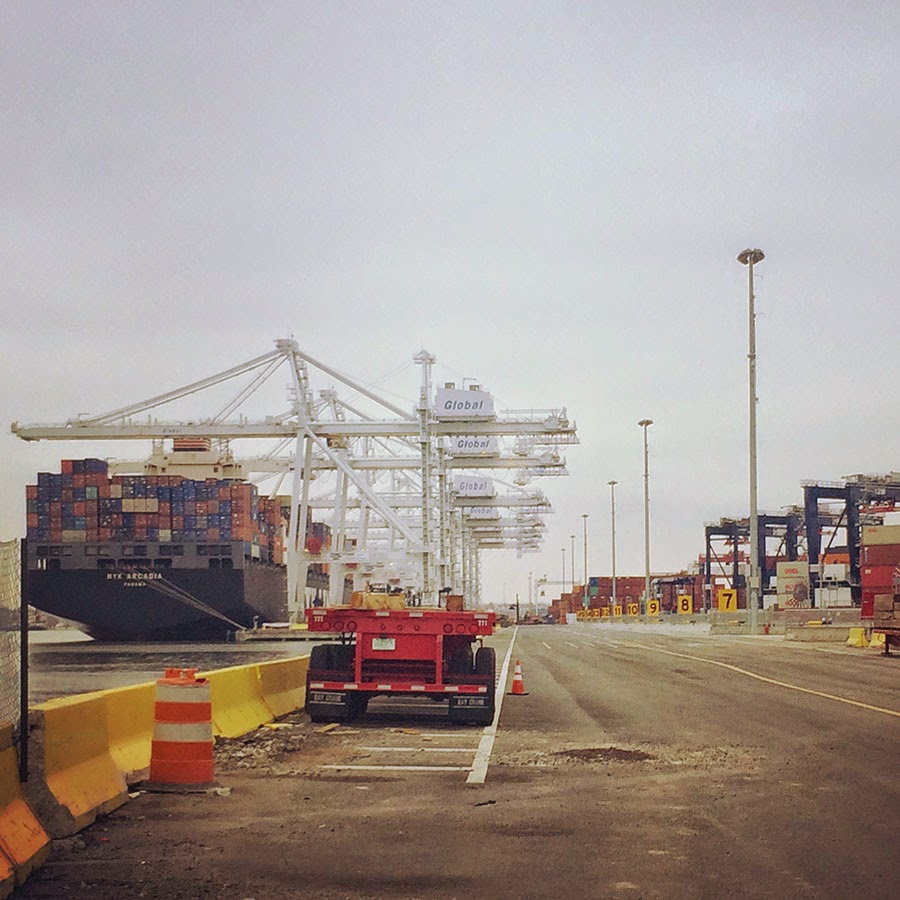
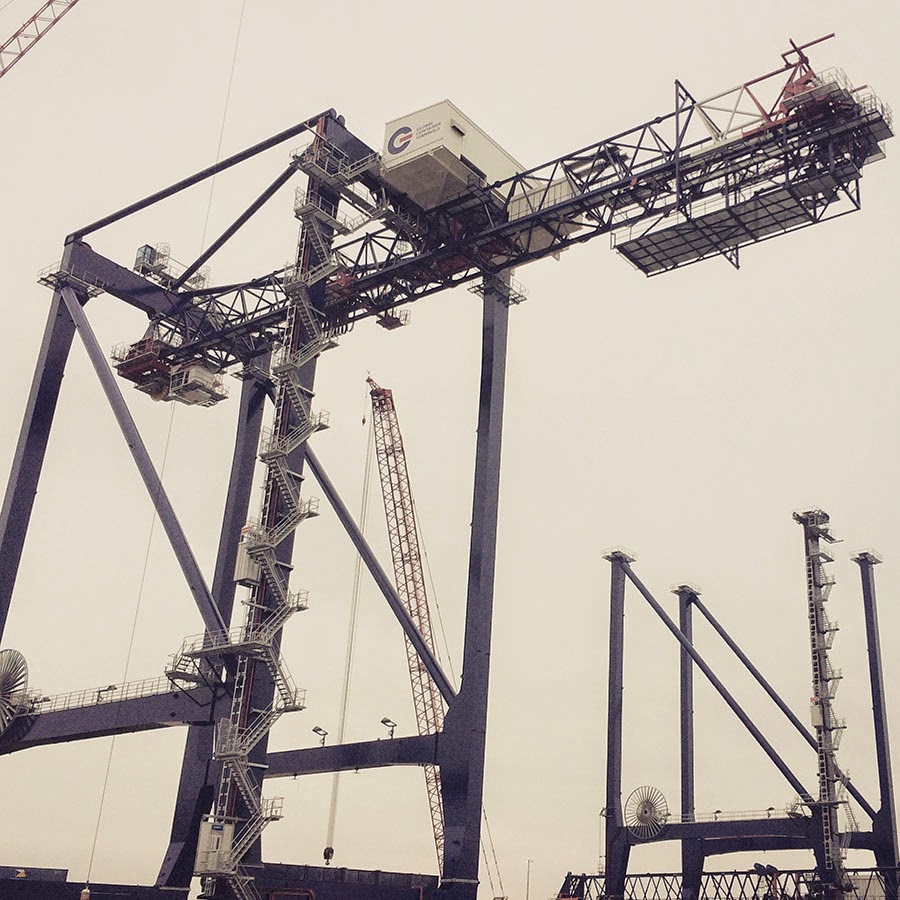
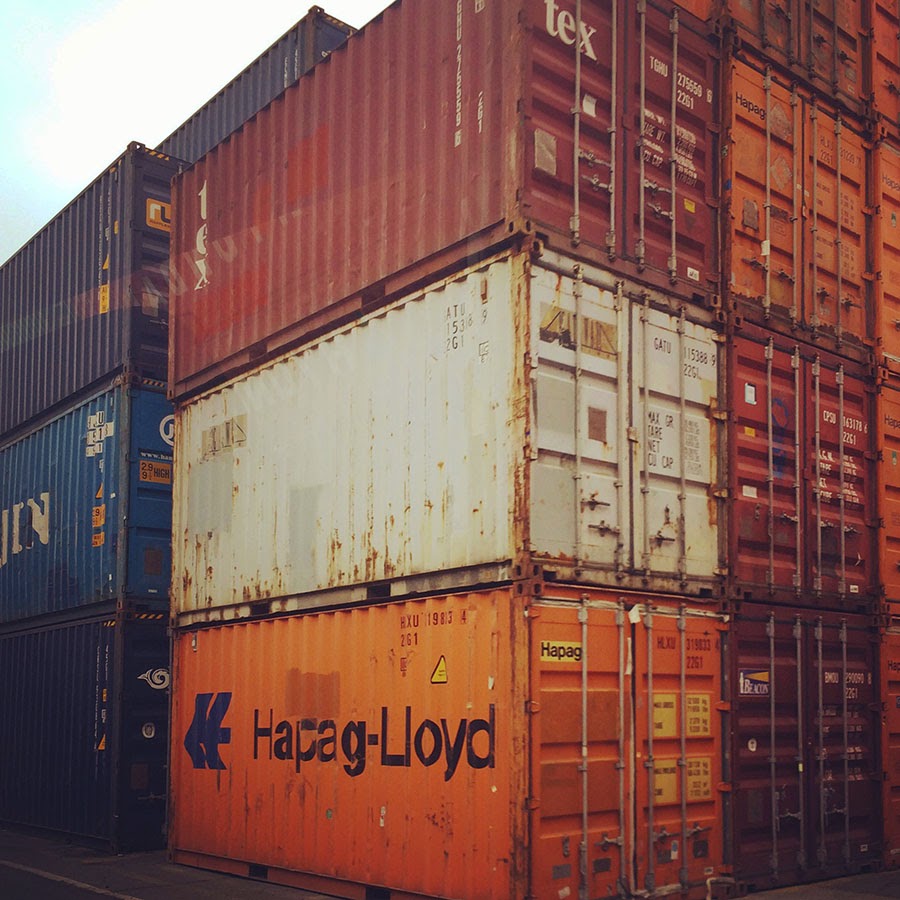
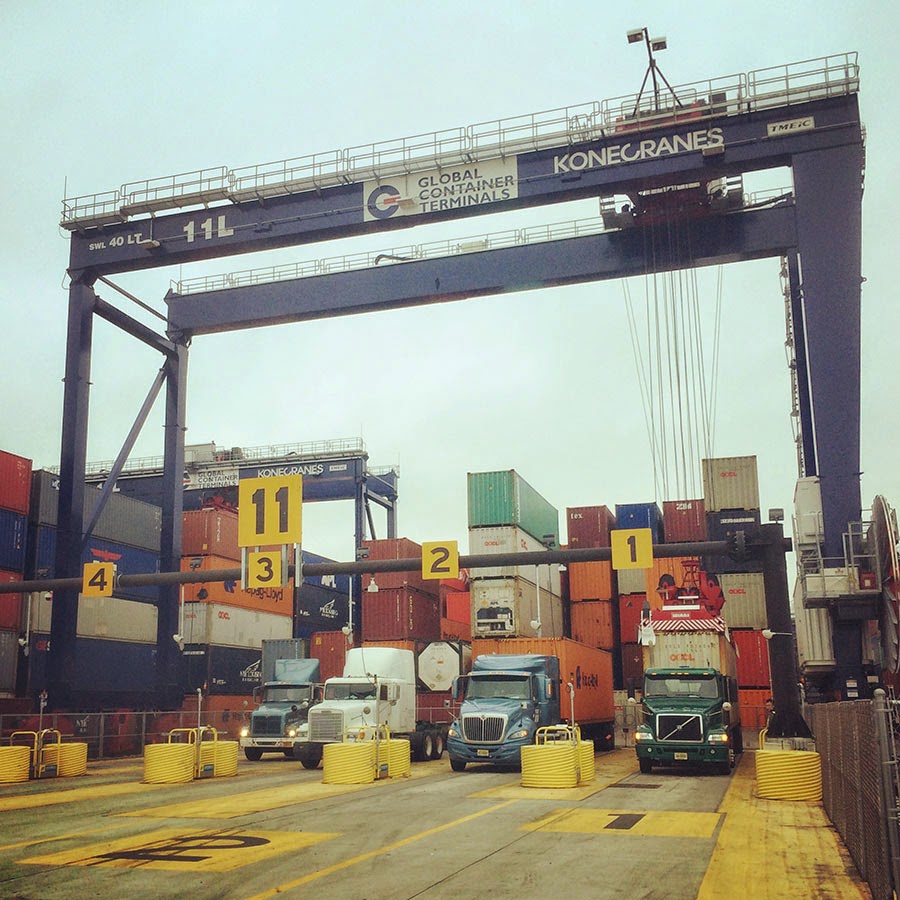
[Image: A view of the Global Containers Terminal in Bayonne; Instagram by BLDGBLOG].

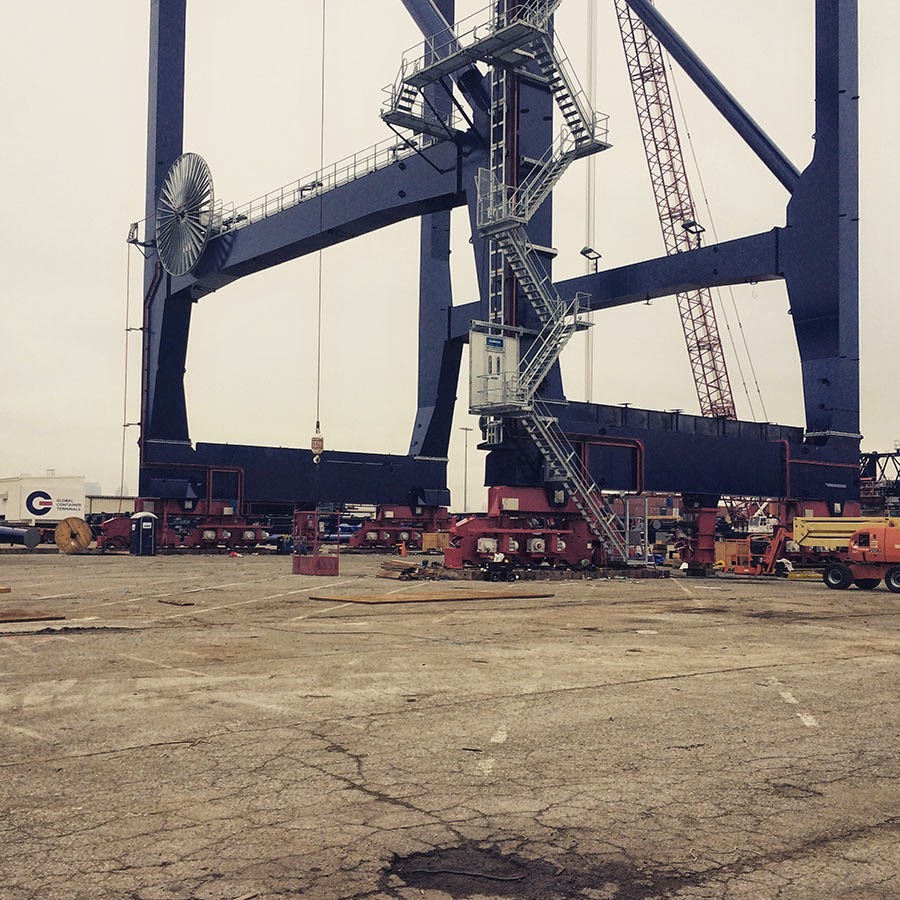
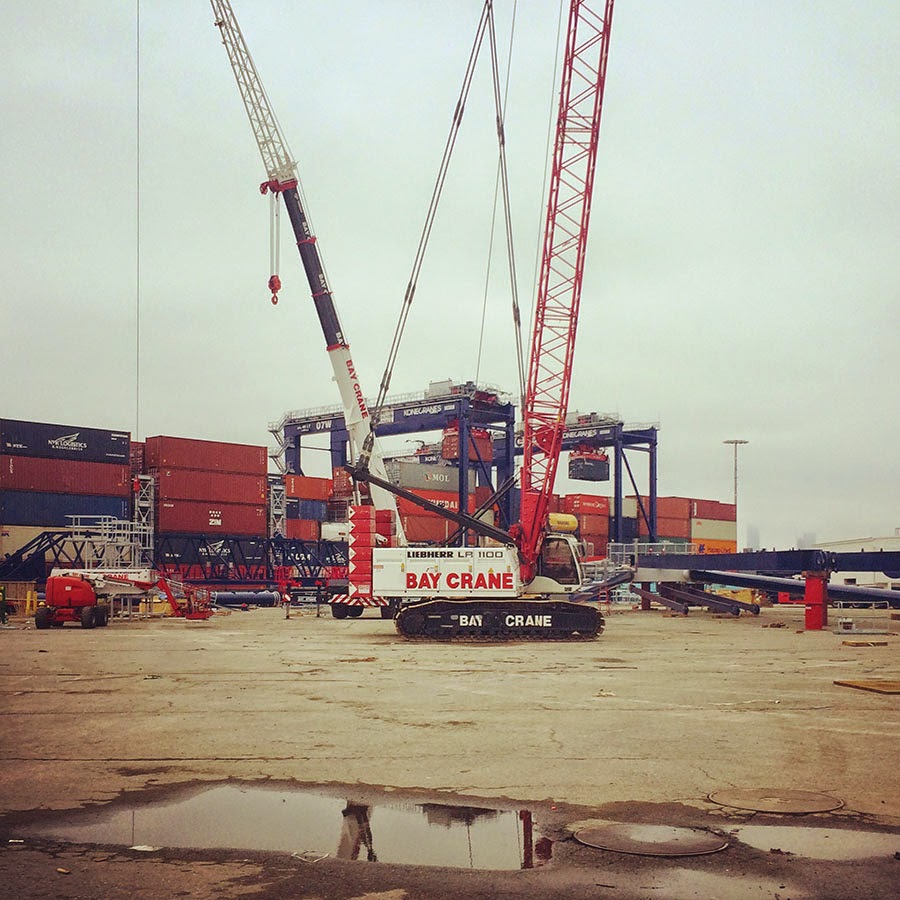
I just spent the bulk of the day out on a tour of the Global Containers Terminal in Bayonne, New Jersey, courtesy of the New York Infrastructure Observatory.

That’s a new branch of the institution previously known as the Bay Area Infrastructure Observatory, who hosted the MacroCity event out in San Francisco last May. They’re now leading occasional tours around NYC infrastructure (a link at the bottom of this post lets you join their mailing list).

[Image: A crane so large my iPhone basically couldn’t take a picture of it; Instagram by BLDGBLOG].

There were a little more than two dozen of us, a mix of grad students, writers, and people whose work in some way connected them to logistics, software, or product development—which, unsurprisingly, meant that everyone had only a few degrees of separation from the otherworldly automation on display there on the peninsula, this open-air theater of mobile cranes and mounted gantries whirring away in the precise loading and unloading of international container ships.

The clothes we were wearing, the cameras we were using to photograph the place, even the pens and paper many of us were using to take notes, all had probably entered the United States through this very terminal, a kind of return of the repressed as we brought those orphaned goods back to their place of disembarkation.

[Images: The bottom half of the same crane; Instagram by BLDGBLOG].

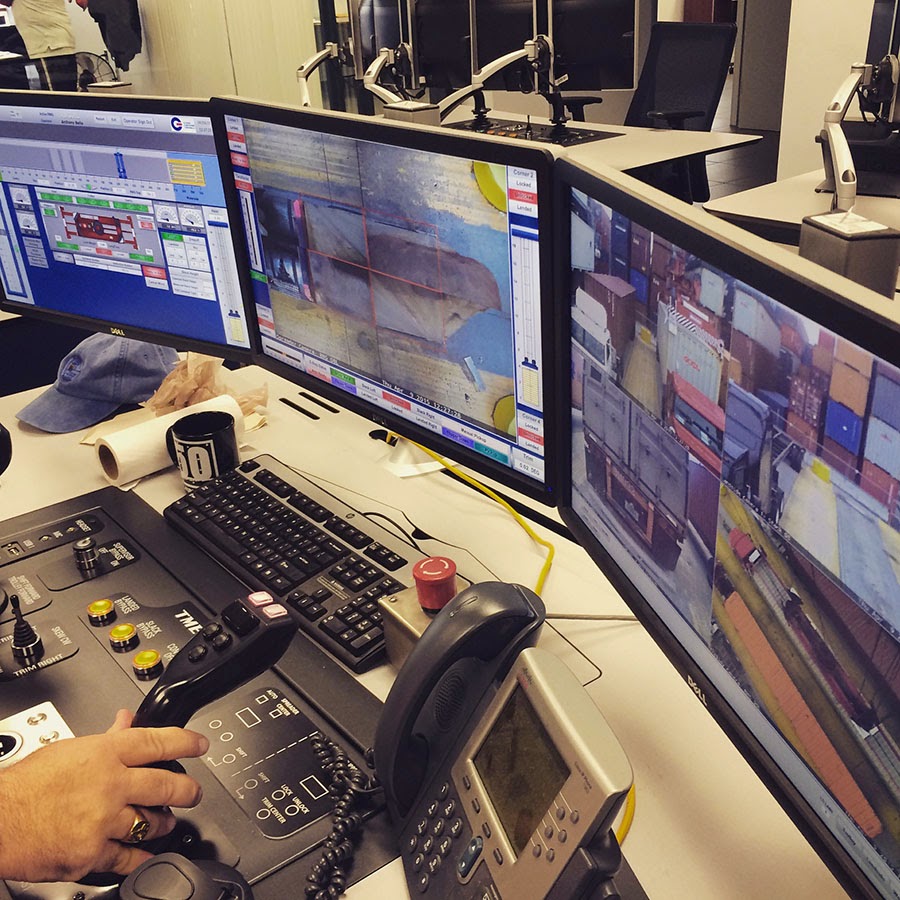
Along the way, we got to watch a room full of human controllers load, unload, and stack containers, with the interesting caveat that they—that is, humans—are only required when a crane comes within ten feet of an actual container. Beyond ten feet, automation sorts it out.

When the man I happened to be watching reached the critical point where his container effectively went on auto-pilot, not only did his monitor literally go blank, making it clear that he had seen enough and that the machines had now taken over, but he referred to this strong-armed virtual helper as “Auto Schwarzenegger.”

“Auto Schwarzenegger’s got it now,” he muttered, and the box then disappeared from the screen, making its invisible way to its proper location.

[Image: Waiting for the invisible hand of Auto Schwarzenegger; Instagram by BLDGBLOG].

Awesomely—in fact, almost unbelievably—when we entered the room, with this 90% automated landscape buzzing around us outside on hundreds of acres of mobile cargo in the wintry weather, they were listening to “Space Oddity” by David Bowie.

“Ground control to Major Tom…” the radio sang, as they toggled joysticks and waited for their monitors to light up with another container.

[Image: Out in the acreage; Instagram by BLDGBLOG].

The infinitely rearrangeable labyrinth of boxes outside was by no means easy to drive through, and we actually found ourselves temporarily walled in on the way out, just barely slipping between two containers that blocked off that part of the yard.

This was “Damage Land,” our guide from the port called it, referring to the place where all damaged containers came to be stored (and eventually sold).

[Image: One of thousands of stacked walls in the infinite labyrinth of the Global Containers Terminal; Instagram by BLDGBLOG].

One of the most consistently interesting aspects of the visit was learning what was and was not automated, including where human beings were required to stand during some of the processes.

For example, at one of several loading/unloading stops, the human driver of each truck was required to get out of the vehicle and stand on a pressure-sensitive pad in the ground. If nothing corresponding to the driver’s weight was felt by sensors on the pad, the otherwise fully automated machines toiling above would not snap into action.

This idea—that a human being standing on a pressure-sensitive pad could activate a sequence of semi-autonomous machines and processes in the landscape around them—surely has all sorts of weird implications for everything from future art or museum installations to something far darker, including the fully automated prison yards of tomorrow.

[Image: One of several semi-automated gate stations around the terminal; Instagram by BLDGBLOG].

This precise control of human circulation was also built into the landscape—or perhaps coded into the landscape—through the use of optical character recognition software (OCR) and radio-frequency ID chips. Tag-reading stations were located at various points throughout the yard, sending drivers either merrily on their exactly scripted way to a particular loading/unloading dock or sometimes actually barring that driver from entry. Indeed, bad behavior was punished, it was explained, by blocking a driver from the facility altogether for a certain amount of time, locking them out in a kind of reverse-quarantine.

Again, the implications here for other types of landscapes were both fascinating and somewhat ominous; but, more interestingly, as the trucks all dutifully lined-up to pass through the so-called “OCR building” on the far edge of the property, I was struck by how much it felt like watching a ceremonial gate at the outer edge of some partially sentient Forbidden City built specifically for machines.

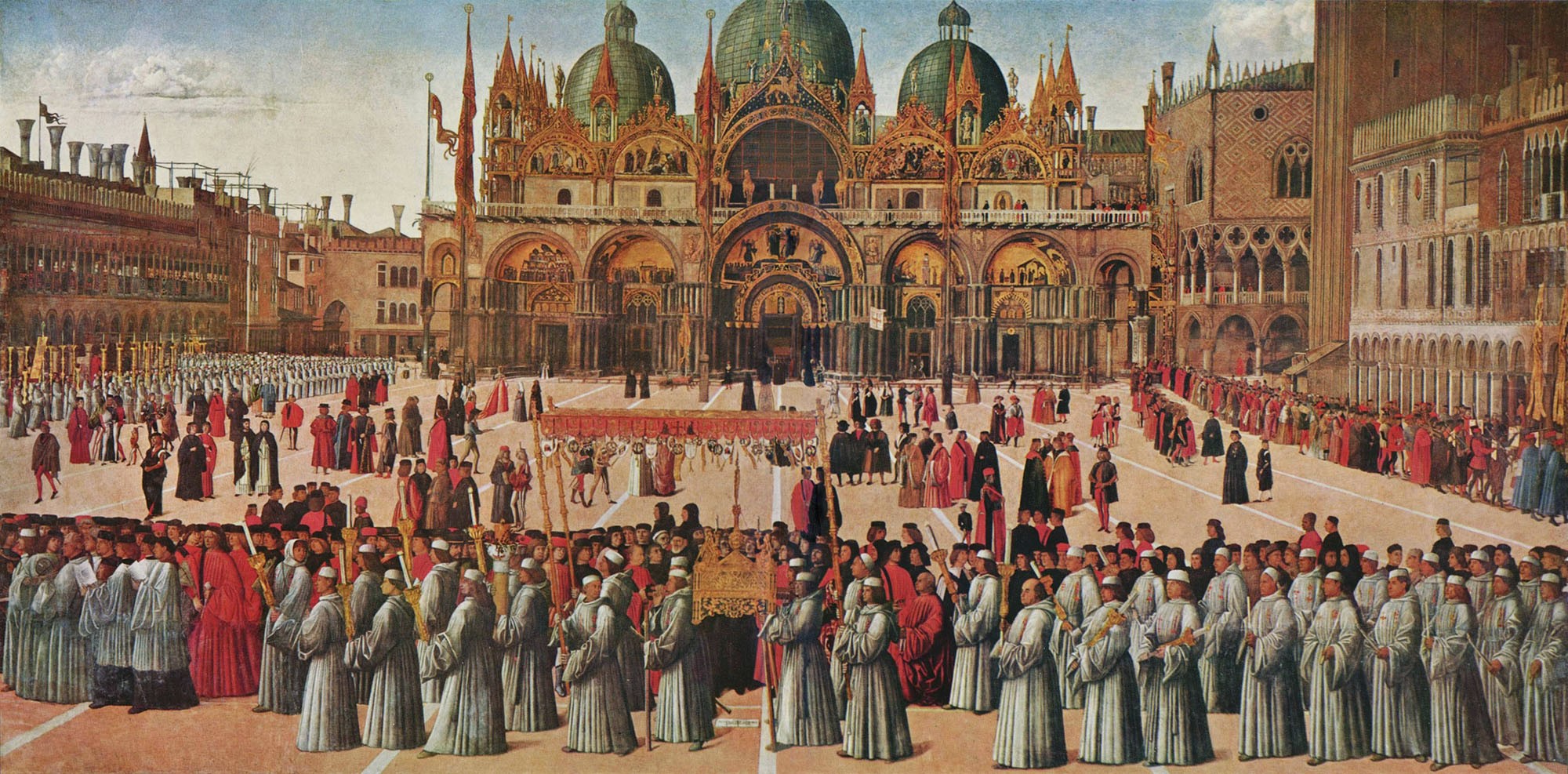
In other words, we often read about the ceremonial use of urban space in an art historical or urban planning context, whether that means Renaissance depictions of religious processions or it means the ritualized passage of courtiers through imperial capitals in the far east. However, the processional cities of tomorrow are being built right now, and they’re not for humans—they’re both run and populated by algorithmic traffic control systems and self-operating machine constellations, in a thoroughly secular kind of ritual space driven by automated protocols more than by democratic legislation.

These—ports and warehouses, not churches and squares—are the processional spaces of tomorrow.

[Image: Procession of the True Cross (1496) by Gentile Bellini, via Wikimedia].

It’s also worth noting that these spaces are trickling into our everyday landscape from the periphery—which is exactly where we are now most likely to find them, simply referred to or even dismissed as mere infrastructure. However, this overly simple word masks the often startlingly unfamiliar forms of spatial and temporal organization on display. This actually seems so much to be the case that infrastructural tourism (such as today’s trip to Bayonne) is now emerging as a way for people to demystify and understand this peripheral realm of inhuman sequences and machines.

In any case, as the day progressed we learned a tiny bit about the “Terminal Operating System”—the actual software that keeps the whole place humming—and it was then pointed out, rather astonishingly, that the actual owner of this facility is the Ontario Teachers’ Pension Plan, an almost Thomas Pynchonian level of financial weirdness that added a whole new level of narrative intricacy to the day.

If this piques your interest in the Infrastructure Observatory, consider following them on Twitter: @InfraObserve and @NYInfraObserve. And to join the NY branch’s mailing list, try this link, which should also let you read their past newsletters.

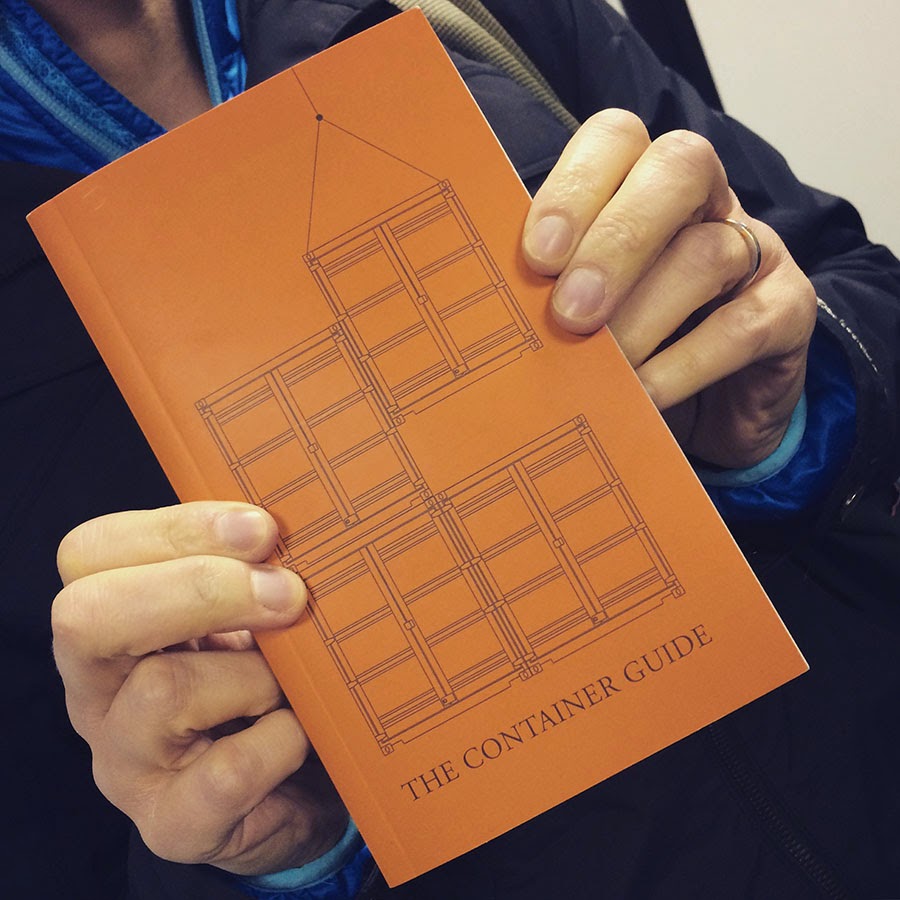
[Image: The Container Guide; Instagram by BLDGBLOG].

Finally, the Infrastructure Observatory’s first publication is also now out, and we got to see the very first copy. The Container Guide by Tim Hwang and Craig Cannon should be available for purchase soon through their website; check back there for details (and read a bit more about the guide over at Edible Geography).

(Thanks to Spencer Wright for the driving and details, and to the Global Containers Terminal Bayonne for their time and hospitality!)

Grimm City

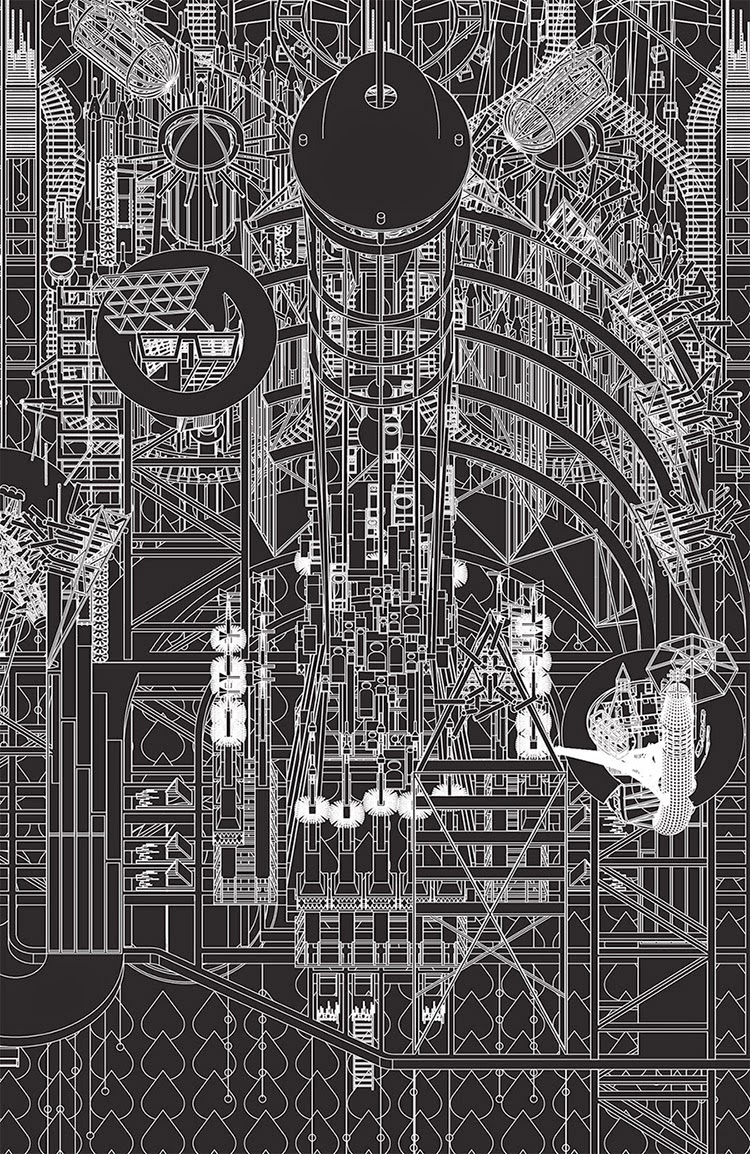
[Image: Grimm City University from Grimm City by Flea Folly Architects].

Later this summer, London’s Flea Folly Architects—Pascal Bronner & Thomas Hillier—will be running a workshop in what they broadly call “narrative architecture” at the Tate Modern.

“What would a town inhabited by Salvador Dali, Pablo Picasso, Alexander Calder and Man Ray look like?” they ask. “Taking inspiration from works in the Tate collection, in particular the speculative etchings by architects Alexander Brodsky and Ilya Utkin and paintings by the Surrealists, our objective is to design and build a fictional miniature village made entirely from paper.”

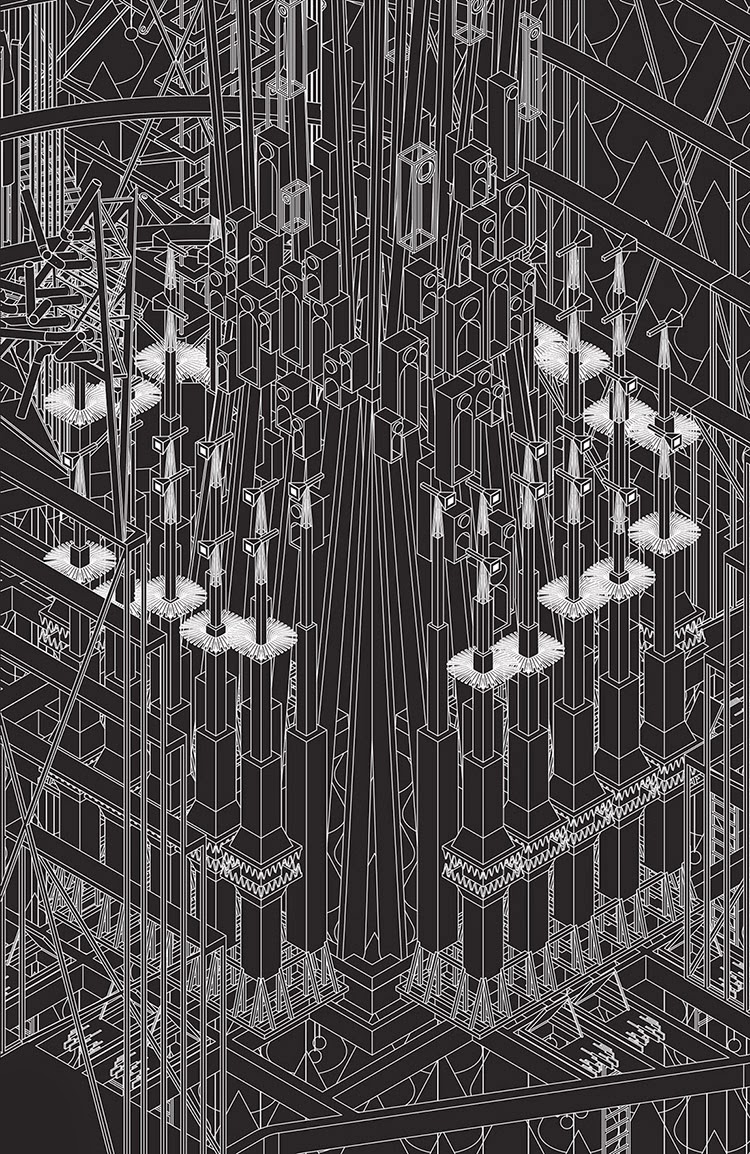
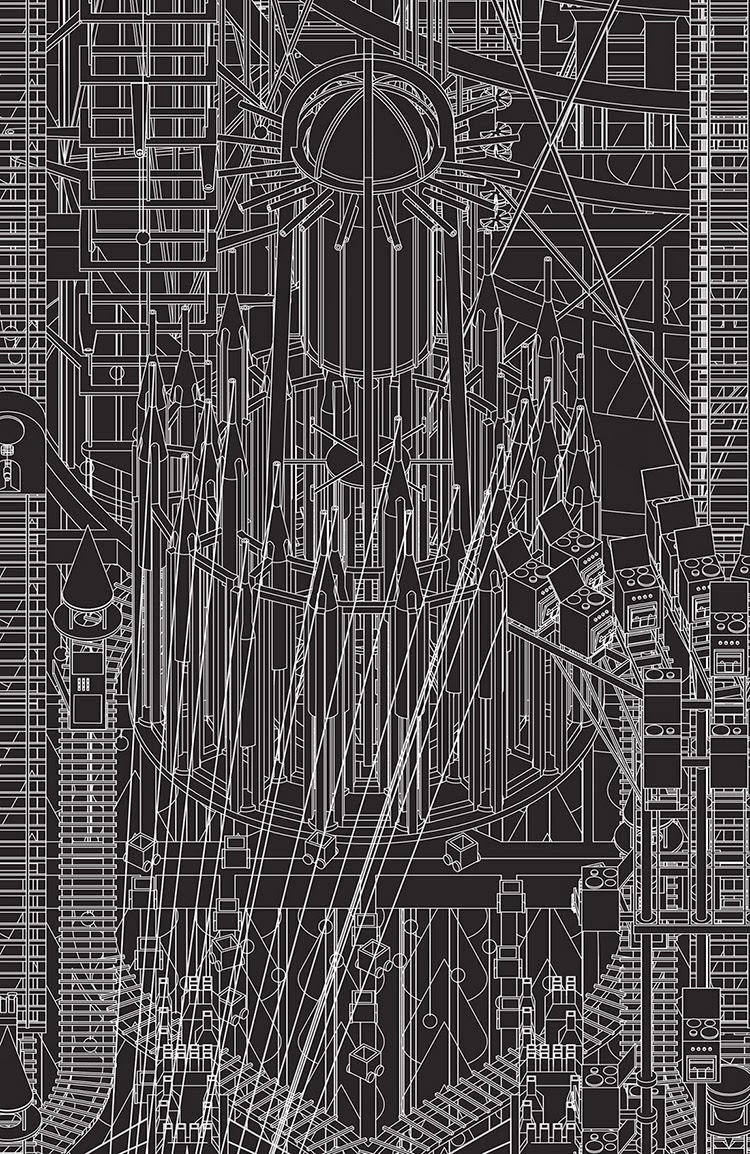
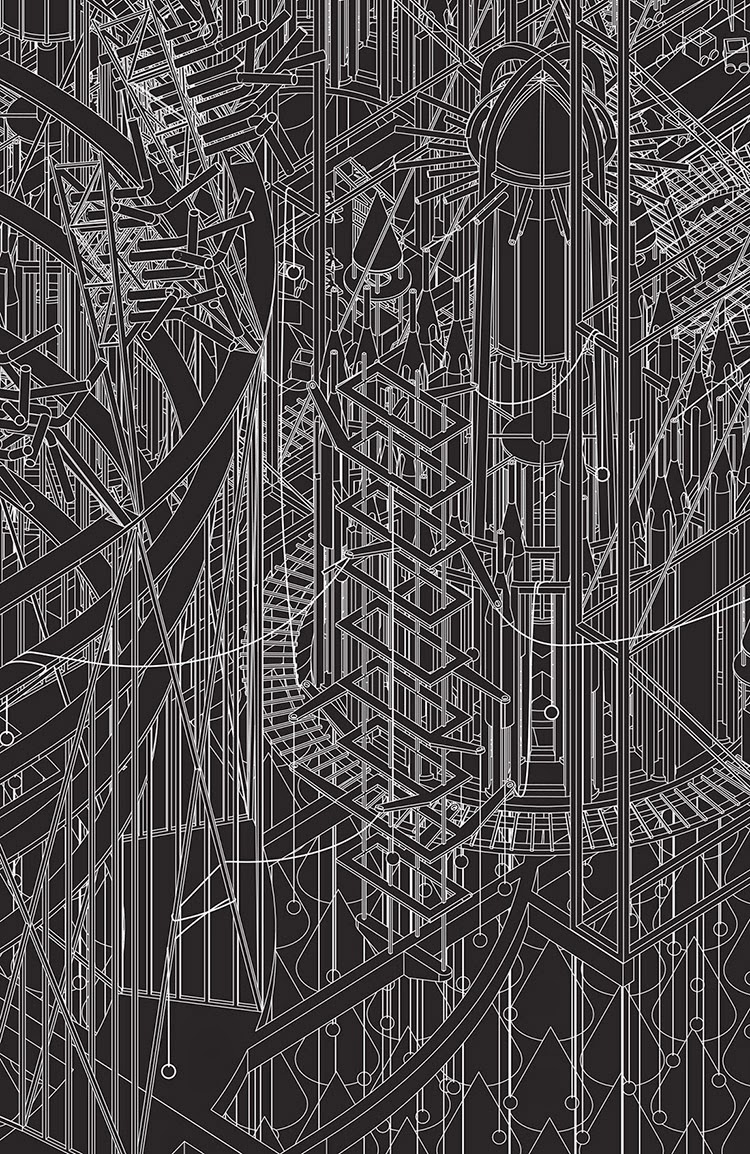
Their own project, Grimm City, is perhaps an example of what might result.

[Image: The Barometer from Grimm City by Flea Folly Architects].

As architect CJ Lim describes it in his introduction to the project in a gorgeously produced, limited print-run hardcover catalog, as “Grimm City is a future state derived from architectural extrapolations of the fairytales by the Brothers Grimm.”

That is, it is an elaborate narrative disguised as a city—a story given urban form.

[Image: The Bremen Town-Musicians from Grimm City by Flea Folly Architects].

Bronner and Hillier explain that the “blueprint” for their city was “conceived in ink exactly 200 years ago,” and “was shaped by 86 magnificent tales collected by two of the most distinguished storytellers of their time.”

They are referring, of course, to the Brothers Grimm.

[Images: Two views of the Church and the neighboring Destruction Structure from Grimm City by Flea Folly Architects].

Briefly, in what now feels like another lifetime, when I was backpacking through Germany after graduating from college, I made a beeline to the small city of Marburg after reading that it was a university town overlooked by an 11th-century fort—and that it was also once home to the Brothers Grimm.

I showed up by train and spent a few days there, mostly reading Grimm stories, feeding ducks, and walking around the roads that spiraled up to the castle; and I later learned, with equal interest, that one of the weird coincidences of history would make Marburg the same city where a strain of hemorrhagic fever would be isolated.

The disease, which is now rather straight-forwardly called Marburg, seems a fittingly strange continuation of the stories of the Brothers Grimm, in terms of the dark and often fatal transformations humans can undergo.

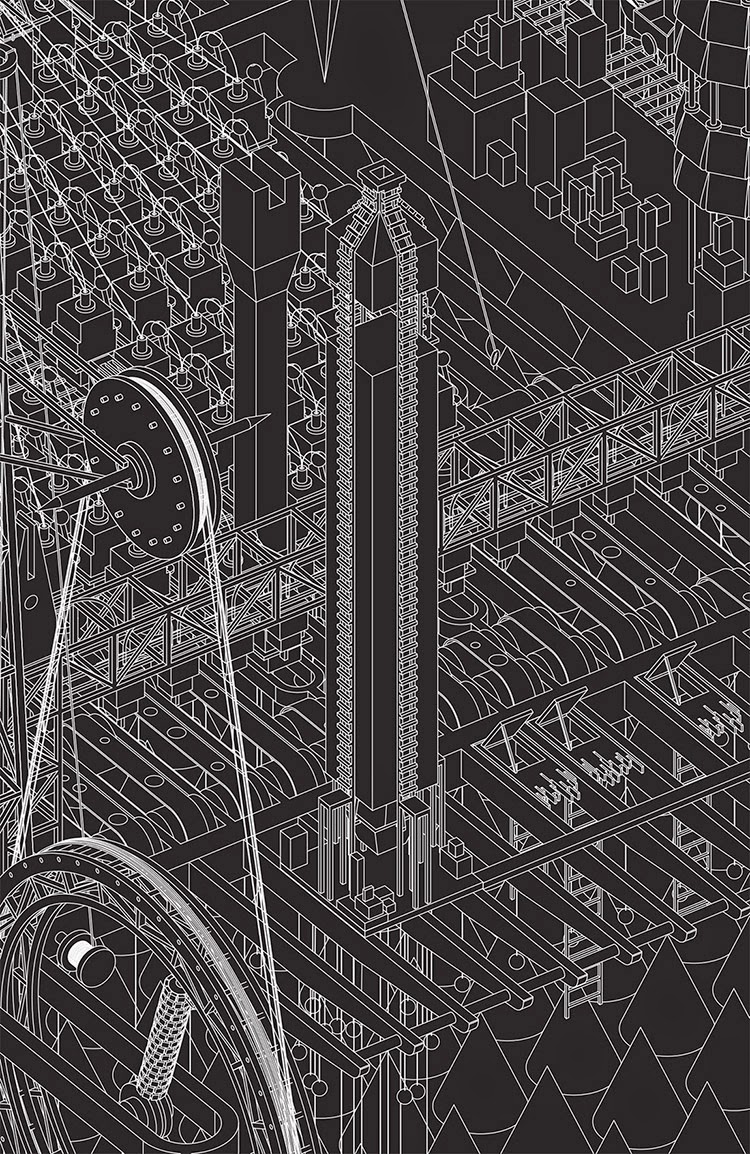
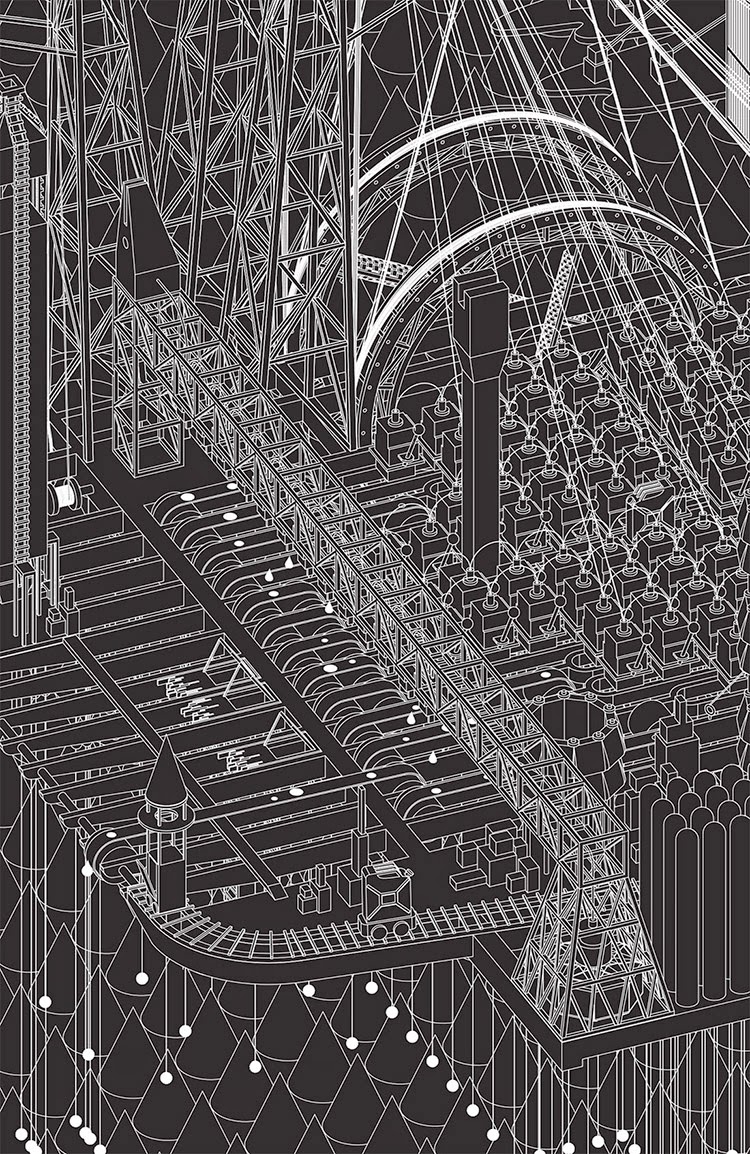
In any case, Grimm City is an architectural translation of their various stories, plots, allegories, and characters, and it took on a life of its own. “With enormous spinning wheels, tower-like limbs and turrets for claws, it began to resemble a machine that had been unjustly woken from its deep slumber,” they write.

[Image: The Timber Factory from Grimm City by Flea Folly Architects].

At times visually reminiscent of Aldo Rossi or even John Hejduk, the black diagrams are unexpectedly carnivalesque, monochromatic yet fizzing with lively detail.

There are structures such as The Ink Factory, a Silver Forest (made entirely of money-producing slot machines, eg. a forest where silver grows), an economic Barometer spinning over the city, and a school of thieves and burglary.

[Image: The Ink Factory from Grimm City by Flea Folly Architects].

There are also banks, churches, and a “windowless monolith” filled with forensic evidence of the city’s crimes.

Then, tacked way at the top of massive stairways so inclined they look like ladders, there are Confession Booths where the city’s sins are meant to be narrated and explained.

[Image: The Confession Booths from Grimm City by Flea Folly Architects].

Your exposure and isolation in ascending to the Booths is part of the process: a confessional infrastructure that compels one toward self-incrimination.

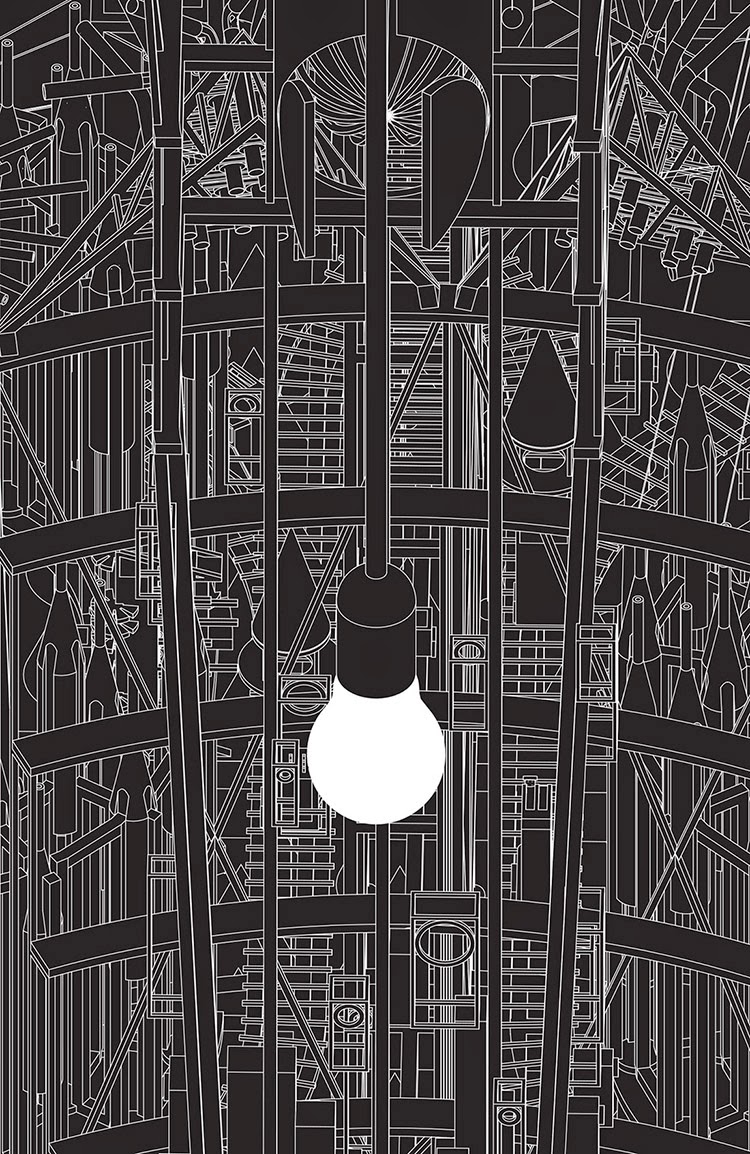
Elsewhere, there’s The Morning Star, a kind of heliogenic megabulb that hangs over the city, casting shadows and making time, burning at the center of an urban calendar that guides the lives of those living in the streets below.

[Image: The Morning Star from Grimm City by Flea Folly Architects].

And, finally, there is a huge plateau known as The Golden Compound where a vast sprawl—of what appear to be batteries—promises a “commune for the living-dead,” a dormitory those who “cheat death and remain everlasting” in this fairy tale metropolis.

“No one really knows if those inside” of these endless, battery-like structures, “are dead or alive,” we read, “and no one dares to find out.” They could be described as electrical mausoleums where sleeping beauties lie, equally alive and dead.

[Image: The Parliament from Grimm City by Flea Folly Architects].

There are many, many further images, of course, as well as an intricate physical model that accompanied them; the whole thing was displayed at the London Design Museum back in October-November 2013 and, with any luck, the images and model both will someday show up in a gallery near you.

It Came From Below

Formless and ancient things from the depths of our planet move beneath Los Angeles, unexpectedly setting fire to sidewalks and burning whole businesses to the ground. Welcome to urban life atop a still-active oil field.

This post was originally published on The Daily Beast.

Sliding around beneath the surface of Los Angeles is something dark, primordial, and without clear form. It seeps up into the city from below through even the smallest cracks and drains. Infernal, it can cause fires and explosions; toxic, it can debilitate, poison, and kill.

Near downtown Los Angeles, at 14th Place and Hill Street, a small extraction firm called the St. James Oil Corporation runs an active oil well. In 2006, the firm presided over a routine steam-injection procedure known as “well stimulation.” The purpose was simple: a careful and sustained application of steam would heat up, liquefy, and thus make available for easier harvesting some of the thick petroleum deposits, or heavy oil, beneath the neighborhood.

But things didn’t quite go as planned. As explained by the Center for Land Use Interpretation—a local non-profit group dedicated to documenting and analyzing land usage throughout the United States—“the subterranean pressure forced oily ooze and smells out of the ground,” causing a nauseating “goo” to bubble over “into storm drains, streets, and basements” as far as two blocks away.

The sudden appearance of this black tide beneath the neighborhood even destabilized the nearby road surface, leading to its emergency closure, and 130 people had to be evacuated. It took weeks to pump these toxic petroleum byproducts out of the basements and to resurface the street; the firm itself was later sued by the city.

While this was an industrial accident, hydrocarbons are, in fact, almost constantly breaking through the surface of Los Angeles, both in liquid and gaseous form. These are commonly known as seeps, and the most famous example is also an international tourist attraction: the La Brea Tar Pits, with its family-friendly museum on Wilshire Boulevard.

The “tar” here is actually liquid asphalt or pitch, and it is one of many reasons why humans settled the region in the first place. Useful both for waterproofing and for its flammability, this sticky substance has been exploited by humans in the region for literally thousands of years—and it has also given L.A. some of its most impressive paleontological finds.

[Image: Tar pushes up through cracks in the sidewalk on Wilshire Boulevard, near the La Brea Tar Pits; photo by Geoff Manaugh].

In other words, precisely because they are so dangerous, the tar pits are a veritable archive of extinct species; these include mastodons, saber-toothed tigers, and dire wolves, examples of which have been found fatally mired in the black mess seeping up from the deep. Groups of these now long-dead creatures once wandered across an otherworldly landscape of earthquakes and extinct volcanoes, an active terrain pockmarked with eerie bubbling cauldrons of flammable liquid asphalt.

What’s so interesting about contemporary life in Southern California is that this surreal, prehistoric landscape never really went anywhere: it’s simply been relegated to the background, invisibly buried beneath strip malls, car dealerships, and sushi restaurants. Every natural tar seep and artificial oil well here can be seen as an encounter with this older, stranger world trying to break back through into our present experience.

What humans choose to do with this primordial stuff leaking through the cracks can often be almost comical. Architect Ben Loescher, who has given tours of the region’s oil infrastructure for the Center for Land Use Interpretation, points out that many buildings near Lafayette Park must contend with a constant upwelling of asphalt. He sent me a photograph showing a line of orange utility buckets arranged as an ingenious but absurd stopgap measure against the endless and unstoppable goo.

[Image: A makeshift system for capturing the near-constant tar and liquid asphalt leaking up from below a building near Lafayette Park; photo by Ben Loescher].

Nearby, Loescher added, parking lots are a great place to see the onslaught. Many are constantly but slowly flooding with tar and asphalt, to the point that one lot—run by a karaoke club—is struck so badly that the tar is actually visible on Google Maps. “That parking lot is riddled with seeps, as well. When it gets hot, the parking lot sort of re-asphalts itself,” Loescher explains, “and they have to put down tarps on top of it so the cars don’t get stuck.” A much larger gravel lot across the street also exhibits multiple sites of seepage, as if pixelating from below with black matter.

Loescher emphasized that these sites are by no means limited to the La Brea Tar Pits. They can be found throughout the Los Angeles basin, beneath sidewalks, yard, parking lots, and even in people’s basements. To exaggerate for dramatic effect, it’s as if the premise of The Blob was at least partially inspired by a true story—one that has been taking place for hundreds of thousands of years throughout Southern California, and that involves, instead of a visitor from space, something ancient and pre-human forcing its way up from below.

[Image: Liquid asphalt leaking upward into the parking lot of a Los Angeles karaoke club; photo by Geoff Manaugh].

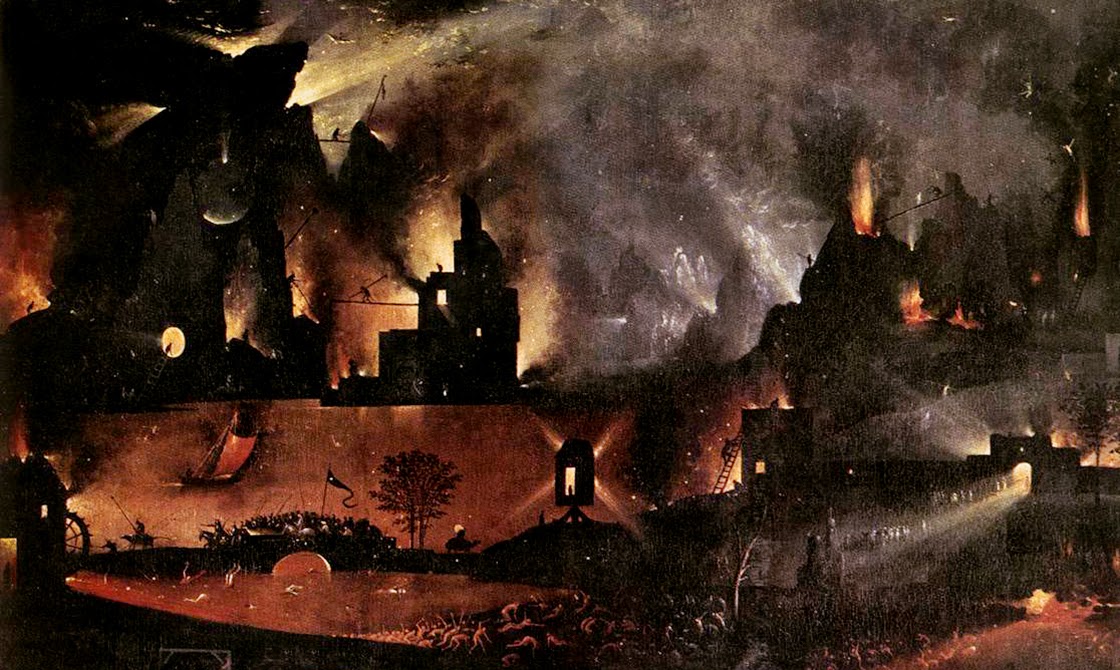
In a short book called Making Time: Essays on the Nature of Los Angeles, writer William L. Fox explores the remnant gas leaks and oil seeps of the city. At times, it reads as if he is describing the backdrop of a Hieronymus Bosch painting. Such is the strange and permanent apocalypse of 21st-century L.A.

Fox writes, for example, that “a methane vent opened up in the middle of Fairfax Street” back in 1985, and that it “burned uncontrollably for days before it could be put out.” At night, it was a world lit by flames. Astonishingly, he adds, in 1962 “a Hawthorne woman had a fire under her house—a house with no basement. She located the source of the problem when she went outside and touched a match to a crack in the sidewalk: A flame ran down to it.”

This city where sidewalks burn and sewers fill with oily ooze is a city built here almost specifically for that very reason; Los Angeles, in many ways, is a settlement founded on petroleum byproducts, and the oil industry for which the city was once known never actually left. It just got better at hiding itself.

It is already well known that there are oilrigs disguised in plain sight all over the city. The odd-looking tower behind Beverly Hills High School, for example, is actually a camouflaged oilrig; an active oil field runs beneath the classrooms and athletic fields. Even stranger, the enormous synagogue at Pico and Doheny is not a synagogue at all, but a movable drilling tower designed to look like a house of worship, as if bizarre ceremonies for conjuring a literal black mass out of the bowels of the Earth take place here, hidden from view. If you zoom in on Google Maps, you can just make out the jumbles of industrial machinery tucked away inside.

However, amidst all of this still-functional oil infrastructure, there are ruins: abandoned wells, capped drill sites, and derelict pumping stations that have effectively been erased from public awareness. These, too, play a role in the city’s subterranean fires and its poisonous breakouts of black ooze.

As Fox explains in Making Time, a labyrinth of aging pipelines and forgotten wells crisscrosses the city. He explains that the Salt Lake Oil Field—which underlies the La Brea Tar Pits, sprawls below an outdoor shopping center known as The Grove, and continues deep into the surrounding neighborhoods—once contained as many as 1,500 operative oil wells. However, most of these “have long since been abandoned and are virtually invisible,” he writes, and, alarmingly, “roughly 300 are unaccounted for.”

These “unaccounted for” oil wells are out of sight and out of mind—but it should not be assumed that they are safely or permanently capped. Indeed, the Salt Lake Oil Field actually “appears to be repressurizing with oil and water,” like an underground blister come back to life, Fox writes. This only raises the stakes of “a hazard already complicated by the lack of knowledge about the exact location of all the wells on the property.” Only 10 years ago, for example, “an orphaned well in Huntington Beach blew out in a gusher forty feet high, spraying oil and methane over one-half square mile, a hazardous-waste problem that will become more common.”
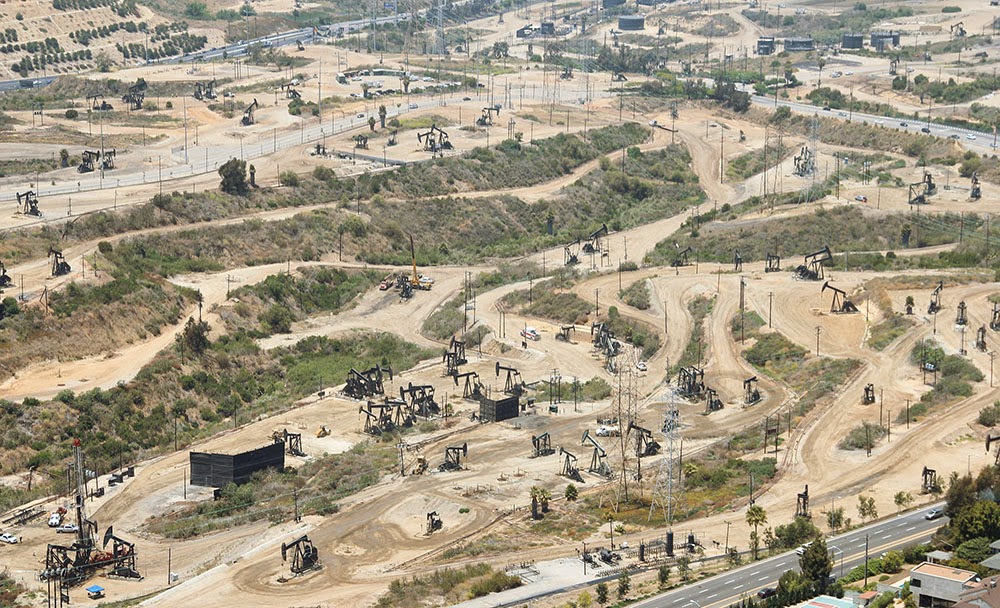
[Image: The Baldwin Hills old field; photo by Geoff Manaugh].

Due to its centrality, the Salt Lake field plays an outsized role in terms of strange petroleum events in the city. The Salt Lake was behind the multiday methane fire in the middle of Fairfax Avenue, for example, and behind arguably the most well known and certainly most destructive reminder of the city’s subterranean presence.

In 1989, in a busy strip mall at Fairfax and 3rd Street, a Ross Dress for Less began to fill with methane gas leaking up from a large pocket connected to the oil field below. Somehow, it had broken through the natural clay boundary that should have held it in place, and the methane thus easily seeped up into the storage rooms, closets, and retail galleries of the discount clothing giant.

Before long, the methane ignited and the entire store blew up.

[Image: Screen grab from YouTube].

This was by no means an insubstantial explosion—you should watch the aftermath on YouTube—as the entire façade of the building was blown to pieces, the roof collapsed, and dozens of people were disfigured by the detonation.

The resulting fires burned for hours. Small fires roared out of nearby sewer grates, and red and orange flames flickered out of even the tiniest cracks in the sidewalk, like some weird vision of Hell burning through the discount blouses and cheap drywall of this obliterated shopping center.
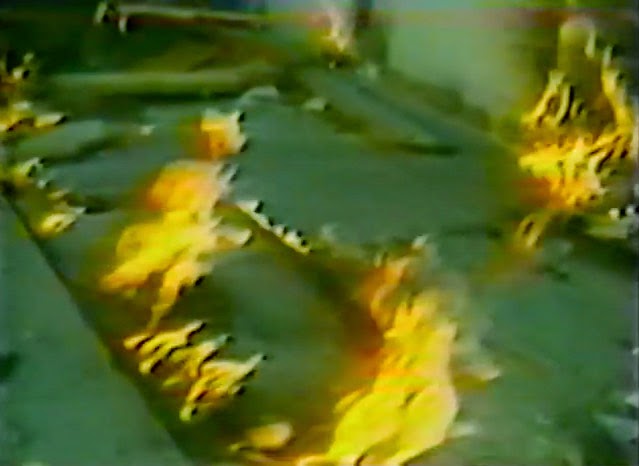
[Image: Flames burn through cracks in the sidewalk; screen grab from YouTube].

While reporting the tragedy, a local newscaster worryingly informed his viewers that it was simply “too early to tell where or when [the methane] might surface again”—in other words, that there could very well be further explosions. This paranoia—that there is something down there, some inhuman Leviathan stirring beneath the city, and that no one really knows when and where it will strike next—continues to this day.

Even at the time of the explosion, the possibility that city workers might inadvertently drill into a methane pocket beneath the neighborhood became one of the chief reasons for blocking the construction of a new subway line in the area. This same fear has recently resurfaced as the number one excuse for blocking a proposed subway through Beverly Hills.

Back in 2012, local parents released a video urging the city to stop the expansion of subterranean public transit through their neighborhood, concerned that it would cause Beverly Hills High School to explode. (The fact that stopping the subway would also keep certain economic undesirables out of their streets and shopping districts was just a fringe benefit.)

In any case, the narrative resonance of all this is impossible to deny. Formless and ancient things from the depths of our planet move beneath the city, unexpectedly setting fire to sidewalks and burning whole businesses to the ground. Taken out of context, this could be the plot of a new horror film—but it’s just urban life atop a still-active oil field.

As Matthew Coolidge, director of the Center for Land Use Interpretation, explained it to me, the city “is really just a giant scab of petroleum-fueled activities,” an impermanently sealed cap atop this buried monstrosity.

It is worth considering, then, next time you step over a patch of tar on the sidewalk, that the black gloom still bubbling up into people’s yards and basements, still re-asphalting empty gravel parking lots, is actually an encounter with something undeniably old and elementally powerful.

In this sense, Los Angeles is more than just a city; it is a kind of interface between a petrochemical lifestyle of cars and freeways and the dark force that literally fuels it, a subterranean presence that predates us all by millions of years and that continues to wander freely beneath L.A.’s tangled streets and buildings.

(Note: This piece was originally published on The Daily Beast. I have also written about the La Brea Tar Pits and William L. Fox’s book in Landscape Futures. Opening image: a close-up of Hell, from “The Garden of Earthly Delights” by Hieronymous Bosch, Museo del Prado, Madrid, Spain).

The Conqueror Worm

[Image: Photo by & courtesy of Trackrunners, used with permission].

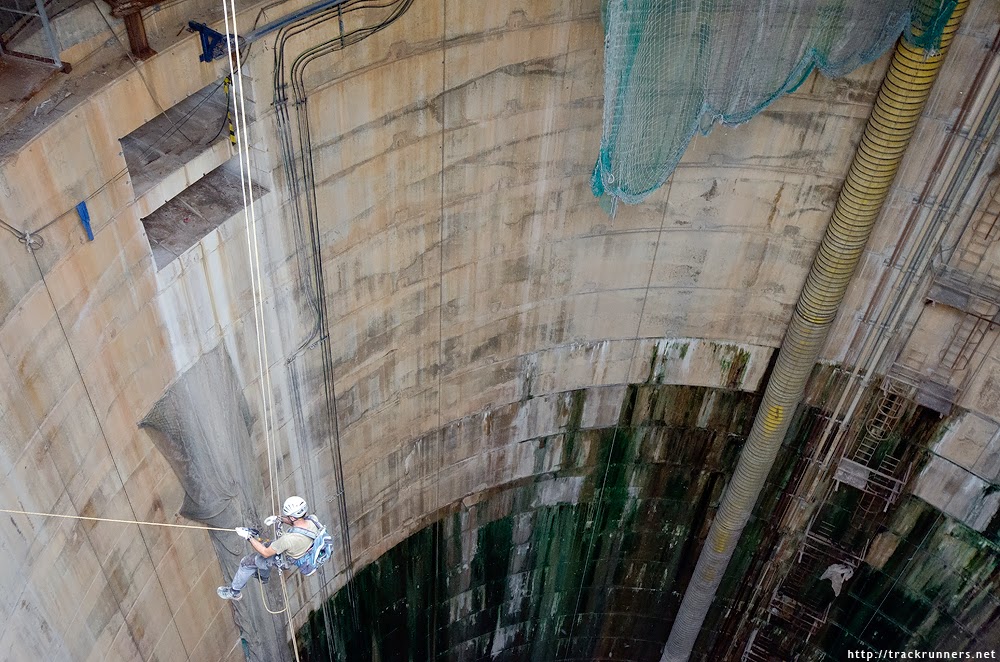
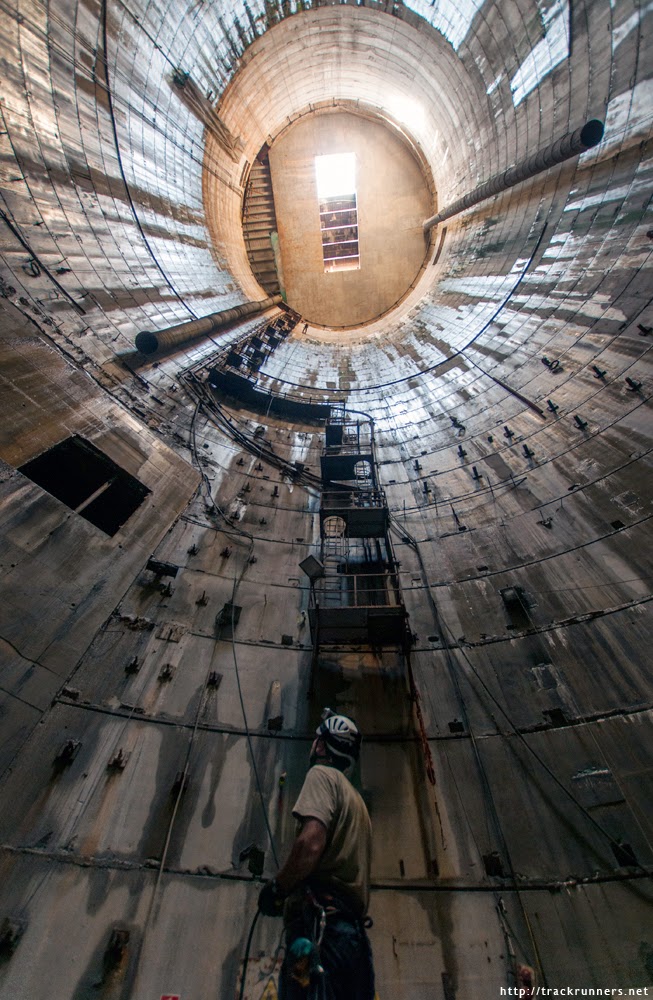
A group of friends, their faces rigorously hidden from public view, find a huge borehole leading down into some tunnels beneath the city.

Not content to just lie there, straining to see more than 260 feet into the deep and merely wondering what might be down there, they do what any enterprising team of explorers would do.

They don mountaineering gear and descend into the pit.

[Images: Photos by & courtesy of Trackrunners, used with permission].

It’s like scaling Mt. Everest in reverse—“descending black ropes,” in their words—swinging ever closer to the entrance to the tunnels, their headlamps and cameras at the ready.

Plus, some weird new myths have been circulating around town: that there’s a monolithic machine down there, something massive and temporarily abandoned beneath the city. It is “the toughest of all the machines. A dormant juggernaut that lies underground.”

They want to find it, to see if the rumors are true—and, who knows, to discover if the machine might still be operational. Imagine what you could do with a discarded tunneling machine seemingly forgotten in the deepest basement of the metropolis. Imagine if you could bring it back to life.

[Image: Photo by & courtesy of Trackrunners, used with permission].

Thus begins the next phase of their subterranean quest to find the so-called “Worm Maiden,” this conquering machine-animal lying dormant in its lair somewhere under the streets.

“Hitting our helmets and our backpacks on almost everything we found on the way,” they inched forward on foot.

[Image: Photo by & courtesy of Trackrunners, used with permission].

They soon drop their ropes and progress through a series of excavated tunnels and industrial caves, as if puzzling some new route into a pharaoh’s tomb—an Egyptology of urban infrastructure with its own secret chambers and traps.

And, incredibly, they actually do it: they actually find the machine, realizing that the rumors were both true and strangely inaccurate.

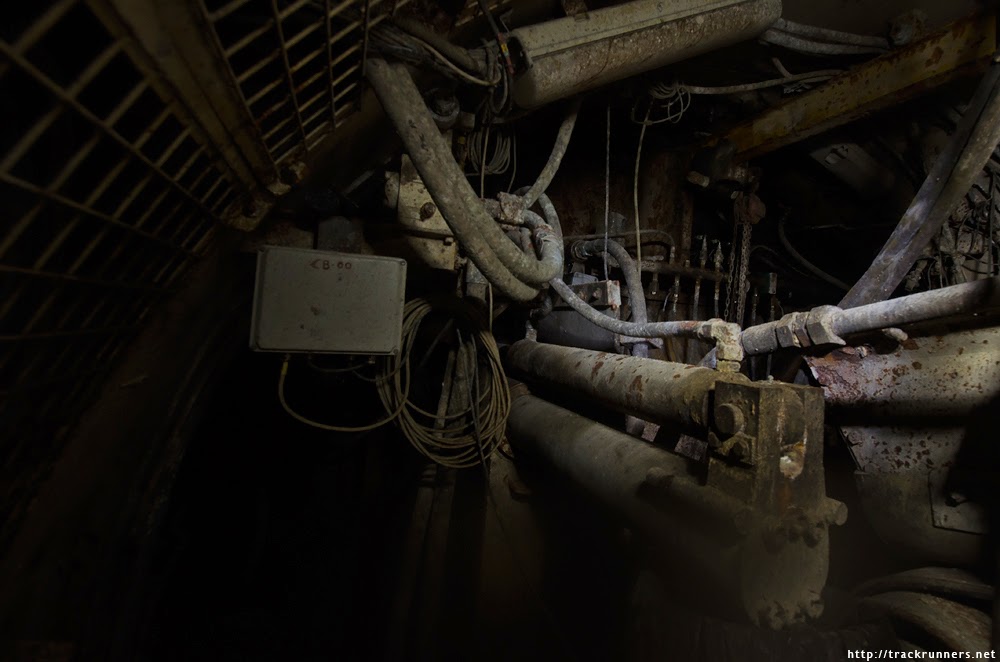
That is, the machine is even larger and more extraordinary than they’d been led to believe. It is a sprawling and tentacular presence that blocks the tunnel with the dark bulk of its old valves and pipework, like some ancient engine that wanted to hide itself in a cocoon of its own making.

[Image: Photo by & courtesy of Trackrunners, used with permission].

“Walking through the sleeping beauty, through her corridors amongst rust and spiderwebs,” we read, “she looked much bigger than we could have imagined. She didn’t seem to have an end. Eventually we reached a point where we couldn’t go any further, it was full of pipes and unknown mechanisms but the end was intuited.”

The machine was so complex, in other words, that they couldn’t find the other end of it, having to negotiate their way through all its internal doors and control panels.

[Image: Photo by & courtesy of Trackrunners, used with permission].

It could be the ultimate joyride—Grand Theft TBM—driving a stolen machine literally through the foundations of the city, carving your own maze through bedrock.

But a way forward was eventually found, and the Kubrickian monolith of this now-stationary drill head was revealed up ahead like some Mayan sculpture in the darkness. Abandoned for now and just lying there: a machine-ruin rusting away in the underground world it had made for itself. The conqueror worm.

[Image: Photo by & courtesy of Trackrunners, used with permission].

“It was much better than I had imagined,” we read. The text is like an archaeological report made possible by climbing gear and GoPros. “A twelve meter diameter of pure love just in front of us, was bestial. I couldn’t stop staring at HER. I could see the strain on her, the hard work she had done. The dirt in every part of the face. Pure beauty. All the space around her was filled by a foot of dirty water. A mixture of sand, dirt, water and oil. This mantle of fluids that covered everything was perfect, the vapors fogged my camera lens but the effect was delightfully dramatic. Go and use a filter to look like this. I can see the new Instagram filter now… TBM vapors effect!”

But that’s literally only half the journey. They’ve mountaineered into the planet, like reverse-Alpinists of the inferno—and they go so far as to discover an artificial lake beneath the city, a brackish reservoir that “shone under the light of our torches”—but now they have to get back out, which is not nearly as easy as it had seemed.

There are dozens of other photographs over at Trackrunners, and a much longer version of how everything happened that day; go check it out (and don’t miss their other stories, such as the disused stations beneath Barcelona).

(Thanks to Charles Bronson for the tip.)

The Moving Mountain, or Terrain as Spectacle

[Image: Courtesy of the Los Angeles Times Photographic Archive, Department of Special Collections, Charles E. Young Research Library, UCLA, via KCET].

Nathan Masters remains one of the more interesting chroniclers of life and landscape in Southern California, as evidenced by his “L.A. as Subject” blog for KCET. I could (and should) just link to all his posts, to be honest—lost hills! buried rivers! conflicting grids!—but last week’s installment, albeit short, was particularly interesting.

“For a few days in late November 1937,” Masters writes, “it was the Southland’s greatest attraction—a landslide in slow motion, 1.5 million tons of an Elysian Park hillside creeping toward the Los Angeles River bed.”

Sensational news reports, printed in papers and broadcast on radio nationwide, described it as a “moving mountain,” and tourists came from afar to witness the geologic curiosity. One Oklahoma City police officer took a leave of absence to watch the slide. Two boys hopped freight trains from New York to see it. Some 10,000 sightseers came by the hour. Spectators pressed against police barricades along Riverside Drive, and enterprising vendors worked the throng like a baseball game, hawking peanuts, popcorn, and soda. Some even sold field glasses.

Even local astronomers showed up, telescopes in tow, in order to study the mobile mass, this blob of geology suddenly making a move into town.

After a catastrophic lurching of the slow-motion mountain, the terrain appeared to come to a standstill. “The next day, an estimated crowd of 500,000 converged on the site, munching on popcorn and hoping the mountain would move again.”

This pent-up dramaturgy of the landscape—the possibility that its newfound agency would continue—crawling, oozing, rolling, forcing its way into public consciousness—remains strong today, even if subsumed into other contexts.

In other words, I’d suggest that many Angelenos are still, in a sense, “munching on popcorn and hoping the [landscape] would move again,” and that this is the dark fascination of seismic instability, of what it means to live in an earthquake zone: that the land itself is active, motivated from within by a kind of a slow-motion sentience, a mineral energy that is as much an invigorating spectacle as it is an existential threat.

Read the rest of Masters’s post over at “L.A. as Subject.”

Under London

[Image: Bond Street platform tunnels, courtesy Crossrail].

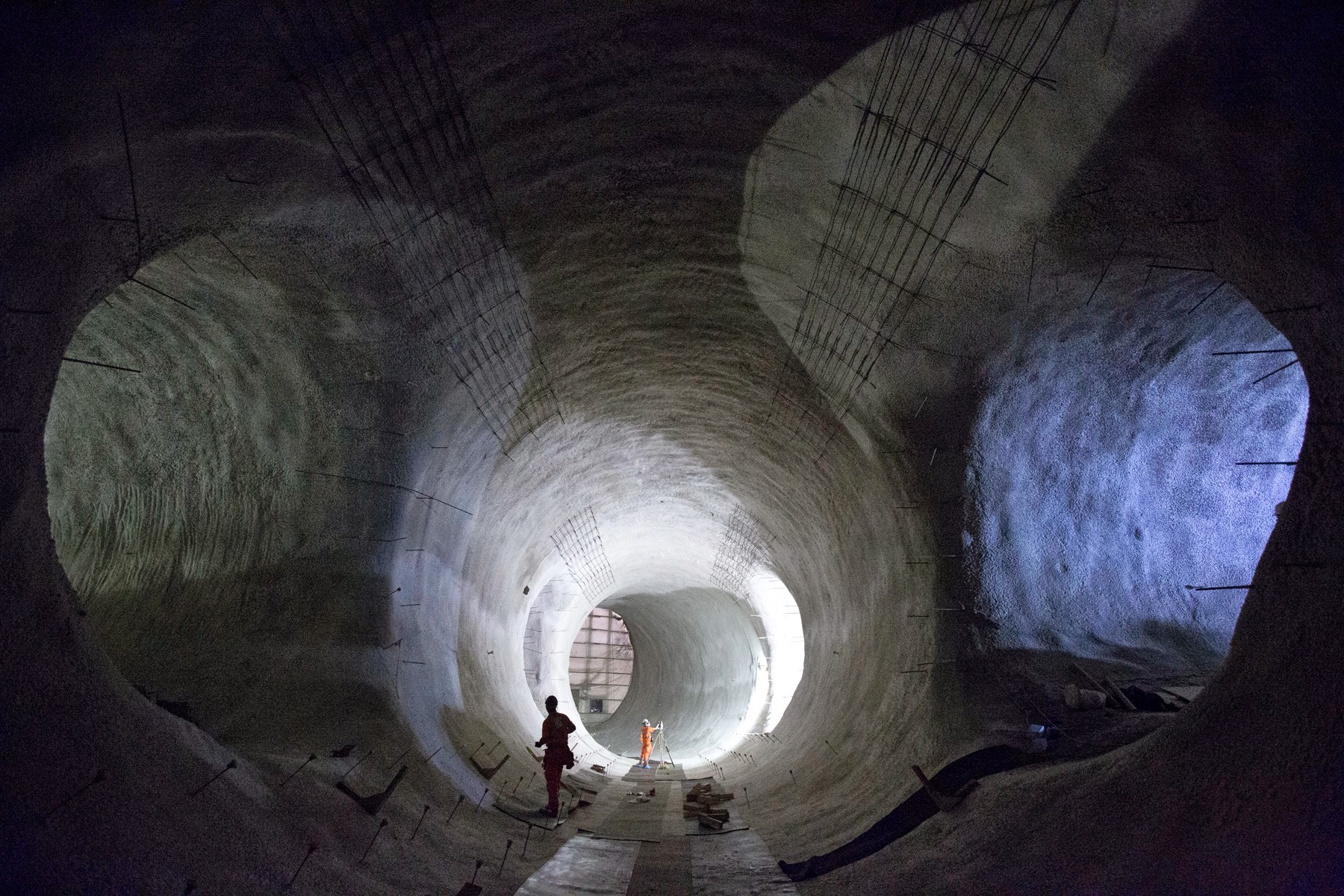
Crossrail—the massive, 73-mile rail project currently underway in London, including twin-bore 13-mile tunnels—has released a handful of new photos showing the underground works.

[Images: Bond Street platform tunnels, courtesy Crossrail].
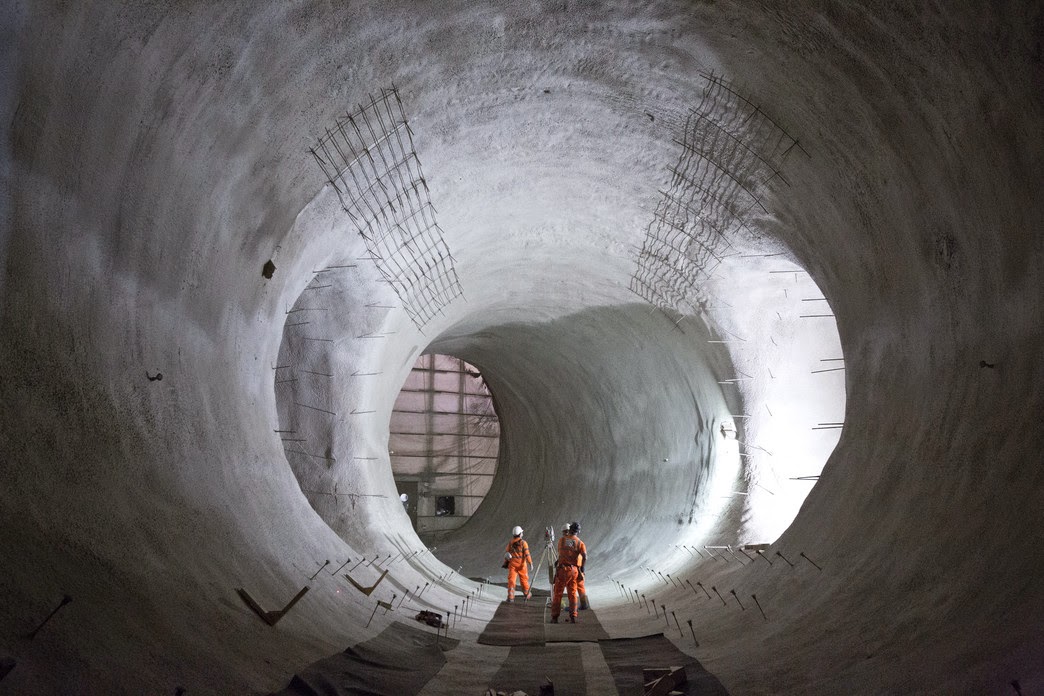
I’m a sucker for images of the human form stranded amidst the shadows of massive, dimensionally abstract spatial environments, so I thought I’d post these purely as eye candy.

[Image: Bond Street platform tunnels, courtesy Crossrail].
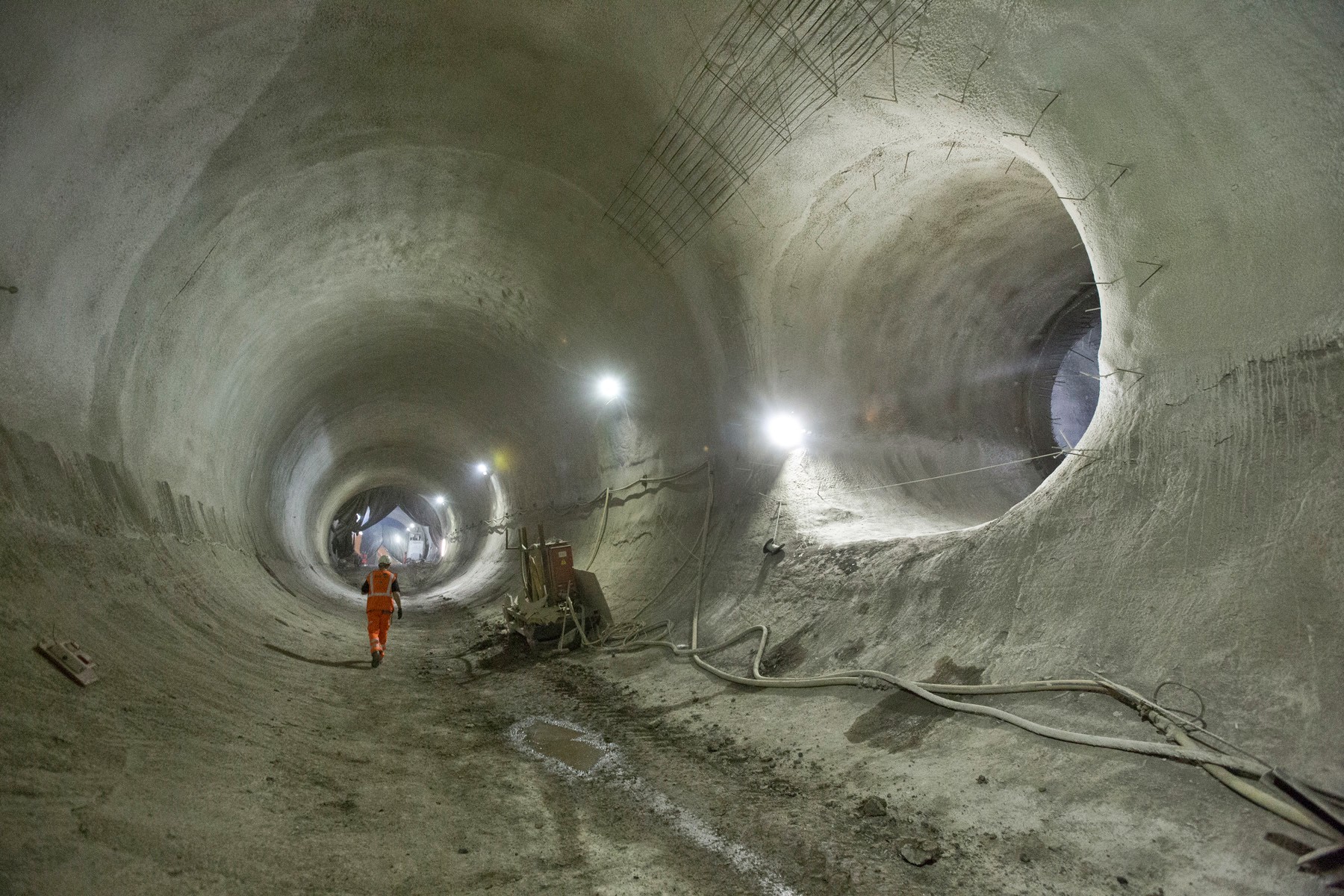
If you want a bit more info on Crossrail itself, consider reading “London Laöcoon” or the second half of “British Countryside Generator,” both earlier on BLDGBLOG, or simply clicking around on the Crossrail website, including a few more photographs.

(Spotted via @subbrit and Ian Visits).