Bering Bridge

If you could design a bridge across the Bering Strait, connecting the U.S. to Russia, what would it look like? Come up with something good and you could win as much as $80,000 ($20,000, if you’re a student).
From the competition website:

This project is a dream project attempting to connect two continents. In a wide sense, it includes building a tunnel or a bridge at both ends of the strait, extending [the] existing railways of the United States and Russia, and laying a world highway around the coasts of the world, which require a massive amount of construction.

Your only two requirements are to design “a peace park with a bridging structure using the two islands, Big Diomede and Little Diomede at the Bering Strait,” and a “proposal of how to connect two continents.”
Of course, Russian engineers have already been considering digging a tunnel between the two continents, and the Discovery Channel has chimed in about how a bridge might actually be built across that “iceberg-swirled ocean near the Arctic Circle.”
But neither of those plans came with a total of $200,000 in prize money…
There’s a confusing clock ticking away on the competition website, but you appear to have until March 24, 2009, to register.

Cable City and the Hanging Hotel

[Image: The Hanging Hotel by Takis Zenetos; think of it as the International Style meets the Potala Palace].
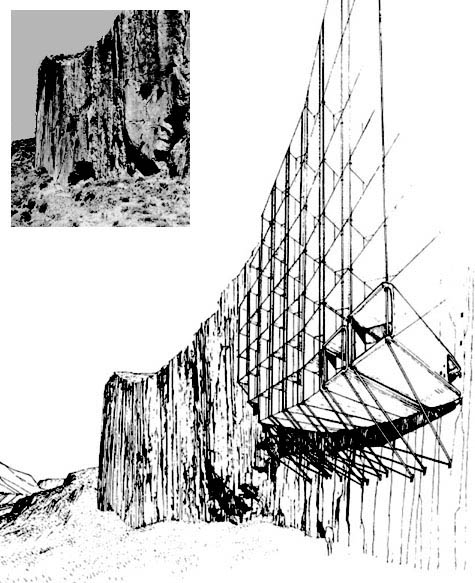
Nearly a year ago, a reader named Stavros Koulis tipped me off to the work of Takis Zenetos. Zenetos was a Greek architect whose work seems clearly to belong in a list of avant-garde mid-to-late 20th century architects like Yona Friedman, Constant, and even Archigram, but who seems otherwise to have been overlooked.
The above project – visible in the next image – is for a hanging hotel, a combination of Tibetan palace, Anasazi cliff dwelling, and artificial geological formation.

[Image: The Hanging Hotel, strung onto a cliffside like a musical instrument, by Takis Zenetos].
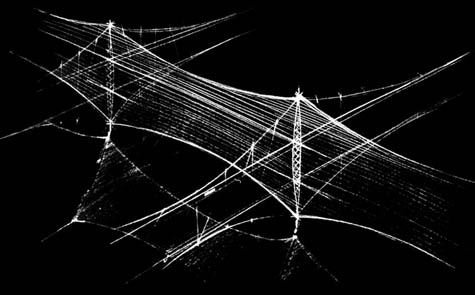
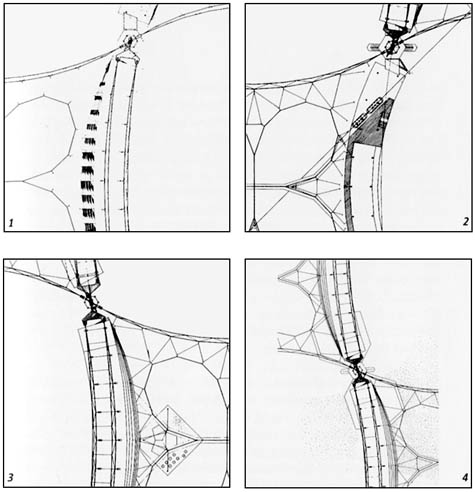
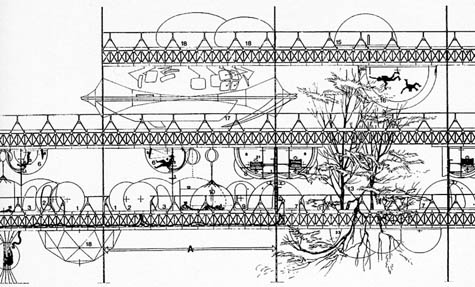
But his most exciting project, I’d suggest (based on very little information, to be frank), is Cable City, an incredible 1961 design for a suspended city – what Zenetos called une ville suspendue.
The entire metropolis would be hung from cables, a kind of tensional extension of the earth’s surface.

[Image: The Cable City of Takis Zenetos].
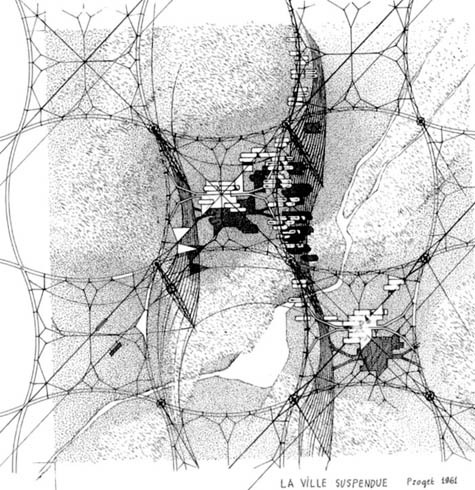
 
To be honest, I’ve never read a word about this thing in English, so who knows what I’m getting right here; but the overall impetus behind the project seems to be something like counter-terrestriality: a city that would not only span, but even temporarily replace, the earth’s surface, forming a cobweb of urban settlement. An extremely local architectural offworld made of capsules, wired Archigramian hammocks, and other high-tech micro-environments.

[Image: The Cable City of Takis Zenetos; the instant city as toupee].

But my own descriptions shouldn’t get in the way of Zenetos’s images.

[Images: The Cable City of Takis Zenetos].
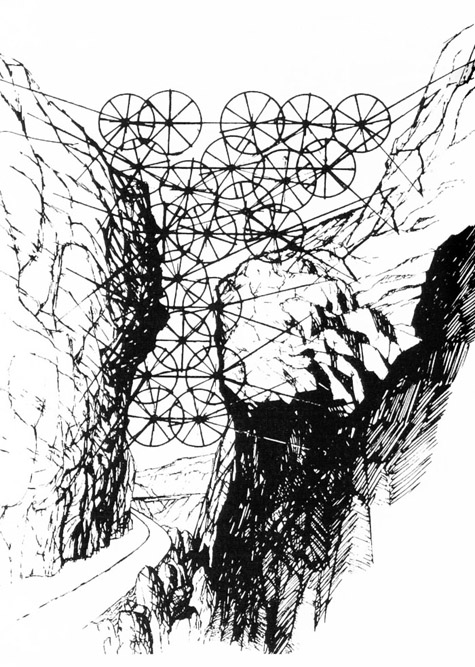
After all, he even drew gullies choked with wind turbines – sustainable, if bird-murdering, power stations – decades ahead of his time.

[Images: A turbined gorge by Takis Zenetos].
I’d love to know more about Zenetos, if anyone reading BLDGBLOG has more information. “Takis Zenetos (1926-1978),” we read, “is the pre-eminent architect of Greek modernism, with a varied oeuvre (industrial buildings, schools, residences, objects, urban planning studies), and he is best known for the FIX building on Syngrou Avenue and the Lycabettus theatre.
“What is not widely known is that Zenetos was a visionary of the future electronic city and the digital age.”

[Thanks to Stavros Koulis for sending me these scans].

SuperMax

It’s not exactly news, but something caught my eye the other week via Robin Sloan’s Twitter feed, so I thought I’d put up a quick post about it here.

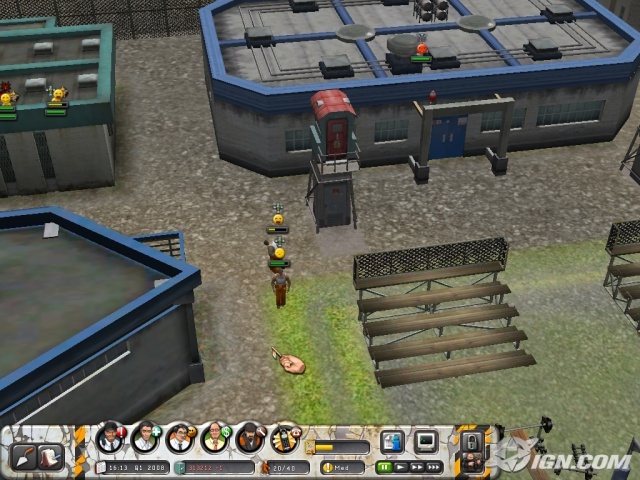
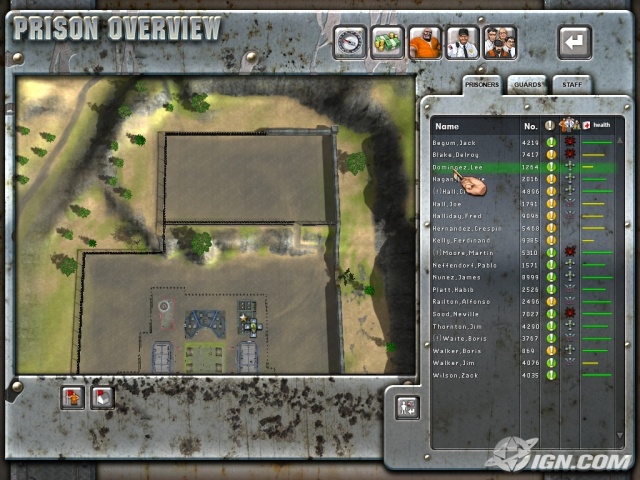
[Image: From Prison Tycoon 4: SuperMax. Image via IGN].
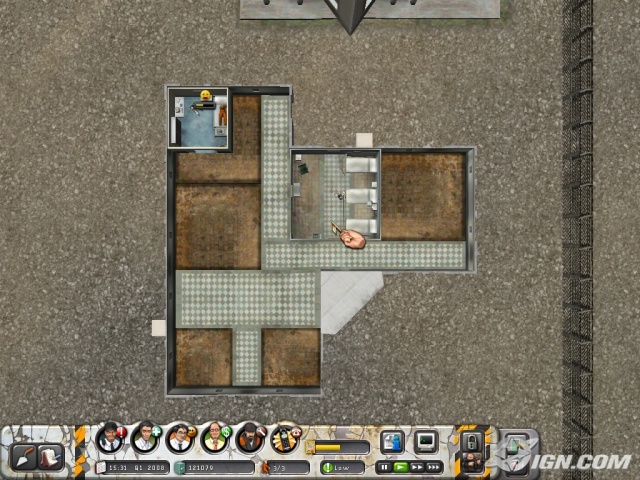
The description of Prison Tycoon 4: SuperMax, a ValuSoft game released in 2008, urges players to experiment in the architectural framing and administrative implementation of prison life.
“Build a profitable privately run prison from the ground up,” it says. “Every wall, every fence, every decision is yours. Start small and forge your reputation as a first rate warden. Grow your facility to SuperMax capabilities, housing the most dangerous and diabolical criminals on earth – all for the bottom line.”
Putting moral limits on our imaginations temporarily aside, perhaps we could even conceive of Prison Tycoon 5: Guantánamo Bay, or Prison Tycoon 6: Austrian Basement Edition. Prison Tycoon 7: Gulag.
Prison Tycoon 8: Escape from Abu Ghraib.
Or scrap the cheap political commentary and go for sci-fi: Inflatable Prisons in Space! The final level is a siege of the earth’s surface via space elevator, convicts raining down upon the planet like dark angels. The plot is loosely modeled on Paradise Lost.
Setting up the next game: Prison Planet.
Or famous prisons from literature – including Brian Aldiss’s rotating prison of Helliconia.
The Library of Babel reimagined as a SuperMax prison in the mountains of western Canada.
Prisons carved from glaciers undergoing catastrophic earthquakes as global climate change causes melt-off. You have to escape before the ice sheet collapses, teaming up with the very guards who once held you captive.
Prison Tycoon 10: Global Meltdown.

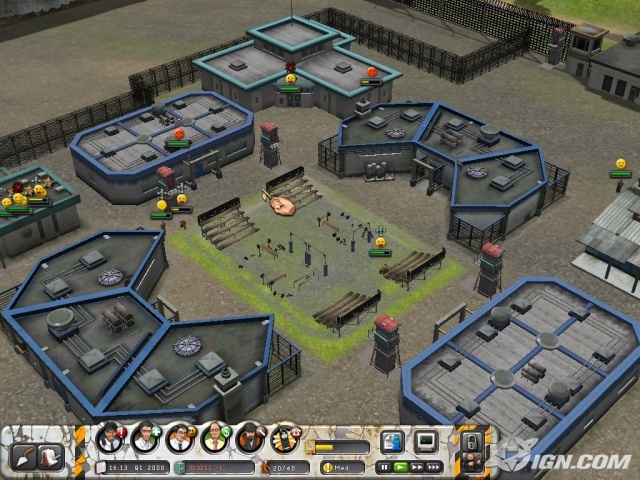
[Images: From Prison Tycoon 4: SuperMax. All images via IGN. If Mies van der Rohe had designed a prison, what might it have looked like?].
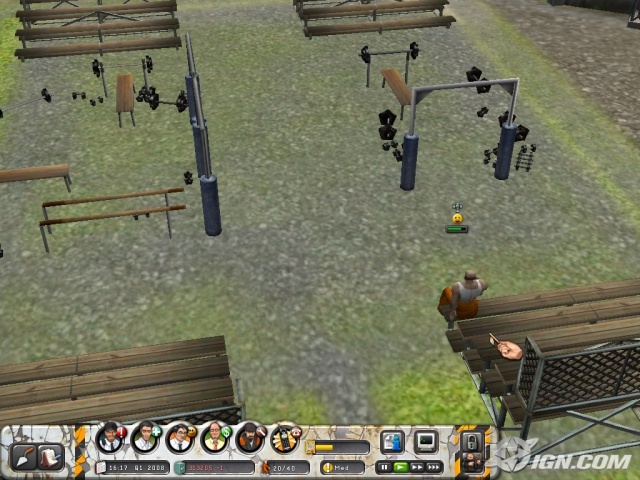
Of course, ValuSoft kicked all of this off back in 2005 with the original Prison Tycoon: “In Prison Tycoon,” we read, “you construct and maintain a private prison, hire the staff, and control the prisoners – all while trying to earn big money.”
But why not open the series to goals beyond “big money” and a swollen “bottom line,” and aim for sheer architectural complexity?
Or locational advantages, like the offshore oil rig -slash- ultramax prison in John Woo’s surprisingly great film Face/Off.
You construct an Alpine labyrinth that has no guards at all; the architecture itself is so bewildering that no one has ever escaped. Umberto Eco’s final novel is set there; or perhaps one of his characters dreams it.
Gormenghast: The Prison.

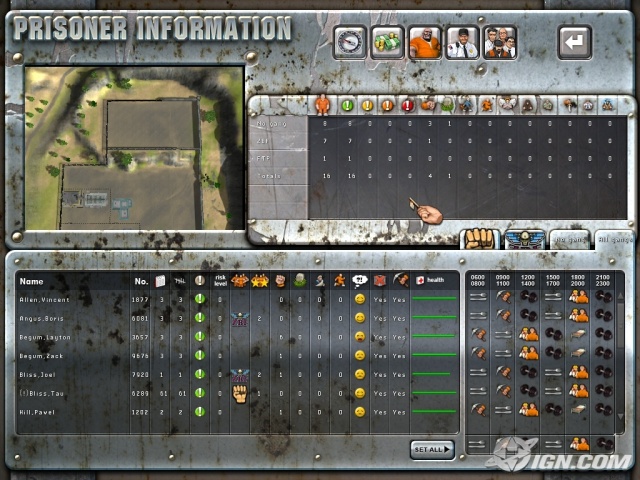
[Images: From Prison Tycoon 4: SuperMax. Images via IGN].

However, lest you now be tempted to purchase Prison Tycoon 4, I’d first suggest reading this review.
For instance:

Since it’s pretty much impossible to tell the difference between a guard and a prisoner in the yard, you’ll have to open up the submenu. From there you click on the guard tab, select a specific guard, look at the minimap to check the whereabouts of the guard, close the submenu, investigate the most recent known whereabouts of the guard, locate and right mouse click the guy (you can’t create a drag box to select anything in this game), move him into the action, right mouse click on a troubled prisoner, and select the beat-him-up icon. By the time you try to initiate all of this, a prisoner might have already died. If this all sounds convoluted it is. The whole game is like this, and it really hurts to not have a proper tutorial.

Sounds like fun.

Of networks, grids, and infrastructures, or: How to make a planet

If I have several blogging resolutions for 2009 – and I do – one of them is definitely to read InfraNet Lab more often.

[Image: Offshore energy islands, via InfraNet Lab].

Easily one of the most interesting architecture blogs out there today – though it’s really an infrastructure blog, hopefully heralding a new focus for design writers in the next few years – and written by Toronto-based architects Mason White and Lola Sheppard, along with two contributors named Maya and Neeraj, it tracks massive infrastructure, waste, energy, and design projects across the global landscape, taking in geology, engineering, network economics, ecology, construction innovation, future fuels, and much more.

Read it and you’ll know how to “harvest energy from the earth’s rotation” using mega-gyroscopes, you’ll discover how a more efficient offshore seaweed industry might work, you’ll pick up clues for how to design a mountain and then how to connect that mountain to others using aerial tramways, you’ll get an architectural glimpse of habitat meshing, you’ll take an hallucinatory tour through Taiwanese mushroom farms, you’ll visit underground waste isolation sites in New Mexico, you’ll turn around and go the opposite vertical direction – into the sky – to farm water from the atmosphere, and you’ll even punt around the artificial inland waterways of Britain using strange mechanized structures and seeing that archipelago as hydrology first, geography later.

So go check it out – and make 2009 the year of networks, grids, and infrastructures.

Infrastructural Domesticity

Because “it takes too long to come down to ground level each day to make it worthwhile,” a crane operator on the Burj Dubai – the world’s tallest building – is rumored to have “been up there for over a year,” the Daily Telegraph reports.

His name is Babu Sassi, and he is “a fearless young man from Kerala” who has become “the cult hero of Dubai’s army of construction workers.” He also lives several thousand feet above the ground.

[Image: The Burj Dubai, via Wikipedia].

Whether or not this is even true – after all, I never think truth is the point in stories like this – 1) the idea of appropriating a construction crane as a new form of domestic space — a kind of parasitic sub-structure attached to the very thing it’s helped to construct — is amazing; 2) further, the idea that crane operators are subject to these sorts of urban rumors and speculations brings me back to the idea that there might be a burgeoning comparative literature of mega-construction sites taking shape today, with this particular case representing a strong subgenre: mythic construction worker stories, John Henry-esque figures who single-handedly assemble whole floors of Dubai skyscrapers at midnight, with a cigarette in one hand and a hammer in the other (or so the myths go), as a kind of oral history of the global construction trade; and, finally, 3) there should be some kind of TV show – or a book, or a magazine interview series – similar to Dirty Jobs in which you go around visiting people who live in absurd places – like construction cranes atop the Burj Dubai, or extremely distant lighthouses, or remote drawbridge operation rooms on the south Chinese coast, or the janitorial supply chambers of inner London high-rises – in order to capture what could be called the new infrastructural domesticity: people who go to sleep at night, and brush their teeth, and shave, and change clothes, and shower, inside jungle radar towers for the French foreign legion, or up above the train tracks of Grand Central Station because their shift starts at 3am and they have to stay close to the job.

How do they decorate these spaces, or personalize them, or make them into recognizable homes? It’s like a willful misreading of Heidegger as applied to the question of building, dwelling inside, and thinking about modern infrastructure.

I’m reminded of a line from Paul Beaty’s new novel, Slumberland. Early in the book he writes, and my jaw dropped: “Sometimes just making yourself at home is revolutionary.”

[Image: The Burj Dubai, via Wikipedia].

In fact, consider this an official book proposal – to Penguin, say: a quick, 210-page look at strange inhabitations, like that guy who lived inside a bridge in Chicago, only not some mindless catalog of quirky stories – like, ahem, that guy who lived inside a bridge in Chicago – but profiles of people with amazingly strange jobs who have to sleep in places no one else would even imagine calling home. Down beneath the streets of Moscow in a subway switching HQ in a little bunkbed. Out on the Distant Early Warning Line of the U.S. Arctic military – where it’s just you, a toothbrush, and the Lord of the Rings on DVD. You dream about forests.

Or perhaps there is a suite of individual employee bedrooms in some South Pacific FedEx re-routing warehouse, where long-haul pilots are required by labor law to sleep for ten hours between flights; they come through twice a year, leaving Robert Ludlum paperbacks behind for themselves to read later.

The micro-tactics of dwelling inside strange but temporary homes.

In any case, while I’m working on that, the rest of the Daily Telegraph article is worth a quick read.

(Spotted on Archinect).

Code 46

On Monday, November 24, I’ll be hosting a live interview at the Barbican in London with director Michael Winterbottom, for a special screening of his film Code 46. You can read a bit more about the event – as well as buy tickets – here.
This is part of an ongoing series called Architecture on Film, curated by the Architecture Foundation.

[Image: From Michael Winterbottom’s Code 46, courtesy of United Artists].

The purpose of the event is to talk about film and architecture – or, in this case, cities, urban design, memory, science fiction, landscape, globalization, and the built environment. As you can see from the list of locations used for the film’s production, Code 46 is very well-traveled, stitching together urban – and exurban – environments from London, Shanghai, Dubai, Hong Kong, and even the deserts of Rajasthan.
That the film achieves the feel of science fiction simply through a well-edited depiction of existing landscapes says as much about the film as it does about the nature of city-building today; perhaps one might only half-jokingly suggest that people build cities today in order to live inside science fiction films.

[Image: Shanghai, from Code 46, directed by Michael Winterbottom, courtesy of United Artists].

As BLDGBLOG explored the other week in a long post, “cities today are well known for popping up in the middle of nowhere, history-less and incomprehensible.”

That’s what cities now do. If these cities are here today, they weren’t five years ago; if they’re not here now, they will be soon. Today’s cities are made up, viral, fungal, unexpected. Like well-lit film sets in the distance, staged amidst mudflats, reflecting themselves in the still waters of inland reservoirs, today’s cities simply arrive, without reservations; they are not so much invited as they are impossible to turn away. Cities now erupt and linger; they are both too early and far too late. Cities move in, take root and expand, whole neighborhoods throwing themselves together in convulsions of glass and steel.

What does it mean, then, to set a film inside a mix of such spaces? And as more and more instant cities appear in the world, built from zero in less than a decade, how can cinema capitalize on the lack of recognition these historically too-new and culturally all but anonymous environments inspire?
What does it mean, as well, that the depiction of the future in Code 46 – a depiction of the future through architecture – involves no U.S. cities at all and only very brief glimpses of urban infrastructure in Europe?

[Image: Shanghai, from Code 46, directed by Michael Winterbottom, courtesy of United Artists].

This brings up one of the more interesting aspects of the film – something not internal to it, but created by the current state of global urbanization. The film makes it deliberately unclear, in other words, that it was shot in multiple locations at all; the opening sequence blurs together landscapes, buildings, and infrastructures from very different cities – yet this unfamiliar new place to which we’re being introduced might very well exist.
For all many viewers know, perhaps Shanghai really is in the middle of a desert; perhaps Dubai really does look exactly like Hong Kong.
This confusion only seems possible, however, within a very narrow window of historical time. As the skylines and iconic hotel interiors of Dubai, Shanghai, Hong Kong, and elsewhere become visually familiar to many more people, it will become much harder to do what Code 46 has done – which is to edit them all up into a convincing pastiche. They are a spatial collage, an urban cut-up – William S. Burroughs as architectural director.
In ten years, then, would this be akin to cutting from a shot of the Empire State Building to a shot of the Eiffel Tower and pretending that these landmarks are in the same city – only to find that almost no one has been genuinely tricked?
In a funny but negative Amazon review of the film, a disappointed viewer actually mocks this very aspect: “If I have to keep seeing these movies with the I haven’t a clue which Metro I’m in look I’m going to scream.”
But what does it mean that Asian cities – cinematically depicted as a kind of monolithic urban Other – are, for the time being, so visually unfamiliar to Western audiences that they can be edited into a seamless Global Metropolis, a vast agglomeration of spatial alterity that we can cut-and-paste together on film?
Where might Code 46 have been made if it had been produced fifteen years from now? What explosive urban outgrowths between now and then will be sufficiently unfamiliar to literally hundreds of thousands of filmgoers that they could be combined into one convincing location?
Will the sci-fi films of tomorrow be set in Lagos, Delhi, Rabat, or Shenzhen? All of the above?
It’s the future science fiction of global third-tier urbanism.
For instance, one of the most striking aspects of the urban environment in The Matrix came simply from the fact that many – though not all – of the outdoor scenes were shot in Sydney, a city with which most American viewers are not visually familiar. The urban world of the Matrix thus took on an uncanny sense of near-resemblance, looking an awful lot like a city everyone has seen before – is that Houston? Tampa Bay? Fresno? – but not enough like any single one of them to be clear.
The film Primer, shot in Dallas, is an amazing example of this: the whole time you’re watching it you have no idea where you are… though absolutely everything about it looks familiar.
The effect, particularly in Code 46, is almost literally uncanny.

[Image: The Shanghai skyline, from Code 46, directed by Michael Winterbottom, courtesy of United Artists].

Briefly, I’m also reminded here of Tativille, the massive film-set city built by Jacques Tati to produce his own film Playtime. Constructed solely for the purpose of hosting camera crews – and later disassembled – Tativille was a city of the image, its design shaped only by how it would look on screen. With Tativille in mind, what might future audiences think if, say, Dubai really does run out of money in the global economic downturn, its towers abandoned and eroding back to sand? It will be visible in films like Code 46 – but nowhere else. It will have ceased to exist.
It will have been a kind of Tativille of the Emirates, built only to host film crews and car commercials.
In any case, the film’s visions of desert poverty – scenes in Rajasthan – and desert opulence – scenes in Dubai – bring up the topic of uneven development. If, as William Gibson‘s oft-quoted line goes, the future is already here, it’s just unevenly distributed, then this also appears to be true in the context of architectural form and urban landscapes.
But which one is the future: the nationless desert of rights-deprived exiles or the golf course-filled desert of the stateless business class?
Or are these perhaps one and the same, requiring each other as the flipsides of their own formation?

[Image: The opening titles of Michael Winterbottom’s Code 46, courtesy of United Artists].

None of these questions are new, of course, going back in some form or another to Sergei Eisenstein, Fredric Jameson, and many, many others; but the opportunity to discuss all this with Michael Winterbottom himself in reference to a specific – and, as it happens, visually stunning – film, in a monumental and legendary architectural complex like the Barbican, is something of which I’m genuinely excited to be a part.
So if you’re in London on Monday, November 24, consider stopping by. Tickets can be purchased directly through the Barbican’s website, and you can learn a bit more about the film here.

The Landscape Anthropology of Photography Museums (and the spatial implications of graven images)

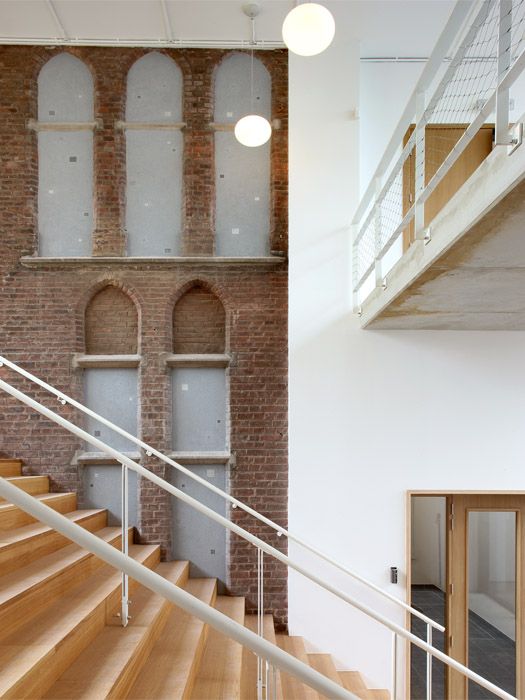
[Image: A new wing for the Museum of Photography in Charleroi by l’Escaut; photo by Filip Dujardin].
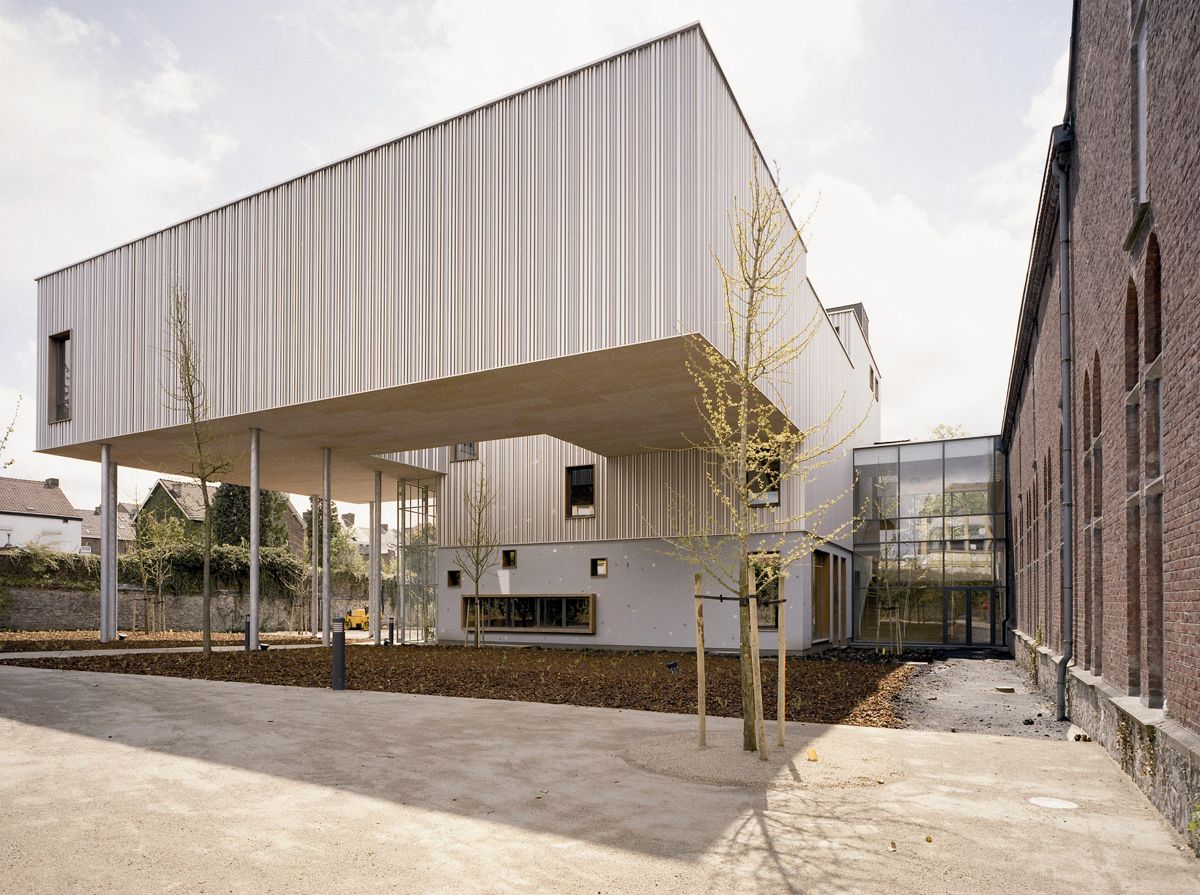
Belgian architects and scenographers l’Escaut have completed a new wing for the Museum of Photography in Charleroi, Belgium.
In an email received this morning, l’Escaut describes the project as being “situated at the intersection of architecture, landscape, city planning, photography and fine arts.”
This wide-ranging program, they go on to point out, “matches the interdisciplinarity of l’Escaut both in its daily life (l’Escaut is situated in a building shared with theatre actors and artists) as in its architecture practice (anthropology, landscaping, city planning, communication intervene in the projects).”
They are not really architects, in other words; they practice something more like landscape anthropology.

[Images: A new wing for the Museum of Photography in Charleroi by l’Escaut; photos by Filip Dujardin].
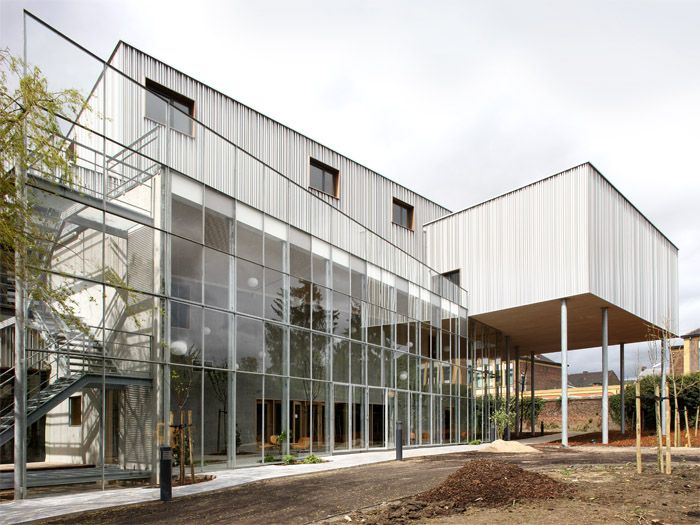
L’Escaut’s new wing is a surprising addition to the existing structure.
Partly raised on stilts, partly cantilevered, and almost entirely defined by a very clean-lined modern geometry, the added galleries nonetheless include a brief glimpse of botanical free-will: a “winter garden” that “shelters fragrant plants inside the museum.” Photosynthesis meets photography.

[Image: A new wing for the Museum of Photography in Charleroi by l’Escaut; photo by Filip Dujardin].
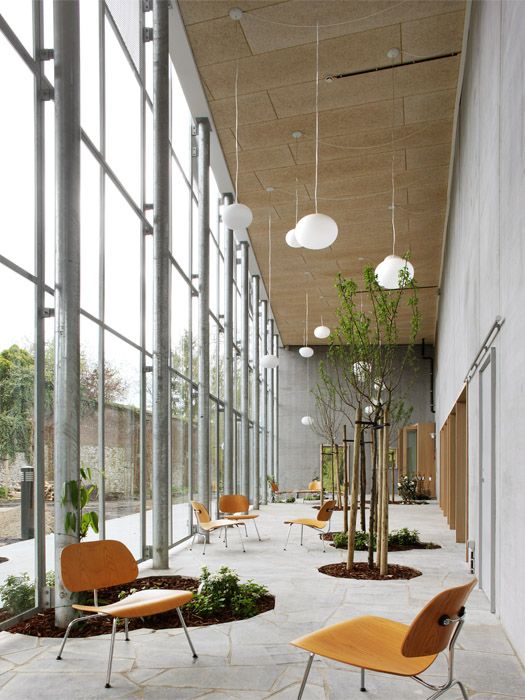
The galleries themselves, we’re told, are part of an overall “spatial scenography” of the site. Everything here is about views, counter-views, cross-views, and panoramas. Everything helps to frame everything else.
The architecture itself is photographic, you could say: the rooms flow into each other through a succession of bare white walls and exposed concrete, as if the space has been edited.
This raises the question, though, of the point at which space, actively experienced, becomes cinematic.
Are buildings ever truly photographic, or are they more like short films?

[Images: A new wing for the Museum of Photography in Charleroi by l’Escaut; photos by Filip Dujardin].

In any case, the story behind the original building itself is fascinating: it turns out that the Museum of Photography is a former Carmelite convent. The grounds include what used to be the nuns’ orchard.
This entails all sorts of interesting theological problems, as we’ll see.

[Image: A new wing for the Museum of Photography in Charleroi by l’Escaut; photo by Filip Dujardin].

Religious prohibitions against “graven images” become abstractly involved in the planning process:

The transformation of the convent into a museum of photography was a reverse process of existing logics in the building. A place where looking at the world was forbidden because of religious reasons became a place of revelation of the image for societal reasons. Its extension defies conventional museum logics by multiplying the relationships to photography, its history and its many facets of representation.

In other words, is a museum of photography – a temple of the graven image – a site for the “revelation of the image,” as the architects write – an inherent violation of Christian doctrine?
Is it de facto heresy to celebrate photography in a site formerly dedicated to the worship of god?
These unresolved tensions help to animate the interlinked spaces of the museum itself.

[Image: A new wing for the Museum of Photography in Charleroi by l’Escaut; photo by Filip Dujardin].

Here are some photos of the construction process, More about the project, meanwhile, can be found here.

Mayan Muons and Unmapped Rooms

[Image: “Guatemala Tikal D8006” by youngrobv].

Easily one of the most interesting things I’ve read in quite a while is how a team of particle physicists from UT-Austin plan on using repurposed muon detectors to see inside Mayan archaeological ruins.
In the new issue of Archaeology, Samir S. Patel describes how “an almost featureless aluminum cylinder 5 feet in diameter” that spends its time “silently counting cosmic flotsam called muons” – “ghost particles” that ceaselessly rain down from space – will be installed in the jungles of Belize.
There, these machines will map the otherwise unexplored internal spaces of what the scientists call a “jungle-covered mound.”
In other words, an ancient building that now appears simply to be part of the natural landscape – a constructed terrain – will be opened up to viewing for the first time since it was reclaimed by rain forest.
It’s non-invasive archaeology by way of deep space.

[Images: The muon detector, courtesy of the UT-Austin Maya Muon Group].

From the UT-Austin Maya Muon Group website:

The first major experiment of the Maya Muon Group will bridge the disciplines of physics and archeology. The particle detectors and related systems are designed specifically to explore ruins of a Maya pyramid in collaboration with colleagues at the UT Mesoamerican Archaeological Laboratory. The Maya Muon Group will travel to La Milpa in northwest Belize to make discoveries about “Structure 1” – a jungle-covered mound covering an unexplored Maya ruin.

Pointing out that dense materials block more muons, Patel explains that a muon detector can actually detect rooms, spaces, and caves inside what seems to be solid:

A detector next to a Maya pyramid, for example, will see fewer particles coming from the direction of the structure than from other angles: a muon “shadow.” And if a part of that pyramid is less dense than expected – containing an open space for, say, a royal burial – it will have less of a shadow. Count enough muons that have passed through the pyramid over the course of several months, and they will form an image of its internal structure, just like light makes an image on film. Then combine the images from three or four devices and a 3-D reconstruction of the pyramid’s guts will take shape.

Referring to a muon detector already at work on the campus of UT-Austin, Patel writes: “The detector sees in every direction, so it also records muon shadows from the adjacent university buildings, and can even identify empty corridors. Silently, with little tending, it takes a monumental x-ray of the world around it.”
“The resulting image,” he adds, “will be almost directly analogous to a medical CAT-scan.”

[Image: The muon detector, courtesy of the UT-Austin Maya Muon Group].

Install one of these things in New York City and see what you find: moving blurs of elevators and passing trucks amidst the strange, skeletal frameworks of skyscrapers that stand behind it all in a labyrinthine mesh.

[Image: A diagram of how it all works; from this PDF by Roy Schwitters].
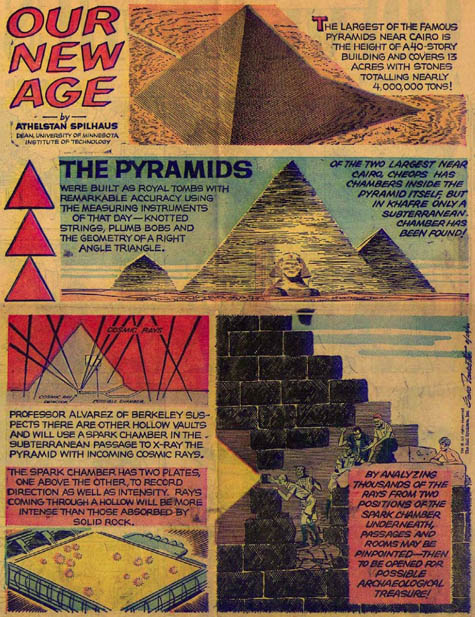
Patel goes on to relate the surreal story of physicist Luis Alvarez, who used muons “to scan the inside of an ancient structure” – in this case, Khafre’s pyramid at Giza. “Working with Egyptian scientists in the late 1960s,” we read, “he gained access to the Belzoni chamber, a humid vault deep under the pyramid.”
Like something out of an H.P. Lovecraft story, “Alvarez’s team set up a muon detector called a spark chamber, which included 30 tons of of iron sheeting, in the underground room.”
Foreign physicists building iron rooms beneath the pyramids! To search for secret chambers based on the evidence of cosmic particles.

[Image: An illustrated depiction of Luis Alvarez’s feat; view larger!].

Indeed, we read:

Suspicion of the research team ran high – here was a group of Americans with high-tech electronics beneath one of Egypt’s most cherished monuments. “We had flashing lights behind panels – it looked like a sci-fi thing from Star Trek,” says Lauren Yazolino, the engineer who designed the detector’s electronics.

Alvarez’s iron room beneath the monolithic geometry of the pyramid – it’s like a project by Lebbeus Woods, by way of Boullée – apparently took one year to perform its muon-detection work.
One day, then, the team took a long look at the data – wherein Yazolino “spotted an anomaly, a region of the pyramid that stopped fewer muons than expected, suggesting a void.”
There were still undiscovered rooms inside the structure.

[Image: Wiring up the muon detector, courtesy of the UT-Austin Maya Muon Group].

Excitingly, when Roy Schwitters sets up his muon detector next to the tree-covered mounds of the Mayan city of La Milpa, he should get his results back in less than six months. Sitting there like a strange battery, the detector’s ultra-long-term abstract photography of the jungle hillsides vaguely reminds me of the technically avant-garde photographic work of Aaron Rose.
Rose has pioneered all sorts of strange lenses and unexpected chemical developers as he takes long-term exposures of Manhattan.
New York becomes less a city than a kind of impenetrable wall of built space.

[Images: Four photographs by Aaron Rose. View slightly larger].

Again, then, I’m curious what it’d be like to install one of these muon detectors in Manhattan: the shivering hives of space it might detect, as delivery trucks shake the bridges and elevators move up and down inside distant high-rises. What would someone like Aaron Rose be able to do with a muon detector?
Are muon detectors the future of urban art photography?
Perhaps it could even be a strange new piece of public art: a dozen muon detectors are installed in Union Square for six months. They’re behind fences, and look sinister; conspiratorialists leave long comments on architecture blogs suggesting that the muon detectors might not really be what they seem…
But the resulting images, after six months of Manhattan muon detection, are turned over as a gift to the city; they are hung in massive prints inside the Metropolitan Museum of Art, near the Egyptian wing, and Neil deGrasse Tyson delivers the keynote address.
Or perhaps a muon detector could be installed atop London’s fourth plinth:

The Fourth Plinth is in the north-west of Trafalgar Square, in central London. Built in 1841, it was originally intended for an equestrian statue but was empty for many years. It is now the location for specially commissioned art works.

For six months, a shadowy muon detector will stand there, above the heads of passing tourists, detecting strange and labyrinthine hollows beneath government buildings where sprawling complexes from WWII spiral out of sight below ground.
Or perhaps muon detectors could even be installed along the European coast to discover things like the buried neolithic village of Skara Brae or those infamous Nazi bunkers “that lay hidden for more than 50 years” before being uncovered by the sea. As the Daily Mail reported earlier this month:

Three Nazi bunkers on a beach have been uncovered by violent storms off the Danish coast, providing a store of material for history buffs and military archaeologists.

The bunkers were found in practically the same condition as they were on the day the last Nazi soldiers left them, down to the tobacco in one trooper’s pipe and a half-finished bottle of schnapps.

So what else might be down there under the soil and the sands…?
I’m imagining mobile teams of archaeologists sleeping in unnamed instant cities in the jungles and far deserts of the world, with storms swirling over their heads, running tests on gigantic black cylinders – muon detectors, all – that stand there like Kubrickian monoliths, recording invisible flashes of energy from space to find ancient burial sites and old buildings underground.

[Images: Tikal, photographed by n8agrin: top/bottom].

Perhaps all the forests and deserts of the world should be peppered with muon detectors – revealing archaeological anomalies and unexpected spaces in the ground all around us.
Architecture students could be involved: installing muon detectors outside Dubai high-rises and then competing to see who can most accurately interpret the floorplan data.

[Images: “Sobrevolando Tikal, Guatemala,” photographed by Eddie von der Becke].

Till one day, ten years from now, an astronaut crazed with emotional loneliness, riding through space with his muon detector, begins misinterpreting all of the data. He concludes – in a live radio transmission broadcast home to stunned mission control supervisors – that his space station has secret rooms – undiscovered rooms – that keep popping up somehow in the shadows…
More to the point, meanwhile, you can read a few more things about Roy Schwitters over at MSNBC – and, of course, at the UT-Austin Maya Muon Group homepage.

15 Lombard Street

[Image: The cover and a spread from 15 Lombard St. by Janice Kerbel].

15 Lombard St. is a book by artist Janice Kerbel, published back in 2000. It presents itself as “a rigorously researched masterplan of how to rob a particular bank in the City of London.”

By observing the daily routine in and around the bank, Kerbel reveals the most detailed security measures such as: the exact route and time of money transportation; the location of CCTV cameras in and around the bank along with precise floor plans that mark the building’s blind spots.
Kerbel’s meticulous plans include every possible detail required to commit the perfect crime.

The book was pointed out to me by Sans façon in relation to an earlier post here on BLDGBLOG about the city re-seen as a labyrinth of possible robberies and heists that have yet to be committed – a geography of tunnels yet to be dug and vaults yet to be emptied.

But is there a literary genre of the crime plan? An attack or robbery outlined in its every detail. Is this fiction, or some new form of illicit literature, detailing speculative and unrealized crimes hidden in the city around us? Is robbing a building just another type of architectural analysis? Or does one put such a thing into the category of counter-geography – a minor cartography, a rogue map? Or perhaps radical cartography, as the saying now goes? Would there be an impulse toward censorship here?

There’s a fascinating series of interviews waiting to be done here with people who work in building security – how a building is deliberately built to anticipate later actions. Or, should we say: how a building is built to contain the impulse toward certain, more radical uses.

When the burglars get to this door, they’ll become frustrated and will try to break through the nearby window, instead – so we must reinforce this window and put a camera nearby.

The building has within it certain very specific possible crimes, the way this house contained a “puzzle.” I’m reminded of the famous Bernard Tschumi line, and I’m paraphrasing: Sometimes to fully appreciate a work of architecture you have to commit a crime.

Architectural space becomes something like an anticipatory narrative – the exact size and shape of a future heist, nullified. It outlines future crimes the way a highway outlines routes.

(Thanks again to Sans façon for the tip!)

The Atlas of All Possible Bank Robberies

[Image: From The Bank Job].

It occurred to me that you could make a map—a whole book of maps—detailing all possible routes of bank robbery within the underground foundations of a city. What basements to tunnel through, what walls to be hammered down: you make a labyrinth of well-placed incisions and the city is yours. Perforated from below by robbers, it rips to pieces. The city is a maze of unrealized break-ins.

A whole new literary genre could result. Booker Prizes are awarded. You describe, in extraordinary detail, down to timetables and distances, down to personnel and the equipment they would use, how all the banks in your city might someday be robbed. Every issue of The New Yorker, for instance, includes a short, 600-word essay about breaking into a different bank somewhere in Manhattan, one by one, in every neighborhood. Ideas, plans, possibilities. Scenarios. Time Out London does the same.

It soon becomes a topic of regular conversation at dinner parties; parents lull their kids to sleep describing imaginary bank robberies, tales of theft and architectural transgression. Buildings are something to be broken into, the parents whisper. It’s what buildings have inside that’s your goal.

For whom the bell tolls

[Image: Diagram of Taipei 101’s earthquake ball via the Long Now Foundation].

Earlier this week, the Long Now Foundation looked at earthquake dampers inside skyscrapers, focusing specifically on Taipei 101—a building whose unanticipated seismic side-effects (the building’s construction might have reopened an ancient tectonic fault) are quite close to my heart.

As it happens, Taipei 101 includes a 728-ton sphere locked in a net of thick steel cables hung way up toward the top of the building. This secret Piranesian moment of inner geometry effectively acts as a pendulum or counterweight—a damper—for the motions of earthquakes.

[Image: The 728-ton damper in Taipei 101, photographed by ~Wei~].

As earthquake waves pass up through the structure, the ball remains all but stationary; its inertia helps to counteract the movements of the building around it, thus “dampening” the earthquake.

It is a mobile center, loose amidst the grid that contains it.

[Image: Animated GIF via Wikipedia].

However, there’s something about discovering a gigantic pendulum inside a skyscraper that makes my imagination reel. It’s as if the whole structure is a grandfather clock, or some kind of avant-garde metronome for a musical form that hasn’t been invented yet. As if, down there in the bedrock, or perhaps a few miles out at sea inside a submarine, every few seconds you hear the tolling of a massive church bell – but it’s not a bell, it’s the 728-ton spherical damper inside Taipei 101 knocking loose against its structure.

Or it’s like an alternate plot for Ghostbusters: instead of finding out that Sigourney Weaver’s New York high-rise is literally an antenna for the supernatural, they realize that it’s some strange form of architectural clock, with a massive pendulum inside—a great damper—its cables hidden behind closet walls and elevator shafts covered in dust; but, at three minutes to midnight on the final Halloween of the millennium, a deep and terrifying bell inside the building starts to toll.

The city goes dark. The tolling gets louder. In all the region’s cemeteries, the soil starts to quake.

(Thanks to Kevin Wade Shaw for the link!)