Voices Loom

[Image: A telephone tower in Stockholm, Sweden, courtesy of the Tekniska Museet].

Trying to catch up on the huge variety of things saved over the summer while out on our most recent jaunt for Venue, I’ve got an awful lot of quick links, now less-than-current news items, and a few longer reads that you’ve no doubt seen elsewhere at this point, but I thought I’d go through and choose a few for posting.

[Image: A telephone tower in Stockholm, Sweden, courtesy of the Tekniska Museet].

In this case, we’re looking at a telephone tower in downtown Stockholm, one that stood from roughly 1887-1913, and that served at least 5,000 local phones lines—lines that take on the literal feel of a sketch or drawing as they stretch over the streets like some urban-scale loom enthroned over the city, weaving conversations together from every district. It’s a cast-iron stupa through which all voices must pass.

[Image: A telephone tower in Stockholm, Sweden, courtesy of the Tekniska Museet].

There are a few more photos available at the Tekniska Museet‘s Flickr set, but here is a selection of some of the most interesting—

[Images: A telephone tower in Stockholm, Sweden, courtesy of the Tekniska Museet].

—including a street scene of people walking to or from home with this strange skeletal structure seemingly waiting for them at the end of the lane, listening and dystopian—

[Image: A telephone tower in Stockholm, Sweden, courtesy of the Tekniska Museet].

—or this view of it blending into its urban context. It could almost pass as a cathedral or as the intimidating battlements of an unfinished electromagnetic fortress in the middle of the downtown core.

[Image: A telephone tower in Stockholm, Sweden, courtesy of the Tekniska Museet].

The weird and invisible mysticism of the phone system is laid bare, its nervous system exposed above the roofs of Stockholm and strung up on a tower like the pelt of some rare and conquered animal, forced to host even our most inconsequential conversations.

[Image: A telephone tower in Stockholm, Sweden, courtesy of the Tekniska Museet].

Teenage Mutant Ninja District

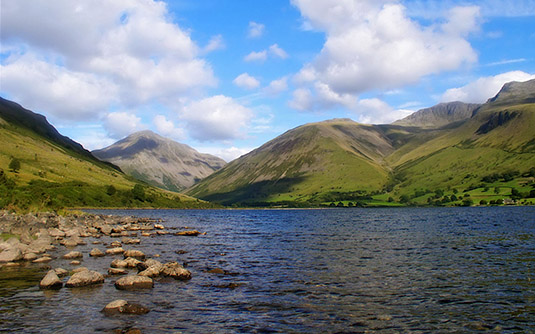
Abandoned terrapin turtles purchased 25 years ago at the height of popularity for Teenage Mutant Ninja Turtles have been harming wildlife and changing the ecological character of England’s famed Lake District. Once an orbital center for the lives of poets William Wordsworth and Samuel Taylor Coleridge, the landscape is now infested with discarded pets purchased for their imaginative resemblance to kids’ toys and comic book characters.

Terry Bowes, a regional zoo director interviewed by the Guardian, has become “exasperated at the routine abandonment of creatures,” he explained, “that suffered the misfortune of becoming fashionable at the time of the Teenage Mutant Ninja Turtle craze.”

“I was thinking what we could do about them all,” Bowes told the paper, “and then I heard about another Teenage Mutant Ninja Turtle film coming out soon and steam came out of my ears. I was thinking, ‘Oh no, this is only going to get worse.'”

Human ownership of changing animal species responds to the quirks of popular appeal, we read, including hit films and toy lines: “Pets are just as vulnerable to fashion as anything else, said Bowes, as we passed three enormous European eagle owls he said were abandoned by their owners after they outgrew Harry Potter, and a trio of perky meerkats he said were probably originally bought after seeing the star of the Compare the Market insurance ads.” The region is an open-air zoo of animals that have escaped from popular media.

Surely, though, in a sense, this is just the latest, albeit inadvertent iteration of the infamous American Acclimatization Society, a group of literary-minded naturalists in 19th-century New York City who made it their bizarre goal to “introduce to the U.S. every bird mentioned in Shakespeare’s scripts.” As Scientific American writes, “The Acclimatization Society released some hundred starlings in New York City’s Central Park in 1890 and 1891. By 1950 starlings could be found coast to coast, north past Hudson Bay and south into Mexico. Their North American numbers today top 200 million.” Shakespeare, the Bible, Teenage Mutant Ninja Turtles—all cultural artifacts and unintended animal blueprints for infested landscapes yet to come.

(The recent documentary The Elephant in the Living Room is worth a view here, for anyone interested in the unforeseen—or, far more often, willfully overlooked—negative side-effects of exotic pets).

Alternative Inputs

UK artist Ryan Jordan led a workshop earlier this summer in Montréal, building musical instruments out of geological circuit boards, an experiment in terrestrial instrumentation he calls “Derelict Electronics.”

[Image: From “Derelict Electronics” by Ryan Jordan; photo by Lauren Franklin].

The sputtering and noisy results use “a mesh of point contacts connecting to chalcopyrite and iron pyrite to make crude amplifiers out of rocks.”

“When an electric current is sent through the rocks,” Jordan explains, “sporadic noise bursts from the speakers. With some fine tuning these rocks begin to behave like microphones, amplifying howling feedback and detecting subtle scratches and disturbances in their surrounding environment.”

[Image: From “Derelict Electronics” by Ryan Jordan].

The extraction of sound from or by way of minerals is less bizarre than it might at first sound, considering that, as Jordan points out, his experiment is actually “based on the Adams Crystal Amplifier (1933), a precursor to the modern transistor, one of the fundamental building blocks of today’s electronic and digital world.” In a sense, then, these are just a hipster rediscovery of crystal radio.

The resulting instruments, though visually crude, are Frankenstein-like webs of copper wire and rocks affixed to, in these photographs, a wooden base. The potential for aestheticizing these beyond the workshop stage seems both obvious and highly promising.

[Images: From “Derelict Electronics” by Ryan Jordan].

In fact, I’m reminded of the amplified lettuce circuits of artist Leonardo Amico or the recently very widely publicized work of photographer Caleb Charland—in particular, Charland’s “Orange Battery“—which literally taps fruit and vegetables as unexpected electrical inputs for lamps and other lighting rigs.

[Image: Caleb Charland, “Orange Battery” (2012), which took a 14-hour exposure time].

Charland takes stereotypical still-life arrangements, using, for instance, apples and potatoes as an electrical source for the lamp that illuminates the resulting photograph—

[Images: Photos by Caleb Charland].

—or he simply plugs directly into crops while they’re still growing in the field, as if we might someday set up lamps in the middle of nowhere and build outdoor interiors shining at all hours of the day. Redefining architecture as electrical effects without walls.

[Image: Photo by Caleb Charland].

Combining Charland’s and Jordan’s work to stage elaborate, fully functioning rock-radios built from nothing but wired-up pieces of crystal and stone could make for some incredible photographs (not to mention unearthly soundscapes: podcasts of pure geology, amplified).

But, continuing this brief riff on alternative geo- and biological sources of power, there was a short article in The Economist a long while back that looked at the possibility of what they called “wooden batteries.” These botanical power sources would be “grid scale,” we read, and would rely on “waste from paper mills” in order to function.

The implication here that we would plug our cities not just into giant slurries of wood pulp, like thick soups of electricity, but also directly into the forests around us, drawing light from the energy of trunks and branches, is yet another extraordinary possibility that designers would do well to take on, imagining what such a scenario literally might look like and how it would technically function, not solely for its cool aesthetic possibilities but for the opportunity to help push our culture of gadgets toward renewable sources of power. Where forests become literal power plants and our everyday farms and back gardens become sites for growing nearly unlimited reserves of electricity.

(Earlier on BLDGBLOG: Electric Landscapes).

The Peterborough Tunnels

A weird old story I came across in my bookmarks this morning tells a tale of tunnels under the town of Peterborough, England.

[Image: Gates in Holywell, Peterborough; photo by Rowland Hobson, courtesy of Peterborough Today].

The local newspaper, Peterborough Today, refers to a woman described simply as “a grandmother” who claims “that she crawled through a tunnel under Peterborough Cathedral as a schoolgirl.” That experience—organized as a school trip, of all things—was “terrifying”; in fact, it was “so scary that it gave her nightmares for weeks afterwards.”

About 25 of us went down into the tunnel, one at a time; none of the teachers came in. It was pitch black, had a stone floor and was about two feet high and three feet wide. We crawled along on our hands on knees. The girl in front of me stopped and started screaming, she was so scared. The tunnel started in the Cathedral and ended there too; we were down there for what seemed like ages. When I eventually got home I was in tears. Afterwards I had horrible nightmares for weeks about being buried alive underneath the Cathedral.

What’s fascinating about the story, though, is the fact that not everyone even agrees that these tunnels exist. A “city historian” quoted in the same article says that, while “there are small tunnels under the Cathedral,” they are most likely not tunnels at all, but simply “the ruins of foundations from earlier churches on the site, dating from Saxon times.” The girls would thus have been crawling around amongst the foundations of ruined churches, lost buildings that long predated the cathedral above them.

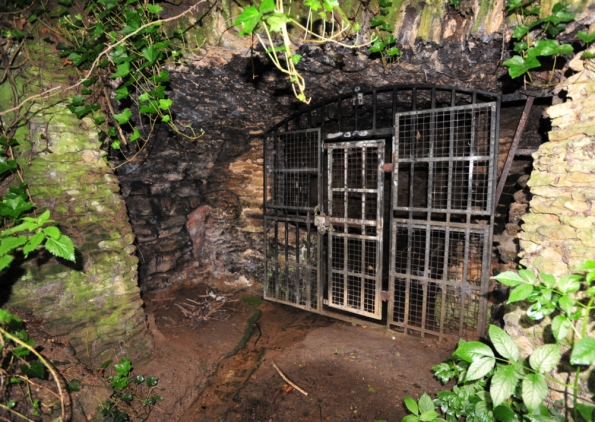
But local legends insist that the tunnels—or, perhaps, just one very large tunnel—might, in fact, be real. To this end, an amateur archaeologist named Jay Beecher, who works in a local bank by day, has “been intrigued by the legend of the tunnel ever since he was a young boy when he was regaled with tales that had been passed down the generations of a mysterious passageway under the city.” This “mysterious passageway under the city” would be nearly 800 years old, by his reckoning, and more than a mile in length. “Medieval monks may have used the tunnel as a safe route to visit a sacred spring at Holywell to bathe in its healing waters,” we read.

Although Beecher has found indications of the tunnel on city maps, not everyone is convinced, claiming the whole thing is just “folklore.” But it is oddly ubiquitous folklore. One former resident of town who contacted the newspaper “claimed that a series of tunnels ran between Peterborough and Thorney via a secret underground chapel.” Another “said that he recalled seeing part of a tunnel in the cellar at a home in Norfolk Street, Peterborough,” as if the tunnel flashes in and out of existence around town, from basement to basement, church cellar to pub storage room, more a portal or instance gate than an actual part of the built environment. And then, of course, there is the surreal childhood memory—or nightmare—recounted by the “grandmother” quoted above who once crawled beneath the town church with 25 of her schoolmates, worried that they’d all be buried alive in the center of town (surely the narrative premise of a childhood anxiety dream if there ever was one).

No word yet if Beecher has found his archaeological evidence, but the fact that this particular spatial feature makes an appearance in the dreams, memories, or confused geographic fantasies of the people who live there—as if their town can only be complete given this subterranean underside, a buried twin lost beneath churches—is in and of itself remarkable.

(If this interests you—or even if it doesn’t—take a quick look at BLDGBLOG’s tour through the tunnels and sand mines of Nottingham, or stop by this older post on the “undiscovered bedrooms of Manhattan“).

On the Road Again

[Image: Muscovites forced to masks against smoke from the burning forests and peat bogs of a drought-stricken Russia; photo by Alexander Demianchuk/Reuters].

I’ll be on the road for the next week or more, driving west, reading The Dead Hand on our long-delayed move back to Los Angeles, so things will be a bit quiet here. In the absence of regular posts, however, some links worth checking out include Pruned‘s proposal for a “conflict zoo,” or a wildlife arena “that only exhibits animals affected by man-made disasters.”

Instead of showcasing the planet’s marvelous natural beauty and ecological diversity, it collects living artifacts from sites of disturbances, where culture messily intersects with the wilderness… In addition to refugees from the Gulf Coast oil spill, it would also house samples of local fauna affected by other large oil spills, including the one in Dalian, China, koalas saved from bushfires, elephants displaced by civil wars, gorillas smuggled out during outbreaks of genocide, and tropical birds caught in the crossfires between loggers, indigenous tribes and the Landless Workers’ Movement.

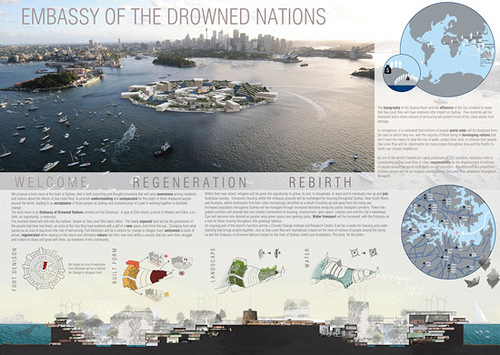
While you’re there, Pruned‘s idea for animals repurposing themselves as a kind of living GPS system is pretty amazing, and the Embassy of the Drowned Nations, also featured on that blog, is worth a gander.

[Image: The Embassy of the Drowned Nations by OCULUS].

The opening image of this post, meanwhile, comes from the ongoing fires in Russia, where 30% of the nation’s grain has been destroyed. These drought-induced fires, however, might soon get a lot more frightening:

As if things in Russia were not looking sufficiently apocalyptic already, with 100-degree temperatures and noxious fumes rolling in from burning peat bogs and forests, there is growing alarm here that fires in regions coated with fallout from the Chernobyl nuclear disaster 24 years ago could now be emitting plumes of radioactive smoke.

But were these fires predicted? Are they simply the expected outcome of an already long-thawing landscape—part of what has been described as the “methane time bomb” hiding in the soils and seabeds of the Arctic region? As such, the “coils of pungent smoke [that] threaded into apartment buildings, offices and metro stations” in Moscow—a city where 700 people are now dying everyday—might be a more regular occurrence in the years to come.

Speaking of grain harvests being interrupted and destroyed, NPR recently interviewed Evan Fraser—who was an electrifying speaker at Foodprint Toronto last week—about “how food empires fail and if America [sic] is next.” One of Fraser’s explicit references is a failure of the grain harvest in Russia.

In any case, some other headlines to read (though many continue this unexpectedly apocalyptic tone): Google is buying unmanned aerial drones, because they’re “brilliant for mapping entire neighbourhoods”; a 53,000-year old “Neanderthal bedroom” has been discovered in a cave in Spain; Dubai is plagued with “deserted highways, empty hotel rooms, [and] miles of unsold residential and office space,” but don’t tell that to the city’s boosters, who disappointingly rely on taking quotations out of context to get their point across; just as we read that a globally vital seed bank, where “more than 90% of the plants are found in no other research collection or seed bank,” is on the verge of being destroyed by property developers, we also read that genetically modified crops have escaped into the wild in the U.S., where they threaten to become herbicide-resistant “super-weeds” (like something out of the fiction of John Wyndham); and, amidst all this, Elon Musk, a “brilliant entrepreneur who made a fortune from the internet and has invested vast amounts of it in building his own private space rocket company,” is “planning to retire to Mars.”

Perhaps, once he’s there, he could find a use for robots that “swim through sand like a fish through water,” transforming that desert planet into an unlikely ocean.

Captive America: An Interview with Alyse Emdur

[Image: Prison Visiting Room Backdrop, Woodbourne Correctional Facility, New York; photograph by Alyse Emdur].

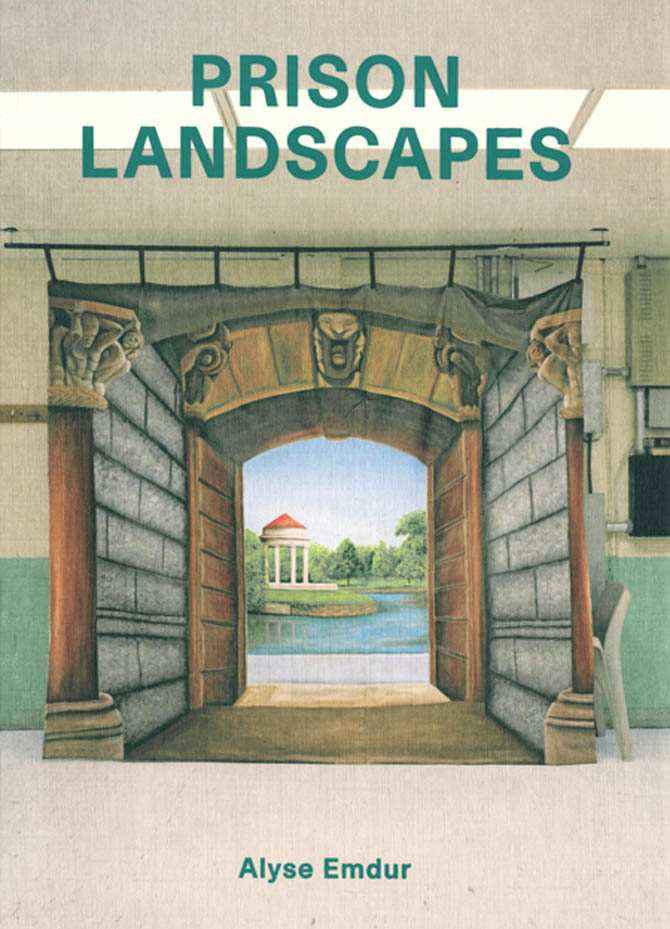
Earlier this year, Venue published an interview with Los Angeles-based photographer Alyse Emdur discussing her project Prison Landscapes. I thought Emdur’s work—a look at the unexpected landscape paintings used as photographic backdrops in prison waiting rooms throughout the United States—deserved a second look, so I am re-posting the interview here.

Venue, of course, is a joint project between BLDGBLOG and Nicola Twilley of Edible Geography, and it is supported by the Nevada Museum of Art‘s Center for Art + Environment.

The full interview, along with its original introduction, appears below.

[Image: Prison Landscapes, published January 2013 by Four Corners Books].

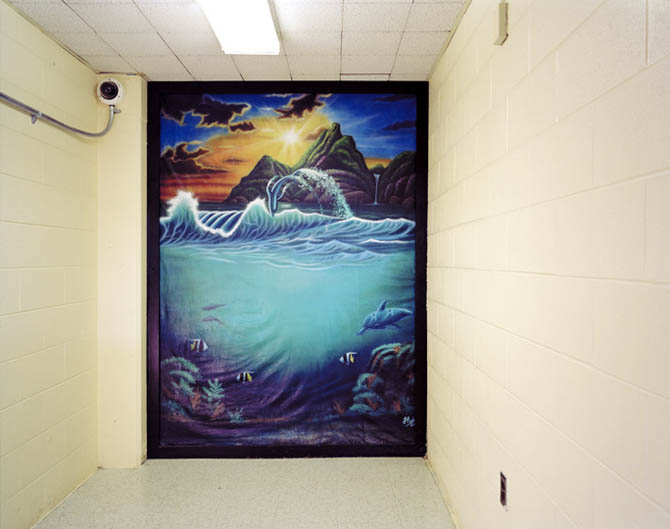
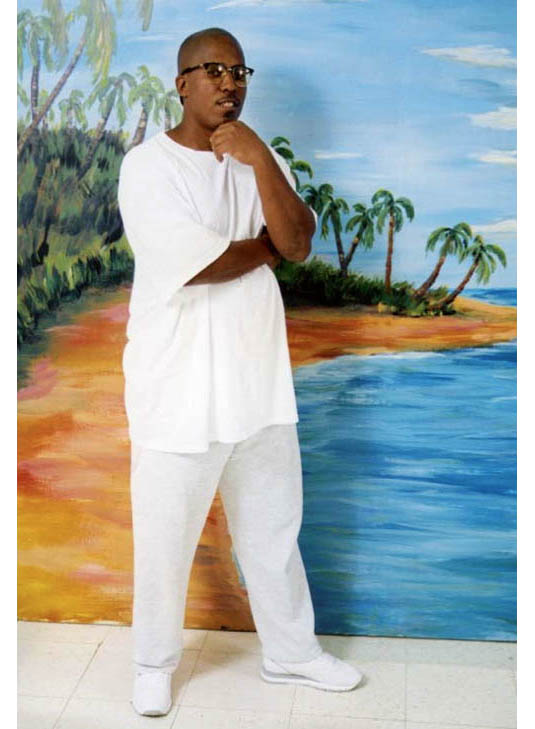
Some of the most unsettling examples of contemporary landscape painting in the United States are to be found in its prison visiting rooms, where they function as visual backdrops for family photographs.

[Image: James Bowlin, United States Penitentiary, Marion, Illinois; photograph courtesy Alyse Emdur. Note the fake trout].

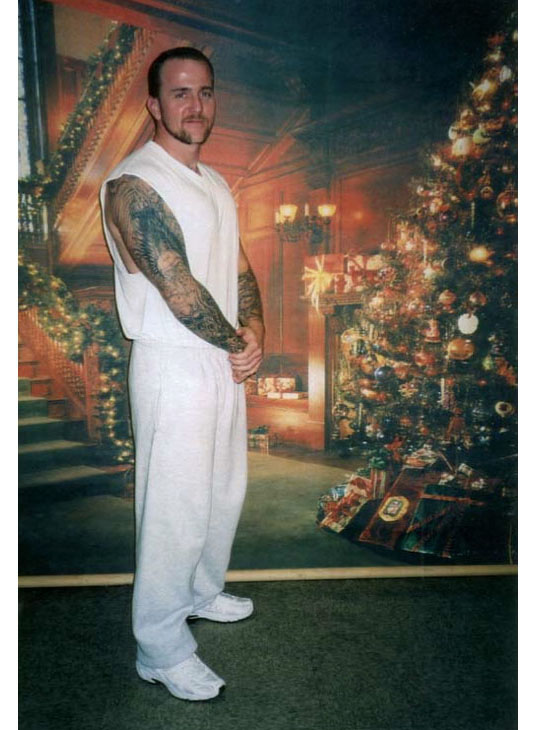
Ranging in subject matter from picturesque waterfalls to urban streetscapes, and from ski resorts to medieval castles, these large-format paintings serve a dual purpose: for the authorities, they help to restrict photography of sensitive prison facilities; for the prisoners and their families, they are an escapist fiction, constructing an alternate reality for later display on fridge doors and mantlepieces.

With nearly 2.3 million Americans in prison today—an astonishing one out of every hundred adults in the United States, according to a 2008 Pew study (PDF)—this school of landscape art is critically overlooked but has a mass-market penetration comparable to the work of Thomas Kinkade. And, like Kinkade’s work, these backdrops—which are usually painted by talented, self-taught inmates—are simultaneously photo-realistic and highly idealized. Cumulatively, they represent a catalog of imagined utopias: scenes from an abstracted and perfect elsewhere, painted from behind bars.

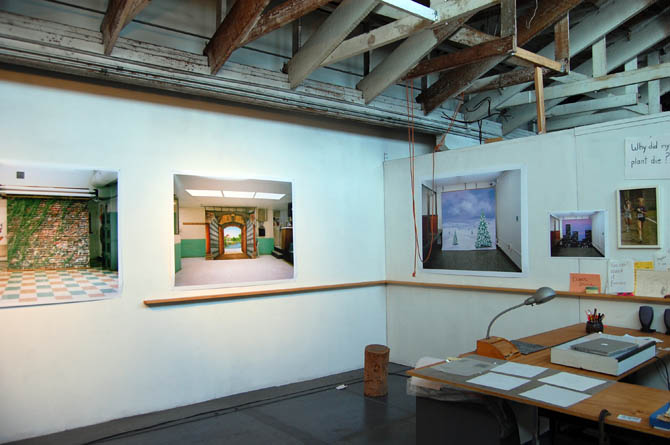
[Image: Prison Visiting Room Backdrop, Shawangunk Correctional Facility, New York; photograph by Alyse Emdur. Unlike the family portraits, Emdur’s own large-format photographs deliberately show the prison context that surrounds the backdrop landscape, for an unsettling contrast].

Several years ago, artist Alyse Emdur was looking through a family album when she came across a photo of herself as a little girl, posing in front of a tropical beach scene while visiting her elder brother in prison. She spent the next few years exploring this surprising body of vernacular landscape imagery, tracking down examples across the United States.

[Image: Emdur family photo in front of prison visiting room backdrop; photograph courtesy Alyse Emdur].

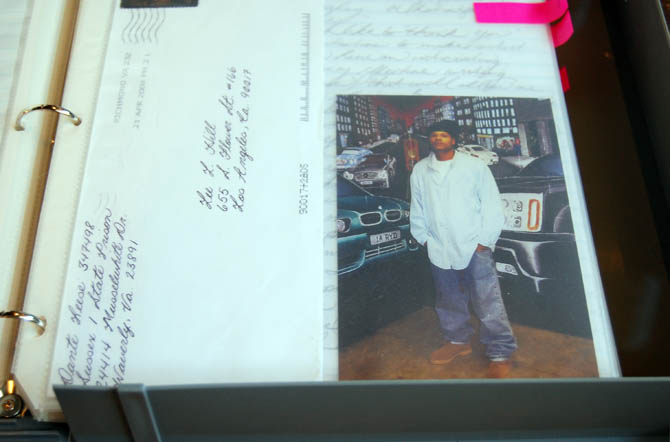
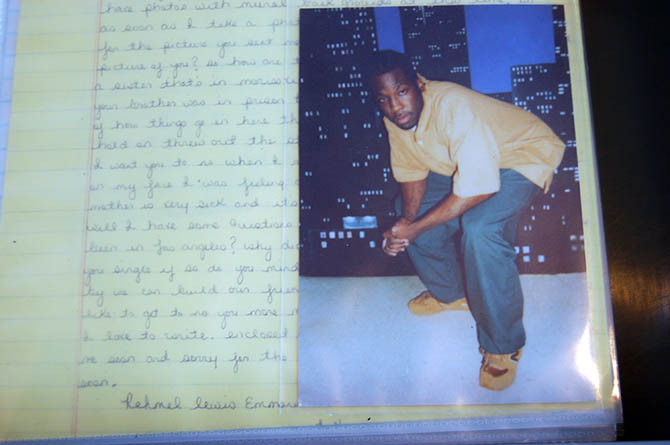
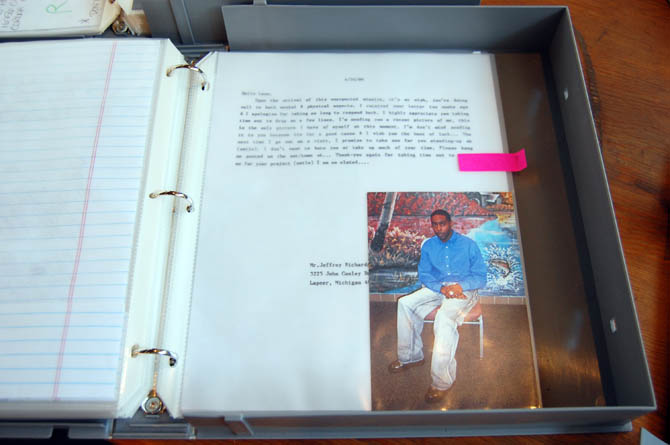
At first, she wrote to prison administrators to ask permission to photograph the backdrops herself—a request that was inevitably firmly denied. Instead, she joined prisoner pen-pal sites, asking inmates to send her pictures of themselves posed in front of their prison’s backdrops; through this method, Emdur eventually assembling several hundred photos and more than sixteen binders full of correspondence. Finally, in summer 2011, she gained permission to visit and photograph several prison visiting room backdrops herself.

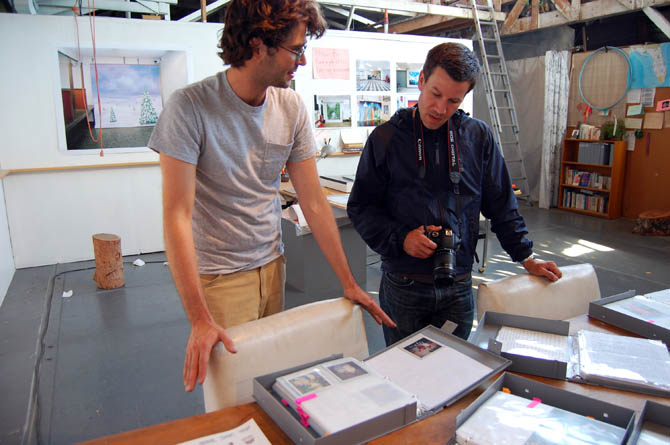
[Image: Michael Parker and Geoff Manaugh looking at Alyse Emdur‘s correspondence and work in Emdur’s studio space; photograph by Venue].

Venue visited Emdur’s studio in downtown Los Angeles in the summer of 2012, as she was collecting all this material for a book, Prison Landscapes, published in January 2013 by Four Corners Books. After a studio tour conducted by her partner, artist Michael Parker, we followed up with Emdur by phone: the edited transcript of our conversation follows.

• • •

[Image: Alyse Emdur‘s large-format photographs of prison visiting room backdrops on her studio walls; photograph by Venue].

Nicola Twilley: From the hundreds of photographs that prisoners sent you, as well as the ten or so backdrops that you were able to photograph yourself, it seems as though there is almost a set list of subject matter: glittering cityscapes, scenes of natural landscapes, like beaches and sunsets, and then historical or fantasy architecture, such as medieval castles. Did you notice any patterns or geographic specificity to these variations in subject matter?

Alyse Emdur: You do see some regional realism—so, prisons in Washington State will have evergreen trees in their backdrops, prisons in Florida will have white sand beaches, and prisons in Louisiana will have New Orleans French Quarter-style features. There’s also the question of where the prisoners are from: one thing that I’ve observed is that in upstate New York, for example, many of the prisoners are actually from New York City, so many of the backdrops in upstate New York prisons show New York City skylines.

Fantastical scenes are actually much less common—from what I gather from my correspondence, realism is like gold in prison. That’s the form of artistic expression that’s most appreciated and most respected, so that’s often the goal for the backdrop painter.

[Image: Brandon Jones, United States Penitentiary, Marion, Illinois; photograph courtesy Alyse Emdur].

Twilley: Do you have a sense of how you get to be a backdrop painter—do inmates chose amongst themselves or do the prison authorities just make a selection? And, on a similar note, how much artistic freedom does the backdrop painter actually have, in terms of needing approval of his or her subject matter from fellow inmates or the authorities?

Emdur: That’s one of the questions that I’ve asked of all the backdrop painters who I’ve been in touch with over the years. The answer is always that if you are a “good artist” in prison, then you’re very well-respected within the prison—people in the prison all know you. You’ll be making greeting cards for people or you’ll be doing hand calligraphy for love letters for friends in prison—you’ll be known for your skills. The prison administration is already aware of the respected artists, because they shine within the culture, and so they are usually the ones that are chosen. And when you’re chosen, it’s a huge honor.

[Image: Genesis Asiatic, Powhatan Correctional Center, Statefarm, Virginia; photograph courtesy Alyse Emdur].

Something to keep in mind, though, is that backdrops do get painted over. In some prisons, the backdrop can change a few times a year.

One of the artists I’ve kept in touch with is Darrell Van Mastrigt—I interviewed him for the book, and he painted a backdrop for me that was in my thesis show. In the prison that he’s in, the portrait studios are organized by the NAACP. He said that the NAACP had seen his paintings in the past, and when they selected him, they gave him creative control over what sort of landscape he chose to paint.

Obviously, there are some rules. The main restriction is that you can’t use certain colors that are affiliated with gangs. So, for instance, Darrell painted a mural with two cars and they had to be green and purple—they couldn’t be red or blue. But, from what Darrell has told me and from what I understand from other painters, they don’t get much input from other prisoners. At the same time, they’re very conscious of wanting to please people and maintain their status within the prison, of course, and they get a lot of pleasure out of doing something positive for families in the visiting room.

One of sixteen binders full of letters and prisoner portraits mailed to Emdur; photograph by Venue].

Another interesting thing a painter told me was that she was very conscious of not wanting to do a specific, recognizable cityscape, because she knew that not everyone in the prison was from the city. So she deliberately tried to paint a more abstract landscape that she thought anyone could relate to. And a lot of imagery they work from is from books in the prison library, rather than just their memories.

Twilley: In some of the photographs you were sent, the prisoners are in front of off-the-shelf printed backdrops—some offering multiple pull-down choices—rather than hand-painted ones. Are these standardized commercial backdrops gradually replacing the inmate-produced landscapes?

Emdur: The backdrop-painting tradition is definitely still vibrant and strong, but my sense is that these store-bought backdrops are becoming more and more common.

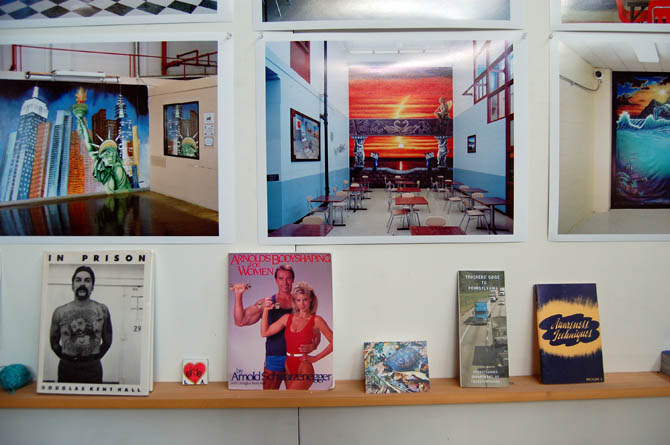
For one thing, the hand-painted backdrops are not always as realistic as a photograph, and, often, the prisoners and their families are looking to create the illusion that they really are somewhere else. So, the more realistic, the better. When I went to photograph a backdrop in one New York State prison, I found an amazing hand-painted mural of a New York City skyscraper with a cartoon-like Statue of Liberty in front—she almost looked alive. But it had been completely covered up by a pull-down, store-bought, photographic backdrop of the New York City skyline. I tried to photograph the backdrop in Fort Dix Federal Prison in New Jersey and they told me that they had just painted over the hand-painted backdrop and replaced it with a commercial photography backdrop.

[Image: Small prints of Emdur‘s backdrop photographs on her studio wall, alongside a few examples of her extensive collection of self-help books; photograph by Venue. Note the hand-painted cityscape featuring the Statue of Liberty on the left].

Of course, another thing is that it’s easier to buy a backdrop than it is to engage with a prisoner, you know? And attitudes vary from prison to prison. In some prisons, you’ll find murals throughout the facility, not just in the visiting rooms. I went on a tour of a privately-operated women’s prison in Florida, for instance, that lasted four hours because there were paintings everywhere—in all the hallways, dorm rooms, and offices. The PR person who assisted me on that tour explained that having prisoners paint murals is really a way to keep them busy and out of trouble, so they saw it as a really positive activity.

Of course, I see these paintings as a way for people in prison to temporarily escape the architecture and culture of confinement, and that’s what makes them so important for me.

[Image: Antoine Ealy, Federal Correctional Complex, Coleman, Florida; photograph courtesy Alyse Emdur].

Twilley: There’s an uncomfortable overlap between the escapism of the landscapes and then the other purpose of the backdrops, which is to not allow photographs of the prison interior to get out.

Emdur: Yes—I found that really concerning. The prison administration either thinks that photographs of the interior of the prison could help inmates escape or, at the very least, the administrators are trying to control the imagery of the prison that reaches the outside world.

During my research, I’ve been trying to figure out how long these kinds of backdrops have been used. From prison administrators to PR people to wardens and prisoners, everyone told me they don’t even remember—these kinds of painted backdrops have been used in visiting rooms for as long as they can remember. I’ve spoken to a sixty-five-year-old warden who just said, “You know, they’ve been here longer than I have.”

[Image: Robert RuffBey, United States Penitentiary, Atlanta, Georgia; photograph courtesy Alyse Emdur].

I do know that at some point in the last twenty years, companies came along that would charge inmates to substitute in a different backdrop. If you’re a prisoner and you have a photograph of yourself or yourself and your kids in front of the painted backdrop in the visiting room, then you could send your photograph to one of these companies and they would take out the painting and then put in a Photoshop background. That’s not very common at all, but it’s pretty bizarre—one fake landscape being replaced by another.

Going along with that is the replacement of Polaroid with digital photography. All these portraits were Polaroid up until the last five to ten years, I would say. Some prisons still use Polaroids, but from what I gather, it’s basically all digital now.

[Image: One of sixteen binders full of letters and prisoner portraits mailed to Emdur; photograph by Venue].

One thing to remember is that all the prisons have slightly different rules and they all organize their prison portrait programs differently. In most state and federal prisons in America, the only place where a prisoner can be photographed is in front of these backdrops, and the only time they can be photographed in front of the backdrops is when they have a visitor—but, then, there are all these exceptions.

At some prisons, for instance, you can get your picture taken at special events, like graduations or holiday parties. Then, some prisons have murals elsewhere in the prison, not in the visiting room, that you can sign up once a month or something to have your picture taken in front of.

[Image: Kimberly Buntyn, Valley State Prison for Women, Chowchilla, California; photograph courtesy Alyse Emdur].

This question of the kinds of images of prisons that are allowed out is quite interesting. In fact, I’m working with a photographer who’s been in prison for almost 30 years in Michigan, on what I think will be my next book. In the 1970s and 80s, he ran the photo lab in Jackson Prison, and he was in charge of developing and printing all the inmates’ photographs. At that time, the rules of photography were very different in prison—there just weren’t as many rules, basically. This guy has hundreds of photographs from all over Jackson State Prison.

It’s just fascinating to see the differences between these very staged and framed visiting room portraits and the reality of the prison as seen through this guy’s eyes—through an insider’s eyes. I think his situation was extremely rare when it happened, but today it’s totally unheard of. The majority of photographs that come out of prisons today are these visiting room portraits. I suppose some prisoners are smuggling cell phones with cameras into prison, but those images aren’t easy to find!

[Images: Sixteen binders’ worth of letters and prisoner portraits have been mailed to Emdur over the course of her project; photographs by Venue. Several of Emdur‘s pen-pals adopted the so-called “prison pose“—a low crouch—while others incorporated props or flexed their muscles].

Geoff Manaugh: Both Nicky and I were amazed by the amount of correspondence you’ve gathered in the process of researching these backdrops—binder after binder organized and shelved in your studio—but I can’t imagine that it’s been easy to edit it all down into a book, or to get releases from all the prisoners, for example. How has that process worked?

Emdur: It’s been really tough. With 2.3 million Americans in prison today, just think how many of these portrait studio photographs there are circulating in family albums and frames all across the country. A big part of me wants to document more and more and more. But, for a book, I figured it was really important to step back a little bit and not go crazy, and instead try to focus and pull out the different genres of backdrops and the different poses and the stories.

In terms of the process of getting releases, that was a huge effort. As you know, I collected the images through contacting prisoners on pen-pal websites. I sent out something like 300 letters and about 150 inmates responded really quickly with photographs of themselves in front of these backdrops.

A lot of prisoners are looking for engagement with the outside world, so it was very easy to collect the images. The challenging thing was getting releases for publication. Tracking down people who’d been released was one thing. For minors, we wanted to get our release approvals from both the incarcerated parents and also from the non-incarcerated parents, and that really was challenging.

[Image: A binder of letters and prisoner portraits mailed to Emdur; photograph by Venue].

But, really, the most difficult thing for me about this project is just how emotionally challenging it is—how draining it is—to correspond with hundreds of people who have a very different reality than I have and live a very different life than I do and who don’t have the privileges that I would normally take for granted.

The relationship between the incarcerated and the free is a very complex relationship, and that’s something that I’m interested in showing in the book, and that I hope comes out in the correspondence.

• • •

For more Venue interviews, focusing on human interactions with the built, natural, and virtual environments, check out the Venue website in full.

Meanwhile, Michael Parker—the artist who showed us around the studio space he shares with Alyse Emdur—has some projects of his own worth checking out, in particular, his work Lineman, which documents, in film, photographs, and interviews, “an electrical lineman class at Los Angeles Trade-Technical College” where adult students learn “how to become power-pole technicians.”

Ghost War

[Image: A “ghost” tank; image via PBS].

In his recent book How to Wreck a Nice Beach: The Vocoder from World War II to Hip-Hop, author Dave Tompkins tells the story of how a military voice-scrambling technology (the vocoder) became absorbed by civilian pop culture in the form of artificial, robotized vocal effects.

While still exploring the sound’s WWII origins, Tompkins describes “ghost armies” conjured from nothing using sensory technologies as part of a “sonic deception strategy” practiced on the battlefield. “During World War II,” he writes, “artifice—the illusion of conflict—was a weapon in itself. There were wooden bombs, fake factories, inflatable tanks, synthetic fogs, electronically generated ghost armies, psychoacoustic ventriloquists, and magicians hired to make the coastline disappear.”

Technologists from places like Bell Labs unleashed hi-fi wizardry against the adversary, including misleading sound effects built into torpedoes and “artificial screaming bombs” that, to put this in somewhat Friedrich Kittler-like terms, turned warfare into a kind of lethal, all-encompassing, international discotheque of blinding lights and disembodied shock waves, a carnivalesque over-investment in technology’s fatal side-effects, distracting people long enough that they could be destroyed.

[Image: Signal Corps officers look at militarized turntables in Paris; via the Audio Engineering Society, and featured in Tompkins’s book].

So it was interesting to see last week that PBS has produced a documentary called Ghost Army:

In the summer of 1944, a handpicked group of G.I.s landed in France with truckloads of inflatable tanks, a massive collection of sound effects records, and more than a few tricks up their sleeves. They staged a traveling road show of deception on the battlefields of Europe, aimed at Hitler’s legions. From Normandy to the Rhine, the 1100 men of the 23rd Headquarters Special Troops—the Ghost Army—conjured up phony convoys, phantom divisions, and make-believe headquarters to fool the enemy about the strength and location of American units. Every move they made was top secret and their story was hushed up for decades after the war’s end.

Amongst their crew were “sonics experts” who “made an early use of multi-leveled mixing to replicate the sounds of a massive military unit on the move.”


You can watch the full episode in the embedded video, above.

(Related: Starfish City, Space in the Adaptive Plastic, and many more old posts from the BLDGBLOG archives).

Ground Sounds

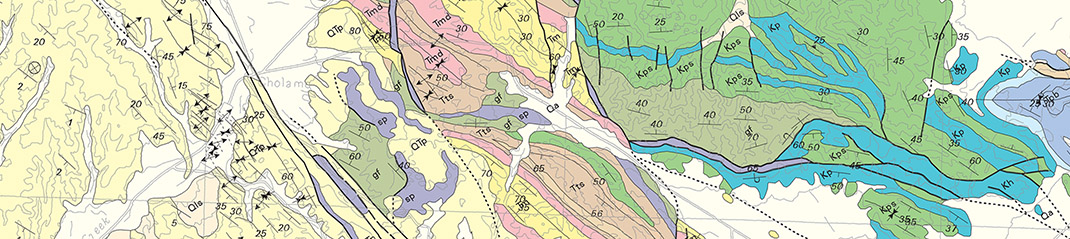
[Image: From a map of the San Andreas Fault, cutting through the Carrizo Plain, by T.W. Dibblee (1973), courtesy of the USGS].

Those of you sonically inclined might be interested in the latest weekend challenge from Marc Weidenbaum‘s Disquiet Junto project: “Read a map of the San Andreas Fault as if it were a graphic notation score,” and then post the acoustic results to Soundcloud.

[Images: From a map of the San Andreas Fault, cutting through the Carrizo Plain, by T.W. Dibblee (1973), courtesy of the USGS].

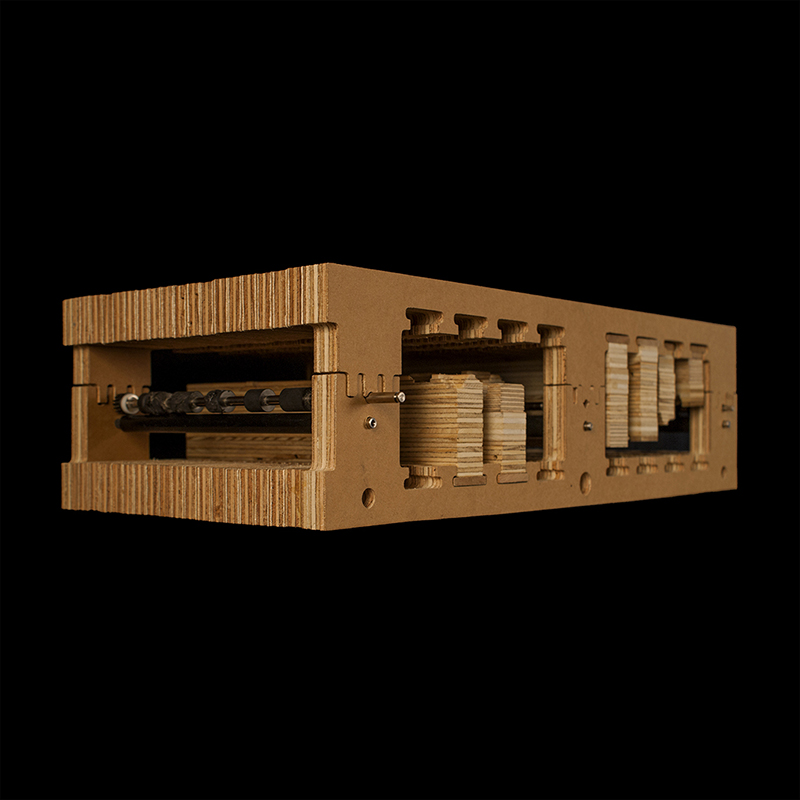
This collaboration-at-a-distance between BLDGBLOG and the Disquiet Junto comes as a kind of sonic follow-up to the San Andreas Fault National Park architectural design studio I taught this past semester at Columbia, part of which involved designing architectural “devices” or “instruments” for the San Andreas.

[Images: An architectural “instrument” for the San Andreas Fault, designed and fabricated by student David Hecht at GSAPP].

However, the Disquiet Junto challenge literalizes the notion of the “instrument” a bit more, specifically listening for the sonic implications of the Fault.

Partially inspired by earlier graphic and musical explorations, by such composers as John Cage and Cornelius Cardew, among many, many others, the basic idea is that geologic maps of the San Andreas can themselves be “interpreted”—or perhaps willfully misinterpreted is more accurate—as a musical score.

They are, in Marc Weidenbaum’s words, a “faulty notation” for pieces of music that do not yet exist.

[Images: From a map of the San Andreas Fault, cutting through the Carrizo Plain, by T.W. Dibblee (1973), courtesy of the USGS].

You can find out more about how to participate over at the Disquiet website. However, compositions are due Monday, May 27th, so, if you’re interested, you need to dive in straightaway.

Listen to previous Disquiet sound challenges on the group’s Soundcloud page (and consider following Marc Weidenbaum on Twitter for reliably interesting sonic news and world reports).

Update: Listen to nearly three hours of ambient compositions resulting from the challenge.

Geomedia

[Image: “Laser Cut Record” by Amanda Ghassaei].

An incredible example of what can be done with laser-cutting, Amanda Ghassaei’s project “Laser Cut Record” features music inscribed directly into cut discs of maple wood, acrylic, and paper, resulting in lo-fi but playable records.

For what they are, the otherwise scratchy and off-kilter audio quality is actually quite amazing, and the sounds themselves are made all the more haunting and strange by the crackling noise and resonance of the material that hosts them.

[Image: “Laser Cut Record” by Amanda Ghassaei].

Some technical details are available at Ghassaei’s Instructables page, and you can see the laser-cutting itself at work in the following video.


I’m reminded of a short letter called “Acoustic Recordings from Antiquity,” written to the Proceedings of the IEEE in August 1969 by a man named Richard G. Woodbridge III. The somewhat eccentric Mr. Woodbridge explains that he has been researching accidental recording of sounds found, after careful analysis, on the surfaces of physical objects rescued from antiquity—in particular, pieces of pottery originally shaped on potters’ wheels (seen here as a kind of primordial record platter).

Woodbridge even claims some sounds have been “recorded” as re-playable waves in the slowly drying shapes of oil paintings.

To listen to these lost recordings, the letter suggests, you simply hold a record cartridge near the work of pottery in question, such that the needle of the phonograph can “be positioned against a revolving pot mounted on a phono turntable (adjustable speed) ‘stroked’ along a paint stroke, etc.” When this was done properly, he claimed, a “low-frequency chatter sound could be heard in the earphones.”

That is, the voices of people present in the room during the making of the pot could be re-played from the surface of the pot itself.

[Image: “Laser Cut Record” by Amanda Ghassaei].

Woodbridge suggests that this might have alternative applications: “This is of particular interest as it introduces the possibility of actually recalling and hearing the voices and words of eminent personages as recorded in the paint of their portraits or of famous artists in their pictures.” So an experiment was orchestrated:

With an artist’s brush, paint strokes were applied to the surface of the canvas using “oil” paints involving a variety of plasticities, thicknesses, layers, etc., while martial music was played on the nearby phonograph. Visual examination at low magnification showed that certain strokes had the expected transverse striated appearance. When such strokes, after drying, were gently stroked by the “needle” (small, wooden, spade-like) of the crystal cartridge, at as close to the original stroke speed as possible, short snatches of the original music could be identified.

Through this technique, the overlooked—overlistened?—acoustic qualities of various objects, beyond high-brow pottery and oil paintings, can thus be revealed:

Many situations leading to the possibility of adventitious acoustic recording in past times have been given consideration. These, for example, might consist of scratches, markings, engravings, grooves, chasings, smears, etc., on or in “plastic” materials encompassing metal, wax, wood, bone, mud, paint, crystal, and many others. Artifacts could include objects of personal adornment, sword blades, arrow shafts, pots, engraving plates, paintings, and various items of calligraphic interest.

Woodbridge calls the pursuit and revelation of these sounds “acoustic archaeology.”

[Image: Like the rings of Saturn, from “Laser Cut Record” by Amanda Ghassaei; in fact, perhaps the rings of Saturn are an unread recording…].

But why stop at sounds?

Perhaps in two years’ time, we’ll watch as Amanda Ghassaei cuts DVDs—”the data on a DVD is encoded in the form of small pits and bumps in the track of the disc“—with a combined and simultaneous laser-cutter/3D printer ensemble, coating inscribed “small pits and bumps” with reflective metals.

Suddenly, wood, rock, metal, even exposed geology in situ can host visual content. Indeed, perhaps it already does, but we haven’t invented—or we simply haven’t applied—the right technologies for decoding it. In other words, we have DVD players; we just haven’t, learning from Richard G. Woodbridge III, used them to “read” other materials.

In August 2015, you and some friends hike up to a rock wall in the middle of Utah, and there are DVDs printed all over the surface of the hillside, full-length albums laser-burned into White Rim sandstone, and audio-visual pilgrims carrying deconstructed laser-lens systems, scanning for hidden film fests and warbling soundtracks, swarm every surface all around them.

It’s the rise of geomedia.

In the Box: A Tour Through the Simulated Battlefields of the U.S. National Training Center

[Image: Photo courtesy of Venue].

(This post originally published on Venue).

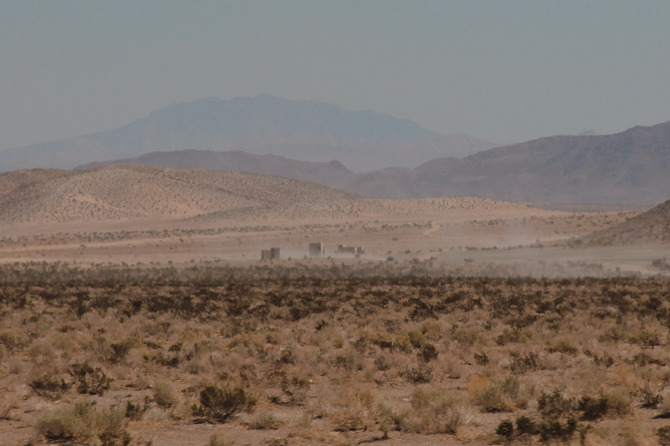
Fort Irwin is a U.S. army base nearly the size of Rhode Island, located in the Mojave Desert about an hour’s drive northeast of Barstow, California. There you will find the National Training Center, or NTC, at which all U.S. troops, from all services, spend a twenty-one day rotation before they deploy overseas.

[Image: Photo courtesy of Venue].

Sprawling and often infernally hot in the summer months, the base offers free tours, open to the public, twice a month. Venue—BLDGBLOG’s ongoing collaboration with Edible Geography’s Nicola Twilley, supported by the Nevada Museum of Art‘s Center for Art + Environment—made the trip, cameras in hand and notebooks at the ready, to learn more about the simulated battlefields in which imaginary conflicts loop, day after day, without end.
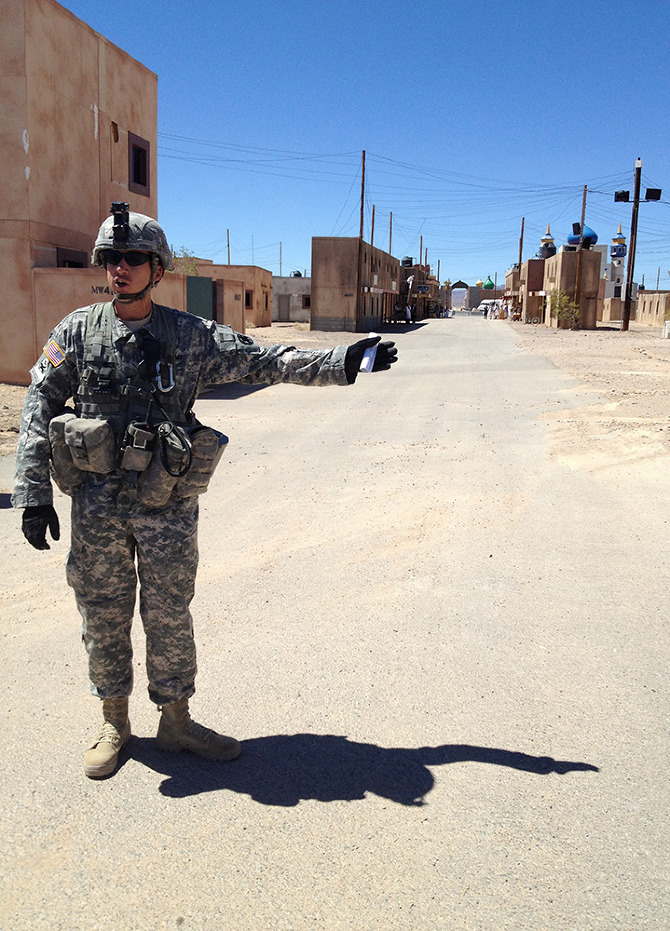
[Images: Photos courtesy of Venue].

Coincidentally, as we explored the Painted Rocks located just outside the gate while waiting for the tour to start, an old acquaintance from Los Angeles—architect and geographer Rick Miller—pulled up in his Prius, also early for the same tour.

[Image: Photo courtesy of Venue].

We laughed, said hello, and caught up about a class Rick had been teaching at UCLA about the military defense of L.A. during World War II, through to the present. An artificial battlefield, beyond even the furthest fringes of Los Angeles, Fort Irwin thus seemed like an appropriate place to meet.
[Image: Photo courtesy of Venue].

We were soon joined by a small group of other visitors—consisting, for the most part, of family members of soldiers deployed on the base, as well as two architecture students from Montréal—before a large white tour bus rolled up across the gravel.

Renita, a former combat videographer who now handles public affairs at Fort Irwin, took our names, IDs, and signatures for reasons of liability (we would be seeing live explosions and simulated gunfire, and there was always the risk that someone might get hurt).

[Image: Photo courtesy of Venue].

The day began with a glimpse into the economics and culture of how a nation prepares its soldiers for war; an orientation, of sorts, before we headed out to visit one of fifteen artificial cities scattered throughout the base.
[Image: Photo courtesy of Venue].

In the plush lecture hall used for “After Action Reviews”—and thus, Renita apologized, air-conditioned to a morgue-like chill in order to keep soldiers awake as their adrenalin levels crash—we received a briefing from the base’s commander, Brigadier General Terry Ferrell.

With pride, Ferrell noted that Fort Irwin is the only place where the U.S. military can train using all of the systems it will later use in theater. The base’s 1,000 square miles of desert is large enough to allow what Ferrell called “great maneuverability”; its airspace is restricted; and its truly remote location ensures an uncluttered electromagnetic spectrum, meaning that troops can practice both collection and jamming. These latter techniques even include interfering with GPS, providing they warn the Federal Aviation Administration in advance.

Oddly, it’s worth noting that Fort Irwin also houses the electromagnetically sensitive Goldstone Deep Space Communications Complex, part of NASA’s global Deep Space Network. As science writer Oliver Morton explains in a paper called “Moonshine and Glue: A Thirteen-Unit Guide to the Extreme Edge of Astrophysics” (PDF), “when digitized battalions slug it out with all the tools of modern warfare, radio, radar, and electronic warfare emissions fly as freely around Fort Irwin as bullets in a battle. For people listening to signals from distant spacecraft on pre-arranged frequency bands, this noise is not too much of a problem.” However, he adds, for other, far more sensitive experiments, “radio interference from the military next door is its biggest headache.”

[Image: Photo courtesy of Venue].

Unusually for the American West, where mineral rights are often transferred separately, the military also owns the ground beneath Fort Irwin, which means that they have carved out an extensive network of tunnels and caves from which to flush pretend insurgents.

This 120-person strong insurgent troop is drawn from the base’s own Blackhorse Regiment, a division of the U.S. Army that exists solely to provide opposition. Whatever the war, the 11th Armored is always the pretend enemy. According to Ferrell, their current role as Afghan rebels is widely envied: they receive specialized training (for example, in building IEDs) and are held to “reduced grooming standards,” while their mission is simply to “stay alive and wreak havoc.”

If they die during a NTC simulation, they have to shave and go back on detail on the base, Ferrell added, so the incentive to evade their American opponents is strong.

[Image: Photo courtesy of Venue].

In addition to the in-house enemy regiment, there is an entire 2,200-person logistics corps dedicated to rotating units in and out of Fort Irwin and equipping them for training. Every ordnance the United States military has, with the exception of biological and chemical weapons, is used during NTC simulations, Ferrell told us. What’s more, in the interests of realism (and expense be damned), troops train using their own equipment, which means that bringing in, for example, the 10th Mountain Division (on rotation during our visit), also means transporting their tanks and helicopters from their home base at Fort Drum, New York, to California, and back again.

Units are deployed to Fort Irwin for twenty-one days, fourteen of which are spent in what Fort Irwin refers to as “The Box” (as in “sandbox”). This is the vast desert training area that includes fifteen simulated towns and the previously mentioned tunnel and caves, as well as expansive gunnery ranges and tank battle arenas.

Following our briefing, we headed out to the largest mock village in the complex, the Afghan town of Ertebat Shar, originally known, during its Iraqi incarnation, as Medina Wasl. Before we re-boarded the bus, Renita issued a stern warning: “‘Afghanistan’ is not modernized with plumbing. There are Porta-Johns, but I wanted to let you know the situation before we roll out there.”
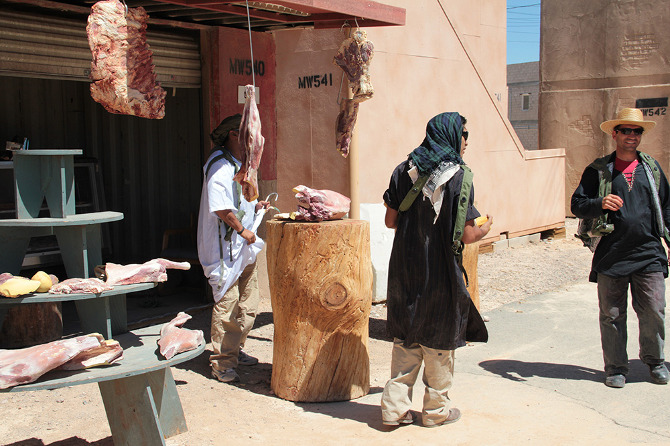
[Images: Photos courtesy of Venue].

A twenty-minute drive later, through relatively featureless desert, our visit to “Afghanistan” began with a casual walk down the main street, where we were greeted by actors trying to sell us plastic loaves of bread and piles of fake meat. Fort Irwin employs more than 350 civilian role-players, many of whom are of Middle Eastern origin, although Ferrell explained that they are still trying to recruit more Afghans, in order “to provide the texture of the culture.”

The atmosphere is strangely good-natured, which was at least partially amplified by a feeling of mild embarrassment, as the rules of engagement, so to speak, are not immediately clear; you, the visitor, are obviously aware of the fact that these people are paid actors, but it feels distinctly odd to slip into character yourself and pretend that you might want to buy some bread.
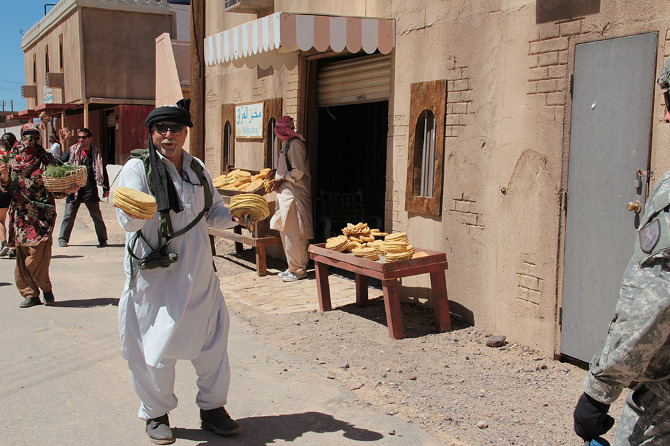
[Images: Photos courtesy of Venue].

In fact, it’s impossible not to wonder how peculiar it must be for a refugee, or even a second-generation immigrant, from Iraq or Afghanistan, to pretend to be a baker in a simulated “native” village on a military base in the California desert, only to see tourists in shorts and sunglasses walking through, smiling uncomfortably and taking photos with their phones before strolling away without saying anything.

[Image: Photo courtesy of Venue].

Even more peculiarly, as we reached the end of the street, the market—and all the actors in it—vanished behind us, dispersing back into the fake city, as if only called into being by our presence.

[Image: Photo courtesy of Venue].

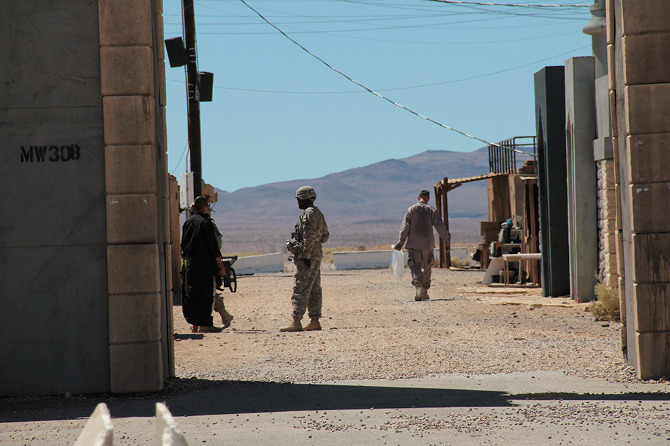
By now, with the opening act over, we were stopped in front of the town’s “Lyndon Marcus International Hotel” to take stock of our surroundings. In his earlier briefing, Ferrell had described the simulated villages’ close attention to detail—apparently, the footprint for the village came from actual satellite imagery of Baghdad, in order to accurately recreate street widths, and the step sizes inside buildings are Iraqi, rather than U.S., standard.

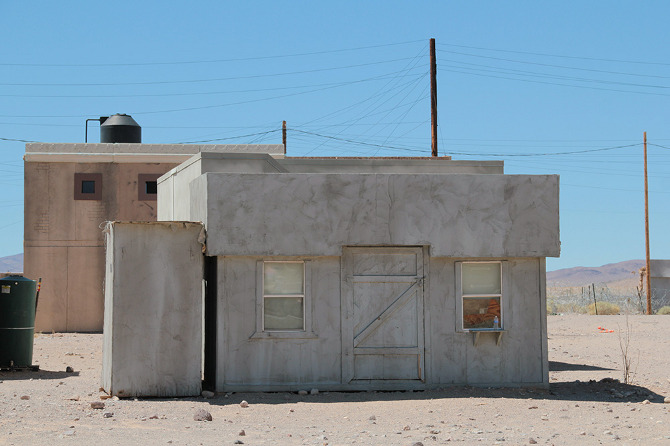
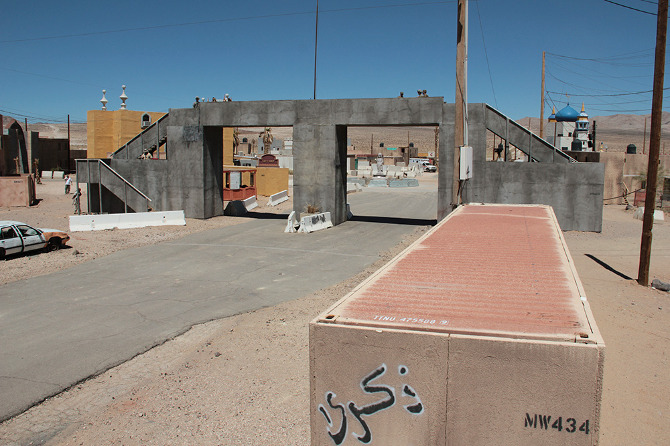
Dimensions notwithstanding, however, this is a city of cargo containers, their Orientalized facades slapped up and plastered on like make-up. Seen from above, the wooden frames of the illusion become visible and it becomes more and more clear that you are on a film set, an immersive theater of war.
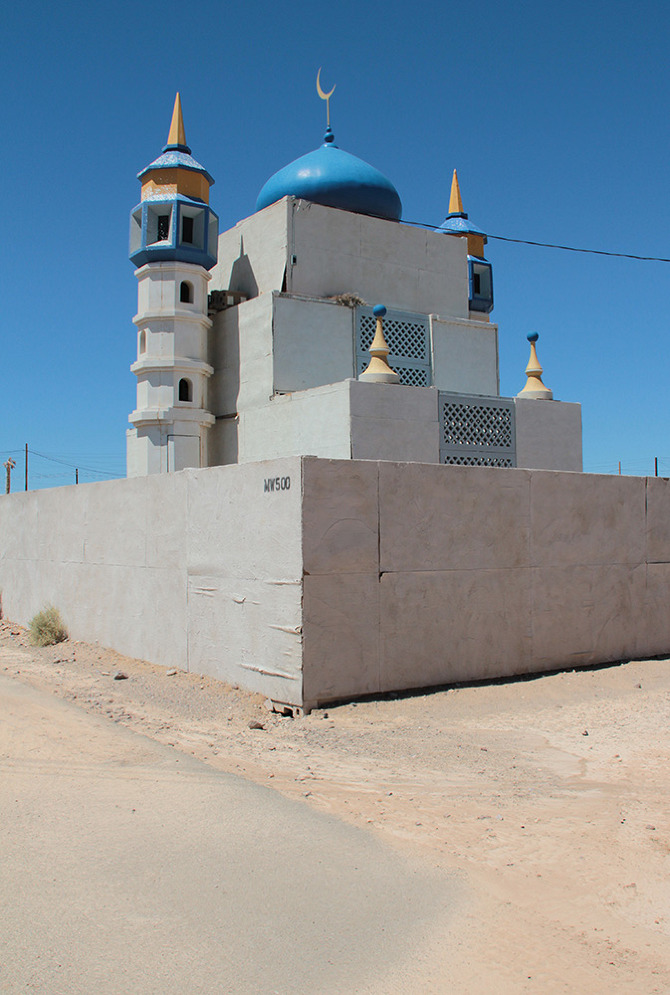
[Images: Photos courtesy of Venue].

This kind of test village has a long history in U.S. war planning. As journalist Tom Vanderbilt writes in his book Survival City, “In March 1943, with bombing attacks on cities being intensified by all sides, the U.S. Army Corps of Engineers began construction at Dugway [Utah] on a series of ‘enemy villages,’ detailed reproductions of the typical housing found in the industrial districts of cities in Germany and Japan.”

The point of the villages at Dugway, however, was not to train soldiers in urban warfare—with, for instance, simulated street battles or house-to-house clearances —but simply to test the burn capacity of the structures themselves. What sorts of explosives should the U.S. use? How much damage would result? The attention to architectural detail was simply a subset of this larger, more violent inquiry. As Vanderbilt explains, bombs at Dugway “were tested as to their effectiveness against architecture: How well the bombs penetrated the roofs of buildings (without penetrating too far), where they lodged in the building, and the intensity of the resulting fire.”

During the Cold War, combat moved away from urban settings, and Fort Irwin’s desert sandbox became the stage for massive set-piece tank battles against the “Soviet” Blackhorse Cavalry. But, in 1993, following the embarrassment of the Black Hawk Down incident in Mogadishu, Fort Irwin hosted its first urban warfare, or MOUT (Military Operations on Urbanized Terrain) exercise. This response was part of a growing realization shared amongst the armed forces, national security experts, and military contractors that future wars would again take the city as their battlefield.

[Image: Photo courtesy of Venue].

As Russell W. Glenn of the RAND Corporation puts it bluntly in his report Combat in Hell: A Consideration of Constrained Urban Warfare, “Armed forces are ever more likely to fight in cities as the world becomes increasingly urbanized.”

Massed, professional, and essentially symmetrical armies no longer confront one another on the broad forests and plains of central Europe, the new tactical thinking goes; instead, undeclared combatants living beside—sometimes even with—families in stacked apartment blocks or tight-knit courtyards send out the occasional missile, bullet, or improvised explosive device from a logistically confusing tangle of streets, and “war” becomes the spatial process of determining how to respond.

At Fort Irwin, mock villages began to pop up in the desert. They started out as “sheds bought from Shed World,” Ferrell told us, before being replaced by shipping containers, which, in turn, have been enhanced with stone siding, mosque domes, awnings, and street signs, and, in some cases, even with internal staircases and furniture, too. Indeed, Ertebat Shar/Medina Wasl began its simulated existence in 2007, with just thirteen buildings, but has since expanded to include more than two hundred structures.

The point of these architectural reproductions is no longer, as in the World War II test villages of Dugway, to find better or more efficient methods of architectural destruction; instead, these ersatz buildings and villages are used to equip troops to better navigate the complexity of urban structures—both physical, and, perhaps most importantly, socio-cultural.

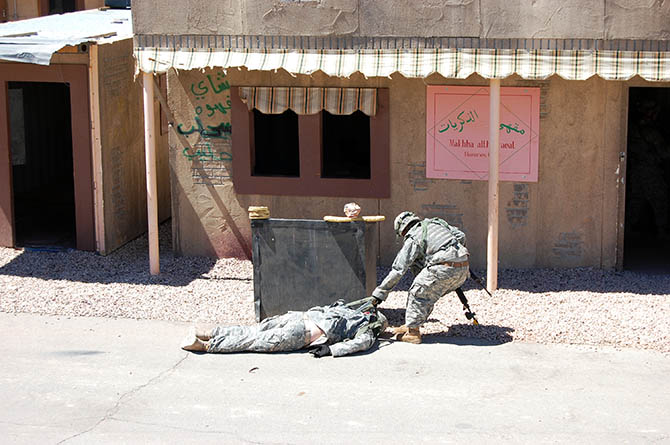
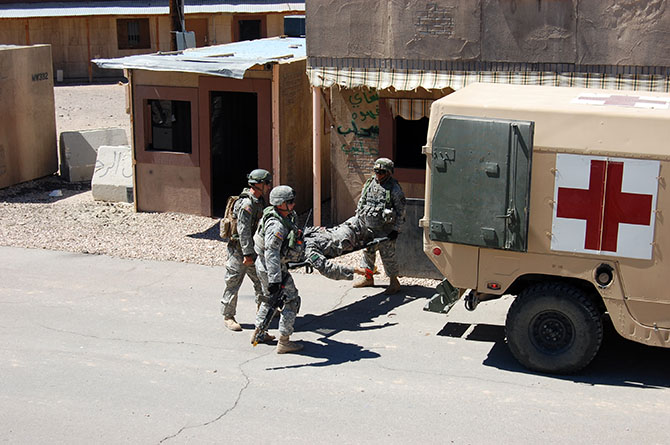
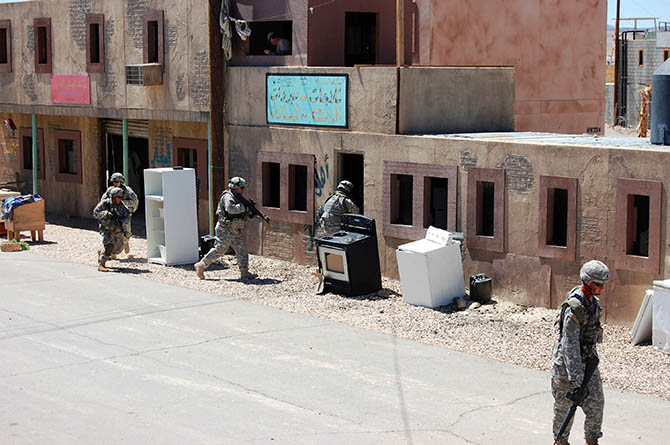
In other words, at the most basic level, soldiers will use Fort Irwin’s facsimile villages to practice clearing structures and navigating unmapped, roofed alleyways through cities without clear satellite communications links. However, at least in the training activities accessible to public visitors, the architecture is primarily a stage set for the theater of human relations: a backdrop for meeting and befriending locals (again, paid actors), controlling crowds (actors), rescuing casualties (Fort Irwin’s roster of eight amputees are its most highly paid actors, we learned, in recompense for being literally dragged around during simulated combat operations), and, ultimately, locating and eliminating the bad guys (the Blackhorse regiment).

[Image: Photo courtesy of Venue].

In the series of set-piece training exercises that take place within the village, the action is coordinated from above by a ring of walkie-talkie connected scenographers, including an extensive internal media presence, who film all of the simulations for later replay in combat analysis. The sense of being on an elaborate, extremely detailed film set is here made explicit. In fact, visitors are openly encouraged to participate in this mediation of the events: we were repeatedly urged to take as many photographs as possible and to share the resulting images on Facebook, Twitter, and more.
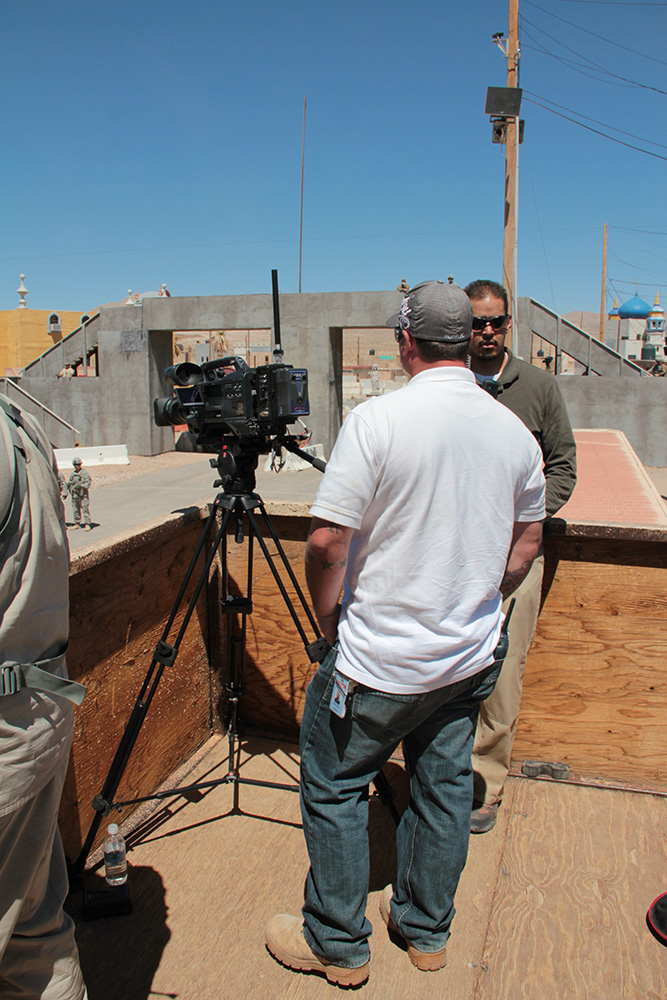
[Images: Photos courtesy of Venue].

Appropriately equipped with ear plugs and eye protection, we filed upstairs to a veranda overlooking one of the village’s main throughways, where we joined the “Observer Coaches” and film crew, taking our positions for the afternoon’s scripted exercise.

[Image: Photo courtesy of Venue].

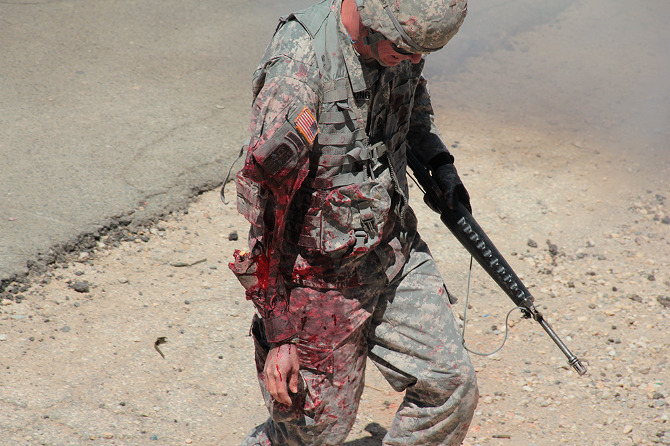
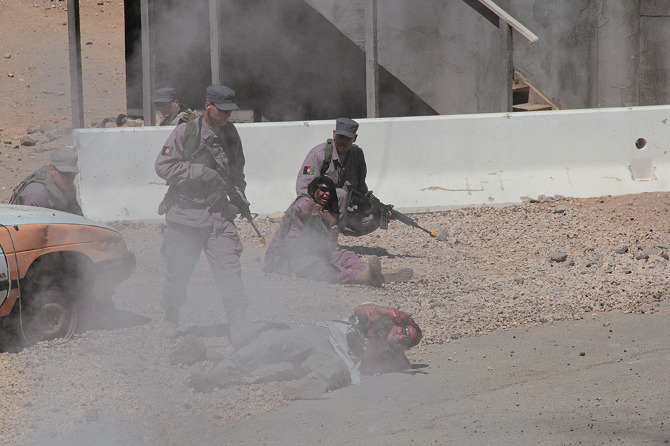
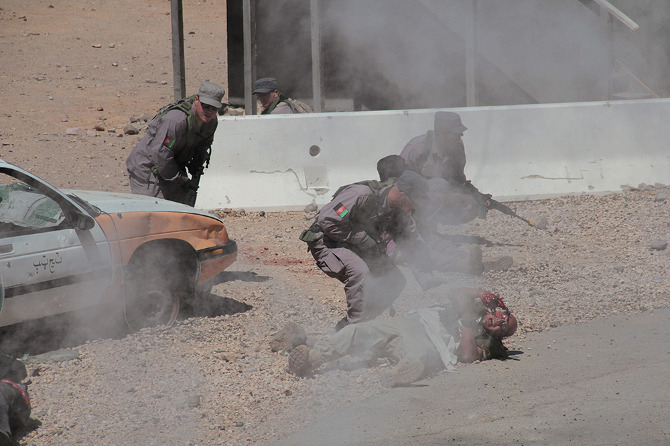
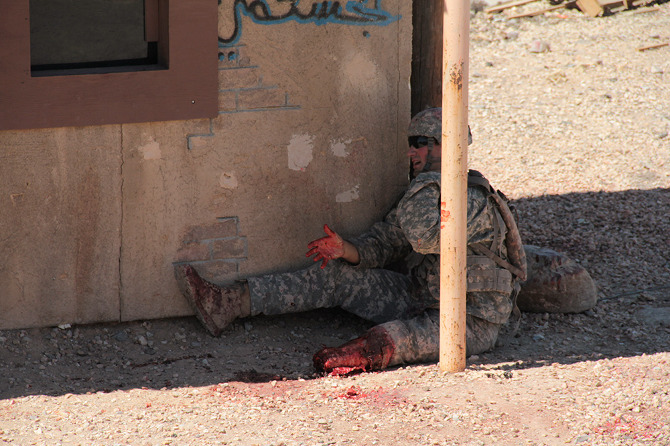
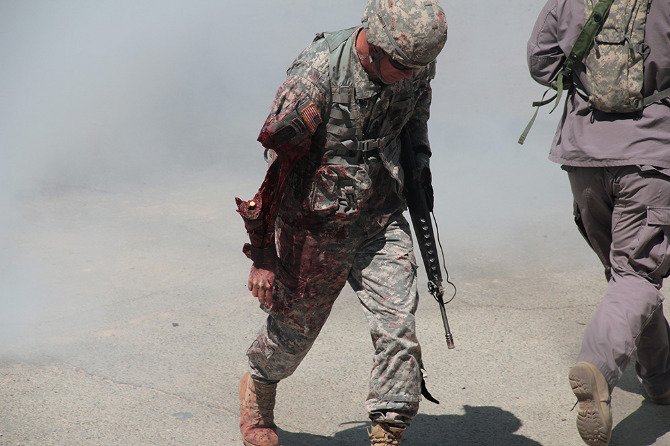
Loud explosions, smoke, and fairly grisly combat scenes ensued—and thus, despite their simulated nature, involving Hollywood-style prosthetics and fake blood, please be warned that many of the forthcoming photos could still be quite upsetting for some viewers.
[Images: Photos courtesy of Venue].

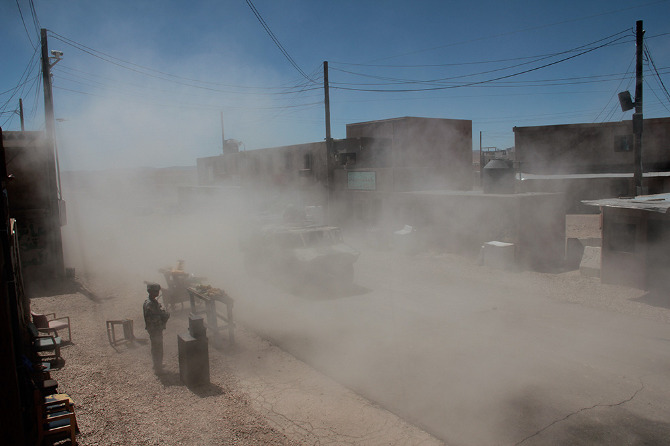
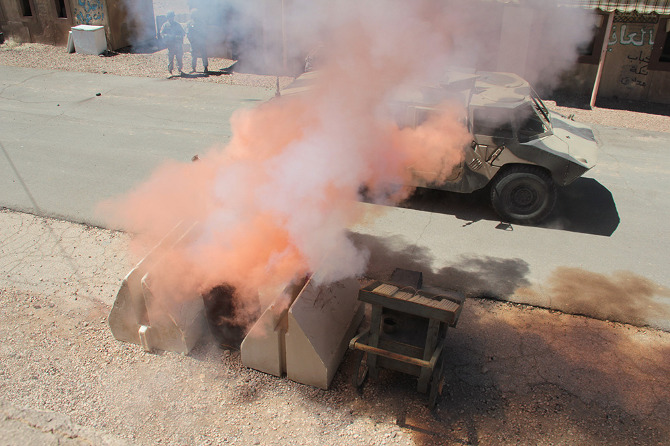
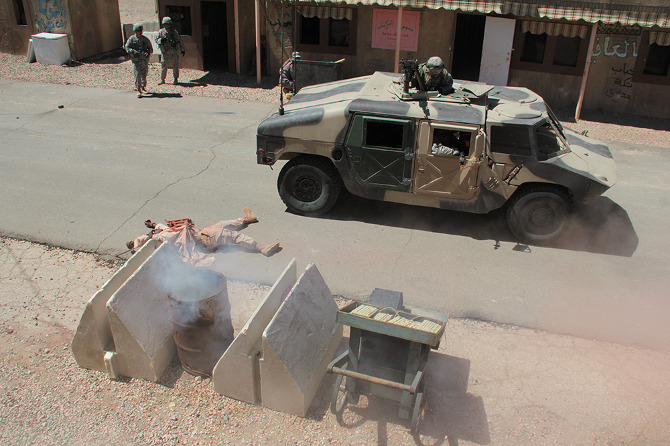
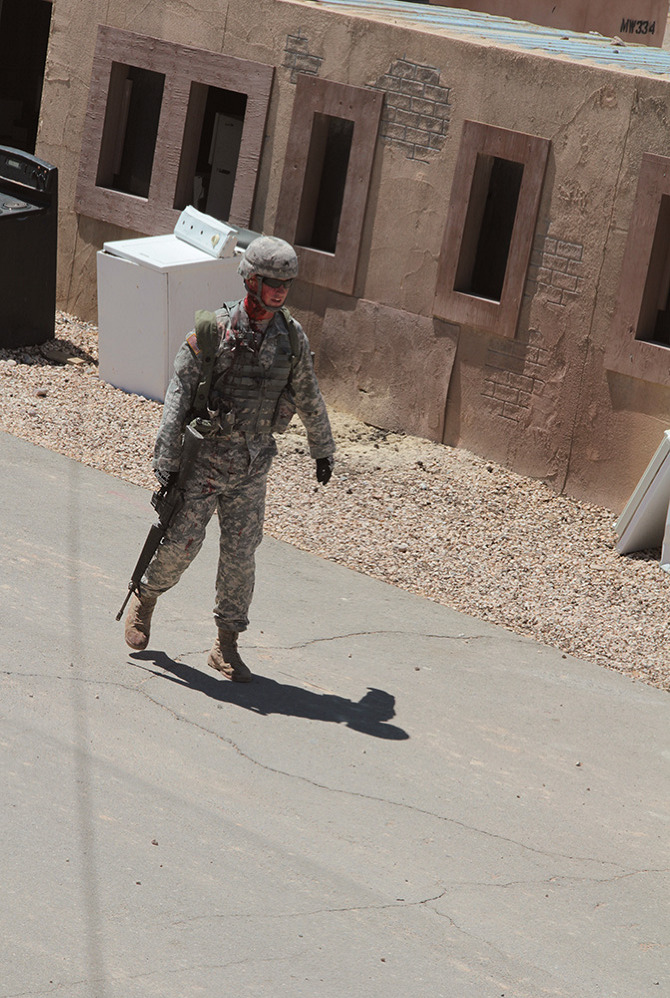
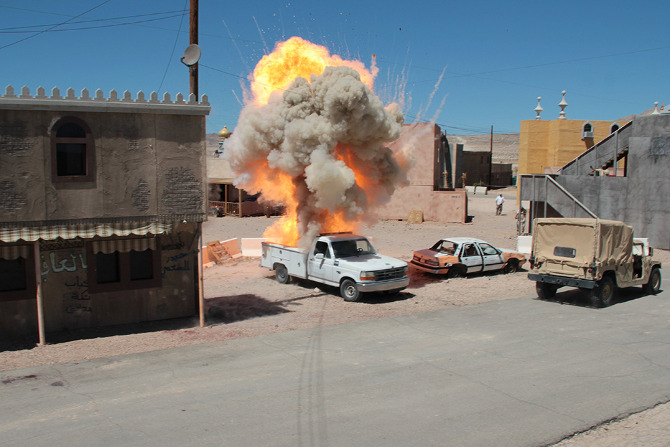
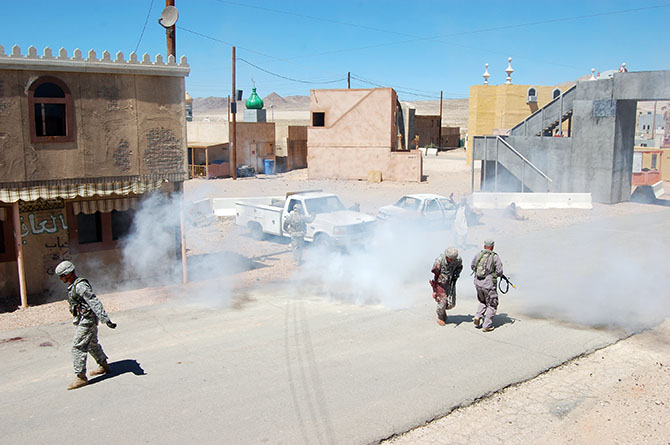
The afternoon’s action began quietly enough, with an American soldier on patrol waving off a man trying to sell him a melon. Suddenly, a truck bomb detonated, smoke filled the air, and an injured woman began to wail, while a soldier slumped against a wall, applying a tourniquet to his own severed arm.
[Images: Photos courtesy of Venue].

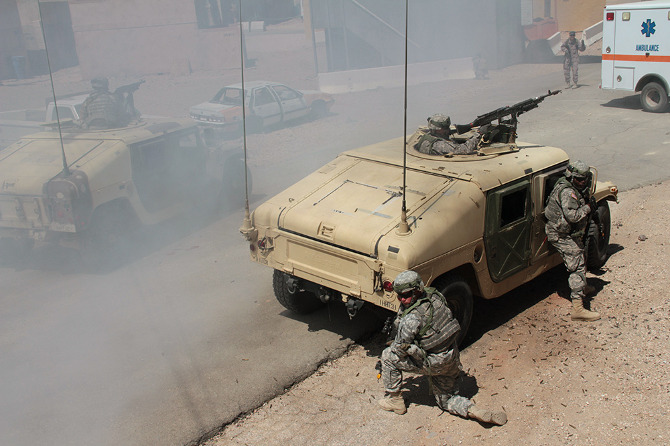
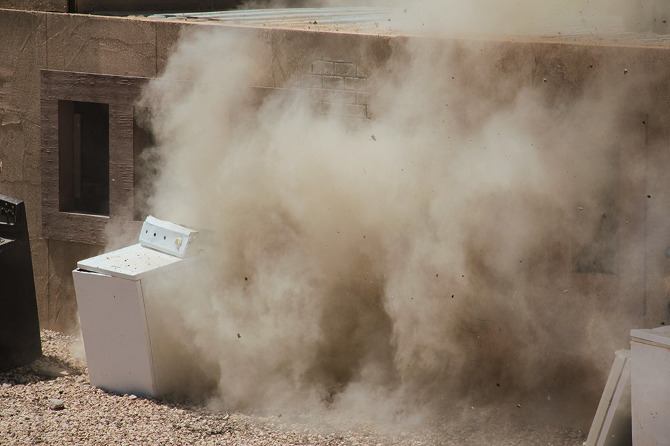
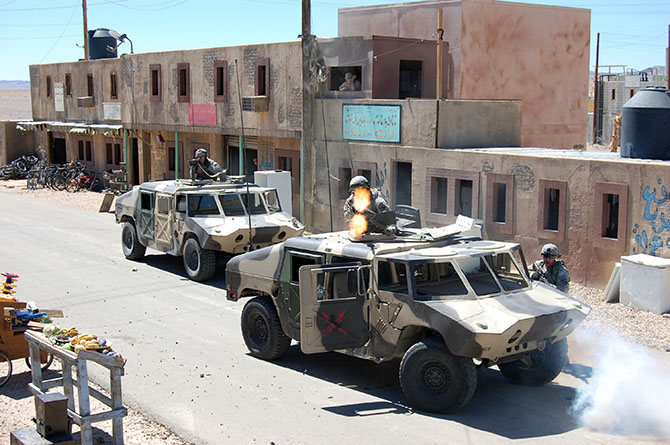
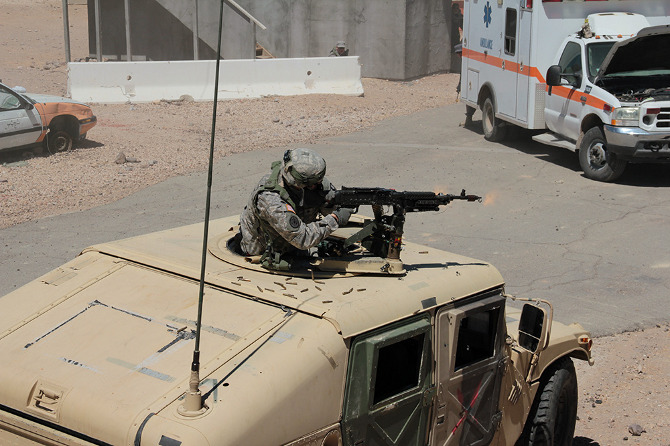
In the subsequent chaos, it was hard to tell who was doing what, and why: gun trucks began rolling down the streets, dodging a live goat and letting off round after round as insurgents fired RPGs (mounted on invisible fishing line that blended in with the electrical wires above our heads) from upstairs windows; blood-covered casualties were loaded into an ambulance while soldiers went door-to-door with their weapons drawn; and, in the episode’s climax, a suicide bomber blew himself up directly beneath us, showering our tour group with ashes.
[Images: Photos courtesy of Venue].

Twenty minutes later, it was all over. The smoke died down; the actors reassembled, uninjured, to discuss what just occurred; and the sound of blank rounds being fired off behind the buildings at the end of the exercise echoed through the streets.

[Image: Photo courtesy of Venue].

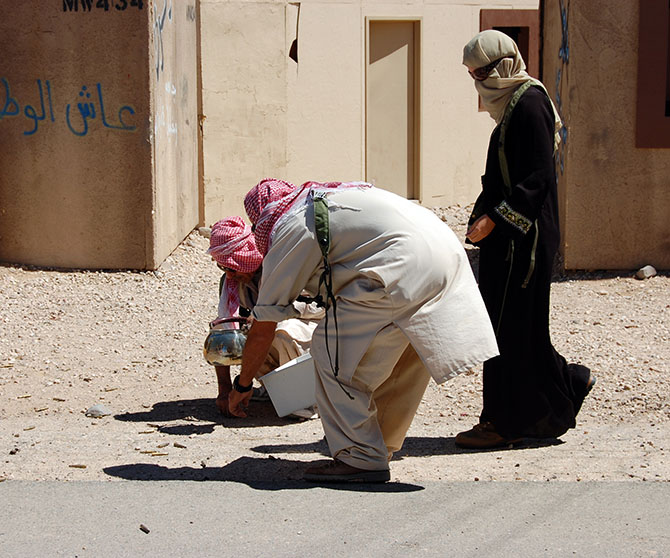
Incredibly, blank rounds assigned to a particular exercise must be used during that exercise and cannot be saved for another day; if you are curious as to where your tax dollars might be going, picture paid actors shooting entire magazines full of blank rounds out of machine guns behind simulated Middle Eastern buildings in the Mojave desert. Every single blank must be accounted for, leading to the peculiar sight of a village’s worth of insurgents stooped, gathering used blank casings into their prop kettles, bread baskets, and plastic bags.
[Images: Photos courtesy of Venue].

Finally, we descended back down onto the street, dazed, ears ringing, and a little shocked by all the explosions and gunfire. Stepping carefully around pools of fake blood and chunks of plastic viscera, we made our way back to the lobby of the International Hotel for cups of water and a debrief with soldiers involved in planning and implementing the simulation.
[Image: Photo courtesy of Venue].

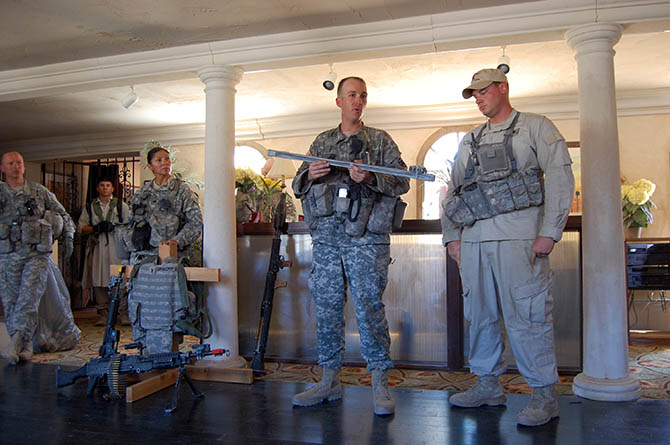
Our hosts there were an interesting mix of earnest young boys who looked like they had successful careers in politics ahead of them, standing beside older men, almost stereotypically hard-faced, who could probably scare an AK-47 into misfiring just by staring at it, and a few female soldiers.

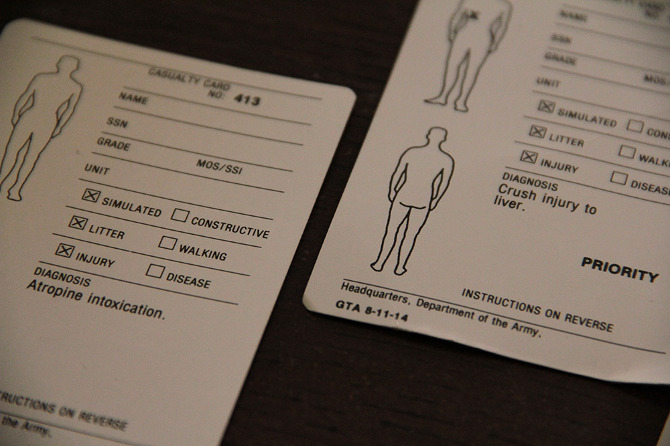
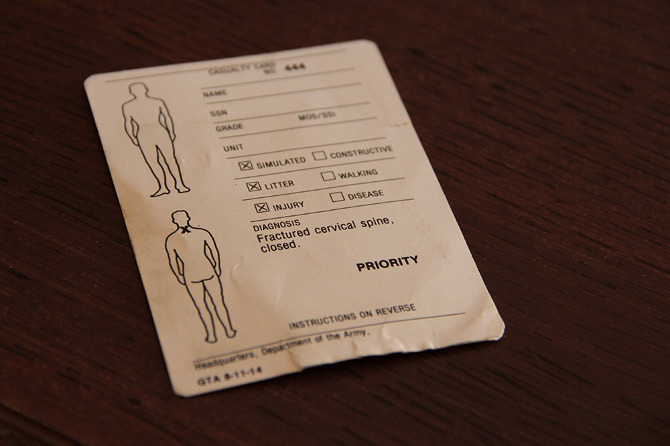
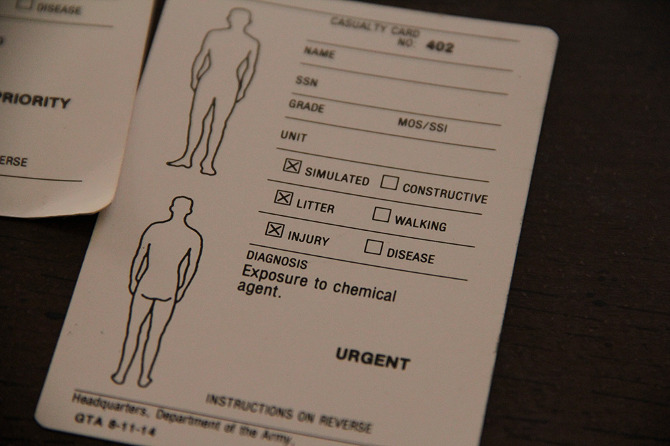
Somewhat subdued at this point, our group sat on sofas that had seen better days and passed around an extraordinary collection of injury cards handed out to fallen soldiers and civilians. These detail the specific rules given for role-playing a suite of symptoms and behavior—a kind of design fiction of military injury.

[Images: Photos courtesy of Venue].

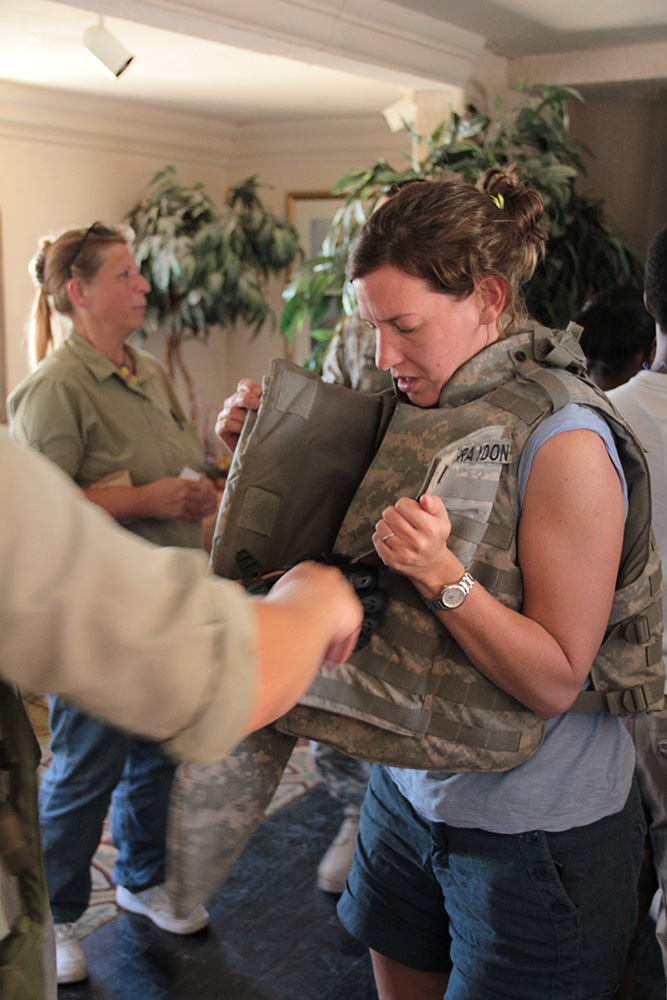
A few of us tried on the MILES (Multiple Integrated Laser Engagement System) harnesses that soldiers wear to sense hits from fired blanks, and then an enemy soldier demonstrated an exploding door sill.
[Images: Photos courtesy of Venue].

While the film crew and Observer Coaches prepared for their “After Action Review,” our guides seemed talkative but unwilling to discuss how well or badly the afternoon’s session had gone. We asked, instead, about the future of Fort Irwin’s villages, as the U.S. withdraws from Afghanistan. The vision is to expand the range of urban conditions into what Ferrell termed a “Decisive Action Training Environment,” in which U.S. military will continue to encounter “the world’s worst actors” [sic]—”guerrillas, criminals, and insurgents”—amidst the furniture of city life.

As he escorted us back down the market street to our bus, one soldier off-handedly remarked that he’d heard the village might be redesigned soon as a Spanish-speaking environment—before hastily and somewhat nervously adding that he didn’t know for sure, and, anyway, it probably wasn’t true.

[Image: Photo courtesy of Venue].

The “town” is visible on Google Maps, if you’re curious, and it is easy to reach from Barstow. Tours of “The Box” are run twice a month and fill up quickly; learn more at the Fort Irwin website, including safety tips and age restrictions.

• • •

For more Venue content, exploring human interactions with the built, natural, and virtual environments through 16 months of travel around the continental United States, check out the Venue website in full.