How To: Seed Grenade

Things like this will never look the same after reading our long interview with Sara Redstone, plant quarantine officer from Kew Gardens, London, but they’re still very cool.

This is how to make a “seed grenade,” “seed bomb,” or, more prosaically, seed ball.

Seed balls, simply put, are a method for distributing seeds by encasing them in a mixture of clay and compost. This protects the seeds by preventing them from drying out in the sun, getting eaten by birds, or from blowing away.

And they’re not new. The blog post I’m quoting from is more than two years old—but “the seed ball method” itself, we read,”has been working for centuries.”

I’ve read that some North American First Nations’ tribes used seed balls. More recently natural farming pioneer Masanobu Fukuoka has experimented with them. And, in New York City, seed bombs were used in 1973’s revitalization of the Bowery neighbourhood and the development of the city’s first community garden.

Landscapes at a distance. BLDGBLOG has already covered the idea of using military equipment in large-scale reforesting efforts, as well as the possibility of dropping “soil bombs” on Iceland.

But this wonderfully down-to-earth how-to guide for making everyday seed grenades saves you the hassle of purchasing decommissioned warplanes…

[Image: “This is what happens just a few day’s after dropping a seedbomb. The rain melted the clay and the compost, feeding the soil surrounding the bomb allowing for other plant growth.” Image and text from Guerilla Gardener’s Blog].

Just pack your seeds in a matrix of red clay, hurl your balls over a fence somewhere, and watch new worlds on the other side grow.

Agenda

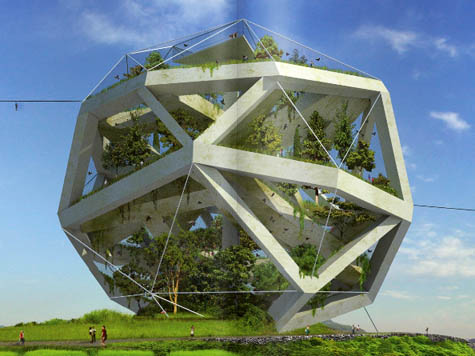
[Image: The DoChoDo Zoological Island by Julien De Smedt Architects, from Agenda].

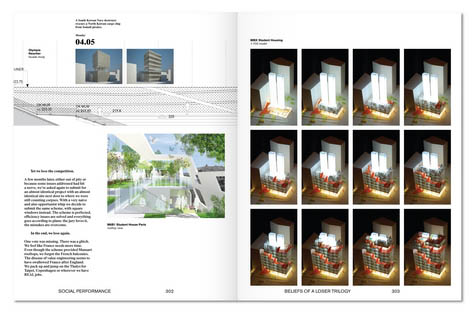
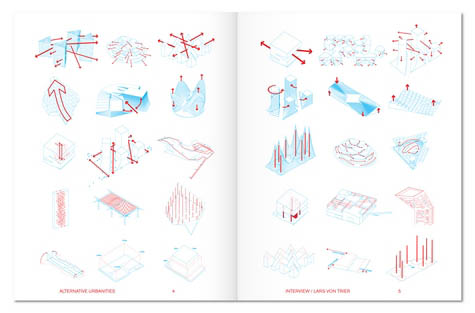
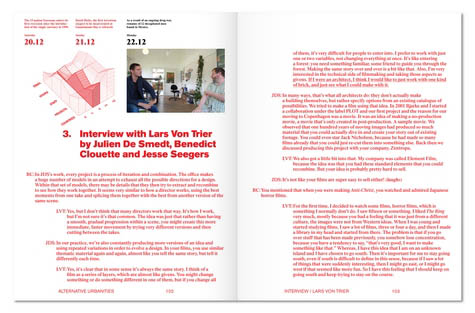
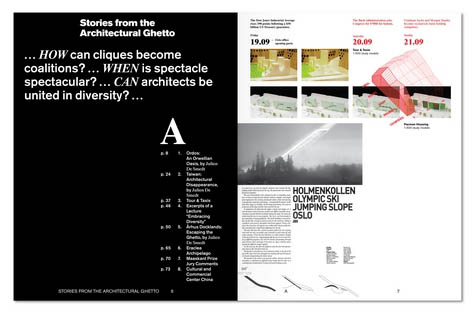
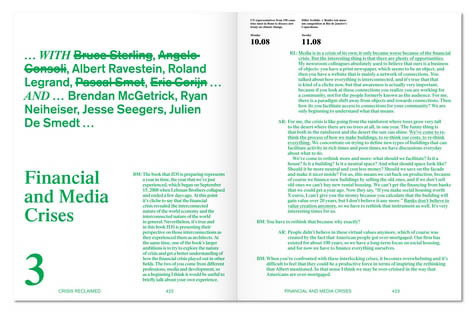
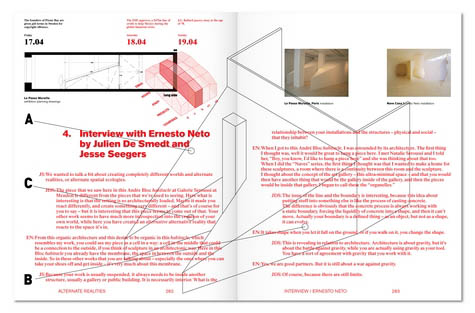
Another book launch I am looking forward to is for Agenda, which documents the work of Julien De Smedt Architects. Here are some page-spreads.

[Images: From Agenda by Julien De Smedt Architects].

If you’re in NYC this week, come by the book’s official North American launch party, hosted by Storefront for Art and Architecture; it’s on Thursday evening, December 10, starting at 7pm.

[Images: From Agenda by Julien De Smedt Architects].

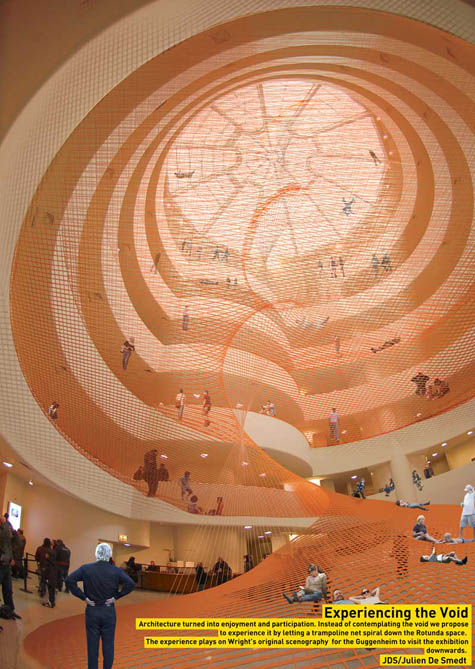
The book includes a huge range of projects, including the DoChoDo Zoological Island proposal, pictured at the head of the post, and “Experiencing the Void,” De Smedt’s proposal for the Guggenheim Museum in New York City in which a massive, climbable web would be hung down through the central rotunda.

[Image: From Agenda by Julien De Smedt Architects].

I’m also excited to say that I have a short story published in the book, about the cross-species appeal of roof gardens as witnessed by a junior executive at Albert Heijn

So stop by if you’re around, and consider picking up a copy of the book.

Landscapes of Quarantine and the Counterfeit University

[Image: “Landscapes of Quarantine” meets at Storefront for Art and Architecture, October 2009].

As many readers will already know, for the past two months BLDGBLOG has been teaming up with Edible Geography to lead an independent design studio called “Landscapes of Quarantine” in New York City. We’ve been meeting every Tuesday—and the odd Saturday—since October, using various spaces around Manhattan but, for the most part, based at Storefront for Art and Architecture (we’ve also met at Front Studio/Harvest and at Studio-X).

It’s all coming to an end this week, however, after which we’ll start getting ready for the “Landscapes of Quarantine” exhibition, which opens in March 2010 at Storefront for Art and Architecture. I thought, therefore, following Edible Geography‘s lead, that I should post some photographs from the previous eight weeks. These are less project documentation shots, however, than they are simply social photographs of our weekly meetings; for the projects themselves, expect more images coming up in the spring.

[Image: “Landscapes of Quarantine” meets at Storefront for Art and Architecture, December 2009].

Of course, I realize that these photos will not be of immediate interest to everyone—but what I nonetheless like about them, and why they are appearing here, is that they show how a design studio without any official institutional affiliation can manage to set itself up, using equipment as simple as cheap wine, PDFs, and Post-It notes, inside already existing spaces around the city.

[Images: Scenes and friendly faces, including guest speaker Jake Barton, from “Landscapes of Quarantine,” autumn 2009].

You don’t need a campus, in other words, or even a dedicated building (or room); you need a schedule, some colored markers, a stack of plastic cups, maybe a Google Groups account, and a willingness to participate in a structured conversation.

[Images: After hours on a Tuesday night at Storefront for Art and Architecture, autumn 2009].

In fact, Nicola Twilley of Edible Geography and I have been joking that we wanted to start a kind of counterfeit university—that is, a form of continuing education that models itself on, and masquerades as, the very academic studio system it is meant to supplement (but not replace).

Whether or not any of that is told by the following photographs—let alone whether or not Nicola and I were actually successful—is something else altogether. But I’ll put these photos up here simply as an act of willful nostalgia and archival documentation. It’s been a great eight weeks. I regret no part of it—even living in a surreal, semi-abandoned building in New York City without a lease while everything we own remains boxed up in a storage unit in west Los Angeles.

[Images: Paola Antonelli from the Museum of Modern Art addresses the “Landscapes of Quarantine” group at Storefront for Art and Architecture, November 2009].

The group has had some fantastic guest critics & speakers, as well. Architect Bjarke Ingels came by in October to see some initial project proposals; Paola Antonelli, senior curator of architecture and design at the Museum of Modern Art, gave us all an inspiring introduction to her own past work (and offered exhibition advice for the future); designer Jake Barton blew everyone away with some of the most interesting exhibition-design ideas out there today; architect and educator Laura Kurgan supplied much-needed feedback on our designs and conceptual approach; graphic designer Glen Cummings came by with countless examples of his books, pamphlets, posters, shows, and websites; and Joseph Grima, director of Storefront for Art and Architecture, gave us an eye-opening history of the space we all then sat in. We even got to meet the immensely talented (and intimidatingly young) landscape architects from paisajes emergentes, in town from Medellín, who stopped by one night to say hello.

[Images: Guest speakers Laura Kurgan and Glen Cummings address “Landscapes of Quarantine,” November 2009].

That’s in addition to the amazing group of people we had along for the ride. The breadth of our participants’ projects is extraordinary, and it’s worth taking a long look at how far they’ve been pushing the idea of quarantine. I’ll here paraphrase—or outright quote from—Edible Geography‘s own round-up of the studio.

At its most basic, quarantine is the creation of a hygienic boundary between two or more things, meant to protect one from exposure to the other. It is a spatial strategy of separation and containment, often invoked in response to suspicion, threat, and uncertainty.

Typically, quarantine is thought of in the context of disease control, where it used, somewhat mundanely, to isolate people who have been exposed to a contagious virus or bacteria (and who, as a result, might be carrying the infection themselves). According to historian David Barnes, quarantine was simply “an unpleasant fact of life” in most port cities for the duration of the eighteenth and nineteenth centuries (and, in some cases, earlier: in 1377, Dubrovnik became the first city-state to hold ships for a thirty day quarantine, on an island outside its harbor).

By the twentieth-century, this kind of routine application of quarantine was becoming less and less common. According to the Centers for Disease Control’s own “History of Quarantine“:

In the 1970s, infectious diseases were thought to be a thing of the past. At that time, CDC reduced the number of quarantine stations from 55 to 8. However, two major events—the September 11 attack on the World Trade Center in 2001 and the SARS outbreak in 2003—caused concerns about bioterrorism and the worldwide spread of disease. As a result, during 2004–2007, CDC increased the number of U.S. Quarantine Stations from 8 to 20.

This year’s swine flu pandemic has prompted an even greater awareness and enforcement of quarantine—although opinions are divided as to whether or not it has actually been effective in slowing the spread of disease.

[Images: Guest critic Bjarke Ingels surveys the scene as the “Landscapes of Quarantine” group presents their preliminary design ideas at Studio-X, October 2009].

The use of quarantine to restrict individual liberties in the name of public health raises a host of legal and ethical questions that proved a fruitful ground for discussions this autumn about the “dark math” of triage and “acceptable losses.”

Game designer Kevin Slavin, for instance, and comic book artist Joe Alterio are both now producing projects that investigate the challenge of shared responsibility and individual decision-making in the face of a deadly disease.

[Images: Add Post-It notes, and every wall becomes a university… Post-It notes at Storefront for Art and Architecture, autumn 2009].

Other studio participants have identified an undercurrent of absurdity inherent to the practice of quarantine, and they have been gravitating toward almost Dada-like real-life images of tourists forcibly confined inside Chinese hotel rooms, receiving takeout food from biohazard-suited attendants, and the returning astronauts of the Apollo program who were denied their public ticker-tape parade and simply waved at by President Nixon through the window of a modified airstream trailer (which was itself later found, mysteriously, on a fish farm in Alabama).

Set designer Mimi Lien and graphic designer Amanda Spielman (in collaboration with her brother, Jordan) are both creating projects that play on the most surreal aspects of quarantined space, with (respectively) evocative, depopulated dioramas of unexpected quarantine locations, and a tongue-in-cheek public health campaign filled with helpful tips. These touch on making the most of your time in quarantine, for example, as well as on relationship-maintenance for married couples divided by quarantine.

Of course, quarantine does not only apply to people and animals. Its boundaries can be set up anywhere and for as long as necessary, creating spatial separation between the clean and the dirty, the safe and the dangerous, the healthy and the sick, the foreign and the native—no matter how those terms might be currently applied. Many of our readings and discussions thus focused on the technical challenges involved in using design to prevent the forward contamination of Mars or the spread of plant pests in an era of global climate change.

Artists Jamie Kruse and Elizabeth Ellsworth of Smudge Studio are focusing their attention on what they term the “limit-case” of quarantine: plans for the one-million-year containment of nuclear waste in subterranean geological repositories around the world. Is there such a thing as infinite quarantine, Smudge has asked, and how might that be represented on a comprehensible human timescale?

[Images: Smudge Studio‘s graphical analysis of how long-term nuclear waste repositories can be designed].

Of course, as a project of spatial control, the implications of quarantine ripple outward to affect the layouts of buildings, the shapes of cities, the borders of nations, and even the clothes we wear. Our weekly discussions have ranged from the fictional potential of quarantine (currently under investigation by writer Scott Geiger) to the infrastructural requirements of quarantine as it applies both to rare orchids and to the President of the United States (architect Thomas Pollman of the NYC Office of Emergency Management).

Architects Yen Ha and Michi Yanagishita of Front Studio are addressing the implications of inserting quarantine spaces directly into the fabric of the city, while architect Brian Slocum has been examining the way quarantine spaces blur the border between inside and outside, resident and visitor, homeland and foreign origin.

Some evenings, our conversations have revolved around the dystopian overlap between border controls and health screening, as well as what quarantine might look like from the point of view of the bacteria or virus that that quarantine has been set up to control (a twist that stems from architect and filmmaker Ed Keller‘s thoughts on networks, information virology, and what he calls political science fiction).

Scott Geiger, Kevin Slavin, and artist Katie Holten were brave enough to rise early on a cold October morning in order to catch the Staten Island ferry with us and witness the ceremonial re-interment of the quarantined dead during a bagpipe-accompanied church service. Later in the studio, Katie went back out onto the waters of the New York archipelago to visit North Brother Island, the final home of Typhoid Mary, where she stepped through ruined buildings half-buried in autumn leaves, while photographer Richard Mosse—previously interviewed here on BLDGBLOG—flew all the way to Malaysia as part of his fascinating exploration of vampirology, family history, and remote villages destroyed by the Nipah virus.

[Images: Benjamen Walker of WNYC records the final Tuesday evening of “Landscapes of Quarantine,” December 2009].

As some people might have noticed, on the other hand, we lost Lebbeus Woods (one of our studio’s original participants who, unfortunately, had to drop out of the proceedings), and we’ve been meeting with Jeffrey Inaba off-site in order to discuss his work (with C-LAB) for the exhibition.

You can read more about the studio here or here—and I want very much to point out to other people elsewhere that you don’t need to be connected to academia in order to put together a group of interesting and committed people for the purpose of pursuing an organized research project. You could work at Jamba Juice and still assemble a makeshift university. In fact, I’ve always thought it worth remembering that Thomas Bulfinch wrote his classic text Bulfinch’s Mythology while working day shifts as a bank teller in Boston.

But you need nothing more than a structure, a common topic, a place to meet up, a backpack full of the most basic office supplies, perhaps a bottle opener, and the will-power to see it through; with any luck, in other words, more “counterfeit universities” will be popping up here and there, their research published independently on blogs, their meetings hosted in apartments, offices, restaurants, bars, and other spaces in their after-hours, bringing more and more people into productive conversation.

Crude City

If I was in Los Angeles next week, I would definitely be aboard the Center for Land Use Interpretation’s forthcoming tour, Urban Crude: The Oil Fields of the Los Angeles Basin. From the gallery’s description of both the bus tour and the accompanying exhibition:
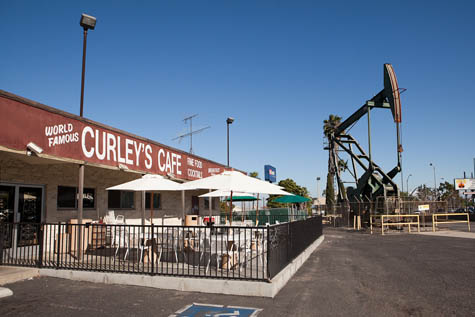
The fabric of Los Angeles, a continuous cloth of development, draped on the surface of the land, is shallow, but its roots, thousands of meandering straws of oil, dig deep into the soil. Like tree roots, these veins extract the living essence of the ground, fueling this city of the car. Like historical roots, these oil fields are the progenerative substrate, the resource pool, where the economy of Los Angeles originated, driving the development and culture of the city. Today, it continues. Los Angeles is the most urban oil field, where the industry operates in cracks, corners, and edges, hidden behind fences, and camouflaged into architecture, pulling oil out from under our feet.

The bus tour kicks off at 9am on Friday, December 18, and you can read more about it here.

Being a long-time fan of the Center for Land Use Interpretation, meanwhile, I was excited to put together an infrastructure-based guide to the city of Los Angeles last year in the form of a short interview with CLUI director Matthew Coolidge. From human-waste-processing sites in El Segundo to the cell-phone towers atop Mt. Wilson—by way of gravel pits and methane-capture valves atop landfills—that tour can be found at Dwell.
Alexander’s Gates

One of many books I’ve been enjoying this autumn is On Monsters by Stephen T. Asma, an extended look into where formal deviation occurs in the world and what unexpected, often emotionally disconcerting, shapes and forces can result.

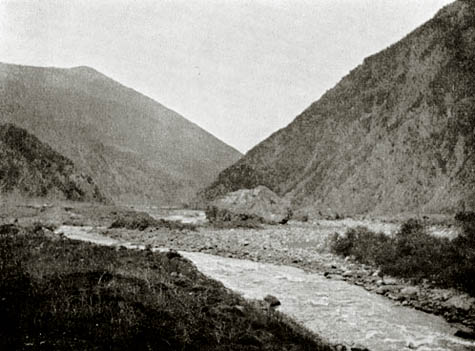
[Image: The Dariel Pass in the Caucausus Mountains, rumored possible site of the mythic Alexander’s Gates].

According to Asma, measuring these swerves and abnormalities against each other—and against ourselves—can shed much-needed light on the alternative “developmental trajectories” by which monsters come into being. This speculative monsterology, as he describes it it, would thus uncover the rules by which even the most stunning mutational transformations occur—allowing us to catalog extraordinary beings according to what Asma calls a “continuum of strangeness: first, nonnative species, then familiar beasts with unfamiliar sizes or modified body parts, then hybrids of surprising combination, and finally, at the furthest margins, shape-shifters and indescribable creatures.” Asma specifically mentions “mosaic beings,” beings “grafted together or hybridized by nature or artifice.”

In the book’s fascinating first-third—easily the book’s best section—Asma spends a great deal of time describing ancient myths of variation by which monsters were believed to have originated. From the mind-blowing and completely inexplicable discovery of dinosaur bones by ancient societies with no conception of geological time to the hordes of “monstrous races” believed to exist on the imperial perimeter, there have always been monsters somewhere in the world’s geography.

Of specific relevance to an architecture blog, however, are Alexander’s Gates.

[Image: Constructing the wall of Dhul-Qarnayn, mythic isotope to Alexander’s Gates].

Alexander’s Gates, Asma writes, were the ultimate wall between the literally Caucasian West and its monstrous opponents, dating back to Alexander the Great:

Alexander supposedly chased his foreign enemies through a mountain pass in the Caucasus region and then enclosed them behind unbreachable iron gates. The details and the symbolic significance of the story changed slightly in every medieval retelling, and it was retold often, especially in the age of exploration.

(…) The maps of the time, the mappaemundi, almost always include the gates, though their placement is not consistent. Most maps and narratives of the later medieval period agree that this prison territory, created proximately by Alexander but ultimately by God, houses the savage tribes of Gog and Magog, who are referred to with great ambiguity throughout the Bible, and sometimes as individual monsters, sometimes as nations, sometimes as places.

Beyond this wall was a “monster zone.”

[Image: The geography of Us vs. Them, in a “12th century map by the Muslim scholar Al-Idrisi. ‘Yajooj’ and ‘Majooj’ (Gog and Magog) appear in Arabic script on the bottom-left edge of the Eurasian landmass, enclosed within dark mountains, at a location corresponding roughly to Mongolia.” Via Wikipedia].

Interestingly, a variation of this story is also told within Islam—indeed, in the Koran itself. In Islamic mythology, however, Alexander the Great is replaced by a figure called Dhul-Qarnayn (who might also be a legendary variation on the Persian king Cyrus).

Even more interesting than that, however, the Koran’s own story of geographically distant monsters entombed behind a vast wall—the border fence as theological infrastructure—appears to be a kind of literary remix of the so-called Alexander Romance. To quote that widely known religious authority Wikipedia, “The story of Dhul-Qarnayn in the Qur’an… matches the Gog and Magog episode in the Romance, which has caused some controversy among Islamic scholars.” That is, the Koran actually includes a secular myth from 3rd-century Greece.

The construction of Dhul-Qarnayn’s wall against the non-Muslim monstrous hordes can specifically be found in verses 18:89-98. For instance:

“…Lend me a force of men, and I will raise a rampart between you and them. Come, bring me blocks or iron.”
He dammed up the valley between the Two Mountains, and said: “Ply your bellows.” And when the iron blocks were red with heat, he said: “Bring me molten brass to pour on them.”
Gog and Magog could not scale it, nor could they dig their way through it.

Think of it as a kind of religious quarantine—a biosafe wall through which no moral contagion could pass.

[Image: Constructing the wall of Dhul-Qarnayn, via Wikipedia].
But as with all border walls, and all imperial limits, there will someday be a breach.

For instance, Asma goes on to cite a book, published in the 14th century, called the Travels of Sir John Mandeville. There, we read how Alexander’s Gates will, on some future day blackened by the full horror of monstrous return, be rendered completely obsolete:

In the end, Mandeville predicts, a lowly fox will bring the chaos of invading monsters upon the heads of the Christians. He claims, without revealing how he comes by such specific prophecy, that during the time of the Antichrist a fox will dig a hole through Alexander’s gates and emerge inside the monster zone. The monsters will be amazed to see the fox, as such creatures do not live there locally, and they will follow it until it reveals its narrow passageway between the gates. The cursed sons of Cain will finally burst forth from the gates, and the realm of the reprobate will be emptied into the apocalyptic world.

In any case, the idea that the line between human and not-human has been represented in myth and religion as a very specifically architectural form—that is, a literal wall built high in the mountains, far away—is absolutely fascinating to me.

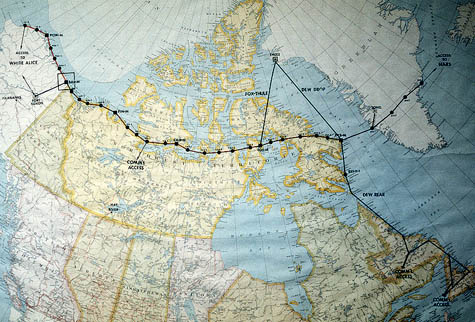
Further, it’s not hard to wonder how Alexander’s Gates compare, on the level of imperial psychology, to things like the Great Wall of China, the Berlin Wall, the U.S./Mexico border fence, or the Distant Early Warning Line—even London’s Ring of Steel—let alone the Black Gates of Mordor in Tolkien’s Lord of the Rings.

[Image: A map of the Distant Early Warning Line, an electromagnetic Alexander’s Gates for the Cold War].

Perhaps there is a kind of theological Hyperborder waiting to be written about the Wall of Gog and Magog.

Or could someone produce an architectural history of border stations as described in world mythology? I sense an amazing Ph.D. research topic here.

Cities Gone Wild

[Image: Photo by Lauren Greenfield for The New York Times].

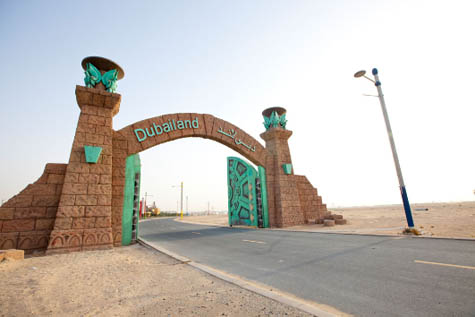
There are two photo-essays circulating that benefit from juxtaposed browsing. On the one hand, you’ve got a series of images taken by Lauren Greenfield for The New York Times of Dubai in decline. This, of course, comes as Dubai’s debt obligations have become so unmanageable that the city-state is actually causing trembles in the entire global economy.

[Image: Ad hoc infrastructure: “A convoy of sewage trucks removing solid waste from the city center. The current sewer system cannot handle the demand.” Photo by Lauren Greenfield for The New York Times].
Indeed, financial historians are living through an extraordinarily interesting time, I have to say; the complex instrumentation of money has never been so Baroque or histrionic. Calculations are made so fast now that the physical location of buildings, vis-a-vis the speed of the data signals they receive, can actually impact urban geography. Call it nanofinance. More to the point, earlier this week the Guardian had this to say:

The Dubai crisis has also thrown a new name into the lexicon of toxic instruments. Just as credit derivatives helped to exacerbate the sub-prime crisis by obscuring who was ultimately exposed to losses, the use of Islamic finance has complicated the reckoning. “Sukuk bonds” are designed to get around religious laws banning the payment of interest for money lending. But one of the most volatile debts in the Dubai World standstill is a $3.5bn Islamic bond due to be repaid in December.

It’s not just comparative religion, in other words, it’s comparative religious finance.

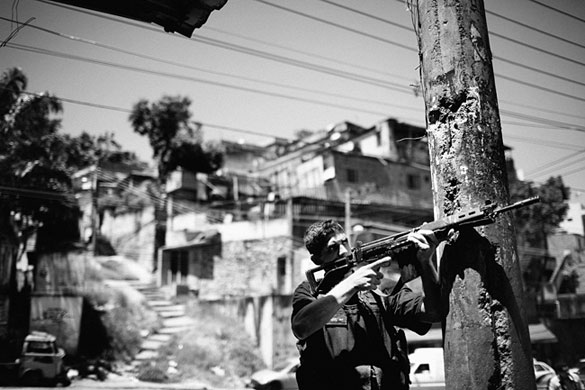
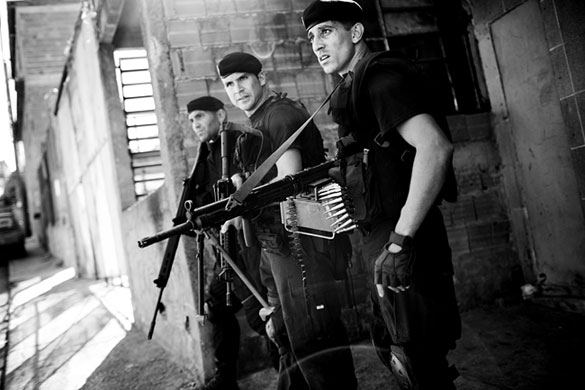
But view Greenfield’s images alongside an equally memorable group of photos, this time documenting drug wars in Rio de Janeiro, that future Olympic city plagued—like New York City—by the occasional blackout.

[Images: (top) “A BOPE unit, the elite special forces of the military police stands guard during the operation in Favela da Grota. BOPE is a small group of well-trained officers infamous for their brutality. They are renowned for not carrying handcuffs.” (bottom) “A BOPE officer takes a defensive position to cover his unit as they pull out of the Grota slum.” Photos by João Pina for the Guardian].

The article that accompanies these images is less compelling, even for its descriptions of “the favela—a mess of slapped-up houses of corrugated tin and unpainted brick, dreadlocked tangles of pilfered electrical wiring, and graffiti-covered walls and alleyways where little shops and rudimentary bars selling beer and cachaça jostled for space with storefront evangelical churches.”

But these contrasting images of cities gone wild—one lost in a kind of financial syncope, a rococo without reference to manageable interest or ground plane, the other made politically incomprehensible by the overlapping invisibilities of heavily armed, microsovereign warlords, whether under government control or not—show us global urbanism as it steps into a surprisingly dark maturity in this second decade of the 21st-century.

(Article about “Sukuk bonds” found via @nicolatwilley).

The Migratory Forest

[Image: Christmas trees for sale outside St. Mark’s Church in New York City; a video-still taken November 30th, 2009].
“The most surreal part of Christmas,” according to Strange Harvest, “is the migratory forest that pops up all around us for three weeks.”

It’s a long forgotten middle European folk-rite that has become buried deep in our seasonal behaviour. Now, thousands of years later, we re-enact this midwinter over and over again in a thoroughly contemporary manner. Christmas trees now may well be entirely and unashamedly artificial objects: pink, fibre optic, colour-changing nylon. Real organic trees appear in the most surreal of locations: strapped to the cab of a crane high above the city, in arrays over the facades of department stores, in the sterile shiny lobbies of corporate institutions, and in the front rooms of homes sitting on carpets which, if you think hard enough, become the mossy floor of a forest…

It’s an image that has stuck with me: Christmas and its ubiquitous tree treated as a kind of vernacular landscape practice—or folk forestry—more than a religious event with Rapturous implications.

“Perhaps Christmas trees are a ghostly return of the mysterious ancient forest,” Strange Harvest suggests, “a rolling back of the mechanisms and constructs of civilisation that addresses the Big Bad Wolf or Little Red Riding Hood inside us all.”

Booked

It’s been a fantastic holiday week for The BLDGBLOG Book. I was thrilled to see, for instance, that the Wall Street Journal chose the book—amidst only 36 books—for their 2009 “Holiday Book Guide.” For good or for bad, The BLDGBLOG Book pops up as one of six titles that the newspaper specifically recommends for “a young artist who enjoys science fiction and high brow fantasy” (!), alongside books by Jonathan Lethem, Margaret Atwood, Jeff VanderMeer, R. Crumb, and Geoff Dyer. So thanks, Wall Street Journal! That was genuinely awesome news.

Check out the rest of their picks here.

However, Planetizen also picked up on the book for their list of the Top 10 Books to read in 2010. “The Planetizen editorial staff based its 2010 edition list on a number of criteria,” we read, “including editorial reviews, popularity, Planetizen reader nominations, number of references, sales figures, recommendations from experts and the book’s potential impact on the urban planning, development and design professions.” Again, it’s great company to be in, including David Byrne’s Bicycle Diaries, Eric Sanderson’s Mannahatta, Green Metropolis by David Owen, Paul Goldberger’s Building Up and Tearing Down: Reflections on the Age of Architecture, and many more.

Planetizen itself is also an extremely useful and interesting website in its own right, with a strong editorial team, so definitely spend some time clicking around there in the new year.

In any case, it’s more than obvious that not everyone thinks the book—or this website—deserves these sorts of appearances, but I’m still excited to see it popping up out there in the world. Go, little book, go!

And, to be honest, whether or not you like the topics I cover here, to see a book about architecture in something like the Wall Street Journal‘s top 36 picks for the entire year should be good news for anyone who thinks that people don’t want to read about the built environment. There is an intense and very widespread interest in architecture out there, and so I’m very happy to see that audience being recognized.

Vardzia

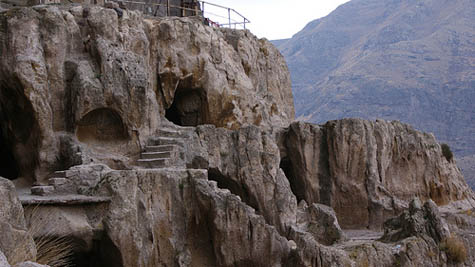
[Image: The Georgian cave monastery of Vardzia, via Wikipedia].
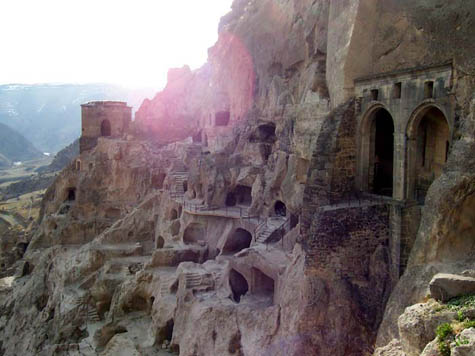
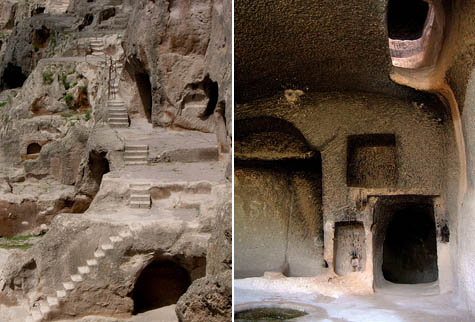
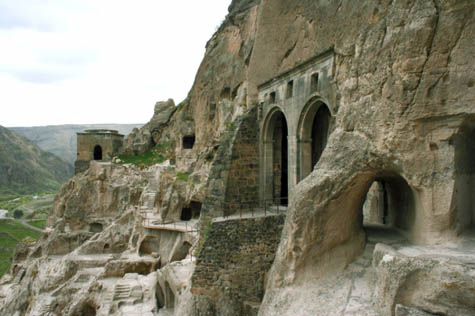
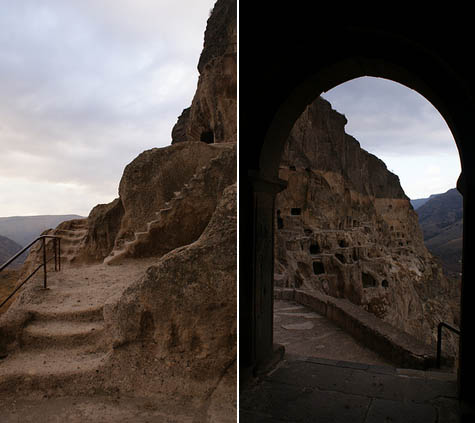
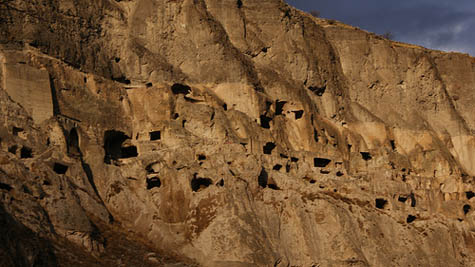
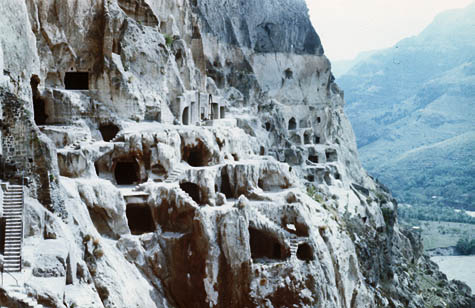
Vardzia is a ruined honeycomb of arched passageways and artificially enlarged caves on a steep mountainside in Georgia. It is on a “tentative list” for UNESCO World Heritage status.

[Image: Vardzia, via Wikipedia].

Quoting from Wikipedia:

The monastery was constructed as protection from the Mongols, and consisted of over six thousand apartments in a thirteen-story complex. The city included a church, a throne room, and a complex irrigation system watering terraced farmlands. The only access to the complex was through some well hidden tunnels near the Mtkvari river.

Nearby are the ruins of another cave monastery, called Vanis Kvabebi.

[Images: Vardzia, via Wikipedia].

In the formal application sent to UNESCO for consideration of the site, we read that the architecture of this region can be seen as spatially punctuating the landscape, supplying moments of almost grammatical emphasis:

Fortresses and churches erected on high mountains and hills are perceived as distinguished vertical accents in such a horizontally developed setting. They terminate and emphasise natural verticals, being in perfect harmony with the latter. They introduce great emotional impulse imparting specific grandeur to the whole environment. The same artistic affect is created by rock-cut monasteries and villages arranged in several tiers on high rocky mountain slopes.

Originally constructed in the 12th century—in a region inhabited by humans since at least neolithic times—and very much resembling one of the cave-cities of Cappadocia, Vardzia is a spatially fantastic site (and, I’d assume, a videogame level waiting to happen).

[Images: Vardzia, via Wikipedia].

It is also located in one of the most geologically interesting places on earth—at least from a subterranean standpoint—as the nation of Georgia also contains the world’s deepest known cave.

As National Geographic explained in an article several years ago, Krubera Cave—also known as Voronya—is still incompletely explored, despite its record-breaking, abyssal depths; expeditions have spent more than three weeks underground there, mapping windows and chambers, sleeping in tents, and using colored dyes to trace rivers and streams locked in the rock walls around them.

Check out this sequence of images, for instance, documenting an organized descent into the planet—or this article about caving in Abkhazia, or even this summary of the “Call of the Abyss” exploration project that sought to find the true depths of Voronya Cave.

[Images: Vardzia, as seen in some stunning photos by cosh_to_jest].

In any case, there’s absolutely no geological connection between Vardzia and Krubera Cave—there is no secret tunnel system linking the two across the vast Georgian landscape (after all, they are extremely far apart)—but how exciting would it be to discover that Vardzia had, in fact, been constructed as a kind of architectural filter above the stovepipe-like opening of a titanic cave system, and that, 800 years ago, monks alone in the mountains reading books about the end of the world might have sat there, surrounded by fading frescoes of saints and dragons, looking into the mouth of the abyss, perhaps even in their own local twist on millennial Christianity standing guard over something they believed to be hiding far below.

[Images: Vardzia, via Wikipedia].

In fact, I don’t mean to belabor the point here, but I’ve always been fascinated by the fact that the CIA has satellite photos that have been used as scouting documents for the rumored location of Noah’s Ark—it is “satellite archaeology,” one researcher claims. That is, there being quite a few religious members of the U.S. government, things like Noah’s Ark are considered more objective and archaeological than they are superstitious or theological.

But how absolutely mind-boggling would it be to find out someday that there is, operating within the U.S. intelligence services, a small group of especially religious analysts who have been scouring the Caucausus region, funded by tax dollars, and armed with geoscanning equipment and several miles of rope, looking for the entrance to Hell?

You can see further images of Vardzia here.

Political Buffer Space and Chinese “Black Jails”

According to the New York Times, there is, in Beijing, “a secret network of detention centers used to prevent aggrieved citizens from lodging complaints against the Chinese government.”

[Image: “Bunk beds are seen in a room in a black jail in Beijing in August 2009,” the New York Times explains. Apparently, “more than a dozen illegal detention centers known as black jails exist in Beijing.” Photo by Greg Baker for the AP].

It is part of a “Byzantine network of interceptors, guards and holding pens,” the article continues, “used to put off the petitioners who flock to Beijing in the hope that the authorities will resolve longstanding grievances, many of them involving official corruption in their hometowns.”

Like a deleted scene—or alternate ending—from Zhang Yimou’s film The Story of Qiu Ju, we read that “those grabbed off the street often have their cellphones and identification confiscated before being locked away in guesthouses or dank basements. After being held for days or weeks, inadequately fed and sometimes beaten, they are shipped back to their home provinces with the admonition that they stay away from the capital.”

It’s The Trial all over again. From The New York Times:

Although the right to petition the authorities is enshrined in the Constitution, that right is frequently swallowed up by the reality of contemporary China’s system of governance: local officials, facing pressure to maintain social stability, are penalized for allowing too many complainants to find their way to the offices of the central government.

This need to prevent “too many complainants” from finding their way to the center necessitates the construction and maintenance of counter-spaces—”dank basements” and other makeshift jails—as a kind of architectural buffer held up against political reform. In fact, it’s more like an exact inversion of Kafka’s “Great Wall of China” story, in which an imperial messenger is lost and indefinitely dislocated on a fruitless attempt to find exit from the governmental architecture all around him.

[Image: The Great Wall of China, via Wikipedia].

In that story, we see a messenger whispered something of great importance by the emperor himself; now that messenger simply has to relay his words to the proper authorities elsewhere. However, “how futile are all his efforts,” Kafka writes.

He is still forcing his way through the private rooms of the innermost palace—but he will never win his way through. And if he did manage that, nothing would be achieved. He would still have to fight his way down the steps, and, if he managed to do that, nothing would be achieved. He would still have to stride through the courtyards, and after the courtyards the second palace encircling the first, and, then again, through stairs and courtyards, and then, once again, a palace, and so on for thousands of years. And if he finally did burst through the outermost door—but that can never, never happen—then the royal capital city, the centre of the world, is still there in front of him, piled high and full of sediment.

It is buffer space, in other words: space in the way of political communication.

By comparing the incarceration of Chinese citizens to a Kafka story, however, I don’t mean to diminish the very real sense of political alarm one should feel at the existence of these “black jails” in Beijing; I do mean, on the other hand, to point out how different political philosophies spatialize themselves, enlisting architecture—here, an off-the-books architecture forming unofficial spaces of detainment—as a realization of their own sovereign philosophies. That is, certain building types befit certain political philosophies—and unacknowledged prisons are a particularly alarming example of this. Geographer Trevor Paglen‘s work becomes especially disturbing in this regard, as he takes us through places like Camp Delta or the unregulated networks of CIA rendition, and so on.

But I want to go back to the less than reassuring political message of The Story of Qiu Ju, mentioned earlier. The bulk of that film presents viewers with a self-possessed heroine who has stood up, once and for all, for her and her husband’s rights in the face of locally corrupted bureaucrats; but her chain of unaddressed complaints leads her to pursue higher and higher levels of governmental authority, including physical trips outward through more and more distant urban spaces. She soon finds herself emotionally alone in a strange city she cannot navigate, tracking down officials by way of nonsensically over-formalized channels of communication.

And, at the end, she seems to go nowhere. It doesn’t work. She lodges her complaint—and returns home.

[Image: A scene of citizenry and its government, from The Story of Qiu Ju].
But when things suddenly seem to go her way—spoiler alert—it’s at exactly the wrong moment, as if she never should have started the complaint process in the first place. It’s as if, the film ambiguously suggests, the very act of petitioning her government has resulted in these previously unseen layers of government coming into being, materializing out of the haze of invisible sovereignty in order to respond to her call.

She brings the government into existence, in other words, by turning to it for guidance and complaint.

This is a morally unconvincing position to take, especially in a nation like China—but it comes with architectural implications, and these are also relevant here. For instance, would these “black jails” and political holding-rooms need to exist, we might ask in this highly specific context, if rural petitioners would simply stop coming to the city in protest? Perhaps not—but 1) this is all the more reason for such petitioners to visit the capital in record numbers, thus forcing, through sheer spatial absurdity, political change and requiring that their grievances be heard, and 2) it says volumes about any political system if its government would hold the very people who come to it for guidance inside an addressless world of dorm rooms, “dank basements,” secret detention centers, and cots, officially unrecognized except for the time it takes to overlook them.

It would make for a fantastic study: how do governments spatially realize themselves? Is democracy possibility in a nation built for authoritarian control—and vice versa: can true authoritarianism ever be achieved in a space designed against these sorts of peripheral—and easily denied—incarcerations?

Could we reverse-Haussmannize entire nations to make repression a spatial impossibility?

City of Gold

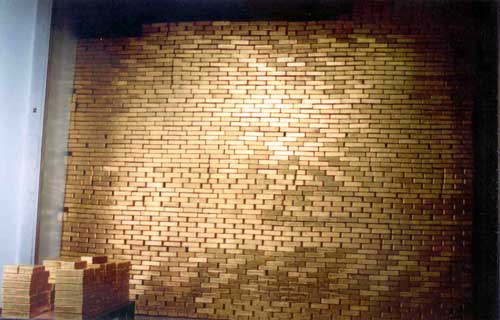
Gold—the price of which has nearly quadrupled over the past decade—is now being purchased (and hoarded) on such a massive scale that the vaults of New York City have run out of space to store it all in.

[Image: Stackin’ it at the Federal Reserve Bank in New York City].

The Wall Street Journal reports this week that “fleets of armored trucks piled with gold bars and coins have been streaming out of midtown Manhattan” in a mass movement, perhaps geologically comparable to a landslide, of financialized minerals.

HSBC has apparently “issued an edict that it wanted retail investors to remove their bullion to make space for big institutional customers,” The First Post adds, and so “owners of vaults and warehouses across the United States have had to jump to action.” However, removing gold from the basements of New York City is “easier said than done,” they add—especially as it requires “something approaching a military operation” to get these huge quantities of extraordinarily valuable metal off the island.

The headline sums it up: “Armored trucks leave NYC ‘loaded with gold‘.”

“I have never seen any relocation like this,” says the managing director of FideliTrade. Except, of course, in Die Hard with a Vengeance

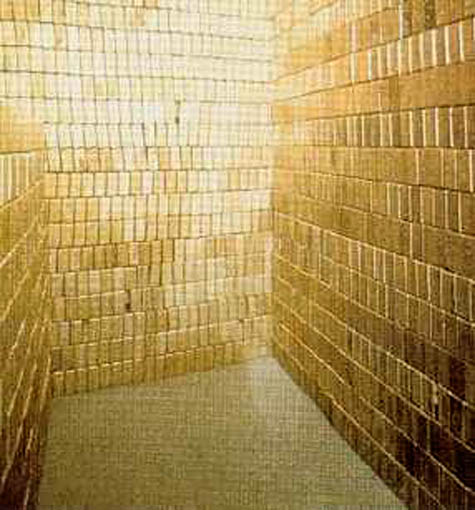
[Image: The solid gold walls of the U.S. Bullion Depository at Ft. Knox].

In fact, some massive new gold heist film should now be forced into production, set in the over-securitized labyrinth of vaults beneath a skyscraper in midtown, a kind of post-Italian-Job-remake example of urban super-thievery, complete with glimpses of the complicated overlapping spatial histories of an earlier island geography, from New York’s forgotten underground rivers (which our criminals could perhaps scuba-dive through) to inexplicable brick walls (bumped up against where the robbers’ maps only show mud). A small baroque pavilion in Central Park could be involved, or perhaps huge rooms of subsurface shelving deep beneath the New York Public Library where CGI-friendly radar equipment could be tested by our future perpetrators.

(Original gold story spotted by Steve Silberman).