Celestial Detector

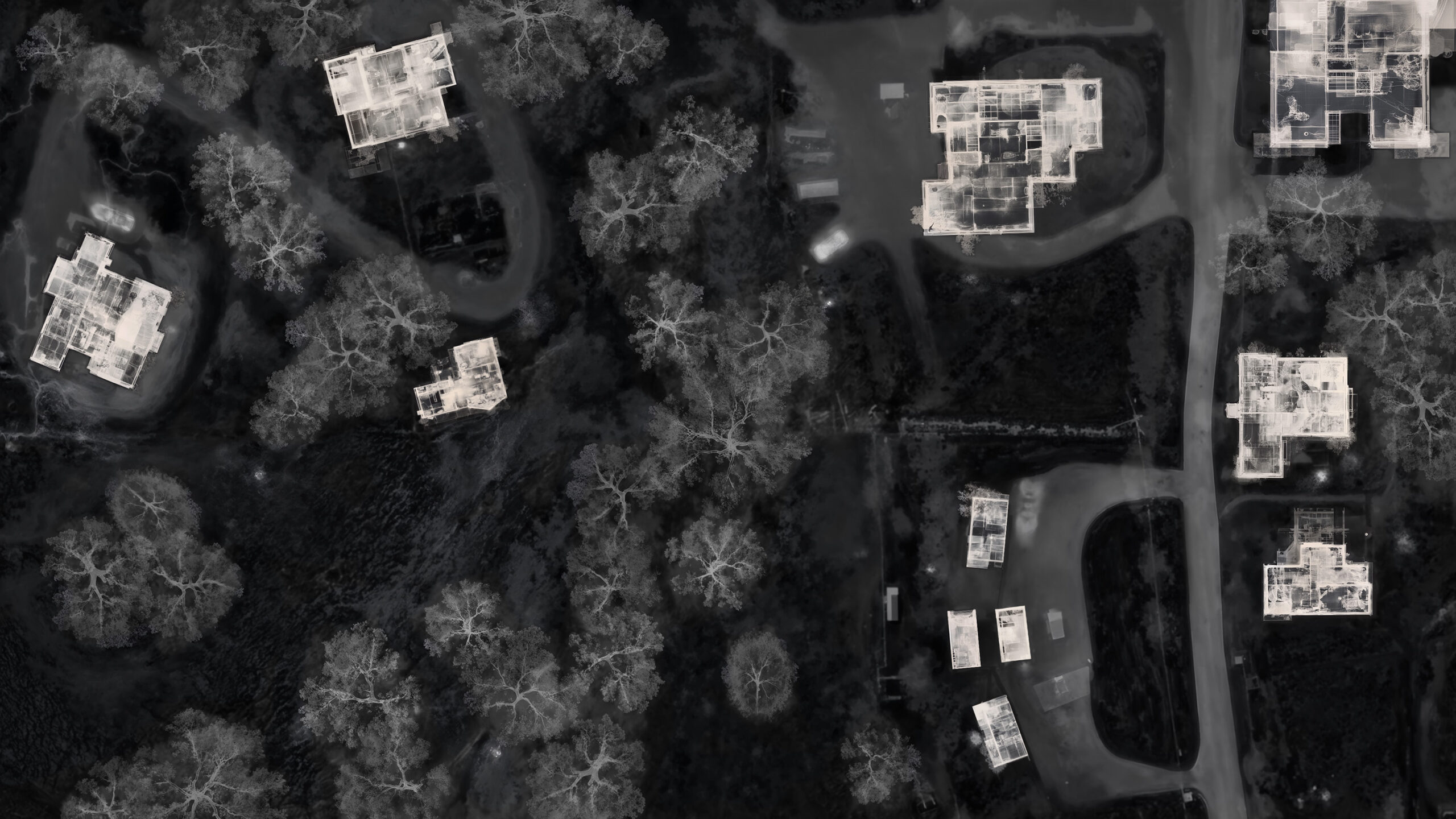
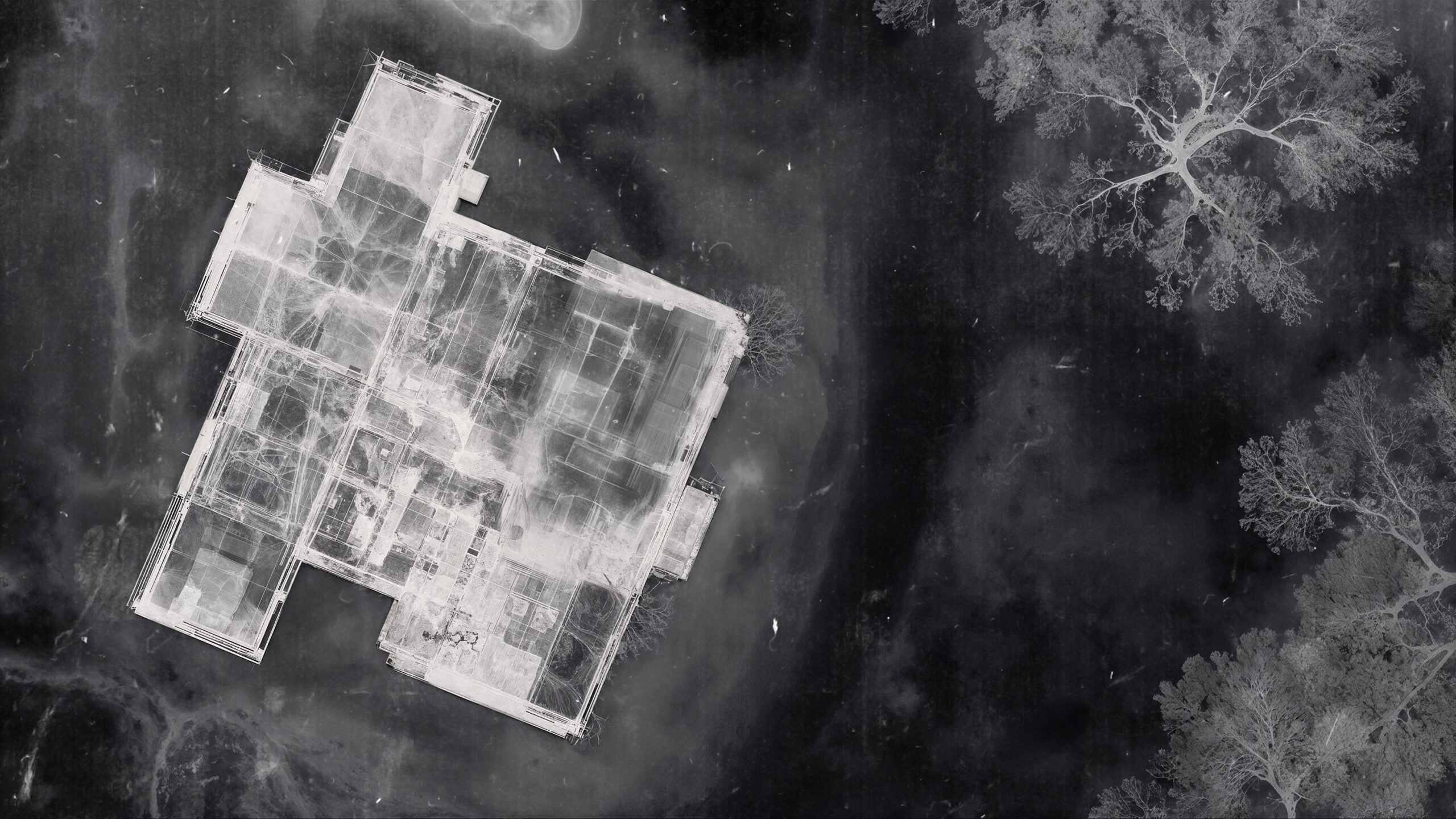
[Image: View larger! From “Celestial Detector,” 2025 Lisbon Architecture Triennale; all text by Geoff Manaugh, all images by John Becker/WROT Studio.]

I had a new piece of short fiction commissioned by the 2025 Lisbon Architecture Triennale that was just published last week over at e-flux.

The theme of the Triennale this year is “How Heavy is a City?” To address that, I wrote about a fictional German physicist named Wendell Brandt. During the Cold War, Brandt proposed using cosmic particles—known as muons—to spy under the Berlin Wall.

[Image: From “Celestial Detector,” 2025 Lisbon Architecture Triennale; all text by Geoff Manaugh, all images by John Becker/WROT Studio.]

Although Brandt (and the story’s first-person narrator) is entirely fictional, muon tomography—or muography—is a real visualization technique.

Muons are constantly passing through all of us—through our skin and bones, our cars and buildings, through the mountains and landforms around us. They are so small, moving so quickly, that they have little interaction with matter. We never feel them, though they are inside our muscle and bone; we never see them, though they pass through our pupils and optic nerves.

Although muons are everywhere, they are surprisingly few in number: every second, fewer than ten muons pass through an area the size of your palm, literally just a handful. With the right instrumentation, however, the passage of muons can be recorded, like light on a digital sensor, which means that, given enough time, muons can be used to create images. Similar to an X-ray, the resulting “muographs,” as they are known, reveal otherwise inaccessible voids inside even the densest of materials.

Muography allows people to peer inside dense materials and structures, from cathedrals and hydroelectric dams to Mayan temples and Egyptian pyramids. Or, of course, entire neighborhoods in Cold War Berlin.

[Images: From “Celestial Detector,” 2025 Lisbon Architecture Triennale; all text by Geoff Manaugh, all images by John Becker/WROT Studio.]

Brandt’s experiment in celestial espionage took advantage of an abandoned church near the Berlin Wall where, funded by the U.S. Department of Defense, he installed his first detector. As the data came in, however, Brandt became obsessed with exactly who he was spying on—perhaps even old friends and family members, now isolated in East Berlin by the construction of the Wall.

In a project notebook I obtained through a Freedom of Information Act request, I found that Brandt had used several pages as a personal journal, reflecting on his experience developing muographic techniques in Berlin. The notes—strangely, written in English, as if he had hoped his American sponsors would someday read them—suggested a scientific curiosity gradually becoming more philosophical. Whether muons could image strategically important military features gave way to speculation about families living in apartments nearby, about the quiet lives of fellow Germans separated by the Wall—people who, he believed, he would never meet face to face. All he would know of them were these shadows and blurs, etched by cosmic particles on secret electronics in the deep.

Brandt’s fixation with capturing the lives of strangers, using particles from space, led him onward from there to a series of increasingly ambitious scientific experiments. These included, after the fall of the Wall in November 1989, a purpose-built architectural facility for rigorously measuring the passage of muons.

[Images: From “Celestial Detector,” 2025 Lisbon Architecture Triennale; all text by Geoff Manaugh, all images by John Becker/WROT Studio.]

Although there is much more to the (fictional) story, Brandt’s experiments culminated in a massive lab constructed beneath a remote California town, within the San Andreas Fault.

[Image: From “Celestial Detector,” 2025 Lisbon Architecture Triennale; all text by Geoff Manaugh, all images by John Becker/WROT Studio.]

Although his scientific goal there was to see if muography could be used to image large-scale terrestrial phenomena, such as a moving tectonic fault, Brandt began to notice, within the data, the outlines of the town above, down to individual houses and rooms—even, over the course of fifteen years, specific pieces of furniture showing up in the resulting scans.

Once again, Brandt was looking into the lives of strangers from below, using particles from space.

[Image: From “Celestial Detector,” 2025 Lisbon Architecture Triennale; all text by Geoff Manaugh, all images by John Becker/WROT Studio.]

The story itself, I hope, is worth reading in full, but the visuals are a huge part of it. Those were all produced by John Becker of WROT Studio, a frequent collaborator of mine (for projects like the “Institute for Controlled Speleogenesis” and 3D-printing concrete bees).

John put together some spectacular depictions of architecture as imaged using muons, including short AI-generated film sequences and a larger animation that will be screened in Lisbon at the Triennale next month.

[Image: View larger! From “Celestial Detector,” 2025 Lisbon Architecture Triennale; all text by Geoff Manaugh, all images by John Becker/WROT Studio.]

The story was at least partially inspired by my old friend Lebbeus Woods, whose fictional projects—including his proposal for an unmade film called “Underground Berlin”—are never far from my mind.

Check it out, if you get a chance.

(Thanks to Nick Axel of e-flux for editorial guidance, and to Ann-Sofi Rönnskog and John Palmesino of Territorial Agency for commissioning the story in the first place.)

Star Forts, Mines, and Other Maastricht Subterranea

I was in Maastricht, Netherlands, for a couple nights last week, mostly as a way to break-up my trip across the Atlantic and thus help get over jet-lag before attending an archaeology conference (where I currently type this).

I went specifically to Maastricht, however, because it’s home to an astonishing number of subterranean sites, from 800-year-old limestone mines and 17th-century star fortifications to NATO defense bunkers. I basically checked into my hotel then disappeared underground for the rest of the visit.

Here are some pics.

My morning started here, at the entrance to the Casemates Waldeck, a labyrinth of defensive earthworks complete with tunnels, counter-mine tunnels, barracks, and firing positions. Large parts of the system were then later repurposed as civilian air-raid shelters during WWII.

The geometric logic of the forts was—among other things—to lure enemy attackers in over cliff-like artificial drops and ridges, thinking they were on their way to the heart of the city. However, this simply trapped them between huge brick walls, directly in front of disguised gun emplacements, many of which were deliberately aimed at stomach-height to maximize suffering.

If you go through the door seen in the above photographs, meanwhile, you end up inside a bewildering system of multi-level tunnels weaving around for kilometers beneath the outer edge of the city.

Because the city has expanded and grown over the centuries, whole neighborhoods now sit atop these structures; if you live in Maastricht, you might very well have disused military fortification tunnels running under your basement.

What’s more, not all of the tunnels are mapped—which means that some are neither maintained nor stabilized. Apparently, seasonal floods have led to sinkholes above, as streets partially collapse into the system.

And that’s just one of many, many underground sites you can tour.

The next place I headed was called the Zonneberg Caves—which are not natural caves, but a colossal limestone mine—and I honestly can say I would spend entire weeks down there.

I’m just randomly typing facts from memory, because I’m on a break from a conference and want to get these photos up, which means I will almost certainly get a few details wrong, but I believe they said that “only” 80 or so kilometers of these ancient limestone mines remain from more than 200, and that the first shafts were cut in the 13th century.

The mines extend all the way over the international border into Belgium. The Belgian tunnels are apparently closed to the public, yet people sneak into them all the time.

There are 20th-century artworks painted on the walls, much older graffiti etched directly into rock, and massive corridors extending off on all sides into darkness.

If you’re into the underground and ever have an opportunity to spend more time than a tour down there, I would recommend it without any hesitation—and I will be deeply, deeply jealous.

The site is even complete with a little church altar.

Bear in mind, this is all still the same day.

The next site I went to was accessed through a locked metal door in the rock (pictured above). This system, known as the North Caves, is actually physically connected to the Zonneberg Caves, although it would take an hour or more to get between them underground. Like I say, I would go back there and wander around in a heartbeat.

The added interest of this latter system is that parts of it were used during WWII to house paintings by the Old Masters, protecting them from Nazi plunder and stray Allied bombs alike.

At the end, you go into a place called “the Vault” to see where Rembrandts and other paintings were hung while war waged above.

Finally, after many hours underground, I walked outside—and the first thing I saw was this rainbow. A cheesily enjoyable end to a fantastic day.

If you’re tempted to see any of these places yourself, and you hope to do so legally, check out Maastricht Underground for potential tours.

[All photos by Geoff Manaugh/BLDGBLOG.]

Mineral Hurricane

I recently had the pleasure of attending a press preview of the new documentary Architecton, directed by Victor Kossakovsky and released last week by A24.

Surreally, the screening I attended was held inside a Cedars-Sinai medical-imaging center in west Los Angeles. Seeing this particular film, with its intensely granular focus on the geological underpinnings of the built environment, amidst diagnostic tools designed for peering inside the human body seemed strangely appropriate.

I imagine that, if you were simply to wander into a room where Architecton was playing, it would very likely appear to be a film about geology: about rocks and mountains, quarries and mines, and the raw streams of matter that create and emerge from them.

There is an extraordinary early sequence, for example, from which the stills in this post were taken, where Kossakovsky captures a landslide. We watch as increasingly large rocks, from sand to gravel to room-sized blocks to immense boulders, all flow downhill in slow motion, crashing into one another, exploding, ricocheting, and splitting apart.

It looks for all the world like an oceanic phenomenon—a series of waves, not a solid planet at all, as if the Earth has begun to boil and heave with liquefaction.

The sequence then fades into what I believe is an aerial drone shot of the same landslide, but the visuals here become almost astronomical in their power and beauty, as if Architecton had somehow captured a proto-planetary storm of partially aerosolized rock. It looks like you’ve woken up inside the asteroid belt—or perhaps what J.M.W. Turner would have depicted if he had traveled in space. Not landscapes but nebulae.

There is something so elemental, even infernal, in this sequence, verging on the cosmic: glimpsing how the Earth itself was assembled through a billion-year maelstrom of mineral hurricanes, spherical landslides, and weather systems made entirely of geology.

Later, the camera lingers over detonations in the walls of strip mines. We watch rocks being bounced and agitated on conveyor belts, wet with leachate and acid. At one point, the camera stares into a minimalist doorway, cut like an Etruscan tomb, through which rocks tumble to be processed as abyssal red embers glow.

It’s just a mine, of course, but Kassakovksy has made it look like an alchemical complex, a brutalist oven in which all things planetary can be melted and enhanced, sluiced off and purified, distilled into a purely economic form. It is brute oceanic metallurgy.

It’s these early sequences that I could have watched literally for hours. It was also these scenes that felt so perfect for the unlikely setting in which the film was being screened that day, knowing that, as we all sat there, people in the rooms around me were getting CT scans, MRIs, and X-rays.

But the movie takes a more architectural turn here, increasingly focused on buildings and cities, on archaeological sites and ruins. We see residential towers in Ukraine, for example, ripped open by Russian missiles and drone-bombs, and then earthquake-damaged apartments undergoing demolition and clearance, followed by landfill-dumping operations so large they look like attempts at terraforming.

These are intercut with the film’s only speaking sections, where we watch architect Michele De Lucchi supervise the construction of a small rock circle in his garden. A light snow falls and hazy mountains are visible in the background. The scenes are meditative and calming.

At one point, De Lucchi’s circle is visually rhymed with an all-too-brief aerial glimpse of what I believe is the Richat Structure in Mauritania, continuing the film’s play on form and organization, as if rocks have within them a natural capacity to resemble storms and hurricanes—as if everything we believe to be is solid is, in fact, made of vortices and waves.

And this is all perfectly enjoyable; I was mesmerized.

But the film ends on a strange note. Despite appearing—to me—to be a documentary about the Earth, geology, and elemental form—about the human relationship with matter and our attempts to control it—Architecton concludes with a somewhat head-spinning turn in which the director himself appears on screen and asks De Lucchi, in person, why humans now construct such ugly buildings.

The question felt totally out of the blue to me and, frankly, irrelevant to the rest of the documentary. Either I had mis-understood everything I’d seen leading up to that point or perhaps Kassakovksy had felt pressured to deliver some sort of easy takeaway, an interpretation or rhetorical question that critics could discuss after viewing.

Speaking only for myself, what I wanted to discuss as I walked out of the cinema was not whether we should build fewer glass towers in Milan, but whether or not we understand what the Earth really is; whether landslide dynamics repeat, in miniature, the formational mechanics of rocky planets in the early solar system; or whether our cultural—and, yes, architectural—encounters with rock, especially in the form of mines and quarries, might force us to reevaluate how we define humanism in the first place. Some people think literature makes us human, but what if it’s actually metallurgy?

In the end, it was as if someone had created a 100-minute-long Rorschach test, composed of extraordinarily beautiful imagery of landslides and rocks, only to spring out from behind a screen and tell us that, this whole time, he had been thinking about classical architecture.

Nevertheless, the film is worth checking out—and I’d recommend doing so in a theater while you can, for the sheer scale of what Kassakovksy depicts.

(Thank you to A24 for providing the stills that appear in this post.)

geo/acc

Slag heap debris on the English coast has apparently been fusing into a new kind of sedimentary rock.

A team of geologists studying the beach recently “found a series of outcrops made from an unfamiliar type of sedimentary rock. The beach used to be sandy, so the rock must have been a recent addition. It was clearly clastic, meaning it was composed of fragments of other rocks and minerals (clasts) that have been cemented together in layers. On closer inspection, they found that the clasts were derived from the slag heap.” Based on inclusions of trash amongst the sediments, such as a discarded coin, some of this rock could not have been more than 36 years old.

It’s accelerated geology, part of what the researchers describe in their resulting paper as “a rapid anthropoclastic rock cycle,” one where a new class of geological material is “forming over decadal time scales rather than thousands to millions of years.”

These new coasts are likely forming elsewhere in the world, New Scientist adds: “Slag waste is a global phenomenon, and it is probably being turned to rock anywhere it comes into contact with ocean waves.” Let’s go find and map some more! The anthro-littoral, or geology itself as an archaeological artifact.

Crusted scablands of industrial coral, bulbous and pockmarked, herniate into the sea, long after the creatures who forged those materials have gone.

Institute for Controlled Speleogenesis

Recently, I’ve been looking back at a collaborative project with John Becker of WROT Studio.

The “Institute for Controlled Speleogenesis” (2014) was a fictional design project we originally set in the vast limestone province of Australia’s Nullarbor Plain.

[Image: A rock-acid drip-irrigation hub for the “Institute for Controlled Speleogenesis,” a collaboration between BLDGBLOG and WROT Studio; all images in this post are by John Becker of WROT Studio.]

The Nullarbor Plain is a nearly treeless region, roughly the size of Nebraska. It is also the world’s largest karst landscape, and thus home to hundreds of natural caves.

“There is a great variety of cave types under the Nullarbor,” as Australian Geographic explains, “but the plain’s most interesting features are long, deep systems (such the Old Homestead Cave), which are found only here, in the U.S. state of Florida, and on Mexico’s Yucatan Peninsula, all of which all have similar karst limestone layers.”

The Institute for Controlled Speleogenesis was imagined as a remote, thinly staffed site for applied geological research, where huge artificial caves could be generated below the Earth’s surface using a special acid mix—as safe as vinegar, but, importantly for our project, capable of dissolving limestone on a greatly accelerated timescale.

Subterranean spaces of every conceivable size, from tiny hollows and capillaries to vast megastructures, could thus be acid-etched into even the deepest karst formations, both rapidly and over decadal expanses of time.

The resulting rooms, tunnels, and interconnected cave systems could be used for a wide range of purposes: generating speleo-pharmaceuticals, for example, as well as testing recreational caving equipment, experimenting with underground agricultural systems, or developing new technologies for subterranean navigation, communication, inhabitation, and mapping.

As John writes on his own website—where you can also see larger, more-detailed versions of these images—our “aberrant caverns,” in John’s phrase, would be monitored in real-time by autonomous systems operating 24 hours a day.

The ever-growing caves could thus be left on their own, unsupervised, while the acid-drip system gradually etches down, drop by drop, reaching increasingly remote underground realms that the acid itself creates.

As a preliminary step, different blends of rock-acid mix would first be tested on large pillars aboveground, to choose or highlight specific spatial effects.

Controlled showers of rock-acid would result in totem-like sculptures, like industrial-scale menhirs—Stone Age ritual artifacts by way of 21st-century geochemistry.

Once the desired effects have been achieved, fields of bladders, nozzles, and injection arrays can be programmed and choreographed to enlarge an artificial cave mouth.

The irrigation system can then be continued underground. Necklaces of acid-drip arrays can easily be extended underground in order to expand the cave itself, but also to lengthen certain tunnels or to experiment with architecturally stable cave formations.

As John explains, the images seen here depict an “injection array using a pressurized system to move large quantities of solution to underlying areas of the cave network. These injection sites are outwardly the tell for a hidden world below. Much like oil derricks extracting resources from the earth, their density and scale across the landscape give you a glimpse into areas afforded the most resources for injection.”

Our initial siting of this in the Nullarbor Plain was motivated entirely by geology, but other large limestone provinces—from Kentucky or northern Arizona to southern France, and from California’s Lucerne Valley to Egypt—would also be good hosts.

While we looked into standard mining acids, currently used for stripping tailings piles of valuable minerals, it quickly became apparent that specific kinds of acetic acid—again, no more toxic than vinegar—offered a more viable approach for creating a maximally spacious site with minimally polluting environmental implications. (Of course, should someone without such qualms want to explore this set-up with no concern for its ecological impact, then much stronger acids capable of dissolving much stronger rocks could also be explored.)

In 2022, I was excited to see that John returned to this project, generating a new series of images using AI image-generation software trained on our earlier project documentation. Given their provenance, the resulting images are unsurprisingly cinematic—equal parts cyberpunk dereliction and underworldly luminescence.

Over the years, John has become a wizard at producing Modernist geological imagery, publishing images on his Instagram account—rock sculpted as smooth as paper and as diaphanous as a veil or curtain.

Check out his own website for more images of the Institute for Controlled Speleogenesis and other recent projects. And, if you like this, don’t miss “Architecture-by-Bee and Other Animal Printheads,” an earlier project of ours that I’m proud to say was published in Paul Dobraszczyk’s excellent recent book, Animal Architecture: Beasts, Buildings and Us.

(All images in this post are by John Becker of WROT Studio. This post contains a Bookshop.org affiliate link, meaning that I might receive a small percentage of any resulting sales.)

The Reaction Area

Enigmatic chemical reactions” have broken out underground inside two Los Angeles-area landfills, according to the L.A. Times. These “highly unusual reactions at Los Angeles County’s two largest landfills have raised serious questions about the region’s long-standing approach to waste disposal and its aging dumps.”

If landfills are the extreme endpoint of a cultural practice of burial—we bury to memorialize, to forget, to protect, to hide, store, and retrieve—then the idea that what we’ve made subterranean might take on a life or chemical activity of its own has a strange irony. Landfills seem to fully embody the idea that we don’t understand the extent of we’ve placed into the ground, nor what it does once we leave it there. Perhaps we also bury to reinvigorate and transform.

I’m reminded of a story from the British nuclear facility at Sellafield, whose new owners realized they had incomplete documentation of the site and thus had no idea where radioactive waste had been buried there. They actually put an ad in the local newspaper saying, “We need your help. Did you work at Sellafield in the 1960s, 1970s or 1980s? Were you by chance in the job of disposing of radioactive material? If so, the owners of Britain’s nuclear waste dump would very much like to hear from you: they want you to tell them what you dumped—and where you put it.”

It feels oddly on-brand with modern living that we might not fully understand long-term landfill chemistry, that random solvents, dyes, acids, fuels, and detergents sloshing around together in huge, sealed landscapes for decades might break out in unexplained reactions, like inadvertent batteries—that we isolated our waste, thinking it would make us safe, but it is only gaining in chemical power.

As of November 2023, the “reaction area” in one of the L.A. dumps “had grown by 30 to 35 acres, according to the agency [CalRecycle]. Already, the heat has melted or deformed the landfill’s gas collection system, which consists mostly of polyvinyl chloride well casings. The damage has hindered the facility’s efforts to collect toxic pollutants.” This seems to imply it will get worse, and nearby residents have begun reporting chemical smells.

“The bad news,” L.A. County Supervisor Kathryn Barger told the paper, “is we’ve never seen anything like this, and if we don’t understand what triggered it, it could happen at other landfills that are dormant. So it’s important for us to get a handle on it.” The earth, riddled with dormant landfills, attaining enigmatic chemical vigor in the darkness.

(Related: Class Action, Land of Fires, and The Landscape Architecture of Crisis.)

Agency of the Subsurface

[Image: The Heathen Gate at Carnuntum, outside Vienna; photo by Geoff Manaugh.]

Last summer, a geophysicist at the University of Vienna named Immo Trinks proposed the creation of an EU-funded “International Subsurface Exploration Agency.” Modeled after NASA or the ESA, this new institute would spend its time, in his words, “looking downward instead of up.”

The group’s main goal would be archaeological: to map, and thus help preserve, sites of human settlement before they are lost to development, natural decay, climate change, and war.

Archaeologist Stefano Campana, at the University of Siena, has launched a comparable project called Sotto Siena, or “Under Siena”—abbreviated as SOS—intended to survey all accessible land in the city of Siena.

[Image: A few of Siena’s innumerable arches; photo by Geoff Manaugh.]

That project’s goal is primarily to catalog the region’s millennia of human habitation and cultural artifacts, but, like Immo Trinks and his proposed ISEA, is also serving to document modern-day infrastructure, such as pipes, utilities, sewers, and more. (When I met Campana in Siena last year, I was interested to learn that a man who had walked over to say hello, who was introduced to me as an enthusiastic supporter of Campana’s work, was actually Siena’s chief of police—it’s not just archaeologists who want to know what’s going on beneath the streets.)

I had the pleasure of tagging along with both Trinks and Campana last year as part of my Graham Foundation grant, “Invisible Cities,” and a brief write-up of that experience is now online over at WIRED.

The article begins in Siena, where I joined Campana and two technicians from the Livorno-based firm GeoStudi Astier for a multi-hour scan of parks, piazzas, and streets, using a ground-penetrating radar rig attached to a 4WD utility vehicle.

[Images: The GPR rig we rode in that day, owned and operated by GeoStudi Astier; photos by Geoff Manaugh.]

We stayed out well past midnight, at one point scanning a piazza in front of the world’s oldest bank, an experience that brought back positive memories from my days reporting A Burglar’s Guide to the City (alas, we didn’t discover a secret route into or out of the vault, but just some fountain drains).

In Vienna, meanwhile, Trinks drove me out to see an abandoned Roman frontier-city and military base called Carnuntum, near the banks of the Danube, where he walked me through apparently empty fields and meadows while narrating all the buildings and streets we were allegedly passing through—an invisible architecture mapped to extraordinary detail by a combination of ground-penetrating radar and magnetometry.

“We want to map it all—that’s the message,” Trinks explained to me. “You’re not just mapping a Roman villa. You’re not mapping an individual building. You are mapping an entire city. You are mapping an entire landscape—and beyond.”

An estimated 99% of Carnuntum remains unexcavated, which means that our knowledge of its urban layout is almost entirely mediated by electromagnetic technology. This, of course, presents all sorts of questions—about data, machine error, interpretation, and more—that were explained to me on a third leg of that trip, when I traveled to Croatia to meet Lawrence B. Conyers.

[Image: A gorge leading away behind the archaeological site I visited on the island of Brač, Croatia; photo by Geoff Manaugh.]

Conyers is an American ground-penetrating radar expert who, when we met, was spending a couple of weeks out on the island of Brač, near the city of Split. He had traveled there to scan a hilltop site, looking for the radar signatures of architectural remains, in support of a project sponsored by the University of Colorado at Boulder.

Conyers supplies a voice of caution in the WIRED piece, advising against over-relying on expensive machines for large-scale data collection if the people hoarding that data don’t necessarily know how to filter or interpret it.

[Image: Lawrence Conyers supervises two grad students using his ground-penetrating radar gear; photo by Geoff Manaugh.]

The goal of an International Subsurface Exploration Agency could rise or fall, in other words, not just on questions of funding or public support, but on the limits of software analysis and human interpretation: are we sure that what we see on the screens of our machines is actually there, underground?

When we spoke in Siena, Campana used the metaphor of a medical biopsy, insisting that archaeologists and geophysicists will always need to excavate, not just for the recovery of historical artifacts and materials, but for verifying their own hypotheses, literally testing the ground for things they think they’ve seen there.

Archaeologist Eileen Ernenwein, co-editor of the journal Archaeological Prospection, also emphasized this to me when I interviewed her for WIRED, adding a personal anecdote that has stuck with me. During her graduate thesis research, Ernenwein explained, she found magnetic evidence of severely eroded house walls at an indigenous site in New Mexico, but, after excavating to study them, realized that the structure was only visible in the electromagnetic data. It was no less physically real for only being visible magnetically—yet excavation alone would have almost certainly have missed the site altogether. She called it “the invisible house.”

In any case, many things have drawn me to this material, but the long-term electromagnetic traces of our built environment get very little discussion in architectural circles, and I would love this sort of legacy to be more prominently considered. What’s more, our cultural obsession with ruins will likely soon begin to absorb new sorts of images—such as radar blurs and magnetic signatures of invisible buildings—signaling an art historical shift in our representation of the architectural past.

For now, check out the WIRED article, if you get a chance.

(Thanks again to the Graham Foundation for Advanced Studies in the Fine Arts for supporting this research. Related: Through This Building Shines The Cosmos.)

Cleared For Approach

[Image: “Forest and Sun” (1926) by Max Ernst.]

When I first saw this painting—“Forest and Sun” (1926) by Max Ernst, a composition and theme he continually revisited and changed over the course of his career—I mistook the tiny white squiggles in the lower right for a procession of human congregants or religious pilgrims, people approaching a huge, alien landform out of some strange act of homage or scientific curiosity. Alas, it’s just Max Ernst’s signature.

Whatever you’re approaching in 2023, may it be unfamiliar, potentially threatening, and new.

Luminous Dreamlight

I spent part of the weekend down in Orange County, looking at birds, then the better part of an hour scrolling around on Google Maps, trying to figure out where we’d been all day.

[Image: Courtesy Google Maps.]

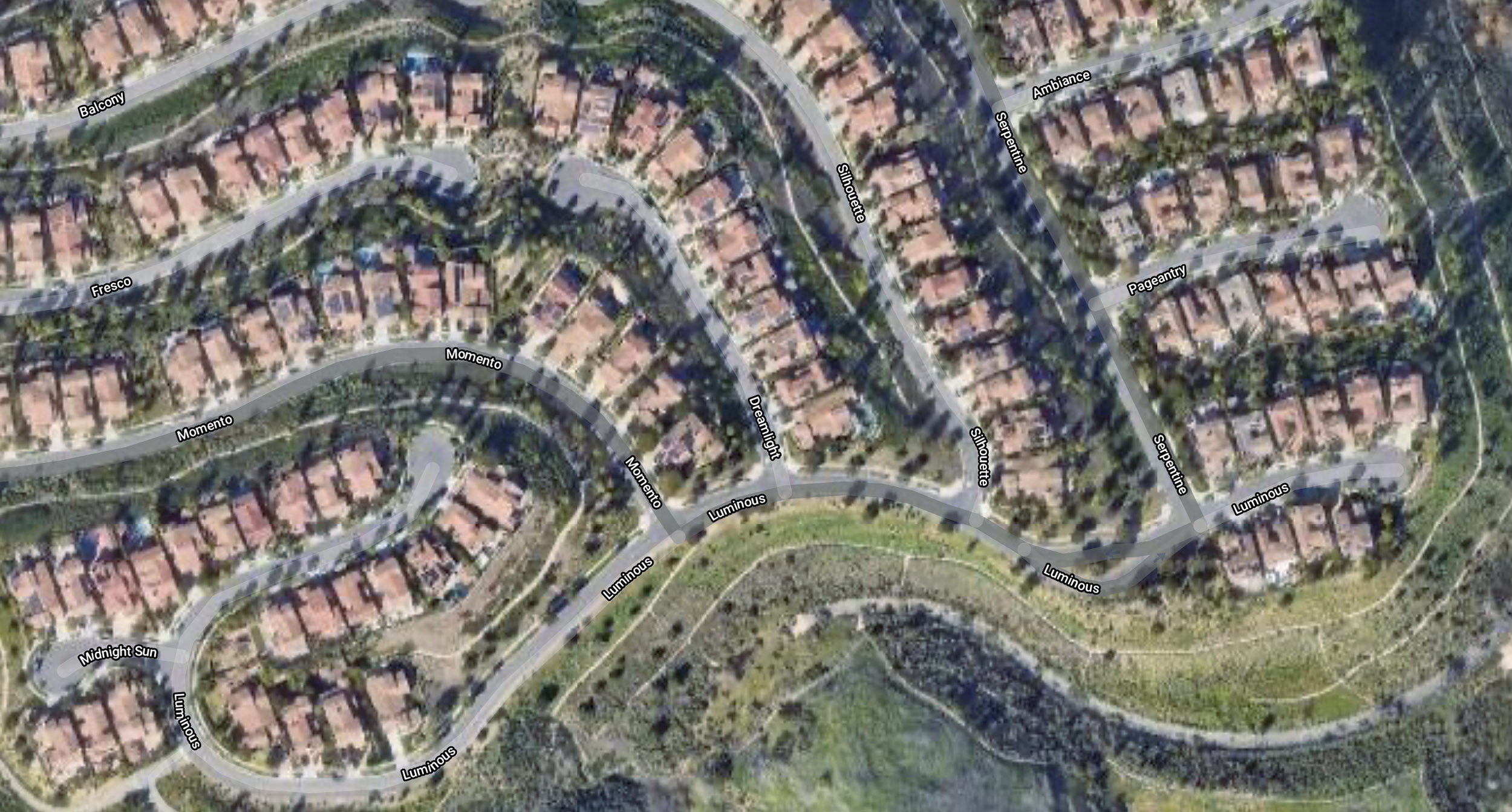
In the process, I noticed some incredible street names. I love this development, for example, with its absurdist, greeting-card geography: you can meet someone at the corner of Luminous and Dreamlight, or rendezvous with your Romeo on the thin spit of land where Silhouette meets Balcony.

The same development has streets called Symphony, Pageantry, and Ambiance—and don’t miss “Momento” [sic]. Nearby is a street called Heather Mist.

I live on Yacht Defender; please leave my packages at the front door.

[Image: Courtesy Google Maps.]

As you can probably tell, I have nothing particularly interesting to say about this; I’m just marveling at suburban naming conventions. I’m reminded of when we moved back to L.A. a few years ago and we were looking for paint colors, finding shades like “Online,” “Software,” and “Cyberspace.” A paint called “Download.”

A beautiful new house on Firmware Update, painted entirely in Autocomplete. Spellcheck Lane, painted in a color called Ducking.

[Image: Courtesy Google Maps.]

In any case, Orange County is actually a fascinating, Ballardian landscape of freeways built for no apparent reason other than to connect one grocery store to the next as fast as possible, residential subdivisions forming interrupted crystal-tiling patterns, migratory bird species flying over car parks, and vaguely named corporate research centers on the rims of artificial reservoirs.

Anecdotally, it has always seemed to me that fans of J.G. Ballard—or ostensible fans of J.G. Ballard—are suspiciously quick in condemning the very landscapes where so many of Ballard’s best stories take place, the suburban business parks, toll motorways, and heavily-policed private infrastructures of real estate developments outside London, in the south of France, or here in Orange County, where subdivisions seem named after the very animals whose ecosystems were destroyed during construction.

But, I mean, come on—where else should a J.G. Ballard fan read Concrete Island or Super-Cannes than in a $3 million rented home on Gentle Breeze, pulling monthly paychecks from ambiguously-defined consultant-engineering gigs, studying schematic diagrams for water-treatment plants at your kitchen table, all while driving a leased luxury car?

One such engineering firm, based near the developments described here, describes its expertise as tackling “earth-related problems” on “earth-related projects.” Earth-related problems. There should be a DSM-5 entry for that.

[Image: Courtesy Google Maps.]

Anyway, all future Ballard conventions should take place in landscapes like this—enormous rented homes impossible to climate-control, overlooking electric-SUV dealerships constructed atop former egret nesting grounds—at the metaphorical intersection of Luminous and Dreamlight.

Impact Gardening

Impact gardening” is the evocative term used to describe surface disturbance—and potential biological effects—caused by the crashing of extraterrestrial objects into planetary bodies.

[Image: The surface of Europa, including “the kind of areas churned by impact gardening.”]

These impacts can “churn” or, in effect, plow the surface, exposing previously buried materials to solar radiation—which, in turn, can break down and even sterilize any life thriving there—but it can also push potential organic matter “downward, where it could mix with the subsurface,” almost like planting seeds, according to a short feature published today by NASA.

“If we hope to find pristine, chemical biosignatures,” planetary researcher Emily Costello explained to NASA, “we will have to look below the zone where impacts have been gardening.”

Distant planetary landscapes, gardened by impacts.

Read more over at NASA—I’m honestly just posting this for the poetry of the phrase impact gardening

(Somewhat related: Life on the Subsurface: An Interview with Penny Boston.)

Feathered Friends

After the previous post, I was interested to see a short piece over at The New Yorker about basically the same idea—of spotting invasive species in the backgrounds of films and television shows, but, there, applied much more broadly to art history.

The article, by Rebecca Mead, looks at the unexpected presence of a cockatoo in an image by Italian Renaissance-era painter Andrea Mantegna, as the bird’s “native habitat is restricted to Australia, Indonesia, Papua New Guinea, the Solomon Islands, and the Philippines.” How did it get to 15th-century Italy—and more specifically, Mead asks, “what did the bird’s presence reveal about the connections between an Italian city and distant forests that lay beyond the world known to Europeans?”

[Image: A cockatoo in the background of Andrea Mantegna’s “Madonna della Vittoria” (1496), via Wikimedia.]
It’s a fun read, and includes a final archival detail I’ll mention briefly—I am particularly obsessed with rare finds in archives, to be honest, and this is a good one. It turns out that Mantegna’s painting was not the first depiction of a cockatoo in European art history. Instead, a manuscript hidden away in a Vatican library included an even earlier representation, made in the mid-1200s. Art history as forensic ecology.

Little creatures popping up in paintings and films, in engravings and TV shows, their presence there indicating larger tides of trade or climate change, acting as a strange barometer of the natural world.

(Related: Check the Sonic.)