Architecture of a Decade Past


[Image: Fresh Kills landscape masterplan by Field Operations, via Mammoth; “With 2,200 acres filled with 150 million tons of trash to contend with,” Metropolis writes, “the challenge is making Fresh Kills public and safe, which means covering the garbage mounds with some four feet of fresh soil. The park would grow itself with cost-effective soil farms that aren’t eyesores.” Read more at the Freshkills Park Blog].

Mammoth has posted a great list of the best architecture of the decade. It runs the gamut from groundwater replenishing infrastructure and Chinese high-speed rail to the Svalbard Global Seed Vault and the iPhone, by way of the Large Hadron Collider, Rome’s Pontine marshes, and a library in Medellín (among others).

The purpose of the list, they write, is “to share a handful of the reasons that we’re genuinely excited about the future of architecture, and to hopefully engender a bit of that excitement in a reader or two.” It’s an inspired (and refreshingly non-building-centric) list of innovations (like microfinance) that have affected the built environment—and yet another reason why Mammoth is one of the best architecture blogs being written anywhere in the world today.

As a list, it also fares very favorably against the mind-numbing self-congratulation of other critics’ decade-in-retrospect lists, in which the last ten years appeared to exist only to validate the publishing decisions of people who, long ago, forgot how to engage with anything more than a shaving mirror.

Again, here’s a link.

Homefront Dissolve

Keiichi Matsuda, a student at the Bartlett School of Architecture, produced this short video in the final year of his M.Arch. It was, he writes, “part of a larger project about the social and architectural consequences of new media and augmented reality.”

The latter half of the 20th century saw the built environment merged with media space, and architecture taking on new roles related to branding, image and consumerism. Augmented reality may recontextualise the functions of consumerism and architecture, and change in the way in which we operate within it.

The bewildering groundlessness of surfaces within surfaces is beautifully captured by this video, and its portrayal of drop-down menus and the future hand gestures needed to access them is also pretty great. Augmented-reality drop-down menus are the Gothic ornamentation of tomorrow.

Now how do we use all that home-jamming ad space for something other than Coke and Tesco? What other subscription-content feeds can be plugged into this vertiginous interface?

Take a look—and you can find more thoughts, and another video, on Matsuda’s own blog.

(Thanks to Nic Clear for the tip!)

The Self-Consuming Barbecue Pavilion

Note: This is a guest post by Nicola Twilley, originally published on Edible Geography.

In a fantastic hybrid of edible architecture and temporary summer pavilion, architect Caroline O’Donnell has proposed Bloodline, a free-standing, self-consuming grilling shelter.

[Image: Sectional model through the preparation bench, Bloodline pavilion by Caroline O’Donnell; Bloodline is supported by the Akademie Schloss Solitude].

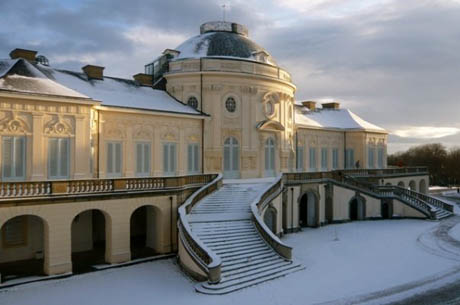
Bloodline is the outcome of O’Donnell’s 2007 fellowship and residency at Akademie Schloss Solitude, a grant-making and residency institution housed in the late-Baroque “Solitude Castle” near Stuttgart in southern Germany.

Karl Eugen, Duke of Württemburg, built Schloss Solitude in 1763 as a private pleasure house—a cross between a party castle, summer retreat, and hunting lodge. Solitude was intended to be more intimate and less formal than his royal palace at Ludwigsburg, like the Trianons were to Versailles.

[Image: Akademie Schloss Solitude, via Wikimedia].

Among the prerequisites for an eighteenth-century aristocrat to achieve relaxation were a natural setting and, perhaps more importantly, minimal interaction with the servant classes. However, since domestic service was still required (aristocratic relaxation did not encompass preparing, serving, and cleaning up after meals, for example), palace architects had to resort to an extremely elaborate set of spatial tricks and distortions to make the servers as invisible as possible. The original design for the Petit Trianon even included a mechanism for raising and lowering the dining table through the floor so that it could be set and cleared out of sight.

According to O’Donnell, “The guides at Schloss Solitude could not understand why I wanted to see the service spaces, and tried to convince me that they were not interesting. I kept telling them in bad German that I was an architect and therefore interested in uninteresting spaces, but that seemed to cause more confusion.”

[Image: The secret service spaces at Ludwigsburg (left) and Schloss Solitude (right)].

What she found, eventually, were a series of awkward and cramped service cupboards and passages, filling in the spaces around the formal, symmetrical rooms. They are the negative space of pure classical order; the banished evidence of domestic effort and bodily needs.

Interestingly, O’Donnell noticed that at Karl Eugen’s main palace, Ludwigsburg Castle, the formal rooms are arranged around the edge, concealing a rabbit warren of service spaces in the interior.

Meanwhile at Solitude, the reverse is true: the cupboards, closets, and service passages are banished to the edge, with the result that seven of the fourteen windows on the perfectly symmetrical south façade actually open onto these deformed, hidden spaces.

[Images: (top) The south-facing façade of Schloss Solitude, in which seven of its windows actually open onto service spaces, rather than public rooms; via. (bottom) The negative spaces into which domestic functions were banished at Schloss Solitude (left); many were used as fire-spaces (right)].

Among the domestic functions concealed in this way was fire maintenance: tiny fire-spaces were used for storing firewood and also enabled servants to stoke open fires while remaining behind the scenes.

O’Donnell explained that when she finally gained access to a fire-space, she noticed “the effects of this small-scale and contorted space on the body,” but she was most fascinated “by this idea of the fire-space as a window, through which the stooping servant had a rare window into the lives of his masters”—and, in some ways, a more complete or privileged understanding of the space of the palace as a whole.

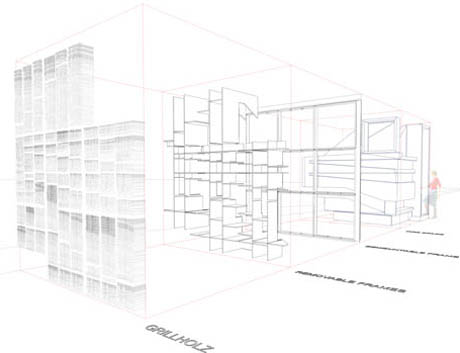
[Image: Bloodline, showing the stacked grillholz cuboid exterior concealing the irregular interior].

So, back to the barbecue pavilion: O’Donnell’s Bloodline proposal would use 360 bags of grillholz (German barbecue wood sticks) as the cladding—enough for a summer season, or ninety barbecues at four bags per cook-out. As July fades into August, and then into September, the pavilion will gradually be dismantled: the architecture’s fiery function will lead it to literally consume itself from the outside in. This is an incredibly poetic literalization of the shelter’s function: architecture parlante at its finest.

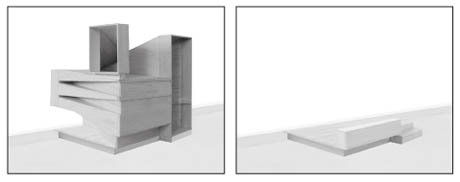
The pavilion also plays on O’Donnell’s initial fascination with Solitude’s squished fire-spaces. Bloodline begins the summer as a perfect, platonic cube, but gradually grills itself down to an awkwardly shaped frame that mirrors a section through the original fire-space. In other words, through use, the mini-barbecue palace will reveal its contorted, service-space origins—a slow, season-long process of revelation.

[Image: The pavilion will begin the summer as a platonic cube before being eroded through repeated barbecuing to reveal its hidden fire-space form].

Like Solitude’s original fire-spaces, which servants had to bend down and crawl to enter, the Bloodline barbecue pavilion is only designed to fit one person. And, as in the originals, that one person—the servant or barbecuer-in-chief, depending on how you look at these things—has a unique, more omniscient view.

Ludwigsburg and Solitude castles are linked by Solitudeallee, each palace is also aligned on its own axis of symmetry. When O’Donnell looked at these lines in satellite view, it became clear that there was a third axis, emerging from the forest, which was missing a castle.

Ingeniously, O’Donnell’s proposed site for Bloodline means that our barbecuing hero, standing in front of the grill-window on the southwest-facing side of the pavilion, is the only person in their party who can see that they are actually inside the missing third castle.

[Image: Plotting the axes and intersections of Ludwigsburg and Solitude: O’Donnell explained that “only the forest is missing a castle”].

In other words, while their friends and family relax in the grounds outside the pavilion, eating sausages they haven’t had to prepare, “only the servant (or grill-master) will know the truth,” explains O’Donnell, “although they can sneak others in, to share the secret.”

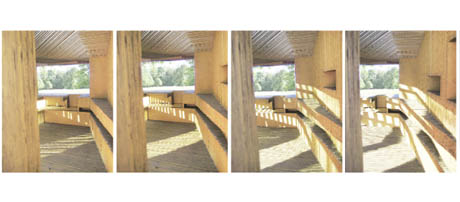
[Images: (top) Renderings of Bloodline show the grill-window and entrance; (bottom) Bloodline interior, looking out toward the grill-window’s privileged view].

In terms of grilling experience, the barbecue pavilion that becomes a secret, personal castle seems second to none. “After that, the sausages are not my responsibility,” O’Donnell told me. “There are however custom spaces built into the pavilion on the west side for a fire-extinguisher and a fire-blanket, as well as a big vent on the east side that aligns with the prevailing wind and uses the stack-effect to ventilate the space naturally.”

A couple of thoughts immediately come to mind here: firstly, that this is the perfect Father’s Day gift. After all, doesn’t every red-blooded male secretly crave his own barbecue castle: a private space of solitude, unspoken power, and burger perfection? Lowe’s or Homebase could even stock build-your-own kits, for an extra DIY frisson.

[Image: (left) Inside Bloodline (the server has clearly snuck in a few friends); (right) Stacked grillholz will form the façade and the barbecue fuel. The wood sticks’ color even matches the ochre putty exterior of Schloss Solitude].

I’m also reminded, via a link that was (coincidentally?) sent to me separately by Caroline O’Donnell, of Harvard anthropologist Richard Wrangham‘s theory that cooking is the root cause of human civilization. His basic idea is that the discovery of cooking allowed us to unlock many more calories in food, which gave us more energy for less effort, which in turn resulted in a massive increase in brain size in Homo sapiens (as compared to our primate ancestors).

[Images: Stages of consumption. At the end, all that will remain is the ash bench (bottom right), which O’Donnell plans to leave on site once the summer is over, “as a clue to the missing castle”].

That expanded brain of course led, eventually, to the flowering of the Baroque, in which rococo pleasure palaces were cleverly designed to hide any evidence of cooking facilities. O’Donnell’s pavilion gives cooking its due once again, as over the course of the summer Solitude’s missing third palace is revealed to be a a functional fire-space, rather than the abstracted perfection of a symmetrical cube. Barbecuing German day-trippers will thus be paying inadvertent homage to the role of fire in human civilization.

[Image: Some of O’Donnell’s incredibly complex cut files for fabrication].

Caroline O’Donnell is working with Akademie Schloss Solitude to secure funding for the pavilion: the hope is to install it during the summer of 2011. My thanks are due to her for an incredibly interesting conversation, and also to Nathan Friedman, who has been working on Bloodline with O’Donnell for the past few months.

(Note: This post, written by Nicola Twilley, was originally published on Edible Geography).

Nakatomi Space

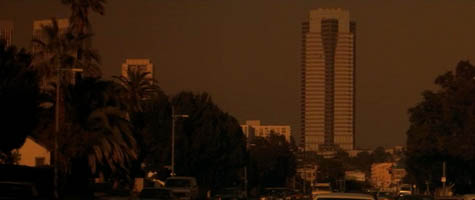
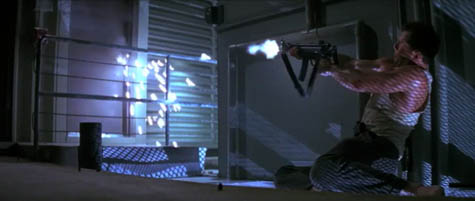
[Image: From Die Hard, directed by John McTiernan based on the novel Nothing Lasts Forever by Roderick Thorpe].

While watching Die Hard the other night—easily one of the best architectural films of the past 25 years—I kept thinking about an essay called “Lethal Theory” by Eyal Weizman—itself one of the best and most consequential architectural texts of the past decade (download the complete PDF).

In it, Weizman—an Israeli architect and prominent critic of that nation’s territorial policy—documents many of the emerging spatial techniques used by the Israeli Defense Forces in their high-tech, legally dubious 2002 invasion of Nablus. During that battle, Weizman writes, “soldiers moved within the city across hundred-meter-long ‘overground-tunnels’ carved through a dense and contiguous urban fabric.” Their movements were thus almost entirely camouflaged, with troop movements hidden from above by virtue of always remaining inside buildings. “Although several thousand soldiers and several hundred Palestinian guerrilla fighters were maneuvering simultaneously in the city,” Weizman adds, “they were so ‘saturated’ within its fabric that very few would have been visible from an aerial perspective at any given moment.”

Worthy of particular emphasis is Weizman’s reference to a technique called “walking through walls”:

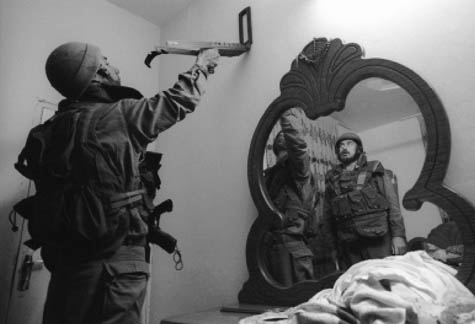
Furthermore, soldiers used none of the streets, roads, alleys, or courtyards that constitute the syntax of the city, and none of the external doors, internal stairwells, and windows that constitute the order of buildings, but rather moved horizontally through party walls, and vertically through holes blasted in ceilings and floors.

Weizman goes on to interview a commander of the Israeli Paratrooper Brigade. The commander describes his forces as acting “like a worm that eats its way forward, emerging at points and then disappearing. We were thus moving from the interior of homes to their exterior in a surprising manner and in places we were not expected, arriving from behind and hitting the enemy that awaited us behind a corner.”

This is how the troops could “adjust the relevant urban space to our needs,” he explains, and not the other way around.

Indeed, the commander thus exhorted his troops as follows: “There is no other way of moving! If until now you were used to moving along roads and sidewalks, forget it! From now on we all walk through walls!”

[Image: Israeli troops scan walls in a refugee camp; photo by Nir Kafri (2003), from Eyal Weizman’s essay “Lethal Theory”].

Weizman illustrates the other side of this terrifyingly dislocating experience by quoting an article originally published during the 2002 invasion. Here, a Palestinian woman, whose home was raided, recounts her witnessing of this technique:

Imagine it—you’re sitting in your living room, which you know so well; this is the room where the family watches television together after the evening meal. . . . And, suddenly, that wall disappears with a deafening roar, the room fills with dust and debris, and through the wall pours one soldier after the other, screaming orders. You have no idea if they’re after you, if they’ve come to take over your home, or if your house just lies on their route to somewhere else. The children are screaming, panicking. . . . Is it possible to even begin to imagine the horror experienced by a five-year-old child as four, six, eight, twelve soldiers, their faces painted black, submachine guns pointed everywhere, antennas protruding from their backpacks, making them look like giant alien bugs, blast their way through that wall?

In fact, I’m reminded of a scene toward the end of the recent WWII film Days of Glory in which we see a German soldier blasting his way horizontally through a house, wall by wall, using his bazooka as a blunt instrument of architectural reorganization—“adjusting the relevant space to his needs,” we might say—and chasing down the French troops without limiting himself to doors or stairways.

In any case, post-battle surveys later revealed that “more than half of the buildings in the old city center of Nablus had routes forced through them, resulting in anywhere from one to eight openings in their walls, floors, or ceilings, which created several haphazard crossroutes”—a heavily armed improvisational navigation of the city.

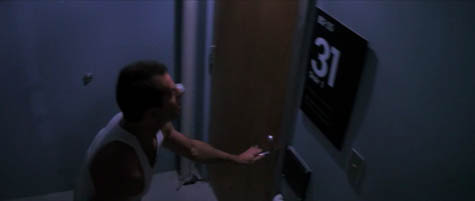
So why do I mention all this in the context of Die Hard? The majority of that film’s interest, I’d suggest, comes precisely through its depiction of architectural space: John McClane, a New York cop on his Christmas vacation, moves through a Los Angeles high-rise in basically every conceivable way but passing through its doors and hallways.

[Images: From Die Hard].

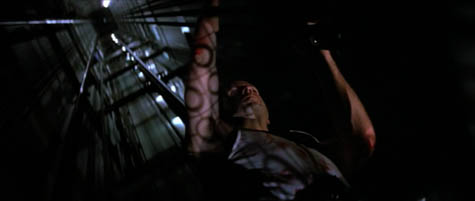
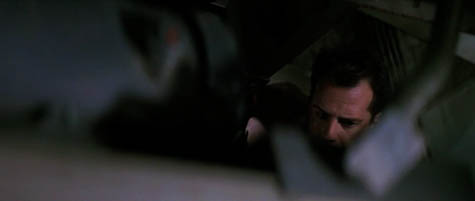
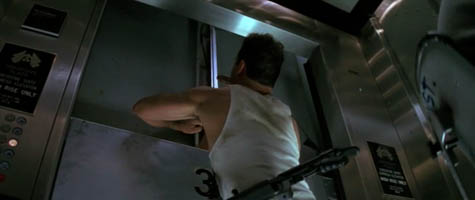
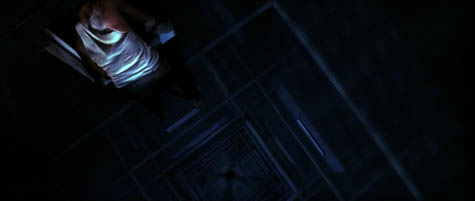
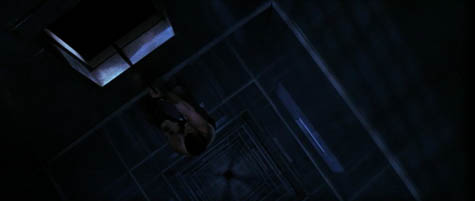
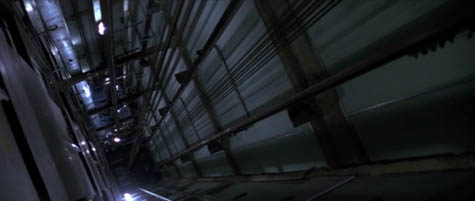
McClane explores the tower—called Nakatomi Plaza—via elevator shafts and air ducts, crashing through windows from the outside-in and shooting open the locks of rooftop doorways. If there is not a corridor, he makes one; if there is not an opening, there will be soon.

[Images: From Die Hard].

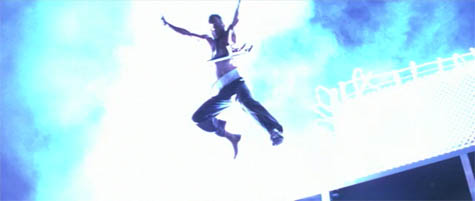
Over the course of the film, McClane blows up whole sections of the building; he stops elevators between floors; and he otherwise explores the internal spaces of Nakatomi Plaza in acts of virtuoso navigation that were neither imagined nor physically planned for by the architects.

His is an infrastructure of nearly uninhibited movement within the material structure of the building.

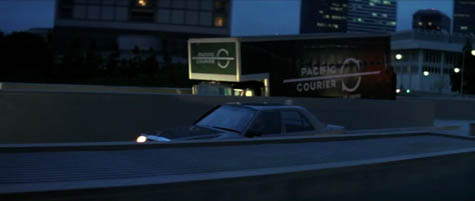
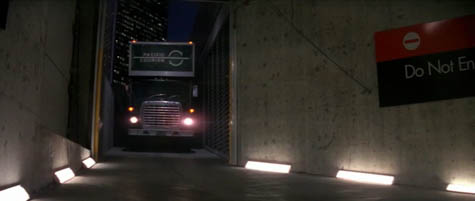
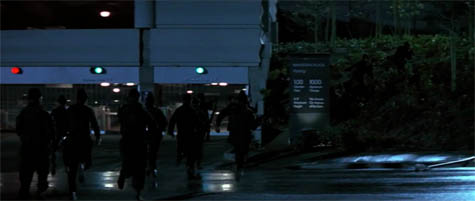
The film could perhaps have been subtitled “lessons in the inappropriate use of architecture,” were that not deliberately pretentious. But even the SWAT team members who unsuccessfully raid the structure come at it along indirect routes, marching through the landscaped rose garden on the building’s perimeter, and the terrorists who seize control of Nakatomi Plaza in the first place do so after arriving through the service entrance of an underground car park.

[Images: From Die Hard].

What I find so interesting about Die Hard—in addition to unironically enjoying the film—is that it cinematically depicts what it means to bend space to your own particular navigational needs. This mutational exploration of architecture even supplies the building’s narrative premise: the terrorists are there for no other reason than to drill through and rob the Nakatomi Corporation’s electromagnetically sealed vault.

Die Hard asks naive but powerful questions: If you have to get from A to B—that is, from the 31st floor to the lobby, or from the 26th floor to the roof—why not blast, carve, shoot, lockpick, and climb your way there, hitchhiking rides atop elevator cars and meandering through the labyrinthine, previously unexposed back-corridors of the built environment?

Why not personally infest the spaces around you?

[Images: From Die Hard].

I might even suggest that what would have made Die Hard 2 an interesting sequel—sadly, the series is unremarkable for the fact that each film is substantially worse than the one before—would have been if Die Hard’s spatial premise had been repeated on a much larger urban scale.

For example, Weizman outlines what the Israeli Defense Forces call “hot pursuit”—that is, to “break into Palestinian controlled areas, enter neighborhoods and homes in search of suspects, and take suspects into custody for purposes of interrogation and detention.” This becomes a spatially extraordinary proposition when you consider that someone could be kidnapped from the 4th floor of a building by troops who have blasted through the walls and ceilings, coming down into that space from the 5th floor of a neighboring complex—and that the abductors might only have made it that far in the first place after moving through the walls of other structures nearby, blasting upward through underground infrastructure, leaping terrace-to-terrace between buildings, and more.

An alternative-history plot for a much better Die Hard 2 could thus perhaps include a scene in which the rescuing squad of John McClane-led police officers does not even know what building they are in, a suitably bewildering encapsulation of this method of moving undetected through the city.

“Walking through walls” thus becomes a kind of militarized parkour.

[Image: Inside Nakatomi space, from Die Hard].

Indeed, recent films like The Bourne Ultimatum, Casino Royale, District 13, and many others could be viewed precisely as the urban-scale realization of Die Hard’s architectural scenario. Even The Bank Job—indeed, any bank heist film at all involving tunnels—makes this Weizmanian approach to city space quite explicit.

[Image: From Die Hard; it’s hard to see here, but an LAPD SWAT team is raiding the Nakatomi Building by way of lateral movements across the surrounding landscape].

Tangentially, I’m reminded of Matt Jones’s thought-provoking 2008 blog post about the urban differences between the Jason Bourne and James Bond film franchises. Jones writes that “there’s no travel in the new Bond”; there are simply “establishing shots of exotic destinations.” By the end of a Bond film, he adds, you simply “feel like you are in the international late-capitalist nonplace,” a geography with neither landmarks nor personal memory.

Compare the paradoxically unmoving, amnesiac geography of James Bond, then, to the compressed spaces of Paul Greengrass-directed Jason Bourne films. These films are “set in Schengen,” Jones writes, “a connected, border-less Mitteleurope that can be hacked and accessed and traversed—not without effort, but with determination, stolen vehicles and the right train timetables.” Indeed, Jones memorably suggests, “Bourne wraps cities, autobahns, ferries and train terminuses around him as the ultimate body-armor.”

Rather than Bond’s private infrastructure [of] expensive cars and toys, Bourne uses public infrastructure as a superpower. A battered watch and an accurate U-Bahn time-table are all he needs for a perfectly-timed, death-defying evasion of the authorities.

The space of the city is used in profoundly different ways by Bond and Bourne—but to this duality I would add John McClane of the original Die Hard.

If Jason Bourne’s actions make visible the infrastructure-rich, borderless world of the EU, then John McClane shows us a new type of architectural space altogether—one that we might call, channeling topology, Nakatomi space, wherein buildings reveal near-infinite interiors, capable of being traversed through all manner of non-architectural means. In all three cases—with Bond, Bourne, and McClane—it is Hollywood action films that reveal to us something very important about how cities can be known, used, and navigated: these films are filled with the improvisational crossroutes that constitute Eyal Weizman’s “Lethal Theory.”

As I wrote the other day, crime is a way to use the city.

[Image: From Die Hard].

On the other hand, as Weizman points out, this is not a new approach to built space at all:

In fact, although celebrated now as radically new, many of the procedures and processes described above have been part and parcel of urban operations throughout history. The defenders of the Paris Commune, much like those of the Kasbah of Algiers, Hue, Beirut, Jenin, and Nablus, navigated the city in small, loosely coordinated groups moving through openings and connections between homes, basements, and courtyards using alternative routes, secret passageways, and trapdoors.

This is all just part of “a ghostlike military fantasy world of boundless fluidity, in which the space of the city becomes as navigable as an ocean.”

[Image: From Die Hard].

Treated as an architectural premise, Die Hard becomes an exhilarating catalog of unorthodox movements through space. I would suggest again, then, that where the various Die Hard sequels went wrong was in abandoning this spatial investigation—one that could very easily have been scaled-up to encompass a city—and following, instead, the life of one character: John McClane. But, when taken out of Nakatomi Plaza—that is, out of the boundless, oceanic fluidity of Nakatomi space—McClane is reduced to an action film cliché whose failing charisma no amount of wise-cracking can salvage.

(I remembered while writing this post that I actually discussed Die Hard on National Public Radio last year; you can listen to that show here).

Crime is a way to use the city

[Image: Published in the New York Tribune, September 11, 1910].

Someday I’d like to write a book about the architectural side of burglary—bank heists, home invasions, jewelry thefts, wall-scaling girl gangs of the Global South, trans-metropolitan tunnels dug vault-to-vault through crypts by men with names like Terry Leather, smoke & mirrors, props and decoys, CCTV control rooms, lock-pickers’ guides, hourly updated routes of gold trucks leaving Manhattan, deterritorialized histories of the getaway car, impersonations and forgeries, spatial camouflage, criminal blueprints and future dream-technologies of the ultimate break-in—all in the name of looking at buildings, and the city itself, as puzzles, spatial systems you try very hard to get into. The well-guarded entrance and its multiple delays. Kafka meets HSBC.

Perhaps an Architectural Guide to the Ultimate Bank Heist—a 108-page pamphlet of speculative break-ins—or Pamphlet Architecture #31, in which incomprehensible robberies are outlined, complete with floorplans and renderings, or even next year’s best-selling stocking stuffer, a quasi-sequel to 15 Lombard Street, the BLDGBLOG Field Guide to Robbery. Illustrated by eBoy.

Until then, I’ll just post images like this one, above, originally published in the New York Tribune on September 11, 1910, in which gangs of silent-airplane enthusiasts raid the metropolis from above. They coast down onto moonlit roofs while unsuspecting homeowners sleep soundly in the comfort of darkness.

The Blobwall and the Bomb

[Image: Operation Sailor Hat, before detonation, via Wikipedia].

It’s a house, it’s a ziggurat, it’s… 500 tons of TNT stacked in a dome on the Hawaiian island of Kaho’olawe. A later test-detonation of these architecturally arranged fissile materials left a huge, still-extent crater that “currently contains unique sub-species of shrimp” that have “evolved to survive the hypersaline conditions” in the artificially excavated hole.

Bringing to mind Greg Lynn’s Blobwall—amorphous and multicolored plastic “bricks” whose puzzle-like stacking produced (unfortunately quite garish) enclosures—or even Gramazio & Kohler’s robot-built wall in New York City, Pike Loop, the dome implies a kind of militarized vernacular through which new, functional architectures can be constructed.

20th-century prefab modularity by way of well-placed bricks of TNT.

[Image: Greg Lynn’s Blobwall, on display at SCI-Arc].

But perhaps someday we’ll see autonomous instruments of robotic war crawling behind enemy lines, building fantastically elaborate, Dr. Seussian architectures on the shores of foreign continents. Artificially intelligent 3D printers, producing bomb-domes—explosive ziggurats—vast and terrible buildings awaiting their detonative spark from the sky.

Vardzia

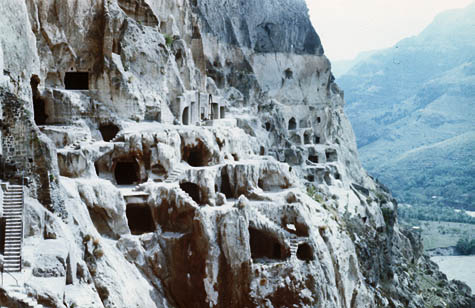
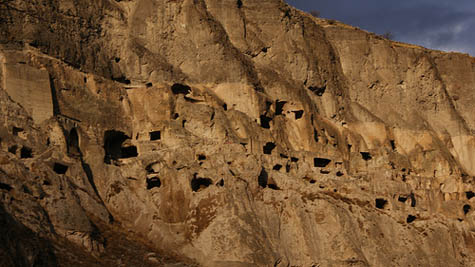
[Image: The Georgian cave monastery of Vardzia, via Wikipedia].

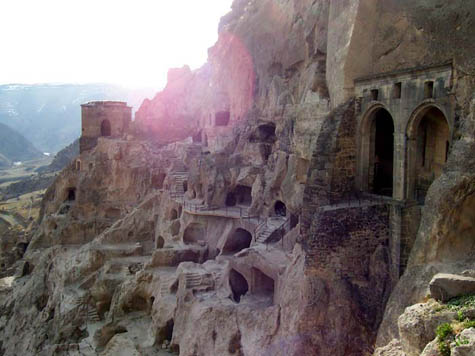
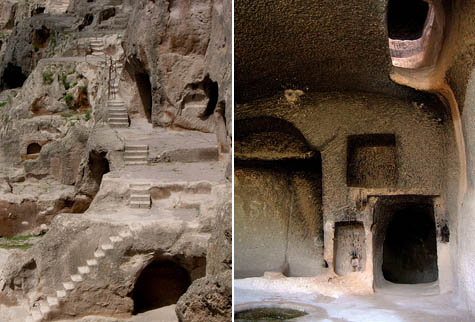
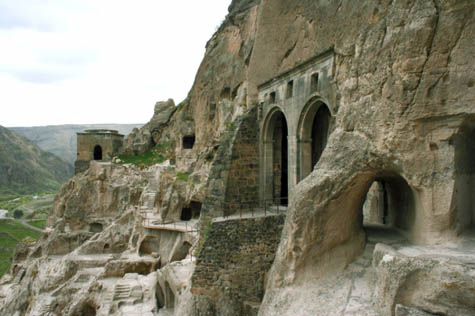
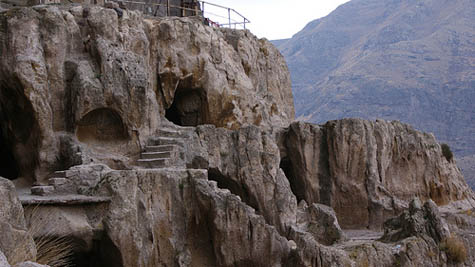
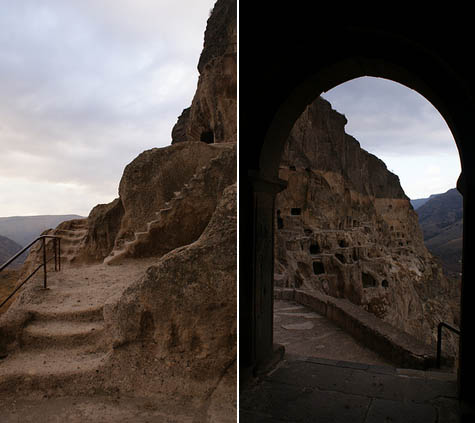
Vardzia is a ruined honeycomb of arched passageways and artificially enlarged caves on a steep mountainside in Georgia. It is on a “tentative list” for UNESCO World Heritage status.

[Image: Vardzia, via Wikipedia].

Quoting from Wikipedia:

The monastery was constructed as protection from the Mongols, and consisted of over six thousand apartments in a thirteen-story complex. The city included a church, a throne room, and a complex irrigation system watering terraced farmlands. The only access to the complex was through some well hidden tunnels near the Mtkvari river.

Nearby are the ruins of another cave monastery, called Vanis Kvabebi.

[Images: Vardzia, via Wikipedia].

In the formal application sent to UNESCO for consideration of the site, we read that the architecture of this region can be seen as spatially punctuating the landscape, supplying moments of almost grammatical emphasis:

Fortresses and churches erected on high mountains and hills are perceived as distinguished vertical accents in such a horizontally developed setting. They terminate and emphasise natural verticals, being in perfect harmony with the latter. They introduce great emotional impulse imparting specific grandeur to the whole environment. The same artistic affect is created by rock-cut monasteries and villages arranged in several tiers on high rocky mountain slopes.

Originally constructed in the 12th century—in a region inhabited by humans since at least neolithic times—and very much resembling one of the cave-cities of Cappadocia, Vardzia is a spatially fantastic site (and, I’d assume, a videogame level waiting to happen).

[Images: Vardzia, via Wikipedia].

It is also located in one of the most geologically interesting places on earth—at least from a subterranean standpoint—as the nation of Georgia also contains the world’s deepest known cave.

As National Geographic explained in an article several years ago, Krubera Cave—also known as Voronya—is still incompletely explored, despite its record-breaking, abyssal depths; expeditions have spent more than three weeks underground there, mapping windows and chambers, sleeping in tents, and using colored dyes to trace rivers and streams locked in the rock walls around them.

Check out this sequence of images, for instance, documenting an organized descent into the planet—or this article about caving in Abkhazia, or even this summary of the “Call of the Abyss” exploration project that sought to find the true depths of Voronya Cave.

[Images: Vardzia, as seen in some stunning photos by cosh_to_jest].

In any case, there’s absolutely no geological connection between Vardzia and Krubera Cave—there is no secret tunnel system linking the two across the vast Georgian landscape (after all, they are extremely far apart)—but how exciting would it be to discover that Vardzia had, in fact, been constructed as a kind of architectural filter above the stovepipe-like opening of a titanic cave system, and that, 800 years ago, monks alone in the mountains reading books about the end of the world might have sat there, surrounded by fading frescoes of saints and dragons, looking into the mouth of the abyss, perhaps even in their own local twist on millennial Christianity standing guard over something they believed to be hiding far below.

[Images: Vardzia, via Wikipedia].

In fact, I don’t mean to belabor the point here, but I’ve always been fascinated by the fact that the CIA has satellite photos that have been used as scouting documents for the rumored location of Noah’s Ark—it is “satellite archaeology,” one researcher claims. That is, there being quite a few religious members of the U.S. government, things like Noah’s Ark are considered more objective and archaeological than they are superstitious or theological.

But how absolutely mind-boggling would it be to find out someday that there is, operating within the U.S. intelligence services, a small group of especially religious analysts who have been scouring the Caucausus region, funded by tax dollars, and armed with geoscanning equipment and several miles of rope, looking for the entrance to Hell?

You can see further images of Vardzia here.

Quadraturin

A Soviet-era, Polish-born, Ukrainian-raised writer named Sigizmund Krzhizhanovsky was the subject of a short profile and review over at The Nation last week. The article focuses on one of Krzhizhanovsky’s stories called “Quadraturin” (which you can read in full online).

[Image: Based on a photo by eversion].

The basic gist is that a man named Sutulin, a “Soviet city dweller” who owns an impossibly cramped apartment, is convinced by a stranger who comes to his door one day to “take a free sample of an experimental substance that is supposed to make rooms bigger.” This “substance” is Quadraturin.

“Sutulin begins to apply the Quadraturin to his walls,” The Nation explains, “as the instructions on the tube advise, but he accidentally spills the entire contents of the tube on his floor.”

He wakes up the next morning in a “faintly familiar, large, but ungainly room,” where his furniture looks awkward and the angles of the walls are uneven. He enjoys the novel pleasure of strolling from one end of his room to the other, but he must enjoy it in secret, for like other citizens he is legally allotted only ninety-seven square feet of living space, and owning more than his share could mean losing his apartment.

After he stands there for a moment, in awe of his apartment’s new, slightly bulbous dimensionality, he begins “rearranging the furniture to fit the new space,” as Krzhizhanovsky himself puts it.

But nothing worked: the abbreviated rug, when moved back beside the bed, exposed worn, bare floorboards; the table and the stool, pushed by habit against the head of the bed, had disencumbered an empty corner latticed with cobwebs and littered with shreds and tatters, once artfully masked by the corner’s own crowdedness and the shadow of the table. With a triumphant, but slightly frightened smile, Sutulin went all round his new, practically squared square, scrutinizing every detail. He noted with displeasure that the room had grown more in some places than in others: an external corner, the angle of which was now obtuse, had made the wall askew; Quadraturin, apparently, did not work as well on internal corners; carefully as Sutulin had applied the essence, the experiment had produced somewhat uneven results.

Sensing that something has gone horribly wrong and that he might soon face the wrath of his building superintendent, he “realizes he has to buy curtains to hide his apartment from the eyes of passers-by.”

And “it only gets worse from there,” The Nation adds: “every time Sutulin leaves the room, he returns to find that his apartment has grown still bigger.”

He realizes that he forgot to apply Quadraturin to the ceiling, so his apartment is only growing outward, not upward, the dimensions increasingly oppressive even as the room becomes larger. It outgrows its electric circuitry and Sutulin is trapped in the darkness. “He knew that there, behind his back, the dead, Quadraturinized space with its black corners was still spreading.”

It’s an amazing image—I’m particularly struck by the idea of a space outgrowing its electric circuitry, like a body grown so monstrous it leaves behind its old nerves.

(Spotted via @PD_Smith).

Isolation or Quarantine: An Interview with Dr. Georges Benjamin

[Image: An emergency hospital ward in Kansas during the 1918 flu].

Dr. Georges Benjamin is executive director of the American Public Health Association (APHA) and former Secretary of Maryland’s Department of Health and Mental Hygiene; there his responsibilities included updating the state’s quarantine laws in response to the threat of bio-terrorism. Dr. Benjamin is publisher of both the American Journal of Public Health and The Nation’s Health.

He is also co-editor, with Laura B. Sivitz and Kathleen Stratton, of the 2005 report Quarantine Stations at Ports of Entry: Protecting the Public’s Health. That report consists of more than 300 pages of policy guidelines for how the United States can operate, maintain, and even expand its network of national quarantine stations. The very idea of a national quarantine policy, let alone phrases like the international “Quarantine System,” can inspire, at the extreme, all manner of conspiracy-laden theories—including the specter of fully militarized, FEMA-administered concentration camps on U.S. soil. In reality, however, “today’s quarantine stations are not stations per se, but rather small groups of individuals located at major U.S. airports. Their core mission remains similar to that of old: mitigate the risks to residents of the United States posed by infectious diseases of public health significance originating abroad.”

A jurisdictional map of CDC quarantine stations is available online, complete with informational PDFs ready for download.

[Image: Map of the CDC’s U.S. quarantine stations].

As part of our ongoing series of quarantine-themed interviews, Nicola Twilley of Edible Geography and I spoke to Dr. Benjamin about the APHA’s policy recommendations for pandemic flu quarantine, about the role of eminent domain in the medically-motivated seizure of private property, and about the architectural challenge of designing dual-use facilities for public emergencies.

• • •

Edible Geography: I was interested to read the American Public Health Association’s flu policy recommendations from 2007—in particular, to see the APHA’s emphasis on mental health support for people held in quarantine. What led to that being included in your official guidelines?

Dr. Georges Benjamin: If people are going to be confined for some time within a facility, then you want to make sure that you’re identifying those people who are already being treated for mental health issues. You want to make sure they’re getting their therapy and their medications, and you want to deal with any issue that might occur when someone has to stay alone under that level of stress.

Remember that someone who is quarantined is different from someone who is isolated. Quarantined people aren’t sick; they’re people who may get sick. They’re people who have been exposed to a disease but who are not physically ill. In many cases of voluntary quarantine, people are being asked to stay at home by themselves, or to stay self-isolated, and we need to make sure that someone is paying attention to them. We want to identify people who are not able to handle being by themselves or being in a relatively confined space—even if it’s inside their own home.

We were also concerned about making sure people have the basic needs of life: food, water, access to medical care, and access to social services. You want to make sure that you’ve addressed whatever those needs might be. All of these things were part of our package for people who might be quarantined.

BLDGBLOG: Who were the specific constituencies that called for those guidelines, and did anyone try to push you in another direction?

Dr. Benjamin: These guidelines come from our members. A lot of these discussions started way back when we were talking about smallpox, rather than pandemic influenza. We were thinking seriously about the idea of having people stay at home and be isolated, if they’re ill, or quarantined should there be a terrorist attack.

No one actually has access to smallpox now, but we were going out and vaccinating people against a potential terrorist threat, anyway. So we started having these discussions around the idea of whether or not you really needed to reinstitute large-scale—primarily voluntary—quarantine. In addition, we were talking about the risk of a pandemic.

Then, as you know, Hurricane Katrina hit New Orleans. You had people there who, by virtue of the fact that they ended up in the Superdome, did not have all of the things they needed. Certainly a lot of that stuff had been planned for, but it hadn’t been done as robustly as it needed to have been—and, obviously, they had more people in there than they could take care of.

Our thinking, based on that experience in New Orleans, was: in an emergency situation, how do you make sure that people have what they need? And, quite frequently, the mental health needs of people are something that matters in every kind of large-scale public health emergency—whether that’s a tornado, a hurricane, the flu, or an event where large numbers of people have died. It’s one of those things that people don’t really think about ahead of time, unless you remind them to think about it.

Our recommendations don’t just apply, by the way, to the people who are confined; there are huge stresses on the people who are managing those events. The EMTs, the paramedics, and the public health personnel who are all actually managing things can be really challenged—and you have to pay attention to them, too.
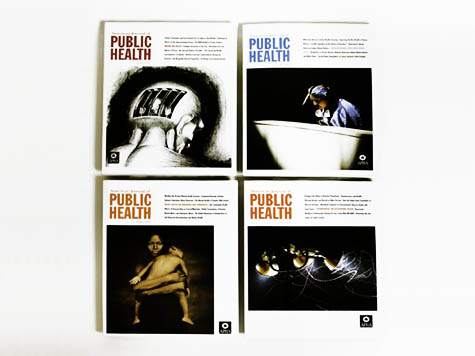
[Image: Sample covers of the American Journal of Public Health; design by Kropf Design].

BLDGBLOG: The APHA has also written about who exactly should have the authority to make decisions about who goes into quarantine and why. Can you talk us through your policy on that issue?

Dr. Benjamin: First of all, we try to guide by the least restrictive policy possible—and, to the extent that someone can be voluntarily in quarantine, that’s our first principle. Voluntary quarantine and the least restrictive quarantine possible is what we think is the most important way to start.

Simply giving people the facts about a disease process and keeping them well-educated and well-informed long before you’re going to need to take any action is the best policy. We, as an association, along with our colleagues in the federal agencies, have been trying to talk to the public about what the risks are for various diseases. How do you catch a disease—and how do you not catch it? How you protect yourself? How do you protect your loved ones? Usually, armed with this information, most people will follow the basic recommendations.

However, to the extent that you have to have compulsory quarantine—because you have someone who is continuing to put people at risk—then that is imposed, in the United States, by public health authorities. They have powers, mostly at the state and local level: those powers give them the authority to incentivize people not to put others—or themselves—at risk. In some cases, they can do that by having the police authorities act; in other cases, they have to go to court first. It depends on the individual jurisdiction.

In most cases, federal authorities’ powers end at the borders of the nation and then at the borders of each state. They can deal with issues across state lines, in some cases, and, of course, at our national borders and at ports of entry; but most of these quarantine authorities rest at the state and local health officer level.

BLDGBLOG: Has any of that legislation been revised in light of SARS, H1N1, or even the anthrax attacks?

Dr. Benjamin: There has been a national effort to modernize our public health laws. A lot of them were written years and years ago.

For instance, I was a state health official in Maryland from 1995 to 1999, and I was the secretary of health in Maryland from 1999 to 2002. During that time we began a process, which we finished when I was secretary, to update and modernize our laws. We had started talking about it before 9/11, but after 9/11 and the anthrax attacks , we realized that biological terrorism was a significant risk, and we really worked to strengthen the public health laws.

To give you an example of the kinds of changes and updates we made: we worked to put in some additional patient protections. The law at that time gave the health secretary enormous police powers to hold and to quarantine individuals—but there were no rights or rules for those individuals, or regulations about what they needed to receive while they were in confinement. The assumption was, of course, that they would get reasonable support and care—but we felt it was very important to guarantee that.

So we worked with several members of our advocacy community to strengthen the authority that the health officer had, and to make the authorities that I had at the time, as secretary of health, much clearer. But, on the same token, we were writing in protections. We guaranteed people due process. We guaranteed that, if we had to forcibly confine someone, then they would get medical care, social services, and social supports that they actually need. We put that in writing.

Other states around the nation have begun doing the same thing. There have been some public health law centers set up through various foundations, and they have also been working very hard to strengthen the various laws. There was a model public health law—I think it was produced with a grant from the Centers for Disease Control and several of the public health groups working with them. That law was then shared with all of the states and their elected officials, and it was used as a template through which states could look at their own laws and see how they matched up to the model.

Some states simply took the model and implemented it, exactly as it was written; some took pieces of it out; others took it and said, no, compared to the law we currently have, ours is better and we like ours. Either way, it served as a useful catalyst for people to begin looking at their own public health laws—not only in terms of the authorities that the public health officer had around isolation and quarantine, but also about reportable diseases, which diseases ought to be reported, and how, and who should do the reporting. There were also things that we added around patient protections, citizen protections, and due process. And there were sections that meant to clarify existing law, based on case law in the state, or nationally.

That work has been going on since late 2001, and it continues to this day in a variety of formats.

[Images: Hong Kong’s entire Metro Park Hotel was put under quarantine for seven days after an H1N1-positive Mexican tourist stayed there in May 2009; “psychologists were on standby,” we read. All photos courtesy of the China Post].

BLDGBLOG: In terms of these public health laws, where can quarantine occur? It was interesting during the SARS outbreak in Toronto, for instance, to see that hotel rooms were simply repurposed as temporary quarantine facilities.

Dr. Benjamin: Quarantine can occur anywhere—that’s the short answer.

Remember that quarantine is basically telling someone who has been exposed to a disease, even if they haven’t come down with that disease, to stay away from others, and to stay somewhere that we can observe them and see if they get sick. Functionally, that can occur anywhere—as long as you have the support that you need, and as long as you’re not kept somewhere where other people will be at risk. For someone who’s quarantined, a hospital is probably not a good place for them, because there are sick people in that hospital and, in any case, the hospital will usually need those beds.

Let’s say I travel to England for a business meeting, and there’s a big infectious disease outbreak. They’re not quite sure what it is, but I could theoretically have been exposed. They don’t want me to travel back home because they don’t want me on an airplane; I could expose people on that airplane. So they ask me to stay in my hotel room, and to get room service. That’s probably a perfectly reasonable request—as long as you know that, in everybody who’s had this disease, it shows up within 48-72 hours. It might be very inconvenient, but, in the interest of public health, somebody could ask me to do that. Now, there are issues around the air circulation in the hotel, and whether or not that’s appropriate—but let’s just assume that it is. From the APHA perspective, that request would be fine, particularly if you have somebody who can call and check on you a couple times a day and make sure that you’re not getting sick in the hotel room.

Now let’s say this happens at a wedding party taking place at a small hotel. For all practical purposes, if everybody at that hotel had been at the wedding, it would be reasonable to ask everybody to stay at that hotel—and, actually, they wouldn’t even have to stay in their rooms. They could be out and amongst each other, as long as they were fully informed about the symptoms that you get when you start to come down with whatever this disease process is. If those symptoms start to show, those people would then self-isolate, call public health authorities, and tell them, “I’m in my room, and I’ve got a cough and a fever, and I didn’t have that yesterday.”

If it turns out that this disease process is something mild, and we know you can take care of it there in the hotel room, then we’d probably just say, OK, isolate yourself in the hotel room. Before, you were able to get up and walk around the hotel—no big deal—but now you have to stay in your room. We’ll have the concierge send up your meals, and we’ll give you some Tylenol for your temperature. If it was something like H1N1—or some other viral illness that we knew is susceptible to antiviral agents—then we may very well give you antiviral agents, too. Of course, we’d also have the hotel doctor come up and see you. However, we would still ask you to stay in your room. That’s a voluntary isolation, now, within a quarantine facility, because you’ve been separated from everybody else.

The people who run the hotel, on the other hand, could say that they really don’t want this sick person staying in the hotel, for whatever reason. We’d then actually ask you to come out of the hotel; we’d come pick you up; and we’d take you to someplace else where people are being held and provided with medical care. At that point, you’re in isolation. It could be a hospital; it could be another facility. It could be a hotel; it could be a home. It could be anyplace where they’ve designated that as an isolation point. Again, in most cases it would be voluntary.

So it depends—these examples show that quarantine could take place anywhere, in a variety of forms.

[Images: (left) Reporter Will Weissert, quarantined in China, receives his lunch sealed in a plastic bag; (right) Weissert’s wife receives a medical check-up in the hotel room].

BLDGBLOG: Things like eminent domain and the government seizure of private property—these legal issues surely play a role in quarantine guidelines?

Dr. Benjamin: You’re right—and we’ve had long discussions about those issues.

For example, let’s say we have to isolate people due to a very severe disease process. In most cases, when people are sick enough, they need to, and are willing to, go to a hospital—but one of the challenges we’ve found is that hospitals don’t want to be known as the “X-disease hospital”: the SARS hospital, the swine flu hospital, the smallpox hospital. There’s some history there—in the United States, it began with places that became known as tuberculosis sanatoriums. If the public begins to shun a place because they’re afraid of catching a disease that has somehow been associated with that hospital, then it takes that hospital out of business—even if you only have one or two cases.

We saw this during the anthrax attacks at hospitals where somebody had been exposed, in whatever way, to anthrax. Even though we know anthrax is not a contagious disease, we had patients who were very concerned—at OBGYN services, in particular. Pregnant women just wouldn’t go to that hospital. As it turns out, we only had a very few cases of anthrax, but the press got onto this, and they publicized the fact that a person with anthrax had been at this particular hospital. Then that hospital had patients who were concerned about going there. So, of course, what we had to do was get on TV ourselves and say: “No, no, you don’t need to worry about that. It’s not contagious. That’s not how you get anthrax. You can still go there; you can still deliver your baby there.” But reassuring the public is sometimes very difficult. In many cases, it’s more about fear than anything else.

The other piece of this is that, if you have a disease outbreak that is so widespread that you have lots of sick people, then it’s unlikely that you’ll have only one hospital impacted. One of the fallacies of people worrying about their hospital being the SARS hospital, or their hospital being the smallpox hospital, or the flu hospital, is that, in most cases, those diseases are so infectious that lots of cases are already in the hospital environment. They’re in the ER, in the outpatient clinics, etc. One hospital might have an intensive care unit, and the very sick patients may end up in that unit—but the other hospitals in the area will end up taking care of the outpatients. The likelihood of only one hospital being the hospital with a particular disease process, and being stigmatized because of that, is very low.

There are exceptions, of course: let’s say you’ve got a research hospital and it has a novel therapy, and the only way to get that novel therapy is by going there—well, that hospital is going to end up with a disproportionate number of those patients. That’s one of the communication issues that hospital is going to have to manage with the public.

Now, to your question, many of the public health laws do have statutes that allow for the taking of stuff. In Maryland, for example, the state can confiscate your facility—and it’s not just your facility: it could be your pharmaceuticals; it could be your box of syringes. If the state declares an emergency, and it has the authority of the law and it goes through the proper procedures, then, yes, it can confiscate things.

But what we did in Maryland was we clarified a few things: firstly, that you would be compensated. We thought that was very important to put in. We also wanted to make sure that it requires extraordinary efforts to make it happen. In Maryland, for instance, a disaster has to be declared by the governor, and there’s a legal process that one has to go through in order to confiscate someone’s stuff.

A lot of the plans in the U.S. for where we’ll put sick people raise some interesting issues. For example, some of these plans say that if we need to expand bed-space beyond the hospitals, then we need to use schools, gymnasiums—anyplace where you have a wide-open ward. Of course, there’s a big debate going on about whether those are the best places for these folks—and the reason for that debate is that they’re not built as health facilities. You couldn’t put your sickest people there. You might be able to quarantine people there—people who are well enough to get up and wash their hands and go to the bathroom, etc.—and you might be able to put people there who are moderately ill, but you couldn’t put very sick people there. It’s simply not set up as an intensive care unit.

The other thing to remember is that, even though you’ve got a disease outbreak going through your community, you still have the other, baseline disease processes. There are still heart attacks and strokes and people with seizures and kids with fever unrelated to the flu or unrelated to the infectious disease going on. You still need beds for people at ICUs for heart attacks, and you still have to treat cancer. The management challenge is to make sure that local providers don’t set up a process, of either isolation or quarantine, that deprives them of the resources they need to maintain their ongoing health system.

Edible Geography: Where are the gaps, as you see it, in public preparations for quarantine?

Dr. Benjamin: There are a couple of things I can think of right away. There’s the public education aspect that we and our colleagues are continuing to work on—there’s always more that could be done there.

The other thing is that we need buildings and facilities that have multiple uses. When you build hospital emergency rooms, for example—and it’s been fascinating watching this shift occur—we’ve gone from a situation where people had individual rooms in the ER to open-bed concepts. But what you need is flexibility. You need facilities flexible enough to accommodate multiple purposes.

You remember I talked about a gym being utilized as a potential quarantine spot? Well, some of the issues that get in the way of that are that there are not enough electrical outlets. You can’t bring up walls to partition the place in a way that easily allows you to isolate one group and quarantine another. There also isn’t the plumbing, and there probably aren’t enough bathrooms. You’ve put a lot of people together who may have a disease—and now you have a problem, because not everybody can wash their hands. We’re all using hand sanitizers today, and they’re wonderful, and they work; but, frankly, good old soap and hot water is the best thing to use.

Then again, most elementary schools were designed for little people, and now you’re about to put a bunch of adults in there; they might not have as many soap dispensers as you need, or the bathrooms are too large, or the toilets are too low, or there aren’t enough sinks. Or, again, maybe the sinks aren’t in the right place: they’re not by the bedside where infection-control needs to occur.

Building an environment that thinks about these other potential uses is extremely important, for places like hotels or gyms or the other big spaces that might be used to hold a bunch of people. And, by the way, quarantine is only one need for those things: as part of our overall public health preparedness, we have to look at putting people up because of a hurricane, or floods, or a tornado, or a big infectious outbreak.

The single-center principle means that a place needs to be flexible enough for large numbers of people, and in which you can have adequate infection-control, adequate toilet facilities, and adequate food facilities so that everyone can eat.

If we build places that do those kinds of things, then they’ll meet all the needs for isolation, all the needs for quarantine, and all the needs for housing people in an emergency.

[Images: Shuhei Endo’s “tennis dome/emergency center” (left), photographed by Kenichi Amano, next to the New Orleans Superdome, post-Katrina].

BLDGBLOG: That actually reminds me of some stadiums in Japan that were built both as sports stadiums and as earthquake-disaster centers. There’s food and water stockpiled in the basement, the entryways are sized for emergency vehicles, and so on. How would you recommend this sort of architectural adaptation, on a policy level?

Dr. Benjamin: We wouldn’t have much trouble convincing the presidents of universities today, who are already challenged with a disease process big enough to affect the whole student body. In the United States right now, with H1N1, the number of sick kids is big enough that they’re having to manage those kids on campus. For a disease process in which people are going to be sick for five or seven days, it’s unrealistic to send them home once they’ve shown up on campus. Colleges are having to deal with accommodating them right now. You can bet that, at least on college campuses in the United States, they would be very sensitive to this idea of dual-use facilities, because there’s an operational need for it.

The second thing is, if I was trying to do this, I would be working directly with architects and engineers, convincing them of the need to do it and then letting them sell it. They can say how best to do this, in a way that does not obstruct the primary purpose of the facility. We don’t want to interrupt anyone’s football games, but at the moment, everyone says, yes, we can put people here but it’s only going to happen once or twice in my lifetime, when the truth is that, if you design it that way, then you could use it much more frequently for that purpose. You could get dual-use out of it. Getting the people who design these places to tell us how to do it, in an appropriate and cost-efficient manner, and then having them make the case to the owners and users, so that they know that this is value added to their facility: that’s how I would get this message across.

Then I would talk to elected city and state officials about ways they could leverage tax-payer dollars to get these dual-use facilities built. Let’s say I’m in city government and I have someone coming up to me wanting the city to put up tax-payer dollars to support the building of a football stadium or a basketball stadium or a new school. If I get this additional bonus—this dual-use that helps my emergency-preparedness—I’m more likely to want to use taxpayer dollars to support it. Increasingly, as you know, private sector guys are coming to the government and asking for fiscal support to build these facilities. If tax-payers are going to be paying for things, then the city or the community needs to get something out of it.

I can tell you that a lot of work had to be done to fix and clean the New Orleans Superdome—but if you had built it so that it could be much more functional in an emergency situation then you would have had less damage. And from an image perspective, a dual-use sports facility now has much more of a public value.

That’s my personal view, not the Association’s view; but I think it’s an effective argument.

• • •

This autumn in New York City, Edible Geography and BLDGBLOG have teamed up to lead an 8-week design studio focusing on the spatial implications of quarantine; you can read more about it here. For our studio participants, we have been assembling a coursepack full of original content and interviews—but we decided that we should make this material available to everyone so that even those people who are not in New York City, and not enrolled in the quarantine studio, can follow along, offer commentary, and even be inspired to pursue projects of their own.

For other interviews in our quarantine series, check out Extraordinary Engineering Controls: An Interview with Jonathan Richmond, On the Other Side of Arrival: An Interview with David Barnes, The Last Town on Earth: An Interview with Thomas Mullen, and Biology at the Border: An Interview with Alison Bashford.

More interviews are forthcoming.

Robotism, or: The Golden Arm of Architecture

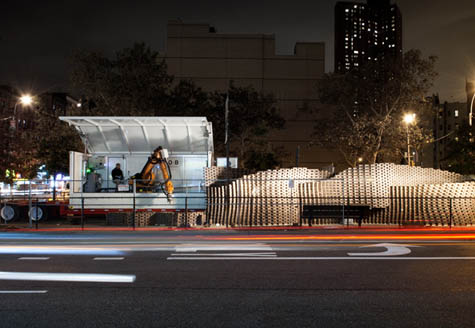
For the past four weeks, an orange robotic arm has been constructing a brick wall in south Manhattan.

[Image: Pike Loop by Gramazio & Kohler].

Neither a new Berlin Wall nor part of a delayed realization of Superstudio’s Continuous Monument, the machine was, in fact, built and programmed by Swiss architects Gramazio & Kohler. It is now the focus of an exhibition, called Pike Loop, at Storefront for Art and Architecture.

Tonight—Tuesday, October 27—at 7pm, Storefront will be hosting a public event in celebration of the project, down at the wall itself, free and open to the public. Here’s how to get there from Storefront. Be sure to stop by.

The Emperor’s Castle

[Image: Image 1, “Eternal Punishment,” from The Emperor’s Castle by Thomas Hillier].

For his student thesis project at the Bartlett School of Architecture, Thomas Hillier produced an immersive narrative world, complete with origami-filled hand-cut book pages and an elaborate model of the story’s architectural landscape. Hillier’s project was called The Emperor’s Castle and it was inspired by the work of Japanese printmaker Hiroshige.

The Emperor’s Castle originates from a mythical and ancient tale hidden within a woodblock landscape scene created by Japanese Ukiyo-e printmaker, Ando Hiroshige. This tale charts the story of two star-crossed lovers, the weaving Princess and the Cowherd, who have been separated by the Princess’s father, the Emperor. These characters have been replaced by architectonic metaphors creating an urban theatre within the grounds of the Imperial Palace in central Tokyo.

The result is astonishing; the images here have been presented in order, so you can follow the flow of the tale, with descriptive text supplied by Hillier. I would advise, however, that you also check out the Flickr set I put together for the project, where much larger versions of these images (and more text) are available.

The first two images, Hillier says, are taken from his “research storybook.” They are hand-cut paper collages, and they show us “two acts from a series of five that illustrate and explore the narrative structure of the tale.” The scenes thus supply “a series of clues, which can inform the future architectural proposition.”

[Image: Image 2, “The Last Meeting,” from The Emperor’s Castle by Thomas Hillier].

As Hillier writes:

Image 1 (Act 3, Eternal Punishment) illustrates the Emperor’s anger over his daughter’s relationship with a cowherd. He separates the couple, placing them back in their original locations. The Emperor wanted to be sure they would never meet again, so he closed the castle and opened the heavens. Rain fell, causing the castle’s moat to flood, creating an island of the castle surrounded by a deep and swift lake unassailable by any man.
Image 2 (Act 5, The Last Meeting). Seeing the sadness of their friend, the Princess, the birds and animals came together to decide how to stop the torrent of her tears. So the sky became black as all the magpies and crows, with their wings spread wide, formed a bridge across the lake. When the Princess realizes what the birds have done, she stops crying and rushes across the feathery bridge to embrace the Cowherd and renew their pledge of eternal love.

The next three images “are hand-cut exploratory paper collages” illustrating “the architectonic character transition” through which the story’s human figures are transformed into pieces of architecture.

In a way, it’s the Hypnerotomachia Poliphili as retold for Late Edo Japan.

[Images: Image 3, “The Emperor’s Origami Lungs”; Image 4, “The Princess’s Knitted Canopy”; and Image 5, “The Cowherd’s Mechanical Cow-cutters”; from The Emperor’s Castle by Thomas Hillier].

From Hillier’s project text:

Image 3 (The Emperor’s Origami Lungs). The Emperor’s lungs come alive through differing gestures and surface transformations based on geometrical tessellations adopted from origami crease patterns. The lungs imitate the motion of breathing through expansion and contraction creating a bellowing volume that allows the Emperor to project his emotions both visually and audibly. They rise and fall, creating a bobbing motion, which produces a rippling affect onto the surrounding skin. The severity of these ripples will depend on the anger of the Emperor, and can cause the newly knitted areas of skin to become loose and break, stopping the Princess from ever reaching the cow herder.
Image 4 (The Princess’s Knitted Canopy). The Princess, a flexible, diaphanous knitted membrane, envelopes the spaces below and is fabricated using the surrounding ‘Igusa’: a natural rush material used in the fabrication of tatami mats. Igusa expels a soothing scent as the skin undulates, which is said to calm body and mind. This scent acts as a perfume of remembrance to the cow herder and his time spent running hand in hand through the meadows with the Princess.
Image 5 (The Cowherd’s Mechanical Cow-Cutters). The cowherd has been reinterpreted architecturally as the grass band, which wraps the perimeter of the site, encompassing the Emperor’s lungs and Princess’s knitted skin. Embodying the cowherd are the mechanical cows, which act as wind-up grass-cutting devices that constantly wander the grazing land, cutting the grass and fanning the aroma towards the Princess as a reminder of the cowherd. These cows are waiting and hoping for the moment the Princess knits her skin over the mechanical waves towards them, re-enacting the connection between the two star-crossed lovers.

The mechanical symbology of the resulting landscape—with “the Princess’s knitted membrane knit[ting] itself ever larger… to reach the grass parkland perimeter representing the Cowherd”—is outlined in more detail in the project text (again, as seen in the Flickr set).

[Image: Image 6 from The Emperor’s Castle by Thomas Hillier].

The rest of the images—including the full model, above—showcase Hillier’s exquisite craftmanship.

[Images: Images 7, 8, 9, and 10 from The Emperor’s Castle by Thomas Hillier].

Image 7, above, shows us “the contoured landscape underneath the knitted canopy, exposing the series of connecting walkways that allow the Emperor’s army to run from one lung to another,” while Image 8 reveals “the Emperor’s origami lungs.” Image 9 reveals how those lungs operate; there, we begin to see “the lung movements” of the Emperor, Hillier writes, as they “generate a bellowing volume of air.” This air is then “forced upwards, sending the woven lung collars into a thrashing frenzy, visually increasing the impact of the Emperor’s anger.” In another context, it might be interesting to explore the use of pneumatic metaphors to explore the nature and function of imperial power; but such an essay will have to wait for another day.

Image 10, meanwhile, zooms in on the Emperor’s “Mechanical Moat,” a machine-hydrology that surrounds and delimits the project landscape.

And then we reach the finale.

[Image: Image 11 from The Emperor’s Castle by Thomas Hillier].

The images below are “the final triptych,” Hillier writes. They offer “a section through the urban theatre [that] illustrates the frenetic ‘life’ of the building. This 1.8m x 0.8m piece is the culmination of all the research and design synthesis carried out above.”

[Images: Images 12, 13, 14, and 15 from The Emperor’s Castle by Thomas Hillier].

Hillier’s project is a beautifully realized example of something I’ve long been curious about—for instance, if a book like Ulysses had been “written” not with a typewriter but with a 3D printer, what sort of architectural world might result? The Emperor’s Castle offers at least one possible answer for how literature could be translated directly into urban and architectural space.

Now reverse-engineer this: take a landscape garden somewhere—or an accidental assemblage of parks, buildings, rivers, and homes—and interpret that setting as if it is literature. Do a reverse-Hillier, so to speak: start with the landscape and extract characters and motivated dramatic actions from the objects placed within it.

In any case, again, check out the Flickr set for more text and much larger images; and don’t miss Johan Hybschmann’s “book of space,” also produced this year at the Bartlett.