


[Images: Four excerpts from the amazingly surreal car park photography of Branislav Kropilak, whose other work appears to document landing airplanes: blurs of stretched light through the angled sky. Many more garages where these came from. Via we make money not art].
Author: Geoff Manaugh
Z
 [Image: Angkor Wat, Cambodia, a city reclaimed by the roots of trees; photographed by Kenro Izu].
I just finished reading a long and totally fascinating article by David Grann called “The Lost City of Z,” from an old issue of The New Yorker.
In it, Grann explores whether or not a city called “Z” might exist somewhere in the Brazilian rain forest – “a region nearly the size of the continental United States” – while tracking the life of a British explorer, Colonel Percy Harrison Fawcett, who “disappeared in the forest, along with his son and another companion” in 1925.
“Fawcett had been acclaimed as one of the last great amateur archeologists and cartographers,” Grann writes, “men who ventured into uncharted territories with little more than a machete, a compass, and an almost divine sense of purpose.” Colonel Fawcett believed that, “in the southern basin of the Amazon, between the Tapajós and the Xingu tributaries,” lay Z, a ruined city lost to the jungles of time.
“To bolster his case that the ruins of Z would be found in the region,” Grann tells us, Fawcett “cited carvings that he had seen on rocks in the area, and documents that he had uncovered from Portuguese conquistadores in Brazilian archives. He quoted a Brazilan scholar, who declared, ‘My studies have convinced me that… there may yet be found in our forests, as yet penetrated in few places, ruins of ancient cities.'”
Because of Fawcett’s disappearance, however, at least 100 other explorers have lost themselves in the Amazon, looking for his remains (or, more likely, looking for Z). There was, of course, one crucial problem: Fawcett, funded by the Royal Geographical Society, kept his expeditionary path completely secret, even releasing false latitudinal coordinates for fear that someone else might steal the final prize: discovering, mapping, and documenting Z. Fawcett was exploring at “the peak of the British Empire,” we read, “a time when the English were constantly confronting and colonizing new, exotic civilizations; when imperial explorers such as David Livingstone were trying to map the so-called ‘dark continent’ of Africa; and when the Allan Quartermain novels by Fawcett’s friend H. Rider Haggard, which chronicle the intrepid adventurer’s discovery of ancient civilizations in Africa, were wildly popular.” The last thing he needed, in other words, was another explorer hot on his trail.
To make a (very) long story short, David Grann – the article’s author – visits Colonel Fawcett’s granddaughter in Cardiff, Wales, whereupon Grann discovers unpublished letters from Fawcett that reveal the expedition’s true route through the jungle. Thus Grann sets off for Brazil.
More and more information about Fawcett pops up. “One day, during a visit to a colonial archive in Rio de Janeiro,” Grann reports, “Fawcett discovered a document, partly eaten by worms, that was titled ‘Historical account of a large, hidden, and very ancient city, without inhabitants, discovered in the year 1753.'” Within the document, Grann tells us, Fawcett learned about a Portuguese “soldier of fortune,” who, along with his expeditionary team, “ascended a mountain path” to find “a spellbinding vista: below them were the ruins of an ancient city. The men climbed down, and discovered stone arches, a statue, wide roads, and a temple with hieroglyphics.” Reading the account, Fawcett “became even more entranced with the idea of a lost civilization” – and, presumably, so did Grann.
Now in Brazil, Grann – carefully tracking Fawcett’s final self-enforestation – is taken by a guide to the ruins of an enormous ranch built deep in what used to be jungle; what he sees there shocks him: “The farm had been consumed by jungle in just a few decades, and I wondered how actual ancient ruins could possibly survive in such a hostile environment. For the first time, I had some sense of how it might be possible for the remnants of a civilization simply to disappear.”
Several pages ensue in which Grann hears contradictory tales of a kidnapped white man paraded through the territories of various tribes back in the 1930s; albino children; “very bad Indians”; and “a colossal man,” named Afukaká, “his arms as thick as legs, his legs as big as a chest.”
But then my eyes started popping out of my head, because here Grann meets Michael Heckenberger, a “highly regarded professor at the University of Florida,” who was doing field work in the upper Xingu basin.
 [Image: NASA, satellite views of Brazil’s Xingu National Park].
Prof. Heckenberger “had battled everything from malaria to snakes to virulent bacteria that made his skin peel off and forced him to boil his garments twice a day.” He looked “a little like a surfer.” Familiar with Fawcett’s story, the archaeologist then turns to Grann and says: “I want to show you something.” He grabs a machete and they walk together, more than a mile into the forest, “cutting away tendrils from trees, which shot upward, fighting for the glow of the sun.”
Then Heckenberger stops. He gestures at the ground: it’s sloping. Why is it sloping?
It used to be a moat.
“What do you mean, a moat?” Grann asks.
“A moat,” Heckenberger answers. “A defensive ditch.” It’s nearly a mile in diameter and more than 900 years old.
Heckenberger then shows Grann some excavation pits, where foundations of “palisade walls” are found, half-buried in black soil.
Turns out the group of them are standing in “the remains of a massive man-made landscape. There was not just one moat but three, arranged in concentric circles. There was a giant circular plaza where the vegetation had a different character than that of the rest of the forest, because it had once been swept clean. And there had been a sprawling neighborhood of dwellings, as evidenced by even denser black soil, which had been enriched by decomposed garbage and human waste.”
There were also the remains, Heckenberger explains, of “Roads. Causeways. Canals.”
So is it the city of Z? Or is Z still out there, waiting?
Secret Soviet Submarine Base
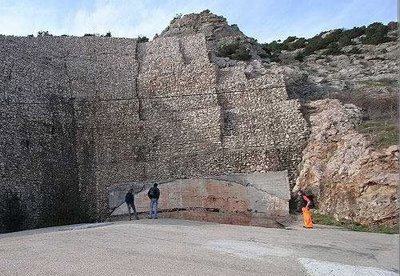
[Image: Via Fun Mansion].
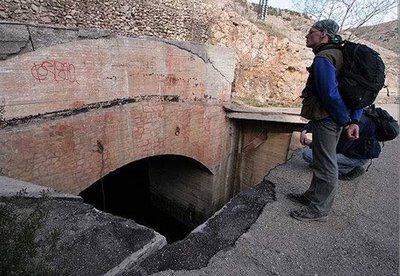
From Fun Mansion: “Until the collapse of the Soviet Union in 1991 Balaklava was one of the most secret towns in Russia. 10km south east of Sevastopol on the Black Sea Coast, this small town was the home to a Nuclear Submarine Base.”
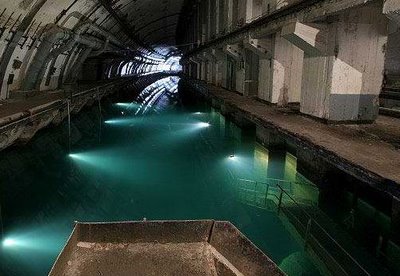
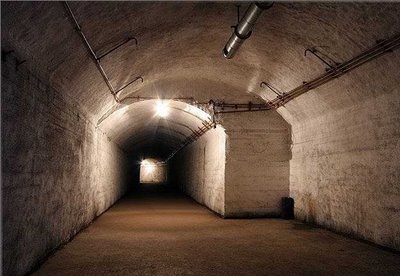
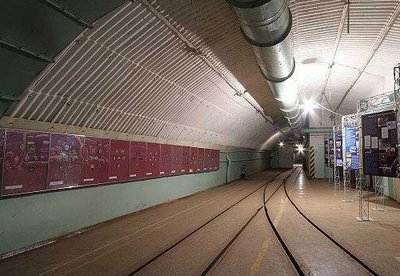
[Images: All images via Fun Mansion].
“The base remained operational after the collapse of the Soviet Union in 1991 until 1993 when the decommissioning process started and the warheads and low yield torpedos were removed. Then in 1996 the last Russian Submarine left the Base.”
Apparently, there are now guided tours.
[Image: Via Fun Mansion].
(Originally spotted at Defense Tech; this post simultaneously published on Bryan Finoki’s Subtopia; see also this LiveJournal blog – though it’s in Russian).
In space, no one can hear you pray
 [Image: NASA].
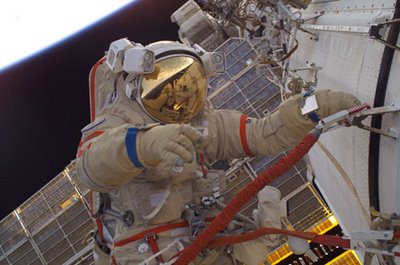
Qibla is the direction a Muslim must face when praying—specifically, toward the Kaaba, in Mecca. In order to align oneself properly with that religious axis mundi, all kinds of complicated mathematical techniques had to be used or developed. From compasses to azimuths to spherical trigonometry, determining what angle to take in relation to the horizon became as much a mathematical, or geographic, pursuit as it was religious.
So now, as Malaysia prepares to send three Muslim astronauts into space, the question of qibla has once again been revived: in what direction should an astronaut pray in order to face Mecca? As that last link reminds us, these astronauts “will also visit the International Space Station, which circles the earth 16 times in 24 hours, so another thorny question is how to pray five times a day as required by Islam.”
I’m imagining a bewildering series of gyroscopes, mirrors, magnets and platforms, with arms covered in quantum clocks, ticking off “days” where there are none, keeping time in space devoid of terrestrial references. Motors will click and whir, aligning the chair constantly, and whole new branches of robotics – RoboQibla™ – gyroPrayer® – will take off. Science academies throughout the Muslim world will start producing new and strange direction sensors, devices of alignment that’d make John Dee proud and Athanasius Kircher whistle. New space stations designed by architecture students in Dubai will show us the future of intercelestial travel: self-unfolding, solar-powered spaceships, ceaselessly rotating in space—whilst maintaining perfect ship-to-Mecca alignment.
The Jesuits respond with floating cathedrals… flying buttresses in space.
(Original article spotted at Off Center).
Delta force

[Image: A false-color “enhanced thematic map” of the involuted deltaic coastline of Guinea-Bissau; check out the fractal self-looping madness of NASA’s incredible 4.6MB version].

Grids and surfaces
 [Image: Steven Holl’s Simmons Hall, MIT; photographed under construction by Stanley Greenberg. Greenberg was the focus of a recent BLDGBLOG post on the underground constellations of drainage known as New York City’s water system, with its secret valve chambers; Greenberg’s new show at Candace Dwan Gallery, NYC, is worth a visit – it’s open till 20 May 06].
A Shopper’s Guide to Urban Catastrophe

Exactly one hundred years ago to the day a “large horizontal displacement” along the San Andreas Fault devastated the city of San Francisco. In the century since then, hurricanes have battered Miami, levees have failed New Orleans, airplanes have become Weapons of Mass Destruction, and “prodigious snowfall combined with drenching spring rains” has conspired to wreak havoc on Grand Forks, North Dakota.
American urban catastrophe, in other words, is everywhere.
This post-disaster urban world – with no police, no public utilities, no clean drinking water, and, potentially, no hope – is something you can prepare for, however, by shopping.

In February 2003, Homeland Security’s then-chief Tom Ridge made life far simpler for Americans everywhere by unveiling a national catastrophe shopping list – at the top of which was duct tape.
“Stash away the duct tape!” said Ridge, and millions did just that. It didn’t matter that duct tape was widely alleged to be ineffective in the face of biological and chemical attack (or that Ridge later withdrew his own advice, complaining that there had been “some political belittling of duct tape”); the silver rolls flew right off the shelves, salving (or stoking?) the anxieties of a traumatized nation.
The rest of Ridge’s shopping list – Recommended Items to Include in a Basic Emergency Supply Kit – compares favorably with many other shopping lists or pre-packaged kits I came across in my urban catastrophe shopping reconnaissance. I was particularly impressed by the inclusion of eating utensils (a common omission), along with a wrench or pair of pliers to turn off any dangerous utilities.
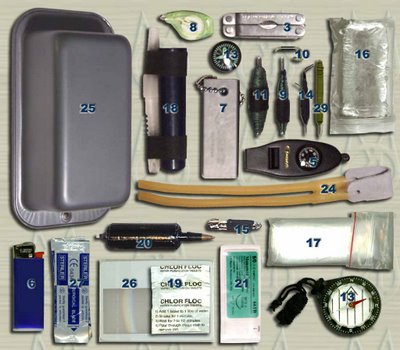
The rest of the basics are predictable and quite consistent from list to list: water, whistle, can opener, first aid kit, copies of important documents, sleeping bags or warm blankets, waterproof matches, etc. The only thing missing is a Paul Oakenfold CD.
Indeed, the core contents of catastrophe survival kits have barely changed since World War I, and, as such, allow little room for personal expression. However, all of the lists do recommend storing at least 72 hours’ worth of food – and food customization is a field of endless opportunity.
There are several things to bear in mind whilst considering what food you should buy to prepare for urban armageddon. Food should be relatively non-perishable (and you should remember to replace it before it expires), require little or no cooking, and be low-sodium so as not to provoke chronic thirst. Canned foods, powdered and instant foods, jerky and peanut butter are standards on the “do-it-yourself” list, with instant soup cups described as a “real boon.”

Vegans and Atkins-aficionados, as usual, will find their choices more limited. In a CarbSmart article entitled “A New Day and New Priorities: Being Prepared For The Unforeseen,” Di Bauer recommends that low-carbers stock up on canned clams (her suggestion: “bread” them with unflavored protein powder), Ragu Double Cheddar Sauce, diet soda, and an intriguing product called not/Starch. (“If the world ends, I am going to be buried with my not/Starch“).
Vegans, of course, seem to be understandably concerned with post-catastrophe protein sources – but, from what I’ve read, they also seem to have a good handle on the cunning you’ll need to survive urban collapse, suggesting “treats for bargaining,” as well as “a small bottle of spirits,” because “sometimes it’s just what you – or others – need.” (It can also be used “as an antiseptic”).
In the run-up to Y2K, Carol Reid authored the delightfully-titled, Catastrophic Cooking: Eating Right When All Is Wrong, in which she shares the secret of her “Cardboard Box Oven,” which was “designed by an Aerospace Engineer” and “will bake everything from bread to pizza at temperatures up to 475 degrees.” The book is now out-of-print.
Thinking outside the box – or the can – one Bay Area architecture and design student recommends growing your own emergency garden: she’s “planting a high-density orchard this winter, with varieties timed to ripen sequentially all year rather than all at once in July.” Let’s hope a rather frightening man called The Everlasting Phelps doesn’t figure out where she lives, because his “plan is a little more simple. I have guns, ammo, and armor, and I plan to loot.”
At specialized sites such as TheEpicenter.com or Earth Shakes (“Are you prepared? Wait no longer!”), online shoppers are offered a choice between 3600-calorie, “pleasant tasting, shortbread cookie-like” foodbars, “6 Can Food Modules,” “10 Year Super Vitamins,” bags of “Survival Candy,” and Heater Meals.

Duct tape, food, and water are the first things the urban catastrophe shopper might purchase – but if the New Orleans Superdome taught us anything, it is the paramount importance of sanitation provision.
This is an area best left to the professionals, and Earth Shakes seems to have covered all the bases: it offers a PETT, WAG BAGS, PUP, and TOTE ensemble. These are, respectively: a Portable Environmental Toilet, “weighing only 7lbs, yet the same height as a standard toilet”; Waste Alleviation and Gelling bags containing “Pooh Powder” (a unique product that “gels liquids, catalyzes decay, and removes odor”); Portable Utility Pop-up tent (to ensure privacy); and a TOTE backpack with which to carry everything around.

Assuming you can find and lift a manhole cover in the midst of catastrophe, the Japanese have even developed a WAG BAG-free option. You are instructed to install it immediately above a (hopefully still intact) municipal sewer system – then relax…
I’d also like to draw your attention to the “Shower in a Bag” – (“No rinsing needed. Microwaveable too!”) – and, for the shy or hijab-wearing, a “Deluxe Privacy & Shower Room.” Truly, all the comforts of home.
Meanwhile, if money’s no object, there’s the “disaster kit of the future.” With this, CNET staff writer Stefanie Olsen introduces us to Seldon Laboratories’ “nano mesh,” which can be fabricated into a “waterstick,” allowing fortunate survivors to “suck ditch water like they would using a straw in a glass of water.” Another membrane technology works by fluid osmosis, with one side flavored “so it can turn dirty puddle water into Gatorade.”
Other tech-savvy toys include a blanket that heats to 104 degrees for eight hours, a flexible light-sheet made of semi-conductors which glows for up to eleven years, a $300 “emergency portable oxygen cylinder with enough air to last more than an hour,” and a full-body viral barrier jumpsuit, which protects against the terrifyingly re-named “Asian blood flu.”
There has even been promising progress in the world of rescue robotics.
Howie Choset at Carnegie Mellon University has developed snake-bots, designed to “slither through collapsed buildings in search of victims trapped after natural disasters or other emergencies.” In an industry breakthrough, “Breadstick” and “Pepperoni” – two prototype robots “about the size of a human arm or smaller” – can climb up and around household pipes. Meanwhile, in Japan, the Kyushu-based TMSUK has developed Enryu (or “rescue dragon”), which is “mounted on a tread similar to a military tank,” and uses “two hydraulically operated arms with a reach of 5 meters” to lift as much as 500 kilograms.
Finally, while down-to-earth sites such as the Red Cross simply recommend storing your catastrophe kit in a tough plastic box or backpack, manufacturers in the niche market of urban catastrophe preparation know that, while the kit’s packaging may not save your life, it could well influence your purchasing decisions. PingMag’s recent survey of Japanese earthquake preparation products directs us to a pink “girl’s emergency kit” –

– as well as this rather sharp offering from Muji.
In the U.S., more time seems spent on the names of these kits than on their containers, so you’re offered a double entendre-laden choice between the Triple Delight, the Family Royale, and the One Person Starter Disaster Fanny Pack.
But I leave you with two parting thoughts: first, the world’s “ONLY Armageddon Survival-Kit” is available here. It does not appear to contain duct tape – but it does “guarantee immortality.” Second, cash spent on urban catastrophe preparation gear is never wasted: even if you’re lucky enough not to have to use it, today’s kit is tomorrow’s collectible. Phil Boguch’s World War II survival kit, containing both silk stockings and chocolates, is now on display at the Mercer Island Museum of Flight; and a World War I M-592 Backpad-Style Survival Kit is valued at $1000 at Stan Wolcott’s Lucky Forward Militaria.
What could you possibly be waiting for?
The Myth of Solid Ground

About six months ago I picked up a copy of David Ulin’s The Myth of Solid Ground, on earthquakes and earthquake prediction. I started reading it in a hotel room – then finished it aboard an airplane, my own solid points of reference put temporarily on hold. The book really stuck with me, and I soon posted about it on BLDGBLOG.
Then, a few weeks ago, I got in touch with David and we set up a telephone interview, during which time we talked about everything from the religious implications of earthquakes to the JFK assassination, from the particularly Californian subculture of earthquake predictors to the psychological role played by seismic instability in “the subterranean mythos of people’s lives,” how they find “identity in the turbulence of the land.” (Quoting from Ulin’s book).
David was friendly, open, and generous with explanations. Throughout the conversation he spoke in great looping sentences, full of parantheses and clarifications; transcribing the tape took on the air of a topological exercise, finding where the punctuation might best fit.
That interview is now online at Archinect, published for the 100th anniversary of the 1906 San Francisco earthquake. So check it out.
The library of airplanes

LOT-EK has just proposed reusing more than two hundred discarded fuselages from Boeing 727 and 737 airplanes as the major structural components for a new library in Guadalajara.

The airplane shells would be “stacked in a north-south slant in relation to sun exposure for energy efficiency.”

I think this is amazing!
“The fuselage is the only part of a decommissioned airplane that cannot be effectively recycled,” we read. “The cost of its demolition exceeds the profit of aluminum resale. A huge amount of fuselages lay in the deserts of the western states. Boeing 727 and 737 are historically the most sold commercial planes and therefore the most common in these graveyards. They are sold at very low prices completely stripped and in great structural conditions.”


“The fuselage becomes the basic module of this building. It is insulated and furnished according to the program. The internal subdivision generated by the existing floor joists is used to respond to functional needs: the upper section is used for inhabitation while the lower one houses independent and interconnected mechanical systems: HVAC, electrical, cabling, and a conveyor belts network for the mechanical distribution of the books.”

Read more at noticias arquitectura.
(Via Archinect).
Walking over a valve chamber outside the Brooklyn Academy of Music

Whilst BLDGBLOG was out exploring the underside of Manhattan, from the island’s faucets to its outer city aqueducts, an email came through from Stanley Greenberg, photographic author of both Invisible New York: The Hidden Infrastructure of the City and Waterworks: A Photographic Journey through New York’s Hidden Water System.
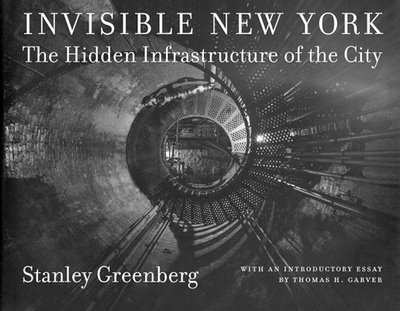
He’s a fascinating guy.
“I started photographing the city’s infrastructure in 1992,” he explained, “after working in NYC government in the 1980s. A few things led me to the project. I felt that the water system was being taken for granted, partially because the government is so secretive about it. Places that were built as parks and destinations were now off-limits to everyone – especially after 9/11. I’m concerned that so many public spaces are being withdrawn from our society.”
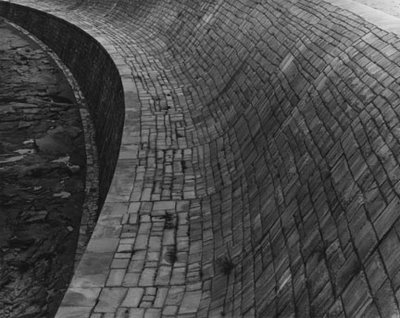
The secrecy that now surrounds New York’s aquatic infrastructure, however, is “really just an acceleration of a trend,” Greenberg continued. “City Tunnel No. 3, the new water tunnel, has been under construction since 1970, and its entryways are: 1) well hidden, and 2) built to withstand nuclear weapons. While there were always parts of the system that were open to the public, there were other parts that became harder and harder to see. But even worse, I think, is the idea that we don’t even deserve to know about the system in ways that are important to us. It’s that much easier to privatize the system (as Giuliani tried to do). The Parks Department here just signed a contract with a private developer to turn part of Randall’s Island into a water park, which will not only take away public space, and probably be an environmental disaster, but will also institute an entrance fee for something that was free before. We don’t know how well our infrastructure is being taken care of and we’re not allowed to know, because of ‘national security.’ So how do we know if we’re spending too little money to take care of it?”
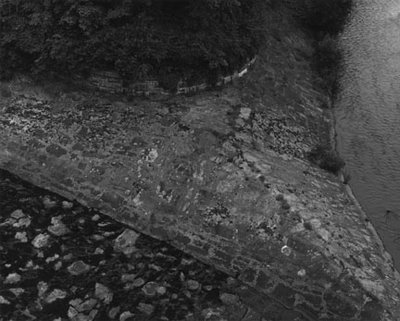
Greenberg’s photographic attraction is understandable. In his work, the New York City water supply reveals itself as a constellation of negative spaces: trapezoidal culverts, spillways, tunnels – cuts through the earth. His subject, in a sense, is terrain that is no longer there.
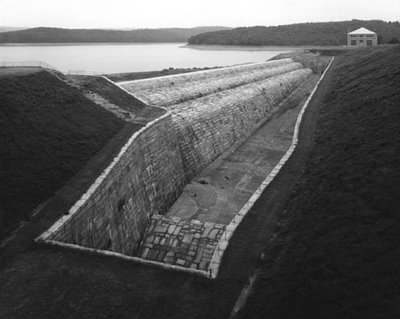
As Greenberg writes: “The water system today is an extraordinary web of places – beautiful landscapes, mysterious structures, and sites where the natural meets the man-made in enigmatic ways.”
These excavations, drained of their water, would form a networked monument to pure volume, inscribed into the bedrock of Hudson Valley.
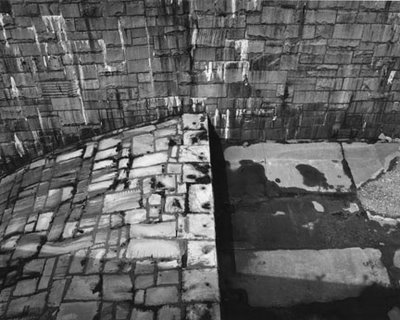
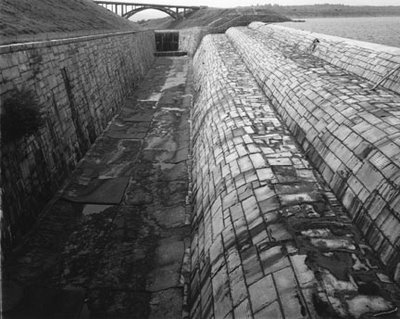
“While the work is not meant to be a comprehensive record of the system,” Greenberg explained over email, “it is meant to make people think about this organism that stretches 1000 feet underground and 200 miles away. I did a lot of research, and spent some time helping to resurrect the Water Department’s archives, which had been neglected for 50 years, so I knew the system pretty well before I started. It got to the point where I could sense a water system structure without actually knowing what it was. My friends are probably tired of my telling them when they’re walking over a valve chamber, or over the place where City Tunnels 1, 2, and now 3 cross each other (near the Brooklyn Academy of Music), or some other obscure part of the system.”
Such tales of hidden topology, of course, do not risk boring BLDGBLOG. One imagines, in fact, a slight resonance to the ground, Manhattan’s sidewalks – or Brooklyn’s – very subtly trembling with echo to those who know what lies below. As if the water system could even have been built, say, as a subterranean extension to the Brooklyn Academy of Music, a strange and amazing instrument drilled through rock, trumpeting with air pressure – a Symphony for the Hudson Valves, Bach’s Cantatas played through imperceptible reverberations of concrete and clay?
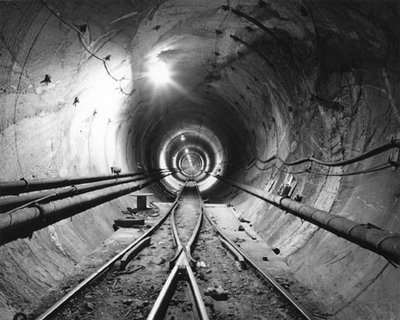
“I did all my photographs with permission,” Greenberg continues. “For one thing, it’s hard to sneak around with a 4×5 camera. For another, many of the places are extremely secure. I went back and forth over several years, sometimes being allowed in, other times being a pariah (and a threat to national security, according to the city, since I knew too much about the system). For some reason in 1998 I was given almost total access. I guess they realized I wasn’t going to give up, or that they would fare better if I were the one taking the pictures. I finished taking pictures in spring 2001. After 9/11, I’m sure I would have had little access – and in fact the city tried to stop me from publishing the book. I contacted curators, museum directors and some well-known lawyers; all offered their support. So when I told the city I would not back down, they gave up trying to stop me, and we went to press.”
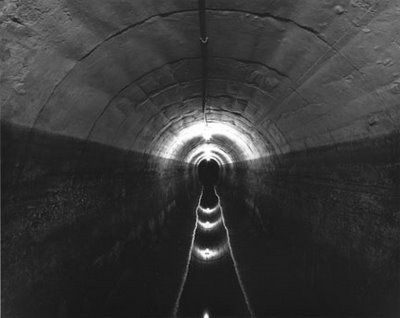
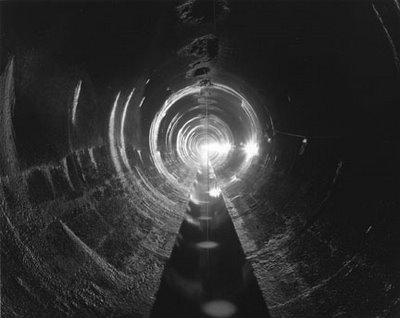
You can buy the book here; and you can read about Stanley Greenberg’s work all over the place, including here, here, and here (with photographic examples), and even on artnet.
Meanwhile, Greenberg has a show, open till 20 May, 2006, at the Candace Dwan Gallery, NYC. There, you’ll see Greenberg’s more recent photographs of “contemporary architecture under construction. Included in the show are photographs of works by Norman Foster, Frank Gehry, Zaha Hadid, Steven Holl, Daniel Libeskind, Yoshio Taniguchi, Winka Dubbeldam, and Bernard Tschumi.”
Earlier: Faucets of Manhattan and London Topological.
talk20: Instant Replay
Well, if you came out to talk20 last night – thanks! It was great.

I figured if any attendees were looking for more info about the things that came up, I should do a quick – though almost absurdly link-intensive – summary here… which may or may not be useful.
So: here’s the abandoned island off Japan that both Herman Mao and I talked about – including this amazing gallery of black and white photography.
The Helicopter Archipelago, then, designed with Leah Beeferman, takes flight here – where you’ll also find information about the Maunsell Towers –

– which were extensively explored and written up by the lads at Underground Kent.
Those tectonic maps of North America are by Ron Blakey. His timeline of paleogeographic evolution makes the brain reel.
Meanwhile, Geoff Shearcroft’s mouse with a house on its back –

– can be gazed upon lovingly here; Mr. Shearcroft is co-founder of the Agents of Change, a London-based architecture firm also responsible for these projects. And if you’re into the genetically modified architecture thing – as explored by Ferda Kolatan last night, with his carrots – you might like these cloned motorways.
That self-unfolding house was by Andrew Maynard. Click around and see what else he’s done – or read this interview with him, on Archinect.
Here are the silver blimp hotels, the water-drop printer (blasting Hitchcock films over Niagara Falls), the shadow billboard, and the gigantic, circular storm cells.
And… the food landscapes, of course, which were featured earlier on BLDGBLOG here and here.
Then there were the unstoppable, sewer-boating nutters of International Urban Glow – apparently run by a guy called Siologen. More info, and images, can be found here and especially here, that latter link being a personal favorite of mine – and an excuse to mention my novel, which is partially set in such subterranean locations. If you like all things underground, meanwhile, check out Sleepy City; the subterranean bunker cities of middle England; and Japan’s secret sub-Tokyo of tunnels – the latter post having been plagiarized, along with several other BLDGBLOG posts – even BLDGBLOG’s tagline – by a guy in Dubai.

If you liked the David Maisel images – and they’re hard to dislike – check out this lengthy interview with him on Archinect. David’s own website is totally amazing, however, so be sure to stop by – then lobby your local museum to host his current shows.
There were also the Bangladeshi shipbreaking yards, including some speculation about how to dismantle Gothic cathedrals, football stadiums, etc., on the beaches of equatorial archipelagos. The photos were by the terrifically great Edward Burtynsky.
And I didn’t talk about this, but I should have: extruding cathedrals directly from the earth using magma from volcanic vents.
Finally, the J.G. Ballard material, about a flooded London, can be found here, where you’ll discover “a nightmare world of competing organic forms returning rapidly to their Paleozoic past.” The images, below, are by Bernhard Edmaier.


More J.G. Ballard here. And, speaking of London: what would its foundations sound like if you could listen to the city through headphones?
There was also James Bond: how to weaponize plate tectonics – with Grace Jones in tow.
After the event, I talked to a guy who was reading Suketu Mehta’s Maximum City, a book which pops up in this post. And if you’re still looking for more – which you probably aren’t, frankly – there’s this post, which acts as a nearly exhaustive, and certainly exhausting, narrative table of contents for BLDGBLOG. Have fun, keep in touch, see you next time – and a huge thanks to Alejandro and Benjamin for setting it all up. And to Detlef, who apparently supplied the wine and who keeps the ideas flowing – thanks!