Foodprint NYC


I’m thrilled to announce that Edible Geography has teamed up with Sarah Rich to host a public event here in New York City next month; it will take place at Studio-X and will also be broadcast on Columbia University’s iTunes U channel.

Nicola’s own description of the day’s themes says it best:

The free afternoon program will consist of four panel discussions: “Zoning Diet,” about the hidden corsetry of policy, access, and economics that gives shape to urban food distribution; “Culinary Cartography,” a look at the kinds of things we can learn about New York City when we map its food types and behaviors; “Edible Archaeology,” about the socio-economic forces, technical innovations, and events that have shaped New York food history, in the context of the present; and “Feast, Famine, and Other Scenarios,” an opportunity to collaboratively speculate on changes to the edible landscape of New York in both the near and distant future.

Each panel, she adds, will feature “a range of voices, including designers, policy-makers, flavor scientists, culinary historians, architects, anthropologists, health professionals, and food producers and retailers.” The line-up so far looks amazing, and a public announcement of all confirmed speakers should be up soon.

So if you’re interested in how food shapes cities, from urban culture to built geography, mark your calendar—and I hope to see some of you there.

Foodprint NYC will take place on Saturday, February 27, from 1-5:30 p.m., at Studio-X, 180 Varick Street, Suite 1610, New York City. Here’s a map.

Steam Tunnel Music

On the advice of a friend here in New York, my wife and I went over to the Pratt Institute in Brooklyn on New Year’s Eve to watch the school’s underground steam infrastructure be transformed, temporarily, into a thunderous musical instrument. Somewhere between subterranean calliope and mutant wave organ, steam-powered explosions of sound threatened to deafen everyone as it turned 2010.

I’ve finally gotten around to uploading some footage I shot that night; you can watch (a very badly edited) clip, above.


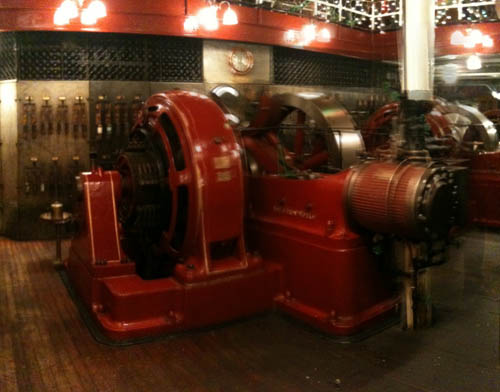
[Image: Pratt’s underground steam HQ, stitched together and cropped by iPhone].

According to the Municipal Art Society, Pratt’s steam-powered plant “is the oldest privately-owned, continuously operating, power plant of its kind in the country”—and, once a year, it gets turned into a gigantic musical instrument. One of the whistles used has even been repurposed from an old steamship, the S.S. Normandie.

The implication here, that you can attach pieces of musical instruments, and even old ship parts, to your city’s existing infrastructure and thus generate massive waves of sound is pretty astonishing; this might be a very site-specific thing, to be sure, and something only Pratt has permission to do to its own steam tunnels, but the mind reels at the possibility that this could be repeated throughout New York. For instance, on any point of the existing steam network as documented last month by Urban Omnibus:

Every winter, a typically unseen machine becomes visible in the streets of Manhattan: Con Edison’s District Steam System. Seen from the street as steam leaking from manholes, or more safely vented through orange and white stacks, leaking steam hints at an underground energy distribution system that is the largest of its kind in the United States and offers a chance for the public to become more aware of and more involved in how the city works.

As Urban Omnibus adds, “the steam system is largely ignored by the public until things go wrong”—or, of course, until that system is turned into a city-scale musical instrument through a maze of well-placed reeds, valves, and resonators.

The city is a saxophone, your grandfather explains, pointing down through sidewalk steam-grates as haunting whistles begin to sound. We have always lived inside an instrument, he adds, even if not all of us have known.

Tama-Re, or the Egypt of the West


[Image: The black pyramid at Tama-Re, the Egypt of the West].

After watching a documentary about Ted Kaczynski—the Unabomber—I started looking into the supermax prison where Kaczynski is currently being held in the mountains of Colorado. And there have been a lot of bizarre people incarcerated there, including Andrew Fastow, former Chief Financial Officer of Enron, and Charles Harrelson, the (now deceased) hitman father of actor Woody Harrelson.

One of the inmates who particularly stood out, however, was Dwight York. York is “an author, black supremacist leader, musician, and convicted child molester,” Wikipedia tells us, and he built a colorful, Ancient Egyptian-themed instant city on several hundred acres of forest land in the U.S. state of Georgia.


[Image: Tama-Re photographed from above, via Wikimapia].

The Urban Dictionary’s description of Tama-Re is amazing; it reads like every race-based fear of the white U.S. middle class summed up in one surreal location.

When York and his Nuwaubians moved there and began erecting pyramids and obelisks there was much curiosity about the group. However trouble started when the citizens became aware of the fact that York was an ex-Black Panther and a convicted felon and statutory rapist who was preaching the gospel that whites were mutants and were inferior to blacks. There is also a foam rubber alien on display in the compound that causes problems with public relations. Officials have had problems with the Nuwaubians failing to comply with zoning and building permits that coincide with what they have created. The Nuwaubians feel that this is a racist attack.

It’s hard to top a “foam rubber alien,” but the fear-factor nonetheless gets ratcheted up a notch:

Many children from upper middle class cities have left college to live in poverty at the cult’s compound, Tama Re. This has caused a lot of turmoil in the lives of many families who can’t accept the fact that their sons and daughters have left them to follow an alien messiah. Throughout the grounds speakers everywhere emit the humming sound of Egyptian chants 24 hours a day. Inside one of the pyramids you can buy books and clothes as well as a Dr. York doll. The people who live on the land dwell in a trailer park full of double-wides. York claims his people are Moors who traveled by foot from Africa to what is currently Georgia before the continental drift. The only problem with this “indisputable” fact is that the moors were Muslims who existed way after the birth of Christ which was only approximately 2000 years ago.

Ergo, there was no way in plate tectonics that they could have walked all the way to Georgia.

In June 2005, after the compound’s governmental seizure, financial forfeiture, and ensuing sale for $1.1 million, outright demolition began. As the Atlanta Journal-Constitution reported at the time, the local sheriff was on the scene, “speaking with relish as he watched crews tear through the series of obelisks, statues, arches and buildings. Many of the dozens of structures were weathered and in disrepair. He said very few of the Egyptian structures or objects were worth salvaging. ‘It feels good to tear down the SOB myself,’ he said. ‘By the middle of next week, there will be nothing but a couple of pyramids.'”

How, though, could these sorts of messianic compounds be addressed by and incorporated into architectural discourse? How do tacky black pyramids full of Luxor references complexify or contradict something like Venturi & Scott-Brown’s ideas of pop cultural ornament discussed just this past weekend at Yale?

Put another way, when will religious compounds find a journalist willing to travel around the world writing an architectural history of these fringe religious environments and stylistically eccentric cult enclaves?

These are sites built such that their every spatial detail is not justified by some historically rigorous academic architectural code, but because they function, psychologically, as a piece-by-piece tuning of the built environment. Add enough ornamental references together, these spaces say, and some weird new Messiah might yet someday return. It is functional ornament.


[Image: The ashes of the David Koresh compound in Waco, Texas].

Of course, I’m fascinated by the idea that Tehran, for instance, has been analyzed by Mahmoud Ahmadinejad—who trained as a traffic engineer—for its ability to handle the crush of cars and pedestrians that will show up to greet the returning Messiah. And, spatially speaking, I would love to read more about the now-destroyed Texas farmhouse inside of which David Koresh once preached his Branch Davidian gospel. But what about the central headquarters of Aum Shinrikyo, where LSD-fueled physicists meditated in the dark, crowned with well-lit helmets of electrodes, or the mirrored room inside of which Heaven’s Gate cultists once strangled themselves out of fear of Hale-Bopp?

Somewhere between Spaced Out, Survival City, and Gomorrah, a seriously amazing book about the architectural design of religious compounds is waiting to be written.

Architecture of a Decade Past


[Image: Fresh Kills landscape masterplan by Field Operations, via Mammoth; “With 2,200 acres filled with 150 million tons of trash to contend with,” Metropolis writes, “the challenge is making Fresh Kills public and safe, which means covering the garbage mounds with some four feet of fresh soil. The park would grow itself with cost-effective soil farms that aren’t eyesores.” Read more at the Freshkills Park Blog].

Mammoth has posted a great list of the best architecture of the decade. It runs the gamut from groundwater replenishing infrastructure and Chinese high-speed rail to the Svalbard Global Seed Vault and the iPhone, by way of the Large Hadron Collider, Rome’s Pontine marshes, and a library in Medellín (among others).

The purpose of the list, they write, is “to share a handful of the reasons that we’re genuinely excited about the future of architecture, and to hopefully engender a bit of that excitement in a reader or two.” It’s an inspired (and refreshingly non-building-centric) list of innovations (like microfinance) that have affected the built environment—and yet another reason why Mammoth is one of the best architecture blogs being written anywhere in the world today.

As a list, it also fares very favorably against the mind-numbing self-congratulation of other critics’ decade-in-retrospect lists, in which the last ten years appeared to exist only to validate the publishing decisions of people who, long ago, forgot how to engage with anything more than a shaving mirror.

Again, here’s a link.

Homefront Dissolve

Keiichi Matsuda, a student at the Bartlett School of Architecture, produced this short video in the final year of his M.Arch. It was, he writes, “part of a larger project about the social and architectural consequences of new media and augmented reality.”

The latter half of the 20th century saw the built environment merged with media space, and architecture taking on new roles related to branding, image and consumerism. Augmented reality may recontextualise the functions of consumerism and architecture, and change in the way in which we operate within it.

The bewildering groundlessness of surfaces within surfaces is beautifully captured by this video, and its portrayal of drop-down menus and the future hand gestures needed to access them is also pretty great. Augmented-reality drop-down menus are the Gothic ornamentation of tomorrow.

Now how do we use all that home-jamming ad space for something other than Coke and Tesco? What other subscription-content feeds can be plugged into this vertiginous interface?

Take a look—and you can find more thoughts, and another video, on Matsuda’s own blog.

(Thanks to Nic Clear for the tip!)

The Right Printhead

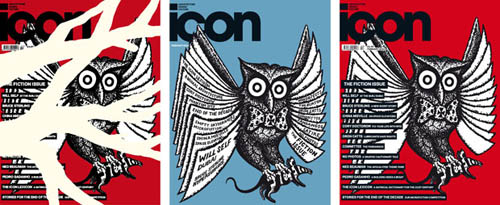
I was excited finally to pick up a copy of Icon’s February issue today; it is, in its entirety, an exploration of how fiction can be used to explore architectural ideas and the future of the built environment.

Contributors range from China Miéville, Bruce Sterling, and Cory Doctorow to Ned Beauman, Alexandra Daisy Ginsberg & Oron Catts, and Will Self, with microfiction contributions from Tim Maly of Quiet Babylon fame and Simon Sellars of Ballardian. I was also very happy to see that “Landscapes of Quarantine” participant Scott Geiger appears with a short review, and there is much else besides.

China Miéville’s story, “The Rope is the World,” takes place amidst “the space elevators, the skyhooks, the geostationary tethered-dock haulage columns” of a planet bound to its lower atmosphere by giant pieces of astral infrastructure. However, these elevators, in Miéville’s telling, are doomed to become fantastic aerial ruins, turning the Earth into “an irregularly spoked wheel” studded with abandoned elevator shafts, each “longer than Russia.” Derelict chain-cities hang flaccid in the skies. What might Caspar David Friedrich have painted in such a world?

Bruce Sterling, meanwhile, presents us with a world in which nothing seems to exist but broadband access—and that world is far from exhilarating. The story’s accompanying photograph shows us a Windows-powered laptop sitting alone on a plaster-flecked apartment floor, plugged into the wall of a room that otherwise has nothing in it; this solipsistic interior, void of anything like human presence or culture, reminded me of an old Peter Lamborn Wilson interview in which Wilson launches into an amazing rant against the rise of home internet use (even if I don’t agree with his conclusions):

Yes. You’re slumped in front of a screen, in the same physical situation as a TV watcher, you’ve just added a typewriter. And you’re “interactive.” What does that mean? It does not mean community. It’s catatonic schizophrenia. So blah blah blah; communicate communicate; data data data. It doesn’t mean anything more than catatonics babbling and drooling in a mental institution. Why can’t we stop?

In Sterling’s fictional world, these empty interiors freed of all personal possessions, with not even a place to sit, pulsate with instant access to Gmail; you can check your Twitter feed even if you can’t cook a decent meal.

But when the story’s protagonist obtains a mail-order 3D printer (“This sleek and sturdy overnight parcel contains everything one might need for do-it-yourself, open-source digital home fabrication,” Sterling writes), he or she gains an ability to produce objects—which then seems to be greeted with hipster disillusionment, rather than with ecstasy.

Indeed, the story ends on a low note; its final line: “I have to print my bed, so that I can lie in it.”

I have to admit to having already read that final sentence courtesy of Matt Jones’s Twitter feed a few weeks ago, and I had imagined, between then and now, a totally different story. I had pictured Sterling’s story, called “The Hypersurface of the Decade,” set in a world where personalized 3D printers create everything from our furniture to our food; today we might print our boarding passes at home before getting on an airplane, but tomorrow we will print our hamburgers, TVs, and even bedspreads.

Maybe we’ll print dogs and subway passes and prescription medications. Maybe we will even print our children.


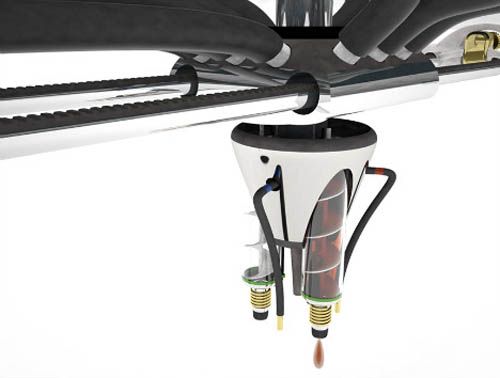
[Image: MIT’s Fluid Interfaces Group’s Cornucopia 3D food-printer].

Maybe it’s just a question of having the right new infrastructure of pipes—no, not those pipes. Maybe we need to forget ink cartridges; we’ll just subscribe to personal flows of speciality ingredients, chemical mixtures that come to us through a radically retooled infrastructure of pipes embedded in the walls of our cities. As unsurprising to someone in 50 years as piped water is to residents of New York today, anyone will simply print a pill of Prozac when they really need it or even print themselves a birthday cake.

Forget killer apps; all you need is the right printhead. Plug it into a nozzle on the wall and voilà.

In any case, I had pictured a story set in some strange Dr. Seuss world of instantly-printed objects. Forget furniture and clothing and utensils. Forget the Apple Tablet; instead you’d carry portable printheads, emitting on-demand, dissolvable realities of the present moment. Trapped in a room, you’d simply print a hammer and attack the wall. Of course, in many ways that is exactly what Sterling has described in his story, but it takes till the last three or four paragraphs to get a glimpse of this malleable world.

But, speaking only for myself, I’d love to spend more time inside this strange fever-dream in which instantly realizable objects appear left and right. I would hold something not unlike a gateway in my hand—some fabulous new printhead—spraying forms into the world of human beings.

Pick up a copy of Icon’s Fiction Issue before it disappears.

Quick Links 3


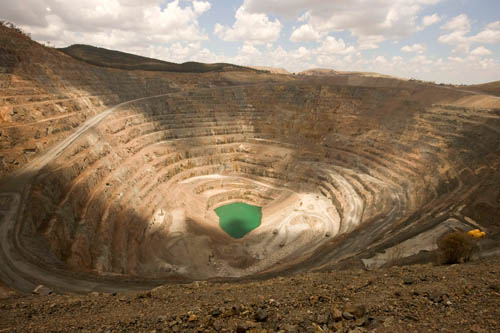
[Image: Australia’s Cadia gold mine, photographed by Jacky Ghossein for Getty Images, spotted at the Big Picture].

L.A. Times | “Ozone from Asia is wafting across the Pacific on springtime winds and boosting the amount of the smog-producing gas found in the skies above the Western United States,” the L.A. Times reports.

Economist | “Much of [California’s central valley] was an inland sea in its geological past,” we read in the Economist, “and its alluvial soils and Mediterranean climate make parts of it, particularly the San Joaquin valley in the south, about the most fertile agricultural region in the world. But this status is at risk because water, the vital ingredient to make the soil productive, is increasingly scarce.”

Popular Science | Undersea Cables Could Be Used as an Early Tsunami Detection System: “Monstrous tsunami waves, like the one that killed over 200,000 people in the Indian Ocean in 2004, create an electric field as they form. This field could possibly be sensed by a network of underwater sensors.”

ABC | “U.S. military veterans are sorting through a massive government archaeological collection that has been neglected for decades, with the hope of archiving the stone tools, arrows and American Indian beads that were found beneath major public works projects.”

Scientific American | Simulating the growth of the Tokyo subway system using slime mold: “A Japan-based research team found that if they placed bits of food (oat flakes) around a central Physarum polycephalum [slime mold] in the same location as 36 outlying cities around Tokyo, the mold created a network connecting the food sources that looked rather like the existing rail system.”


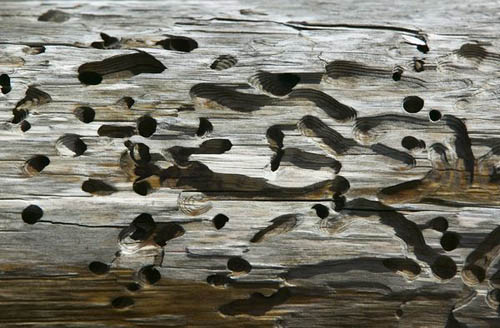
[Image: A “shipworm invasion” is threatening “thousands of Viking vessels and other historic shipwrecks” in the Baltic Sea, National Geographic reports; photo by Paul Kay, Oxford Scientific Photolibrary].

Scientific American | “Wind energy could generate 20 percent of the electricity needed by households and businesses in the eastern half of the United States by 2024, but it would require up to $90 billion in investment,” according to Scientific American.

BBC | “A new US assessment of Venezuela’s oil reserves could give the country double the supplies of Saudi Arabia,” we read at the BBC.

Brookings Institution | The Suburbanization of Poverty: “Suburbs saw by far the greatest growth in their poor population and by 2008 had become home to the largest share of the nation’s poor.”

Washington Post | “The gravelly beaches of Prince William Sound are trapping the oil [from the Exxon Valdez] between two layers of rock, with larger rocks on top and finer gravel underneath… creating a nearly oxygen-free environment with low nutrient levels that slowed the ability of the oil to biodegrade.”

Financial Times | Stray dogs in Moscow are “evolving greater intelligence and wolf-like characteristics”—as well as an ability to use the subway.

(Some links via Archinect, Futurismic, Reid Kotlas, and @stevesilberman. Quick Links 1 and 2).

The Self-Consuming Barbecue Pavilion

Note: This is a guest post by Nicola Twilley, originally published on Edible Geography.

In a fantastic hybrid of edible architecture and temporary summer pavilion, architect Caroline O’Donnell has proposed Bloodline, a free-standing, self-consuming grilling shelter.

[Image: Sectional model through the preparation bench, Bloodline pavilion by Caroline O’Donnell; Bloodline is supported by the Akademie Schloss Solitude].

Bloodline is the outcome of O’Donnell’s 2007 fellowship and residency at Akademie Schloss Solitude, a grant-making and residency institution housed in the late-Baroque “Solitude Castle” near Stuttgart in southern Germany.

Karl Eugen, Duke of Württemburg, built Schloss Solitude in 1763 as a private pleasure house—a cross between a party castle, summer retreat, and hunting lodge. Solitude was intended to be more intimate and less formal than his royal palace at Ludwigsburg, like the Trianons were to Versailles.
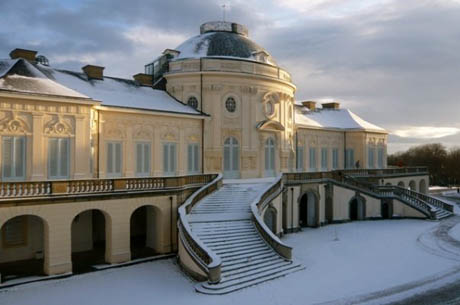
[Image: Akademie Schloss Solitude, via Wikimedia].

Among the prerequisites for an eighteenth-century aristocrat to achieve relaxation were a natural setting and, perhaps more importantly, minimal interaction with the servant classes. However, since domestic service was still required (aristocratic relaxation did not encompass preparing, serving, and cleaning up after meals, for example), palace architects had to resort to an extremely elaborate set of spatial tricks and distortions to make the servers as invisible as possible. The original design for the Petit Trianon even included a mechanism for raising and lowering the dining table through the floor so that it could be set and cleared out of sight.

According to O’Donnell, “The guides at Schloss Solitude could not understand why I wanted to see the service spaces, and tried to convince me that they were not interesting. I kept telling them in bad German that I was an architect and therefore interested in uninteresting spaces, but that seemed to cause more confusion.”

[Image: The secret service spaces at Ludwigsburg (left) and Schloss Solitude (right)].

What she found, eventually, were a series of awkward and cramped service cupboards and passages, filling in the spaces around the formal, symmetrical rooms. They are the negative space of pure classical order; the banished evidence of domestic effort and bodily needs.

Interestingly, O’Donnell noticed that at Karl Eugen’s main palace, Ludwigsburg Castle, the formal rooms are arranged around the edge, concealing a rabbit warren of service spaces in the interior.

Meanwhile at Solitude, the reverse is true: the cupboards, closets, and service passages are banished to the edge, with the result that seven of the fourteen windows on the perfectly symmetrical south façade actually open onto these deformed, hidden spaces.

[Images: (top) The south-facing façade of Schloss Solitude, in which seven of its windows actually open onto service spaces, rather than public rooms; via. (bottom) The negative spaces into which domestic functions were banished at Schloss Solitude (left); many were used as fire-spaces (right)].

Among the domestic functions concealed in this way was fire maintenance: tiny fire-spaces were used for storing firewood and also enabled servants to stoke open fires while remaining behind the scenes.

O’Donnell explained that when she finally gained access to a fire-space, she noticed “the effects of this small-scale and contorted space on the body,” but she was most fascinated “by this idea of the fire-space as a window, through which the stooping servant had a rare window into the lives of his masters”—and, in some ways, a more complete or privileged understanding of the space of the palace as a whole.
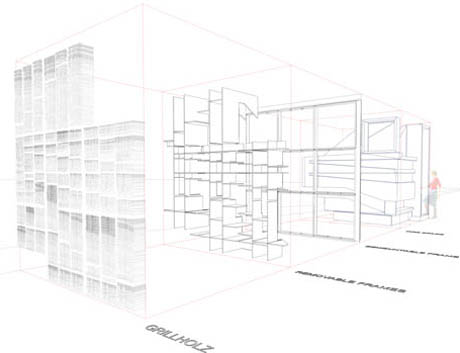
[Image: Bloodline, showing the stacked grillholz cuboid exterior concealing the irregular interior].

So, back to the barbecue pavilion: O’Donnell’s Bloodline proposal would use 360 bags of grillholz (German barbecue wood sticks) as the cladding—enough for a summer season, or ninety barbecues at four bags per cook-out. As July fades into August, and then into September, the pavilion will gradually be dismantled: the architecture’s fiery function will lead it to literally consume itself from the outside in. This is an incredibly poetic literalization of the shelter’s function: architecture parlante at its finest.

The pavilion also plays on O’Donnell’s initial fascination with Solitude’s squished fire-spaces. Bloodline begins the summer as a perfect, platonic cube, but gradually grills itself down to an awkwardly shaped frame that mirrors a section through the original fire-space. In other words, through use, the mini-barbecue palace will reveal its contorted, service-space origins—a slow, season-long process of revelation.

[Image: The pavilion will begin the summer as a platonic cube before being eroded through repeated barbecuing to reveal its hidden fire-space form].

Like Solitude’s original fire-spaces, which servants had to bend down and crawl to enter, the Bloodline barbecue pavilion is only designed to fit one person. And, as in the originals, that one person—the servant or barbecuer-in-chief, depending on how you look at these things—has a unique, more omniscient view.

Ludwigsburg and Solitude castles are linked by Solitudeallee, each palace is also aligned on its own axis of symmetry. When O’Donnell looked at these lines in satellite view, it became clear that there was a third axis, emerging from the forest, which was missing a castle.

Ingeniously, O’Donnell’s proposed site for Bloodline means that our barbecuing hero, standing in front of the grill-window on the southwest-facing side of the pavilion, is the only person in their party who can see that they are actually inside the missing third castle.

[Image: Plotting the axes and intersections of Ludwigsburg and Solitude: O’Donnell explained that “only the forest is missing a castle”].

In other words, while their friends and family relax in the grounds outside the pavilion, eating sausages they haven’t had to prepare, “only the servant (or grill-master) will know the truth,” explains O’Donnell, “although they can sneak others in, to share the secret.”

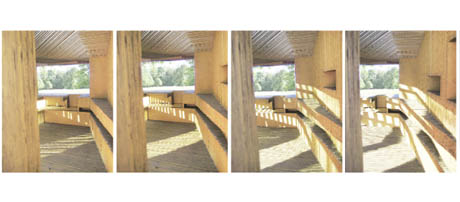
[Images: (top) Renderings of Bloodline show the grill-window and entrance; (bottom) Bloodline interior, looking out toward the grill-window’s privileged view].

In terms of grilling experience, the barbecue pavilion that becomes a secret, personal castle seems second to none. “After that, the sausages are not my responsibility,” O’Donnell told me. “There are however custom spaces built into the pavilion on the west side for a fire-extinguisher and a fire-blanket, as well as a big vent on the east side that aligns with the prevailing wind and uses the stack-effect to ventilate the space naturally.”

A couple of thoughts immediately come to mind here: firstly, that this is the perfect Father’s Day gift. After all, doesn’t every red-blooded male secretly crave his own barbecue castle: a private space of solitude, unspoken power, and burger perfection? Lowe’s or Homebase could even stock build-your-own kits, for an extra DIY frisson.

[Image: (left) Inside Bloodline (the server has clearly snuck in a few friends); (right) Stacked grillholz will form the façade and the barbecue fuel. The wood sticks’ color even matches the ochre putty exterior of Schloss Solitude].

I’m also reminded, via a link that was (coincidentally?) sent to me separately by Caroline O’Donnell, of Harvard anthropologist Richard Wrangham‘s theory that cooking is the root cause of human civilization. His basic idea is that the discovery of cooking allowed us to unlock many more calories in food, which gave us more energy for less effort, which in turn resulted in a massive increase in brain size in Homo sapiens (as compared to our primate ancestors).
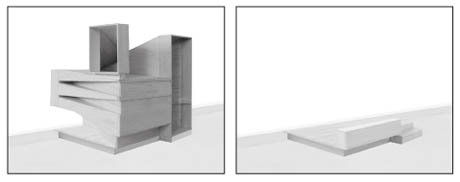
[Images: Stages of consumption. At the end, all that will remain is the ash bench (bottom right), which O’Donnell plans to leave on site once the summer is over, “as a clue to the missing castle”].

That expanded brain of course led, eventually, to the flowering of the Baroque, in which rococo pleasure palaces were cleverly designed to hide any evidence of cooking facilities. O’Donnell’s pavilion gives cooking its due once again, as over the course of the summer Solitude’s missing third palace is revealed to be a a functional fire-space, rather than the abstracted perfection of a symmetrical cube. Barbecuing German day-trippers will thus be paying inadvertent homage to the role of fire in human civilization.
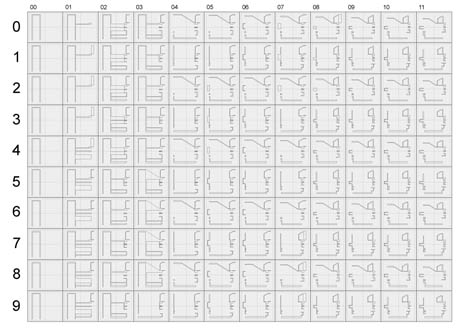
[Image: Some of O’Donnell’s incredibly complex cut files for fabrication].

Caroline O’Donnell is working with Akademie Schloss Solitude to secure funding for the pavilion: the hope is to install it during the summer of 2011. My thanks are due to her for an incredibly interesting conversation, and also to Nathan Friedman, who has been working on Bloodline with O’Donnell for the past few months.

(Note: This post, written by Nicola Twilley, was originally published on Edible Geography).
States of Metamorphosis

Photographer David Maisel will be celebrating the opening of his show “Library of Dust” tonight, Thursday, January 21, at New York’s Von Lintel Gallery.

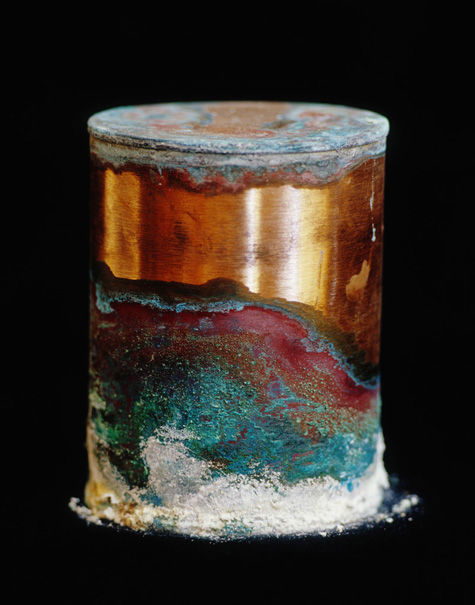
[Image: From Library of Dust by David Maisel].

Chronicle Books put out an absolutely gorgeous book documenting Maisel’s work last year. From the project’s own description:

David Maisel’s Library of Dust features copper canisters in varying states of metamorphosis. The containers are photographed individually, black backdrop in place, each posed like a subject sitting for a portrait. Maisel’s treatment of these objects is apropos. The canisters, once stored in a dilapidated outbuilding of a state-run psychiatric hospital, hold the cremated remains of people—more specifically, the unclaimed ashes of the asylum’s patients. The Oregon State Hospital, inaugurated as the Oregon State Insane Asylum in 1883, interred the canisters in an underground vault in the mid-1970s. As the vault flooded repeatedly, the canisters—some containing remains more than a century old—underwent potent transformations. The chemical composition of each cremated body’s ashes has caused unique and colorful mineralogical blooms to form on its individual copper surface.

The gallery opens at 6pm—roughly one hour from now—and the show will stay up until February 27, 2010. Be sure to stop by if you are near; here is a map.

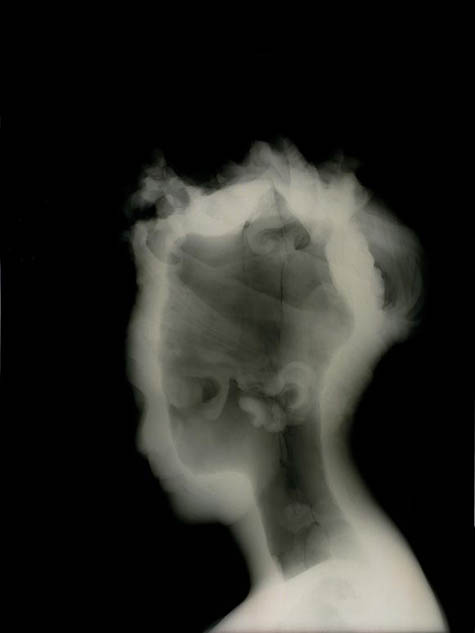
For those of you already familiar with this project, meanwhile, Maisel has been working on a new, long-term series called “History’s Shadow.” This consists entirely of “re-photographed x-rays of art objects from antiquity,” and the results offer eerily delicate views inside objects thousands of years old. An example appears below, but the whole series is well-worth checking out in full.

[Image: “GM12,” from History’s Shadow by David Maisel].

I would love to see an architectural version of this project, with Maisel somehow re-photographing large-scale x-rays of cathedrals and temple walls, peering inside columns, arches, and ruins, with buttresses doubled and tripled with the grain of their rock revealed, stuttering into the silent core of an object not ever meant to be seen this way.

(I was fortunate enough to have an essay included in Maisel’s Library of Dust; you can read that essay in its entirety on BLDGBLOG).

Glacier / Island / Storm

I thought it might be fun to post the course description and design brief for a course I’ll be teaching this semester at Columbia.

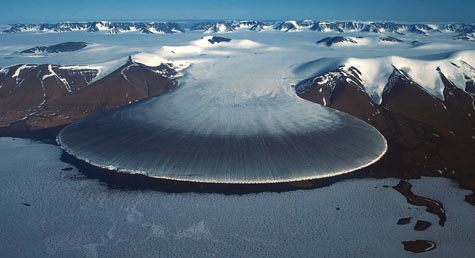
[Image: Photo via the Alfred Wegener Institute].

The idea behind the studio is to look at naturally occurring processes and forms—specifically, glaciers, islands, and storms—and to ask how these might be subject to architectural re-design.

We will begin our investigations by looking at three specific case-studies, including the practical techniques and concerns behind each. This research will then serve as the basis from which studio participants will create original glacier/island/storm design proposals.

GLACIER: For centuries, a vernacular tradition of constructing artificial glaciers in the Himalayas has been used to create reserves of ice from which freshwater can be reliably obtained during dry years. This is the glacier as non-electrical ice reserve, in other words; some of these structures have even received funding as international relief projects—for instance, by the Aga Khan Rural Support Program in Pakistan. Interestingly, the artificial glacier here becomes a philanthropic pursuit, falling somewhere between Architecture For Humanity and a sustainable water-bank.

Through an examination of glacier-building techniques, water requirements, and the thermal behavior of ice, we will both refine and re-imagine designs for self-sustaining artificial glaciers, for the ultimate purpose of storing fresh water.

But what specific tools and spatial techniques might this require? Further, what purposes beyond drought relief might an artificial glacier serve? There are myths, for instance, of Himalayan villagers building artificial glaciers to protect themselves against invasion, and perhaps we might even speculate that water shortages in Los Angeles could be relieved with a series of artificial glaciers maintained by the city’s Department of Water and Power at the headwaters of the Colorado River…

ISLAND: Building artificial islands using only sand and fill is relatively simple, but how might such structures be organically grown?

In the ocean south of Japan is a complex of reefs just slightly below the surface of the water; Japan claims that these reefs are, in fact, islands. This is no minor distinction: if the international community supports this claim, Japan would not only massively extend its Exclusive Economic Zone (EEZ), complete with seabed-mining and fishing rights, but it would also block China from accessing those same resources. This would, however, also limit the ability of Chinese warships to patrol the region—and so the U.S. has publicly backed Japan’s territorial claim (China does not).

Okinawan scientists have thus been developing genetically-modified species of coral with the express idea of using these species to “grow” the reefs into a small but internationally recognized archipelago: the Okinotori Islands. Think of it as bio-technology put to use in the context of international sovereignty and the U.N. Law of the Sea.

The stakes are high—but, our studio will ask, by way of studying multiple forms of reef-building as well as materials such as Biorock, where might other such island-growing operations be politically and environmentally useful? Further, how might the resulting landforms be most interestingly designed? Assisted by a class visit from marine biologist Thomas Goreau, one-time collaborator of architect Wolf Hilbertz, we will look at the construction techniques and materials necessary for building wholly new artificial landforms.

STORM: For hundreds of years, a lightning storm called the Relampago del Catatumbo has flashed in the sky above Venezuela’s coastal Lake Maracaibo. The perfect mix of riverine topography, lake-borne humidity, and rain forest air currents has produced what can be described, with only slight exaggeration, as a permanent storm.

This already fascinating anecdote takes on interesting spatial design implications when we read, for instance, that Shanghai city officials have expressed alarm at the inadvertent amplification of wind speeds through their city as more and more skyscrapers are erected there—demonstrating that architecture sometimes has violent climatological effects. Further, Beijing and Moscow both have recently declared urban weather control an explicit aim of their respective municipal governments—but who will be in charge of designing this new weather, and what role might architects and landscape architects play in its creation?

We will be putting these—and many other—examples of weather control together with urban, architectural, and landscape design studies in an attempt to produce atmospheric events. For instance, could we redesign Manhattan’s skyline to create a permanent storm over the city—or could we rid the five boroughs of storms altogether? And under what circumstances—drought-relief in the American southwest or Gulf Coast hurricane-deflection—might our efforts be most practically useful?

• • •

The studio will be divided into three groups—one designing “glaciers,” one designing “islands,” one designing “storms.” Each group will mix vernacular building technologies with what sounds like science fiction to explore the fine line between architectural design and the amplified cultivation of natural processes. Importantly, this will be done not simply for the sake of doing so (although there will be a bit of that…), but to address much larger questions of international sovereignty, regional drought, global climate change, and more.

They Will Build Clouds For Us

[Image: A C-141 Starlifter flying toward sunset; via Wikimedia].

A cloud of metal dust released by U.S. military airplanes in the skies 100 miles west of Los Angeles caused a temporary blackout in the city and “interfer[ed] with radar at airports in southern California” when the cloud began blowing back toward land.

What exactly was the purpose of this inadvertently weaponized offshore atmospheric event? “The Navy says it spread several thousand pounds of the particles of chaff in an operation 100 to 300 miles offshore designed to test its ability to jam radar,” the New York Times reported.

However, all of this actually occurred 25 years ago, in January 1985; I simply stumbled upon it while researching blackouts.

The idea, though, that there are airplanes flying somewhere out there west of Los Angeles creating strange weather for those of us on shore—clouds sculpted on the rising winds of the Southland, drifting unpredictably toward Santa Monica—seems both extraordinary and all too ready for capitalization. Sunsets on demand! Your least favorite celebrity gets married on a Malibu terrace and repurposed military aircraft paint the distant skies red, weaving fantastic ribbons of color in front of the falling sun.

It’s like something out of J.G. Ballard’s old short story “The Cloud Sculptors of Coral D,” in which famous portraits are carved into passing cloud forms by trained kite operators standing below on the shores of a tropical island. They have invented a stunning, lo-fi, vernacular 3D printing that can only be applied to the earth’s atmosphere.

“Lifted on the shoulders of the air above the crown of Coral D, we would carve seahorses and unicorns, the portraits of presidents and film stars, lizards and exotic birds,” Ballard wrote, describing this new mythology of atmospheric design and the “manicurists of the air” who so beautifully practiced it.

Or, for that matter, perhaps this strange meteorological event—the metal chaff of a new weather emperor, self-installed atop his flying throne, deploying cloud-weapons across the horizon—was an electromagnetically active twist on the anti-hero from Roberto Bolaño’s novel Distant Star. There, we meet a skywriting poet-pilot with a penchant for fascism who sells his political soul to the Nazis in order to write his Romantic words in huge drifting scripts above the mountains of South America.

He becomes “a Michelangelo of the sky,” as Ballard might have it.

Meanwhile, radar-jamming clouds of nanoparticles settle onto the plates of outdoor diners in Venice Beach, salting take-out pizzas and dusting the bodies of sunbathers, as screens inside the LAX control tower madly ping with invisible aircraft.