Vincent Van Gogh and the Storm Archive

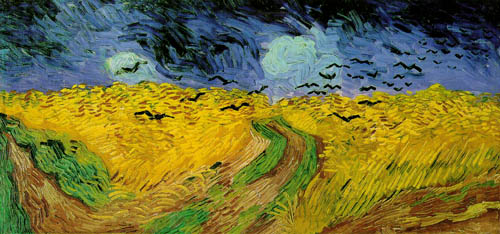
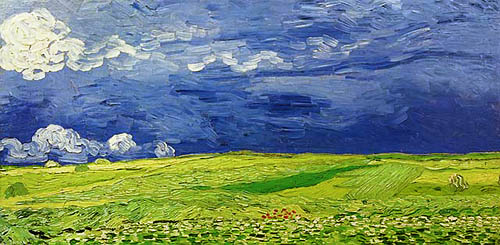
[Image: Vincent Van Gogh, “Wheatfields under Thunderclouds” (1890)].

One of many books I’ve been referring to quite often these days, both in personal conversations and during desk-crits with my students, is Michael Welland’s Sand, newly released in paperback.

I’ll be mentioning many things from his book throughout the coming days and later; for now, I simply want to call attention to a comment Welland makes about Vincent Van Gogh‘s habit of painting en plein air—that is, outside, with fresh paint, in the windswept meadows and fields near the Mediterranean, where dust storms were an expected part of an afternoon.

This regional meteorology often resulted in sand grains being blown onto Van Gogh’s still-wet canvases—and thus becoming a permanent part of art history.

Indeed, in some cases, Welland writes, citing Van Gogh’s own letters, the sand could get so dense and accumulate so thickly that he would have to scrape preliminary images from the unfinished canvas and start again. That intrusive terrestrial presence—pieces of the very thing his paintings were meant to represent—was thus removed.

[Image: Vincent Van Gogh, “Wheatfield with Crows” (1890)].

More interestingly, though, passing meteorological events of the 19th century left behind what we might call aerial fossils: traces of violent wind patterns and minor climatologies that have been frozen into place on the surface of plein air paintings.

The result is a kind of storm archive—an unintentional core sample of 19th-century weather—housed in museums around the world. Squint long enough, perhaps, and beneath those swirling mists and pixelations you will see traces of the Sahara, of building dust, of pollen, of the wheat-sprouting soil of the region, all recorded for good measure through time.

Like some unexpected variation on Jurassic Park—in which it is not the DNA of dinosaurs extracted from ancient amber that we use to reconstitute a missing being—perhaps an army of art historians and scientists, equipped with microscopes and tweezers, could pull from the surface of every painting by Vincent Van Gogh a catalog of lost weather systems, mapping the moving sands of his era.

#GlacierIslandStorm

Geothermal Gardens and the Hot Zones of the City

[Image: “Reykjavik Botanical Garden” by Andrew Corrigan and John Carr].

In a fantastic issue of AD, edited by Sean Lally and themed around the idea of “Energies,” a long list of projects appeared that are of direct relevance to the Glacier/Island/Storm studio thread developing this week. I want to mention just two of those projects here.

[Image: “Reykjavik Botanical Garden” by Andrew Corrigan and John Carr].

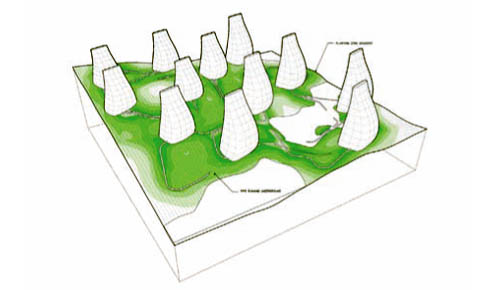
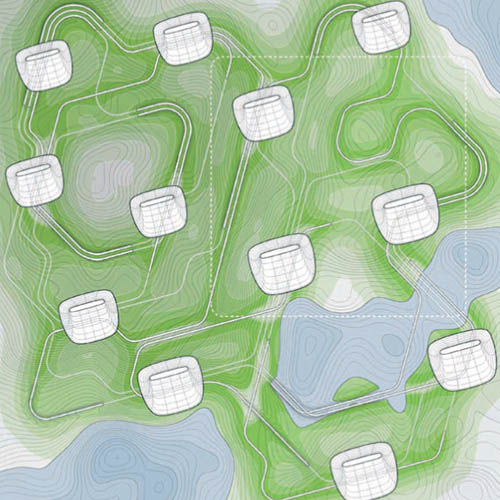
For their “Reykjavik Botanical Garden,” Rice University architecture students Andrew Corrigan and John Carr proposed tapping that city’s geothermal energy to create “microclimates for varied plant growth.”

“Heat is taken directly from the ground,” they write, “and piped up across the landscape into a system of [pipes and] towers.”

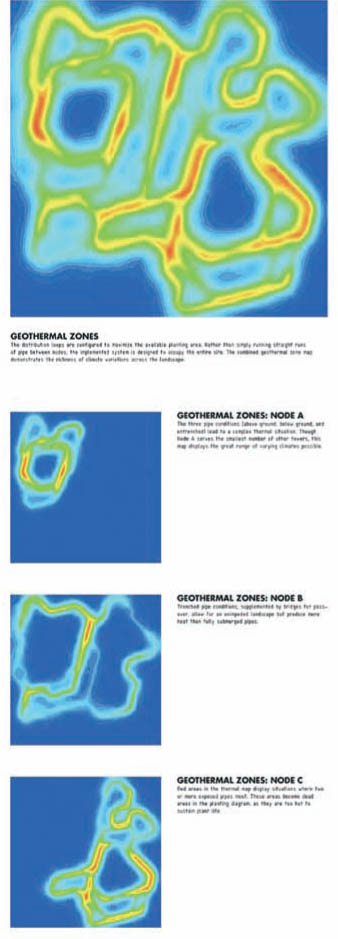
Zones of heat radiate out from the pipes, creating a new climate layer with variable conditions based on their number and proximity to each other. These exterior plantings are mostly native to Iceland, but the amplified environment allows a wider range of growth than would normally be possible, informing the role and opportunity of this particular botanical garden. Visitors experience growth never before possible in Iceland, and travel through new climates throughout the site.

Amidst “hydroponic growing trays and research laboratories,” and sprouting in the climatic shadow of complicated “air-intake systems,” a new landscape grows, absorbing its heat from below.

[Image: “Reykjavik Botanical Garden” by Andrew Corrigan and John Carr].

The climate of the city is altered, in other words, literally from the ground up; using the functional equivalent of terrestrially powered ovens, otherwise botanically impossible species can healthily take root.

This domestication of geothermal energy, and the use of it for purposes other than electricity-generation, raises the fascinating possibility that heat itself, if carefully and specifically redirected, can utterly transform urban space.

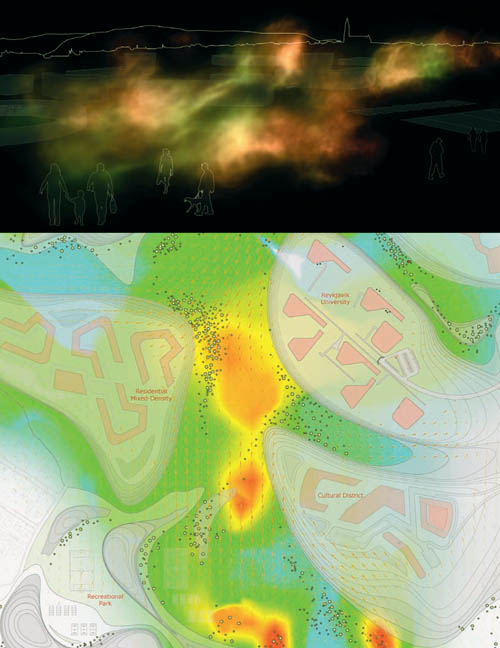
[Image: Produced for the “Vatnsmyri Urban Planning Competition” by Sean Lally, Andrew Corrigan, and Paul Kweton of WEATHERS].

A variant on this forms the basic idea behind Sean Lally’s own project, produced with Andrew Corrigan and Paul Kweton, for the Vatnsmyri Urban Planning Competition (a competition previously discussed on BLDGBLOG here).

Their design also proposes using geothermal heat in Reykjavik “to affect the local climatic conditions on land, including air temperature and soil temperature for vegetative growth.” But their goal is to generate a “climatic ‘wash'”—that is, an amorphous zone of heat that lies just slightly outside of direct regulation. This slow leaking of heat into the city could then effect a linked series of hot zones—or variable microclimates, as the architects write—that would punctuate the city with thermal oases.

Like a winterized inversion of the air-conditioned cold fronts we feel rolling out from the open doors of buildings all summer long, this would be pure heat—and its attendant humidity—roiling upward from the Earth itself. The result would be to generate a new architecture not of walls and buildings but of temperature thresholds and bodily sensation.

Indeed, as David Gissen suggests in his excellent book Subnature, this project could very well imply “a new form of urban planning,” one in which sculpted zones of thermal energy take precedence over architecturally designated public spaces.

Of course, whether this simply means that under-designed urban dead zones—like the otherwise sorely needed pedestrian parks now scattered up and down Broadway—will be left as is, provided they are heated from below by a subway grate, remains, for the time being, undetermined.

This is all just part of a much larger question: how we “renegotiate the relationship between architecture and weather,” as Jürgen Mayer H. and Neeraj Bhatia, editors of the recent book -arium: Weather + Architecture, describe it. The Glacier/Island/Storm studio will continue to explore these and other abstract questions of climate and architectural design throughout the spring.

An amplification of processes that already occur

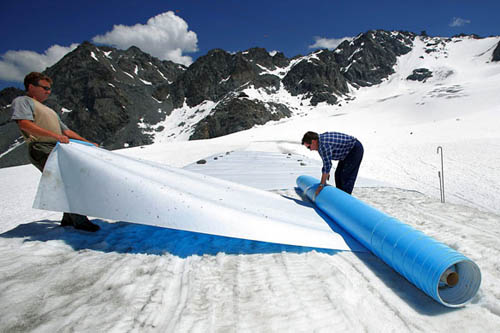
[Image: Glacier-protection services in the Swiss Alps; photo by Olivier Maire/Epa/Corbis, via the Guardian].

Several posts in our Glacier/Island/Storm blog week are already up and working it:

Nick Sowers, Design to Fail: In which we read about tree-bombing Guam, the unintended reuse of abandoned military artifacts, global climate change as national security threat, and how all architects should plan for the failure of their most grandiose ideas.

InfraNet Lab, LandFab, or Manufacturing Terrain: In which we read about “volcanic heroism,” desert islands, “politically anomalous artificial land fabrication,” and a brief history of dredging in the Florida Everglades (perhaps vaguely related: Prosthetic Delta).

mammoth, a glacier is a very long event: In which we read about the self-altering internal torque of metamorphic glaciers, salt farms, shell middens, the ecological redesign of an abandoned landfill, accretionary geographies, and much more.

The title of this post, meanwhile, comes from mammoth, as cited above. It was also chosen as way of pointing out that, while this week pretends toward the status of symposium—that is, multiple blogs with different backgrounds all pursuing a shared suite of themes and references at the same time for a limited period—it is, in reality, no more than what already happens in the deep chains of internet conversation everyday. I write a post referring to something on Pruned; Pruned perhaps saw something tweeted by Ballardian or Alexis Madrigal; the link in question might have come from the New York Times or even Metafilter; and the endlessly marbled laminations of successive re-linking never cease to accumulate. That’s how things are; that’s simply what happens. This is thus just an amplification of processes that already occur.

(There may or may not be Twitter updates throughout the week using the #glacierislandstorm hashtag, as well).

Glacier / Island / Storm Online

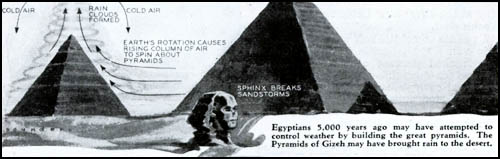
[Image: From Modern Mechanix, thanks to a tip from Nicole Seekely].

For the next five days, if everything goes as planned, BLDGBLOG and eight other architecture, design, and technology blogs will be engaged in a series of linked posts and ongoing conversations about themes relevant to the “Glacier/Island/Storm” studio at Columbia University this Spring.

In the broadest terms, we will be exploring the architecture of large-scale natural processes; more specifically, this means studying artificial glaciers; organically-grown archipelagos and other artificial reef technologies; and the unintended climatic side-effects of architecture, including the possibility of “owning the weather.”

[Image: From Modern Mechanix].

The participating blogs are a456 (Enrique Ramirez), Edible Geography (Nicola Twilley), HTC Experiments (David Gissen), InfraNet Lab (Mason White, Maya Przybylski, Neeraj Bhatia, and Lola Sheppard), mammoth (Rob Holmes and Stephen Becker), Serial Consign (Greg J. Smith), Soundscrapers/UC-Berkeley Archinect School Blog Project (Nick Sowers), and Quiet Babylon (Tim Maly).

For my own part, I’ll be posting on a wide range of themes directly related to the studio, including summaries of visiting expert lectures and class field trips to local scientific institutions; but I will also be offering my own speculative thoughts on the matter. Also, in addition to each blogger commenting on one another’s posts when possible, or simply following up with their own response-posts, I will be maintaining a list of relevant links to keep the whole thing flowing.

So my students and I are off on a field trip for the rest of the day, but I will begin putting up posts this evening. Feel free to join in, leave comments, suggest further readings, and more. Thanks!

Screens in Space

A mind-bogglingly awesome new project from MIT called Flyfire hopes to use large, precision-controlled clouds of micro-helicopters, each carrying a color-coordinated LED, to create massive, three-dimensional information displays in space.

[Image: Via Flyfire].

Each helicopter is “a smart pixel,” we read. “Through precisely controlled movements, the helicopters perform elaborate and synchronized motions and form an elastic display surface for any desired scenario.” Emergency streetlights, future TV, avant-garde rural entertainment, and even acts of war.

Watch the video:

Instead of a drive-in cinema, in other words, you could simply be looking out from the windscreen of your car at a massive cloud of color-coordinated, precision-timed, drone micro-helicopters, each the size and function of a pixel. Imagine planetarium shows with this thing!

The Flyfire canvas can transform itself from one shape to another or morph a two-dimensional photographic image into an articulated shape. The pixels are physically engaged in transitioning images from one state to another, which allows the Flyfire canvas to demonstrate a spatially animated viewing experience.

Imagine web-browsing through literal clouds of small flying pixels, parting and weaving in the air in front of you like fireflies (or imagine training fireflies to act as a web browser). You’re in a university auditorium one day when, instead of delivering her projected slideshow, your professor simply remote-controls a whirring vortex of ten thousand flying micro-dots. Digital 3D cinema is nothing compared to this murmuration of light.

Channeling Tim Maly, we might even someday see a drone-swarm of LED-augmented, artificially intelligent nano-helicopters flying off into the desert skies of the American southwest, on cinematic migration routes blurring overhead. On a lonely car drive through northern Arizona when a film-cloud flies by…

An insane emperor entertains himself watching precision-controlled image-clouds, some of which are distant satellites falling synchronized through space.

Quick Links 7

[Image: The Cornucopia Digital Fabricator, “a personal, three-dimensional printer for food,” by Marcelo Coelho and Amit Zoran; Coelho will be speaking this Saturday at Foodprint NYC].

1) Foodprint NYC is this Saturday, February 27, at Studio-X in New York City: “Foodprint NYC is the first in a series of international conversations about food and the city. From a cluster analysis of bodega inventories to the cultural impact of the ice-box, and from food deserts to peak phosphorus, panelists will examine the hidden corsetry that gives shape to urban foodscapes, and collaboratively speculate on how to feed New York in the future. The free afternoon program will include designers, policy-makers, flavor scientists, culinary historians, food retailers, and others, for a wide-ranging discussion of New York’s food systems, past and present, as well as opportunities to transform our edible landscape through technology, architecture, legislation, and education.” It is free and open to the public, and the speaker line-up is amazing. The whole thing goes from 1-5:30pm. Here is a map. Foodprint NYC is organized by Nicola Twilley and Sarah Rich.

2) Here is a great design competition: “Currently, over 100,000 people each year follow informal trails through wetlands and over active train tracks to gain access to the surf breaks at Trestles,” we read. “These impromptu manmade paths present a safety hazard with passing trains and threaten the fragile ecosystem of Trestles.”

In response, a coalition of concerned groups organized by the volunteer non-profit organization Architecture for Humanity, are launching “Safe Trestles,” an open-to-all, two-stage design competition to create a safe pathway to serve surfers, the local coastal community and day visitors to San Onofre State Beach. This coalition is looking for cohesive designs that eliminate the danger of crossing active train tracks, help to restore wetlands that have been damaged by the present path, preserve and improve vistas, and offer education about the history of the site and the beach marsh environment.

Registration deadline: March 17, 2010; submission deadline: April 17, 2010

[Images: From 49 Cities by workAC].

3) workAC‘s 49 Cities exhibition travels to San Francisco next month, where it opens at the San Francisco Planning and Urban Research Association (SPUR. “A survey of utopian urbanism, 49 Cities provides a remarkable insight into the contemporary metropolis and our efforts over time to make cities more controllable, monumental, organic, taller, denser, sparser or greener.” A newly expanded reprint of the accompanying 49 Cities book, published by Storefront for Art and Architecture, will be for available for purchase. Amale Andraos, principal architect (with Dan Wood) of workAC will be speaking at Foodprint NYC.

4) Follow the agricultural practices and economic landscapes of cocaine production. Watch heavily processed leaves be transformed from gasoline-infused paste to powder. Then watch this radically alchemized form of plantlife be smuggled across the U.S. border.
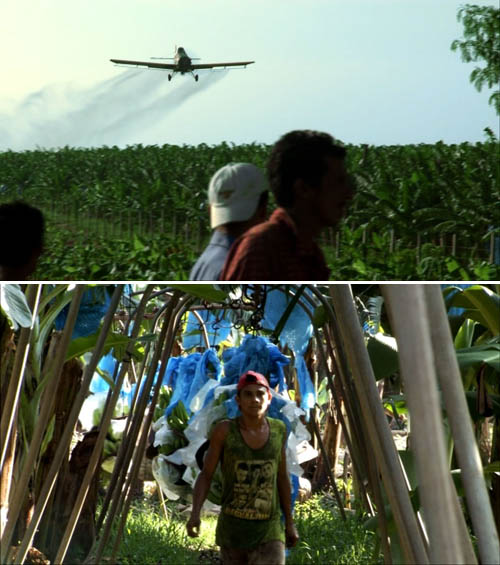
[Images: From BANANAS!*].

5) Then go back out into the fields and watch this trailer for a Swedish documentary about bananas.

6) Coastlines: Images of Land and Sea opens at the Dallas Museum of Art on April 25, 2010. The exhibition explores “how modern and contemporary artists—from Childe Hassam and Edward Hopper to Willem De Kooning, Gerhard Richter and Catherine Opie—have drawn upon coastal landscapes as a source of inspiration, metaphor and mystery in their work. Through selections from the Museum’s rich collections and important local holdings, Coastlines: Images of Land and Sea will juxtapose coastal landscapes from around the world and from a range of different artistic traditions.”

7) Pruned supplies his newest list of quick links—and they’re all worth reading: Prunings LIII. In particular, don’t miss the $100 million, seven-story aquarium being planned for Times Square: a Canadian developer hopes to “install tanks featuring sharks, rays, penguins, otters, and other animals in the bottom floors of the 40-story building, known as 11 Times Square, hoping to attract some of the 35 million people who pass through Manhattan’s major crossroads every year.”

8) The new issue of Vague Terrain has been released; its theme is Architecture/Action. “Where is the boundary that separates space from computation?” the issue asks. “What is this territory that lies between interaction design, gaming, physical computing, and architecture?”
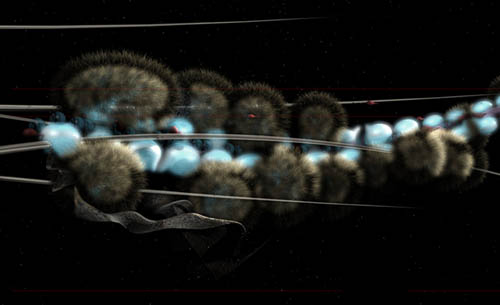
[Image: Unknown image, via Interactive Architecture].

9) Speaking of computation, Unconventional Computing & Architecture will be held this Friday, February 26, at the Building Centre in London. “This one-day conference explores new materials for architectural practice in the 21st century. International architects and scientists will explore the decision-making properties of matter and how this may be applied to create increasingly life-like buildings.”

10) Built for the Bush is now on display in the Australian city of Albury, showcasing “green architecture for rural Australia.” The exhibition “explores some of the energy efficient features of Australia’s 19th century country homes and the reappearance of many of these traditional practices in contemporary green architecture.”
[Image: Unknown image, via Interactive Architecture].

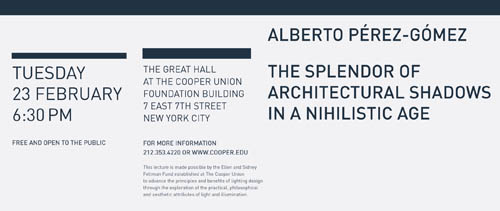
And one to grow on: Alberto Pérez-Gómez will be speaking tomorrow night, Tuesday, February 23, in the Great Hall of New York City’s Cooper Union. His talk—”The Splendor of Architectural Shadows in a Nihilistic Age”—is free and begins at 6:30pm.

(Some links found via Design Under Sky, Some landscapes, Foodprint [Dutch], Super Colossal, Interactive Architecture, and possibly elsewhere; Quick Links 1, 2, 3, 4, 5, and 6).
Anthropogeomorphology Today

[Image: From Elevated Descent: The Helipads of Downtown Los Angeles, Center for Land Use Interpretation].

I was excited to see that Matthew Coolidge, of the Center for Land Use Interpretation (CLUI), will be speaking at Pratt tomorrow night, Monday, February 22nd, in Brooklyn. His subject is “Anthropogeomorphology Today.” The talk starts at 6pm, is free and open to the public, and starts at 6pm. Just head over to Higgins Hall at the Pratt Institute: 60 St. James Place, near the corner of Lafayette. Here is a map.

CLUI’s exhibitions are always worth checking out in detail, as are their field trips through the American landscape. Meanwhile, for an infrastructural tour of Los Angeles, guided by Coolidge, check out an old article I wrote for Dwell.

Tactile Maps of Coastlines and Buildings

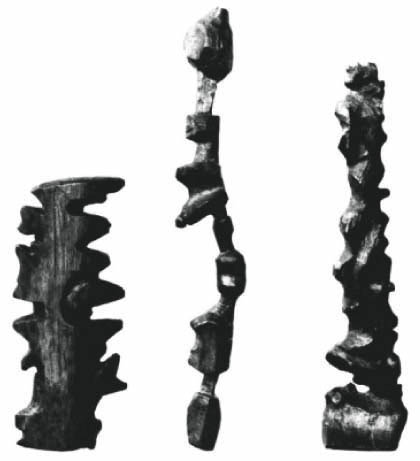
Two years ago, Colleen Morgan of Middle Savagery pointed out these amazing tactile maps of the Inuit, “3D wood carvings of the East Greenland coastline, with the details of inlets and islands in sculptural relief. These could be employed by [travelers] at night in conjunction with the stars, feeling your way along the coastline, navigating at an intimate scale.”

[Image: tactile maps of the Inuit: 3D representations of the Greenland coastline].

She compares these to Braille maps for the blind—which I would further compare to the embossing printer used by a blind architect in San Francisco to produce tactile building plans. “He began drawing with Wikki Stix,” the L.A. Times reported last month, “strands of wax-covered yarn that adhere to paper with just a little pressure. His most useful tool became a large-format embossing printer, which turns blueprints into raised line drawings that he can read with his fingertips.”

As if using the Inuit maps pictured above, he simply runs his fingers along the creased lines of rooms and hallways, and buildings take shape in their every variation around him.

Briefly diverging here, I was fascinated to read elsewhere in that same article about the subtle architectural design cues that can be deployed for the blind or visually impaired. For instance, the architect once “collaborated on a room-numbering system to help blind students navigate the building. The facility will use different textured flooring in a few key areas so students can tell where they are by the tap of a cane.” Further, “blind students who descend a staircase that deposits them in the middle of a vast lobby will be able to find their way because the ceiling will be enhanced, at [the architect’s] suggestion, to create an acoustic corridor to the door.” Designing “acoustic corridors” across the city sounds like a superb design challenge (as well as something that could be of much wider use in the event of prolonged urban blackouts).

In any case, like Middle Savagery, I am fascinated by the other applications these sorts of handheld, tactile maps might have—where else they might be useful and what other spaces they might be able to represent. Could there be a tactile map of a novel’s plotline, or or the New York City subway system, or of the Appalachian Trail? What about of your own apartment, or the house you grew up in? Could there be tactile cinema? Could you make a tactile map of a song?

(Spotted via an old post on Tightgrid).

Where does your taco come from?

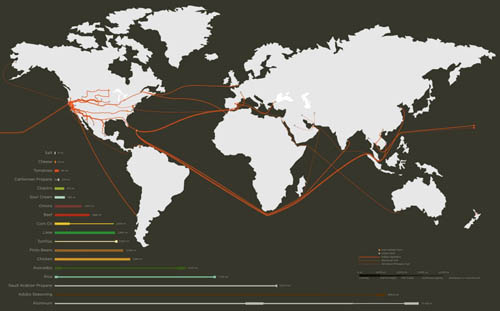
Like a culinary version of Sourcemap, Rebar has teamed up with landscape architect David Fletcher and some students from the increasingly interesting California College of the Arts in San Francisco to explore the ingredients of your local taco—from pinto beans to the aluminum foil it all comes wrapped in.

Our premise was that a seemingly simple, familiar food like the taco truck taco could provide visceral insight into the connections between the systems we were exploring [in our studio’s investigation of the city]. By thoroughly learning the process of formation and lifecycle for what it takes to make a taco, we would be better able to propose and design a speculative model of a holistic and sustainable urban future. What resulted was a richly complex network of systems, flows and ecologies that we call the global Tacoshed.

This is a participatory undertaking; meet at the Studio for Urban Projects in San Francisco at 7pm on Thursday, February 25, to find out how you, too, can map a taco. Here’s a map.

The Studio for Urban Projects, meanwhile, has a pretty fascinating list of previous endeavors, including Foodshed, Strange Weather, and the awesome Unnatural History of Golden Gate Park. Large parts of what are now west San Francisco were once covered by nomadic sand dunes, a kind of peninsular erg; that granular presence is now only temporarily locked in place beneath the foundations of houses. Every grain you see blowing down a San Franciscan street is this lost geography attempting to reassert itself.

[Image: “There are two basic types of taco trucks,” we read; “the first and most common is the transient truck which is a truck that stops at approximately 20 different locations at 20-minute intervals during an 8-hour shift, typically beginning at 6am and ending at 2pm. The second type is the semi-permanent truck, which is a truck that has found a location that has a density of clientele to sustain it for an extended period of the day, creating a nearly fixed presence in a particular community.” From Polar Inertia].

And I can’t let this post end without calling attention to the excellent—in fact, extraordinary—Polar Inertia, specifically its photo-essay published more than four years ago tracing the taco-truck geography of greater Los Angeles. These dispersed infrastructures might now be quite trendy, but the functional networks things like taco trucks actually form on the streets of our cities are still worth mapping in full.

Vs.

1) Constructed Territory: “A juried exhibition of work integrating the use of maps, cartography, or environmental and topographical explorations.” Submissions due: May 14, 2010.

2) made up: “This call welcomes designers, filmmakers, architects, scholars, researchers, and artists to submit proposals for design-driven research projects to be conducted in Summer 2010 in the Graduate Media Design Program studio [at the Art Center College of Design in sunny Pasadena]. We are looking for projects that are motivated by research questions and that use design/making as a mode of inquiry. We are particularly interested in projects that address the theme ‘made up’ which explores the role of fiction in design.” Submissions due: March 23, 2010.

[Image: From Mine the Gap].

3) Mine the Gap: “An international design ideas competition dedicated to examining one of the most visible scars left after the collapse of the real estate market in Chicago: the massive hole along the Lake Michigan shore that was to have been—and may yet be—the foundation for a singular 150-story condominium tower designed by an internationally-renowned Spanish architect, a tower which was to have become a new icon for the city and region. What to do with the gap?” Submissions due: “anytime between March 22, 2010 and May 3, 2010.”

4) All That Glitters Is Good: “How do you prepare your architectural drawings? What mediums do you allow yourself in your quest to explain three dimensional intent and ideas on a two dimensional surface? Answer truthfully, when was the last time you did anything beyond hitting print?

All That Glitters Is Good asks you to submit your most accomplished architectural representation that uses glitter. This includes new drawings made with glitter, old drawings pepped up with a little sparkle, as well as anything else that you can imagine so long as it satisfies two criteria:

1. It’s a drawing of architecture.
2. It uses glitter.”

Submissions due: March 15, 2010.

5) You just missed: GOOD magazine, Studio-X, and PRE Office teamed up to judge Spontaneous Architecture—the results of which can be seen at that latter link. For some background to that call-for-ideas, read Studio-X’s Gavin Browning debate with Cameron Sinclair about the efficacy of design competitions inspired by natural disasters over at Building Design. While you’re there, refresh your memory about Building Design‘s stance on climate change.

(Constructed Territory spotted via Katie Holten; made up spotted via Anne Burdick).

Expedition to the Geoglyphs of Nowhere


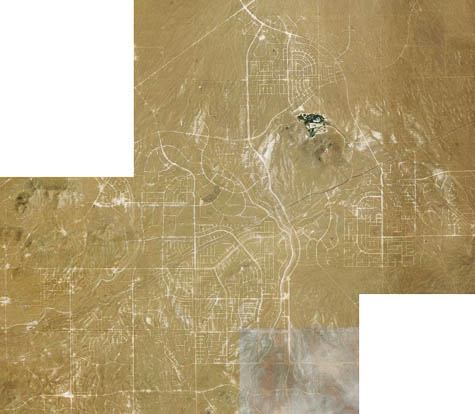
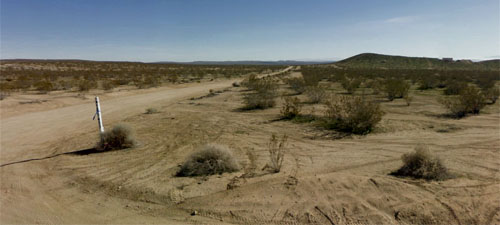
BLDGBLOG and Atlas Obscura have teamed up to lead an outing into the deserts of southern California on Saturday, March 20: an afternoon-long photographic expedition through the dusty grids of unpaved streets on the northeastern fringe of California City.


To quote from an earlier post here on BLDGBLOG:

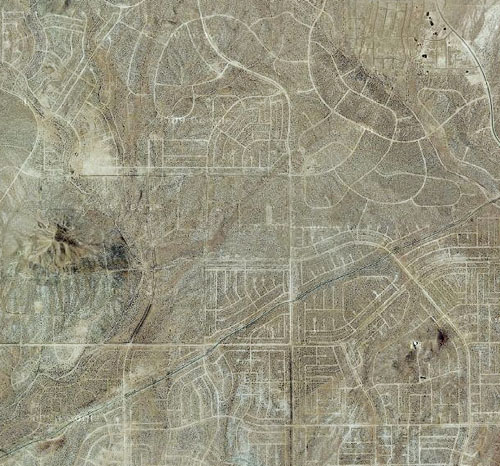
In the desert 100 miles northeast of Los Angeles is a suburb abandoned in advance of itself—the unfinished extension of a place called California City. Visible from above now are a series of badly paved streets carved into the dust and gravel, like some peculiarly American response to the Nazca Lines (or even the labyrinth at Chartres cathedral). Bill & Ted meet Cerne Abbas Man.

The uninhabited street plan has become an abstract geoglyph—unintentional land art visible from airplanes—not a thriving community at all.


Take a look.

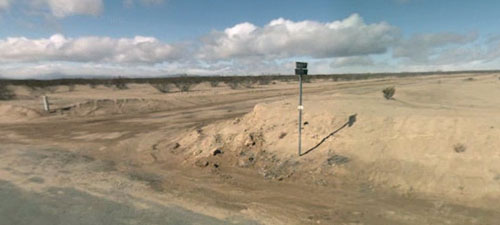
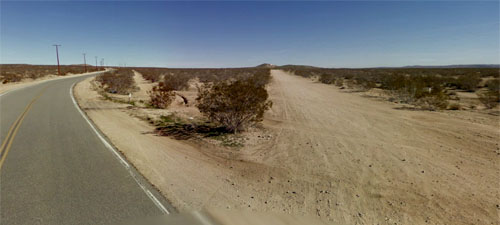
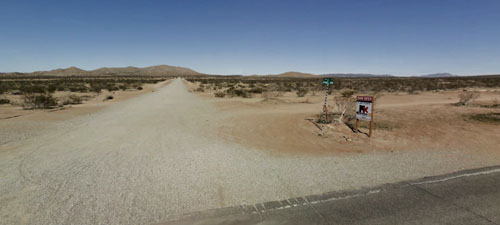
On Google Street View, distant structures like McMansions can be made out here and there amidst the ghost-grid, mirages of suburbia in the middle of nowhere. Meaningless STOP signs stand guard over dead intersections.


And it’s a weird geography: two of the most prominent nearby landmarks include a prison and an automobile test-driving facility run by Honda. There is also a visually spectacular boron mine to the southeast—it’s the largest open-pit mine in California, according to the Center for Land Use Interpretation—and an Air Force base.


To make things more surreal, in an attempt to boost its economic fortunes, California City hired actor Erik Estrada, of CHiPs fame, to act as the town’s media spokesperson.

The history of the town itself is of a failed Californian utopia—in fact, incredibly, if completed, it was intended to rival Los Angeles. From the city’s Wikipedia entry:

California City had its origins in 1958 when real estate developer and sociology professor Nat Mendelsohn purchased 80,000 acres (320 km2) of Mojave Desert land with the aim of master-planning California’s next great city. He designed his model city, which he hoped would one day rival Los Angeles in size, around a Central Park with a 26-acre (11 ha) artificial lake. Growth did not happen anywhere close to what he expected. To this day a vast grid of crumbling paved roads, scarring vast stretches of the Mojave desert, intended to lay out residential blocks, extends well beyond the developed area of the city. A single look at satellite photos shows the extent of the scarred desert and how it stakes its claim to being California’s 3rd largest geographic city, 34th largest in the US. California City was incorporated in 1965.

California City is now the site of a proposed mega-farm for solar energy harvesting, as well as for a bizarre plan to build the so-called Cannabis City of the Future.

Sign up to join us over at the Obscura Day site.


Note, however, that this is not a guided tour; it is simply an organized simultaneity of people all going out to investigate these streets en masse. Armed with cameras, microphones, sketchbooks, GPS devices, quickly scrawled notes for future blog posts, and more, we’ll be exploring the site at our own pace, perhaps even miles apart at various times. This is not a guided tour with an expert on the area.

As such, all questions of transportation (including tires suitable for travel over unsealed dirt roads); adequate food, fuel, and water; personal safety (including protection from sprained ankles and snakes); and navigation are up to individual participants.

We will meet at 1pm on Saturday, March 20, 2010, in the parking lot of Rite Aid in California City: 9482 California City Boulevard, California City, CA 93505. There will be a very brief group introduction there—and you can run inside to buy Cokes or whatever—before we set off to document the uninhabited streets outside town. Let’s photograph, film, blog, Lomo, Twitter, and audio-record the crap out of this place! I’ve started a Flickr group, which will be opened up soon. If you arrive late, simply head out Randsburg Mojave Road, onto 20 Mule Team Parkway, and look for the cars; our eventual cluster of destinations is approximately 15 minutes’ drive northeast of town.

And, in the unlikely event of torrential rains, I will post travel updates here on BLDGBLOG.


Meanwhile, the incomparable Atlas Obscura has a whole slew of amazing trips planned for March 20, all over the world, all part of their first annual “Obscura Day.” Definitely check out that list for sites closer to you, if you’re not in southern California.

(California City was originally pointed out to me by David Donald, and it was written up by The Vigorous North last year. The “cannabis city” and solar farm links come courtesy of Alexis Madrigal. All images in this post via Google Maps and Google Street View).