Live in a high-rise? Consider having your heart attack elsewhere: a study in the Canadian Medical Association Journal looks at “the relation between floor of patient contact and survival after cardiac arrest in residential buildings.” Their take-away was almost Onion-like in its obviousness: “the survival rate after out-of-hospital cardiac arrest was lower for patients residing on higher floors.” It literally took too long for help to arrive. Yet the authors also suggest devising “interventions aimed at shortening response times to treatment of cardiac arrest in high-rise buildings,” as this “may increase survival”—which sounds like an interesting design challenge.
Category: BLDGBLOG
The Sky Roads of Kauttua
 [Image: A 17th-century engraving by Abraham Bosse, scanned from the excellent Architectural Representation and the Perspective Hinge by Alberto Pérez-Gómez and Louise Pelletier].
Thanks to airborne ice crystals reflecting street lights into the sky—an effect known as light pillars—the small Finnish village of Kauttua was greeted with an astral image of itself, as seen in a photo that made the rounds earlier this week. The town’s night-lit streets and buildings became uncanny constellations: the village as self-reflecting planetarium.
“How is that possible?” asks a helpful blog post by Fiona MacDonald. “When the temperature gets close to freezing,” she writes, “flat, hexagonal ice crystals can form in the air—not just up high, but also close to the ground. When this happens, these crystals essentially form a collective, giant mirror that can reflect a light source—such as a streetlight—back to the ground.” They are like ladders of light, or perhaps optical arrow chains, pulling images of our world up to space.
While the effect is already amazing, it’s worth noting that Kauttua is also the site of an ongoing search for an Iron Age village buried beneath the existing streets and property lines.
“The oldest archive source, a cadastral map from the year 1696, presents a homestead of 10 houses by the bridge leading across Eurajoki River,” we read over at Day of Archaeology. “A later cadastral map from 1790 presents large holdings of one farm at the same site and around it.” Today, however, there is little more than one surviving building, “an area of black soil” next to it, and “two light lines, presumably the earlier roads,” revealed in aerial photographs taken in 2008.
While there is obviously no connection between a lost Iron Age village and the ghostly street map that appeared in the sky over Kauttua last week, there is nonetheless something quite striking about the idea of a small village in the far north poised between two versions of itself: an underground web of old buildings and streets, now turned to black soil beneath the wheat fields, and this perfect, far more ethereal version, hovering there in a crystallography of light.
It’s almost as if a strange and other-worldly calendar exists, where, every summer, the town turns downward, scraping through soil and rock to uncover what it used to be, and then, each winter, it turns its eyes to the skies to see an inverted cartography, like some municipal zodiac, of its thriving streets.
(Thanks to Finnish novelist Hannu Rajaniemi, who first pointed this out to me on Twitter. “In Finland,” he wrote, “we make city maps in the sky out of light and snow crystals.”)
Rings
In the forests of northern Ontario, a “strange phenomenon” of large natural rings occurs, where thousands of circles, as large as two kilometers in diameter, appear in the remote landscape.
 [Image: From the thesis “Geochemistry of Forest Rings in Northern Ontario: Identification of Ring Edge Processes in Peat and Soil” (PDF) by Kerstin M. Brauneder, University of Ottawa].
“From the air, these mysterious light-coloured rings of stunted tree growth are clearly visible,” the CBC explained back in 2008, “but on the ground, you could walk right through them without noticing them.”
Since they were discovered on aerial photos about 50 years ago, the rings have baffled biologists, geologists and foresters… Astronomers suggest the rings might be the result of meteor strikes. Prospectors wonder whether the formations signal diamond-bearing kimberlites, a type of igneous rock.
While it’s easy to get carried away with visions of supernatural tree rings growing of their own accord in the boreal forest, this is actually an example of where the likely scientific explanation is significantly more interesting than something explicitly otherworldly.
 [Image: From the thesis “Geochemistry of Forest Rings in Northern Ontario: Identification of Ring Edge Processes in Peat and Soil” (PDF) by Kerstin M. Brander, University of Ottawa].
As geochemist Stew Hamilton suggested in 1998, the rings are most likely to be surface features caused by “reduced chimneys,” or “big centres of negative charge that frequently occur over metal deposits,” where a forest ring is simply “a special case of a reduced chimney.”
Reduced chimneys, meanwhile, are “giant electrochemical cells” in the ground that, as seen through the example of forest rings, can affect the way vegetation grows there.
 [Image: Screen-grab from Google Maps].
One of many things worth highlighting here is this suggestion that the trees are being influenced from below by ambient electrochemical processes in the soil, set into motion by the region’s deep geology:
Hamilton was testing an analytical technique over a Matheson gold deposit to determine if there was any kind of geochemical surface signal. To his surprise, there were signals coming through 30 to 40 metres of glacial clay.
“We’re thinking there’s no way metals can move through clay 10,000 years after glaciation.”
After ruling out transport by ground water, diffusion and gas, he theorized it had to have been lifted to surface on electrical fields.
He applied the same theory to forest rings and discovered that they were also giant negatively charged cells.
Any source of negative charge will create a forest ring.
In landscape architecture terms, a forest ring—which Hamilton describes [PDF] as “a plant assemblage that is different from the surrounding forest making the features visible from the air”—could be seen as a kind of indirect electrochemical garden taking on a recognizably geometrical form without human intervention.
In effect, their shape is expressed from below. For ambitious future landscape designers, note that this implies a potential use of plantlife as a means for revealing naturally occurring electrical networks in the ground, where soil batteries and other forms of terrestrial electronics could articulate themselves through botanical side-effects.
That is, plant a forest; come back after twenty years; discover vast rings of negative electrochemical charge like smoke rings pushing upward from inside the earth.
Or, of course, you could reverse this: design for future landscape-architectural effects by formatting the deep soil of a given site, thus catalyzing subterranean electrochemical activity that, years if not generations later, would begin to have aesthetic effects.
 [Image: From the paper “Spontaneous potential and redox responses over a forest ring” (PDF) by Stewart M. Hamilton and Keiko H. Hattori].
But it gets weirder: as Hamilton’s fieldwork also revealed, there is a measurable “bulge in the water table that occurs over the entire length of the forest ring with a profound dip on the ring’s outer edge.” For Hamilton, this effect was “beyond science fiction,” he remarked to the trade journal Northern Ontario Business, “it’s unbelievable.”
What this means, he explained, is that “the water is being held up against gravity” by naturally occurring electrical fields.
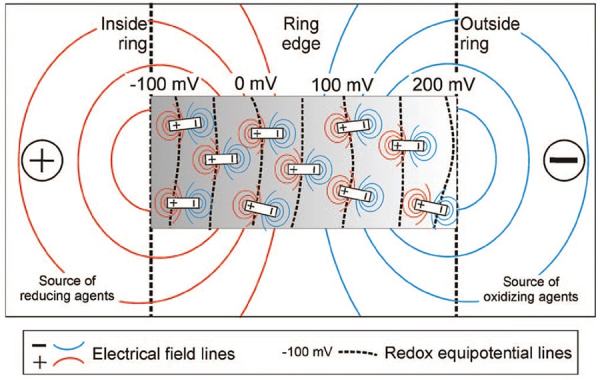 [Image: From the paper “Spontaneous potential and redox responses over a forest ring” (PDF) by Stewart M. Hamilton and Keiko H. Hattori].
Subsequent and still-ongoing research by other geologists and geochemists has shown that forest rings are also marked by the elevated presence of methane (which explains the “stunted tree growth”), caused by natural gas leaking up from geological structures beneath the forest.
Hamilton himself wrote, in a short report for the Ontario Geological Survey [PDF], that forest ring formation “may be due to upward methane seepage along geological structures from deeper sources,” and that this “may indicate deeper sources of natural gas in the James Bay Lowlands.”
Other hypotheses suggest that these forest rings could instead be surface indicators of diamond pipes and coal deposits—meaning that, given access to an aerial view, you can, in effect, “read” the earth’s biosphere as a living tissue of signs or symptoms through which deeper, non-biological phenomena (coal, diamonds, metals) are revealed.
 [Image: Forest ring at N 49° 16′ 05″, W 83° 45′ 01″, via Google Maps].
Even better, these electrochemical effects stop on a macro-scale where the subsurface geology changes; as Hamilton points out [PDF], the “eastward disappearance of rings in Quebec occurs at the north-south Haricanna Moraine, which coincides with a sudden drop in the carbonate content of soils.”
If you recall that there were once naturally-occurring nuclear reactors burning away in the rocks below Gabon, then the implication here would be that large-scale geological formations, given the right slurry of carbonates, metals, and clays, can also form naturally-occurring super-batteries during particular phases of their existence.
To put this another way, through an accident of geology, what we refer to as “ground” in northern Ontario could actually be thought of a vast circuitboard of electrochemically active geological deposits, where an ambient negative charge in the soil has given rise to geometric shapes in the forest.
 [Image: Forest rings at N 49° 29′ 48″, W 80° 05′ 40″, via Google Maps].
In any case, there is something incredible about the idea that you could be hiking through the forests of northern Ontario without ever knowing you’re surrounded by huge, invisible, negatively charged megastructures exhibiting geometric effects on the plantlife all around you.
Several years ago, I wrote a post about the future of the “sacred grove” for the Canadian Centre for Architecture, based on a paper called “The sacred groves of ancient Greece” by art historian Patrick Bowe. I mention this because it’s interesting to consider the forest rings of northern Ontario in the larger interpretive context of Bowe’s paper, not because there is any historical or empirical connection between the two, of course; but, rather, for the speculative value of questioning whether these types of anomalous forest-effects could, under certain cultural circumstances, carry symbolic weight. If they could, that is, become “sacred groves.”
Indeed, it is both thrilling and strange to imagine some future cult of electrical activity whose spaces of worship and gathering are remote boreal rings, circular phenomena in the far north where water moves against gravity and chemical reactions crackle outward through the soil, forcing forests to take symmetrical forms only visible from high above.
For more on forest rings, check out the CBC or Northern Ontario Business or check out any of the PDFs linked in this post.
The Politics of Land Use
USC geographer Travis Longcore on the Malheur National Wildlife Refuge occupation: “When the occupiers blithely talk of putting the land ‘to use’ again (as if scientific research, recreation, hunting, fishing, education, and all manner of public access were not ‘use’), the CNN reporter mindlessly repeats the trope, implying that the occupiers have a legitimate demand in wanting to work the land, as if it were some sort of de Tocquevillian tragedy that one of the most productive migratory bird stopover sites on the Pacific flyway was not being overrun with cattle by the ranchers from Utah. No, Malheur National Wildlife Refuge does not need to be worked, and CNN should have reporters that know better than to take the claim at face value.”
Sulphur Bricks and Super-Arches
 [Image: Mars architecture concept by ZA Architects, via The Verge].
Without water or traditional building materials, what will hypothetical Martian settlers use to build their future homes? Worry no more: materials scientists at Northwestern University have developed “Martian concrete” using sulphur, which is abundant on our neighboring planet.
The key material in a Martian construction boom will be sulphur, says the Northwestern team. The basic idea is to heat sulphur to about 240°C [464°F] so that it becomes liquid, mix it with Martian soil, which acts as an aggregate, and then let it cool. The sulphur solidifies, binding the aggregate and creating concrete. Voila—Martian concrete.
The resulting bricks are apparently quite strong and readily recyclable. As the MIT Technology Review points out, “Martian concrete can be recycled by heating it, so that the sulphur melts. So it can be re-used repeatedly. It is also fast-setting, relatively easy to handle and extremely cheap compared to materials brought from Earth.”
Briefly, it’s worth noting that sulphur-based brick mixes were previously explored at McGill University in Montréal by a team of environmentally minded designers, including architect Vikram Bhatt. As I got to learn from Bhatt himself during a summer at the Canadian Centre for Architecture back in 2010, that group sought to reuse waste sulfur as a building material.
One of the more interesting and, if I remember correctly, totally unexpected side-effects was the discovery that full-color images could be transferred to the bricks with a startling degree of verisimilitude, as the following two photos make clear.

 [Images: Photos by Geoff Manaugh, originally published here].
Of course, this feature is presumably rather low on the list of details future astronaut-architects will be hoping for as they build their first encampments on Mars.
More practically, one thing I’d love to learn more about would be the possibility of novel architectural structures constructed using sulfurous concrete in the lower-gravity environment of Mars. Would the planet’s weaker gravity augment an architect’s ability to construct ambitious spans and arches, for example, because the materials themselves would be substantially lighter? Or, conversely, would the planet’s gravitational strength already be accounted for by a reduced density of the material, negating gravity’s diminished pull?
Put another way, the idea of ultra-light sulphur-concrete vaults and arches covering distances and spans that would be terrestrially impossible is quite a beautiful thing to imagine—and, coupled with those image-transfer techniques seen by Bhatt and his team at McGill, could result in vast new galleries and chapels illustrated with Martian frescoes, a high-tech return to older representational techniques from art history.
New Digs

[Image: A “Lunar Rendezvous Simulator” (1962), courtesy NASA].
After much ado, including multiple near-moves and abandoned attempts, I have finally gone over to WordPress, with BLDGBLOG now residing here at bldgblog.com. Please update any bookmarks or links you might have to the site—but please also be sure to update your RSS feed:
https://bldgblog.com/feed/
You can also find individual tags and categories that you might like and subscribe specifically to them, as well—for example:
https://bldgblog.com/tag/a-burglars-guide-to-the-city/feed/
or
https://bldgblog.com/topics/los-angeles/feed/
Meanwhile, the new site offers a bunch of cool tools, such as a “Headlines” category that publishes only in the right-hand column—think of it as a kind of expanded Twitter feed for news items and quick links—as well as the ability to use marginal H6 tags for secondary asides and commentary.
Undoubtedly, there will be many details that still need fixing—that is, posts with no tags, missing links, or strange formatting—but I’ll get to those over the next few weeks.
Finally, I owe huge, huge thanks to Jim Webb for his help with CSS and coding; Jim absolutely knows his stuff and makes a fantastic teacher. Consider hiring him for any site needs of your own.
And don’t forget to update your RSS!
Mass Death Assemblage
An unlikely paleontological event occurs every year behind a Lowe’s superstore in suburban New Jersey: a “mass death assemblage” of dinosaur fossils is excavated bit by bit in an open event for the community. 66 million years old, the fossils might hold clues to the extinction of the dinosaurs.
Land of Fires
One of the most memorable scenes in Roberto Saviano’s book Gomorrah is his description of the illegal waste-dumping schemes of southern Italy’s Camorra organized crime syndicate. In a chapter called “Land of Fires,” Saviano conjures a Blakean landscape of rampant groundwater toxins, dispersed radioactivity, industrial sludges, paints, and slowly lethal atmospheres perfumed with hexavalent chromium. Unsurprisingly, a new report shows that cancer rates in the region have spiked, including “‘excessive’ instances of tumors, especially brain tumors.”
The Maunsell Hilton
A God-awful rendering has been released for a misguided plan to transform the amazing offshore megastructural war ruins of the Maunsell Towers into a luxury hotel.
Agrirobotics
The USDA has announced a grant-giving program “for robots to roam farmlands,” Modern Farmer reports. It’s called the “National Robotics Initiative,” and it’s “getting $3 million to give in grants to robotics programs around the country to create robot-led agricultural advances.”
London’s Secret Circuitry
I’ve got a new piece up over at The Daily Beast about London’s Hatton Garden heist—in a sense, a preview of many themes from my forthcoming book, A Burglar’s Guide to the City, including the idea that “the tools and techniques of breaking and entering are more often than not also those of architectural construction and maintenance.”