City Laid Out Like Lizard

[Image: View larger].

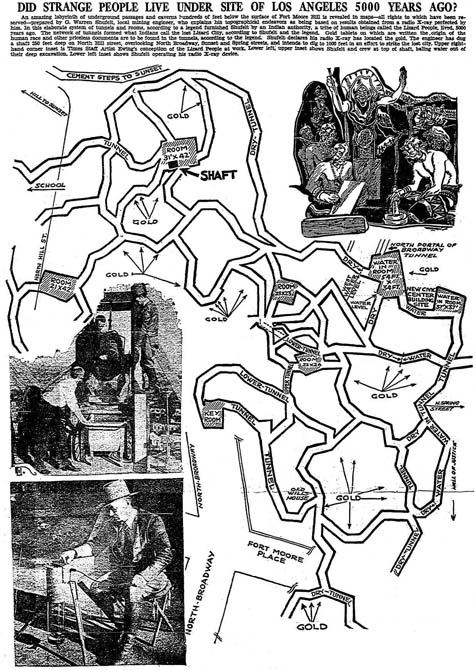
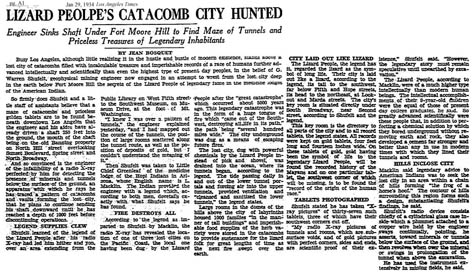
Last week, Josh Williams, formerly of Curbed LA, emailed with an amazing link to an article, reportedly published back in 1934 by the L.A. Times, about a race of “lizard people” who once lived beneath the city.

“Did strange people live under site of Los Angeles 5000 years ago?” the article asks, supplying a bizarre treasure map through the city’s undersides in the process.

[Image: View larger].

Although you can read the article in full through these links, I wanted to give you a taste of the story’s strange mix of gonzo archaeology, Poltergeist-like pre-Columbian cultural anxiety, and start-up geophysical investigation squad:

So firmly does [a “geophysical mining engineer” named G. Warren Shufelt] believe that a maze of catacombs and priceless golden tablets are to be found beneath downtown Los Angeles that the engineer and his aides have already driven a shaft 250 feet into the ground, the mouth of the shaft behind on the the old Banning property on North Hill Street overlooking Sunset Boulevard, Spring Street and North Broadway.
And so convinced is the engineer of the infallibility of a radio X-ray perfected by him for detecting the presence of minerals and tunnels below the surface of the ground, an apparatus with which he says he has traced a pattern of catacombs and vaults forming the lost city, that he plans to continue sending his shaft downward until he has reached a depth of 1000 feet before discontinuing operations.

The article goes on to suggest that this ancient subterranean city was “laid out like [a] lizard”; we visit a Hopi “medicine lodge,” wherein geophysical secrets are told; there are lost gold hoards; and, all along, the engineer’s “radio X-ray” apparatus continues to detect inhabitable voids beneath the metropolis.

“I knew I was over a pattern of tunnels,” Shufelt is quoted, “and I had mapped out the course of the tunnels, the position of large rooms scattered along the tunnel route, as well as the position of the deposits of gold, but I couldn’t understand the meaning of it.”

Perhaps this is what we’d get if Steven Spielberg hired Mike Mignola to write the next installment of Indiana Jones.

(Thanks to Josh Williams, and to vokoban, who originally uploaded the scan. Vaguely related: The Hollow Hills and Mysterious Chinese Tunnels).

The Edge

Amongst the huge stacks of reading material that I always seem to accumulate, even while traveling, I have just picked up a copy of Philip Parker’s new book The Empire Stops Here. In a nutshell, the book documents Parker’s epic tour around the former edge of the Roman empire, “visiting all its astonishing sites, from Hadrian’s Wall in the north of Britain to the desert cities of Palmyra and Leptis Magna,” the book jacket explains. We’re reminded that “the Empire guarded and maintained a frontier that stretched for 10,000 kilometres, from Carlisle to Cologne, from Augsburg to Antioch, and from Aswan to the Atlantic.” So why not explore the whole thing?

[Image: Hadrian’s Wall].

On page one Parker writes that “I have concentrated deliberately on the edge of the Roman world, on the lands that promised victory, booty and glory and yet so often left the bitter taste of compromise or defeat instead. Here, unique societies developed, distinct from that of the mother-city” – frontier micro-cultures amidst border country that, even today, remains populated with architectural and anthropological evidence of these long-ago evaporated Roman outposts. Outpost tourism, perhaps. Edge-traveling.

It would be a curious project, indeed, to try something similar for a nation-state today, when borders are often fluid and even exportable. In fact, I’m reminded of a plan to “take the UK border overseas,” as the Times reported last year, dematerializing the actual national border and replacing it with a series of offices and points of entry maintained far away in the country of origin. Right when you think you’ve found the perimeter of Britain, it’s relocated yet further away, pushed to an airfield or embassy two thousand miles in the distance.

How interesting would it be to set out to explore the edge of a country – only to be unable to find it? China Miéville meets Tlön by way of the UK Border Agency.

For now, Parker’s book only seems to be available in the UK – but I’ve got high hopes for it and plan to report back as I read further. You can listen to a brief interview with the author here.

Dissection of a Cathedral

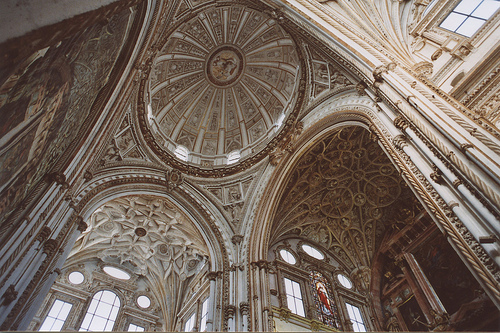
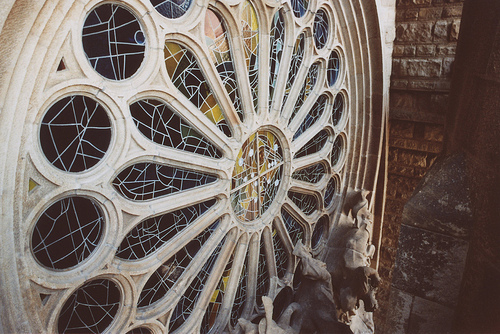
[Images: All photos by Danny Wills, from his recent photos of Barcelona; I’ll print a t-shirt: “Cathedrals are the shape that gravity makes when it takes on the form of a building”].

I couldn’t resist posting a few more fantastic photos by Danny Wills, this time of a cathedral in Barcelona.

(Earlier on BLDGBLOG: Doors, Thirds, Bridges, and Doors).

City of Fees and Services

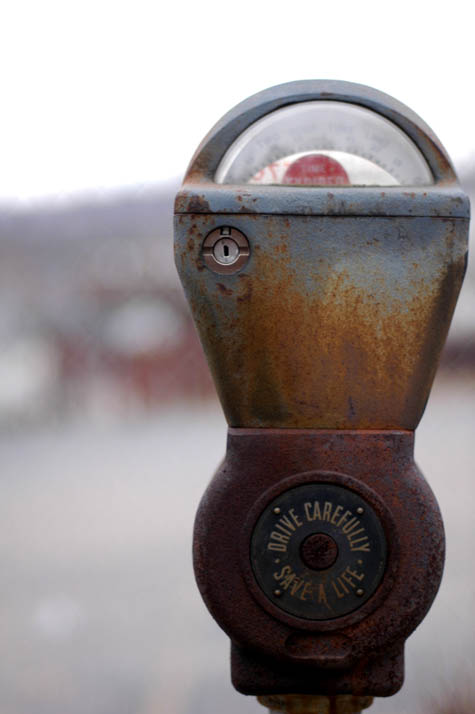
[Image: A parking meter photographed by shooting brooklyn, via a Creative Commons license].

A story I missed earlier this summer reports that Oakland, California, is making up for falling tax revenue by “aggressively enforcing traffic violations.”

The decision is driven by the city’s budget woes, which deep cuts to city services alone did not solve. Falling sales and property, property transfer and hotel taxes have contributed to a $51 million decline in revenues.

It’s worth asking, though, whether paying “aggressively” increased fees and fines for our everyday use of the city – whether this means road tolls and garbage collection fees or suddenly unaffordable parking meters – is the best financial model for a post-taxation metropolis.

Put another way, if the ongoing recession has revealed, amongst other things, that a new type of city, run along very different financial lines, looms just weeks away – a kind of make-your-own-omelette city of fines, fees, and services, where every ingredient is individually priced – then perhaps the recession might also stimulate a wider debate about what could be called method of payment.

That is, what method of payment do we wish to use when it comes to living in a functioning metropolis? If we find ourselves paying no tax at all, for instance – no income tax, no sales tax, no property tax – would we be happy to pay parking tickets that hit upper limits of, say, $2000 or more each time, if this is what it takes to keep the city running? Conversely, would we be happy to pay more sales tax in order to avoid things like road tolls altogether? How exactly do we mix and match these urban outlays and receipts?

This would seem to cut to some of the most basic questions of what services constitute a city in the first place: what a government might provide and how it is that we will pay for what it offers.

In a distant way, and by means of a long digression, I’m reminded of the oft-repeated idea that nationalized health care would be a mere “hand-out,” not a central platform of what any government might do to protect its citizenry.

For instance, one man at a recent but quite bizarre anti-health care rally – during which a U.S. senator apparently praised this very man for his publicly announced support of terrorism – said that “he could trace his ancestors back to the Mayflower and said ‘they did not arrive holding their hands out for help.'” Ergo, this man should not “hold out his hands for help” and ask the government for a doctor’s visit. Of course, this same argument would surely never be advanced against, say, calling the police, calling the fire department, or accepting the defense of the U.S. military. Yet these are all tax-funded government services.

The bizarre irony for me throughout all of this has been that police officers, fire crews, and members of the military are all, to use this language very deliberately, the most socialized subsector of the U.S. economy. That is, they are paid through what many people would call “government hand-outs.” On the other hand, it is these very social positions that are often held up – by these same critics – as triumphant examples of national service and personal heroism. Indeed, it is not entirely inaccurate to say that The Greatest Generation was a generation of near-total tax-funded employment.

If the recent health care debates are to be believed, doctors are not subject to this same sense of national appreciation; they are mysteriously yet fundamentally unlike the police, we are meant to believe, offering services that only private money can afford. But where is the line between private health (diabetes) and public safety (tuberculosis) – and when might this solidify into actual government infrastructure?

Doctors are not like the tax-funded fire departments who we freely call to save us from wildfires, this logic goes, and they are quite unlike the government-supported soldiers who we have stationed in Iraq, Afghanistan, and elsewhere. Surely, then, anyone who relies on the U.S. military to protect them is “holding their hands out for help”?

In this context, it’s worth speculating what might happen today if fire departments had, until now, been entirely privatized, motivated to protect you only if your insurance policy was up to date (as, indeed, was the case with the first urban fire departments, and as is now re-emerging in places like California). What would be the reaction, then, if someone proposed that these services be folded into a more general package of government services?

If fire crews, in this model, suddenly became tax-funded and available to all citizens – indeed socialized as part of a shared, city infrastructure – would there be the same level of outrage? One wonders if fire crews might ever attain the entirely deserved levels of public adulation they now receive, if their tax-funded nature was, once and for all, revealed. Protesting citizens, like the gentleman cited above, might never have the stomach to “ask for help” from the government, even if their houses are burning down around them.

In any case, I mention all this because of the urgency with which we need to rethink the world of urban services and the economic basis through which we pay for them. If the tax system, as it is currently operated, cannot pay for the very activities that we once thought synonymous with urbanity, are radical increases in one-off fees a permanent, economically viable solution to this problem or simply an irritating and only mildly effective band-aid? Is it better to pay more, once a year, in order to avoid such fees altogether?

Further, how are we best to judge the effectiveness of increased fines and pay-as-you-go services: by the psychological sense of irritation that a penalty-based system might cause – I’m reminded of parking attendants required to wear bulletproof vests during streetwork – or by the comfort that a lack of taxes might provide?

Or, more measurably, do we judge them by their physical effect on the city?

(Original article spotted via the denialism blog).
The Bioluminescent Metropolis

[Image: “Lightning Bugs in York, PA,” by tom.arthur, courtesy of a Creative Commons license].

While traveling last week, I managed to re-read W.G. Sebald’s book The Rings of Saturn.
At one point, Sebald describes two entrepreneurial scientists from the 19th century, who he names Herrington and Lightbown; together, we’re told, they had wanted to capture the bioluminescent properties of dead herring and use that as a means of artificially illuminating the nighttime streets of Victorian London.
Sebald writes:

An idiosyncrasy peculiar to the herring is that, when dead, it begins to glow; this property, which resembles phosphorescence and is yet altogether different, peaks a few days after death and then ebbs away as the fish decays. For a long time no one could account for this glowing of the lifeless herring, and indeed I believe that it still remains unexplained. Around 1870, when projects for the total illumination of our cities were everywhere afoot, two English scientists with the apt names of Herrington and Lightbown investigated the unusual phenomenon in the hope that the luminous substance exuded by dead herrings would lead to a formula for an organic source of light that had the capacity to regenerate itself. The failure of this eccentric undertaking, as I read some time ago in a history of artificial light, constituted no more than a negligible setback in the relentless conquest of darkness.

Sebald goes on to write, elsewhere in the book, that, “From the earliest times, human civilization has been no more than a strange luminescence growing more intense by the hour, of which no one can say when it will begin to wane and when it will fade away.”
But it’s the idea that we could use the bioluminescent properties of animals as a technique of urban illumination that absolutely fascinates me.
In fact, I’m instantly reminded of at least three things:

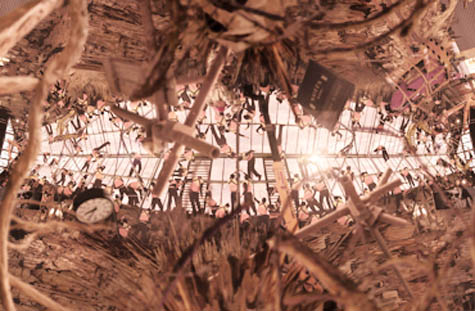
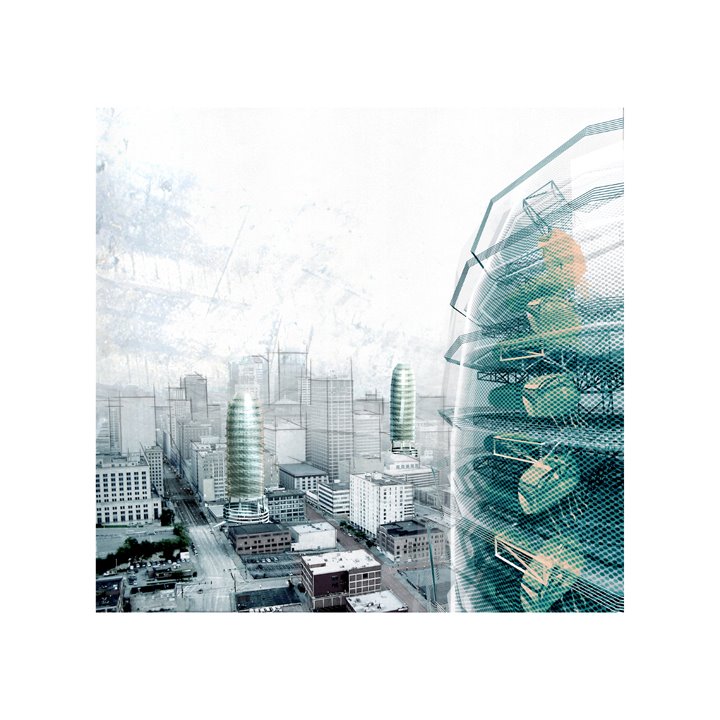
1) Last month I had the pleasure of stopping by the Architectural Association’s year-end exhibition of student work. As part of a recent studio taught by Liam Young and Kate Davies, a student named Octave Augustin Marie Perrault illustrated the idea of a “bioluminescent bacterial billboard.”
From the project text: “A bioluminescent bacterial billboard glows across the harbour… We are constantly reminded of the condition of the surrounding environment as the bio indicators becomes an expressive occupiable ecology.”

[Image: Bioluminescent billboards on one of the Galapagos Islands, by Octave Perrault].
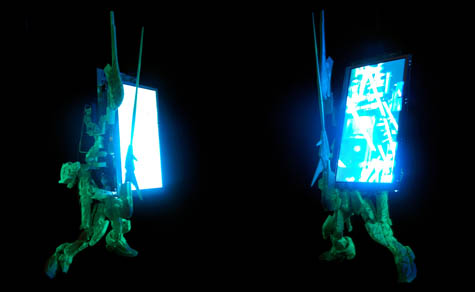
In many ways, Perrault’s billboards would be a bit like the River Glow project by The Living… only it would, in fact, be illuminated by the living. These bioluminescent bacteria would literally be a living window onto a site’s environmental conditions (or, of course, they could simply be used to display ads).
Liam Young, the studio’s instructor, has also designed a version of these bioluminescent displays, casting them more fantastically as little creatures that wander, squirrel-like, throughout the city. They pop up here and there, displaying information on organic screens of light.

[Image: Bioluminescent billboards by Liam Young].

I’m genuinely stunned, though, by the idea that you might someday walk into Times Square, or through Canary Wharf, and see stock prices ticking past on an LED screen… only to realize that it isn’t an LED screen at all, it is a collection of specially domesticated bioluminescent bacteria. They are switching on and off, displaying financial information.
Or you’re watching a film one night down at the cinema when you realize that there is no light coming through from the projector room behind you – because you are actually looking at bacteria, changing their colors, like living pixels, as they display the film for all to see.
Or: that’s not an iPod screen you’re watching, it’s a petri dish hooked up to YouTube.
This is what I imagine the world of screen displays might look like if Jonathan Ive had first studied microbiology, or if he were someday to team up with eXistenZ-era David Cronenberg and produce a series of home electronic devices.
Our screens are living organisms, we’ll someday say, and the images that we watch are their behavior.

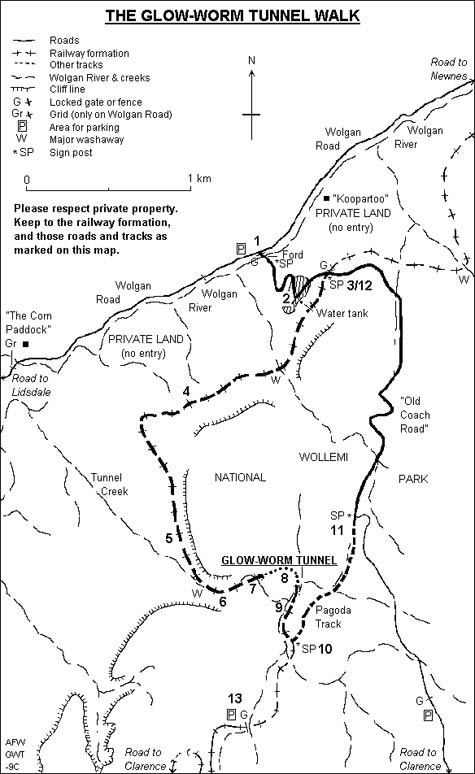
2) As I mentioned in an earlier post, down in the Blue Mountains of New South Wales is a tunnel called the Newnes Glow Worm Tunnel. It is a disused railway tunnel, bored through mountain sandstone 102 years ago, that has since become the home for a colony of glow worms.
As that latter link explains: “If you want to see the glow worms, turn off your torch, keep quiet and wait a few minutes. The larvae will gradually ‘turn on’ their bioluminescence and be visible as tiny spots of light on the damp walls of the tunnel.”

[Image: A map of the Glow Worm Tunnel Walk, New South Wales].

Incorporate this sort of thing into an architectural design, and it’s like something out of the work of Jeff VanderMeer – whose 2006 interview here is still definitely worth a read.
I’m picturing elaborate ballrooms lit from above by chandeliers – in which there are no lightbulbs, only countless tens of thousands of glow worms trapped inside faceted glass bowls, lighting up the faces of people slow-dancing below.
Or suburban houses surviving off-grid, because all of their electrical illumination needs are met by specially bred glow worms. Light factories!
Or, unbeknownst to a small town in rural California, those nearby hills are actually full of caves populated only by glow worms… and when a midsummer earthquake results in a series of cave-ins and sinkholes, they are amazed to see one night that the earth outside is glowing: little windows pierced by seismic activity into caverns of light below.

3) Several years ago in Philadelphia, my wife and I went out for a long evening walk, and we sat down on a bench in Washington Square Park – and everything around us was lit by an almost unbelievable density of fireflies, little spots of moving illumination passing by each other and overlapping over concrete paths, as they weaved in and out of aerial formations between the trees.
But what if a city, particularly well-populated with fireflies (so much more poetically known by their American nickname of lightning bugs) simply got rid of its public streetlights altogether, being so thoroughly drenched in a shining golden haze of insects that it didn’t need them anymore?
You don’t cultivate honeybees, you build vast lightning bug farms.
How absolutely extraordinary it would be to light your city using genetically-modified species of bioluminescent nocturnal birds, for instance, trained to nest at certain visually strategic points – a murmuration of bioluminescent starlings flies by your bedroom window, and your whole house fills with light – or to breed glowing moths, or to fill the city with new crops lit from within with chemical light. An agricultural lightsource takes root inside the city.
Using bioluminescent homing pigeons, you trace out paths in the air, like GPS drawing via Alfred Hitchcock’s The Birds.
An office lobby lit only by vast aquariums full of bioluminescent fish!
Bioluminescent organisms are the future of architectural ornament.

[Image: A bioluminescent tobacco plant, via Wikivisual].
On the other hand, I don’t want to strain for moments of poetry here, when this might actually be a practical idea.
After all, how might architects, landscape architects, and industrial designers incorporate bioluminescence into their work?
Perhaps there really will be a way to using glowing vines on the sides of buildings as a non-electrical means of urban illumination.
Perhaps glowing tides of bioluminescent algae really could be cultivated in the Thames – and you could win the Turner Prize for doing so. Kids would sit on the edges of bridges all night, as serpentine forms of living light snake by in the waters below.
Perhaps there really will be glowing birds nesting in the canopies of Central Park, sound asleep above the heads of passing joggers.
Perhaps the computer screen you’re reading this on really will someday be an organism, not much different from a rare tropical fish – a kind of living browser – that simply camouflages new images into existence.
Perhaps going off-grid will mean turning on the lifeforms around us.

Scuba Diving Beneath Hagia Sophia

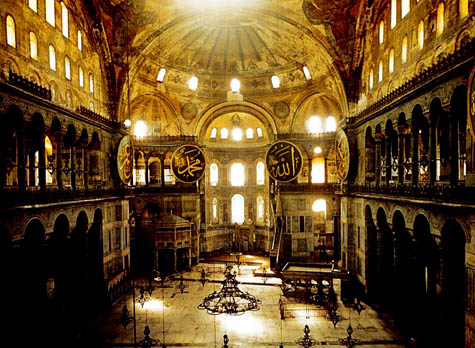
[Image: Inside Hagia Sophia; via].

While scuba diving beneath Hagia Sophia, an exploratory team led by filmmaker Goksel Gülensoy has “managed to reach areas that until now, no one had ever managed to reach,” down there in flooded basins 1000 feet beneath Istanbul’s heavily touristed religious structure.
In the process, they have discovered 800-year old submerged graves containing the remains of “canonized children.”
This was just part of a larger, underwater archaeo-spatial survey:

The divers and specialists explored the connection of the basins underneath Aghia Sophia with the aqueduct and the palace of Top Kapi. In addition they attempted to locate the secret tunnels from Tekfour Palace to the Islands.

Those “secret tunnels” are presumably the rumored subterranean extensions of the Anemas Dungeons – but who knows.
Either way, I have long been fascinated by the idea of scuba diving beneath – if not actually through – architectural structures, so I am definitely looking forward to watching Gülensoy’s forthcoming documentary about these discoveries. That film, appropriately enough entitled In the Depths of Hagia Sophia, will begin screening at film festivals this autumn.
“I believe what is beneath Hagia Sophia is much more exciting than what is above the surface,” Gülensoy explained to the Hürriyet Daily News and Economic Review. There, we read about the flooded basins in more detail:

Years ago, Erdem Yücer, one of the former directors of the museum, had shown Gülensoy a photograph that was taken of the foundations of Hagia Sophia. The photo showed researchers in a boat in a place filled with water, resembling the Yerebatan Cisterns. Seismic research had also demonstrated that the area underneath the big hall was empty. The team, which had previously lowered a camera down from the second door during the first exploration, was thrilled to see two passages extending to the center of the building and to the exit door – passages that might extend to Yerebatan and Topkapi.

For somewhat obvious reasons, I’m reminded of the “huge underground lake” discovered underneath Budapest late last year. “Budapest is built above a maze of unexplored underground caves,” The Sun reported at the time.
In any case, the Hürriyet article includes short descriptions of the actual tunnels beneath Hagia Sophia, and it mentions plans for these otherwise archaeologically unknown spaces to be scanned for later study. This latter detail reminds me of the Bill Stone video that I linked a few days back.

(With thanks to John Maas! Vaguely related: recreational fishing in the basements of Manhattan).

On Publishing Student Work

Having arrived back in London to another massive stack of books, magazines, and other architectural publications – including one-off broadsides, pamphlets, and even a deck of urban-themed playing cards – I’ve been immersed in a sea of mind-bending spatial ideas.
This morning, I’ve been specifically thinking about the publication of student work, as I’ve (finally) been able to read through a recently published catalog of the Bartlett School of Architecture‘s 2009 school year.

[Image: From Unit 23 at the Bartlett, taught by Bob Sheil and Emmanuel Vercruysse].

The book includes some amazing imagery and ideas – from a cantilevered “salt spa,” by Janinder Bhatti, partially held up on shadow-casting stilts, to a “sailing school” proposed for a trans-continental urban site on the Bosphorus by Nicholas Elias, by way of a “landfill tower” for Manhattan designed by Gabriel Chung.
There are two entirely separate designs for blood banks (one in Brooklyn by Stefano Passeri and one on the U.S./Mexico border by Victor Hadjikyriaki); there are the extraordinary-sounding “archaeological prosthetics for the Schliemann excavations of Troy” by Fei Meng; there is an ingenious pitch for a “South African Land Registry and Claims Court,” in the guise of exploring “political geology,” by Joshua Scott; there is a “dissolvable pavilion” by Snow Cai, a “Museum of Dust” by Olivia Pearson, and a “Roosevelt Island Respiratory Clinic” by Chiara Montgomerie, all from Unit 8, taught by Johan Berglund and Rhys Cannon; there is a “flower therapy institute” by Sandra Youkhana; and there is something that I am dying to know more about, called “Pioneering Weather” by Martin Tang. This latter project appears to be a kind of nuclear-powered sky-alteration device, complete with conical cooling towers and a wharf-like extension, perhaps implying its use for coastal weather generation.

[Image: Unidentified student work from Unit 15 at the Bartlett, taught by Nic Clear and Simon Kennedy].

However, I have to point out right away that the publication heavily over-prioritizes the instructors’ own studio descriptions, giving, in almost all cases, no descriptions (sometimes not even a title) for the student work. When I say, above, that Martin Tang’s project “appears to be” something, it is not because I didn’t read the caption or because I don’t want to repeat what Tang himself intended; it’s because there is no textual explanation of what these student projects actually are (and the images themselves are too small to help).
In other words, we’re given tantalizing imagery and the occasional project title – but that’s it. In fact, this seems to be a trend in year-end school publications, and I think it’s a bad one.
After all, when we see an extraordinary image for something called “Phileas Fogg’s Orchestral Landscape,” as designed by student Okan Kaleli, what exactly does this tell us? What is an “orchestral landscape,” for instance, and how does this relate to the writings of Jules Verne? I would genuinely like to know – and I have a feeling that Kaleli would like to tell us.
Or, when we stumble upon an eye-popping collage of architectural sections by student Nancy NiBhriain, what exactly are we looking at? What is the story or idea behind the image?
One more example: one of the most complex 3D-printed objects I’ve seen in years – like some sort of nautiloid architectural structure as devised by H.R. Giger after spending two decades lost in the geometric depths of the Alhambra – is captioned simply as a project by Yousef Al-Mehdari (but what is it? what’s the scale? did Al-Mehdari give it a title? or a story? is it meant for a certain site or purpose? is it a prototype? is it 3D-printed at all?). Readers like myself – and, I have to imagine, these students – are left frustratingly curious as to what it is that actually occurred inside that studio.
It is sadly the case that year-end school catalogs like these are the only times that many of these students’ work will ever be published, and so it would be nice – if not emotionally important – even to see short, 50-word descriptions of each project.
After all, these students have worked their asses off for years now, and they deserve the exposure.

[Image: From Unit 21 at the Bartlett, taught by Christine Hawley, A. Ashton, and A. Porter].

Commendably, the instructors of 2009’s Unit 14 – Stephen Gage, Phil Ayres, and Richard Roberts – do exactly this, including short descriptions of each image; and, as a reader, I hugely appreciate it.
For instance, we read: “Max Pringle, Wearable Buildings: Max is following a long standing interest in the boundaries between architecture, furniture design and fashion. This project is part of a ‘collection’ that proposes a wearable table cloth that is shared between two people.” Or this: “Sam McElhinney, Switchable Labyrinths: Sam develops a maze by switching between monocursal labyrinth forms. This is investigated digitally through the creation of intelligent maze forms populated by intelligent agents and then at 1:1 [scale] as an interactive maze.”
That’s it – but at least now I know what Pringle’s and McElhinney’s projects actually were, and I’m even given a glimpse into a whole suite of other possible ideas – all in less than 40 words. Less than 40 words. As a writer, it feels absurd to be asking that these students be given 40 words’ worth of attention, but it’s absolutely better than nothing. It’s better for the students, better for the readers, and, I’d assume, also better for the school.
Put another (and much more cynical) way: when every architecture student in the world today is busy producing vast, triangulated web-structures that sort of sprawl all over the city, for no immediately obvious reason, it is often the idea behind the project (and not, in fact, the rendered visual quality of your bio-, phylo-, viro-, rhizo-, this, that, and the other thing) that will make or break the project in final reviews.
Of course, this raises another question, which is: why on earth is everyone currently engaged in architecture producing viral triangular web-nets? But I think that’s a conversation for another day.
Finally, an expansion of focus on student content like this will almost undoubtedly require more pages in future editions of these catalogs, but I would also urge these publications to step away from heavy, coated paper toward thinner stocks that allow for longer books while hitting the same price-point and actually, in the end, being easier (that is, lighter) to carry.
The students would, presumably, appreciate the extra attention – and readers like myself would love to learn more about what they’ve made. For my own part, I know that, five years ago, it was year-end reviews of student projects, published by Cornell and the AA, that really got me interested in the narrative possibilities of architectural design – and it’s a shame to see this aspect of spatial education played down today.

Architecture is always a way of envisioning our world transformed into something else

Omnivoracious, the Amazon.com editors’ blog, has just posted a relatively long interview with BLDGBLOG about The BLDGBLOG Book – and I think it turned out really well, in fact. If you’re new to BLDGBLOG, or if you simply want to know more about the motivation behind this site or The BLDGBLOG Book, then it might be worth checking it out.
From Franz Kafka to prison break films, haunted house novels to the effects of weathering on high-tech materials, Norse myths to Los Angeles traffic jams, artificial glaciers to the overlooked spatial opinions of private parking attendants, the interview really seems to run the list of things I’ve been trying to focus on here.
A brief excerpt:

For instance, what do janitors or security guards or novelists or even housewives – let alone prison guards or elevator-repair personnel – think about the buildings around them? What do suburban teenagers think about contemporary home design, when their own bedrooms are right next door to their parents – or what do teenagers think about urban planning, when they have to drive an hour each way to get to school? These sorts of apparently trivial experiences of the built environment are often far more important to hear about than simply learning – yet again – how a certain architect fits him- or herself into a self-chosen design lineage.

So perhaps we should stop talking to Frank Gehry and start interviewing valet parkers in Los Angeles – or crime novelists, or SWAT team captains. They all have an opinion about the built environment, and about the way that cities function, but no one tends to ask them what those opinion might be.

If you get a chance, check it out – and if you haven’t picked up a copy of The BLDGBLOG Book yet, definitely consider ordering one soon. And thanks!

Future Pastoral

Earlier this week I stumbled across a series of genuinely beautiful architectural prints by Nathan Freise. These were first exhibited back in July 2008 at New York’s School of Visual Arts, and it would have been a real treat to see them in person.

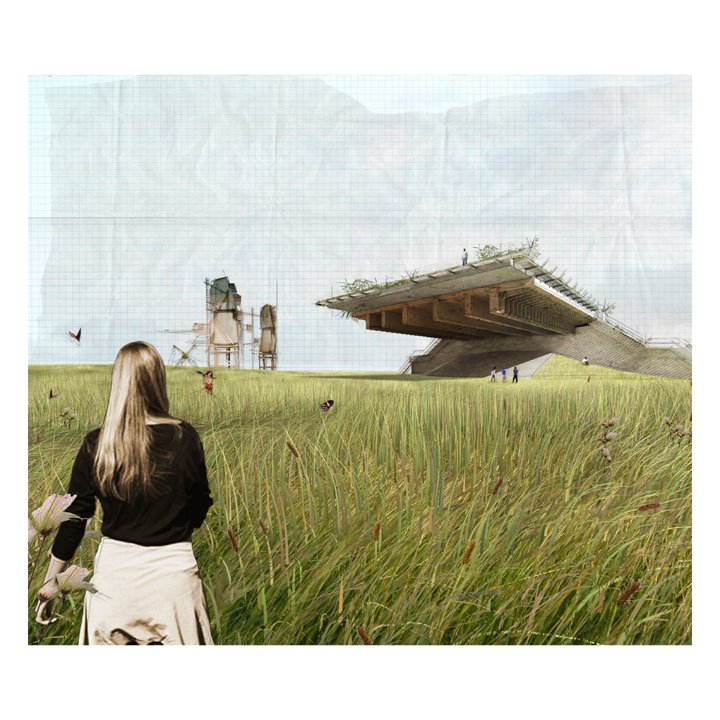
[Image: “The Garden of Machines” by Nathan Freise, from his extraordinarily well-produced Unseen Realities series; perhaps it’s Andrew Wyeth meeting the U.S. interstate highway system in a world art-directed by Guillermo del Toro].

Nathan, of course, is the brother of Adam, and the two of them together – as the Freise Brothers – also directed a short film called The Machine Stops, whose website is also worth a visit if you get the opportunity.

[Image: “The Garden of Machines (Dwell)” by Nathan Freise, from Unseen Realities; this one brings to mind some 22nd-century Charles Darwin watching the machine-birds of tomorrow’s eco-motorways, where billboards become breeding grounds for species we’ve never seen before].
The specific images here are described as follows:

Freise’s series of inkjet prints depict experimental architecture projects. His hybrid illustrations combine multiple forms of media – ink, graphite, photography and marker – with computer graphics. Freise’s representations of utopian worlds question our current conditions of suburban sprawl and urban master-planning.

They are absolutely worth checking out in their original, full size; click through to the Freise Brothers’ website and open them in their full, 1000-pixel glory.

[Image: “Transience (The Nomads)” by Nathan Freise, from Unseen Realities].

What I like so much about these is not just their technical quality but their combination of pastoral, near-Edenic landscapes with semi-unconstructed megastructures straight out of scifi. Technicolor screenprints of the architectural future!
A new Hudson River School arises, in which the flowering concrete foundations of incomprehensible buildings can be seen, scattered throughout the wild valleys, glinting with fragments of steel as the sun goes down.

[Images: “Transience (Decay and Renewal)” by Nathan Freise, from Unseen Realities].

In any case, hopefully someday someone will commission him to make more.

Excavatory Improv

[Image: From Sean Regan’s final project at Urban Islands 2009].
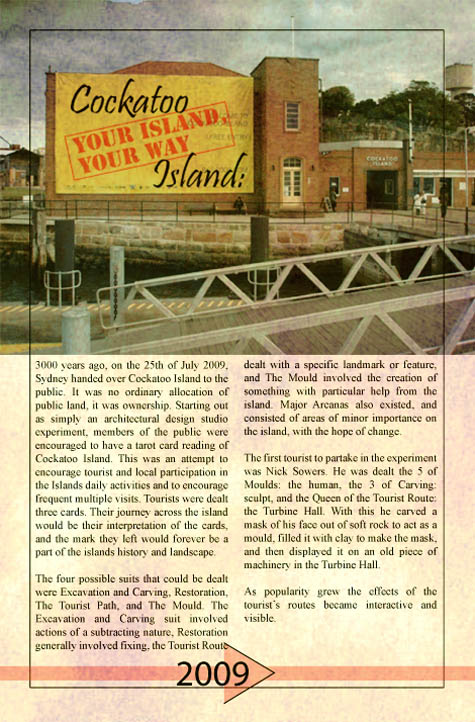
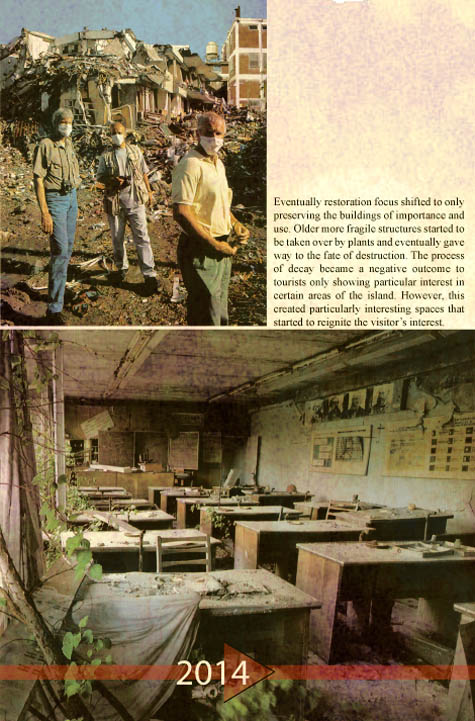
For his final project at Urban Islands – hosted the other week in Sydney and previously discussed here, here, here, here, and elsewhere – Sean Regan produced a heavily-illustrated fake article for a distant-future issue of National Geographic.

[Image: Image and text from Sean Regan’s final project at Urban Islands 2009].

Piecing together found imagery to create his own narrative exploration of Cockatoo Island, Sean addressed the following question: What would happen to the island if it was no longer historically preserved but deliberately, often violently, altered by the tourists who came to visit it?

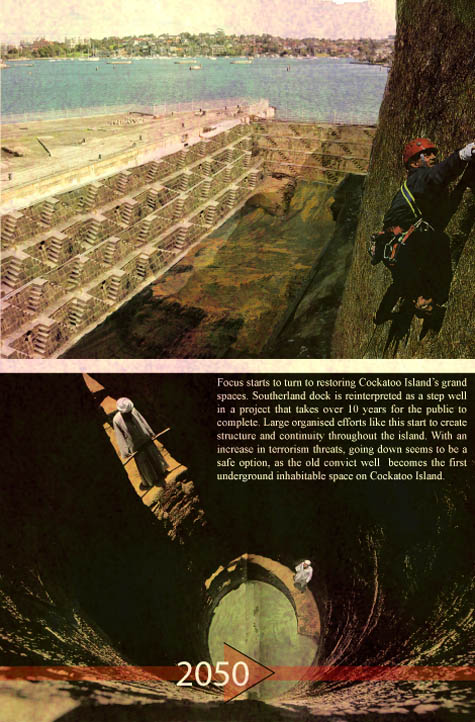
[Images: From Sean Regan’s final project at Urban Islands 2009].

That is, what if tourists were given a more or less complete freedom to carve, excavate, blast, construct, drill, tunnel, and alter their way across the island landscape?

[Images: From Sean Regan’s final project at Urban Islands 2009].
Because of the nature of the studio itself – which was based around the idea of random program generation through the design and distribution of Cockatoo Island-themed “Tarot” cards – this would take the specific form of tourists being handed a series of cards upon arrival at the island.
On these cards would be actions, sites, tools, materials, and so on that the visitors would be free to interpret – acting out their conclusions in physical form through often drastic and completely unregulated interventions into the structure of the island itself.

[Images: From Sean Regan’s final project at Urban Islands 2009].
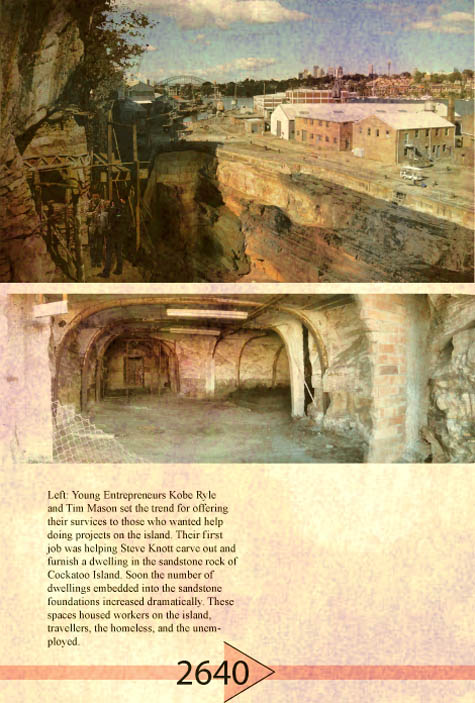
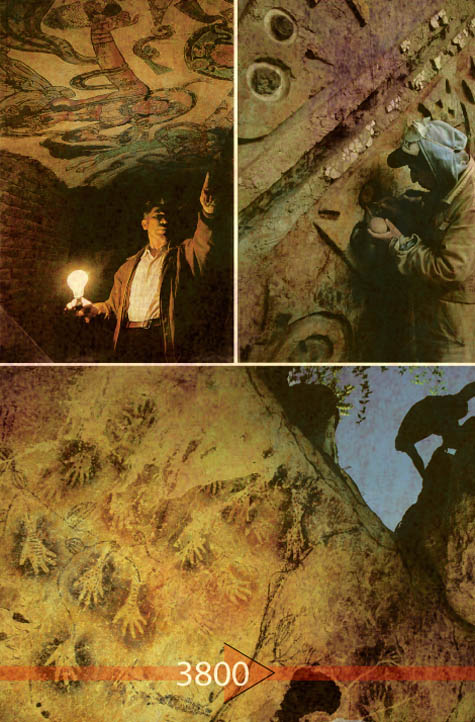
Over thousands of years, then, Cockatoo Island would be transformed through tourist excavations into an increasingly subterranean mazescape of new, improvised passageways – think of it as a kind of geotechnical free jazz, burrowing its way through new forms and structures of geology.
The walls themselves become gradually covered in post-aboriginal myths and cave paintings, and anthropologists from around the world come to Sydney to study the altered massing of Cockatoo.
It was pointed out in the final studio crit, as exhaustively documented by fellow participant Nick Sowers over on Archinect, that this sort of anything-goes approach to managing Cockatoo Island’s future is diametrically opposed to the strange and disappointing historical stasis in which the island is currently trapped.
The island needn’t be frozen in place, in other words, becoming a museum of its last role (an industrial shipbuilding yard); it could, in fact, be endlessly transformed, over decades, centuries, and even thousands of years, to become a palimpsestic reduction of eras, needs, and fleeting intentions.
After all, it was pointed out, that’s exactly what Cockatoo is already: a delirium of excavations. It is sliced through with tunnels. Its cliffsides are artificial. Its shorelines have been expanded. Its native species have been replaced.
But it’s as if Cockatoo’s preservationists have been saying, “We will celebrate this island… by transforming it into the very thing it is has never been: static.”
In this context, perhaps Sean’s project isn’t merely a speculative fantasy of permanent excavation – proposing a future state of geological amnesia in which constant, superficial erasure reacts mindlessly to the past – but a necessary demonstration of how historic preservation often fails to reveal the very essence of the sites it seeks to celebrate.

[Image: Cockatoo Island is now a warren of artificial caves extending for kilometers into the earth’s surface below. From Sean Regan’s final project at Urban Islands 2009].

In any case, the sandstone plateau of the island, the project suggests, will eventually be scraped away to levels far below the waves of Sydney Harbor, requiring the construction of massive ring dams to hold back the sea. The entire island is thus placed into a state of dry dock.
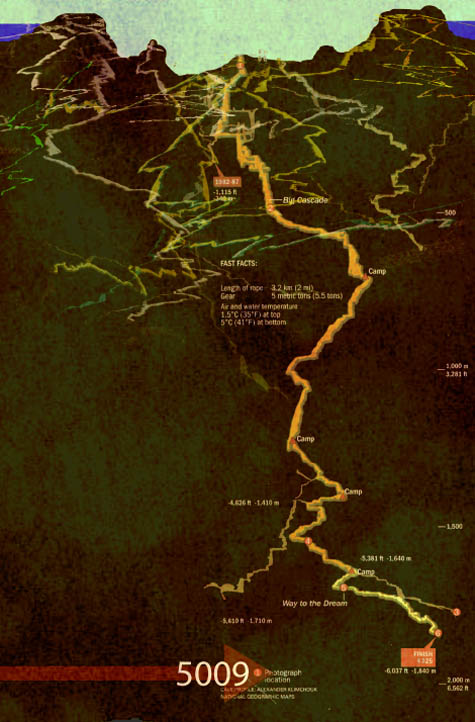
By the year A.D. 5009, Cockatoo is nothing more than an opening into the underworld, the island’s terrestrial presence having been replaced with the thousands of tunnels now spiraling away into the earth below.
Of course, the images that appear here have been deliberately aged to look as if they were found in an excavation several thousand years from now, but Sean’s collaging skills, disguised beneath those stains and discolorations, are extraordinary. It was a genuine pleasure to watch this project take shape over the second half of our two-week studio.