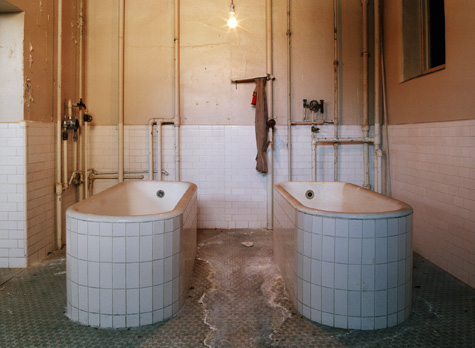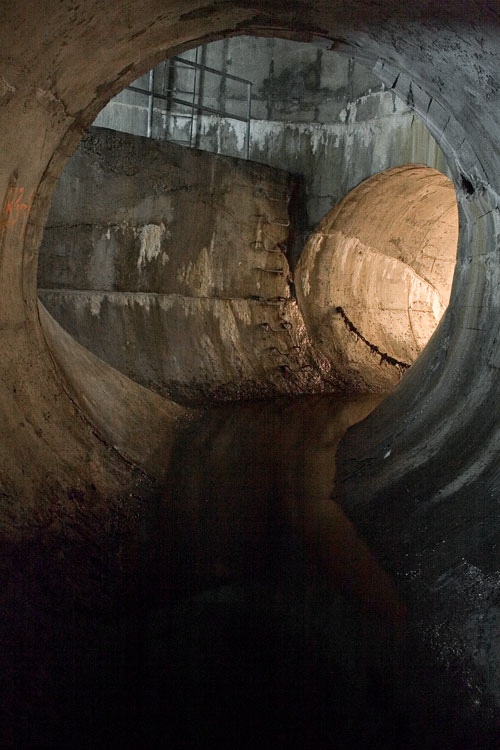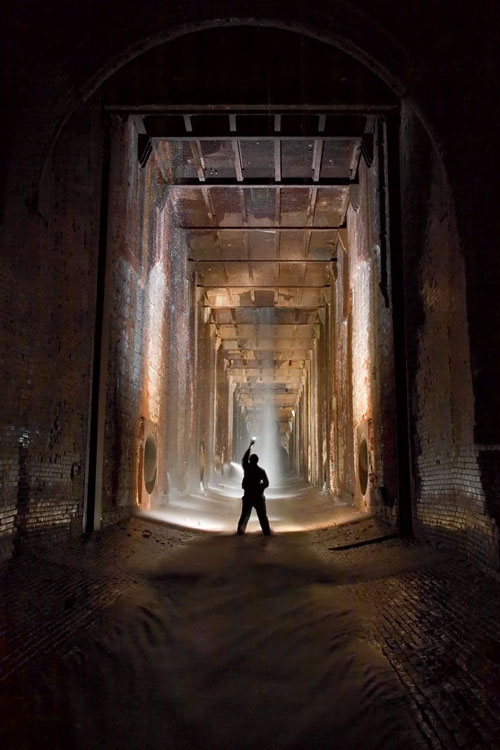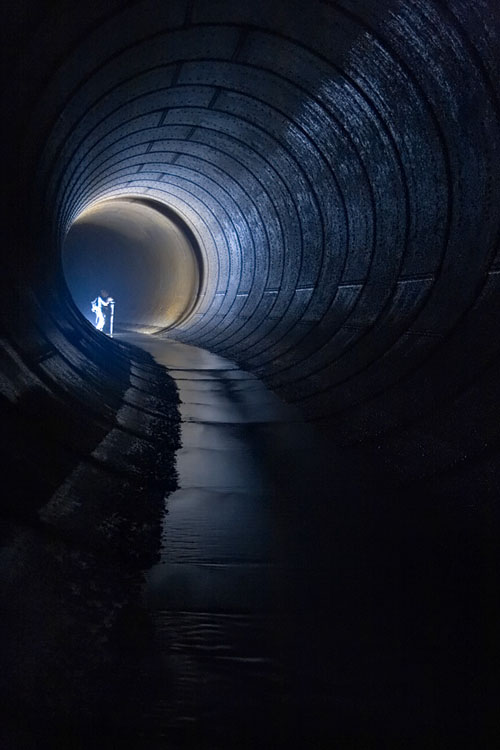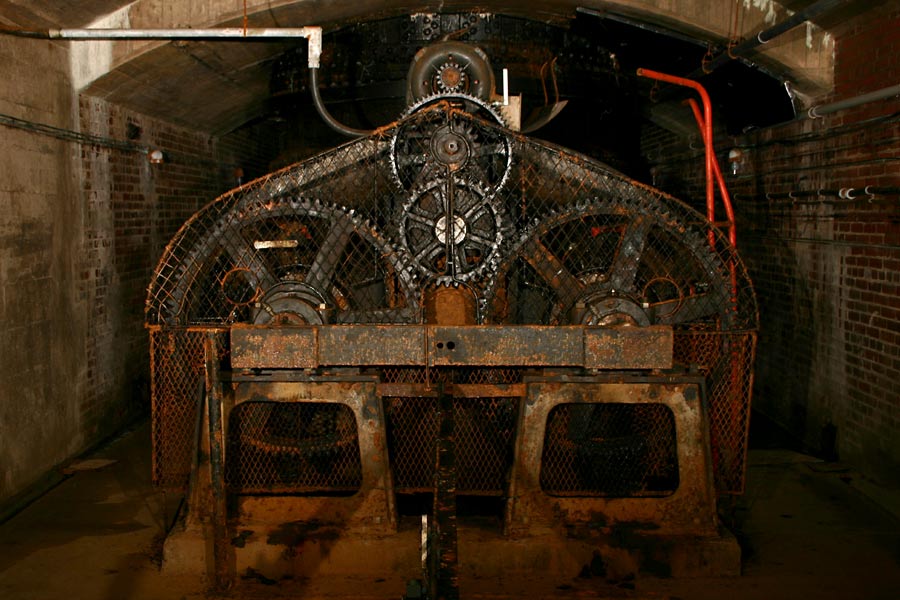
The Landscape Anthropology of Photography Museums (and the spatial implications of graven images)

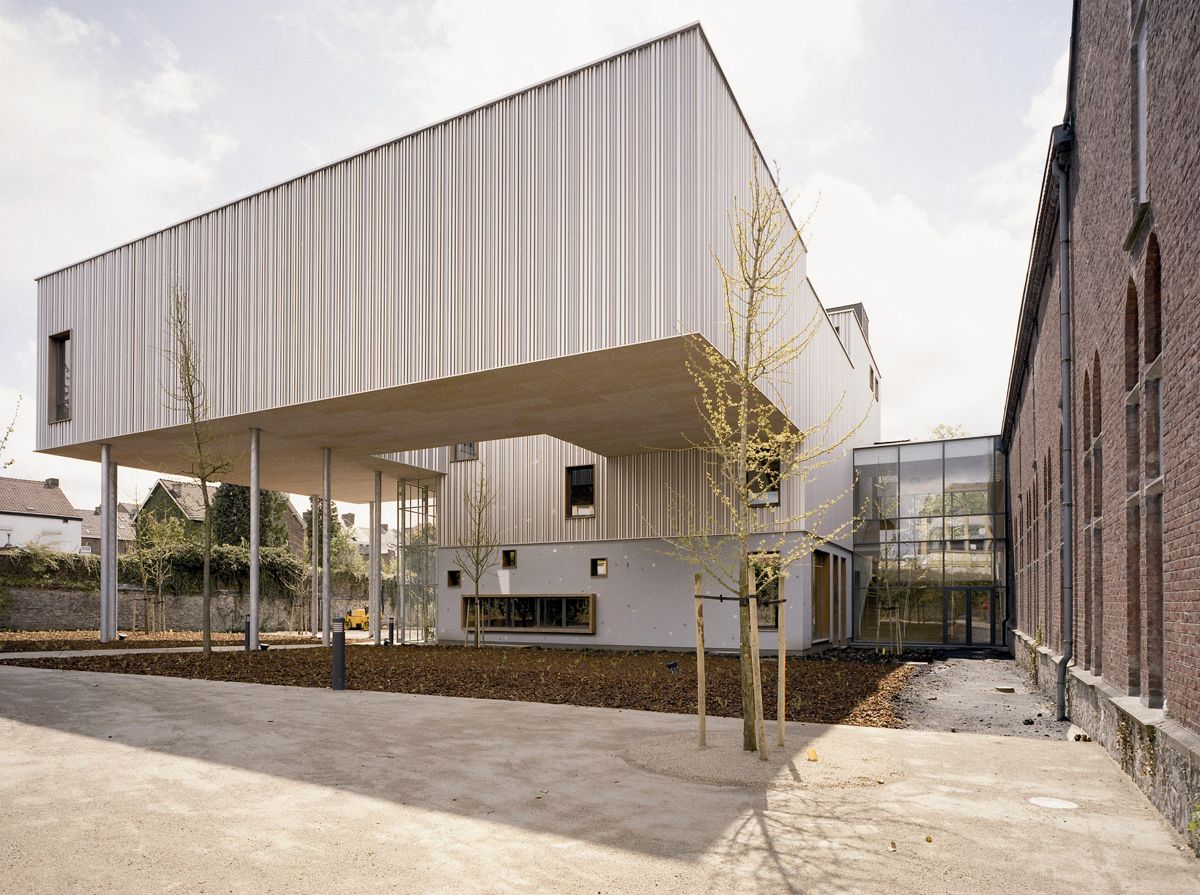
[Image: A new wing for the Museum of Photography in Charleroi by l’Escaut; photo by Filip Dujardin].

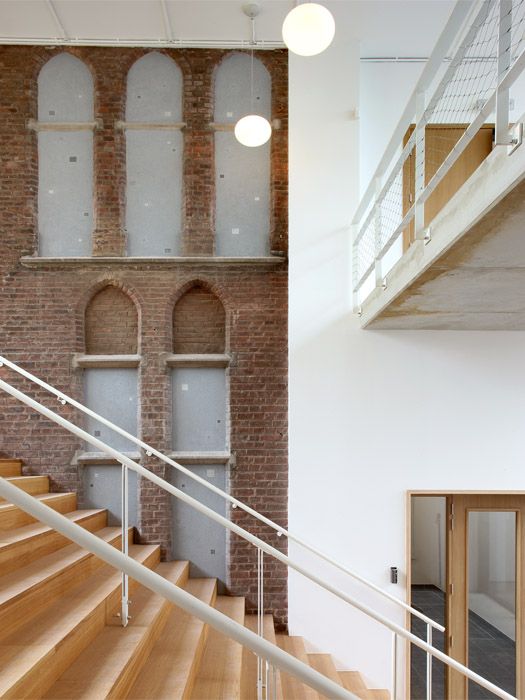
Belgian architects and scenographers l’Escaut have completed a new wing for the Museum of Photography in Charleroi, Belgium.
In an email received this morning, l’Escaut describes the project as being “situated at the intersection of architecture, landscape, city planning, photography and fine arts.”
This wide-ranging program, they go on to point out, “matches the interdisciplinarity of l’Escaut both in its daily life (l’Escaut is situated in a building shared with theatre actors and artists) as in its architecture practice (anthropology, landscaping, city planning, communication intervene in the projects).”
They are not really architects, in other words; they practice something more like landscape anthropology.

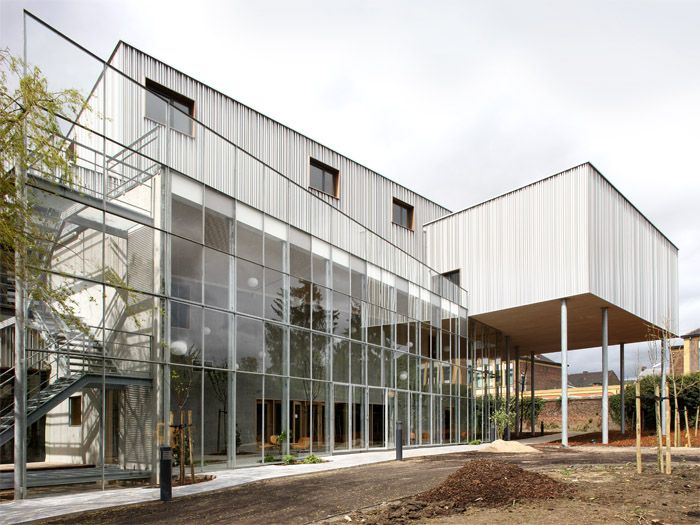
[Images: A new wing for the Museum of Photography in Charleroi by l’Escaut; photos by Filip Dujardin].

L’Escaut’s new wing is a surprising addition to the existing structure.
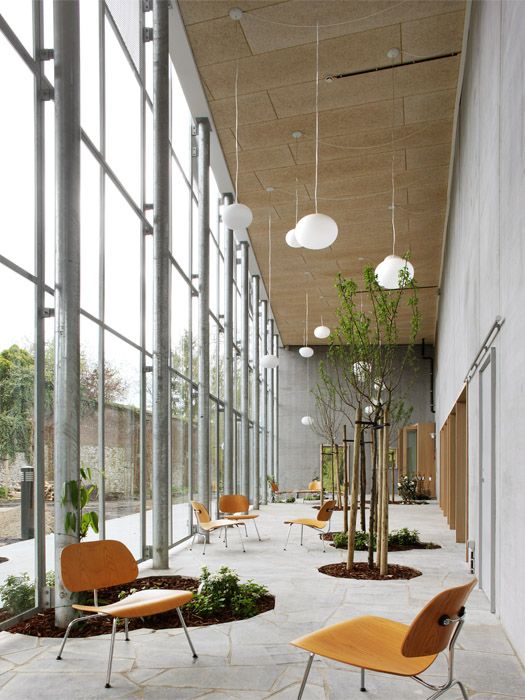
Partly raised on stilts, partly cantilevered, and almost entirely defined by a very clean-lined modern geometry, the added galleries nonetheless include a brief glimpse of botanical free-will: a “winter garden” that “shelters fragrant plants inside the museum.” Photosynthesis meets photography.

[Image: A new wing for the Museum of Photography in Charleroi by l’Escaut; photo by Filip Dujardin].

The galleries themselves, we’re told, are part of an overall “spatial scenography” of the site. Everything here is about views, counter-views, cross-views, and panoramas. Everything helps to frame everything else.
The architecture itself is photographic, you could say: the rooms flow into each other through a succession of bare white walls and exposed concrete, as if the space has been edited.
This raises the question, though, of the point at which space, actively experienced, becomes cinematic.
Are buildings ever truly photographic, or are they more like short films?

[Images: A new wing for the Museum of Photography in Charleroi by l’Escaut; photos by Filip Dujardin].

In any case, the story behind the original building itself is fascinating: it turns out that the Museum of Photography is a former Carmelite convent. The grounds include what used to be the nuns’ orchard.
This entails all sorts of interesting theological problems, as we’ll see.

[Image: A new wing for the Museum of Photography in Charleroi by l’Escaut; photo by Filip Dujardin].

Religious prohibitions against “graven images” become abstractly involved in the planning process:

The transformation of the convent into a museum of photography was a reverse process of existing logics in the building. A place where looking at the world was forbidden because of religious reasons became a place of revelation of the image for societal reasons. Its extension defies conventional museum logics by multiplying the relationships to photography, its history and its many facets of representation.

In other words, is a museum of photography – a temple of the graven image – a site for the “revelation of the image,” as the architects write – an inherent violation of Christian doctrine?
Is it de facto heresy to celebrate photography in a site formerly dedicated to the worship of god?
These unresolved tensions help to animate the interlinked spaces of the museum itself.

[Image: A new wing for the Museum of Photography in Charleroi by l’Escaut; photo by Filip Dujardin].

Here are some photos of the construction process, More about the project, meanwhile, can be found here.

Library of Dust

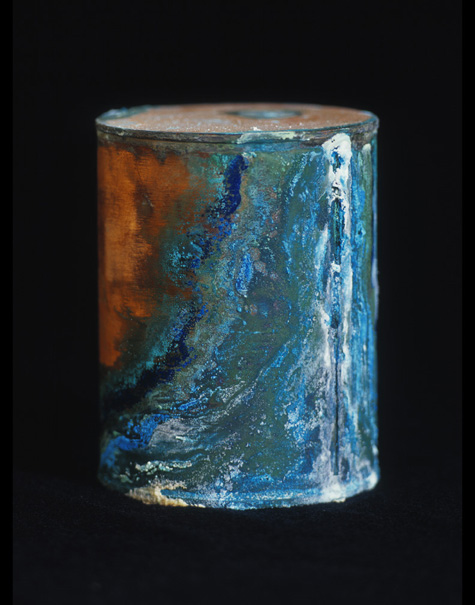
[Image: From Library of Dust by David Maisel, published by Chronicle Books].

There’s a spectacular new book coming out at the end of this summer called Library of Dust, by photographer David Maisel, published by Chronicle Books. I had the intensely exciting – and flattering – opportunity to write one of the book’s introductory essays; that essay now re-appears below.
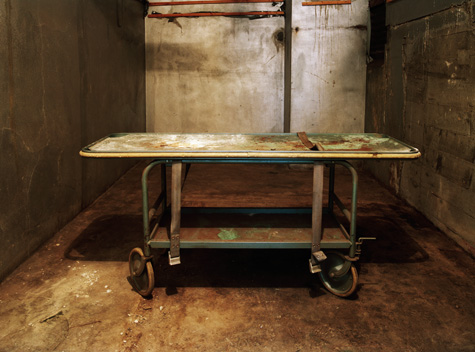
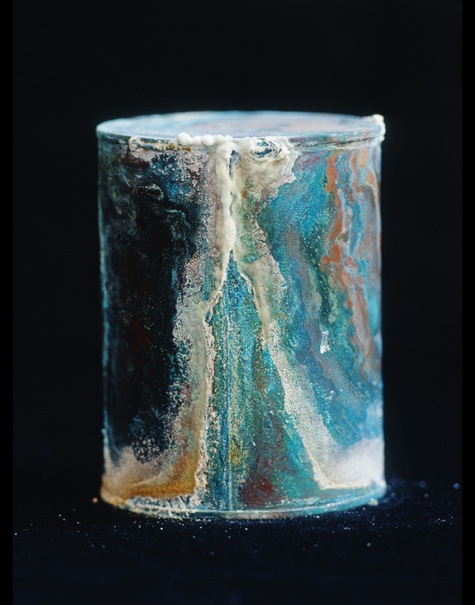
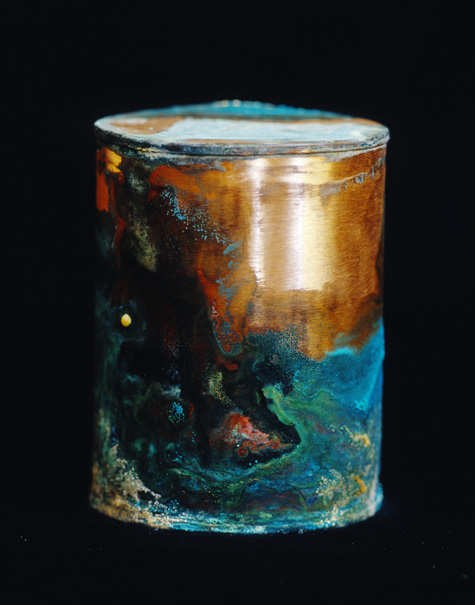
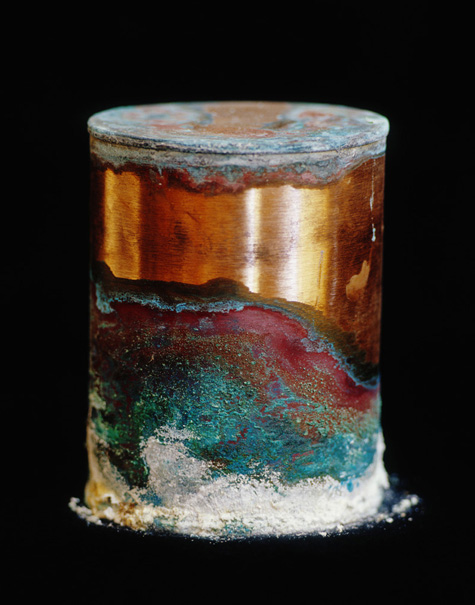
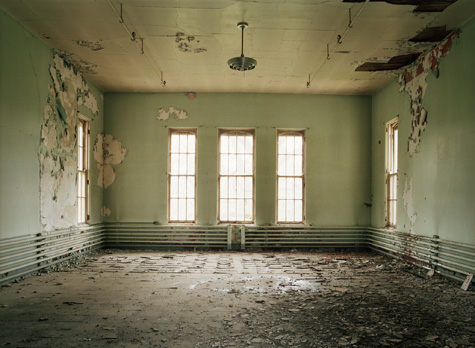
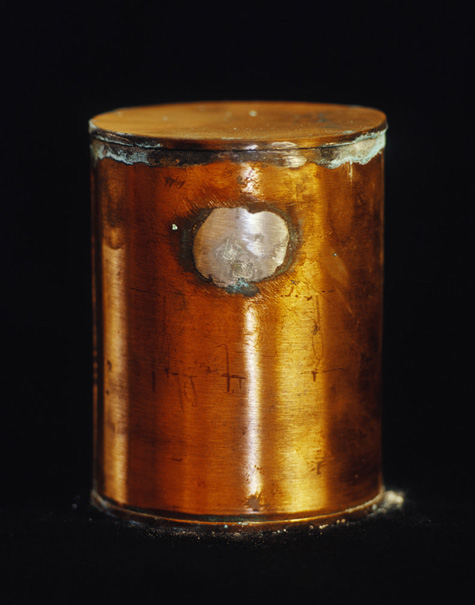
I first learned about Library of Dust when I interviewed Maisel back in 2006 for Archinect. In 1913, Maisel explained, an Oregon state psychiatric institution began to cremate the remains of its unclaimed patients. Their ashes were then stored inside individual copper canisters and moved into a small room, where they were stacked onto pine shelves.
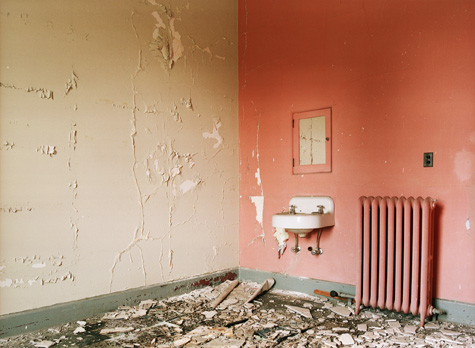
After doing some research into the story, Maisel got in touch with the hospital administrators – the same hospital, it turns out, where they once filmed One Flew Over the Cuckoo’s Nest – and he was granted access to the room in which the canisters were stored.

[Image: Abandoned rooms of the hospital. From Library of Dust by David Maisel, published by Chronicle Books].

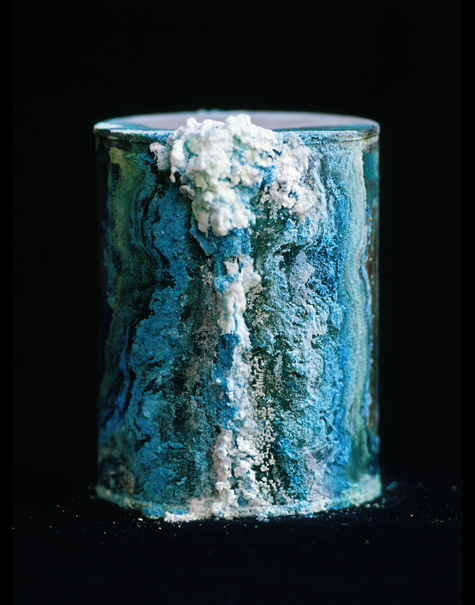
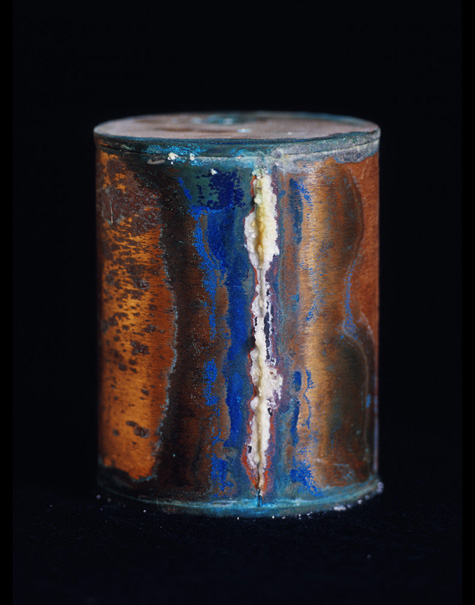
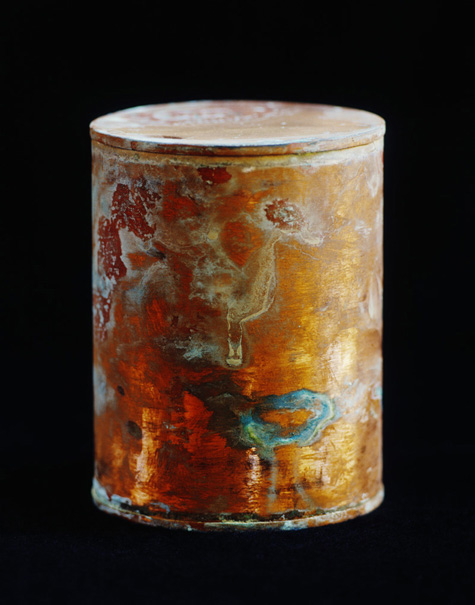
Over time, however, the canisters have begun to react chemically with the human ashes held inside them; this has thus created mold-like mineral outgrowths on the exterior surfaces of these otherwise gleaming cylinders.
There was a certain urgency to the project, then, as “the span of time that these canisters are going to be in this state is really finite,” Maisel explained in the Archinect interview, “and the hospital is concerned that they’re now basically corroding.”

So when I was there just a few weeks ago, photographing for I think the fourth time, there was a proposal being floated that each canister be put into its own individual plastic bag, and then each bag would go into its own individual black box that’s made for containing human ashes. And that would be it.
To me, the arc of the project – if it ends like that, which it seems it probably will – has a certain kind of conceptual logic to it that I appreciate. I appreciate the form and the story of these canisters, that they’re literally breaking down further every day, even between my visits to the hospital. My time of doing it, then, is finite as well.

In order to deal with the fragility of the objects, and to respect their funerary origins, Maisel set up a temporary photography studio inside the hospital itself. There, he began photographing the canisters one by one.
He soon realized that they looked almost earthlike, terrestrial: green and blue coastal forms and island landscapes outlined against a black background. But it was all mineralogy: terrains of rare elements self-reacting in the dark.
Maisel’s photos have now been collected into a gorgeous, and physically gigantic, book. It’s expensive, but well worth checking out.
The following is my own essay for the book; it appears alongside texts by Terry Toedtemeier and Michael Roth.

[Image: From Library of Dust by David Maisel, published by Chronicle Books].

• • •

In Haruki Murakami’s novel Hard-boiled Wonderland and the End of the World, an unnamed man finds himself walking through an unnamed town. Its depopulated spaces are framed most prominently by a Clocktower, a Gate, and an Old Bridge. The nameless man is told almost immediately to visit the town’s central Library – an unspectacular building that “might be a grain warehouse” for all its allure. “What is one meant to feel here?” the man asks himself, crossing a great, empty Plaza. “All is adrift in a vague sense of loss.”

Once inside the Library, the man meets a Librarian. The two of them sit down together, and the man prepares to read dreams. They are not fairy tales written in pen and ink, however, but the psychic residues of long-dead creatures, a gossamer field of electrical energy left behind in the creatures’ bleached skulls. Weathered almost beyond recognition, one such skull is “dry and brittle, as if it had lain in the sun for years.” The skull has been transformed by time into something utterly unlike itself, marked by processes its former inhabitant could not possibly have anticipated.

Each skull is the most minimal of structures, seemingly incapable of bearing the emotions it stores hidden within. One skull in particular “is unnaturally light,” we read, “with almost no material presence. Nor does it offer any image of the species that had breathed within. It is stripped of flesh, warmth, memory.” It is at once organic and mineralogical – living and dead.

The skull is also silent, but this silence “does not reside on the surface, [it] is held like smoke within. It is unfathomable, eternal” – intangible. One might also add invisible. This “smoke” is the imprint of whatever creature once thought and dreamed inside the skull; the skull is an urn, or canister, a portable tomb for the life it once gave shape to.

The Librarian assists our nameless narrator by wiping off a thin layer of dust, and the man’s dream-reading soon begins.


[Images: From Library of Dust by David Maisel, published by Chronicle Books].

Dust is a peculiar substance. Less a material in its own right, with its own characteristics or color, dust is a condition. It is the “result of the divisibility of matter,” Joseph Amato writes in his book Dust: A History of the Small and the Invisible. Dust is a potpourri of ingredients, varied to the point of indefinability. Dust includes “dead insect parts, flakes of human skin, shreds of fabric, and other unpleasing materials,” Amato writes.

Many humans are allergic to dust and spend vast amounts of time and money attempting to rid their homes and possessions of it, yet dust’s everyday conquest of the world’s surfaces never ends. Undefended, a room can quickly be buried in it.

Dust lies, of course, at the very edge of human visibility: it is as small as the unaided eye can see. And dust is not necessarily terrestrial. “Amorphous,” Amato continues, “dust is found within all things, solid, liquid, or vaporous. With the atmosphere, it forms the envelope that mediates the earth’s interaction with the universe.” But dust is found beyond that earthly sphere, in the abiotic vacuum of interstellar space, a freezing void of irradiated particles, where all dust is the ghostly residue of unspooled stars, astronomical structures reduced to mist.

Strangely representational, the chemistry of this stardust can be analyzed for even the vaguest traces of unknown components; these results, in turn, are a gauge for whatever hells of radiation once glowed, when the universe burned with intensities beyond imagining. Those astral pressures left chemical marks, marks which can be found on dust.

Such dust – vague, unspectacular, bleached and weathered by a billion years of drifting – can be read for its astronomical histories.

Dust, in this way, is a library.

[Image: From Library of Dust by David Maisel, published by Chronicle Books].

A geological history of photography remains unwritten. There are, of course, entire libraries full of books about chemistry and its relationship to the photographic process, but what the word chemistry fails to make clear is that these photographic chemicals have a geological origin: they are formed by, in, and because of the earth’s surface.

Resists, stops, acids, metals, fixes – silver-coated copper plates, say, scorched by controlled exposures of light – produce imagery. This is then called photography. Importantly, such deliberate metallurgical burns do not have to represent anything. Photography in its purest, most geological sense is an abstract process, a chemical weathering that potentially never ends. All metal surfaces transformed by the world, in other words, have a literally photographic quality to them. Those transformations may not be controlled, contained, or domesticated, but the result is one and the same.

Photography, in this view, is a base condition of matter.

[Image: From Library of Dust by David Maisel, published by Chronicle Books].

David Maisel’s photographs of nearly 110 funereal copper canisters are a mineralogical delight. Bearded with a frost of subsidiary elements, their surfaces are now layered, phosphorescent, transformed. Unsettled archipelagos of mineral growths bloom like tumors from the sides and bottoms – but is that metal one sees, or some species of fungus? The very nature of these canisters becomes suspect. One is almost reluctantly aware that these colors and stains could be organic – mold, lichen, some yeasty discharge – with all the horror such leaking putrescence would entail. Indeed, the canisters have reacted with the human ashes held within.

Each canister holds the remains of a human being, of course; each canister holds a corpse – reduced to dust, certainly, burnt to handfuls of ash, sharing that cindered condition with much of the star-bleached universe, but still cadaverous, still human. What strange chemistries we see emerging here between man and metal. Because these were people; they had identities and family histories, long before they became nameless patients, encased in metal, catalytic.

In some ways, these canisters serve a double betrayal: a man or woman left alone, in a labyrinth of medication, prey to surveillance and other inhospitable indignities, only then to be wed with metal, robbed of form, fused to a lattice of unliving minerals – anonymous. Do we see in Maisel’s images then – as if staring into unlabeled graves, monolithic and metallized, stacked on shelves in a closet – the tragic howl of reduction to nothingness, people who once loved, and were loved, annihilated?

After all, these ash-filled urns were photographed only because they remain unclaimed; they’ve been excluded from family plots and narratives. A viewer of these images might even be seeing the fate of an unknown relative, eclipsed, denied – treated like so much dust, eventually vanishing into the shells that held them.

It is not a library at all – but a room full of souls no one wanted.

[Image: From Library of Dust by David Maisel, published by Chronicle Books].

Yet perhaps there is something altogether more triumphant at work here, something glorious, even blessed. There is a profoundly emotional aspect of these objects, a physical statement that we, too, will alter, meld with the dust and metal: an efflorescence. This, then, is our family narrative, not one of loss but of reunion.

There is a broader kinship being proclaimed, a more important reclamation occurring: the depths of matter will accept us back. We will be rewelcomed out of living isolation. We are part of these elements, made of the dust that forms structures in space.

Maisel’s photographs therefore capture scenes of fundamental reassurance. The mineralized future of everything now living is our end. Even entombed by metal, foaming in the darkness with uncontrolled growths – there is splendor.

[Image: From Library of Dust by David Maisel, published by Chronicle Books].

To disappear into this metallurgical abyss of reactions – photographic, molecular – isn’t a tragedy, or even cause for alarm. There should be no mourning. Indeed, Maisel’s work reveals an abstract gallery of the worlds we can become. Planetary, framed against the black void of Maisel’s temporary studio, the remnant energies of the long dead have become color, miracles of alteration. There are no graves, the photographs proclaim: only sites of transformation.

That is our final, inhuman release.

[Image: From Library of Dust by David Maisel, published by Chronicle Books].

At the end of winter 2005, David Maisel traveled to a small city in Oregon. There were bridges, plazas, and gates. He was there to locate an old psychiatric hospital – a building now housing violent criminals – because the hospital held something that interested him.

Upon arrival, he met with the head of security, who already knew why Maisel had come. The two of them walked down a nearby corridor, where Maisel was shown what he’d been looking for. It was an isolated room behind a locked door – smaller, less official, than expected.

Within it was the Library of Dust.


• • •

David Maisel’s Library of Dust is available both through Chronicle Books and through Amazon.com – though you can also buy a signed copy through photo-eye.
Don’t miss my earlier interview with David over at Archinect – and, at some point soon, take a long trip through David’s website.

(Thanks to Joseph Antonetti for his help with the images – and to editor Alan Rapp for instigating this book in the first place).

Drains of Canada: An Interview with Michael Cook

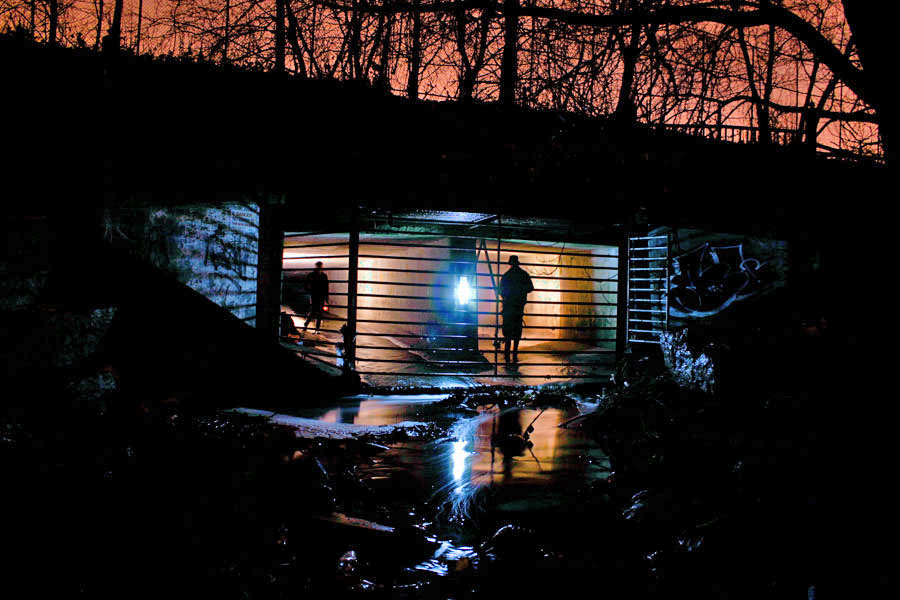
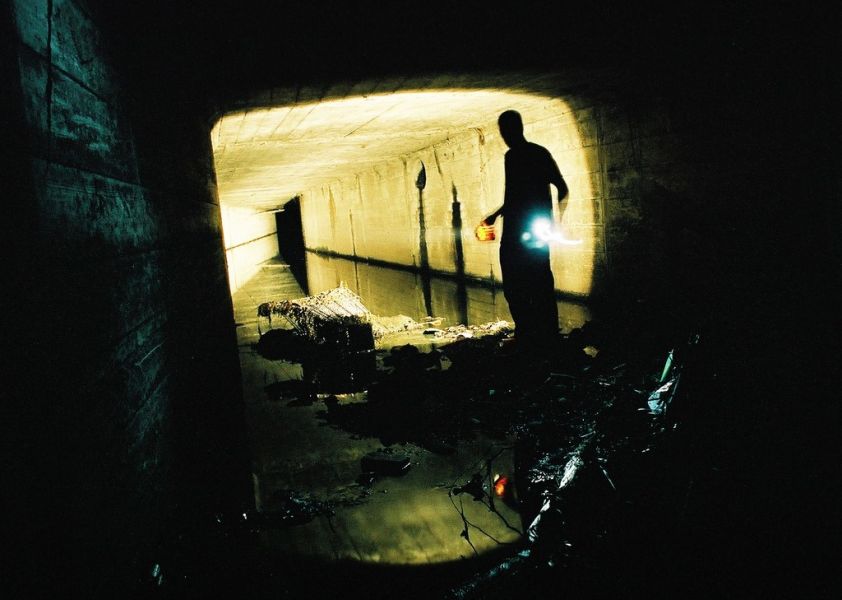
[Image: The Toronto Power Company Tailrace at Niagara; this and all other photos in this post by Michael Cook].

Michael Cook is a writer, photographer, and urban explorer based in Toronto, where he also runs a website called Vanishing Point.
Despite its subject matter, however, Vanishing Point is more than just another website about urban exploration. Cook’s accounts of his journeys into the subterranean civic infrastructure of Canada and northern New York State – and into those regions’ warehouses, factories, and crumbling hospitals – often include plans, elevations, and the odd historical photograph showing the sites under construction.
For instance, his fascinating, inside-out look at the Ontario Generating Station comes with far more than just cool pictures of an abandoned hydroelectric complex behind the water at Niagara Falls, and the detailed narratives he’s produced about the drains of Hamilton and Toronto are well worth reading in full.
As the present interview makes clear, Cook’s interests extend beyond the field of urban exploration to include the ecological consequences of city drainage systems, the literal nature of public space, and the implications of industrial decay for future archaeology – among many other things we barely had time to discuss.
Or, perhaps more accurately phrased, Cook shows that urban exploration has always been about more than just taking pictures of monumentally abstract architectural spaces embedded somewhere in the darkness.

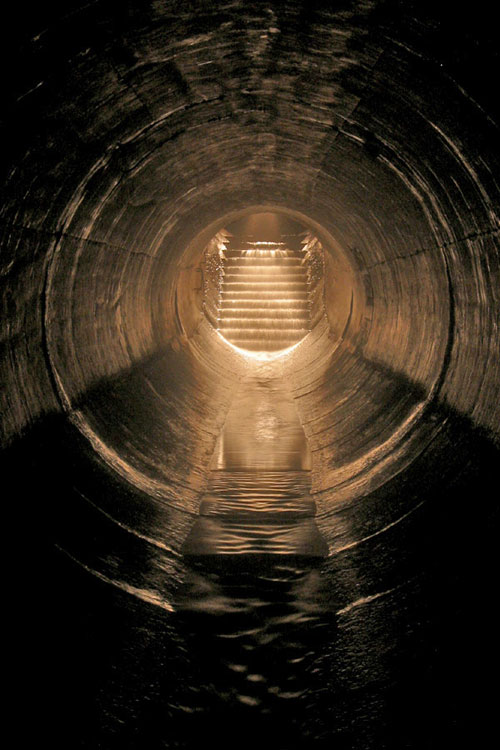
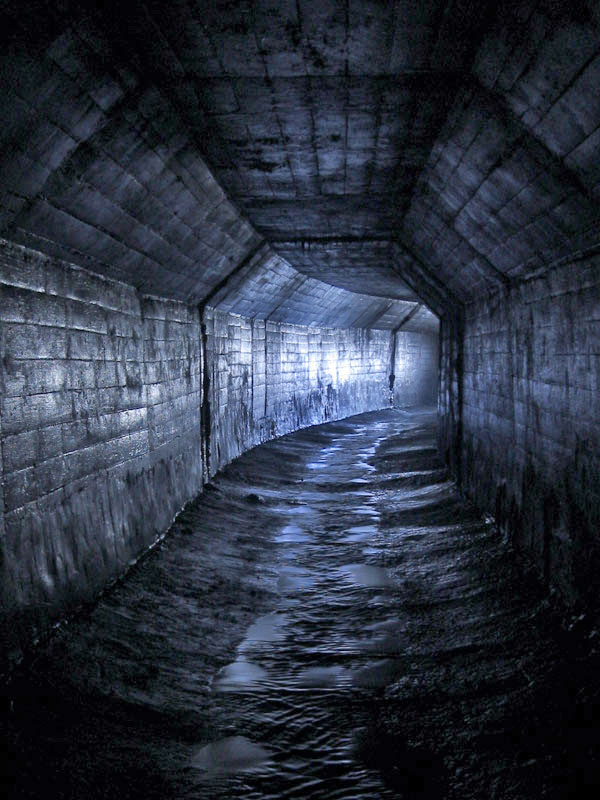
[Image: The Memorial Park Storage Chambers in Toronto’s Belt Line Drain; this is architecture as dreamed of by Adolf Loos: shaved of all ornament, exquisitely smooth, functional – while architecture schools were busy teaching Mies van der Rohe, civil engineers were perfecting the Modern movement beneath their feet].

As he writes on Vanishing Point:

The built environment of the city has always been incomplete, by omission and necessity, and will remain so. Despite the visions of futurists, the work of our planners and cement-layers thankfully remains a fractured and discontinuous whole, an urban field riven with internal margins, pockmarked by decay, underlaid with secret waterways. Stepping outside our prearranged traffic patterns and established destinations, we find a city laced with liminality, with borderlands cutting across its heart and reaching into its sky. We find a thousand vanishing points, each unique, each alive, each pregnant with riches and wonders and time.

This is a website about exploring some of those spaces, about immersing oneself in stormwater sewers and utility tunnels and abandoned industry, about tapping into the worlds that are embedded in our urban environment yet are decidedly removed from the collective experience of civilized life. This is a website about spaces that exist at the boundaries of modern control, as concessions to the landscape, as the debris left by economic transition, as evidence of the transient nature of our place upon this earth.

In the following conversation with BLDGBLOG, Cook discusses how and where these drains are found; what they sound like; the injuries and infections associated with such explorations; myths of secret systems in other cities; and even a few brief tips for getting inside these hyper-functionalist examples of urban infrastructure. We talk about ecology, hydrology, and industrial archaeology; and we come back more than once to the actual architecture of these spaces.

[Image: “Stairs” by Michael Cook, from the Westview Greenbelt Drain].

• • •

BLDGBLOG: Is there any place in particular that you’re exploring right now?

Michael Cook: I am trying to piece together entrance to a drain here in Toronto. It’s part of a larger system. As part of their efforts to improve Toronto’s water quality on the lake front, the city built this big storage tunnel called the Western Beaches Storage Tunnel. It intercepts and stores overflow from a number of combined sewers, as well as from several storm sewers along the western lake front. I guess this was finished in 2001, but they had various technical issues, with the mechanics of it, so it was only operational this past summer.

But there are three storm sewers, I guess, that are part of this system. One of them is on my site already – Pilgrimage – and then there’s a second one that’s large and possibly worth getting into. It’s just not something I’ve investigated thoroughly, so… I’ll probably go down and look for that.

[Images: (top) “Transition to CMP,” from Toronto’s Old Ironsides drain; (middle) “Junction with small sidepipe (falling in on the right)” inside Toronto’s Graphic Equalizer drain; (bottom) “Backwards junction” in Toronto’s Sisters of Mercy drain].

BLDGBLOG: How do you know that the system fits together – that all these storm sewers actually connect up with one another? Are there maps?

Michael Cook: In this case, I have an outfall list that was prepared in the late 80s for portions of Toronto – so I know, from this list, what the size of this storm sewer was at its outfall, before it was intercepted by the new system.

There was also a fair bit of media coverage when the system was being built, because it was a huge expenditure on the part of the city. So we know which combined sewers are part of the system, and I do know where a particular storm sewer is when they intersect – I just don’t necessarily know which residential streets it runs under.

Basically, I have a starting point – and the way I’m going to do this is just go down there on foot and walk around the various residential streets, starting at the lake and moving north. I’ll see if I can find any viable manhole entrances – which involves being by the side of the road or in the sidewalk, where it will be possible to enter and exit safely.

[Image: “Emerging in Wilson Heights,” out of Toronto’s Depths of Salvation drain].

BLDGBLOG: What do you actually bring with you? Do you have some kind of underground exploration kit? Full of Band-Aids and Advil?

Michael Cook: I have a pair of boots or waders, depending on the circumstances. I’ll also bring one or more headlamps, and a spotlamp, and various other lighting gear – plus a camera and a tripod. That basically sums it up.

I also have a manhole key – that’s basically just a loop of aircraft cable tied onto a bolt at one end and run through a piece of aluminum pipe that serves as a crude handle. Most of the manhole lids around here have between two and twenty square holes in them about an inch wide, and they’re reasonably light. Assuming the lid hasn’t been welded or bolted into the collar of the manhole, it’s relatively quick and painless to use this tool to pull the lid out. It’s only useful for light-weight lids, though. In Montreal, for instance, most of the covers are awkward, heavy affairs that sometimes need two people, each with their own crowbar, to dislodge safely. Real utilities workers use pickaxes – but those aren’t so easily carried in the pocket of a backpack.

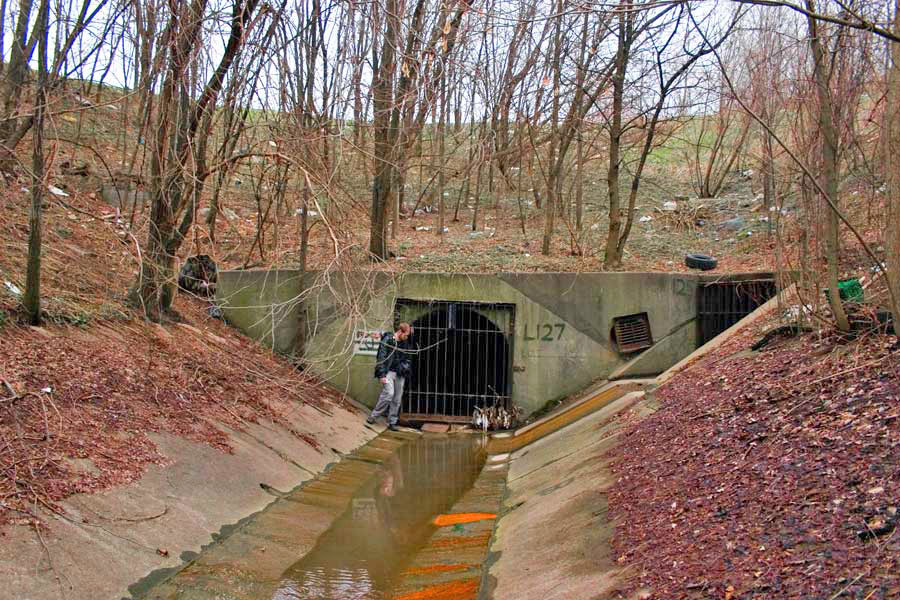
[Image: The outfall of Toronto’s Old Ironsides drain].

BLDGBLOG: Do you ever run into other people down there?

Michael Cook: That’s never happened to me, actually. It’s just not that popular a pursuit, outside of certain hotspots.

People can accept going into an abandoned building: you might run into someone you don’t want to run into there, or you might find that part of the building’s unstable – but it’s still just a building.

Even people I know who self-identify as urban explorers aren’t at all that interested in undergrounding – especially not in storm drains. A lot of them just don’t see the actual interest. It’s not a detail-rich environment. You can walk six kilometers underground through nearly featureless pipe – and there’s not something to see and photograph every five feet.

[Image: An “A-shaped conduit” in Toronto’s Belt Line Drain].

BLDGBLOG: Yet a lot – possibly most – of these drains are already named. Who names them, and how do the names get passed around and agreed on by everyone else?

Michael Cook: With people who drain, one of the first things you pick up is a respect for existing names – and the first person to explore a drain has naming rights over it. People generally respect that. Sometimes we’ll make exceptions – I know I’ve made exceptions a few times – but, ultimately, we depend on other people respecting our names.

It’s at once a completely pointless exercise; but, at the same time, it’s fairly meaningful in terms of having a way of discussing this with other people.

So that’s how it comes up. You then use that name, both offline and online. In Australia, they have a kind of master location list, that they keep within Cave Clan, but here we don’t have that level of organization, or that size of a community. It’s just a matter of publishing stuff on our websites.

That said, sometimes we’ll adopt the official name. This usually happens when we’ve been using that name for awhile before we find a way to actually get inside the system, and this usually comes about with something really big or historically significant. We’ll never rename the Western Beaches Storage Tunnel, for instance, though we call it the “Webster,” colloquially. When I find a way into Toronto’s storied Garrison Creek Sewer, the buried remains of our fabled “lost” creek, it won’t be the subject of renaming either. Those are the exceptions though; most of the time naming is one of the things we do to capture and communicate something of the magic of wading for three hours through a watery, feature-poor concrete tunnel underground.

[Image: (top) “Outfall structure in the West Don Valley,” part of Toronto’s Depths of Salvation drain; (bottom) The outfall of Toronto’s Graphic Equalizer drain].

BLDGBLOG: A lot of these places look like surreal, concrete versions of all the streams and rivers that used to flow through the city. The drains are like a manmade replacement, or prosthetic landscape, that’s been installed inside the old one. Does the relationship between these tunnels and the natural waterways that they’ve replaced interest you at all?

Michael Cook: Oh, definitely – ever since I got into this through exploring creeks.

At their root, most drains are just an abstract version of the watershed that existed before the city. It’s sort of this alternate dimension that you pass into, when you step from the aboveground creek, through the inlet, into the drain – especially once you walk out of the reach of daylight.

Even sanitary sewers often follow the paths of existing or former watersheds, because the grade of the land is already ideal for water flow – fast enough, but not so fast that it erodes the pipe prematurely – and because the floodplains are often unsuitable for other uses.

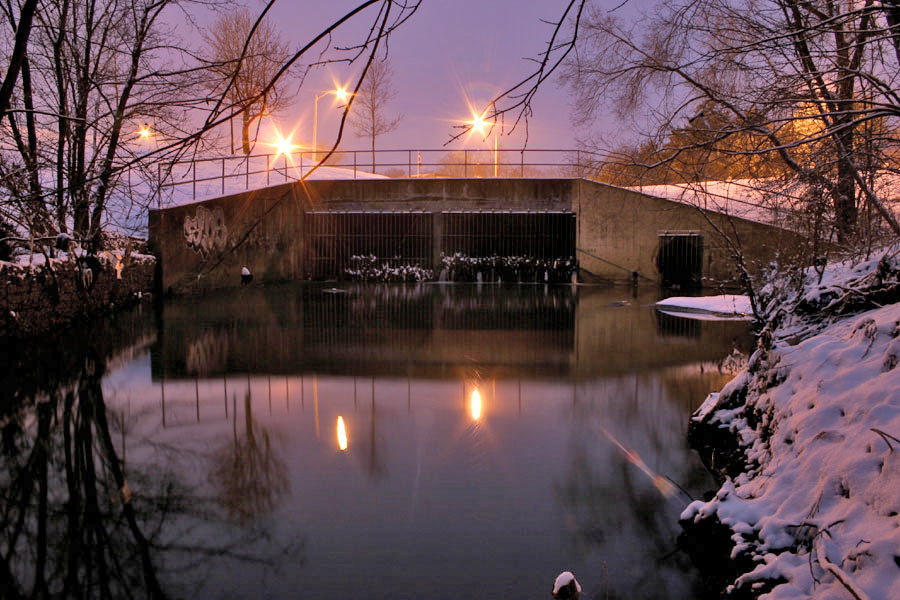
[Image: “Outfall in winter” at Toronto’s Gargantua drain].

BLDGBLOG: How does that affect your attitude toward this, though? Do you find yourself wishing that all these drains could be dismantled, letting the natural landscape return – or, because these sites are so interesting to explore, do you actually wish that there were more of them?

Michael Cook: It’s an awful toll that we’ve taken on the landscape – I’m not one to celebrate all this concrete. If it were conceivable to set it all right, I’d be the first one in line to support that. And the marginal progress being made in terms of environmental engineering – building storm water management alternatives to burial and to large, expensive pipes – is a great step forward; unfortunately, its success so far has been limited.

Ultimately, you just can’t change the fact that we’ve urbanized, and we continue to do so. That comes with a cost that can be managed – but it can’t be eliminated completely.

[Image: Looking out of a spillway at the Ontario Generating Station].

BLDGBLOG: So do you actually have an environmental goal with these photographs? Your explorations are really a form of environmental advocacy?

Michael Cook: Well, I want to find something that goes a bit further than just presenting these photos for their aesthetic value – but, at the same time, turning this into some sort of environmental advocacy platform doesn’t really come to mind, either.

I’m very interested in urban ecology and in the environmental politics that take place in the city – and I’ve done some academic work in that regard – but I’m not really prepared to distill the photography and these adventures into an activist exercise.

[Image: The “spectacular, formerly natural waterfall that the [Chedoke Falls Drain] now feeds,” in Hamilton, Ontario].

BLDGBLOG: I’m curious if you’ve ever been injured, or even gotten sick, down there. All that old, stagnant air – and the dust, and the germs – can’t be very good for you!

Michael Cook: I can’t say that I’ve ever gotten sick from it. Sometimes, the day after, you can feel almost hung-over – but I don’t know what that is. It could be dust, or it could be from the amount of moisture you breathe in. But it passes. It may even be an allergy I have.

I haven’t really done any exploration of sanitary sewers – that would be a different story. In Minneapolis/St. Paul they actually have a name for the sickness they sometimes come down with after a particularly intense sewer exploration: Rinker’s Revenge. It’s named after the engineer who designed the systems there. And a colleague caught a bout of giardia recently, which he believes he acquired exploring a section of combined sewer in Montreal.

So, obviously, there are disease risks in doing this, though they’re not as extensive as one might want to imagine.

The only serious situation I’ve ever been in, with a high potential for injury – and I was pretty lucky – was while exploring in Niagara. The surge spillways for the Ontario Generating Station used to carry overflow water from the surge tanks, and those were fed by the intake pipes. So the water would overflow from the intake pipes into the surge tanks, and then drain out through these helical spillways that spiral downwards to the bottom of the gorge. They then outfall in front of the plant into the river.

So we made an attempt to ascend both of these spillways, and we were successful in the first one; but the second one, we found, was more difficult toward the latter stages of the climb. We had to turn back just before reaching the surge tanks. On the way back down I lost my footing – I lost all grip on the surface, it was so steep and so slippery, and it was covered in very fine grit – and I ended up sliding all the way down to the bottom, nearly 200 vertical feet. And I was going at a very high speed by the time I reached the bottom.

I was very lucky to come away from that with just a few friction burns and a sprained thumb.

[Images: A “short drop” in Toronto’s beautifully torqued and ovoid Viceroy Drain].

BLDGBLOG: As far as the actual tunnels go, how connected is all this stuff? Is it like a big, underground labyrinth sometimes – or just a bunch of little tunnels that look connected only because of the way that they’ve been photographed?

Michael Cook: Well, most of the drainage systems I’ve been in are pretty linear. You have a main trunk conduit, and then sometimes you’ll get significant side pipes that are worth exploring. But as far as actual maze-quality features go, it’s pretty rare to find systems like that – at least in Ontario and most places in Canada. It requires a very specific geography and a sort of time line of development for the drains.

You might end up with a lot of side overflows and other things, which makes the system more complicated, if the drain has several different places where it overflows into a surface body of water – or if there’s a structure that allows one pipe to flow into another at excess capacity. That sort of thing allows for more complicated systems – but most of the time it doesn’t happen.

You can still spend hours in some of these drains, though, because of how long they are. And sometimes that makes for a fairly uninteresting experience: drains can be pretty featureless for most of their length.

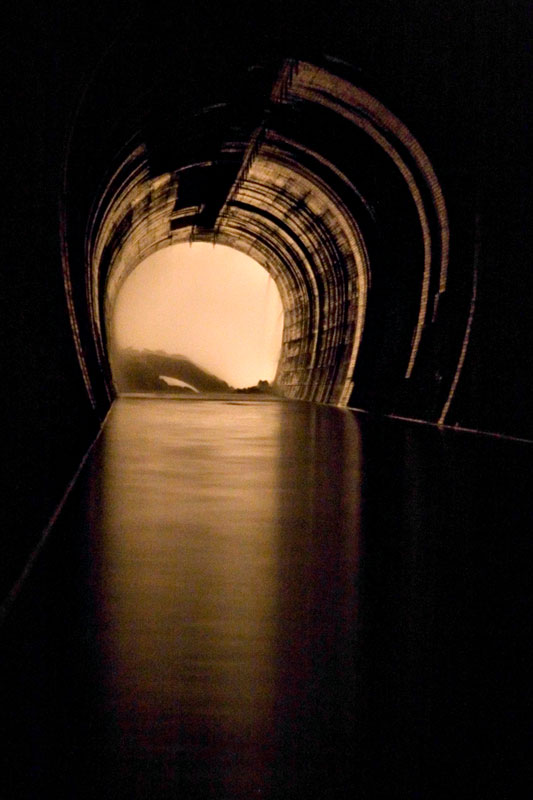
[Images: Four glimpses of the vaulted topologies installed inside the Earth at Niagara’s William Birch Rankine Hydroelectric Tailrace].

BLDGBLOG: Are the drains up there mostly poured concrete, or are they made of brick?

Michael Cook: We have recently opened up our first significant brick sewer in Toronto – The Skin of a Lion – which is built from yellow brick and would probably date to around the turn of the last century. So there are a few locations where you can find brick, but most are concrete.

[Images: (top) Leaving the William Birch Rankine Hydroelectric Tailrace, Niagara Falls; (bottom) Tailrace outlet, William B. Rankine Generating Station].

BLDGBLOG: Does that affect what the drains sound like, as far as echoes and reverb go? What sort of noises do you hear?

Michael Cook: I’d say that every drain is acoustically unique. Each has its own resonance points – and even different sections of the drain will resonate differently, based on where the next curve is, or the next room. It all shifts. I often explore that aspect a bit – probably to the annoyance of some of my colleagues. I’ll make noises, or hum. Even sing.

As far as environmental noises, the biggest thing is that, if there’s a rail line nearby, or a public transit line, you often get that noise coming back through the drain to wherever you are. It’s very frightening when you first hear it, till you figure out what it is – this rushing noise. It’s not a wall of water. [laughs]

But the most common recurring noise is the sound of cars driving over manhole covers – which gives you an idea of which covers you don’t want to exit through. It also helps you keep track of the distance, and where you are – that sort of thing.

[Image: “Transitions” inside the Duncan’s Got Wood sewer, Toronto].

BLDGBLOG: What kind of legal issues are involved here – like trespassing, or even loitering? Do you have to go out at 2am, dressed like an official city worker, or wear a hood or anything like that?

Michael Cook: For draining, the legal issues are pretty grey. After all, you’re on public property the entire time – so the risk of a serious trespassing fine is a lot lower. There’s no private security company looking out for you, and there’s no private property owner who’s going to be irate if you’re found inside his building. It’s a municipal waterway – it just happens to run underground. A lot of times the outfalls aren’t even posted with notices telling you to stay out.

Now, some people have been given fines for trespassing – for having been inside drains in Ontario – but these have been for pretty minor sums of money. It’s not something that I’ve ever had a problem with – and definitely not something that requires me to go in the middle of the night.

The only thing that really dictates what time you can go is traffic conditions. If you have to use a street-side manhole, you generally don’t want to be doing that doing the day.

[Image: “Deep inside the century-old wheelpit that is the beginning of the Rankine Generating Station Tailrace” (view bigger)].

BLDGBLOG: Within Toronto itself, are you still finding new drains, or is the city pretty much exhausted by now?

Michael Cook: We are still finding new tunnels beneath Toronto, and we’re on the trail of others that we know about but just haven’t discovered access to yet. There are also still a few underground gems in Hamilton that haven’t been seen by anyone except municipal workers and a handful of journalists. These days though, Montreal and Vancouver are emerging hotbeds for new sewer and drainage finds in Canada, thanks to explorers in those cities.

When Siologen came over here he found a whole bunch of new drain systems in Toronto – systems nobody else knew about. He had the time and the inclination to go and scout out a whole lot of stuff that I’d never gotten around to doing.

BLDGBLOG: How’d he do that?

Michael Cook: Basically by riding all the buses. That, and looking at a lot of little creek systems, and searching around for manholes – all of that.

But there are people who happen to read in the paper about some new tunnel project, or whatever, and so they pass that on to people who do this sort of thing. Outside of that, I don’t really know what to say. I guess some people have even found stuff after it’s been featured in skateboarding magazines.

BLDGBLOG: [laughs]

Michael Cook: Some of the largest pipe in the world is used as spillways for hydroelectric projects – big dams and that sort of thing – and usually the first people who find out about this stuff are skateboarders. Usually they try to keep the locations pretty quiet – just as we do. But I’m sure that, at least once or twice, some tunnel explorer has found out about a system through the skateboarding community.

[Image: Ottawa’s Governor General’s Drain].

BLDGBLOG: I’m also curious if there’s some huge, mythic system out there that you’ve heard about but haven’t visited yet, or even just an urban legend about some tunnels that may not actually be real – secret government bunkers in London, for instance.

Michael Cook: I guess the most fabled tunnel system in North America is the one that supposedly runs beneath old Victoria, British Columbia. It’s supposedly connected with Satanic activity or Masonic activity in the city, and there’s been a lot of strange stuff written about that. But no one’s found the great big Satanic system where they make all the sacrifices.

You know, these legends are really… there’s always some sort of fact behind them. How they come about and what sort of meaning they have for the community is what’s really interesting. So while I can poke fun at them, I actually appreciate their value – and, certainly, these sort of things are rumored in a lot of cities, not just Victoria. They’re in the back consciousness of a lot of cities in North America.

[Image: “Looking into the bottom of the William B. Rankine G.S. wheelpit from the Rankine tailrace“].

BLDGBLOG: Is there some system – a real system – that you’re really dying to explore?

Michael Cook: If I had unlimited funds, I’d really like to make a trip to South America and see some of the underground workings beneath Rio and São Paulo and Montevideo; and I want to go to Africa for a lot reasons but, obviously, it would also be really neat to see what’s built under some of the larger cities in Africa. It’s a place of real cleavages between modern development and the complete impossibility of expanding that development to the entire population. So great sums of money have been wasted on huge highway projects and huge downtown core projects that were completely unnecessary for anything other than creating the semblance of a modern city – but, undoubtedly, there’s subterranean infrastructure connected to all of it.

BLDGBLOG: As well as abandoned pieces of infrastructure just sitting up there on the surface – unused highway overpasses and derelict stadiums and things like that.

Michael Cook: Definitely. And huge mine workings, as well, in certain parts of Africa, that have been shut down.

[Image: Inside a distributor tunnel at the Ontario Generating Station drain; meanwhile, I can’t help but imagine what it’d be like if architects began building hotel lobbies like this: you check into your boutique hotel in London – and nearly pass out in awe…].

BLDGBLOG: Meanwhile, urban exploration seems to be getting a lot of media attention these days – this interview included. How do you feel when you see articles in The New York Times about people exploring tunnels and drains?

Michael Cook: The problem I have with general interest reporting is that it almost invariably becomes, you know: look at this, isn’t this weird. Because that’s the easiest way of presenting what we do. It’s not about anything else – it’s entertainment.

So I’ve never really been interested in taking part in articles like that. They happen all the time in various places around the continent. Somewhere, there’s always a reporter who needs to file a story this week, or this month, and so they find an urban exploration site on the internet and they think, hey, that’s a great thing to write about, and then I can fill my quota. It’s not even that what they’re going to write is false or misleading, but it ultimately presents an incomplete and slightly cheapening image of what we do – and, in the end, it doesn’t really accomplish that much.

I think what I’m getting at is that the format of the newspaper article or the television news feature ultimately waters all this down and forces it into a specific block – that, while true of a certain segment of urban exploration, isn’t really representative of the whole. It has the effect of pigeon-holing the whole endeavor in a way.

[Images: Disused hydroelectric machinery: top/bottom].

BLDGBLOG: That implies that there’s a way of looking at all this that you think needs more exposure. What parts of urban exploration should the media actually be covering?

Michael Cook: I think, even among explorers, that we don’t pay enough attention to process. I think every piece of infrastructure – every building – is on a trajectory, and you’re experiencing it at just one moment in its very extended life.

We see things, but we don’t often ask how they came about or where they’re going to go from here – whether there will be structural deterioration, or if living things will colonize the structure. We tend to ignore these things, or to see them in temporal isolation. We also don’t give enough time or consideration to how this infrastructure fits into the broader urban fabric, within the history of a city, and where that city’s going, and whose lives have been affected by it and whatever may happen to it in the future. I think these are all stories that really need to start being told.

Which is something I’m starting on. It’s just not something that necessarily comes naturally. It requires a lot of work, and a lot of thought while you’re on-site – which maybe you’re not really inclined to do, because you’re too busy paying attention to the immediate, sublime nature of the experience.

But the basic linear photo gallery really bores me at this point – especially when you’re seeing basically the same photos, just taken inside different buildings. It has no real, lasting value. A lot of people have fallen into that trap, and a lot of people defend that – saying that they’re making art or whatever, or that it’s just for their own personal interest.

BLDGBLOG: So it’s a matter of paying attention both to the site’s history and to how your own documentation of that site will someday be used as history.

Michael Cook: If you decide to take a purely historical approach to it, though, I think the real question is: are these photos of asylum hallways and drainage tunnels ultimately going to be useful to anyone else at some point in the future? And the answer is probably not. Probably we’re photographing the wrong things for that.

Some architect or materials historian is going to be cursing us for photographing some things and not others, or for not taking a close-up of something – or for not writing down any supplementary information at all to help them identify this stuff.

So that historical angle, to justify some of the stuff we’re doing, falls down on further analysis.

[Image: Abandoned cash registers].

BLDGBLOG: It’s like bad archaeology.

Michael Cook: What’s that?

BLDGBLOG: It’s like bad archaeology.

Michael Cook: Yeah, basically. It’s like we’re just digging things up and not paying attention to where they were placed, or what they were next to, or who might have put it there.

Ultimately, we need some sort of framework, and to put more effort into additional information beside just taking a photo. That doesn’t necessarily mean publishing all that information so that everyone can see it – but just telling stories in other ways, and creating narratives about the places and the things that we’re seeing.

Otherwise, these are just postcard shots. We’re taking postcard shots of the sublime.

[Image: Inside The Skin of a Lion, Toronto].

• • •

While we were editing the transcript for publication, Michael wrote:

I got into the storm sewer I mentioned [at the beginning of the interview], shortly after talking to you. It’s now on the site as Sisters of Mercy. Similar to Pilgrimage, it ends in a siphon, rather than a traversable passage into the Western Beaches Storage Tunnel, which I’m still working on finding. We’ve started exploring combined sewers as well here – so that opens up some other options. In the end, the access I found was directly above where the siphon begins, quite close to the lake.

So the explorations continue.
With a big thanks to Michael Cook for having this conversation – and for maintaining such a great website.

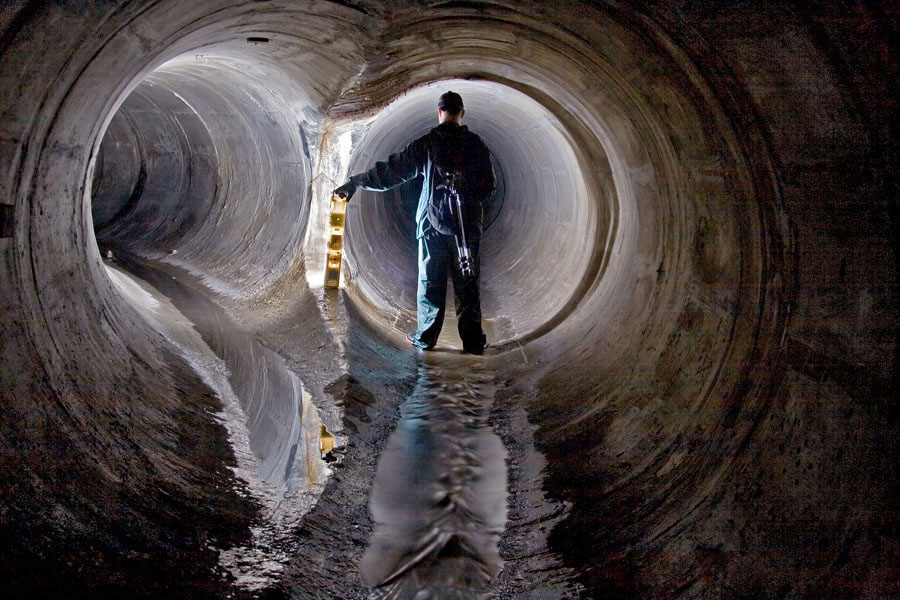
[Image: The “Three Musketeers” standing inside Toronto’s Westview Greenbelt Drain; Michael Cook is the one on the right; one of the other two is Siologen].

For a few more images, meanwhile, check out Vanishing Point – in particular, stop by the Daily Underground).

(More underground worlds and urban exploration on BLDGBLOG: Urban Knot Theory, London Topological, Derinkuyu, or: the allure of the underground city, Beneath the Neon, Valvescape, Subterranean bunker-cities, and Tunnels, mines, and the “upwardly migrating void”).

Other Landscapes

[Image: Michael Benson, from Beyond, via the New York Times].

The New York Times reports on Beyond, “a one-year exhibition of more than 30 large-format photographs of Earth’s planetary neighbors,” opening soon at the American Museum of Natural History in New York. (For what it’s worth, the AMNH is easily one of my favorite museums in the world; I couldn’t count all the times I’ve been there.)

In any case, the New York Times explains that Michael Benson, “a writer, photographer and filmmaker, created the stunning series of pictures from the enormous archives of images taken over the years by robotic explorers of the solar system.”

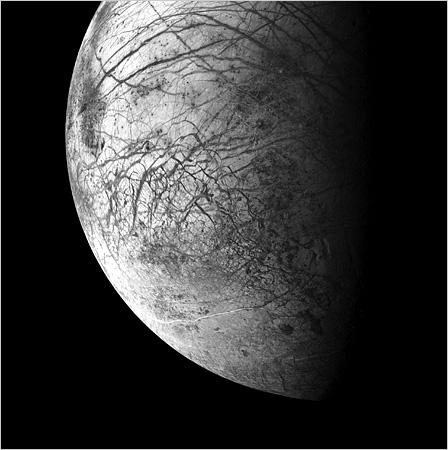
Beginning in 1995 Mr. Benson spent years sifting through hundreds of thousands of photographs, looking for those that offered an aesthetic punch. He then painstakingly combined images, using digital tools like Photoshop, to eliminate dropouts and blurs from individual photos beamed back across millions of miles of space. A lovely picture of Europa, a moon of Jupiter, gliding in front of the swirling atmosphere of that planet, for example, is a blend of some 70 frames sent back by Voyager.

Benson’s got an entire book of these photographs, called Beyond: Visions of the Interplanetary Probes, complete with essays by Arthur C. Clarke and Lawrence Weschler. The book is very positively reviewed, being referred to as “breathtaking,” “resplendent,” “miraculous,” “sublimely exhilarating,” and “supremely reproduced.” Best of all, from my end, I’ll be in NY next month, so I’ll get to see the show…

The Museum of Nature

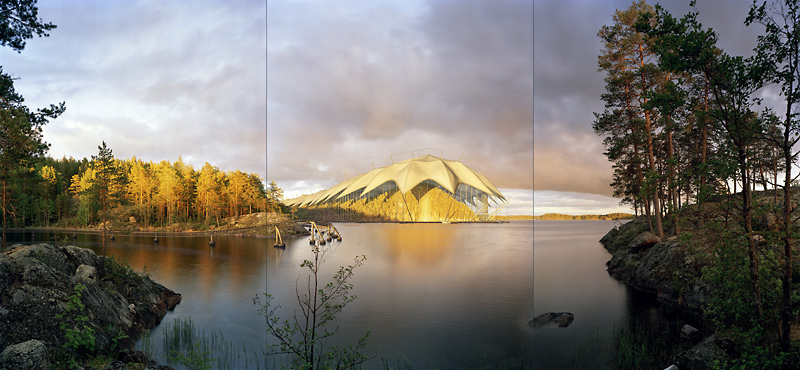
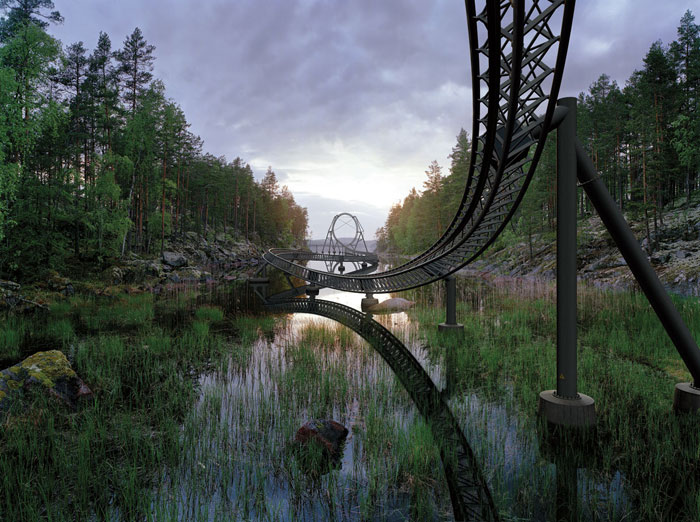
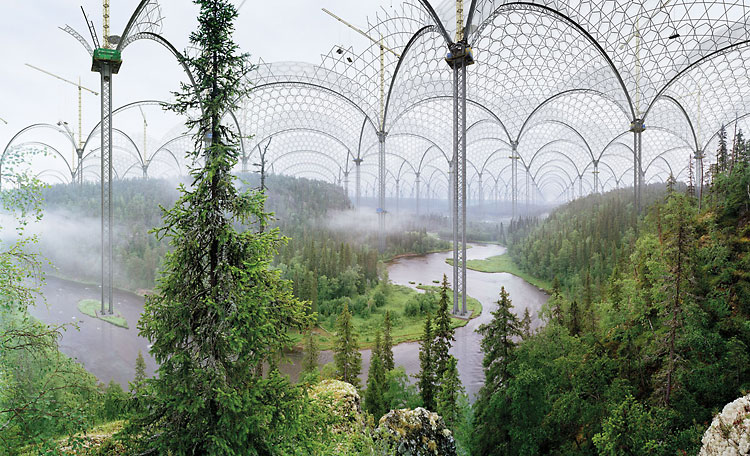
[Image: Museum 2 by Ilkka Halso, featuring a protected mountain. If you look close enough, you’ll also see the roller-coaster, pictured below, as it wraps around the bay…].

A few years ago, I picked up an old copy of Framework: The Finnish Art Review because it looked really good and had some cool images in it – and, even now, I think it’s an interesting magazine. I don’t regret the purchase.

[Image: Museum 1 by Ilkka Halso].

So I was flipping through it again the other night, looking for something, when I re-discovered a bunch of photographs by Ilkka Halso.

The images are part of an amazing series called the “Museum of Nature,” and I’m frankly still in awe of the project.

[Image: Roller-coaster by Ilkka Halso].

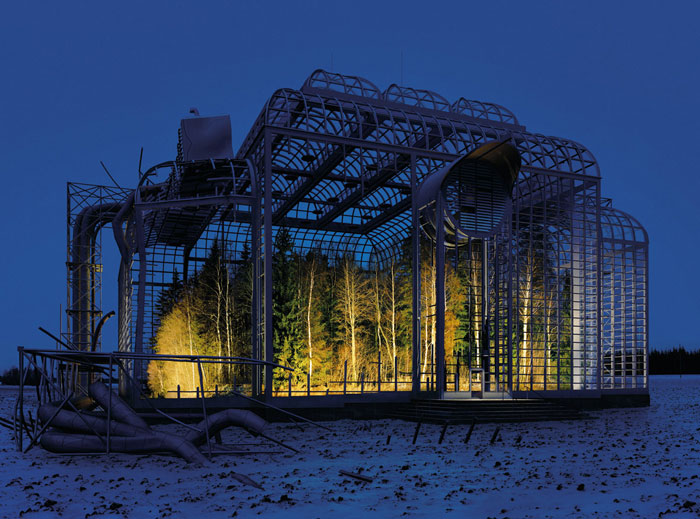
The basic premise of Halso’s digitally manipulated work is that “nature” has been transformed into a museum display – yet the public’s interaction with this new, endangered artifact is limited to spectacular roller coaster rides, perfectly reflected in the still waters they pass over. Alternatively, you can visit this steamy, delirious, quasi-Parisian gallery of iron and glass roofs built arching into disappearance over pine forests.

[Image: Kitka-river by Ilkka Halso].

These are “shelters,” the artist writes, “massive buildings where big ecosystems could be stored.”

The more I think about this project, the more interesting it gets; someone should write a novel set in this place – a kind of eco-catastrophic sequel to Westworld, perhaps – or, at the very least, someone should put Halso’s images on display in the United States. They’d also make a gorgeous spread in Wired.

In any case, be sure to spend time clicking around through Halso’s site. It’s worth it. And check out another of Halso’s projects, featured on Pruned back in 2005.

Urban Knot Theory

[Image: From Blend, where this post first appeared (translated into Dutch)].

Rumor has it that a university outside Manchester teaches courses in mathematics and knot theory not inside comfortable, well-lit classrooms – the university has none – but down in the sewers, drains, valves, and storm tunnels built long ago beneath the city. That subterranean world of old Victorian brickwork is measured, sketched, and catalogued every year by new students; they spend whole weeks at a time mapping the curvature of spillway walls, graphing intersections of unexplored side-channels.
The results are then compared to diagrams of Euclidean geometry.
Manchester’s storm overflow sewers, the rumor goes, are actually topological models. They are knot theory in built form.
Other rumors claim that a former student of that program is now Chief Engineer for the city of Brisbane, Australia, where he leads the construction of new civic infrastructure; every sewer and spillway built there is designed by him alone. As a result, each time you flush a toilet in Brisbane, a bewildering and exhaustively contorted world of concrete knots and brick culverts comes to life, engineered to faultless precision, washing everyone’s waste out to sea.
Manifolds, loops, toroids, even prime number sequences: the entire history of Western mathematics can be derived from the sewers of Brisbane, monuments of urban plumbing.

[Image: An artificial waterfall below the surface of the earth, photographed by Siologen].

Perhaps even as you read this, meanwhile, two extraordinary photographers – under the names Siologen and Dsankt – are busy documenting these topologically complex systems built beneath cities throughout the UK, Australia, Canada, greater Europe, and beyond.
Siologen ranks tunnels according to their “connectivity, variation and age,” he explained in an email, and he travels literally around the world to explore new systems, collecting tetanus shots along the way…
Some drains, he claims, resemble subterranean car parts, as if glimpsing, from within, huge engines attached to the underside of the city, resonating with the echoes of unseen pumps. For instance, Sidedraught Induction, Siologen writes, referring to a system in Manchester, “reminds me of a Stromberg carburetor.”

[Image: Tower of ladders and platforms, photographed by Siologen].

The drains, then, are even named – “the person who finds them, names them,” Siologen says – ranging from The Motherload to the ROTOR Bunker, to systems called Supercharger, Maze, Processor, Zardox, and The Works. Post that name, with photographs, onto enough websites, and eventually the label sticks. The sewers are a known geography.
Dsankt, meanwhile, actually boats his way into the underworld, boarding small skiffs in the rivers of outer Brisbane and following tides up intake valves, ducking beneath dangling scraps of sewage. His visits to the subcity are therefore carefully timed: should the waters rise faster than expected, both he and his boat will be crushed – shipwrecked in a world of abstract concrete rooms, slowly flooding.

[Image: Black and white topology of intake valves, photographed by Dsankt].

Apparently, Australian drains sound different than drains in the UK. In Sydney, for instance, there are “weird acoustics due to the jagged facets of rock in the walls,” Siologen explains, whereas London’s tunnels “sound wet” – and smell like shit. “Mostly it’s the sound of rushing water, with the clank of cars running over loose manhole lids and, of course, the splashing of people walking through.”

[Images: The human encounter with geometry by torchlight, photographed by Siologen].

Unreliable sources suggest that the earliest Victorian sewer engineers were also trained to make musical instruments: thus many storm drains beneath London are designed like saxophones, tubas, and flutes. Distant changes in air pressure cause the whole system to shudder, whistling subliminally on the edges of the wind, a soundtrack for the city so beautiful it’s often hypnotic. If you wait long enough in certain alleys in Soho, you’ll hear it, droning beneath the rustle of crisp bags and trash.
It is rumored that the final, dying words of composer John Cage were: “Make sure they play my London piece… You have to hear my London piece…” He was referring, many now believe, to a piece written for the subterranean saxophony of London’s sewers.

[Image: Instrumental curvature, photographed by Siologen].

In any case, it is worth wondering what these tunnels will look like in five hundred years’ time. Will future archaeologists correctly conclude that all these drains, carved beneath the cities of the world, from Cairo to Shenzhen, were indeed textbooks in advanced knot theory? Or will those labyrinthine tunnels and networks of spillways simply appear to be some kind of prehistoric earthwork sculpture – Giza, Stonehenge, Easter Island, Heathrow – abandoned in the subsiding clay?
Perhaps the entire archaeological profession will be revolutionized by the discovery that alignments exist between the sewers of central Paris and the rising summer sun – lines of solstice and equinox that fill whole drains with light. Anthropologists will speculate that vast mirrors once stood at the junctions of empty corridors, illuminating the underworld bright as day. Post-graduate researchers will apply for funding to re-construct that subterranean maze of mirrors: reflections hitting reflections… hitting reflections.
Finally, on a summer solstice five hundred years from now, the archaeologists will stand, cameras in hand, as every sewer system in Europe begins to shine, light escaping from manhole covers, the surface of the earth faintly glowing.

[Image: Shining tunnelwork of the future, photographed by Siologen].

[Note: Thanks to Dsankt for putting me in touch with Siologen – and to Siologen for answering my questions and supplying the images for print. For more urban exploration, meanwhile, see London Topological; and under no circumstances miss the DIY Supervillain Hideout on Dsankt’s own Sleepy City. Finally, the image captions, above, are my own descriptions, not the actual titles of the photographs – which is why they’re so pretentious].

War/Photography: An Interview with Simon Norfolk

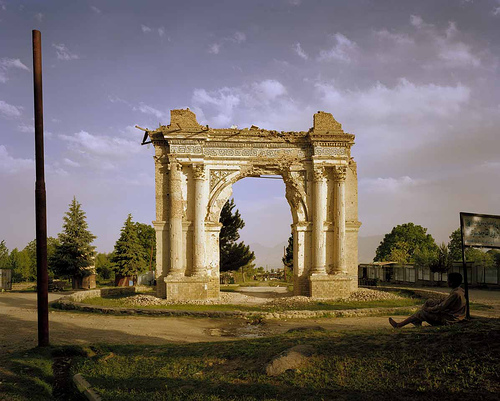
[Image: Simon Norfolk. “King Amanullah’s Victory Arch built to celebrate the 1919 winning of Independence from the British. Paghman, Kabul Province.” From Afghanistan: Chronotopia.]

As photographer Simon Norfolk claims in the following interview, his work documents an international “military sublime.” His photos reveal half-collapsed buildings, destroyed cinemas, and unpopulated urban ruins in diagonal shafts of morning sunlight – from Iraq to Rwanda, Bosnia to Afghanistan – before venturing further afield into more distant, and surprising, landscapes of modern warfare. These include the sterile, climate-controlled rooms of military command centers, and the gargantuan supercomputers that design and simulate nuclear warheads.

As Norfolk himself writes, in a short but profoundly interesting text called Et in Arcadia Ego: “These photographs form chapters in a larger project attempting to understand how war, and the need to fight war, has formed our world: how so many of the spaces we occupy; the technologies we use; and the ways we understand ourselves, are created by military conflict.”
Indeed, he reminds us, “anybody interested in the effects of war quickly becomes an expert in ruins.”
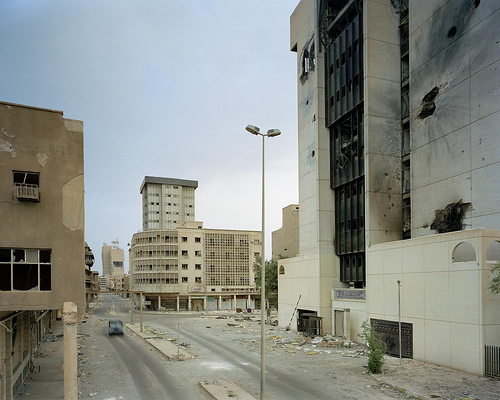
[Image: Simon Norfolk. “Rashid Street in Central Baghdad. The buildng on the right overlooks the bridge and so was heavily damaged in the fighting.”]

Norfolk’s written work delivers crisp and often stunning insights about urban design and historical landscapes. Later, in the same essay, he writes:

What these “landscapes” have in common – their fundamental basis in war – is always downplayed in our society. I was astounded to discover that the long, straight, bustling, commercial road that runs through my neighbourhood of London follows an old Roman road. In places the Roman stones are still buried beneath the modern tarmac. Crucially, it needs to be understood that the road system built by the Romans was their highest military technology, their equivalent of the stealth bomber or the Apache helicopter – a technology that allowed a huge empire to be maintained by a relatively small army, that could move quickly and safely along these paved, all-weather roads. It is extraordinary that London, a city that ought to be shaped by Tudor kings, the British Empire, Victorian engineers and modern international Finance, is a city fundamentally drawn, even to this day, by abandoned Roman military hardware.

I first got in touch with Norfolk after I’d seen his portraits of supercomputers (posted here several months ago as Rooms of algebraic theology). I was particularly impressed, however, by his photographs of Ascension Island, a joint US/UK surveillance outpost in the south Atlantic.

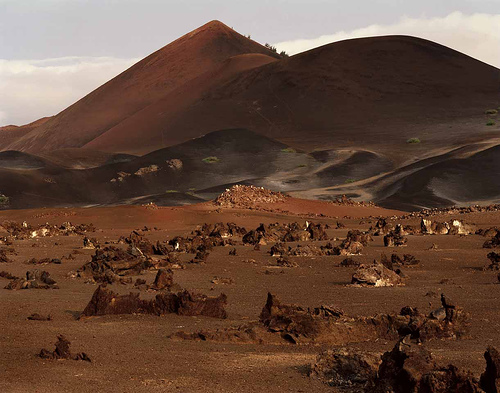
As Norfolk explains: “Although only 64 km square and mostly ash and lava fields, the island is festooned with more than 100 antenna relays. These are bizarre; like some kind of aerial spaghetti. Some are wire versions of the Millennium Dome; some like large skeletal bomber aircraft raised on tall pylons; and some are delicate cones and spirals.” This technologically Dr. Seuss-like landscape, “against a background of lifeless, red, volcanic ash is unearthly – more akin to a base on Mars.”

[Image: Simon Norfolk. Ascension Island, South Atlantic. “On the edge of the Broken Tooth Live Firing Range on the slopes of Sister’s Peak. Tyre tracks by the RAF. Distant aerials part of the American-controlled complex along Pyramid Point Road. In the far distance Cross Hill with another American facility on its peak.”]

Norfolk and I soon set up an interview, which appears below. We discuss European Romanticism and the paintings of Claude Lorrain; the long-term urban effect of WWII bombing raids over Germany; Joseph Conrad’s Heart of Darkness; the military origins of grain in black and white film; genocide; the invasions of Iraq and Afghanistan; modern art; the modeling of nuclear warheads; and how to survive snipers in a combat zone – including some unexpected fashion tips for other war photographers.

Norfolk is the author of For most of it I have no words (with Michael Ignatieff), Bleed, and Afghanistan: Chronotopia.
We spoke via telephone.

• • •

[Image: Simon Norfolk. “Bullet-scarred outdoor cinema at the Palace of Culture in the Karte Char district of Kabul.” From Afghanistan: Chronotopia.]

BLDGBLOG: Could you start with a brief thematic introduction to your work?

Simon Norfolk: All of the work that I’ve been doing over the last five years is about warfare and the way war makes the world we live in. War shapes and designs our society. The landscapes that I look at are created by warfare and conflict. This is particularly true in Europe. I went to the city of Cologne, for instance, and the city of Cologne was built by Charlemagne – but Cologne has the shape that it does today because of the abilities and non-abilities of a Lancaster Bomber. It comes from what a Lancaster can do and what a Lancaster can’t do. What it cannot do is fly deep into Germany in the middle of the day and pinpoint-bomb a ball bearing factory. What it can do is fly to places that are quite near to England, that are five miles across, on a bend in the river, under moonlight, and then hit them with large amounts of H.E.. And if you do that, you end up with a city that looks like Cologne – the way the city’s shaped.

So I started off in Afghanistan photographing literal battlefields – but I’m trying to stretch that idea of what a battlefield is. Because all the interesting money now – the new money, the exciting stuff – is about entirely new realms of warfare: inside cyberspace, inside parts of the electromagnetic spectrum: eavesdropping, intelligence, satellite warfare, imaging. This is where all the exciting stuff is going to happen in twenty years’ time. So I wanted to stretch that idea of what a battleground could be. What is a landscape – a surface, an environment, a space – created by warfare?

[Image: Simon Norfolk. “Victory arch built by the Northern Alliance at the entrance to a local commander’s HQ in Bamiyan. The empty niche housed the smaller of the two Buddhas, destroyed by the Taliban in 2001.” From Afghanistan: Chronotopia.]

BLDGBLOG: And that’s how you started taking pictures of supercomputers?

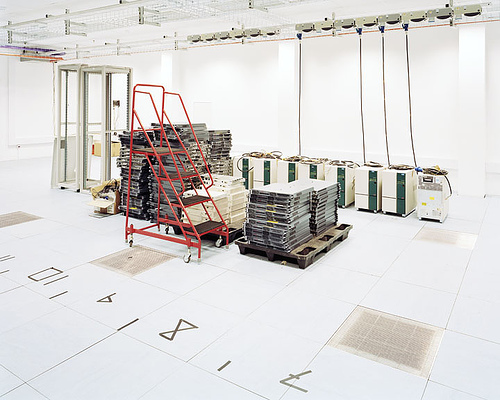
Norfolk: Those supercomputers – big BlueGene, in particular – those are battlegrounds. BlueGene is designing and thinking about a space that is only about 30cm across and exists for about a billionth of a second, and that’s an exploding nuclear warhead. BlueGene is thinking about and modeling that space very intensely, because what happens there is very complicated.

That computer is as much a battlefield as a place in Afghanistan is, full of bullet holes.

[Image: Simon Norfolk. “BlueGene/L, the world’s biggest computer, at Lawrence Livermore Laboratory, California, USA. It is the size of 132,000 PCs. It is used to design and maintain America’s nuclear weapons.” On his website, Norfolk notes that the computer is used for “modeling physics inside an exploding nuclear warhead.”]

BLDGBLOG: In the context of those computers, your references to the divine proved quite controversial – in the comments, for instance, at the end of that earlier post on BLDGBLOG where the photographs appeared. Could you talk more about these overlaps between the military, computer technology, and what you think is “godlike” about the latter?

Norfolk: Where weapons and supercomputers fit in for me is in a military-industrial complex. The problem is that that complex has drifted off so far above any idea of democratic control – even Eisenhower pointed this out – that I would call it godlike. It’s beyond irrational, it’s beyond any kind of comprehension in a scientific sense. It’s designing nuclear weapons that can destroy the world more efficiently – when we already have nuclear weapons that can destroy the world many times over.

People seem to think that I’m saying oh, they’re full of gods, or look, this is where god lives… But obviously I don’t think that. I don’t think that those computers are somehow unprogrammed by humans, or supernatural. What I’m concerned about is that those humans, who have programmed them, aren’t warm and fuzzy professors like The Nutty Professor. They’re introverted people working in the basements of DynaCorp, and General Dynamics, and Raytheon, and they’re so far beyond any kind of democratic control that you or I will ever have over what they do.

It ends up being like a relationship with the sublime – a military sublime. All of the work I’m doing, I might even call it: “Toward a Military Sublime.” Because these objects are beyond: they’re inscrutable, uncontrollable, beyond democracy.
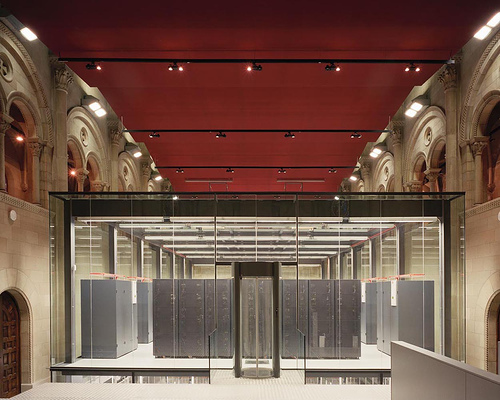
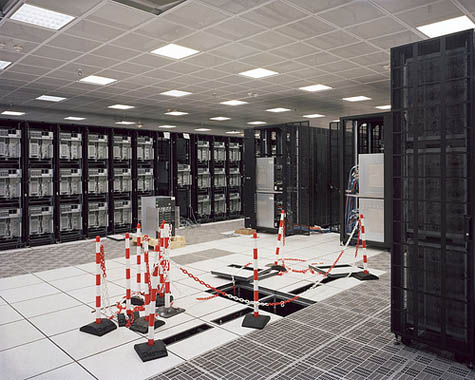
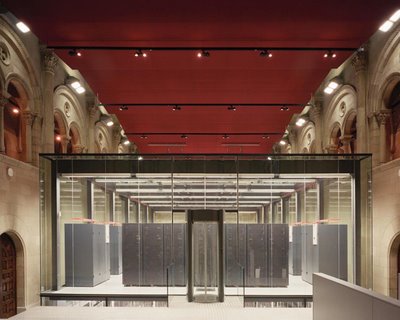
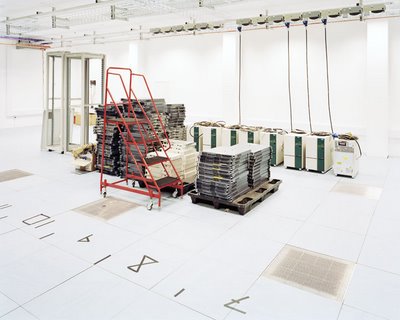
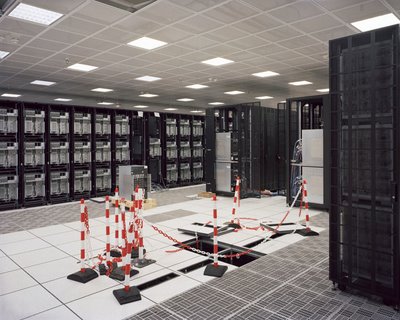
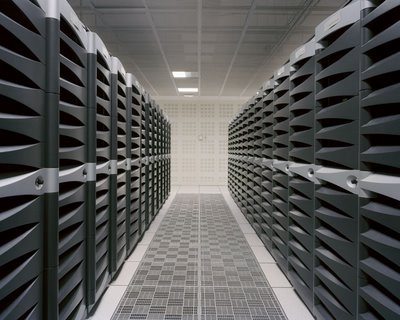
[Images: Simon Norfolk. Top: The Mare Nostrum, housed in a deconsecrated church in the Barcelona Supercomputer Centre, Spain. Middle: “Commissariat à l’énergie atomique, Bruyers-le-Chalet, near Paris. CEA designs and maintains France’s nuclear weapons. Installation of the new Tera10 supercomputer. The red poles are to prevent any accidents by falling down the open holes during installation.” Bottom: CEA. “A ‘cold aisle’ between two rows of TERA-1 racks.”]

BLDGBLOG: One of your photographs from Ascension Island shows a perfectly white-washed church – but, in the background, you see a military radar installation. There’s a fantastic overlap there between the theological lines of communication represented by the church, and the military/electromagnetic lines of communication represented by the radar. Both are immaterial, but both appear in the photograph.

Norfolk: [laughs] I’ve just been in the Outer Hebrides, off the coast of Scotland, where they have one of the biggest missile testing ranges in the world. It’s mainly a radar site – to follow the missiles down-range, when they fire missiles into the north Atlantic – but there’s other stuff out there, too: there’s submarine surveillance stuff and ocean surveillance stuff, and it’s all on top of this mountain range. But at the foot of the mountain there’s also a statue of the Madonna. It’s called The Madonna of the Isles – but the local people call it Where God Meets Radar.

[laughter]

It’s a bugger, though, because the way the mountain curves, you can’t actually get a picture of both of them at the same time. There’s no place you can actually get both things in the same frame. But when you visit, it’s just extraordinary: she’s a statue about 25′ high, with a child in her arms, made out of white marble, and on the hill about 100′ above are these huge white radomes, with these silently circling radar dishes.
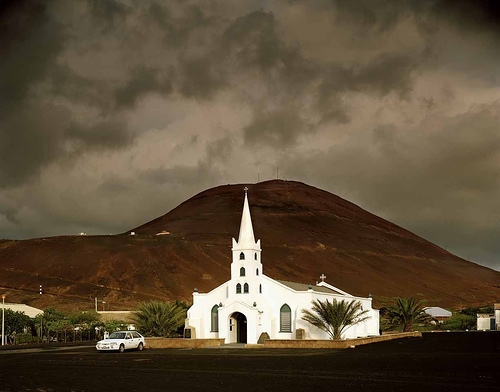
[Image: Simon Norfolk. Ascension Island, South Atlantic. “The Church Of St Mary in Georgetown with Cross Hill in the background with an American radar facility on its summit.”]

BLDGBLOG: Your photos are usually unpopulated. Is that a conscious artistic choice, or do you just happen to be photographing these places when there’s no one around?

Norfolk: Well, part of this interest of mine in the sublime means that a lot of the artistic ideas that I’m drawing on partly come out of the photography of ruins. When I was in Afghanistan photographing these places – photographing these ruins – I started looking at some of the very earliest photojournalists, and they were ruin photographers: Matthew Brady‘s pictures of battlefields at Gettysburg, or Roger Fenton‘s pictures from the Crimea. And there are no dead bodies. Well, there are dead bodies, but that’s very controversial – the corpses were arranged, etc.

But a lot of those photographers were, in turn, drawing upon ideas from 17th century and 18th century French landscape painting – European landscape painting. Claude Lorraine. Nicolas Poussin. Ruins have a very particular meaning in those pictures. They’re about the folly of human existence; they’re about the foolishness of empire. Those ruins of Claude Lorraine: it’s a collapsed Roman temple, and what he’s saying is that the greatest empires that were ever built – the empire of Rome, the Catholic church – these things have fallen down to earth. They all fall into ivy eventually.

So all the empires they could see being built in their own lifetimes – the British empire, the French empire, the Dutch empire – they were saying: look, all of this is crap. None of this is really permanent: all of these things rise and fall. All empires rise and fall and, in the long run, all of this is bullshit.

I wanted to try to copy some motifs from those paintings – in particular, that amazing golden light that someone like Claude Lorraine always used. Even when he does a painting called Midday, it’s bathed in this beautiful, golden light. To do that as a photographer, I can’t invent it like a painter can; I have to take the photographs very early in the morning. So they’re all shot at 4am.
[Image: Simon Norfolk. Ascension Island, South Atlantic. “The BBC World Service Atlantic Relay Station at English Bay.”]

BLDGBLOG: So of course no one’s around!

Norfolk: It is partly because of that that people aren’t there – but it’s also… for me, I think people kind of gobble up the photograph. They become what the photograph is. For me, people just aren’t that important; it’s about this panoptic process, it’s about this kind of eavesdropping, it’s about this ability to look into every aspect of our lives. And I think if you put people into these pictures, I don’t know – it would draw viewers away. It would draw viewers into the story of the people. It’s not about, you know, Bob who runs the radar dome; it’s about this thing that looks inside your email program, and listens to this phone call, and listens to every phone call in the world in every language, and washes it through computer programs. And if you say plutonium nerve gas bomb to me over the telephone, in an instant this computer is looking at what web pages you’ve been to recently, it’s looking at my credit card bills, it’s looking at your health records, it’s looking at the books I check out of the library. That’s what frightens me – it’s not about: here’s Dave, he works on the computer systems for Raytheon

So I’ve always tried to pull people out of the pictures – and, if they’re in my pictures, it’s usually because they represent an idea, really. I think if you’re going to talk about Dave, or Bob, or Wendy, you have to do it properly. You either do it properly or you don’t do it at all.

[Image: Simon Norfolk. Ascension Island, South Atlantic.”The BBC World Service Atlantic Relay Station at English Bay.”]

BLDGBLOG: How did you get to Ascension Island in the first place? Can anyone just buy a ticket ticket and go there?

Norfolk: You have to fill in a permission form – but, yeah, you can buy a ticket. A lot of birdwatchers go down to the Falklands, and airplanes have to refuel at Ascension Island. It’s expensive, but you can do it.

You also have to fill in a form which they go through, and it says what you’re up to and all the rest of it. So I’d filled in the form, and I’d said I was a photographer – but I got there and no one had read the forms! On my last day on the island, I phoned up and said: I’m a photojournalist, and I’ve been on the island for two weeks, and can I talk to someone up there…? And they fucking crapped themselves. They said how did you get here? Didn’t you fill out the forms? And I said yeah, didn’t you read the forms?

And they said, well – actually, nobody reads the forms.

[laughter]

BLDGBLOG: So much for international surveillance.

Norfolk: They also didn’t pick up any emails that said I was going to Ascension Island.

BLDGBLOG: Or any phonecalls you made while staying there.

Norfolk: It’s run by clowns, of course.
[Image: Simon Norfolk. Ascension Island, South Atlantic. “Looking towards the cinder cone of Sister’s Peak from English Bay Road. On the edge of the Broken Tooth Live Firing Range.”]

BLDGBLOG: It often seems like the most interesting thing about these places is what cannot be photographed.

Norfolk: Absolutely – absolutely. That’s why, whenever you see warfare now, it’s photographed in that same dreary, clichéd way: it’s metal boxes rolling across the desert. Every time you switch on CNN, or buy a newspaper, you see guys in metal boxes – because that looks good. These photojournalists, and these TV crews, they don’t explain the process: they show things that look good on TV. A satellite orbiting in space doesn’t look good. A submarine – you know, the greatest platform we’ve ever built for launching nuclear weapons and for surveillance – that has no presence whatsoever in how most people understand what the military does today.

The same is true of electromagnetic stuff – information warfare, cyber-warfare – and I wonder what photojournalists of the future are going to photograph? Are they still going to photograph guys with guns, shooting at each other? Because quite soon there aren’t going to be guys with guns shooting at each other. We’re quite soon getting to the era of UAVs and stuff. People aren’t even going to know what shot them – and there will be nothing to photograph.
[Images: Simon Norfolk. “The supercomputer at the Wellcome Trust’s Sangar Institute, Cambridge, UK.”]

BLDGBLOG: Except for empty rooms and computer systems.

Norfolk: Exactly. Look at the way the war in Afghanistan was photographed: what you got was a guy on a ridge in a turban watching a very, very far away explosion. That was war photography! That was the way the Afghan war was covered. What worries me is that, if these wars become invisible, then they will cease to exist in the popular imagination. I’m very worried that, because these things become invisible, they just – people don’t seem to be fucking bothered.

But, you know, wouldn’t it be amazing to have a series of portraits printed of missile systems, but you photographed them the way you’d photograph a BMW?

[laughter]

You get them straight off the production line in the factory, and then you polish them, and you wax them – so they’re just beautiful – and then you light them the way you would an Audi TT, with a black background, and you shoot them on a big camera. Just gorgeous – sculptural. Then the caption says, you know: Predator Drone. Hellfire Missile. Nuclear Warhead.

BLDGBLOG: It’s interesting that, on your website, it says you gave up photojournalism to move into landscape photography – yet that seems to have coincided with a more explicit politicization of your work.

Norfolk: Yeah, absolutely.

BLDGBLOG: So your projects are even more political now – yet they’re intended as landscape photography?

Norfolk: I mean, I didn’t get fed up with the subjects of photojournalism – I got fed up with the clichés of photojournalism, with its inability to talk about anything complicated. Photojournalism is a great tool for telling very simple stories: Here’s a good guy. Here’s a bad guy. It’s awful. But the stuff I was dealing with was getting more and more complicated – it felt like I was trying to play Rachmaninoff in boxing gloves. Incidentally, it’s also a tool that was invented in the 1940s – black and white film, the Leica, the 35mm lens, with a 1940s narrative. So, if I’m trying to do photojournalism, I’m meant to use a tool that was invented by Robert Capa?

I needed to find a more complicated way to draw people in. I’m not down on photojournalism – it does what it does very well – but its job is to offer all its information instantly and immediately. I thought the fact that this place in Afghanistan – this ruin – actually looks a little like Stonehenge: that interested me. I wanted to highlight that. I want you to be drawn to that. I want you to stay in my sphere of influence for slightly longer, so that you can think about these things. And taking pictures in 35mm doesn’t do it.

So the content of photojournalism interests me enormously, it’s just the tools that I had to work with I thought were terrible. I had to find a different syntax to negotiate those things.

BLDGBLOG: Ironically, though, your photos haven’t really been accepted by the art world yet – because of your subject matter.

Norfolk: Well, I cannot fucking believe that I go into an art gallery and people want to piss their lives away not talking about what’s going on in the world. Have they not switched on their TV and seen what’s going on out there? They have nothing to say about that? They’d rather look at pictures of their girlfriend’s bottom, or at their top ten favorite arseholes? Switch on the telly and see what’s going on in our world – particularly these last five years. If you’ve got nothing to say about that, then I wonder what the fucking hell you’re doing.

The idea of producing work which is only of interest to a couple of thousand people who have got art history degrees… The point of the world is to change it, and you can’t change it if you’re just talking about Roland Barthes or structuralist-semiotic gobbledygook that only a few thousand people can understand, let alone argue about.

That’s not why I take these photographs.

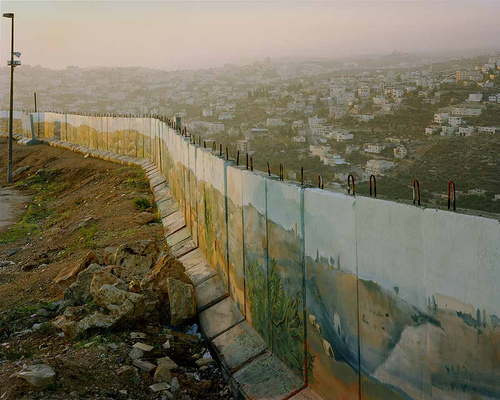
[Images: Simon Norfolk. Top: “Wrecked Ariana Afghan Airlines jets at Kabul Airport pushed into a mined area at the edge of the apron,” from Afghanistan: Chronotopia. Bottom: “The illegal Jewish settlement of Gilo, a suburb of Jerusalem. To deter snipers from the adjacent Palestinian village of Beit Jala (seen in the distance) a wall has been erected. To brighten the view on the Israeli side, it has been painted with the view as it would be if there were no Palestinians and no Beit Jala.”]

BLDGBLOG: Clearly you’re not taking these pictures – of military supercomputers and remote island surveillance systems – as a way to celebrate the future of warfare?

Norfolk: No, no. No.

BLDGBLOG: But what, then, is your relationship to what you describe, in one of your texts, as the Romantic, 18th-century nationalistic use of images, where ruined castles and army forts and so on were actually meant as a kind of homage to imperial valor? Are you taking pictures of military sites as a kind of ironic comment on nationalistic celebrations of global power?

Norfolk: No, I don’t think it’s ironic. I think what I’m in favor of is clarity. What annoys me about those artists is that there were things they actually stood for, but what seems to have happened is their ideas have been laundered. They’ve been infantilized. I don’t mind what the guy stands for – I just want to know what the guy stands for. I don’t want some low-fat version of his politics. And unless you can really understand what the fellow stood for, how can you comprehend what his ideas were about? How can you judge whether his paintings were good paintings or rubbish paintings?

The thing that pisses me off about so much modern art is that it carries no politics – it has nothing that it wants to say about the world. Without that passion, that political drive, to a piece of work – and I mean politics here very broadly – how can you ever really evaluate it? At the end of the day, I don’t think my politics are very popular right now, but what I would like to hear is what are your politics? Because if you’re not going to tell me, how can we ever possibly have an argument about whether you’re a clever person, your work is great, your work is crap, your art is profound, your art is trivial…?

For instance, I’m doing a lot of work these days on Paul Strand – and Paul Strand is a much more interesting photographer than most people think he is. The keepers of the flame, the big organizations that hold the platinum-plating prints and his photogravures, or whatever – these big museums, particularly in America, that have large collections – they don’t want the world to know that Strand was a major Marxist, his entire life. He was a massive Stalinist. That just dirties the waters in terms of knowing who Strand was. So Strand has become this rather meaningless pictorialist now. You look at any description of Strand’s work, and he was just a guy who photographed fence posts and little wooden huts in rural parts of the world. If you don’t understand his politics, how can you make any sense of what he was trying to do, or what he photographed? These people have completely laundered his reputation – completely deracinated the man.
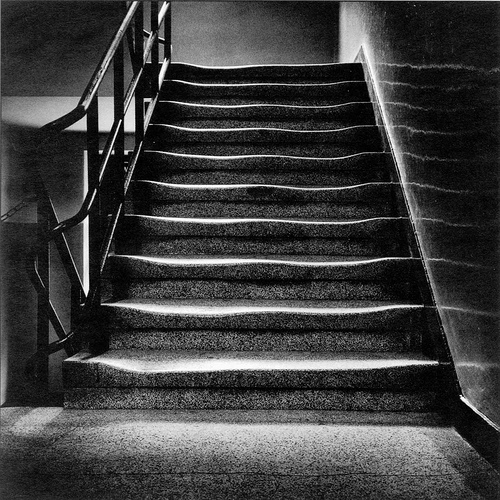
[Image: Simon Norfolk. Staircase at Auschwitz, with worn footsteps.]

BLDGBLOG: How does working outside of photojournalism, and even outside the art world, affect the actual practicality of getting into these places – photographing war zones and ruins and so on? You weren’t an embedded photographer in Iraq?

Norfolk: No, no. I was just kind of winging it.

You know, the camera I use is made of wood – it’s a 4×5 field camera, made of mahogany and brass – and it looks like an antique. Part of what I do is I make sure I don’t look very serious – it’s best to look like a harmless dickhead, really, so no one bothers you. You look like a nutter. And, to be honest, I play that up: I’ve got the bald head, and the Hawaiian shirt, and, to look at the image on the back of the camera, you have to put a blanket over your head and go in there with a magnifying glass, and it’s always on a tripod.

So I have two choices: I can either do these images from a speeding car, or I can stand there with a blanket over my head, and look like such a prick that somebody’s going to find me through their rifle scope and think: Oh! What’s that? Let’s go down and have a look… I can’t believe that photographers go into war zones dressed like soldiers! Soldiers are the people they shoot at. If I could wear a clown suit I would do it – if I could wear the big shoes and everything. I would wear the whole fucking thing.

I think there’s a lot to be said for that, actually, because I can either scrape in there on my belly, wearing camo, and sneak around; or I can stand right there in front, wearing a shirt that says, you know, Don’t shoot me. I’m a dick.
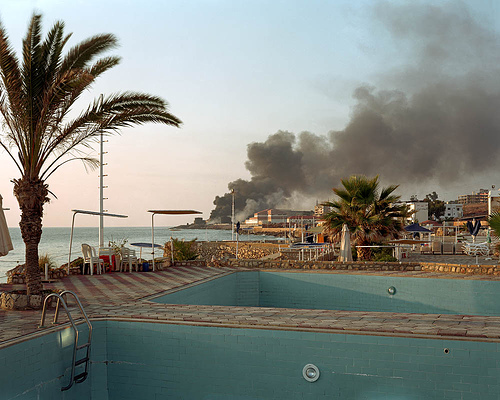
[Image: Simon Norfolk. “Storage depot for the oil-fired power station at Jiyé/Jiyeh bombed in the first few days of the [Israel-Hezbollah] war and still on fire and still dumping oil into the sea 20 days later. Seen from the Sands Rock Resort, 1 Aug 2006.”]

BLDGBLOG: Of course, you read how more journalists, photographers, and television reporters have been killed, or taken hostage, in Iraq over the last two years alone than were killed during the entirety of the Vietnam War – but, of course, this is the war where they’ve been embedded. They’re all –

Norfolk: The way the embeddeds are dressed!

BLDGBLOG: They’re dressed like combatants.

Norfolk: What are you thinking, going around in brown trousers and stuff? I don’t want to say that the people are to blame for what happened to them – but I would not do that. I just would not do that. You know those orange vests that guys working on the roads wear? I’ve had those made with the word Artist on the back. [laughs]

BLDGBLOG: You’ll probably get shot by a soldier now.

Norfolk: [laughs] So the practicalities – I mean, you still have to be able to shift like a journalist does. You have to find out where things are, what’s going on – and you still have to get there.

[Image: Simon Norfolk. “A controlled explosion of an American fuel convoy in Iraq being filmed on the set of Over There, a Fox TV production about the life of a US Army platoon in contemporary Iraq. Being filmed in Chatsworth, just north of Los Angeles, Sept 2005.”]

BLDGBLOG: In your photos of movie sets, where a war scene is being filmed, it’s very clear that we’re looking at a staged event. It doesn’t look anything like real warfare. But have you ever found that the situation is reversed – where you’re shooting a real war scene, in Baghdad, say, but all the reporters from CNN and the BBC make it look like some kind of TV set?

Norfolk: Oh, yeah, yeah – on the roof of the Palestine Hotel. You’re up on the big, flat roof of the hotel, and you’re looking down on this ballroom, and the streets of Baghdad are below that. The reporters were all camped out on the roof of this ballroom – with little tents and little pergolas with lights and generators and stuff – and you could see where it was evening in the world because you could see whose TV crews were up and working. You could see all the Europeans were out – oh, it must be 6 o’clock in Europe. Oh, it must be 7 o’clock now in the U.S., because all the Americans are out. Then the Japanese come out later on, and they do it all at 3 o’clock in the morning because that’s 5 o’clock in Japan, or whatever. They’re all sharing gear and generators and stuff, and using the same background – but they’re acting like they’re on their own, out on the frontline. Standing right next to each other. Quite bizarre. It was like some kind of casting for a new film.

There are these weird layers. When I photographed the Iraq movie, it was done, interestingly, in the same place where they made the M*A*S*H TV series – which is why it looks like M*A*S*H The same landscape that could be M*A*S*H could also be North Korea – and it could also be Iraq. What else could it be? Greenland? [laughs] So there are these weird layers of history – and weird layers of non-history, as well. These juxtapositions of time kind of crashing into each other.

The first book I did, the Afghanistan book, I called it Chronotopia, and that’s a term taken from Mikhail Bakhtin. The idea of the chronotope – chronos is time, and topos is place – is any place where these layers of time fit upon each other. Either satisfactorily or uncomfortably – it fascinates me. Especially coming from Europe. In northern France, there are places where the English fought the French in 1347 – and it’s the same place we fought the Germans in 1914, and it’s the same place where the Americans rolled through in 1944. Their battle cemeteries are within a hundred yards of each other. These places have thicknesses, military thicknesses –

BLDGBLOG: It’s like the Roman roads in London, that you describe in your writings: they’re actually a military transport system, still there beneath modern streets. London is a military landscape.

Norfolk: Absolutely: it’s military technology left lying around. This stuff comes down to us. You know, the reason I can take night shot photographs is not because Mr. Kodak wanted me to take these photographs, but because he needed to design a certain kind of film that could go into a Mosquito bomber and take reconnaissance photographs during the Second World War. That’s really when all the advances in film were made – in grain-structure – and it was for aerial reconnaissance.
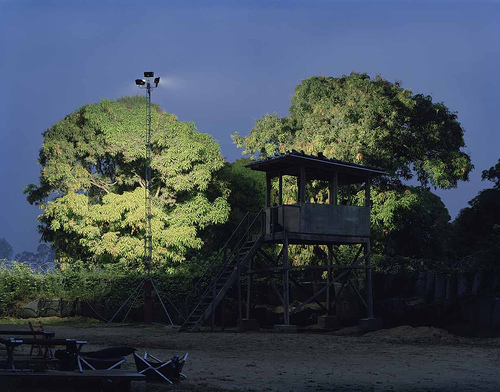
[Image: Simon Norfolk. From “Hotel Africa.”]

BLDGBLOG: Your “Hotel Africa” series reminds me a bit of some J.G. Ballard stories – overgrown air conditioning systems, tent cities, native warfare, and so on – and you mention Shelley and Byron in some of your texts; so I’m curious if there are any intentional literary references in your work? Or is there a particular book or a particular writer who has influenced you?

Norfolk: Unfortunately, this is the biggest cliché of Africa, but the first book I wrote was pretty much based on Joseph Conrad’s Heart of Darkness. Not because it features pictures of Africa, but because it has a curve, I think. What fascinates me about Conrad’s book is that it starts in the real world, this world that we understand – they’re in a boat in the Thames estuary – and he says, This, too, was one of the dark places of the earth… And what he’s talking about are these chronotopes, these layered histories. Then he says, I’ll tell you a story about the Congo, and so he goes to Belgium, and then he goes to Africa, and then he starts going up the river.

So little by little you move away from these certainties; you move toward instabilities around the narrator as he talks. As he moves up the river, everything becomes harder to grasp. So the idea of that curve – I took that from Conrad.

When I did the first book, it started out with these photojournalistic pictures of genocide in Rwanda – it was about six months after the genocide, and there were 2000 bodies in one church alone. Then I went back in history, looking at other genocides that had taken place: at Auschwitz, where there’s bits of evidence lying around, and then back to Namibia in 1905, and then to the Armenian genocide, where there’s almost no evidence at all. There, the pictures become pictures of snow and sand, as a metaphor about a covering and a hiding, a new layer, so these evidences become harder and harder to discern and unwrap.

That was also something that I took from Conrad.
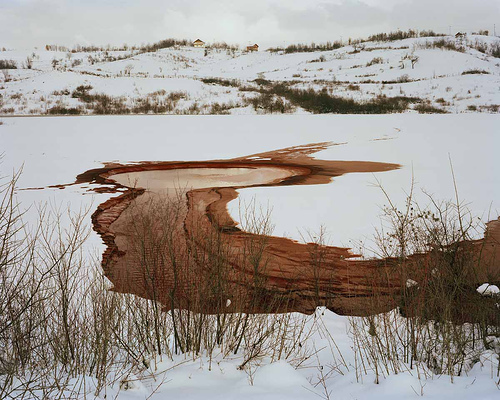
[Image: Simon Norfolk. “Tailings pond of the Petkovici Dam. A mass grave was discovered dug into the earth of the dam and bodies were also thrown into the lake.” From Bleed.]

• • •

Simon Norfolk will speak at the Los Angeles County Museum of Art on Saturday, December 2nd, at 4pm, in the Brown Auditorium. If you’re anywhere near Los Angeles, consider stopping by.
Meanwhile, there are many, many more photographs available on Norfolk’s website, and his own writings deserve a long look. His books – For most of it I have no words, Bleed, and Afghanistan: Chronotopia – are also worthy acquisitions. Shit, it’s Christmas – buy all three.
Finally, a huge thank you to Simon Norfolk for his humor and patience during the long process of assembling this interview.

The Visionary State: An Interview with Erik Davis

[Image: Philip K. Dick’s former apartment complex, Fullerton, CA; photo ©Michael Rauner].

In The Visionary State, published last month by Chronicle Books, Erik Davis and Michael Rauner explore the religious landscape of California. The state’s cultural topography, Davis tells us, mirrors the physical terrain, “an overlapping set of diverse ecosystems, hanging, and sometimes quaking, on the literal edge of the West”:

This landscape ranges from pagan forests to ascetic deserts to the shifting shores of a watery void. It includes dizzying heights and terrible lows, and great urban zones of human construction. Even in its city life, California insists that there are more ways than one, with its major urban cultures roughly divided between the San Francisco Bay Area and greater Los Angeles. Indeed, Northern and Southern California are considered by some to be so different as to effectively constitute different states. But that is a mistake. California is not two: it is bipolar.

Indeed, the state is animated from below with “titanic forces implied by its geology,” Davis writes, and a “frontier strand of nature mysticism” long ago took conscious root.

[Image: The labyrinth in Sibley Volcanic Regional Preserve, Oakland; photo ©Michael Rauner].

Over the course of the book, the authors visit California’s “Buddha towns” and Vedantic ashrams, its National Parks and the properties of discontented theosophists. They try to fathom what strange mutations of 21st-century Christianity could produce Jesus, the “OC Superstar,” in whose name compassionate self-sacrifice and divine generosity have been reduced to a grinning statue rather pleased with itself in a well-watered grove of palm trees. They even stop by California’s hot springs, wineries, observatories, and mind labs – without forgetting the dark side of the state, where Charles Manson, “trippy folk songs,” and a psychedelic obsession with “the Now” all meet.
At one point Davis hilariously describes Anton LaVey, author of The Satanic Bible:

Born Howard Levey in 1930, LaVey was less a freak guru than a Playboy-era steak-and-martini man. He hated hippies and LSD, played Wurlitzer organs in strip clubs, and had no interest in mystically dissolving the ego. Though essentially a con man, LaVey had enough psychological frankness and sleazy charm to attract scores to the black masses he held at his house in the Outer Richmond, a place he had, as the song goes, painted black.

Meanwhile, fans of Blade Runner will be pleased to hear that Davis and Rauner visit the so-called Bradbury Building. There, in Ridley Scott’s film, lived J.F. Sebastian, abandoned by everyone and prematurely old, designing his robotic toys.

[Image: The Bradbury Building, Los Angeles; designed by George Wyman, the interior of the building “shoots upward toward a gabled canopy of glass, a lattice of light suspended over the delicate wrought-iron trusses that float in the clerestory haze.” Photo ©Michael Rauner].

Though I found the book philosophically adventurous, strangely good-humored, and particularly well-photographed, I will add that my own sense of the sacred – if I can phrase it as such – felt constantly challenged throughout. In other words, almost every time the authors visited a new site, I found myself immediately engaged in a kind of comparative landscape theology, asking: why is this place sacred?
Why on earth would they go there?
After all, is an archaeological site sacred to the Chumash more sacred than a street sacred to Philip K. Dick – or a quarry sacred to the Center for Land Use Interpretation? Or vice versa? What about a site favored by Erik Davis and Michael Rauner themselves, as they performed literally years of research for the book?
Such questions only lead to more of themselves. If the Mormons, for instance, launched a geostationary satellite over the city of Los Angeles, and they used it to broadcast radio sermons, is that precise location in the sky – a square-meter of rarefied air – to be considered sacred? Or is there a holy tide or blessed current that flows through the coves of Big Sur – whose landscape, a “wild harmony of impermanence and beauty,” Davis writes, so stunned the poet Robinson Jeffers? Does that visionary landscape have a correspondingly sacred hydroscape, some undersea world of the dead discussed a thousand years earlier in tribal myths? Can the weather be sacred – or even a particular storm?
And where does the geography of celebrity fit in…?
How do you differentiate between the sacred and the postmodern – and even outright kitsch?

• • •

I decided the best thing to do was talk to Davis himself – and so I called him. What follows is a transcript of the conversation.

[Images: Swami’s in Encinitas; a room in the Star Center, Unarius Academy of Science, El Cajon; and the Temple Room at Goddess Temple, Boulder Creek. Photos ©Michael Rauner].

BLDGBLOG: What were your criteria for deciding if a location – a building, a landscape, a particular street in Los Angeles – was sacred or visionary? Was your list of sites determined by rigorous historical and anthropological research, or by your own subjective interpretation of the sites?

Erik Davis: It was pretty clear, in an objective sense, where the major points were – the major locations to find. I was looking either for a new religious movement that had some literally visionary quality behind it, or for a novel, visionary development within an older and existing tradition. But there was always a grey area. On that level, I started to go a little bit on intuition – not just picking things that I liked, obviously, but picking things that seemed to complete or expand the story behind the book.

A good example is Luna, the tree that Julia Butterfly Hill sat in. Is it religious, is it spiritual, is it visionary? Even from an anthropological perspective, you’re kind of left wondering about that – but I really felt like there was something powerful in the way the tree came to serve as an update for the story of nature mysticism in California. We actually had to work quite a lot to access Luna – because it’s on private land, and they don’t like people to know where it is – but we did finally get there, and we went to the tree, and we thought, you know: it’s an impressive tree, it’s got these weird braces on it that stabilized it from where somebody tried to chop it down… But around the back side of the tree, there was this hollowed-out, blackened hole – and it was full of little trinkets. People had come, sneaking onto the land, in order to pay homage. There was a Navaho dreamcatcher and a little bodhisattva figure and a teacup and a little glyph of a tree – it was this rag-tag mixture of objects that had transformed the tree into a kind of miniature shrine.

I saw that and I thought: okay, I’m on the right track. [laughs]

[Image: Tire Tree, Salvation Mountain, Slab City; photo ©Michael Rauner. This, of course, is not Luna].

BLDGBLOG: At one point, you visit Gary Snyder’s zendo, and you mention the Beat Generation in several places throughout the book – but what about visiting a few more locations from the Beats’ literary heyday, like the apartment where Allen Ginsberg wrote “Howl”?

Davis: I tried to keep to things that were as explicitly religious or spiritual as possible – but, you can imagine, we had a long B-list of places we thought we could include. We were constantly asking for more space from the publisher! There are just so many elements that went into it: geography; wanting to keep a balance between urban and rural, north and south, different traditions – Buddhist, Christian, pagan, Native American. There were places that were famous vs. places that weren’t famous – this kind of high/low tension – but there were also things that just came out of the earlier sites. People start telling you stuff.

Like at Watts Towers: one of the guys who worked there was a local, and we started talking about assemblage, and collage, and using different pieces of trash to make art – and he said, Oh, you know, there’s this great place called Self Help Graphics out in East L.A., and I never would’ve found that place if I hadn’t met the guy. So Michael Rauner and I went out there, and it was great.

There were all kinds of synchronicities like that.

[Image: The Virgin of Guadalupe, Self Help Graphics & Art, East L.A.; photo ©Michael Rauner].

BLDGBLOG: This is perhaps a question more appropriate for J.G. Ballard than it is for The Visionary State, but were you ever tempted to include things like the site where James Dean was killed? Or the exact route driven by O.J. Simpson as he fled the police? For that matter, what if you’d found out that the whole Los Angeles freeway system had been designed by some rogue Freemason – and so all those knotted flyovers and concretized inner-city access routes are really a huge, psycho-spiritual landscape installation? Something between the Blythe geoglyph and the maze outside Grace Cathedral?

Davis: I would have loved that. [laughter] But, you know, the further you go into these weird mixtures of imagination and space, inevitably that kind of thing comes your way. That’s the thing about psychogeography – because, in a way, what I was doing was a kind of relatively gentle psychogeography of the state.

For instance, one thing I really enjoyed seeing was this witch’s map of California, where she’d laid the 7 chakras down onto different regions of the state – and I really wanted to work that in. But as far as the built, modern, commercial, secular landscape of California goes, if I had come across stuff like that – and I’m sure there’s some of it out there – then of course. That wouldn’t surprise me, for one thing – and it would excite me, for another. As I say, we have a long B-list.

[Image: The Witch House/Spadena House, Beverly Hills; photo ©Michael Rauner].

BLDGBLOG: Finally, where do earthquakes and seismology fit in all this? For some reason, I was expecting the San Andreas Fault to play a much larger role in the book – but you don’t really play that up. Which I actually then preferred.

Davis: You’re right – I didn’t play that too strongly – but it’s definitely there as a kind of psychic twist inside the state. For me, the seismology thing really worked in a more gentle way, and that was by talking about the hot springs. In the hot springs you see how the seismically active underside of California has created an environment where you get natural springs, and those become centers of healing.

When I started out, I thought there were going to be more explicit landscapes to include in the book – like Death Valley, and the San Andreas Fault – but the more we got into it, the more we found there were built structures just screaming out for inclusion. The book ended up shifting subtly toward architecture and the built environment, with the landscape providing the background, as it were, for these more specifically cultural places of spiritual and visionary power.

[Image: Huxley Street, Los Angeles, named after Aldous Huxley. By the end of his life, Davis tells us, Huxley had “concluded that people needed to change on an individual psychological level if civilization was going to avoid the disasters he glimpsed on the horizon: overpopulation, high-tech war, ecological catastrophe, and the sort of narcotized totalitarian propaganda depicted with such lasting power in Brave New World.” Photo ©Michael Rauner].

• • •

At the book’s end, Davis reconsiders sunset, an event that resets the westward clock to its cyclic eastern origins; it is, he says, “the holiest moment of the day.” But sunset is too easily mythologized: it resets no clocks, and its cycles are not human but magnetic, thermochemical, turning on an alien timescale that knows nothing of earthly religion.
In the myths that do arise, however, transforming westward motion into something yet more godly and epic, California plays a distinct – and vulnerable – role:

In the American imagination, California’s shores stage both the fulfillment and decline of the West, its final shot at paradise and its perilous fall into the sea. That is why the California dream encompasses both Arcadian frontier and apocalyptic end zone, Eden and Babylon. As Christopher Isherwood put it, “California is a tragic land – like Palestine, like every promised land.”

[Image: Noah Purifoy Sculpture Garden, Joshua Tree; photo ©Michael Rauner].

(Thanks to Erik Davis for his time and enthusiasm, and to Michael Rauner for the fantastic photographs. Meanwhile, Erik will be presenting The Visionary State at a number of locations; here’s his schedule of appearances.

Mud Mosques of Mali

[Image: Tambeni Mosque; Sebastian Schutyser, 2001].

Belgian photographer Sebastian Schutyser spent nearly four years photographing the mud mosques of Mali. A collection of 200 such black & white photographs is now online at ArchNet.

The project “began in 1998,” Schutyser explains: “For several months I traveled from village to village by bicycle and ‘pirogue’, navigating with IGN 1:200.000 maps. The inaccessibility of the area made me realize why this hadn’t been done before.”

[Images: (top) Noga Mosque, (bottom) Tenenkou Mosque; Sebastian Schutyser, 2001].
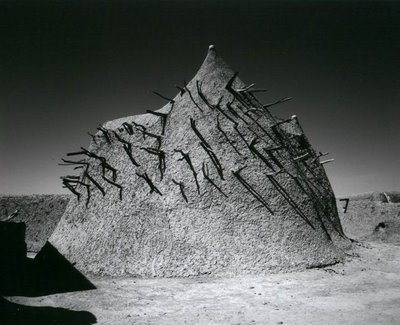
Within a few years, however, and over a period lasting roughly till the Spring of 2002, Schutyser managed “to travel faster, and reach the most remote parts of the Inner Delta. To increase the documentary value of the collection, I worked with 35mm color slides, and photographed every mosque from different angles. Whenever I encountered a particularly pretty mosque, I also photographed it on 4-5 inch black & white negative, to add to the ‘vintage’ collection.”

[Images: (top) Sébi Mosque, (bottom) Tilembeya Mosque; Sebastian Schutyser, 1998].
“With 515 mosques photographed,” Schutyser writes, “this collection shows a representative image of the adobe mosques of the Niger Inner Delta. Advancing modernity, and a lack of appreciation for this ‘archaic’ approach to building, are serious threats to the continuity of this living architecture.”

I might also add that each building is a kind of ritually re-repaired ventilation machine capable of generating its own microclimate: “During the day,” ArchNet explains, “the walls absorb the heat of the day that is released throughout the night, helping the interior of the mosque remain cool all day long. Some structures, for example, Djenné’s Great Mosque, also have roof vents with ceramic caps. These caps, made by the town’s women, can be removed at night to ventilate the interior spaces. Masons have integrated palm wood scaffolding into the building’s construction, not as beams, but as permanent scaffolding for the workers who apply plaster annually during the spring festival to restore the mosque. The palm beams also minimize the stress that comes from the extreme temperature and humidity changes typical of the climate.”

Finally, each tower is “often topped with a spire capped by an ostrich egg, symbolizing fertility and purity.”

Schutyser’s images have been collected in a beautiful book, co-written with Dorothee Gruner and Jean Dethier, called Banco: Adobe Mosques of the Inner Niger Delta.

[Image: Sinam Mosque; Sebastian Schutyser, 2002].

(All images in this post are ©Sebastian Schutyser).

Transformer Houses


In 1987, Canadian photographer Robin Collyer began documenting houses that aren’t houses at all – they’re architecturally-disguised electrical substations, complete with windows, blinds, and bourgeois landscaping.

“During the 1950s and 1960s,” Collyer explains in a recent issue of Cabinet Magazine, “the Hydro-Electric public utilities in the metropolitan region of Toronto built structures known as ‘Bungalow-Style Substations.’ These stations, which have transforming and switching functions, were constructed in a manner that mimics the style and character of the different neighborhoods.”


[Images: Robin Collyer].

Simulacra meant to reflect how it looks to be domestic and Canadian, “there are about 100 of these structures located on residential streets in the central and the suburban parts of the greater Toronto area.” Pictured here are only five of them. So if you live in suburban Toronto and your neighbor’s house is humming – perhaps now you know what’s really going on inside.

Meanwhile, the address 555 Spadina – i.e. the third image, above – shows up in this list of 322 properties owned by the city of Toronto. If anyone out there knows something about the other 321 buildings, be in touch!

(Note: These images come courtesy of the Centre for Contemporary Canadian Art – with the exception of the first, which appeared in Cabinet Magazine).

Rooms of algebraic theology

[Image: The supercomputer pictured above is the MareNostrum, “meaning ‘our sea,'” New Scientist writes; “it is housed in a 1920s chapel at the Technical University of Catalonia in Barcelona, Spain, and built from commercially available parts.” Photo by Simon Norfolk].

“The supercomputers I’m showing here are powerful almost beyond human understanding,” photographer Simon Norfolk explains, describing his extraordinary new images of supercomputers and their architectural settings. “They can map every molecule of the billions on a human DNA string; scrutinise at the atomic level the collision between two pieces of plutonium in an exploding bomb; or sketch the gravitational pull of every star in the galaxy upon every other star in the galaxy. These are not questions that humans could grapple with given plenty of time, a notebook and a sharp pencil.”

Norfolk has also photographed computers used for “mapping and predicting global virus outbreaks” and for “simulating automotive crash tests.”

[Image: “Modeling physics inside an exploding nuclear warhead.” Simon Norfolk].

These computers, Norfolk continues, “are omniscient and omnipresent and these are not qualities in which we find a simulacrum of ourselves – these are qualities that describe the Divine. The problem is not that these computers might one day resemble humans; it is that they already resemble gods.”

[Images: Simon Norfolk. The top image is titled “Mapping the human genome.” The others are the TERA-1 and the TERA-10].

In almost supernaturally sterile rooms, these angelic landscapes of silicon quietly hum their way through introspective worlds of calculation: derivatives, logorithms, advanced topologies. One could, in fact, imagine a whole new series of Duino Elegies, written by a posthumous Rainer Maria Rilke, in terrified praise of these cloistered machines – machines Rilke seems to describe preemptively in his “Seventh Elegy,” where the “annihilator” meets the “Angel.”

Rilke writes that “the external shrinks into less and less”:

Where once an enduring house was,
now a cerebral structure crosses our path, completely
belonging to the realm of concepts, as though it still stood in the brain.
Our age has built itself vast reservoirs of power,
formless as the straining energy that it wrests from the earth.
Temples are no longer known.

In this context, it seems almost like an act of religious sarcasm that the MareNostrum computer – pictured at the top of this post – has been housed in a chapel. (Of course, a consecrated supercomputer is certainly a stunning intellectual possibility – perhaps setting up the plot of Da Vinci Code 2, wherein future archaeologists discover that the Vatican is not a complex of buildings at all but a fully functioning Jesuit supercomputer).

In any case, because all harddrives are actually geological objects – careful rearrangements of minerals under the influence of artificial magnetic fields – these are mathematical terrains in the most exciting sense: the surface of the earth dreaming of stellar detonations.

[Images: Two close-ups of cerebral machines. Simon Norfolk].

Finally, Giordano Bruno, following Giulio Camillo, wrote extensively about the idea of a Memory Palace, or Memory Theater. As Victoria Nelson tells us, the basic idea was that an “esoterically trained memory was a godlike vessel for encapsulating the entire universe within a single human mind.” This was part of what Nelson calls a Neoplatonic “quasi-religion” that “venerated memory as an organ possessing magical and world-ordering powers.” Neoplatonists believed that “the whole cosmos could be ‘memorized’ in a much more overt imitatio dei and by this act magically incorporated into the human organism” – or, of course, into the air-cooled circuits of a supercomputer.

So if I were forced to take issue with the existence of these machines, it would not be because of their use in modeling new nuclear warheads – as Norfolk makes clear they do – but in something far more secondary, even faintly absurd: what I’d call the lack of a supercomputer poetics, or a more imaginative role for these machines to play in our literary and even religious lives. Oracular, Delphic, radically non-secular: they are either all or none of the above.

(With thanks to Simon Norfolk, who supplied all the images that appear in this post. And don’t miss BLDGBLOG’s later interview with Simon Norfolk, in which he discusses his war photography in much greater detail).