The Landscape Architecture of Auroras on Demand

I’ve mentioned the following story to so many people, I thought I might as well put up a quick post about it. There are strong Kristian Birkeland vibes with this—and, of course, anything involving an entire mountain transformed into a kind of passive-cosmic megamachine is bound to get my attention.

[Image: Watercolor by Karl Lemström, taken from the paper “From laboratory to mountaintop: Creating an artificial aurora in the late nineteenth century” by Fiona Amery.]

Karl Lemström was a 19th-century Finnish physicist who believed that he had figured out how the Northern Lights—and planetary auroras, more generally—were produced.

Lemström was convinced the lights were an electromagnetic phenomenon, Graham Lawton writes for New Scientist, while others argued for things like “meteoric dust” combusting in the sky. Lemström, Lawton writes, “was determined to prove them wrong. Not with a tabletop simulation, but by creating an actual, full-sized aurora in one of its natural habitats, the frigid mountains of Lapland.”

[Image: Extraordinary watercolor by Karl Lemström, taken from the paper “From laboratory to mountaintop: Creating an artificial aurora in the late nineteenth century” by Fiona Amery; also seen via New Scientist]

In November 1871, Lemström installed a kind of super-antenna on a mountain known as Luosmavaara, in what is now Sweden (in fact, Luosmavaara is right above the mining city of Kiruna, which is now infamous for being moved, building by building, to avoid collapsing into the ever-expanding mine).

Lemström’s device “consisted of a 2-square-metre spiral of copper wire held aloft on steel poles about 2 metres tall. Soldered to the wire were a series of metal rods that pointed skywards. He ran another copper wire 4 kilometres down the mountain, to which he attached a galvanometer to measure the current and a metal plate to ground the device. This elaborate apparatus was designed to channel and amplify the electric current that Lemström fervently believed was flowing from the atmosphere into the earth, and hence bring forth an aurora.”

As with Kristian Birkeland, Lemström’s experiments only got more ambitious from there. He ended up on a different mountain, known as Orantunturi, where he unfurled what Lawton calls a “copper wreath” nearly 900 square meters in size.

[Image: Watercolor by Karl Lemström, taken from the paper “From laboratory to mountaintop: Creating an artificial aurora in the late nineteenth century” by Fiona Amery.]

Lawton’s full article is worth reading for more details and context, but I would strongly urge you to read historian Fiona Amery’s paper, “From laboratory to mountaintop: Creating an artificial aurora in the late nineteenth century,” from which Lawton pulled the majority of his material.

There, Amery refers to “a tradition of mimetic experimentation in the late nineteenth century, whereby morphologists sought to scale down sublime natural phenomena to tabletop devices in the laboratory.” The story of Lemström, she quickly adds, is about a “different kind of imitation,” or the production of a 1:1 simulation that would “materialize at the same scale as the original phenomenon.”

Of particular interest in Amery’s piece is the central question of whether or not Lemström did, in fact, successfully model—that is, trigger—an aurora, or whether the instrumentation he installed on these mountains was simply coincidentally present during otherwise unrelated auroral displays, or, indeed, whether Lemström saw an aurora at all, not a similar effect known as St. Elmo’s Fire.

My own imagination, for whatever it’s worth, remains totally captivated by the idea of mountain-scale atmospheric machinery, where vast copper wreaths, perhaps resembling the fine metalwork of royal jewelry, have been draped down a mountainside as a means for calling titanic curtains of electricity down from space.

What’s more, I can’t stop thinking about what might have happened if a passive experimental apparatus of this scale had been left, operational but abandoned, in the distant woods somewhere, forgotten entirely by local generations, such that rich auroral displays burning above the local mountains every season are only later discovered to be, in a sense, artificial. Then local teenagers—or an intrepid grad student, or, for that matter, a lost cross-country skier—come through, pulling aside dead branches only to discover an enormous machine covered in two century’s worth of vegetation, perhaps wondering if what they’ve found was built by humans at all.

(Of very tangential but potentially related interest: Shining Path; less related but still cool: A Voice Moving Over The Waters.)

Covert Cartographics

[Image: Map Measuring Tool, CIA].

The U.S. Central Intelligence Agency has uploaded a massive set of images from their historic mapping unit to Flickr.

[Image: Triangular 24-Inch Engineering Scale, CIA].

The collections include state-of-the-art graphic tools for producing maps and other measured cartographic products, as well as the maps themselves. Organized by the decade of its production—including batches from the 1940s, 1950s, and 1960s—“each map is a time capsule of that era’s international issues,” as Allison Meier points out.

[Image: Terrain map of the Sinai Peninsula (1950s), CIA, CIA].

“The 1940s include a 1942 map of German dialects,” Meier writes, “and a 1944 map of concentration camps in the country. The 1950s, with innovative photomechanical reproduction and precast lead letters, saw maps on the Korean War and railroad construction in Communist China. The 1960s are punctuated by the Cuban Missile Crisis and Vietnam War, while the 1970s, with increasing map automation, contain charts of the Soviet invasion of Afghanistan, and the Arab oil embargo.”

[Images: The Austin Photo Interpretometer, CIA].

But it’s the mapping tools themselves that really interest me here.

On one level, these graphic devices are utterly mundane—triangular rulers, ten-point dividers, and interchangeable pen nibs, for example, any of which, on its own, would convey about as much magic as a ballpoint pen.

[Image: 10-Point Divider, CIA].

Nonetheless, there is something hugely compelling for me in glimpsing the actual devices through which a country’s global geopolitical influence was simultaneously mapped and strategized.

[Images: Rolling Disc Planimeter, CIA].

As the CIA points out, their earliest mapping division “produced some 8,000 hand-drawn maps and 64 plaster topographic 3-D models in support of the war effort. Many of their products played crucial roles in the planning and execution of major military operations in the European, North African, and Asian Theaters. On display here are just some of the many tools that OSS cartographers employed in their production process.”

[Image: Dietzgen Champion Drawing Instruments, CIA].

In a sense, it’s not unlike seeing the actual typewriter with which a particular author wrote her novels, or the battered, handheld sketchbooks a painter once carried with him to a distant mountaintop—only here, in art historical terms, we are looking at the graphic tools and visual documents through which a country’s overseas influence was realized and maintained.

It is a narrative of covert state power as relayed through cartographic objects, the outlines of an imperial nation-state arising from them like a ghost.

[Image: Stanley Improved Pantograph, CIA].

I’m reminded of one of my favorite books on the subject of geopolitics, literally understood: Rachel Hewitt’s Map of a Nation: A Biography of the Ordnance Survey.

Among other things, Hewitt’s book reveals the often deeply strange tools—including surreal glass rods—through which British mapmakers and other agents of terrestrial exploration measured their nascent empire, helping to transform landscape into a mathematized system of coordinates and, in the process, conveying to British authorities the exact volumetric extent of their political domain.

There was the empire, in other words—but there were also these exotic objects of measurement through which that same empire was conjured, as if through cartographic magic.

[Image: Keufel & Esser 20.5-inch Slide Rule, CIA].

In any case, check out more at the CIA’s “Cartography Tools” Flickr set.

(Originally spotted via Alessandro Musetta).

Landscape Futures Arrives

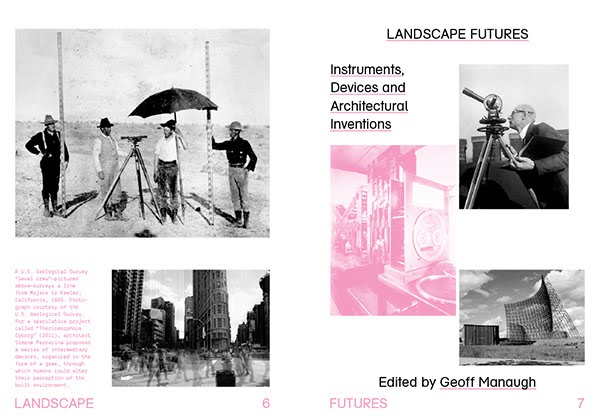
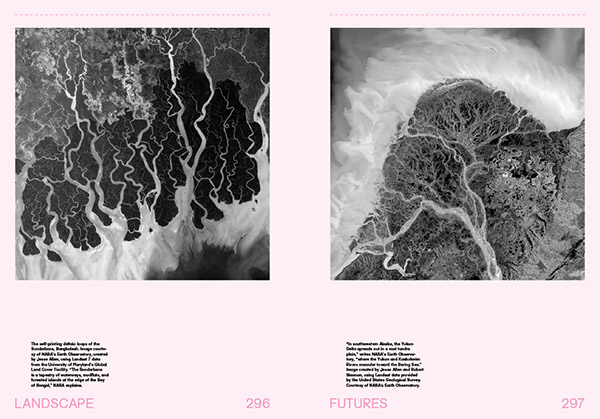
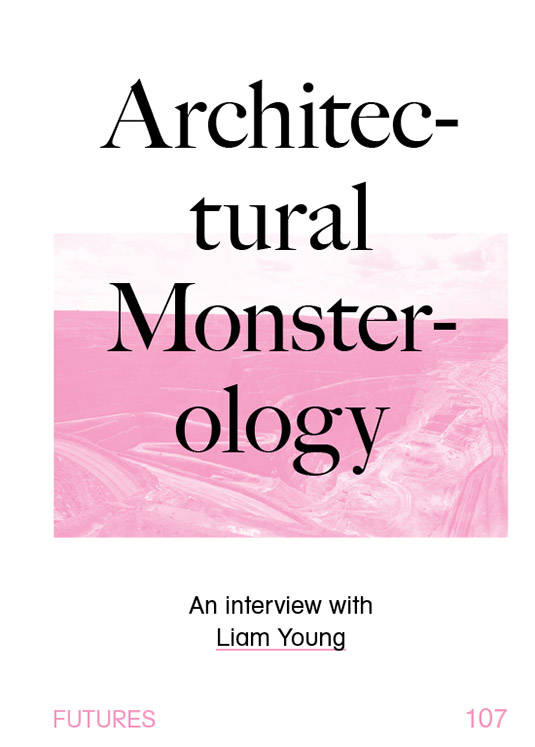
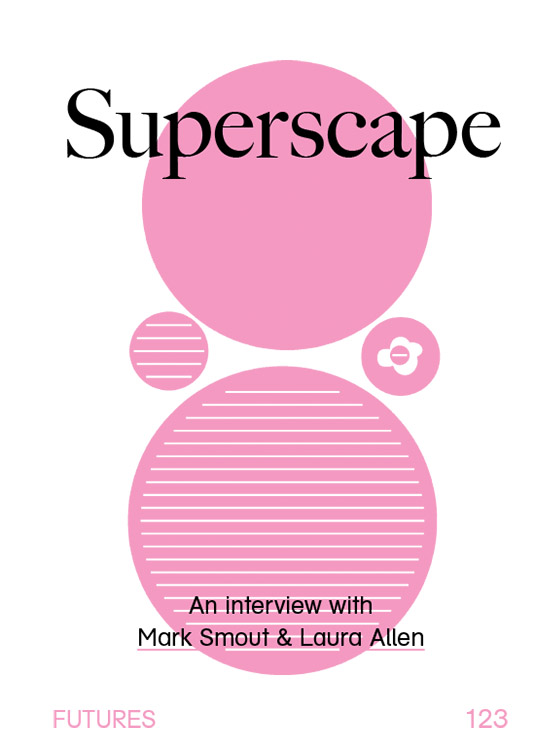
[Image: Internal title page from Landscape Futures; book design by Everything-Type-Company].

At long last, after a delay from the printer, Landscape Futures: Instruments, Devices and Architectural Inventions is finally out and shipping internationally.

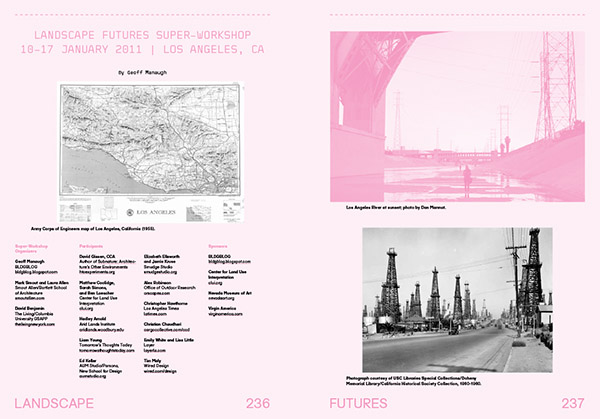
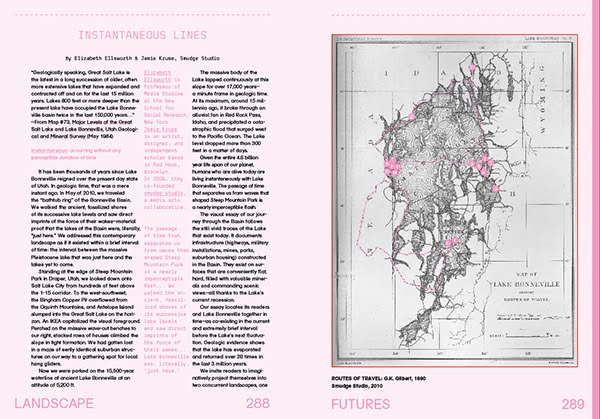
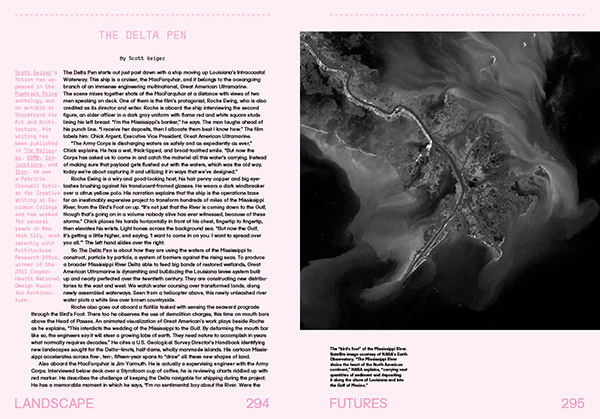
I am incredibly excited about the book, to be honest, and about the huge variety of content it features, including an original essay by Elizabeth Ellsworth & Jamie Kruse of Smudge Studio, a short piece of landscape fiction by Pushcart Prize-winning author Scott Geiger, and a readymade course outline—open for anyone looking to teach a course on oceanographic instrumentation—by Mammoth’s Rob Holmes.

These join reprints of classic texts by geologist Jan Zalasiewicz, on the incipient fossilization of our cities 100 million years from now; a look at the perverse history of weather warfare and the possibility of planetary-scale climate manipulation by James Fleming; and a brilliant analysis of the Temple of Dendur, currently held deep in the controlled atmosphere of New York’s Metropolitan Museum of Art, and its implications for architectural preservation elsewhere.

And even these are complemented by an urban hiking tour by the Center for Land Use Interpretation that takes you up into the hills of Los Angeles to visit check dams, debris basins, radio antennas, and cell phone towers, and a series of ultra-short stories set in a Chicago yet to come by Pruned‘s Alexander Trevi.

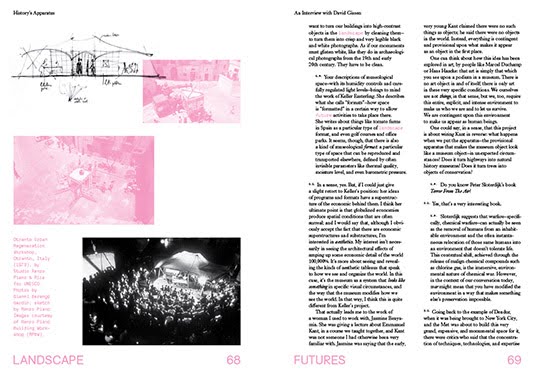
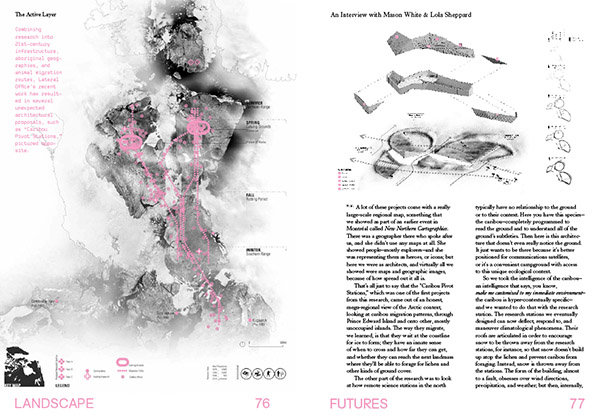
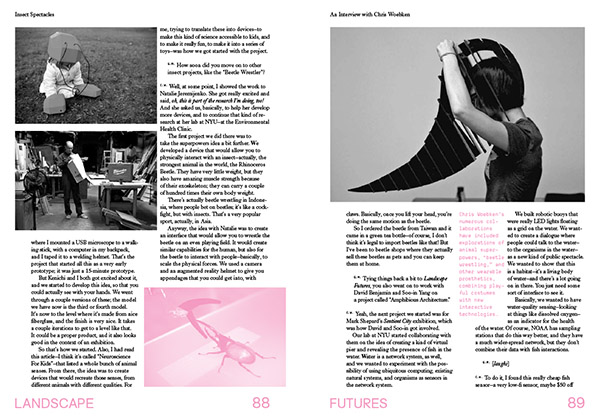
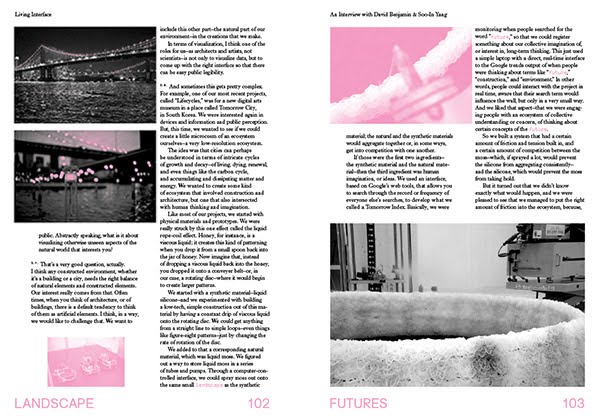
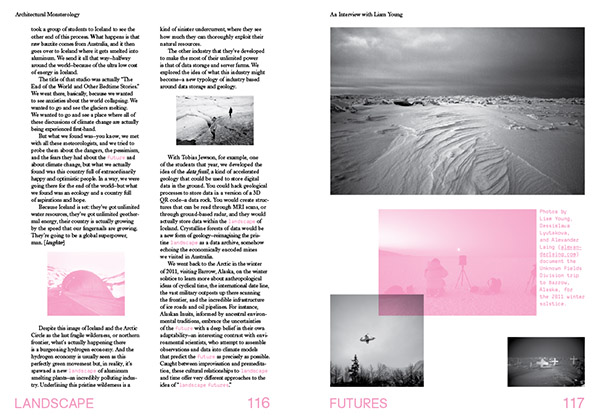
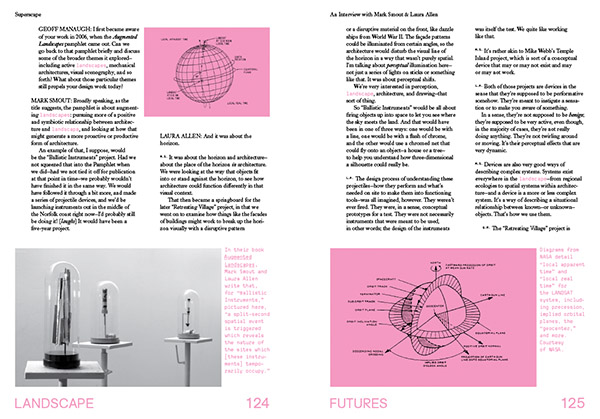
[Images: A few spreads from the “Landscape Futures Sourcebook” featured in Landscape Futures; book design by Everything-Type-Company].
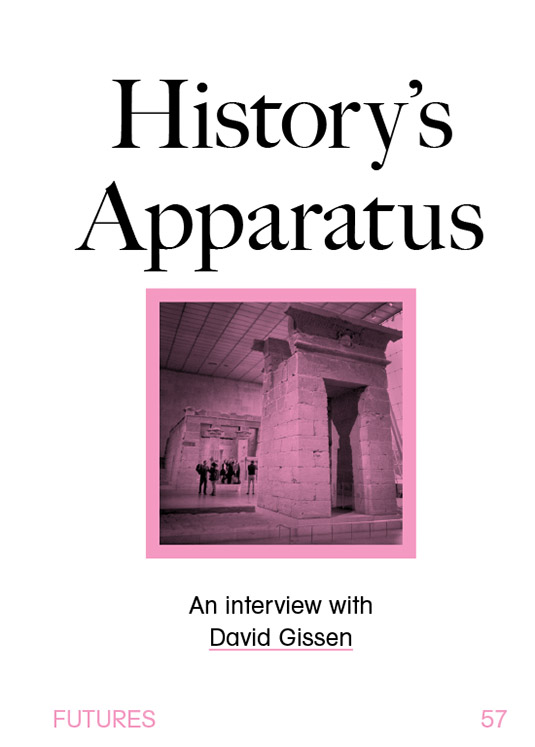
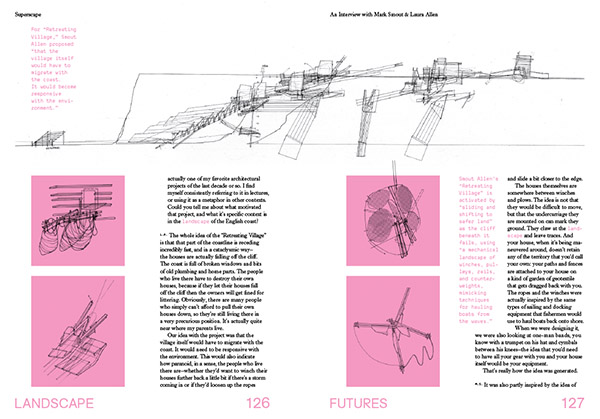
Of course, everything just listed supplements and expands on the heart of the book, which documents the eponymous exhibition hosted at the Nevada Museum of Art, featuring specially commissioned work by Smout Allen, David Gissen, and The Living, and pre-existing work by Liam Young, Chris Woebken & Kenichi Okada, and Lateral Office.

Extensive original interviews with the exhibiting architects and designers, and a long curator’s essay—describing the exhibition’s focus on the intermediary devices, instruments, and spatial machines that can fundamentally transform how human beings perceive and understand the landscapes around them—complete the book, in addition to hundreds of images, many maps, and an extensive use of metallic and fluorescent inks.

The book is currently only $17.97 on Amazon.com, as well, which seems like an almost unbelievable deal; now is an awesome time to buy a copy.

[Images: Interview spreads from Landscape Futures; book design by Everything-Type-Company].

In any case, I’ve written about Landscape Futures here before, and an exhaustive preview of it can be seen in this earlier post.

I just wanted to put up a notice that the book is finally shipping worldwide, with a new publication date of August 2013, and I look forward to hearing what people think. Enjoy!

Probe Field

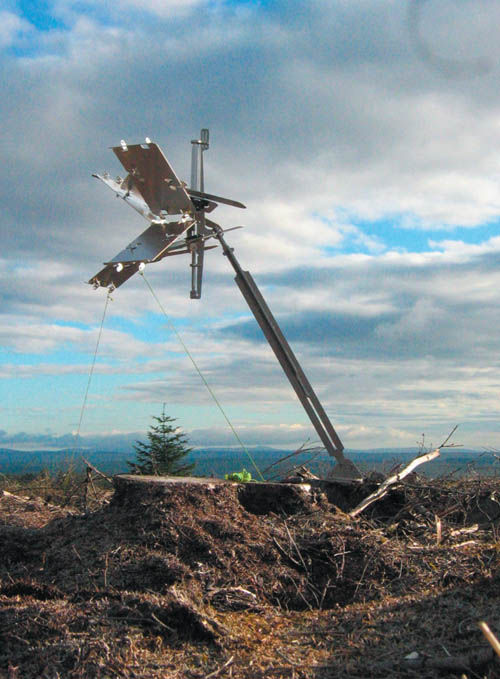
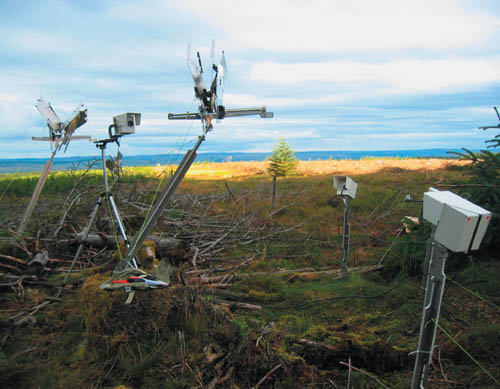
[Image: From “Kielder Probes” by Phil Ayres, Chris Leung, and Bob Sheil, courtesy of sixteen*(makers)].

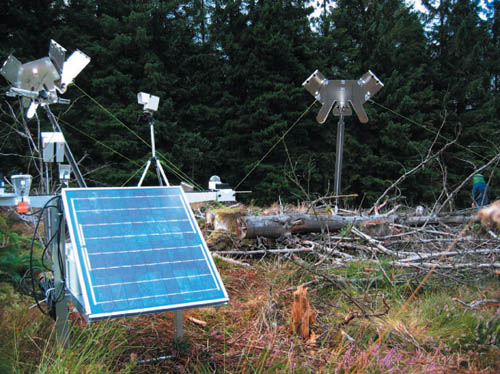
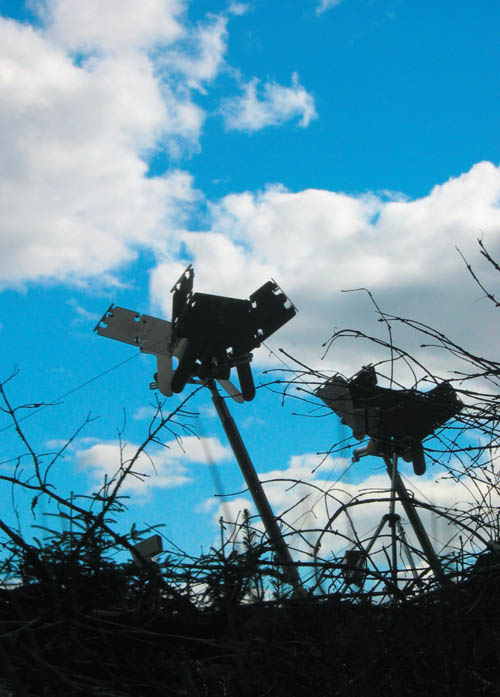
Beginning in 2003, architects Phil Ayres, Chris Leung, and Bob Sheil of sixteen*(makers) began experimenting with a group of “micro-environmental surveying probes” that he was later to install in Kielder Park, Northumbria, UK.

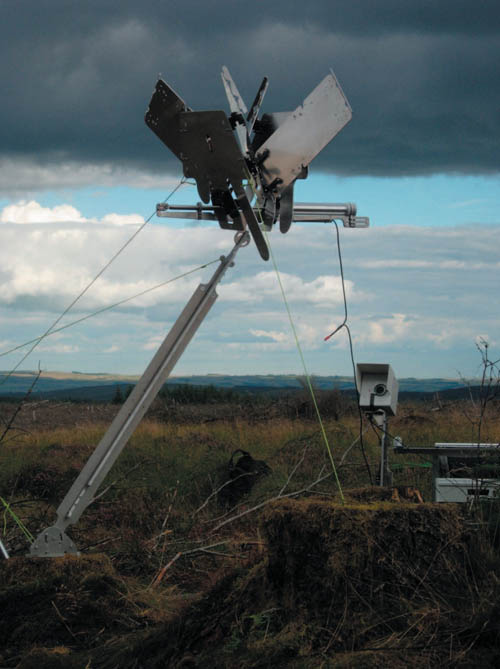
[Image: From “Kielder Probes” by Phil Ayres, Chris Leung, and Bob Sheil, courtesy of sixteen*(makers)].

The probes were “designed to act as dual monitors and responsive artefacts.” Which means what, exactly?

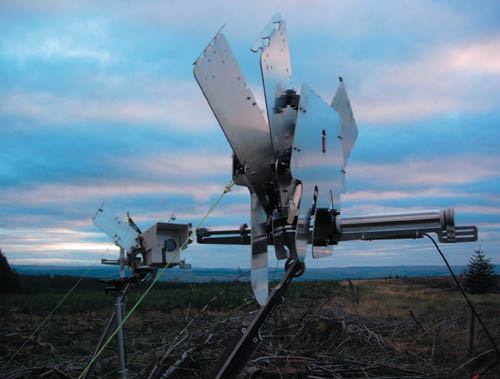
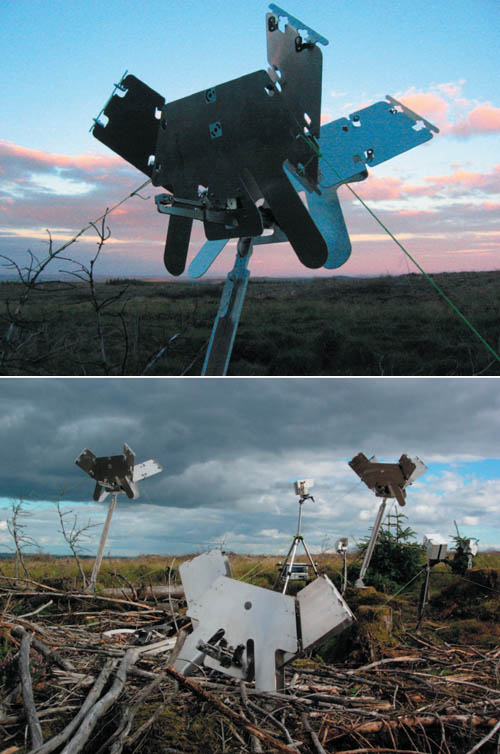
The probes were designed to measure difference over time rather than the static characteristics of any given instance. Powered by solar energy, the probes gathered and recorded ‘micro environmental data’ over time. The probes were simultaneously and physically responsive to these changes, opening out when warm and sunny, closing down when cold and dark. Thus not only did the probes record environmental change, but they demonstrated how these changes might induce a responsive behaviour specific to a single location.

After the probes were installed, they were filmed by “an array of high-resolution digital cameras programmed to record at regular intervals.”

[Images: From “Kielder Probes” by Phil Ayres, Chris Leung, and Bob Sheil, courtesy of sixteen*(makers)].

The resulting data—which took note of the climatic and solar situations in which the objects began to change—offers insights, Sheil suggests, into how “passively activated responsive architecture” might operate in other sites, under other environmental conditions.

[Images: From “Kielder Probes” by Phil Ayres, Chris Leung, and Bob Sheil, courtesy of sixteen*(makers)].

As DIY landscape-registration devices constructed from what appear to be off-the-shelf aluminum plates, they also cut an interesting formal profile above the horizon line, like rare birds or machine-flowers perched amidst the tree stumps.

[Image: From “Kielder Probes” by Phil Ayres, Chris Leung, and Bob Sheil, courtesy of sixteen*(makers)].