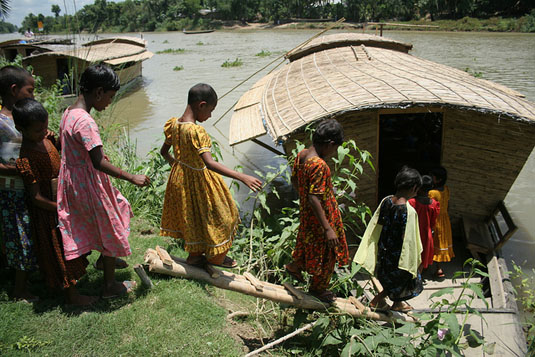
 [Image: A riverboat library in Bangladesh; image courtesy of the Gates Foundation].
Many, many books have arrived at the home office here, and I’m thus once again woefully behind in tallying up all the titles that have come my way. Accordingly, there are still many more write-ups to come, but it will be next month, after some upcoming travels, before I get to those other books.
Meanwhile, as has always been the case with Books Received posts, I have not read all of the books linked here and not all of them are necessarily new. However, in all cases, these are included for the interest of their approach or subject matter, and the following list should easily give just about anyone at least one good book to read over the coming summer.

1) City: A Guidebook for the Urban Age by P.D. Smith (Bloomsbury) — P.D. Smith’s voluminous look at the history of urbanism stretches from the Sumerians to the 2012 London Olympics, from Tenochtitlán to Dubai, from the Code of Hammurabi to J.G. Ballard, and from the Italian Renaissance to the urban ruins of nuclear war. Smith has organized his book like a travel guide, albeit not for a particular metropolis but for the city in and of itself. Chapters are thus divided into overarching categories such as “arrival,” “where to stay,” “getting around,” and more, and while the result can sometimes conflate otherwise quite different urban phenomena found in disparate cities around the world, that slight sense that things are starting to blur is evened out by Smith’s eye for detail in the stories and anecdotes he relates, particularly in the book’s many boxed texts and sidebars. Migration, food security, global tourism, natural disasters, economic expansion, and war: these are all perennial influences on urban form—and urban futures—and Smith works hard to show their role in shaping the life of what he calls “the ape that shapes [its] environment, the city builders.” City comes out in the United States in June 2012.
2) Tubes: A Journey to the Center of the Internet by Andrew Blum (Ecco) — I had the pleasure of receiving periodic email updates from author Andrew Blum as he traveled to the unmarked buildings and coastal warehouses—amongst many other sites—that enable, store, and protect what we broadly refer to as the internet. The resulting book, released earlier this week, tells the story of those travels: it is Blum’s field guide to the physical infrastructure of contemporary data, tracking the internet’s actual geography, the sites where the switches are kept and the servers are cooled, where the cables come out of the sea and relay onward, deeper into cities and suburbs, into office and apartments like the one from which I’m posting this. “The Internet couldn’t just be everywhere,” Blum writes, questioning ethereal metaphors like “the cloud” or the abstract “tubes” of the book’s title. “But then where was it? If I followed the wire, where would it lead? What would that place look like? Why were they there? I decided to visit the Internet.” In one particularly memorable description, Blum quips that he “had begun to notice that the Internet had a smell, an odd but distinctive mix of industrial-strength air conditioners and the ozone released by capacitors,” as if even the most amorphous realms of data have their own peculiar body odor. This body—the “tubes” of the internet—leads Blum from underground London to the middle of nowhere in central Oregon, from downtown Milwaukee to locked rooms in Amsterdam, on the trail of the “pulses of light” that give the internet physical and geographic form.
3) The Appian Way: Ghost Road, Queen of Roads by Robert A. Kaster (University of Chicago Press) — As Kaster’s book claims on its opening page, “No road in Europe has been so heavily traveled, by so many different people, with so many different aims, over so many generations.” The Appian Way, which cuts broadly southeast from the old city walls of Rome, gives Kaster—a Classicist at Princeton—a long and meandering geography on which to base this otherwise concise, almost pamphlet-length look at the Italian landscape and how it has evolved over the past two millennia. From marshes and town centers to incongruously 21st-century wind farms where the ancient road all but disappears into gravel-strewn ruins, by way of endless crumbling tombs that will be familiar to any fan of Piranesi, Kaster’s book describes the sites, monuments, churches, cemeteries, and more that give readers an opportunity to explore the historical—usually archaeological—context for this legendary piece of transportation infrastructure. The Appian Way is part of the “Culture Trails” series from the University of Chicago Press.
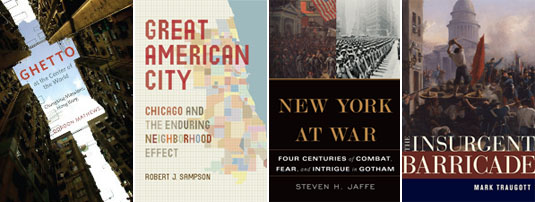
4) Ghetto at the Center of the World: Chungking Mansions, Hong Kong by Gordon Mathews (University of Chicago Press) — Mathews offers a kind of anthropological critique of globalization in the guise of architectural reportage, telling the story of Chungking Mansions, “a dilapidated seventeen-story commercial and residential structure in the heart of Hong Kong’s tourist district,” and using close descriptions of everyday life in the complex to build a cross-section of the global economy. “A remarkably motley group of people call the building home,” we read in the book’s own description: “Pakistani phone stall operators, Chinese guesthouse workers, Nepalese heroin addicts, Indonesian sex workers, and traders and asylum seekers from all over Asia and Africa live and work there—even backpacking tourists rent rooms. In short, it is possibly the most globalized spot on the planet.”
5) Great American City: Chicago and the Enduring Neighborhood Effect by Robert J. Sampson (University of Chicago Press) — Sampson’s very academic book—less narrative than statistical and analytic, and keenly based in empirical research—weighs the importance of community in defining, empowering, and uniting the city of Chicago, neighborhood by neighborhood.
6) New York at War: Four Centuries of Combat, Fear, and Intrigue in Gotham by Steven H. Jaffe (Basic Books) — Jaffe has written an incredibly interesting military history of New York City, beginning well before it was either New York or a city. Jaffe’s detailed accounts of early colonial battles and Revolutionary battlegrounds reveal the, to me, surprising number and topographic diversity of combat sites that dot the greater New York landscape. In the process, he offers little-known historical anecdotes—for instance, not only that Wall Street is so named after the defensive wall once constructed there, from one side of the island to the other, but that the wall was the first example of debt-financed urban infrastructure in what were then Dutch colonies. Jaffe’s look at a military urbanism peculiar to New York, from the 1600s to WWII to the security bollards of post-9/11 NYC, has proven hard to put down.
7) The Insurgent Barricade by Mark Traugott (University of California Press) — Traugott’s history of the barricade as a uniquely successful “technique of insurrection” is, first and foremost, a look at the spatial politics of the built environment. These politics operate in at least two primary, and clearly oppositional, ways, Traugott suggests. The first is the deliberate mis-use or counter-use of the city, transforming it into something that, through improvisatory re-design, can be express the political demands of an otherwise overlooked constituency. This is the production of barricades, which interfere with and strategically realign the internal movements of the city. The other side of this story, however, is the purposeful and systematic alteration of a city’s fabric precisely so that its everyday spaces cannot be used as outlets for political expression. In the latter example, streets can be widened or public spaces closely surveilled; in the former, makeshift tools and ad hoc materials, from cobblestones to wheelbarrows, can be transformed at a moment’s notice into walls that clog the city’s arteries and bring its streets to a halt. Traugott shows how all this has played out over more than four centuries of European urban history, also looking at what future spatial possibilities exist, on both sides of the barricade, for the political life of the metropolis.
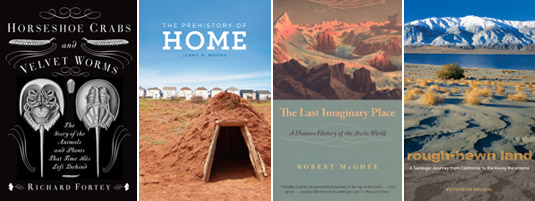
8) Horseshoe Crabs and Velvet Worms: The Story of the Animals and Plants That Time Has Left Behind by Richard Fortey (Alfred A. Knopf) — Fortey is easily one of my favorite natural history writers, and his Earth: An Intimate History remains high on my list of recommended books. With this new book, Fortey takes on the question of survival—or super-survival—in creatures whose wildly successful evolutionary paths mean they have had a disproportionately deep effect on whole ecosystems still thriving today. This is “life’s history told not through the fossil record but through the stories of organisms that have survived, almost unchanged, throughout time,” in the book’s own words. The horseshoe crabs and velvet worms of the title are only two of the most-cited creatures in Fortey’s unsurprisingly enjoyable book.
9) The Prehistory of Home by Jerry D. Moore (University of California Press) — Moore starts things off with the unfortunate claim that “various animals build shelters, but only humans build homes,” an unprovable statement that belongs on the sadly endless pile of false comparisons made about humans and animals. Indeed, only four pages later, Moore himself writes that “we [humans] have been building homes longer than we have been Homo sapiens,” which can literally only be true if animals—that is, non-humans or non-Homo sapiens—can, after all, build homes, not just shelters, and have been doing so all along. In any case, this minor but by no means inconsequential quibble shouldn’t hold you back from enjoying Moore’s engaging history of the home—that is, the symbolically rich personal shelter—which he takes on a wide and exciting run from hand-woven walls and mud floors on the coast of Peru all the way to maximum security prisons, from Mesopotamian walled cities to gated suburbs, and from bachelor pads to underground “dwellings” built for the recently deceased in globally diverse burial practices. Part archaeological survey dating back, as Moore explains, to before humans were Human, and part speculative treatise as to why humans have an emotional need for homes at all, Moore’s book spans hundreds of thousands of years and nearly every continent.
10) The Last Imaginary Place: A Human History of the Arctic World by Robert McGhee (Oxford University Press) — McGhee, an archaeologist at the Canadian Museum of Civilization, “paints a vivid portrait of Viking farmers, entrepreneurial Inuit, and Western explorers” in their encounter with, and long-term settling of, the Arctic. Though the book has been out for several years, it just crossed my desk and I look forward to jumping in over the summer.
11) Rough-Hewn Land: A Geologic Journey from California to the Rocky Mountains by Keith Heyer Meldahl (University of California Press) — Meldahl’s book is, in its own words, “a 1000-mile-long field trip back through more than 100 million years of deep time to explore America’s most spectacular and scientifically intriguing landscapes.” Those landscapes are the western plateaus, mountains, and deserts of the southwestern United States, a region whose terrain now verges on the over-exposed—hardly a season goes by without a new book on the subject—but, as Meldahl suggests, “geology is stranger than fiction,” and the book he’s built around that statement is a worthwhile read.
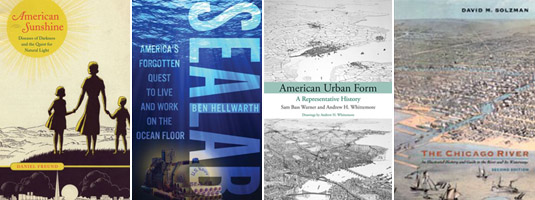
12) American Sunshine: Diseases of Darkness and the Quest for Natural Light by Daniel Freund (University of Chicago Press) — Freund’s book is a delightfully idiosyncratic look at the “quest for natural light” in American culture, from the earliest use of tanning beds as a kind of surrogate sun to the mainstream acceptance of “light therapy” as a cure for Seasonal-Affective Disorder, and from the marketing of climate tourism to the development of specialty lighting rigs for use in industrial food preparation. Freund explains in his introduction that the book was motivated by three otherwise unrelated historical figures—Akhenatan, Vitruvius, and Linnaeus—all of whom represent for Freund “the universality of sunlight as a subject for consideration.” The results are this unique look at the confluence of personal health, urban design, and near-religious popular beliefs about the purifying power of sunlight over roughly 150 years of American culture.
13) Sealab: America’s Forgotten Quest to Live and Work on the Ocean Floor by Ben Hellwarth (Simon & Schuster) — Hellwarth relates the surprisingly overlooked story of U.S. Navy “saturation divers” and the international oceanographers whose research helped to pioneer the construction of deepsea equipment and large-scale architectural environments that almost made living on the ocean floor an everyday reality. Equal parts tropical retro-futurism, complete with scenes of Jacques Cousteau assembling his Conshelf habitats in the Mediterranean Sea, and high-tech adventure story populated by military super-athletes and entrepreneurial gear manufacturers few of us even knew existed—including surreal high-pressure diving experiments involving presumably quite bewildered farm animals—Hellwarth’s book tells the true history of what have been (and what might still be) for human inhabitation of the oceans. Best of all, it’s almost entirely set in a quasi-utopian underwater world, like Archigram crossed with The Abyss.
14) American Urban Form: A Representative History by Sam Bass Warner and Andrew H. Whittemore (MIT Press) — Warner and Whittemore have produced an illustrated historical survey of U.S. urbanism, with short chapters ranging from “the city’s seventeenth-century beginnings” on the Atlantic coast to “the federally supported city” of the 1950s, ending with a somewhat obligatory overview of the “global city” and its suburban fringe. The book is a great introduction to the processes that have influenced and restrained urban development in the United States for more than three centuries, but it focuses more on presenting a coherent narrative—often reading more like a special issue of The Economist—as opposed to developing an original or otherwise surprising new interpretation of American urban form.
15) The Chicago River: An Illustrated History and Guide to the River and Its Waterways by David M. Solzman (University of Chicago Press) — Re-released in its current, second edition back in 2006, Solzman’s book will no doubt already be familiar to many readers of BLDGBLOG, but his history of the Chicago River, its ecological context and industrial re-engineering, complete with a hands-on guide for anyone who might want to explore it, was new to me.
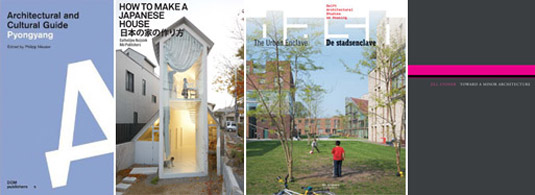
16) Pyongyang: Architectural and Cultural Guide edited by Philipp Meuser (DOM Publishers) — In print for less than three months, Meuser’s guide is already something of a cult classic in architectural circles, offering as it does a photographic and textual survey of the gonzo dictatorial postmodernism of Pyongyang, North Korea. A genuinely fascinating look at the political symbology of a capital city—Stefano Boeri’s memorable description of Pyongyang as a “rogue city” comes to mind—this slipcased, two-volume set offers “photographs and descriptions” in one book, including brief lessons on Pyongyang’s overall urban organization, and, in the other, what Meuser calls “background and comments.” These latter categories include—incredibly—excerpts from an architectural pamphlet written by the late Kim Jong-Il, who explains to his readers that, among other things, “architects are creative workers and operations officers,” spatially gifted functionaries of the State. Many of the photographs found in each volume can unfortunately resemble washed-out tourist postcards, and the buildings themselves are often striking for their super-ornamental, propagandistic absurdity—in a city whose natural setting makes it look oddly like Memphis, Tennessee—but to mock the city so easily and dismissively would be to miss the guide’s more interesting insight, which is that Pyongyang is, in fact, a remarkably assembled collection of processional spaces and monumental object-buildings, aesthetically arranged in a kind of 3-dimensional essay extolling the wonders of uncontested state power.
17) How to Make a Japanese House by Catherine Nuijsink (NAi Publishers) — Although architecture blogs have perfected the art of Japanese house fatigue over the past few years—in which it seems like a central server somewhere has been auto-feeding photos of small Japanese houses to the same design blogs over and over again every week—Nuijsink’s book is, refreshingly, a more substantive exploration of 21st-century domestic space in Japan, complete with one-on-one architectural interviews and occasional floor plans. Many of the projects you will already have seen online, but, given the breadth of context here, some great photographs, and three framing “monologues” written by architects Yoshiharu Tsukamoto, Taro Igarashi, and Jun Aoki, it more than justifies its publication.
18) Dash 5: The Urban Enclave edited and produced by Delft Architectural Studies on Housing (NAi Publishers) — Dash—not quite a magazine, more of a subscription book series—continued last autumn with this look at the “urban enclave,” which the editors have framed as an often progressively intended urban mega-project. These developments, both privately and publicly funded, can create what one of the book’s essays calls “a city-within-the-city” or a city “made up of miniature utopias”: social developments and architectural forms that appear, at first glance, to be entirely disconnected from one another but that, the authors argue, actually invigorate the city through these clear and obvious contrasts. The enclave offers—in fact, it does not let you avoid—”the proximity and the accessibility of ‘the other.'” Agree or disagree, it’s another well-produced issue in the ongoing Dash series, including an interesting look at Oswald Mathias Ungers’s notion of Grossform by historian Lara Schrijver, author of Radical Games.
19) Toward A Minor Architecture by Jill Stoner (MIT Press) — Stoner’s book looks to “dissect and dismantle prevalent architectural mythologies,” and to do so through a turn toward fiction—but the result is an often somewhat timid and unnecessarily academic entry in what should be a very rich conversation. Stoner relies too much on citations from the usual suspects found in your, mine, and everyone else’s thesis papers from the 1990s (Deleuze & Guattari, Walter Benjamin, Leibniz, Sigmund Freud, Italo Calvino, and even the now sadly over-exposed J.G. Ballard). But, having said that, it’s hard not to find pleasure in a book that takes, well, J.G. Ballard, Walter Benjamin, Sigmund Freud, Franz Kafka, James Joyce, and more—even the Berlin Wall—as fuel for a descriptive expansion of architecture into various other genres and media.
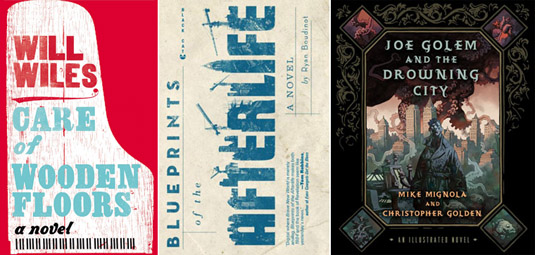
20) Care of Wooden Floors by Will Wiles (Amazon) — Many of you will recognize Will Wiles from his work as deputy editor of ICON magazine or his excellent though infrequent blog Spillway, but here he turns to fiction in a debut novel that tells the story of a man slowly going mad whilst house-sitting for a friend in Eastern Europe. From the book’s own description: “A British copywriter house-sits at his composer friend Oskar’s ultra-modern apartment in a glum Eastern European city. The instructions are simple: Feed the cats, don’t touch the piano, and make sure nothing damages the priceless wooden floors. Content for the first time in ages, he accidentally spills some wine. The apartment and the narrator’s sanity gradually fall apart in this unusual and satisfying novel.” The book has already been released in the UK, where it’s been receiving good reviews as a dark-humored “disaster novel,” but it’s not due out in the States until later this year, when it will become part of the first crop of books published directly and exclusively by Amazon.com.
21) Blueprints of the Afterlife by Ryan Boudinet (Grove Press) — Boudinet’s “bracingly weird new novel” has been receiving high praise and enviable comparisons for the author’s style, including to such writers as Philip K. Dick, William Burroughs, and Neal Stephenson, as Blueprints of the Afterlife picks up considerable buzz in the scifi/speculative fiction world. Fans of odd settings and spatial details will presumably appreciate the book’s “sentient glacier” or its “full-scale replica of Manhattan under construction in Puget Sound.” I’m looking forward to reading this while traveling over the next few weeks.
22) Joe Golem and the Drowning City by Mike Mignola and Christopher Golden (St. Martin’s Press) — It’s no secret that I’m a huge fan of Mike Mignola’s work, and his novelistic collaborations with Christopher Golden have so far been great, if not quite as gripping as Mignola’s own early Hellboy tales. Joe Golem tells the story of a flooded Manhattan, or, in the book’s own words: “In 1925, earthquakes and a rising sea level left Lower Manhattan submerged under more than thirty feet of water, so that its residents began to call it the Drowning City. Those unwilling to abandon their homes created a new life on streets turned to canals and in buildings whose first three stories were underwater.” The results, set 50 years after the flooding, are somewhere between H.P. Lovecraft and Central European urban folklore, featuring occasional black and white drawings by Mignola.
All Books Received: August 2015, September 2013, December 2012, June 2012, December 2010 (“Climate Futures List”), May 2010, May 2009, and March 2009.

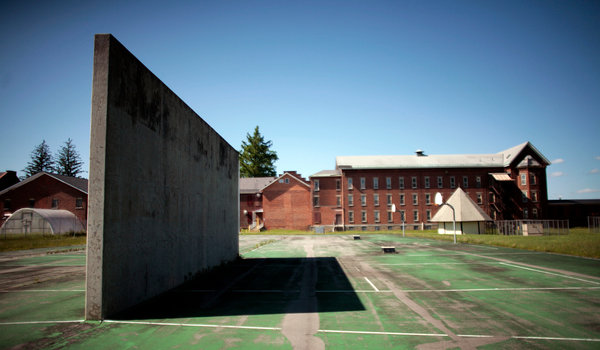 [Image: Prisons for sale; photo by
 [Image: “
 [Image: “
 [Image: Art by
  [Image: The
 [Image:
  [Image: Ole Scheeren’s “
 Like the
  [Image: Konstantin Melnikov’s “
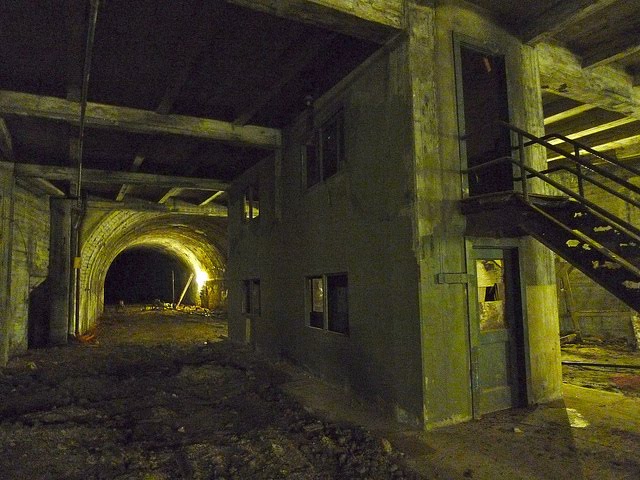 [Image: L.A.’s original subway, now walled-off beneath downtown; photo by
 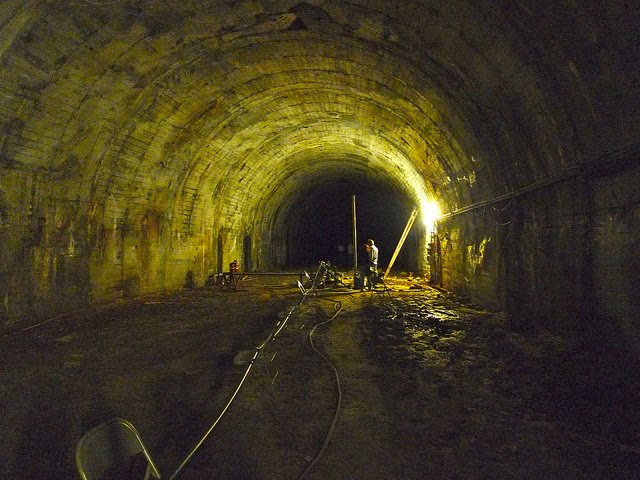 [Image:Photo by
 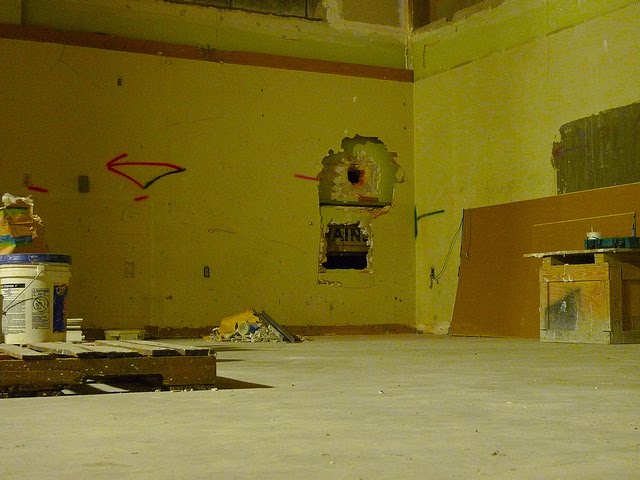 [Image: A walled-up sign announces, “TRAINS”; photo by
 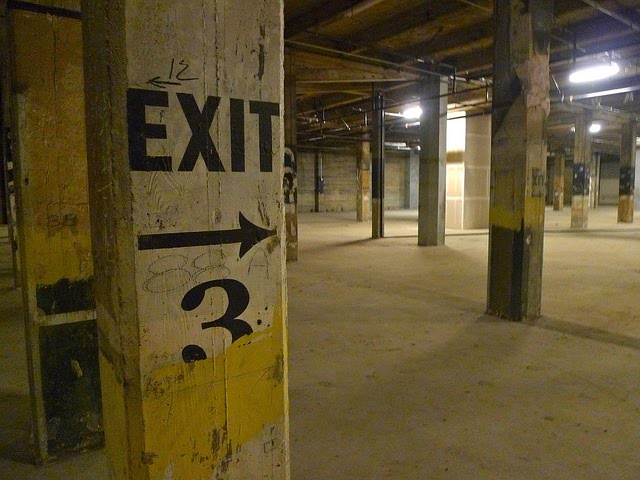 [Image: Photo by
 I finally became a paying member of
 [Images: From
  [Image: Photo by I. Yakovlev/Itar-Tass, courtesy of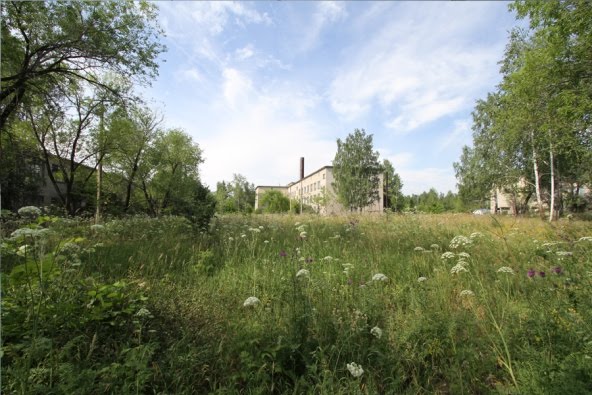
 [Images: (top) photo by Tatjana Paunesku; (bottom) photo by S. Tapio. Courtesy of
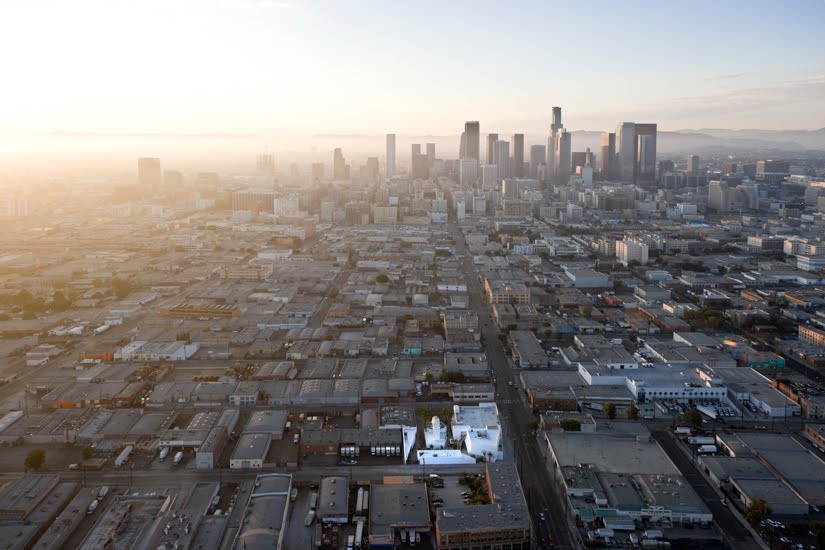 [Image: Michael Maltzan’s
  [Image: Los Angeles; photo by
 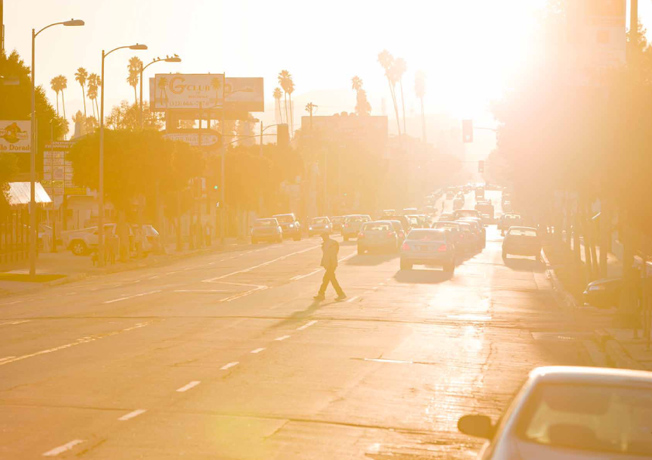 [Image: Los Angeles; photo by
 [Image: Wifi-blocking wallpaper from the
  [Image: Printed electronics produce 2D loudspeakers; photo by Hendrik Schmidt, via


 [Images: Lasercut
