Hydro-Pharmacology

Medical researchers have found that some of the streams, rivers, and groundwater in Patancheru, India, are really “a soup of 21 different active pharmaceutical ingredients, used in generics for treatment of hypertension, heart disease, chronic liver ailments, depression, gonorrhea, ulcers and other ailments. Half of the drugs measured at the highest levels of pharmaceuticals ever detected in the environment.”

[Image: The Iska Vagu stream near Hyderabad, India. “Indian factories that make lifesaving drugs swallowed by millions worldwide are creating the worst pharmaceutical pollution ever measured,” we read, “spewing enough of one antibiotic into a stream each day to treat everyone living in Sweden for a work week.” Photo by AP Photo/Mahesh Kumar A].

“If you just swallow a few gasps of water,” a German doctor said to MSNBC, “you’re treated for everything. The question is for how long?”

Indeed, all of this has the unsurprising effect that “some of India’s poor are unwittingly consuming an array of chemicals that may be harmful, and could lead to the proliferation of drug-resistant bacteria.” For instance, amongst this mix are high levels of Ciproflaxin:

The more bacteria is exposed to a drug, the more likely that bacteria will mutate in a way that renders the drug ineffective. Such resistant bacteria can then possibly infect others who spread the bugs as they travel. Ciprofloxacin was once considered a powerful antibiotic of last resort, used to treat especially tenacious infections. But in recent years many bacteria have developed resistance to the drug, leaving it significantly less effective.

With sources of freshwater all over the world now showing at least trace signs of pharmaceutical pollution, is some kind of global superbug brewing?

Aside from the very real health implications of this story, though, I’m fascinated by these drugs’ effect on the landscape; in other words, millions of pounds’ worth of loose pharmaceuticals will surely someday form a detectable layer in the soil, given time.

Pharmaco-geological formations take shape in the sand, compacted into strange new types of stone. The locals dissolve slices of it in their tea, as it’s used to treat illnesses.
Thousands of years pass; then millions. The rocks you’re looking at in the wall of that canyon are made of lithified Prozac. Tylenol Gorge State Park.

A deltaic geography of sedimentary Tamiflu is eventually mined as a building material; temples of this unusually smooth rock are built; visits to them are believed to help prevent infection.

And how will this affect plants? If river grasses and trees begin to accumulate this novel class of mineral, taking pharmaceutical-rich waters up into their roots, will it change the way they grow? Day of the Triffids.

“We don’t have any other source, so we’re drinking it,” a local woman named R. Durgamma explains to MSNBC. In a chilling detail that reveals how those in power clearly know what is happening there, she adds: “When the local leaders come, we offer them water and they won’t take it.”

(Thanks, dad, for the link!)
State of Incorporation

I recently came across something I first read back in January 2004 about what might be called the private nationalization of Italy under Prime Minister Silvio Berlusconi – when your country becomes a labyrinth of overlapping properties owned by one man – and it seemed interesting enough that I thought I’d re-post it here. So:

Hi there,

I’m an Italian citizen living in Milan, in a building that was built by Immobiliare EdilNord, which is owned by the Prime Minister. I work part-time for the Pagine Utili, owned by the Prime Minister, but I might soon be contracted by Blockbuster, the famous chain owned by the Prime Minister. I’ve always been a fan of Milan, the soccer club of the Prime Minister. I go to work in a car which I first saw in an ad in Panorama, a weekly magazine owned by the Prime Minister, and which I bought secondhand from an employee of the Banca Mediolanum, a bank amongst whose biggest shareholders we find the Prime Minister. The insurance for the car is also owned by the Prime Minister, and when I’m driving I often listen to some radio stations… owned by the Prime Minister. When I leave my house I first accompany my neighbor, who works at the Finbanc Inversiones (owned by the Prime Minister) before I pick up some newspapers and magazines (also owned by the Prime Minister). Sometimes there’s traffic on the way to work, and so to tell my colleagues I’ll be late I use a cellphone of the Compagnia Telefonica Mobile, which sees the Prime Minister as one of its shareholders.

Some afternoons I go shopping in the supermarkets built by one of the Prime Minister’s construction and development companies, where I buy products produced, published, and sponsored by the Prime Minister. In the evening I nearly always watch the television, nowadays completely in the hands of the Prime Minister, on which the movies (often produced by the Prime Minister) are continuously interrupted by commercials made by the Prime Minister’s own publicity agency. Thus, through satellite, I try to get out of Italy to see if anything good is being transmitted elsewhere, but then it happens that I find TV networks functioning under Mediaset – which is owned by the Prime Minister. Distrustful and tired, I do some surfing on the internet via the Jumpy Provider, of NewMedia Investment, another property of the Prime Minister, and there I find lots of declarations of the Prime Minister, nearly all against his political opponents. Sundays I like to stay at home and just read books – which come from publishing companies owned by the Prime Minister.

Panta rei, everything proceeds – but for a while now I’ve heard a lot of whispering about the conflicts of interest in relation to our Prime Minister, so I ask myself: why? Is there something anomalous? This isn’t how it’s supposed to be?

My sincere greetings,
An Italian Citizen

Originally published on Indymedia Italia.

Twin Town

In what sounds like the plot of a John Carpenter film, the Daily Telegraph reports that a village in Brazil might be populated by genetically altered twins created by notorious Nazi doctor Josef Mengele.

[Image: The Brazilian twin town of Josef Mengele].

“For years scientists have failed to discover why as many as one in five pregnancies in a small Brazilian town have resulted in twins – most of them blond haired and blue eyed,” we read. “But residents of Candido Godoi now claim that Mengele made repeated visits there in the early 1960s, posing at first as a vet but then offering medical treatment to the women of the town.”
According to an historian named Jorge Camarasa who has written a book about Mengele’s bio-genetic legacy, “Candido Godoi may have been Mengele’s laboratory, where he finally managed to fulfil his dreams of creating a master race of blond haired, blue eyed Aryans. There is testimony that he attended women, followed their pregnancies, treated them with new types of drugs and preparations, that he talked of artificial insemination in human beings, and that he continued working with animals, proclaiming that he was capable of getting cows to produce male twins.”
The article points out that “the town’s official crest shows two identical profiles and a road sign welcomes visitors to a ‘Farming Community and Land of the Twins’. There is also a museum, the House of the Twins.”
“Nobody knows for sure exactly what date Mengele arrived in Candido Godoi,” Camarasa adds, “but the first twins were born in 1963, the year in which we first hear reports of his presence.”
This sounds insanely implausible to me – more like a Nazi-infused origin story animated by a pronounced fear of witchcraft – but it’s a fascinatingly bizarre proposition.
In many ways, meanwhile, it reminds me quite strikingly of a book called The Angel Maker by Stefan Brijs, which I just picked up last week. The back cover description:

The village of Wolfheim is a quiet little place until the geneticist Dr. Victor Hoppe returns after an absence of nearly twenty years. The doctor brings with him his infant children – three identical boys all sharing a disturbing disfigurement. He keeps them hidden away until Charlotte, the woman who is hired to care for them, begins to suspect that the triplets – and the good doctor – aren’t quite what they seem. As the villagers become increasingly suspicious, the story of Dr. Hoppe’s past begins to unfold, and the shocking secrets that he has been keeping are revealed. A chilling story that explores the ethical limits of science and religion, The Angel Maker is a haunting tale in the tradition of The Strange Case of Dr. Jekyll and Mr. Hyde and Frankenstein.

Only here, it’s Dr. Mengele creating dark angels in the rain forest.

(Thanks, Steve!)

Planet Harddrive

[Image: “Conceptual diagram of satellite triangulation,” courtesy of the Office of NOAA Corps Operations (ONCO)].

I’ve long been fascinated by what I might call the geological nature of harddrives – how certain mineral arrangements of metal and ferromagnetism result in our technological ability to store memories, save information, and leave previous versions of the present behind.

A harddrive would thus be a geological object as much as it is a technical one: a content-rich, heavily processed re-configuration of the earth’s surface.

[Image: Geometry in the sky. “Diagram showing conceptual photographs of how satellite versus star background would appear from three different locations on the surface of the earth,” courtesy of the Office of NOAA Corps Operations (ONCO)].

Perhaps someday we won’t need harddrives at all: we’ll simply use geology itself. In other words, what if we could manipulate the earth’s own magnetic field and thus program data into the natural energy curtains of the planet?

The earth would become a kind of spherical harddrive, with information stored in those moving webs of magnetic energy that both surround and penetrate its surface.

This extends yet further into an idea that perhaps whole planets out there, turning in space, are actually the harddrives of an intelligent species we otherwise have yet to encounter – like mnemonic Death Stars, they are spherical data-storage facilities made of content-rich bedrock – or, perhaps more interestingly, we might even yet discover, in some weird version of the future directed by James Cameron from a screenplay by Jules Verne, that the earth itself is already encoded with someone else’s data, and that, down there in crustal formations of rock, crystalline archives shimmer.

I’m reminded of a line from William S. Burroughs’s novel The Ticket That Exploded, in which we read that beneath all of this, hidden in the surface of the earth, is “a vast mineral consciousness near absolute zero thinking in slow formations of crystal.”

[Image: “An IBM HDD head resting on a disk platter,” courtesy of Wikipedia].

In any case, this all came to mind again last night when I saw an article in New Scientist about how 3D holograms might revolutionize data storage. One hologram-encoded DVD, for instance, could hold an incredible 1000GB of information.

So how would these 3D holograms be formed?

“A pair of laser beams is used to write data into discs of light-sensitive plastic, with both aiming at the same spot,” the article explains. “One beam shines continuously, while the other pulses on and off to encode patches that represent digital 0s and 1s.”

The question, then, would be whether or not you could build a geotechnical version of this, some vast and slow-moving machine – manufactured by Komatsu – that moves over exposed faces of bedrock and “encodes” that geological formation with data. You would use it to inscribe information into the planet.

To use a cheap pun, you could store terrabytes of information.

But it’d be like some new form of plowing in which the furrows you produce are not for seeds but for data. An entirely new landscape design process results: a fragment of the earth formatted to store encrypted files.

Data gardens.

They can even be read by satellite.

[Image: The “worldwide satellite triangulation camera station network,” courtesy of NOAA’s Geodesy Collection].

Like something out of H.P. Lovecraft – or the most unhinged imaginations of early European explorers – future humans will look down uneasily at the earth they walk upon, knowing that vast holograms span that rocky darkness, spun like inexplicable cobwebs through the planet.

Beneath a massive stretch of rock in the remotest state-owned corner of Nevada, top secret government holograms await their future decryption.

The planet thus becomes an archive.

(Earlier on BLDGBLOG: Geomagnetic Harddrive).

Cable City and the Hanging Hotel

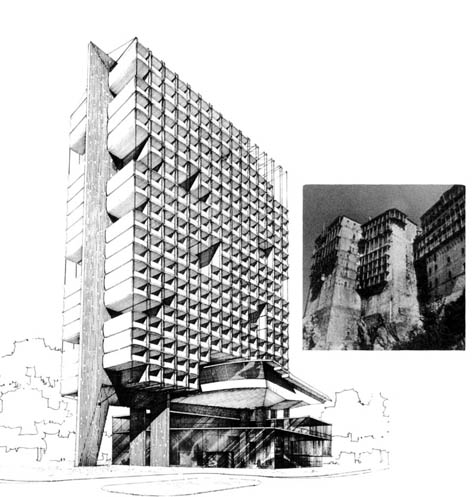
[Image: The Hanging Hotel by Takis Zenetos; think of it as the International Style meets the Potala Palace].
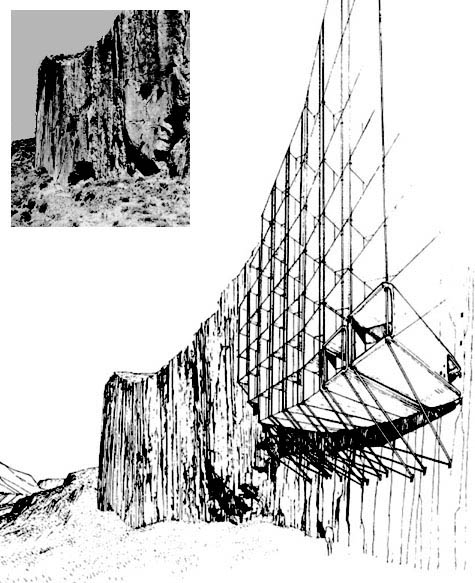
Nearly a year ago, a reader named Stavros Koulis tipped me off to the work of Takis Zenetos. Zenetos was a Greek architect whose work seems clearly to belong in a list of avant-garde mid-to-late 20th century architects like Yona Friedman, Constant, and even Archigram, but who seems otherwise to have been overlooked.
The above project – visible in the next image – is for a hanging hotel, a combination of Tibetan palace, Anasazi cliff dwelling, and artificial geological formation.

[Image: The Hanging Hotel, strung onto a cliffside like a musical instrument, by Takis Zenetos].
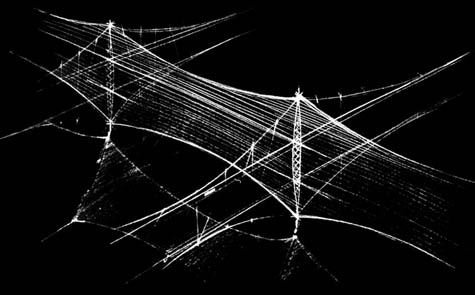
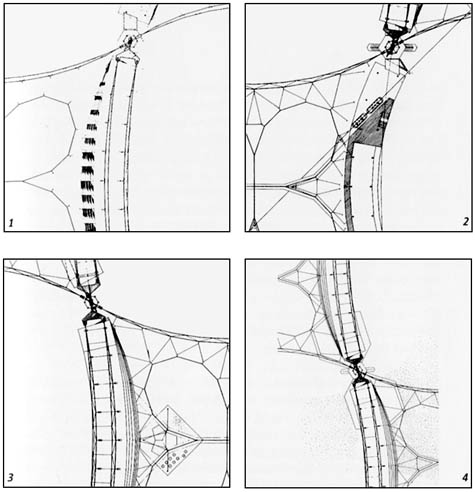
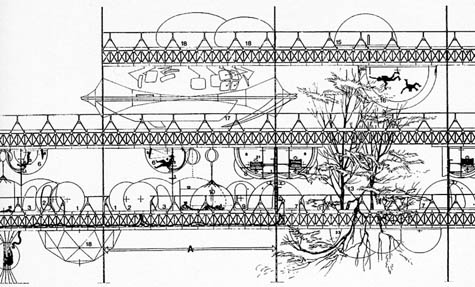
But his most exciting project, I’d suggest (based on very little information, to be frank), is Cable City, an incredible 1961 design for a suspended city – what Zenetos called une ville suspendue.
The entire metropolis would be hung from cables, a kind of tensional extension of the earth’s surface.

[Image: The Cable City of Takis Zenetos].
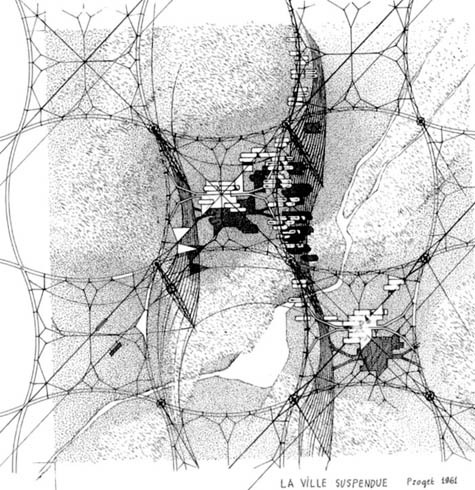
 
To be honest, I’ve never read a word about this thing in English, so who knows what I’m getting right here; but the overall impetus behind the project seems to be something like counter-terrestriality: a city that would not only span, but even temporarily replace, the earth’s surface, forming a cobweb of urban settlement. An extremely local architectural offworld made of capsules, wired Archigramian hammocks, and other high-tech micro-environments.

[Image: The Cable City of Takis Zenetos; the instant city as toupee].

But my own descriptions shouldn’t get in the way of Zenetos’s images.

[Images: The Cable City of Takis Zenetos].
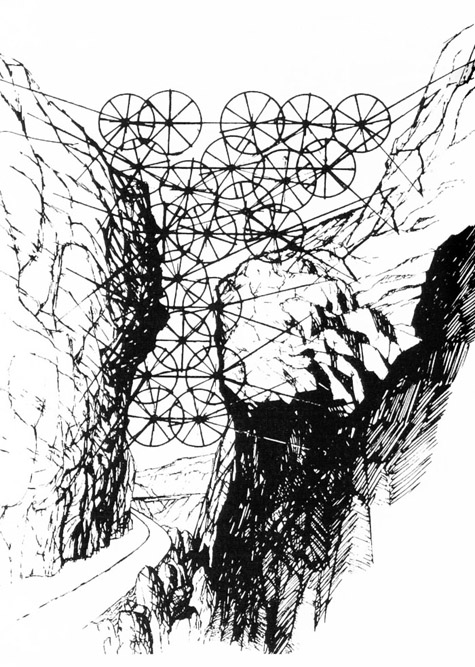
After all, he even drew gullies choked with wind turbines – sustainable, if bird-murdering, power stations – decades ahead of his time.

[Images: A turbined gorge by Takis Zenetos].

I’d love to know more about Zenetos, if anyone reading BLDGBLOG has more information. “Takis Zenetos (1926-1978),” we read, “is the pre-eminent architect of Greek modernism, with a varied oeuvre (industrial buildings, schools, residences, objects, urban planning studies), and he is best known for the FIX building on Syngrou Avenue and the Lycabettus theatre.
“What is not widely known is that Zenetos was a visionary of the future electronic city and the digital age.”

[Thanks to Stavros Koulis for sending me these scans].

Hydro-Manhattan

[Image: From Manhattan’s Annex by W. Amanda Chin. View larger].

There are a few student projects from my trip the other week to Rice University that I’m going to be posting here over the next week or so – beginning with Manhattan’s Annex: The Crosstown [of] Excess by W. Amanda Chin.
For her thesis project at Rice, Chin proposed ten “waterscrapers” that would slice across the urban space of Manhattan, cutting through buildings, through parks, and through the urban grid itself, forming strange aquatic intersections with the city.

[Image: From Manhattan’s Annex by W. Amanda Chin. Image slightly cropped: view larger].
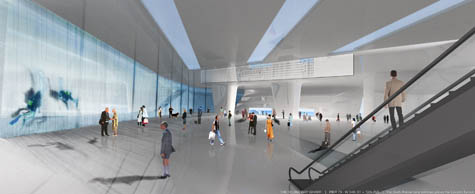
Inside would be routes for scuba-diving, new aquariums, and multi-seasonal sites for public swimming.
These above-ground pipes of water – like hydro-boulevards, or one might say the hydrological Haussmannization of Manhattan – are less an actual proposal for construction than a sort of architectural dream: the city cross-cut by amniotic utopias through which people can wander at all hours of the day.

[Images: From Manhattan’s Annex by W. Amanda Chin; view larger].
As you can see in the short comic strips that accompanied the project – see the larger Flickr set for more – the project is themed around overlapping idea of excess, self-indulgence, and addiction, as if these Voluntary Prisoners of Architecture-like scenes might be therapeutic, a mass psychotherapy of space.
It’s 3am and you’re depressed; you can’t sleep. You go out wandering across Harlem, inside one of the Annexes, completely alone, not a single other person in sight – when a group of people goes scuba-diving over your head. As if they’ve attained flight through an artificial river in the sky.
In a city of insomniacs, the city itself becomes the dream.

See more: Manhattan’s Annex: The Crosstown [of] Excess by W. Amanda Chin.

Sky TV

[Image: From the series Cloud Projections by Blake Gordon].

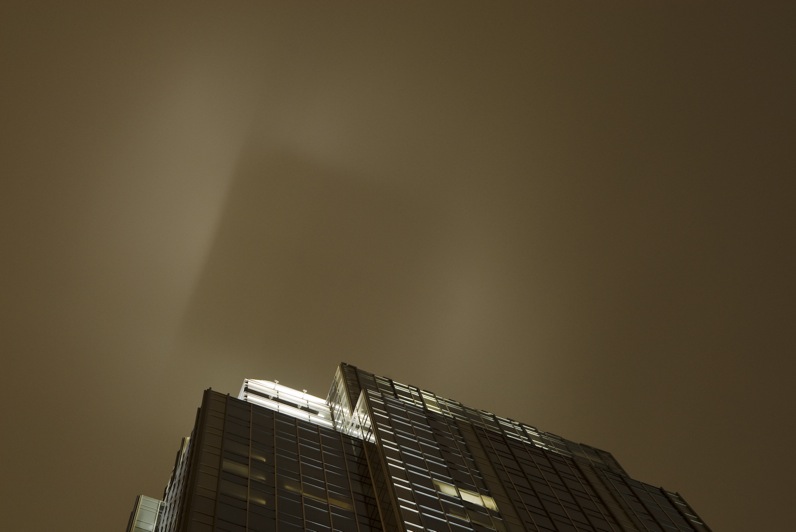
Photographer Blake Gordon has been documenting the geometric effects of light pollution in Austin, Texas, capturing thinly defined shapes in the clouds, projected upward from the tops of buildings.
It’s an accidental ornamentation of the city sky – or what Gordon calls Cloud Projections.

[Image: From the series Cloud Projections by Blake Gordon].

“I captured defined patterns of light above the city when atmospheric conditions were right,” he explained in an email. This is part of a larger interest in seeing “the clouds as a surface.” For instance, Gordon mentioned that he had also produced “rough images from a plane flight in Minnesota where I saw the reverse: low winter clouds gave light pollution a medium to mark upon, and towns broadcast their cluster signals to those above.”
About these “broadcasts,” Gordon asks: “Some of them were so precise that it’s hard to conceive that they are just afterthoughts of a lighting design. Would it still be called light pollution?”

[Image: From the series Cloud Projections by Blake Gordon].

While I’m instantly reminded of Paul Virilio’s War and Cinema – where Virilio memorably describes the Nazi use of searchlights as a form of temporary light-architecture, creating a “space” of monumental vaults and upward-projected walls to help define their night rallies – I’m also struck by at least two possibilities here:

1) Airplanes could project downward onto the cloud canopy, showing anything from television shows to the latest Hollywood blockbuster to local weather and temperature information. The audience? The people in that particular aircraft. Like some strange technological implementation of Jacques Lacan, you’d be moving forward into a world defined by your own projections. Imagine, though, looking out across the city at other airplanes stuck in holding patterns, projecting films down onto the clouds of their respective flight paths. You glimpse scenes from The Dark Knight, Valkyrie, and The Wrestler. Or perhaps planes could project images in all directions, forming cylinders of imagery. An IMAX of the sky. Whenever you encounter clouds, your flight crew switches on the outside projectors… and everyone gazes out at that ghostly presence, a dream-cloud of film passing hundreds of miles per hour through the inner atmosphere.

2) Buildings could project films upward onto the cloud canopy. For your next corporate party you hire SkyTV: a patented, cinematic approach to urban cloud cover. Drive-in cinemas would no longer exist; high-rises would, instead, have installed bleachers on their roofs, like those old tiered seats you find atop houses near Wrigley Field, put there so you can see the game without an official ticket. Only, here, those bleachers are tilted back like planetarium seats – and everyone is watching the sky.

a) Even without shining films into the sky, this would be an amazing idea: turning the whole city into a planetarium. Perhaps astronomers should be asking: Why aren’t there sky-bleachers on every roof? You’re out on a date some night and you’re invited to stop by a friend’s party – but everyone seems to be heading up onto the roof. You both follow, drinks in hand – and soon you’re out on the roofscape, nervous amidst bleachers, gigantic hulking silhouettes against the night sky. And there are dozens and dozens of people up there, reclined in near-silence, watching the constellations. There are thousands of buildings around the city like this, you’re told. No one stays inside anymore.

b) Perhaps it’s time to rethink movie theater design. Perhaps the coolest architecture studio you could take right now would be one in which you rethink the contemporary cinema. Perhaps the outdoor cinemas of the future use clouds as their surface, and rooftops as their arena. AMC might even offer corporate sponsorship. From GPSFILM to CINEMA41, ideas for redesigning the cinematic experience are already out there – so how might they be tweaked to involve the sky?

c) It’s the summer of 2011 – a Friday night – and you’re out for drinks in Manhattan with friends. But then all the lights in midtown begin to switch off, and weird glowing shapes appear in the sky. There are noises. You think it’s some kind of cheesy night club opening up downtown, or perhaps the Mayan apocalypse a year early. But then: Ghostbusters III, projected from some kind of mega-projector, appears above you in the clouds. It’s the world’s most talked-about film premiere: ghosts in the sky and a million unticketed viewers, in a kind of vertical philanthropy of the moving image.

3) Like something out of Archigram, you develop a stationary airship that passes up through the clouds each night to project films back down; for the audience below, it’s as if a talking hologram has settled into the sky above the city. The people who control the ship are dream technicians. But then the airship is hijacked by a 15-year old, who flies it above remote stretches of the Amazon, terrifying uncontacted native tribes. Steven Spielberg soon makes a movie about him, produced by Werner Herzog.

4) BLDGBLOG here proposes FogFilms, a new project for my fellow San Franciscans. When the fog gets bad, the films get going.™ We’ll transform fog banks into film screens.

In any case, it seems worth asking if we could transform light pollution from its current status as a kind of abstract blur, somewhere between orange and white, into something worth watching – if we could focus it, concentrate it, or, more accurately, give it content.

[Image: Andrea Mantegna, Oculus in the Camera degli Sposi].

After all, there would seem to be serious architectural possibilities here. On foggy nights, or humid nights, or cloudy nights, you transform the sky into a trompe l’oeil painting, a cinematic oculus, a new ceiling, a kind of dream-valve above the city.

[bracket]

Don’t forget that submissions for the first issue of [bracket] are due on Monday, February 2. The theme is “On Farming.”

[bracket] is a collaboration between Archinect and InfraNet Lab (who I posted about last week).
A description of what they’re hoping to address:

The first edition of [bracket] is centered around the theme of farming. Once merely understood in terms of agriculture, today information, energy, labour, and landscape, among others, can be farmed. Farming harnesses the efficiency of collectivity and community. Whether cultivating land, harvesting resources, extracting energy or delegating labor, farming reveals the interdependencies of our globalized world. Simultaneously, farming represents the local gesture, the productive landscape, and the alternative economy. The processes of farming are mutable, parametric, and efficient. From terraforming to foodsheds to crowdsourcing, farming often involves the management of the natural mediated by the technologic. Farming, beyond its most common agricultural understanding is the modification of infrastructure, urbanisms, architectures, and landscapes toward a privileging of production.

With a global food crisis looming, even the traditional farm’s impact on land, resources, and economics is in need of re-visioning. Other innovations have led to a growing number of people investing in shares of a local farmer’s crop, reducing trips to the supermarket and the cost of shipping food. Energy farming has seen immense diversification in the last decade with essential innovations in renewable energies such as wave farms, wind, tidal, solar, and even piezoelectrical.

Submission requirements and so on are available on their website.

Ride the Lightning

Sky-borne accumulations of car exhaust can cause lightning, New Scientist reports.

[Image: You bring the weather with you].

“In the south-eastern states,” we read, a recent study showed that “lightning strikes increased with pollution by as much as 25 per cent during the working week. The moist, muggy air in this region creates low-lying clouds with plenty of space to rise and generate the charge needed for an afternoon thunderstorm.”
So it seems like a bit of an overstatement to say that car exhaust actually generates lightning storms, but it’s nonetheless quite fascinating to think that the atmospheric conditions generated by traffic jams and congested freeways might also stimulate airborne electrical activity.
Traffic jams become a kind of planetary event. You could even construct lightning highways: deliberately planned, cultivated routes of positive charge.
Dubai, sick of skyscrapers (or simply bankrupted by them), instead builds itself a freeway dedicated to the electrical exploitation of the sky.
On a map of global lightning strikes, it shows up as an anomalous 50km stretch across the desert, where automotive wizards of the inner atmosphere summon light from the sky.
Metallica films its last music video there.
But the fact that you might not only be driving within a local weather system but actually creating one as you drive just fascinates me.
The weather above you is part of the traffic jam you’re in; it is an epiphenomenon of urban infrastructure.
Or, to re-describe climate change in a slightly more mundane way: there is so much car exhaust in the air right now that it has begun to generate its own weather.

The Year of Listening

[Image: Photo by Taylor Deupree].

At the end of 2008, musician Taylor Deupree wrote that he would start a new project on January 1, 2009: recording one new sound a day. He explains that he “will carry a small digital audio recorder with me every day of the year and record one sound per day throughout 2009. (…) this exercise will not only force me to listen more carefully every day, but open my own sound palette, expanding into field recording.”
He continues, avoiding the upper-case:

i will not set a time limit on each day’s recordings, but rather make each recording as long as it needs to be to capture whatever it is i’ll be capturing. along with the recorder i will carry a small notebook and make a note of date and time as well as location and “subject.”

After all, he concludes, “2009 will be a year of listening.”
The first dozen or more sounds are already up; you can listen to them at his blog. Note that you can play several files simultaneously, so it’s quite interesting to move up and down the page and start different files at different times; the blog becomes a kind of musical instrument made of field recordings, used-defined audio landscapes on demand.
You can listen to melting snow, a small stream, the inside of Grand Central Station, sand on the beach in Hawaii, and so on – acoustic snapshots of life on the planet.
Note that Deupree is also a photographer; some of his work is really fantastic. He also once produced an album with Savvas Ysatis called Tower of Winds, inspired by the inner electronic programming of Toyo Ito’s Tokyo building.

[Spotted at Rare Frequency].

Found Sound City

There’s a building somewhere in New York City: every time you go there – maybe it’s a bank or a department store or the office where you work – you hear what sounds like air-conditioning equipment, a distant droning noise in the background that you can’t quite place.
But it’s always there – maybe sometimes higher pitched than other days, but always audible.
One day, though, you happen to be there with some friends and you’ve got a videocamera. You’re filming each other goofing off, playing in the stairwells, and so on – but when you get back home and begin to watch the video you realize it’s actually quite boring. Making faces at a camera is not as interesting as you’d hoped it’d be.
So – overlooking the fact that this would not actually be possible – you begin to fast-forward the video at 4x speed, then 8x, then 16x, then 32x – and you realize, with a collective gasp, that that droning sound in the background is not a drone at all but a piece of music played slow to the point of unrecognizability. It’s Beethoven, say, or Jimi Hendrix.
Someone is playing incredibly slow music, like a kind of acoustic glacier, inside the building. It’s avant-garde Muzak.
You go a little crazy upon discovering this, however, and begin to make field recordings all over Manhattan, recording drones. You stand in alleys, beneath trees in Central Park, and inside abandoned warehouses, capturing ambient background sounds on tape. You visit the airport, deliberately seek out traffic jams, and illegally access basements on the Upper East Side.
And for the next six months you sit and listen to all of them at 32x speed – 64x speed, 128x speed – convinced that this world has strange music embedded in it somewhere and, if only you use your equipment right, you can find it.