SuperMax

It’s not exactly news, but something caught my eye the other week via Robin Sloan’s Twitter feed, so I thought I’d put up a quick post about it here.
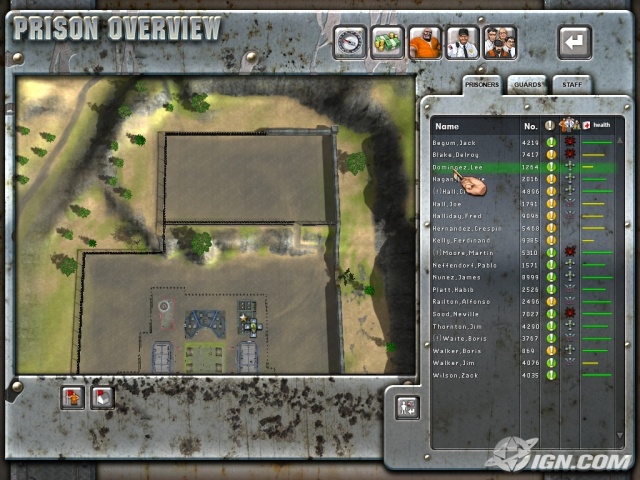
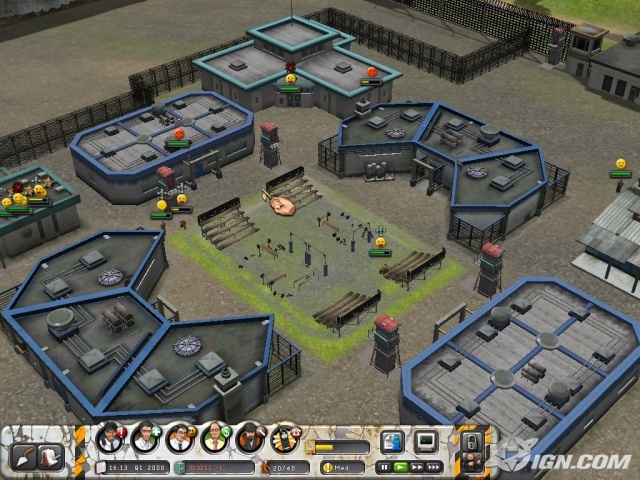
[Image: From Prison Tycoon 4: SuperMax. Image via IGN].

The description of Prison Tycoon 4: SuperMax, a ValuSoft game released in 2008, urges players to experiment in the architectural framing and administrative implementation of prison life.
“Build a profitable privately run prison from the ground up,” it says. “Every wall, every fence, every decision is yours. Start small and forge your reputation as a first rate warden. Grow your facility to SuperMax capabilities, housing the most dangerous and diabolical criminals on earth – all for the bottom line.”
Putting moral limits on our imaginations temporarily aside, perhaps we could even conceive of Prison Tycoon 5: Guantánamo Bay, or Prison Tycoon 6: Austrian Basement Edition. Prison Tycoon 7: Gulag.
Prison Tycoon 8: Escape from Abu Ghraib.
Or scrap the cheap political commentary and go for sci-fi: Inflatable Prisons in Space! The final level is a siege of the earth’s surface via space elevator, convicts raining down upon the planet like dark angels. The plot is loosely modeled on Paradise Lost.
Setting up the next game: Prison Planet.
Or famous prisons from literature – including Brian Aldiss’s rotating prison of Helliconia.
The Library of Babel reimagined as a SuperMax prison in the mountains of western Canada.
Prisons carved from glaciers undergoing catastrophic earthquakes as global climate change causes melt-off. You have to escape before the ice sheet collapses, teaming up with the very guards who once held you captive.
Prison Tycoon 10: Global Meltdown.
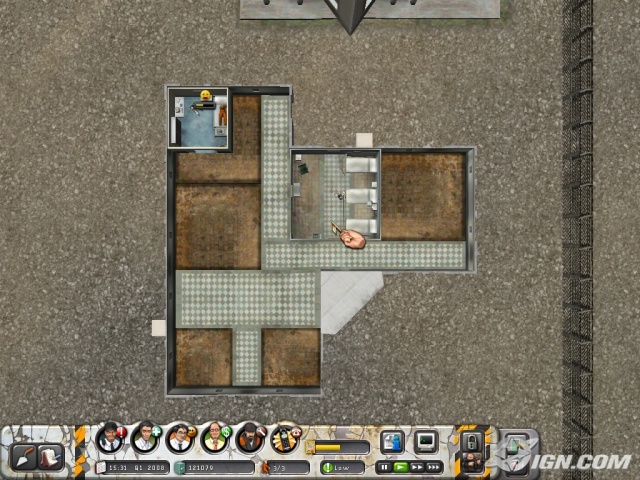
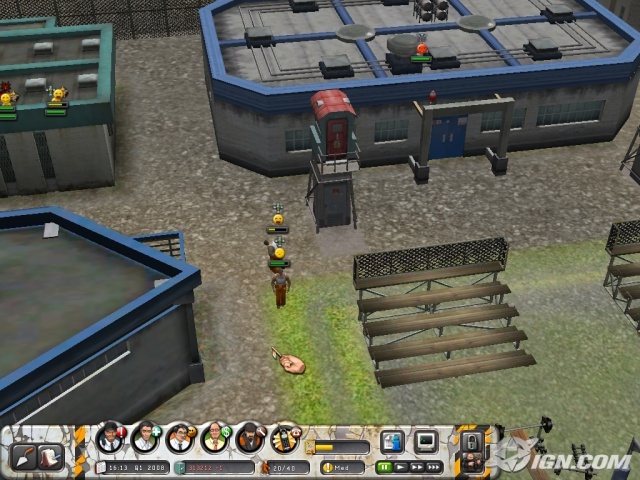
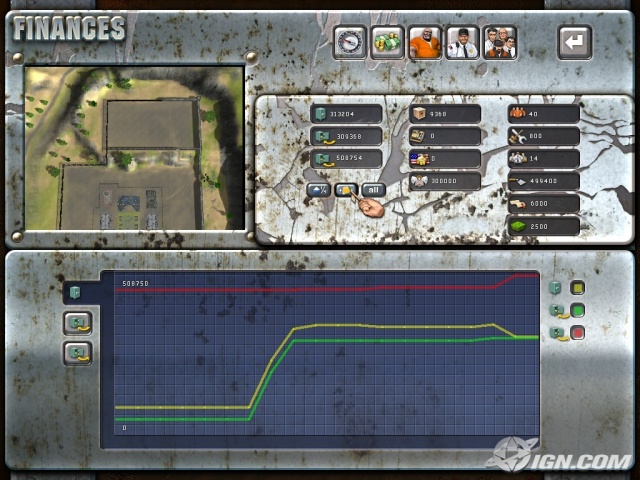
[Images: From Prison Tycoon 4: SuperMax. All images via IGN. If Mies van der Rohe had designed a prison, what might it have looked like?].

Of course, ValuSoft kicked all of this off back in 2005 with the original Prison Tycoon: “In Prison Tycoon,” we read, “you construct and maintain a private prison, hire the staff, and control the prisoners – all while trying to earn big money.”
But why not open the series to goals beyond “big money” and a swollen “bottom line,” and aim for sheer architectural complexity?
Or locational advantages, like the offshore oil rig -slash- ultramax prison in John Woo’s surprisingly great film Face/Off.
You construct an Alpine labyrinth that has no guards at all; the architecture itself is so bewildering that no one has ever escaped. Umberto Eco’s final novel is set there; or perhaps one of his characters dreams it.
Gormenghast: The Prison.
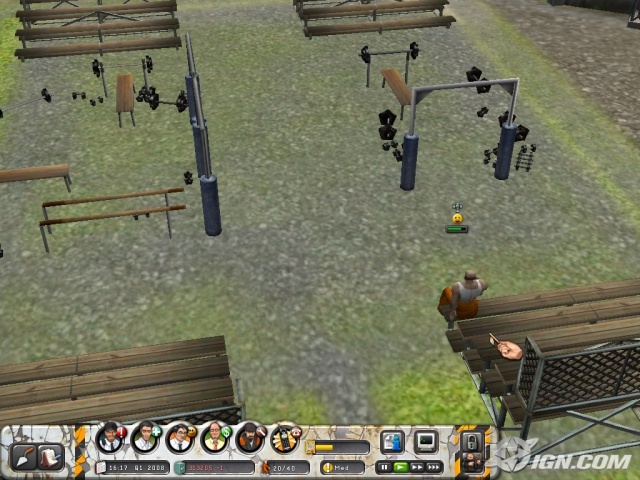
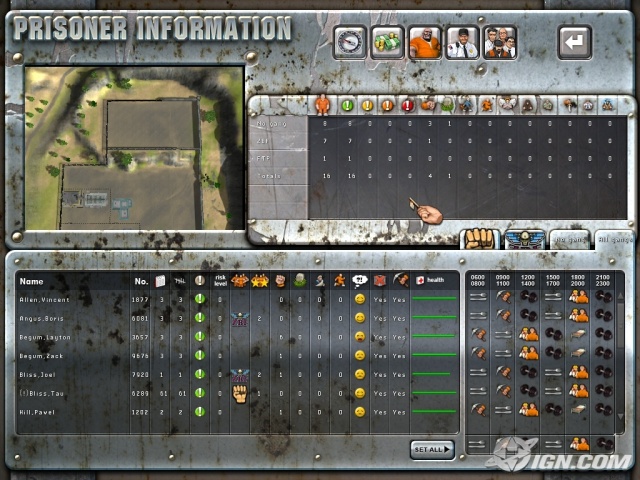
[Images: From Prison Tycoon 4: SuperMax. Images via IGN].

However, lest you now be tempted to purchase Prison Tycoon 4, I’d first suggest reading this review.
For instance:

Since it’s pretty much impossible to tell the difference between a guard and a prisoner in the yard, you’ll have to open up the submenu. From there you click on the guard tab, select a specific guard, look at the minimap to check the whereabouts of the guard, close the submenu, investigate the most recent known whereabouts of the guard, locate and right mouse click the guy (you can’t create a drag box to select anything in this game), move him into the action, right mouse click on a troubled prisoner, and select the beat-him-up icon. By the time you try to initiate all of this, a prisoner might have already died. If this all sounds convoluted it is. The whole game is like this, and it really hurts to not have a proper tutorial.

Sounds like fun.

Manhattan as a vascular organ

As part of their new water-themed issue, the beautifully designed New York Moon has produced this interactive map of the water systems of Manhattan.

[Image: The New York Moon‘s interactive map of the water systems of Manhattan; map by Zack Sultan].
“Beneath New York’s lattices of concrete, iron and landfill lie dozens of organic waterways,” they write. “Using data from an 1865 sanitation map and contemporary satillite photographs, this projection depicts Manhattan as a vascular organ, whose obscure opperation has had powerful bearing on the fate of the city.”
Older issues of the Moon are definitely worth checking out, including their recent look at deserts, underground acoustics, and the idea of a four-dimensional document for “investigating time and space.”
While you’re there, don’t miss the floating bog-city of Lake Titicaca:

Beginning with a sturdy floating bog, and then laying a base of totora reeds over it, the men, women and children of Uros work together, piling the reeds in a different direction every two weeks until they have created a latticework strong enough to hold six or seven homes and one kitchen on each island, a process that takes about eight months. All of the forty-odd islands are then anchored to sticks pitched into the lake’s floor, making the community buoyant but stationary. Though the islands at conception are about three to four feet thick, they will double over time as dying reeds are covered with newer, stiffer ones, a process of renewal repeated until it is time to build an entirely new island.

Note that I hereby pitch a jointly edited future edition of New York Moon, to be curated by BLDGBLOG and Pruned, around the theme of gardens. Late summer 2009.

BLDGBLOG @ Rice University

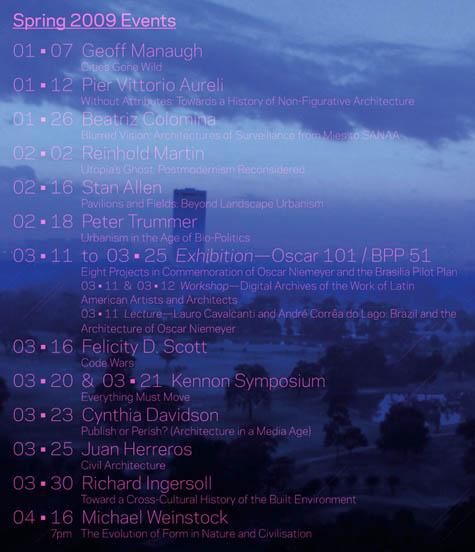
I’m excited to announce that I’ll be lecturing at the Rice University School of Architecture in Houston, Texas, in only two days’ time, kicking off their Spring 2009 lecture series.

[Image: View larger].

I’ve clearly got some very large shoes to fill with this series, however, as I’ve been lined up with everyone from Beatriz Colomina to Cynthia Davidson. Stan Allen, Juan Herreros, Richard Ingersoll, Pier Vittorio Aureli, Michael Weinstock, Peter Trummer – it looks like a fantastic series.
For my own part, I think I’ve got a great talk planned – called “Cities Gone Wild” – expanding from the lecture I gave back in November, sponsored by the Complex Terrain Laboratory, at University College, London.
This talk begins at 5pm on Wednesday, January 7; it’s free and open to the public; and it will take place in Anderson Hall.
I don’t know how many readers BLDGBLOG has in Houston – or, for that matter, at Rice – but I’d love to see some of you there. And please introduce yourselves, too, as I love meeting new people.
Also, at the end of my talk I hope to address the more general subject of blogging, if for no other reason than I can guarantee that there are students enrolled at Rice right now – and people living in Houston – who have something interesting to say and simply need a new platform from which to say it. I’d be happy to talk about establishing a blog and so on, as that’s not a topic I’ve much addressed throughout all of these talks.
Finally, I’ll be doing thesis reviews at the architecture department all day on Thursday and Friday, so if you happen to be enrolled in the courses I’ll be visiting, then cool. I look forward to meeting you!
And come out to the talk – it should be fun.

Stonehenge Beneath the Waters of Lake Michigan

[Image: Standing stones beneath Lake Michigan? Via Mark Holley].
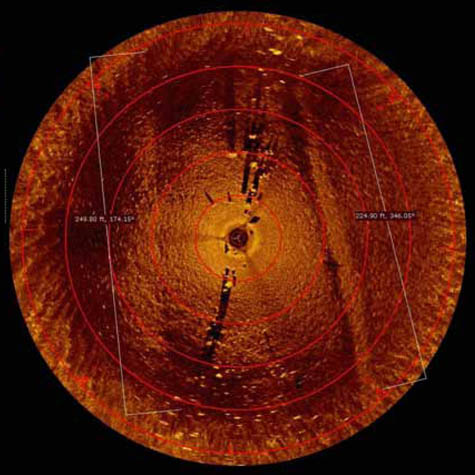
In a surprisingly under-reported story from 2007, Mark Holley, a professor of underwater archaeology at Northwestern Michigan College, discovered a series of stones – some of them arranged in a circle and one of which seemed to show carvings of a mastodon – 40-feet beneath the surface waters of Lake Michigan.

If verified, the carvings could be as much as 10,000 years old – coincident with the post-Ice Age presence of both humans and mastodons in the upper midwest.

[Image: The stones beneath Lake Michigan; via Mark Holley].
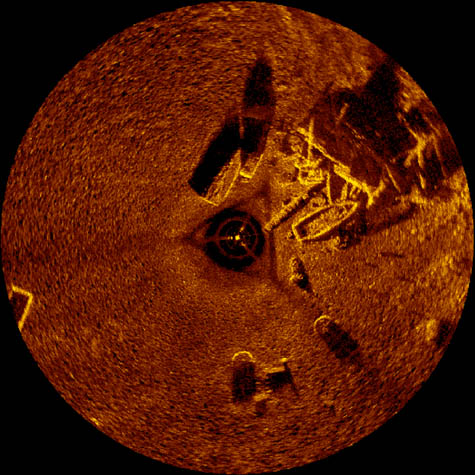
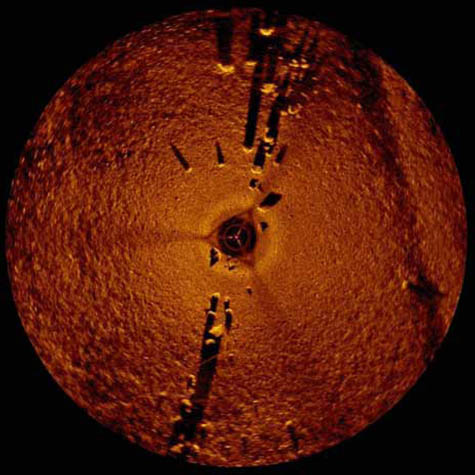
In a PDF assembled by Holley and Brian Abbott to document the expedition, we learn that the archaeologists had been hired to survey a series of old boatwrecks using a slightly repurposed “sector scan sonar” device. You can read about the actual equipment – a Kongsberg-Mesotech MS 1000 – here.

The circular images this thing produces are unreal; like some strange new art-historical branch of landscape representation, they form cryptic dioramas of long-lost wreckage on the lakebed. Shipwrecks (like the Tramp, which went down in 1974); a “junk pile” of old boats and cars; a Civil War-era pier; and even an old buggy are just some of the topographic features the divers discovered.

These are anthropological remains that will soon be part of the lake’s geology; they are our future trace fossils.

But down amongst those otherwise mundane human remains were the stones.

[Image: The “junk pile” of old cars and boat skeletons; via Mark Holley].
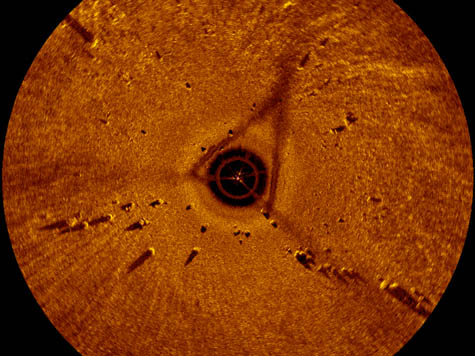
While there is obviously some doubt as to whether or not that really is a mastodon carved on a rock – let alone if it really was human activity that arranged these rocks into a circle – it’s worth pointing out that Michigan does already have petroglyph sites and even standing stones.

A representative of the University of Michigan Museum of Paleontology has even commented that, although he’s skeptical, he’s interested in learning more, hoping to see better photographs of the so-called “glyph stone.”

[Image: The stones; via Mark Holley].

So is there a North American version of Stonehenge just sitting up there beneath the glacial waters of a small northern bay in Lake Michigan? If so, are there other submerged prehistoric megaliths waiting to be discovered by some rogue archaeologist armed with a sonar scanner?

Whatever the answer might be, the very suggestion is interesting enough to think about – where underwater archaeology, prehistoric remains, and lost shipwrecks collide to form a midwestern mystery: National Treasure 3 or Da Vinci Code 2. But only future scuba expeditions will be able to tell for sure.

Of networks, grids, and infrastructures, or: How to make a planet

If I have several blogging resolutions for 2009 – and I do – one of them is definitely to read InfraNet Lab more often.

[Image: Offshore energy islands, via InfraNet Lab].

Easily one of the most interesting architecture blogs out there today – though it’s really an infrastructure blog, hopefully heralding a new focus for design writers in the next few years – and written by Toronto-based architects Mason White and Lola Sheppard, along with two contributors named Maya and Neeraj, it tracks massive infrastructure, waste, energy, and design projects across the global landscape, taking in geology, engineering, network economics, ecology, construction innovation, future fuels, and much more.

Read it and you’ll know how to “harvest energy from the earth’s rotation” using mega-gyroscopes, you’ll discover how a more efficient offshore seaweed industry might work, you’ll pick up clues for how to design a mountain and then how to connect that mountain to others using aerial tramways, you’ll get an architectural glimpse of habitat meshing, you’ll take an hallucinatory tour through Taiwanese mushroom farms, you’ll visit underground waste isolation sites in New Mexico, you’ll turn around and go the opposite vertical direction – into the sky – to farm water from the atmosphere, and you’ll even punt around the artificial inland waterways of Britain using strange mechanized structures and seeing that archipelago as hydrology first, geography later.

So go check it out – and make 2009 the year of networks, grids, and infrastructures.

Arrested Development

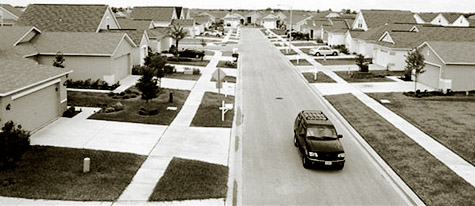
Instead of putting people under house arrest – where they’d stay at home all day, unable to leave their own property for weeks or months at a time – you instead send them out to some perfect suburb in the middle of, say, Nebraska or Utah, a remote development where each house is fully furnished and tastefully maintained, but each also has only one inhabitant: a minor criminal of some sort, dwelling on the immorality of shoplifting or tax fraud and serving-out a short period of house arrest. They can even get their mail redirected there, and watch Netflix.
But out on the far periphery are watchtowers, and the streets are lined with cameras.

In the winter of light

“There are architecture photographers [who] refuse to photograph anything from November up to February,” Michiel van Raaij writes on his blog Eikongraphia. “In their view the long shadows and dimmed light intensity of the winter season compromises their work. The effect is that – in the architecture media – not only the sun always shines, but that it is also never winter.”
There are several interesting observations here, but I’m particularly struck by the thought that the spherical trigonometry of the earth’s surface – and its angular effect on shadows – has an impact on how we might popularly view and represent architectural space.
By extension, then, if raised only on images of buildings in which there are no visible shadows – and in which surfaces thus appear to be all but shaved of ornament – are architects actually designing for a particular season of light? That is, buildings that are meant to look good, and photograph well, only in summer?
How amazing it would be to find that architectural styles begin to change – moving away from the Clement Greenberg-like flatness of international modernism toward a new era of ornamentally active deep surfaces – if something as simple as when photographs are taken were to change.
All the works of Frank Gehry, photographed in the anemic, angular light of midwinter. I sense a book idea here, if any enterprising photographers might be reading this…

Fortifications Tour

In between discovering this thing the other day and sitting down to post about it this morning – it was cancelled.
What was it?
A fortifications tour through the United States and Europe, planned for 2009. And it sounded awesome.

As you can read in the trip’s accompanying PDF (3.2MB), Cornell professor Arthur Ovaska, architects Austin + Mergold, and their students would “travel along the east coast of the US and traverse Europe north to south in pursuit of a transformation in space and history of a particular type. The typology is fortifications. It is neither building nor landscape, but a hybrid, shaped in response to thousands of years of war.”

We will study the architectural responses to conflict; their continuing evolution and adaptation to new technology, tactics and politics; as well as their impact on the national, urban and individual scale in the built environment and landscape… While architects no longer design for war, we have to reconcile with its aftermath through re-appropriation of killing fields for parks, the re-engagement of city centers choked by defensive rings, and the transformation of space formerly traversed by metal and fire into places of peaceful public interaction.

Although I don’t at all agree with the statement that “architects no longer design for war” – this might be true for, say, Zaha Hadid and Norman Foster, but it is in no way true for military spatialists employed on prototype base housing, prefab field shelters, or even secure urban embassy design – I nonetheless think the very idea of this trip is pretty amazing.

The program will begin by travelling down the East Coast of the US (an area that has been fortified against the “invasion by sea from the east and by land from the west”) to look at urban and rural examples of Fortress America and their effects on our built situation today. We will then continue on to Britain and study results of nearly 2000 years of military history expressed in buildings and landscape. Then, traveling along the French-German border (a continuous battlefield for over a thousand years), we will visit mediaeval castles, baroque garden-fortresses and WWII bunkers, in addition to post-bellum architecture such as Le Corbusier’s Notre Dame du Haut at Ronchamp. Next we will make our way into Switzerland and northern Italy to see some of the incredible natural defenses from the time of Napoleon and Garibaldi (area also featured in numerous James Bond movies and written about by Ernest Hemingway) as well as examples of modern architecture built in short spans of peacetime. Travelling down the fabulous Adriatic coast through several Croatian cities (including Dubrovnik – the ultimate walled city) we will observe traces of the Roman, Venetian, and Italian conquests as well as the recent civil war in the former Yugoslavia. After that we will stop in Greece to visit the famous last stand of the 300 Spartans and study the unique landscape of Thermopylae pass. And finally, finishing our Great March across Europe, we will arrive on the island of Malta: a fortified naval refuge of the Maltese order for the last 500 years that is now contending with its legacy of isolationism.

Here’s the actual itinerary:

[Image: View larger].

You’d engage in design studios along the way – this sounds so unbelievably cool to me, imagine filling whole sketchbooks and blogs with images of well-fortified hill towns, walled cities, bunkers, and urban cores – and, lest you fear for their absence, we’re reminded that “coffee & refreshments will be served.”

You would even have studied “operational walls”:

This technology seminar will focus on the evolution of the fortified wall and earthwork construction dating back several thousand years and its influence on current architecture & landscape production. The primary topics in this seminar will include utilizing the vernacular landscape as a source for construction materials; examining construction methodologies and phasing for the production of an earthwork and wall assembly; analyzing the relationship between form and functional operation; exploring the danger/safety nature of the double-sided programmed wall; and dissecting the logic of wall details. Coursework will require a series of analytical sketches, photographic documentation exercises and a final measured project.

I have to assume that the trip was cancelled because of lack of enrollment, or some other trickle-down effect of the financial crisis (after all, enrollment, airfare, accommodation, and so on was all estimated at a rather eye-popping $20,000 – perhaps I’m wrong, but I feel like BLDGBLOG could organize a cheaper version of this trip quite easily).

[Image: The pack and the bunker: equipment for landscapes].
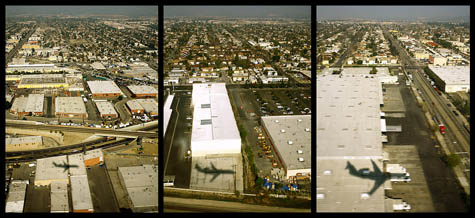
How exciting would that be, though? You get Bryan Finoki, Nick Sowers, Javier Arbona, Edwin Gardner, the Complex Terrain Laboratory, and a dozen others; you all buy a copy of Paul Virilio’s Bunker Archaeology; and then you head over to Europe for five or six weeks of cheap hotel rooms, high-speed trains, rural bus routes, and some overgrown fortifications. You visit bunkers and tunnels and dungeons and barrows. You sketch things, make short films, and one of you draws a comic book. You read Beowulf and shave Javier’s leg hair while he’s sleeping…
Etc. etc.
Then you visit Spartan battlefields in Greece and update the rest of the world via Twitter. At the end, you all split a book deal.
Perhaps a serious plan for 2010…
Read more about the actual trip in the original PDF.

Air Born

The new year begins with a look at sovereign geography as applied to movement through the atmosphere: a Ugandan baby girl was born aboard an airplane en route from Amsterdam to the United States – and so was given Canadian citizenship, because the plane was flying over eastern Canada at the time.

[Image: Three photos by greentheory./Sarah Palmer].

Of course, one wonders what citizenship this baby would have been given if the parents had been flying over the middle of the ocean, for instance, or across the tangled borders of an enclave or exclave. A complicated mathematics of trajectory, speed, and height is unleashed by terrestrial scholars below in order to find the exact location of the plane at the moment of childbirth.
Like something out of Borges, imperial trigonometricians are called in for consultation. Their calculations take days and arguments break out.
Perhaps the child goes on to be famous – a political leader, a poet, a revolutionary, the next pope – and his or her exact aerial origin becomes increasingly important to determine. Weather data and wind speed, the weight of fellow passengers, tiny aerodynamic imperfections in the wings, and even gravitational anomalies in the earth’s crust are brought to bear: how fast was the airplane traveling?
Like the origins of the Sunni/Shia split in Islam, rival factions form: their battle lines are drawn, like wisps of cloud in a springtime sky.
Perhaps, in a virtuoso application of air rights laws delivered to a stunned General Assembly of the UN, a property entrepreneur actually purchases the exact section of sky where he believes the baby was born. Rethinking the deal later, he buys the entire historic flight path. Soon, he owns vast corridors of air.
I’m reminded of Allen Ginsberg, who once wrote of a “Subliminal Billionaire” who “owns vast Spheres of Air” – only, here, those carefully surveyed envelopes of atmospheric real estate are more like UNESCO Heritage Sites, international sky parks hovering somewhere over a border near you.

(Note: The obituary of the man who invented air rights – please, oh please, someone commission me to write a longer article about this man! – was originally spotted last summer via Marcus Trimble’s Super Colossal).

The Six Nations of 2010

[Image: Professor Igor Panarin’s six-fold vision of a disintegrated United States; I love how it will precisely follow today’s existing state lines – and that Kentucky will join the European Union].
In what sounds to be very obviously an act of wishful projection, a former KGB intelligence analyst turned public intellectual named Igor Panarin has explained to the Wall Street Journal that the United States only has about 18 months left to live. In the summer of 2010, it will “disintegrate” into six politically separate realms – and, conveniently for a thinker who clearly leans to the right, the borders of these realms will coincide with a new racial segregation.

Best of all, from Panarin’s perspective, Alaska – Sarah Palin included, looking out with alarm from her office window – will “revert” to Russian control.

Quoting at length:

[Prof. Panarin] predicts that economic, financial and demographic trends will provoke a political and social crisis in the U.S. When the going gets tough, he says, wealthier states will withhold funds from the federal government and effectively secede from the union. Social unrest up to and including a civil war will follow. The U.S. will then split along ethnic lines, and foreign powers will move in.

California will form the nucleus of what he calls “The Californian Republic,” and will be part of China or under Chinese influence. Texas will be the heart of “The Texas Republic,” a cluster of states that will go to Mexico or fall under Mexican influence. Washington, D.C., and New York will be part of an “Atlantic America” that may join the European Union. Canada will grab a group of Northern states Prof. Panarin calls “The Central North American Republic.” Hawaii, he suggests, will be a protectorate of Japan or China, and Alaska will be subsumed into Russia.

“People like him have forecast similar cataclysms before, he says, and been right,” the Wall Street Journal continues. Panarin then “cites French political scientist Emmanuel Todd. Mr. Todd is famous for having rightly forecast the demise of the Soviet Union – 15 years beforehand. ‘When he forecast the collapse of the Soviet Union in 1976, people laughed at him,’ says Prof. Panarin.”

In some ways, I’m reminded of Paul Auster’s newest novel, Man in the Dark, in which a civil war has set multiple regions of the United States against one another and against the so-called Federal Army. Or, for that matter, there’s also Rupert Thomson’s Divided Kingdom in which the UK has been split up along emotional lines.

But surely an ex-CIA operative, now milking the lecture circuit for all its worth, could also propose a realistic scenario in which the entire Russian east has been sold off, say, to a combination of Euro-American agribusiness firms and the Chinese government, who them embark upon an elaborate, generations-long act of industrial deforestation? Leaving Moscow a kind of irrelevant, feudal city full of Bulgari and handguns, its governmentally terrorized tower blocks populated almost entirely by unemployed and half-drunk retro-Stalinists?

I don’t mean to imply that I think the end of the United States is somehow politically unimaginable, but that, in a still-bipolar, post-Cold War international imagination, surely either side could convincingly outline the other’s demise?

(Earlier on BLDGBLOG: North America vs. the A-241/BIS Device and The Lonely Planet Guide to Micronations: An Interview with Simon Sellars).

Architects of the Near Future

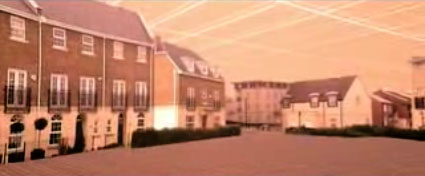
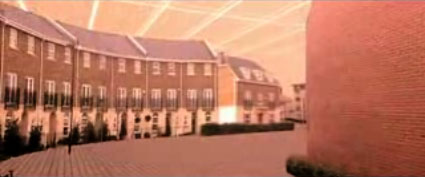
[Images: From a short film by Michael Aling, produced for Nic Clear’s Unit 15 at the Bartlett].

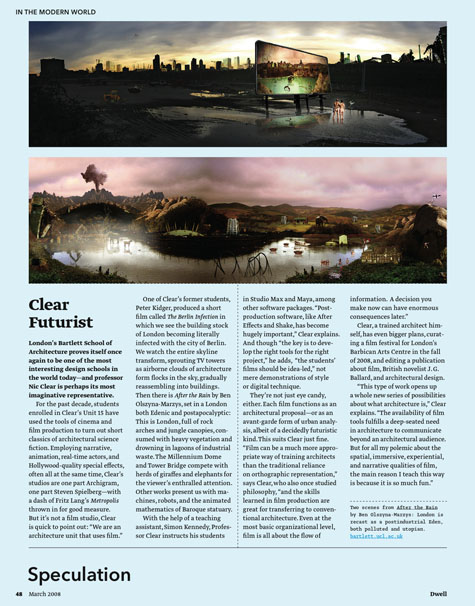
A few days ago, Ballardian posted a long, well-timed, and very interesting interview with Nic Clear, from London’s Bartlett School of Architecture. I’ve long been a fan of Clear’s work with his students; I wrote a short article about him for Dwell last spring (see image, below), and Clear organized last month’s Science Fiction and Architecture panel in London.

[Image: A short article about Nic Clear from the March 2008 issue of Dwell].

Huge sections of the interview, in which they discuss the value of extra-architectural ideas in helping to shape the “near future” of spatial design, are worth quoting in full; but I’ll stick to a few specific moments here, and you can then go read the rest.
What I like about Clear, though, is that he’s 100% comfortable with – and seemingly relentless about pursuing – architecture not as a system of codified ornament or as a closed universe of citational conformity open only to grad students, but as a resource for ideas of every kind, whether or not they apply to your own local building codes or will ever lead to an act of construction.
Want to write a novel? A screenplay? An essay about landscape and climate change? Want to direct a music video? Start a blog? Architecture offers fuel – and amazing visuals – for all of these things.
The field becomes almost infinitely more exciting when you realize that architectural projects, by definition, entail the reimagination of how humans might inhabit the earth – how they organize themselves spatially and give shape to their everyday lives. Architecture is, within mere instants of discussing any idea or project, real or imagined, something with anthropological, economic, legal, libidinal, seismic, and even planetary implications.
In fact, if architecture can be viewed as the material alteration of the earth’s surface, then it is not a stretch to say that architecture has astronomical consequences: it can alter the very shape of a planet.
Little wonder, then, if we do decide to go in this direction, that there appears to be a growing cross-over of interests between architecture and science fiction – as in, for instance, the work produced by Nic Clear’s Unit 15.

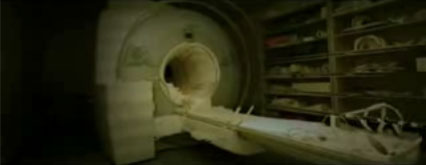
[Images: From a short film by Dan Farmer, a tour through a landscape of abandoned hospital equipment, produced for Nic Clear’s Unit 15 at the Bartlett].

In any case, it shouldn’t be surprising that Ballardian would then focus specifically on the architectural value of J.G. Ballard.
When asked whether Ballard is a growing influence on today’s practitioners, Clear answers:

I’m not sure how many architects are being influenced by Ballard in their work, especially within ‘commercial’ architecture – maybe the forthcoming recession will make architects aware of the Ballardian possibilities of architecture. Within academia and architectural criticism, if such a thing still exists, there is a general disdain for ‘popular’ fiction – writing on, and about, architecture is still very elitist – and I have met quite a bit of resistance when discussing Ballard as a serious subject. However, I think that there is a desire to face up to a future that deals with a system in crisis, which Ballard articulates so brilliantly. I was recently reading Mike Davis’s breathtaking collection of essays, Dead Cities, and was constantly thinking ‘this is so Ballardian.’ Also, writers like Frederic Jameson and Jean Baudrillard, who have been influenced by Ballard, are still incredibly important and influential. Obviously Ballard’s early identification of global environmental issues also makes him incredibly pertinent to many people. However Ballard does not give easy, or even any answers and this puts off many people. Given the current economic and environmental conditions, he seems more prescient than ever, not simply because of the situations he describes, but because he offers a mindset for dealing with these issues.

Asked to define “Ballardian space,” if such a thing exists, Clear says: “If you take Jameson’s postmodern hyperspace, remove the post-structuralist jargon, add some dark humour and set it on the periphery of any declining western industrialised city – especially London – then you are pretty close [to Ballardian space].”
Finally – because you can simply read the interview itself in full – Clear sums it all up: “We have to stop thinking about architecture simply in terms of building buildings – that’s why I am so interested in looking at other models and disciplines to draw inspiration from.”