California City

[Image: Geoglyphs of nowhere].

In the desert 100 miles northeast of Los Angeles is a suburb abandoned in advance of itself—the unfinished extension of a place called California City. Visible from above now are a series of badly paved streets carved into the dust and gravel, like some peculiarly American response to the Nazca Lines (or even the labyrinth at Chartres cathedral). The uninhabited street plan has become an abstract geoglyph—unintentional land art visible from airplanes—not a thriving community at all.

Take a look.

[Image: Empty streets from above, rotated 90º (north is to the right)].

On Google Street View, distant structures like McMansions can be made out here and there amidst the ghost-grid, mirages of suburbia in the middle of nowhere.

And it’s a weird geography: two of the most prominent nearby landmarks include a prison—
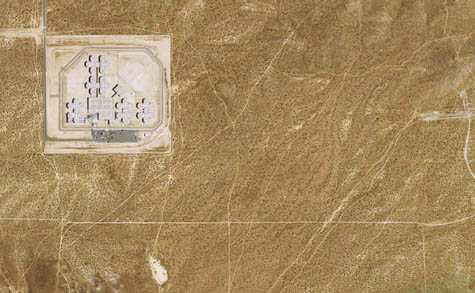
[Image: The geometry of incarceration].

—and an automobile test-driving facility run by Honda. There is also a visually spectacular boron mine to the southeast—it’s the largest open-pit mine in California, according to the Center for Land Use Interpretation—and an Air Force base.

To make things slightly more surreal, in an attempt to boost its economic fortunes, California City hired actor Erik Estrada, of CHiPs fame, to act as the town’s media spokesperson.
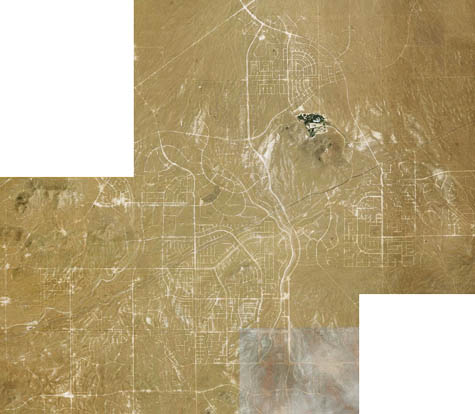
[Image: Spatial fossils of the 20th century].

The history of the town itself is of a failed Californian utopia—in fact, incredibly, if completed, it was intended to rival Los Angeles. From the city’s Wikipedia entry:

California City had its origins in 1958 when real estate developer and sociology professor Nat Mendelsohn purchased 80,000 acres (320 km2) of Mojave Desert land with the aim of master-planning California’s next great city. He designed his model city, which he hoped would one day rival Los Angeles in size, around a Central Park with a 26-acre (11 ha) artificial lake. Growth did not happen anywhere close to what he expected. To this day a vast grid of crumbling paved roads, scarring vast stretches of the Mojave desert, intended to lay out residential blocks, extends well beyond the developed area of the city. A single look at satellite photos shows the extent of the scarred desert and how it stakes its claim to being California’s 3rd largest geographic city, 34th largest in the US. California City was incorporated in 1965.

I can see an amazing article being written about this place for GOOD magazine —”California and its Utopias,” say—or The New Yorker, or, for that matter, Atlas Obscura. The large-scale spatial remnants of an economic downturn, decades in advance of today’s recession.

[Images: Zooming in on the derelict grid].

Either way, and with any luck, a road trip out through the deserted inscriptions of this forgotten masterplan will hopefully beckon once BLDGBLOG moves back to Los Angeles.

(California City was pointed out to me a very long time ago by a BLDGBLOG reader—whose original email I can no longer find. If it was you who pointed this out to me, I owe you a huge thanks! David Donald—who also pointed out that California City was written up by The Vigorous North last year).

A Social Philosophy of Buttresses

[Image: The front and back covers of Support Structures].

The last book launch I want to mention today—it seems like the only things going on these days are launches!—is for a fantastic-looking book called Support Structures by Céline Condorelli. The launch is coming up on December 3 at Storefront for Art and Architecture in New York (although Storefront’s website currently has the wrong date listed—see a complete catalog of launch dates here).

UPDATE: The launch has been postponed until January/February 2010—I will mention this again when a date is confirmed.

[Image: From Support Structures].

The book “exposes an almost complete absence of literature or theory on what constitutes ‘support’,” Condorelli suggests, “and therefore the imperative need to create a bibliography on the subject.” Indeed, Condorelli hopes the book will inspire “the creation of the missing bibliography of support structures.” Call it a philosophy of buttresses.

Support Structures is a manual for what bears, sustains, and props, for those things that encourage, care for, and assist; for that which advocates, articulates; for what stands behind, frames, and maintains: it is a manual for those things that give support. While the work of supporting might traditionally appear as subsequent, unessential, and lacking value in itself, this manual is an attempt to restore attention to one of the neglected, yet crucial modes through which we apprehend and shape the world.

While the phrase the work of supporting brings to mind Derrida, the book itself seems to fall somewhere between a catalog of scaffolding, retaining walls, buttresses, archways, keystones, and more—a typology of gravitational resistance—and a call for more generous collaborations in our everyday lives as architects, artists, designers, writers, and more.

The very idea of a “support structure” here becomes a social metaphor for the role of friends and co-conspirators.

[Images: Some page spreads from Support Structures].

In the book’s Foreword, Condorelli describes the “conceptual devices offered by thinking through what a support structure could or might be,” in the process “asking if a universal support structure could be developed.”

Read more about the book courtesy of the publishers, Sternberg Press—and I hope to see some of you at the book launch next month.

The squalor, the possibilities, the madness

It is clearly the season for book launch events! Tomorrow, Saturday, November 21, at the Columbus Circle Borders in Manhattan, Jeff VanderMeer will be reading from his new book Finch—and then engaging in a conversation about fiction and the city with Jeffrey Ford, Ron Hogan, and myself.

[Image: The cover to Finch, designed by John Coulthart].

From the event description:

What do writers take from the real world when creating their fantastical creations? What does the real world take from fantasy? VanderMeer�’s new noir phantasmagoria, Finch, takes place in a once-prosperous failed city-state. Manaugh’s BLDGBLOG Book is a biography of the city through essays and interviews. Ford has written about both historical and fantastical cities in his many acclaimed novels and stories. Come out to celebrate the squalor, the possibilities, and the madness of cities.

In preparation, read BLDGBLOG’s earlier interview with Jeff VanderMeer here. VanderMeer will be starting things off at 5pm; attendance is free; and it should be a lot of fun.

The Fall

Photographer Richard Mosse, interviewed here on BLDGBLOG earlier this year, has a show opening up tonight in New York City: The Fall.

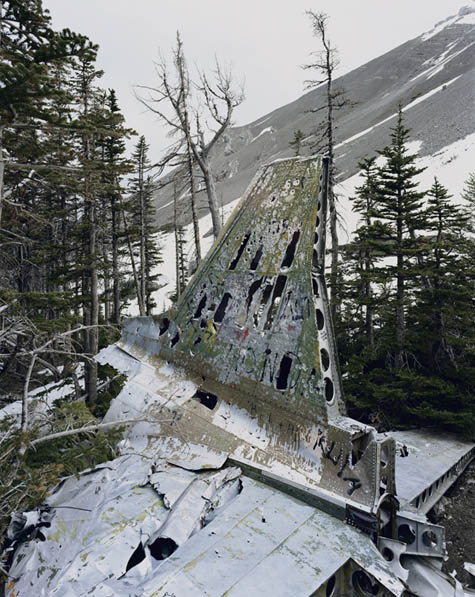
[Image: Richard Mosse, “Grand Voyager Sunni Triangle” (2009), courtesy of the Jack Shainman Gallery].

For the past year, Mosse has been traveling the world on a Leonore Annenberg Fellowship, documenting distant sites of aviation wreckage, war ruins, and more. From Iraqi battlefields and ruined palaces to bullet-riddled trucks and disaster-preparation test-landscapes, his new exhibition, The Fall, “is a photographic survey of our historic unconscious,” the gallery explains.

Mosse travelled to intensely remote locations, from the Patagonian Andes to the Yukon Territories, and worked as an embed with the US military to produce work for this exhibition. The Fall is a rescue mission to try to locate our blasted sense of landscape and archeology, and reclaim the primeval waste for our imagination. Produced to an epic scale, each of the photographs in The Fall is a history painting for our times.

The exhibition will be up until December 23, 2009, at the Jack Shainman Gallery, and is highly recommended; here’s a map of how to get there.

[Image: Richard Mosse, “C-47 Alberta” (2009), courtesy of the Jack Shainman Gallery].

Refuge

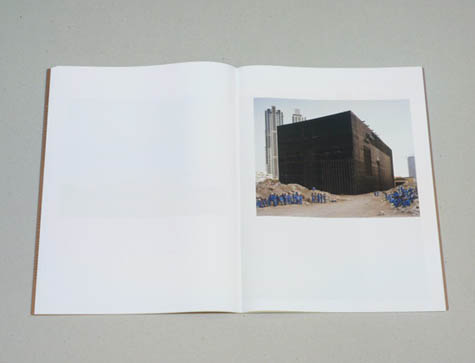
[Image: Photo by Bas Princen, from Five Cities Portfolio].

Photographer Bas Princen has a new book out, Five Cities Portfolio: Amman, Beirut, Cairo, Dubai, Istanbul, coinciding with a conference to be held this Friday, November 20, at the Netherlands Architecture Institute.

That event, called “Refuge: Architectural Propositions for Unbound Spaces,” will feature—among many other things—a presentation by Philipp Misselwitz and Can Altay, whose research accompanies (and seems to have at least partially inspired) Princen’s photos.

[Images: Photos by Bas Princen, from Five Cities Portfolio].

About the conference:

“Refuge” explores the causes and spatial impact of migration through voluntary or involuntary “refugees” who are transforming cities around the globe. Individuals or groups are elegantly or forcefully encapsulated from within the context of the city and society. Refuge produces an ever more atomized urban tissue where the “camp” has become both spatial paradigm and everyday reality, be it in the form of a gated community, slum, or humanitarian refugee camp.

You can check out the conference schedule in this PDF—in which you will also see that there is a release party this week for the new issue of Pedro Gadanho’s Beyond, as well as a lecture by Eyal Weizman.

More of Princen’s work can be found at Icon magazine, meanwhile, and an interesting interview with Princen was published in Oase #76 last year.

Salt Space / Biospeleology

The previous post reminded me of a news item reported roughly two weeks ago, that the town of Carlsbad, NM, is in danger of collapsing into the earth below due to the out-of-control dissolution of underground salt deposits.

[Image: An otherwise unrelated photograph of a house radically subsiding; courtesy of NOAA].

“The cavern was formed over three decades,” the AP writes, “as oil field service companies pumped fresh water into a salt layer more than 400 feet below the surface and extracted several million barrels of brine to help with drilling… Over the past few decades, communities in Texas, Kansas, Michigan, Canada and Europe learned of similar underground danger only after cracks appeared and the ground began to sink.” Unsurprisingly, then, “this man-made salt cavern has residents nervous.”

It’s interesting to point out, however, that Carlsbad, NM, is, of course, home to Carlsbad Caverns—making this delirious salt cave a kind of upstart simulacrum, a replicant geology intent on asserting its prominence over the natural formations nearby. We will be assaulted by copies from below.

But I mention this here because of the idea that Carlsbad could easily become the setting of some future variant of Sigizmund Krzhizhanovsky’s story “Quadraturin,” mentioned previously, in which the fabled room-expanding substance is accidentally deployed underground, deep-injected in an act of misguided chemical sequestration, only to form vast and endlessly self-expanding caverns miles below the earth’s surface.

Unpredictably fractal and resistant to all known forms of cartography—perhaps it could even be a Mandelbulb—these weirdly life-like systems of space coil and surge through bedrock, threatening to destroy all those who live above. Living space, crawling through geology.

(Thanks to Steve Silberman for the tip!)

Quadraturin

A Soviet-era, Polish-born, Ukrainian-raised writer named Sigizmund Krzhizhanovsky was the subject of a short profile and review over at The Nation last week. The article focuses on one of Krzhizhanovsky’s stories called “Quadraturin” (which you can read in full online).

[Image: Based on a photo by eversion].

The basic gist is that a man named Sutulin, a “Soviet city dweller” who owns an impossibly cramped apartment, is convinced by a stranger who comes to his door one day to “take a free sample of an experimental substance that is supposed to make rooms bigger.” This “substance” is Quadraturin.

“Sutulin begins to apply the Quadraturin to his walls,” The Nation explains, “as the instructions on the tube advise, but he accidentally spills the entire contents of the tube on his floor.”

He wakes up the next morning in a “faintly familiar, large, but ungainly room,” where his furniture looks awkward and the angles of the walls are uneven. He enjoys the novel pleasure of strolling from one end of his room to the other, but he must enjoy it in secret, for like other citizens he is legally allotted only ninety-seven square feet of living space, and owning more than his share could mean losing his apartment.

After he stands there for a moment, in awe of his apartment’s new, slightly bulbous dimensionality, he begins “rearranging the furniture to fit the new space,” as Krzhizhanovsky himself puts it.

But nothing worked: the abbreviated rug, when moved back beside the bed, exposed worn, bare floorboards; the table and the stool, pushed by habit against the head of the bed, had disencumbered an empty corner latticed with cobwebs and littered with shreds and tatters, once artfully masked by the corner’s own crowdedness and the shadow of the table. With a triumphant, but slightly frightened smile, Sutulin went all round his new, practically squared square, scrutinizing every detail. He noted with displeasure that the room had grown more in some places than in others: an external corner, the angle of which was now obtuse, had made the wall askew; Quadraturin, apparently, did not work as well on internal corners; carefully as Sutulin had applied the essence, the experiment had produced somewhat uneven results.

Sensing that something has gone horribly wrong and that he might soon face the wrath of his building superintendent, he “realizes he has to buy curtains to hide his apartment from the eyes of passers-by.”

And “it only gets worse from there,” The Nation adds: “every time Sutulin leaves the room, he returns to find that his apartment has grown still bigger.”

He realizes that he forgot to apply Quadraturin to the ceiling, so his apartment is only growing outward, not upward, the dimensions increasingly oppressive even as the room becomes larger. It outgrows its electric circuitry and Sutulin is trapped in the darkness. “He knew that there, behind his back, the dead, Quadraturinized space with its black corners was still spreading.”

It’s an amazing image—I’m particularly struck by the idea of a space outgrowing its electric circuitry, like a body grown so monstrous it leaves behind its old nerves.

(Spotted via @PD_Smith).

Electrical Folklore

[Image: Barry Underwood, courtesy of Johansson Projects].

The Johansson Projects gallery over in Oakland is hosting an exhibition of photographs by Barry Underwood, called Earth Engines; the show also includes a series of sound installations by artist Oliver diCicco.

[Image: Barry Underwood, courtesy of Johansson Projects].

On the one hand, Underwood’s photos document an obvious artistic intervention into the landscape, in the form of embedded and highly colorful light sources smuggled into unlikely situations; but, on the other, these images imply that Underwood has, in fact, captured a previously unrecorded natural phenomenon, an unidentified electrical presence in the trees. In other words, like some battery-powered variation on “Pickman’s Model” by H.P. Lovecraft, these earth engines could, under the right circumstances, perhaps even be naturally occurring: glowing piles of uranium, say, or strange new bioluminescent creatures, unknown to science till now.

[Images: Barry Underwood, courtesy of Johansson Projects].

The juxtapositions of spectacular landforms and immersive, forested environments with these subtle networks of lighting effects—and the accompanying idea that there might be a power source shining away somewhere deep within the natural world—even brings to mind Archigram’s design for a deep-woods electrical outlet disguised inside an artificial log.

Of course, I’m also reminded of an old Paul Simon song: These are the days of lasers in the jungle.

[Image: Barry Underwood, courtesy of Johansson Projects].

So is it a Will-o’-the-Wisp or stray camper’s light? A radioactive spill or an art project?

Produce a catalog of these sorts of strange lights seen in the woods, throughout history, and you’ve got a new field of study: electrical folklore.

[Image: Barry Underwood, courtesy of Johansson Projects].

In any case, the show opens up this weekend, on November 21; stop by the gallery’s website for more details.

Shelved in the Sky

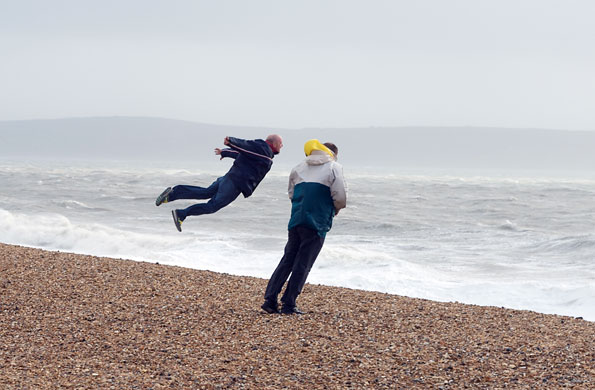
I couldn’t resist this photo of a man blown off his feet by high winds on the British coast.

[Image: Photo by Steve Poole/Rex Features, via the Guardian].

How could we take better spatial advantage of meteorological situations like this, I wonder, whether that means designing parachute-like clothing lines for weekend air-surfing or perhaps manufacturing perfectly weighted hovering objects so that we could shelve things in the air, stationary but airborne, even whole rooms lifting off the ground to pause, several feet above the surface of the earth, looking out over the battered sea?

Messianic Urbanism

I mentioned Tom Zoellner’s book Uranium the other day, in the context of atomic geology, but there is another brief comment in that book worth calling attention to here.

[Image: Azadi Tower in Tehran’s Azadi Square].

At one point late in the book, Zoellner is discussing Iran’s uranium-processing program and that country’s president, Mahmoud Ahmadinejad—who, as Zoellner points out, earned his doctorate in Traffic and Transport. Ahmadinejad, that is, is an urban designer. However, he “is also said to be a fervent believer in a Shiite folk belief,” Zoellner writes. This “folk belief” is “the return of the ‘hidden imam,’ a holy man who disappeared in the ninth century and is believed by Shiites to be the Mahdi, a salvation figure whose dramatic reentry into the world will trigger a final confrontation between good and evil before the dawning of a final age of justice and peace. This is not found in the Koran, but millions believe it to be true.”

This Second Coming, as it were, or the eagerly awaited return of someone or something that left us long ago, has its own spatial requirements, however—and, Zoellner again points out, “There have also been reports that the president—a doctor of traffic—has studied the layout of Tehran to make sure the city can handle the crush of people who will arrive for the imam’s first procession.”

The idea that the Second Coming of a messianic figure—from any religion—will bring with it enormous traffic-engineering concerns is something that had not, in fact, occurred to me. What would Tom Vanderbilt have to say about this, I wonder?

But has there been any serious study of what we might call messianic urbanism: the theologically motivated preemptive re-design of a city in order that that metropolis might better receive a future, supernatural guest? Somewhere between the work of Walter Benjamin and Robert Moses, it would be the city spatially formatted in an urbanism of End Times arrival.

The City and its Flooded Double

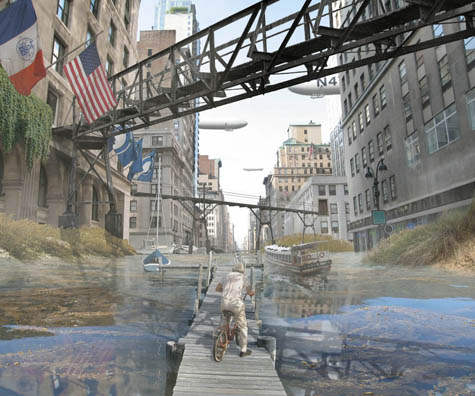
[Image: “Aqualta: 5th Avenue & 35th Street, NYC,” by Studio Lindfors; view larger].

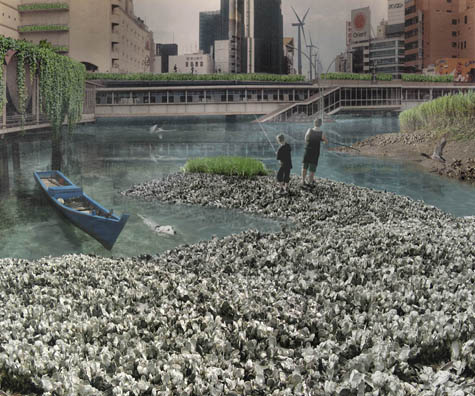
Studio Lindfors—of Cloud Skippers and Cloud City fame—have released a stunning new series of images, published here on BLDGBLOG for the first time, in which we see New York City and Tokyo after a catastrophic flood.

[Image: “Aqualta: Garment District, NYC,” by Studio Lindfors; view larger].

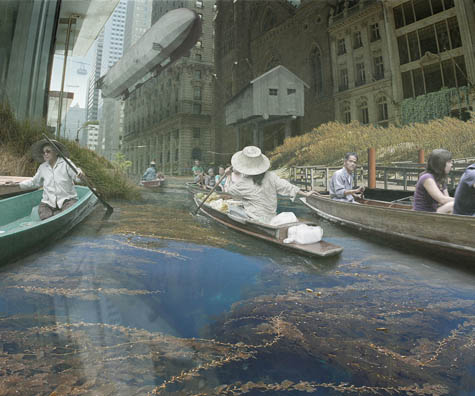
Called Aqualta, the project is an exquisitely produced tour of a hydrologically transformed metropolis. Gondolas float through a still-blazing Times Square; people fish atop gravel banks that have built up beside inundated skyscrapers; and an aerial network of blimps, catwalks, pedestrian skyways, and cable cars passes and sways above the Venetian streets.

I can’t emphasize enough how beautifully detailed the images are; I’ve put them into a Flickr set for closer viewing. They knock me out.

[Images: “Aqualta: Times Square at Night, NYC,” “Aqualta: Roppongi Minato-ku, Tokyo,” and “Aqualta: W. 29th Street & Broadway, NYC” by Studio Lindfors].

Similar in spirit to Squint Opera’s earlier look at a Flooded London, Aqualta is hard—if not impossible—to separate from the context of melting ice caps and global climate change. However, it deserves visual attention in its own right, even outside such politically charged discussions.

Far from stoking fear about a coming catastrophe, both of these projects—Studio Lindfors and Squint Opera—offer a vision in which people, and the cities they live in, have learned to adapt to the overwhelming presence of water. Indeed, Times Square, in Studio Lindfors’s vision, is radiant, markedly improved by the reflective waters that now flow through it. Of course New York should be at least partially flooded, one might be tempted to think; of course the future of urban planning involves designing with water.

[Image: “Aqualta: Shibuya Station, Tokyo,” by Studio Lindfors; view larger].
In fact, there’s a memorable, if brief, scene in Steven Baxter’s recent novel Flood—a surprisingly thought-provoking book about a global flood that, in Wikipedia‘s words, “even covers Mount Everest in 2052, submerging all landmasses on Earth”—where we see a character scraping barnacles off the rocky sides of New York high-rises after the city has been lost to the sea. South Manhattan has been transformed into a tidal world of mussels, clams, and seaweed—and, even then, the waters continue to rise. But if that novel were ever to be adapted for film, I’d unhesitatingly suggest that Studio Lindfors’s visual firepower be snapped up for art direction and set design.

[Image: “Aqualta: 5th Avenue & 53rd Street, NYC,” by Studio Lindfors; view larger].

The architects got in touch after reading the urban premise of DJ /rupture‘s new album with Matt Shadetek, mentioned a few days ago; in an interview with New York magazine, /rupture says the new mix “paints a picture of New York 40 years in the future, where the water line is at the fourth story of buildings and the rich people are dry in the Catskills. Kids are making music on their cell phones and grilling octopi. So, it’s postapocalyptic, but not necessarily grim.”

Again, check out the images in more detail.