Designing the Post-Terrestrial @ the SVA

[Image: The “worldwide satellite triangulation camera station network,” courtesy of NOAA’s Geodesy Collection].

I’ll be lecturing in New York City at the School of Visual Arts, as part of their fantastic new Design Criticism program, on Tuesday, April 14, in case any of you are in New York that night. I’m on a roster with some really fantastic people, in fact, so definitely check out the rest of the lecture schedule.
I’m particularly excited about this talk, at the very least because it’s a huge honor to be speaking at the SVA. But I’m also looking forward to discussing post-terrestriality, or the point at which the built environment supersedes the foundation it’s based on to become planetary in both scale and implication. From genetically modified crops and artificial wetlands to wholesale plate-tectonic engineering – by way of on-demand weather, constructed reefs, and even ruined buildings mistaken for hills – there is a point at which design infiltrates so thoroughly into the workings of the planet that the Earth’s unnaturality, so to speak, becomes impossible to detect.
The talk starts at 6pm, is free and open to the public, and will take place at 136 West 21st Street on the 2nd Floor. Here’s a map.

(You can read more about the Design Criticism course here).

The Program Is Not on the Floor

Benjamin Bratton of The Culture Industry is lecturing tonight at SCI-Arc in Los Angeles, presenting his talk The Program Is Not on the Floor: Stories about Projection, Planning, and Partition. According to SCI-Arc, Bratton’s “research, writing, and practical interests include contemporary social theory, the perils and potentials of pervasive computing, architectural theory and provocation, inverse brand theory, software studies, systems design and development, and the spatial rhetorics of exceptional violence.” If you go, tell him BLDGBLOG says hello…

Hotelier at Sea

[Image: Courtesy of Morris Architects].

Could nearly 4000 oil rigs soon to be decommissioned in the Gulf of Mexico be retrofitted into an American Dubai of offshore luxury hotels?
If so, would that really be a good idea?

[Image: Courtesy of Morris Architects].

Either way, Morris Architects has proposed exactly that:

There are approximately 4,000 oil rigs in the Gulf of Mexico varying in size, depth and mobility that will be decommissioned within the next century. If a deck on one of these rigs is about 20,000 square feet, then there is potentially 80 million square feet of programmable space just off the coast of the United States. The current method for rig removal is explosion, which costs millions of dollars and destroys massive amounts of aquatic life. What if these rigs were recommissioned as exclusive resort islands? Could the Gulf be America’s “Dubai” and the rig the artificial island on which to build it? This project examines the possibilities of creating a self-sufficient, eco-friendly high-end resort experience in our own backyard – the Gulf of Mexico.

According to Curbed LA, the hotel rooms themselves “are pre-fabricated, designed to be transported out to the rig as a standard cargo container.”

[Images: The rooms arrive by ship – before sliding open to form individual cabinettes. Courtesy of Morris Architects].

Once there, a new world of luxury interiors unfolds above the continental shelf – apparently an ideal environment in which groups of semi-nude women can watch James Bond films.

[Image: Courtesy of Morris Architects].

Of course, if the real Dubai is any model for what might actually happen with such a resort, then we’ll probably see dozens of oil rigs partially converted to luxury hotels only then to be abandoned by their construction crews and investors. As the lands of southern Louisiana continue to disappear into the Gulf, heavily armed refugees on fishing boats will move out to sea, recolonizing the derelict structures. There will be campfires at night, burning driftwood, and specialty gardens.
Within four or five decades of inconsistent contact, the Library of Congress sends out a new, 21st century Alan Lomax to visit those thriving offshore subcultures and record their folk songs and oral histories.

[Image: Courtesy of Morris Architects].

He discovers a sort of new Kalevala, written by dwellers of empty structures at sea, somewhere between creation myth and national folk history. The Kalevala of Abandoned Oil Rigs.
Alas, it turns out to be a latter day Ossian – that is, he just makes the whole thing up.

[Image: Courtesy of Morris Architects].

Or, of course, the economy will recover, this plan will work, and within a decade you’ll be suntanning on a platform in the Gulf of Mexico, reading Self.

(Via Curbed LA, with thanks to David Donald).

The London Glaciarium

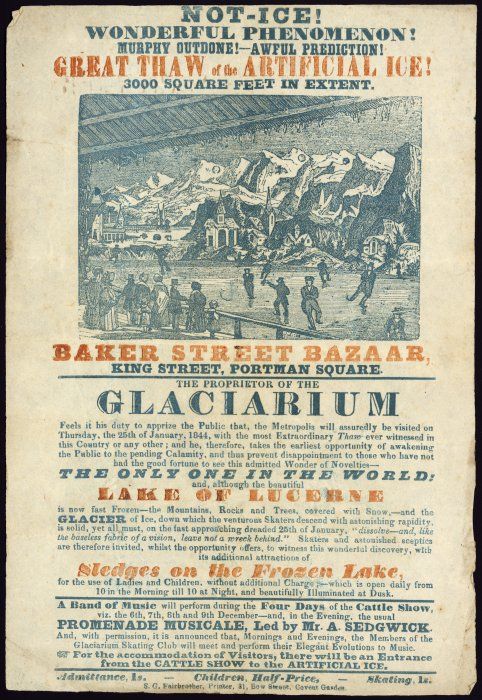
[Image: “Not-ice! Wonderful phenomenon!” A flyer by the Proprietor of the London Glaciarium, 1844, from the National Library of New Zealand].

From the National Library of New Zealand, this flyer announces a “spectacular event,” held in London’s Covent Garden back in 1844, “in which a model of Lake Lucerne and a glacier of ice were to be thawed. There would be sledges available for women and children,” we read, and “members of the Glaciarium Skating Club were to meet and ‘perform their Elegant Evolutions.'” Strangely enough, “the event was to be held in conjunction with a four-day cattle show on adjacent premises.”
Reproducing the terrains of other nations through simulacra of ice in our streets.

(Via David Lovely).

Geologics

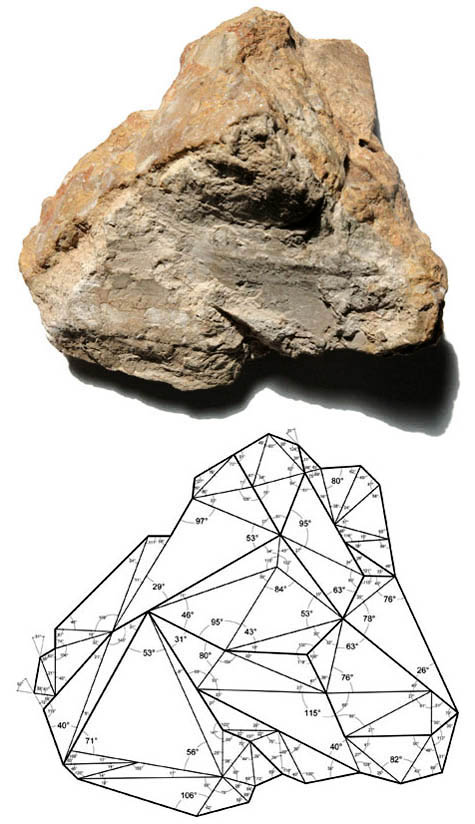
[Image: The geometry of geology, by Vicente Guallart].

If anyone in London happens to attend this lecture at the Architectural Association – beginning in only about an hour and a half – can you let me know how it is? Vicente Guallart – whose work I’ve discussed both on BLDGBLOG and in lectures over the past few years – is speaking on Geologics: Geography Information Architecture.

Yes is More

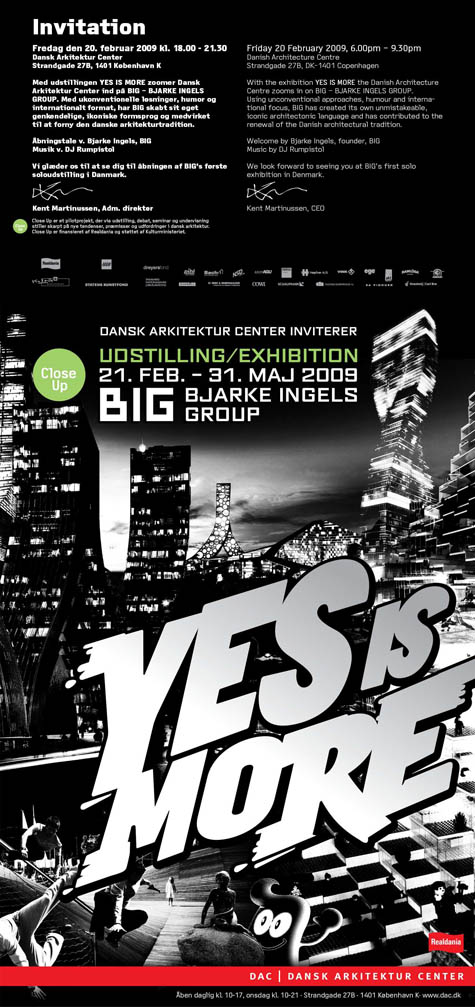
[Image: The invitation. View larger!]

The Bjarke Ingels Group – BIG – are kicking off their first solo exhibition with a party next Friday, February 20, in Copenhagen. Check out the invitation, above, for more info.
They’ve got a lot to celebrate, so the mood should hopefully be high. For instance:

“Playful,” “controversial,” “cheeky,” “innovative” and “provocative” are just some of the terms used to describe BIG. Headed by Bjarke Ingels, this architectural company has in the space of a few years created prize-winning projects, a long list of innovative buildings and an international reputation, as well as taking an active part in current debates in society. Starting out from a vision aiming to free architecture from tired clichés, choosing instead to see modern life as an inspiring challenge, BIG has made a major contribution to the renewal of the Danish architectural tradition.

The exhibition itself opens on the 21st. (Somebody fly me over, please!)

Pushkin Park

[Image: A moldy sofa, otherwise unrelated to this post, photographed by Flickr user melinnis].

Russian scientists have begun testing blood stains on the sofa where novelist Alexander Pushkin is rumored to have died, in order to determine if those stains might have come from Pushkin himself.
At least two things interest me here:

1) It’s the forensic sciences applied to antique furniture in order to find the otherwise undetectable remains of a dead Russian novelist. One might even say residue here, not remains at all; it is the barest of traces. Suddenly, though, it’s as if those old stuffed sofas, fading carpets, and tables of hand-worn wood in obsolete interiors around the world have been transformed into a kind of archaeological site, in which the chemical traces of literary history might yet be discovered. The sofa is Pushkin’s Calvary, if you will – a chemical reliquary. Furniture becomes a kind of hematological Stargate into literature’s mortal past. Who else might they find in there? You go around the world performing genetic tests on antique furniture to see which novelists ever used it – traces of Sebald, Hemingway, Tolstoy.

2) Two words: Pushkin Park. We clone Pushkin and start a theme park. Like a thousand Mini-Me‘s well-versed in storycraft, Pushkin – one man distributed through a thousand bodies – wanders the artificial landscape, and like some strange Greek myth wed with Antiques Roadshow, he tells the crowds, “I sprung forth, fully formed, from a sofa…” And there begins a tale for stunned tourists.

(Via the Guardian).

Worship the Glitch

[Image: The revised tower, via the Las Vegas Sun].

A new boutique hotel in Las Vegas designed by architect Norman Foster – who is soon to lose his seat in the House of Lords after becoming a Swiss citizen to avoid paying taxes – is being cut almost in half due to a construction error: “15 floors of wrongly installed rebar.”
The hotel, called the Harmon, was meant to stand at 49 stories; it will now reach a mere 28.
“It’s still unclear how the Harmon will be capped,” the Las Vegas Sun reports, “and what reengineering will be required for such infrastructure elements as elevators and vents. If the Harmon’s exterior isn’t significantly redesigned, it risks looking unmistakably out of proportion. Think 28 oz. of tomatoes squished into a 16 oz. can.”
Midway through becoming what you were meant to be, an unanticipated internal flaw forces you to become something else entirely – for good or for bad, that remains to be seen.

(Via Archinect).

Agricultural Sabotage

A Welsh farmer has become an “agricultural saboteur” by “secretly planting and harvesting genetically modified varieties of maize and feeding them to local sheep and cattle.” This undercuts Wales’s ability to claim that it is a GM-free nation.

An unrepentant Harrington [the farmer in question] said he had resorted to the secret planting after the Welsh assembly, which voted unanimously for GM-free status in 2000, refused to have any meaningful discussions over its policy. He said: “Out of frustration I went and bought some varieties of maize bred to be resistant to a pest called the European corn borer and which are grown widely in Spain, France, Germany and the Czech Republic.”
The varieties he chose were on the EU common variety list, and as such it is legal to grow them anywhere in Europe.

The ease with which this sort of thing could happen makes it obvious that the genetic purity of a nation’s agricultural supply cannot be rigorously policed.

[Image: “Johnny Apple Sandal” by Lift].

Briefly, I’m reminded of a design project from nearly half a decade ago called “Johnny Apple Sandal,” where the soles of a pair of sandals had different varieties of wildflower seeds embedded in their plastic; as your soles wore down, the seeds were released – theoretically going on to form new landscapes. A kind of pedestrian agronomy.
But what a perfect tool for agricultural smuggling! You load up your sandals with genetically modified seeds, fly to Wales, and go for a long hikes in the Brecon Beacons. Soon enough, you’ve contaminated the hills with illegal plants, or forms of life subject to government regulation.
In any case, I also can’t imagine that this is the only example of such a thing; this farmer just seems like the only one who was caught. It’s not hard to speculate that there are what might be called – with no small amount of irony – protest gardens full of genetically modified plants sprouting in secret across the world.
What strange cultivations might we yet stumble upon in some unofficial garden in the woods?

(Thanks, Alex, for the Welsh farmer article!)

The Boom is Over

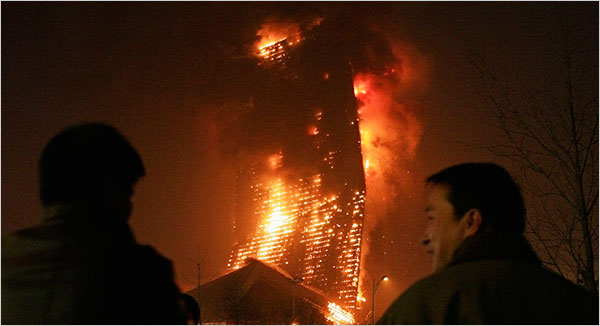
[Image: By David Gray for Reuters, via The New York Times].

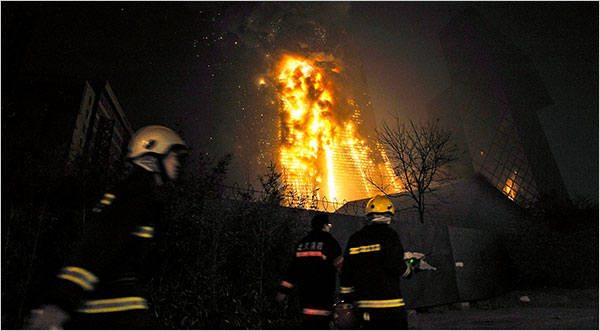
Amongst many, many signs that the building boom has come to an end, from gridlocks of cars abandoned at the Dubai airport by fleeing workers to massive holes in the urban surface of Chicago, to entire architectural firms going out of business, to delayed towers and theme parks on pause, none seem quite as explicitly apocalyptic as the sight of OMA’s CCTV complex – that is, the part of it known as TVCC, containing a luxury hotel – roaring with flames.

[Image: By Andy Wong for the Associated Press, via The New York Times].

The boom ended long ago, but its icon are now on fire.

(Note some updates on this story in the comments thread, below).

Park’s Parks

[Image: “Daechi Dong,” a photo by Hosang Park, from his series A Square].

Note: This is a guest post by Nicola Twilley.

Korean photographer Hosang Park‘s series A Square consists of bird’s-eye views of the small, over-landscaped parks that seem to accompany modern apartment towers all over the world. As Park explains, these “parks” are too small to serve their ostensible purpose: as open space for recreation and places “to make discussions or take a rest.” In the UK and US, they are included in new construction projects to fulfill the letter of planning regulations (if not the spirit) – a token band-aid of “nature” applied to high-density development. As Park points out, their presence in Korea is both a reassurance and an investment: the trees, paths, and water features, no matter how artificial, push up property prices by providing an implicit guarantee of “the environmental benefits of a place where they belong.”
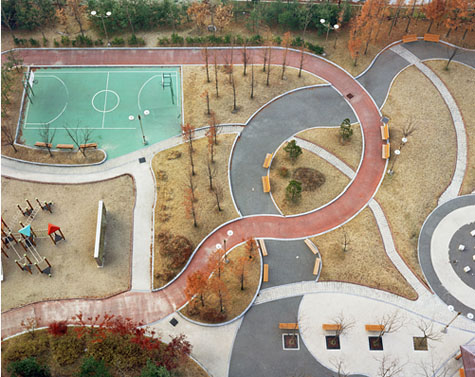
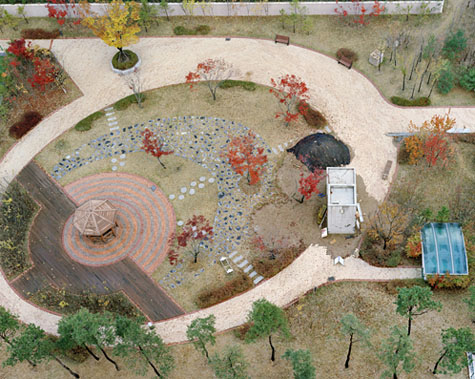
[Images: “Howon Dong” and “Sinbong Dong 2,” photos by Hosang Park, from his series A Square].

Park’s parks are photographed from above – which seems, in fact, to be the view for which they were designed. As two-dimensional compositions of curved paths, colored paving, and rhythmically spaced rocks or trees, they resemble pleasing, if sterile, designs for wrapping paper or Ikea rugs. Tellingly, they are also completely empty. Park explains that he took these photos while he was living on the 13th floor of Jugong Apartment in Chang-dong, Seoul. He and his hundreds of neighbors experienced their park as a a patch of eye candy – visual respite from the concrete and tarmac of their surroundings. Its cornucopia of amenities – climbing frames, fountains, seesaws and swing sets, pagodas, grass, ornamental rocks, meandering paths, trees and flower beds, benches, ponds, basketball courts… even public art – are crammed together as visual shorthand for endless leisure. They are landscape as signage, a placeholder for the possibilities of a park.
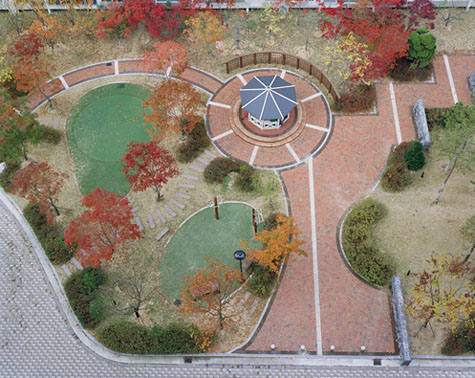
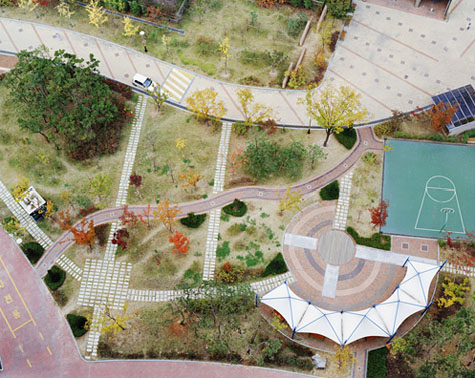
[Images: “Samsung Dong” and “Uman Dong,” photos by Hosang Park, from his series A Square].

But could we then imagine that Korea’s urban landscape subcontractors have been applying the lessons of graphic design to their creations, as if to a poster or magazine spread? The spaces between ornamental planters are carefully kerned, the edges of flower beds masterfully shaped through ragging to create an “organic” appearance – each element ordered and constrained by a Tschicholdian grid. Or perhaps these parks are the work of one visionary landscape designer, a passionate disciple of Edward Tufte. His goal is the ultimate park infographic, and he diligently recombines ponds, benches, and pagodas to achieve ever greater data density that allow for ever more sophisticated landscape analyses. The published results will become the canonical park design text for a generation, changing public policy as effectively as John Snow’s landmark cholera outbreak map of London once did.
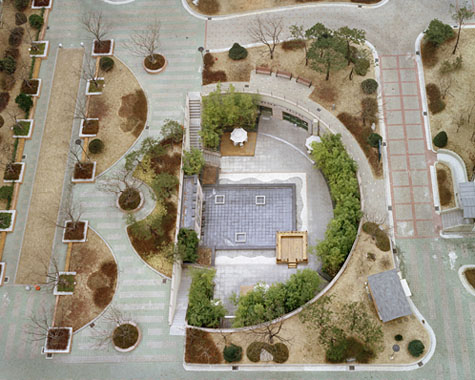
[Image: “Sindorim Dong” by Hosang Park, from his series A Square].

Finally, I’m reminded of the Royal Horticultural Society’s model gardens at Wisley. Wisley, an otherwise unremarkable village in Surrey, is home to an educational garden, meant to fulfill the Society’s remit “to show to the public the best kinds of plants to grow.” Behind the scenes at Wisley, fields are devoted to trialling difficult, delicate, or entirely new kinds of flowers, vegetables, and fruit for “garden or ornamental use.” Teams of horticulturists partner with botanists, entomologists, and pathologists to determine the correct details, cultivation, and advice for each group of plants, with high performing plants winning an Award of Garden Merit (AGM) – the gardening equivalent of a Good Housekeeping Seal.
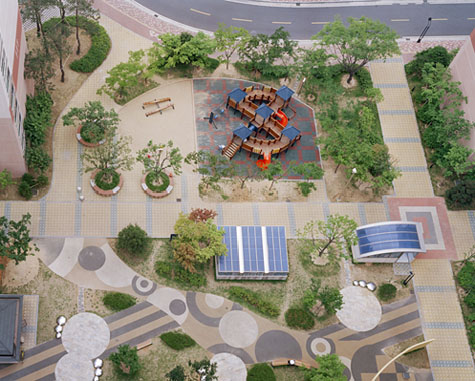
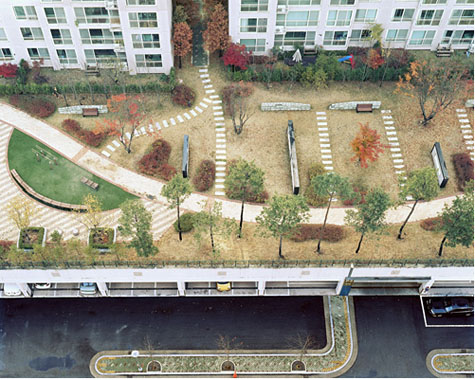
[Images: “Jangan Dong” and “Sinbong Dong,” photos by Hosang Park, from his series A Square].

AGM-winning plants are then arranged in model gardens at Wisley, to which the public is invited to learn the ideal varietals, patterns, and conditions for a garden on chalky soil, say, or a poorly drained lot. These model gardens are not actually intended to be the private back yards they resemble; instead they are part-instruction manual, part-shop window, part prototype of future, unrealized landscapes elsewhere. Like Park’s parks, they are primarily designed to be read, rather than sensed or experienced; and they are deliberately exhaustive in their approach, with each rather small plot landscaped to show all appropriate elements of, for instance, a sub-alpine rock garden. Which leads me to wonder if Park’s photos have inadvertently documented an experimental array of urban test gardens, new spatial formats for high-density leisure in their beta phase.

(Hosang Park’s work discovered via Flavorwire. Earlier posts by Nicola Twilley include Dark Sky Park and Zones of Exclusion).