Blogger was down for nearly 24 hours yesterday, and seems to have erased some recent posts and comments. Anyone else out there having trouble with Blogger? Or with deleted posts?

Update: Blogger will be restoring missing posts, including, I hope, yesterday’s look at Utopia Forever. Thanks to Clement Wan and Robert Seddon for the tip.

Update 2: The Utopia Forever post is now back up, and I will see about restoring lost comments.

Beyond the restrictions of the factual

If you’re in Berlin this evening, Thursday, 12 May, Gestalten will be hosting a release party for Utopia Forever: Visions of Architecture and Urbanism, edited by Lukas Feireiss.

The book includes essays by Dan Wood & Amale Andraos of WORKac, Darryl Chen of Tomorrow’s Thoughts Today, Matthias Böttger & Ludwig Engel of raumtaktik, Ulf Hackauf from The Why Factory, and Lukas Feireiss himself; I also contributed a short “Utopia Generator” game that readers can play (bring your own six-sided die).

[Images: From Utopia Forever].

From the book:

Utopia Forever is a collection of current projects and concepts from architecture, city planning, urbanism, and art that point beyond the restrictions of the factual to unleash the potential of creative visions. In contrast to the largely ideal-theoretic approaches of the past, today’s utopias take the necessity for societal changes into account. The projects in this book explore how current challenges for architecture, mobility, and energy as well as the logistics of food consumption and waste removal can be met.

The book is more or less an apotheosis of the well-rendered and the unbuilt, not a sustained exploration of what constitutes social change, but its selection of projects—including concept art, student models, artificial mountains, flooded cities, houses on stilts, supergrids, verticalized landfills, private islands, living clocks, robotic agriculture, and more—is strong.

There are also many projects that you might have seen here on BLDGBLOG, including Taylor Medlin’s extraordinary thesis project from UC-Berkeley, Protocol Architecture’s counterfeit maps from Columbia’s GSAPP, David Benqué’s “Fabulous Fabbers,” Anthony Lau’s “Flooded London,” Magnus Larsson’s “Dune,” and several more. It’s nice to see those reproduced outside the amnesiac world of the web, where anything featured more than two years ago is ancient history.

[Images: From Utopia Forever].

Of course, there are also a handful of projects in the book that fall squarely into the camp of random squiggles that look like Venus fly traps—or like the towering vertebrae of impossible animals, or like unusable clumps of pink kudzu—for no apparent programmatic reason, showing that images that could pass for rave flyers from the 1990s can still be taken as formally advanced architectural utopias, divorced from questions of political critique. As if a nightmare of leafy metallic squid drifting through New York streets would somehow solve questions of human rights or civic participation.

But perhaps utopia won’t arrive, money-shot in hand; perhaps utopia will be the same flawed and imperfect city you already live in, but simply governed by a more equitable constitution. Perhaps we need more collaborations between architecture and political science departments, even if to work out nothing more basic than where the design of urban space ends and humanist activism begins—and how these can be more effectively made into one, utopian pursuit.

These latter examples don’t weigh the book down, on the other hand; they are perhaps just necessary counter-examples, showing where utopian spatiality can go wrong: lens-flared images implying falsely that, if only our roofs could grow green peppers or if our houses looked like trees, we’d also achieve gender equality and political free-expression.

In any case, all of this would be interesting to discuss at greater length with the featured architects, artists, and writers in this visually compelling book, and tonight’s party in Berlin seems like as good an occasion as any to start the discussion; check out Gestalten’s website for more details.

Art + Environment, Landscape Futures, and a Million Reasons to Visit Reno

[Image: From Modeling the Universe by Linda Fleming, courtesy of the Nevada Museum of Art].

The Nevada Museum of Art’s Center for Art + Environment—which, three years after its founding, “remains the only research institute in the world devoted to the subject of creative interactions with natural, built, and virtual environments”—is hosting its second Art + Environment Conference this year.

The line-up is incredible. From 29 September-1 October, at the Nevada Museum of Art in Reno, expect to hear from Edward Burtynksy (whose extraordinary Oil series will be on display at the museum in 2012), Chris Jordan, Amy Franceschini, Fritz Haeg, Jorge Pardo, Alexander Rose of the Long Now Foundation, Newton & Helen Mayer Harrison, Leo Villareal, William L. Fox, and nearly two dozen others, including a panel featuring architects Liam Young, from Tomorrow’s Thoughts Today, and Mark Smout & Laura Allen, authors of Pamphlet Architecture #28: Augmented Landscapes, moderated by none other than Bruce Sterling.

Expect to hear about such topics as “Designing for Longevity,” “Designing the Wild and Cultivating the City,” “Designing Architectures for Environmental Change,” “Farming in the Future,” and “Altering the Landscape,” among many others, including an announcement from Nicola Twilley and I about a major cultural and landscape research project we will be undertaking together in 2012.

The Museum has also recently announced a discounted student rate for conference tickets, so definitely consider attending; Reno is presumably not a city you would otherwise find yourself passing through on a regular basis, but it’s not a bad drive up from San Francisco, Las Vegas, or even Los Angeles, and there will be tons to see and do.

Also on display at the Nevada Museum of Art during the conference, for instance, will be a massive show called The Altered Landscape: Photographs of a Changing Environment, whose gorgeous, full-color catalog published by Rizzoli and featuring contributions by Lucy Lippard and W.J.T. Mitchell, will also be available at the Conference.
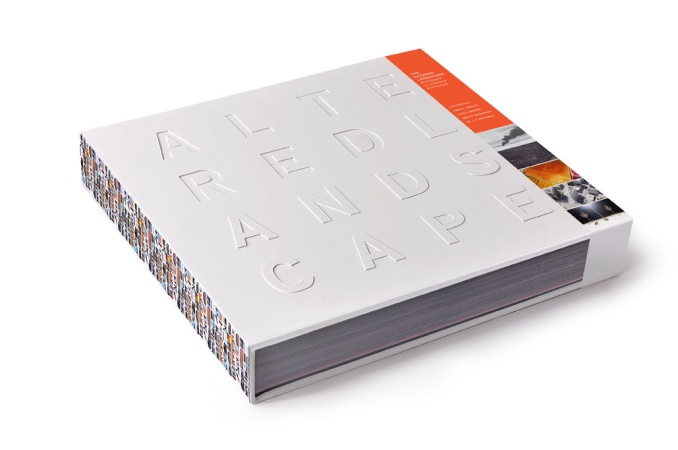
[Image: The Altered Landscape: Photographs of a Changing Environment edited by Ann M. Wolfe].

You can then walk down the hall to see Fog Garden: The Architecture of Water. Quoting at length:

People have been using dew from fog as a source of drinking water for centuries, but it wasn’t until the 1950s that scientists in Chile and elsewhere began measuring the moisture content of clouds and designing structures to collect it.
During the last five years, several groups of architects have been testing small models of fog collectors in the Atacama Desert, a place where it has not rained in recorded history, and fog is the only source of moisture.
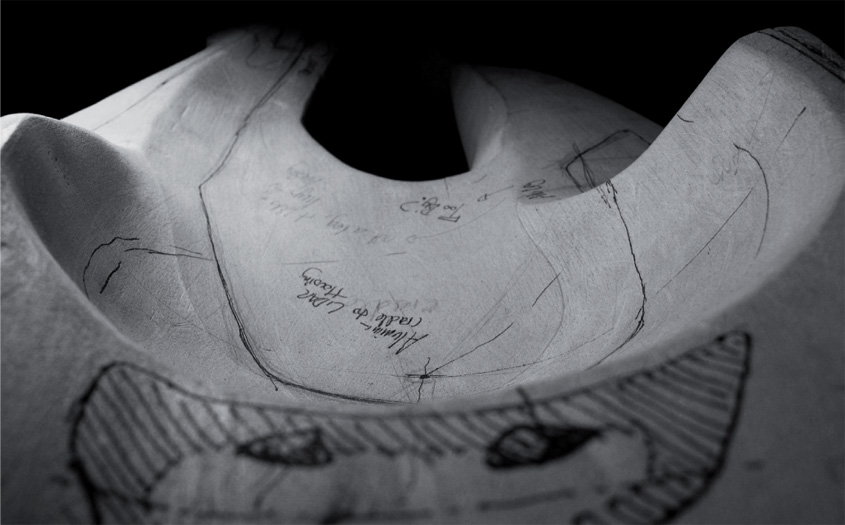
Working with the Atacama Desert Center and students from the Catholic University in Santiago, architect Rodrigo Pérez de Arce is overseeing the creation of models for a large-scale complex of structures, the Fog Garden, that would collect enough water to both support a garden and satisfy the needs of a nearby village. This exhibition is the first time these structures have been displayed, and along with sample building materials and documentation, form an archive that is important to artists, architects, and scientists.

And then onward from there to see Shirin Neshat’s film Passage

[Images: From Passage by Shirin Neshat, courtesy of the Nevada Museum of Art].

—before stopping in to see Linda Fleming’s awesomely intricate “models of the universe.”
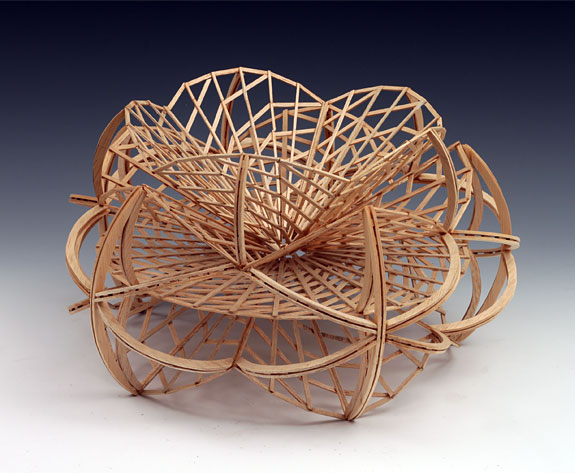
[Image: From Modeling the Universe by Linda Fleming, courtesy of the Nevada Museum of Art].

And that’s barely half of what will be on display during the conference.

You’ll also be able to see Sierra Nevada: An Adaptation by Newton & Helen Mayer Harrison; that will consist of “a 30-foot-long map of the mountain range, topographical sketches of its seventeen principal watersheds, and aerial photographs of sites in the Truckee and Yuba watersheds.”

Australia’s Murray River, a “series of sustainable design solutions” exploring “overlaps and adjacencies between architecture and landscape” by conference presenter Richard Black, will also be on display nearby.

Not last—as there will be several smaller exhibitions up, as well—and, I hope, also not least, is Landscape Futures: Instruments, Devices and Architectural Inventions. Landscape Futures features work by a group of absolute all-stars:

—David Benjamin & Soo-in Yang from The Living
—Mark Smout & Laura Allen from Smout Allen
David Gissen
—Mason White & Lola Sheppard from Lateral Office & InfraNet Lab
Chris Woebken
Liam Young

[Image: “Electric Aurora” by Liam Young, from Specimens of Unnatural History].

I am especially honored to be the curator of this exhibition, able to have commissioned new work from many of the exhibitors, and to be the editor of a forthcoming book that will document the exhibition in full, including last winter’s Landscape Futures Super-Workshop. That book will feature several outside contributions, and is being designed by Atley G. Kasky of, among other things, but does it float.

I will be writing more about both the exhibition and the book soon, but keep it on your radar, if it sounds like something that might be of interest.

[Image: From The Active Layer by Lateral Office; photo by Michelle Litvin].

In any case, there are a million reasons to attend the Center for Art + Environment Conference this year, as I hope the above post makes clear; consider getting a group of friends or colleagues together to spend the weekend up in Reno, a city you might not otherwise be visiting any time soon (and where you can wear bald eagle t-shirts with abandon and gamble till the sun comes up—not to mention visit the National Bowling Stadium), and dive into an incredible range of exhibitions, talks, and programs.

Further, if you’re a student or educator, also think about the possibility of bringing a whole class to attend; between the conference participants and the museum’s exhibitions, think of it as a weekend super-workshop for art, architecture, and the global environment.

Read more at the conference website.

Applied Fictions Unit

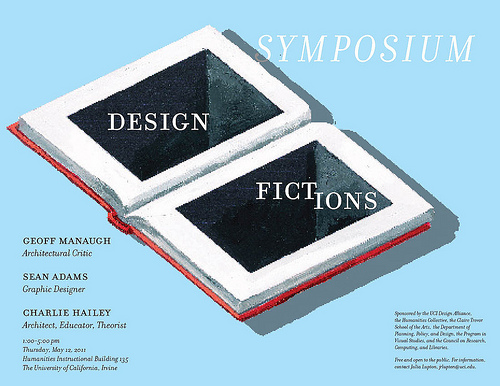
Just a quick note that I’ll be speaking Thursday afternoon down at the UC-Irvine School of Humanities, part of an event called “Design Fictions.” Charlie Hailey, author of Camps: A Guide to 21st-Century Space, and graphic designer Sean Adams will also be on the bill.

The overall agenda for the day is to ask, in the organizers’ words: “How do designed objects and environments tell stories, and what genres do they favor (science fiction, fantasy, romance, satire)? How do branding, anti-branding, and corporate identity programs insert their products into narrative scenarios and fictional worlds, and how do consumers find their own place as characters within those worlds? How do fiction writers and literary journalists incorporate designed things and designed landscapes into their stories?”

I’ll be giving a talk called “Applied Fictions Unit,” about the role of architecture in speculative fiction and the utility of speculative fiction as a tool for architectural criticism, with examples taken from urban legends, conspiracy theories, film, classical mythology, the petroleum industry, and more, with a spot of horror fiction thrown in for good measure.

The event is free and open to the public, and you can find out more over at the UC-Irvine site.

Border Town

[Image: Photo by m.joedicke, via Border Town].

From Border Town, an independent research and design workshop to be held in Toronto this summer, from 16 June-18 August, now seeking applications:

Your farm is completely surrounded by a foreign country because the king lost it in a game of cards. You live in Cooch Behar.

You are eating at a café when you are informed that it must close. If you’ll just shift to a table in the other country, service is still available. This café is in Baarle/Hertog.

You work in the mayor’s office. Down the hall is a parallel mayor’s office with a whole mirror set of city officials to govern the other half of your city. You work in Texarkana.

We believe that a great deal can be learned by investigating the strange edge cases of the world. Border towns are the extreme edge of where geography and politics collide. They throw the abstractions of governance into sharp physical relief. They are a fertile site for investigation into questions of security, freedom, architecture, immigration, trade, smuggling, sovereignty, and identity.

Border Town is a 10-week, multi-participant collaborative design studio that will investigate the conditions that surround life in cities situated on borders, divided by borders, or located in conflict zones. By investigating these strange specimens of political geography, we can being to think and design about the interaction of legal and physical architecture and how these forces shape the built environment and the lives of the people living in it.

The workshop is organized by Tim Maly and Emily Horne, and applications are due by 2 June.

By way of my own hypothetical reading list for such a course, I might suggest checking out a few of the following books: The City & The City by China Miéville, Divided Cities: Belfast, Beirut, Jerusalem, Mostar, and Nicosia by Jon Calame and Esther Charlesworth, Hollow Land: Israel’s Architecture of Occupation by Eyal Weizman, City of Walls: Crime, Segregation, and Citizenship in São Paulo by Teresa P. R. Caldeira, Divided Kingdom by Rupert Thomson, A Wall in Palestine by René Backmann, and any number of other books, films, essays, and chapters elsewhere on the subjects of smuggling, demilitarized zones, police jurisdiction, international espionage, the Berlin Wall, the Jewish ghetto, quarantine, border survey teams (and the equipment they utilize), segregation and apartheid, political gerrymandering, micronations, and much more.

In any case, Border Town promises to be an interesting experience for all involved—and I should add that it’s great to see people putting together this kind of independent educational workshop outside of the university system. If you end up being one of the participants, I’d love to hear how it goes.

Urban Islands 2011

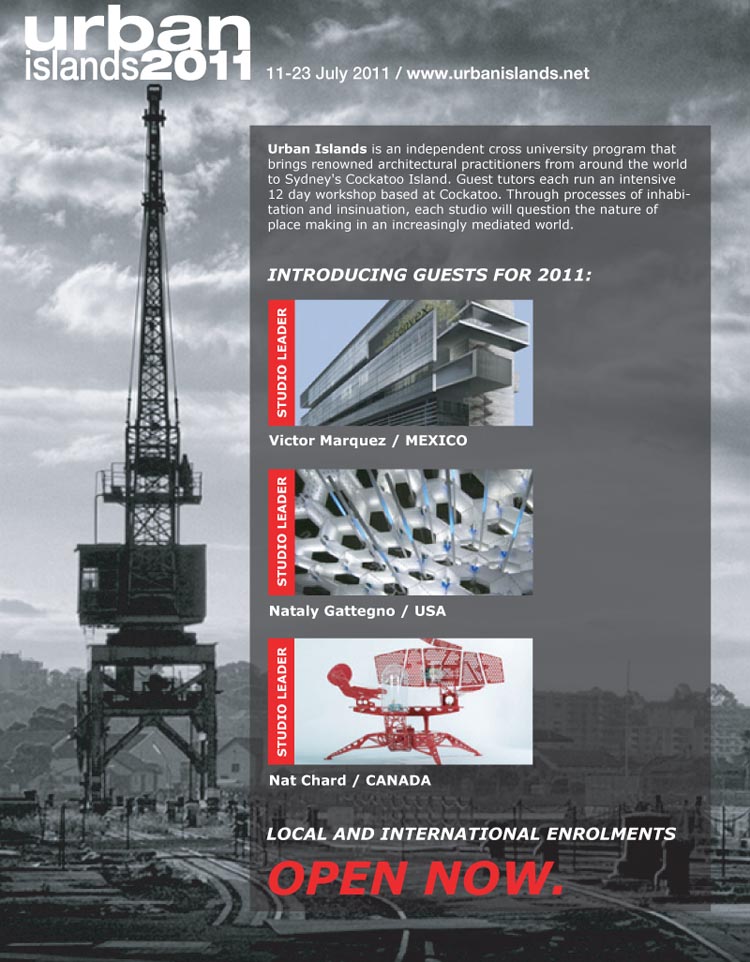
Two years ago, I had the pleasure of teaching a design studio on Cockatoo Island, in Sydney Harbor, as part of the Urban Islands intensive workshop.

Cockatoo Island is a semi-abandoned industrial site and former island prison—amongst many other such uses, including boarding school, wartime naval shipbuilding yard, and X-Men filmset—and a wildly inspiring site for speculative architectural projects. You can read a bit more about the island in this older post.

This year’s studio leaders have been announced; they are Victor Marquez, Nataly Gattegno, and Nat Chard (whose work you might have read about on BLDGBLOG the other week).

Since 2006, the Urban Islands program has hosted emerging architects and firms from Chile, Costa Rica, Denmark, England, Germany, India, Japan, Peru and the USA. Befitting its location on Cockatoo Island in Sydney Harbor, the program is constructed as an immersive experience, with high expectations on both studio leaders and their students. A collaborative and productive culture is central to the program, informed by participation in an array of events: site visits, installations, presentations, lectures, symposia and the closing day installations and reviews on the island.

Applications for this year’s program are now open, and international applicants are encouraged. The program itself runs from 11-23 July, in Sydney, Australia.

[Image: A sign on Cockatoo Island; photo by BLDGBLOG].

Check out the Urban Islands website for more—and, if you do it, let me know how it goes.

A Lesson in Abysses

[Image: The surface of the earth peeled away to reveal rock and fissures – a perfect excuse for one of my favorite quotations: “Look down well!” Jules Verne once wrote. “You must take a lesson in abysses.” Image produced by R.C. McDowell, G.J. Grabowski, and S.L. Moore for the U.S. Geological Survey; this is Kentucky. An alternative map, by A.C. Noger, is no less topo-optically extraordinary].

(Earlier: BLDGBLOG’s Topographic Map Circus – although most of the links in that post are now broken).

Infrastructural Opportunism

[Image: From Coupling: Strategies for Infrastructural Opportunism by Lateral Office/InfraNet Lab].

Going all the way back to the fall of 1997, my own interest in architecture was more or less reinvigorated—leading, by way of a long chain of future events, to the eventual start of BLDGBLOG—by Mary-Ann Ray’s installment in the great Pamphlet Architecture series, Seven Partly Underground Rooms and Buildings for Water, Ice, and Midgets.

To this day, the pamphlet format—short books, easily carried around town, packed with spatial ideas and constructive speculations—remains inspiring.

The 30th installment in this canonical series is thankfully a great one, authored by Lateral Office and InfraNet Lab, a design firm and its attendant research blog that I’ve been following for many years.

[Image: From Coupling: Strategies for Infrastructural Opportunism by Lateral Office/InfraNet Lab].

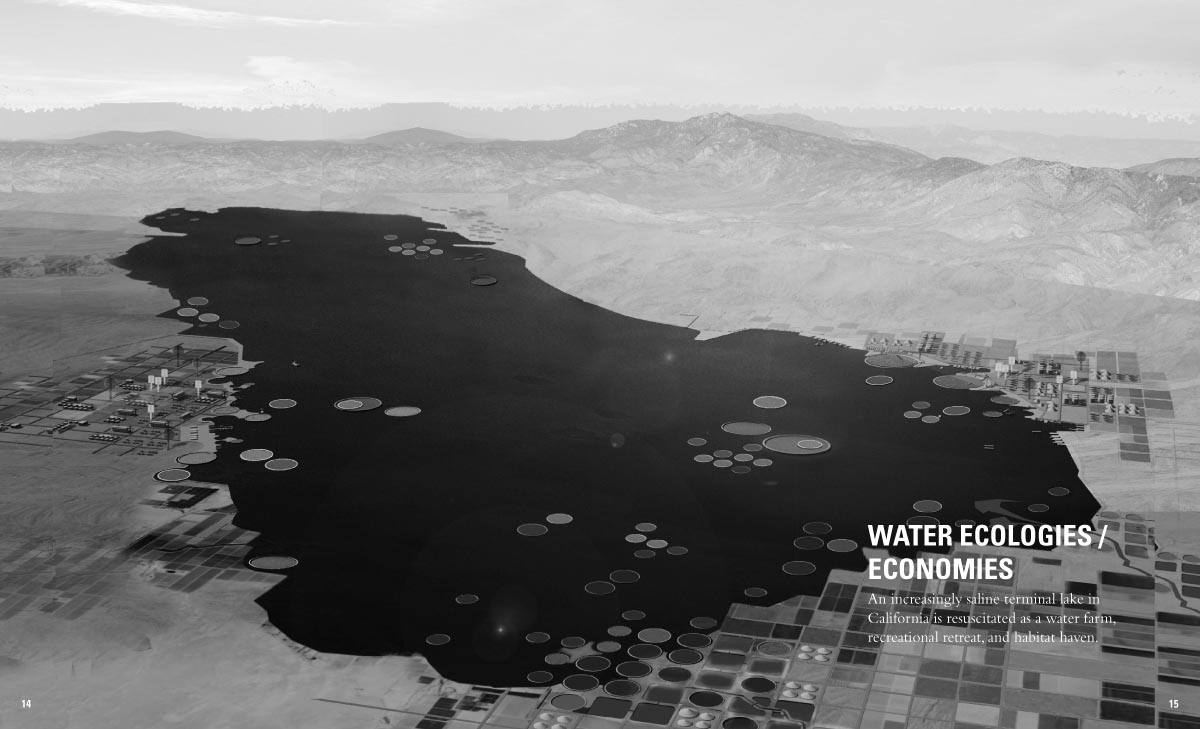
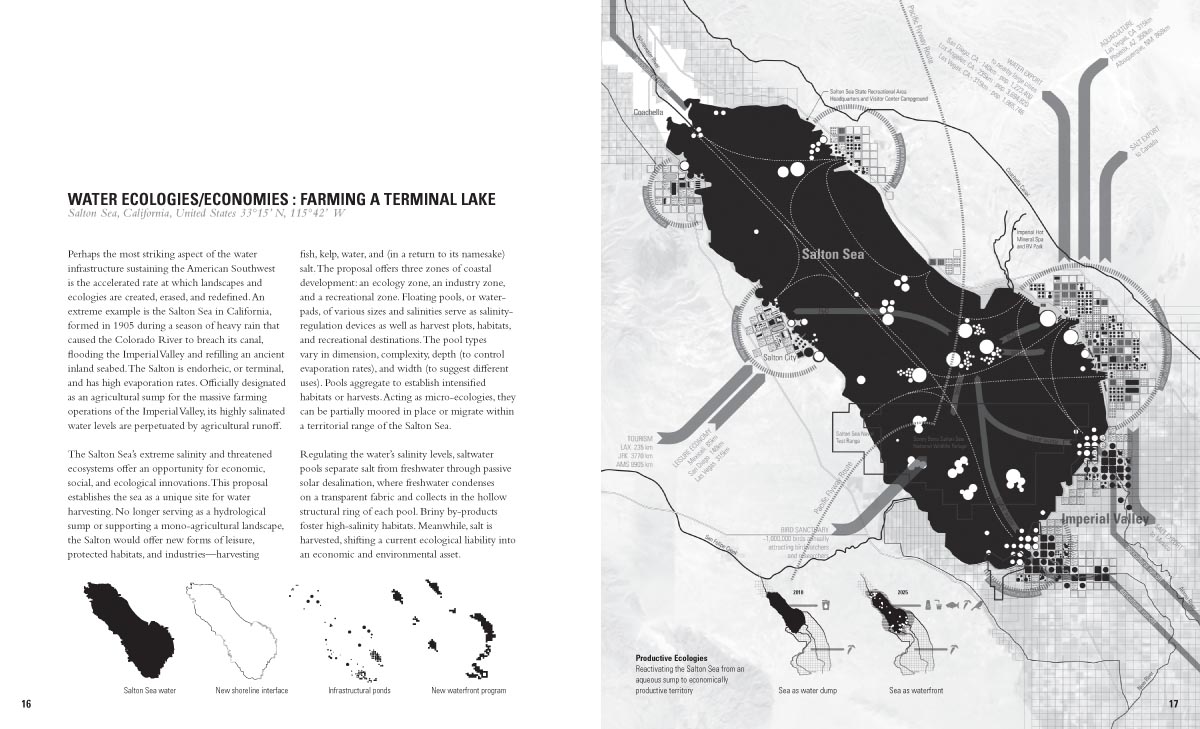
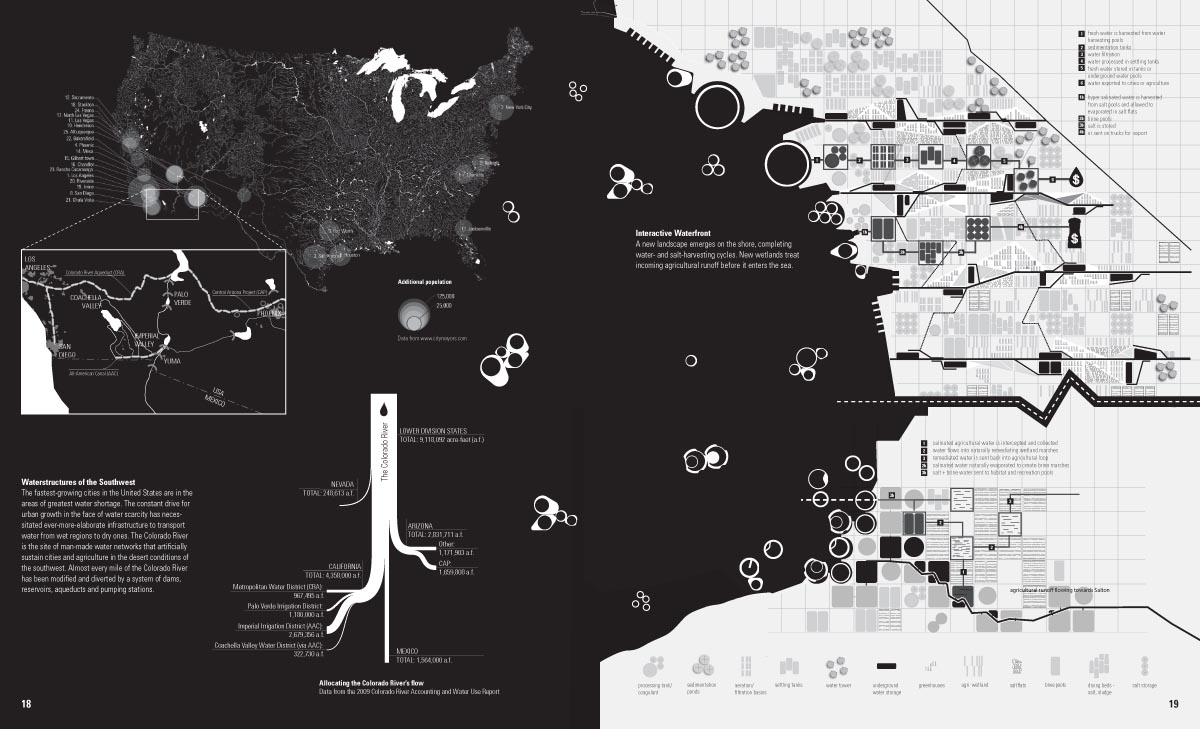
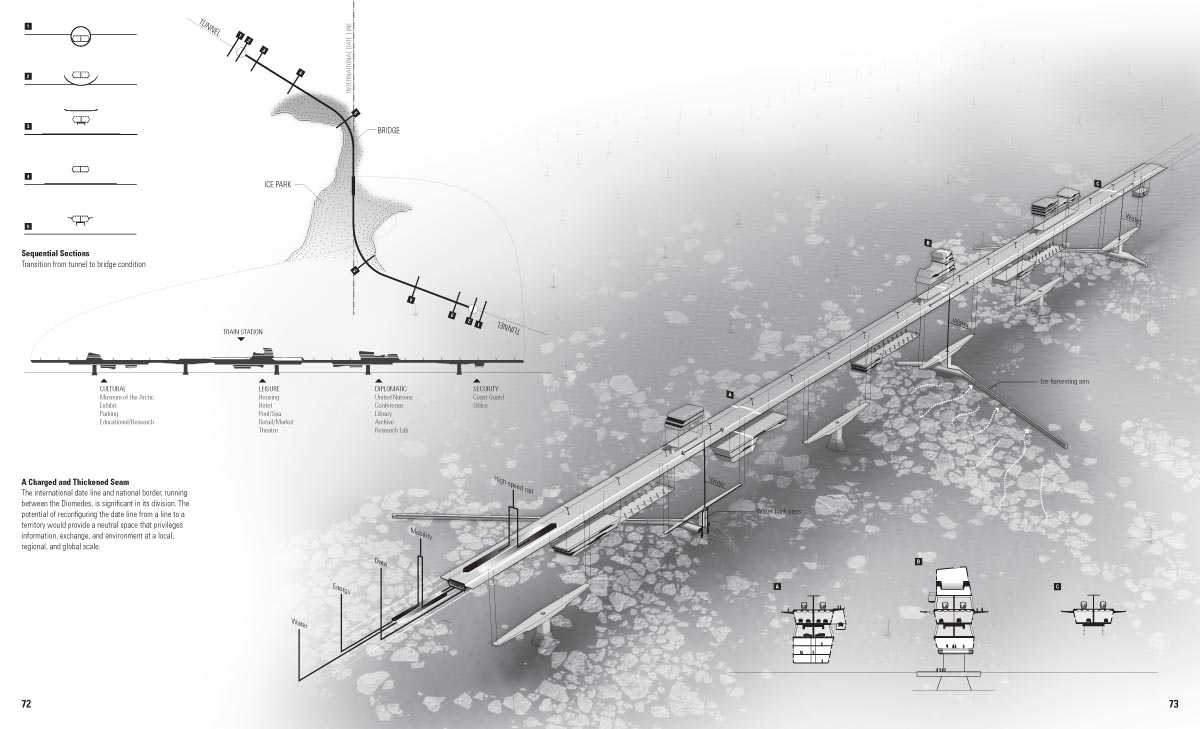
The premise of the work documented by their book, Coupling: Strategies for Infrastructural Opportunism, is to seek out moments in which architecturally dormant landscapes, from the Arctic Circle to the Salton Sea, can be activated by infrastructure and/or spatially reused. Their work is thus “opportunistic,” as the pamphlet’s title implies. It is architecture at the scale of infrastructure, and infrastructure at the scale of hemispheres and ecosystems—the becoming-continental of the architecture brief.

In the process, their proposed interventions are meant to augment processes already active in the terrain in question—processes that remain underutilized or, rather, below the threshold of spatial detection.

As the authors themselves describe it, these projects “double as landscape life support, creating new sites for production and recreation. The ambition is to supplement ecologies at risk rather than overhaul them.”

[Images: From Coupling: Strategies for Infrastructural Opportunism by Lateral Office/InfraNet Lab].

One of the highlights of the book for me is a section on the so-called “Next North.” Here, they offer “a series of proposals centered on the ecological and social empowerment of Canada’s unique Far North and its attendant networks.”

Throughout the twentieth century, the Canadian North had a sordid and unfortunate history of colonial enterprises, political maneuverings, and non-integrated development proposals that perpetuated sovereign control and economic development. Northern developments are intimately tied to the construction of infrastructure, though these projects are rarely conceived with a long-term, holistic vision. How might future infrastructures participate in cultivating and perpetuating ecosystems and local cultures, rather than threatening them? How might Arctic settlements respond more directly to the exigencies of this transforming climate and geography, and its ever-increasing pressures from the South? What is next for the North?

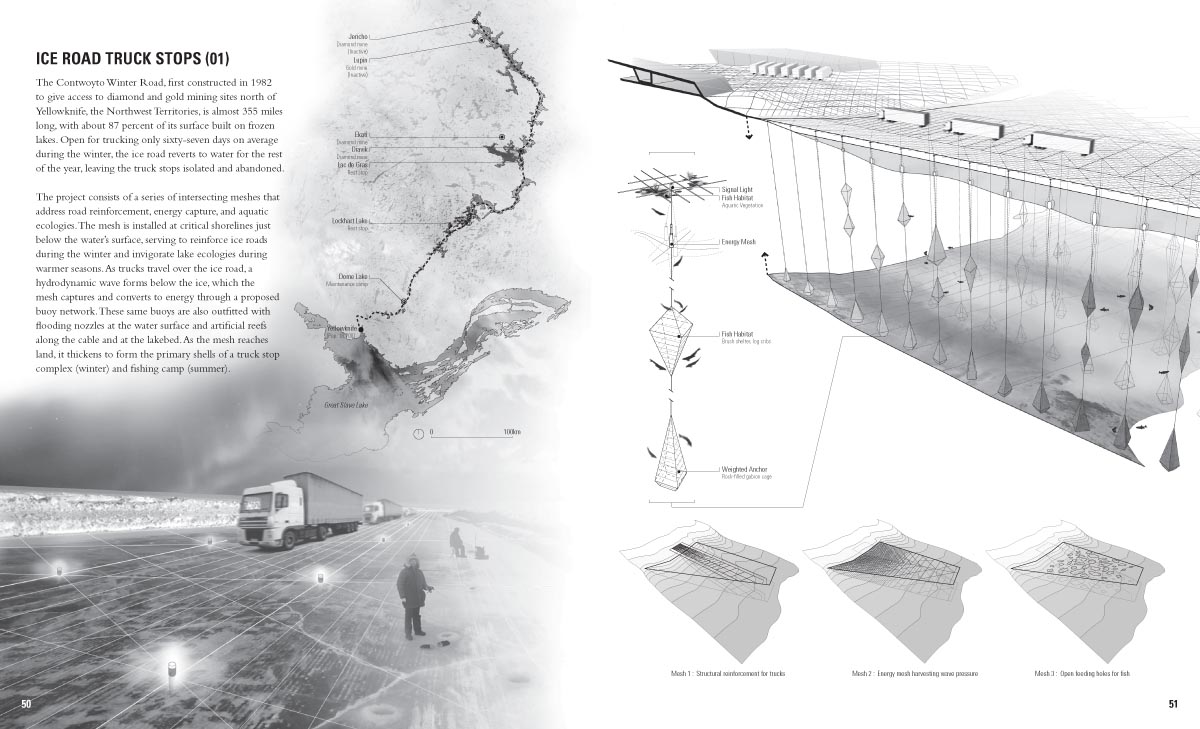
Three specific projects follow. One outlines the technical possibility of building “Ice Road Truck Stops.” These would use “intersecting meshes,” almost as a kind of cryotechnical rebar, inserted into the frozen surfaces of Arctic lakes to “address road reinforcement, energy capture, and aquatic ecologies.”

The mesh is installed at critical shorelines just below the water’s surface, serving to reinforce ice roads during the winter and invigorate lake ecologies during warmer seasons. As trucks travel over the ice road, a hydrodynamic wave forms below the ice, which the mesh captures and converts to energy through a proposed buoy network.

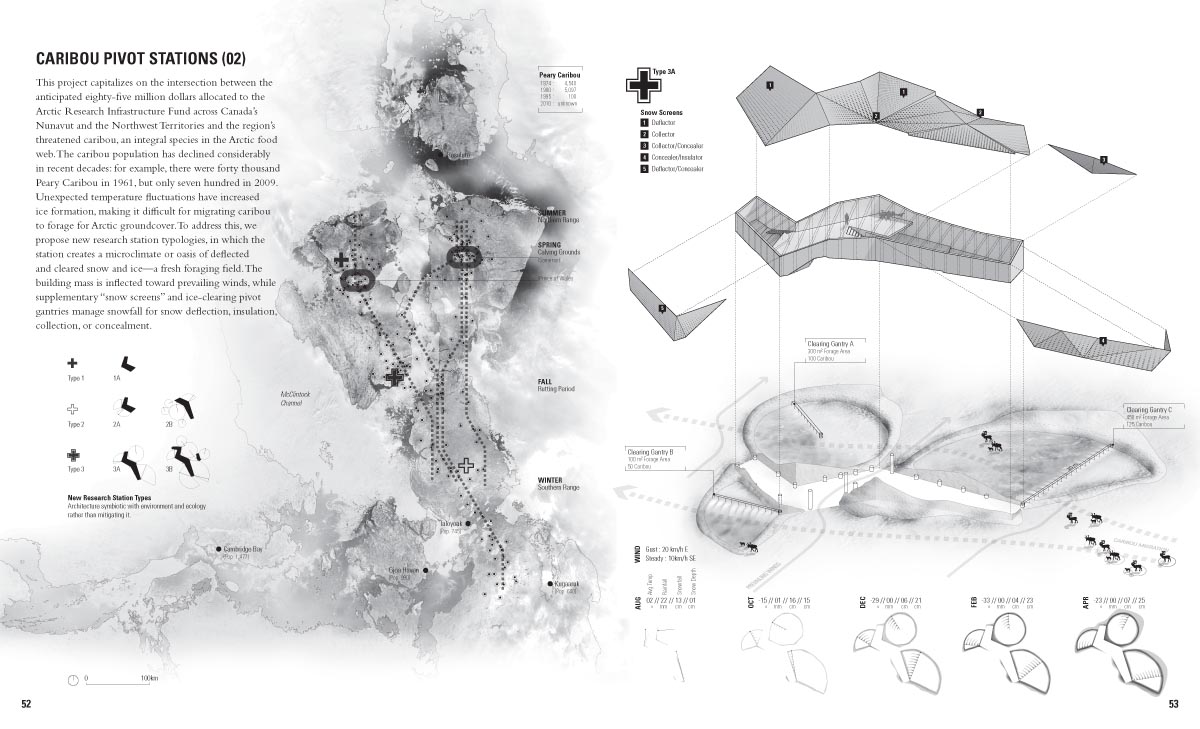
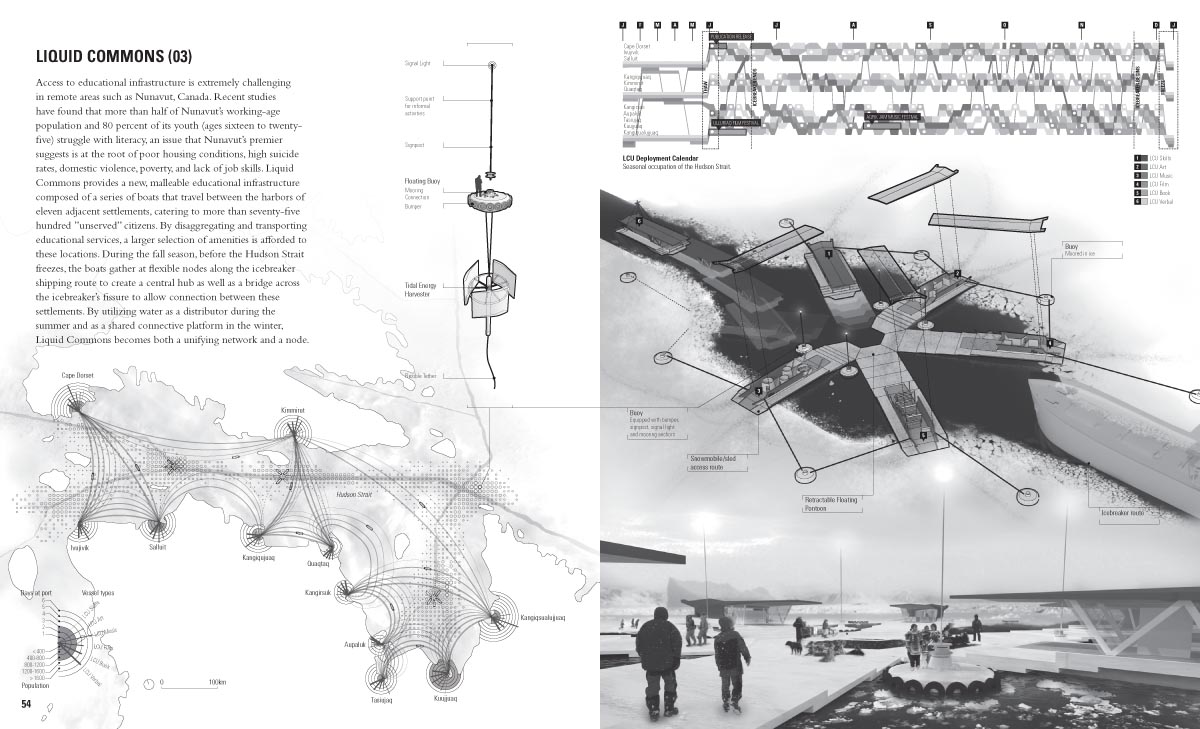
There is then a series of “Caribou Pivot Stations”—further proof that cross-species design is gathering strength in today’s zeitgeist—helping caribou to forage for food on their seasonal migrations; and a so-called “Liquid Commons,” which is a “malleable educational infrastructure composed of a series of boats that travel between the harbors of eleven adjacent communities.” It is a mobile, nomadic network bringing tax-funded educational opportunities to the residents of this emerging Next North.

[Images: From Coupling: Strategies for Infrastructural Opportunism by Lateral Office/InfraNet Lab].

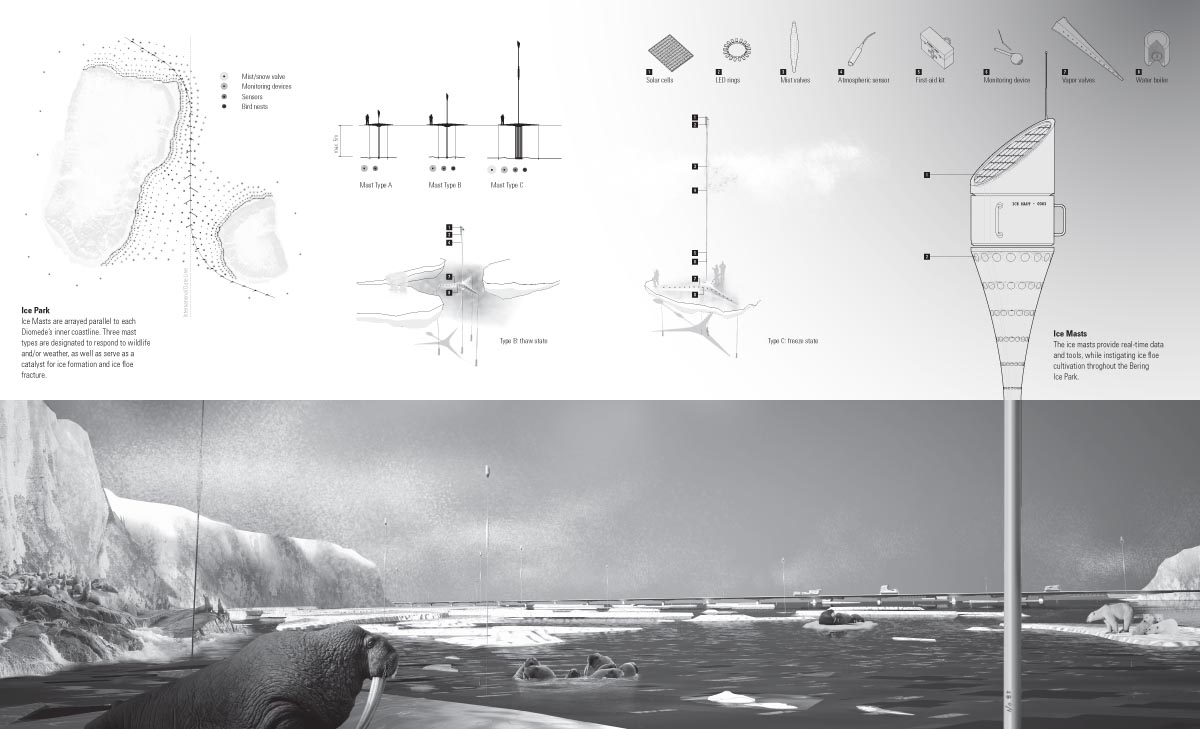
Here, I should point out that the book has an air of earnestness—everything is very serious and technical and not to be laughed at—but the projects themselves often belie this attitude. It’s as if the authors are aware of, and even revel in, the speculative nature of their ideas, but seem somehow rhetorically unwilling to give away the game. But the implication that these projects are eminently buildable—shovel-ready projects just waiting for a financial green light to do things like “cultivate” ice in the Bering Strait (duly illustrated with a Photoshopped walrus) or “harvest” water from the Salton Sea—is a large part of what makes the book such an enjoyable read.

After all, does presenting speculative work as if it could happen tomorrow—as if it is anything but speculative—increase its architectural value? Or should such work always hold itself at an arm’s length from realizability, so as to highlight its provocative or polemical tone?

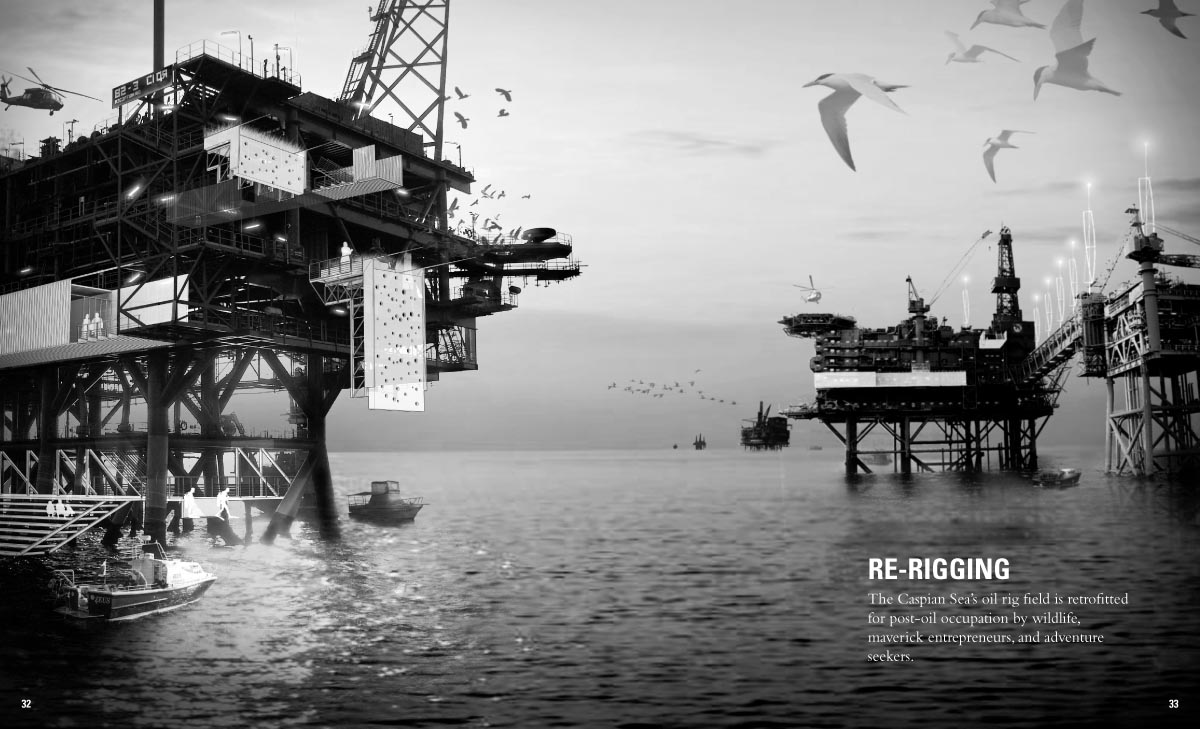
The projects featured in Coupling have an almost tongue-in-cheek buildability to them—such as recreational climbing walls on abandoned oil platforms in the Caspian Sea. This opens a whole slew of important questions about what rhetorical mode—what strategy of self-presentation—is most useful and appropriate for upstart architectural firms. (At the very least, this would make for a fascinating future discussion).

[Image: From Coupling: Strategies for Infrastructural Opportunism by Lateral Office/InfraNet Lab].

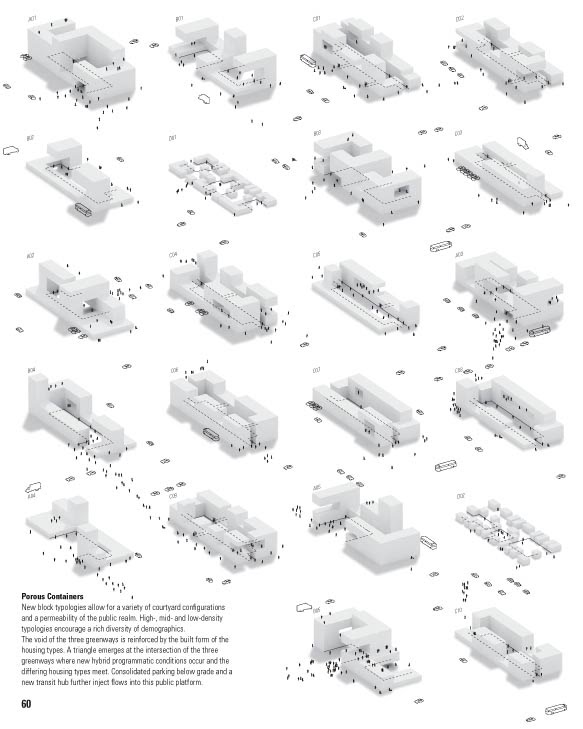
In any case, the book is loaded with diagrams, as you can see from the selections reproduced here, including a volumetric study (above) that runs through various courtyard typologies for a hypothetical mixed-use project in Iceland. For more on that particular work, see this older, heavily-illustrated BLDGBLOG post.

[Images: From Coupling: Strategies for Infrastructural Opportunism by Lateral Office/InfraNet Lab].

Essays by David Gissen, Keller Easterling, Charles Waldheim, and Christopher Hight round out the book’s content. It’s a solid pamphlet, both practical and imaginative—made even more provocative by its implied feasibility—and a fantastic choice for the 30th edition of this long-running series.

Stealth Objects and Scanning Mist

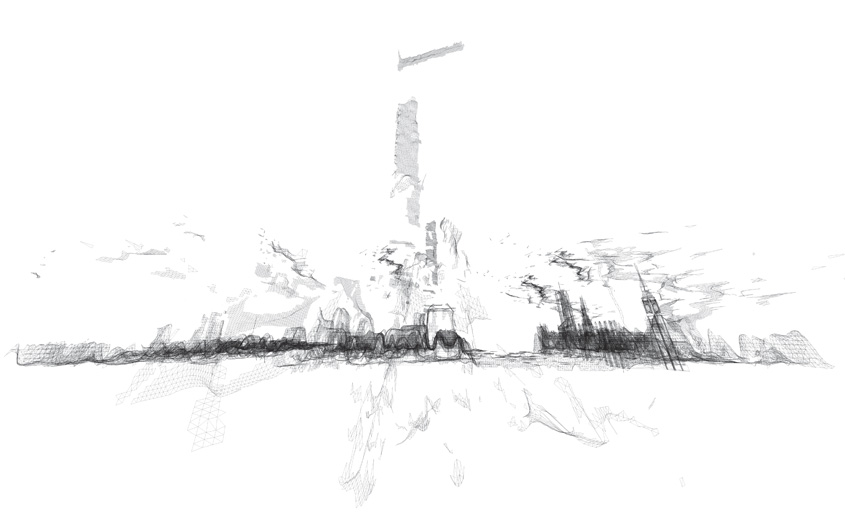
The London-based architectural group ScanLAB—founded by Matthew Shaw and William Trossell—has been doing some fascinating work with laser scanners.

Here are three of their recent projects.

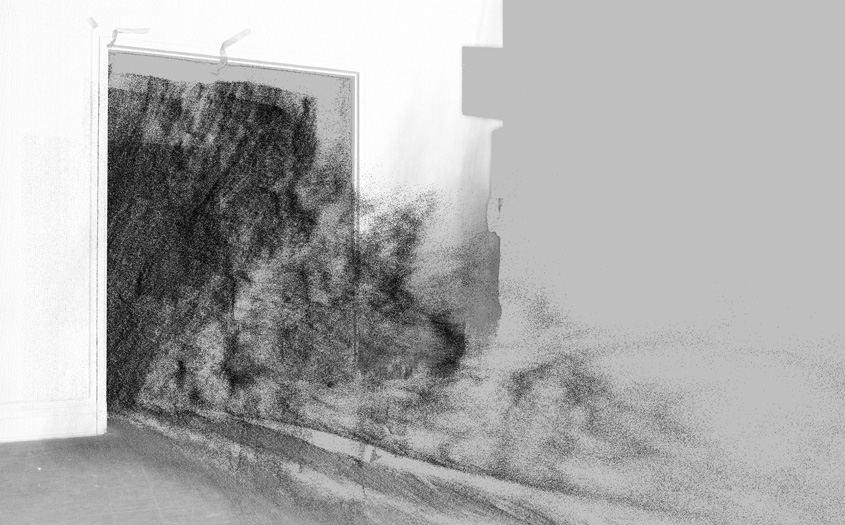
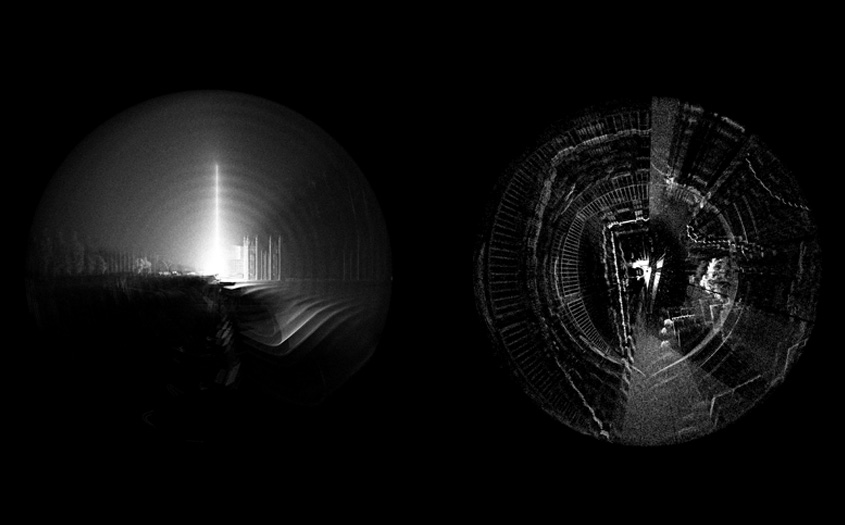
1) Scanning Mist. Shaw and Trossell “thought it might be interesting to see if the scanner could detect smoke and mist. It did and here are the remarkable results!

[Images: From Scanning the Mist by ScanLAB].

In a way, I’m reminded of photographs by Alexey Titarenko.

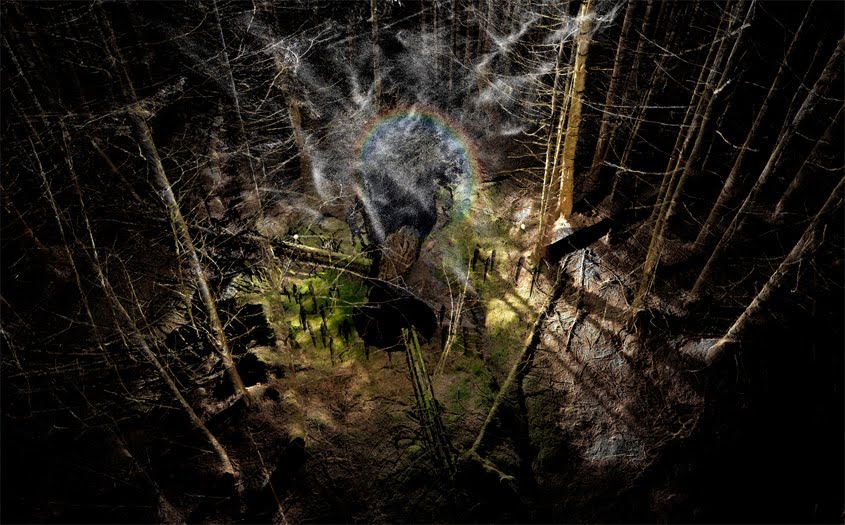
2) Scanning an Artificial Weather System. For this project, ScanLAB wanted to “draw attention to the magical properties of weather events.” They thus installed a network of what they call “pressure vessels linked to an array of humidity tanks” in the middle of England’s Kielder Forest.

[Image: From Slow Becoming Delightful by ScanLAB].

These “humidity tanks” then, at certain atmospherically appropriate moments, dispersed a fine mist, deploying an artificial cloud or fog bank into the woods.

[Image: From Slow Becoming Delightful by ScanLAB].

Then, of course, Shaw and Trossell laser-scanned it.

3) Subverting Urban-Scanning Projects through “Stealth Objects.” The architectural potential of this final project blows me away. Basically, Shaw and Trossell have been looking at “the subversion of city scale 3D scanning in London.” As they explain it, “the project uses hypothetical devices which are installed across the city and which edit the way the city is scanned and recorded.”

Tools include the “stealth drill” which dissolves scan data in the surrounding area, creating voids and new openings in the scanned urban landscape, and “boundary miscommunication devices” which offset, relocate and invent spatial data such as paths, boundaries, tunnels and walls.

The spatial and counter-spatial possibilities of this are extraordinary. Imagine whole new classes of architectural ornament (ornament as digital camouflage that scans in precise and strange ways), entirely new kinds of building facades (augmented reality meets LiDAR), and, of course, the creation of a kind of shadow-architecture, invisible to the naked eye, that only pops up on laser scanners at various points around the city.

[Images: From Subverting the LiDAR Landscape by ScanLAB].

ScanLAB refers to this as “the deployment of flash architecture”—flash streets, flash statues, flash doors, instancing gates—like something from a short story by China Miéville. The narrative and/or cinematic possibilities of these “stealth objects” are seemingly limitless, let alone their architectural or ornamental use.

Imagine stealth statuary dotting the streetscape, for instance, or other anomalous spatial entities that become an accepted part of the urban fabric. They exist only as representational effects on the technologies through which we view the landscape—but they eventually become landmarks, nonetheless.

For now, Shaw and Trossell explain that they are experimenting with “speculative LiDAR blooms, blockages, holes and drains. These are the result of strategically deployed devices which offset, copy, paste, erase and tangle LiDAR data around them.”

[Images: From Subverting the LiDAR Landscape by ScanLAB].

Here is one such “stealth object,” pictured below, designed to be “undetected” by laser-scanning equipment.

Of course, it is not hard to imagine the military being interested in this research, creating stealth body armor, stealth ground vehicles, even stealth forward-operating bases, all of which would be geometrically invisible to radar and/or scanning equipment.

In fact, one could easily imagine a kind of weapon with no moving parts, consisting entirely of radar- and LiDAR-jamming geometries; you would thus simply plant this thing, like some sort of medieval totem pole, in the streets of Mogadishu—or ring hundreds of them in a necklace around Washington D.C.—thus precluding enemy attempts to visualize your movements.

[Images: A hypothetical “stealth object,” resistant to laser-scanning, by ScanLAB].

Briefly, ScanLAB’s “stealth object” reminds me of an idea bandied about by the U.S. Department of Energy, suggesting that future nuclear-waste entombment sites should be liberally peppered with misleading “radar reflectors” buried in the surface of the earth.

The D.O.E.’s “trihedral” objects would produce “distinctive anomalous magnetic and radar-reflective signatures” for anyone using ground-scanning equipment above. In other words, they would create deliberate false clues, leading potential future excavators to think that they were digging in the wrong place. They would “subvert” the scanning process.

In any case, read more at ScanLAB’s website.

Earthquake Sounds, Tsunami Rocks, Future Trenches

[Image: Photo by Ko Sasaki, courtesy of the New York Times].

1) “This webpage contains earthquake ‘sounds’ created from seismic recordings around the world generated by the 2011/03/11 Mw9.0 Tohoku, Japan earthquake. They provide a unique way for us to listen to the vibration of the Earth that is otherwise inaudible to us, and to decipher the complicated earthquake physics and triggering processes.”

2) “The stone tablet has stood on this forested hillside since before they were born, but the villagers have faithfully obeyed the stark warning carved on its weathered face: ‘Do not build your homes below this point!’ Residents say this injunction from their ancestors kept their tiny village of 11 households safely out of reach of the deadly tsunami last month that wiped out hundreds of miles of Japanese coast and rose to record heights near here. The waves stopped just 300 feet below the stone… Hundreds of so-called tsunami stones, some more than six centuries old, dot the coast of Japan, silent testimony to the past destruction that these lethal waves have frequented upon this earthquake-prone nation.”

3) “Europe may be starting to dive under Africa, creating a new subduction zone and potentially increasing the earthquake risk in the western Mediterranean Sea… For millions of years the African plate, which contains part of the Mediterranean seabed, has been moving northward toward the Eurasian Plate at a rate of about an inch every 2.5 years (a centimeter a year). Now studies of recent earthquakes in the region indicate that a new subduction zone may be forming where the plates are colliding along the coasts of Algeria and northern Sicily… [M]ost established subduction zones are marked by giant undersea trenches. A similar trench should eventually form in the Mediterranean—but certainly not overnight.”